




Abstract
In this article, we argue that the resourcification of wind is based on a specific entanglement of different property objects - in particular wind, land and wind turbines - and property holders. We depart from an understanding of property as a social phenomenon that is enacted through social practices and thereby becomes relevant within an arrangement of different entities (human, non-human and material) by structuring the relations between these entities. We propose a practice theoretical approach based on Theodore Schatzki's concept of practice-arrangement constellations for understanding how property becomes relevant through socio-material relations which enable the resourcification of wind. Based on this theoretical approach, we show how different entities and practices bring about chains of property objects that enable the transformation of wind into electricity. With our conceptual considerations concerning property chains we hope to deepen the discussion around the significance of property in the resourcification of renewable energy sources.
Introduction
Globally, fossil fuels continue to attract significant investment, amounting to USD 953 billion in 2022. In addition, investments in renewables have been steadily growing, reaching USD 499 billion in 2022 (International Renewable Energy Agency and Climate Policy Initiative, 2023). In this context, wind energy has become a resource considered as a promising investment option by various actors ranging from banks, investment funds to energy companies and private individuals (Nadaï and Cointe, 2020). However, because natural resources—whether renewable or fossil—are place-bound and locally dispersed, access to the sites where these resources can be found and harvested is a crucial element in the appropriation of such resources. Since energy production in modern societies is highly technologically mediated (Mumford, 2020 [1934]), different technological artifacts are a necessary component of the appropriation of energy resources. Drawing on Actor-Network-Theory, Alain Nadaï and Béatrice Cointe highlight that renewable resources such as wind have to become enrolled in an assemblage—i.e., a kind of network of related entities—in order to become exploitable and acquire the qualities of an asset (Nadaï and Cointe, 2020: 165). Within such an assemblage, different practices as well as forms of property contribute to the valorization of these resources. Particularly relevant to the assemblage that contributes to the valorization of wind is the land–wind nexus (Scheidel and Sorman, 2012).
As Gordon Walker (1995) and Vaclav Smil (2015), among others, have pointed out, renewable energy sources have a lower power density than fossil energy sources. This means that transitioning from a fossil-based to a renewable-based energy system requires more land to produce energy (Smil, 2015; van Zalk and Behrens, 2018). The increased demand for the limited land resources suitable for wind energy production has led to a so-called “landrush” (Kirkegaard et al., 2022). The land use intensity and spatial distribution, especially of wind turbines, has two consequences: there is an increased number of siting decisions for energy facilities (Burke and Stephens, 2018: 83) and rural areas are particularly affected since they offer the required land (Knuth et al., 2022: 1000). This is where conflicts over the distribution of benefits and burdens arise (cf. e.g., Alonso Serna, 2022; Dunlap, 2020; Hogan et al., 2022; Hughes, 2021; Siamanta, 2019). Closely linked to such distributional conflicts are procedural conflicts (Ramasar et al., 2022); i.e., conflicts over inclusiveness and participation in decision-making processes concerning respective infrastructures.
An often neglected but in our view promising way of understanding of such conflicts is to take a closer look at questions of ownership that arise at different points in the decision process of wind energy development. These decisions are inevitably connected to power dynamics, economic pressures, aesthetic preferences, or social inequalities. As already mentioned above, access to land is structured by property rights, but ownership of wind turbines, and ultimately ownership of the energy resource itself, air, also moderates the distribution of benefits and burdens, as well as the openness and inclusiveness of participation and decision-making processes. In this context, we aim to develop a deeper conceptual understanding of how property structures the wind energy expansion. In particular, we introduce the notion of property chains as practice-arrangement constellations (Schatzki, 2010) in order to illuminate from a socio-material perspective how the resourcification (Corvellec et al., 2021; Hultman et al., 2021) of wind unfolds along a line of different property objects (in particular, land, technologies, and the resource itself) with the involvement of various property holders (i.e., owners of specific property objects). In doing so, the multiplicity of entanglements between property holders and property objects as well as associated power asymmetries become apparent and traceable and the question of “who owns the wind?” (see, e.g., Hughes, 2021) can be viewed in a new light.
Our line of argumentation is structured as follows: first, we sketch out a sociological understanding of property that goes beyond the dominant understanding of property as a mere bundle of rights. On the basis of the concept of resourcification, we subsequently illustrate that turning wind into a resource is a complex social process in which property becomes relevant at different points. Following this, we introduce a practice-theoretical approach that enables us to theorize how property is entangled in socio-material relations from which the resourcification of wind emerges. We then apply this practice-theoretical approach to the case of wind energy production, elaborating on how property in the form of chains of property and associated power relations become relevant. We conclude with a brief outlook on the potential relevance of our approach for debates around energy justice and beyond.
Understanding property from a sociological perspective
In the liberal tradition of political philosophy, private property, and more specifically property rights, are understood as cornerstone of individual freedom (Dagan, 2021). Therefore, in societies that are based on liberal ideas, private property is a central element of their functioning, especially with regard to a capitalist mode of economy. The central institution formally maintaining this property is law (Carruthers and Ariovich, 2004: 24; Pistor, 2019). Law defines who gets to access, use, exclude, transfer, destroy, or control certain objects. Consequently, property can be understood as a bundle of rights, as Harold Demsetz, among others, has elaborated (Demsetz, 1967). The so-called bundle of rights approach is common in legal and economic theory. According to Frank Snare, property is primarily constituted by the following rights (Snare, 1972: 202–203): (a) A has a right to use P; (b) others may use P if, and only if, A consents; and (c) A may permanently transfer the rights under rules (a) and (b) to specific other persons by consent. These rights are also accompanied by obligations (e.g., environmental obligations of landowners) (Sikor, 2006). They are thus encoded by rules that oblige the property holder to do, refrain from doing, or tolerate something. Furthermore, as Larissa Katz argues with regard to the bundle of rights approach, it is not so much the right to exclude others that is a core feature of property but rather “the owner's position as the exclusive agenda setter for the owned thing” (Katz, 2008: 275). With agenda setting, Katz refers to the right of the property holder to decide how their property is used. As Jesse Ribot and Nancy Peluso have pointed out, property rights—i.e., the right to use and benefit—are often insufficient to actually benefit from property. For example, if one owns land but does not have access to labor or technology, one cannot benefit from the land. Thus, the ability to benefit from property may be mediated by access to other resources (Ribot and Peluso, 2003: 160). Nevertheless, it is always the holders of property rights who control access (Ribot and Peluso, 2003: 162).
The combination of rights differentiated in the bundle of rights approach may vary depending on the type of property object. Moreover, the rights can be held by different entities: (a) public authorities such as governments, municipalities, etc. (state/public property), (b) individual or fictitious persons (private property), or (c) specific groups of persons (common property) (Reeve, 1986: 29–37). How exclusive these rights are, how they can be transferred, how they are enacted, and how they are enforced also varies from (legal) context to context. In Germany, for example, there are both national and state-specific regulations that govern wind energy production (e.g., distance rules or planning schemes). Despite the law being the central institution for defining and maintaining property, there are also gray areas where the legal status of property becomes fuzzy. This allows for different “performances of property” as well as flexible interpretations of existing laws (see, e.g., experimental lawmaking in the context of the EU's innovation policies (Sabel and Zeitlin, 2012)) and also opens up a sociological perspective on property, where property can be understood as (a) a relationship between different entities, (b) social construction, and (c) ultimately as something that is enacted and thus becomes relevant within specific social settings. Thus, from a sociological point of view, it is of central importance how property and property relations are constructed, stabilized, transformed, and performed.
Since property refers to entities that are regarded as valuable (Benda-Beckmann et al., 2006: 2), processes of the social construction of value (Lamont, 2012) are closely associated with property. This entails processes and practices of categorization, legitimization, and evaluation. With regard to the social construction of property, property is not understood as an inherent quality of any kind of entity but something that is ascribed through cultural and political processes and stabilized by social norms and institutions such as property rights. What can be owned and which kind of use rights evolve is a matter of culture, political conflicts, and ultimately perceived legitimacy. There are no societies in which everything can be owned. Rather, people possess specific use rights, which allow them to exploit and make use of their property in a specific way (Carruthers and Ariovich, 2004: 25–27). Such rights can, for example, cover rights of access, withdrawal, management, exclusion, or alienation (Schlager and Ostrom, 1992: 250–251). Accordingly, one may, for example, own a piece of land but not necessarily be allowed to drill and extract resources such as ore or geothermal energy from it. The social rules that define property and use rights are usually constituted and enforced by the state and are thus to a certain degree country-specific. Thus, there is a close connection between politics, power, and property (rights) (Carruthers and Ariovich, 2004: 29). Simultaneously, the limits of what can be owned in modern societies are constantly expanded (e.g., in modern democratic societies, humans cannot be owned by others, but we can observe an increased propertization of genetic information; Braun, 2024). Inherent in this constant process are disputes over who is supposed to own what. Such struggles are particularly prevalent with regard to the privatization of previously state-owned infrastructures, such as telecommunication, electricity, sanitation, public transport, etc. (Schneider et al., 2005). From this follows that property is entangled in social relationships that are characterized by power dynamics and social hierarchies. These power dynamics extend beyond the state as the authority which defines what counts as property by means of law. Ownership entails that an actor has command over a specific property object, and thus can benefit from using or selling it, or exclude others from accessing or using it. Thus, owners can exert power over others through the bundle of rights associated with the property object. As property is in many cases accumulated over time (e.g., the Catholic Church as the largest non-governmental landowner in the world) and in an unequal way (Piketty, 2014), property distribution is also a direct manifestation of social inequalities and hierarchies (Sørensen, 1996), which in turn constitute power relations.
Moreover, there are informal conventions and practices of “performing property” (Blomley, 2013), that are distinct from formal institutions and thus point to the importance of how property becomes relevant in particular social settings. Ultimately, property only becomes societally relevant when it is performed within social practices. Such practices are never fully determined by formal rules and regulations, but also by informal norms as well as the creativity and agency of actors in performing them (Giddens, 1984; Ortner, 2006). Thus, the relevance of property for the manifestation of social phenomena, such as social inequality, can never be fully derived from the formal rules that constitute property, but is also shaped by the logic of the practices through which property is performed. While there may be formal laws defining property rights, they may not become relevant in the performance of particular practices because they are deliberately ignored or have even been forgotten. Furthermore, rules, whether strictly formal ones, such as laws, or informal ones, such as norms or conventions, are open to varying degrees of interpretation, leading to variations in the performance of practices. For example, the laws and regulations governing the zoning of wind parks are interpreted and implemented differently by regional and state regulatory agencies (for the Unites States, see: Lerner, 2022). Thus, the limitation of use rights associated with property depends on the respective regulatory practice of the authorities.
To sum up, the following can be derived from the theoretical discussion of property above, which will inform our further argumentation: First, property is defined by a combination of rights which are based on the institution of law and are historically and culturally variable. Although they are based on the institution of law, formal property rights govern the performance of related practices only to a certain extent, since laws—like all rules—are open to interpretation. Second, property rights constitute relations between property objects and property holders—i.e., owners—as well as between owners and non-owners. In particular, these relations are characterized by power asymmetries, since the command over property confers specific rights on property holders. Third, the effects of property (e.g., the exclusion of certain people from the benefits of a particular resource) are brought about by the performance of practices in which property (rights) become relevant.
Thus, going beyond the prevalent understanding of property as a combination of rights, we understand property as a social phenomenon that is enacted through social practices and thereby becomes relevant within an arrangement of different entities (human, non-human, and material) by structuring the relations between these entities. Power asymmetries, informal rules of doing property, social meanings associated with property objects or subjects (e.g., ideas about who is allowed to own what) as well as property rights are key features that structure these specific relations (for a similar understanding see Benda-Beckmann et al., 2006). Hence, we do not argue that the bundle of rights approach is inadequate for analyzing property-related social phenomena such as conflicts over land or resources, but that it should be complemented by a more sociological understanding as outlined above and further elaborated below.
Understanding moving air as a resource
Environmental media such as air, sunlight, or water are not resources per se, rather, they are turned into resources. As Erich Zimmermann has put it: “resources are not, they become” (Zimmermann, 1933: 15). Resources serve the realization of interests and are therefore considered useful and valuable (Bridge, 2009: 1219). They can be used to satisfy needs or pursue individual or collective projects such as the transition to renewable energy. To describe the process of turning something into a resource, we use the term “resourcification,” as suggested by Johan Hultman and colleagues (Hultman et al., 2021). They identify 28 characteristics of the process of resourcification, of which we want to highlight those that we believe are particularly relevant in the context of wind energy. According to Hultman and colleagues, resourcification is both spatially and socially distributed. Thus, it creates both regional disparities as well as winners and losers in different areas, since resources are usually locally dispersed and the access to them is socially structured (e.g., through property rights). Hultman and colleagues also state that “resourcification builds upon the current states of knowledge, technology, infrastructures, and regulations, and upon institutionalized regimes of value and supportive discourses” (Hultman et al., 2021: 3). Thus, to become a resource, an environmental medium has to be fitted and inserted into current discourses, planning, and governance practices, policy goals, regulations, and sociotechnical infrastructures. At the same time, however, these arrangements also have to adapt to the qualities of the specific resource. For example, in order to satisfy the energy demand of an economy transitioning from a centralized, fossil energy regime to an energy regime that is based on locally dispersed and fluctuating renewable energy sources, for instance, additional transmission lines and storage facilities are necessary (Brunner et al., 2020). Thus, resourcification is relational and practical, since it creates social–material relations and builds on a specific set of practices. Practices put different elements in relation to each other, such as technologies, infrastructures, discourses, and so on. Also, economic processes of commodification (Castree, 2003), financialization (Chiapello, 2015), or assetization (Birch and Ward, 2024) are elements of resourcification but are not synonymous with it, since resourcification goes beyond such economic processes. Ultimately, an analysis of the whole process of resourcification reveals social inequalities and power relations in terms of access to, use of, control over, and benefits from resources. According to Hervé Corvellec and colleagues, power dynamics are central to resourcification processes: “This is the core of the politics of resourcification: the power dynamics that strengthen certain agents and interests, while weakening others. More precisely, it distributes and redistributes benefits, incomes, and privileges, as well as costs, inequalities, and inconveniences. Hence, resourcification will inevitably generate competition and conflicts about developmental goals and priorities” (Corvellec et al., 2021: 1252).
Combining our thoughts about property in section “Understanding property from a sociological perspective” with the concept of resourcification presented in this section, we arrive at the following conclusions: Turning moving air into a resource requires the establishment of new socio-material relations and the modification of existing ones. With regard to property, this means that new property objects and property holders emerge and are put in relation to each other. It can thus be assumed that a great deal of the power dynamics that Corvellec et al., (2021: 1252) place at the center of processes of resourcification are brought about and structured by property. The concept of resourcification also reminds us that in order to become a resource, other resources have to be assembled and involved (e.g., infrastructures enabling the exploitation of other resources). Moreover, since the resourcification of wind builds on a set of socio-material relations, property-related effects of the resourcification of wind can only be fully traced by taking into account the whole set of socio-material relations, which in turn are influenced by the specific physicality of wind. Unlike other resources such as iron, coal, or gold, wind is ephemeral because it exists only as long as there is moving air containing kinetic energy. It also cannot be contained or transported unless it is converted into electricity (Howe and Boyer, 2015: 34). Thus, the kinetic energy of the resource wind must be extracted where wind occurs, giving the associated infrastructures a place-bound form. This distinguishes wind from fossil resources such as oil or coal, which can be extracted in one place and converted into heat or electricity in another.
Accounting for socio-material relations from a practice-theoretical perspective
We believe that a practice-theoretical lens can help illuminate how specific property constellations emerge from the process of resourcification of wind. This follows from our understanding of property sketched out in section “Understanding property from a sociological perspective,” where we stated that property as a social phenomenon is, amongst others, enacted through practices. According to Theodore Schatzki, one of the most influential contemporary practice theorists, social phenomena are brought about and happen on the basis of what he calls practice-arrangement constellations. Such practice-arrangement constellations can be understood as basic building blocks of the social world. Thus, “the social” is constituted by them. In Schatzki's understanding, arrangements are a set of interconnected entities which can be divided into the categories: humans, artifacts, organisms, and things of nature (Schatzki, 2010: 129). Thus, what Schatzki refers to as arrangements largely resembles what Bruno Latour understands by actor-network (Latour, 1996) and Gilles Deleuze and Félix Guattari by assemblage (Deleuze and Guattari, 1987): a multiplicity of related entities which, as a whole, are part of the production of social phenomena. In contrast, practices are, simply put, what people do. According to Schatzki, practices are structured by implicit understandings, rules, and normative teleologies. The latter can be understood as a kind of goal that is pursued by the participants in the practices and thus gives meaning to the practices (Schatzki, 2010: 129). The performance of practices is governed by formal and informal rules and their understanding is determined by implicit or tacit knowledge, that is, an intuitive and pre-reflexive knowing of how to do or handle something.
As elaborated above, power dynamics are central to resourcification processes and are inherent in the concept of property as something that creates and configures relations, which can be asymmetrical. Thus, a practice-theoretical perspective on property constellations should be able to account for power dynamics. As Michel Foucault has elaborated, power can be understood as a quality of institutions or even of a society as a whole. From this perspective, “individuals are the vehicles of power, not its points of application” (Foucault, 1980: 98). In contrast, power can also be conceptualized as a quality of a social relation where one actor is able to enforce their will on others (cf. e.g., Max Weber's understanding of power: Weber, 2019 [1921]: 134). From these two different understandings of power, a third can be distinguished, which is prevalent in practice theories. Here, in particular with reference to Anthony Giddens, power can be understood as a social phenomenon that is generated by the performance of practices. According to Giddens, actors draw on what he calls allocative resources (e.g., raw materials, technologies, artifacts, etc.) and authoritative resources (e.g., organizations of social time-space, relations between actors, chances of self-expression, etc.) as structures in the performance of practices, thereby reproducing these resources. Giddens refers to specific combinations of these two types of resources as “structures of domination” (Giddens, 1984: 258). Such resources or structures of domination are then “media through which power is exercised, as a routine element of the instantiation of conduct in social reproduction” (Giddens, 1984: 16). Thus, the social order resulting from the performance of practices can also be understood as a result of power (Schatzki, 1996: 13). Furthermore, as Matt Watson points out (Watson, 2017), practices can also be differentiated in a Foucauldian sense in terms of their capacity to carry out other practices (Foucault, 1982). In particular, practices that generate the formal or informal rules that are central elements of practices and, moreover, both enable and constrain the performance of practices (Schatzki, 2002: 79), have a distinctive status with regard to expressions of power. Of course, these rules can be creatively interpreted or violated, but they still influence the performance of practices. Thus, power is both embedded in the performance of practices through the involvement of resources in their performance and is manifested through practices with a rule-making, shaping, or enforcing character.
Understanding the property related resourcification of wind from a practice-theoretical perspective
Drawing on the concept of practice-arrangement constellations, the production of energy from wind can be understood as a social phenomenon that involves interlinked human actors but also natural entities and technical artefacts, which again are connected through specific practices. The production of wind energy is “accomplished” by a specific practice-arrangement constellation that transforms wind, i.e. moving air, into the commodity of electricity. However, this transformation encompasses multiple steps (cf. e.g., Labussière and Nadaï, 2018: 58), where again different entities, practices, and power dynamics become relevant. First, a specific parcel of land has to be turned into an energy production site by securing rights to access the land and construct wind turbines there. As soon as wind turbines are set up, they can extract the kinetic energy from the wind and turn it into electricity. The electricity has to be quantified in order to get tradable units. Also, it has to be fed into the grid so that it can be distributed to the end consumers who then pay for the amount of electricity they consume (Labussière and Nadaï, 2018: 58). In this process of resourcification, different human actors and technologies like wind turbines and distribution grids, as well as land as a natural entity, are of relevance for the transformation of wind into electricity as a commodity. Figure 1 gives an overview of the most relevant entities and practices that form the practice-arrangement constellation of wind energy production. The involved entities are pictured as rectangles, practices as ellipses. Property holders are highlighted in dark gray and property objects in light gray.
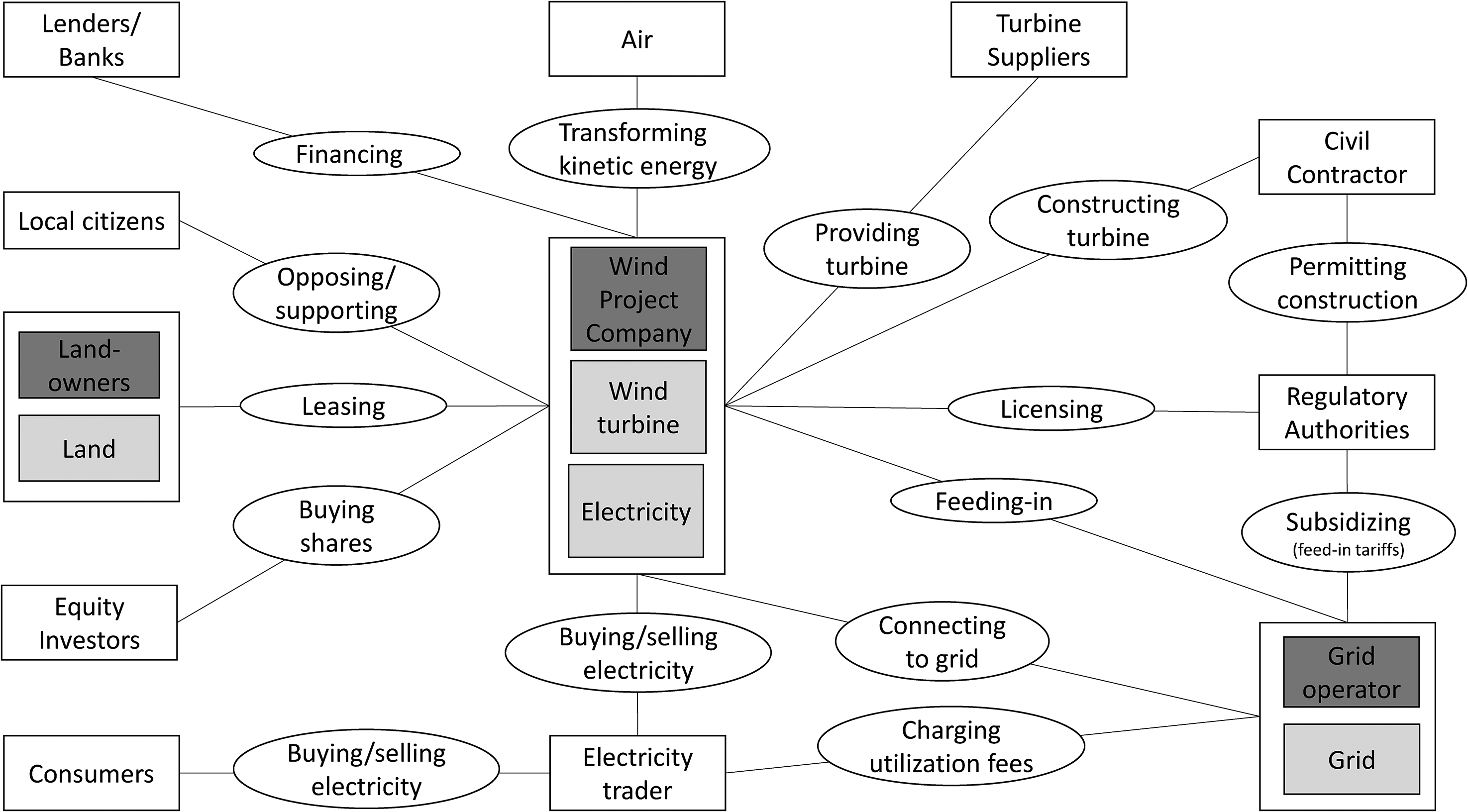
The practice-arrangement constellation of wind energy production as a chain of different property objects and property holders.
The resourcification of wind brings about mutually adaptive chains of resourcification. This means, the resourcification of resource A—in this case wind or moving air—leads to the resourcification of resource B—in this case land and technical artifacts (grids and wind turbines). Understanding the dynamics of the property related resourcification of wind requires taking into account the property related appropriation of other resources. As Figure 1 shows, there is a wider range of practices and entities necessary in order to make wind a valuable resource that can be bought and sold as electricity. Without the practices of acquiring money, regulating land use and the erection of wind turbines, manufacturing wind turbines, leasing land, establishing grid connections, subsidizing, and so on, the production of electricity from wind would be impossible. With regard to property, some entities and practices involved are of particular relevance. These entities can either take the form of property objects or property holders and the respective practices can be regarded as performances of property relations, which are to a varying degree shaped by power dynamics. Land, wind, and wind turbines as the main technical and natural entities in the resourcification of wind, are all legally codified as property objects. This means that there are laws that prescribe under what circumstances these property objects can be owned by whom and what property holders are allowed to do with them. Needless to say, these laws vary according to national contexts. However, with regard to wind as a property object, the answer to the question “who owns the wind?” is remarkably invariant. Typically, wind is legally codified as a commons. According to Ostrom, in theory, commons are characterized by considerable difficulty in excluding others from use and also by a high subtractability of use—i.e., the use of the commons by one actor reduces the amount of the resource available for others (Ostrom, 2010: 645). In practice, however, when a commons is embedded in a property regime, the possibility to make use of a resource is tied to ownership of and access to other resources; in our case of wind energy, this applies in particular to ownership of and access to the resource land. The relevance of land for the exploitation of other resources is manifested in Western countries by the so-called “ad coelum” rule. The ad coelum rule is a general principle of property law, formulated by the Italian jurist Cino da Pistoia at the beginning of the fourteenth century. It states: Cujus est solum, ejus est usque ad coelum, or: to whomsoever the soil belongs, he owns also up to the sky (Rule, 2014: 15). The ad coelum rule is still applied in Western countries although it is restricted by other laws (e.g., by overflight rights in aviation law). It thus affects wind energy production because it ties the right to wind to the right to land (Hughes, 2020), although the ad coelum rule does not do justice to the ephemeral and fluid nature of wind by treating wind as a stock rather than a flow. However, it is not only the access to land as a property object, but also control over wind turbines, that is essential to the resourcification of wind.
The entanglement of the three property objects wind, land, and wind turbines involves specific practices. There are practices of measuring wind speeds, calculating expected profits, designing the layout of wind farms, acquiring land, securing acceptance among local communities, and so on. All these practices involve different entities. For example, landowners, local citizens, and project developers are involved in making land accessible for the erection of wind turbines. As all practices, the practice of acquiring land is always open to potential failure, when certain entities refuse their compliance. For example, local citizens can protest against wind energy projects, resulting in landowners deciding against leasing their land (Nadaï, 2007). Furthermore, non-human natural entities, such as birds, can thwart wind energy projects due to their presence in a certain area (Nadaï and Labussière, 2010). This also holds true for wind if, through practices of modeling and simulation, a specific area is deemed not profitable enough.
Moreover, with regard to land and wind turbines, there is a broad range of potential property holders, which can become involved in wind energy projects. In Germany, land is owned by private individuals (in particular farmers and investors), municipalities, churches, and regional states, or the federal state (in particular forests). Ownership of wind turbines is also quite diverse: some are public property (owned by municipal utilities/municipalities), some private property (e.g., owned by energy companies, funds, banks, project developers, private individuals), and some are communal property (owned by energy cooperatives). A combination of two or all three is also conceivable, such as a municipal utility joining a community energy cooperative. Of course, there are differences in the mobilization of resources in the performance of practices among these different social or human entities. For example, big energy companies are usually better equipped to run through the complex planning and approval processes for a wind turbine or farm, since they are less constrained by financial, cognitive, or time resources than, say, energy cooperatives (Bauwens et al., 2016).
With regard to questions of power, two human/social entities involved in the resourcification of wind are particularly relevant: landowners as the property rights holders that can determine the use of the land, and the state with its regulatory authorities. As pointed out above, the lower power density of renewables compared to fossil fuels requires considerable amounts of land. 1 Thus, land becomes a scarce resource. This puts landowners in a special position. They are veto-players in the wind energy expansion, since they can prevent the erection of wind turbines and also use their land as an asset by leasing it to project developers (Schwarz, 2020; Wade and Ellis, 2022), which is a very profitable form of land use compared to other uses, such as farming (Fuchs et al., 2019). The powerful position of landowners has the potential to reproduce and reinforce social and economic inequalities with regard to wind energy: Landowners are usually one of the first local actors consulted for newly planned renewable energy projects as they are key veto-players in their implementation. For example, local opposition to wind turbines is much less effective if local landowners agree to a planned wind farm. Practices of resistance against wind energy projects are more likely to be successful if landowners are involved. In contrast, a renewable energy project desired by citizens cannot be implemented if landowners decide to oppose it. This does not only hold true for landowners on whose property wind turbines are supposed to be installed, but also for adjacent landowners who can refuse trespass rights. However, landowners only have agency over the first links in the chain that connects the resource of wind to the commodity of electricity. While they may potentially be owners of a wind turbine, wind turbines are typically owned by corporations or cooperatives. The property holders of wind turbines also have income rights due to the bundle of rights associated with the wind turbine, not via land, but via technology. Their income, however, is dependent on many other entities. While landowners benefit from renting out their land, even when a wind turbine is not sufficiently working, owners of wind turbines are dependent on landowners, grid operators, investors, banks, electricity traders, and so on.
The ethnographic case studies on wind energy development by Cymene Howe (2019) and Dominic Boyer (2019) in Mexico's Isthmus of Tehuantepec (Howe and Boyer, 2015, 2016) as well as by Hughes (2021) in a small village in Spain are insightful examples of how landed property leads to the exclusion of the landless from the benefits of wind energy, and thus generating local opposition. In the case of Mexico, neoliberal ideas of wind energy development marginalize communal land property by favoring land in private hands. Nevertheless, even if wind energy projects are developed on communal land, people who are not members of the community of owners are still excluded (Howe and Boyer, 2015: 40). While these wind energy projects benefit local elites through rents from landed property, these rents are still much lower than rents in countries such as the United States (Howe and Boyer, 2016: 219). Thus, inequalities on different scales are reproduced and enforced here. These case studies furthermore illustrate how past and ongoing struggles over the privatization of communal land create specific distributions of landed property, thereby pointing to the role of the state in the resourcification of wind. The state, through its different regulatory authorities, also defines the legal framework for identifying, designating, establishing, and appropriating suitable locations for wind turbines (Kirkegaard et al., 2023). Thus, it shapes the legal rules that in turn shape practices within the practice-arrangement constellation of wind energy production. For example, the setting up of feed-in tariffs steers the direction of investments in renewables and opens up predictable revenue streams, which render wind energy as an attractive investment option (Nadaï and Cointe, 2020: 153). By identifying and legally codifying sites as wind development areas, regulatory authorities more or less decide whose land becomes a valuable resource and whose does not. Thus, administrative practices create and shape energy landscapes and indirectly distribute benefits and burdens through the channel of property rights. Furthermore, the specific qualities of wind are also of particular relevance with regard to state practices of planning and governing. Wind is a four-dimensional resource with the flow rate—i.e., time—as the fourth dimension that goes beyond the two-dimensionality of land to which planning and governance practices usually refer to (Ehrman, 2020: 628). Due to its fluid nature, wind as a resource cannot be adequately covered legally by the logic of manmade property division with respect to land parcels (Bradshaw Schulz and Lueck, 2015: 2511). Thus, wind as a natural entity exerts its own influence on the practices through which property is performed. This leads, for example, to phenomena such as so-called “wind theft” (van der Horst and Vermeylen, 2010), which in turn can lead to property conflicts due to inadequate regulation (Finserås et al., 2024).
Conclusion
In this paper, we have suggested that the role of property in the process of transforming wind into an exploitable and profitable resource can be analyzed through a practice-theoretical lens in order to make visible and traceable the entanglements of different entities and practices—here conceptualized as practice-arrangement constellations. As illustrated above, the property-related resourcification of wind rests on a chain of entangled property holders, property objects, and property-related practices that enable some to reap the benefits of wind energy production and distribute the burdens to others. Simply looking at one element in the whole property chain, such as the ownership of wind turbines, obscures the conditions for the realization of wind turbine ownership. We have also shown how power dynamics can be captured by such a practice-theoretical perspective. Power exercised through the performance of practices, structures the practice-arrangement constellation of wind energy production. For example, landowners can use the bundle of rights associated with landownership to prevent or promote the construction of a wind farm in a municipality, thereby actively shaping the municipality's landscape for decades.
We believe that our approach can contribute to a deeper understanding of the complex and multifaceted property constellations that exist in the field of wind energy production and that are critical to questions of energy justice (Carley and Konisky, 2020; Jenkins et al., 2016; Wahlund and Palm, 2022). For example, practices of participation in wind energy production through private landownership raise the question of distributive and procedural justice (Delicado, 2018). Chewinski et al., (2023) point out that distributional justice is most often associated with financial benefits, which “include a diverse range of compensatory schemes such as individualized lease payments to landowners hosting turbines, financial compensation to adjacent property owners, tax revenues for municipalities, and community payments or infrastructure investments” (Chewinski et al., 2023: 478). Channeling such financial benefits requires an understanding of the whole network of involved entities and their relations. Our property chains approach points us to the generation of unequal distributional effects from landownership. In order to ensure distributional justice with regard to wind energy, Hughes (2021) has suggested that wind rights should be severed from land rights. This could be achieved by the socialization of airflows by the government. The wind rights could then be passed to municipalities or states that in turn could raise fees for wind energy production in their territory. This would liberate wind from its status as a quasi-fictitious commons, where people are excluded from benefiting by being excluded from other property objects in the property chain that forms the basis of the resourcification of wind. Wind would thus ultimately become a true aeolian commons (Hughes, 2021: 219–221). Furthermore, issues of procedural justice can only be resolved when there is an idea of the whole plenum of entities which should be involved in decisions about wind energy production. The relations between these entities are structured by power dynamics, which partially depend on the control over property and impact procedural justice. Building on an understanding of the chains of property objects and subjects that enable the resourcification of wind and other renewables is in our opinion a fruitful path for future discussions and elaborations of energy justice. With our thoughts, we hope to have provided a first conceptual starting point for this.
We also believe that our approach offers a relevant contribution to (Marxist) discussions about value in several fields of political ecology (e.g., Gesing, 2021; Joshi, 2022; Kay and Kenney-Lazar, 2017; Stuart et al., 2024). Here, our approach provides vocabulary as well as basic ideas and tools for conceptualizing the involvement of non-human entities in the creation and extraction of value from “nature” (Kay and Kenney-Lazar, 2017: 307). Our approach shows that production of value takes place in complex and dynamic processes involving several property objects and subjects. In addition, the production of value is deduced from the ownership of only one specific means of production. This applies to both fossil and renewable energy resources and beyond. However, as discussed above with reference to the physicality of wind (fluid, ephemeral, uncontainable, and not transportable), the characteristics of the property chains that form the basis for the resourcification of entities may again depend on the characteristics of the specific entity.
Highlights
Based on practice theory, we propose a conceptual approach for a deeper understanding of property effects in the field of wind energy
We illustrate that land as a property object is central to the resourcification of wind
We highlight the entanglements of different property objects and property subjects with regard to wind energy expansion
Footnotes
Acknowledgments
The authors would like to thank the three anonymous reviewers for their comments that helped to improve the paper as well as the members of the Collaborative Research Centre TRR 294 “Structural Change of Property,” who have commented on earlier versions of the paper.
Funding
The authors disclosed receipt of the following financial support for the research, authorship, and/or publication of this article. This work was supported by the Deutsche Forschungsgemeinschaft (grant number 424638267).
