



Abstract
Mining frontiers are moving ever further beyond Earth's surface, as new subterranean realms, the seafloor, the atmosphere and outer space increasingly come into the purview of entrepreneurial activity. In this paper, we deploy an environmental governmentality analytic to examine mining as a site-specific, intervening activity that brings the relationship between these different material spaces into view. We recognise that as mining expands through technological advancement ever further beyond its previous terrestrial foundations, it builds on and deepens colonial environmental governance strategies. We argue that as it does so, efforts to govern mining are likely to be increasingly challenged by its ‘excess’, by which we mean the matter that surpasses surficial enclosures and goes on to produce unintended physical and social consequences for other spaces and places. We construct our argument by examining secondary data on mining at three resource frontiers at varying stages of exploitation and associated governance: (i) surface mining during European colonialisation of the Amazon Basin; (ii) ongoing preparations for deep-sea mining in the Clarion-Clipperton Fracture Zone of the Pacific Ocean; and (iii) the prospect of asteroid mining in outer space. Overall, the paper draws attention to the overlapping nature of the planet's voluminous, material spaces and its ability to frustrate environmental governance efforts. It offers a voluminous analysis across material spaces to burgeoning debates within political ecology.
Introduction
Mining frontiers are moving ever further beyond Earth's surface. New subterranean realms, the seafloor, the atmosphere and outer space are increasingly coming into the purview of entrepreneurial activity. In this paper, we deploy an environmental governmentality analytic to examine mining as a site-specific intervention into the terrestrial and extraterrestrial surfaces of the Earth that brings the relationship between different voluminous ecosystems into view. We argue that mining and efforts to manage it are likely to be increasingly challenged by its ‘excess’, understood as the matter that surpasses surficial enclosures and goes on to produce unintended physical and social consequences for other spaces, places and times outside the boundaries of the mining intervention. We identify two characteristic features of excess – unintentionality and movement – and argue that these two features offer to the interdisciplinary research field of political ecology a means of engaging with the rich debates on the voluminous nature of territory and processes of territorialisation unfolding across the social sciences.
For political ecologists, ecological processes are always political and generative of power relations (Bersaglio et al., 2023). At the heart of the field is ‘a commitment to pulling apart the many ways in which these power–ecology intersections play out in diverse empirical settings and with diverse actors’ (Bersaglio et al., 2023: 53). Further afield in the wider social sciences, an uptick in engagement with the concept of territory has followed Elden's call (2013) for scholars to pay attention to volume. In essence, his request was that scholars complement their focus on the flatness of territory with attention to height and depth by integrating an explicit vertical dimension in relation to different spatial and material geographies. Since then, the field of political geography has become more active than political ecology in recognising and conceptualising the vertical dimensions of territory (Mosquera-Camacho and Marston, 2021). Mosquera-Camacho and Marston note that while ‘political ecologists have, in a sense, always been working in three dimensions in that they have been concerned with subterranean, deep sea, and aerial resources as well as agriculture and other land-level natures…’ (Mosquera-Camacho and Marston, 2021: 14); they ‘have generally avoided theorising along a vertical axis’ (Mosquera-Camacho and Marston, 2021: 14). To this, we add that they have also largely avoided theorising volume beyond the vertical to explicitly consider its cross-material dynamics.
This paper attends to questions of power and volume in our examination of mining in three temporally and geographically distant frontiers. Following Klinger, we use the word ‘frontier’ to refer to ‘the limits of state power and rule of law, of the known and disciplined, and of a set of particular social relations or identities’ (Klinger, 2017: 14). Frontiers are often described in ways that signal the onlooker's ‘spatialized intentions to transform a place that is unknown and ungoverned into the known and disciplined: to penetrate the impenetrable, to transform untapped minerals into wealth and power’ (Klinger, 2017: 14).
The first mining frontier we examine, the Amazon Basin, has its origins in European colonisation of the Americas from the 15th century onward. We highlight the social and material atmospheric, sedimentary and watery excess of terrestrial mining and show how this excess mediated through forests, the land surface and the aerial atmosphere. The retelling of this history provides a cautionary tale. It points to mining's unintended social and material outcomes by showing how the territorialising effect of colonial claims on land and resources provided the basis for independent governments to successfully stake their own claims on the very same land and resources. The second and third frontier spaces we examine are much newer and/or speculative. They are projected or in relatively early stages of development. The second, the Clarion-Clipperton Fracture Zone of the Pacific Ocean where deep-sea mining (DSM) is slated to take place, highlights DSM's probable watery and sedimental excess as it mediates the flatness of the ocean floor and the vertical expansion of the water column. The third, outer space, turns attention to the prospect of asteroid mining, which, if made possible, will generate excess that negotiates between the asteroid surface and surrounding space that is atmospheric and sedimentary.
The temporal arc drawn out through our frontiers is not accidental. The mining activities carried out and projected in these frontiers point sequentially and respectively to how mining did, likely will, and could negotiate voluminous ecological spaces from a point of initial illegibility to a later point of taken-for-granted territorial state claims. It points to the advancing technologies that make this expansion possible and the increasing ability of humans to navigate and dominate non-terrestrial spaces. Across these historical and projected political outcomes, our focus on mining and its excess allows us to attend to the voluminous, complicated, non-linear and erratic relationship between cause and effect manifested in the disturbance of ecosystems. Excess shows up in our frontiers as environmental externalities that move across voluminous spaces and are unintended by the mining enterprise. In other words, they are not the object of the mining intervention and, thus, go overlooked or unvalued within capitalist frameworks. These include mercury leaks from terrestrial gold mining, sediment plumes from mining polymetallic nodules on the seafloor, and space debris from asteroid mining in outer space. Excess also shows up as social externalities through its effect on processes of territorialisation and even state formation. After all, as Elden pointed out, ‘territory is a process, not an outcome’ (Elden, 2013: 36).
We use environmental governmentality (also known as environmentality (Fletcher, 2010)) to demonstrate the colonially informed, temporal connections and material ruptures underpinning the intensification of mining's extraterrestrial shift. Environmentality allows us to examine the ‘characteristic techniques, instrumentalities and mechanisms through which such practices operate, by which they attempt to realise their goals and through which they have a range of effects’ (Dean, 2009: 31). Environmental governmentality, therefore, underwrites our charting of a historically informed exploration of efforts to respond to challenges associated with mining the surface, the ocean floor and near-Earth objects (NEOs) while recognising that ‘the surface of planet Earth has become an inadequate boundary for environmental governance’ (Olson, 2012: 1028). We argue that as technological advancement enables mining to move ever further from its terrestrial foundations, mining is extending already established strategies of colonial environmental governance. This analysis is fundamentally a theoretical one. The paper offers a voluminous analysis across material spaces outside national jurisdictions (Liu and Bennett, 2024) to intensifying debates on volume within political ecology (see Collins, 2024a; Mosquera-Camacho and Marston, 2021; Mostafanezhad and Dressler, 2021) and further afield.
A voluminous political ecology
In the decade since Elden's call, researchers have begun to pay attention to the voluminous nature of the subterranean (Squire and Dodds, 2020), the above ground (Collins, 2024b); the ocean and deep sea (Childs, 2020; Steinberg and Peters, 2015), outer space (Beery, 2016; Dunnett et al., 2019) and the atmosphere (Adey, 2015; Böhme, 2021; Choi, 2016; Fregonese, 2017; Nieuwenhuis, 2016, 2018; Stephens et al., 2017; Verlie, 2019). Following these debates, we understand a voluminous theoretical approach to political ecology to be possible in several ways. First, in its most general sense, a voluminous theoretical approach to political ecology can function as a descriptor signalling that a particular phenomenon has clear, non-linear, three dimensional or temporal effects (Childs, 2020). It might also reread historical events to highlight the voluminous thinking or dynamics they involved, but that were overlooked or uninterrogated (Childs, 2020; Jang and Thomas, 2024; Johnson and Fleming, 2014; Kaplan, 2018). This shift would complement rather than negate existing surface-based research and knowledge systems by explicitly adding a third perspectival dimension in view of the intensification of extractive practices above and below the surface, their ensuing voluminous excess and the novelty of efforts to address them.
Second, a voluminous theoretical approach could be deployed as a means of investigation, exploring how the methods and framings of political ecology (or any other research field) might change through explicit attention to volume. This approach might deploy a variety of voluminous methods as a means of sensing the world across material spaces through, for example, sounding or remote sensing (Helmreich, 2016; Kanngieser, 2015). In this way, attending to volume also inspires methods that attend to saturation and envelopment. Rather than the experience of being on land, one might be in and think through a particular milieu (Barlow, 2022; Durham Peters, 2015; Jue, 2020; McCormack, 2018; Steinberg and Peters, 2015). More fundamentally, volume might expand the remit of familiar research questions, such as those that question the governance, justice, or sustainability of environmental use practices by applying them to newly accessible or increasingly relevant voluminous spaces (Aganaba-Jeanty, 2016; Avila et al., 2022; Dunnett et al., 2019). This might involve investigating how these newly accessible and varied material spaces and their use practices transition from being voluminous in nature (Billé, 2020), as a descriptor, to being volumetric or calculable through legibility-building activities that improve their comprehensibility to specialist and non-specialist audiences (Engelmann, 2015; Engelmann et al., 2022).
In this paper, we adopt a third mode of theorising volume. We understand this approach as one through which scholars could attend to the complicated, non-linear and precarious relationship between cause and effect evident in ecosystem functioning, as demonstrated in the various debates around the Anthropocene that seek to attribute causation to different factors (Buscher and Fletcher, 2020; Haraway, 2015; Hecht, 2018; Moore, 2018; Yusoff, 2018). We connect mining's physical and social excess, alongside its characteristic features of unintentionality and movement, to subsequent claims of territorial sovereignty over three dimensions (Marston, 2019). Here we caution the reader that the places that come to be shaped through mining's excess are not only terrestrial, but also aerial and fluid. Hence, this paper is not interested in studying ‘geos’ or even ‘aeros’ on their own terms, as do some scholars engaged in related debates (Bobbette, 2023; Bobbette and Donovan, 2019a, 2019b). Instead, the paper is interested in the ecological reverberations of mining across multiple voluminous spaces and material substrates. It studies mining across material scales and attends to those effects that frustrate efforts to govern different environments but that still support, or could support, possible territorial claims as an unintended social consequence of the mining intervention.
Environmental governmentality and the mine
Exploring multiple material spaces and scales through the Foucauldian inspired environmental governmentality framework allows us to demonstrate how governing regimes take shape (Collins, 2019; Dean, 2009; Fletcher, 2010; Rutherford, 2007). Environmental governmentality does not only attribute the ability to govern to state governments, international organisations and municipalities – the usual suspects in governing architectures. Instead, the ability to govern can be attributed to any actor or set of actors imbued with the power to intervene in the affairs of a given population (human or nonhuman) to bring about a particular outcome. In governmentality analyses, the explicit awareness remains that the subjects of governance retain the ability to act differently than intended by the governing body (Li, 2014).
Environmental governmentality is also useful for making theoretical space for the unintentionality of outcomes through its elaboration of ‘instrument effects’ – those outcomes that emerge as the unintended consequences of a particular governing intervention (Ferguson, 1994). According to the governmentality analysis outlined by Dean (2009) and adopted throughout this paper, and given the processual nature of territory (Branch, 2012; Elden, 2013), it is important to highlight that mining frontiers become objects of governance through several steps, as shown in Figure 1. First, frontier spaces are rendered visible as ‘places’ in the minds of the governing body, often through the erasure of indigenous claims (Havice and Zalik, 2018, Klinger, 2017; Messeri, 2016; O’Donnell et al., 2022, Teaiwa, 2014). Second, systems or regimes of governing these places are sketched out. This second step is often carried out by subjecting frontier spaces to various knowledge systems that imagine and depict them in ways amenable to the governing intervention. Third, strategies for governing these newly visible and legible places are developed and deployed. An ideal governing intervention would see, thereafter as a fourth step, the population (human or non-human) of its governance behave in accordance with its desires (Dean, 2009). Most often, however, the behaviour of the population does not align precisely with the intention of the governing body. In these cases, unintended consequences or instrument effects emerge (Ferguson, 1994). It is here that our focus is on excess gains analytical purchase.

Processual nature of governmentality framework (Dean, 2009).
Excess, in terms of movement and unintentionality, signals not only the material and social manifestations of unintended outcomes, but it also shows how excess can become productive for later territorialising and capitalist accumulating strategies. This is seen most clearly in the historical accounting of the colonisation of the Amazon Basin, where colonial land claims that facilitated capitalist accumulation through plantations and mining later became independent state claims that support carbon offsetting, fossil fuel extraction and myriad other activities. Thus, the environmental governmentality framework allows us to understand the materiality of the unintended consequences of strategies of environmental governance (Fletcher, 2010; Li, 2014), and later enclosures as sites for accumulation.
Our attempts to grapple with the question of how theoretical attention to volume pushes the boundaries of political ecology involve questioning the extent to which mining in voluminous spaces can be governed according to plans yoked to notions of the surface as territory. Our work shows that the material space in which mining (understood as a governing intervention) takes place matters, for example by affecting the speed and intensity by which its effects spread through different voluminous environments or ecosystems. In other words, the extent to which the effects of mining go on to affect other places differs according to the material conditions of the site in which it takes place (Sengupta, 2021). Consequently, in developing our arguments, we reflect on how places become woven into new capitalist markets while generating material and social excess with the potential to both undermine and contribute to processes of territorialisation.
The rest of the paper is structured as follows. First, we examine the excess of terrestrial mining during European colonialisation of the Amazon Basin. Then, we recount ongoing preparations for DSM for minerals in the Clarion-Clipperton Fracture Zone of the Pacific Ocean. Third, we examine the prospect of asteroid mining in outer space. While we recognise the exercise of delimiting each voluminous space as surface, ocean floor and outer space as being somewhat arbitrary in nature, we use each frontier to illustrate the political and voluminous impacts of mining beyond the intended footprint of extraction, across space and time, ecosystems and societies. Each frontier space demonstrates how mining, as it unfolds across voluminous, material spaces, verges on the unknown in its outermost physical, temporal and social effects.
Mining the surface of the ‘new’ world
At the point of the arrival of European colonisers in the 15th century, the Amazon Basin was an unruly frontier space – at least in the eyes of the colonisers. Now, its entirety is firmly enclosed within the borders of the (mostly) independent states that govern it and claim exclusive access to its land and resources. Focusing on histories of territorialisation, this section shows how terrestrial mining in the Amazon Basin had unintended physical and social consequences. Mining was not only implicated in the eventual establishment of the firm, surficial territorial borders that supported colonial and now independent states (Jackson, 2006), but it also generated voluminous, cross-scalar material effects that harm adjacent environments and historically marginalised indigenous communities.
As outlined in Dean's framework of analysing regimes of governance, mining in the Amazonian frontier was predicated on first making the Amazon imaginable to the colonisers. Second, it required that the forest basin be made legible. Third, it necessitated that those strategies of governing the Basin be carried out in the hope of finally leading to successful outcomes (Braun, 2000; Dean, 2009). While mining in the Amazon Basin did indeed yield some of its desired outcomes, some of its unintended consequences in terms of movement and excess are detailed in the remainder of this section.
Unintended territorialising outcomes
Legend played a key role in making the Americas and its subterranean resources visible in the European imagination. The tale of ‘El Dorado’, the city of gold, brought European explorers in search of this place after they had heard stories of a tribe whose ceremonial customs included having new leaders bathed in gold somewhere near what is now called Bogota, Colombia (Hills, 1961). El Dorado was imagined, in line with the first step of environment-governing interventions, to be beautiful and ethereal, rich in gold and silver. Its location shifted in the collective European imagination until finally, it began to refer to a source of untold riches somewhere in Guianas. Christopher Colombus’ reports of docile indigenous populations and vast mineral wealth therefore drove European desires to settle in and colonise the Americas (Dym and Offen, 2011). In 1492, when European colonisers first encountered these areas covered in forests, they saw what they interpreted as largely underused and unproductive land that could be divided, managed and utilised in ways that allowed for the generation of profit and the intensification of capitalism back at home (Quijano, 2007; Robinson, 2020).
After having made these forested places visible, or in this case, imaginable, European colonisers developed new regimes of governing these historical frontier spaces, in line with the second step of governmental interventions. Initially, the Europeans settled on small parcels of land near water and set up amicable trading relations with the indigenous people they encountered. Over time, they set up small colonies that became plantations (Glasgow, 2012) on which laboured enslaved Africans and indentured servants from India. The establishment of these plantations saw land, sea and labour reorganised to facilitate capital accumulation through agriculture over centuries of exploitative relations with various European colonisers at the helm (Robinson, 2020; Rodney, 1981; Williams, 1994).
Across subsequent centuries of European colonisation on the surface of the Amazon Basin, colonial land use practices settled into more established colonies, as seen in the historical evolution of British and Dutch Guiana, for example. Over time, through various shifts, continuities and disruptions (Collins, 2019), the Amazon Basin was enclosed into the independent states of Brazil, Guyana, French Guiana, Colombia, Peru, Bolivia, Ecuador, Venezuela and Suriname. These centuries witnessed the transformation of these lands from the ‘commons’, freely accessible to indigenous groups living there, into independent states in the 19th and 20th centuries. All in all, this transformation was made possible through a variety of methods of making the forests, their people and resources legible and visible to the colonisers (Agrawal, 2005), in line with Dean's recognition of the first step in the establishment of governing regimes.
Colonising verticality and volumes
Mining, as a specific socio-economic relationship to these material spaces, was couched within these statal transformations. It functioned, in part, as both a rationale for European colonisation of the Amazon Basin and as a factor that shaped the social relations in this then frontier. Gibbs and Baron (1993) provide one of the few scholarly works on how mining became established in these terrestrial environments. They explain that early gold exploration in Guyana was carried out by Dutch mining engineers and Sir John Harrison who had discovered Guyana's bauxite deposits. Geological mapping of the ‘colony’ then took place to enable the search for base metals. They note that much of the geological knowledge of the Guiana Shield region, of which Guyana and Suriname are a part, was tied to mining (Gibbs and Baron, 1993).
Mining and other extractive and exploitative activities was enabled by these state and legibility-building exercises. As Dooley and Griffiths (2014) describe, ‘British land and development policy was primarily geared towards the colonization of the forested interior and increased economic development, including mining development and plans for commercial farming and market gardening’ (2014: 15). Eventually, forest zoning and management, which sought to manage vertical aspects of the territory, commenced and became established. Since then, efforts to improve the legibility of the forests have been increasing for several reasons, prominent among which is the desire of the governments of these countries to gain income for development, from logging and timber production, mining and latterly carbon sequestration services, in recognition of the key role the Amazon's forests play in mitigating climate change. Therefore, most of the mining carried out in these places negotiates with the forests and surrounding vegetation. Mining for minerals is now a major driver of deforestation. Now, the work of these previous terrestrial commons is being made legible through a suite of state policy documents managing different aspects of its use, and through the development of systems aimed at measuring and monitoring the carbon sequestration work of the forests (Collins, 2024a).
Indigenous communities in the area often challenge the excess of mining both in social and physical terms. In Guyana, for example, they challenged the zoning practices embodied in the state's territorial land claims, which says that all land that is not privately titled, including the sub- and above-soil, is within the exclusive purview of the state. Thus, the contestation around gold mining brings the territorial and physical excess of mining the volume into view (Collins, 2024a).
All in all, this section highlights that mining in the previously illegible Amazon came to be managed first through isolated, surface-based methods like physical site visits by forest management professionals based outside the forests and subsequently through the implementation of MRV systems that allow for governments and other actors to view and measure forests from afar. This perspectival shift enabled the forests, within which mining was taking place, to move from two-dimensional to three-dimensional representations in the minds of external governing actors. The driving logic of the eventual legibility of these now firmly claimed state territories was capital expansion into unknown (to the colonisers), previously surface-based, mining frontiers.
Unintended material outcomes
The effects of terrestrial mining, as shown in Figure 2, do not stay firmly ensconced within their intended enclosures. By necessity, mining crosses material spaces and draws into view certain voluminous dynamics that cross both scale and materiality. Jonkman and de Theije (2021) provide a compelling description of gold mining in Suriname that is voluminous in its description although they do not claim it as such. They write: In alluvial mining, such metallic bonding occurs principally in the collecting stage of extraction, when miners sprinkle mercury in washing pans and sluice boxes to entrap gold specks from surrounding sediment. Later, miners (or gold buyers) split the amalgam (the combination of mercury and gold) by roasting the mercury away, usually through the use of lighters or welding gear. This practice of amalgamation is highly controversial among policymakers, development practitioners, and academics, and rightly so. Mercury leads to brain and kidney poisoning and, when employed in gold mining, almost inevitably washes out into riverscapes, through which it enters the food chains of humans and other species. What is more, it also enters miners’ bodies more directly in a gaseous form during the roasting process (Jonkman and de Theije, 2021: 204). Their excavator beaks devour subsistence crops, their chainsaws fell trees and saplings, their tailings cut into waterways, and their mercury poisons the fish swimming there (Jonkman and de Theije, 2021: 207).
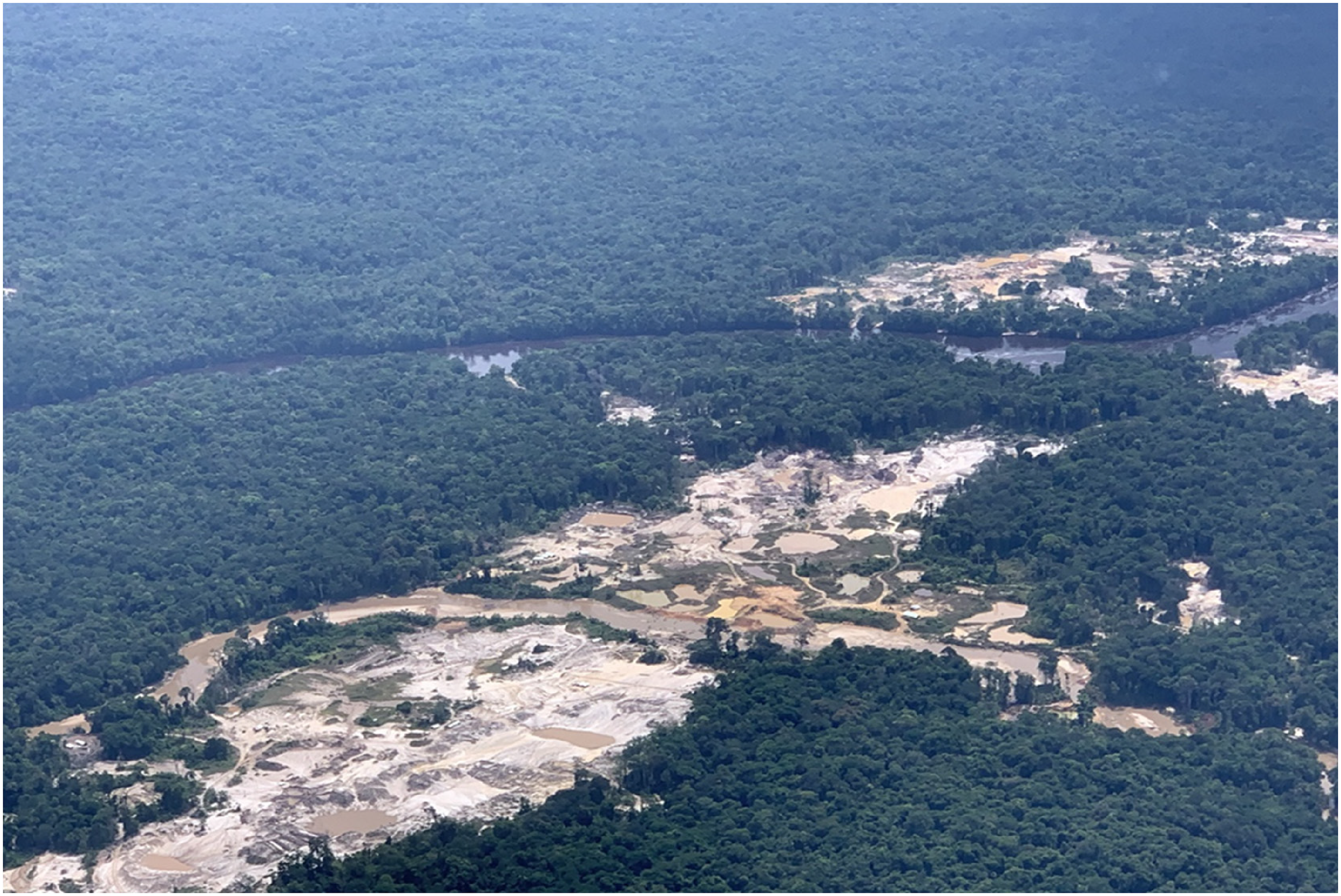
Visible effects of gold mining on forest cover in Guyana.
Further, the example shows that the creation of colonies and eventually states in this historical capitalist frontier space was made possible through a drive for resources and made accessible through legibility-building exercises that now inform the resource management plans of these states. In addition, mining's excess goes on to shape voluminous spaces and places outside the territorial borders of these countries through the atmospheric, sedimentary and fluid effects of expansionary capitalist activities with profound implications. Paying attention to the voluminous effects of mining in this way shows how its effects do not usually accord with the predictions of the governing body, in line with Dean's identification of the fourth aspect of a governing regime.
Put simply, the eventual independence of the states now claiming jurisdiction over swathes of the Amazon Basin was the unintended social outcome of initial European colonisation of this land from the 15th century onward. Understanding mining as an element of territorialisation over the long durée in this way thus provides a cautionary tale for the frontier spaces taking shape in the 21st century, to which we turn next.
Preparing to mine the ocean floor
As with the Amazon Basin, very little was known about the topography and ecology of the abyssal environment prior to the establishment of knowledge systems that made them legible. In the case of the ocean floor, this role was taken up by modern oceanography, which emerged in the late 19th century. With the voyages of the H.M.S Challenger (1872–76), not only did several thousand new species of marine life become legible to scientific knowledge, but for the first time the sea floor was shown to contain vast quantities of mineral resources, principally in the form of polymetallic nodules. Despite the diversity of deposits currently being explored, from the cobalt-rich crusts found on seamounts to seafloor massive sulphide deposits located around hydrothermal vents, this section will focus principally on polymetallic nodules as these are prioritised by many DSM initiatives due to their expected monetary value.
While the prospect of DSM remained a distant possibility until the mid-20th century (Cronan, 2022), plans to mine the deep sea are currently at an advanced stage and truly global in scale. Around 81% of known polymetallic nodule deposits considered favourable for DSM occur in an expanse of the seabed beyond national jurisdiction (or what is often simply labelled ‘the area’), covering some 38 million km2 (Petersen et al., 2016). Polymetallic nodules occupy spaces at the extreme limit of mining frontiers, both in terms of accessibility and insofar as they are particularly abundant in such areas outside of state jurisdiction. They exist largely outside regimes of visibility too, where significant gaps remain in both ecological knowledge and regulatory frameworks being designed to govern their extraction (Deberdt and James, 2024). The abundance of polymetallic nodules in spaces beyond visibility and national jurisdiction, as well as the temporal and voluminous dynamics of the deep sea itself, create significant challenges to those seeking to extend terrestrial environmental governance frameworks into this environment (Childs, 2020).
Between governability and visibility
The UN body responsible for regulating the emerging DSM industry is the International Seabed Authority (ISA), which at the time of writing has granted 31 exploration licences covering three main types of marine mineral deposit (ISA, N.D.). The parties involved range from the national governments of countries including India and Poland to private companies such as UK Seabed resources, formally a subsidiary of Lockheed Martin, and now owned by Norway's Loke Marine Minerals. Most of these licences are linked to an area known as the Clarion-Clipperton Zone (CCZ), located off the western coast of Mexico in the Pacific Ocean, where a range of factors such as topography and nodule distribution make extraction a more commercially viable prospect than elsewhere. While the ISA has been developing regulations for DSM since 2016, there was an attempt to fast-track the process in 2021 following the triggering of an obscure rule by the Pacific nation of Nauru together with its Canadian commercial partner The Metals Company (formerly DeepGreen Metals, Inc.), which gave the ISA an ultimatum to draw up regulations for DSM within 2 years. Having subsequently missed this deadline, the ISA now risks leaving a regulatory vacuum in which DSM companies could seek approval for mining activity on an ad hoc basis (Jackson and Karan, 2024).
While attempts to fill this regulatory vacuum continue apace, reminders of how little is known about the deep sea affirm its status as a space not only beyond national jurisdiction but also beyond thresholds of perception and discernability, at least from the perspective of Western epistemologies. As discussed in point two of Dean's (2009) framework for environmental governmentality referenced earlier, attempts to govern the marine environment rely upon processes that first render it visible and legible as an object of governance. With respect to visibility, the deep sea poses a unique set of challenges insofar as for most of human history it has remained inaccessible to direct observation. It was only in the 1930s that submersible craft enabled marine biologists to experience the deep sea first hand (Fox, 2023). For many years, representations of the deep sea existed exclusively in the form of maps, charts and tabulated data gained through such methods as depth sounding (Abberley, 2018; Crawley et al., 2023).
Cartographic representations are only one type of image-making practice used to support extractive activities, such as prospecting (Reeves-Evison, 2024). They bring the seabed into regimes of visibility. Today, both commercial and scientific endeavours rely heavily on remote sensing, with one of the companies furthest ahead in the race for DSM countering the opacity of the deep sea with a proposed ‘adaptive management system’ that uses ‘a mix of deep-sea ecological data, marine sensors and cloud based AI [to] create a digital twin of [the] operating environment.’ (The Metals Company, N.D.). As speculative as such proposals may be, they exemplify claims on the part of DSM proponents to be bringing transparency to the deep sea (Childs, 2022). In many ways the diversity of remote sensing devices now available enables DSM companies to circumvent some of the challenges posed by vertical surveillance technologies such as satellite observation. However, as Steinberg and Peters point out, ‘it has been the ocean's volume – that is, its existence as a hydrodynamic arena in which waves (of water) restrict investigators’ ability to observe the reflection of other waves (of light and sound) – that ultimately is making surveillance and, more generally, governance so challenging’ (2015: 254). Such attempts to fold the deep sea into existing scopic regimes demonstrate the challenge of making oceans legible.
Lines, laws and terrestrial bias
Rendering the deep sea legible as an object of environmental governance is not only a question of visibility; it also relies upon means of devising strategies for governing, in line with Dean's second principle of governing interventions. In many ways, this process already begins with the structuring of the ocean in relation to the territorial baseline of coastal nations. The United Nations Convention on the Law of the Sea (1982) is still the most significant and extensive legal framework in this respect. As many as 17 separate categories of ocean space are set out in the framework, including territorial sea 12 nautical miles from the coast, the exclusive economic zone (EEZ) some 200 nm from land, and in some cases an extension of the sovereign rights to seabed resources in an area that can be said to constitute a continental shelf. 1 Such inscriptions seek to stabilise territory as an object of environmental governance, resulting in a ‘sea of lines and laws’ (Braverman and Johnson, 2020: 11). The fact that the continental shelf takes the geological properties of land as its point of reference is also significant, and in many ways sets the stage for the regulation of DSM based on terrestrial mining, rather than an approach that begins with the management of the water column (Carver et al., 2020). The oceans are also stratified vertically into a series of regions and surfaces. As Childs (2020) points out, noteworthy here is the discursive construction of the seabed as a ‘surface of earth’, rather than something permeable and relational, where the ‘earth's hydrosphere, lithosphere and biosphere are in dynamic interaction with each other at different speeds’ (Childs, 2020: 199; see also Helmreich, 2009; Jue, 2020). This is particularly evident in the kinds of mineral deposits found near hydrothermal vents and seamounts, but also apparent in the case of polymetallic nodules, which often form around biological debris, and take shape through processes that include the slow precipitation of metallic compounds from seawater (Benites et al., 2018). In other words, many polymetallic nodules would not have formed without the voluminous milieu of seawater and the biotic life within it, forcing us to reconsider the boundaries that separate organic and inorganic materials on the seafloor (Helmreich, 2009; Povinelli, 2016).
The process of bringing the deep sea into regimes of visibility and legibility often means it is refracted through a spatial logic of lines, layers and territorial anchor points, or what has otherwise been called a process of ‘zonation’ (Easterling, 2014; Ryan, 2015). A map of the ISA's areas for polymetallic nodule exploration in the CCZ (Figure 3), covering an approximate total of 1 million square km, is a good example of this logic in action. In its dual role as both regulator of mining operations in areas beyond national jurisdiction and protector of its biological diversity, the ISA carves up the seabed into ‘areas of particular environmental interest’ (APEIs) and areas where extraction could eventually take place. With significant sums of money already flowing into exploration activities in the CCZ, the latter comprises a constellation of ‘places for fixed capital investment’ (Ranganathan, 2019: 574). This logic of zonation is not restricted to DSM, comprising part of a wider practice of maritime spatial planning that subdivides the ocean into areas that serve the purposes of transport, security, aquaculture and conservation (Bear, 2019; Bear and Eden, 2008; Ehler, 2021; Ryan, 2019; Steinberg, 2011; Trouillet and Jay, 2021). As Barry Ryan puts it, this approach creates areas ‘that mirror and extend zoning practices on land’, creating ‘an architecture of governance that is ill-tuned to the materiality it seeks to secure, [and] one unlikely to fulfil its ecological function’ (Ryan, 2015: 577, 579). This often sits in tension with more holistic Indigenous perspectives on marine conservation, for example in the Pacific Islands, where spiritual and cultural attachments to the sea stand in opposition to the extractive ideologies underpinning seabed mining (Tilot et al., 2021). Due to its remote location, the CCZ figures less directly in such cultural attachments than it does in the Pacific Ring of Fire. Nevertheless, the ISA has generated barriers to the participation of indigenous peoples in decision making regarding DSM outside of this region (Morgera, 2024).
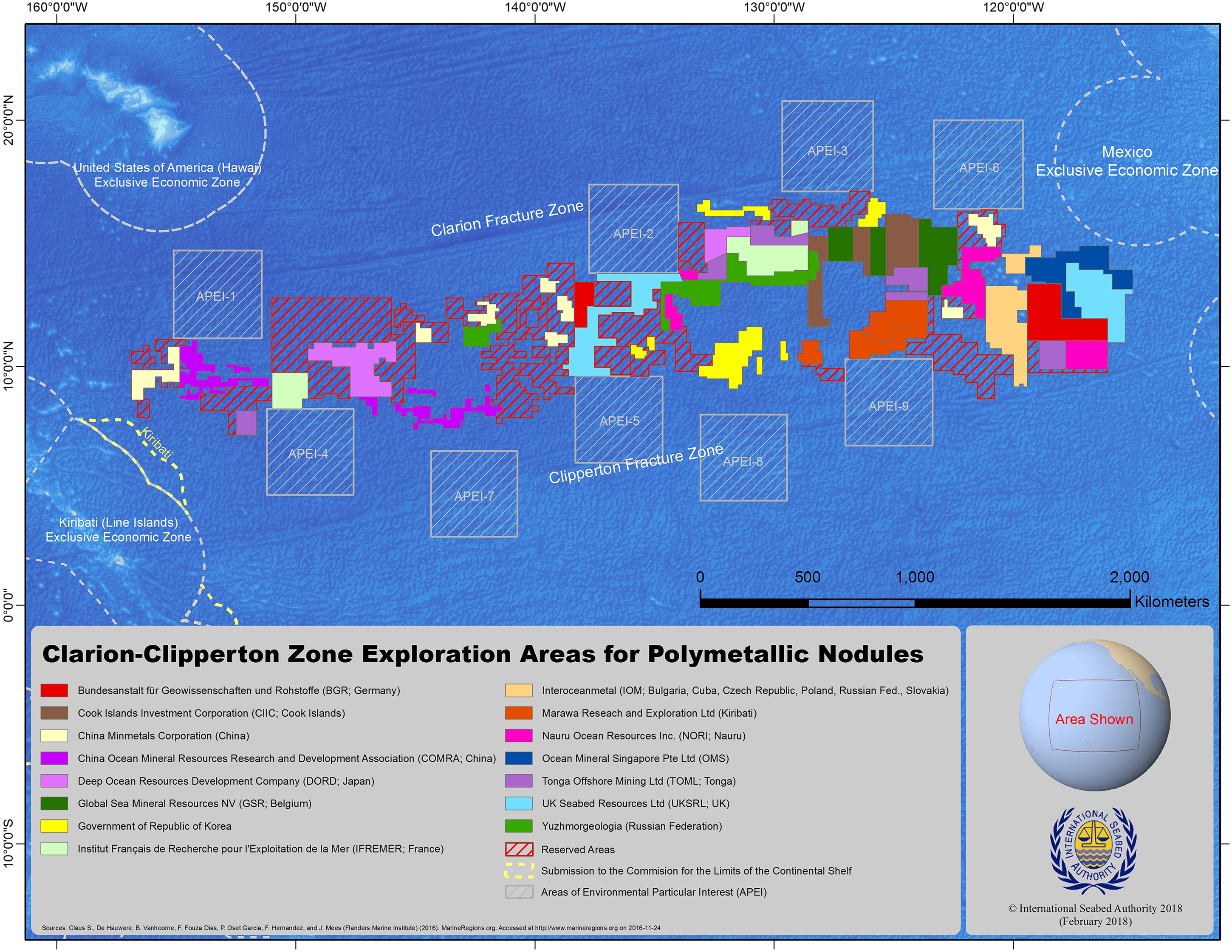
A map of exploration contracts awarded by the ISA in the Clarion Clipperton Zone, including areas of particular environmental interest (APEIs) currently protected from mining. In 2021 the ISA increased the number of APEIs from 9 to 13. Image adapted from the International Seabed Authority, available from https://oceanexplorer.noaa.gov/explorations/18ccz/background/plan/plan.html.
Yet, in its voluminous and temporal dynamism, the ocean continually ‘unground(s) notions of place’ underpin practices of zonation (Bremner, 2015: 15; Childs, 2020). The ocean is misrepresented as a static, neatly bounded area, often viewed from above (e.g. Bear, 2017; DeLoughrey, 2019) when in reality, it constitutes a space of ‘churning’, ‘drifting’ and ‘dynamic fluidity’ in which ‘vertical forces are translated into horizontal motions that often supersede both legal logics and human intentions’. (Steinberg and Peters, 2015: 259). Very little of the ocean lives up to the expectation of transparency or fixity, with volume playing an important role in frustrating any attempts to constitute the abyssal environment in particular as a stable object of governance. While considerations of volume here are often central to how marine space has been misapprehended, we would also do well to keep in mind Dalby's argument that ‘the materialities of spaces matter, not just the volume’ (2013: 43).
The environmental excess of DSM
The ocean is a space in which environmental effects can rarely, if ever, be contained to specific areas due to its voluminous dynamism. This brings us to the fourth aspect of how processes of environmental governmentality come to function: the mismatch between the construction of environments as objects of environmental governance and their unruly existence in an area of the planet still barely understood. As Childs (2020) notes, one solution to this apparent gulf between regulations and the specificity of the spaces they seek to regulate is the adoption of ‘ecosystem-based’ strategies that increase levels of scientific knowledge production in and around the target areas (Childs, 2020: 198; Danovaro et al. 2017: 453). Indeed, the rate of knowledge production in areas such as the CCZ has increased dramatically in recent years, with numerous teams of oceanographers working on assessing the environmental impacts of DSM (e.g. Spearman et al., 2020; Washburn et al., 2019) and international networks such as The Deep-Ocean Stewardship Initiative rounding up literature on DSM several times per month.
Despite the growth of ecosystem-based management strategies developing in parallel with commercial proposals for DSM, there is limited evidence of how real-world mining activity in the CCZ would affect ecosystems for the simple fact that commercial-scale mining has not yet taken place (Cuvelier et al., 2018), and doubt has been cast on the validity of studies facilitated by the mining companies themselves (Cecco, 2023). Nevertheless, marine scientists argue that it is reasonable to assume that a range of direct impacts will be caused by resource removal including noise and light disturbances, sediment compaction and the loss of biodiversity through the destruction, modification and fragmentation of habitats, which can all be understood as instrument effects of this particular governing intervention (Levin et al., 2016). In the case of polymetallic nodule fields, despite attempts on the part of mining companies to characterise these environments as ‘underwater deserts’ 2 very little is understood about the lifeforms that occupy this region of the abyssal environment, with the rate of species’ discovery continuing apace since early scientific voyages. Within this fluid abiotic environment is a continuous volume of biotic life, variously associated with particular sea-floor habitats and moving between them. Given that the impacts of DSM are ‘three-dimensional, diffuse, poorly understood, and wide-ranging’ (Niner et al., 2018), designating protected areas that directly border sites of extraction in the form of APEIs – may hold some value in mitigating the loss of biodiversity resulting from mining activities and provide opportunities for local regeneration in exploitation areas over long timescales (Niner et al., 2018), if carefully designed (e.g. Taboada et al., 2018). However, they may prove ineffective in fulfilling these goals as some Marine Protected Areas have already been established (Edgar et al., 2014).
To conclude this section, it is worth focusing on one particular environmental effect of DSM that is likely to elude the spatial logic of legibility building through zonation, and both serve as a potent symbol of the opacity of the abyssal environment and an exemplar of the non-linear and unpredictable relations of cause and effect that a political ecology of volume brings to the fore. The effect in question is the creation of sediment/turbidity plumes, both as a ‘primary’ plume from the operation of machinery on the sea floor (based on current plans for nodule extraction) and as part of a secondary discharge in the benthic water column after matter has been processed in a support vessel. As well as impacting sensitive species close to the mine site, it is highly likely that sediment as material excess would be transported in the water column far beyond the area in which extraction activities take place. In one recent study on the impact of deep-sea nodule mining, the authors note that it can take as long as 1 year for a 10-micrometre particle of sediment to fall from the midwater column to the sea-floor, during which time it can be transported up to 1000 km (Muñoz-Royo et al., 2021). Another study exploring the disturbance of sediment associated with mining of cobalt crusts in shallower waters reported a much more localised benthic plume as material excess extending only to 1.4 km from the mining site, with crust aggregates settling within 100 m (Spearman et al., 2020). Although scientists have been modelling the extent and impacts of sediment plumes since the 1980s (Ozturgut et al., 1980), deploying increasingly sophisticated methods in and ex situ (e.g. Spearman et al., 2020), factors such as turbidity, tidal currents and bathymetry constrain the potential to extrapolate plume dynamics across space and time. Our ability to predict the vulnerability of biodiversity to these plumes is thus further limited (Washburn et al., 2019). This has knock-on effects on how environmental regulation will seek to maintain separation between DSM and other segments of the blue economy such as fishing, which could suffer because of metals (an example of mining excess) polluting food chains (Mestre et al., 2017), in the same way that indigenous food supply in the Amazon Basin suffers from mercury generated upstream, as described earlier.
As the example of sediment plumes demonstrates, the environmental impacts of DSM operate across spatial, temporal and material scales that to a great extent scientists are not yet able to predict (Niner et al., 2018; Washburn et al., 2019). Furthermore, it seems that the issue cannot be addressed through typical regimes of environmental governance that extend legislation, surveillance and logic of spatial planning developed on land such as zoning and demarcation. In their spatially and temporally distributed effects, sediment plumes highlight, generate and drive unintentionality of outcome and movement across voluminous materiality – as excess – that a political ecology of volume helps foreground.
Preparing to mine NEOs
Much like the historical view of the Amazon Basin as a site to be conquered and made productive by European colonisers, outer space is being depicted in popular imaginations as Earth's ultimate frontier – a site for future capital accumulation and a harbinger of threats to humanity. The effort to make outer space legible has intensified in recent years. This begs the question of the extent to which its governance differs from that of land or the deep sea. This section turns towards the prospect of asteroid mining to support the argument that outer space is increasingly being made visible, and that efforts to govern it are being made coherent, in line with the first and second aspects of governmentality analyses. Drawing on lessons from mining the surface, we caution that the social and material excess of asteroid mining – understood through the prospect of material movement and unintentionality – are similarly likely to make themselves felt in socially unequal and ecologically harmful ways.
Ever since Sputnik was shot into space in 1957, there have been attempts to govern activity in outer space. In an international agreement that was in many ways analogous to the regulation of the deep sea, outer space was declared part of the global commons through the Outer Space Treaty (OST) of 1967. As Blount highlights, Article II of this treaty ‘must be understood as banning something very specific, which is the acquisition of territory over which the sovereign has full authority that results from occupation or use’ (Blount, 2018: 113). The treaty was therefore orchestrated in relation to state sovereignty and was a response to the ongoing negotiations and conflicts over international order in the wake of WWII and The Cold War. It was initiated in the recognition that ‘international regulation of outer space was seen as the best way to ensure that outer space would not become an extension of the problems on Earth’ (Beery, 2016: 95). What happens in outer space, however, should not be thought of as something detached from everyday lives on Earth. Outer space ‘has become instrumental to many modern technologies and forms of mobility’ (Dunnett et al. 2019: 315). Just as networks of cables underneath the sea keep societies across the globe connected, satellites and the atmospheric layer above Earth they inhabit has become increasingly important to surveillance, mapping, data and telecommunications practices (Klinger, 2017; Starosielski, 2015). Satellites are also vital to Artificial Intelligence assisted automobiles and increasingly useful in warfare (Illingworth and Downey, 2021; Kaplan, 2018). The governance of satellites and the data they produce is deeply connected to the governance of life on Earth, especially in an age of unprecedented climate change and advanced methods of climate modelling.
Territorialising the low earth orbit
The contestation around the Low Earth Orbit brings some of the colonially fuelled inequalities associated with outer space capital expansion into view. Given that efforts to keep satellites in orbit are a fraught and expensive endeavour, satellites are usually positioned in a thin layer of outer space known as Geostationary Orbit (Figure 4). In this layer of space between Earth's atmosphere and outer space, satellites remain in a fixed position relative to a position on Earth's surface, making them much easier to track and control. This zone is about 36,000 km above Earth's equator, and as such is a finite parcel of space. 3 It is expensive to get satellites there, but once there, it is relatively cheap to keep them in orbit due to their stable position in relation to Earth's surface. As such, it is a contested part of space, and most satellites in its orbit are owned by the United States, Russia and China. Its location above equatorial countries, who control less than 4% of active Low Earth Orbit (LEO) satellites, brings access to, and distributional benefits from, this part of outer space into question (Van Eijk, 2022). Those living in equatorial countries use geographic data generated by satellites that are owned and operated by governments, and increasingly private companies, in the Global North.
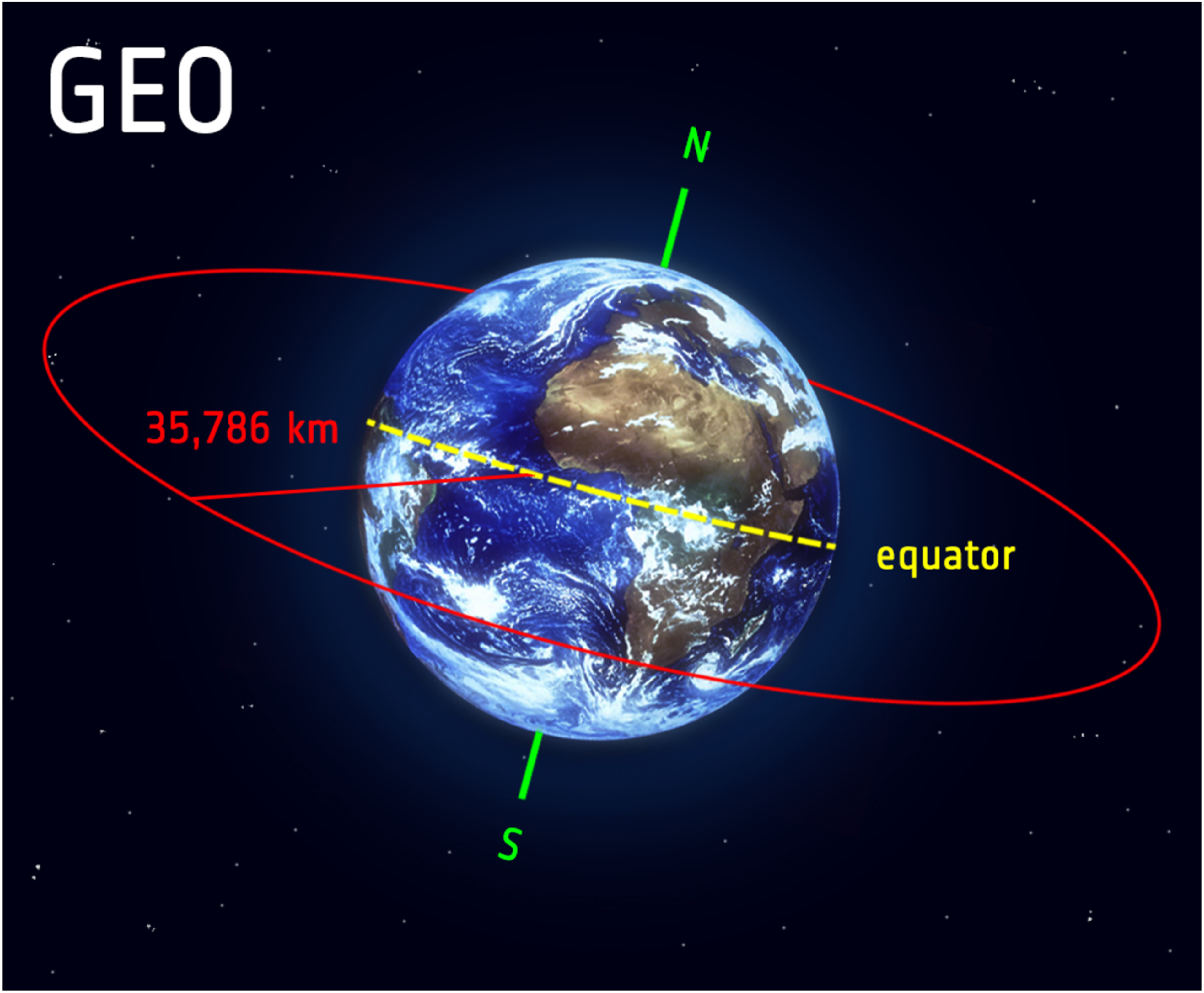
Geostationary orbit. European Space Agency.
Geostationary orbit both challenges and reinscribes two-dimensional notions of geopolitics through national borders that were assumed to extend vertically into Earth's atmosphere from its surface. On this basis, a group of equatorial countries gathered in Bogota in 1976 to refute the inequity of satellites in geostationary orbit, using articles from the OST to support their claims. They argued that they had sovereignty over the atmospheric and outer space above their national borders, challenging the occupation of these orbital zones by the USA, China and the former USSR. These claims were eventually quashed by the UN, and outer space remains unregulated and largely inequitable in relation to who has access to and enjoys distributional justice over resources (including space itself). As van Eijk states, ‘the space commons and environmental rights may seem unconnected, but they bookend a Southern history of fighting the same battles to similar (non-) effect’ (van Eijk, 2022: 17).
Access to outer space is further contested and restricted through the movement of orbital debris floating in LEO. It is estimated that there are ‘half a million pieces of orbital space debris today, only a fraction of which can be tracked by space agencies like NASA’ (Reno, 2018: 12). This unintended material excess is a result of decommissioned satellites, collisions and explosions during previous space exploration. With tens of thousands of satellites due to be launched into space in the coming years by Space X and their competitors (Williams et al., 2024), some have speculated that this could lead to what is known as the Kessler Syndrome, whereby a cascade of collisions essentially blankets LEO, cutting Earth off from outer space (ibid). Outer space, as a valuable resource in which to keep ‘mega constellations of communications satellites’, is not only politically contested, but increasingly a risky place to do business (Boley and Byers, 2021). Most of this debris has been generated by the Global North, demonstrating that ‘the colonization of space is preceded by, and proceeds alongside, the colonization of Earth’ (Scharmen, 2021: 34). However, space itself, and the data generated from it, is not the only valuable resource in outer space.
NEOs as frontier spaces
The fabrication of resource scarcity on Earth (Barnes, 2009; Klinger, 2017) has fuelled fantasies about the proliferation of easily accessible and highly valuable minerals beyond Earth. These fantasies, as their Earth-bound versions explored earlier, overlook many Indigenous cosmologies that understand ‘outer space’ as already governed, connected to earth, and as a homeland peopled by spirits and celestial beings’ (Bawaka Country et al. 2023: 223). It is in these contexts that NASA and private enterprises such as SpaceX, Blue Horizon, Planetary Resources and Deep Space Industries are advancing the prospect of mining asteroids and other NEOs for their minerals.
In 1997 planetary scientist John S. Lewis published a book called Mining the Sky: Untold Riches from the Asteroids, Comets, and Planets. Like other space scientists before him, Lewis claimed that resources in outer space would free humans from the limits of growth on Earth (Scharmen, 2021). More recently one of the world's leading astrophysicists and Professor of Astrophysics at Harvard University, Martin Elvis, published a book, simply called Asteroids, within which he claims that greed will propel humans further into space and asteroids ‘are the future’ (Elvis, 2021: 3). He follows in the footsteps of Lewis announcing that ‘making a profit—preferably an obscene, gold rush–like profit—from space will produce a cascade of benefits for the science and security motives of going to space’ (Elvis, 2021: 3). Some space ethicists warn that a sudden influx of raw materials from asteroids into the economy would exacerbate existing inequalities on Earth and potentially disrupt the global economy in disastrous ways (Milligan, 2016; Pilchman, 2016). These researchers also ask important questions about the ethics of coming to know asteroids purely as resources. Here we are firmly in the first and second steps of a governmentality analysis according to Dean, as asteroids are imagined and made visible and knowable to governments and those with economic, political and technological power, purely as resources.
As repositories of resources, asteroids and other NEOs are made into highly valuable commercial products that warrant investment and the associated risks of outer space travel. Asteroids have also been imagined as space debris in and of themselves and pose a serious threat to Earth's liveability. As such, they represent a dual identity as both the source of valuable minerals and potential harbingers of catastrophe. In this scenario, asteroids have also incentivised and been used to justify the militarisation of outer space to act as a defence system against asteroids that might stray too close to Earth (Mellor, 2007). It is perhaps here that the tensions between extracting wealth from asteroids, on the one hand, and controlling threats to humans emanating from frontiers perceived as uncontrollable, on the other, become most apparent.
In April 2020, Donald Trump, during his first term as President of the USA, signed an executive order which declared that outer space was not part of the ‘global commons’ and encouraged commercial space exploration. The order came after US Congress passed a law in 2015 explicitly allowing American companies to use resources from the moon and asteroids for private interests. Nearly 5 years later, he then promised to ‘plant the stars and stripes on the planet Mars’ in his inauguration address on 20 January 2025, with founder of Space X, Elon Musk, right behind him. Such declarations and legal orders indicate that without further critical attention, if (perhaps more a question of when) mining in outer space is to occur, it will increase the production of social and material forms of excess such as space debris and (perhaps, intended) territorial contestations on Earth. It appears that step three of Dean's governmentality framework, involving the development of coherent strategies of governing frontiers, is well underway. The material and social excess generated by its eventual execution, however, is yet to be made apparent.
Conclusion
In this paper, we examined mining in three frontiers through the lens of environmental governmentality, to bring attention to the cross-scalar, colonially informed nature of mining's extraterrestrial expansion and its historical and likely projected voluminous social and physical excess. We adopted Dean's interpretation of Foucauldian environmental governmentality as a means of identifying and labelling different logics of its governance.
We showed that the first and second legibility-building and knowledge-consolidating steps of governance, according to this framework, had been enabled through legend in the colonisation of capitalist frontiers of the New World, through early scientific voyages in the case of the ocean floor, and through quasi-scientific literature by the likes of Lewis and Elvis in the case of asteroid mining in outer space. In line with the third step of Dean's framework, we showed that governance in the Amazon was subsequently predicated on small colonies that eventually supported European claims to ever-large segments of land. In the case of the deep sea, we see these similar manoeuvres through the creation and generation of cartographic representations, charts and data. These governing strategies were fully deployed in the Amazon Basin but remain under development in the deep sea and outer space. Finally, we noted how the effects of mining the surface of the Amazon spread through other material spaces in ways unaccounted for by those intervening in territorial volumes through mining. This raises questions of whether lessons can or will be learnt from the connections that exist between the colonisation of the surface of Amazon Basin and emerging means of colonising extraterrestrial, voluminous frontier spaces that are even less fixed, permeable and predictable than that of Earth's surface.
Through a focus on mining in three disparate frontiers, we argued that voluminous ecosystem dynamics have the potential to frustrate the effectiveness of the governing interventions that accompany mining – a condition that appears to only intensify the further mining moves off land. We demonstrated, for example, how the movement of water, as affecting and being affected by mining in the deep sea, is both similar to and different from the movement of objects in LEO and outer space. In other words, claims to any measurable portion of the atmosphere (e.g. air) and outer space (e.g. geostationary orbit) in vertical relation to Earth are challenged by Earth's constant movement and rotation in a way that resonates with the movement of water in the ocean. In so doing, we pointed to the material nature of the unintended consequences of strategies of environmental governance (Fletcher, 2010; Li, 2014).
Notwithstanding the complicated, non-linear and erratic relationship between cause and effect manifested in mining's excess – evident through movement and unintentionality – other continuities between our case studies exist. We see these continuities in the expansion of mining activities off land, fuelled by technological advancement and a colonially rooted imaginary of some parts of the world as barren, meaningless and unclaimed. By bringing environmental governmentality into conversation with volume and political ecology, we extend an invitation for political ecologists to engage more directly with the disparate, yet powerful, ways in which material relations exceed taken-for-granted frames of reference. Resisting the parameterisation of the environmental impacts resulting from the exploration of new frontiers requires interdisciplinary collaboration in a form that encourages new questions to be asked of environmental governance. By blurring traditional human-imposed borders and connections across territorial claims through notions of excess, the voluminous approach adopted in this paper foregrounds the need for sharing a crowded planet, rather than for relying on a competitive arrangement of nation states assumed to be flat, separable and enclosed (Dalby, 2013).
Highlights
Mining frontiers are moving further beyond the Earth's surface.
Uses environmental governmentality to examine mining as an intervening activity that brings the relationship between different material spaces into view.
Mining in extraterrestrial spaces building on and deepening colonial environmental governance strategies.
Efforts to govern mining are likely to be increasingly challenged by its ‘excess’.
Argues for more focus on the voluminous nature of extractive activity and its excess.
Footnotes
Acknowledgements
The authors would like to thank three anonymous reviewers for their thoughtful comments and feedback.
Funding
The author(s) disclosed receipt of the following financial support for the research, authorship, and/or publication of this article: The authors benefitted from internal funding made available through the St Andrews Interdisciplinary Research Support Fund.
