




Abstract
The opportunity to snorkel with orcas (killer whales) near the Norwegian Arctic town of Skjervøy is unparalleled globally, due to the absence of regulations prohibiting the activity, requiring licenses, or limiting the number of boats. Since 2017, the annual arrival of orcas and other large whale species in winter has been attracting increasing numbers of tourists, leading to crowding and sometimes risky situations at sea that are described as a ‘wild west’. Based on ethnographic fieldwork in Skjervøy across two winter seasons, the article first describes how whale watching emerged in this low-regulation context, and the consequences of the growing popularity of snorkelling activities. Second, it examines tourists’ self-reported responses to their snorkelling experiences, revealing that many people see encounters with wild orcas as a form of redemption or apology for the ways that humans have mistreated the species, particularly in captivity. The embodied experience of immersion in orcas’ Arctic habitat begins a process of recontextualisation, whereby a species understood to have suffered at human hands is imagined anew according to principles of freedom and autonomy. For other tourists, their awe at the opportunity to observe orcas up close is complicated by feelings of unease about their role in a sometimes-chaotic activity that can disturb the whales, shaped by the experience of sharing the sea space with numerous other tourists and boats. In the final section, the article suggests that these ‘ambivalent encounters’ undermine their hopes for a benign form of human-whale encounter, as the crowding creates an image of humans ‘chasing’ the whales.
Introduction
The water was cold, but the air had been colder. Plunging below the surface before bobbing up again, courtesy of his buoyant drysuit, the snorkeller was warmed not only by this difference in temperature but by the heat of his blood pounding. He scanned the shadowy murk for something denser, the dark, torpedo-shaped masses with their iconic flashes of white. Through the streams of bubbles and muffled exclamations around him, he tried to remember the instructions: don’t splash your feet. No sudden movements, just float and breathe. And look down – whales don’t fly (Figure 1).
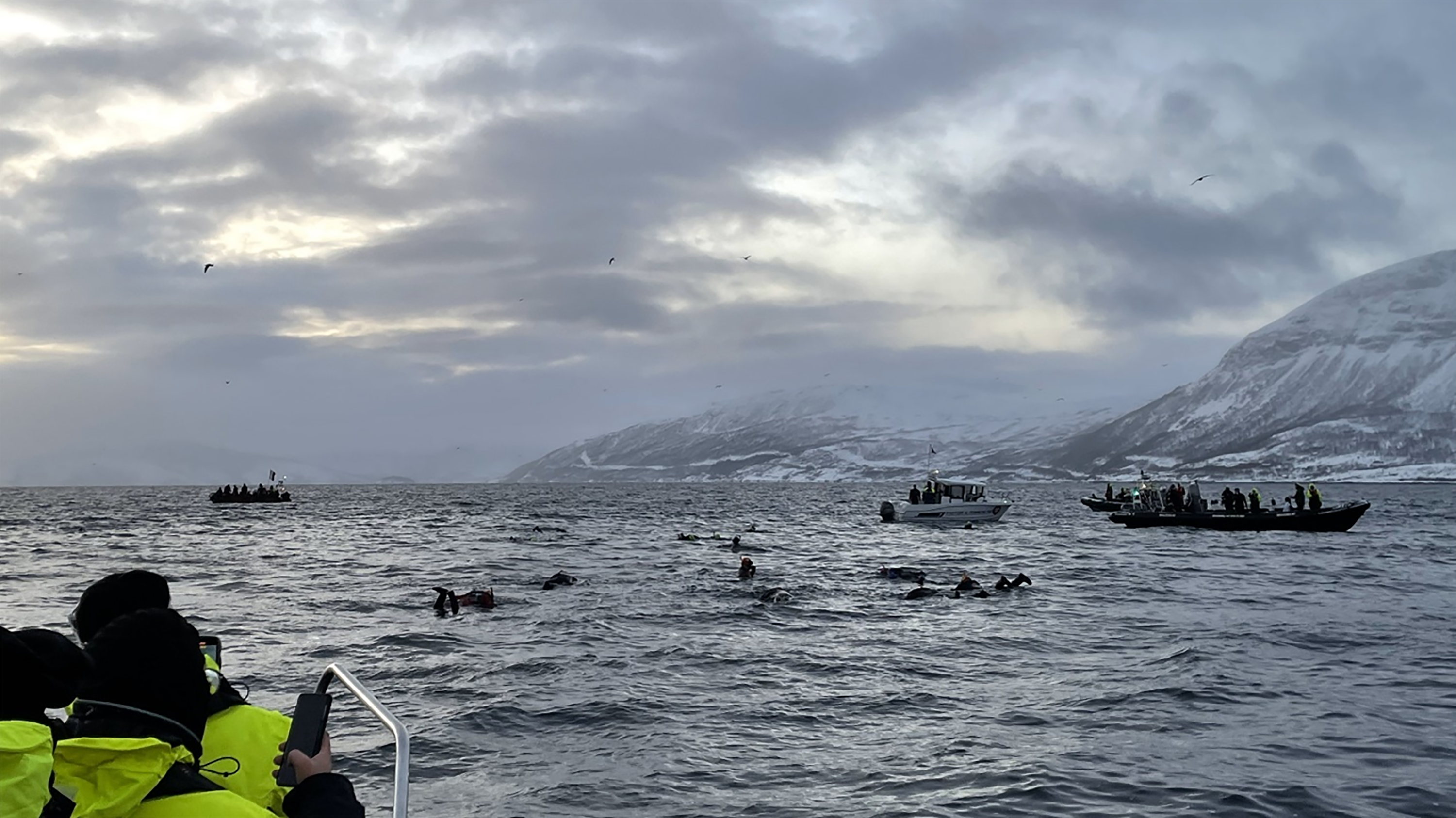
A busy day in Skjervøy, as boats and snorkellers try to get close to a ‘feeding event’ in which orcas, humpback whales, and fin whales can be observed hunting herring in close formation. Photo: Author's own.
The Brazilian tourist who relayed this account to me was just one of many dozens of snorkellers in the frigid Arctic waters that mid-January day, hoping to catch a glimpse of orcas (killer whales) beneath the surface. From my perspective as a whale-watching guide on board the RIB (rigid inflatable boat), mercifully dry and wrapped in bulky layers of wool against the lashing winds, the 12 snorkellers I had just directed into the water looked disorientated and now far away from the orca pod we had tried to deposit them close to. I glanced at the captain, who was concentrating on maintaining our position as the current stirred beneath the RIB. Had they even seen anything? I wondered. But when the snorkellers hauled themselves back on board up the rear ladder some minutes later – shivering violently, icicles already beginning to form on their dripping hair – their bright eyes told me that this had been a good encounter. One couple high-fived, GoPros swinging from gloved wrists. ‘When can we go again?’ someone asked breathlessly.
Where whales go, curious humans tend to follow. Since around 2017, increasing numbers of whale enthusiasts have been travelling every winter to Skjervøy, a small harbour town huddled between steep mountains in the Norwegian Arctic. They are motivated by the chance to see the large numbers of orcas, humpback whales, fin whales, and sometimes sperm whales that have been gathering here for the last several years, between the months of October and January. Such concentrations of ‘charismatic megafauna’ (Goble, 2009 cited in Barua, 2019: 687; Kleiman and Seidensticker, 1985; Lorimer, 2007) invite great interest among different publics, but orcas are undoubtedly the species most tourists want to see. The whales that the humans follow are themselves following a particular fish they like to eat: the Norwegian spring-spawning (NSS) herring, which overwinters in the nearby fjords of Lyngen and Kvænangen in enormous shoals. Operators, usually using nimble RIBs, compete to satisfy tourists and get close to the action, offering whale watching, snorkelling, and diving. The chance to snorkel with orcas in Norway is unparalleled globally, because of the combination of commercial infrastructure and the absence of legislation prohibiting the practice (Pagel et al., 2021: 77–78, 90). 1
Whale-watching activities, increasingly popular in Norway, are known to cause disturbances to cetaceans (the word for whales, dolphins, and porpoises). These include intercepting the animals’ path of travel, causing them to dive or flee, and engine noise that can increase stress and disrupt feeding and vocal communication (Arranz et al., 2021: 1; Weilgart, 2007). In Skjervøy, whale watching emerged rapidly within a low-regulation context, and it is not uncommon to see a dozen vessels at a time – RIBs and larger cruisers alike – coalescing around just a few whales, some of whom may be young orca calves. This can have consequences for snorkellers as well as for whales. What anthropologist Katja Neves (2010) calls ‘cetourism’ (cetacean tourism) is therefore worthy of scrutiny in Skjervøy for a few reasons: the proximity and number of the boats, the possible risks to both whales and tourists, and because cetourism is often assumed by guests to be a benign form of human-whale encounter – especially when compared with captivity 2 and whaling. 3
Responsible whale-watching companies are well aware of their potential impacts and will try to mitigate them, for example by turning off boat engines when getting within a certain distance of a whale, approaching from an angle that does not startle them, and refraining from snorkelling if the whales seem avoidant or stressed. Nonetheless, the intended outcome of these tours is human bodies easing (or more often tumbling) into the water, close to whale bodies. While both are popular, the demand for snorkelling outstrips whale watching, often being sold out many months in advance, especially in the peak month of November. It is this intense desire for physical proximity that interests me in this article, and the ostensibly contradictory emotions – awe, and sometimes guilt – that the snorkelling experience both provokes and was sought out to heal in the first place.
The article is based on four months of ethnographic fieldwork in Skjervøy, carried out between October 2023 and December 2024 across two winter seasons. Part of my research involved working as a guide with a company called Whale2Sea. I was only one among an assortment of whale-curious humans in Skjervøy during those winters, one that included scientists, tour operators, tourists, fishers, artists, and private boat owners. I am here interested in the tourists who came to snorkel with orcas, and whom it was my job to inform, keep safe, and help dress in Arctic-appropriate gear every day. Cetourism in Skjervøy is an economy of affect (Barua, 2019) where excitements, tensions, and anxieties run high. I draw on responses to a tourist survey, supplementary conversations, and hundreds of hours of participant observation to present an ethnography of people's emotional responses (Servais, 2005: 326–327) to their underwater encounters with orcas. For a small but notable minority, these encounters mediate anxieties about human-whale relations and interspecies etiquette more broadly (Warkentin, 2010; Whitehouse, 2015), bringing anthropogenic impacts such as crowding and habitat degradation into relief.
Andrew Whitehouse (2015) noted a similar phenomenon in his UK-based Listening to Birds project, in which members of the public were invited to submit stories about bird sounds they heard (2015: 63). Whitehouse noticed that people would describe a bird that they had heard or seen, and reflexively comment upon that species’ decline and humans’ probable complicity (2015: 65). Noting this striking ‘sense of uncertainty and concern over potential human culpability in loss’ (2015: 55), he develops the concept of ‘anxious semiotics’ particular to ‘a human-dominated world’, or the Anthropocene. What is most important is not merely that respondents are anxious about climate change and biodiversity loss, but that these feelings emerge through the very act of listening to the birds they love. Listening to birds becomes listening for loss, even if that loss is not (yet) actualised (2015: 55). Anxious semiotics is a valuable term in that it points to feelings of anxiety about human impacts on other species at the very moment that they come together. It is therefore of particular analytical relevance to the cetourism context, which is characterised by discrete, often fleeting moments where whales come into view, rather than a relation of continuous companionship, and where customers and employees alike think of themselves as caring about the whales they encounter. At the same time, loss is not the only or most relevant paradigm in Skjervøy, where huge aggregations of whales amass. As will be discussed, this dual abundance of whales and tourists produces its own ambivalent emotions.
Nonetheless, orca charisma can partly be said to arise from the affective dimensions of loss that haunt this species, which is actually the largest of the dolphins. In the Euro-American context, orcas emerge in a media and cultural ecology dominated by images of miserable individuals held in captivity, thanks in part to the enormous impact of the film Free Willy (1993), in which a troubled boy befriends a captive orca and helps him to freedom, and subsequent campaigns and documentaries. As others have argued, the film was ‘fundamental’ to shifting perceptions of orcas from being ‘feared and hunted’ (Lawrence and Phillips, 2004: 9) to being revered (Lawrence and Phillips, 2004; Wearing et al., 2011: 128). The opportunity to see orcas in the wild was an explicit and commonly held motivation for tourists I surveyed, with orcas’ matriarchal, multigenerational pod structure, close family bonds, high intelligence, cooperative hunting strategies, and presumed curiosity about humans also mentioned. Tour operators in Skjervøy know this, marketing specific ‘orca safaris’ in their logos and promotional material.
The article unfolds in two parts. It begins with an overview of cetourism in Skjervøy, explaining how the lack of regulations pertaining to whale watching can sometimes lead to disorder at sea. In the second half, I consider survey responses and conversations with tourists. From this, two themes emerge: first, that for some, being in the water with wild orcas represents a vital form of compensation or atonement for humans keeping them in captivity elsewhere. To a lesser extent, the excesses of industrial whaling also leave a trace in present-day encounters, and perceptions of past abuses strongly inform my interlocutors’ responses. The article thus shows that such encounters are not merely rooted in the present, but are imagined to be part of a dark lineage containing other, more harmful forms of human-whale encounter from which ‘we’ have hopefully ‘progressed’. When this progress appears disrupted – such as when boats outnumber or surround the whales – it produces feelings of unease, which I analyse as ‘ambivalent encounters’ by drawing on anxious semiotics and Véronique Servais’ (2005) work on wild dolphin encounters. In light of the low regulations and unrestrained tourist numbers particular to Skjervøy, the article complicates often-idealised encounters with wild cetaceans.
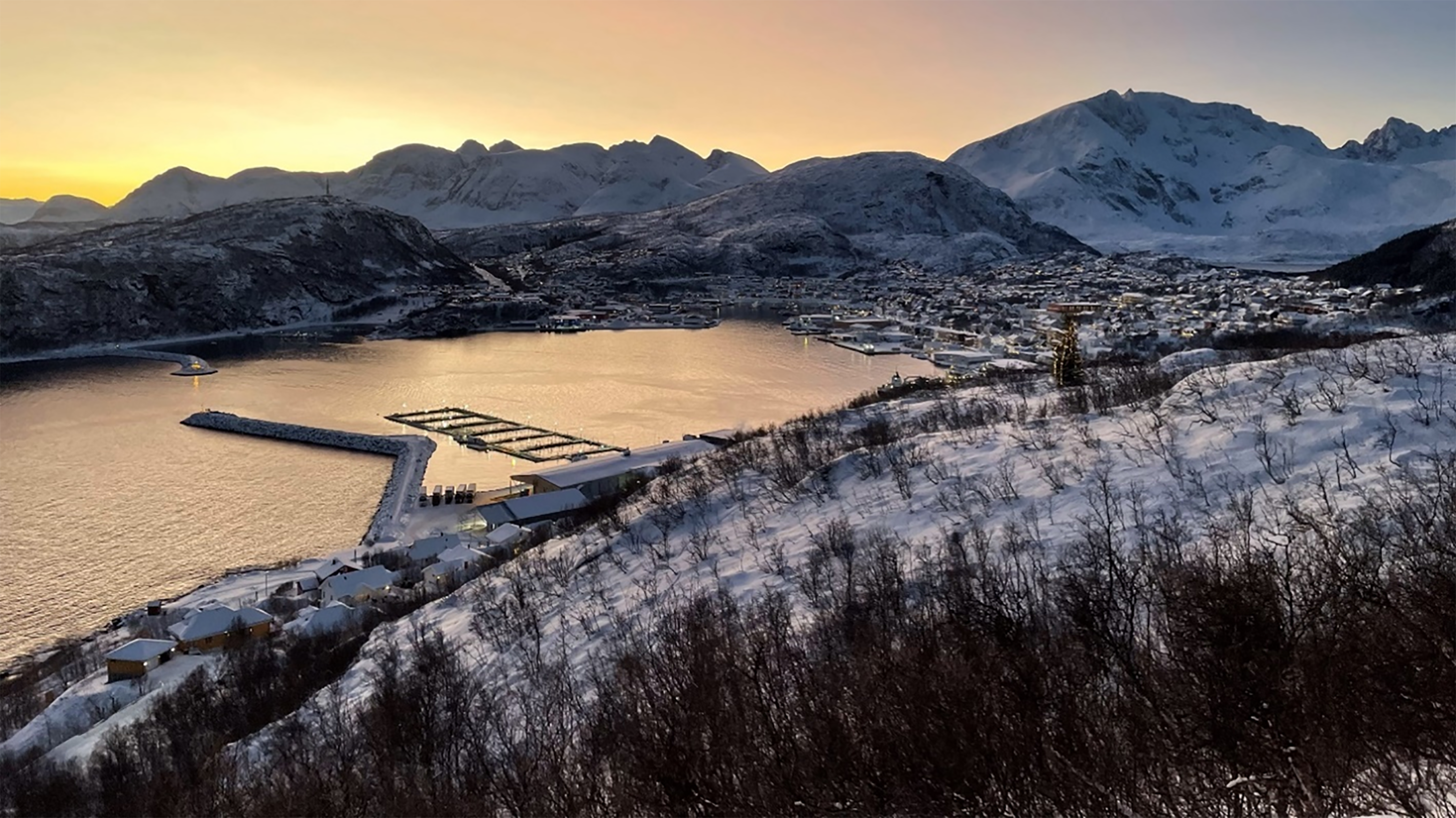
Skjervøy as seen from a nearby hill. Photo: Author's own.
A seasonal spectacle
Travelling to Skjervøy for the first time by Hurtigruten ferry, one of the first things that struck me, as we pulled into port under fluttering green Northern Lights, was that even the topography of the town seemed to anticipate spectacle. Surrounded by grand mountains, snow-dusted from September onwards, it sits in a sheltered natural harbour, where parallel rows of wood-clad townhouses rise concentrically up steep hills like the lines of a clam shell. The impression one has is of a natural amphitheatre facing the sea (Figure 2). The twinkling lights lend it a perpetual air of festive charm in an otherwise dark, sparsely populated landscape. Skjervøy is, to use a common Norwegian word, the very definition of koselig (cosy).
Many people in Skjervøy – latitude 70° north, population 2794 (Statistisk Sentralbyrå, 2023a) – work in the services sector, such as health, social care, tourism, hotels, restaurants, and retail. But by far the most visible aspect of the local economy is the harbour's ebb and flow of mostly herring fishing vessels, as well as the large salmon aquaculture facility owned by seafood company Lerøy, which recently expanded and employs more than 200 people (NRK, 2022). Indigenous Sea Sámi who historically relied on fishing, trading, and animal husbandry, as well as whaling (Balfour, 1889: 234–235; Kramvig and Kristoffersen, 2025; Sagat, 2022), have also been present in this coastal area for thousands of years (Lyngsalpan Landskapsvernområde, 2024). 4 Skjervøy, then, has long been a significant fishing area, with whale watching a relatively recent addition that many locals have only a passing interest in. 5
While certainly not immune to large winter swells and rough weather, the nearby fjords, with their sprinkling of islands, are relatively well protected, meaning that whale-watching boats are able to operate most days throughout the season. The window of daylight shrinks to just 2 to 3 hours after the sun takes its leave of these latitudes around 23 November, reducing underwater visibility to such an extent that snorkellers need to get quite close to a whale to see it clearly. Skjervøy is two hours north by speed ferry of the lively Arctic city of Tromsø, population ca. 80,000 (Statistisk Sentralbyrå, 2023b), where winter tourism has exploded in the past decade or so. Crucially for the whales, this relative proximity to Tromsø means that cruise ships bearing up to 150 tourists can offer whale watching as a convenient day trip. Many visitors also make the journey in a single day via special ‘whale route’ buses. This opens up the activity to even more people, meaning even more boats. On the busiest days, I counted 30 RIBs and larger vessels within my field of vision. Such is the intensity of interest and the brevity of the window of winter daylight during mørketid (polar night) that a palpable sense of haste hangs in the air. These Arctic conditions are not irrelevant to, but rather heighten the affective atmosphere: the freezing temperatures, dim skies, and jagged mountains all prime tourists for the dramatic encounter they hope to have.
Cetourism might be fairly new to Skjervøy, but it has an established history in Northern Norway. In 1985, commercial boat trips to see orcas were set up on a seasonal basis in Lofoten and Tysfjord, at a time when their NSS herring prey overwintered further south (Damsgård, 2000; Pagel et al., 2021: 80–81; Similä et al., 1996; Stenersen and Similä, 2004). A closely studied, though not wholly understood species, NSS herring are known to periodically shift their overwintering grounds, with the whales in tow (Dietz et al., 2020; Rikardsen, 2019; Similä, 2005). In the winters since then the orcas, following herring, have appeared variously in Andfjord, Senja, Kvaløya, Kaldfjord, Tromsø, Skjervøy, and Alta. In 1989 Hvalsafari (Whale Safari), Norway's first whale-watching company with a permanent base, was established in Andenes, about 357 km south of Skjervøy by road. In 2010 Whale2Sea (formerly Sea Safari Andenes) was founded, also in Andenes, and moves a portion of its operations to Skjervøy every winter season. In Andenes, an aggregation of male sperm whales in the deep Bleik Canyon just 15 km from shore (Morange et al., 2024) makes whale watching possible all year round, and the highly productive marine area serves as foraging grounds for up to 10 different species of cetaceans. In 2006, some 10,000 whale watchers came to Andenes (Fosse, 2006); in 2023, that number stood at almost 28,000 in the May–September period alone, according to official company statistics (Similä, 2024, personal communication). In both Andenes and Skjervøy, demand is growing year on year. Note, however, for the purposes of comparison with Skjervøy, that tours off Andenes often require a more extensive period of searching in the open ocean, with the help of a hydrophone and binocular-clad lookouts.
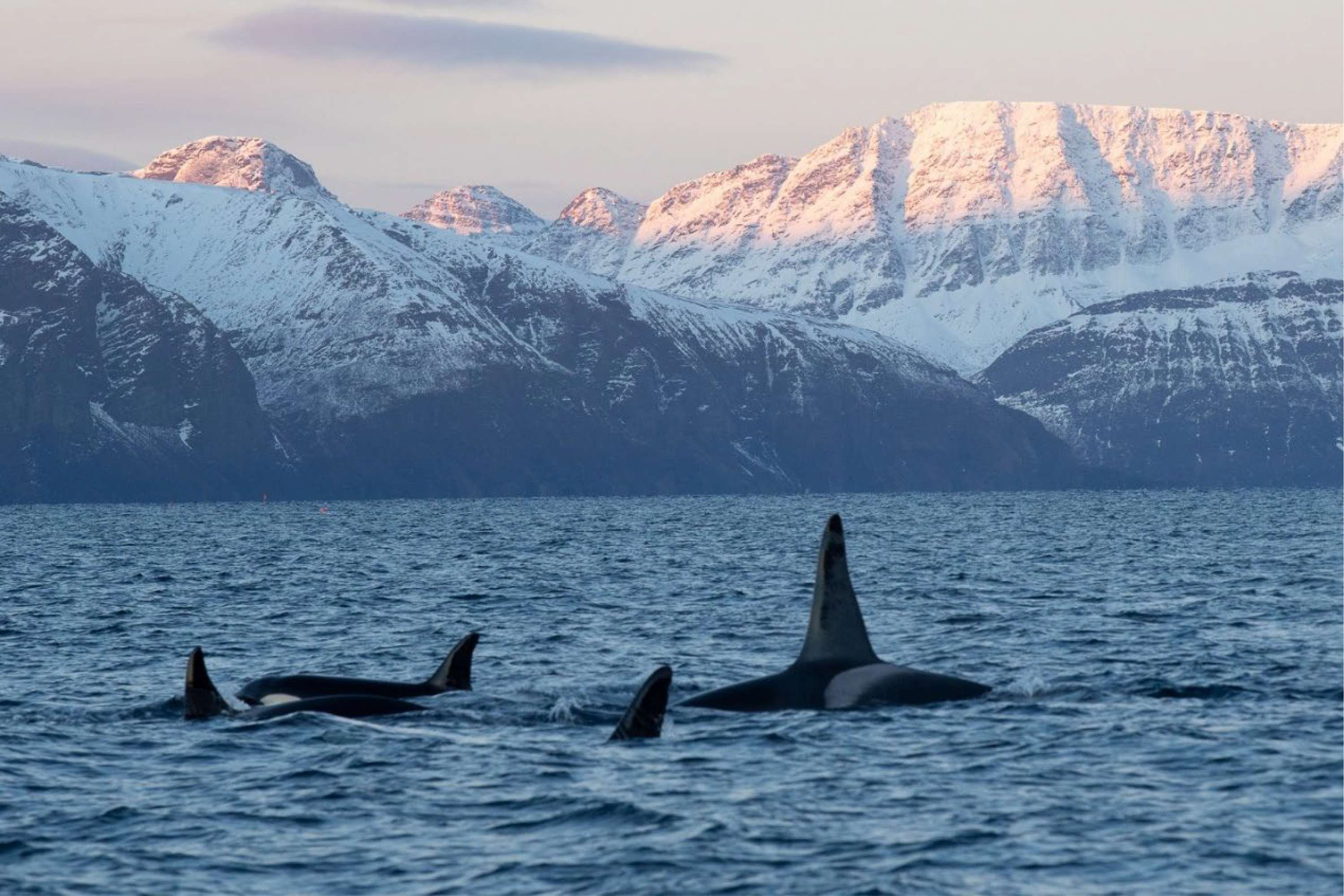
A pod of orcas in front of the mountains in Skjervøy, November 2021. Photo: Luís Diaz.
Since 2011, the presence of ‘winter whales’ (Rikardsen, 2019) further northeast towards Tromsø and more recently Skjervøy has added to Northern Norway's appeal (and accessibility) as a whale-watching destination. What makes the situation in Skjervøy striking is the concentration of whales in a relatively small, enclosed area close to shore (Figure 3). It is not unusual to see dozens of orcas, sometimes within minutes of leaving the harbour. ‘I call it “the whale Uber”!’ one experienced captain said to me with a grin, referring to the ride-hailing app to illustrate the relative ease of shuttling tourists from shore to sea. The behaviour of the whales in question is also a specific draw for visitors. Northern Norwegian orcas use a method of hunting known as carousel feeding (Similä and Ugarte, 1993), in which they corral their primary prey, the NSS herring, into a tight ball near the surface and, with a slap of their powerful tails, pick off the stunned fish one by one (Matika et al., 2022; Similä and Ugarte, 1993). Into such scenes can burst much larger humpback and fin whales from below the surface, jaws agape, filtering tonnes of herring into their mouths in a behaviour known as lunge feeding (Goldbogen et al., 2017; Iwata et al., 2024). Occasionally, such a ‘jackpot’ feeding event involving several whale species can occur. Orcas and humpback whales also opportunistically eat fish discarded from herring-fishing vessels, the animals having learned to follow them for this very purpose (Similä, 2005). Skjervøy is one of only a few places in the world where one can so readily observe these phenomena close together.
Aided by social media and the popular BBC documentary series Blue Planet II (2017), word of such sights has spread, and whales have been branded the ‘new Northern Lights’ for Arctic tourism (Kramvig et al., 2016: 29). The paying guests I met were mostly from European countries like Italy, France, Spain, Germany, and the Netherlands, with relatively high incomes and education levels. Whale watching and snorkelling tours are expensive, ranging from NOK 1800 (around EUR 150 at the time of writing) to more than NOK 3500 (around EUR 300). Liveaboard companies, offering multiday stays on a larger boat and several opportunities per day to snorkel, can cost in excess of NOK 37,500 (EUR 3294 total/EUR 823 per day) (PADI, 2024). While some are licensed divers, many snorkellers have little to no experience and are just eager for the chance to swim with whales.
The price of proximity
In Skjervøy's increasingly crowded cetourism space, petitions for stricter rules and complaints against ‘cowboy’ operators have intensified over time (Moe and Åsali, 2017; Skjelvik, 2021; Tao, 2022). Another objection has been against foreign operators, who reportedly are not liable to pay tax in Norway (Klausen, 2022). While I sensed much camaraderie between captains across different companies, I also found an almost uniform frustration about what they perceived as others’ cavalier attitude to whale (and snorkeller) welfare. I heard stories of this or that company cutting in front of other boats or recklessly ‘throwing’ snorkellers ‘on’ the whales, or of snorkellers not wearing visibility markers such as brightly coloured caps. This is a source of great stress for captains, who are trying not to hit anyone while dealing with low light and potentially challenging sea conditions. ‘It's a miracle that there hasn’t been an accident yet’, one long-time guide told me frankly. This is not an uncommon view: local newspapers report on the ‘chaos’ (Henriksen, 2023) and an Icelandic journalist declared ‘it's amazing no one has died’ (Bjarnason, 2023). Poor seamanship can also lead to whale research boats being blocked as they try to take samples or carry out photo-ID (Tao, 2022: 44). Perhaps most hazardously, operators have been known to put snorkellers in the water closer to active fishing vessels than the minimum 0.4 nautical miles (740 m) required by law (Ministry of Trade, Industry and Fisheries, 2022). One captain told me about a scenario where divers had surfaced extremely close to a fish pump that was being cleaned: These pumps, they can pump like 30 cubic metres of water every minute. When you’re cleaning it, you cannot stop it immediately, there's a lot of momentum. Suddenly … there came up two divers just next to the pump. So if the pump had been on, they would definitely go into it. So yeah, so this is the big fear every [boat driver] has. We’re like, really, really afraid of [hitting people].
The Facebook group Hvaler i nord (Whales in the north), which during winter whale season serves as a digital bulletin board of sorts where people can post photos, events, and tips from their days at sea, documents similar outbursts of alarm going back to at least 2018. One post from that year bemoaned snorkellers swimming too close to fishing vessels, commenting upon ‘the horrible lack of ethics and standards by boat users this season’ (Bertella, 2019: 270). That same year, whale researcher Hanne Strager posted of her worry about ‘serious alteration[s]’ to orcas’ behaviour: ‘with the numbers of boats and people in the water increasing I fear that it may lead to negative consequences. Maybe the time has come where these activities should be regulated in Norway?’ (Strager, 2018). In 2021 Krisztina Balotay, a guide and photographer who has worked in Skjervøy for many seasons, wrote a distressed post concluding that what she had seen at sea that day amounted to ‘pure animal harassment’, adding: ‘As a guide, my job has become to explain the behaviour of the other boats, rather than talking about the animals’ (Balotay, 2021).
Within Norway, other kinds of marine economic activities are strictly regulated, such as king crab fishing or whaling. In contrast, whale watching is predicated on a combination of voluntarily-observed national guidelines (NorWhale, 2024a) and light-touch regulation 6 that stipulates the distance tourist boats must keep from working fishing vessels, but not from whales (Ministry of Trade, Industry and Fisheries, 2022). Guidelines first compiled in 2016 (Henriksen, 2023) were updated in 2019 by the government's Fisheries Directorate, and enforcement has allegedly escalated in Skjervøy since 2021 (Malmo, 2021). Nonetheless, the regulatory situation is still comparably permissive by international standards, referred to by many of my companions as a ‘wild west’. Although regulations state that ‘it is forbidden to practice whale watching in a way that contributes to disturbing the whales in their natural habitat’, no scientific definition of disturbances is given (Ministry of Trade, Industry and Fisheries, 2022), limiting the regulations’ impact and leaving them open to interpretation. And while swimming, free diving, and scuba diving are ‘not recommended’ in the guidelines (NorWhale, 2024b), these activities are almost daily occurrences during the Skjervøy winter season.
There are various theories as to Norway's relatively laissez-faire approach. An orca expert told me she is sure that cetourism disturbs their feeding habits, ‘but orcas are not a food source for humans in Norway, unlike herring, so they’re not important to protect’. Some also suspect that the coexistence of whaling and whale watching in Norway prevents the development of specific protections for cetaceans, although this has been refuted by NGOs and politicians (Kramvig et al., 2016: 32). One whale-watching company owner – who has tried for many years to persuade the authorities to implement stricter regulations, even drafting and presenting a blueprint for how it could work – described it to me as ‘allemannsretten 7 at sea’. In other words, the ‘right’ to take a boat out to see whales can be understood as a continuation of a cultural, social, and legal norm in which common access, or the right to roam on public and private land, sea, and rivers, is taken for granted. For this owner, however, allemannsretten is a poor excuse for allowing untrammelled cetourism. Salmon fishing even in some public rivers, for instance, is readily monetised, but there is a quota of fish per person and a requirement to buy a licence beforehand. The right to fish is not assured without first obtaining permission – and in my interlocutor's view, the same should apply to anyone offering commercial whale watching.
Finally, the perception of winter whales as a temporary phenomenon may mean they fall through the regulatory cracks – after all, the herring's next wintering ground could be far offshore, attracting the whales where the industry cannot follow. ‘Go before it is too late’, urges one Northern Norwegian tourism website (Visit Lyngenfjord, no date). ‘We recommend you don’t wait too long before making your dream of whale watching safari come true. … The whale adventure will soon be over’. Newspaper editorials and the Skjervøy mayor have also urged that whales are a ‘unique opportunity’ to ‘extract big, quick money from foreigners … Build up an infrastructure that is equipped for a different type of tourism on the day the whales do not come’ (Skog, 2024). While these may sound like exaggerations, they reflect the aforementioned dynamism inherent to NSS herring and whales in this region. During my first season, reports were already trickling in of orcas and humpbacks in a huge numbers near Alta, a further 206 km northeast by road; the cetourism centre of gravity will likely begin to fall away from Skjervøy in the coming years. For now, the town remains the gateway to the whale riches that everyone wants to cash in on before they disappear. ‘It's kind of a free-for-all’, one captain said to me with a shrug. ‘But it won’t be here forever’.
Witnessing the wild: From captivity to connection
While some guests are aware of the issues, none of the disorderliness described in the previous section precludes a successful tour from a tourist perspective. To illustrate this, I turn now to the results of an online survey I distributed to tourists at Whale2Sea throughout both seasons. It is important to first make clear that a large percentage of visitors were self-described ‘bucket-listers’, for whom the main concern was fulfilling an activity they perceived as adventurous and extreme. These were often couples or wealthy, well-travelled individuals whose primary motivation was doing something fun and, ideally, getting photo and video evidence for social media.
Looking beyond this contingent, a notable minority of people professed a much deeper relationship with whales, or felt more ambivalent about cetourism as they witnessed it in Skjervøy. They are of particular interest to my research because, in contrast to the bucket-listers, they arrived in Skjervøy having already devoted considerable time, energy, and financial resources to exploring and reflecting upon their relationship to whales. A confidential survey was designed to offer these tourists a chance to write at length about their feelings in their own words, after they had had time to get dry and warm after a tour. 8 The survey also became a means to capture responses to a greater breadth and number of topics than I could reasonably ask about as a lone researcher. I, or one of my teammates, would mention the survey during our introductory briefing, then encourage people to scan a QR code on a poster linking to it as they were coming back from their trip. Importantly, introducing the survey allowed me to be transparent about my dual role as researcher and guide – whereby I contributed to creating positive experiences for guests within best practice guidelines, while also being honest about some of the drawbacks of cetourism. In this sense, I found myself in a similar position to other employees at Whale2Sea, many of whom are trained biologists who combine working in tourism with their own research projects.
Through 25 questions, the survey asked tourists to describe their emotions before, during, and after the tour; memorable moments (positive or negative); and whale-related books and films they had been exposed to. Most questions were qualitative and open-ended, such as ‘why did you decide to come whale watching in Skjervøy?’. I also made a considerable effort to talk to people as I helped them to get ready, and sometimes we would continue the conversation over hot soup when they got back. There is a certain intimacy to helping people adjust their gear and pack their bodies into awkward drysuits; this no doubt facilitated the many positive exchanges I had. To date, I have received 55 survey responses from people from dozens of different countries. Responses have been lightly edited for spelling, but are otherwise presented verbatim.
The high emotional stakes of whale watching in this place, at this time, were made apparent to me almost immediately upon going out on my first tour. Occasionally, I could hear people on other boats screaming with delight when an orca passed close to them, and in smaller private vessels people would lean over the edge to splash the water, whistling and singing to the whales. Rumours abounded among employees at whale watching companies of ‘wackos’ proclaiming the power of orca encounters to heal them from physical ailments and psychological distress. Although none of the tourists I spoke with explicitly expressed such views, there was undoubtedly a spiritual dimension to the experience for many of them. Some were aware of orcas’ significance for some indigenous peoples in the Pacific Northwest of North America (Knudtson, 1996; McMillan, 2019). On several occasions people related to me personal stories of suffering that had been eased by their interest in, and subsequent encounters with wild orcas (see also Servais, 2005). Many had taken pilgrimages of sorts to encounter wild orcas, travelling vast distances to countries like Canada, Iceland, and Aotearoa-New Zealand.
Narratives of people's experiences of watching or snorkelling with orcas were overwhelmingly positive and often poignant, with almost everyone I spoke to expressing variations on the theme of a lifetime dream come true. Responses are filled with superlatives: ‘best experience of my life’, ‘orcas are one of the most interesting sea animals’, and ‘felt like a dream’. Many reported that they cried. Having seen Free Willy (1993) (70.9% of respondents) was often cited as a profound turning point in people's childhoods. Many tourists I surveyed had also seen the anti-captivity documentary Blackfish from 2013 (45.5%), 2021's Seaspiracy (38.2%), and BBC Blue Planet and other nature documentaries presented by David Attenborough (61.8%).
The possibility of interaction or eye contact was also something explicitly hoped for. Many people both sought out, and found very meaningful, encounters where they felt ‘acknowledged’: ‘One orca saw me from below, looked at me … then turned onto its belly and swam away. It was magical’, wrote one respondent. ‘The orca calf checking me out maybe stands out from the rest’, wrote another, when asked about a memorable moment. One British freediver wrote: ‘I feel like there is such an emotional connection to large wild animal encounters, when you get to look an animal in the eye … and see its intelligence and soul’. She added: I knew that there were no guarantees of an encounter, so tried to mentally and emotionally prepare for that. Before we departed on [the first] day, I sat crosslegged, in the snow on the pontoon, and offered a little prayer to … well … whoever was listening … I asked for permission to enter, promised to tread lightly, and do no harm, and asked if they could send the orca. I’d watched a documentary about Lolita/Tokitae and the native people in the Puget Sound, who consider the orca to be their dead relatives, and this was something that the elder talked about. I’m not religious, but do consider myself as spiritual, and figured it was worth a try … It worked. Every day we were blessed with what I asked for … I think I will do this to prepare every time now!!
Most respondents reported, unprompted, that they found it very important to see orcas in a habitat of the whales’ own choosing. The power of this seems to be in the opportunity to recontextualise a species that has been wrenched from its home and mistreated for entertainment purposes by humans. Orcas emerge as ‘a large charismatic animal whose intelligence and physical force are rendered proportionate with its suffering’ (Huggan, 2018: 67), and whose potency as a figure of both hope and melancholy (2018: 86) is derived from this very paradox. Longer, freeform responses to open-ended questions often directly juxtaposed captivity with wildness: ‘I refuse to see orcas in captivity in [S]ea [W]orld, and I am fascinated by their intelligence and power, so decided to see them in the wild’; ‘determined to see them in the wild’; ‘[wanted] to see orcas in their natural habitat’. Referencing the stage name of several performing orcas at SeaWorld, a young American man reported wanting to ‘observe Shamu in its natural habitat’. ‘Seeing orca in the wild … it feels like an apology for going to dolphinariums as a child’, the aforementioned British freediver elaborated, going on: I am very strongly anti-captivity, especially for whales/dolphins and despise marine aquariums. Visited a dolphinarium as a very young child, and now feel a sense of guilt, so it's also an opportunity to apologise or atone! It's also a hope thing … to reassure that they are still there, and living wild and free.
Another, a Londoner who worked as a marine mammal medic and rescue pilot, told me over a coffee after his tour that the knowledge that wild orcas are plentiful in Northern Norway comforted him: ‘For every animal I don’t save, there's hundreds of them here in Skjervøy, and that feels good’.
It is striking here that for these latter two respondents, the experience of snorkelling with orcas anticipates abundance rather than loss (Whitehouse, 2015). Anxious semiotics can emerge in response to increases in some species (Whitehouse, 2015: 55) and for Giraud et al. (2019) abundance, just as much as loss, must be situated as a ‘constitutive element of the Anthropocene’ (2019: 359) – although this can also include less desirable forms of abundance, as I will show in the next section. For now, these respondents’ positive experience derives from their sense that loss in one place (i.e. wild orcas ‘lost’ to dolphinariums or who cannot be saved from strandings or entanglement in fishing nets) is compensated for by abundance elsewhere – in places like Skjervøy. Servais, in her decade-long study of wild dolphin encounters, summarises: ‘The experience may be intimate and soft or more active, but it is always embedded in powerful emotions’ (2005: 328–329). But more than this, these respondents were able to mobilise the experience as part of a hopeful narrative. Adom Philogene Heron (2018: 126) points out, drawing on Rapport (2000: 82), that ‘narratives may be understood as stories people tell about themselves and their worlds’ that enable a meaningful sequence across temporal, experiential, and spatial disjunctures (2018: 126). Snorkelling here did not just produce positive emotions in the moment, but represented a healing step, on a personal level but also for the human-whale story writ large, across time and space – in the journey from ‘sin’ to redemption. For Servais (2005) dolphins, like orcas, are in Western contexts ‘probably the only animal whose animality is not figured as a regression from humanity but as a progression towards better humans’ (2005: 325), propelling us towards ‘better’ versions of ourselves. That the orcas ‘turn the other cheek’ and choose not to attack the humans splashing in their midst is interpreted as evidence of their fundamentally ‘better' nature. 9
For these respondents, snorkelling catalyses the better interspecies relations they wish for; human offences against whales are not an abstraction to be solved at a distance, but confronted ‘face to face’. In her article ‘Interspecies Etiquette’ (2010), Traci Warkentin finds that the notion of ‘attentiveness’ to other species in the pursuit of more respectful relations often has a strong embodied component. In Western animal ethics, ‘an ethical praxis of paying attention requires much more than mere politeness or mildly observing. … Rather, the kind of attentiveness we are concerned with here involves one's whole bodily comportment and a recognition that embodiment is always in relation to social others, both animal and human’ (2010: 102). Drawing on the work of feminist environmental philosophers and cultural anthropologist Thomas Csorda's (1993) notion of ‘somatic modes of attention’, Warkentin finds that ‘embodiment enables the expression of ethical comportment toward others’ (2010: 103). Analytically, what is at stake is a conceptual shift from species to individuals: feeling guilt ‘as humans’ towards ‘the whale’, my respondents seek redemption through the affordances of fleshy, one-to-one proximity and immersion in orca habitat. Through this, they feel that they have transitioned from a passive, observational mode (watching Free Willy, going to aquariums) to an active, participatory mode more congruous with their ethical values.
It is worth elaborating further on this individual-to-species shift. By availing themselves of the opportunity to watch or swim with non-captive orcas, snorkellers momentarily ‘become wild’ themselves, able to experience – in all its wintery, snow-blown darkness – the Arctic ecology that captive orcas are so deprived of. In the process, they can envision orcas anew as autonomous, strong individuals, not captive, damaged ones. There is something therapeutic about the language people used to describe this experience, and it oscillates between individual whales and/or humans and species-level understanding of what ‘humans’ have ‘done’ to ‘the whale’, or ‘whales’. 10 Guilt arising from one's membership of a species that has kept, and continues to keep cetaceans in captivity was eased through the embodied experience of snorkelling in an orca habitat. By being synchronous with wild orcas, where the animals can choose for themselves whether to stay, these tourists were able to muster a different narrative, one that felt more hopeful and in line with their values. What is more, if the orcas returned their gaze and made eye contact, it was not only experienced as a moment of intense connection for the snorkeller, but many reported feelings of enormous humility and the thrill of helplessness when being watched back by one of the ocean's apex predators: ‘I actually liked the feeling of powerlessness, that if it chose to attack me it could. I’m in their world now’, one young woman from Aotearoa-New Zealand told me after her tour. ‘It was almost like coming full circle, returning power back to the orcas’. Another reported ‘orcas are particularly attractive to me for their social and predatory behaviours, and for the possibility to get [close] to them … despite their potential danger’. The reverse asymmetry of this interaction, where humans are ‘for once the impotent ones’ (Servais, 2005: 333), is a significant appeal of these experiences.
‘A bit double overall’: Ambivalent encounters and interspecies asymmetry
Nonetheless, other respondents were sensitive to interspecies asymmetry and human abundance (Giraud et al., 2019) whereby tourists registered as too numerous, prompting self-reflection about humans’ role in potential harm to the whales. Servais uses the term ‘enchanted encounter’ to describe meetings with dolphins in which ‘some kind of “revelation” is experienced’, notably where the human reports ‘learn[ing] something about themselves’ (2005: 326). Enchantment is not a concept I explore in depth here, but for Servais, the term ‘refers at the same time to the positive emotional content of the experience and to the charm which, in occidental tales and legends, is usually at work when animals speak to humans’ (2005: 348). The dolphin encounter is idealised by her interview subjects, who rarely seem to come up against any situation that challenges their overwhelming positivity. My survey respondents complicate this, describing encounters that I refer to as ambivalent: ambivalent because they are compounded by anxieties around anthropogenic threats to whales like climate change and, more pertinently, poor interspecies etiquette (Warkentin, 2010), which is readily observable in the disorderliness of Skjervøy.
In response to a question about overall satisfaction with the tour, two separate respondents, both women from the Netherlands, wrote: I was happy to see the captain and guide had a lot of respect for the animals. And how hard they try to find the whales for us. I was a little bit in shock of how many boats are chasing the animals. And I thought we would be more in the water. (My emphasis) It was beautiful to see the animals, the environment, to be on the sea with the boat. I did not score it a 10 because it feels a bit double overall that there are so many boats and people and that eventually this (the orcas being here, the possibility to go in the water with them) will not last because of that. I’m part of that but also still at the same time I am glad I was able to have this experience now. (My emphasis)
There is a duality at work here. In the first extract, the word ‘chasing’ indicates pursuit; despite her aversion to this, the respondent nonetheless imagined having more opportunities to go in the water, a situation which might actually have intensified the ‘chase’ and the pressure on the captain. In the second extract, the respondent reflects upon how the initial positivity of the experience of which she is a part is undermined somewhat by her suspicion that it ‘will not last’. This creates an emotional contradiction, ‘a bit double overall’, as she perceives herself to be both benefiting from the riches of the whale phenomenon, but also unwittingly contributing to its eventual demise. In short, it feels unsustainable. Such doubleness, or ambivalence, points to a preoccupation with future human relations with whales, even as one enjoys the possibilities of emotional fulfilment afforded by the present encounter (Whitehouse, 2015).
While extracting juvenile orcas from their family pods and confining them in tanks is an obvious and egregious violation of interspecies etiquette, befitting to a pre-Free Willy era, the problem of tourist crowding around whales may be more apt for an era when even superficially wild animals are entangled with human influence. If ‘everything is now anthropogenic to some degree’ (Swanson, 2018: 143), then even ostensibly benign encounters carry the possibility of disruptiveness. This does not imply that every whale-watching tour causes direct harm, but that individual encounters multiplied many times over can, as in Skjervøy, become problematic in their abundance, complicating the ethical potential of body-to-body encounters described above (Giraud et al. 2019: 360; Warkentin, 2010). Referring to the crowdedness, a British woman wrote that there were too many boats in the same fjord around the same pods which was probably stressful for the whales, which slightly ruined the experience as it felt cruel. (My emphasis)
Another, an Italian woman, wrote that
It was outstanding and an amazing experience I’d give it a 10, but I am just concerned about seeing so much human presence in the daily life of whales, knowing how many boats go out also from Tromsø.
In response to the question ‘How would you describe your emotional reaction to what you saw?’ a man living in the UK, who had taken part in a snorkelling trip, wrote: Positive initially. However negative and sad later as I felt that the animals were being exploited and their ecosystem damaged by all the boats who were always around the animals. The focus appeared to be the paying customers rather than protection of the wildlife. I felt the noise pollution must be immense. 1) the visualising the animals closely 2) how this left me with a sense of consumerism/exploitation. How it felt that humans exploit every species to their advantage and that others on the tour like myself consider themselves to either be engaged with nature or simply were there to say they had been close to the whales but both are invasive. I would say because of this experience I’ll reconsider if I do another experience like this. I’m not sure I think it is ethical. Perhaps if the government introduced strict permitting which only allowed one boat per day or week to visit a particular area. … On reflection this was a very interesting experience considering how this had changed my thoughts about wildlife experiences, of which I’ve done multiple scuba diving and snorkelling trips. This has also made me reflect on those as well as probably unethical or at least troublesome to their invasive nature and how to be more responsible myself. (My emphasis)
In this example, there is an identification of humans as a problem at the species scale. But on another level, this is personal: what is revealed here is the slow-dawning discomfort of a respondent feeling that he is ‘part of the problem’. Both despite and because of the fact that he enjoyed ‘visualising the animals closely’, this respondent moves to a strong critique of whale-watching activities – but especially his experience in Skjervøy – as ‘unethical’, ‘troublesome’, or ‘invasive’, leading him to want to ‘be more responsible myself’. In this way, he individualises a problem based on a collective activity. Recalling Whitehouse, the Anthropocene, and its anxiety-laden semiotic context, can be theorised as reconciling the scales of human activity writ large with a sense of individual guilt or responsibility. Crucially, the Anthropocene is fraught with anxiety because ‘it emphasises our separation from the rest of life just at the moment we connect with it’ (2015: 62). This, then, is a temporal as well as a spatial phenomenon – where species meet, but also when (Haraway, 2008). Something is made visible to people in the precise moment when they expect to feel, and often do feel, most connected to, or enchanted by the whales (Servais, 2005). This can be difficult to reconcile for tourists, such as this whale-watching respondent from Italy, who wrote that her experience was Overwhelming! It was a great emotion, a great sense of gratitude for the nature around us (the landscape was breathtaking as well) and for these giants so graceful and pacific. I was even not sure it was real! … Additional feelings I had was a sense of sadness and anger for humans being so cruel, stupid and selfish still hunting and killing these miracles of the nature and destroying and poisoning their habitat.
Her final sentence reveals an anxiety about human culpability in the loss of other species: watching and snorkelling with whales becomes a fraught process, ‘draw[ing] our reflections anxiously towards our own disruptiveness’ (Whitehouse, 2015: 70). More broadly, the responses presented here show a recognition of the burden placed on whales by the collective desire for an encounter. This is a powerful double bind in the Anthropocene: ‘Engaging with and reflecting upon the world is essential to our own sense of well-being’, writes Whitehouse, ‘but it brings with it the realisation of our own destructiveness’ (2015: 69–70). There are surely many more locally meaningful, less disruptive, less commercial ways than tourism of engaging ‘our’ relations with other beings; people and their relations with whales are always multiple, even in touristic settings (Kramvig et al., 2016; Kristoffersen et al., 2015). Nonetheless, disorderly days at sea in Skjervøy can be confronting for those who imagine cetourism to represent a form of progress away from more harmful relations with whales.
Conclusion
Whale watching is only one form of disturbance to cetaceans, and a relatively new one in Skjervøy's long history as a fishing settlement. Fishing is another, taking place in large vessels with loud engines that operate both day and night. In Skjervøy, cetourism is compressed temporally – limited by mørketid, and the anticipated migration of NSS herring – and spatially, as tours are generally restricted to sheltered sea areas. While the Arctic winter naturally limits the number of whale watching hours, there is no cap on the quantity of boats, creating intense traffic around the most desired orcas especially. Regardless of company policies and the ethics of individual captains, Norway's comparatively lenient regulatory framework and the competitive nature of the cetourism industry contribute to some captains crowding around or edging closer to whales, at times violating guidelines and even creating risky situations. This can lend an uncomfortably crowded, almost spectatorial feeling to the experience, not entirely dissimilar from observing captive animals in an aquarium or zoo.
The permissive regulatory environment could lead me to treat Skjervøy as a global anomaly in the world of whale watching. And yet, it is precisely this comparative lack of constraints that enables scrutiny of cetourism in its least restricted, ‘truest’ form. While some felt a strong sense of atonement and connection through snorkelling, others came to feel that they were at least partially culpable for any disturbances to the whales, leading to ambivalence about the encounter. It is not necessarily that they had never before considered that the activity comes at a cost to the watched whales, although most considered it vastly preferable to other violations, such as captivity and whaling. Rather, the very act of being an observer or snorkeller in a boat entrapped and thereby implicated them in the physical disturbance and noise pollution emitted by the vessels. Their gaze, so focused on the whales, inevitably turned upon themselves, and the act of observation itself became negatively charged. Positive encounters are embodied, but so too are disturbances.
When treated as responses that emerge through discrete human-whale encounters, the survey shows that anxieties about interspecies etiquette (Warkentin, 2010) can be located empirically in particular moments in time, that is, on the tour itself. In Skjervøy, these appear to emerge beyond certain numerical thresholds. They exist not a priori as fully formed sentiments, but come about through the very act of watching whales alongside lots of other people doing the same thing. Even if wild orcas are perceived as abundant in Skjervøy, the ‘shadow’ abundance of tourists watching them represents an undesirable imbalance. The close proximity of other boats, many of which look very similar, amplifies the sense of an undifferentiated horde of humans ‘hunting down’ a helpless pod of orcas. Given most respondents’ aversion to captivity and whaling, any notion of a chase brings cetourism uncomfortably close to these more obviously violent forms of relating to whales.
Whales in Skjervøy nonetheless complicate notions of autonomy and human influence through their inclination to pursue fishing vessels. That orcas will preferentially listen for and follow the mechanical sounds of the vast herring nets being reeled in shows that they are comfortable with at least some kinds of encounter with humans (or their technologies), as long as it confers a foraging advantage (Mul et al., 2020; Similä, 2005). These whales can even be thought of as ‘domesticated’, per Swanson's definition, in the sense that they have altered their movements to track the vessels (2018: 151–152). Domestication is not only a ‘project of enclosure’, as with captivity, but ‘an act of landscape disorientation’ (Swanson, 2018: 155). On the busiest days, then, is Skjervøy not SeaWorld's opposite, and hence salvation, but domestication by other means? One reading of people's unease, beyond discomfort in their communal culpability, is that the sheer number of boats challenged their underlying hopes for a ‘wild’, unpredictable experience, without the feeling of being a spectator. But in cetourim, a degree of certainty is required: free the orcas may (and should) be, but not so free that they forego the area altogether, something the fishing vessels help ensure. While beyond the scope of this article, there is surely much more to say about people's expectations that they ought to get a private audience with the whales, as well as how ‘charismatics’ (Lorimer, 2007: 928) like orcas, even outside of captivity, continue to be enrolled as ‘labourers’ in the project of generating monetary value through commodified encounters (Barua, 2016: 726; Lorimer, 2015: 143; Lorimer, 2007).
It might be that people want to feel a connection to whales, but also need an illusion of separateness for the fantasy of wild animals in the Anthropocene to hold. It can be emotionally fulfilling – even redemptive – to imagine that there are still places in the world, like the fjords of Arctic Norway, where undisturbed orcas swim free. Yet cetourism involves a degree of human disruptiveness, even when precautions are taken; while often framed as a form of reverence and connection, is also an increasingly recognised form of intrusion.
Highlights
Skjervøy is a unique case study because of its comparative lack of snorkelling and whale-watching regulations. Norway is the only country in the world to offer unregulated snorkelling activities with orcas, which can lead to crowding.
Snorkelling tourists in Skjervøy can feel that the experience somehow atones, or compensates for, humans keeping orcas in captivity elsewhere.
Others have a more ‘ambivalent encounter’, feeling shocked by the number of boats and experiencing conflicting feelings of awe and guilt when snorkelling with whales.
Footnotes
Acknowledgements
None of this could have been written without the help of some key individuals. My immense gratitude to Marten and Tiu at Whale2Sea, who welcomed an anthropologist into their midst and put trust in me from the start. Numerous others associated with Whale2Sea contributed in ways large and small: thank you all for your company during the long winter nights. I am also grateful to all the visitors who shared their experiences with me in the survey, and to the captains and whalers who contributed their stories. I wish to thank Jon Henrik Ziegler Remme and Marianne E Lien for general encouragement and invaluable feedback on earlier drafts of this article. To Tiu, Zoë, and Elena, thank you for your careful reading and support. The article also benefited immensely from the suggestions and enthusiasm of fellow PhD students and faculty at the ‘Anthropology of Life’ course at the Centre Universitaire de Norvège à Paris (CUNP) in April 2024, and again at a PhD seminar at the Department of Social Anthropology at the University of Bergen in November 2024. Finally, thanks to three anonymous reviewers, whose generous feedback and suggestions strengthened the article.
Declaration of conflicting interests
The author declared no potential conflicts of interest with respect to the research, authorship, and/or publication of this article.
Ethical approval and informed consent statements
Survey respondents were informed about the purpose of the data collection and provided consent for me to use their responses when filling in the survey online. All names have been removed to safeguard confidentiality. The research follows ethical guidelines by The National Committee for Research Ethics in the Social Sciences and the Humanities (NESH). Personal data collection is registered and approved by RETTE.
Funding
The author disclosed receipt of the following financial support for the research, authorship, and/or publication of this article: This research is funded by the Norwegian Research Council (grant SEATIMES 324793). My thanks to Sarah Hamilton and the Environmental Humanities Research Group at the University of Bergen, for providing additional financial support during my stay in Skjervøy. A climate and energy travel grant from the University of Bergen enabled flight-free travel from Andenes to present early ideas from my research at the University of Oslo's ‘Transdisciplinary in the Environmental Humanities’ ECR conference in September 2023.
