




Abstract
Ever since its disappearance in the mid-19th-century, the fate of the ‘Franklin expedition’ has attracted interest and intrigue. The story has been told and re-told but remained one of ‘mystery’ into the early 21st-century. When the expedition’s two ships were finally located, the narrative shifted with the reappearance of long-absent objects and materials – in turn, posing challenges for museum curators seeking to re-present the story. In this article, we conduct a side-by-side examination of two sites: the 1845 Franklin expedition in the Northwest Passage and the 2017 Death in the Ice exhibition at the National Maritime Museum in Greenwich, UK. We juxtapose these to consider the forces unleashed by the ships’ absence and their presence-ing first in Victorian times and then in the UK museum space today. By analysing the sites through the concept of ‘absent presence’, the agency of both the material and the immaterial is powerfully highlighted. Via an emphasis on the relation of the absent presence to the sensing bodies of others, we consider the concept as simultaneous and co-constitutive. That is, absence and presence ought to be understood not as objective states, but as becoming-absent and becoming-present: processes that are dependent on curated and embodied sensibilities.
Introduction
The Northwest Passage was a long-sought objective in the 19th-century – of commercial and military significance to the British Empire, but also of popular interest for a nation intrigued by tales of exploration and masculine adventure. On 19 May 1845, Sir John Franklin and his crews departed the Thames Estuary with HMS Terror and HMS Erebus, bound for the Pacific Ocean through a much-prized and much-hypothesised Northwest Passage. Excepting stops in the Orkneys and Greenland, and two sightings by whalers operating in Baffin Bay that summer, no Europeans would ever see the members of the expedition alive again. The mystery – first of whether the sailors were alive, and later of what had happened to them – loomed large in Victorian Britain, with Franklin’s wife Jane lending material support and pathos to the public discourse. Ross (2002) argues persuasively that a total of 36 missions were launched to save the crews or, later, to find their bodies and artefacts of the expedition. The Franklin expedition was a Victorian sensation, and this has inspired a range of cultural materials, from paintings to music to plays. It has remained a primary cultural narrative in Canada until the present, with no less than the celebrated Canadian author Margaret Atwood (2004) attesting to its centrality. A slow trickle of material discoveries of material artefacts and oral clues both fuelled active searching and kept the mystery alive; and more than 160 years later, the two ships were at last located in the Arctic waters of what is today Nunavut (Canada).
On 14 July 2017, the exhibition Death in the Ice: The Shocking Story of Franklin’s Final Expedition opened at the National Maritime Museum in Greenwich (London, UK) – only 16 miles upstream from where the expedition departed 172 years prior. Jointly organised with the Canadian Museum of History, the planning of the exhibition in Canada had already started when the Erebus was found in 2014. This shifted the exhibition from a clear-cut tale of ‘mystery’, to one that had an answer to at least one aspect of the expedition’s end. Then, the Terror was also located in 2016 while the London exhibition was being designed – shifting the balance yet again from the mysterious absence to the presence of artefacts.
While the museum exhibition is in some ways derivative of the expedition site, both involve artefacts (and their absence) being productive of spatialised affects that moved people. First, the search for the expedition at the time was hampered by a discounting of Inuit oral accounts. The disregard of oral traditions, moreover, points to the well-known privileging of materials and ‘hard evidence’ in Anglo-European epistemology (Sparke, 2004; Watts, 2013); ‘solid’ truth and knowledge were the domain of white men of the Empire. Second, the museum context privileges the artefact as a key mode of presence-ing the past. The initial narrative of the exhibition, following long-standing tropes, was meant to highlight the mystery of the voyage, with key artefacts (most obviously the ships) absent and yet simultaneously generative of affects that would work upon exhibition visitors. However, the discovery of first the Erebus in 2014 and then the Terror in 2016 posed curatorial challenges: the presence of artefacts altered the affective potentials of the exhibit, as some answers to the mystery were now known, most obviously the location of the ships. Further, the artefacts’ material presence raised uncomfortable questions of ownership, highlighting the far-from-absent colonial legacies of the region.
In this paper, we advance the extensive literature on the Franklin expedition by juxtaposing these two sites and analysing them through the concept of ‘absent presence’. Absent presence is a powerful concept because it highlights the agency of both the material and the immaterial in the production of time and space. Our contribution to the also-extensive literature on absent presence is in our assertion of their shifting, but simultaneous, co-constitution of a given space, via our emphasis on the relation of the absent presence to the sensing bodies of others. That is, absence and presence ought to be understood not as objective states, but as becoming-absent and becoming-present: processes that are dependent on curated and embodied sensibilities.
Absent presence, haunting and folded temporalities
For the better part of two decades, geographers (and others) have constructed new ways of understanding space and place as emergent from an array of relations that sprawl, stretch, envelop and enfold human actors (Massey, 2005). ‘The local is never local’ (Callon and Law, 2004: 6). In this section, we review the work that explicitly engages with absent presence, haunting/spectral geographies and the relational museum.
Absent presence and the missing
Drawing on relational geography, the absent can be considered something that is presenced through mediating relations. As Hetherington argues, ‘Social relations are performed not only around what is there but sometimes also around the presence of what is not’ (Hetherington, 2004: 159 emphasis in original). For a field like geography, which for most of its history has taken as its object the earth itself (and people’s material relations with it; see Meier et al., 2013), an engagement with absence might be a challenge. However, as Frers (2013) notes, the absent is not an exotic ‘other’ to presence. Rather, it is ubiquitous and mundane, as every presence brings with it an array of absences, and so the experience of presence is necessarily an experience of absence(s). Indeed, as Hodder (2017) notes with regard to the archive, what is frequently understood as a space in which traces of the past offer glimpses of absent lives is also, simultaneously, experienced as a deluge of actual, present papers which pose challenges to researchers.
Meier et al. (2013: 424) argue that the relations of this admixture can be assessed and traced, but that ‘it still remains an open question as to what gives life to absences’. Positing that this role is played by lived, corporeal experience, with its emotional and affective energies, they (2013: 425) highlight the politics of absence: ‘A wide range of different actors is involved in the production of absences and their spatial, cultural and political organization’. In our empirical study, we examine the cultivation of affective admixtures of absence and presence, both in Victorian times and today, in the museum.
DeLyser (2014) has identified four different iterations of ‘absence’ in human geography literature. The first form of absence is a romanticised ode to the absent, often framed through haunting or the ‘beyond’ (e.g. Vanolo, 2016). The second form of absence is an embodied form of absence, such as that of the homeless or otherwise missing (e.g. Moran and Disney, 2019). The third form of absence is that of things, whether objects or consumables (e.g. Mansvelt, 2010). Finally, the fourth form of absence is that of the past, as in the decay of landscapes (DeLyser, 2001; Edensor, 2013; Gibas, 2013). The first three of these apply in some way to our study, but we would like to focus in particular on the absence of bodies, as this largely underpins our empirical study (although objects also loom large).
Absent bodies appear in a range of geographical studies, from those whose locations are unknown to loved ones (Parr and Fyfe, 2013; Parr et al., 2015), to those who are undocumented (Sigvardsdotter, 2013), to those who have died (Maddrell, 2013). All three occupy a liminal space that can be understood through the lens of absent presence. For the families of the missing, the absence of definitive information about their loved one means that they occupy an ambiguous space between hope and grief (Parr et al., 2015). Further, the missing themselves are made quasi-present despite their absence through family members’ ‘witness talk’, in which the character of the missing person is narrated to the police for the purpose of searches (Parr and Stevenson, 2015). The undocumented are also liminal, but in reverse: they are physically present but are illegal in that presence, and thus lack the ability to shape space through occupancy: For politics to occur, the participating individuals must be able to see and speak to one another in public; to meet in public spaces so that their commonalities as well as their differences come into view and can become the subject of political debate. Deprived of that, [Arendt] writes, is, humanly and politically speaking, to be deprived of reality. (Sigvardsdotter, 2013: 526)
The dead might seem definitively un-liminal, with death the threshold definitively crossed. However, the deceased remain interwoven with the living in therapeutic discourse. Maddrell (2016: 180–181) notes that grieving for a lost loved one is often caught up in objects and spaces: ‘In many ways [when mapping grief] it is an artificial distinction to separate the external material world from the embodied-psychological and virtual spaces’. Collectively, with the grieving subject, these objects create an extensive assemblage that allows for the intensive emergence of the dead in space. In our empirical study, we will see how in both Victorian England and in today’s museum, the missing and dead are conjured up through various technologies of presence-ing. To understand this further, we turn to the literature on haunting.
Haunting, spectral geographies and mediation
Relational geography’s refusal to accept binaries, but rather envisioning space as emergent out of relations, has accentuated a concern with in-betweenness that speaks to the ambiguity of haunting and the absent presence. For some, more-than-human agency has itself been conceptualised as a ‘poltergeist’ – existing outside traditional social science definitions of agency (Dittmer, 2017). Here, affect becomes a kind of force that produces unexpected outcomes. For others, however, the idea of the ghost (as a form of non-human presence) is downplayed in favour of the idea of haunting, with its emphasis on the absence of the missing, as discussed above. Indeed, haunting is a concept that emphasises agency-through-absence. Some authors have referred to absence as an ‘ambiguous materiality’ or an ‘immaterial thing’ (Bille, 2010: 179), while others warn of collapsing absence into some form of presence: Essentially, [we should] see absence not as an existing ‘thing’ in itself but as something that is made to exist through relations that give absence matter. It means seeing absence as something performed, textured and materialized through relations and processes. (Meyer, 2012: 107)
Both an empirical and theoretical parallel to our study can be found in McCormack’s (2010) work on the doomed 1897 Andrée Balloon Expedition to the North Pole. In this contrapuntal study, McCormack rethinks remote sensing as ‘a set of mobile and modest techniques for sensing the unsettling geographies of the spectral’, while the spectral itself is ‘a constitutive element of geographical experience, taking place as a persistent and unsettling capacity of place to enchant and haunt […] a sensed persistence without the fullness of presence’ (McCormack, 2010: 642, emphasis added). As McCormack notes, remote sensing ‘is the sensing of something without direct contact: That which is sensed is never, immediately, fully, present’ (McCormack, 2010: 643). However, remote sensing involves the production of the trace, and so the sensor and the sensed must in fact have an existing, virtual connection that can be actuated. In other words, ‘tracing’ a story through objects and their absences, such as here, also relies on the cultivation of the tracing subject’s sensibilities.
More recently, McCorristine (2018) engages the 1845 Franklin expedition to explore the role of haunting and the spectral in Victorian Britain – including dreams, clairvoyance, séances and other forms of what McCormack would call ‘remote sensing’. McCorristine demonstrates how the mystery engendered relational connections through dreams, bodies and feelings; and, in turn, a space for marginalised voices not always traditionally associated with narratives of Arctic exploration, including female, working-class and/or Indigenous actors. Of particular relevance here, McCorristine describes how mesmerism and clairvoyance were used to attempt to generate geographical knowledge about the location and health of the expedition. The simultaneity offered via a clairvoyant’s mediation allowed, for instance, the local time at the expedition to be compared with Greenwich time, thereby enabling the longitude of the expedition to be estimated. While this may seem surprising today, it was in fact aided by several members of the Royal Geographical Society.
Both McCorristine’s and McCormack’s studies can be seen as part of the so-called ‘spectral turn’ in the social sciences (see Derrida, 2006; Holloway and Kneale, 2008; Luckhurst, 2002). Absent presence – as with the example of clairvoyance and other forms of ‘remote sensing’ above – enables people to experience the expedition without literally travelling there. One might see the curation of the exhibition at the National Maritime Museum as an attempt to conjure up the space of the expedition in the present space of the museum. We wish to combine the insights from this spectral turn with Deleuzean approaches to time in order to offer a transversal notion of the absent present as productive of space-time.
Folding time at the relational museum
The doubleness of the word ‘present’, as both actualised proximity and the temporality of ‘now’, hints at how space and time are intertwined. It would be possible to see the present moment as emergent from all the things that are materially and spatially ‘present’. By expanding the frame to consider time this way, we can see how the present itself is absent: a void filled with futures and pasts rendered here and now (Holloway, 2015), conjured by various human and non-human actors (Meehan et al., 2013). Anderson focuses on an affective orientation towards the future that conjures certain futures as a kind of absent presence in the now: hope. ‘Frequently likened to the immaterial-matter of air, or sensed in the prophetic figure of the horizon, hope anticipates that something indeterminate has not-yet become’ (Anderson, 2006: 733). And indeed, as noted above, McCorristine (2018: 100) alludes to how spectral geographical relations helped maintain Jane Franklin’s hope, which in turn was generative of action: Hope became a symbol and a weapon for Jane Franklin once the period of Franklin’s expected arrival came and went. On one Sunday in January 1849, some 50,000 worshippers across churches in Britain prayed for the safe return of the expeditioners[.]
If geography has only recently begun to consider the future, it has a long history of considering the past in the present, via the sub-discipline of historical geography. A recent development has been increasing interdisciplinary crossover with museology, archaeology and heritage studies, largely around mutual concerns with materiality (Geoghegan, 2010). Hill (2015: 420) argues for geographers to consider the notion of time as used in symmetrical archaeology, in which time ‘both passes and does not pass’. By avoiding a binary division between past and present, in ‘symmetrical archaeology pasts are regarded as not exclusively past. Instead, [this field] seeks to uncover pleats and folds in the fabric of time’ (Hill, 2015). This approach to time is shared with recent work in heritage studies (Waterton and Dittmer, 2014) and is also our approach here. Following Craciun (2014a), this allows a temporal orientation towards museum artefacts (or ‘relics’) as not just what they ‘were’ on board a ship or in the hands of Inuit, but as continually becoming otherwise through circulation of use and display.
A specific area of empirical overlap between archaeology and historical geography has been human remains (McGeachan, 2014). Young and Light (2013) note that human remains are a physical manifestation of past lives, subject to cultural practices that are political in nature. Therefore, human remains, and practices pertaining to them, are part of wider processes of place-making. For our purposes, and related to our earlier discussion , human remains are crucial in that their admixture of absence and presence animated many actors in our two parallel stories. First, the absence of bodies spurred hope, for instance in Jane Franklin. Second, the absence of bodies provided mystery, which drove further expeditions and romantic heroism. Third, the discovery of (some) bodies moved the mystery forward without resolving it, and also posed new questions about how to ‘present’ the bodies in the modern exhibition in ways that were spectral without being vulgar or disrespectful. In short, to haunt a space not only requires some traces, but also the curatorial enrolment of those present through cognitive and corporeal sensibilities (Maddrell, 2013).
Museums offer an obvious site at which the past is brought into the present. As Geoghegan (2010: 1471) notes, geographers should examine ‘both museology and the political context surrounding museums and collections, not to mention the poetical encounter with the space of the museum and the varied collected objects’. There, bodies encounter artefacts, technologies and even human remains that have been curated to affect them. Within museology, the ‘relational museum’ paradigm has come of age in the past 15 years. If the proto-museum was about separation and classification ‘under glass’, the relational museum ‘re-imagine[s] the contemporary museum as connected, plural, distributed, multi-vocal, affective, material, embodied, experiential, political, performative and participatory’ (Grewcock, 2014: 5). Thus, the space of the museum is shot through with relations to distant (and proximate) lands and times, and recognition of this is a sine qua non of understanding contemporary museums. This paradigm of museology is paralleled by work in museum geography relating to the assembling of collections (Anderson and Tolia-Kelly, 2004; Geoghegan and Hess, 2015 ; Macdonald, 2002 ; Naylor, 2002 ). One of the implications of the relational museum is that museum objects are remade by the milieu (or network-assemblage) in which they are contextualised: It will be reshaped by the process of ‘remembering’ itself, which is not a matter of retrieving, but of reshaping in a new mechanism of selection altered by the history of the network. Additionally, it will be altered because the subjectivities which remember, the groups and roles and the perspectives they represent, are not the same anymore. (Felder et al., 2015: 464)
However, as Crang and Tolia-Kelly (2010) show, affects generated by the museum apparatus do not encounter universal and undifferentiated bodies. Rather, they argue that ‘the affective economies of race emerge in heritage encounters: that is, race is produced through movements between sites, bodies, and feelings’ (Crang and Tolia-Kelly, 2010: 2327). We would go further and argue that the affective encounter of museum-goers is not limited to the materials of heritage, but also the immaterials of heritage – the absent presences that virtually inform the production of both national (and other) heritages and individual racialised subjects. In our study, this is relevant as both ‘sites’ of the story – that of the 1845 expedition and that of the exhibition – entail affective encounters with (im)material artefacts that produce ‘viscosity’, in which ‘racial types gradually become “sticky” and cluster into racialised aggregates where localised “thickenings” emerge from fluxes’ (Crang and Tolia-Kelly, 2010: 2316, drawing on Saldanha, 2006). As Warrior (2012) notes, and as we return to later, the National Maritime Museum has gradually come to emphasise the perspective of Indigenous people in its curation. Yet, museums are to some extent palimpsests, with past collection practices imprinting on the present. This is a perspective that crystallises our arguments about relational space-time, the expedition and the exhibition. We argue that both sites – the expedition and the exhibition – are shot through with mediated relations that composed each, and that the absent and the present were always simultaneously constitutive of these spaces. The relative admixtures of absence and presence relate as much to the (un)cultivated sensibilities of those conjuring relations as they are to some objective ‘truth’ of their composition. That is, we argue that it is not absence or presence that matters, as much as becoming-absent and becoming-present.
Tracing absence and presence across two sites
Meyer (2012: 107) argues that the question facing social scientists is how to trace absence. That is, the challenge is to find ways to follow and describe the movements, the attachments, the translations and representations through which absence becomes matter and through which absence comes to matter.
Here, we trace the story of the lost expedition through bodies and artefacts, lost and found. Our research design drew on ‘methodologically engaged pluralism’, which DeLyser (2014: 41) notes is the ‘open embrace that elusive phenomena like absence demand.’ Beyond secondary sources on the expedition, we undertook the research through repeat extended (auto)ethnographic visits to the National Maritime Museum. This is a method in which we self-reflexively used our bodies as ‘instruments of research’ (Longhurst et al., 2008: 215) to understand the relations between our bodies, the exhibition artefacts and sensory technologies. This requires dwelling in the exhibition long enough to de-naturalise the relations within, which we achieved with multiple extended visits. This autoethnographic sensibility was supplemented by observations of others going through the exhibition, and their interactions with the artefacts and sensory technologies. We also had an interview with Helen Schulte, the exhibition manager, to understand the exhibition’s production; we discussed everything from transnational negotiations around curated objects to decision-making around room layout and object placement. Together, these methods allowed us to juxtapose the two sites and trace the becoming-absent and becoming-present of various bodies and artefacts. It is this juxtaposition – holding both processes in view together – that underpins this paper. The 1845 expedition ‘phenomenon’ required both the absence of the bodies and ships and the presence of various materials that highlighted the absence. Similarly, the Death in the Ice exhibition required both the presence of artefacts and the absence of key materials that left the affective power of the expedition/exhibition intact. The appearance and disappearance of bodies and ships can be accounted for through attention both to the cultivation of bodily sensibilities and to technologies.
It is worth noting that questions of absence and presence also pervade our methodology, as the politics of both the expedition and the exhibition shaped what we have been able to report here. First, somewhat prosaically, visitors to the Death in the Ice exhibition were prohibited from taking photographs, and so they mark an obvious absence in this account. Second, as briefly discussed later, the ownership of many artefacts from the ships has a complicated politics with not only a British/Canadian axis but also a settler/Indigenous axis. Interview content relating to this topic is also absent from our discussion, presented only ‘off the record’. A lack of research funding and participation by potentially key Canadian interviewees prevented deeper engagement with the settler/Indigenous axis. To be clear, there is a story there to be told, but we are not in a position to tell it. Let that untold story be an absent presence in what we are able to say here.
The ships and expedition – from Great Britain to Canada
When the 1845 expedition did not return on time, what had first been a highly publicised tale of brave explorers soon became an equally publicised tale of mystery. Their absence enacted a powerful affective force in contemporary media and society (Craciun, 2016; McCorristine, 2018; Potter, 2007, 2016). As a case in point, ‘the lack of firm “scientific” evidence about the expedition’s whereabouts conferred on people such as Emma [a clairvoyant], who were usually excluded from public discourse, the power to assign their own meanings to the case’ (Boucher, 2018: 51). The numerous accounts of clairvoyant séances and dreams that were said to offer news of the expedition speak to the powerful desire to presence the absent sailors: the affective forces that could conjure them in absentia (Holloway, 2015). As McCorristine shows, the role of divination in the Victorian-era searches should not be dismissed as ‘un-scientific’, but rather shows how emotions and affects ‘were part of an extended field of Arctic exploration and knowledge that directly involved women’ (McCorristine, 2018: 169). Even in these cases, however, ‘contact’ was often made through the physical and material: a soothsayer touching the missing’s letters or even hair, often a working-class woman ‘guided’ by a male mesmerist. A small amount of material ‘presence’ could – via occulted practices – conjure up a fuller sense of the lost sailors across space-time.
In 19th-century Europe, visibility mattered, and so did ‘hard’ proof (Watts, 2013). Jane Franklin funded several follow-up expeditions with a high monetary reward. One of those partaking in the searches was Dr John Rae. In contrast to the orthodoxy of the time, he learnt skills and traditions from Inuit and consulted them in the search (Potter, 2016). Dr Rae soon heard stories of starving white men, of corpses and of cannibalism (now corroborated by bone analyses of found remains (Mays and Beattie, 2016)). He brought back artefacts from the ships, traded from Inuit, but faced scorn and disbelief in contemporary Britain when it came to the accounts he relayed. The testimony he presented was a grisly one of deteriorating ‘civility’, at odds with Jane Franklin’s glorification of her husband’s memory. Beyond this, the immaterial nature of the claims – rooted in Inuit speech, which were deemed transient and untrustworthy – meant that it was not considered evidence at all. Like Sigvardsdotter’s (2013) undocumented, Inuit were not granted full presence in the British public sphere, despite their physical co-location with the site of the expedition.
With Dr Rae’s return, the crew’s presence in minds and media perhaps momentarily unsettled – only to resume in a familiar form through the public rejection of such gruesome acts by these ‘heroic’ and ‘civilised’ British men (see Lewis-Jones, 2017; Potter, 2016). Instead, it was Inuit who were labelled savage. Despite the rejection of these findings, another search went out to the same areas in 1857 under the command of the experienced Arctic explorer Sir Francis Leopold McClintock. This was, in his own words, based on a ‘necessity of following up, in a more effectual manner, the traces accidentally found by Dr Rae […]’ (McClintock, 1860: 32). That is, McClintock thought he was discerning enough to sense what Rae had only dimly witnessed. In 1859, his expedition found written notes in a cairn on King William Island, which established Franklin’s death two years into the voyage (notably, this one-page document is the only written record from the expedition among numerous other objects; see Craciun (2014a)). In McClintock’s published journal, dedicated to Jane Franklin, he wrote of this search for material evidence: Putting aside the hope which some of us entertained, that a few of the younger men of the missing expedition might still be found to be living among the Esquimaux [sic], we had every reason to expect, that if the ships were discovered, the scientific documents of the voyage, including valuable magnetic observations, would be recovered. (McClintock, 1860: xx)
Far from the North too, settler Canadians did not let Franklin’s voyage disappear into the past. Rather, it has been sustained in the present through stories, songs, art and imaginaries (see Atwood, 2004; Davis-Fisch, 2012; Francis, 1997). What in the early 20th-century represented Canada’s British heritage shifted in the latter parts of the century; assertions of an independent Canadian identity centred on their difference from the Empire. The imaginary of the Arctic as terra incognita to be filled in with increasingly sophisticated cartography and science has also allowed a variety of meanings to be projected onto it: it was simultaneously a threating space of otherness and exception and one where the ‘national character’ was distilled and purified (Baldwin et al., 2012; Grace, 2001). With the ‘patriation’ of the constitution in the Canada Act of 1982, the narrative of Franklin’s expedition again shifted as it took on new political force in a wholly other project: what had been primarily a story of tragedy and disaster, loss and love, became re-interpreted as European folly (Cavell, 2007). And later yet, with another political object of desire on the table, the story’s force has once more shifted course; it is ‘present-ly’ enrolled in the Canadian mission for sovereignty and natural resources (Craciun, 2017). In particular, former Conservative Prime Minister Stephen Harper was famously intrigued by the story, and it became his personal goal to find the ships – which indeed ‘he’ did.
In 2014 and 2016 respectively, the HMS Erebus and the HMS Terror were sensed in shallow waters, discerned by both new technologies and old Inuit stories. With the re-materialisation of these imperial artefacts, the story again momentarily altered. However, as also experienced by Dr Rae, what is presented and absented in the story is by no means divorced from contemporary political context (Potter, 2016). For Harper’s Conservative government, the re-materialisation of the ships allowed the construction of a narrative link to national settlement, Anglo-European heritage and the image of the ‘heroic’ (male) explorer (see Lewis-Jones, 2017). For half a century, the above-mentioned critical and revisionist voices have highlighted the highly problematic role of the expedition within a context of imperial racism and colonialism. These were ‘absented’ and circumvented, as were themes of both past cannibalism and present climate change in the region. Instead, the themes that were presented were the victorious role of technology and Inuit voices – both of which were subsumed in a narrative of the modern, multicultural Canadian state (see Kobayashi, 1993; McCorristine, 2018: 230–231). In this manner, the lost and found ships have become embedded in much larger geopolitical projects in the Arctic: from partisan politics and foreign policy, to sovereignty claims and potential resource riches. The ships’ presence-ing was a vindication of Inuit witnesses, but there is also a need to consider how the scientific achievement reinforces governmental and settler-state discourses which absent Nunavummiut from political discussions (see Craciun, 2014b; Williams, 2010).
The exhibition – the National Maritime Museum
Back in present-day Britain, the National Maritime Museum in Greenwich opened their exhibition Death in the Ice: The Shocking Story of Franklin’s Final Expedition in the summer of 2017. In what follows, we narrate a synthesis of our repeat tours, highlighting how the expedition was produced in situ as a kind of spectral presence, to be remotely sensed by museum-goers. Notably, this production not only relied on material artefacts but on the use of sound (wind, voices, etc.) and mirroring spaces (the creation of an empty space that conjures a distant space beyond itself). Here, as in the expedition itself, we can see the relative admixture of materials and immaterials being curated in order to allow an affective space to emerge. However, this too is dependent on visitors’ sensibilities enabling those spaces to become present, as will become clear.
From a dark and solemn entrance that evoked the mourning implied by the exhibition’s title, the first section of the exhibition sought to show the Arctic as a place of life. The collaborating Government of Nunavut and the Inuit Heritage Trust considered this an important opportunity to dispel colonial stereotypes and anachronisms. Rather than threatening, white expanses, marked by the absence of vitality and humanity (the initial design idea), Arctic flora and fauna were projected onto the walls. As Helen Schulte (Personal communication, 20 October 2017) explained: ‘this area of the exhibition [is] a chance to show that the Arctic isn’t mysterious and dark and dangerous. It’s actually a vibrant, inhabited place’. In the Inuit request lies a desire to contest the colonial imagination of the North as empty and as a blank slate. Yet, flickering across the whole wall were images and film from the Arctic – notably free of people. Nevertheless, these projections recalled visual images’ ‘[…] undecidable, “in-between” status, haunting between material and immaterial, real and virtual’ (Roberts, 2013: 386). This was a spectral Arctic that is, and was long before Franklin’s time, home to Inuit as well as abundant flora and fauna. This initial stage of the exhibition served as a reminder that what British audiences might have imagined as an absence of life, might with different eyes be the very opposite. The admixture of absence and presence is a given place is dependent on the cultivation of specific sensibilities, in this case by the curators with their Inuit collaborators.
More than this, the spectral images served as a reminder that this is a story not only of Victorian Britain’s tragedy, but also part of a larger story of colonisation, exploitation and racialisation. However, it is equally a story of contact and connection, of helping those whose language you cannot speak and subsequently of not being heard even when you do speak in the other’s tongue. By presenting Inuit–European encounters both before and after Franklin’s expedition, the exhibition demonstrated centuries of Inuit presence (see Warrior, 2012). By thus widening the temporality of the exhibition, it becomes clear that these explorers were not ‘discoverers’ but visitors in others’ lands and waterways. For the Inuit co-sponsors, this immersion ought to cultivate a sensibility in visitors that furthers Inuit claims to the land and its resources.
Leaving the dynamic Arctic, the next room of the exhibition sought to cultivate sensibilities regarding the crew’s experiences aboard the ships by mirroring the space of the ship. There were dark walls, with wooden boxes for clothes and seating, and items for leisure, eating and working were neatly arranged under glass. Even the size of the space corresponded to that onboard, presence-ing an absence through spatial design (Hetherington, 2004). Schulte explained the intentions (2017): […] we wanted to toe the line between evoking that interior, but not literalising it so much that it feels fully tangible. Again, it goes back to that idea of [the ships] being just slightly out of reach.
Next, visitors were aurally surrounded by a female voice, reading Jane Franklin’s letters. Jane Franklin is a lonely female figure in the exhibition. The political undertones of this resonate with limits to her powers as a woman in 19th-century Britain, but also with her relative agency and privilege as someone from the upper echelons of society. In contrast to the romantic displays and yearning voice evoking the heart-broken wife, Jane Franklin travelled extensively, wrote and engaged politically. In short, she was a formidable public figure, and one of the most influential female travellers and explorers of her time (Alexander, 2013; McGoogan, 2006) – certainly not one to wait passively on the shore. Despite her travels and work prior to her husband’s disappearance, however, it could be argued that it was only in his absence that she gained her full presence in British political and public life. And today, she may still often be remembered as ‘the wife of’ Franklin but she is nevertheless one of few women whose portrait is present in the Royal Geographical Society’s halls. In this story too, it is her actions and forceful presence that propel the narrative forward.
Moving through the exhibition, the tales of unsuccessful searches were presented alongside Inuit testimonies: knowledge passed down for generations through oral traditions without being written down or ‘materialised’ on paper. Here, we stood and listened to audio stations, reading subtitles as the Inuktitut language filled the room. In this manner, the exhibition transcended traditional European epistemologies to offer a multimodal experience of the story. According to Schulte, this was for her one of the successes of the exhibition: seeing visitors engage with what may be an unfamiliar presence. She elaborated that ‘those oral listening stations, I think have really given substance to the story’ (2017, emphasis added). Here, we can see how the immaterial of Inuit testimony is granted materiality and its consequent standing in European epistemology. Notably however, it is not taken on its own terms, but must be linked to screens and subtitles, translated into the regime of English testimony. Here, the material is dominant – in that most visitors appeared to read the accounts on screen – while the absent and immaterial serve as an affective flourish.
Eventually, both in the story and in the exhibition space, ‘hard’ evidence was presented – in the shape of life-size photos of three sailors’ bodies found on Beechey Island. Here, the ghosts haunting the exhibit finally came into view. We had to enter a small room to view the three young men, effectively making the spectral remains an optional part of the visit. The walls here were bright white and well-lit – this time not only to visually echo the ice, but to affectively position us within a medical space rather than a voyeuristic one. Here, the remote sensing worked not only to presence the remains but also simultaneously to absent them. The narrative here shifted to the scale of the body, telling of a range of potential causes of death. Perhaps most famously lead poisoning and scurvy have been blamed, but analyses of remains have also shown a range of other ailments (Keenleyside et al., 1997). A small note stuck to the wall asked visitors to get in contact if they might be descendants of the crew; their DNA may today help identify remains or traces. As such, the DNA of those who died in the ice may still flow through veins in the present. We were reminded that not only do they ‘live on’ in memories and mysteries, but also within flesh and blood – even, possibly, of the museum visitor next to you – within the ‘pleats and folds in the fabric of time’ (Hill, 2015: 420). We were reminded of Maddrell’s (2016) argument that the dead remain with us in the present. Here, literally their genes remain as active agents in the processes of reproduction and evolution. The search for the sailors continues, enfolding lives and bodies of museum visitors thousands of miles from the sailors’ icy graves.
Finally, the exhibition’s last section was in deep oceanic hues: back in the ‘present’ was, at last, the presence of the ships. Or rather, artefacts and images of the submerged finds were presented; the ships themselves remain absent, still out of reach for audiences back in Britain. As such, even the story of the exhibition ended with the visual: a spectral rendering of sonar data, demonstrating how the ship was first ‘seen’ underwater (see Figure 1). With the aid of visualised sonar data and photographs, vast geographical distances are collapsed and what is still submerged is rendered present to the viewer. In other words, sound was here translated into image (as with the Inuktitut subtitles), which in turn can be read, understood and known. It is only when the audible ‘materialises’, whether it be as documents or shapes of a ship on-screen, that it may be counted as ‘truth’. While Inuit perspectives have been inserted into the exhibition, ultimately the presence-ing must be rendered sensible to the intended (Western) audience.
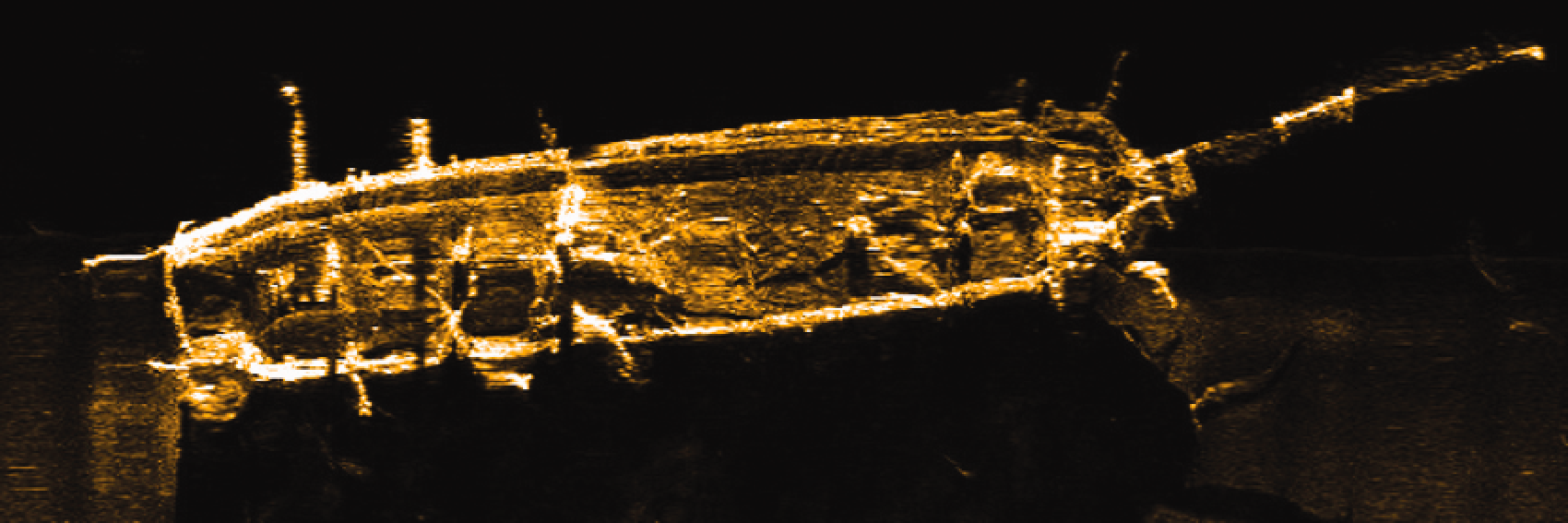
Sonar image of the HMS Terror. Source: (Parks Canada, 2017) .
As mentioned prior, when the exhibition was first planned, only HMS Erebus had been found. In the midst of its preparation, however, HMS Terror was located too, and the museum’s staff had to quickly adapt. Considering the duration of their absence, the ships’ sudden presence has led to a range of processes gaining unexpected speed beyond the museums. In the present, we know that with the ships a range of questions came into view too: to whom did the finds belong? The Canadian Government and Parks Canada? The Government of Nunavut and the Inuit Heritage Trust? Or perhaps British actors, such as the Royal Navy or others (Thorpe, 2017)? Indeed, who are to be credited with the ‘triumphant’ find: governmental actors, private financiers, collaborating partners and/or Inuit who have known the location for decades? The first of these questions was partly answered after two years of negotiations, when the United Kingdom in early 2018 signed over both ships and their contents for co-ownership between the Canadian Government and the Inuit Heritage Trust. However, the news agency The Canadian Press (2018) reports that ‘Britain retains ownership of 65 artefacts already discovered – both on land prior to the discovery of either shipwreck, as well as onboard Erebus itself after it was found in September 2014’, including its ship’s bell. Only vaguely does the news release refer to the negotiations having ‘hit some road blocks that necessitated high-level intervention’ (The Canadian Press, 2018). It is here that we reiterate that these topics were rendered ‘off the record’ or interviews were refused, producing an absent presence in our own account here. What is clear from journalistic accounts of the discovery, however, is that unlike intangible hopes and mysteries, material objects are owned and possessed, even bought and sold or here, ‘gifted’. No longer are social relations performed around what was a shared absence (Hetherington, 2004). In the ships’ materialisation, the relations between those involved in the search altered too: power relations crystallise in the in-between spaces previously occupied only by immaterial and nebulous possibilities.
Just before exiting the exhibition, the display of technological triumphs and ‘evidence’ gave way to a final few items. Behind glass sat a glove with an embroidered heart and a small beaded purse, inviting (or indeed curating) curiosity, prompting new questions in the visitor. On an all-adult and all-male expedition, who brought these items and why? These items open up new mysteries just when science seemed to be answering them all. Many bodies and logbooks remain absent (see Craciun, 2014a). What stories would they tell? And what questions do these new finds ask? Every presence has embedded within it an absence, and every absence carries with it the trace of what is gone. In these two sites, we see how it is through curation, cultivation and technological augmentation that the affective mystery of the Franklin expedition emerges; these practices allow for the simultaneous co-mingling of absence and presence, which is inherent to all things, to be parsed out between the categories of the absent and the present.
Conclusion
We have traced the story of Sir John Franklin’s ‘lost’ expedition in pursuit of the Northwest Passage from, first, its presence to its absence in Victorian Britain and the Arctic; and second, its re-materialisation and presentation in a 2017 British museum exhibition that, in turn, also turns out to be marked by powerful absences. In tracing these changing states of materiality and immateriality, imagination and knowledge, it soon becomes clear that what may seem clear-cut categories of absence and presence, immaterial and material, are far from it in practice. Rather than absence and presence, what we see are practices and processes of becoming-absent (such as sailing away, or moving the goalposts for a mystery to be solved) and becoming-present (such as the production of sonar images or subtitled Inuktitut audio)
In the end, it is the expedition’s disappearance, its ‘Death in the Ice’, that has allowed it to live on in this way, to morph and change through myths and mysterious objects. Perhaps it is only when every mystery of what happened in the ice is ‘solved’, when we have all the ‘evidence’, that Franklin’s ships and crew will finally disappear and be forgotten (see Holloway, 2015). However, as we have shown here – as in the example of the glove – each ‘find’ poses new questions, new mysteries; each presence carries with it the traces of new (or old) absences. Indeed, the very act of questioning whether something is wholly absent is to conjure up a relation to that absence in the present. The case of the 1845 expedition in the Arctic, and its subsequent exhibition in Britain, demonstrates this to be so. And further, it demonstrates the effort that must be made both to presence the absent and to absence the present. This effort – whether by Jane Franklin or by museum staff – is crucial to producing the affective forces that drove explorers to search for the 1845 expedition in the Arctic and that led visitors to the exhibition in Greenwich. The cultivation of mystery requires the right admixture of absence and presence. When that balance is put off, for instance by the discovery of artefacts, it must be set right through the cultivation of new mysteries, the presenting of new absences.
Finally, we have argued that absence and presence (and their various admixtures) are not empirical facts that are easily measured or proven. Rather, they are both equally dependent on the sensibilities of the observer. The labour of balancing absence and presence is paralleled by the labour of cultivating bodily sensibilities, through cultural curation or technological enhancement. Here, for example, we can see the translation work done by Dr John Rae in the Arctic and by staff at the National Maritime Museum, each bringing Inuit oral testimony to European audiences with varying degrees of success (in part because of the receptiveness of the audience).
Our contribution to the literature is necessarily modest given the enormity of the literatures on both the Franklin expedition and on absent presence. To the former, we have contributed by folding – in the vein of the relational museum literature – the expedition artefacts into the curated spaces of the National Maritime Museum. By extending the lost expedition into the present, it becomes possible to understand its polysemy and the indeterminacy of its relations. To the literature on the absent presence, we have added a focus on the processes and practices through which bodies and objects become-absent and become-present. These processes and practices are necessarily corporeal, relating equally to the bodies of explorers like Dr John Rae and Sir Francis McClintock, and to the bodies of everyday museum-goers. Balancing the absent and the present correctly – whatever that might mean in context – is key to unleashing the affects that move people to action. This is a finding that is broadly applicable and may find resonance well beyond the specifics of our research sites.
Footnotes
Acknowledgements
We wish to thank the staff at the National Maritime Museum, Greenwich, and in particular Helen Schulte, for their generous time. We are also grateful for the helpful feedback from Professor Derek McCormack, and from audiences at the 2018 Annual Meeting of the American Association of Geographers (AAG) and at the 2018 Emotions Across the Disciplines-seminar at Oxford Brookes University. Finally, we are indebted to the thoughtful feedback from anonymous peer-reviewers and the journal’s editor.
Declaration of conflicting interests
The author(s) declared no potential conflicts of interest with respect to the research, authorship, and/or publication of this article.
Funding
The author(s) received no financial support for the research, authorship, and/or publication of this article.
