




Abstract
People from all sections of society should feel welcome and included to enjoy greenspaces. However, people from ethnic minority backgrounds may experience exclusionary practices and discriminatory processes, limiting their access, enjoyment, and benefits from such spaces. This paper aims to address these issues through an in-depth qualitative study exploring how 53 individuals from UK ethnic minority backgrounds residing in Bristol perceive and experience exclusion in UK greenspaces. Going beyond narratives that pathologise the exclusion of ethnic minorities from greenspaces, this research reveals a spectrum of experiences related to perceived exclusion, including both positive and negative, and challenges and expressions of empowerment and agency. Common experiences of exclusion are often intangible, necessitating sensitivity to their elusive and relational nature, with variation between urban and rural contexts. Drawing on Bourdieusian theories of practice, this study illuminates how social and cultural capital, habitus, and symbolic violence shape exclusionary practices and discriminatory processes, contributing to feelings of otherness, discomfort among UK ethnic minority group members in greenspaces. By highlighting the diverse nature of these processes and their variations across social and geographic contexts, this study emphasises the need for tailored, coproduced interventions to enhance greenspace accessibility and engagement. It advocates for recognising diverse experiences, integrating critical thought into environmental planning, and leveraging social and cultural capital to promote inclusivity and address systemic inequalities.
Introduction
Greenspaces, defined as ‘all green open spaces in and around towns and cities, as well as the countryside and coastline’ (Natural England, 2017b), have the potential to improve people's health and wellbeing (Lovell et al., 2018; Twohig-Bennett and Jones, 2018). They have been shown to reduce stress, improve mental health, increase physical activity, and foster social interaction (Enssle and Kabisch, 2020). However, access remains inequitable, with UK ethnic minority individuals consistently reporting lower greenspace visitation than their White counterparts. Recent statistics demonstrate this persistent trend: White adults report more frequent visits to green spaces, while Black or Black British adults are most likely to report no visits within 14-day or yearly periods. Additionally, White and Mixed ethnicity adults view these visits as routine, whereas Asian or Asian British and Black or Black British adults typically consider them exceptional (IFF Research, 2023; Natural England, 2017a).
UK ethnic minorities face multiple intersecting barriers to greenspace access (IFF Research, 2023; Rishbeth et al., 2022; Robinson et al., 2022). These include structural inequalities, such as higher likelihood of residing in areas with poor quality greenspaces (Astell-Burt et al., 2014; Rigolon, 2016; Robinson et al., 2022), and systemic biases in design and planning that privilege White British users (Snaith and Odedun, 2023: 1). Additionally, in-moment acts imposed by fellow users raise concerns about ‘personal security, safety and harm, including anxiety about antisocial behaviour, racism and hate crime’ (Rishbeth et al., 2022: 9). These combined barriers manifest as both direct and indirect discrimination, cultivating feelings of exclusion and out-of-placeness (Robinson et al., 2022; Ward et al., 2023), ultimately leading to greenspace avoidance (Cronin-de-Chavez et al., 2019; Ward et al., 2023).
In this study, we explore the experiences of people from UK ethnic minority groups. 1 Our aim is to understand the various ways exclusion may be experienced by these individuals and, in doing so, contribute to wider understandings of nature engagement. Introducing the concept of perceived exclusion – which encompasses both subjective perceptions and tangible experiences of exclusionary practices, discriminatory processes, and feelings of otherness and discomfort – we seek to inform more equitable and accessible greenspace planning and management. By highlighting these processes and their effect on individuals, we aim to provide a more nuanced understanding of inclusivity within the realms of nature, health and wellbeing, and environmental justice.
In the following section, we outline our theoretical framework, before drawing on relevant literature on the processes and experiences of inclusion and exclusion (in both urban and non-urban greenspace settings). We then present the conceptual framing and methodological aspects of the paper, followed by an empirical examination of the role of context, capital, and background in positive experiences; the nuanced and differentiated nature of exclusion within greenspaces; and the examples of empowerment and agency demonstrated in overcoming these obstacles. We conclude by reflecting on the relevance of our findings for broader academic discussions as well as their implications for policy and practice.
Understanding greenspace and inclusion/exclusion
This study develops on Bourdieu's (1986) theory of practice – a framing which has been proposed as a way to analyse the dynamics of social interactions and power relations within specific contexts, particularly in understanding how individuals navigate and leverage their resources in various social fields (Silva and Warde, 2010). Bourdieu and Passeron (1977) identify the connections between structural conditions at the macro level and individual actions at the micro level. This is especially relevant concerning the (re)production of practices, behaviours, tastes, and values, through the concepts of habitus, field, and capital (Maton, 2012). Field refers to social structures, such as those that operate in greenspaces, which have unspoken regulations where individuals compete for various types of assets. Capital encompasses three forms – social (networks and affiliations), cultural (knowledge, language, preferences), and economic (financial and material assets) – all of which facilitate navigation within these fields. Habitus is ‘a way of being’, encompassing subconscious attitudes, perceptions, and behaviours within fields. These forms of capital can be transformed through symbolic capital, a socially recognised type of capital often seen as prestige or social standing, which plays a crucial role in navigating and influencing the field.
This Bourdieusian thinking is useful in inclusivity research because it enables situating individual stories within wider historical, social, and political settings as well as revealing connections to, and perceptions of greenspaces (Palmer et al., 2023; Phoenix et al., 2021). It has also been argued that these concepts are useful in understanding and recognising the interconnected nature of social categorisations such as race, class, and gender, that is, Crenshaw's concept of (1991) ‘intersectionality’ (see Kilvington-Dowd and Robertson, 2020). Most studies using a Bourdieusian framing have focused on habitus and cultural capital, but we also draw on Bourdieu's symbolic violence, a concept instructive for understanding the ways in which actors reproduce social hierarchies and domination through covert or tacit strategies. For example, White men have been theorised to use their capital to construct women and African Americans as ‘inauthentic and illegitimate’ in order to maintain their own superiority in the field of recreational hunting (Lee et al., 2014: 319).
Perceived exclusion in urban settings: The importance of social capital
Urban greenspaces can serve as convivial, multicultural arenas for meeting people and sharing practices (Neal et al., 2015). These spaces offer practical wellbeing benefits for diverse communities, particularly those with high populations of ethnic minority groups (Edwards et al., 2022b). However, these spaces can also become sites of power struggles and cultural contests (Byrne, 2012), leading to differential participation, visitation, and experiences of discrimination (Gobster, 2002). In this context, social capital – defined as the resources linked to a group (Bourdieu, 1986) – can play a crucial role in mediating perceptions of exclusion and experiences of discrimination. Higher social capital, for example, is often associated with reduced feelings of alienation and discrimination (Heim et al., 2011; Pradana et al., 2022). However, the extent to which social capital and cohesion is experienced depends on specific ethnic and cultural mix and levels of segregation (Laurence, 2016).
Research in the UK indicates that ethnic minority groups encounter varied experiences regarding their access to and enjoyment of greenspaces, especially in low-income areas where infrastructural issues are prevalent. These challenges can be compounded by experiential barriers, including safety concerns and fears of crime and discrimination (Cronin-de-Chavez et al., 2019; Ward et al., 2023). Byrne (2012) highlights how these factors, including historical displacements and lack of safety measures, contribute to social exclusion and perceived discrimination in urban greenspaces. This theme is further explored by Harris et al. (2020), who note how gentrification processes can exacerbate conflicts and discrimination, leaving specific groups, i.e., Latinx users, excluded from decision-making processes or facing micro-aggressions.
The pattern of exclusion is also highlighted in a pivotal study by Glover (2004), who reveals accounts of African Americans facing barriers in community gardening initiatives due to unequal access to social capital, a disparity rooted in historical racial inequalities. Similarly, Fernandez et al. (2021) discuss how social status can manifest as symbolic violence, with environmentalists and conservationists exerting power over Latinx communities through ‘greensplaining’ – a hegemonic narrative disguised as local knowledge. In this example, residents’ concerns regarding a proposed trail were often dismissed through power asymmetries and the use of scientific research to assert authority.
Despite these contested dynamics, there are also signs that intergroup contact (Allport, 1954; Pettigrew and Tropp, 2006) can reduce conflict between ethnic and racial groups by fostering positive interactions (Peters et al., 2010; Powers et al., 2022). Yet, this research is still growing with differing findings suggesting that researchers might be better focusing on the broader context and enhancing the overall quality of greenspaces and addressing environmental social justice, rather than promoting social mixing in ‘unequal social circumstances’ (Mullenbach et al., 2022: 463).
Perceived exclusion in non-urban greenspace settings
Non-urban greenspaces 2 have been places of lower visitation for ethnic minorities in Western countries (Natural England, 2019; Schipperijn et al., 2010). Scholars have explored several hypotheses to understand this disparity with Washburne's (1978) seminal work introducing the idea that minority groups in the USA might be excluded through marginality or ethnicity (also see Floyd, 1998). Later work added that discrimination may also play a role in this under-representation (see Krymkowski et al., 2014 for a review of this literature). In considering perceived exclusion, we observe these as explanations interacting and reinforcing each other. Marginalisation in society, stemming from socio-economic disadvantages or feelings of displacement due to cultural disparities and minority status, might manifest in sensations of discomfort or alienation (Cloke, 2013; Isopahkala-Bouret et al., 2023). One example is how the UK's national parks are often perceived as White, monocultural spaces restricting access ‘both physically and emotionally’ (Askins, 2009: 365). For example, in contrast to the familiarity and practicality of greenspaces in urban areas, where most ethnic minority groups tend to live (ONS, 2022), non-urban greenspaces may be less known and harder to get to (Edge et al., 2023; Phillips et al., 2022). This narrative, however, may reinforce this exclusion by overlooking the experiences of ethnic minority groups who occupy rural towns and enjoy non-urban greenspace (Agyeman, 1990; Agyeman and Spooner, 1997; Askins, 2006).
The application of Bourdieusian concepts to outdoor leisure research has primarily focused on the USA. For instance, Erickson et al. (2009) highlighted how historical exclusion, segregation, and racism affected African American visitors at a national park. Participants reported that the spectre of racial tensions and institutional racism limited their visitation, created safety concerns and a reluctance to venture outside their ‘comfort zones’. This finding supports Lee and Scott's (2016) discovery that racial conflict and power imbalances can foster scepticism about inclusiveness among African American visitors, i.e., shaping their habitus (Bourdieu, 1984). Participants noted that cultural differences contributed to their disinterest in such spaces, while institutional racism further influenced their habitus. This was reflected in the lack of attractions related to slavery history, which participants expressed interest in. Although the USA and UK have distinct systems of oppression (Uslaner, 2011), a parallel can be drawn here where connections between country estates and historical slavery are often obscured (Fowler, 2024; Moody and Small, 2019: 1).
Perceived exclusion for outsiders and newcomers: Displaced capital
When an individual's habitus is mismatched with the requirements of a new setting, it can lead to a sensation of feeling like ‘a fish out of water’ (Wacquant and Bourdieu, 1992: 127). This experience can also be pronounced among specific religious or cultural groups and migrant populations. Horolets et al. (2019) detail such experiences during migrants’ transitions from rural to urban settings where previous practices and social and nature-related cultural capital were not readily transferable. The way that migrants struggled to adapt their previous rural nature practices (social and familial) to urban greenspaces illustrates the friction between different habitus and the fields they attempt to navigate. This is further complicated by negative encounters and discrimination, illustrating how the field's power dynamics and rules govern interactions and access to capital. Through a Bourdieusian lens, the alteration of their field's norms and regulations can result in the devaluation of a person's cultural capital, leading to discomfort and a sense of otherness (Bourdieu, 2000: 160).
The experience of discrimination or exclusion can be difficult to capture due to the influence of broader processes of exclusion. Kloek et al. (2015) discovered that Dutch non-immigrants reported higher instances of discrimination in leisure settings than Turkish and Chinese immigrants, alongside a greater fear of discrimination among Turkish immigrants. The authors speculate that the lower reporting of discrimination might reflect both the normalisation of such experiences and self-censorship among marginalised groups, a phenomenon Collins (2000) identifies through her work on internalised oppression and Crenshaw (1991) through intersectional power dynamics. Interpreted through the lens of symbolic violence, dominant cultural norms and values are imposed upon certain groups through the construction of symbolic realms leading to some individuals accepting or justifying their own discrimination (Kloek et al., 2015).
Building on this understanding of symbolic violence, the heightened visibility and discrimination faced by Muslim people living in non-Muslim countries underscores the operation of symbolic power within social fields. The political significations of skin colour and religious attire are said to act as markers of difference and become symbols of exclusion, power or marginalisation (Askins, 2006; Babakhani, 2024). Chatterjee (2020) argues that Islamophobic narratives in Western countries point to a process of the Muslim habitus, portrayed through brownness, movement, hygiene, eating habits, and prayer rituals, being ‘disembodied’ through disempowerment, alienation and annihilation. This disembodiment helps explain the exclusion that some Muslim people face in greenspaces and in public life, such as illustrated through the elevated discrimination faced in leisure settings by Muslims living in the West following the 9/11 terror attacks (Livengood and Stodolska, 2004).
Bourdieu's theories have faced critique for portraying marginalised groups as passive social actors (Garrett, 2007; Tulle, 2007) which includes symbolic violence, and it's seeming complicity between victims and agents (Bourdieu, 2001: 246). It has also been highlighted how other people engage in confrontation and resistance (Kloek et al., 2013; Nayak, 2017). In response, Yosso (2005) shifted Bourdieusian thinking toward these resistances and positive assets within communities pointing to their expressions of unique social and cultural capital (i.e., knowledge, talents, capabilities, and connections). Wallace's (2017) work on Black cultural capital further enriches this discussion by highlighting the specific cultural practices, values, and knowledge systems that Black communities cultivate in response to systemic marginalisation. Bourdieu was largely silent on race but Wallace emphasises that Black cultural capital is a source of empowerment and identity formation which extends to how divergent forms of capital contribute to the resilience and empowerment of marginalised communities – something illustrated by Sierra Leonean parents in the context of UK outdoor education (Cook, 2021).
Methodology
Setting
The research was conducted in Bristol, UK, a city known for, and which celebrates, its diverse population, representing numerous countries, religions, and languages (Bristol.GOV.UK, 2023). The city has links to the transatlantic slave trade, which is evident in the names of various buildings throughout the city. In 2020, a statue of the slaver Edward Colston was toppled, defaced, and thrown into Bristol's harbour, sparking discussions about the city's past and its ongoing efforts towards reconciliation and social justice (Collett, 2023).
Recruitment
We aimed to include individuals from various UK ethnic minority backgrounds 3 to explore the diversity of experiences within these groups and uncover processes of exclusion that derive from greenspaces being perceived as (un)welcoming due to their socio-political context. The strategy involved online recruitment, community group attendance, and door knocking. We also asked participants to refer other potential participants to expand the sample size (Raifman et al., 2022). By adopting the approach of not focusing exclusively on one ethnic group, we are able to identify broad trends as well as individualised experiences, and caveats and frictions within the data, thereby increasing depth and contextuality (Arday and Jones, 2022; Coombs, 2017). To ascertain the composition of our sample and inform our ongoing recruitment, a short survey was used to gather consent 4 and demographic information, and an approximation of the participants’ visitation frequency to greenspace (adapted from the Natural England (2023) People and Nature Survey).
Online recruitment involved promoting the research in collaboration with community centres and groups on Facebook, and direct messaging members of the community with links to ethnic minority groups. Community group attendance involved spending time at community centres in Bristol, and providing flyers. The door knocking strategy was adapted from Davies (2011) and involved 2 days of knocking on doors in the Ashley and Lawrence Hill wards of Bristol to recruit participants. Both areas have a high population of ethnic minority residents, and have poor access to quality greenspace (assessed, using Natural England's GI Infrastructure Mapping tool, Natural England, 2021). This strategy sought to reach participants who visited greenspace less frequently and diversify our sample in response to the implicitly self-selecting nature of the research. Participants were reimbursed with a choice of £20 via bank transfer, voucher, or charity donation.
Data collection
Semi-structured interviews were conducted with 53 participants from various ethnicities, including African, Asian, Arab, Caribbean, and Mixed backgrounds (see Table 1). This was an effective method of generating in-depth insight into the experiences of participants and overcoming barriers that might exist within quantitative methodologies (see Tillman, 2002). Interviews were conducted through ‘Zoom’ (13), via telephone (12), or in-person (28), with some participants choosing to be interviewed within small groups. Pre-arranged interviews were generally between 30 and 60 minutes, while the ad-lib, in-person interviews were expectedly shorter (Fillone and Mateo-Babiano, 2018).
Participant characteristics.
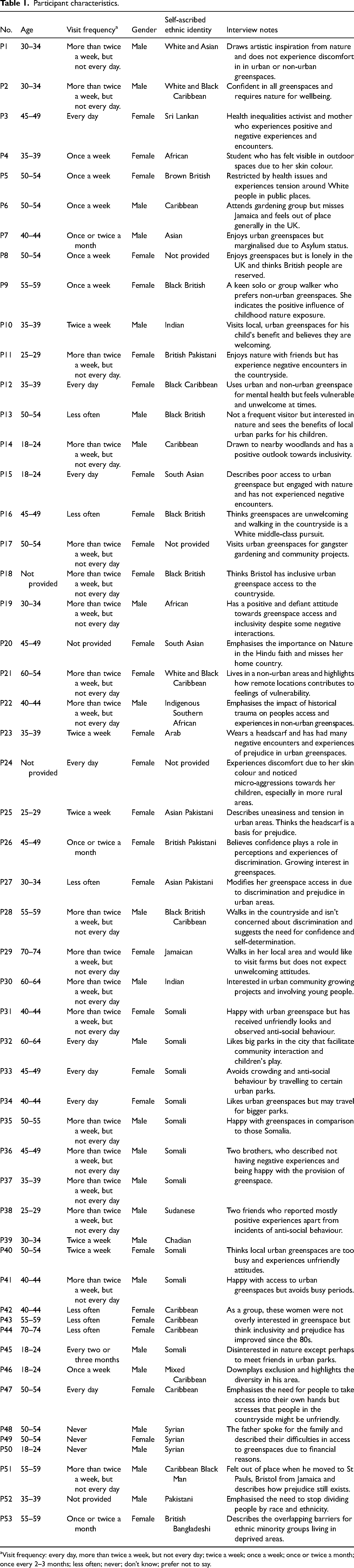
Visit frequency: every day, more than twice a week, but not every day; twice a week; once a week; once or twice a month; once every 2–3 months; less often; never; don’t know; prefer not to say.
Interview themes involved the participants’ access and engagement with greenspaces and their feelings towards the topic of perceptions of inclusion/exclusion in urban and non-urban settings. Each interview started with a discussion about their greenspace practices, including where they visited, and if they visited both urban and non-urban settings. To address the subjectivity in understandings of greenspace (Taylor and Hochuli, 2017), participants were provided with Natural England's (2017b) definition of ‘all green open spaces in and around towns and cities, as well as the countryside and coastline’.
Analysis
The transcripts were analysed following Braun and Clarke's (2006) six-step reflexive thematic analysis: (a) familiarisation; (b) open coding; (c) generating initial themes; (d) developing and reviewing themes; (e) refining, defining and naming themes; and (f) writing for analysis. During this procedure, NVivo 12 was used for manual analysis which was underpinned by constructionist epistemology, recognising the bidirectional nature and importance of language and experience (Byrne, 2022). This led to identifying both surface level codes and deeper level themes which proved to be meaningful, interpretive, accounts of the participants’ experiences (Braun and Clarke, 2019). The themes and quotes were subsequently compared with concepts derived from the literature on the theory of practice. Our analysis is further enriched by incorporating biographical details and interview insights in Table 1.
Positionality
Reflecting on, and documenting, positionality is central to acknowledging and addressing power dynamics within research processes and understanding how researcher identity shapes knowledge production (Collins, 2015). Data were collected by the lead author, and they offer, here, the following statement on positionality. I conducted the data collection and analysis as an early career researcher, who identifies as a White British male. This intersection of identities carries significant systemic advantages that inevitably shaped the research process and how my academic authority was perceived and received. While my working-class background initially led me to think my sensation of being an outsider in academia would help me connect with participants, the reality proved more complex. My associations with Natural England and The University of Liverpool, led to perceptions of me as someone of higher social status, highlighting the differential between my position and that of respondents who may experience marginalisation through the intersections of ethnicity, skin colour and gender. This experience was at times offsetting, instilling a sense of vulnerability in me, which informed the power dynamics within the interviews. I often felt indebted to the participants, recognising that my ethnic identity positioned me as an outsider, without right to comment on the issue. While the fieldwork was constructive, with participants sharing their experiences in detail and at times creating emotional resonance, some participants may have withheld thoughts and feelings, whether due to politeness or to avoid portraying my ethnic group as antagonists (Miles et al., 2022). This became evident in one instance, where a participant thanked me for enquiring about the experiences of the Islamic community in reference to wearing a headscarf – indicating their uncertainty about discussing this topic freely.
Upon joining the project, which was originally more positivistic, I was aware of my limited experience in this area. I engaged with literature on race and ethnicity, environmental justice, cultural sensitivity and decolonising perspectives which led me to prioritise a more inductive and qualitative approach, emphasising depth, variation, and contextuality over generalisability. I also aimed to develop co-productive relationships with community organisations in order to curate a more balanced research methodology. However, this proved challenging as organisations were reluctant to establish new research partnerships. This reluctance likely reflected limited perceived benefits, and concerns about extractive research practices that have historically characterised academic engagement with minority communities (Gaudry, 2011).
During the analysis, I maintained a responsibility to provide an authentic account of participants’ expressions, regularly questioning whether my interpretations fairly represented their experiences. While I strived to attune to participants’ lived experiences, I acknowledge that my understanding may remain inherently limited, or miss nuance, as I do not face the same structural and gendered barriers that shape their daily interactions with greenspaces. For example, not only is my ethnic and cultural background different but I grew up with considerable access to rural greenspaces and coastline which has shaped my individualised conceptualisation of ‘nature’, and I do not feel uncomfortable or out of place due to identity markers such as skin colour. This reflexivity was also crucial when introducing theoretical concepts – a process that I felt could risk compromising the authenticity of the research. Recognising the limitations of my own perspective, I invited a subject specialist (who identifies as British born, Nigerian-Igbo indigene) to collaborate as a co-author. Their expertise, along with participant feedback sessions, 5 has enriched the analysis and interpretation, helping to ensure the research better serves its intended purpose.
Findings and discussion
The following sections examine three empirical categories identified in our analysis (see Figure 1), which covered a mix of positive experiences in greenspaces; perceived exclusion and symbolic violence; and empowerment and agency in human–environment interactions. We will now further elucidate these themes within the context of our theoretical framework.
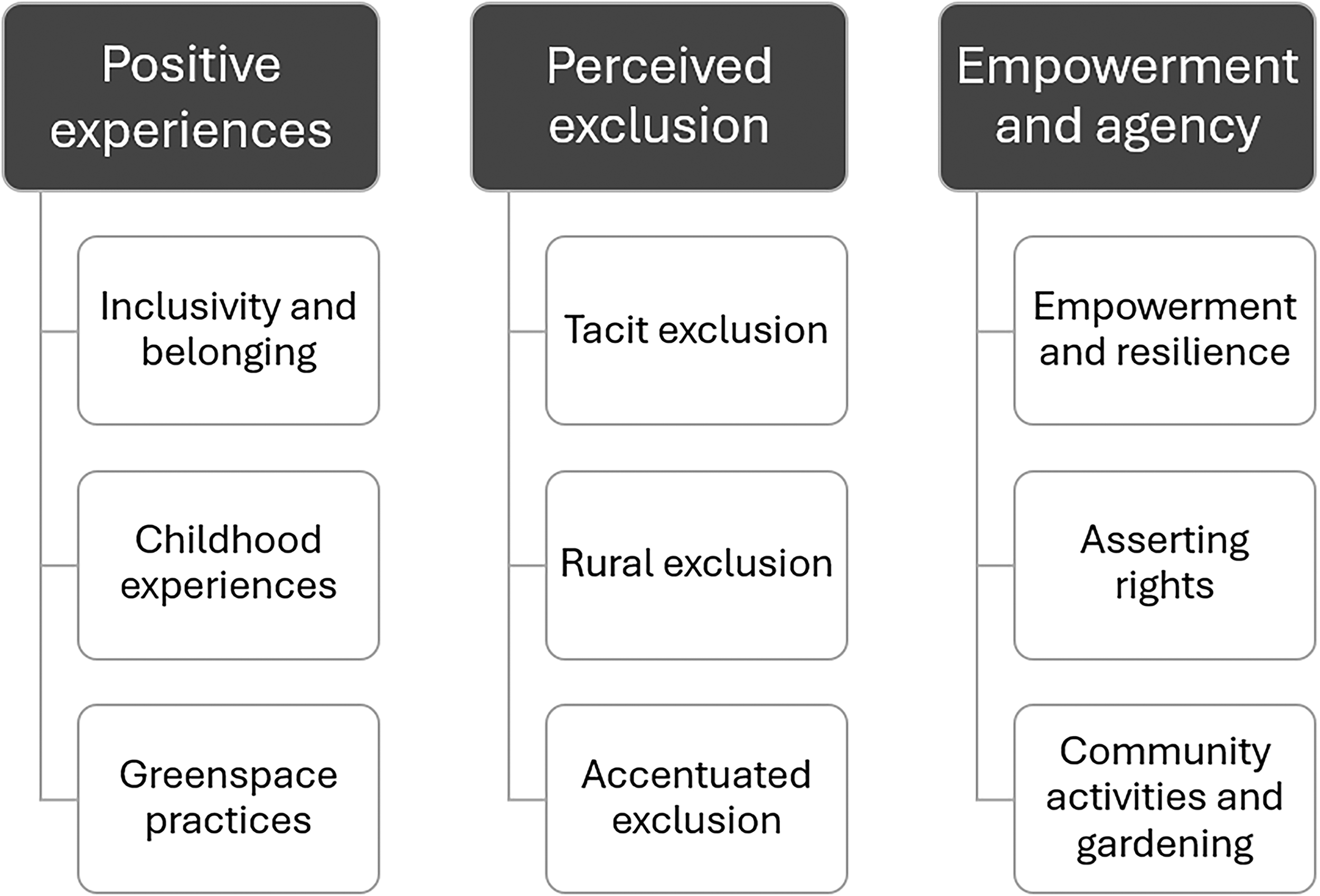
Visualisation of the empirical themes.
Positive greenspace experiences: Context, capital, and background
A first emerging theme from interviews was the positive experiences of the participants in relation to greenspaces. These perspectives represented over half of the participants and are significant in challenging the notion of exclusion often depicted in the greenspace literature concerning UK ethnic minorities. Within this theme, we note the importance of context, capital, and background, setting the stage for a more nuanced discussion of perceived exclusion as we explore the subsequent empirical categories. The responses provided below, for example, constitute a starting point for our analysis in illustrating how greenspaces were seen as being inclusive places, where many participants belonged and could pursue health and wellbeing motives: I haven't experienced any uncomfortable feeling or anything […]. Everything is open to be honest […] You don't feel unwelcome anywhere, to be honest, not in open spaces, at least. (P10) I've never felt there's nowhere you can't go that's not inclusive. (P18)
These accounts were mainly representative of the participants when considering urban, and to a lesser extent non-urban settings, which as we discuss in the second empirical category, could be associated with more discomfort. In reflecting on these positive experiences, UK ethnic minorities should not simply be assumed to be ‘in deficit’ as has been a critique of Bourdieusian notions of capital (Yosso, 2005). Several of these participants shared insight into their lives as they spoke with fondness and enthusiasm when reflecting on their practices: ‘I’ll literally be there [nearby woods] for hours, literally, I love nature’ (P19) which occurred in a city often described by the participants by its ‘greenness’ and accessibility: ‘there's so many greenspaces, there's parks, rivers […] all sorts of places you can access’ (P2). Drawing from these insights, we not only observe the diverse experiences of perceived exclusion but contribute to research illustrating the similarities across ethnicities in respect to the way in which people derived benefits from nature (Edwards et al., 2022b).
While it is important to recognise that some participants simply did not have, or downplayed, negative greenspace experiences (Kloek et al., 2015; Miles et al., 2022), several participants acknowledged that the context has a bearing on the extent to which they might feel comfortable. Wacquant and Bourdieu's (1992: 127) metaphor of feeling like ‘fish out of water’ encapsulates the entwined nature of cultural capital, context, and social fields, and the disconcerting sensation that one might experience. The two quotes below highlight this interface, demonstrating how cultural capital might play a role in their confidence, enjoyment, and perceptions of exclusion: […] any open, free public spaces, I never, never shy away from going to those sorts of spaces and have never been put off about being there. It's an open public space, so anyone can be there, you know, if it was like a classical concert, a Beethoven concert and I rocked up in the middle of, you know, I don't know in the middle of flippin’ London somewhere you may feel a little bit different, but the public open spaces, they're open and free to everybody. (P2) I've had some beautiful experiences and felt safe and welcomed [outside the city] but I do find that if I go to some rural areas, I feel a little bit uncomfortable. You know “Oooh Arr, my land!” but that might be my perception. I don't know if that's always true…. (P17)
The above quotes offer insight into the variation in perceptions of inclusion/exclusion, which in turn goes beyond binary ways of thinking in relation to ethnicity and exclusion. Adding to these variations, the individual's background was also important which, as we now discuss, was tied to their positive experience in greenspaces. Several participants referred to how their childhood experiences and access to nature in non-urban areas furnished them confidence in greenspaces in their adult lives. This supports Bourdieu's (1984) observation on the importance of formative experiences and the accumulation of cultural capital to navigate certain fields. P1, for example, associates his current feeling of comfort in the countryside, with his early exposure: I think because I was exposed to that from such a young age and I was in living in such a rural area, it was almost impossible for me not to be kind of comfortable around that because it's all I've ever known. (P1)
While we do not imply that early exposure to greenspace prevents discrimination and experiential barriers later in life, nor infer that cultural capital serves to erode systemic exclusionary practices, our findings suggest that paying close attention to nature-related cultural capital offers more flexible thinking tools in the field of greenspace experiences and under-representation. We concur with the suggestion by Horolets et al. (2019: 313) that ‘embodied and emplaced skills of using nature should be incorporated in the notion of cultural capital’ to better understand contextual variations and feelings of otherness.
Related research has also highlighted the positive associations between childhood exposure to ‘nature connectedness’ and visiting in adulthood (Stehl et al., 2024). While these associations have not been explored in the context of inequality and under-representation, this research does complement the idea that the transmission of cultural capital occurs through children's access to resources and experiences (Bourdieu and Passeron, 1977). These formative experiences may also be equated with sports and other activities too – several participants pointed to the importance of activities such as team sports or being active and learning emplaced skills irrespective of the conceptualisation of ‘greenspace’: […] loads of kids just go to a park just to play football. We don't think about it as being a greenspace. And so it's is more about that, having an awesome thing to do when they are there to enjoy, and even like sourcing their own food and all these things, you know, and I think if we instil things from a young age as well, there's a lack of in the culture, it seems instilled from a young age, whether it's Black or White, or whatever, then I think they're more inclined to do it. (P13)
Such examples hint at the basis to engender positive greenspace experiences and highlight the need to recognise the plural and fluid constructions of ‘identity-in-context’ such as nature-based identities (Kloek et al., 2013). It also aligns with research describing the importance of including broader constructions of nature engagement and utilising various ‘entry points to engagement’ to facilitate confidence, increase positive experiences, and build nature-related cultural capital (Waite et al., 2023). These examples suggest that cultural capital is important in our understanding of perceived exclusion. Yet, our interviews also revealed the significance of ethnic diversity and social ties within urban settings, pointing to the importance of considering social capital along with the relative normativity of whiteness between social and geographic contexts, and differences in micro and macro fields. Examples of these insights often involved participants describing themselves as ‘not being in a minority’ (P13) when referring to urban spaces. Participant 16 articulates this perspective in a discussion of her previous negative experiences in a non-urban area and the discussion of people being excluded or made to feel uncomfortable locally due to cultural differences: I don't want to say I feel like I'm being held back or anything like that because I tend to be around my own people. So, I don't really experience that. So, no, I don't feel like I'm being held back in that sense. (P16)
In such cases, it was apparent that social networks and affiliations – that is, social capital (Bourdieu, 2006: 105–106) were important – echoing research highlighting the importance of representation in nature and inclusivity contexts more generally (Cook, 2021; Rishbeth et al., 2022; Yosso, 2005). In our study, Bristol's appeal to participants was often in its ethnic and cultural diversity, which had the effect of making the sense of being a minority a distant feeling when living among vibrant and multi-cultural communities. Below, participant 46, who lives in an inner-city area of Bristol, illustrates the perception that urban greenspaces are diverse and free from exclusionary practices, meanwhile alluding to the comparative differences across social classes and urban–rural contexts: I always assumed it was [White people that were] more a minority of people going into these places. I'll be honest, it's definitely, definitely round here as well. I rarely see like, for example, just White people just being the main dominator in parks and stuff like that here. The adventure playground is literally a very, very, very cultural place. Yeah, it's literally run by a lot of cultural people. So, of course when we go to like rural areas like Paulton, it's almost 100% White. (P46)
As intimated by P46, there are differences between contexts and the role that ethnicity and social composition play in comfort or discomfort experienced in greenspaces – urban greenspaces (micro fields) may cater for minorities, while simultaneously being overshadowed by the exclusivity and whiteness of greenspaces generally (macro fields) which may narrow their options. We draw a comparison here to Evers’ (2008: 412) concept of ‘safety maps’, which speaks to how ‘safety works in an everyday context as a complex embodied, social, and spatial practice’. These maps draw on diverse discourses including gender, ethnicity, and culture to assess and navigate possible dangers or threats, and sensing comfort in some places, while avoiding others. This was true in our study, where the degree of comfort and ‘right to be there’ was reflected spatially, between urban–rural contexts.
Our findings, then, direct attention to the importance of recognising the diverse forms of social capital that may be at work and how this may fit in with the discourse around these cultural contests in greenspaces (cf. Snaith and Odedun, 2023) – our observations show that there are positive assets, such as social and cultural capital possessed by the participants which also contribute to these understandings of greenspaces. In noting themes of safety, inclusivity, and ownership, the observations reveal how narratives of domination and exclusion may have limited explanatory power in these contexts, and that we need to recognise the potential of social capital to disrupt and subvert these – a theme that we return to in the third empirical category of this paper.
Perceived exclusion and symbolic violence
The previous section considered how positive experiences of greenspaces are influenced by context, capital, and backgrounds (cf. Bourdieu, 1984). In the following sections we consider more negative experiences of perceived exclusion (subjective perceptions and tangible experiences of exclusionary practices, discriminatory processes, and feelings of otherness and discomfort). These negative interactions and experiences in greenspace were relayed by around half of the participants and can be categorised into three sub-themes: tacit exclusion; rural exclusion; and accentuated exclusion in the case of Muslim women.
Tacit exclusion and feelings of otherness
The most common negative experiences reported by respondents were those which might be classified as tacit exclusion – which fell short of overt hostility but included incidences such as unfriendly looks or intrusive questions which can be understood as manifestations of societal racialisation. During her interview, participant 12 indicated that her skin colour played a role in this insecurity. Below, she describes a kind of inner-dialogue and process that she goes through when encountering perceived unfriendliness, particularly in non-urban greenspaces: A couple of times, and I've been walking on my own, I've said hello to the people I'm walking towards. And it's just a total blank of, you know, you're not even there, and in fact, it's quite impossible to not know that I'm not there […] You know, sometimes I've had looks where it's, it's a kind of aggressive look, or a look of what's the word, maybe disgust I don't know, but I kind of sometimes I rationalise that and say maybe that, you know, it's just my perception. I don't know what's going on for that person but it doesn't make me feel comfortable sometimes […] But I think hello or just acknowledge another person, it's not so far out of my capability, why not? But then when people don't do that, it just makes me feel… it's actually makes you feel upset at the moment when I'm talking about it now. (P12)
Participant 12's experience reflects how exclusion operates through multiple, intersecting power domains (Collins, 2000). Her sense of insecurity stems not merely from individual interactions, but from the convergence of different practices, cultural narratives about belonging, and everyday manifestations of racialisation in these spaces. Previous work has also illustrated how people may not directly encounter prejudice in greenspaces but ‘feel it’ (Ward et al., 2023). These micro-aggressions, whether perceived or actual, can have a significant impact on individuals experiences of place (Peterson, 2020), as we can see in the emotional account by participant 12. Central to these micro-aggressions are power asymmetries which might be seen as an example of what Bourdieu (1977, 1990) refers to as symbolic violence – where the dominant group uses tacit strategies to exclude those who do not fit the dominant cultural norm. As Lee et al. (2014: 317) explain, ‘the dominant social groups establish social hierarchies by justifying their distinctive dispositions and cultural tastes as superior in quality, thereby distancing themselves from others’. Below, participant 23, who mainly visits urban ‘multicultural places’, perceives this symbolic dominance in the way that White people hold an unpleasant superiority in these spaces based on skin colour and cultural differences. This perspective is complemented by participant 19 who describes how the rules set out by the dominant group exclude those who feel less ownership of the countryside: They look down at us like, “oh my gosh, are you enjoying yourself? Like us?” You know, in that way. And I can see that, like, you know, from the comments, from the looks. (P23) So many rules, like, you know, some people just don't feel comfortable doing it. Especially ethnic minorities, they wouldn't do it. Mainly, because that's not their space. (P19)
These narratives contribute to our broader understanding of why some individuals from ethnic minority backgrounds may avoid certain spaces due to heightened visibility and awareness of being unwelcome (Agyeman, 1990; Finney, 2014). While many of these incidents are rooted in perception and wider experiences, as acknowledged by some participants, differences in social and cultural capital across contexts seem to exacerbate or predispose people to such feelings of discomfort. Our analysis revealed a common thread of encountering prejudice, or feeling othered, in daily life (i.e., non-greenspace) among most participants, often stemming from factors such as skin colour or immigration status. This sense of displacement seemed to be particularly pronounced when individuals were not surrounded by their usual or previously used support networks (e.g., when in White dominated spaces), such as when participant 6 reflected on his everyday experience of otherness: I'm always out of place mate. I'm not with my family […] I’m used to be seeing people like her [points to a Black woman], I'm seeing people like you now. (P6)
These themes indicate the cost in social capital when people are dislocated from their original community and social capital (Bourdieu, 1986) which complements the findings in the next subsection detailing similar processes between local fields.
Rural exclusion
As suggested earlier, there was a rural–urban distinction in the extent to which respondents reported having sufficient contextual social and cultural capital to enable positive greenspace interactions – which is important consider in respect to the different benefits that might be obtained between these contexts (Coldwell and Evans, 2018). Alongside the influences of capital, the intersection of economic and infrastructural barriers – such as travel and entry fees – were among the reasons participants reported as impacting their access to greenspaces in more rural contexts. Moreover, many respondents’ nature-based practices oriented in urban settings rather than rural areas like Areas of Outstanding Natural Beauty. 6 In contrast to urban spaces, which, to some, were perceived as safe and inclusive, rural places were often viewed with less confidence about their inclusivity. These findings are consistent with previous studies demonstrating: the significance of familiarity and proximity in greenspace utilisation, particularly for migrants (Rishbeth and Finney, 2006; e.g., Robinson et al., 2022); the preference for urban vs. rural greenspaces in British contexts (Rishbeth, 2001); and the way ‘meaning’ is construed in particular places through their capacity to maintain social and familial motives – which might be particularly volatile for people moving country (Horolets et al., 2019, 2021; Stodolska et al., 2017).
Although explicit discrimination was relatively rare, there were indirect accounts and anecdotes that contributed to a broader discourse that more rural and lesser-known areas were associated with potential negative experiences and symbolic barriers. For instance, participants shared their experience of not fearing physical harm but feeling guarded against derogatory comments while enjoying nature within rural and less familiar contexts. These dispositions can stem from a heightened vulnerability due to their intersecting identities and is a stark example of the layered nature of systemic exclusion and how it affects everyday experiences and amplifies concerns in rural spaces. Similarly, some participants described them or their family being ‘singled out’ by landowners. In the example below, participant 3 portrays the sense of rurality embodied by actors watching runners in a local half marathon through the countryside: […] and one time I ran through this tiny hamlet that had about four massive houses with a great big like stone columns and Griffins on the posts, and Mercedes Benzes. And there was a group of White people, probably, maybe in their 50 s all out in their barbours with cups of coffee, cheering us on. How lovely… And one of the women called out to me “ohh we don't see many in sarees round here” And you know, I’m in shorts and a T-shirt and a runner number like and all. I mean and I was the only brown skinned person on that run. And so, I stopped, and I ran back, and she ducked behind her friend […]. (P3)
Participant 3's observations show how exclusion may be more explicit and based on physical characteristics, with her appearance opening her to unwanted comments and being unduly socially categorised, which is often triggered in unequal power/status situations (see Kenny and Briner, 2013). Others referred to specific places where this out of placeness was more pronounced to them, with National Trust properties, and associated broader histories of oppression, often featuring within this discussion: […] in a National Trust space, I do feel like I probably stand out quite a bit. My friend who is Black as well. So, we'll go with our children, I do feel like, we're probably generally the only sort of like, the two black pair that are there and that we see. (P4) […] for me the [National Trust] house represents something which is you know, unpleasant, because usually that word came from colonialism and still, so in a way that is a barrier. (P21)
In addition to the social composition of these contexts, mentioned by participant 4, ethnic minority groups often feel conspicuous in these spaces. This sentiment echoes our earlier observations around the available social and cultural capital. Furthermore, these responses highlight how historical legacies can render places exclusionary, affecting perceptions, embodied experiences, and bounded realities. These findings reinforce those from the USA which note that African American's visitation to a state park might partly be explained through such legacies, a lack of relevant cultural attractions, leisure habitus, and symbolic violence (Lee and Scott, 2016). The response of participant 22 expands this discussion of the reproduction of these issues through the hierarchies and ideological conditions that envelope greenspace management and rural areas more broadly in the UK: […] it's a continuation and perpetuation of that same attitude, that same class of groups of owners and at the expense of others, […] it's just now they are more insulated and protected by the different laws and the bylaws that be implemented to benefit them. (P22)
As work elsewhere has noted (Erickson et al., 2009; Lee and Scott, 2016), colonial legacies, for example, may serve to make places exclusionary, and may have a lasting imprint on the British countryside (Fowler, 2024). We would extend these points here in noting that symbolic violence may not be limited to in-the-moment acts, but may play out, as participant 22 suggests, through historical legacies and their material cultures.
Accentuated exclusion: The experiences of Muslim women
While each participant shared unique experiences with greenspaces, Muslim women reported facing specific forms of discrimination tied to the intersection of their religious and gendered identities, highlighting a distinct dimension of exclusion. This illustrates how socio-geographical contexts and visible markers of religious identity might intersect and compound feelings of exclusion. This category doesn’t seek to highlight that Muslim women face more exclusion or marginalisation within greenspace than other minority individuals. Rather it highlights the ‘flavour’ of the exclusion they face, at times differs from the aggregate whole, due to the intersection of religious, gender, and racial minority identity, creating a type of ‘triple jeopardy’ for participants within this small sub-section who introduced their religious affiliation into discussions. Participants described negative interactions in greenspaces such as intrusive questioning, coldness, and racism. Participant 27, for example, who highlighted how enduring exclusion was a regular occurrence for her in greenspaces or during her daily activities, described a time in which her son was excluded in a park by a White woman in an insensitive and brazen manner: She was being so unkind and was being very, very, very racist towards him. She didn't even blink an eye to you know, an apology, when he had tears in his eyes […] I was so upset, but I didn't want to make any scene in the park […] I was also scared to make a scene to be very honest and I hate confronting people […] So I was like “She's like that, just don't go there” and he was like “mama it's a park, I want to go into that ride”. She saw that I kept looking at her, but she had the audacity to look at me in my eyes and still be mean to us. And I was like, “just ignore her just, go on to this side of the park”. (P27)
While accounts such as this were uncommon in the data, these types of experiences were a prominent aspect of these women's experiences and had the effect of impacting their enjoyment and choices regarding greenspaces. This finding reinforces research that demonstrates the different coping strategies that Muslim women deploy in response to discrimination during leisure activities (Hamza et al., 2024; Kloek et al., 2013). For example, these women illustrated how the social environment and the users within greenspaces might influence them to modify or reduce their visit behaviour (habitus): If there will be certain people, people who doesn't make you feel belong or make you feel comfortable you wouldn’t go there, so yes, there are some areas I would say I would not go […] I wouldn't choose to go in that outdoor space. (P25)
Importantly, the above accounts juxtapose against participants’ accounts of largely positive experiences of security in urban greenspaces, demonstrating that while social and cultural capital is felt and extends into some urban greenspaces, its geographical extent may be limited. Here, Muslim women might be at a more complex identity intersection than our other respondents who felt comfortable in urban greenspaces. Muslim women belong to minority ethnicity and religion identity groups and disadvantaged or disempowered by gender – highlighting the subtle yet important need to consider identity intersections when coming up with suitable solutions or strategies to mitigate exclusion and discrimination. Significantly, these participants described the areas where they resided in the south of the city as less diverse than those in the north-east which accurately reflects the cities demography (Bristol.GOV.UK, 2023). Unfortunately, our data is limited in its ability to fully furnish these contextual variations but it does contribute to research demonstrating the variance in how people experience discrimination, for example, such as those living in segregated, high minority share areas who might more-likely experience anti-immigrant sentiment (Borkowska and Laurence, 2024).
Although our sample is modest in scale, an important theme emerged that illustrates the importance of intersectional identities. It appears here that being Muslim and being female is an example of how these intersections can play out in the context of greenspace experiences in the UK. More than participants describing discrimination in their regular activities due to political signifiers such as ethnicity and skin colour (Askins, 2006), for some, their headscarf potently demarcated them and their otherness, and made them more likely to attract negative interactions. The consequences of religious dress reinforce other's findings, highlighting how such experiences might be associated with Islamophobia in Western countries (Chatterjee, 2020; Kloek et al., 2017; Snaith and Odedun, 2023). They also dovetail with research demonstrating that Muslim people often have specific safety concerns regarding discrimination and attack in greenspace settings. Edwards et al. (2022a) found that these safety concerns were accentuated through a lack of ethnic diversity of staff and users in greenspace, or in areas that are more secluded. This finding was also true in the present study, where Muslim participants described their reluctance to use certain pathways in urban areas due to their sense of vulnerability: ‘you feel very uneasy, you just want to run fast through that area’ (P25). Taken together, these findings highlight an important interplay between social and physical dimensions of space and the need to understand how social positioning and power structures influence behaviours, practices, and their perceptions.
Empowerment and agency in human–environment experiences
Our final theme is focused on the ways that the participants respond to, and show defiance towards, discrimination in greenspace contexts, which we conceptualise as empowerment. These attitudes were characterised by a defiance and resilience in respect to the spectre of discrimination and exclusion and underscored the role of self confidence in empowering individuals to overcome challenges and enjoy greenspaces, regardless of potential prejudice. This theme encompasses experiences in urban and non-urban settings, relevant to the participants’ experiences and allows an expansion of the understanding of how specific forms of capital might be harnessed in resisting exclusion. Examples in our data frequently demonstrated this defiant attitude through phrases like ‘I don’t care’ (P24 and P28) or ‘I don’t really let anyone make me feel unwelcome’ (P22) in response to questions regarding discrimination or exclusion. The quote below complements these responses while reflecting participant 19's undeterred attitude, self-belief, and resilience: […] there's no one on earth that, like, make me doubt myself. Just mental growth like, it's the moment you realise, you know, every single person actually goes through that, like, whether your white, black, yellow, pink, wherever, whatever race you are. (P19)
Participant 19 and other responses such as above are typified by a kind of critical consciousness, demonstrating their awareness of social injustices, power dynamics, and systemic barriers within the environment (Freire, 1973). In this case, defiance and resilience are manifested through resistant capital (Yosso, 2005), which brought a challenge to discriminatory practices and destabilising notions of otherness. Participants exhibited resistance in multiple ways. One illustrative example of this was expressed by participant 26, a Muslim woman who, as we have discussed, might be at risk of feeling excluded. She described how her self-confidence was intrinsically linked with her enjoyment of greenspace irrespective of the potential issues regarding her religious dress as the headscarf: I do wear a headscarf and I put on my hair. I personally haven't felt it, but then I'm quite confident in myself. I don't necessarily feel it, but you hear of other people who feel conscious about it. (P26)
Participant 26 was not alone in recognising potential judgments as other participants discussed previously experiencing discomfort in these or other settings. Yet as participant 19 alluded to earlier, the capacity for ‘growth’ and reflexivity in these contexts is reflective of how individual agency can build resilience, as defiance is one of many dispositions and strategies that can empower individuals to navigate and negotiate their social environments (Bell et al., 2014; Telling, 2016; Threadgold and Nilan, 2009). More than heritable disposition through ‘reproduction’, there is individual agency and the possibility to shape these social structures – a somewhat overlooked concept by those who critique Bourdieu (see Telling, 2016). The participants promoted this idea of agency by illustrating that it is ‘down to the individual’ (participants 2 and 47) to assert their right to access greenspaces. In an illustrative example, participant 22, who is involved in community greenspace projects, refers to a growing resistance post-COVID where more people are challenging exclusionary norms and practices: […] and to some degree, they still feel like they are getting othered or they don't belong, but also more and more people are claiming their right to access. (P22)
Accounts such as this regarding access also resonate with new ideas in urban greenspace planning which harness this empowerment and move us from thinking in terms of the individual to the group and its empowerment. Anguelovski et al. (2020) describe various approaches which reflect the ability of minority or marginalised groups to shape socio-spatial practices of well-being and political freedom. They may then challenge historical patterns of disenfranchisement and exclusion from decision-making processes regarding urban green spaces. Individuals and communities, such as those within this study, may draw upon different capital to navigate and challenge discriminatory experiences and be involved in creating inclusive spaces for diverse needs and experiences.
The need for these spaces were accentuated during COVID-19 pandemic with inequities in access accentuated and greenspace practices altered (Burnett et al., 2021; Ugolini et al., 2021). In our data, the disruption of the pandemic seemed to serve as a schism in which collective action could grow. Participants demonstrated how collective action initiatives similar to those to reclaim and remake cities such as Detroit, USA (Anguelovski, 2014). Several participants referenced ‘Gangster Gardening’ – a process whereby communities take the initiative in claiming and transforming normally transient, disused, or neglected spaces through greening, growing, and planting (Graf, 2014). These activities were the theme of a recent film Plant Power (Ayisi, 2023) with residents of St Pauls in Bristol which also featured as a topic of conversation within our interviews: […] they've just taken over spaces, and it's happening all over Bristol […] taking over lands that's normally been used for fly-tipping that being neglected. They've taken it and cleaned it, they dispersed of the rubbish and now they have to start the guerilla/gangster gardening. (P22) I have a little garden or urban area that I've taken over, a bit of gangster gardening by me and my corner, so that gets me out. (P17)
Such examples reaffirm how an individual's practice is produced through an interplay between their dispositions (habitus) and their standing in a particular social domain (capital), within the present circumstances of that social context (field). As noted by participant 17, these new spaces (and their creation) play a significant role in enabling her nature-oriented activities, highlighting their crucial importance to areas with limited access to well-maintained green spaces (cf. Mell and Whitten, 2021) and contributing to social cohesion and adding resilience to communities (Aldrich, 2017; Jamison, 1985).
Conclusions
This study advances theoretical and empirical understandings of inclusion and exclusion in UK greenspaces in several ways. First, it reveals how experiences of exclusion are often intangible and relational, requiring nuanced understanding. Second, by moving beyond deficit-based approaches to examine broader contexts, we demonstrate how various forms of capital offer flexible analytical tools for understanding greenspace experiences and under-representation. These findings illustrate the intersectional nature of social categories (Crenshaw, 1991; Opara et al., 2020) while also their potential for resistance (cf. Wallace, 2017; Yosso, 2005), highlighting how capitals can be transferred across fields to achieve new positions and (re)shape the field. Importantly, we identify the spatiality in these processes, noting how social capital operates differently at macro and micro levels, with exclusion at broader scales often coexisting with inclusion and empowerment in local contexts.
These findings point to several practical interventions for policymakers and practitioners. Central to these recommendations is the integration of social scientists within environmental planning teams, who can facilitate cultural translation and implement truly participatory processes that meaningfully engage un(der)heard voices. While we acknowledge resource constraints, the essential role of social sciences in environmental policy is increasingly recognised (ACCESS, 2024; Morris et al., 2024), and aligns with the UK’s commitments under the Aarhus Convention to ensure public access to information, participation in decision-making, and access to justice on environmental matters (United Nations, 1998).
To enhance accessibility and engagement, we recommend establishing co-produced greenspace management committees with diverse representation and creating cultural liaison roles within park authorities. These initiatives should be supported by community-led activities such as civic gardening programmes (Alaimo et al., 2010), which can build social cohesion while fostering convivial environments. Additionally, mandatory cultural sensitivity training for greenspace staff, multilingual resources, and dedicated spaces for diverse cultural practices can help address barriers to inclusion. Particular attention should be paid to early exposure and youth engagement. This can be achieved through structured family-friendly programmes targeting under-represented communities, partnerships with schools in diverse areas to integrate regular greenspace visits into curricula, and youth ambassador programmes to develop long-term engagement. Supporting intergenerational knowledge-sharing through community mentorship schemes can further strengthen these initiatives and help build lasting connections to greenspace.
These recommendations align with the UK’s Equality Act (2010) and reflect the need for systemic change in how we approach greenspace accessibility and inclusion. By implementing these measures alongside existing environmental management practices, we can work towards creating more equitable and welcoming greenspaces for all communities. Future research should extend Bourdieusian approaches to further challenge deficit thinking (Yosso, 2005) and examine systemic inequalities in environmental planning. This should include investigating (inter)cultural differences across larger geographical areas, examining class–ethnicity intersections in non-urban contexts, and conducting longitudinal studies of childhood socialisation in nature. Particular emphasis should be placed on understanding how early exposure contributes to confidence and ownership in greenspaces, and evaluating the effectiveness of community-led interventions. This research agenda requires sustained engagement between social and environmental sciences to ensure both theoretical advancement and practical impact in fostering more inclusive greenspaces.
Highlights
We explore perceived exclusion in greenspaces in a qualitative study involving people from UK ethnic minority groups.
The findings reveal positive experiences, negative experiences, and attitudes of empowerment and agency in greenspace experiences.
Common experiences of exclusion are often intangible, necessitating sensitivity to their elusive and relational nature.
The paper leverages theories of practice to understand individualised experiences of perceived exclusion.
We discuss the role of social and cultural capital and processes of symbolic violence in shaping these experiences.
Footnotes
Acknowledgements
Deepest thanks to all the participants for contributing their experiences and insights to this study; to the Economic and Social Research Council and Natural England for funding this research; and to the community organisations that helped with introductions in Bristol.
Authors contributions
Andrew K Palmer contributed to conceptualisation; methodology; data collection; analysis; writing–original draft; and writing–review and editing. Mark Riley: conceptualisation; writing–review and editing; and methodology. Sarah Clement contributed to conceptualisation; methodology; and writing–review and editing. Karl L Evans contributed to conceptualisation; methodology; and writing–review and editing. Laurence Jones: conceptualisation; methodology; and writing–review and editing. Beth Brockett: conceptualisation; methodology; and writing–review and editing. Victoria Opara contributed to writing–review and editing; analysis; and interpretation.
Data availability
Due to ethical concerns of maintaining participant confidentiality, the research data supporting this publication are not publicly available.
Consent to participate
All participants provided written consent to take part in this study and for their responses to be published in anonymised form.
Ethical considerations
Ethical approval for this research was granted by the University of Liverpool's, Faculty of Science and Engineering Committee, research ethics approval number: 11121.
Funding
The authors disclosed receipt of the following financial support for the research, authorship, and/or publication of this article: This research originates from an ESRC funded CASE Studentship in collaboration with Natural England, award number: ES/P000665/1.
