




Abstract
Despite being common, the problematization of animals is ill-understood and undertheorized in urban geography. Being problematized has significant implications for animals: not only in how they are subjected to violent disciplinary practices but also in how they are made epistemically visible (or not) as urban subjects. That is, problematization objectifies animals and can contribute to their physical and epistemic in/visibility in cities. One effect of problematization is that it makes some animals visible to the historical record as problems. Consequently, scholars often write urban histories and analyses that reconstitute these animals as problematic objects, failing to recognize that problematization involves multispecies power relations that animals experience. This article offers a theoretical framework for analyzing the problematization of urban animals. It requires understanding problematization as a sociospatial and historical process in which animals come to be discursively constituted as problems in urban regulation, and materially managed as such through disciplinary practices that frequently rely on material and spatial interventions. I argue that a spatial awareness is essential to telling multispecies histories and geographies that attempt to grapple with problematization as a process as well as its impacts on the experiences of animals.
The absence of animals in discourses and thinking about cities is not necessarily benign but could also be thought of, as geographer Chris Philo (1995) suggests, an “antianimal agenda” in which many cities and theorizations of cities are frequently “hostile to the presence of live animals” and encourage “their sociospatial exclusion” (Philo 1995: 664). While questions about biodiversity, climate change, and environmental health are ubiquitous, urban theorists often neglect to account for how multiple animals are urban subjects and have varied experiences of urbanization (Arcari et al., 2021; Barua and Sinha, 2017; Thrift, 2021; Wolch, 1996; Wolch, 2002). For animals, “the city has always been a site of danger, contestation and violence” (Oliver, 2023: 530) and the analytical neglect of animals’ experiences is illustrative of epistemic invisibilities not only in urban theory but also in the acceptance of violence directed at animals (Wadiwel, 2015). Cities are more-than-human, they have always been more-than-human, and to understand how they operate requires paying attention to multispecies processes of urbanization and how they impact multiple species (Brown, 2016).
One principal way animals are managed in cities is as “problems” (Gordon, 2020; Hubbard and Brooks, 2021; Jerolmack, 2008; Narayanan, 2017, Palmer, 2003; Tissot, 2011) so in this article I develop an understanding of problematization as a theoretical and analytical framework that is useful for analyzing urban animals, particularly historical urban animals. I define the problematization of animals as a sociospatial and historical process in which animals come to be discursively constituted as problems in urban regulation, and materially managed as such. I originally developed this framework to understand the historical problematization of cows in Kingston, Ontario, but it can be applied to understanding the urban histories of other animals, possibly even exploring the problematization of animals today.
While investigations into the problematization of animals remain scant in broader urban studies, it has been a popular subject among animal geographers (Narayanan, 2017; Hubbard and Brooks, 2021; Philo, 1995). This is not surprising when one considers the ubiquity with which extermination campaigns are leveled against wild and liminal animals (such as wolves, coyotes, rats, and raccoons) and the near universal removal of some agricultural animals (such as cows, horses, and pigs) from North American cities. From Seattle to San Francisco, New York, Toronto, and Montreal, many domesticated animals have been pushed from urban boundaries using discourses, modes of accumulation, and policies related to modernity, sanitation, and civility (Brown, 2016; Cronon, 1991; Kheraj, 2015; McNeur, 2014; Robichaud, 2019; Thrift, 2021).
Asking about the problematization of animals is a political question about who belongs in cities and who has a right to the city (Hubbard and Brooks, 2021; Shingne, 2022). It is also a multispecies question because animals who disrupt urban imaginaries find themselves in varied states of urban exile, with any existing acceptance precarious at best (Narayanan, 2017; Oliver, 2023). The extent to which problematized animals are removed from or made invisible in cities could be considered indicators of a “successful” governance response to such problematizations. For example, pigeons and pigs have both historically been problematized in New York and have been subjected to eviction campaigns there (Jerolmack, 2008; McNeur, 2014); but these have had varied levels of regulatory “success” because, unlike pigs, pigeons are comparatively more epistemically and physically visible in the city today. Unpacking the reasons and logics that inform and make problematization possible exposes the fault lines of urban imaginaries as well as the ways in which animals are understood relative to cities, and cities relative to animals.
Discussed more later, there are at least three logics used to problematize urban animals: (1) they flout human urban imaginaries, (2) they are entangled with and possibly disrupt human economic objectives, and (3) they are affiliated with other problematized populations or situations. That is, animals who disturb ideas of the city being a modern or human place (Jerolmack, 2008; Philo, 1995; Wolch, 1996), who disrupt economic operations (Benson, 2013; Collard and Dempsey, 2017), and/or who are associated with problematic situations like disease outbreaks (Kheraj, 2017; Lynteris, 2019) might be problematized. Examples include rats who live off city waste (Biehler, 2013, Talton, 2019), monkeys who encroach on urban developments (Yeo and Neo, 2010; Barua and Sinha, 2017), and feral cats who disrupt domestic/wild boundaries (Holmberg, 2017; Lynn et al., 2019; van Patter and Hovorka, 2018).
Building on Michel Foucault, Carol Bacchi (2012: 4) argues that the emergence of problems also makes problematization a useful method of inquiry. For Bacchi (2012), it is not so much a question of what “problems” are but rather a critical inquiring into what problems are represented to be. To access such representations, Bacchi (2012) suggests asking what presuppositions underpin the problematization and the effects such problematization might have. She uses questions such as these to illustrate how policies and governance discussions that provide “solutions” are guided by “deep-seated conceptual logics” that are not merely responsive to problems but constitutive of them. Following Bacchi (2012), if one hopes to understand how animals were historically (and continue to be) problematized it is necessary to analyze how they emerged, or became intelligible, as problems. How rats came to be understood as diseased, monkeys as nuisances, and feral cats as transgressive, for example.
However, where Bacchi (2012) focuses on what problems are represented to be, I join Foucauldian inspired geographers in arguing that to appreciate the material and imaginative effects of problematization also requires thinking about where problematizations take place (Driver, 1993; Legg, 2005; Philo, 2000, 2019). Geographers have argued that Foucault is a spatial analyst whose analytics provide opportunities to explore the tight and mutually reinforcing relationships between discourse, social policy, and material practice (Crampton and Elden, 2007; Driver, 1993; Philo, 2019). Inclusionary and exclusionary geographies are abundant in discursive, material, and institutional attempts to govern (Philo, 2019). The aforementioned rats, monkeys, and cats were problematized in specific cities and particular spatial strategies were used in attempts to manage them.
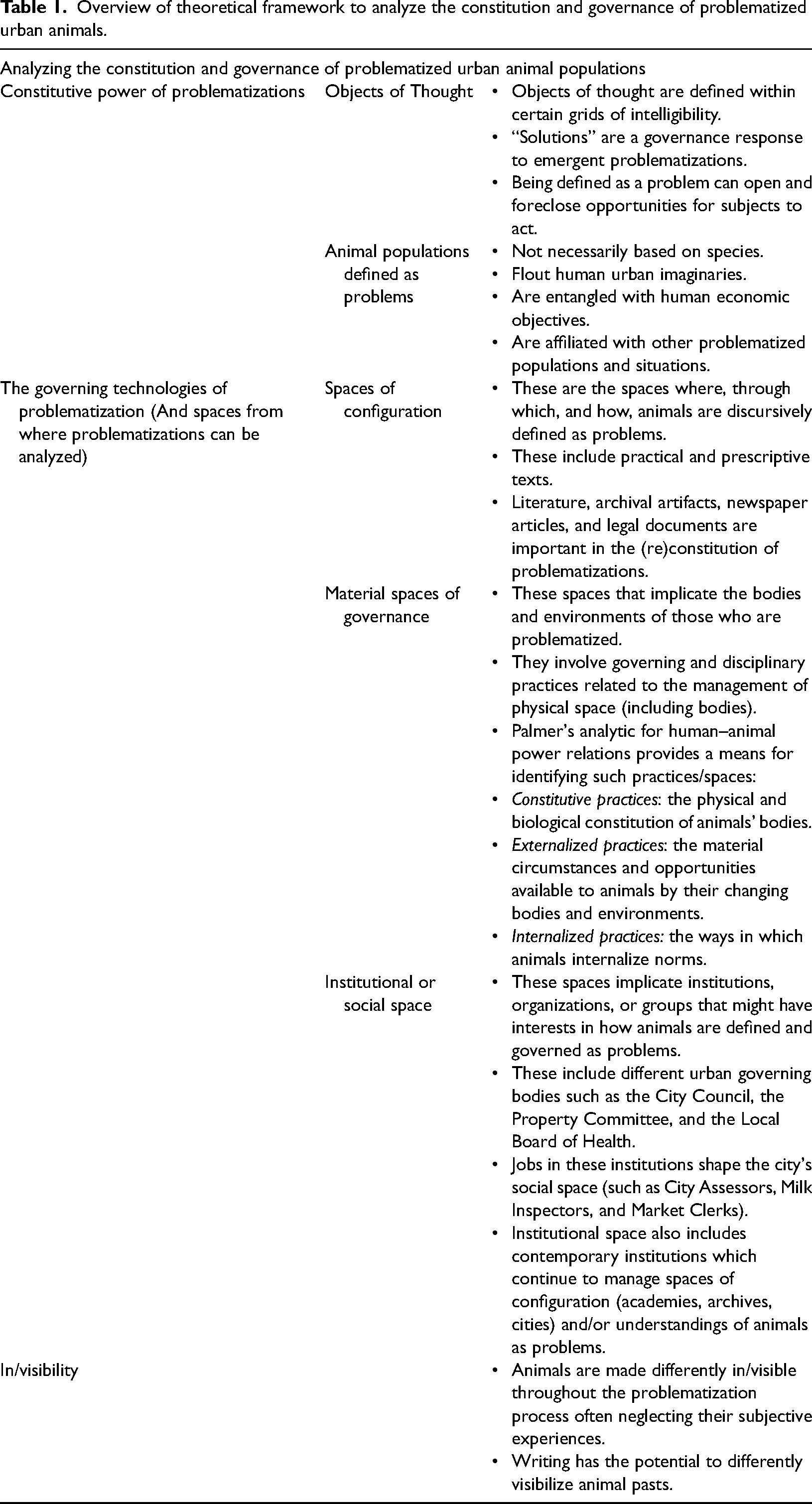
To better understand problematization as a multifaceted, spatial process that impacts urban animals, I develop a theoretical framework in this article that appreciates the power of constituting urban animals as problems, by also analyzing the spatial technologies used to govern them as such. This spatial awareness allows one to analyze how specific animals have been discursively configured as problems; and the material, social, and institutional spaces used to govern them as problems. Because animals are regularly only made visible as objects in policy and academic literature, understanding problematization spatially also opens opportunities to think through how animals experience being problematized. I will show how problematization allows one to pay attention to the sociospatial ordering of animals (particularly domesticated animals), offering a useful avenue for thinking through how they could have been urban subjects. First, I unpack the constitutive power of problematization and address how it might apply to urban animals before discussing some of its spatial technologies of governance, an overview of which you can see below (Table 1).
Overview of theoretical framework to analyze the constitution and governance of problematized urban animals.
Knowledge, power, and subjects: The constitutive power of problematization
Foucault's complex ideas related to power, particularly the knowledge-power nexus, help in understanding the historical problematization of urban animals because problematization produces particular “truths” about animals that then entail social and material responses. In this section, I am primarily concerned with how problems are epistemically defined. I will unpack how particular “objects of thought” are constituted through problematization before noting some of the ways in which urban animal populations have been problematized. First, however, I want to briefly touch on Foucault's spectrum of power relations as it underpins much of the discussion that follows.
Foucault identifies a diversity of power relations which stretch from relations of domination to pastoral relations of governmentality and power relations in general (Palmer, 2003). Relations of domination are stable, hierarchical, and tend to persist over time with little chance of resistance (Foucault, 1982; Palmer, 2017; Thierman, 2010). With complete domination there is no chance of resistance (and thus it is outside of power relations); but with relations of domination there is, albeit an extremely constrained and unbalanced, opportunity to respond. On the other end of the spectrum are power relations in general which are unstable, and resistance is always present (Foucault, 1982; Palmer, 2017). And somewhere between the poles of general power relations and relations of domination are pastoral relations of governmentality. To govern is “to structure the possible field of action of others” (Foucault, 1982: 790). These are fairly stable and involve repressive and creative practices to promote certain types of subjects, but here too resistance and change is possible (Foucault, 1982; Palmer, 2017). Unlike relations of domination, these latter power relations constitute a variety of subjectivities because power is not something owned by particular groups but rather something that flows through varied relations shaping both subjects and action (Foucault, 1977; Thierman, 2010). That is, power relations are not only oppressive but productive too (Chrulew and Wadiwel, 2017; Palmer, 2017; Philo, 2019).
The abovementioned power relations can be understood by unpacking how microphysics of power operate; that is, studying how power manifests in particular environments, instances, and relationships (Foucault, 1982; Hansen, 2017; Palmer, 2017). This involves paying attention to systems of differentiation, types of objectives, means of bringing power relations into being, forms of institutionalization, and degrees of rationalization (Foucault, 1982). By focusing on the “micropractices” of everyday life, one is also able to sidestep concerns about intent in relations of power (Chrulew, 2017).
While Foucault was not directly concerned with human–animal relations his power spectrum offers an opportunity to consider the “the diverse range of human/animal power relationships and how diversely situated they can be” (Palmer, 2017:120). Even though Foucault has rightly been critiqued for not adequately focusing on animals (Palmer, 2003; Taylor, 2013; Chrulew and Wadiwel, 2017), many scholars have found his ideas about power useful for understanding the lives of animals (Arcari et al., 2021; Chrulew and Wadiwel, 2017; Hansen, 2017; Howell, 2012; Palmer, 2017; Rinfret, 2009; Taylor, 2013; Thierman, 2010). Critical Animal Studies scholars have used and further developed Foucauldian concepts such as sovereign power (Wadiwel, 2002, 2015), disciplinary power (Thierman, 2010), biopower (Srinivasan, 2013), and pastoral power (Shukin, 2009) in relation to animals. Some geographers have even mobilized these concepts to critically analyze urban animal relations (Arcari et al., 2021; Howell, 2012; Gordon, 2020; Narayanan, 2017; Srinivasan, 2013). For example, by unpacking the ambivalent practices of euthanasia and neutering in Indian and British cities, Srinivasan (2013) expands biopower to analyze the changing configurations of human–dog relations.
Although Foucault consistently avoided taking normative positions, recognizing them as expressions of power within specific contexts, his work and ideas were inherently political. At the core of Foucauldian thought lies a recognition that comprehending how mechanisms of power operate can foster an appreciation for how what seems entrenched, normal, and taken-for-granted could be otherwise. This means that the very analysis and writing of animals’ problematizations is a tactic that has the potential to reinforce and/or disrupt existing knowledges related to them. Unlike Foucault, I align myself more with the many critical scholars who have come after him and viewed these disruptions as politically necessary to transform what are established relations of domination. With this general understanding of power in mind, I now consider problematization as a specific process involving numerous discursive and material power relations and technologies; that define and govern particular populations as problems. This is first, and foremost, achieved through the practice of constituting particular objects of thought.
Practice of problematization: Constituting and visibilizing objects of thought
When something (or somewhere or someone) becomes a problem, it also becomes an object of thought. The fields of knowledge and practices that develop around objects of thought operate as grids of intelligibility that make the governance of them possible. For instance, “the mad” became known as an object of thought in France through a range of medical practices, whereas “the criminal” became known as an object of thought through a series of punitive ones (Foucault, 1964, 1977). Foucault described these “practices” as “places” where “what is said and what is done, rules imposed and reasons given, the planned and the taken for granted meet and interconnect” (Foucault in Burchell et al., 1991: 75). Those who are positioned as objects of thought (such as “the madman” or “the criminal”) are also constituted as particular kinds of subjects in how they respond to, accept, or resist such framings. While “an object” is the target of power relations that operate to define and control it, “a subject” is pliable and born of historically and socially specific power relations (Foucault, 1982).
The subject/object interrelation is an important site of analysis that has the potential to illuminate interspecies power relations. I understand a subject as a being who is conscious and who socially experiences, perceives, and responds to their world; whereas an object is a thing that is acted upon. However, as Chrulew (2017: 227) posits: “animals are not only experiential subjects in a phenomenological or zoosemiotic sense, nor merely patients of suffering or moral concern; they are subjected to power and subjectified and governed through it.” That is, the objectification of animals, through processes like problematization which seeks to govern them, shapes how they can be subjects. I argue that focusing on how some animals are objectified as problems has the potential to explain how they might have experienced historical changes as subjects. Like researching how “the mad” become known as an object through medical practices, I seek to find out how “the problem animal” became known as an object through urban governing practices. This is worthwhile because how animals are constituted as problems is subject to change: The grids in which animals become intelligible as problems (grids of intelligibility) are always relational and contextual, shaped in-and-through power relations.
Such power relations can also become entrenched and contribute to legitimized forms of violence, control, and regulation (Blomley, 2003; Hinchliffe et al., 2017, Collard and Dempsey, 2013). Part of how these relations endure is through how particular objects of thought are institutionalized and disciplinary practices emerge to manage them (Driver, 1993; Philo, 2000). Said differently, how a particular object becomes known within a particular grid of intelligibility (fields of knowledge and practices) can allow for certain practices to be impressed on a specific population. For example, how “the mad” became understood within the medical sciences allowed for practices of constraint, punishing, and curing to be applied to a particular population. This sentiment is captured by Foucault below: “…how madmen were recognized, set aside, excluded from society, interned, and treated; what institutions were meant to take them in and keep them there, sometimes caring for them; what authorities decided on their madness, and in accordance with what criteria; what methods were set in place to constrain them, punish them, or cure them; in short, what was the network of institutions and practices in which the madman was simultaneously caught and defined” (Foucault, 1969 in Eribon, 1991).
Acknowledging that subjects participate in power relations is not to deny materially worrying situations. Rather, acknowledging such participation takes seriously the power of problematizations in shaping the lives of those in their grids. As Bacchi (2012), eloquently states: “In this view the ‘public’, of which we are members, is governed, not through policies, but through problematisations—how ‘problems’ are constituted. To be clear, this claim does not ignore the host of troubling conditions in people's (and peoples’) lives; nor does it suggest that we are simply talking about competing interpretations of those conditions. To the contrary the proposition is that lives are lived in specific ways due to the shaping impact of proposals that create particular understandings of ‘problems’” (Bacchi, 2012: 22, emphasis added).
Geographers have shown how some urban populations have been problematized and how regulations have emerged to manage them as such. These include “the poor” (Gillespie and Lawson, 2017; Driver, 1993), “the homeless” (Blomley, 2004; 2009), “sex workers” (Buckingham et al., 2018; Howell, 2004; Sanchez, 2004), “drug addicts” (Kammersgaard, 2020), “the obese” (Guthman, 2013), “breastfeeding mothers” (Mathews, 2019), and “immigrants” (Hier and Greenberg, 2002), to name a few. Each of these constituted populations has become known, established, and governed within localized and contextually specific urban grids of intelligibility (such as race relations, health, and development) and has been subjected to various governance and disciplinary practices (such as zoning, policing, and welfare policies). Animal populations who have been problematized include “vermin” (Jerolmack, 2008), “pests” (Biehler, 2013; McKiernan and Instone, 2016), “strays” (Howell, 2015; van Patter and Hovorka, 2018), and “dependent wildlife” (Delon, 2020). These human and animal problematizations are born of plural and diffuse power relations that both restrain and produce problematic objects and possibilities for subjective experiences.
A key requirement and effect of problematization is how problems become “visible.” That is, the process of how an object becomes “seen,” or rather regarded, as a problem. Part of becoming visible as a problem entails being essentialized as a problem, often reducing the complexity of a subject's materiality and experiences. Furthermore, how one problematized object is regarded might impact the extent to which another is made in/visible to policy makers and governance mechanisms. For example, the problematization of milk in Kingston, Ontario, in the 1920s resulted in cows becoming visible to the Local Board of Health as vectors of disease which also obfuscated cows’ sociospatial needs (Hirtenfelder, 2023b). Understanding when or how animals like cows became visible, regarded, or known as problems illuminates urban multispecies relations and processes. What is seen or regarded is always in tension with what is not seen and not regarded. “The human capacity to not-see, to not-register, and even actively to mute some aspects of the given world” is, as Sabloff (2001: 12) argues, “important to maintaining a sense of order.” And taking notice of what is marginalized, or invisible, in this ordering is important to understanding human–animal relations and the speciesism that often informs them (Arcari et al., 2021; Sabloff, 2001; Taylor and Fraser, 2019; Pachirat, 2011; Wadiwel, 2015).
Scholars such as Arcari (2020) contend that one cannot only consider how animals are literally made in/visible, one needs to also grapple with how they are epistemically, ontologically, morally, and discursively in/visible. 1 For Arcari (2020), the persistent entitled gaze at the heart of meat consumption is what makes perceiving animals as anything but food seemingly impossible. This prompts her to question how animals might be known and seen beyond what she calls “cartographies of meat” (Arcari, 2020). I am asking a similar question but moving from how animals are constituted and seen as food, to instead thinking through how they are constituted and made visible as problems in urban governance and imaginaries. In essence, “visibility is already enrolled in technologies of “truth.” It already plays an integral role in shaping, affirming, and maintaining understandings of what is real, normal, proper, and right” (Arcari, 2020: 273). This means the ways in which animals are made visible within governing structures is a question of epistemic justice and social recognition (Donaldson, 2020).
Because this is a matter of epistemic justice and social recognition, I am concerned with the multiscalar ways in which animals are in/visibilized. This entails not only analyzing how specific animal populations have been visibilized in their city's historical by-laws as problems but also noting their physical appearance and the ways in which they are included or excluded in urban imaginaries. Furthermore, it methodologically requires taking seriously how animals are visibilized in one's own writing and analysis. Coupling an analysis of how animals have been objectified and differently in/visibilized through problematization, together with methodologically regarding them as subjects is to take seriously the connections between epistemological, physical, and social violence. Following this line of thought, the next section will discuss some of the dominant underlying logics that scholars have identified to explain how some animals have become visible and defined as urban problems.
Defining problematized animal populations
Animals appear in many historical documents, including personal stories and photographs, where they are not problematized but rather prized (such as agricultural animals), marveled at (such as circus or menagerie animals), or even loved (painted pets). There are, then, several ways in which animals have been objectified. Many have been objectified as “food” (Adams, 2010; Arcari, 2020), “commodities” (Collard and Dempsey, 2013; Gillespie, 2018), “infrastructure” (Barua, 2021), and “ecosystem services” (Apfelbeck et al., 2020; Collard and Dempsey, 2017). But in documents related to urban governance, one of the dominant ways animals are defined is as problems that need to be managed.
While species is often used as shorthand for discussing and explaining animal populations generally, and problematic populations in particular, species is not necessarily the underlying logic that defines animals as problems. Sometimes only a subset of a species (such as “stray dogs”) or mixed populations (“strays” generally) are problematized. Therefore, species is just one marker for how a population could become known as a problematized object of thought. Sociobiological relations can delineate a variety of different populations, using species (cows, chickens, humans), gender (cows, bulls, heifers, steers), or breed (Holsteins, Shorthorns, Herefords) to do so. Furthermore, how an animal is defined by a particular institution (a Holstein cow versus a Shorthorn steer in agricultural circles) has significant material and social impacts for those involved (being entangled and violently used within dairy versus meat industries, for example). That is, how animal populations are defined has significant impacts on their life chances and experiences (“a dairy cow” will be repeatedly impregnated to sustain the supply of milk whereas a “meat steer” will be subjected to fattening practices so his body is made ready for slaughter as quickly as possible). With this in mind, and based on existing literature, I have identified at least three underlying logics, or mechanisms, that are important in problematizing urban animals. These include flouting human urban imaginaries, being entangled with and possibly disrupting human economic objectives, and/or being affiliated with other problematized populations and situations.
First, scholars have illustrated how some urban animals are problematized due to flouting human urban imaginaries, particularly those of the city being a human, civilized, and/or modern space (Brown, 2016; Jerolmack, 2008; Luther, 2013; Narayanan, 2017; Palmer, 2003; Srinivasan, 2013; Wolch, 1996). For example, near the end of his article on how pigeons were problematized in New York City, Jerolmack (2008: 89) hypothesized it was due to “the underlying imaginative geography of the modernist constitution” and that “if this logic is correct, we would expect that the animals most likely to be deemed problem species are those that most flout our imaginative geographies.” This led Jerolmack (2008) to conclude that most public spaces are “out of bounds for animals unless they are controlled or civilized.” Similarly, Philo (1995: 669) shows how the problematization of killing cows in London was shaped through a “grid of moral assumptions” which framed animals’ presence as leading to human degeneracy. Both pigeons and cows were problematized because they disrupted ideas of what a modern and/or civil, and ultimately “human,” city should look like.
Undergirding this modern/civil imaginary in North American and British cities is a deeper politics of cities being framed as different from, and in opposition to, “nature” (Braun, 2005; Cronon, 1991; Howell, 2012; Jerolmack, 2008; Philo, 1995; Wolch, 1996). This is not to say that cities are devoid of “nature” but that often only controlled, dominated, and domesticated nature is expected and accepted as appropriate (Hubbard and Brooks, 2021; Tuan, 1984)—this includes manicured lawns, monkeys in zoos, cats in homes, and fish on plates. In the nineteenth century (and arguably still today), animals who disrupted the anthropocentric imaginings of the ordered city and its related bifurcations (such as technology/nature, human/animal, domesticated/wild, and civilized/wild) were subject to problematization. While this imaginary of nature being external to cities is characteristic of European and American imaginaries it is often exported and adopted in other cities seeking to be “smart” or “modern” (Shingne, 2022).
Second, animals might be problematized in cities if they are entangled with human economic objectives. Economic systems are shaped in-and-through power relations and are key sites for where animals are constituted and regulated as objects of thought. Foucault's broader understanding of power goes beyond considerations of ownership and control and includes the innumerable ways power flows through a social body—and this includes economic institutions and relations. One particularly enduring, and often not problematized, way in which animals are objectified is as commodities. Within urban economic relations, animals might be valued and constituted as “inputs,” they might be undervalued as “excess,” or they might even be regarded as threats (Collard and Dempsey, 2017). For example, urban squirrels that chew through power cables, and are responsible for the loss of electricity, may be constituted as threats to urban financial markets (Benson, 2013).
This is markedly different from animals who are actively included in economic relations as commodities but who might be problematized because the efficiency with which they are utilized is challenged. For example, in the nineteenth century, butchers (and the animals they killed) were increasingly pushed to the fringes of San Francisco as the industry grew and the space needed to “process” these animals intensified (Robichaud, 2019). From Chicago to Toronto and San Francisco, the problematization of domesticated animals such as cows and pigs in the city was shaped by their entanglement with growing meat markets (Cronon, 1991; MacLachlan, 2001; Robichaud, 2019). There are, then, varied ways in which urban animals might be problematized because of how they threaten or are part of economic and capitalist activities.
Third, animal populations may be problematized through their affiliation with other problematized populations and situations. These affiliations may be with other animal or human groups or with particularly challenging situations, places, or substances. A classic example is rats being problematized due to their symbiotic relationship with fleas and these animals’ entanglement with the plague, a particularly severe disease situation (Lynteris, 2019). Another is the entanglement of flies and “livestock animals” in Toronto where the presence of flies was used to trouble the belonging of animals such as pigs and cows in the city based on fears of disease (Mackintosh, 2017). In cities, animals’ affiliations with some human groups are often crosscut with ideas of class, race, and gender, involving tactics of dehumanization and animalization (Brown, 2016; Hovorka, 2008, 2012; Hubbard and Brooks, 2021; Kheraj, 2015; McNeur, 2014; Narayanan, 2023). 2
That is, through the human/animal dualism “certain groups of humans become symbolically associated and materially related to certain other (nonhuman) species (and vice versa)… [which] (re)produces the positionality and life chances of both humans and nonhumans within society” (Hovorka, 2012: 876, emphasis mine). Hubbard and Brooks (2021) note, for example, that the visibility of specific species or breed can be a proxy for class, also serving as a justification for and indicators of gentrification, such as stray dogs found within poorer areas and specific breeds of pet dogs in wealthier areas (Hubbard and Brooks, 2021). The regulation of particular animal populations in cities often impacts specific human populations (Brown, 2016; Kheraj, 2015; Hovorka, 2018; McNeur, 2014). For example, the urban regulation of salmon and chickens in Seattle was also used as a proxy for the management of Japanese and Chinese immigrants (Brown, 2016). Recognizing the species privileging and hierarchizing both within and between different groups affords an opportunity to analyze how broader power structures of control and domination are sustained (Wolch and Emel, 1998: 18).
The above typology is not an exhaustive explanatory tool but an opportunity to think about how problematization runs through varied urban animal relations. Identifying that the problematization of animals is not contingent on species allows for an analysis that can see how one species might be subjected to varied practices of problematization which position them in several grids of intelligibility. In the history of Kingston, Ontario, cows tended to flout existing and future-oriented imaginaries of the city as an ordered, propertied, and sanitized place (Hirtenfelder, 2023b). Cows were objectified for their utility in making milk and meat, but they were also affiliated with diseases and waste associated with their production. While not mutually exclusive, these—what might appear to be dispersed—framings contributed to cows being defined as transgressive, risky, and waste—eventually prompting their physical, sociospatial, and imaginative removal from Kingston (Hirtenfelder, 2023b). Yet as I argued at the onset of this article, the analytical power of problematization is strengthened through a spatial awareness, a point I now turn to more explicitly.
Spatial technologies of power: The governing of problematized objects
Where the previous section discussed the constitutive power of problematizations in producing objects of thought (such as “problematic animals”), this section is concerned with how those defined as problems are governed. To appreciate the effects of problematization, it is necessary to unfurl their related tactics, technologies, and strategies. Furthermore, when it comes to the historical problematization of urban animals, focusing on the spatialization of this governance and the disciplinary practices employed offers analytical opportunities.
Geographers have noted how Foucault's ideas allow for a serious consideration of the reciprocity of sociospatial relations (Philo, 1992, 2000, 2002, 2005; Driver, 1993; Ogborn, 1995; Crampton and Elden, 2007), enabling one to critically analyze and crack open “relations which risk being obscured” (Philo, 2019: 43) and to focus on how some populations have been abstracted through relations of power (Legg, 2005). Driver (1993), using Foucauldian thought, argues that the historical views and experiences of paupers in the United Kingdom are “obstinately silent” in the massive administrative archive related to the workhouse system because it was not designed to serve the poor but rather to manage them. Acknowledging this allows Driver (1993) to focus on the features of the system that rendered paupers discursively invisible and to illustrate how technologies of control originated in a specific sociocultural and political milieu that also called for specific kinds of concrete, spatial forms of regulation (such as the physical workhouse itself).
Similarly, Philo (2000), as part of his broader project to examine the spatial histories and opportunities in Foucault's work, 3 shows how the spatializations presented in Birth of a Clinic provide a useful analytic for medical geographers to think about how and where medical objects of thought are constituted and governed, including how medical practice and knowledge have been shaped in-and-through the physical and social geographies of bodies and institutions. In Birth of a Clinic, Foucault excavates statements and discourses about historically serious objects of attention (such as “the sick”) to show how normal medical practices today (like distinguishing between healthy and unhealthy bodies by gazing deeper into the recesses of bodies) were invented through the establishment of clinics which also served a teaching hospitals. Philo (2000) pries apart the three spatializations Foucault (1963) offered in that book: Spaces of configuration (such as the tabulation of disease), corporeal spaces (like the localization of disease on specific body parts), and social space (the broader landscape of medical practice and institutions), offering a geographical analytic that is not only helpful in understanding medical geographies but also geographies of problematization.
For my purposes, the three spatializations offer useful analytic entry points for thinking about how and where animals are constituted and governed as problems. Spaces of configuration, corporeal spaces, and social space are technologies used for the governance of problematized animals and when analyzed together can illuminate the underlying logics that make up, change, and disrupt problematizations.
Spaces of configuration: Literature, archival artifacts, and municipal documents
Spaces of configuration are where knowledge is organized and ideas are framed (Philo, 2000) making them important sites for analyzing how problems are made intelligible. Literature, archival artifacts, and legal documents are all spaces of configuration where epistemic and discursive visions of animals as problems are produced. While the problematization of specific animal populations might emerge in material and everyday practices, they become reified as problems in what could be called practical or prescriptive texts. Policies, scientific diagrams, instructions, and literature reviews are all examples of prescriptive texts which offer rules, opinions, and suggestions for how one should act (Bacchi, 2012).
Academic literature is a space of configuration where ideas are crafted and stitched together in an attempt to provide a coherent picture, narrative, or argument. In the social sciences, we use the grooves and patterns of thought that emerge from literature to justify our own work, to validate the questions we are asking, and to choose worthy subjects of consideration. Therefore, in any study, literature is a tool and space of configuration that has the potential to illuminate power relations. This is because discourse is not only language or narrative but it is also produced in-and-through varied experiences, practices, and power relations which can become crystalized in readings, literature, and canons. Scholarship is produced within an academy that privileges particular ways of knowing and often cements and builds on established narratives. This offers a potential explanation for the inadvertent reimagining of many urban animals (particularly domesticated animals) as mere tools, material entities, resources, and symbolic elements in many historical and geographical narratives. As the academy becomes more receptive to and accepting of animals as experiential subjects it also opens opportunities to ask questions that try to move away from these sterilized and simple understandings of them (Bonnell and Kheraj, 2022; Glover and Mitchell, 2024).
The taken-for-granted, often invisibilized, tendencies in literature can be subverted by probing how something could be different and identifying tactics for potentially making it so. Some scholars, for example, resist the dominant constitutions of cows as tools and objects of utility and instead tell more complex and nuanced stories (Gillespie, 2018; Glover, 2019; jones, 2014; Narayanan, 2019). Gillespie (2018) uses ethnographic methods and creative writing to stitch together life histories for individual cows. This includes Sadie, a cow who was used on a large dairy farm in the San Francisco Bay area before being sold at auction to a university veterinary teaching hospital where students performed rectal exams and practiced venepuncture on her. At the end of 20 weeks, Sadie was going to be sent to slaughter, but after a student intervened, she was sent to a sanctuary instead (Gillespie, 2018). Another example is the tragic story of a Holstein cow with ear tag #1389. Despite being on sale for only $35 at auction, no one bought her due to the abrasions that covered her and her raw, infected udders (Gillespie, 2018). She died in the auction yard. Gillespie's (2018) strategy of focusing on and telling individual stories brings visibility to cows and the structural and institutional violence they experience, countering the tendency in literature to treat them as a monolithic mass.
Multispecies ethnography and ethology have also been important methods in positioning animals as subjects in urban analyses (Hovorka, 2008; Barua and Sinha, 2017; Sabloff, 2001; Srinivasan, 2013; Narayanan, 2023; van Patter, 2022). Van Patter (2022), for example, used tracking devices and direct observations to “(re)story” Toronto and shows how coyotes spatially navigated the city in complex, socially informed ways. Narayanan (2023) conducted an extensive multispecies ethnography of bovine relations in India, which included direct observations of cows and water buffalo in urban dairying operations and their abandonment in streets and temples. Because one cannot directly observe historical animals, multispecies ethnography has not translated easily to understanding their lives. For Wilcox and Rutherford (2018), historical animal geographies can benefit from bringing together the contemporary work in animal geographies with insights from environmental histories in a way that prioritizes the agency of animals and their ability to be affected. Their main argument is that animal geographies should be temporally sensitive, and that “space, place, landscape and scale” are “essential to re-constructing animal lives of the past” (Wilcox and Rutherford, 2018: 3). Some methods that can be employed to achieve this include map-making and speculative vignettes (Hirtenfelder, 2024).
Archives and archival artifacts are another space of configuration. Archives are not neutral but are places which represent “the past” and often privilege particular narratives and voices. Kean (2012: s63) notes that archives are places where whole, supposedly ordered worlds can be imagined and where historians “find material, often created in different times, with which to imagine a past and bring it alive in the present.” The presence of individuals in the archive and the artifacts they are linked to are shaped by prevailing notions of whose stories are considered significant and worthy of preservation (Oliver, 2021). Archives have “enormous power over memory and identity, over the fundamental ways in which society seeks evidence of what its core values are and have been, where it has come from, and where it is going” (Schwartz and Cook, 2002: 1). As a result, archives and their organizational structures play an active role in shaping the perception of which stories are deemed valuable and accessible, making them critical spaces to consider when examining the construction of history and the shaping of specific subjects (Oliver, 2021; Stoler, 2008). However, one must remember that archives are not exhaustive accounts of the lives one finds and sometimes they might only document and catalog the violences and deaths of those whom you are trying to understand (Hartman, 2008).
Animals are found in numerous prescriptive texts in the archives, including everything from sketches, to agricultural censes and ledgers that account for their births and deaths. These form “administrative landscapes” (Driver, 1993: 32) because how animals are listed in documents relative to one another says something about how they were (and continue to be) valued, and the opportunities and foreclosures enabled by such ordering. For example, animals listed on agricultural lists versus those on conservation lists are defined as different objects for whom different practices (such as killing and protecting) are made possible. Prescriptive texts are powerful instruments in establishing new norms and “rules of engagement” because they can define the boundaries of what is considered appropriate and when sanctioned violence is deemed legitimate (Blomley, 2004: 24). While an agricultural list might present animals who “should” be killed, a conservation list might have animals who “should” be protected. More tangibly, wolves and foxes were historically subjected to extermination campaigns in Ontario as bounties for their heads were advertised to “protect” sheep (Hirtenfelder, 2023a), pointing to some of the interspecies hierarchizing often present in such documents (Hovorka, 2018). Prescriptive texts are, then, important spatial technologies of power because they arrange problems relative to specific environments, populations, solutions, or punitive actions.
As the above example of the wolf bounty suggests, legal documents and municipal regulations are also important spaces for analyzing how animals are constituted as problems. For Ogborn (1995) and Blomley (2004, 2009), the law offers a critical medium through which subjects can be disciplined and actions mobilized. Ogborn (1995: 32) argues that “a space of situated interpretation” is opened in any legal framework and that “the power of formal legal discourse and practice to legitimate other forms of power/knowledge should not be underestimated.” The power of the law in dictating animals’ lives is perhaps why many scholars have focused on regulation in their analyses of historical urban animals (Brown, 2016; Gallo, 2022; Kheraj, 2017; Robichaud, 2019; McNeur, 2014; Srinivasan, 2013). Kheraj (2015), for example, demonstrates how the first urban by-laws in Canada targeted the movements of domesticated animals through trespass regulations. By-laws and other policing documents are essential to the supervision of urban animals and are often mediated through a legitimized use of violence. Euthanasia and neutering are common practices used to regulate the reproduction of dogs in cities across the world, for example (Srinivasan, 2013; Narayanan, 2017).
To appreciate the effects of problematization without reconstituting and essentializing animals as problems requires tools that make them differently visible. Some of these tools are theoretical, others are methodological. Theoretically, animals must be understood as subjects who are objectified in spaces of configuration and methodologically it is necessary to read (and write) against the dominant constitutions of animals as problems in existing literature, the archives, and legal documentation. Furthermore, while spaces of configuration are important for unpacking the various grids that make animals intelligible as problems, to appreciate the effects of such constitutions for the lives of historical animals, it is also necessary to analyze how animals’ bodies and environments were sociospatially governed. Where spaces of configuration shape and offer an analytical entry point for thinking about how animals are known and defined, a focus on the material spaces of governance helps to unpack the effects of such governance. Animals are constituted as problems in municipal documents (such as by-laws) and physically and socially policed by through the spatial management of their bodies and environments.
Material spaces of governance: The disciplining of bodies and environments
How one is defined in spaces of configuration is shaped in-and-through material relations and can have implications for the bodies and environments of those defined. As Foucault (1977: 141) notes “discipline proceeds from the distribution of individuals in space” and is often achieved through techniques of enclosure, partitioning, the creation of functional sites, and ranking. However, material spaces of governance (such as the prison, lunatic asylum, or body) are “more than incidental stage sets to the overall drama” (Philo, 2019: 47); they are indicative of specific sociospatial strategies, tactics, and flows between spatializations, where emergent governance practices could inform spaces of configuration, and vice versa. So, in telling the history of urban animals it is not enough to only attend to the spaces in which they were written down and essentialized as problems; one needs to account for material spaces of governance as well.
Whereas Philo (2000) used Foucault's (1963) “second spatialization” to show how different parts of the human body became known under the medical gaze, I extend this spatialization to instead consider the material (primarily the corporeal and environmental) spaces used to govern (and discipline) animals as urban problems. Being attentive to animals’ bodies and environments is particularly important for someone interested in telling an animal history in which traditional artifacts (such as first-hand diaries) are not available. The governing of animal spaces and their urban places is important because, like with other historical populations, “they mark places and indicate values; they guarantee the obedience of individuals, but also a better economy of time and gesture” (Foucault, 1977: 148). Other geographers have made similar moves when trying to understand how the physical environment of cities and their varied social contexts, create embodied experiences that also evoke different subjectivities, including Susan Buckingham and her colleagues (2018) who analyzed sex workers and their lives in London. Nonetheless, to carry out a transspecies analysis of problematization that takes seriously how animals’ spatially and materially experienced measures suggested in legal and municipal regulation, I strengthen the second spatialization by borrowing from Palmer's (2017) typology regarding human–animal power relations. In the typology, Palmer (2017) outlines how animals’ bodies, environments, and subjectivities are impacted through constitutive, externalized, and internalized practices.
Animals are not only constituted discursively as problems but efforts to manage problematic animals might also entail constitutive practices (Palmer, 2017). Constitutive practices involve the physical and biological configuration of animals’ bodies (Palmer, 2017). This can be achieved through activities such as domestication, selective breeding, and genetic manipulation that aim to alter the bodies of animals so that they conform to certain desires (Hansen, 2017; Palmer, 2017). These desires might entail making animals less problematic by ontologically altering their bodies or social dispositions. The genetic modification of mosquitos as a strategy for combating diseases like malaria is a recent illustration of constitutive practices (Wang and Jacobs-Lorena, 2013), whereas the breeding of cows to be docile is an established practice in agricultural circles (Ritvo, 1987).
Another strategy for responding to problematized animals might entail externalized practices that seek to alter the material circumstances and opportunities available to animals by externally changing their bodies and environments (Palmer, 2017). This includes physically confining, punishing, or altering animals’ spaces and bodies. The already mentioned castration and neutering of urban stray populations is a good example of such externalized practices (Narayanan, 2017; Srinivasan, 2013). Another example is the household confinement of pet cats as they are increasingly constituted as problems for urban birdlife (Lynn et al., 2019). Exclusion and confinement are two spatial tactics regularly employed in the management of problematized populations (Philo, 2019).
Practices that respond to or are constitutive of problematizations attempt to discipline animal bodies, environments, and behavior. Internalized practices are shaped by not only constitutive and externalized practices but they also involve other tactics (such as training, taming, and socializing) and spaces (such as dog school) that encourage animals to internalize how they should behave around particular established social norms (Chrulew, 2017; Palmer, 2017; Tuan, 1984). While “governmentality” has not “translated easily when it comes to human relations with the non-human world” (Srinivasan, 2013: 108) a spatial focus allows for an appreciation of the embodied and environmental implications of governance for the animals involved. Dogs who walk loose on leashes, cats who stay indoors when windows are open, and animals who avoid human traps are all examples of what could be construed as internalized practices.
Constitutive, externalized, and internalized practices can be mobilized within broader relations of power that seek to discipline the bodies, environments, and behaviors of animals who are defined as problematic. Power acts upon the body, it bends it and breaks it—it can dominate it and constitute it (Foucault, 1977). Because animals’ bodies have been so instrumentalized and used by humans, having sensitivity to their bodies and environments is essential to finding them in the archives and understanding their historical experiences. That is, analytically paying attention to the sociospatial openings and foreclosures afforded by disciplinary practices offers an opportunity to think about how particular animals could have materially been subjects. While one might not know exactly what a historical animal in a specific city was thinking or feeling (much like it would be difficult to fully comprehend what a fellow human was thinking or feeling)—I contend that it is possible to understand some of the structures and ways in which they were expected to act and how this delimited their potential to act by focusing on what ways of being a subject were sociospatially available.
However, as Ogborn (1995) cautions, one must resist framing the relationship between law and discipline as straightforward or neutral, and instead analyze how it is interpreted “in concrete situations by socially and spatially situated people” (Ogborn, 1995: 32). Howell (2012: 237) reiterates this when he shows how the muzzling of dogs in Victorian London was sporadically enforced and that the success of making dogs welcome pets might “owe a great deal more to the governmentality of the liberal city than to any more direct, coercive and disciplinary form of intervention.” Furthermore, as political ecologists have argued, urbanization is a socioecological transformation in which “sentient creatures negotiate and learn to inhabit complex, dynamic environments, apprehending them according to their own knowledges, speeds, and rhythms, with or against the grain of urban design” (Barua and Sinha, 2017: 2). Therefore, to fully comprehend the problematization of urban animal populations it is not enough to only pay attention to the discursive spaces where they were constituted as problems, and the ways in which their bodies and environments were governed: it is also necessary to understand the broader institutional and social spaces in which such problematizations take place.
Social and institutional space
Power relations are diffuse and entail a policing of the social order which is premised on intricate sociospatial logics of exclusion and inclusion (Philo, 2019) which operate differently across a range of institutions or social groups (Driver, 1993: 2). Said differently, “if we are to locate disciplinary programmes in a wider field of power relationships and resistances, historically and geographically” then we need to “know more about the actual workings of different institutional regimes and the complex relationships between institutions and the communities in which they are situated” (Driver, 1993: 16). How urban animals are defined as problems in spaces of configuration and the ways in which their bodies, behaviors, and environments are disciplined through material spaces of governance are not neutral or standard but shaped by social and institutional space.
Social and institutional space is the third spatialization discussed by Foucault (1963: 17) and later Philo (2000: 15). It relates to how diseases were institutionalized, referring to the “landscape of medical practices and institutions” and how they were embedded within “social space.” The “intersecting gazes” of these institutions “spread across a diversity of sites” and “constituted the terrain across which negotiations between the primary and secondary spatializations were played out” (Philo, 2000: 15). I adapt this consideration of medical institutions to instead contemplate how urban institutions and social spaces define and govern animals as problems and how this can illuminate important details about animals’ experiences and broader urban processes and social situations.
Institutions are born of and shaped in-and-through changing histories and geographies; they can also propel, propagate, deepen, reify, and resist the ways in which animals have been problematized. Thinking through why some animals emerged as particular problems for particular institutions at particular moments in time might reveal details about the broader social practices and spaces these animals were part of. For example, pigs and cows both emerged as problems to the Local Board of Health in Kingston, Ontario, but at different points in history (Hirtenfelder, 2023b). This difference is somewhat reflective of distinctive disease situations in the city's past where pigs were problematized in relation to cholera and cows in relation to milk-borne diseases such as tuberculosis and typhoid.
Importantly, how institutions grapple with animals as problems contributes to how animals have become visible to the historical record. Part of the reason pigs are frequently discussed in relation to waste, horses in relation to transport, and cows in relation to slaughter is because these animals are made differently in/visible by institutions such as urban waste management, public health boards, and transportation services. These institutions were, quite literally, responsible for not only governing some animals but also making them visible to the historical record as particular objects. This act of visibility has perhaps contributed to the obfuscation of other aspects of these animals’ lives. Therefore, details of animals’ histories and experiences can be gleaned from looking at when and how they come into (and out of) view as problems in institutional records.
Furthermore, in trying to account for animals’ presence or absence in urban imaginaries it is also necessary to think about how contemporary institutions in/visibilize them. As has already been discussed, the academy, the archives, and the urban government all represent institutions that play a role in continuing to (re)produce urban memory and often reductive understandings of animals that can obfuscate the complexity of urban animal experiences. The ways in which animals are (or are not) visible in various spaces of configuration but also institutional and social spaces is an effect (and continuation) of problematization practices as well as human–animal power relations. The failure to write animals into urban histories, or to only include them as simplified objects or problems, is a disservice to the animals involved and a misrepresentation of historical urban relations.
When conducting an urban analysis, there is a risk of further objectifying animals and reducing them to specific roles by essentializing them within the predetermined frameworks established by certain institutions. It is, therefore, important to acknowledge that animals’ lives and experiences extend beyond these limitations. For this reason, it is perhaps analytically necessary to pay attention to several social spaces with which these problematized animals might have interacted. Social spaces that are frequently neglected in the urban histories of animals include where (and with whom) they ate, drank, and slept. Palmer (2003, 2017) also reminds us, that transgressive behavior in relations of domination can also be understood as resistance to human power. 4 When animals are ambivalent to property boundaries, for example, we are reminded that animals not only transgress some human imaginings and material spatial arrangements of the city but that animals also attempt to create their own social spaces. Appropriation is not only a human form of territorialization (Barua and Sinha, 2017) and while animals do not practice property in the same way humans do, they do create (and maintain) places and relations that are important to them. Appreciating the problematization of animals and the material and social effects of such problematization requires, then, not only paying attention to how animals are discursively constituted as problems, and physically disciplined as such, but also how problematization is mediated through the social relations of humans and animals.
Reconstitution: Making animals visible as historical urban subjects
In this article, I have outlined how problematization is a process whereby some animals and their relations are constituted (and even cemented) as problems that require regulation and intervention. Problematization involves the production and circulation of knowledge (grids of intelligibility) which help to define “the problem” and “its solution.” These grids work to define certain behaviors, populations, or groups as in need of control. In many cities, underlying logics that have been used to problematize animals include flouting urban imaginaries, entanglement in or disruption of human economic objectives, and/or being associated with other problematized populations and situations. I argue that problematization can be analyzed by focusing on the spatial technologies of power that are used to constitute, practice, and maintain them. This involves looking at: (1) spaces of configuration such as literature, archives, and legal documents where animals have historically (and continue to be) defined as problems; (2) material spaces of governance that historically disciplined those animals’ bodies and environments; and (3) the institutional and social spaces that not only make such problematizations possible but also sustain or resist them.
One effect of problematization is that urban animals are often visibilized (and essentialized) in the historical record as problems. Because animals were constituted as problems in important spaces like municipal documentation, they are regularly rewritten and reconstituted as problems in contemporary literature about urban pasts. This kind of reductive retelling fails to appreciate the complexity of problematization as an urban process and the complexity of animals’ lives and contributions. Interventions that theoretically and methodologically challenge how animals are treated as passive surfaces are not only novel but politically and epistemology significant. It is a matter of epistemic justice and social recognition that also has the potential to foster new, less violent imaginaries. And, as I have tried to argue throughout this article, geography and space arguably essential dimensions for how such urban histories can effectively be told.
Highlights
Urban animals are governed and objectified as problems. This opens and forecloses opportunities for how they can be subjects.
Animals have been discursively constituted as problems in spaces of configuration, such as literature, in archives, and in policy.
Animals are materially managed as problems in spaces of governance which attempt to discipline their bodies and environments.
Animals are made visible as problematic objects through institutions concerned with governing them as such.
Spatial awareness offers opportunities to better analyze and write about urban animals’ experiences.
Footnotes
Acknowledgments
Thank you so much to my supervisors Laura Cameron and Carolyn Prouse for their assistance in developing these ideas. Thank you also to members of the Animals in Philosophy, Politics, Law, and Ethics reading group for their comments on an earlier draft of this paper. I am also grateful to members of my examining committee who helped me to think through these ideas further, including: Will Kymlicka, Catherine Oliver, Mark Stoller, and Dan Cohen. And, finally, thank you to the editor and reviewers of EPE whose thoughtful comments helped to greatly strengthen this article.
Declaration of conflicting interests
The author declared no potential conflicts of interest with respect to the research, authorship, and/or publication of this article.
Funding
The author received no financial support for the research, authorship, and/or publication of this article.
