




Abstract
This paper contributes to the literature that critically engages with the so-called ‘twin green and digital transition’ by assessing the twin transition as a policy discourse. Our research question is: why and how is the twin transition legitimised and implemented in the European Union (EU) despite recognised pitfalls and uncertainties? The analysis is based on interpretative text analysis of high-level EU policy documents about the twin green and digital transition and of Member States’ resilience and recovery plans. The paper assesses the political and socio-economic context as a central factor that explains how the coupling of the green and the digital comes to be seen as desirable. Our results show that innovation associated with the digital imaginary is used to discursively reframe tensions between economic and sustainability policy aims as synergies. Legitimacy is derived not only from the promise of win-win ideas but also from the claimed ability of governing institutions to steer the twin transitions in the desired direction and avoid the recognised risks. With regard to implementation, the twin transition logic guided the allocation of funds by framing the need to recover from the COVID-19 pandemic as an opportunity to accelerate the green and digital transitions. Hence, the digital imaginary merges environmental governance with the governance of innovation.
Introduction
As you wake up in 2050, you might begin your day by looking out of the window, with your augmented reality device showing you real-time pollution data. You then have breakfast that you bought because you were convinced by its environmental score, which was clearly visible at the time of the purchase, thanks to digital data. The food itself is produced by farmers in a resource-efficient manner, because they know exactly which crop to plant when – they have access to Big Data, thanks to open-source platforms gathering public environmental information, weather forecasts, or data through on-farm sensors. Before you turn on your washing machine, you check the electricity price at the moment. To incentivise consumption at periods when renewable-produced energy is abundant, the prices vary and gamification is making the hunt for good timeslots a fun experience. You not only consume but also produce electricity, thanks to the solar panels installed on your roof, which is connected to a meshed micro-grid. (EC, 2022a)
According to the European Commission Joint Research Centre (JRC), ‘the term “twin transitions” refers not only to two concurrent transformational trends (the green and digital transitions); the term also refers to uniting the two transitions’ (Muench et al., 2022). We refer to this definition because the paper focuses on EU policies. Although the idea of twin transitions is central to the European Green Deal, to what extent the green and digital transformations go hand in hand or are two separate and even opposite transitions is an unsolved question (Ahmadova et al., 2022; Dauvergne, 2020; Guthman and Butler, 2023; Lange and Santarius, 2020).
This paper contributes to the literature that questions the link between the green and the digital transitions (Kloppenburg et al., 2022; Mäkitie et al., 2023; Wadud et al., 2016). Digitalisation enhances a number of existing trends in environmental governance, identified by Kloppenburg et al. (2022) as: (i) the growing reliance on the digital way of ‘seeing’ the environment, (ii) the increasing participation of private actors who provide technology and data, with implications for data access and ownership and (iii) a shift towards automated and data-driven decision making, which makes optimisation the main form of policy intervention.
The importance of indicators and quantitative evidence in environmental governance, which enable technocratic decision-making bypassing public deliberation, is not a new phenomenon. Asdal (2008) argues that ‘nature’ entered environmental policies thanks to the quantitative accounting of acid rain and of the impacts of acidification. Turnhout et al. (2014) speak of ‘measurementality’ to signal the central role of standardised science-based measurements in the neoliberal rendering of environmental governance. The digital turn is a step further in the same trajectory of data-driven decision-making.
Precedents of the digital turn in EU policy can be found in the European Innovation Partnership for Smart Cities and Communities (Cardullo and Kitchin, 2019), which gained traction in the 2010s, becoming the ‘common sense’ of twenty-first-century digital urbanism (Gibbs et al., 2013; Hollands, 2015) and a ‘source of hope for urban futures’ (Taylor Buck and While, 2017). Critics of smart city solutions have pointed out that the digital turn frames urban challenges as technical challenges and ignores the non-technological aspects of urban problems (Bell, 2011; Gibbs et al., 2013; March, 2018; March and Ribera-Fumaz, 2016; Viitanen and Kingston, 2014). Similarly, the digital turn in environmental governance reduces sustainability challenges to problems of lack of data, insufficient precision and incomplete integration and coordination (Goldstein and Nost, 2022).
Interestingly, there is ample recognition of the tensions between the digital and the green transitions within the European Commission. The JRC warns that the digital and green transitions can reinforce each other but can also clash. Tensions include, to name a few, the issue of the growing energy demand of data centres and cryptocurrencies; possible rebound effects by which improvements in energy efficiency make technologies cheaper to use and more accessible, leading to greater energy consumption in the long term; the risk of increased dependence on imports of critical materials such as lithium and cobalt, which are scarce and may create new geopolitical tensions; and the increased production of e-waste as new technologies require the replacement of old equipment (EC, 2022b).
Despite such uncertainties and concerns within science and policy, the ‘twin transition’ is a driving concept of the European Green Deal (EC, 2019). In the wake of the COVID-19 pandemic, the NextGenerationEU plan recasts the need to recover from the pandemic-induced economic slowdown as an opportunity to give impulse to the twin transitions. At the same time, the lockdown measures adopted by many EU countries during the pandemic accelerated the adoption of digital technologies in many economic sectors (Ena, 2020; OECD, 2020), reinforcing the narrative that digital transformation is inevitable and already underway.
The stated benefit of twinning the green and the digital transition is to contribute to the goal of ‘transforming the EU economy for a sustainable future’ (EC, 2019). The twin transition can thus be seen as yet another instance of ecological modernisation. Many critiques have been raised towards ecological modernisation, focusing on different arguments: to some, ecological modernisation and green growth are problematic because techno-fixes reproduce a fundamentally unsustainable capitalist system and fail to question the need for economic growth (Foster, 2012; Grunwald, 2018). Reducing transformation to a political approach, or a discursive tool of neoliberal governance (Kotsila et al., 2021), forgoes a more fundamental socio-ecological transformation (Görg et al., 2017). Others point to the fact that ecological modernisation diverts attention from the power imbalances between the core and periphery (Brand et al., 2021; Ewing, 2017) and perpetuates extractivism in countries where the rare earth materials used for green technologies are mined (Dunlap, 2024; Voskoboynik and Andreucci, 2022). In this paper, we put in brackets, as an analytical approach, the stated objective of the twin transition. We argue that the question of what the twin transition is a solution for needs to be problematised and investigated. Following Kotsila et al. (2021), we see the twin transition as a ‘discursive tool’ and suggest that the problems being solved are not primarily sustainability problems as such but problems related to the difficult challenge of governing complex sustainability issues and their trade-offs. Using a science and technology studies (STS) perspective, the paper attends the following research question: why and how is the twin transition legitimised and implemented despite recognised pitfalls and uncertainties?
The paper is organised as follows: in Section 2, we contextualise the role of the twin transition discourse through a brief introduction to the EU’s political, historical and economic context in the past twenty years. Section 3 presents our theoretical framework. We use the lenses of purification and hybridisation in institutional legitimacy strategies (Latour, 1993) and combine this approach with the concept of imaginaries. This allows us to understand how legitimacy is created for and through the twin transition by EU institutions. Section 4 introduces the methods and materials used. Section 5 presents the results of the analysis of the legitimisation and implementation of the twin transition in the European Green Deal and Member States. We discuss the relevance of our results in section 6. The win-win ideas supported by the digital imaginary serve the political function of transforming tensions into synergies. This creates a new logic of legitimation that couples imagined digital solutions to environmental issues. At the same time, the trade-offs created by digital solutions are governed through more digital innovation at the discursive level. As the problems created by innovation are solved through more innovation, environmental challenges drift into the background and environmental governance merges with the governance of innovation.
The evolution of environmental governance in high-level EU policy
This section focuses of the historical, political and economic conditions in which the twin transition emerges. Following Clarke (2005), we understand that historical, political and economic conditions are more than just contextual factors; they are constitutive of the twin transition discourse and give it meaning.
The general framework and reference to guide EU policy broadly in the 2010s was the EU2020 strategy. The strategy was formulated in the wake of the 2007–2009 global financial crisis triggered by the collapse of the subprime mortgage market in the United States. Governments and central banks responded to the global financial crisis by providing massive bailouts to banks and financial institutions to prevent a meltdown of the financial system. In Europe, the financial crisis led to a sovereign debt crisis that unfolded to the mid-2010s and was particularly severe for countries such as Greece, Portugal, Ireland, Spain and Cyprus, which were unable to manage their debt without financial assistance. Financial support, in turn, was provided under the condition of strict austerity measures, leading to an austerity crisis and a legitimacy crisis of European institutions (Calvário et al., 2022; Kovacic, 2013; Saltelli and Giampietro, 2017). The legitimacy crisis extended throughout the 2010s exacerbated, among other factors, by the election of so-called Euro-sceptics to the European Parliament during the 2014 elections and the 2016 referendum that led to the exit of the United Kingdom from the European Union.
The response of the EU to the 2007–2009 financial crisis was to focus on delivering economic growth as a means to regain legitimacy vis-à-vis its disenfranchised publics, focusing on ‘smart, sustainable and inclusive growth’ driven by ‘innovation’ (EC, 2010b). Restoring economic growth became the leitmotif of EU policy in the 2010s, leading to a rewriting of, among others, environmental governance. Speaking of environmental policy in terms of economic benefits, rather than as a way to set limits to economic growth, became a means of keeping environmental concerns on the policy table at a time when economic recovery was prioritised (Kovacic et al., 2019). The circular economy (EC, 2015), a prime example of the industrial policy turn of the Juncker Commission, in office from 2014 to 2019, is exemplary of the reformulation of environmental policy aims. This policy breaks with earlier debates about the biophysical limits of economic growth. Circularity is purported as the means to overcome resource scarcity by sourcing material resources from within the economy and thus delivering at once economic growth and a so-called decoupling from environmentally harmful resource extraction. The circular economy discursively resolves decades of debates and tension between environmental and economic policy goals by supposedly turning trade-offs into synergies and joint objectives (Kovacic et al., 2019).
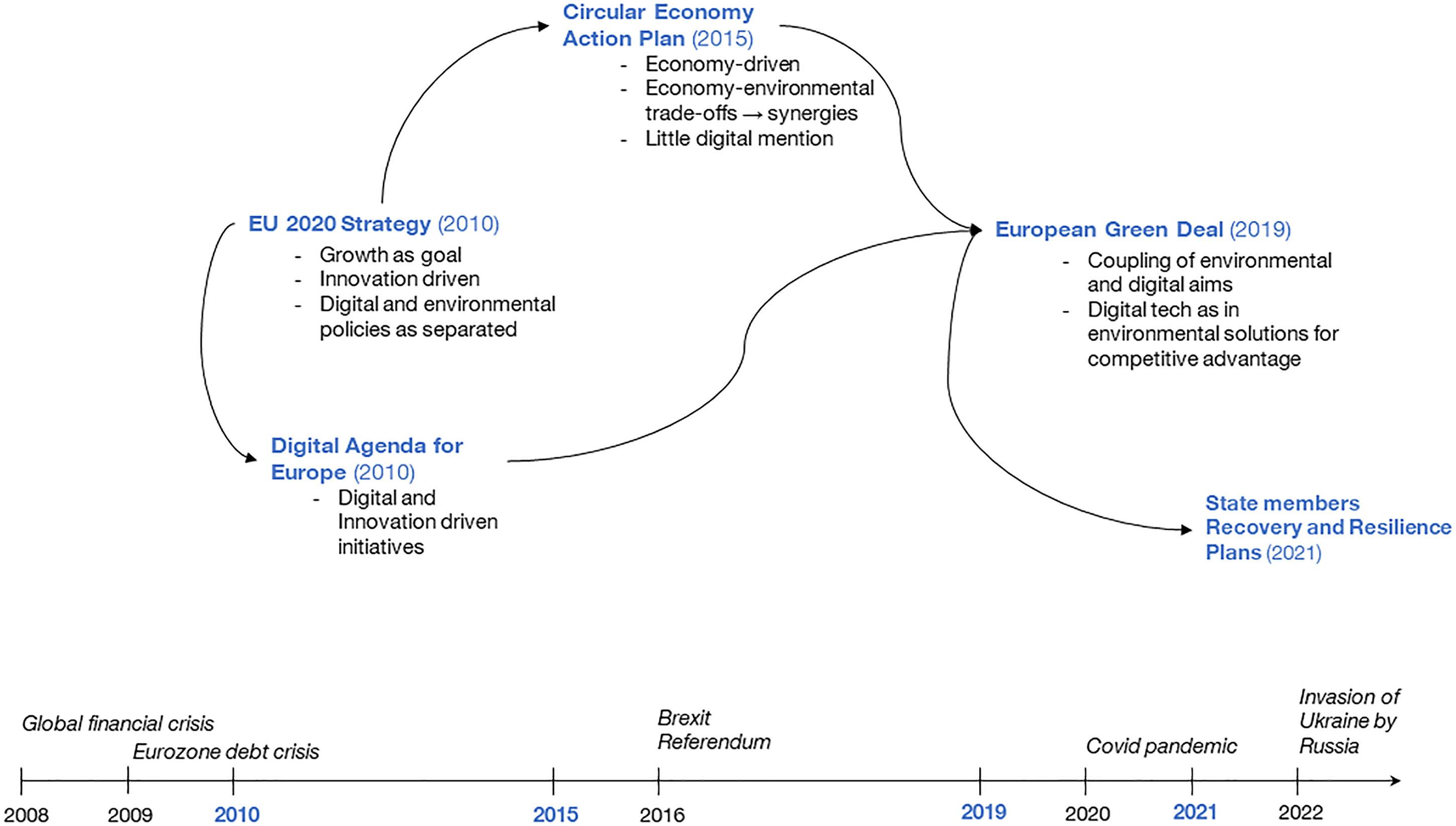
Graphical summary of the coupling of environmental and digital policies.
Environmental policy continues to be reformulated in the European Green Deal (EGD), the EU growth strategy for the 2020s published at the end of 2019. The EGD tackles the ‘twin challenge of the green and the digital transformation’ (EC, 2019). The coupling of environmental and digital aims could already be seen in the ‘smart, sustainable and inclusive growth’ trope of 2010, mainly under the smart city rhetoric. In the EGD strategy, it takes a central position (see Figure 1). The EGD sets up a cross-sectoral framework, and digitalisation is seen as a key enabler of the goals pursued in each of the eight areas of action proposed (called ‘transformative policies’). The focus on digitalisation and EU competitiveness is also telling of the geopolitical turn of the von der Leyen Commission, in office from December 2019 to 2024 (at the time of writing).
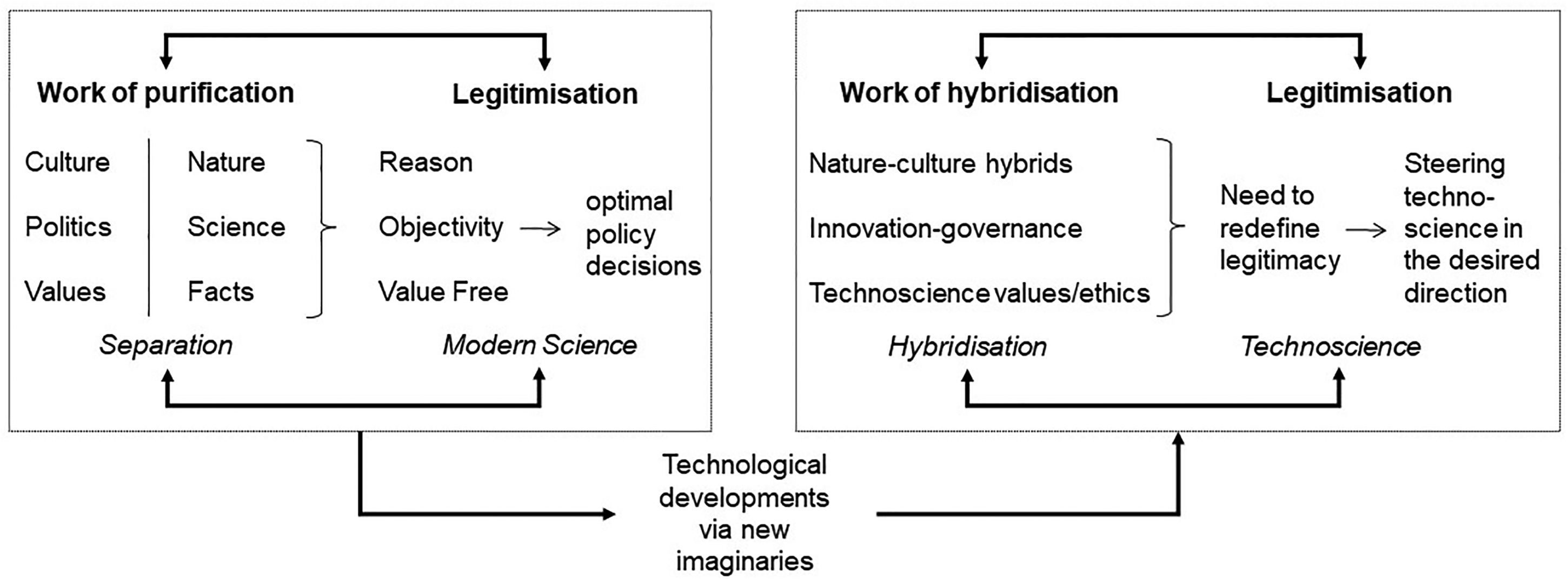
Legitimisation strategies related to the work of purification and hybridisation.
At the end of 2019, the digital transformation responded to a large extent to the EU's worry of being left behind in the global digital race. As stated in the 2022 Strategic Foresight Report, ‘the EU's capabilities in artificial intelligence, big data and robotics are similar to Japan's, but it needs to catch up with leaders: the USA and China’ (EC, 2022b: 3). The strategy of the EU is to gain competitiveness by boosting these technologies while creating a ‘sustainable future’. The EU sees itself as ‘a leader in future smart and sustainable mobility and low-carbon technologies’ (EC, 2022b: 3). Digital technologies applied to environmental challenges are seen as providing a ‘competitive advantage’ in the global competition and portray the EU as a moral intervener also outside of the EU (Vela Almeida, 2023). The immediate political answer required by the outbreak of the COVID-19 pandemic in early 2020 delayed the publication and implementation of many digitalisation strategies. However, after the pandemic, the digitalisation of many services and the widespread adoption of home office practices contributed to presenting digitalisation as inevitable and already underway. Furthermore, the economic slowdown and risk of an economic crisis in the wake of the COVID-19 pandemic triggered adjustments and updates of many digitalisation strategies, ultimately leading to substantial public investment in competitiveness (see, for example, the case of the European Industrial Strategy (EC, 2023)).
The COVID-19 pandemic was also a turning point because the controversial role of digital technologies in society became a public debate. High scientific uncertainty characterised the monitoring of contagion, how the virus spread, the effectiveness of containment measures and the effectiveness and side-effects of vaccines (Waltner-Toews et al., 2020). In this context, digital technologies, such as contact tracing, failed to reduce the complexity of managing the pandemic, and digital means, such as social networks, were places of confrontation and disinformation about the virus. Scientific authority could not be invoked to solve disinformation issues as scientific controversies themselves were under the public eye. This opened the way for the digital imaginary in which data-driven and automated decision-making bypassed the experts and the public. The digital imaginary linked the tech developer directly to the application, as Rommetveit and Wynne (2017) argue. Like in the case of smart cities, the private sector becomes a central actor in implementing the digital transition, and private interests dominate technological development (Kloppenburg et al., 2022).
The COVID-19 pandemic was followed by the invasion of Ukraine by Russia. The return of war in Europe can be seen at once as a potential threat to the ability of the EU to keep peace in Europe and as a potential uniting factor, as the Union needs to act against a common enemy. Either way, the crisis exacerbated the need to reduce dependence on Russian oil and gas, which was already prioritised to tackle climate change. Interestingly, the geopolitical crisis created by Russia's invasion of Ukraine is given visibility in the JRC report on the ‘twin transition’ as the source of many problems: ‘soaring energy and food prices and related social implications, the potential need to temporarily increase the use of coal, further pressure on public finances, higher inflation rates, increased cyber risks, issues with supply chains, and impaired access to critical raw materials and technologies’ (Muench et al., 2022). Overall, the 2010s and early 2020s have witnessed a succession of crises (economic, health, war and environmental), which interact and reinforce each other.
Theoretical framework
The following sections outline our theoretical framework. Starting from the analytical point of EU policy responding to a ‘polycrisis’ we outline how the creation of legitimacy for the twin transition can be analysed through the concepts of ‘hybridisation’ and ‘imaginaries’.
Redefining legitimacy in the polycrisis
The concept of polycrisis, first introduced by Morin and Kern (1999), is being taken up to describe the current era (Lähde, 2023; Lawrence et al., 2024). Morin and Kern (1999) argued that the polycrisis creates a loss in the perception of the possibility of progress. Similarly, writing at the time of the sovereign debt crisis, Felt et al. (2013) spoke of turbulent times for the EU. Relevant to his paper, the polycrisis context changes the basis of legitimisation of EU institutions. The economic crisis of the 2010s was accompanied by a legitimacy crisis. Metz (2014) argues that the EU is largely based on output legitimacy, whereby governance processes are evaluated according to their ability to reach desired outcomes. In the highly unpredictable and changing context of the polycrisis, however, outcomes become more uncertain. To understand how the twin transition discourse responds to the question of legitimacy, we turn to insights from Latour (1993) and Rommetveit and Wynne (2017).
The European Green Deal prominently mentions ‘the twin transition’, which involves the convergence of green and digital trends. This concept aligns with observations made by Rommetveit and Wynne (2017) in the field of science and technology studies, who note a shift away from the ‘work of purification’ described by Latour (1993). In Latour's terms, modernity involves two parallel processes: purification and hybridisation. Purification entails the separation of nature and culture, science and politics, and facts and values. This separation forms the foundation of the legitimation strategy for modern institutions. The ‘work of purification’ aims to govern through reason, guided by science and free from human perception and emotional biases. Purification rehearses the ideal of science as an objective interpreter of nature (Daston and Galison, 2010). Modern science's solutions are envisioned as detached from political interests, thus lending legitimacy to policies (Saltelli and Giampietro, 2017; Winner, 1986).
However, as Latour (1993) points out, modernity leads to the creation of nature–culture hybrids. The work of purification spurs extensive technological development and leads to the proliferation of hybrids. Rommetveit and Wynne (2017) provide several examples of hybridisation, where value judgements and ethical issues are addressed through technoscience. That is, technoscience does not develop independently from its ‘real-world’ application but is guided by the aspiration to provide solutions and is expected to embed ethical issues in its design. Examples of this expectation are ideas such as ‘responsible research and innovation’ and ‘green by design.’
Rommetveit and Wynne (2017) argue that the EU is experiencing an intensification of the relationship between innovation and governance, bypassing the discursive work of purification and witnessing the emergence of a new governance of hybrids. The digital transition is a case in which hybridisation creates new questions for governance. The use of digital technologies in the energy transition, for example, provides solutions as well as uncertainties, derived among other factors from the Jevons paradox, 1 which alerts to the adaptive response of complex systems (Polimeni et al., 2012). The effect of digitalisation on energy consumption is a contested topic (Lange et al., 2020; Robison et al., 2023; Truby, 2018).
Zeitlin et al. (2019) argue that different crises create different fractures between EU countries and regions, in addition to the political division between left and right. As a result, they argue, ‘improbable coalitions’ form around specific solutions and dissolve thereafter, making EU policy resemble a patchwork project. Zeitlin and colleagues refer to ‘improbable coalitions’ between different political parties. We apply the concept of improbable coalitions to coalitions between EU policies. We argue that the coalition between environmental objectives, economic objectives and the digital imaginary is an improbable hybrid, formed in response to the polycrisis, that may create a patchwork of environmental policies.
One of the characteristics of digital transition hybrids is that technologies go straight to the application, transposing governance to the field of large-scale experimentation (Rommetveit and Wynne, 2017). Experiments exit the contained setting of the laboratory (Jasanoff and Kim, 2009). Legitimacy is no longer solely derived from the application of rational, science-based solutions with known outcomes. Technoscience unfolds through real-world experimentation, which may produce positive or negative results, akin to Ulrich Beck's (1992) concept of risk society, and is often influenced by private commercial interests (Kloppenburg et al., 2022). In this context, legitimacy must be redefined beyond the promise of control of nature offered by independent science. The change in legitimation strategies is summarised in Figure 2.
The digital imaginary
The emergence of hybrids such as the ‘twin’ green and digital transition can be better understood in dialogue with technoscientific imaginaries. We define imaginaries as collective meaning-making devices that play a role in legitimation processes (Rommetveit and Wynne, 2017). Scholars from various traditions have contributed to the concept of the imaginary (see Rommetveit and Wynne (2017) for an in-depth discussion of the literature). The concept was first introduced by Castoriadis (1987), who proposed that imaginaries are how society creates symbolic orders that give rise to a common understanding of what constitutes ‘reality’ and ‘rationality’. In his work on hermeneutics, Taylor (2004) refers to social imaginaries as the shared meanings that make mutual understanding possible and provide symbolic moral orders for collective action. Dewey (1929) considers imagination as constitutive of the ways in which humans make collective sense of the world. Broadly, an imaginary refers to a collective practice, as opposed to individual imagination, and becomes a useful analytical tool when seen as performative. That is, because of their collective nature, imaginaries have been enrolled, for example, in nation-building (Jasanoff and Kim, 2009, 2015). Jasanoff and Kim (2009, 2015) speak of ‘sociotechnical imaginaries’ to describe how science and technology have become a central means through which collectively imagined social orders are to be achieved.
The concept of an imaginary helps elucidate the shift in the legitimation discourses away from the rhetoric of purification. Purification works in a world of puzzle-like problems that have a unique and clear solution. In a world of wicked problems (Rittel and Webber, 1973) and interconnected crises, any solution has its trade-offs and poses the difficulty of creating winners and losers (Kovacic et al., 2020). The digital imaginary is mobilised as a technical means that enables environmental problems and trade-offs to be discursively transformed into win-win ideas. Win-win ideas play an important discursive role in policy: while trade-offs force policy-makers to make the difficult decisions of picking winners and losers, win-win ideas make policies uncontroversial, catering to the common good (Kovacic et al., 2020) and creating consensus. Win-win ideas come into being thanks to the narrowing of the problem framing to a challenge that can be addressed, in this case, through digital innovation. Turning trade-offs into imagined win-win solutions responds to a political need and, at the same time, contributes to reducing the sustainability challenges being governed to a digitally defined technological problem.
Allenby and Sarewitz distinguish between three levels of analysis to characterise technology. Level I refers to the practical tools and systems, and level II refers to the technical, social and institutional infrastructure that make level I technology work. Level III refers to the larger socio-ecological system in which level I and level II technologies are embedded and invokes the complex interplay of technology, nature and humanity. Following Allenby and Sarewitz's (2011) theoretical taxonomy, win-win ideas refer to ‘level I technology’. Digital technologies can achieve, with relative success, the specific goal for which they are designed within a limited domain. This relative success reinforces the tendency of digital imaginaries to reduce ‘level III’ challenges of sustainability to a problem of missing data, lack of precise measurements, discontinuities in monitoring and variability in (non-automated) decision-making. Thus, digital innovation can be seen as a technical and political means that reduces environmental challenges to a domain in which digital technologies are quite effective in achieving a desired goal (Allenby and Sarewitz, 2011; March, 2018).
The policy domain defined by digital technologies provides an illusion of control (Benessia and Funtowicz, 2015) despite the irreducible uncertainties of complex socio-environmental systems. The capacity to gather and analyse more data does not mean that uncertainty can be reduced. Digital technologies can help deal with the intermittency of solar radiation and wind but cannot reduce this intermittency (Kovacic and Giampietro, 2015). The unpredictability of adverse weather events such as droughts and floods cannot be reduced through digital technologies. Using many climate scenarios increases uncertainty, and using fewer scenarios introduces bias (Huang et al., 2015). The reliance on digital innovation, even as its internal contradictions are acknowledged, can be associated with what Strand (2002) calls ‘desperate modernity’. Desperate modernity is a situation in which the complexities of the issues to be governed and the inadequacy of governance strategies used are recognised, yet no alternative course of action is, or can be, considered. Rather, policymakers and institutional discourses believe, or pretend to believe, in silver bullets and techno-fixes (Strand, 2002).
Technoscientific innovation is no longer utilised for its neutrality but rather to address controversial social, political and environmental challenges. Digital technologies are invoked for their imagined ability to provide win-win solutions. Win-win ideas provide the discursive means through which hybrids can be acknowledged and legitimately governed. The digital imaginary, which depicts the digital transition as inevitable and already under way, creates a shared framing through which both eco-modernist and alternative solutions are formulated as digital and debates about diverging futures are reduced to which type of digital technologies should be used and how. We speak of the digital imaginary because debates about digital transitions tend to focus on who has access to data (Bronson, 2022) and on the uses of data (e.g. proprietary versus open access) (Goldstein and Nost, 2022), rather than questioning the need of digital data in the first place. In this sense, the digital imaginary becomes a collective and shared meaning-making device.
The fact that the digital imaginary is shared by actors with different political views, is akin to the ‘post-political condition’ (Swyngedouw, 2010). Win-win ideas create a consensus around the desirability of the digital transition. Consensus, in turn, ‘eliminates a genuine political space of disagreement’ (Swyngedouw, 2009: 609) and confines the political to the limited domain of access, use and control of digital technologies. The political tensions and conflicting policy goals of the twin transition discourse are framed and negotiated within the digital imaginary, and preferably in the limited domain of level I technology. Similar to what Chandrashekeran (2022) observes for the Australian case, politics are re-located in the realm of resource management and sustainability discourses.
Methods and materials
To characterise the twin transition discourse, policy documents were analysed through interpretative text analysis based on coding and annotation. The codes used for the analysis are: stated challenges, stated solutions, the role of digital technologies in the solutions suggested, who is expected to benefit from digitalisation, whether any risks or drawbacks are mentioned and whether the role of digital technologies is new or gives continuity to previous policies. We selected high-level EU policy documents to assess the discourse of the twin transition at the EU level. More specifically, we analyse (1) the ‘Communication from the Commission to the European Parliament, the European Council, The Council, the European Economic and Social Committee and the Committee of the Regions The European Green Deal, COM/2019/640 final’ (henceforward EGD) (EC, 2019), which introduces the concept of ‘twin green and digital transition’. The EGD is of particular interest because it sets the policy framework for 2020–2029, defined as ‘a growth strategy that protects the climate’, and is the document where the idea of the ‘twin transition’ is presented as critical to achieving the formulated policy goals. Other publications of the European Commission that elaborate on the twinning of the green and digital transitions include: the Joint Research Centre report ‘Towards a green and digital future’ (Muench et al., 2022), ‘The twin green & digital transition: How sustainable digital technologies could enable a carbon-neutral EU by 2050’ (EC, 2022a) and the Strategic Foresight series. The 2021 Strategic Foresight Report ‘The EU's capacity and freedom to act’ (EC, 2021a) identified several ‘global trends’, including digitalisation. The 2022 report focuses more specifically on ‘Twinning the green and digital transitions in the new geopolitical context’ and builds on the JRC report (Muench et al., 2022). The 2023 report ‘Sustainability and people's wellbeing at the heart of Europe's Open Strategic Autonomy’, foregrounds the idea of open strategic autonomy as a means of responding to changing global geopolitics. Although all three strategic foresight reports mentioned deal with the idea of twinning the green and the digital transitions, we focus our analysis on (2) the 2022 report ‘Communication from the Commission to the European Parliament and the Council, 2022 Strategic Foresight Report Twinning the green and digital transitions in the new geopolitical context’ (EC, 2022b) because the entire report focuses on the twinning of the green and digital transitions and thus offers a more in-depth analysis of the twin transition.
With regard to implementation, we analyse the national recovery and resilience plans linked to NextGenerationEU funds. Next Generation funding aimed at turning the need to recover from the economic slowdown generated by the COVID-19 pandemic into an opportunity to accelerate the twin digital and green transitions in the Member States. We trace how NextGenerationEU funds are allocated in all 27 Member States by analysing the green and digital measures that each Member State chose to highlight as examples of the measures taken. Data are taken from the Recovery and Resilience Plan Scoreboard published by the EC. 2 We analyse how NextGenerationEU funding is allocated. The rules through which funding is allocated and the requirements that the Member States have to comply with to secure funding are some of the means through which EU-level discourses are translated into policy implementation.
The limitations of our methodological approach should be noted. With regard to the analysis of funding, we analyse the information provided by each Member State. The choice of study materials allows for a general overview rather than a detailed analysis of the implementation of the twin transitions.
The legitimisation and implementation of the twin transition
Mainstreaming the twin transition discourse in EU policy
Building on the discourse of the EU2020 strategy, the EGD is presented as a ‘new’ strategy based on (i) economic growth that is sustainable and decoupled from resource use; (ii) competitiveness; (iii) efficient use of resources; and, (iv) no net (or net-zero) emissions of greenhouse gases in 2050. This ‘transition’ must be fair and inclusive, leaving no one behind (EC, 2019). To this purpose, as part of the European Green Deal policy package, the Commission created a Just Transition Fund. The blending of economic goals, sustainability objectives and ideas of just transition are an example of the work of hybridisation.
Eight ‘transformative policies’ addressing different environmental challenges are identified. In each policy, ‘transformational change is needed’ (EC, 2019: 4). The role of the digital imaginary is prominent: the EGD states that ‘digital transformation tools are essential enablers of the changes’ (EC, 2019: 4). Digitalisation is mentioned both as a generic idea and with reference to specific technologies in six of the eight policy areas of the EGD, which are analysed more in detail in Table 1. The other two policies fall outside of the scope of this paper.
The role of digitalisation in the European Green Deal.
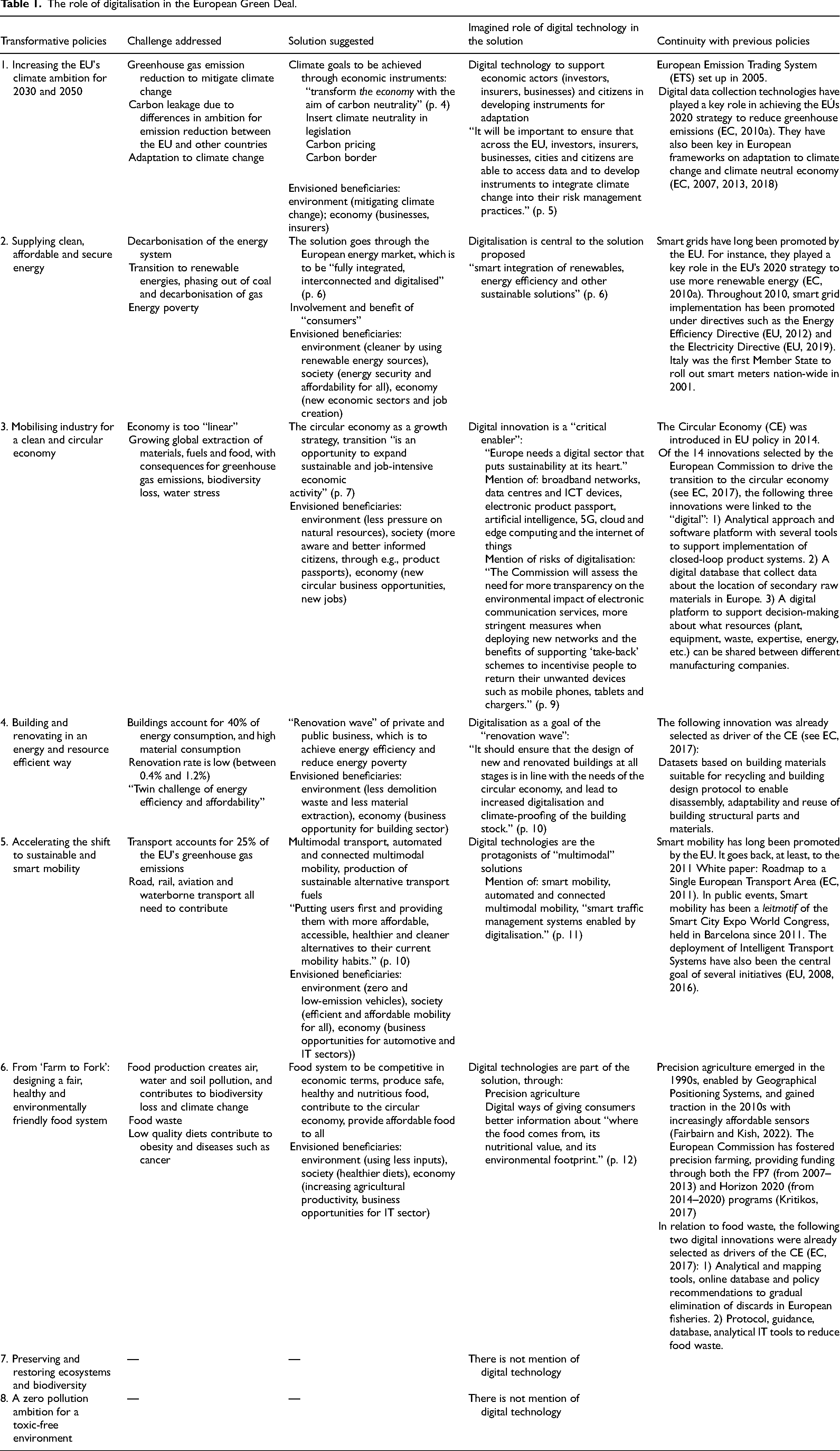
In Table 1, we summarise the results of the coding in each policy area.
The digital imaginary is very present in the formulation of ‘suggested solutions’. In the ‘transformative policies’ related to energy, the circular economy, the building stock and mobility, imagined solutions are closely related to ‘the role of digital technologies’. Digital technology is a central means that enables environmental problems and trade-offs to be turned into win-win ideas. In the ‘transformative policies’ related to climate change and agriculture, digital technologies are seen as supportive of the need for data, information and precision.
In all cases, the win-win logic is prominent. Environmental and economic benefits are coupled in all ‘transformative policies’ and in most instances, benefits for the environment, the economy and society are envisioned. For example, in the policy ‘From “Farm to Fork”: designing a fair, healthy and environmentally-friendly food system’, digital technologies enable precision agriculture, which appears beneficial: (i) for the environment, thanks to reduced use of pesticides through sensors that capture ‘bad’ insects, reduced use of water resources through sensors of humidity, less food waste through Artificial Intelligence (AI) software that points to the specific ingredients that can be avoided because they are wasted; (ii) for society, through healthier diets, digitally mediated information about where food comes from; and, (iii) for the economy, with a new digital economic sector, job creation, lower costs for the farmer or for business as they become more efficient with sensors and big data.
Win-win ideas are introduced without paying much attention to the potential trade-offs derived from large-scale implementation of digital technologies. At the policy level, trade-offs are solved discursively. In the realm of implementation, trade-offs are handled according to dominant practices. A similar critique is raised also by Vezzoni (2023), who argues that public funding will be captured by corporations who consolidate the EU's ‘project of an open market economy based on mercantilist export-led growth, market-based innovation, technocratic governance and alignment of state and corporate interests’ (p. 12). In practice, economic goals tend to be prioritised because digital ‘solutions’ are implemented within a neoliberal political rationality (Barry, 1993). For instance, in the policy ‘Supplying clean, affordable and secure energy’, the digitalisation of an energy sector largely based on renewable energy sources will prioritise creating new business opportunities in the digital sector with applications to the energy field despite the increasing energy demand of digital services. In the policy ‘Accelerating the shift to sustainable and smart mobility’ an automated and connected multimodal mobility together with a digitalisation system for traffic management, will prioritise economic goals such as business opportunities in the automotive and digital sectors despite the increasing demand of critical raw materials to produce batteries for electric cars. As a result, digital solutions give continuity to dominant practices and previous policies (see also Table 1).
In contrast to the win-win discourse of the EGD, the 2022 Strategic Foresight Report examined more in detail the tensions and risks that emerge from the twinning of the green and digital transitions. Interestingly, the report was published at the same time as the NextGenerationEU funds that support the digital and green transitions are being distributed and before the results of funded initiatives are in. The focus on trade-offs, therefore, does not emerge from practical experience. In Table 2, we identify for each policy area which tensions are identified by the 2022 Strategic Foresight Report and how the tensions are addressed. It should be noted that digital technologies often appear in both the challenges and the proposed solutions.
2022 Strategic Foresight Report.
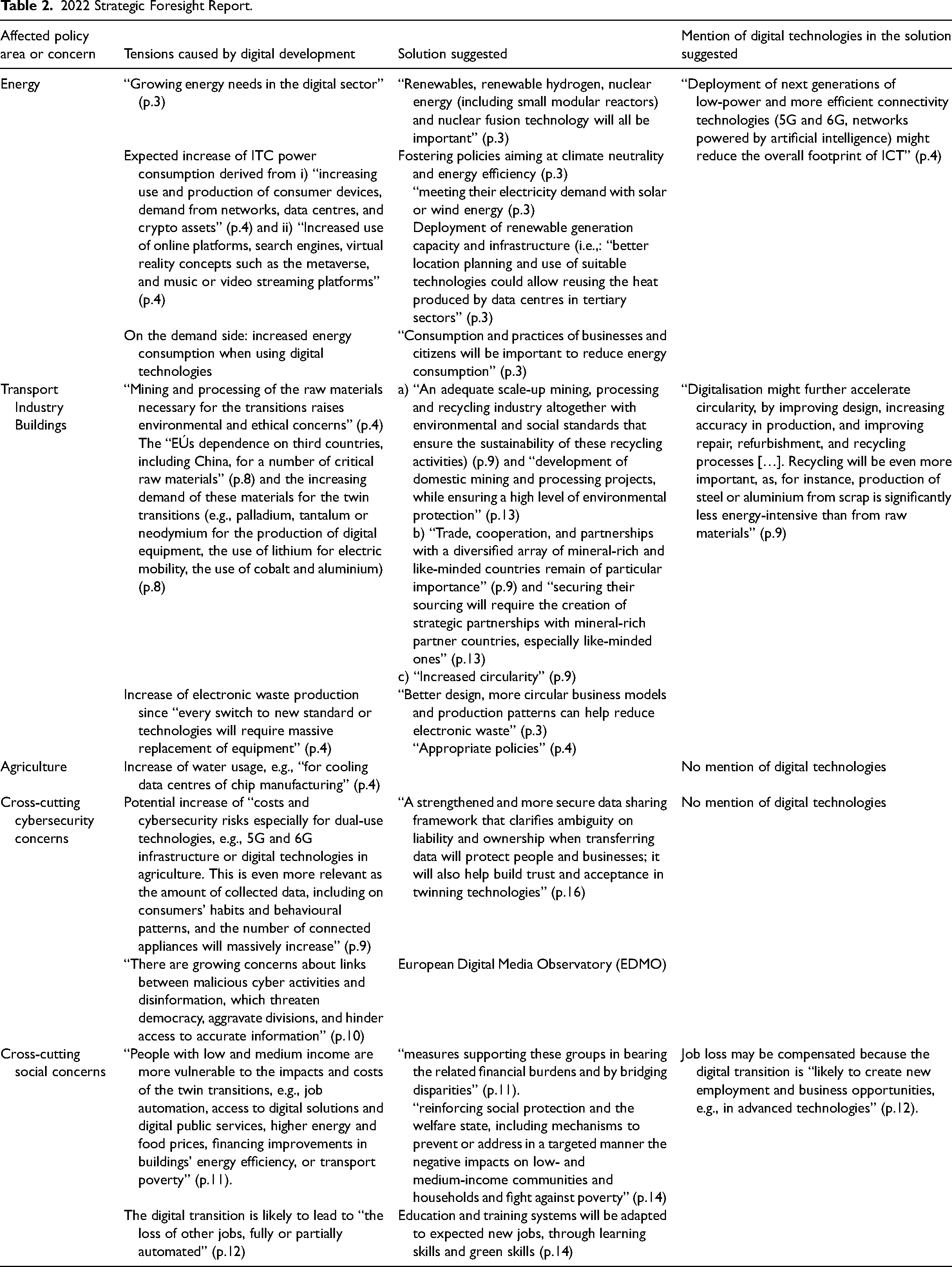
The 2022 report is a forward-looking strategic reflection on the interactions between the green and digital transitions, where ‘twinning’ is defined as ‘their capacity to reinforce each other’ (EC, 2022b: 2). The report points out that ‘until recently, the digital transition progressed with only limited sustainability considerations’ (EC, 2022b: 2). There is a change in narrative from supporting the twin green and digital transition (in the singular) in the EGD, to the challenge of twinning the green and digital transitions (in the plural) and turning the tensions between the two transitions into synergies in the 2022 Strategic Foresight Report.
By jointly analysing the coding of challenges and solutions, we show that digital innovation is seen as part of both the problem and the solution. On the one hand, the idealised role of digital technologies in addressing environmental goals is mentioned. This discourse is aligned with the discourse of the European Green Deal. On the other hand, several tensions between digital innovation and sustainability are mentioned, including environmental problems created by digital innovation itself (such as increasing electricity demand). Notably, the tensions created by digital innovation are addressed by new and existing technologies, including digital technologies, together with a ‘sound EU-level framework’. That is, there is no re-assessment of the desirability of digital innovation and its capacity to provide solutions, even when discussing the problems of digitalisation. Drawing from our theoretical framework, we can say that the hybrids created by the twin transition are either expected to provide win-win solutions or are solved within the digital imaginary, through the promise of win-win solutions to be created by more innovation.
The twin transition at the level of the Member States
The implementation of the EGD was delayed by the onset of the COVID-19 pandemic. Nonetheless, in response to the crisis caused by the pandemic and coinciding with the war in Ukraine and its impact on gas prices and energy security for the EU, the European Commission launched the NextGenerationEU plan, which presents the need to recover from the crisis as an opportunity to streamline the twin transition. The centrepiece of the NextGenerationEU plan is the Recovery and Resilience Facility, a temporary and exceptional instrument that raises funds and directs them towards Member States ‘to implement ambitious reforms and investments that make their economies and societies more sustainable, resilient and prepared for the green and digital transitions, in line with the EU's priorities’ (EC, 2021b) (our emphasis). This way, the green and digital transitions become the central logic for allocating funds, moving the ‘twin transition’ logic from the policy level to the level of implementation.
Member States are required to draft a national ‘recovery and resilience plan’, with a minimum of 40% of the funding allocated to the green transition and a minimum of 20% to the digital transition. The remainder is assigned to economic and social resilience measures. Member States are expected to draft measures for the green transition and the digital transition separately, and funding is assigned either to green transition measures or digital transition measures. This structuring of the funds is in line with political agendas both at the European and National level that have existed at least since 2010 and prima facie does not link the two transitions.
In Figure 3, we summarise the total grants received by each Member State (EU-27) and how much funding the countries allocate to the green and digital transitions and to resilience. The data show what Member States have reported in their national plans. The Member States that received the most funding are Spain (69.5 billion €) and Italy (68.9 billion €), followed by France (39.4 billion €). The proportion of funds allocated to the green transition varies from 40% (Spain and Croatia) to about 60% (Luxemburg, Denmark and Bulgaria). The proportion of funds allocated to the digital transition varies from 20% (Croatia and Romania) to just over 30% (Luxemburg, Lithuania, Ireland). Germany is an outlier, with 52% of its funds allocated to the digital transition.
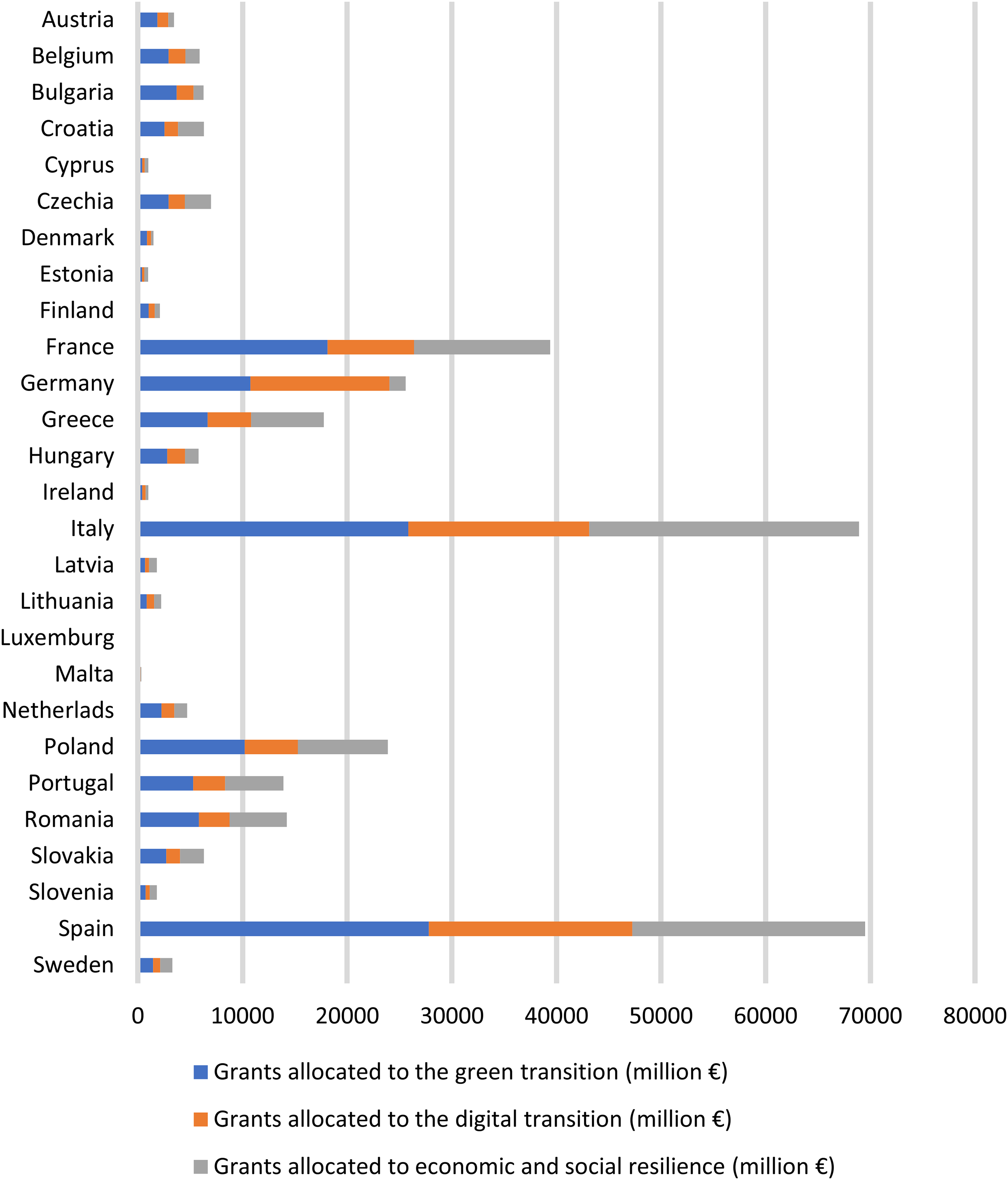
Allocation of funds by Member State. Own elaboration, Source: (EC, 2023b).
Green transition measures focus mostly on renewable energy production and green hydrogen, sustainable mobility and transport, energy efficiency of buildings, and decarbonisation of industry, with few mentions of circular economy initiatives and protecting nature. The focus areas of the digital transition are public administration services, health care, education and connectivity. Interestingly, in the third pillar of the Recovery and Resilience funding, namely economic and social resilience measures, there is more often a joint mention of the green and digital transitions. For an overview of the complete list of measures reported in the Recovery and Resilience Plan Scoreboard for all 27 Member States, see Annexure I.
Seeing the twin transitions as a logic helps understand how countries allocate funds. Many of the measures highlighted in the Recovery and Resilience Scoreboard refer to the specific needs and interests of each Member State. Countries seem to use the twin transition label strategically and consistently with the principle of subsidiarity 3 as a means to fund specific local projects, either by coupling green measures with local needs (for example, energy efficiency coupled with post-earthquake reconstruction) or by presenting local projects as part of the green transition (for example, the extension of metro and train lines).
Many Member States drafted their own recovery plans following the onset of the COVID-19 pandemic. Countries thus tend to engage with the NextGenerationEU plan in a way that directs EU funding towards their previously established plans. For example, in the France Relance plan, several initiatives receive double funding from the digital and green pillars of the Recovery and Resilience budget, including innovation projects in strategic sectors, the reinforcement of vocational training and research programs, health insurance, dependence and cooperation and territorial cohesion. The strategic engagement with EU policy enabled by the principle of subsidiarity creates situations in which it is unclear whether what is being funded falls within the realm of environmental policy. For instance, France's Aeronautical Support Plan receives funding both as a digital and green initiative, because it includes the aim of developing green energy and technology.
While measures are assigned either to green or digital transition funds, when analysed more in detail, many green measures rely heavily on smart technologies, creating a technology-mediated “twinning” between the green and the digital. Taking Germany's plan as an example, some measures allocated to the green transition also have a clear digital component and vice versa. For instance, measure ‘1.3 Climate friendly constructions and renovations’ from the green pillar focuses on the potential of smart technologies. Measure ‘2.1 Data as raw materials of the economy of the future’ from the digital pillar includes a pilot project on data cooperation for sustainability and ecosystem services in food value chains. Measure ‘2.2 Digitalisation of the economy’ includes projects on climate-neutral mobility via digital technological innovations for train systems and digital innovation for e-mobility vehicle production. In all cases, the twinning comes into being through smart technologies and innovation. The twinning suggests that sustainability can be achieved by merely ‘adding’ digitalisation into the mix while underlying production and consumption patterns are not being questioned.
Although the twin transition may fail to bring about fundamental change to European economies, the digital imaginary creates new governance practices. On the one hand, Member States have created national agencies that support the digital transition, as in the case of the Agency for Digital Italy, the French National Digital Council (CNNum), created in 2011 and renovated in 2021. Spain counts with five such agencies, namely the Observatory of the Digitalisation of the Agri-food sector, ObservaCIBER dedicated to digital security, the Observatory of the Social, Labour and Ethical Impact of Algorithms (OBISAL), the National Agency for the Supervision of Artificial Intelligence, and the State Agency of Digital Administration. On the other hand, digital advancements may be redefining what environmental governance deals with, shifting attention towards the narrow objective of greening digital technologies. The Spanish Green Algorithms National Strategy shows an interesting effect of the digital turn in environmental governance; namely, the focus of environmental governance might shift from the governance of the environment to the governance of the emerging digital sector, its energy demand, and related environmental impacts. This shift reinforces the tendency to equate the green transition with the increased use of renewable energy, reducing sustainability to a matter of the type of energy sources used. ‘Improbable coalitions’ may thus intensify the reductionism already created by digital technology in environmental governance (Kloppenburg et al., 2022).
Overall, there are a number of parallels with EU policy. First, innovation is central to national plans, as it is at the EU level. Innovation is funded through all three branches of the Recovery and Resilience Plans. 4 In the economic and social resilience category, funding is often directed to generic ‘innovation’ (see footnote 4). Second, in the same way as EU policy, environmental aims are merged with economic aims, creating an ‘improbable coalition’ between environmental concerns and economic growth. France is a good example of how the EU discourse of the twin transition is reduced to promoting the energy transition and picking up economic growth. The France Relance plan mobilises the green transition to create economic growth, focusing mainly on innovation in the energy sector. Third, digitalisation is closely tied to economic competitiveness. For example, Germany's ‘growth and future package’ focuses on developing ‘future technologies’. Digitalisation, in particular, is treated as a cross-cutting issue. Similar to EU logic, Germany's policy-makers see ‘the digitalisation of the economy and society as a major factor for future international competitiveness’ (Bundesministerium der Finanzen, 2020: 7). Last, the trade-offs between the green and the digital are recognised from the onset also by the Member States. In the Spanish case, the Green Algorithms National Plan was formulated within the National Strategy of Artificial Intelligence, which addresses artificial intelligence or AI's negative environmental impacts and requires that intelligent algorithms be made green by design.
Discussion
In this section, we discuss our results in light of the research question that guided our analysis: why and how is the twin transition legitimised and implemented?
With regard to legitimacy, our results speak to the argument that the move away from the discursive work of purification (Latour, 1993) creates a different logic of legitimation for EU policy-making (Rommetveit and Wynne, 2017). We argue that the new logic of legitimation is based on the purported ability of governing institutions to steer the twin transitions in the desired direction. Since the twin transition presents risks as well as benefits, the task of policy is described as making sure that the EU can ‘harness its benefits for greening and to limit its harmful effects’ (EC, 2022a). The tensions between the green and the digital transitions and the risks of digitalisation require governing agencies to manage risk and direct the (inevitable and already underway) technological and digital developments towards the desired direction. The 2022 Strategic Foresight Report puts it clearly: ‘To diminish adverse side effects and deliver its full potential for enabling environmental, social and economic sustainability, the digital transition requires appropriate policy framing and governance’ (EC, 2022b).
The positive sci-fi-like vision quoted at the beginning of this article can thus be understood as sketching the promise of what digital innovation can do, if well governed. The presentation of such a vision on the landing page of the EC communicates that the EU knows how to avoid so-called ‘transition risks’ and direct the twin transition hybrid in the ‘right’ direction. Within this context, an in-depth analysis of the potential challenges created by the large-scale adoption of digital technologies can come into being in high-level EU policy reports, such as the 2022 Strategic Foresight Report, without destabilising or creating the need to re-assess the policy goals set by the EGD. The risk narrative creates legitimacy for a governing institution which can sort through emerging risks.
These results speak to the debates about how sustainability transitions shift legitimacy to a normative field (Braams et al., 2021; De Geus et al., 2022). Suchman (1995) makes the case for the importance of managing legitimacy to maintain credibility in the eyes of stakeholders. Our results show how the analysis of risks associated with the twin transitions and the creation of promising future visions are examples of how legitimacy is managed in EU institutions. We contribute to the debate by showing how legitimacy strategies take shape in EU policy discourse and we argue that the promises of green and digital solutions are an ‘improbable coalition’. As Zeitlin et al. (2019) explain, improbable coalitions form in response to a crisis but are not durable coalitions.
Digital innovation constitutes a discursive solution to trade-offs and tensions. We speak of a discursive, rather than material, solution because solutions are often expected to come from technologies still being researched and developed, such as hydrogen (Di Felice et al., 2023). Our analysis highlights the political role of innovation in sustainability policies (Kovacic et al., 2020; Di Felice et al., 2023) by showing that digital innovation (as a discourse and imaginary) is used to solve the challenges created by digitalisation (the material practice). By believing, or pretending to believe (Strand, 2002), in the digital imaginary, the material challenge is bracketed by the promise of a future solution.
In terms of implementation, we have observed that the discursive emphasis on innovation and the NextGenerationEU funding concur to the same practical effect of supporting European innovation and the international competitiveness of the EU. Vezzoni (2023) argues that EU environmental policy is committed to ‘institutionalised forms of neoliberalism’, which includes ideas of competitive innovation, market-based solutions and exponential economic growth. The discourse of the twin transition gives rise to a ‘twin transition logic’ that influences the allocation of funds. This logic strengthens the objective of advancing the single European market and ensuring economic growth and prosperity. This result contributes to the critical study of the legitimacy of green policy discourses. A similar approach is taken by Vela Almeida (2023), who enquire how the European Green Deal acts as a legitimating strategy of the EU vis-a-vis other countries. In this paper, we look inward and outward. Within the EU, the European Green Deal can be regarded as a political strategy aligned with the goal of revitalising the single market amid persistent crises. Looking outward, as explained in section 2, the coupling of digitalisation with environmental concerns can be understood as an attempt to create a place for the EU in the global digital race.
No alternative to digital innovation is considered, perhaps because of fears of falling behind in the global technological race and losing international competitiveness. The fact that the 2022 Strategic Foresight Report, which details the shortcomings and trade-offs associated with the twin transitions, was published at the same time as the twin transitions were being funded, seems to suggest that the EC “pretends to believe” (Strand, 2002) in the solutionism of the digital imaginary.
Innovation accommodates the increasingly recognised tensions and concerns created by digital win-win ideas. The EGD strategy falls into a circular argument as digital innovation is evoked as a central technical means to deal with the concerns created by the ‘digital solution’, which were suggested to deal with environmental concerns in the first place. The unquestioned need for digital solutions can be seen as part of the digital imaginary, which shifts the debate to a matter of distinguishing between ‘good’ and ‘bad’ digital solutions without questioning the very need of digital solutions. The reliance on digital solutions even as the problems generated by digital solutions are recognised, can be seen as an instance of ‘desperate modernity’ (Strand, 2002).
Conclusion
Science and technology studies on the digitalisation of environmental governance have analysed the limitations, contradictions, and uncertainties of the digital turn (Bronson, 2022; Gabrys, 2014; Goldstein and Nost, 2022; Kloppenburg et al., 2022). Nevertheless, scant scholarship has delved into how such a digitalisation trend is created, shaped and implemented at different policy scales and how such digitalisation, rather than an isolated dynamic, fits in and is explained by broader political and socio-economic processes.
Theoretically, we develop an approach to understand how ideas criticised by science and whose drawbacks are also recognised in the policy realm – as is the case of the twin transition – may nonetheless become central to EU policy frameworks because of the political function that win-win ideas exercise. We theorise that the political function of win-win ideas is to provide discursive solutions to concerns about both environmental challenges and economic competitiveness, avoiding difficult decisions that trade-offs create. The twin transition discourse mobilises the digital imaginary, as described in the introductory quote of the paper, by which complex environmental challenges are depicted as seamlessly solvable through responsible consumption, transparent data-driven decision-making, and gamification.
With regard to implementation, we discussed how innovation and the digital imaginary are central to the National Recovery and Resilience Plans funded by the NextGenerationEU scheme. Member States strategically engage with the twin transition discourse and funding is directed to long-standing national interests. The EU is coupling the green and digital transitions to gain the so-called competitive advantage in the digital domain (Rehman et al., 2023). This ‘improbable coalition’ (Zeitlin et al., 2019) (i) turns environmental problems into business opportunities to be exploited by digital technologies (such as AI, big data, and blockchain), thereby creating new markets and businesses and (ii) puts environmental governance at the service of the digital sector (as in the case of the Green Algorithms plan in Spain), possibly redefining the scope of environmental governance away from environmental issues and towards promoting the sustainability of the new digital sector. All in all, we argue that environmental challenges drift into the background and environmental governance merges with the governance of innovation.
As a closing remark, we note that the ‘twin transition’ is one more discursive device used by the European Commission to create synergies and consensus around policy issues that are difficult to govern and often controversial. Precedents include the circular economy (Kovacic et al., 2019) and the RE Power EU plan (Vezzoni, 2023). We do not argue that the twin transition is a case of green washing, or a buzzword, by design. We argue that the twin transition discourse is based on simplified win-win ideas, supported by the digital imaginary, which fail to deliver their promised solutions. An alternative policy path would be to avoid technocratic solutions, which inevitably entail trade-offs, and rather focus on democratic resolutions, as a means of dealing with trade-offs in a participatory and inclusive way.
Highlights
We critically assess the so-called ‘twin green and digital transition’ as a policy discourse
The analysis is based on interpretative analysis of high-level EU policy documents and of Member States’ resilience and recovery plans
Innovation associated with the digital imaginary is used to discursively reframe tensions between economic and sustainability policy aims as synergies
Legitimacy is derived from the claimed ability of governing institutions to steer the twin transitions in the desired direction
Supplemental Material
sj-docx-1-ene-10.1177_25148486241258046 - Supplemental material for The twin green and digital transition: High-level policy or science fiction?
Supplemental material, sj-docx-1-ene-10.1177_25148486241258046 for The twin green and digital transition: High-level policy or science fiction? by Zora Kovacic, Cristina García Casañas, Lucía Argüelles, Paloma Yáñez Serrano, Ramon Ribera-Fumaz, Louisa Prause and Hug March in Environment and Planning E: Nature and Space
Footnotes
Declaration of conflicting interests
The author(s) declared no potential conflicts of interest with respect to the research, authorship, and/or publication of this article.
Funding
The author(s) disclosed receipt of the following financial support for the research, authorship, and/or publication of this article: This work was supported by the Ministerio de Ciencia e Innovación (grant number RYC2021-031839-I, TED2021-132205A-I00, IJC2020-045101-I). This publication is part of the 2021 SGR 00975 project funded by the Department of Research and Universities of the Generalitat de Catalunya. Hug March is an ICREA Academia (2023) research fellow.

Supplemental material
Supplemental material for this article is available online.
Notes
References
Supplementary Material
Please find the following supplemental material available below.
For Open Access articles published under a Creative Commons License, all supplemental material carries the same license as the article it is associated with.
For non-Open Access articles published, all supplemental material carries a non-exclusive license, and permission requests for re-use of supplemental material or any part of supplemental material shall be sent directly to the copyright owner as specified in the copyright notice associated with the article.
