



Abstract
The emergence of green industries has been considered from multiple social science perspectives. Economic geographers view green industries as unevenly distributed firms forging green development paths. Sustainability transitions scholars view green industries as niche sectors struggling to mainstream green technologies in existing socio-technical systems. Political ecologists view green industries as metabolic actors whose development shapes and is shaped by the environment. Conceptualizing green industries as the interplay of green firms, socio-technical systems and the environment, this article proposes an integrative framework that synthesizes the three aforementioned perspectives for a research agenda of the geographies of green industries.
I Introduction
With the growing salience of global climate change, resource depletion and many other environmental challenges to human survival, calls for green development are more urgent than ever (Calignano et al., 2019). Accordingly, we have witnessed a boom in so-called “green economy” projects that promise to remedy ecological crises while simultaneously being “pro-growth, pro-jobs, and pro-poor” (Gibbs and O’Neill, 2014: 201). Green industries, which comprise firms within a range of sectors that produce or market products that facilitate the protection or improvement of the environment (Shapira et al., 2014), are undoubtedly among the most critical forces enabling green development (Sotarauta and Suvinen, 2019). They appear to disrupt (or at least reconfigure) existing socio-economic institutions and market segments that rely on “a high-growth, carbon-based, consumer-led economy” and help realize the sustainable development of the economy and the environment (Gibbs and O’Neill, 2017: 162). Many governments worldwide currently view green industries as a crucial sector for maintaining their growth trajectories in the context of rising environmental awareness (Trippl et al., 2020). Instead of providing an exhaustive definition of green industries (Grillitsch and Hansen, 2019), we conceptualize them as lying at the intersection of three domains: green firms (engaging in industrial sectors that contribute to environmental protection, e.g., those related to renewable energy and waste recycling (Shapira et al., 2014)), socio-technical systems (encompassing production, diffusion, and use of green technologies (Geels, 2004)) and biophysical environment (including abiotic components, e.g., land, water, air and minerals; and biotic ones, e.g., humans, animals and plants). Accordingly, we should examine green industries not only as triggers for the spatial unevenness of green industrial growth but also as niche sectors in temporally evolving socio-technical transitions and drivers of socio-material transformations.
This article identifies three key approaches to understanding the geographies of green industries. Although green industries span across the three aforementioned domains, existing scholarship tends to ontologically privilege a single domain as its analytical entry point. The first concerns firms in regions, inspired by the focus of economic geography (EG) literature on the spatiality of the emergence and growth of green industrial activities in a specific region (He and Mao, 2020). This line of research enlightens us on how green industries develop spatially in the process of green path development (e.g., Njøs et al., 2020; Sotarauta et al., 2021; Trippl et al., 2020) and how firms driving their development are situated within particular economic networks, that is, global value chain (GVC) and global production network (GPN) (e.g., Alexander, 2020; Krishnan et al., 2023; Werner, 2022). The second concerns socio-technical systems, echoing the emphasis of the sustainability transitions (ST) literature on how green technological innovations develop and how they challenge and reconfigure established socio-technical systems over time (Köhler et al., 2019; Markard et al., 2012). ST scholars focus on the role of green technological niches, such as R&D institutes and start-ups, in building up their momentum in the mainstream economy by improving the technical and economic performance of their innovations so as to explore the temporal features of ST processes (e.g., Ko et al., 2021; Markard et al., 2016). The third concerns the environment, a key focus of political ecology (PE) scholarship exploring “the nature of the social relationships that unfold between individuals and social groups and how these, in turn, are mediated by and structured through processes of ecological change” (Swyngedouw et al., 2002: 125). Political ecologists view green industries as embedded in a politically mediated network of actors driving green production and biophysical masses, with a focus on material flows as inputs to and outputs of green industries (e.g., Archer, 2022; Gandy, 2022; Wang et al., 2022).
Scholars from each of the three strands mentioned above typically select one domain of green industries as an entry point of analysis. EG sees green industries as unevenly distributed firms seeking to profit from environmental improvement goals. ST sees green industries as niche sectors struggling to mainstream their green technologies in existing socio-technical systems. PE sees green industries as metabolic actors whose development shapes and is shaped by flows and stocks of materials in the metabolism of socio-natures. Although existing literature has yielded important insights, our subsequent review shows that none of them can single-handedly reveal the full range of drivers, processes and effects of green industry development across space and time. This article argues that the three domains are interdependent and supplementary, and it is their interactions and synergies that jointly shape the geographies of green industries. Considering this context, we argue for a constructive synthesis of the three approaches, which enables us to comprehend why and how green industries are developed in certain forms in particular sites.
The remainder of the article is structured into five sections. The next three sections review the three aforementioned approaches, namely, EG, ST, and PE, in addressing one of the three domains of green industries. We examine how their different conceptualizations of green industries have been applied and what limitations they have in terms of considering other domains. Then, we address these limitations by proposing a threefold construct to integrate the three siloed approaches and highlight the entanglements of the three domains in green industry development. The final section concludes the article with a call for geographers to engage critically with the geographies of green industries by advancing our theoretical and analytical approach.
II Green firms as drivers of green industry development: Insights from EG
The interrelations between firms, industries and space constitute a major focus of interest in EG (Featherstone and MacKinnon, 2017). Following the emergence of a new “green” techno-economic paradigm (Hayter, 2008), economic geographers have posed fundamental questions about why certain industries have developed unevenly across space and how they can be developed in certain regions (Gibbs and Jensen, 2022; Trippl et al., 2020; Werner, 2022). This has led to the development of a new thematic strand of EG scholarship, that is, green EG, comprising studies that, despite their different approaches, are united in their focus on the development of EG in a world of growing environmental concerns.
First, the emphasis on the drivers of the “greening” processes of firms, production networks and industry sectors can be traced back to the rise of environmental EG (Bridge, 2008; Hayter, 2008). This green subfield of EG examines “the reciprocal relationships between economic organization and environmental outcomes” (Bridge, 2008: 76). Scholars in this subfield typically analyze how green industrial activities unfold in particular spatial patterns and how these activities are shaped by growing pressures for environmental protection (He and Mao, 2020). Inspired by the theory of ecological modernization, which optimistically views environmental problems as resolvable through industrial and technological progress (Bridge, 2008), environmental economic geographers are interested in the contextual factors that give rise to the boom of green industries (Gibbs, 2006; Schulz and Bailey, 2014). Specifically, they examine what types of context-specific institutional changes are required to set economic restructuring in a “greener” direction (Zhu et al., 2014).
The subfield of green EG is marked by the same high degree of theoretical diversity as EG’s scholarship on conventional sectors in recent decades. Some economic geographers apply a relational perspective to explain the greening behavior of firms through the lens of GVC and/or GPN (e.g., Krishnan et al., 2023; Werner, 2022). Informed by increasing awareness of sustainable production, they argue that the key enabling factors for the green actions of firms are embedded in value chains or production networks (Alexander, 2020; Krauss and Krishnan, 2022; Poulsen et al., 2018). A growing number of firms have embraced a green turn in their business operation, for instance, by using recycled raw materials or reducing waste and pollution. These efforts create a key competitive advantage for firms, driving lead firms to govern their value chains through various ways to enroll their suppliers in green production pathways (De Marchi et al., 2013a, 2013b). In addition to buyer-seller relationships, the GPN framework has considered actors external to production processes for unpacking how multiple forms of embeddedness affect the environmental decision-making of firms. Moreover, scholars draw particular attention to three dynamics that shape a firm’s green industrial activities in GPNs, namely, evolutionary processes, embeddedness, and pressures from diverse governance actors (Alexander, 2018, 2020; Dawley et al., 2019).
Scholars have also drawn on established concepts and models in evolutionary EG to investigate the conditions and mechanisms that drive the development of new green industries in particular regions (e.g., Njøs et al., 2020; Trippl et al., 2020). Evolutionary EG aims to examine the spatial distribution of economic activities over time (Boschma and Frenken, 2006). This scholarship gives more emphasis on endogenous factors than exogenous factors when discussing the emergence of new economic activities (Trippl et al., 2018). It has shed light on the path-dependent behavior of firms, industries and clusters that grow and diversify or have become locked into particular trajectories (Boschma and Frenken, 2006; Martin and Sunley, 2006). Previous economic achievements do not necessarily lock a region’s economy into a particular path; however, they do exert influence on the type and range of new—including greener—paths that can be created. Recent literature has studied specifically green path creation to further account for how green industries emerged in a region over time (Calignano et al., 2019; Trippl et al., 2020). Much work on green path creation takes a microeconomic approach that views firms as primary agents, especially highlighting the role of entrepreneurs who strategically and mindfully take actions in multiple stages to realize a new, greener branch of business (Mackinnon et al., 2019; Sotarauta et al., 2021).
In evolutionary EG, recent advances have enriched this perspective by importing critical insights from transition studies, which have been strong in examining the conditions and processes shaping the emergence of a new green industry (Chlebna et al., 2023; Heiberg et al., 2020; Gibbs and Jensen, 2022). EG has been criticized for being “largely silent on the issues of how and where that novelty comes from, or why one form of novelty gets selected over another” (Martin and Sunley, 2006: 407). Given technological innovation as a prerequisite for green industry development, some scholars have worked on the concept of path creation and argued that it relies on “self-reinforcing mechanisms that cumulatively stimulate entrepreneurial activities, [technological] innovation, and growth” (Steen and Hansen, 2018: 193). In addition to self-reinforcing mechanisms, some forms of disruption or triggering events are necessary for a new industrial development path to be initiated (Steen and Hansen, 2018). Therefore, recent contributions (Chlebna et al., 2023; Gibbs and Jensen, 2022) point to the intersections between industrial path creation and transition studies to unpack the process through which actors mobilize resources to trigger the initiation of new paths. This process used to be vaguely charted and not conceptualized in much detail but usually explained as contingent outcomes in conventional evolutionary EG (Binz et al., 2016).
In addition to a lack of specification of the generic resources that actors mobilize in early path creation phases, evolutionary EG has offered limitied insights into the adverse impacts of a new green path on the region. The recent development of green industries that form a green path creation may be beneficial to the local economy and the environment, but it may also crowd out investment in more traditional sectors, resulting in the decline of an existing regional path. Since an industry's new green path may not be a growth path for the entire region, some EG studies have shed light on the “dark side” of path development to investigate its variegated consequences (Breul et al., 2021; Blažek et al., 2020). According to MacKinnon et al. (2019: 121), “new [green] paths may generate new forms of inequality and exploitation through, for instance, the growth of low-value and precarious employment, uneven resource allocation, and the exclusion and displacement of some groups.” We argue that discussions of the dark side of green path creation may not only focus on the unevenly distributed economic and social impacts but consider the equally significant environmental externalities, to which current studies have paid less attention.
Given that “economic processes must be considered in relation to the biophysical, cultural and social processes with which they co-evolve” (Sheppard, 2011: 321), EG scholars incorporate geographical political economy (GPE) approaches to enrich evolutionary thinking (Pike et al., 2009; Pike, 2022). GPE imparts an explicit grasp of the different kinds and degrees of power that shape evolution in EG by recognizing unequal socio-spatial relations (Pike et al., 2009). Moreover, scholars who are interested in decarbonization believe that a focus on the GPE of energy transition helps unpack how the transition is shaped by processes of innovation that are constituted spatially and how these processes constitute space through their interactions with one another (Bridge and Gailing, 2020). With increasing literature combining transition theories with EG research, we provide an overview of ST work, summarize key critiques of this approach, and identify constructive ways in which ST ideas can supplement EG, especially in the research on green industries, in the next section.
III Socio-technical innovations in green industry development: Insights from ST
Transition research has drawn attention to the socio-technical factors that shape the development, uptake, and demise of various technologies shaping changes in society, the economy, and the environment (Köhler et al., 2019). Some scholars in this tradition have studied how established socio-technical systems can be radically restructured toward a sustainable mode of production and consumption (Farla et al., 2012; Markard et al., 2012), a trend known as ST (Sengers et al., 2019). Among studies of ST, one of their favored empirical points of entry is green industries, which they conceive as the origin and outcome of innovation of green technologies for a greener economy (Zhang et al., 2021).
Two analytical frameworks in ST research are conducive to the understanding of the opportunities and constraints that confront green industry development in a specific region. The first one, technological innovation systems (TIS), conceptualizes technological innovation as a multi-stage process supported by institutional and organizational changes (Markard et al., 2015). The TIS is defined as a dynamic network of actors who generate, diffuse, and utilize new technologies in a given region with a particular institutional setting (Carlsson and Stankiewicz, 1991; Wieczorek et al., 2015). Concerned with shifts in technology-specific innovation systems (Hekkert et al., 2007), the process-based perspective of TIS on industry formation has distinguished a set of system-building processes that are directly related to green innovation, including entrepreneurial activities, knowledge development, identification of specific directions of innovation, market formation, resource mobilization, and creation of legitimacy for the new technology (Bergek et al., 2008; Hekkert et al., 2007). They cover the key processes in the development of any TIS and form distinct resources that support the invention and mainstreaming of new—including green—technologies. According to this perspective, the emergence and development of green industries rely on how these necessary resources are aligned with one another through the interactions among relevant actors, networks, and institutions (Ko et al., 2021; Wieczorek et al., 2015).
Second, the multi-level perspective (MLP) highlights ST as a non-linear and long-term historical process produced by the interplay of development at three analytical levels: niche, regime, and landscape (Geels, 2002, 2004; Smith et al., 2010). The niche is the locus of radical green innovation generated by a small and emerging network of actors, for example, in the form of R&D laboratories (Geels, 2011). The socio-technical regime is the locus of established practices and associated rules that stabilize existing systems (Geels, 2011). The landscape is a constellation of social and physical conditions that form the exogenous context of interaction between niches and regimes (Geels, 2011; Zhang et al., 2021). While both EG and ST studies argue that prevailing development patterns may affect future growth, it is ST that underscores the necessary conditions for changes to be achieved. In particular, the MLP interprets technological change as a result of newly emerged niches developing technologies to address challenges to the incumbent socio-technical regime brought by abrupt changes of long-term, relatively stabilized landscape-level trends (Raven, 2007). Therefore, from the perspective of ST, the development of green industries is more than a firm-specific transition (with the firm being a niche actor) as it often requires and provokes changes at the regime level, for example, infrastructure and institutions, as well as at the landscape level, for example, consumer behavior in a specific region (Yu and Gibbs, 2020). It is critical to unpack how changes in regimes and landscapes create windows of opportunities for niche innovation so that a new green industry can emerge (Zhang et al., 2021).
In recent decades, ST scholars have engaged with geographers to better account for the role of multi-scalar and place-specific factors in shaping the pace, scope, and direction of transitions (Hansen and Coenen, 2015; Fastenrath and Braun, 2018; Murphy, 2015). Classic transition research has assumed that regimes operate at the national scale, while some scholars argue that this narrow emphasis prevents ST studies from “conceptualizing the spatial variety and complex interdependencies that result in geographically specific forms of institutional embeddedness within regions and places” (Lawhon and Murphy, 2012: 362). Conventionally, ST studies also tend to disregard the fact that niche-regime interactions are embedded in multiple networks, a key research focus of EG scholars (Binz et al., 2020; Truffer et al., 2015). For instance, niche actors not only interact with regime actors that are related to the state but also those as lead firms and suppliers within GPNs. By identifying these spatial relations in multi-scalar networks based on EG knowledge, we can account for the geographically diverse sources of influence on green technological innovation and even sustainability transitions (Zhang et al., 2021).
In addition, ST studies should have been more concerned with the biophysical environment in which green technological innovation is achieved and implemented. Although some ST scholars may view adverse changes in the environment as landscape changes (Geels, 2011), they have paid less attention to how ecological processes directly shape and are shaped by new green technologies. Alongside environmental changes, the distribution of socio-environmental harms and benefits of green industry development deserves investigation as people and places unevenly experience the costs and benefits of the distribution, production and consumption that evolve in ST (Newell and Mulvaney, 2013). Therefore, some scholars advocate and explore ST with an emphasis on environmental justice in the hope that inequalities, such as exposure to ill-health and localized degradation, are not reproduced or exacerbated. These attempts have further imported justice principles into ST studies to develop an integrated framework of “just transition” (e.g., Bouzarovski, 2022; Garvey et al., 2022; While and Eadson, 2022).
While just transition approaches often highlight the ethical implications of or dilemmas inherent in environmental decisions (Köhler et al., 2019), they can give more explicit consideration to power dynamics and politics. Existing ST scholarship tends to present ST as a kind of “right course of action” while neglecting the contestations involved between different actors who stand to benefit or lose with the development of new (green) technologies (Markard et al., 2015: 81). Feeling threatened by their greener counterparts, existing industries may exploit their market dominance to protect their vested interests and resist transformative green innovations (Normann, 2015). Meanwhile, actors in favor of greener socio-technical configurations will lobby for public support. Given that the resistance from existing interests is often substantial, struggles between newcomers, regime supporters and marginalized groups in green transitions should be revealed. Therefore, the need to address the politics of ST that goes beyond more apolitical origins of the ST literature is being increasingly recognized, not least for ensuring that the proposed transitions are socio-environmentally just (Loewen, 2022; Wang and Lo, 2021).
IV Materiality of green industry development: Insights from PE
Although green EG and ST studies are motivated by the recognition of environmental concerns, they do not necessarily explore in detail the changes in ecological processes and conditions brought by green industrial restructuring efforts. Resource shortage is widely regarded as a shaping force of the industrial pathway toward a more sustainable transformation. However, there is a lack of attention to natural resources as crucial material inputs to green industries as raw materials and ambient conditions, not to say whether and how these material requirements affect the bargaining among different stakeholders for resource access (Werner, 2022). Furthermore, detailed explanations of the probable impacts of green industries on ecosystems are lacking, barring several exceptions (e.g., De Marchi et al., 2013b). In other words, the extent to which a new green industry contributes to achieving greater ecological sustainability remains unknown (Trippl et al., 2020). Without knowing its outcomes, we are less able to determine how “green” a “green industry” is.
To highlight the role of “greenness” in green industry development, we draw on insights from PE to develop an understanding of nature-society relations, hybrid socio-material metabolisms, and power dynamics (Turner, 2016). We are consciously broad in using the term “political ecology” to denote a group of studies that share the same fundamental concern for the interplay of politics and ecology but differ in their substantive focus, for example, those in urban political ecology and political-industrial ecology (Breetz, 2017; Zimmer, 2015). PE in this sense refers to a field that studies “how political, economic, and social relations shape and are shaped by [the environment], which co-constitute the ecological conditions of human life” (Cederlöf, 2021: 71). With a focus on metabolism, political ecologists have drawn inspiration from Marx’s reference to the metabolic process to analyze how ecological metabolism processes are reconfigured to produce uneven socio-environmental changes (Baka, 2017; Swyngedouw et al., 2002). They have specific interests in teasing out “who gains from and who pays for, who benefits from and who suffers (and in what ways)” from particular processes of these changes (Swyngedouw et al., 2002: 125).
Three crucial insights from PE offer a lens for exploring the material politics of resource flows that shape green industry development. First, PE helps reveal whether the environment, not as an idea but as a material entity, shapes economic activities. PE shares with its urban political ecology counterparts an emphasis that “[e]nvironmental and social changes co-determine each other” (Swyngedouw et al., 2002: 124). On the one hand, as a commonly recognized view, environmental changes result from specific industrial or economic processes, patterns and institutions that accompany them (Swyngedouw, 1997; Swyngedouw et al., 2002: 125). On the other hand, as argued by Swyngedouw et al. (2002: 125), “all socio-spatial processes are invariably also predicated upon the transformation or metabolism of physical, chemical, or biological components.” Such flows not only result in social pressures for environmental improvement but can also pose physical and material constraints to industrial development, such as in the form of a shortage of wind resources hindering the wind power industry (as discussed below). The idea of PE can help explain why environmental conditions enable or constrain green industry development and, more importantly, how such development consequently reshapes socio-economic relations within and outside a specific industry.
Second, what further distinguishes PE is its stress on the agency of ecological matters, whose flows and stocks are quantified by political-industrial ecologists sharing the same concern on the material underpinnings of the economy. Early research of industrial ecology has well-established interests in resource recovery and other green industrial activities relevant to a circular economy (Hobson, 2016). This strand of work “draw[s] analogies with material and energy flows in natural ecosystems to argue that the means to sustainable development is to close material loops through the exchange of by-products and wastes” (Gregson et al., 2015: 220; McManus and Gibbs, 2008). However, it tends to obscure the equally, if not more, important question of how historical, social, political and economic mechanisms influence metabolisms of socio-natures (Cousins and Newell, 2015). Given these concerns, political-industrial ecology studies combine “industrial ecology’s quantitative resource flow analysis”, “urban ecology’s appreciation of the biophysical dimensions of urban spaces”, and “[classical] political ecology’s analysis of power relationships” (Deutz et al., 2017: 337). They provide a framework to analyze the socio-political and economic mechanisms of green industrial activities that facilitate the material interchange necessary for closed production-consumption loops for a circular economy.
Third, PE is explicitly concerned with how relations of power are developed through material transformation. As political ecologists argue, “[q]uestions of socio-environmental sustainability [... are] fundamentally political questions” (Heynen et al., 2006; Swyngedouw et al., 2002: 125). PE’s emphasis on social and political processes suggests that special attention has been paid to issues of power, power relations, and discourses (Newell et al., 2017). In this regard, political ecologists exhibit a strong concern for the socio-spatially uneven distribution of the benefits and costs of attempts to exploit the environment and develop green industries (Basu and Chakraborty, 2022; Guibrunet et al., 2017; Holifield, 2015). For example, studies have focused on how the poor, women and ethnic minorities may be involved in conflicts over the development of local green industries (Demaria and Schindler, 2016). Although justice concerns have also emerged in the ST recently, “[t]he extent to which just transitions can achieve a radical transformation in power relations” is largely absent from current literature (Bouzarovski, 2022; Wang and Lo, 2021: 8). The GPE perspective in EG regards green production in industries as “a highly politicized process in which preexisting power inequalities operating at a variety of geographical scales shape who gains control of what aspects of nature, to which effects” (Sheppard, 2011: 324). However, it is PE that provides critical insights into addressing inequality, injustice, and asymmetric power relations at the nexus of people and ecology (Sovacool, 2021).
As Barca and Bridge (2015: 366) argue, “[i]ndustrialization is one of the great markers for periodizing socio-ecological relations.” It is a continuous process of socio-ecological transformation and differentiation which involves launching new forms of appropriation of raw materials, commodifying land and labor, and accelerating the generation and recycling of waste. By transforming socio-material conditions, industrial activities simultaneously reproduce and transform the uneven distribution of political-economic power of actors involved in industrialization (Barca and Bridge, 2015). However, PE has given industrial activities, a driver of resource mobilization and socio-ecological metabolism, comparatively limited attention. Green industrial processes—the dynamics of transforming and capturing value via the physical transformation and (re)assembly of raw materials into manufactured green products (Barca and Bridge, 2015: 370)—are often occluded in PE accounts. In the case of green energy, for example, PE scholarship typically starts with either the act of resource extraction or the politics of energy access and consumption, with the intermediary industrial processes and the metabolic changes involved relegated to the contextual backdrop rather than treated as an explanatory focus. More considerations of how green technologies gain momentum over time and how green industrial production is driven by firms, as ST and EG scholars have stressed respectively, may enlighten political ecologists to unpack struggles over material resources as the root of environmental (in)justice consequent to green industrialization.
V Developing an integrative framework
A summary of the three views of green industry development.
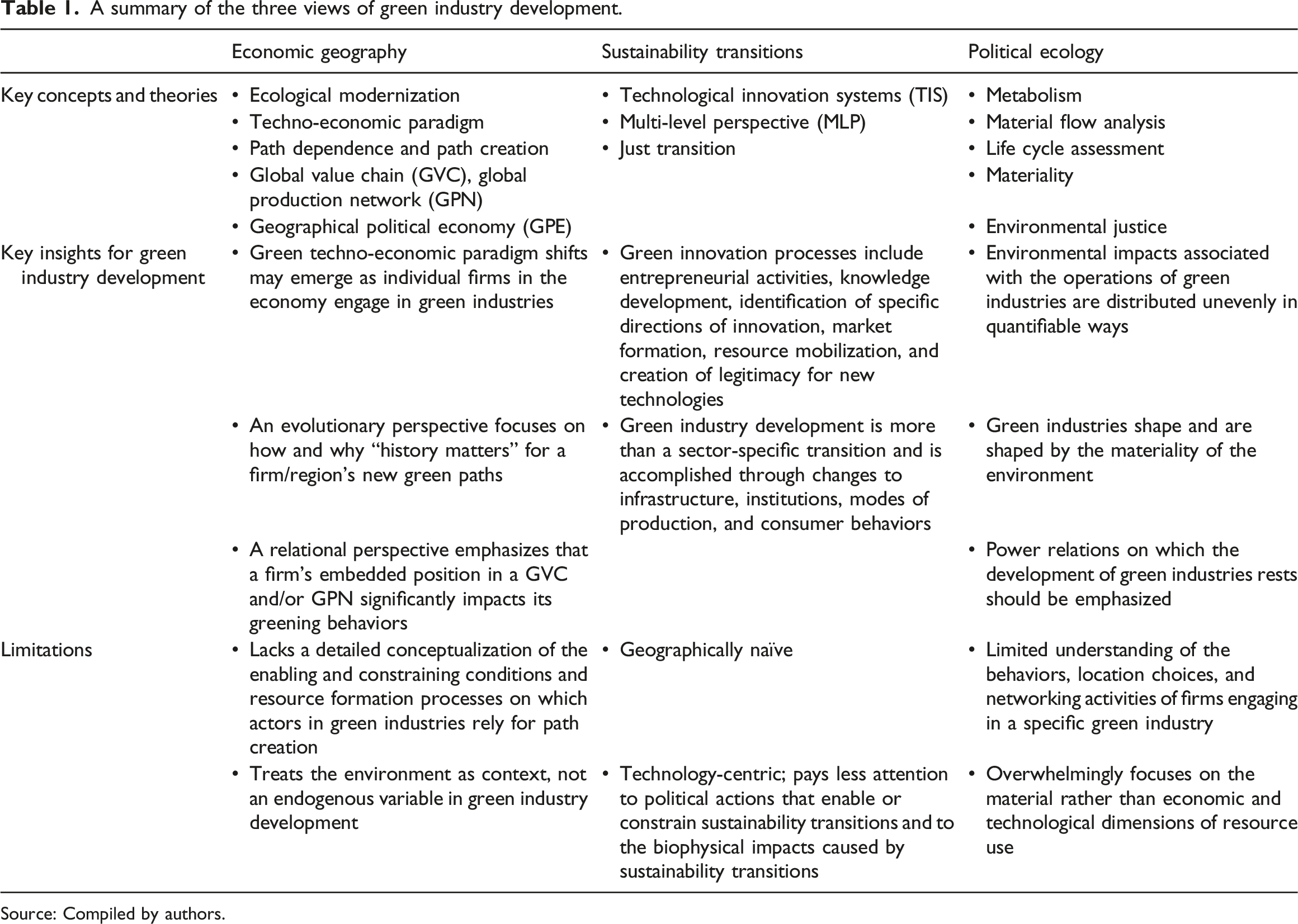
Source: Compiled by authors.
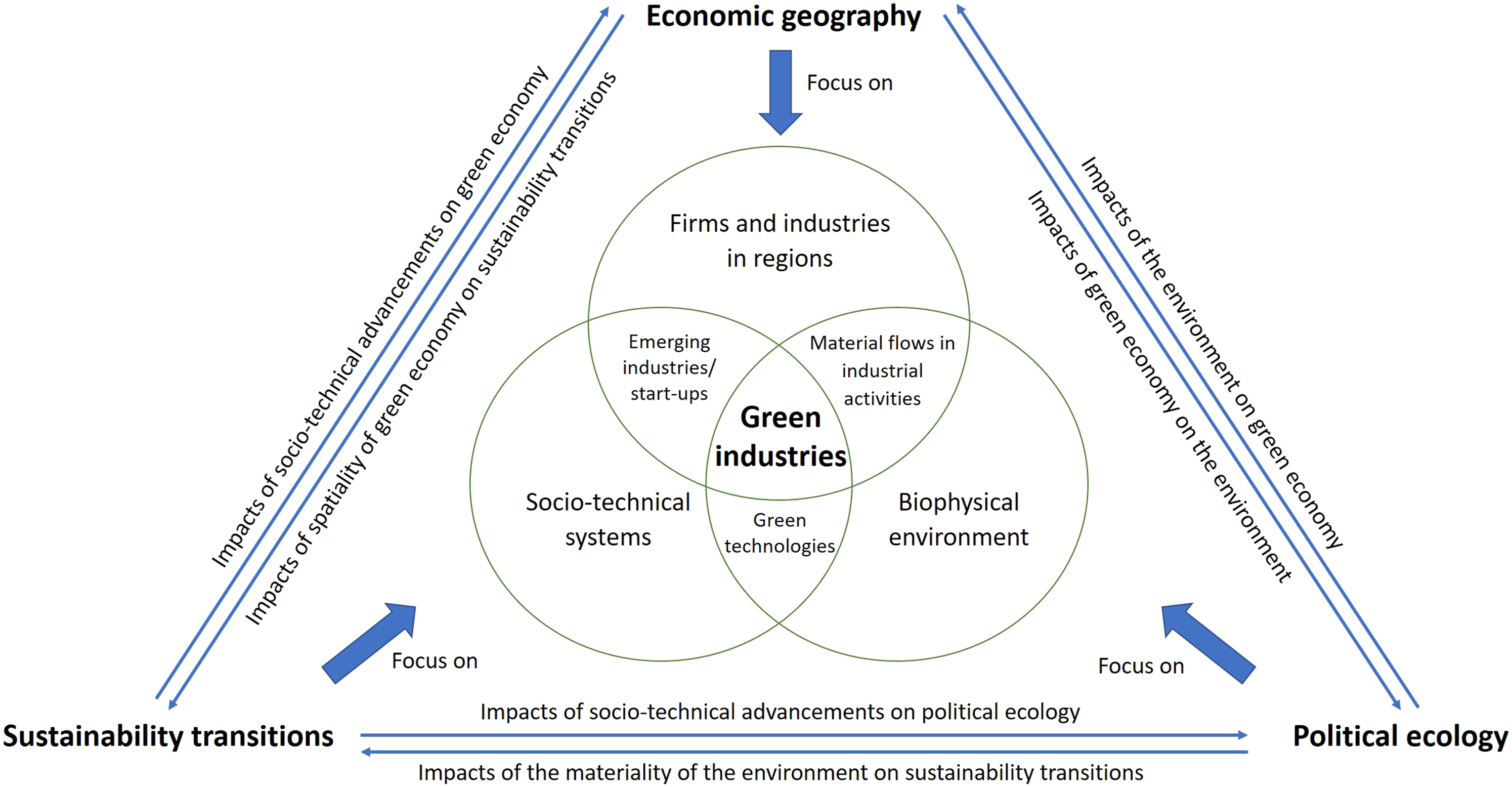
Conceptual framework for a multidimensional analysis of green industry development.
1 Geographies of green industries: Integrating three perspectives
Our integrative framework builds upon the following central premise: underscoring any one perspective can be a useful entry point to studying green industries, but whatever that perspective may be, the attention of researchers should sooner or later be extended to the two other aspects. First, economic geographers who study the spatial development of different types of industries are becoming interested in how environmental concerns have recently shaped the modes and distribution of industrial development (Trippl et al., 2020; Werner, 2022). Many of these scholars combine elements related to the technological evolution of ST research with an account of green path creation in evolutionary EG to strengthen the explanation of the socio-technical aspects of the emergence of a new green industry in particular localities (Binz et al., 2016; Gibbs and Jensen, 2022). However, EG scholarship tends to overlook the impacts of green industry development on the ecological environment. Economic geographers recognize the context of environmental improvement and green development, but they do not treat the environment itself as a key mediator in the green industrial activities of firms (Gibbs and Jensen, 2022; He and Mao, 2020). As the GPE perspective underlines, production is entangled with “biophysical, social, political and cultural processes and presupposes the commodification of nature” (Sheppard, 2011: 324). Therefore, it is desirable for economic geographers to further question what specific biophysical effects green industry development brings to a specific region to examine the extent to which this kind of development enhances ecological sustainability in reality. Instead of taking the environment as a contextual factor (Turner, 2016), this framework also highlights the importance of considering how natural conditions enable or constrain green industry development within a particular physical metabolism. In short, an integrative framework incorporating ST and PE insights into EG can help further investigate the processes, mechanisms, and impacts of the initiation of a new green industrial path and move beyond the legacies of the nature-society divide in economic-geographic thought.
Second, the strength of the ST approach lies in analyzing the socio-technical system changes and co-evolution of technologies, markets, user practices, policies, and cultures with green industry development (Yu and Gibbs, 2018). ST research has recently engaged with the work of economic geographers to demonstrate how multi-scalar and place-specific factors can contribute significantly to sustainability transitions (Binz et al., 2020; Garvey et al., 2022; Sengers et al., 2019). Moreover, some scholars have recognized that there is a lack of a critical examination of nature-society relations and power dynamics in the context of mainstream socio-technical and just transition debates (Lawhon and Murphy, 2012; Bouzarovski, 2022). Despite these contributions in favor of complementary perspectives, ST studies share with EG the same obscurity in the analysis of the ways in which technological artifacts are embedded into the biophysical environment, and of its biophysical consequences. They should pay more attention to the environmental outcomes of ST like political ecologists do; otherwise, it is hard to say whether the regime shifts we are encouraging and promoting actually lead to a more sustainable future. Bringing the politically-sensitive insights of PE to bear on ST theories will provide better guidance for advocates of ST to achieve just and sustainable outcomes. In short, it is critical to emphasize the role of place-specific factors in ST through preexisting industrial bases as foundations for green niches or industry formation, which concomitantly are conditioned by the materiality of natural resources.
Third, the PE approach with a focus on nature-society relations opens spaces for considering the materiality of new green industrial development. While political ecologists are equally interested in the development of green industries, they regard green industries as entities that shape the metabolism of socio-natures rather than drivers of economic development. In other words, their focus is on the material impacts but not the economic behaviours of green industries (Deutz et al., 2017; Newell and Cousins, 2015). Due to its central analytical concern on material flows and stocks, PE literature tends to show a limited understanding of economic and market logic. It has difficulty explaining firms’ behaviors, location choices and networking activities that may shape where and how environmental impacts will be distributed. The impacts on as well as the struggles over metabolic processes associated with green industries are also mediated by how green technologies become mainstream in the complex socio-technical context. Therefore, PE may benefit from insights into the economic and technological dimensions of resource use to investigate the possibilities for ecological metabolism related to green industry development to assume particular forms (Breetz, 2017). A promising realm of PE research is to analyze the influences of economic, technological, and spatial factors on the flow, use, and distribution of resources to unpack why green firms cluster in eco-industrial parks and how socio-environmental equity can be realized in the green industry domain.
2 Wind power industry in China: An illustration
The necessity of an integrative framework can be illustrated by our recent research on the complex development of the wind power industry in Guangdong province, China, which explains why a green industry emerges in Zhongshan City and subsequently develops in Yangjiang City. The wind power industry has developed rapidly in China under the state’s appeal for extensive adoption of renewable energy to meet its “dual carbon goal” (Yu et al., 2023). Zhongshan has been a hub for wind turbine manufacturing since the 2000s. Wind turbine manufacturing demands notable capital investment, technological advancements, and specific ecological conditions for testing. To economic geographers, the first question that comes to their mind is why a green industry prospers in Zhongshan but not in other cities. Given that Zhongshan did not have any industry that is linked to the wind power sector, EG scholars may argue that such development can be interpreted through the lens of path creation (MacKinnon et al., 2019). However, EG hardly tells us the mechanisms of how path creation is either enabled or constrained by key socio-technical resources in the early path creation phase (Dawley, 2014). In this regard, ST scholars would consider whether niche building is necessary during path creation and whether we need adjustments in the socio-technical regime for new green paths. On this basis, scholars pay attention to how wind industrial start-ups as niches have developed and how governments at multiple levels played a critical role in energy regime shifts and niche building for the development of the wind power industry in Zhongshan. For example, the national and provincial governments introduced a new policy to subsidize local wind power companies for technological innovations. The Guangdong provincial government provided these companies with preferential treatment to promote cooperation between wind power firms and local electricity generators. The Zhongshan municipal government promoted the materialization of wind turbine technologies with the land resources required for wind turbine manufacturing. These efforts for niche building support green path creation in wind power sectors in Zhongshan.
However, more recently, the development of the wind power industry in Zhongshan has been challenged by Yangjiang. Materiality, an aspect emphasized by PE, refers to (1) the use and exchange values of ecological matters as raw materials and conditions of production; (2) the biophysical impacts of green industry development as pressures and benefits to the environment; and (3) the implications of such biophysical impacts on the environmental reputation of a firm and/or its legitimacy to operate (Afewerki et al., 2019; Krishnan et al., 2023). These biophysical conditions make a difference to the strategies of different actors for value capture in the development of the wind power industry. In particular, apart from the policy environment, entrepreneurs of wind power firms also care about the biophysical environment in terms of where wind power resources are available. Zhongshan does not offer strong winds for testing, while Yangjiang does, so the Yangjiang government stressed its rich wind resources to attract wind power firms and persuaded the Guangdong government to introduce more locational supportive policies for Yangjiang. Due to the renewable nature of wind power and its clean credentials in the public mind, PE scholars would draw attention to the process of how wind power firms make use of their advantages as green industrial sectors to ask for preferential treatment from the Guangdong provincial government which faces pressure to promote ecological civilization construction. Meanwhile, the Yangjiang government sought policy support from the Guangdong government given a positive impact of the wind power industry on the energy structure and ecological environment of Guangdong province. When Zhongshan's wind power lead firm planned to relocate its production base from Zhongshan to Yangjiang, the Yangjiang government used wind testing sites as a bargaining chip to negotiate with the lead firm for inviting more suppliers from the upstream and downstream of its supply chain to gather in the wind industrial park of Yangjiang. As we study the spatial dynamics of production in the wind sector, the EG approach becomes once again relevant for us to recognize that the Yangjiang government needs to promote the construction of local wind industry clusters by matching regional assets (that is, offshore wind resources and wind test facilities) to the strategic needs of the lead firm within a GPN. The spatial expansion of wind power firms is understood in relation to broader extra-region dynamics. The production base of the wind power lead firm finally moved from Zhongshan to Yangjiang, which was closer to offshore wind power resources. Only the R&D department and headquarters of the wind power firm remain in Zhongshan.
As the above case illustrates, the geographies of green industries, such as the wind power sector, are a result of the state-firm interactions across scales within a particular material, technological and institutional context. It highlights how it is possible, as our integrative framework argues, to explain the geographic dynamics of green industry development as a threefold process of firms forging green development paths (a perspective favored by economic geographers), new green technologies being developed and mainstreamed (a core concern of ST researchers), and the environment shaping and being shaped by green economic activities (as stressed by political ecologists). In this example, we have demonstrated how ideas from ST and PE can provide critical insights into the EG studies of green path development and help create a theoretically and empirically more robust EG framework. Given the shared interest in and focus on green industry development and its potential for sustainability transitions and/or the dynamics of social, economic, and environmental changes, there is considerable scope for cross-fertilization among the relevant literature in EG, ST and PE to further improve the framework sketched out in this article.
VI Conclusion
In this article, we reviewed how the academic literature has examined green industries to unravel why and how green industries are developed in particular forms and at particular sites. What is unique about green industries is their potential to balance economic and environmental demands. Through conceptualizing green industries as lying at the intersection of green firms, socio-technical systems, and the biophysical environment, this article proposes a framework to combine the insights of EG, ST, and PE for examining the geographies of green industries.
This article starts with an analysis of the three scholarly perspectives on the geographies of green industries: EG, ST, and PE. Recently, there have been attempts in EG to adopt an evolutionary approach to conceptualizing the spatial dynamics of green industries with the notion of green path creation (Trippl et al., 2020), or focus on unpacking the greening of firms in the GVC and/or GPN based on a relational perspective (Hu et al., 2021). Meanwhile, ST research focuses on temporal variations in which new green technologies gain momentum and legitimacy; it also emphasizes the importance of institutional innovations for the emergence of green industries (Köhler et al., 2019). In relation to green industry studies, PE scholarship has developed critical insights into and conceptual ideas about the role of materiality in shaping human-environment relationships (Zimmerer, 2007). Political ecologists insist on a thorough consideration of the socio-material processes through which green industries are created, developed, and distributed. They highlight potential consequences of these industries to socio-ecological systems, which may benefit from or be damaged by the development of a particular green industry (Lawhon and Murphy, 2012). However, existing literature stressing conversations across all three perspectives for exploring green industry development remains limited as they usually select one domain of green industries as an entry point of analysis while overlooking the others.
Therefore, this article calls for a synthesis of perspectives from EG, ST, and PE to investigate green industries in multiple dimensions. Instead of prioritizing any single domain, we argue for an equal empahsis on the insights from different approaches to provide a means for unpacking the drivers, processes, and impacts of green industry development across space and time. Based on this integrative framework, we outline some preliminary avenues for research on geographies of green industries that draw together and develop the common interests and concepts of green industry studies, and the geographic understanding of the subjects and spaces of green industries. In terms of the nature of green industries, researchers need to pay greater attention to the conceptual complexities and diverse realities of green industries before claiming whether or not these industries represent an important step towards sustainability (Bailey and Caprotti, 2014). The green industry is not a monocultural project but a developing and ambiguous concept that incorporates a multitude of meanings and practices within and across various material spaces and functional domains. For example, discussions on green industries are not limited to renewable energy (e.g., wind power and solar photovoltaic energy) and green manufacturing but also have extended to green agriculture and green finance in recent years (see Amundsen and Hermansen, 2021; Bridge et al., 2020). Thus, a clearer understanding of how the scope, structure, practices and discourses of green industries shape their identities and trajectories should be scrutinized as a basis of green industry research. Furthermore, compared with traditional green industries, whose geographies are heavily influenced by the extraction, processing, and distribution of specific materials, some emerging green industries may be shaped by materiality differently. For instance, given the seeming intangibility of carbon (Bridge et al., 2020), we would encourage future research to investigate how the materiality of carbon matters to the ways in which carbon finance is made based on our integrative framework.
In terms of geographic focus, accounting for contextual conditions that influence green industry development in different types of regions is a crucial challenge for future research. Current literature discussing green industries mostly focuses on the global north (Pike, 2022). However, what green industries constitute and what governments prioritize in green development agendas can differ substantially both within and between the global south and the global north. We still know relatively little about “how the Global South leverage green growth policies to enhance competitiveness, ‘leapfrog' directly to cleaner technologies, and ‘catch-up' economically and environmentally through innovation in environmental technologies” (Herman, 2023: 43). This may not be beneficial to the development of a comprehensive theoretical framework of the geographies of green industries because it is the global south that has been the latest hotspot of green industry development. Moreover, divergent tendencies in green industry research across the global north and south are also reflected on empirical analyses that focus on different materialities and different degrees, characters, and types of socio-ecological relations. We encourage future work to expand the geographic scope of our analysis beyond developed countries. Not only should we be aware of this uneven geographical focus, but we should draw on multiple perspectives developed based on different contexts, including the global north and south, so as to open up new avenues for the geographies of green industries.
We acknowledge that EG, ST, and PE are not the only three perspectives that scholars have used to approach green industries (see, for example, Huang et al., 2021). Nonetheless, we hope that this article has demonstrated what a constructive synthesis can enable us: in our case, to examine green industries as an economic sector whose development is an outcome of struggles that involve multiple firms seeking to create new development paths (a focus of EG), mediate transitions of socio-technical systems (a focus of ST), and span the divide between human and the environment (a focus of PE). Even though each perspective has its own strengths, we argue that once one of the three perspectives is chosen as an entry point of analysis, the other two should be taken into account in order to grasp a holistic picture of the spatiality-temporality-materiality nexus of green industries. We encourage more empirical studies to examine to what extent integrating EG, ST and PE research can contribute to a more rigorous understanding of the development of green industries, and believe that our approach holds significant promise for geography and sustainability as green industries continue to grow.
Footnotes
Acknowledgments
We thank the editor and two anonymous referees for their constructive review comments.
Declaration of conflicting interests
The author(s) declared no potential conflicts of interest with respect to the research, authorship, and/or publication of this article.
Funding
The author(s) disclosed receipt of the following financial support for the research, authorship, and/or publication of this article: This work was supported by the General Research Fund of the Research Grants Council of Hong Kong (project number CUHK14602522); the 2022 AAG Research Grants; and Seed Funding Support for Thesis Research 2021-22, The Chinese University of Hong Kong (award number 5502619).
