




Abstract
This paper speaks to the uneven scholarly attention gone into tracing dominant forms of water governance as opposed to practices crafting alternative human-water relations on the ground. Through the case of an Indian-based network mobilising to transform how we understand rainfed regions as rain-dependent socio-ecologies, I theorise their action ‘with care’, a commitment to think-with grassroots movements as actors capable of bringing new worlds into being. Describing their activities as worlding-practices, I explore how the network confronts the invisibilities inscribed by the current paradigm reducing water to irrigation by defining alternative metrological tools that recentre the governance of water from the perspective of the rainfall. Tinkering with the variables of the constituted metrology, the network utilises an atlas, a formula, and an acronym to enact a different rainfed sociality into being, creating visibilities and cares for neglected things. Through the story of a grassroots group and their strategies of mobilisation, this account contributes to debates on how to pluralise water governance, suggesting that reimagining its practices requires taking seriously the performativity of grassroots knowledges. Building alliances between research and activism as e/affective world-building partners becomes key to co-theorise liveable human-water relations and caring socio-ecologies at large.
Introduction
It was May 2021 and, unable to travel to India due to the COVID-19 pandemic, I was discussing remotely with Rohit 1 , an agronomist and grassroots advocate working in the Indian drylands, about the country's vision for the future of rainfed regions – where agriculture depends primarily on monsoonal rainfall. ‘From the colonial times there has been a push to think of irrigation as the driver for developing our landscapes’. He begun reflecting, ‘even nowadays approaches addressing climate uncertainties are dominated by this idea that you must increase the supply. Then when you focus on irrigation, you buy into myths that the health of your land can be created artificially, and your work measured as output of market products. This mentality just replicates the Green Revolution model and is unable to value the richness of rainfed regions’. He paused for a moment and added; ‘there is a wilful ignorance at the heart of how policies understand water in rainfed areas. This ignorance is what we are actively trying to redress’ (Interview_Rohit_May2021).
Reimagining the governance of water requires rethinking our understanding of what water is and the actors that can bear upon its diverse articulations. This article is motivated by a wish to address the uneven scholarly attention gone into tracing the establishment of dominant forms of water governance as opposed to practices crafting alternative human-water relations on the ground. Understanding realities as multiple and enacted (Mol, 2002), critical water scholarship (Ballestero, 2019a; Barnes, 2013; Savelli et al., 2022) has begun exploring water governance as a practice that unfolds within specific socio-material configurations. Engaging with water as an object with multiple materialities (Ballestero, 2019b) this work has untangled how diverse ‘water worlds’ (Barnes and Alatout, 2012) emerge from assemblages of technologies, histories, ideas, that policies themselves help bringing together and materialising. Governance practices, they suggest, are productive of new ontologies, in they do not regulate water from a detached external place, but actively create spaces for their water worlds to exist (Lavau, 2013).
In the Indian drylands, for example, historical analyses have uncovered how colonial regimes produced an irrigated reality by rearranging the existing rainfall-dependent agrarian landscape into one centred around predictable water flows, with consequences still evident in the present (Tozzi et al., 2022). Focussing on the politics at play when asserting one (water) reality over another (Mol, 1999) this scholarship has pointed to the urgency of ‘pluralising both our understanding of what water is and what its governance entails’ (Yates et al., 2017, 809) to make room for more liveable human-water relations.
Yet, following feminist and decolonial sensitivities for which worldmaking processes are located within relations of power as well as resistance (Gibson-Graham, 2011; Todd, 2016), it is striking how while water management practices have been shown to partake in the ontological project of inscribing hegemonic realities (Barnes, 2013; Linton, 2010), we are yet to think of grassroots mobilisation as holding the mirroring capacity to reconfigure and pluralise worlds. Thus, while we know very well what current governance arrangements reduce rainfed areas to – vulnerable regions to be secured through the steadfast development of an irrigated model of agriculture (Bharucha, 2019) – we are left with little material to imagine their future in different terms.
Taking this inconsistency as a starting point, I explore how we may rethink the governance of water beyond the current irrigated paradigm by looking at the practices of the Revitalising Rainfed Agriculture (RRA) Network – an Indian-based group of civil society organisations that mobilises to transform our understandings of rainfed regions as diverse and dynamic territories, site for positive transformations and hopeful futures. Contributing to social movement scholarship exploring grassroots’ mobilisation beyond adversarial protest politics (Chesters, 2012; Choudry, 2015; Walsh, 2010), I theorise movements’ action ‘with care’ (Puig De La Bellacasa, 2011, 2017), reflecting a commitment to engage with them not as passive sites of knowledge for the academy, but active world-making agents.
In attending to the Network's mobilisation as ontological work that advances the rainfall as the ground for reconfiguring monsoon-dependent environments, I describe their action as ‘worlding-practices’; concrete and situated activities that, by rearranging elements in particular ways, contribute to the emergence of alternative (water) worlds (Moser, 2008). Following Papadopoulos (2018), understanding movements as composing the worlds they wish to inhabit expands their mobilisation into the more-than-social arena, in they reweave the social and material fabric of reality to make room for alternative ways of being (Ghelfi and Papadopoulos, 2022).
To unpack how this ontological reformulation might be taking place, the work of Mitchell (2008) is informative as he describes how worlds are supported by specific metrologies – codified systems of measurements that define and therefore also circumscribe the field of possibility. Being subject to re-inscription but also open to contestation, metrological tools therefore provide concrete sites from where actors can foreclose but also transform and reimagine the present (Ballestero and Oyarzun, 2022). To challenge the invisibilities enacted by the current paradigm of irrigation, I show how the Network sets-up a rival metrological system (Mitchell, 2008), crafting alternative tools that recentre water governance from the perspective of the rainfall. An atlas, a formula, and an acronym – the Network strategically mobilises these techno-social devices (Ballestero, 2019a) to insert new elements within their formulations and create visibilities into discarded things and relations. For if realities are produced within specific sociomaterial orderings (Latour, 1987) – including those held together by hegemonic tools of enumeration and visualisation – it is by tinkering with the variables of the constituted order that lie the Network's strategy to enact a different rainfed sociality into being.
An argument running through the paper is therefore that many socio-ecological movements do more than challenging established systems of governance by producing knowledges and ideas regarding the objects of their struggles. More radically, they engage with the ontological as a space for reinvention (Law and Urry, 2004), developing strategies that operationalise these prefigured possibilities and redefine spaces of being. In taking seriously the performativity of grassroots’ knowledges, the paper contributes to debates on how to pluralise water governance. In doing so, it urges research to move beyond their policy-centric focus (Shah et al., 2021; Taylor and Bhasme, 2020) which, analytically privileging sites of instituted power, unwittingly contributes to making them dominant (Gibson-Graham, 1996). Instead, by re-focussing analysis from the ground up, the paper exhorts to be more curious about the theorising taking place in grassroots contexts (Choudry and Kapoor, 2010) siding with a research practice that acts in the world by bringing about the changes it wishes to see (Gibson-Graham, 2011).
The paper begins by expanding social movement research, proposing an understanding of grassroots action as performative of worlds. After outlining the methodology, I explore the ontological work of the RRA Network as articulating alternative forms of living centred around the rainfall. I then situate their worlding-practices as establishing a rival metrology for water governance and examine the three tools the Network devises and the visibilities each creates. In the conclusions, I reflect on how taking seriously the worlding-practices of more-than-social movements advances movements scholarships and critical water research.
Expanding research on (more-than)-social movements
Social movement research is often premised on the assumption that grassroots mobilisation is enacted through oppositional organising aimed at political resistance as the end goal (Blumer, 1995; Shah, 2004). Taking movements themselves as objects of investigation, this perspective frames their action as challenging existing institutions and systems of power to establish what factors render a group successful in achieving its goals. The analytical aim is to identify the structures they oppose and mechanisms of mobilisation in order to generate new knowledge around movements’ politics and strategies for success (McAdam et al., 1997).
Treating movement's knowledge as ‘corroborative rather than constitutive’ (Luchies, 2015, 528) of theories, academic research has often reduced their action to a zero-sum game of protest politics, overlooking the rich analytical processes that takes place within activists’ circles (Choudry and Kapoor, 2010). Calling for a different mode of scholarly engagement, Walsh (2010) thus suggests that the reluctance to see movements as sites of knowledge creation has made it difficult to capture the transformative powers of their action. Beyond discerning strategies enacted in pursuit of political transformation, Choudry (2015) adds, there is a need to appreciate how communities in struggle articulate a diverse paradigm of being, voiced from experiences of social, economic and ecological marginalisation (Kothari, 2014; Singh et al., 2018).
In this context, feminist theories of care indicate more generative avenues of engagement. Puig De La Bellacasa (2011, 2017) defines ‘matters of care’ as those affectively charged practices that make possible interdependent living in more-than-human worlds. Transforming the things we study into matters of care, for Puig De La Bellacasa (2011), entails a deeper way of engaging with them and take seriously their powers to generate care for historically neglected issues. Thinking with movements as matters of care therefore has a dual significance. First, it represents a commitment to pay attention to movement's own intellectual processes, grappling with the complexities of their knoweldges and practices in their own terms (Rodríguez-Giralt et al., 2018). Second, care refocuses the work movements do as ontological – as pertaining to that often-neglected labour of focussing onto things at the margins to amplify neglected worlds (Henry, 2018; Tozzi, 2021b). The analytic of care therefore not only recognises movements as spaces where new knowledges are generated from marginalised positions (Choudry, 2015), but takes seriously the performativity of their knowledges in composing the worlds movements struggle to make possible.
When it comes to socio-ecological movements, care allows us to engage with their action as crafting alternative ways of living in the world (DiChiro, 2019), opening to an enlarged understanding of the social arena as made of a variety of beings (Tsing, 2013). According to Papadopoulos (2018), many contemporary movements are therefore better described as ‘more-than-social’ in they materially rearrange more-than-human relations to make room for other ways of existing and relating (Ghelfi and Papadopoulos, 2022) From permaculture practices designing eco-social arrangements for ethical living (Puig De La Bellacasa, 2010), to community initiatives mobilising to redefine water as a common good (Domènech et al., 2013), more-than-social movements engage with the world as a field for experimentation and confront the established political order with their coming into existence. Before slogans denouncing dominant ideologies are chanted in the streets or demands for recognition fully articulated, transformations begin quietly, from those everyday practices that care to establish differences in ways of arranging our world (Schlosberg and Coles, 2016).
To remark this ontological dimension as a crucial (yet overlooked) component of contemporary mobilisation, I describe their actions as ‘worlding-practices’. Embodied, concrete, and situated, worlding-practices represent those reality-generating activities that, assembling actors and elements in specific ways, contribute towards building some worlds and relations rather than others (Moser, 2008). Working within the contours of the present situation, these configurations are sticky, needing to be worked out from the particularities of each situation. The term therefore avoids the immateriality of a politics of prefiguration (Yates, 2015) associated with activists’ construction of a future elsewhere and otherwise (see Blaser and de la Cadena, 2018; Escobar, 2018). Instead, I situate grassroots demands closer to the grounds of their struggles, within the everyday work people do to bring about the realities they strive to make possible 2 (Casas-Cortés et al., 2008; Chesters, 2012). Without assuming the emancipatory effects of their actions, these movements craft alternative forms of living from within; expanding, stretching, and probing the limits of the constituted order using resources at hand.
Understanding movements’ action as grounded within day-to-day practices also suggests that inquiries could begin by looking at the nitty-gritty of the tools of organisation people deploy to engender change from their situated position. A good place to start, following Ballestero (2019a), is to follow the devices, language, and ideas actors mobilise to rework the frameworks we use to apprehend life. As concrete instruments onto which people anchor their political work (Ballestero and Oyarzun, 2022) mundane devices provide an unusual entry point into how people within movements generate new care in the world by making visible previously unseen objects and relations (Lindén and Singleton, 2021).
Bringing the proposed lens to bear upon scholarship on civil society organising around water in India (Choudhary, 2000; Joy and Janakarajan, 2018; Paranjape and Kulkarni, 2018; SOPPECOM, 2010) enriches current research in important ways. Here ethnographically informed studies have explored in depth farmer's struggles against large dams (Baviskar, 1999), the challenges mounted against water re-allocation to industries (Joy et al., 2014) and pollution of water bodies by the hands of corporations (Bijoy, 2018). These contributions have highlighted the centrality of grassroots struggles in mounting critiques against the prevailing model of development on the ground of ecology and social justice concerns (Joy et al., 2020; Omvedt, 1987), unfolding movements’ intersectional dynamics across caste and gender relations (Baviskar, 2005; Omvedt, 1980). Yet a mindset privileging movement's ‘resistance and opposition’ (Walsh, 2010, 209) has so far prevented us from engaging with how their critiques are not only contestatory, but also productive of theories about how to bring about the alternatives they call forth.
Putting the worlding-practices of socio-ecological movements front and centre is therefore critical to rethink the governance of water against the grain of the current irrigated paradigm. The urgency could not be overstated. Rainfed regions have in fact been historically neglected by policies that extended Green Revolution technologies developed for irrigated conditions into unirrigated lands with disastrous social and ecological consequences (Harriss-White, 2008). Together with loss of soil fertility and groundwater overextraction (Patel, 2013), the commercialisation of agriculture has turned farming into an incredibly risky venture. Compelled to borrow money at the start of each season to purchase seeds and other inputs (Vasavi, 2020), smallholder farmers on unirrigated lands are often just one failed monsoon away from defaulting on their loans (Sethi, 2021). Matthan (2023) has poignantly renamed this condition as a ‘climate of uncertainty’, where weather variability intertwines with fluctuations in commodity prices on neither of which farmers have much control. The tragic rise of farmers suicides (Vasavi, 2012) and the hardship women face when taking care of agriculture in an institutionally patriarchal society (Kulkarni and Bhat, 2010), are the latest examples of the broken promises of a capitalist mode of agriculture for all but the lucky few.
In this context, calls for the accelerated adoption of technologies of irrigation as benign solutions to build resilience against climate change are misleading (Bharucha, 2016). Doubling down on age-old generalisation of rainfed regions as drought-prone territories characterised by endemic scarcities (Mehta, 2005), these policies adopt a techno-managerial understanding of resilience as a normative goal of water supply augmentation (Tozzi, 2021a), while overlooking the power dynamics and environmentally unsustainable practices resilient configurations support (Taylor and Bhasme, 2020). These dynamics are exemplified by Bharucha et al. (2014) who show how even decentralised approaches like watershed development are often driven by a supply-oriented mindset that locks farmers into a regime of water-intensive cultivation ill-suited to the local conditions. This feeds into a narrative where farming of ‘dry’ crops (millets or pulses) – more adapted to withstand rainfall variability – is seen in negative terms as farmers aspire to move away from rainfed production systems altogether (Argade and Narayanan, 2019). Engaging with socio-ecological movements articulating alternative hydro-social configurations is thus crucial for the emergence of more equitable relations of agrarian production and reproduction in rainfed regions and beyond.
Methodological notes
The paper uses ethnographic methods (semi-structured interviews and participant observations) to advance its arguments. The bulk of empirical material comes from a series of repeated interviews I conducted with seventeen members of the RRA Network at national level and in the state of Maharashtra. With 80% of its area under rainfed agriculture – the majority under drought-prone conditions (Kuchimanchi et al., 2019) – Maharashtra is central to the group's mobilisation and the testing ground for many of their campaigns. Interviews were conducted remotely and in person over a period of eleven months between 2021 and 2022. To avoid ascribing participant's worldviews onto a pre-established framework, interview themes were left open, allowing participants to introduce their stories while guiding the conversation around broad topics (Briggs, 1986). The number of interviews conducted with each participant varied (between two and five) depending on topics discussed and whether follow-up questions emerged during the research. Interviews were conducted in English and each lasted around 60 min.
Whenever appropriate I attended online group meetings and followed discussions on WhatsApp groups. These remote participatory observation methods (Postill and Pink, 2012) provided insights on the everyday working of the group, feeding thoughts into following discussions and involving participants in the production and refinement of research ideas. I also reviewed policy briefs, campaign material and other documents produced by the Network alongside water and agriculture policies in Maharashtra.
In 2022 as COVID-19 restriction were lifted, I travelled to Vidarbha, Maharashtra, and conducted interviews and participant observations with farmers in two villages where Network members operate. These were identified through Dharamitra, an organisation working on rural livelihood programmes in the region. Interviews took place in the farm, following ‘walk along’ techniques (Kusenbach, 2003). With the help of a Marathi-English translator, I asked farmers to show me around their land and share their knowledge about the rainfall, soils, cropping patterns, seeds, farming techniques, etc. This approach reflected a commitment to invert research expertise and recognise that farmers’ knowledges cannot be separated from their enactment in the field (Richards, 1993). I engaged with 23 farmers across gender, caste, ethnicity, and age groups. Conversations were recorded and later transcribed and analysed using thematic analysis (Guest et al., 2011).
Following feminist research approaches (Haraway, 1988), my aim in the pages that follow is not to narrate the story of the RRA Network as detached observer. Instead, grappling with the performative power of my own thinking and writing (Law, 2004) I focus on aspects of the group's mobilisation that hint towards the world-making capabilities of their actions. This lens is inevitably shaped by my own positionality (Sultana, 2007). As an early career scholar from Italy working at a British University while conducting research in India, it is important to consider imbalances with regards to my social and economic position and to reflect on the epistemic inequalities reproduced during research encounters. Yet, as Nagar and Ali (2003, 356) note, these issues cannot be addressed with reflexivity alone, but require willingness to ‘cross multiple and difficult borders’, shaking hierarchies in knowledge production to generate research that is contributes towards movement's own goals (Bevington and Dixon, 2005). Reflexivity therefore also emerged through continuous dialogues with participants, as I exchanged ideas and discussed findings during repeated interviews to ensure that the research was faithful to their experiences and material produced meaningful to them. This culminated with two workshops with RRA Network members and farming communities where we reflected on how to disseminate findings using policy briefs and other non-academic outputs.
Daring to reimagine
If movements worlding-practices begin from the ground of situates experiences, the Network's more-than-social mobilisation is seeded within a landscape of drought-proneness. A field for the display of socio-political influence, rather than a ‘naturally-occurring’ phenomenon (Sainath, 1996) from the colonial times droughts – intended as periods of below average precipitation leading to agricultural losses – have been the guiding principle to channel public policies into rainfed areas (Tozzi et al., 2022). Supported by what Brooks (2017, 32) calls number narratives – ‘numerical stories about how water works in a particular place’– drought-proneness reduces complex socio-ecological relationships to one issue; water's unavailability making rainfed agrarian environments governable through the techno-managerial script of irrigation (Bharucha, 2016, 2019).
‘All government programs revolve around irrigation. Expanding the area irrigated as the metric for policy performances’, Rohit explained. ‘What they [policymakers] see when looking at rainfed areas is the need to drought-proof these regions by harvesting water. So they build check dams, recharge structures, percolation tanks ‘vaghera vaghera’ [etc. etc.]. But this does not reflect what water in rainfed regions really is. Forget about irrigation, here you need to start thinking from the rainfall’ (Interview_Rohit_Dec2021). This point was advanced by other members (Interview_Aparna_June2021; Interview_Dinesh_June2021) who expressed their frustrations towards policies adopting blueprint supply-led solutions to enhance agricultural productivity whilst ignoring the diversity of rain-dependent livelihood systems.
In the face of policies reducing water to a matter of irrigation, the RRA Network proposes ‘thinking from rainfall’ as the site for enacting alternative water circulations tied to the comings and goings of precipitation. Emerged in 2009 from the disillusionments with the supply-oriented mentality driving agriculture development programs, the RRA Network brings together a tapestry of voices from practitioners, community advocates, social workers, researchers, farmer's groups and grassroots organisations, to achieve a paradigm shift away from techno-managerial solutions promising to secure rainfed drylands against rainfall uncertainties.
Rainfed geographies, the RRA Network posits, do not simply relate to monsoonal precipitations as an external element against which lives and livelihoods need to be adapted. Rather, they compose complex socio-ecologies constituted within and through its ebbs and flows. A spatio-temporal phenomenon binding together multispecies landscapes (Bremner, 2021), the rainfall is the protagonist of the Network's more-than-social mobilisation, constituting the ground around which alternative relathinships are to be built. ‘The whole “rainfedness” will strike you’. Rohit added trying to convene an almost inexpressible characteristic of these landscapes, ‘how interdependent everything is from the rainfall, its timing and distribution. Only when our policies will appreciate these dynamics, we may be able to build strategies where their diversity is valued’ (Interview_Rohit_Dec2021).
Turning towards the rainfall as their constitutive subject, the group engages in a series of experiments that, starting from the practices of people inhabiting these lands, cultivate alternatives ways of living in rainfed ecologies. Farmer's study groups are key spaces for more-than-social experimentation. Held in the evenings when work in the field is over and household chores completed, these gatherings bring together smallholder farmers interested in transitioning away from chemical agriculture, alongside pastoralists, fisherfolks, artisans and labourers whose livelihoods are punctuated by rainfall's timing and distribution (Figure 1).
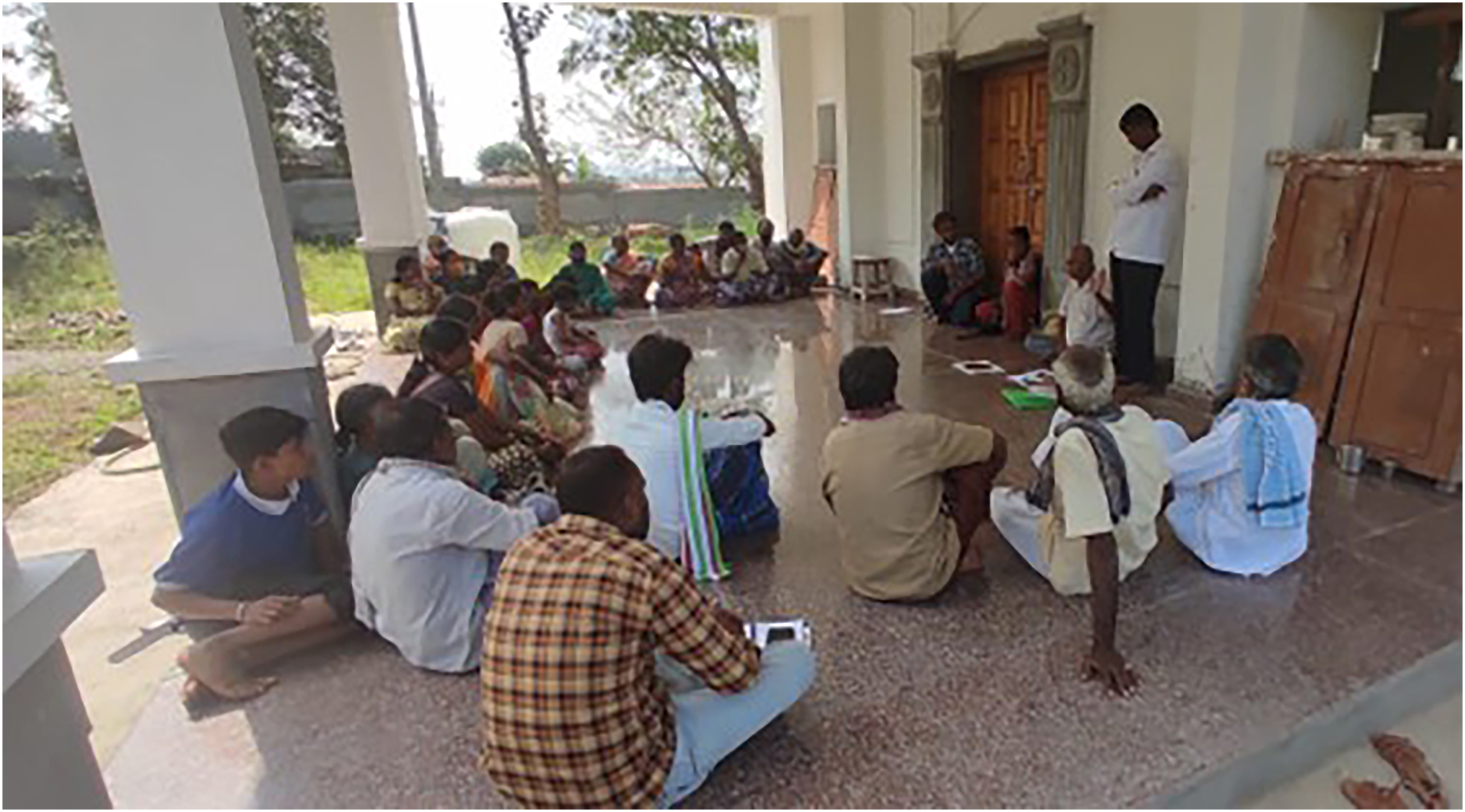
A farmer's study group. Source: The RRA Network. Reproduced with permission.
Following methods that are knowledge-based, rather than technology-led (Shankar, 2011), these meetings encourage collective remembering where older generations name cropping arrangements and plant's varieties grown in the past, promoting their revival in experimental plots, their conservation and exchange during ‘millet jatras’ (millet journeys). Building connections across rainfed livelihoods, the groups also promote women-led organisations manufacturing chemical-free medicines for crops, integration between agriculture and livestock to regenerate soils, artisanal fishery carried out across ponds which turn into pastures as the monsoon retreats, alongside dissemination of knowledge on soil health, indigenous plants and animal breeds.
Without aiming to restore a traditional ideal of a rural world, these fora indicate how socio-ecological transformations do not necessarily begin from acts of direct opposition. Instead, they materialise through the work of cultivating spaces where alternative configurations of life can emerge and gradually take hold (Ghelfi and Papadopoulos, 2022). ‘You will not see us demonstrating on the streets, blocking roads or go on hunger strikes’ Sameer explained: ‘what we say is to start where the rain falls and from there build relations with the land, people, and environments’ (Interview_Sameer_Dec2021). By no means synonym of disconnection, this plea for ‘autonomy and self-determination’ (Interview_Sameer_Dec2021) reflects the need to disengage from the gravitational pulls of an irrigated direction of travel, cultivating broader networks of interdependencies in its place (Tsing, 2020). For a revitalised rainfed agriculture to emerge, instituted systems of governance should take seriously that inexpressible ‘rainfedness’ as an uncommon ground around which alternative hydro-social configurations are articulated.
To this end, the language of care was often deployed to inspire another kind of policymaking, able to create visibilities and uncover relations overlooked by expert eyes. Behind that ‘wilful ignorance’ Rohit remarked at the start of the paper, in fact sits a specific modality of uncare operating through the hands of policy actors. This ignorance was enacted through devices of categorisation and enumeration, as a distinct form of policymaking delimiting practices, relations and worlds seen as possible and real from those unthinkable and hence unreal (Moser, 2008).
Aparna's recollection makes this clear. During a meeting with government officials, she was introducing the concept of ‘protective irrigation’, a term used by the group to characterise farmer's techniques to harness the rainfall across the soil profile, making sure moisture is maintained at the root-zone of plants. Proposing this as an alternative form of irrigation she recalls being met with scepticism as she was unable provide a figure showing the water saving potential of the strategy. ‘They did not care about what I had to say. They only see the water that can be measured, the one that can be put into formulas’ she remembered with disappointment (Interview_Aparna_July2021). Rather than an affective attitude displayed by people within governments, the uncare infused through these devices constitutes a modality of management that helps creating invisibilities (Gupta, 2012), discarding metrics that hint towards worlds of water beyond those gathered around its measurable form.
Yet, while speaking to the power of policy in silencing nonconforming (water) realities (Lavau, 2013), Aparna's story also hints towards places where the group's practices of reimagination can fruitfully begin. For if, as Gupta (2012) suggests, ones’ understanding of the mechanisms of government matters in formulating strategies for action, it is by situating policy's performative powers within its instruments of enumeration that indicates a location from where the Network's worlding-practices could be articulated. This is where the paper turns next.
Care-fully theorising: utilising tools to multiply worlds
According to Mitchell (2008) the success of governance tools such as maps, formulas and modes of classification, is determined not so much by their representational accuracy or mathematical rigour. Instead, it depends on the extent by which they make it possible to conceive what is to be governed and assist with bringing it into being. In other words, when they support a metrology; a system of signification that defines and upholds a specific understanding of the world (Latour, 1987). Confronted with the invisibilities cast by a metrology of measurable water flows, the Network's response was to craft a rival metrological system to redefine the governance of water from the perspective of the rainfall. Aparna explained Demands for a different policy paradigm are teethless without a framework that converts our vision into actions. Our strategy is to get into the language officials speak and develop our advocacy around it. So next time they ask us to prove the irrigation saving potential of our strategies, we have the instruments to ask them back ‘what have you done to understand practices for protective irrigation in your district? Or cropping system? Or livelihood integration?’ (Interview_Aparna_Jan2022)
A rainfed atlas, a rainfall efficiency formula, an acronym for soil classification, this is the initial list of tools developed by the Network to return Aparna's questions back to policy actors, pausing expert's imperatives and amend the invisibilities enacted by the prevailing irrigated metrology. As an engineer-turned-social-scientists, I was initially disoriented by this strategy, having learned first-hand about the power technical instruments hold to support certain worlds at the expense of others (Harris, 2004; Robbins, 2001). Yet, as Ballestero (2019a) points out, devices’ world-closing powers should not be cofounded with their destiny. Showing how tools of enumeration are used by practitioners in Costa Rica to distinguish water as a human right from water as a commodity, she unpacks how actors use seemingly uninspiring techno-legal devices – like a list or an index – to drive social change and urges water researchers to examine their working in other contexts. Similarly, researching water scarcity in Bangalore, Vogt (2021, 99) narrates how a local organisation deployed a series of quantifying tactics to ‘re-socialise and re-historicise’ water, suggesting that depending on how enumerative tools are developed and by whom, they can contribute towards a more ‘multiple and multiply-contextualised sense of water’. Thus, while modes of abstraction and quantification often end-up marginalising knowledges that do not conform with the dominant metrology (Henry, 2018) attempts to measure and visualise differently can go a long way into re-signifying what water is (Ballestero, 2014), affecting in turn how water in its multiple historical and socio-material forms can be cared for (see also Puig de la Bellacasa, 2015 on soils).
In a similar light, I read the proposed tryptic of tools as the Network's way to advance a careful mode of theorising (Fernando, 2019), one that by revealing the invisibilities and exclusions crystalised within everyday objects of governance, redefines these objects to bring attention towards previously unseen things and relation (Lindén and Singleton, 2021; Martin et al., 2015). Such careful way of producing knowledge refuses universalist explanation, leading to the burgeoning of categories, concepts, and ideas that, by creating new connections and relations, expand the present and open possibilities for different futures (Ballestero and Oyarzun, 2022). Situating their world-making tactics within the crafting of alternative technologies of enumeration and visualisation, the group's mobilisation thus rests on what Puig De La Bellacasa (2017, 11) describes as everyday ‘politics of reclaiming’, an effort to work within the horizon of the existing condition without accepting it as a given. In other words, the Network's theory of change expresses that slow and incremental work of changing the present, tinkering with the variables of the constituted metrology to seed within them the conditions for a future where rainfed geographies are better characterised, valued, and cared for.
In the remaining part of the paper, I explore how each of these tools zoom into one aspect of the rainfed landscapes, situating the Network's worlding-practices within the reality multiplying capacity care holds to make visible marginalised worlds.
The rainfed atlas
Atlases have been instrumental for inscribing the history of people and places. Bundles of maps representing salient geographic features and political boundaries of a region, paired with social and economic statistics, these cartographic books are performative of worlds (Del Casino and Hanna, 2006). Providing a seemingly detached perspective from above, maps reduce complex realities within pre-defined systems of categorisation and contribute to materialising the history of people and places they are meant to simply represent (Harris, 2004). In recent years however cartographies have also been used as tools for reinvention (Hazen and Harris, 2006; kollektiv orangotango, 2019), for breaking with past silences and give visibility to forgotten histories. Situated within this counter-cartographic tradition, the Rainfed Atlas (also referred to as ‘The Atlas’) expands common understandings of Indian agriculture away from irrigated rice and wheat-producing regions, characterising the diversity rainfed landscapes, their history, and livelihood practices. Challenging ideas of what counts as a map, The Atlas uses different modes of visualisation including graphs, charts, investment and divestment flows, people's stories, livelihood cycles, to bring readers into a different journey of rainfed socio-ecologies (The RRA Network, 2019a).
This journey begins in the past. Tracing the ‘nature and amount of public investments’ (The RRA Network, 2019a, 3) from the time of independence, The Atlas begins by drawing the contours of what, borrowing from Milligan and Wiles (2010), I describe as a landscape of (un)care; a web of resource (re)allocation and (re)distribution that resulted in the systematic neglect rainfed regions suffered from. Going at the heart of care as a relational practice, Milligan and Wiles (2010) engage with its geographical manifestation, untangling the ways in which care relations (or the lack thereof) are woven into the fabric of a territory.
Similarly mobilising care as a guide into the history of rainfed geographies, The Atlas quantifies flows of public investments into irrigated regions, mirroring them with the continued disregard for schemes considered the lifeline of rainfed territories (e.g., rural employment guarantees and integrated watershed programs). Staggering numbers run through The Atlas, suggesting how while producing over 80% of crop varieties and supporting a number of allied activities, less than 10% of yearly agricultural budget goes to strengthening this diversified production. By contrast, public procurement of rice and wheat together with fertiliser subsidies mostly benefitting irrigated areas account for 75% of agriculture investments over the years considered. Figure 2 provides a representation of this landscape of (un)care using a collage of maps and graphs from The Atlas.
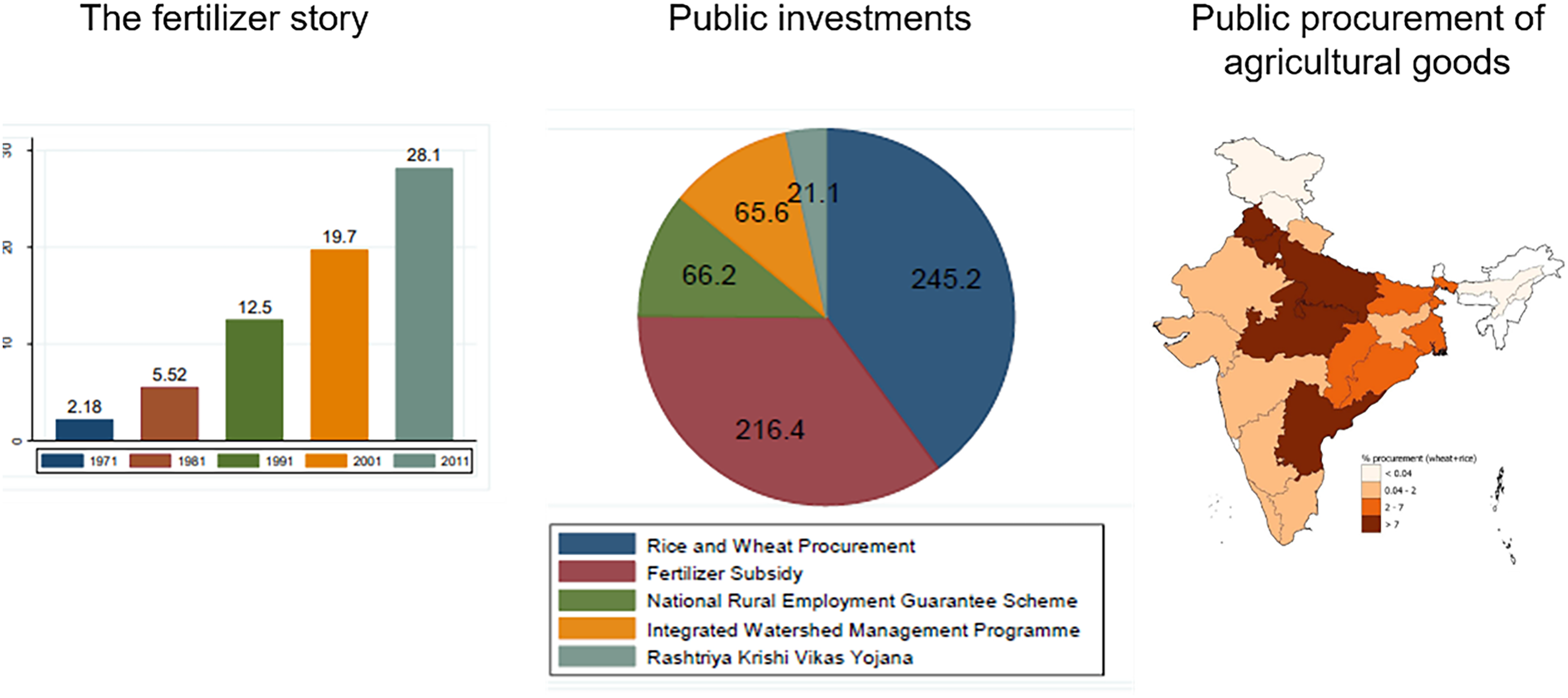
The rainfed landscape of (un)care. Legend: A collage of maps and charts from The Rainfed Atlas highlighting the rise in fertiliser subsidies, the imbalance of public investments, and the overlap between public procurement of rice and wheat and irrigated states. Source: The RRA Network (2019a). Reproduced with permission.
By exposing the historical neglect these regions suffered from while revealing how rainfed areas are anything but a marginal part of the country's agrarian economy, The Atlas points to an uneven history of social and economic relations and reflects on its legacies, as they materialise in high incidence of poverty, malnutrition and lacking public infrastructures (see also Kumar et al., 2020; Deshpande, 2022). Reclaiming spaces for the flourishing of these neglected socio-ecologies, The Atlas tell us, is therefore more than just metaphor (Tuck and Yang, 2021) in it requires going beyond the theoretical ground of recognising diverse systems of knowledges, to pay attention to the lived material inequalities and urgent need for reparative practices.
Yet redrawing geographies of responsibility able to redress these uneven material and spatial relationships (Raghuram et al., 2009) is not about reverting the flow of public funding to redress some asymmetry between irrigation haves and have-nots. What is at stake, I was told many times, is more complex than evening up skewed percentages. Instead, the responsible geographies sketched-back by The Atlas are part of a broader effort to understand rainfed regions in their own terms. As Anirudh explained to me, rainfed socio-ecologies cannot be understood with the same parameters we use for irrigated regions. Instead, they require efforts to ‘revitalise our language […], and our vision’ (Interview_Anirudh_Sept2021) so that we engage with rainfed practices, knowledge and relations without assuming a unidirectional trajectory of rural development.
Rich descriptions therefore populate the Atlas; starting from naming indigenous millets, pulses and oilseeds cultivated in these regions, characterising their nutritional value, ecological and cultural significance, giving relevance to cropping arrangements such as ‘Patta Paddhati’ or ‘Akri Salu’, the choreography of crops they draw in the field, situating farmer's knowledges of these arrangements within practices of protective irrigation and soil regeneration. People's stories add further texture, bringing to light feelings of self-esteem and joy that comes from reviving these practices. One story is that of Vinodha, a farmer that to escape debt-driven cotton cultivation, shifted her land to non-chemical cropping system. Storing most seeds every year and producing medicines against plant's diseases, Vinodha now harvests 25 varieties of millet and pulses. These not only provide enough food for her family and fodder, but also fetch a good price in the markets, giving her some respite from the spiral of debts that come from practicing input-intensive agriculture on unirrigated lands. The Atlas's work to represent-back rainfed regions and characterise their differences is exemplified in Figure 3.
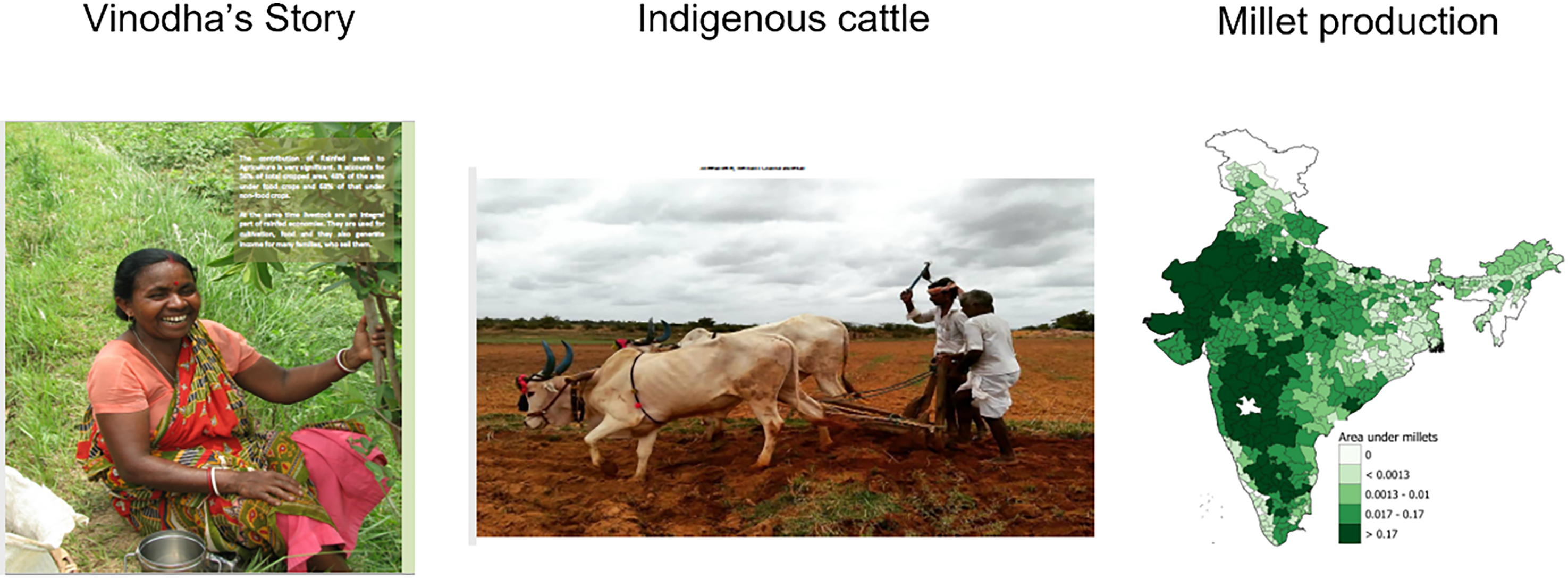
Representing-back rainfed landscapes. Legend: A collage from The Rainfed Atlas highlighting the story of Vinodha, indigenous livestock, and a map showing the overlap between millet production and rainfed regions. Source: The RRA Network (2019a). Reproduced with Permission.
Page after page, The Atlas multiplies the present situating the dominance of an irrigated and monocropped landscape as only one part of a larger ecosystem of agrarian relations and more-than-human ecologies. It is by characterising and giving relevance to this rich landscape of practices as it already exists, rather than being imagined, that The Atlas highlights how policies have a choice to support this diversity or continue along a trajectory of uncare, allowing differences to deteriorate in the name of a more manageable uniformity.
The rainfall use efficiency formula
While The Atlas bears witness of the diversity of rainfed agricultural practices and ecologies, this second tool engages with the temporal shift needed to appreciate the ‘rainfedness’ of these landscapes. The reduction of water to predictable flows in fact not only ignores water's other shapes and forms (Ballestero, 2019b), but also constitutes a choice in time. For one, the unspoken assumption of water's liquidity overlooks all the other times when water is not flowing along defined lines but precipitating, evaporating or percolating in ways that resist delineation (Mathur and da Cunha, 2020). In conceiving these messier moments as transient to water's liquid manifestation, policies and management practice, according to Da Cunha (2019, 9), are grounded on one specific moment of the hydrological cycle; the moment of flow.
No parameter better encapsulates this temporal orientation than Water Use Efficiency (WUE), the key metric against which the success of water infrastructure projects is judged. Expressing the relation between crop yields (kg) and the volume of water consumed to produce that yield (m3) (Equation 1), WUE brings imperatives to raise ‘more crops per drop’ (Wanvoeke et al., 2015), hurrying the water that precipitates on the ground into controllable flows for synchronised rhythms of crop production (Boelens and Vos, 2012). Overlooking the countless ways water gets entangled with different more-than-human elements (Camargo and Cortesi, 2019), WUE commands an anthropocentric and future-oriented temporality where the past is reduced to something to overcome and the present to a fleeting moment towards the future (Adam, 2005). Rather than a neutral quantitative assessment, WUE thus encapsulates a whole way of arranging agrarian life, bringing uniform, highly synchronised, monocropped landscapes into being. This formula, Aarti told, me will never be able to capture the complex social and ecological relations the rainfall supports (Interview_Aarti_March2022).

Equation 1 shows the formula, expressing WUE.
Engaging with formulas as stories about the objects that sit across the lines of an equation (Ballestero, 2014), the Network proposes Rainfall Use Efficiency (RUE) to advance a different temporal narrative grounded on another moment of the water cycle; the moment of rainfall (Da Cunha, 2019). Described as ‘a way of seeing, rather than a numerical exercise’, and ‘an orientation more than a prescription’ (Notes_Dec2021), RUE subverts efficiency idea(l)s, aiming to capture under one expression all those relations that become meaningful when looking at a landscape from the perspective of the rainfall. Rohit explained: when looking at water from the point of view of the rainfall, you start noticing all sorts of connections; between soil and leaves covering the land to avoid evaporation, between growth of crops and the timing of precipitation, between soil moisture and the ways roots develop. You would never have noticed these if you looked at water in the conventional way. (Interview_Rohit_Jan2022)
The quality of this shift is better understood by taking a practice-oriented approach to time as emergent within everyday practices (Adam, 2005). Rather than as a series of uniform intervals ticking in an abstract space, time is something we make through relations whose diverse configurations give rise to multiple temporal registers that exceed human timeframes (Bastian, 2019; Rose, 2012). The anthropocentric and future-oriented timescape expressed by WUE is therefore only one among many other temporalities shaping rainfed landscapes. To express this diversity, RUE captures a temporal horizon close to what Puig de la Bellacasa (2015, 692) describes as ‘care time’; an inclination to pay attention to and amplify temporalities rendered irrelevant by the productionist ethos of efficiency.
My interaction with Veena, a farmer in Wardha District, renders this well. ‘This field has red soil which is not very good at holding moisture. So here I plant mung beans together with jowar [sorghum] and arrange them in rows.’ Explaining the reason for this arrangement she said, ‘jowar grows first and being taller helps the mung growing on it. Then I harvest jowar, leaving air and sunlight for mung to develop on its own. Their roots are also matched, see?’ she asked showing me the two plants ‘when there is with mung, jowar searches for moisture deeper in the ground which makes it stronger and more able to survive breaks in the rains’ (Interview_Veena_2022). Invoking Tsing (2020, 229), the coordinations happening in Veena's field represent temporal responses where human intentionality gives way to a myriad of more-than-human interconnections concatenated around the rhythms of the rainfall.
Elusive, uncertain, and tentative, temporal coordinations come out of attunements (Gan, 2018) which, like care, improve with repetition, affectionate involvement and embodied knowledges (Singh, 2013). Walking up and down the farm, Veena touched the soil next to the plants feeling the moist it contained. Sometimes she added a home-made mixture of fermented animal urine and dung, jaggery, water, and leaves. This mixture increases earthworm activity, so that, as worms move through the soil, they circulate nutrients and help plants grow healthier. While tasks like this look unproductive, simply a waste of time compared to spraying fertilisers, Veena's care to make time to grow healthy crops reflects a qualitatively different mode of engaging with the landscape and its ecology. While never innocent nor romanticizable – representing devalued and often unremunerated practices taking place within uneven socio-economic fields (Pattnaik and Lahiri-Dutt, 2022) – her ‘rainfall-efficient’ labour contributes to the survival of more liveable relations, demanding metrics able to capture its worth (Tozzi, 2021b).
Rather than a fraction with terms separated above and below a straight line, the relations RUE describes are better expressed by what I describe as a ‘rain web’. Figure 4 represents one such rain web sketched from my interactions and participant observation with Veena. Starting from the element of the rainfall, this web brings together an assemblage of entities – soils, plant's roots, crops and their arrangement in the field, farmers practices, etc. – brought into alignment around the rhythms of the rainfall in one particular site. Capturing a specific set of relations, each ‘rain web’ is unique, a snapshot that represents one group of interconnected temporalities that become relevant to ensure liveability in a place.
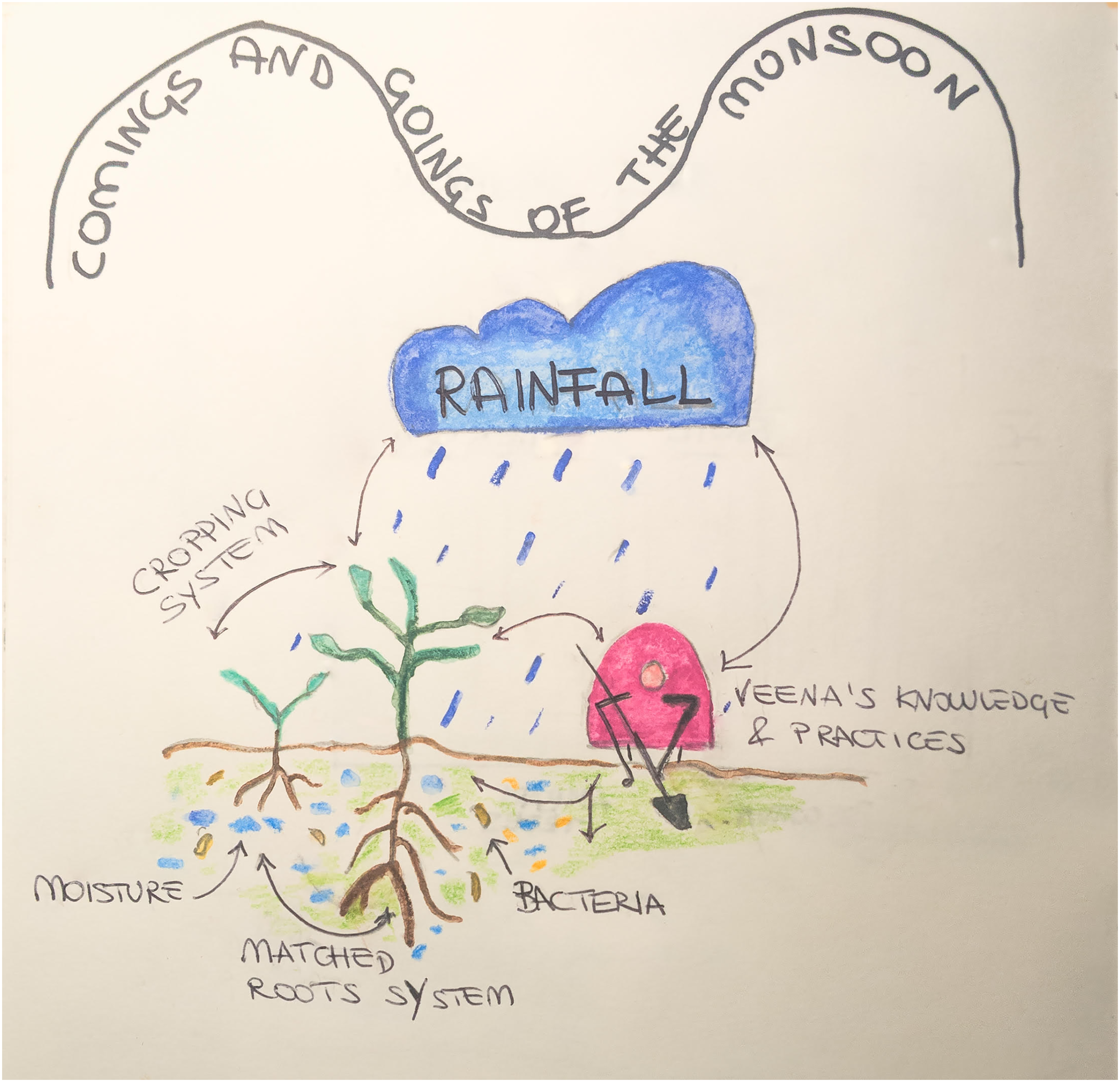
A rain web representing veena's rainfall use efficient practices. Sketched by The Author.
Proposed by the Network as an alternative tool for policymaking, RUE is not about finding a recipe to be abstracted and scaled. Rather, ‘it is an enunciation that needs to be left in the hands and practices of people’ (Interview_Rohit&Sameer_Jan2022). Invited to present these ideas to a group of experts advising the government on the upcoming National Water Policy (The RRA Network, 2019b), the group believes that what is now a simple enunciation could nudge the government towards seeing water out of their usual box. While unlikely to replace WUE in the hearts and minds of engineers, their hope is that the situated analytic RUE advances will start circulating among policy actors, bringing attention towards those rain-dependent practices and relations the Network hopes to make visible.
The acronym of the 3Ms
Further thinking from the webs of relations coordinated around the rainfall, this last tool addresses another problematic aspect of the irrigated metrology; namely the separation it maintains between water and the lively biota soils are made of. Reflecting with Puig De La Bellacasa's (2015, 170) precept that ‘what soil is thought to be affects the ways it is cared for’, the 3-M acronym challenges common understandings of soil as a container for plant nutrients (Rinot et al., 2019), demanding that we see soils as inseparable from the water they hold. In place of chemical models reducing soils’ health to combinations of Nitrogen (N), Phosphorous (P) and Potassium (K) (Marchesi, 2020) the proposed acronym foregrounds a different way of knowing, relating, and caring for soils (Krzywoszynska et al., 2020; Tironi et al., 2020) as multispecies worlds permeated by wetness; that is a world of Moisture, organic Matter, and Microbes (MMM).
The Network's proposition is a response to the nationwide Soil Health Card (SHC) scheme. Launched in 2015 to address worrying levels of soil degradation caused by overuse of chemical fertilisers, the scheme encourages farmers to send soil samples to testing facilities who provide information about nutrient status and recommend fertilisers to improve productivity. Figure 5 gives an example of a SHC for the region where this study was conducted. It shows in clear terms how SHCs ascribe soil fertility to a set of chemico-physical parameters, reducing soils complex socio-material relations to a simplified representation (Marchesi, 2020) and soil knowledge to some distant expert advice (Kon et al., 2020). Reflecting on the performativity of soil health assessments in inscribing soil realities, Krzywoszynska and Marchesi (2020) suggest that their metrics lead to a mode of engaging with soils that is both shallow and universalist. Shallow because they reduce soil's multi-dimensional materiality to a thin surface, and universalist because they obscure soil's specificity to some standardised parameters.
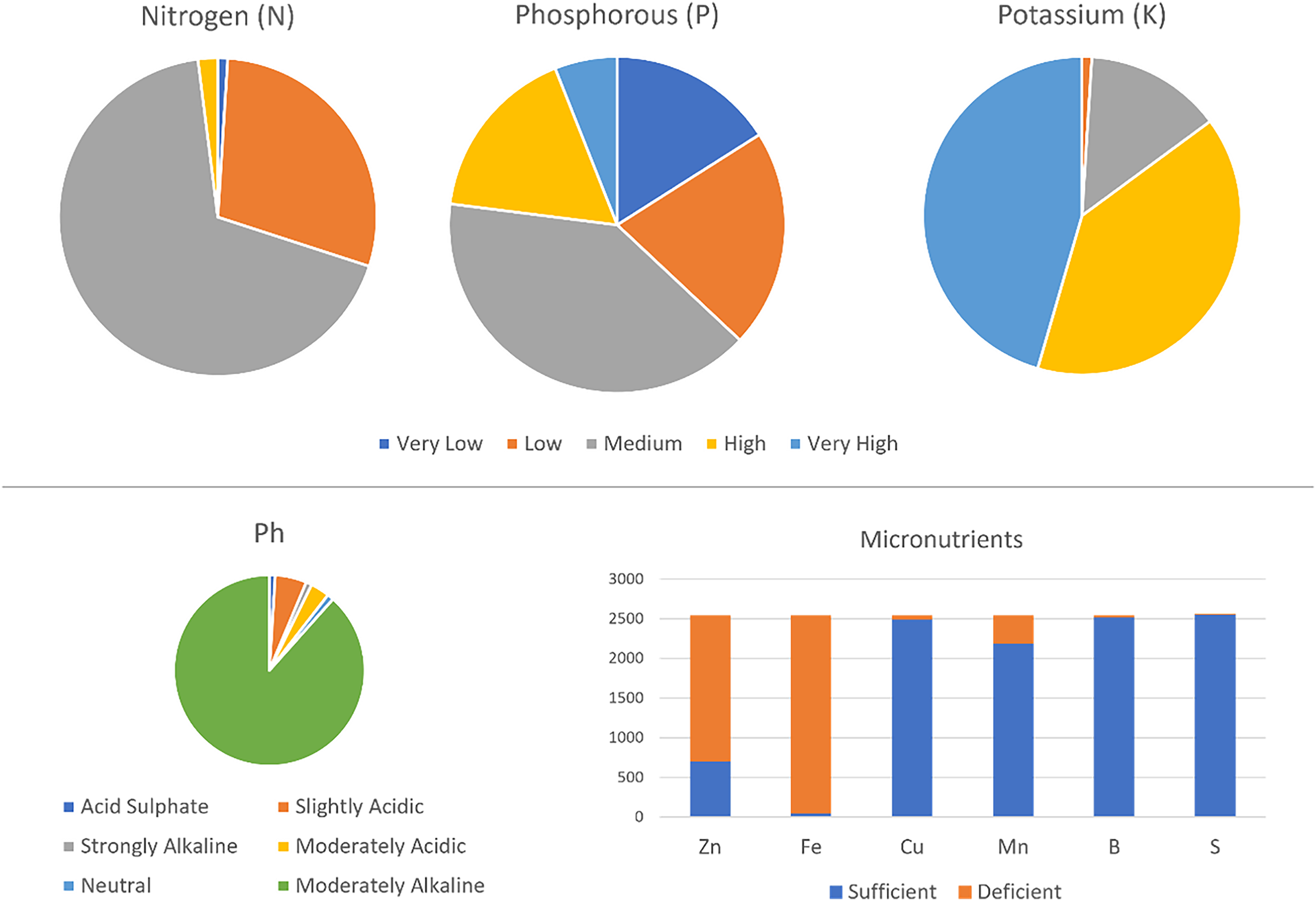
Soil health card for the Arvi sub-district, Wardha, Maharashtra. Produced by The Author using data from the Department of Agriculture and Farmer's Welfare (2022).
Particularly worrisome for the Network is the way in which these nutrient-centred profiles overlook soil's hydrological functions (Indoria et al., 2020), invisibilising the relation between soil's capacity to retain water, its lively ecology, and farmer's attentiveness towards such moist-rich underground world. A publication launching the 3M acronym as part of the ‘Living Soils’ campaign makes this clear; ‘life and livelihoods in rainfed areas depend on the quantum of rains that can be harvested and retained across the soil profile’, a reality being ‘dangerously overlooked’ by the prevailing focus on chemical indicators (The RRA Network, 2017). Discussing the need to develop alternative metrics Tapan noted, ‘This understanding of soil as an NPK bucket could not be more dangerous than in rainfed regions. Here we cannot afford to reduce our soils to a fertiliser treadmill like in irrigated areas. A healthy soil cannot exist without water, soil without moist is meaningless’. From the porch of his house, he picked some earth from the garden, ‘can you tell the difference between the soil and water?’ he asked opening the palm of his hand (Interview_Tapan_March2022_PersonalNotes).
Going at the heart of soils’ ontological politics (Mol, 1999) – a politics over which soil realities get enacted, silenced, or never voiced (Krzywoszynska and Marchesi, 2020) – the 3-M acronym challenges the invisibilities promoted by shallow and universalising SHC guidelines, demanding that we take seriously soils’ wet materiality as the terrain from where rainfed grounds become known, legible and ultimately worthy of care (Puig de la Bellacasa, 2015).
Observations of farming practices are revealing of these dynamics. When asked what constituted a healthy soil, farmer's response followed an intricate exploration of how it was the land's ability to capture precipitation, together with soil's texture and its capacity to conduce water towards plant's roots or create obstacles with stones and other layers that made a difference (see also Cortesi (2021) for a similar exploration in Bihar, India). Conversely, a good monsoon could not be separated from how the temporality of the rainfall matched soil's ability to get soaked by its precipitations. As farmers explained to me what makes a good rainy season is an initial stage of downpours softening the ground followed by frequent and short breaks allowing water to percolate deeper into the soil. These interruptions also send a signal to plant's roots that begin searching for moist at different depths, strengthening plant's ability to withstand future dry spells. As roots go deeper, they facilitate circulation of nutrients, feeding microbial population across layers (FieldNotes_2022). Figure 6 captures the difference between a healthy soil (left) and an unhealthy one (right) and how this relates to its moisture content.
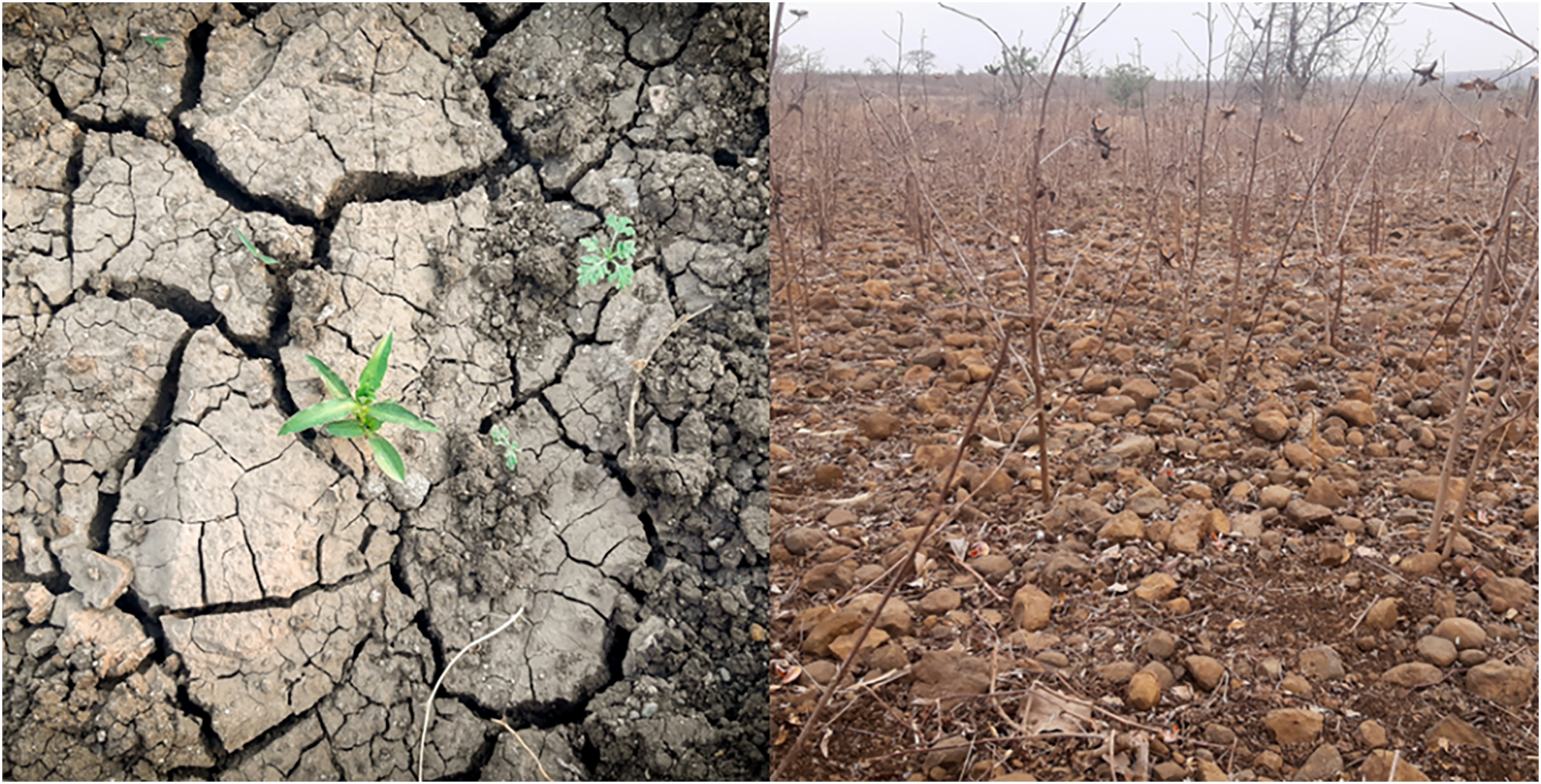
A healthy soil (left) and an unhealthy soil (right) in Arvi sub-district, Wardha, Maharashtra. Source: The Author.
Caring for rainfed soils therefore connects to farmer's ability to look after the water they contain, devising cropping patterns where plant's growth is coordinated with rainfall's timing, roots systems matched to capture moist at multiple depths, covering the ground with leaves to avoid evaporation, re-ploughing residues to increase organic matter, and reducing tillage to protect microbial population which in turns preserves water (Tozzi and Leonardelli, forthcoming).
The 3-M acronym enlarges policy metrological sensibility, demanding that we reimagine what counts as soil beyond a chemically-defined surface and medium through which water passes, but as a lively ecosystem composed of and made through the water it contains. Deepening understandings of what soil is thought to be, the tryptic of Moisture, Microbes and Matter affects how it becomes worthy of care, demanding new indicators able to grasp its vitality. Beyond shallow and universalist SHC classifications, new modes of accounting demand ‘looking down and deep’ (Krzywoszynska et al., 2020, 99) below the surface, and learn from existing practices engaging with soil-(rain)water dynamics.
Conclusions
Motivated by a wish to go beyond scholarly approaches prioritising the enactment of hegemonic forms of water governance, this paper turned towards a grassroots organisation to unfold the ways in which the governance of water is contested and reimagined from the ground up. Thinking alongside a rich feminist tradition for which research is about opening pathways towards the worlds we wish to inhabit (Gibson-Graham, 2011), I engaged with the RRA Network as a more-than-social movement (Papadopoulos, 2018) whose mobilisation is not directly aimed at contesting existing institutions. Instead, it pertains to ‘worlding-practices’; situated, embodied and care-full activities that zoom onto what is at the margins to amplify neglected words (Lindén and Singleton, 2021). Rather than as an object of academic knowledge, I engaged with their action as ‘matters of care’ (Puig De La Bellacasa, 2017), reflecting a commitment to learn from and think with movement's own analytical ground without subduing them to pre-existing frameworks (Choudry, 2015).
Establishing the rainfall as the terrain around which monsoon-dependent ecologies ought to be reconfigured, I explored how the Network confronted the current metrology of water ‘as irrigation’ by crafting a series of rival tools that would recentre its governance from the perspective of precipitation. Attending closely to these tools as concrete nodes of ontological reinvention revealed how the Network's mobilization was immanent to the very project of governance it set out to challenge. Without resorting to a politics of prefiguration for a rainfed world yet to come (Yates, 2015), their strategy is to appropriate and subvert the idioms through which the legitimacy of the current model of agricultural development had been sought. The group's tactics of reimagination therefore reflected that painstaking work of establishing incremental (yet meaningful) differences working from the constraints of the present (Ballestero, 2019a). Speaking to scholarship tracing the performativity of policies and management practices (Barnes, 2012, 2013; Lavau, 2013; Yates et al., 2017), I have argued that reimagining the governance of water will not happen solely by revealing the powerful networks of actors crafting spaces where their water worlds can survive. Instead, it requires taking seriously grassroots forms of mobilisation as similarly productive ontological interventions with the power to bring new worlds into being.
Bringing the Network's care-full work to bear upon climate adaptation research (Nightingale et al., 2020; Taylor, 2014) also suggests an avenue for climate resilience strategies to get out of the impasse they find themselves in (Mikulewicz, 2019). This impasse is represented by the fact that their techno-managerial solutions (of irrigation and otherwise) have been shown to redistribute, reinforce of even create new vulnerabilities rather than addressing their root causes (Eriksen et al., 2021; Schipper, 2020). In this regard, the paper suggests that scholars interested to politicise climate adaptive responses and make them work towards emancipatory outcomes should direct their attention towards places beyond the remit of climate action (see also Koslov, 2019; Paprocki, 2022). In fact, while not speaking of climate change as a direct issue of concern, the Network's mobilization articulates a broad set of political, economic and ecological transformations that emerge through the alternative hydro-social relations their tools give rise to. As we become aware of the significance of rainfed lives and livelihoods, of the more-than-human temporality precipitation entangles, and the vitality of the wet ground underneath our feet, their tools become a vehicle to transform existing relations of rainfed agrarian production and reproduction expanding what equitable and just adaptive strategies in these regions might look like.
Finally, attentiveness towards movements as productive of their own theory of the world and of pathways for how to get there (Casas-Cortés et al., 2008), also speaks to a space where grassroots worlding-practices can contribute towards a feminist and decolonial agenda (Gibson-Graham, 2011; Todd, 2016). In this regard, the paper calls for closer ethnographic attention to unexpected and mundane places of grassroots theorising as sites from where concrete alternatives to hegemonic realities are articulated. Without guarantees that more equitable, decolonial and nonpatriarchal ways forward will emerge, encouraging productive alliances between research and activism as e/affective world-building partners is crucial for co-theorising more liveable human-water relations and caring socio-ecologies at large.
Highlights
The governance of water in rainfed regions should be reframed from the perspective of the rainfall.
Theorising socio-ecological movements ‘with care’ highlights their mobilisation as productive of the worlds they wish to make possible.
Taking seriously the performativity of knowledges generated in grassroots context is key to pluralise water governance.
More-than-social movements tinker with the variables of the dominant metrology to engender concrete change.
Building alliances between research and activism as e/affective world-building partners is paramount.
Footnotes
Acknowledgements
I wish to thank members of the Revitalising Rainfed Agriculture Network and farmers in Arvi bloc, Wardha who shared their knowledge and time with me. Thanks to Yugandhara Khode and Rushikesh Kalokar for Marathi–English translation. I also wish to thank Professor Stefan Bouzarowski, Dr Caitlin Henry, Dr Maria Rusca, and Professor David Sauri Pujol for the meaningful discussions on these topics and the three anonymous reviewers for their insightful and constructive comments on earlier drafts of the manuscript.
Declaration of conflicting interest
The author(s) declared no potential conflicts of interest with respect to the research, authorship, and/or publication of this article.
Funding
The author(s) declared the following potential conflicts of interest with respect to the research, authorship, and/or publication of this article. This research was supported by the Royal Geographical Society (with IBG) (grant number Postgraduate Research Award 03.21).
