




Abstract
For many decades, southern Africa has been at the forefront of global conservation paradigms and practices, ranging from protected area models and community-based conservation to transfrontier parks and, more recently, the wildlife economy. A key goal of many of these was to meet conservation and development goals, something that often proved elusive. In fact, what has been consistent across these conservation strategies is a continuation of many environmental and, especially, socio-economic and racial injustices. Currently, a further increase of both conventional and novel capitalist conservation initiatives—including wildlife estates, different tourism activities and wildlife breeding—seems to further intensify rather than ameliorate existing uneven and unjust conditions. This introduction preludes some of the most important recent and contemporary dynamics in southern African conservation addressed in this special issue. Titled Fallen from grace? The legacy and state of southern African conservation, the papers in this special issue reflect on these dynamics and ask whether the global significance of southern African conservation has crumbled under the weight of its own contradictions, or whether it can still turn the tide. Pushing theoretical discussions on the links between environmental injustice, race, labour, power, inequality and conservation, we argue that the contributions do not merely critique conservation in southern Africa for failing to live up to its promises; together they question the very sustainability of the entire enterprise and the ideologies on which it is based. This is important because some conservationists continue to laud the region as a shining example for biodiversity conservation globally.
Introduction
Southern Africa has long been at the forefront of biodiversity conservation globally. Under colonial regimes, the region was a leader in establishing national parks (Cock and Fig, 2000; Ramutsindela, 2004a). Motivated by their interests in hunting, cheap labor for settlers, and later conservation, colonial administrators were key in the establishment of well-known protected areas like Etosha National Park in Namibia, the Kruger National Park (KNP) in South Africa, the Moremi Game Reserve in the heart of the Okavango Delta in Botswana and Hwange National Park in Zimbabwe. This process was accompanied by the (sometimes violent) eviction of local and indigenous communities, yet the post-colonial southern African states that inherited these protected areas have largely maintained these spaces as they were set up.
In addition to national parks, the region has seen a rapid expansion of private conservation enterprises since the 1960s. Especially South Africa, Zimbabwe and Namibia were at the forefront of this through private nature reserves and activities including hunting, wildlife breeding and photographic safaris. This was followed in the 1970s by pioneering efforts around community-based conservation, which really took off in the 1990s (Dressler et al., 2010). These interventions combined the conservation of biodiversity with development ideals through a set of well-funded and studied ‘Community-based Natural Resource Management’ (CBNRM) programmes. Most notable in this regard are the CAMPFIRE project in Zimbabwe (Murombedzi, 1999), and the conservancies in Namibia (Madzwamuse et al., 2020; Boudreaux and Nelson, 2011).
CBNRM was based on the premise of economic benefits for communities through tourism, trophy hunting and other market-based forms of development (Murphree and Taylor, 2009; Nuulimba and Taylor, 2015). The idea was that communities and private investors would come together in ‘win-win’ constellations that benefitted nature, development and private profits (Nattrass, 2021; Sullivan 2023). These were soon criticized for not achieving these high expectations around conservation and poverty alleviation through development (Sullivan, 2002; Blaikie, 2006; Dressler et al., 2010). Despite this backlash, many CBNRM initiatives continued, subsequently receiving similar critiques (Koot, 2019; Kalvelage et al., 2020), while the recent COVID-19 crisis further evidenced CBNRM's vulnerability in relying on tourism and trophy hunting (Hockings et al., 2020).
The waning popularity of CBNRM around the mid-2000s saw the simultaneous rise of Transfrontier Conservation Areas (TFCAs or ‘Peace Parks’): a globally popular conservation paradigm with a strong base and many early initiatives in southern Africa. Again, this created high expectations about local development, poverty alleviation and democratic inclusion, one key supporting organisation even referred to Peace Parks as ‘the global solution’. But again, the results on these fronts were disappointing (Duffy, 2001; Ramutsindela, 2007; Büscher, 2013; Sinthumule, 2017a). TFCAs did create more space for wildlife (amidst evictions), for example in the Mozambican part of the Great Limpopo Transfrontier Park that also encompasses South Africa and Zimbabwe. The fanfare around the establishment of TFCAs soon waned in the face of intensifying transboundary wildlife crime, especially the surge in rhino poaching since 2008, but also other species important to commercial wildlife trade like elephant, lion and pangolin. In response, many conservation practitioners and scholars have urged for more enforcement to protect biodiversity, including the closing of TFCA borders (Mogomotsi and Madigele, 2017; see also the NGO National Parks Rescue). 1 This triggered a substantial militarization of conservation and translated into different forms of ‘green violence’: the use of violent methods and discourses to conserve biodiversity (Lunstrum, 2014, Büscher and Ramutsindela, 2016; Duffy et al., 2019; Mushonga, 2021; Ramutsindela et al., 2022a).
At the same time, and especially since the early 2010s, a renewed and strong push for the full-scale commodification of natures as part of a broader strategy to build a regional ‘wildlife economy’ can be identified. The concept of a wildlife economy emphasizes the private sector's role in conservation through (high-end) tourism, a rapidly growing trade in (parts of) game species and the creation of so-called ‘wildlife estates’, amongst others. Given these latest trends, it increasingly seems that conservation in southern Africa is currently less concerned with building inspiring and (seemingly) inclusive conservation narratives and practices than to find more ‘pragmatic’ ways to merge protection and profit in an increasingly tense neoliberal context (Koot et al., 2019; Massé and Lunstrum, 2016; Mpofu-Walsh, 2021; Silva and Motzer, 2015).
Given these historical environmental governance transformations, and the fact that southern Africa has long influenced (and been informed by) international conservation ideologies, strategies, and policies, we believe it is important to review the legacy and current state of conservation in southern Africa. As a region that plays a leading role in global nature conservation, 2 this special issue 3 pays attention to how developments in this region may influence and even foreshadow conservation dynamics on the continent and globally. It showcases six papers that contribute to and advance debates in political ecology and the conservation social sciences on questions of conservation, development and socio-ecological and political-economic (in)justice.
More specifically, we believe they collectively do more than critique conservation in southern Africa for failing to live up to its promises. Importantly, together they question the very sustainability and legitimacy of the entire conservation enterprise. To be clear, mainstream conservation did not enjoy legitimacy with most African communities due to well-documented evictions and human rights abuses. Despite this, it was often able to continue with relatively minor changes in postcolonial settings and even receive some ‘grace’ from reaching out to ‘communities’ (Ramutsindela, 2004b). We are thus specifically concerned here with the combined legitimacy emanating from the postcolonial state and how this is supported through strong international policy, political and (tourism) market pressures, despite a consistent tendency for conservation to fail to live up to its emancipatory promises. Hence the title of the special issue, ‘fallen from grace’: not because previous models succeeded in effectively marrying conservation with community upliftment where current models are failing. Rather, we signal a changing situation where the continued pedestalisation of southern African conservation vis-a-vis the equally continuing harsh realities of unjust, racialized exclusion and marginalization in conservation is now wearing thin. The recent rise of the ‘wildlife economy’ exemplifies this: it shows that state and private interests are converging to render conservation a more systemically important part of—and thus more akin to—the highly uneven southern African capitalist economy as a whole.
Based on the articles and our own research, we believe these strong conclusions are warranted. However, three important observations contextualise these arguments. First, these developments in southern Africa are not isolated from extra-regional and global trends. Indeed, they are encouraged and enabled by a continued global hegemonic belief that mainstream forms of conservation will curb the 6th mass extinction—a belief that has not waned with the latest Convention on Biological Diversity framework signed in Montreal in December 2022 that continues to emphasize the growth of protected areas while not seriously addressing the downsides and contradictions of earlier strategies. So, although our empirical critique in this special issue is focused on southern African conservation, it is simultaneously a critique of the underlying ideology, which is not separated from the rest of the world. Therefore, the special issue is relevant for conservation beyond southern Africa.
Second, the above-mentioned conservation strategies might create the impression that one strategy follows upon the other, as if those from the past have now become defunct. However, in reality all these strategies continue to have a big influence, creating many variations and often conflated strategies that traverse contemporary southern African conservation. Third, southern Africa is a massive subcontinent. The intergovernmental regional body ‘Southern African Development Community’ (SADC) includes no less than 16 countries. It is impossible in one special issue to do justice to all the different conservation developments in these countries. Instead, it focuses on a selection of countries (Botswana, Namibia and South Africa) that are at the forefront of regional conservation efforts, with an emphasis on South Africa as the (sub-)continental front-runner (Death 2011). We acknowledge that several other countries in the region are also showing innovative conservation schemes and dynamics, or have done so in the past (e.g., Zimbabwe, Tanzania, Eswatini) and that the dynamics observed here resonate in the region and beyond. 4 Our aim, therefore, is not to provide an all-encompassing picture, but to theorize the region's current status within global conservation by understanding recent dynamics and their underlying ideologies and logics.
To substantiate our argument, this Introduction will first discuss southern African conservation in a global context, after which we focus on southern African conservation in more detail, particularly how it relates to the deeper privatization and commodification of conservation. Next, we further detail why this questions the very sustainability of conservation and, finally, how the contributions to the special issue substantiate this claim.
Southern African conservation in the world
A special issue on southern African conservation is globally relevant because of the leading role this region has played in broader conservation policies, debates and practices. The ecological basis for this claim is southern Africa's exceptional endemic biological diversity and the fact that South Africa is generally recognised as one of the 17 so-called ‘megadiverse’ countries globally. 5 Central to this is that, despite significant levels of wildlife crime and habitat loss, southern Africa continues to be a haven for globally adored charismatic African species such as lion, cheetah, elephant and rhino. In fact, these and other species have become synonymous with the region's conservation success stories. Take rhinos as an example: South Africa has the highest concentration on the African continent accounting for 79% of the species. 6 This is, amongst other reasons, attributed to celebrated conservationist Ian Player's efforts during the 1960s. Through ‘Operation Rhino’, Player translocated rhino from their last stronghold in the (then) Natal Province, South Africa, to protected areas in other provinces, so re-establishing diverse populations (Brooks, 2006). Consequently, Player is globally celebrated for ‘bringing rhino back from the brink of extinction’. Other examples from the region abound, like the fact that Namibia has the largest cheetah population globally. 7
Above and beyond global ecological importance, the southern African region, and South Africa especially, has built a geopolitical reputation for being at the forefront of many conservation and environmental discussions and initiatives. As Death (2011) describes, South Africa has been able to use the ending of the cold war and the formal ending of apartheid in 1994 to employ the supposedly less political terrain of the environment and especially conservation to reinsert itself into the global political community. Organising the 2002 World Summit on Sustainable Development, the 2003 World Conservation Congress, the 2011 Conference of Parties of the Climate Change Convention and the 2016 Convention on International Trade in Endangered Species of Wild Fauna and Flora (CITES) Conference of Parties, amongst others, helped the country geopolitically to show international leadership and push for broader diplomatic initiatives.
The reverse, however, is also true: while southern Africa claimed geopolitical space in global debates and initiatives through nature conservation, the latter has also been strategically used by international actors to maintain or increase their stakes in the region. Commenting on USAID, international NGOs and institutions, Singh and Houtum (2002, 260) state that “through their persistent imagery and funding, these aforementioned actors have been able to ‘re-colonize’ southern Africa while giving the states more control over populations and resources, which is eerily similar to the tactics of the early colonists”. Similarly, under the banner ‘environmental colonialism’, Nelson (2003) reviews the historical development of conservation areas in Tanzania that have served western interests over African lives and livelihoods. Similar trends have been observed in South Africa: while analysing the rise of Peace Parks just after 1994, Ramutsindela (2004b) shows how South African billionaire Anton Rupert mobilized global networks in international organisations to champion cross-border conservation areas and in so doing facilitated global agendas to shape environmentalism in the SADC.
Within this context, the southern African conservation community has emphatically also tried to project global leadership. Besides the above examples, another key area has been ‘systemic conservation planning’. Grounded in conservation biology, the area has been and remains influential in conservation thinking globally. Built around key initiatives like the Maloti-Drakensberg Transfrontier Conservation and Development Area and the Cape floristic kingdom in the 2000s, it was posited that in terms of “conservation planning in the real world”, “South Africa shows the way” (Balmford, 2003: 435; see also Büscher 2013). A closely related field of conservation practice in which these global projections often happened was ‘payments for environmental services’ (PES) and other neoliberal conservation initiatives more generally. Many South African conservationists in the 2000s pushed for PES to be recognised globally and in the process projected South Africa's accomplished ‘success’ in these schemes, despite tenuous or non-existing scientific evidence to back up their claims (Büscher, 2012). For example, two conservationists argued that “South Africa's innovative water laws, which enshrine the principles of equity, sustainability and efficiency, have enabled the development of some of the most advanced approaches to PES in the world” (Mander and Everard, 2008: 33). Like so many other conservation promises, however, this soon proved to be just another ‘conservation fad’ that quickly waned without any major impact (Redford et al., 2013; Lund et al., 2017; for further evidence see Büscher, 2013).
More examples can be mentioned, but the point is that in both historical and current south(ern) African conservation there seems to be a structural tendency to marketize success and achievements and to minimize or even ignore contradictions, failures and the continuing socio-environmental injustices underpinning all of it (Büscher, 2014). This includes conservation researchers working with or for large conservation NGOs, some of whom even actively try to silence opinions and ideas that do not suit their agendas (Koot et al., 2023a; Koot et al., 2023b).
It also relates to South Africa's international environmental commitments, about which Death (2011: 469) writes that they “seem characterised by an exceptionally successful global performance, underpinned by a questionable domestic commitment”. He refers specifically to the dramatic dependence on coal for energy generation and the half-hearted, neoliberal environmental policies that seem to have little effect on reducing pollution, CO2 emissions and general environmental degradation in the country (see also Büscher et al., this issue). One way in which this is evidenced is the explicit objective to combine global environmental meetings with the promotion of international tourism to the region. The 2016 Conference of Parties of CITES held in Johannesburg, for example, ended with a very explicit encouragement to all flag-waving delegates to ‘come back’ to South Africa “as visitors with your families”, seemingly disregarding the intense consumption patterns and high CO2 emissions necessary to do so (IPBES-IPCC, 2021; Trisos and Pigot, 2020) (Figure 1).
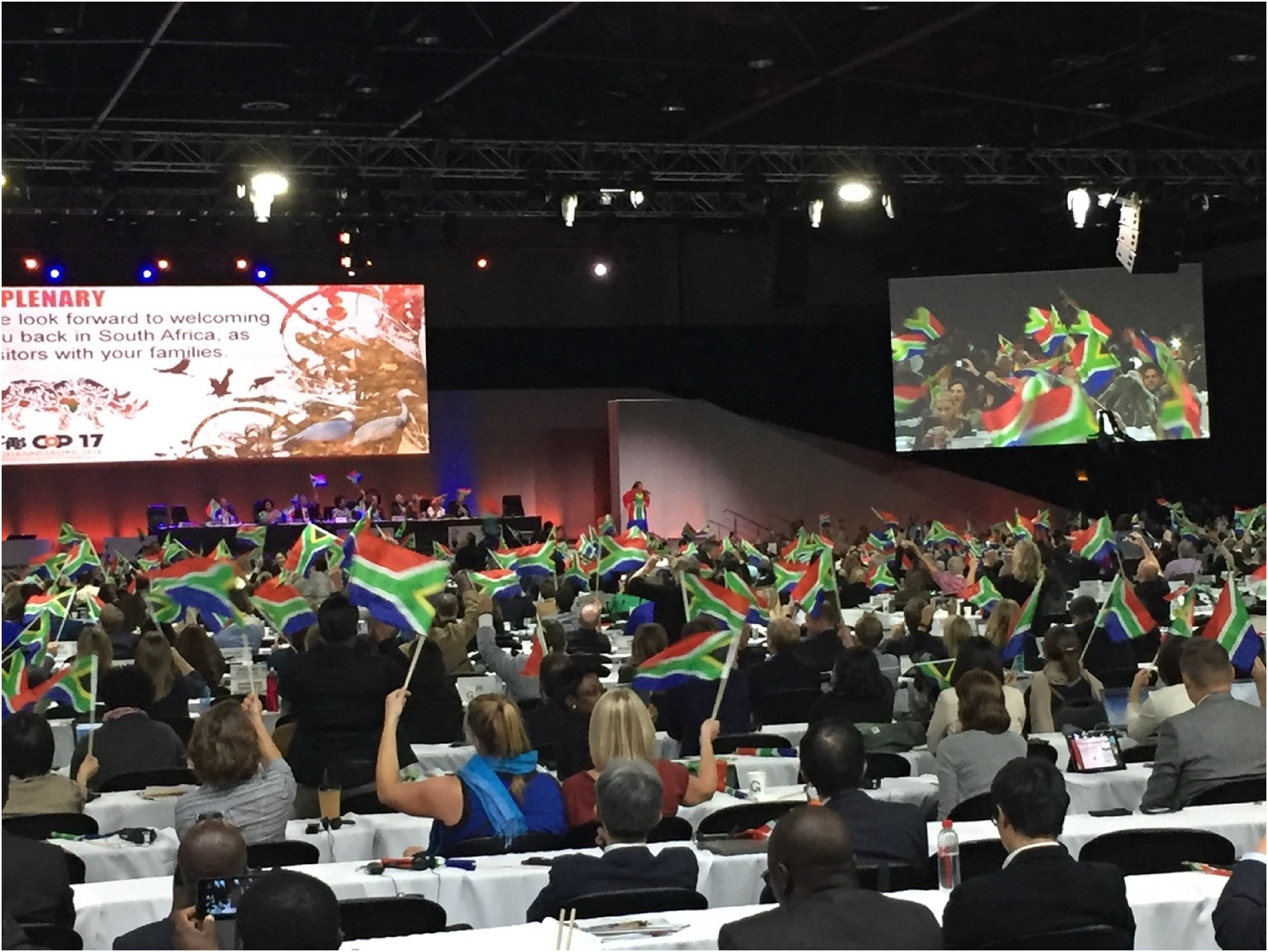
Final plenary of the CITES Cop 17 in Johannesburg, 4 October 2016. Photo: Bram Büscher.
At the same time, this is also where biodiversity conservation differs from broader environmental policies and diplomacy. Given its critical dependence on international tourism, the southern African conservation sector has continually promoted the availability of iconic wildlife and experiences. In contrast to progress on CO2-emissions and pollution, wildlife numbers have grown significantly over the last decades, which has been intimately connected to the privatisation and commodification of wildlife and wildlife-based products (Wilson et al., 2016). Indeed, over the last decades, the “‘wilderness experience’ is one that has increasingly been offered not only by state-run protected areas like the KNP, but on private lands by hosts who have grasped the opportunity to benefit from the growing ecotourism-based leisure market” (Brooks et al., 2011: 261). In the process, capitalism and conservation have conjoined even more intensely in the ‘wildlife economy’ as the currently dominant form of conservation in South Africa, which builds on, and often resembles and intensifies, market-based ideologies that have been so prevalent in the sub-continent over the last decades.
Private sector and the wildlife economy
Since the declining media attention on Peace Parks in the 2010s, no other major conservation paradigm seems to have taken over in southern Africa to inspire conservation action regionally and globally. The main initiative that could perhaps be regarded as a successor paradigm is the ‘wildlife economy’, coined by the South African Department of Environmental Affairs (see Figure 2). In this section, however, we argue that this initiative is no successor paradigm but rather signifies both the continuation and culmination of the long history of the commodification of nature in southern Africa for tourism and other markets.
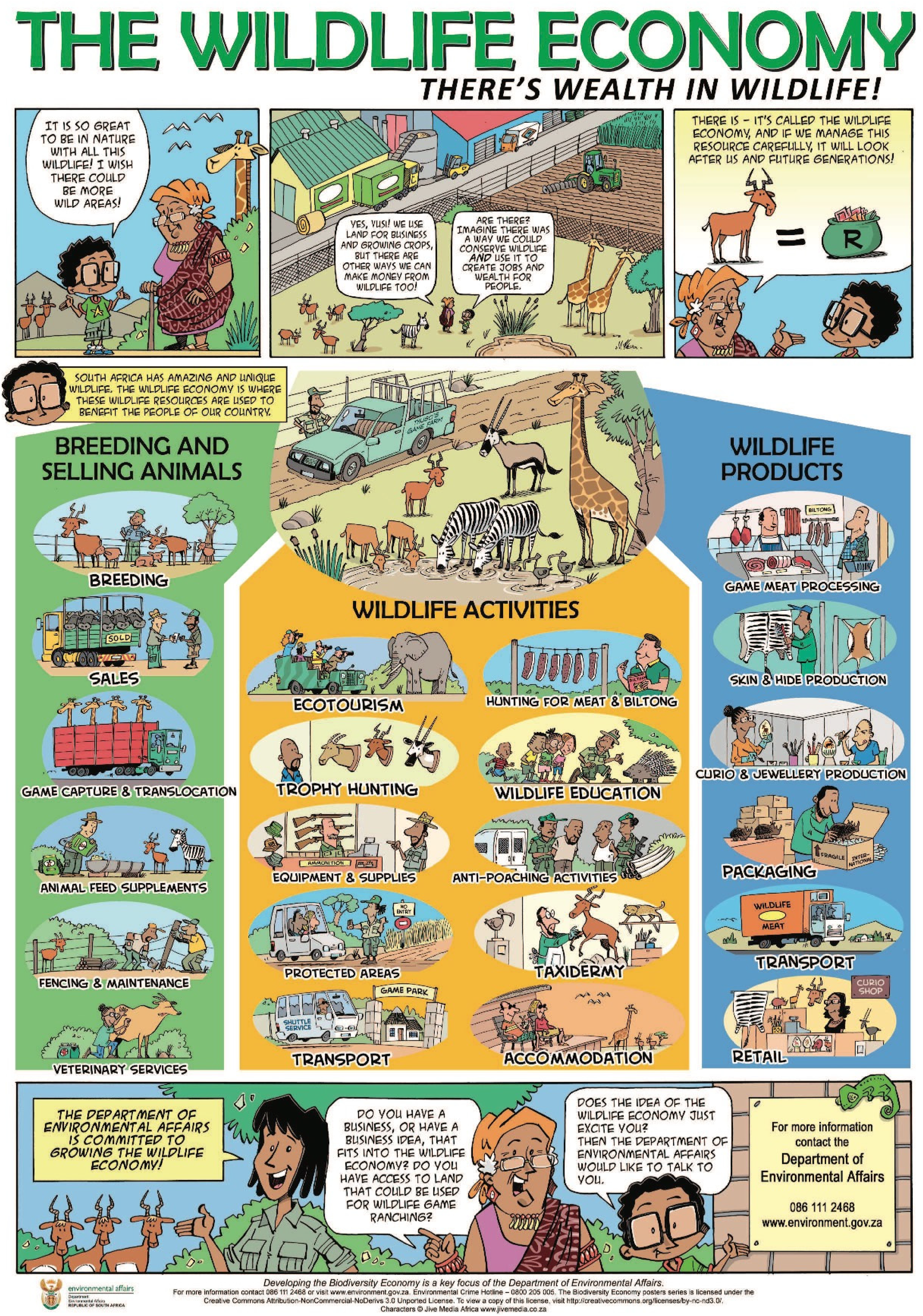
DEA leaflet on the wildlife economy. 8
The wildlife economy is a continuation of the history of southern African conservation because capitalist economic motives have been a central driving force through all other paradigms. Through neoliberal alignment with community-based conservation, for example, we have seen the erosion of communal rights over land and wildlife (Ramutsindela and Shabangu, 2013), while benefitting a small selection of private and state actors (Sinthumule, 2017b). More generally, capitalist economic mechanisms of conservation have always been central to protected areas, community-based conservation and transfrontier conservation. This ideology was pushed by states, conservation NGOs and the private sector and such mechanisms have been studied and critiqued for a long time (Brockington and Scholfield, 2010). In this sense, specific neoliberal conservation paradigms such as PES ‘merely’ accentuated logics that have long been present in conservation in the region.
The wildlife economy is also the culmination of all of this because these various historical experiments with capitalist conservation now seem to have come to the point where they are systemically mature: they have become part and parcel of the broader capitalist economy of southern Africa and, indeed, a central pillar in this economy. Critical in this is the ‘National Biodiversity Economy Strategy’ (NBES) of South Africa, launched in 2016 (DEA, 2016). As one of us argued earlier, this government strategy “aims to transfer this entire [biodiversity] sector into a broader economy across the agricultural, eco-tourism and conservation domains that is supposed to play an important part in the South African economy as a whole” (Büscher, 2021: 769; DEA 2016: 18). What this de facto means is a deeper convergence of state and private interests around biodiversity and wildlife (Peet, 2002; Ramutsindela et al., 2022b).
This convergence, to be sure, has been growing in southern African conservation for decades (see also Peet, 2002), but, we argue, is now becoming even more overt and integrated. This is evidenced by the 2019 Africa Wildlife Economy Summit which was hosted by Zimbabwe and attended by representatives from over 30 African countries including Botswana, Namibia and Zambian heads of states (AWES, 2019). Though funded by the European Union and other external parties, this was an important summit because it was hosted by an African head of state and the agenda was seemingly set by Africans themselves (Child, 2020). During the summit “H.E Emmerson Mnangagwa, President of the Republic of Zimbabwe, through his opening statement underscored that the Wildlife Economy must seek to explore innovative ways to leverage wildlife resources to reduce poverty, create jobs, especially for women and conserve biodiversity and wildlife spaces” (AWES, 2019, 2). Furthermore, in 2021, the SADC commissioned a ‘Framework for a SADC Wildlife-based Economy Strategy’ which stressed the importance of a consistent southern African approach to the wildlife economy. 9
All of the above indicates that state and private conservation interests have now systemically integrated largely based on claims about the moral and inclusive dimensions of the paradigm. Similar to previous paradigms, the wildlife economy is presented as a vehicle for economic growth, rural development, job creation, poverty alleviation and other ‘wins’ (see DEA, 2016; AWES, 2019). Hence it fits the classic win-win narratives that have received much criticism (Chaigneau and Brown, 2016; Büscher, 2013). However, the focus seems to be on the idea that the wildlife economy and its commodification and privatisation of wildlife simply work within the global capitalist economy: it brings in revenues and it boosts wildlife (Child, 2009; Krug, 2001; Snyman, 2017). This view of wildlife is utilitarian and simplistic: whatever works in terms of making money is regarded as successful, so it seems, whether from tourism, live sales of wildlife trophy or biltong hunting, breeding or taxidermy. As one private wildlife owner told two of the present authors, the lions on his farm are not God's lions, they are his lions, and if they don’t bring in money, they are not worth anything, according to him, ‘if it doesn’t pay it cannot stay’ 10 (see also Kamuti, 2015; BL, 2015).
Success, in other words, is measured in plain economic terms, where species numbers and habitat protection, together with financial profit become the benchmark of sustainability (Hoveka et al., 2020, Bond et al., 2004, Clements et al., 2018). This, then, is also considered beneficial for ‘local’ communities. To give but one example, the neoliberal NGO Peace Parks—working mainly in southern Africa and currently expanding further North in the continent—defines their sustainable ‘dream’ according to four main aspects: “1. Commitment - We engage with governments to obtain buy-in, secure protected land, and channel investment into development of transboundary conservation areas. 2. Conservation at Scale - We plan and implement innovative strategies that revitalise habitat integrity, restore ecological functionality, and protect biodiversity. 3. Commercial Development - we develop nature-based tourism and enterprise opportunities to ensure the long-term sustainability of protected areas. 4. Community Engagement - We capacitate communities in the sustainable use of natural resources and unlock opportunities for deriving equitable benefits from conservation.
11
”
There is an important caveat here. Whereas many southern African countries have been moving towards unquestioned faith in the private sector to enact conservation, in Botswana natural resources are legally owned by the state (LaRocco, 2016). This highlights an important distinction between ownership and use rights because “the emergent wildlife-based tourism [in Botswana] laid the foundation for the dominance of the private sector and individual entrepreneurs in the country's wildlife economy” (Mogende and Ramutsindela, 2020, 405). Botswana's environmental governance is, however, exemplary of the fact that the neoliberal logic in nature conservation not only occurs on private land but also on communal (Büscher and Dressler, 2012) and state land. This can result in eroded land rights (Bluwstein, 2017) and elite capture (Koot, 2021). In the end it means that the ‘wildlife economy’, rather than an uplifting conservation paradigm, is a systemically central element of the economy as a whole, something Botswana has long embodied.
Many more elements of the intertwined relationship between private conservation and the state can be mentioned, from the outsourcing of services in state protected areas to private sector restaurants and tour guides (Cundill et al., 2013), to states and private sector parties leasing conservation land to each other in decades’ long concessions (Mahony and Van Zyl, 2002; Sinthumule, 2017a). It is important, however, to also note the limits and contradictions in these relations. The private sector does not have free reign as there are laws that prohibit or limit certain activities such as hunting certain species or developments in national parks. There are also unresolved tensions between private sector industries supported by the state, like for instance between proponents of nature reserves and ‘canned hunting’ and commercial crop farming areas. Finally, states also have to adhere to international legal restrictions such as those coming from CITES (Hübschle, 2016) and aspirations of industries they support, such as the desire of private rhino owners in South Africa and Swaziland to trade rhino horn internationally. 12
Altogether, the neoliberal ideology that centralises the merging of state and private sector interests over biodiversity conservation and community development has led to a transformation in the global significance of southern African conservation. Rather than proposing a conservation with inclusive grace, it has, as LaRocco and Mogende argue in this issue, come back down to earth, to the harsh realities of how capitalist conservation works in practice, with all its contradictions, conflicts and tensions. Based on the papers in this special issue, however, we go a step further to argue that the weight of these contradictions, conflicts and tensions has become so big and violent that they expose the unsustainability and undermine the global idealization of the entire conservation enterprise in southern Africa.
Violence and the question of sustainability
If we look at the literature on community-based and transfrontier conservation, even the most critical literatures believe that these paradigms could perhaps be salvaged if they profoundly rethink their neoliberal capitalist and state bureaucratic underpinnings. With regards to CBNRM, for example, Dressler et al. (2010: 5) argue that despite the crisis it was in, “there is scope for refocusing on the original ideals of CBNRM: ensuring social justice, material well-being and environmental integrity”. This, we believe, is no longer possible with the wildlife economy. The severity of its contradictions, the harshness of its violence and dispossession and its full integration into a deeply unsustainable global capitalist economy make it such that we need to question its perceived inherent sustainability.
In addition to the contradictions discussed in the previous section, the pervasive use of violence in the wildlife economy makes it irredeemable. One of the most concerning manifestations of this is the normalisation of a hierarchy of life. For instance, regarding water politics in the Waterberg, South Africa, Marcatelli and Büscher (2019) show how white landowners’ and tourists’ lives are prioritised over the lives of (ex-)farmworkers and their families. They argue that high end commercial eco-tourism and the state normalise structural violence “where some [farm workers] have access to water quantities barely sufficient for survival while others [white landowners] have plenty to use for high-end commercial and touristic objectives” (Marcatelli and Büscher, 2019, 770). In this line, Thakholi (2021) shows how the wildlife economy in and around Hoedspruit, South Africa, creates a hierarchy of life in which rhino are protected at all costs while Black conservation labourers and their families are exposed to structural harm. She further argues that by creating new commodities, mainly for tourist consumption, the wildlife economy even prioritizes capital accumulation over the lives of rhino (Thakholi, 2021).
Structural violence is paralleled by the more spectacular violence that attracts much media attention. The spectacularised ‘war on poaching’ and associated discourses can mask the structural and direct violence experienced by conservation workers more broadly and especially anti-poaching units, paramilitary organisations, (assumed) poachers and rangers (Büscher, 2016; Koot and Veenenbos, 2023). Conservation workers at the forefront of militarization need mentioning to further underscore why the wildlife economy in southern Africa should not be pedestalised. In Zimbabwe, Mushonga (2021) explores the workplace violence experienced by paramilitary personnel in the Sikumi Forest Reserve. She shows the violence that rangers experience, which includes a lack of protective clothing and insufficient food, ammunition, and firearms. Paramilitary personnel—while celebrated as conservation heroes—also experience occupational violence from their employer, the Zimbabwe Forestry commission (Mushonga, 2021). Similarly in South Africa's KNP, Smidt's (2022) rich ethnographic research with anti-poaching rangers reveals an uncanny resemblance between apartheid policing tactics and anti-poaching in the park. He argues that under the labour regime in the KNP, workplace productivity “is not only related to the willingness of field rangers to merely arrest individuals from their social worlds as it was in the past but their willingness to use violence, measured in the expenditure of ammunition or the use of torture on suspects” (Smidt, 2022, 119). When meting out violence becomes the measure of productivity in conservation, the perpetrators of violence themselves become victims of workplace violence.
In addition to the violence experienced by illegal hunters and conservation labourers, militarisation tends to spill over into neighbouring communities where harassment, intimidation and surveillance endangers people and fractures community-park relations (Sithole and Matose, 2021, Annecke and Masubelele, 2016). Consequently, Ramutsindela et al. (2022a, 4) argue that “violence is a permanent feature of conservation in Africa”. This alone makes mainstream conservation's continued legitimacy in international circles an indictment against democratic African states but also the conservation sector more broadly. These are several important dynamics that deeply question the sustainability of conservation in southern Africa, which in turn can undermine the fragile post-colonial legitimacy of the sector. The papers in this special issue provide further evidence that this should be a major concern for all those involved in conservation.
The contributions to the special issue
The papers are geographically located in private, community and state conservation areas in Botswana, Namibia and South Africa. Three papers focus on new dimensions and conceptualizations of the ‘wildlife economy’ model in South Africa. The other three papers relate to this by also addressing core issues around human wildlife conflict, (un)democratic decision making and the discursive resistance to neoliberal conservation in the region. Some papers show a continuation of capitalist market mechanisms in new empirical situations, while others show an intensification or expansion of such mechanisms. Together, they lead to new theorizations of the (un)sustainability of conservation within historical and contemporary contexts of broader capitalist dynamics in southern Africa and globally.
Our point of departure is that sustainability and success claims ought to consider the environment within specific geographical, historical and social contexts. Based on this premise the collection of papers empirically demonstrates that the neoliberal biodiversity conservation sector in southern Africa can hardly be considered sustainable, both from a broad eco-centric perspective that emphasises climate change next to biodiversity dynamics and certainly when socio-economic realities are also taken into account. The cases range from state interventions (Mogende and LaRocco, this issue), private nature reserves (Thakholi and Büscher, this issue), wildlife estates (Koot et al., this issue), conservation NGO-operated private farms (Brandon, this issue) and the conservation sector more broadly (Burnett, this issue; Büscher et al., this issue). Collectively, they highlight three main themes that overwhelmingly demonstrate why the private, state and communal forms of conservation in southern Africa continue to be unsustainable and should have never been considered aspirational.
The first theme relates to the dependency of the conservation sector on fossil fuels, especially in terms of coal (electricity) and oil (transport) consumption. Büscher et al. (this issue) demonstrate the multiple ways in which the private and state conservation sector is dependent on fossil fuels and mineral extraction in South Africa. From private airstrips in conservation areas, to the pivotal role of international tourists for revenue (see Burnett, this issue), the conservation sector in South Africa is firmly steeped within the ‘mineral-extraction complex’ which casts serious doubts on its claims of environmental sustainability. A recent study corroborated these findings for the South African public parks sector by showing that SANParks’ CO2-emissions do not even meet their own modest target of 2% per annum, let alone the more ambitious target of 8% necessary for a global 1,5 °C future as agreed in the Paris Accord (Phophe and Masubelele, 2021). Importantly, this study left out the private conservation sector, which in relative terms is even more carbon-intensive, as Büscher et al. (this issue) argue.
The fossil fuel dependency is indirectly highlighted in the other papers. For instance, in Namibia, Brandon (this issue) unpacks private cheetah conservation NGOs as a capitalised serviced-based industry. Some of the services offered include luxury tourism accommodation and voluntourism programs. Both these activities require tourists from mainly the USA and Europe to travel on long haul flights and drive long stretches in Namibia (Brandon, ibid.). Observing similar trends in private wildlife estates in South Africa, Thakholi and Büscher (this issue, 13) conclude that “it is not likely that estates have a net positive contribution to the environment writ large. After all, conservation-property developers will go to any lengths to enable high-modern, luxury consumption-driven lifestyles and hence willingly sacrifice environmental sustainability on the altar of white conservation imaginations and private profit”. COVID-19 threw a spanner in the wheel of the conservation and tourism sectors when most (international) flights were suspended. Some responses from the tourism sector and state officials to the subsequent lock downs revealed a myopic belief in the private sector and a casual disregard for human health and life for profit making (Burnett, this issue; see also Fletcher et al., 2020).
Second and related to the first point is the subsumption of local realities to hegemonic ideas about conservation and the market. Koot et al. (this issue) explore spatial enclosures in the private wildlife economy. Building on work by Achille Mbembe (2017), they demonstrate how fortified, physical enclosures are reinforced through further ‘class and race enclosures’ and ‘ideological enclosures’. The former refer to those who have (tourism business owners, real estate agents, wildlife estate inhabitants) and those who do not have (predominantly Black labourers) capital to invest in decent housing for themselves when taking part in the wildlife economy, and how this class distinction continues to take shape based on racial segregation so common in South Africa. Ideological enclosures refer to “the ideology of the open market and the ability to capitalise on the wildlife economy” as if this creates a level playing field “because they create ‘equal opportunities’ for all” (Koot et al. this issue, 11). Furthermore, another ideological enclosure shows how some white conservationists negate the legacy of apartheid by suggesting that racism is a thing of the past and that everyone, irrespective of class or race, has a fair chance at participating in the wildlife economy, which is not the case in reality.
In a similar vein, Burnett (this issue) critically analyses the online news coverage of the nature conservation industry during the COVID-19 lock downs in South Africa. He shows how during the pandemic mainstream news overwhelmingly reproduces the dominant neoliberal approach to conservation. Kevin Pietersen, a prominent white South African sports man turned conservationist echoes this dominant conservation script in a tweet calling out President Cyril Ramaphosa for failing the tourism industry. Burnett (ibid.) analyses the responses that question and ridicule the racism and white privilege espoused in Pietersen's tweet. He (ibid., 13) suggests that the “use of humour works in disciplinary fashion to reveal the ridiculousness of people whose solidarity with a national community is entirely contingent on self-interest, and who yet claim to speak for South Africa and its animals, whom they protect from local people who in their unfathomable hunger and need would (supposedly) otherwise decimate them”.
While Burnett (ibid.) points to a simmering counter-hegemonic resistance online, on the ground in Namibia Brandon (this issue) unpacks yet another iteration of a dominant conservation class, the cheetah conservation NGOs. The latter run their operations on private land and offer a myriad of services including research, and intangible commodities such as voluntourism and accommodation. This prompts Brandon (ibid.) to suggest that these NGOs have fashioned a business model in line with pleasing their global audiences and not local farmers impacted by human-wildlife conflict.
Lastly, conservation of biodiversity impedes social and spatial justice. Thakholi and Büscher (this issue) zoom in on the spatial configurations of two types of conservation land use; share blocks and residential wildlife estates. They borrow from Ekers and Prudham's (2018) conceptualisation of the socio-ecological fix to argue that the emerging congruence between conservation ideals and private developers results in the mooring of conservation into place due to the complex entanglement of multiple legal arrangements which in turn block other claims to land (see also Mollette and Kepe 2018). What this means in practice is that the state offers alternative land or financial compensation. This utilitarian approach to land restitution disavows other values to land (Bezerra, 2008) and supposes that all land is the same, negating historical ties and different cultural values (Koot and Büscher, 2019).
Relatedly, the aforementioned class and racial enclosures (Koot et al., this issue) in the wildlife economy in and around the small town of Hoedspruit, South Africa, show how some white and wealthy conservationists actively oppose the development of low-cost housing under the guise that it would introduce ‘a criminal element’ to the town. Low-cost housing would invariably result in the permanent, more dignified dwellings for Black labourers who are at the heart of the wildlife economy. Many have to travel upwards of 30 kms daily to get to work. Ultimately, these class and racial enclosures also manifest themselves physically as shown by Thakholi and Büscher (this issue).
By analysing the environmental policy under the Khama and Masisi presidency, LaRocco and Mogende (this issue) debunk the ‘miracle state’ narrative that presents Botswana as a shining beacon for democracy and nature conservation. During the Khama presidency (2008–2018) environmental policies that were praised internationally were found unpopular in Botswana because they alienated local people from the land. Importantly, LaRocco and Mogende show that many of these environmental policies were not subject to kgotla, a community meeting integral in Botswana's participatory, democratic governance. They state that “the policies of the green miracle state—predicated on a lack of consultation and heavy-handed state violence—undermined the central characteristics that constitute Botswana's domestic norms around democratic practice” (LaRocco and Mogende, this issue, 17). The Masisi presidency (2018-present) rolled back some of these policies and was unsurprisingly shunned by the international community even as some Batswana supported these measures including the lifting of the hunting ban.
Together the papers show that conservation ideology and practice limit the possibilities of creating equitable societies. The three themes that come out of the papers—dependency on fossil fuels, undermining local realities in service of hegemonic ideas about conservation and the market and spatial and social injustices—all point to the conclusion that conservation in southern Africa functions on a deeply problematic foundation, legitimized as a ‘green’, sustainable sector that contributes to the long-term wellbeing of the region and the planet.
Conclusion
Has southern African conservation fallen from grace? While the region has long been at the forefront of global conservation, aiming to achieve both conservation and development goals, the reality has been marked by persistent environmental, socio-economic, and racial injustices. The contributions in this special issue go beyond mere critique of conservation and delve into the fundamental links between environmental injustice, race, labour, power, and inequality. By doing so, they collectively question the overall sustainability of the entire enterprise.
This critique for a large part also applies beyond southern Africa: new initiatives at the global level, such as the ‘30 × 30’ initiative, again show a strong reliance on the continuation of market mechanisms, mostly global tourism 13 . The fact that southern African states have endorsed 30 × 30 in spite of the contradictions unpacked in this special issue is deeply concerning but not surprising given the international legitimacy that southern African states can acquire through this (Mogende and Ramutsindela, 2020).
The ongoing intensification of market-based conservation initiatives in the convergence of state and private sector interests further concentrates power in the hands of government and corporate elites (Peet, 2002). Actors in the wildlife economy hold on to, and even intensify and expand, market mechanisms that are at the root of the mentioned problems, which shows what Fletcher (2023: 5) recently called ‘Failing Forward’ in relation to global neoliberal conservation: Rather than provoking critical self-reflection concerning the essential viability of a market-based strategy, however, all of these daunting obstacles in the face of neoliberal conservation's success have thus far tended merely to spur introduction of even grander initiatives aiming to intensify market logic still further as the great future promise for global conservation efforts.
These dynamics have prompted scholars and some conservation professionals to start thinking about fundamentally transforming the conservation sector. For instance, Buscher and Fletcher (2020) propose convivial conservation, a conservation vision that moves beyond the nature-society dichotomy and beyond capitalist economic systems. Similarly, writing about east Africa, Mabele et al. (2022, 98) suggest Ubuntu—a southern African philosophy that centres ethics of care—“to facilitate a decolonial reimagining of conservation in southern Africa through its ethos of relationality and communality”. Others still noting the violent nature of conservation have proposed a framework for developing a ‘non-violent conservation’ premised on dignity and protecting the rights and wellbeing of people (Ramutsindela et al. 2022). Lastly, noting the violence perpetrated against conservation workers, Smidt (2022, 123) suggests “a conservation workplace premised on dignity and care”.
We concur with these proposals premised on the belief that the current conservation model in southern Africa is fundamentally unsustainable. Altogether, this special issue provides a thought-provoking foundation for further research on conservation in southern Africa and beyond. By confronting uncomfortable realities and the status quo, we hope that a more just and sustainable approach to conservation can be developed.
Footnotes
Highlights
The papers in this theme issue question the overall sustainability and legitimacy of the conservation enterprise in southern Africa.
Three issues: dependency on fossil fuels, amplifying hegemonic ideas about market-based conservation and spatial injustices- make southern African conservation unsustainable.
Conservation ideology and practice limits the possibilities of creating equitable societies in southern Africa.
Declaration of conflicting interests
The author(s) declared no potential conflicts of interest with respect to the research, authorship, and/or publication of this article.
Funding
The authors disclosed receipt of the following financial support for the research, authorship, and/or publication of this article: This work was supported by the Nederlandse Organisatie voor Wetenschappelijk Onderzoek,
