




Abstract
Soybeans are ubiquitous in the global food system. As a major forest risk commodity, they are also at the heart of efforts to untangle the dynamics of land use change and associated impacts resulting from distant drivers. However, land system science has so far largely ignored the historically and socially embedded nature of these entanglements. This results in snapshot-like representations relying on neoclassical approaches to production and consumption. Here, we trace the evolution of the global soybean complex (GSC) since the late nineteenth century. We analyze how in the context of external developments soybeans have been channeled into different provisioning systems. This has occurred in a series of socio-ecological fixes, facilitated by socio-technological innovations and public sector interventions, motivated by different impediments to capital accumulation. Today, several emerging socio-technological practices promise to transform the GSC towards sustainability. We argue that the contemporary GSC inherits defining properties from the past, particularly the postwar strategy of using industrial animal farming to add value to surplus grains and oilseeds. The expanding GSC is therefore not merely a result of increasing demand, but rather the outcome of different provisioning systems’ continued dependence on soybeans. Future transitions will depend on public interventions and the influence of vested interest in current socio-metabolic patterns.
Keywords
Introduction
Soybeans are an integral part of the global food system. They are the fourth most important crop by area harvested and the seventh by production output and are currently the most traded agricultural commodity by volume (FAO, 2020). In the past decades, the rise of the crop has come with its share of controversies as soybean expansion has led to major socio-ecological transformations and impacts. The crop is often characterized as a major forest risk commodity, with about 9 percent of the forest lost across South America over the past two decades having been converted to soybeans (Song et al., 2021).
As a “flex crop” (Borras et al., 2016), soybean products have many applications. Here, we use the term Global Soybean Complex (GSC) to refer to the network of social relations and material flows constitutive of the production, transformation, and final use of soybeans and their processed derivatives. The case of the GSC exemplifies many of the challenges and breakthroughs associated with research in land system science, as it provides a perfect example of the growing disconnect between places of production, processing, and consumption of land-based products, which has been at the heart of the discipline's recent debates and conceptual developments. Specifically, the problematization of various spillover effects, or displaced impacts, has complicated conventional place-based understandings of land use (Bastos Lima et al., 2019; Meyfroidt et al., 2013).
To link consumption patterns to distant land use impacts, methods from industrial ecology have been adapted to allocate biomass flows between processing co-products and to attribute responsibility to either final consumption, production, or value-added (Kastner et al., 2011; Schaffartzik et al., 2015). Further, increasing detail and complexity in econometric models and remote sensing products has allowed quantifying leakage effects or evaluating the performance of governance interventions (Garrett et al., 2016; Villoria et al., 2022) and multi-sited qualitative field research has disentangled dynamics between local land use and distant ideological projects (Persson et al., 2022; Busck-Lumholt et al., 2022).
These recent contributions have undoubtedly led to innovations that allow tracing impacts and evaluating governance mechanisms in a globalizing global economy. However, there is a tendency to characterize land-use change in “snapshot-like” representations (Friis et al., 2016) as the field “has not considered the underlying impetus of globalization processes or sufficiently accounted for land change in the evolution of the capitalist world-economy” (Napoletano et al., 2015: 199). Indeed, as Munroe et al. (2014) observed, land system science has relied mainly on neoclassical approaches to economic processes, which tend to neglect their socially and historically embedded nature.
This contribution addresses this shortcoming by tracing how land and other resources have been metabolized in different socio-technological arrangements through the GSC since the late nineteenth century. We leverage conceptual approaches from political economy, economic geography, and transition studies to understand how the contemporary GSC evolved and shaped different provisioning systems according to external circumstances, socio-technical innovations, and socio-ecological fixes. Our final discussion distills lessons from our findings for current endeavors in sustainability transitions.
Linking socio-metabolic relations to accumulation: uncovering regimes in the GSC
This contribution firmly grounds our understanding of the GSC's historical formation and its present controversies in its role within the broader capitalist world-economy. We place specific emphasis on the materiality of socio-metabolic pathways, or the circuits of appropriating, transforming, and consuming matter and energy for social reproduction employing specific technological infrastructures and socio-ecological relations. We use the term regime to refer to a period characterized by a relatively stable functional operation of the GSC given a specific historical conjuncture of these metabolic circuits in capitalist development. In doing so, we leverage insights from the study of provisioning systems, different perspectives on technological innovation, regulation theory, as well as socio-ecological fixes.
The concept of provisioning systems allows us to understand economic processes as historically specific and embedded within socio-ecological practices as in classical political economy or contemporary substantivist approaches (Jo, 2011). Building on Plank et al. (2021) and Schaffartzik et al. (2021), we understand provisioning systems as historically evolved relations of production, distribution, and consumption shaped by power relations, technological infrastructures, available resources, and cultural values. The socio-metabolic dimension of provisioning systems encompasses “the material and energy inputs, their transformation […], the accumulation and reproduction of materials stocks, and all resulting outputs, involved in societal reproduction” (Schaffartzik et al., 2021: 1408). It also involves the technological infrastructure through which material transformations take place.
The evolution of such socio-technological systems is addressed in the transitions literature, drawing from science and technology studies, complex system theory, and approaches to governance (Grin, 2016). This literature is often guided by the key concept of a multi-level perspective (Geels, 2005), which distinguishes between interactions at different levels, such as existing structures, niche experiments, and broader external processes at the landscape level. Further, technologies do not only transform socio-ecological relations but are also conditioned by them. As Hornborg (2016, 2020) has pointed out, technological artifacts are made possible not only by ingenuity and innovation but by systems of relations, which make energy sources (including land and labor) available for a new socio-technological regime to become practically feasible and economically viable.
As part of capitalist forms of provisioning, soybeans and their derivatives take the commodity form and flow through industrial circuits mediated by technological infrastructures operated by corporate actors to maximize profit (Jo, 2011). We can then understand their role in terms of the “fixes” these arrangements have provided for capital accumulation at specific historical conjectures. Originally, “spatial fixes” conceptualized how crises of overaccumulation can be deferred by switching capital between distant places mainly through outlets in the built environment (Harvey, 1982). Recently, the “socio-ecological fix” (Ekers and Prudham, 2015) has broadened this idea to “something that directly engages with and resolves, mitigates, or postpones a structural impediment -including any environmental one- to sustained capital accumulation” (McCarthy, 2015: 11). Further, capitalist forms of provisioning are embedded in broader modes of regulation or geographical and historical variations in the institutional arrangements of capitalist economies (Aglietta, 1979; Lipietz, 1986). These can be defined through institutionalized compromises, such as the wage-labor nexus, forms of competition, insertion in the international regime, and the role of the state (Jessop and Sum, 2006).
We use these conceptual tools to characterize the evolution of the GSC as a sequence of regimes. For each regime, we identify large-scale landscape developments and crisis tendencies in the mode of accumulation, which are resolved, displaced or postponed by specific socio-ecological fixes. These bring about a configuration of socio-metabolic pathways between the GSC and specific provisioning systems and a set of dominant socio-technological practices and actors, which characterize the new regime.
Regime shifts in the GSC
The following sections outline regime shifts in the GSC. Key characteristics and events are summarized in Figure 1.
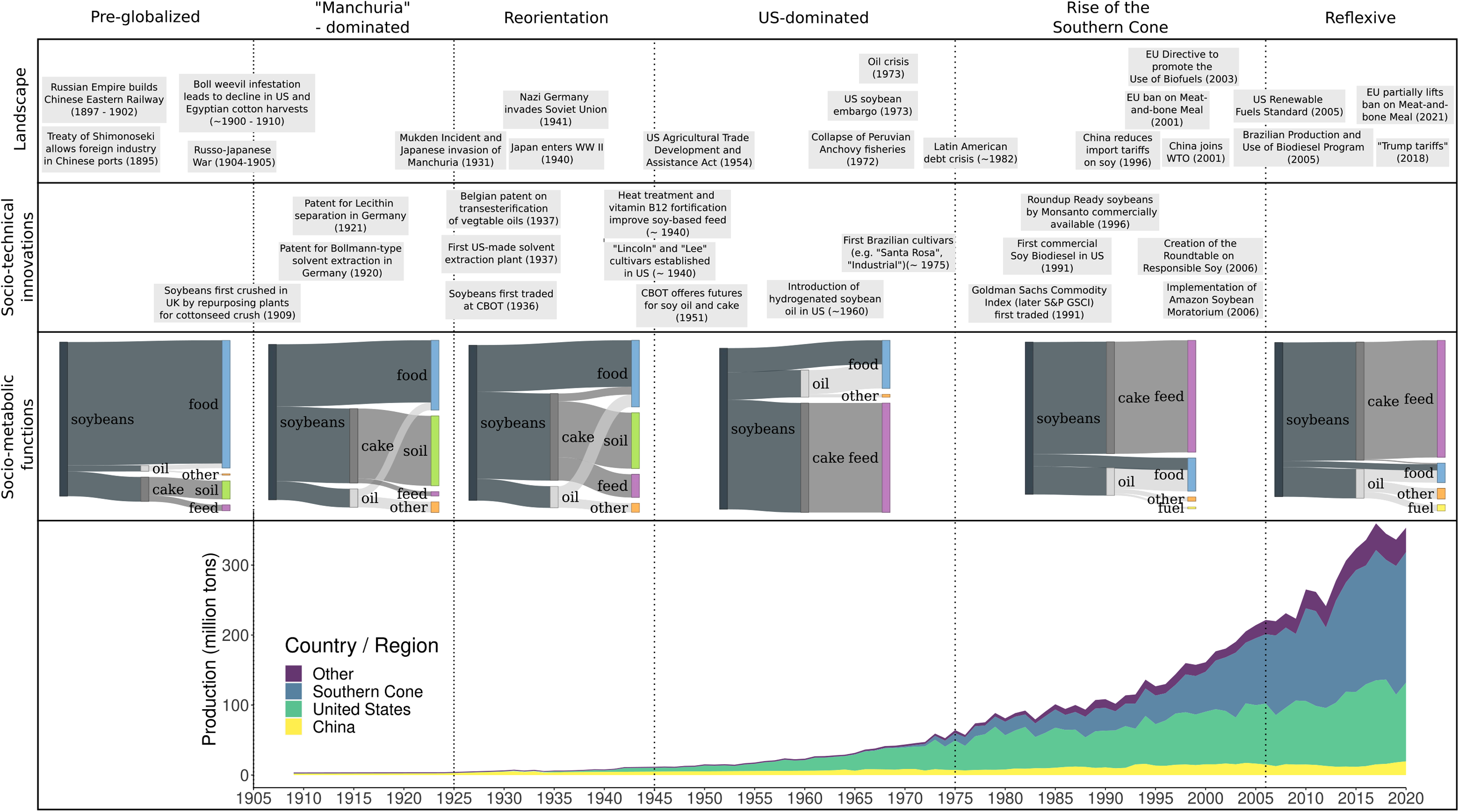
2019 Regime shifts in the global soybean complex. Production and use data taken from Shaw (1911), Stewart (1936), Deasy (1939), Bruckner et al. (2019), FAO (2020), and USDA (2020). Until 1990, metabolic function allocations are rough estimates.
The rise of a regional commodity: soybeans before the first era of globalization
The domestication of soybeans took place in China during the Shang dynasty (ca. 1766–1125 BCE) (Hymowitz, 2008; Qiu and Chang, 2010). Despite their high complete protein and fat content, soybeans contain antinutritional factors, causing digestive problems when they are not processed and prepared properly (Liener, 1994). Unlike the immature beans (edamame), mature beans required processing and did not play an important role in local foodscapes initially (Fu, 2018: 21). Soybeans thus originally primarily served the purpose of a leguminous cover and fodder crop and only played a minor role in human diets (Lander and DuBois, 2022).
Over time, several processing technologies evolved in East Asia, including sprouting, fermentation techniques to yield products such as shi, miso, soy sauce, and tempeh, and grinding delivering soybean milk and curd. Soybean food products and associated socio-technical practices spread across many parts of East Asia, aided by the travels of Buddhist monks observing plant-based diets (Du Bois, 2018). The soybean thus evolved into an essential staple crop and protein source in the region.
Further, improved mechanical soybean crushing technologies also allowed for other uses. Soybean oil began to be used as a cooking oil and for lubrication and lighting. Soybean cake was employed as nitrogen-rich fertilizer across Eastern Asia (Mizuno and Prodöhl, 2019; Shaw, 1911). Northeast China began exporting significant tonnages of soybean cake for sugarcane plantations in Zhejiang, Guangdong, and Fujian and cotton production in the Lower Yangzi River, particularly after the Qing rulers had lifted restrictions on grain exports in 1772 (Fu, 2018: 23).
There were experimental shipments of soybean cake to the coffee plantations in British Ceylon (the former British colony in present-day Sri Lanka) and Hawaii, yet in both cases, the operations were deemed too costly in these early stages of steamship technology (Shaw, 1911). Since the seventeenth century soy sauce was also exported as a bourgeois specialty food item to Europe (Du Bois, 2018). By fertilizing sugar cane and cotton plantations, soybean cake was also embedded in the Qing dynasty's regional and increasingly inter-regional trade with refined sugar and textiles (e.g., the valued “nankeens”), both of which were among China's first modern industries (Chao, 1977; Chen, 1971) and played a role in the Qing dynasty's trade surplus with Europe, which drained Europe of its colonial silver and ultimately led to the Opium Wars (Von Glahn, 2019).
By the end of the nineteenth century, soybeans were part of regional provisioning systems as a cover crop and a dietary protein source but were also transitioning towards a regional and – to some extent – inter-regional commodity in the form of traded soybean cake fertilizer. Thus, while the crop was only partially commodified, the early flows of soybean cake can be read as a socio-ecological fix, which brought land in the Northeast China Plain into production to prevent soil-depletion in other regions, thereby enabling the further development of textile and refined sugar industries. A legacy from this early commodification which remains to this day is the transformation of soybean derivatives into industrial inputs.
Railroad imperialism: soy exports from “Manchuria”
The first truly global soybean trade regime emerged at the turn of the twentieth century when Northeast China, or “Manchuria”, a term now associated with imperialist ambitions (Tamanoi, 2000), became the center of imperialist interventions with Russia and Japan struggling for spheres of influence (Hiraga, 2017; Mizuno and Prodöhl, 2019). Several strategic assets in the region fell under Japanese control. Imperial Japan used these assets to access resources for its rapid industrialization following the Meiji Restoration.
The opening up of the Northeastern commodity frontier was achieved through the South Manchurian Railway Co. (SMR), an institution comparable to the British East India Company. Established after the Russo-Japanese War, the SMR was primarily funded by the Japanese government. The SMR managed the commodity trading network through Port Arthur and Dalian, integrating the Southern part of the China Eastern Railway, which Russia had ceded to Japan following the war. The power wielded by the monopolistic control of this railway system as a “tool of empire” (Elleman et al., 2010: 6) was enormous. It served a dual purpose, firstly as a military railway network for the fast deployment of troops, rendering the region a Japanese military protectorate, and secondly, as the infrastructure to spur development in the frontier region of the railroad's catchment area to stimulate the export of soybeans and other commodities (Matsusaka, 2010).
Through large-scale investments, Japan further evolved into a “co-regimist” in international shipping (Wray, 1998), building a fleet of high-speed ships, developing the ports of Yokohama and Kobe, and using existing telegraph systems between Europe and East Asia. All these activities were coordinated by a tightly integrated network of shipping companies (e.g., Nippon Yusen), trading companies (e.g., Mitsui), and financing institutions (mainly the Yokohama Specie Bank) with long-standing business ties (Kunio, 1986; Wray, 1998). Through these efforts, Japan developed lines to Europe and North America and controlled a significant tonnage of international shipping.
Among the commodities sourced from the Northeastern China was the soybean. Soybeans became a staple food item in the Japanese diet but were mainly processed to use the protein cake as fertilizer on intensifying Japanese rice fields. This was part of an effort by the administration to make the empire self-sufficient in food (Farina, 2017). The nitrogen-rich cake alleviated shortages of fish manure as coastal herring stocks were being depleted (Fu, 2018: 24). Japanese trading companies successfully navigated the geopolitical tensions in the region and also used the Russian-controlled railway systems and export hubs for their operations (Mizuno and Prodöhl, 2019).
It was the co-product of the nitrogen-rich cake, soybean oil, which was increasingly sought after in Europe for industrial applications. This must be understood in the context of the increasing importance of vegetable oils imported into Europe since the early nineteenth century following shortages of animal fats, particularly with the depletion of whale oil from the arctic (Waibel, 1943). Early shipments of soybeans to Britain started in 1907.
Soybeans were originally pressed to yield meal and oil using traditional mechanical crushing with large millstones turned by mules. Brown (1981) describes how early attempts by foreign entrepreneurs to enter the regional soybean processing business with modern steam-powered equipment failed, partly due to the strength of Chinese guilds and their ability to oppose innovations that would have threatened their influence. The Treaty of Shimonoseki from 1895, ending the First Sino-Japanese War, finally allowed foreign-owned industry in port cities, and steam-powered technologies were then rapidly adopted by both foreign and Chinese companies (Brown, 1981).
Japanese actors, such as the Japan-China Bean Meal Manufacturing Company, concentrated their processing facilities around the port of Dalian. They began operating steam mills in 1909 and later introduced industrial plants with solvent extraction technologies (Shurtleff and Aoyagi, 2004). Starting in 1907, soybeans began to be crushed in Europe for the first time, when poor cotton harvests in the American South and Egypt led to a shortage of vegetable oil in Britain (Wen, 2019). With minor modifications, the technological infrastructure built around the cottonseed flows to the British Empire, primarily located in the cities of Hull and Liverpool, was now used for the newly arriving soybean.
The rising demand for soybeans was met by the expansion of cultivated land and the large inflow of settlers from Southern China (Langthaler, 2020). Between 1887 and 1930, cultivated acreage in the Northeastern region increased five-fold, and the population rose from 5 to 31 million, driven by net immigration (Eckstein et al., 1974). Germany became Europe's largest importer of soybeans, developed new solvent extraction technology, which significantly improved efficiencies, developed a soy-based rubber substitute, and evolved into Europe's center of soybean crushing (Shurtleff and Aoyagi, 2004).
Entrepreneurs saw opportunities the new soybean trade provided for “the prosperity which it promises to numerous buyers of foreign cottonstuffs, and in its general influence on mercantile exchanges” (Rose, 1912: 103). However, this early soybean frontier also foreshadowed some of the current controversies. The conversion of the Northeastern plain into farmland followed extractive practices, with soil fertilities declining rapidly (Langthaler, 2020). Christmas (2019) linked these practices to cases of selenium deficiency disorder in the region. While Chinese farmers flocked to the area in response to the economic opportunities presented by soybean expansion, the industrialization process displayed highly unequal patterns. Development was largely controlled by Japanese monopolists, who tried to cut out local middlemen and paid highly unequal wages, leading Grajdanzev (1935: 151) to conclude that “the future of the Manchurian in Manchuria is to be at the bottom of the social pyramid”.
This first global soybean regime constituted a socio-ecological fix for rapid Japanese industrialization during the Meji Restoration by providing a cheap nitrogen fertilizer, which replaced scarce fishmeal and allowed for more intensive rice cultivation. Soybeans thereby entered the provisioning system of the country's main staple crop. A few decades before the spread of synthetic nitrogen fertilizers, soybeans from Northeastern China occupied a socio-metabolic function reminiscent of the guano deposits in the nineteenth century (Hollett, 2008). In Europe, soybean oil was a fix for its struggle to meet the demand for lipids used in provisioning for manifold consumer products (e.g., soaps, detergents), after animal fats from the Artic had been depleted and other oilseeds were scarce due to poor harvests.
Reorientation: interwar period and World War II
During World War I and the interwar period, China's Northeastern region remained the global center of soybean production and export. At the same time, European demand for vegetable oils soared, fueled by applications in nutrition, soaps, detergents, and machinery. New efforts to cultivate the crop in other world regions began, notably in Egypt, where Britain increasingly pushed for soybean production (Wen, 2019), and in the US, where the plant was initially used as a cover crop for forage and to enhance soil fertility. Western corporate actors increasingly invested in soybean processing, particularly in the margarine industry. The invention of a process to separate soy lecithin, patented in Germany in 1921, further diversified the applications of soy products (Shurtleff and Aoyagi, 2016: 8).
A Belgian patent for the transesterification of vegetable oils in 1937 was a breakthrough moment for research into using soybean oil and other vegetable oils as fuel (Guo et al., 2015). Solvent extraction technology was improving crushing efficiencies, and the world's largest soybean crushing plant at the time, operating in Hamburg, Germany, had a capacity of 1089 tons per day (Shurtleff and Aoyagi, 2004). European nations preferred imports of raw beans, which led to a decline in China's crushing industry. In 1929, Unilever was founded through a merger of a Dutch margarine company and a British soap maker, who shared a need to source soybeans and other oilseeds as raw materials.
At the outset of World War II, the GSC began to be transformed radically. Attempts by Chinese warlords to push Japanese companies out of the soybean business contributed to the launch of a false-flag attack on the railway system providing pretext for the subsequent invasion of the region by the Kwantung Army (Mizuno and Prodöhl, 2019; Young, 2017). However, with the creation of Manchuko as a Japanese puppet state, the Northeastern soybean rush began to fade. The region experienced severe flooding (Grajdanzev, 1935), the Second Sino-Japanese War began, and Japan entered World War II on the side of the Axis powers (Kung and Li, 2011). At the same time, the war industry itself became thirsty for soybean oil, which was used in machine lubricants and the production of nitroglycerin, while soy protein became a vital ingredient in army provisions (Du Bois, 2018). An early foreshadowing of the present role of soybeans appeared in Denmark, where soybean meal in animal feed played a significant role in the country's shift from a grain-based economy towards a major exporter of animal products by 1930 (Shurtleff and Aoyagi, 2004).
In Nazi-Germany, massive but ultimately unsuccessful research efforts sought to develop soybean varieties that could be grown domestically. Meanwhile, the industrial conglomerate IG Farben spearheaded the expansion of soybean production in South-Eastern Europe. Supply was to be secured as a safeguard against collapsing trade routes to East Asia. Germany established a core-periphery trade relationship by exchanging soybeans and other primary goods from Southeastern Europe for German machinery and manufactured industrial products (Drews, 2004). The soybean played a vital role in the regime's efforts to maintain the availability of protein and fats, which had long been dependent on imports and were threatened during wartime. The beans initially found applications in the margarine industry (oil) and as animal feed (protein cake), but the state attempted to increase its direct use as a food item to reduce losses in animal metabolism. While the general population was reluctant to adopt soybean products in their diets, these played a crucial role in army rations and meals provided at workplaces. However, production in Eastern Europe and Germany was never sufficient to break the dependency on soybeans from Northeastern China, and shortages ensued after Germany's invasion of the Soviet Union led to the collapse of trade routes (Drews, 2004).
The most radical transformation began in the US in the late 1920s, when soybeans were increasingly cultivated for oil and meal, rather than for hay or soil improvement as they had previously been. The US government encouraged soy cultivation over other crops under the New Deal when earnings from cotton and maize had stagnated due to oversupply and financed further botanical research expeditions to acquire material for public plant breeding operations (Prodöhl, 2013; Roth, 2018). The use of novel hybridization techniques greatly improved yields, producing the dominant “Lincoln” cultivar in the Midwest and the “Lee” cultivar in the South (Vieira and Chen, 2021).
The soybean further became a focus of attention for the Chemurgy movement, a political force in the US that sought to replace raw material imports by using domestically available biomass sources and gained government support in the form of financing for research on soybean applications in the face of wartime shortages in tropical oils (Finlay, 2004). In the 1940s, soybean oil was increasingly used for margarine, as there was a shortage of butter (Prodöhl, 2013). Soybeans thus became crucial in the American wartime economy by providing farmers with a new source of income. They also patched holes in the vegetable oil and dietary fat supply, while using the byproduct, protein meal, in livestock production to supply the army with protein-rich provisions and – to a lesser extent – market soy meal protein for direct use in civilian diets.
Overall, this period constituted a time of experimentation with different final uses and attempts to decrease dependency on trade routes from Northeastern China by opening new regions up to cultivation. The fix consisted of sheltering the supply of vital raw materials from war-related shortages and providing an alternative income for farmers in a strained rural economy characterized by falling prices. The different demands for lipids and protein in the wartime economy further diversified the function of soybeans. At the same time, there was tension between strategies to use soybean protein directly or feed them into animal product provisioning systems.
Redirecting agricultural surplus: soybeans under US hegemony
In the mid-1930s, the US evolved into a net-exporter of soybeans and by 1942 had overtaken Northeastern China as the world's center of soybean production (Du Bois, 2018). Soybean trading started on the Chicago Board of Trade in 1936 (Turkish, 1961) and the domestic soybean crushing industry took off with major players like ADM and Cargill entering the business. An American-made solvent extraction process replaced German imports of that technology and publicly funded research developed methods for soybean-oil refinement to diversify its uses further and increase its acceptance as a vegetable oil among the general population (Shurtleff and Aoyagi, 2004).
As pointed out by Langthaler (2020), in the US, soybeans did not expand by converting natural vegetation into farmland as in the Northeast China plain. Instead, soybeans replaced corn and other cereal crops in the former frontiers of the Mid-West and South, aided by government price support, tariffs on soy imports, and new varieties emerging from the breeding efforts following the botanical expeditions. Further, the petrochemical boom transformed farming practices, using tractor-drawn machinery, combine-harvesters, and synthetic agrochemicals. Somewhat ironically, the rise of petrochemistry allowed for significant increases in soybean yields, but simultaneously ended the Chemurgists’ vision of using soybeans and other domestic biomass products to decrease import dependencies, as cheap petroleum by-products became the dominant feedstocks for new synthetic materials (Finlay, 2004).
Soybean oil had proven essential in the wartime economy, and experiments with hydrogenation to reduce its linolenic acid content further diversified its uses in food processing and made it the dominant fat used in margarine production (Roth, 2018: 162). Marketing soybean cake and flour remained difficult, despite considerable advances in promoting their use in human nutrition. This forced the US government to buy up much of the supply (Prodöhl, 2013). Thus, after WW2, the US faced the problem of overproduction of soybeans, particularly an oversupply of soybean cake (Langthaler, 2020). However, the increase in livestock production for the war effort and the rise of mixed-feed manufacturers and feed mills for pellet production had demonstrated the potential of soybean cake in animal nutrition (Roth, 2018: 79), particularly after improving digestibility with moistened heat treatment, vitamin B12 fortification and dehulling technologies (Du Bois, 2018). Rising wages in the booming postwar economy soon allowed for increasing meat consumption.
The rapid expansion of broiler-type chicken production and the growing importance of soybean exports through the port of New Orleans drove the spread of the soybean industry in the Southern US using new varieties selected for the regional climate (Roth, 2018: 167). Breeding high-meat-yielding chickens, providing mixed feeds to farmers, and marketing their products became the burgeoning business of companies such as Tyson foods. Constance (2008) describes how this “Southern Model” of contract broiler production provided some alternative income for marginalized farmers who were outcompeted by capital-intensive agriculture. Further, it relied on cheap, unskilled labor in processing plants, typically performed by women, minority groups, and later primarily immigrants from Latin America.
After the Soviet invasion of former Manchukuo, the regional economy was in turmoil, the US soon stepped in to export soybeans to Europe and Japan, and industry associations assisted in the efforts to incorporate soybean cake in mixed feeds (Du Bois, 2018). As part of a new, US-dominated, global food regime (Friedmann and McMichael, 1989), price-depressed soybean products and other grains from the US were part of efforts to use the domestic agricultural surplus in geopolitical instruments to secure partners in the fight against communism. The Agricultural Trade Development and Assistance Act subsidized these under the Marshall Plan. Partnerships between the USDA and agribusiness giants, such as Cargill, helped set up concentrated feeding operations based on cheap animal feed in other countries, which were exported as a model worldwide (Du Bois, 2018). The dominant function of soybeans evolved into a cornerstone of the global “industrial grain-oilseed-livestock complex” (Weis, 2013a).
Following its defeat and occupation by the US, Japan lost access to soybeans from Northeastern China along with other raw materials from overseas territories. The major trading companies were dismantled, and the country faced an extreme hunger crisis (Hiraga, 2018). However, these companies were soon re-assembled in new corporate groups, which played an essential role in importing US agricultural surplus (including soybeans) during the economic recovery, developing domestic intensive meat and processed food sectors, and thereby stimulating a dietary transition according to the Western example (Hiraga, 2018).
This continued demand for soybean products led to increased output, facilitated by rising yields but mainly by expanding acreage, further replacing cereal and cotton crops as well as cropland pastures, but also native vegetation, as in the Mississippi Alluvial Valley (Siniard, 1973). The dependence on agricultural inputs and the increasing shift from labor-intensive to capital-intensive farming practices in soybean production favored larger farm sizes as economies of scale became more critical (Langthaler, 2020).
As the processing industry progressively moved towards state-of-the-art solvent extraction technologies and the capacities of individual plants increased, the sector experienced rapid horizontal and vertical integration (Roth, 2018: 189). Processing capacity was consolidated under dominant firms, which also entered the formulated feed and oil refining businesses, and by the mid-1970s the largest two processors, Cargill and ADM, controlled over a third of the soybean crushing in the US (Shurtleff and Aoyagi, 2004). The soybean crushing business also became increasingly entangled with futures trading at the Chicago Board of Trade, which started listing futures contracts for soybean oil and cake in the 1950s and drove a widening disconnect between the physical processing of soybeans as a value-adding activity on the one hand and the financial returns from hedging and speculating on the other (Roth, 2018: 183).
The US-dominated regime was a defining moment that cemented the dominant socio-metabolic function of soybeans in provisioning systems of animal products, which persists to the present. This pattern constitutes a socio-ecological fix to the overproduction of oilseeds and grains in the postwar period. It constructed industrial animal (particularly broiler) farming to add value to feed. The animal body was a strategic site of this fix, as associated metabolic losses created scarcity in soybeans and other surplus grains and oilseeds. This went hand in hand with increasing intakes of meat and vegetable oils in Western diets, facilitated by low prices due to subsidized grains and oilseeds and low-wage labor in meat processing facilities.
The making of Soylandia: reprimarization in the Southern Cone
There had been agronomic experiments with soybean cultivation in Latin America as early as the late nineteenth century and, as in the US, the crop was initially adopted on a small scale as a cover crop for soil management in Southern Brazil, Paraguay, and the Argentinian Pampas, with a small portion of production harvested for export as beans (Brazilian soybeans constituted about 3.5 percent of global output in 1970) (FAO, 2020; Oliveira and Hecht, 2016).(FAO, 2020; Oliveira and Hecht, 2016). Until the 1970s, growing international demand for soybean products had been met by increased output from the US (70 percent of global production in 1970) and – to some extent – China, still the second largest producer and a net exporter at the time (20 percent of global output in 1970) (FAO, 2020).
A series of external circumstances led international soybean prices to skyrocket in the 1970s, triggering the emergence of Brazil and Argentina as incubators for subtropical and tropical socio-technical practices in soybean production, which would later be exported to other countries in the region (Oliveira and Hecht, 2016). These circumstances included major soybean purchases by the USSR and the historic collapse of Peruvian Anchovy fisheries following El Niño-Southern Oscillation (ENSO) warm events, which decreased the international supply of fishmeal and contributed to a shortage of protein sources for animal feed, leading the US to ban exports of soybeans for several months (Turzi, 2017: 7). High petroleum prices following the 1973 oil crisis also stimulated new research on the use of soybean oil as biodiesel, which producer organizations partly funded to find new marketing pathways.
The global shortage of protein meal led to significant investments in research to increase Brazilian soybean production capacity, carried out by the national agronomic agency EMBRAPA, which was created by the military dictatorship in 1973 as part of ongoing efforts to modernize Brazilian agricultural production (Turzi, 2017: 32). Part of the funding came from Japan and Europe, which sought to reduce their dependency on US soybeans, and further support was provided through USAID, much to the outrage of American producers (Du Bois, 2018). Emphasis was placed on the Cerrado, a tropical savanna biome in central Brazil, which had long been characterized as unproductive, empty, barren land and which was now to be inserted into the realm of capitalist production. EMBRAPA developed methods that soon turned the highly acidic Cerrado soils into valuable cropland and their plant breeding experiments resulted in new soybean varieties suited to tropical climates (Peruchi Moretto et al., 2022). Public funding was not only essential in agronomic research but also in financing infrastructure projects, that would become the backbone of regional agribusiness. New or improved highways (e.g., BR-163), waterways (e.g., Araguaia-Tocatins), and railways (e.g., Ferronorte) allowed the transport of soybeans from frontier regions in the interior to the port cities on the Atlantic coast (Goldsmith and Hirsch, 2006).
In Brazil, as in Argentina, the expansion of export-oriented soybean cultivation developed as the country began to abandon the model of import-substituting industrialization (ISI), which had been dominant in the region since the 1950s and had diverted resources away from agriculture to prioritize domestic industry (Berndt et al., 2020; Turzi, 2017: 118). The shift towards a dominant agro-export sector intensified after the debt crisis in the 1980s and the ensuing trade-liberalization under structural adjustment programs, which eradicated rural credit and price support systems and allowed foreign capital to acquire parts of the formerly subsidized soy industry (Langthaler, 2020). The reorientation of Brazil's and Argentina's economies from regional industrial powerhouses to significant exporters of primary goods has often been called “reprimarization” (Cooney, 2021).
Over the following decades, other external circumstances further fed the soybean boom in the Southern Cone. These include the opening of new export markets with trade liberalization in the former Eastern Bloc, China, and India, increasing meat consumption in many parts of the world, China's relaxing of its policies on grain self-sufficiency (Schneider, 2011), and the 2001 ban on meat and bone meal in the EU following outbreaks of bovine spongiform encephalopathy (BSE). Further, a new emphasis on renewable energy sources and feedstocks as envisioned by projects such as the bioeconomy and green chemistry revived some of the Chemurgists’ earlier endeavors. It led to new demand for soybean oil as biodiesel, as promoted by legislation in the EU, US and Brazil in the mid-2000s, and other industrial applications.
Early technological development, which underpinned the expansion of soybean cultivation to new climates and soil types, was spearheaded by state-owned agronomic research and domestic plant breeding and seed companies. Initially, cultivars developed for the Southern United States were introduced but these were later crossed with other varieties, yielding the first Brazilian cultivars, such as “Industrial”, “Santa Rosa” and “Campos Gerais”, selected mainly for their long juvenile period (Wysmierski and Vello, 2013). However, since the late 1990s the rapid adoption of a new standardized technological package based on transgenic seeds (e.g., Roundup Ready) coupled with specific herbicides and non-tillage soil management, concentrated the market for seeds and agrochemicals in the hands of a few transnational corporations (Oliveira and Hecht, 2016). After having produced the genetic basis of virtually all modern soybean varieties, public plant breeding efforts have declined since the introduction of patent rights over living material in the 1980s and have focused on basic and applied research instead (Kingsbury, 2009; Vieira and Chen, 2021). However, translating patent rights over transgenic traits into productive capital through collecting rents has faced resistance, particularly in the case of the ambiguous legal status concerning property rights and seed saving in Argentina (Berndt et al., 2020).
The adoption of the new technological package has led to a dominance of low-labor and high-chemical-input farming styles (Goldsmith and Montesdeoca, 2018), favoring land-concentration in fewer and larger units (Russo Lopes et al., 2021). Indebted farmers, unable to achieve required economies of scale, often signed lease agreements with national and transnational agribusinesses or agriculture investment funds, which effectively take control of land-management in an asset-light, networked business model (“pool de siembra”) (Gudynas, 2008; Langthaler, 2020). However, individual farming practices in medium and large units can differ substantially depending on access to capital, migratory histories, and market integration (Mier Y Terán Giménez Cacho, 2016).
While the Brazilian soybean sector was controlled mainly by domestic companies until the late 1980s, leading US and European transnational agribusiness companies, which had risen to dominance in the postwar economy, began investing in soybean crushing, logistics, and export infrastructure, including acquisitions of regional companies (e.g., Bunge bought Ceval and ADM purchased soybean operations from Perdigão and Sadia). However, several large domestic producers also integrated downstream to manage their trading operations (Goldsmith et al., 2004; Oliveira and Hecht, 2016; Wesz, 2016). Whereas Argentina has focused on exporting processed soybean products and stimulated domestic crushing capacity as an upgrading strategy, Brazilian exports are dominated by unrefined soybeans, following the exoneration of raw material exportation (Wesz, 2016). According to Medina (2022), Brazilian corporate actors now hold relatively small market shares in most inputs such as seeds (16.5%), fertilizers (33.1%), pesticides (4.3%), or machinery (1.9%) and control about 30.7% of trade.
The increasingly dominant role of China as an importer further changed the dynamics in the global production network with Chinese actors now operating among the leading players in all nodes. This includes COFCO as one of the dominant grain traders for soy from Brazil and ChemChina operating in seeds and agrochemicals (the company purchased Syngenta in 2015). Further, Dabeinong Group developed an herbicide-tolerant GM soy cultivar, now licensed for use in Argentina (Wilkinson et al., 2022). However, taking advantage of a crisis in the Chinese soy crushing sector in 2004, the ABCDs (ADM, Bunge, Cargill, and Louis Dreyfus) also bought up a segment of crushing capacity in China (Oliveira and Schneider, 2016). Chinese dependence on Brazilian soybeans further increased when China imposed tariffs on US soybeans in retaliation for the “Trump Tariffs” on Chinese manufactured goods (Fuchs et al., 2019).
The rise of the Southern Cone as the new global center of soybean production thus provided a socio-ecological fix by putting new commodity frontiers into production to sustain the penetration of industrial concentrated feeding operations and Western dietary transitions, especially in East Asia. Soybeans became essential in provisioning systems of animal products in many countries of the South and began entering new pathways as biofuels. The tropical soybean boom allowed dominant TNCs to sink capital into the technological infrastructure in the new frontiers. It also provided governments in Brazil and Argentina with a way to acquire hard currency and equalize their trade balances after the debt crisis, the collapse of domestic industries, and increasing imports of manufactured goods from East-Asia.
From crisis to sustainability? soybeans in the age of reflexivity
We have shown how the evolving GSC has previously provided fixes for various crisis tendencies in the global capitalist economy. However, its more recent expansions themselves have been accompanied by socio-ecological conflicts and crises. These have become increasingly publicized and at times appear to put into question the GSC's contemporary function more generally. At the same time, soybeans are yet again part of a new round of imaginaries for fixes or transitions towards more sustainable socio-technological practices, which may transform how soybeans enter different provisioning systems in the future.
Soybeans are today considered a major forest risk commodity, and their production has been linked particularly to deforestation in the Cerrado, Amazon, Gran Chaco, Caatinga, and Atlantic Forest biomes (Song et al., 2021). Soy-planted areas have either encroached into native vegetation directly or indirectly by replacing extensive pastures, which subsequently cleared other forested areas (Arima et al., 2011; Nepstad et al., 2006). Further, soy expansion has been linked to processes of exclusion, dispossession, violent expulsion, and exposure to potentially harmful pesticides (Correia, 2019; Lapegna, 2013; Russo Lopes et al., 2021; Schmidt, 2019), as well as alterations to the global nitrogen cycle (Lassaletta et al., 2014). These issues have gained attention in Western public spheres through news coverage and advocacy groups, albeit with a strong focus on deforestation and implications for climate change (Mempel and Corbera, 2021).
On the other hand, the crop's high-quality protein and fat content make it an ideal renewable source material for many industrial applications and soybeans have been promoted as part of solutions to environmental problems. Soybean oil has increasingly been diverted for biodiesel in the US, Brazil, and the EU to replace fossil fuels with first-generation biofuels. Second-generation biofuels allow for the conversion of used soybean cooking oil into biodiesel. Meanwhile, soybean food products, some based on traditional East Asian food processing, have been part of renewed interest in vegetarian and vegan lifestyles among Western publics, promoted as an answer to environmental impacts associated with global livestock production.
This ambiguous role of soybeans between driver and response to socio-ecological problems characterizes a new, reflexive regime in-the-making, where different imaginaries and practices for potential transformations of the GSC meet and collide. Table 1 summarizes emerging socio-technological practices with the potential to transform the GSC. We grouped these practices into four distinct categories according to their underlying assumptions. Here we will briefly describe their main characteristics and discuss their current outlook.
Transformation imaginaries and related emerging socio-technological practices.
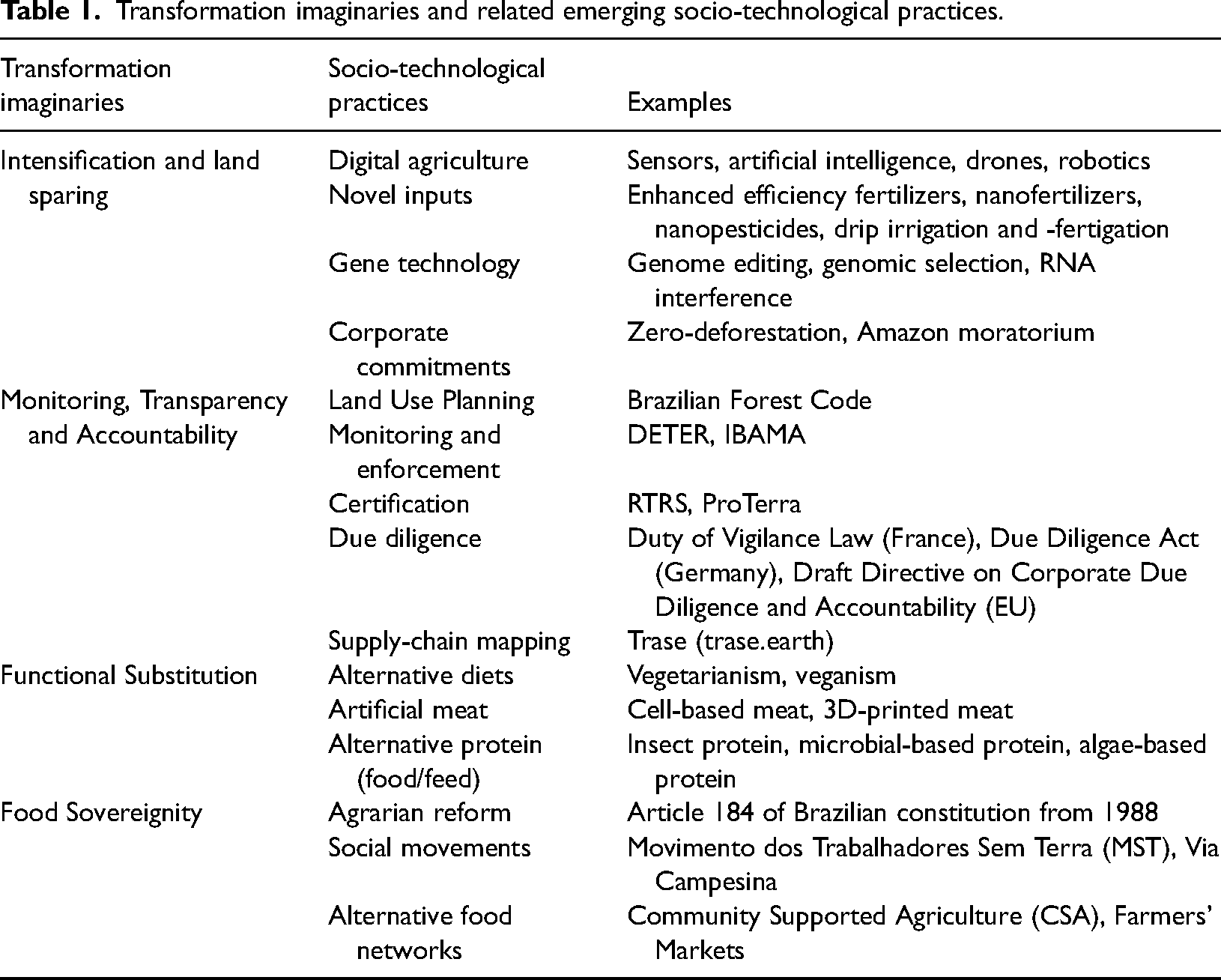
Intensification and land-sparing strategies define socio-ecological problems in the GSC as outcomes of inefficient land use practices and resulting yield gaps, which put unnecessary pressure on marginal cropland. Envisaged solutions involve rational cost-reducing and market-based practices that adopt state-of-the-art agricultural production methods to increase yields and thereby prevent further conversion of native vegetation and displacement of local communities. Emphasis is placed on win-win solutions, whereby corporate actors can commit to zero-deforestation pledges while still expanding their business. Emerging socio-technical practices that promise to increase yields include digital (precision) agriculture, novel farming inputs, and state-of-the-art gene technology.
The 2006 Amazon Soybean Moratorium as a commodity- and biome-specific zero-deforestation pledge by industry actors has often been described as a success (Heilmayr et al., 2020). In 2014, the New York Declaration on Forests included the key goal of eliminating deforestation from agricultural supply chains. Unilateral zero-deforestation commitments by private companies have been on the rise (Lambin et al., 2018) and the European Commission has recently agreed on a deforestation-free regulation. While absent from most governance interventions in the soy sector, China has also signaled its willingness to address sustainability in its supply chains and boost domestic soy production (Wilkinson et al., 2022). The current Brazilian government has signaled the intention to pursue a zero-deforestation policy and the belief that this does not stand in the way of boosting agricultural output. However, there has been a long-standing debate about potential leakage effects concerning deforestation being displaced to other biomes (Moffette and Gibbs, 2021; Villoria et al., 2022). More generally, the prospects of intensification-induced land sparing are uncertain in the presence of rebound-effects and appear to vary substantially between different crops (García et al., 2020).
Monitoring, Transparency, and Accountability strategies see the main problems with the GSC as resulting from a lack of transparency, enforcement, or accountability. From this perspective, compliance with rules defined through land use planning, industry standards, international treaties, or general constitutional or universal rights needs to be monitored and enforced. Further, independent certification agencies can evaluate compliance with industry standards or certification requirements, and supply-chain mapping data tools can provide transparency to the public or corporate actors. Due diligence legislation in importing regions can enforce compliance with social and environmental norms through global value chains including suppliers.
Many legislative instruments for land-use planning are in place, such as the Brazilian Forest Code, which obliges landowners to converse parts of their property in native vegetation. There are monitoring and enforcement mechanisms, such as the real-time satellite observation system DETER and the Brazilian Environmental Ministry's executive organ, IBAMA. Further, the soy sector has several certification schemes, most notably that of the Roundtable of Responsible Soy (RTRS). In recent years, several European countries have introduced due diligence legislation (Gustafsson et al., 2022) and the proposed EU Corporate Sustainability Due Diligence Directive (European Commission, 2022) is expected to be voted on in 2023.
Concerning national legal frameworks, Reis et al. (2021) argue that existing legislation in Brazil has not been stringent enough to effectively prevent deforestation and has been subject to modifications pushed for by landowners and various administrations, which have legalized previously illegally deforested parcels. Schilling-Vacaflor et al. (2021) find that existing certification and auditing under the RTRS are aligned with industry interests and do not effectively protect the rights of local communities. Further, existing due-diligence measures still face significant challenges with monitoring and sanctions of non-compliance, and litigation is overshadowed by highly asymmetrical power-relations in the production of knowledge concerning the evidence for impacts (Schilling-Vacaflor, 2021).
Functional substitution strategies connect the problem to the current primary socio-metabolic function of soybeans as feed within provisioning systems of meat. This constitutes an inefficient pathway for dietary protein with large environmental footprints and numerous other impacts associated with the livestock industry. Alternative plant-based diets have been proposed and are finding growing adherence in certain countries. Further, emerging technologies aim to develop meat substitutes that closely resemble its characteristics, such as cell-cultured or 3D-printed meat. Other protein sources, which have been proposed to either replace meat in human diets or replace soybean cake as feed, include insect, microbial, or algae-based protein. Some of these approaches would completely substitute new protein sources for the existing uses of soybean cake. In contrast, others may employ soybeans or soybean cake in other, more efficient pathways to yield dietary protein. For example, plant-based diets may include traditional soybean products and cell-based meat may use textured soy protein in scaffolds, which provide nutritional value and structural support for growing cells (Ben-Arye et al., 2020).
There is some evidence for changing practices. Levels of meat consumption have stagnated and even declined in several industrial core countries in what has been termed a “second nutrition transition” (Vranken et al., 2014). In 2021, the EU partially repealed the ban on meat and bone meal in animal feeds, citing “the need to reduce the Union dependence on third countries for its protein supply” (Regulation 2021/1372, 2021: 2). The Chinese central government has expressed the aim to reduce meat consumption within China (Wilkinson et al., 2022). Further, meat analogs appear to be gaining popularity in Western countries (Boukid, 2021).
However, this market still faces issues with consumer acceptability (Anusha Siddiqui et al., 2022). Moreover, after initial publicly funded research, socio-technological innovations related to alternative meat are now largely funded by corporate actors (Dolgin, 2020). New products at the development stage are often marketed as completely “de-materialized”, but their actual resource footprints or processing pathways are obfuscated through patents and trade secrets (Guthman and Biltekoff, 2021). Further, different protein sources have been envisioned and marketed as meat alternatives in the past and have met resistance from vested interest. In the late 1980s, Goodman et al. (1987: 141) described how actors with large stakes in the industrial grain-oilseed-livestock complex moved to prevent the broader adoption of single-cell proteins.
Food Sovereignty approaches trace the problem to the current social organization of food systems, characterized by increasing commodification, financialization, and corporate control in the form of modern agribusiness. This perspective demands a rights-based approach to food in which communities determine their own agricultural practices and food systems and emphasizes the role of peasant and family farmers (Wittman, 2011). Advocates demand agrarian reform, which would redistribute control over land, water, and rural biodiversity. Further, alternative food networks are proposed as parallel niche practices to existing corporate structures, promising to re-embed food systems by strengthening family farmers and their direct links to consumers (Matacena, 2016).
In Brazil, as in most of Latin America, agrarian reform has a long history and while article 184 of the Brazilian constitution from 1988 prescribes a social function for land ownership, which signifies an obligation to use it in ways that contribute to the collective or common good, this and other existing examples remain ambivalent and are hardly enforced. The Movimento dos Trabalhadores Sem Terra (MST) has occupied unproductive land to enact this constitutional social function and to provide access to land for impoverished communities (Diniz and Gilbert, 2013; Wolford, 2003). Peasant and indigenous movements have strongly articulated their opposition to industry-led initiatives, such as the RTRS, and organized bottom-up counter-gatherings under the slogan “No Sustainable Soy”, a process that achieved important changes in Paraguay's agrarian politics (García-López and Arizpe, 2010). In Argentina, the “Madres de Ituzaingó” organized against pesticide-induced illnesses through large-scale fumigations, initiating a trial that eventually sentenced a soy producer and a spraying pilot to prison (Arancibia, 2016). Further, the Movimiento Nacional Campesino Indígena (MNCI) drafted a bill against forced evictions in the countryside and pushed the government to create a new position for family farming in the Argentinian Ministry of Agriculture (Motta, 2017).
Local traditional and indigenous communities clearly have not been passive observers, but have organized to gain concessions and influence practices in the GSC. However, they have often been sidelined by the strong political influence of agribusiness and landowner lobbies (Milmanda, 2023) and by a long history of attempts to criminalize their movements, particularly under authoritarian administrations (Toledo et al., 2021). Further, Motta (2017) points to processes of demobilization resulting from a perceived alliance with left-leaning administrations, which eventually gave up on their promises of land reform and continued to pursue export-led agrarian development to secure political partners and finance their strong welfare programs.
Finally, while Brazil, the US and Argentina still dominate production by large margins (in sum over 75% of global output), in the past decades the soybean industry has also become increasingly important in Southern Asia, Eastern Europe and Southern Africa. In some cases this is related to niche markets corresponding to preferences resulting from perceived problems with soybean production in the Southern Cone. For example, the sector in India, now the world's fifth largest soybean producer (FAO, 2020), has marketed its output to a growing non-GM market in Asia and has faced its own set of socio-ecological conflicts (Kumar, 2022).
Outlook: lessons learned from regime shifts in the GSC
The preceding overview reveals drivers of regime shifts as well as long-lasting legacies, which have shaped the current role of the GSC in various provisioning systems and associated socio-technical practices. While it could be argued that the inherent properties of the soybean would have inevitably resulted in its ascendance to a major global commodity, we have shown that this process was by no means natural or self-evident. Technological innovations opened the doors to new potential applications and socio-metabolic pathways for soybeans. Yet, these innovations did not bring about change by themselves and did not occur in a vacuum. We have traced how regime shifts have depended on external landscape developments (e.g., imperialist interventions in Northeastern China, the Latin-American debt crisis, or the collapse of Peruvian anchovy fisheries) and significant public investment (e.g., botanical expeditions, plant breeding, and other agronomic research, infrastructure, price support, subsidized credit). These historically specific conjectures have configured the GSC in relation to distinct socio-ecological fixes for capital accumulation over time.
The present regime owes its configuration mainly to the legacy of overcoming postwar surplus production by adding value to grains in animal bodies, using metabolic losses to create scarcity. Corporate actors who rose to dominance through consolidation in the postwar period still control large shares of inputs, logistics, processing, trade, and finance today and have expanded throughout all major producing and importing countries. This postwar fix laid the foundation for the current moment of crisis and the different emerging practices and imaginaries of transition. Not coincidently, Da Silva and De Majo (2021) explore the expanding GSC as the “Soyacene” alluding to the notion of a Great Acceleration, which typically refers to drastic anthropogenic global change since the postwar period, and ask: “has the Soyacene constructed new animal breeds, influencing human-animal relations?” (Da Silva and De Majo, 2021: 349).
Our approach provides land system science with a new lens for understanding land-use change and evaluating its implications in terms of desired societal transformations toward sustainability (Nielsen et al., 2019). Firstly, instead of focusing on particular impacts of soybean expansion resulting from a given external demand structure, our work turns this relation on its head. Our perspective understands consumption patterns as influenced by how land and other resources have been metabolized through soybeans as an intermediate commodity to sustain capital accumulation. When looking at provisioning systems of meat (or dietary protein in general), this perspective is supported by heterodox analyses that identify the political economy of agricultural production as the key driver for “meatification” (Weis, 2013a, 2013b), along with cultural signifiers, growing affluence, and urbanization processes (Hansen, 2018). In other words, in the postwar period, specific provisioning systems became “addicted” to soybeans, just as the larger economy did to oil (Huber, 2013).
Secondly, this study positions deforestation as one among several interrelated outcomes of the evolving GSC. How land is embedded in the global capitalist economy via soybean derivatives gives rise to various socio-ecological issues. In this sense, deforestation represents a type of “formal subsumption” (Boyd and Prudham, 2017), or an extensive strategy of appropriating nature (Werner, 2022) through soybeans as an intermediary commodity. Combating deforestation in isolation through land-sparing measures does not only leave other issues unaddressed but may even exacerbate them through intensification strategies, for example by further concentrating land ownership at the expense of family farmers or exposing communities to increasing loads of hazardous pesticides (Thaler, 2017; Arancibia et al., 2020). Further, the current configuration of the GSC is implicit in a myriad of other issues, from the contamination of water resources by animal wastes (Schneider, 2017) to the exploitation of marginalized workers in meat processing.
Thirdly, our historical account of socioecological fixes shows how transforming a given socio-metabolic aspect of provisioning systems can render previous functions of soybean-derivatives completely irrelevant over time. For example, since the widespread adoption of synthetic nitrogen fertilizers, soybean cake has played no significant role as an input to soil management (Lander and DuBois, 2022). Hence, the transformation of socio-technological practices in different provisioning systems has the potential to lead to major shifts in the GSC. Technological innovation is only one factor in such a change. The Chemurgists’ dream of a bioeconomy and the early experiments with transesterification for biofuels were delayed for almost a century due to the dominance of cheap oil and the petrochemical industry. Likewise, the sunk costs in current technological infrastructures will make dominant actors resistant to any radical changes in the socio-metabolic function, as “fixed capital assets play a crucial role in locking-in specific forms of provisioning” (Schaffartzik et al., 2021: 1411).
This directly leads to a fourth observation. At critical points, the regime changes described above relied on major public interventions in the form of botanical expeditions, plant breeding, infrastructure, price support, or subsidized credit. Roth (2018: 149) recounts how the successful marketing of soybean cooking oil in the US relied on publicly funded research and even industrial espionage, to improve its palatability. What role public institutions will play in sustainability transitions remains to be seen. Currently, interventions seem mainly limited to providing incentives or obligations for corporate actors to eliminate specific problems (e.g., deforestation) from their supply chains.
Finally, when expanding soybean production is simply attributed to population growth, rising affluence, or increased demand for animal products, this reinforces a narrative of soybeans feeding the world. Certainly, there have been critical nutritional benefits from increased intake of animal products in many regions. However, these concerns have not been the main driver behind soybean expansion, nor are provisioning systems characterized by the grain-oilseed-livestock complex the only possible pathway for such benefits. Currently, soybeans flow around rather than into most regions with higher risks of protein or micronutrient deficiencies, which typically have not experienced a Livestock Revolution (e.g., South Asia, East, and Southern Africa) (Pica-Ciamarra and Otte, 2011). Further, as Wilkinson et al. (2022) argue, projections of soybean demand tend to neglect the possibility of radical shifts in provisioning systems in the mid to long term.
Conclusions
Socio-ecological impacts of soybean expansion are often conceptualized as driven by external demand structures and considered isolated from broader provisioning systems and their social and historical embeddedness. This snapshot-like representation is linked to the reliance on neoclassical economic theory in land system science and related disciplines. Here, we followed the historical evolution of the GSC to problematize such narrow representation, focusing on how through soybeans, land has been metabolized according to accumulation strategies and inserted into different provisioning systems, providing successive socio-ecological fixes in moments of crisis. Transformations have happened in the context of broader landscape developments and socio-technological innovations, often catalyzed by public interventions. The current regime is primarily shaped by a specific accumulation strategy characterized by its dependence on industrial animal farming to add value to surplus grains and oilseeds.
Today, the widespread concern over socio-ecological impacts associated with the GSC has led to various prospective socio-technological interventions promising sustainability transitions on the horizon. How soybeans and other commodities are embedded in different provisioning systems may radically shift along with associated socio-ecological outcomes. The nature of such transitions will depend on the struggles between dominant vested interests, different niche practices, and the role of public institutions. Land system science can and should play a role in untangling these dynamics and informing much-needed public debate.
Highlights
Land System Science usually ignores historical and social embeddedness of economic processes
We trace the evolution of the global soybean complex analyzing external developments, socio-ecological fixes, and socio-technological practices
Defining properties are inherited, particularly the postwar strategy of using industrial animal farming to add value to surplus agricultural production
Future transitions will depend on public interventions and the influence of vested interest in current socio-metabolic patterns
Footnotes
Funding
The authors disclosed receipt of the following financial support for the research, authorship, and/or publication of this article: This work was supported by the HORIZON EUROPE Marie Sklodowska-Curie Actions [grant numbers 801370, 765408] and the María de Maetzu Programme for Units of Excellence of the Spanish Ministry of Science and Innovation [grant number CEX2019-000940-M].
