




Abstract
This paper examines how global climate mitigation policies articulate with urban political–ecological transformations. It focuses on South African waste-to-value projects as case studies, exploring how local processes of urban ecological modernization combine with global climate finance through the now largely defunct Clean Development Mechanism (CDM). Whilst it is generally recognized that waste-related CDM projects in South Africa (and elsewhere) have been an unmitigated failure in terms of climate and socio-economic benefits, we demonstrate that landfill-to-gas/energy projects have functioned effectively as geographical–discursive dispositifs through which particular knowledge systems are enrolled, specific ‘solutions’ are projected, and singular imaginaries of what is possible and desirable foregrounded, thereby crowding out alternative possibilities. This not only nurtures the commodification and marketization of non-human matter with an eye towards sustaining capital accumulation but, rather more importantly, successfully installs state-orchestrated private property relations around common resources, thereby deepening the dispossessing socio-ecological relations upon which expanded capitalist reproduction rests. We argue that whilst the formal outcome of the CDM is a failure, its success resides precisely in how it permitted local and global elites to create administrative and regulatory practices that solidify and naturalize a neoliberal market-based framework to approach the climate crisis.
Keywords
Offsetting is worse than doing nothing. It is without scientific legitimacy, is dangerously misleading and almost certainly contributes to a net increase in the absolute rate of global emissions growth. (Kevin Anderson (2012: 7), Climate Scientist)
Introduction
This paper examines the articulation between urban political–ecological transformations on the one hand and processes of global climate mitigation on the other. More specifically, we use South African waste-to-value projects as case studies of how local processes of urban ecological modernization combine with global climate finance through the now largely defunct Clean Development Mechanism (CDM). The CDM was gradually wound down from 2013 to be replaced by a new mechanism, provisionally identified as the Sustainable Development Mechanism (SDM). This was tentatively agreed at the 2015 Paris COP21 meeting (Article 6) and refined at the 2021 Glasgow COP26. It is imperative, therefore, to assess critically the ‘effectiveness’ of the CDM as it operated between 2005 and its formal ending in 2020. 1 The newly proposed SDM, which will also aim to transfer funds from the Global North to the Global South whilst addressing the climate crisis and sustainable development, will further deepen the process of financializing the atmosphere on the foundation of the largely failed CDM experience. Our focus is on exploring, through specific case studies, the antinomies of climate-related projects and on examining the implications and contradictions of the current climate mitigation architecture.
Whilst it is generally recognized that waste-related CDM projects in South Africa (and elsewhere) have been an unmitigated failure in terms of climate and economic benefits (see Lane and Newell, 2016; Pearse and Böhm, 2014; Watt, 2021), we demonstrate that landfill-to-gas/energy projects have functioned effectively as geographical–discursive dispositifs through which particular knowledge systems are enrolled, specific solutions are projected, and singular imaginaries of what is possible and desirable foregrounded, thereby crowding out alternative possibilities. Our paper re-enforces what Sarah Bracking (2015a), following Ferguson (1994), called the ‘antipolitics of climate finance’ where increasing bureaucratic complexity is a political strategy deployed in negotiations over foundational dialectic contradictions derived from capitalist accumulation, which act to conceal politics by depoliticising the process and rendering it technical. (Bracking, 2015a: 297–298)
We argue that whilst the formal outcome of the CDM was a failure, its success resided precisely in the process by which local and global elites invented a complex set of administrative and regulatory practices and technological devices that obscured underlying problems and dynamics whilst nurturing further processes of enclosure, privatization, and market-based approaches to mitigate the climate crisis. This CDM-assemblage of technologies, administrative procedures, regulations, committees, meetings, consultants, and reports continues to enrol and create certain knowledges, logics and approaches articulated around legitimizing and naturalizing a commoditizing neoliberal market-based approach to address the global climate crisis, whilst obscuring the fundamental transformation in socio-ecological relations that accompany its implementation. The CDM spurred a new global industry of consultants and a new architecture of climate finance, which regardless of the ‘failure’ in climate mitigation terms persists after the collapse of the CDM and is ready for its enrolling in new and deepening trajectories of dispossession, nature commodification and ecological modernization – now in the guise of the SDM. Whilst CDM appears as a failure (in both economic accumulation and climate mitigation terms), it is an unmitigated success in sustaining and deepening a particular ideological vision of how to tackle the climate conundrum at the exclusion of others (see also Bigger and Millington, 2020; Christophers, 2018; Newell and Bumpus, 2012; Silver, 2015).
This paper will take the chequered history of urban landfill CDM projects in South Africa from 2006 to 2018 as the empirical entry point to unfold the antinomies that pertain to carbon offsetting as originally conceived by the Kyoto Protocol. It will furthermore analyse the attempts to institutionalize the process in ways that would allegedly benefit Non-Annex 1 countries. 2 The paper considers all South African landfill CDM projects that were submitted to and approved by the United Nations Framework Convention on Climate Change (UNFCCC), as of 2018. 3 Data collection included company reports, news outlets, and interviews in 2017 and 2018 with key project managers, financial investors, consultants, and experts, combined with quantitative analysis of the exhaustive UNFCCC database of CDM projects (see Tables 1 and 2).
Overview of all actual and potential South African CDM waste-to-energy projects identified in the national database of the Designated National Authority (DNA), 2018.
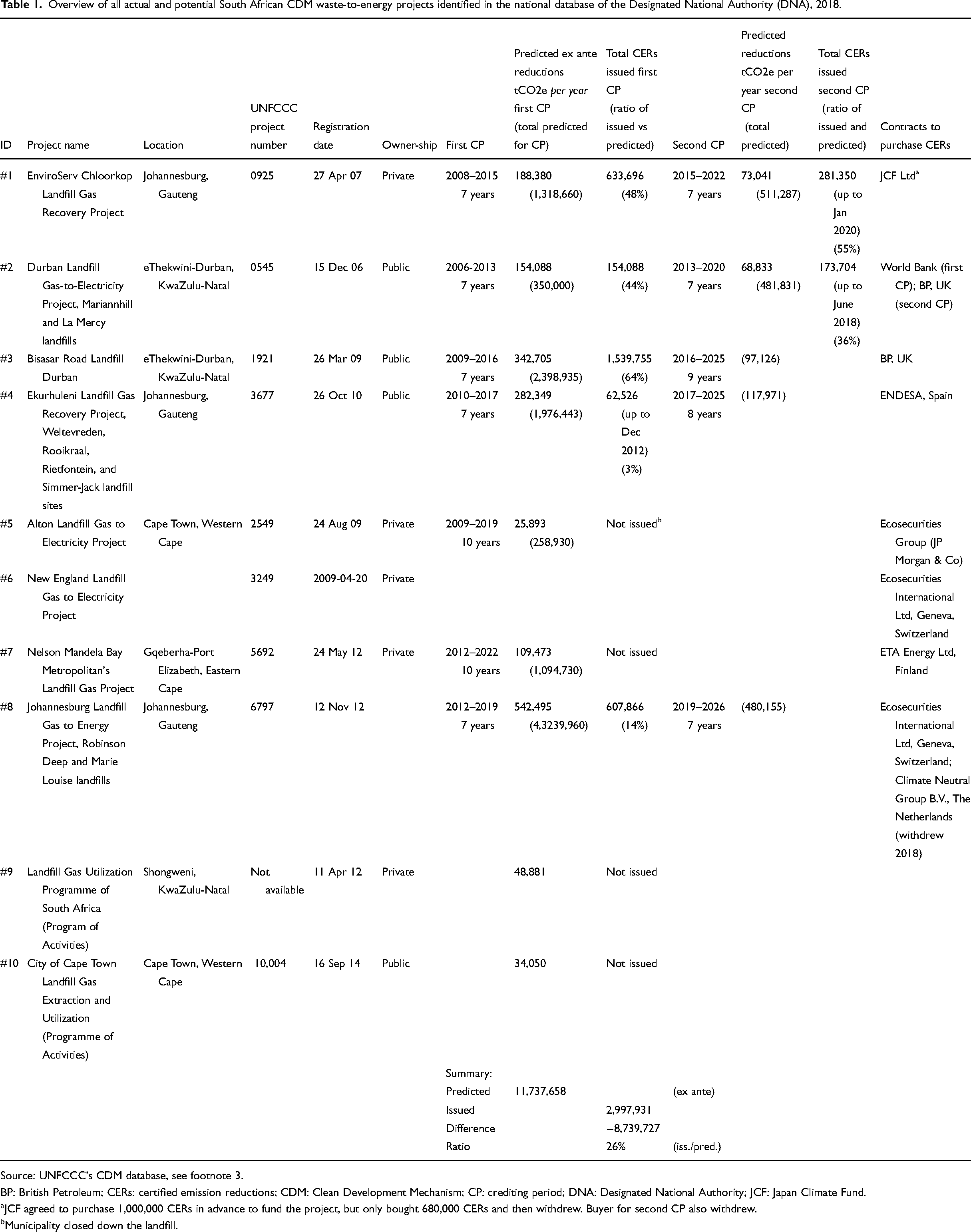
Source: UNFCCC's CDM database, see footnote 3.
BP: British Petroleum; CERs: certified emission reductions; CDM: Clean Development Mechanism; CP: crediting period; DNA: Designated National Authority; JCF: Japan Climate Fund.
JCF agreed to purchase 1,000,000 CERs in advance to fund the project, but only bought 680,000 CERs and then withdrew. Buyer for second CP also withdrew.
Municipality closed down the landfill.
List of interviews.
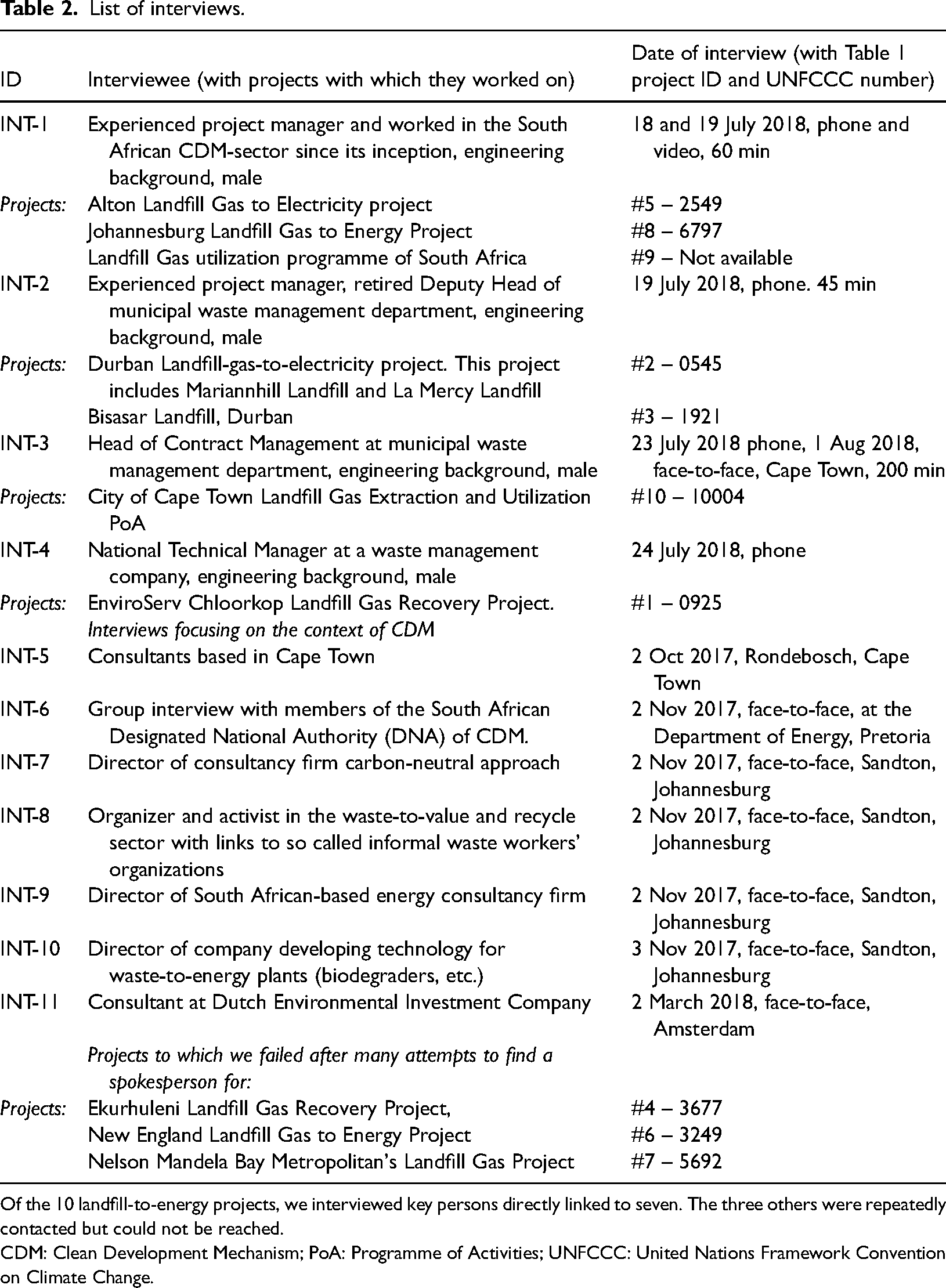
Of the 10 landfill-to-energy projects, we interviewed key persons directly linked to seven. The three others were repeatedly contacted but could not be reached.
CDM: Clean Development Mechanism; PoA: Programme of Activities; UNFCCC: United Nations Framework Convention on Climate Change.
The argument of this paper is situated within the twin terrains of the critical analysis of commodifying nature as a climate mitigation policy on the one hand and of eco-modernizing urban governance strategies on the other. Whilst it is now generally accepted that neoliberalizing nature has been a failure, the process nonetheless deepens further as new instruments are implemented. This has been particularly well theorized and substantiated in research on commodifying biodiversity preservation. Following Jamie Peck's notion of Failing Forward to account for deepening processes of urban neoliberalization (Peck, 2010), Robert Fletcher has demonstrated how neoliberal conservation instruments have systematically failed, yet this has not stopped further deepening and widening the use of market-based instruments (Fletcher, 2023). Several other comprehensive studies (Apostolopoulou et al., 2021; Büscher et al., 2014) have confirmed this view. Nonetheless, there are relatively few in-depth and empirically substantiated analyses of the CDM as climate mitigation and its ‘successful’ failure. This paper demonstrates that the hidden reality of the CDM narrative resides not only in nurturing the commodification and marketization of non-human matter with an eye towards sustaining capital accumulation but, rather more importantly, in silencing how the urban/carbon nexus successfully installs state-orchestrated private property relations around common resources, thereby deepening the dispossessing socio-ecological relations upon which expanded capitalist reproduction rests. Moreover, this paper seeks to articulate urban practices focused on neoliberal eco-modernization (see, e.g., Krueger et al., 2019; Rosol et al., 2017) on the one hand and the financial flows associated with global carbon offset schemes on the other. It is precisely through this intersectional analysis that the antinomies of neo-liberal climate instruments can be identified, its lure assessed, and is continuing deployment despite successive failures understood.
We examine the following propositions. First, the CDM was considered a vital ingredient for assuring the financial feasibility of eco-modernizing urban waste-to-flaring/energy projects. Without the CDM, these projects were deemed unviable financially. Nonetheless, despite the failure of CDM to provide significant financial input, most of the projects proceeded anyway, further securing state-orchestrated neoliberalizing urban eco-projects as a hegemonic strategy. Second, the CDM projects offered a road into the global financialization of waste projects, the enclosure of waste, and the insertion of waste into a new resource-accumulation nexus. Third, the creation of methane from landfill sites, a much more potent greenhouse gas than CO2, potentially offered significant carbon rents (Felli, 2014, 2021) and thus the assetization of greenhouse gases, comparable to rent extraction from other resources (see Andreucci et al., 2017). Fourth, whilst legitimized in terms of their socio-ecological benefits, CDM landfill projects and their socio-metabolic transformation of methane into CO2 (and energy) are predicated on enclosing the commons of waste and can undermine the livelihoods of vulnerable groups who depend on accessing, using, re-using, or recycling the commons of waste (Demaria and Schindler, 2016; Gidwani, 2013; Inverardi-Ferri, 2018; Samson, 2015). Whilst the fantasy that undergirded the CDM pointed out a a win–win situation (Watt, 2021), its most tangible success resides in establishing exclusive private property relations around common resources. Fifth, this process often fostered urban social conflict around the question of entitlements to waste and the livelihoods associated with it (Millington and Lawhon, 2019; Samson, 2020). Finally, despite the disintegration of the CDM carbon market in recent years, the commodification of landfills deepened, often through sustained public investment and significant public sector subsidies. In sum, the paper explores how CDM projects functioned as a Trojan Horse that sustained both the marketization of carbon and the consolidation of urban eco-modernizing governance regimes, whilst sustaining a fantasy of effective climate mitigation (Pohl and Swyngedouw, 2023).
Urban ecological modernization and global climate change instruments
Transforming urban socio-ecological processes is now considered central for nurturing sustainable urban practices and low-carbon transitions (Silver, 2015; Sippel and Michaelowa, 2013; World Bank, 2010a). Re-organizing urban infrastructure and the associated flows of materials is considered vital to secure liveable, environmentally sensible, and dynamic cities. Urban environmental boosterism has grown in parallel with institutions that facilitate a broadly market-conform, neoliberal, socio-economic logic (Davidson and Gleeson, 2015). Within this framework, urban waste has become an important quilting point in the process of transforming the urban socio-ecological imprint (Savini, 2019). As a 2010 UNEP report stated, ‘the waste sector is in a unique position to move from being a minor source of global emissions to becoming a major saver of emissions’ (United Nations Environment Programme, 2010). Waste provides a potentially significant entry point for climate mitigation at the urban scale. As Silver argues, ‘alongside the potentials bound up in capturing its material value (and in addressing under-funded waste system operations through new circulations of finance) it is likely that waste infrastructure will become a crucial site of urban carbon governance’ (Silver, 2017: 1481). Local authorities and entrepreneurial mayors look at climate projects to portray an image of ecological awareness whilst mobilizing investment and revenue generation to modernize urban infrastructure (Ernstson et al., 2021). Obed Mlaba, the former mayor of eThekwini-Durban, was early in expressing this view with respect to the World Bank-supported Durban Landfill Gas to Energy proposal: I think this is a first for the whole African continent, a project of this magnitude, dealing with waste. I think the example we are setting in Durban, working with the World Bank to deal with a landfill is a huge innovation—we are turning dirt and garbage into a raw material that we could grow wealth from. If you wanted to say to yourself, ‘we want to be the cleanest city in the world’, waste, in my view, is the best place to start. (Prototype Carbon Fund, 2004: 24)
The World Bank echoed this enthusiasm for waste-to-value investment, stating that ‘the proposed Durban Landfill Gas to Energy Project will contribute towards the city's sustainable waste management’ (World Bank, 2006: 2). Jointly implemented projects like this become nodes in forging urban socio-ecological ‘sustainability’ and are at times propelled to the international limelight through a global system of advertising, prizes, and showcase presentations: The landfill site [in eThekwini-Durban] has won numerous awards, including the Dubai International Award for Best Practices to Improve the Living Environment (2008); the Honorary Energy Globe Award for Sustainability (2009); and several conservancy and green energy awards in South Africa. In addition, the project made KPMG's list of ‘100 most innovative and inspiring urban infrastructure projects in the world.’ (World Bank, 2015: 1)
From its very inception, in the aftermath of the 1997 Kyoto Protocol, the advocates of the CDM portrayed the system as simultaneously generating financial flows to the developing world, mitigating climate gas emissions, and facilitating economic growth. The chequered history of CDM has been analysed critically, highlighting the complexity of its institutional arrangements, the pseudo-commodification of the atmosphere, and the speculative nature of turning non-human material like CO2 into financialized assets to be traded on an uncertain, volatile, and now basically defunct market (Bigger and Millington, 2020; Böhm et al., 2012; Newell and Bumpus, 2012; Paulsson, 2009). Nonetheless, despite these critical accounts of the CDM mechanism – and the fact that it has basically stopped performing since the price of the greenhouse gas credits (so-called certified emission reductions, CERs) collapsed after the 2008–2011 financial crisis – we maintain that the CDM nonetheless played a critical role in sustaining and nurturing the assetization (Swyngedouw and Ward, forthcoming) and financialization of nature and has helped to solidify urban eco-modernization policies.
Whilst waste has traditionally been understood as an economically and ecologically expensive externality, ecological modernization management is predicated upon turning ‘waste’ into an economically viable resource by transforming useless (and therefore value-less) waste into a resource to produce a marketable commodity (Ernstson et al., 2021; Millington and Lawhon, 2019; Savini, 2019). Landfill sites in which urban waste is accumulated are therefore among the pivotal terrains through which such combined endeavour can be achieved. The biochemical reaction on which this financialization hinges resides in the process whereby large landfill sites create anaerobic conditions which in turn generate methane gas, a highly potent greenhouse gas. If these methane gas emissions can be removed, or greatly reduced, then a financial flow can supposedly be created if a market value exists for reduced emissions. This logic was used in arguing for the waste-to-energy project in eThekwini-Durban, with a consultancy report in 2006 stating that ‘in excess of 25% of the City's greenhouse gas emissions [can] be attributed to landfill sites’ (Strachan et al., 2006: 8). More generally, early in the CDM design process, landfill gas projects were considered an easy option to obtain significant tradable carbon credits (Michaelowa et al., 2019: 8): From the outset of CDM projects, landfill gas projects may have been viewed as the most viable and easiest to implement, offering a perception of quick access to realizing emission reduction credits. An omnipresent description phrase to landfill gas CDM projects has been ‘low hanging fruit’. (Strachan et al., 2004a, 2004b)
Nonetheless, as Graham Erion (2006: 79) put it, ‘Low hanging fruit always rots first’. As landfills produce methane gas (CH4) – assessed by the UN framework as 23 times more potent than CO2 as a greenhouse gas – flaring methane or using it to generate electricity for sale offers particularly attractive possibilities for climate finance, provided the pricing of carbon-equivalent emissions is sufficiently high. As the executive of a green company put it with respect to the Durban Bisasar Road landfill site: At the Bisasar Road Landfill Site, methane gas emissions alone, at approximately 50% of LFG [Land Fill Gas] by volume, will amount to some 25,000 tons [of methane] per annum when active gas extraction is increased for proposed electricity generation demands. Methane presents a carbon gas emission that is twenty-one times more potent [amended to 23 times in 2007] than carbon dioxide in terms of its global warming potential… This factor of 21 is often referred to as the financial “Methane Kick” of a Landfill Gas based project as it is multiplied by the tons of methane emissions to provide equivalent carbon dioxide emissions (CO2eq). This project “kick” provides CDM project viability with landfill sites and is a prime reason why landfill gas utilisation projects have been referred to as the “Low Hanging Fruit” [of] CDM projects. (Strachan et al., 2006: 2)
Landfill gas-flaring projects, therefore, allegedly serve the twin purpose of implementing advanced urban ecologically modernizing infrastructure and mitigating climate change whilst permitting a new income stream to nurture further development.
The CDM: Trojan Horse of climate finance
Carbon offsetting has been welcomed as a cornerstone of the international community's attempts to curtail carbon emissions. Despite the misgivings of respected voices from the climate science community about the potentially perverse effects of offsetting initiatives (Anderson, 2012; see also McAfee, 2022), climate managers, institutions, and policymakers keep pressing ahead. Observers from the social sciences are equally sceptical, particularly with respect to measurement, reporting, and verification (Descheneau and Paterson, 2011; Hoag, 2011), including the administrative procedures, the lengthy bureaucratic trajectory, the low price of carbon credits, and the deepening commodification of the atmosphere (Bryant, 2018; Lohmann, 2010).
The CDM is fundamentally a market-based instrument to produce transferable permits to emit carbon equivalents in one place by saving or reducing carbon-equivalent emissions elsewhere (Felli, 2014). The scheme emerged as one of the flexibility mechanisms initiated after the Kyoto Protocol was agreed in 1997 with the aim to assist ‘sustainable’ technological transformation in Non-Annex 1 countries and became operational in 2008. Polluting companies in Annex I countries would buy the right to pollute by investing in CO2-reducing projects in Non-Annex I countries, supposedly transferring technology and finance from the Global North to the Global South. The crux of the mechanism resides in making a particular project financially feasible by pricing the carbon emissions that would be ‘avoided’ if the project was to be realized. This additionality clause was vital in passing the CDM and already hints at the underlying financializing motive that drove the CDM endeavour (Gillenwater and Seres, 2011).
The production of a tradable permit is a complex, time-consuming, expensive, and highly bureaucratic process that involves a wide range of actors, institutions, companies, expertise, and bureaucracies in many different places and operating at diverse geographical scales (Descheneau and Paterson, 2011). Apart from spreadsheets, reports, and algorithms for calculating credits, the list of actors involved is long, including local project developers, local governments, the Designated National Authority (DNA) at national level, the CDM Executive Board at the UN international level, consultancy companies (technical, legal, and accounting services), project operators, and engineering experts, alongside private and state funders (for a review, see Couth et al., 2011: 396). The entire process is geared towards the production of certificates that certify in a verifiable, reproducible, and accountable manner that a specific volume of greenhouse gasses was not emitted. These CERs – where 1 CER is 1 ton equivalent of CO2 that was not emitted – can then be traded either on an emission trading system or on the voluntary market at either a market price or an agreed upon price between seller and buyer. In purchasing permits, the buyer can emit a specified volume of greenhouse gases. After emission, the CER is ‘cancelled’. Taken together, then, the CDM is an institutional arrangement that produces a tradable permit to pollute.
The bureaucratic process is costly. For a project to go through a validation process, the cost varies between US$20,000 and US$30,000 (World Bank, 2010b). For the project or entity that applies, the outcome is also uncertain as the UNFCCC committee – which is the administrator of the global program – might eventually (after a costly validation process) reject the project as eligible under the CDM regulations or reject or amend the amount of CERs to be allocated (World Bank, 2010c). Regardless, however, the validation process generates all manner of business and profits for participating private actors including local and international consultancy firms and experts. This means that the price of the CERs must be sufficiently high to mitigate the significant risks and costs associated with initiating and following up the validation process.
Critics have argued that such financialized mechanisms facilitate the commodification of CO2, enclose and privatize the atmosphere (Bond and Dada, 2005), and permit forms of ‘accumulation by decarbonization’ (Bumpus and Liverman, 2008). However, as Felli (2014) has carefully argued, such permits are not a real commodity but rather a pseudo-commodity in the Polanyian sense, conceptually comparable to land, intellectual property rights, and indeed money itself. In contrast to real commodities that are the result of a production process to assemble something useful, pseudo-commodities are not. They are a particular asset class with a particular function around which private property relations are constituted (Polanyi, 1944). The use enshrined in the entitlement of these assets can be exchanged for money, which in turn permits financializing the asset class. The generated ‘rent’ from the asset is strictly parallel to land rent and comparable payments for the ‘right of use’ of someone else's property. Monetary value is inscribed in such fictitious commodity in the way that entitles the owner to compensation for surrendering it to someone else. It is subject to all manners of fluctuation, speculative movements, and changes with respect to state- or global governance-regulated supply and demand. Carbon credits, therefore, can be understood as potential forms of ‘accumulation by assetization’ (Swyngedouw and Ward, 2022), whereby the ‘permit’ does not relate to anything other than the constructed monetary value, relatively independent from the movements of greenhouse gas molecules (Lohmann, 2011; Wark, 2015). In a profound material sense, the circulation of carbon credits is strangely disconnected from the very physical–chemical process it portends to contribute to managing. It is one of the forms of accumulation by dispossession that David Harvey (2004) theorized, and it operates through the medium of a pseudo-commodity that itself is predicated on enclosing, privatizing (i.e. assigning property rights), and appropriating something as a good (or commodity) that under earlier legal–bureaucratic or governance regimes operated as a common. In the case under consideration, it is the commons of waste and landfills that form the substratum through which the CER entitlement is constituted. 4
The CDM carbon market started officially in 2008 and was structured in two commitment periods, 2008–2012 and 2013–2021. The CDM was set up as a flexible mechanism with the dual purpose to help host Non-Annex 1 countries to achieve their sustainable development objectives and to assist industrialized Annex 1 countries in achieving compliance with their emissions targets (Article 12.2 Kyoto Protocol; see Newell, 2012). Projects could start the registration process from 2002 onwards, and the first projects were officially registered by the UNFCCC in 2005 (Lecocq and Ambrosi, 2007) and in South Africa from 2006 (Table 1).
The extraordinary volatility of the carbon emissions market and the determining effects of the institutional–regulatory environment are illustrated by Figure 1. At its launch in January 2008, the price of a CER was 16.53 Euro/CER, to rise to its all-time high of 22.60 Euro/CER in July 2008. There was a real euphoria over the potential success of carbon markets. The price subsequently fell rapidly to 7.50 Euro/CER in the wake of the financial crisis in late 2008 to stabilize at an average of about 11 to 13 Euro/CER until 2011. 5 The period 2008–2011 has been described as the ‘gold rush’ phase of the CDM, but the system basically disintegrated after that (Michaelowa et al., 2019: 23). The price of CERs collapsed in December 2012 to less than 0.48 Euro/CER when the first commitment period was over and there was no arrangement in place to carry CERs over to other carbon credit markets such as European Union Allowances (EUAs, also shown in Figure 1). The price has remained extremely low ever since. At the end of 2018, CERs were traded at less than 30 Eurocents in the compliance market and about 3 Euro on the voluntary market (Fair Climate Fund, 2021). Over this time period and as of November 2021, a total of 8056 CDM projects were registered with the UNFCCC, out of which 3355 had received CERs with a total of over 2.1 billion CERs issued. 6 After an initial rush to have CDM projects registered, new applications dropped dramatically after 2013 to just a trickle of new projects registered (Figure 2; see also Michaelowa et al., 2019).
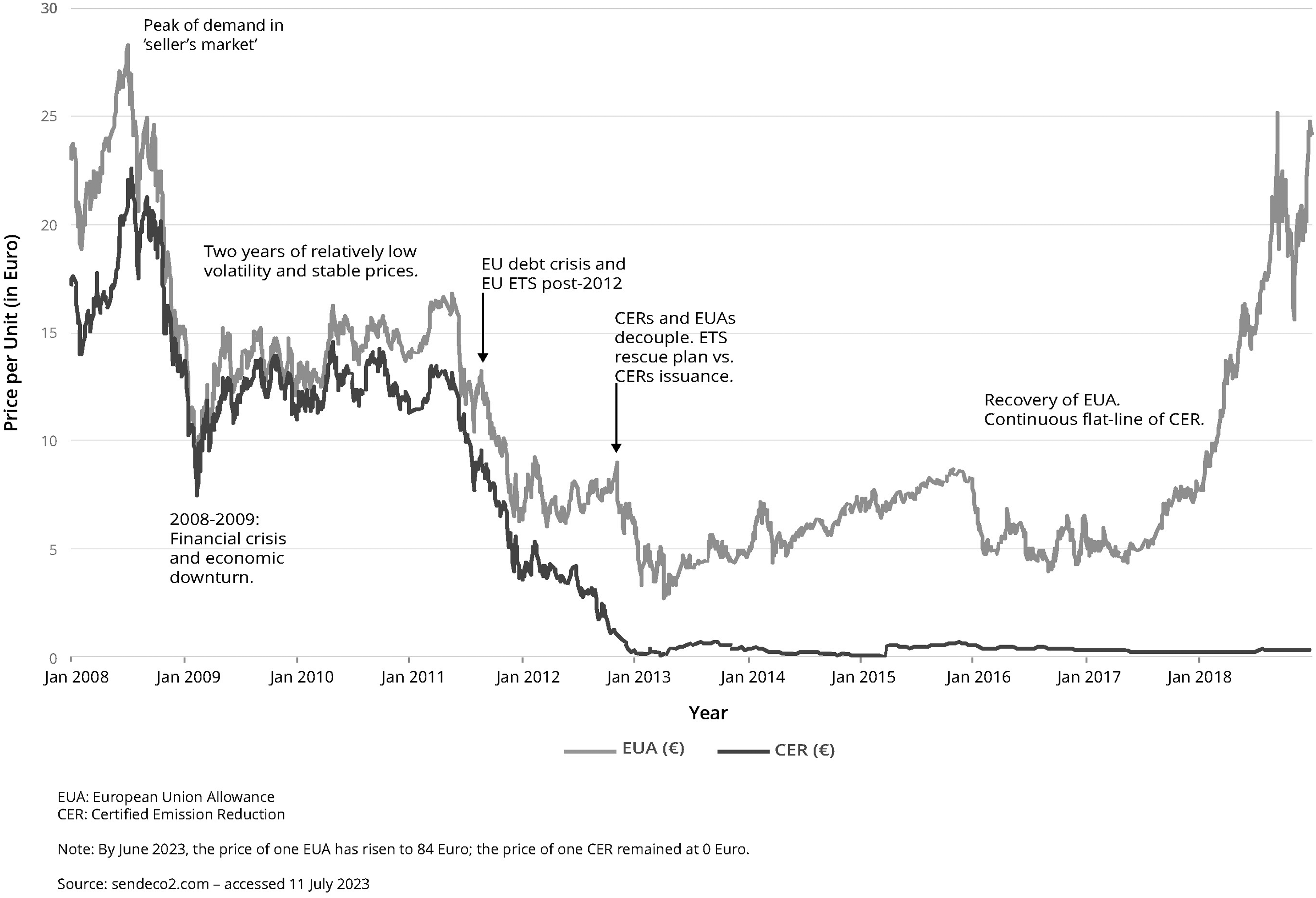
The price evolution of Certified Emission Reductions (CERs) and European Union Allowances (EUAs), 2008–2018. Source: SENDECO2, 2022. https://www.sendeco2.com/es/precios-co2.
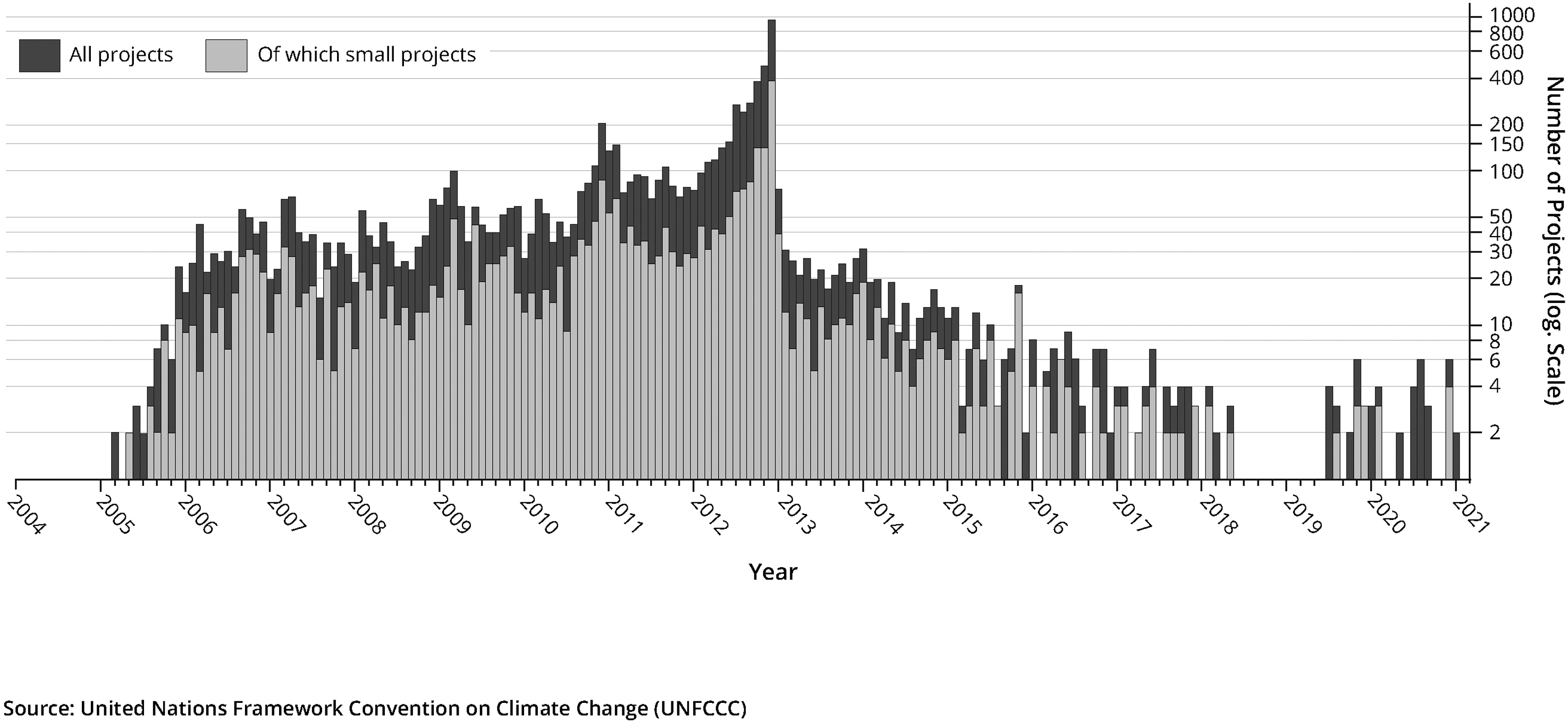
Projects registered and registering world-wide with the UNFCCC, 2004–2021. Source: UNFCCC, 2022.
It is difficult to obtain accurate data on how many CERs were actually traded and cancelled during this period. According to the UNFCCC, only 114.7 million CERs have been cancelled via the voluntary market by 28 February 2022, about 5% of all CERs issued. 7 A World Bank report stated that, by 2020, about 2002 MtCO2e were issued, and a total of 1192 MtCO2e or some 60% were retired or cancelled (World Bank, 2020). The discrepancy between CERs issued and bought is enormous (confirmed also by our research, see Table 1), leading to a situation whereby there was a significant over-supply of CERs in a very limited market. This problem was one of the key bottlenecks to be resolved at the 2021 Glasgow COP26 meeting. At the meeting, the successor system to the CDM – and the issue of remaining or still to be issued CERs under the ‘old’ CDM arrangement – was resolved in principle, but to date, no clear guidelines have been implemented (Depledge et al., 2022; Michaelowa et al., 2020). 8
The initial promise of climate credits to serve as a major source of finance disappeared quickly (Bracking, 2015a, 2015b). There is now also a general recognition that carbon offsetting is too limited in scale and scope to make a significant dent in the world's carbon economy (Pearse and Böhm, 2014; Watt, 2021). Nonetheless, there is a continued stubborn insistence on the beneficial prospects of market-based carbon offsetting. In addition, there is considerable uncertainty of the effects of offsetting on the local socio-ecological environment that generates carbon offsets. The expected positive effects in terms of technology-transfer, socio-ecological sustainability, and employment generation remain rather elusive too (Newell and Paterson, 2010). Nonetheless, the CDM framework was effectively used to legitimize the economic–financial feasibility of major urban ecological modernization projects. We shall now turn to considering in greater detail how landfill waste, through CDM finance, can be turned into capital.
Turning landfill waste into capital
Turning landfill waste into capital revolves around the production of the pseudo-commodity of CERs. This process permits the calculus of future earnings from a project, based on anticipated CER income. This, in turn, increases the financial viability of the project and makes investment feasible. The potential for generating capital both decreases carbon emissions and supports the profitability of the overall investment. The making of CERs depends of course on linking potential capital flows and landfill sites with material goods and technological infrastructure that connect the anaerobic environments of the landfill to capturing, measuring, and flaring methane.
The material enrolment of methane operates through the biochemical process of methane production in the deeper layers of anaerobic waste metabolism in landfills. Normally, at least a 5-metre-thick layer of general household waste is required for initializing anaerobic microbiological processes to produce methane (Themelis and Ulloa, 2007; also INT-4). The infrastructure to capture the gas consists of vertical and horizontal steel pipes, connected to valves, that are dug into the landfill site. They capture and collect the methane, which is led to the surface where it is burnt, i.e. ‘flared’. The system requires maintenance, in particular, as pipes can bend and break as the landfill subsides and compounds when gas is removed (INT-4). The flaring of the captured methane produces heat, water, and carbon dioxide. This heat can, in turn, power a turbine and produce electricity, which can be sold to an energy provider. As methane (CH4) is officially deemed 23 times more potent as a greenhouse gas than CO2, the flaring of methane reduces total carbon-equivalent emissions as the methane would otherwise slowly seep out of the landfill. As such, a ton of flared methane gas ‘avoids’ – in accounting terms – 22 tons of CO2, making landfill gas projects the ‘low hanging fruits’ in generating carbon credits.
Of course, projects for flaring waste gas or to produce energy also require enclosing and privatizing the commons of waste (Gidwani, 2013); this forms the material base that permits the institutional–regulatory construction of CERs as an asset. Socio-ecological conflicts can emerge as different social groups hold different claims to accumulated waste in landfills, both formally recognized and more informally appropriated entitlements. In particular, waste pickers in the Global South customarily eke out a marginal existence by sorting through and selectively appropriating discarded items for their own use, for resale, and/or recycling (Samson, 2008, 2010, 2015, 2017; Viljoen et al., 2016). These embodied and grounded practices to extract value from waste are blocked through enclosing and privatizing waste, often manifested by fences, walls, gates, and security guards around landfill sites that are turned into gated spaces with triaged access. The economic promises of waste-to-energy projects meet the value creation and employment already invested in the landfill. In such a context, the labour displacement threatens to spark off significant social unrest and mobilization (Bond and Sharife, 2012; Demaria and Schindler, 2016; Hartmann, 2018; Samson, 2015), a process that renders the production of CERs highly contentious.
Waste landfill-related CDM projects in South Africa
We examined 10 South African waste-flaring or waste-to-energy projects that were submitted for registration to the UNFCCC, with a particular focus on three emblematic cases that will be discussed in greater detail below. We obtained relevant documents from the UNFCCC, the South African DNA, and specific documents for each project. Of the 10 projects we identified in the UNFCCC database (Table 1), we interviewed key persons directly linked to seven projects (Table 2). Individuals linked to the three other projects were repeatedly contacted but did not respond. Another six interviews were made that explored the wider context of CDM in South Africa, and further interviews were conducted with environmental finance funds and carbon market experts. Information was verified across sources, and some interviewees were contacted again for follow-up questions. Two expert stakeholder workshops were held in 2018 in Cape Town and Johannesburg.
South Africa's landfill projects
Up to early 2017, there have been a total of 360 CDM projects submitted to the South African DNA, with the first project submitted on 10 March 2005 (SADNA, 2016). Of these, however, only 86 have effectively passed the first phase and been registered by the CDM Executive Board. Eventually, a meagre 12 have received CERs after verification and validation. The top year of 2012 counted 80 submitted projects, but the number of submissions has dropped considerably after 2013, coinciding with the rapid decline of the value of CERs.
Of the 10 identified waste projects, six were registered between late 2006 and early 2009 when CER prices were either over 15 EUR/CER and rising, or over 12 EUR/CER and returning from a low after the financial crisis of 2008/2009 (Projects 1–6, Table 1; Figure 1), three were registered in 2012 when CER-prices were in steady free fall and the European Trading System was preparing to decouple CER from its own EU-based trading scheme, with CER prices reaching lower than 0.10 EUR/CER in January 2013 (Figure 1). The last one, a Cape Town-based project (#10), was one of the few registered in late 2014 when CERs were basically worthless with no sign of recovery. Furthermore, one project has been rejected by UNFCCC (New England, #6), and one is not any longer operational as the municipality closed the site (Alton, #5; INT-1). Only two have successfully generated electricity (eThekwini Projects #2 and #3). Seven projects passed authorization, but for two of these (#9 and #10), no CERs were ultimately issued, primarily because the price of CERs had collapsed during their application period (INT-1 and INT-3). After this list of casualties and losses, it leaves a total of only five projects that went through a CER validation process during their first crediting period and obtained a verified amount of CERs: Chloorkop landfill site in Johannesburg (#1); the landfills in eThekwini-Durban, Marianhill, and LaMercy (#2), in Bisasar Road (#3), and in Ekurhuleni (#4); and the Alton project in Cape Town (#5) (see also Bhailall, 2015: 100). Only the first three projects renewed their application for a second crediting period. In total, some 3 million CERs were issued across the projects from the end of 2006 to the end of 2016. All projects that received CERs (except for EMM, #2) have been able to sell most of their CERs, but not always at the anticipated price. It proved surprisingly difficult to obtain the exact price of the sale of CERs. The interviewee from eThekwini-Durban, when asked for the CER price stated: ‘According to the contract with the World Bank and British Petroleum, I cannot disclose the price of the CERs’. It was also not possible to check the prices through the budget records of the municipality, since, as the interviewee said: ‘The project is not ring-fenced, so you won’t find anything there [in the budget] … You won’t find electricity sales nor CER sales’. Of note is also the big discrepancy between the ex ante anticipated emission savings and the actually certified amount (see Table 1). Of the almost 12 million CERs predicted (ex ante), which was factored into the economic feasibility of the project, only 3 million CERs (or 26%) were eventually issued.
The financial promises of CERs
Climate financing through CERs played a vital role in legitimizing the financial viability of waste-to-flaring/energy project. This holds true for all projects except for the Cape Town project registered in 2014 (#10), which we shall return to below. The CDM rules insisted on the additionality principle to approve a project (Shrestha and Timilsina, 2002). The project proposal had to demonstrate that the project would not be financially feasible without the CER financing. This conditionality, combined with assuring the economic viability of the project, nurtured a tendency among project proposers to inflate massively the anticipated greenhouse emission avoidance in the project formulation stage (Table 1). Whilst waste-to-electricity projects based their profitability calculus on the combination of methane burning and the sale of electricity, the economic feasibility of methane flaring depended exclusively on the income generated through CER carbon offsets. In sum, for six cases, the promise of being able to generate CERs and then trade them, with an anticipated price level commensurate with market conditions at the time of project preparation, was crucial for getting the projects off the ground: The sale of the CERs is often considered to be a critical part of the project design. Without the sale of the CERs the projects are often not economically viable for project developers. ‘You know it is not at all uncommon for a project to become viable and unviable several times while you’re going through the development stages just because of the carbon price changing’. (CDM Project Developer, cited in Varughese 2012: 27–28)
This was also confirmed by the project managers of both the Alton (#3) and Bisasar Road (#5) gas-to-electricity project: CERs were an absolutely crucial component of the financial decision. At this point the price of CERs was much higher, around 17–18 euro per tCO2e [CER]. (INT-1, #8)
Effectively, there is a shortfall to project viability of 100%. The injection of the carbon finance, derived from a CDM project undertaking, is essential to allow landfill gas utilization projects in South Africa to be viable. (Strachan et al., 2006: 8)
All other interviewees confirmed that the initial project financing plans included a significant input from climate finance. It is precisely these anticipated returns that provided the economic rationale for the projects’ implementation, whilst the socio-ecological benefits sustained the political rationale for supporting the project. The highly inflated ex ante calculations of anticipated CERs permitted the production of a rosy financial calculus of the project's economic viability and therefore assisted in shaping the discursive and material framing that supported the efforts to privatize, commodify, and enclose the commons of waste.
For the Cape Town project, which came on board after the CER prize drop in 2013, the financial calculus was local rather than international. Rather than pinning any financial decision on selling CERs, the interviewee (INT-3) brought up the still uncertain Paris Accord and the possibility of a South African national carbon tax or carbon offset in a not-too-distant future as part of the discussion leading up to the decision. The project was funded as a long-term, 20+ year, investment ‘within the City's longer-term environmental policy’. Whilst electricity sales are still difficult in South Africa, the project planned to sell methane gas (rather than flaring it). If any revenues would accrue from CERs, it ‘would be a bonus… [as a] cherry on top!’ (INT-3).
The internationalization of waste-to-value finance
The architecture of the CDM was built around the transfer of capital from the Global North to the Global South. Of the five projects that had CERs issued, they initially all entered Emission Reduction Purchase Agreements (ERPAs) with a variety of international financiers, weaving a network that moved from anaerobic methane production, enclosing landfill sites, socio-physical transformation of methane into water and CO2, and, in two cases, electricity and national and international climate institutions to investors elsewhere who agreed to purchase the CERs. For example, the Japanese Climate Fund (JCF) had committed to buy one million CERs in the first credit period from the Chloorkop project (eventually only circa 680,000 CERs were validated; see Table 1).
There is a range of potential buyers. They include ‘compliance buyers’ who seek to buy offsets for compliance or ‘sovereign buyers’ to meet their Kyoto obligations. In addition, various financial sector actors (traders, brokers, private and commercial banks, and investment funds) purchase CERs to speculate in the market and develop carbon asset portfolios. Buyers have different risk preferences and may be constrained by various rules and restrictions regarding both the CDM project type and its details. To facilitate financing and minimize risks, many projects sign ERPAs with buyers. This assures the CERs will be purchased (if and when they are assigned), usually at an agreed price. Of the five projects that eventually produced CERs, all had ERPAs in place at the beginning of the project. Nonetheless, the whole process would prove to be fraught with all manners of problems and difficulties.
For example, the Ekurhuleni project (#4) entered an ERPA with ENDESA, the Seville-based Spanish electricity utility, to purchase 800,000 CERs from 2008 to December 2012 (Ekurhuleni Metropolitan Municipality, 2011) at an agreed price of 10 Euro/CER. ENDESA entered the agreement to ensure its compliance with obligations set by EU's Emissions Trading Scheme. The project failed to deliver any CERs to ENDESA who served Ekurhuleni Municipal Management with a Default Notice for Delivery Failure in February 2012, and the ERPA was cancelled in June 2012 (Bhailall, 2015: 183). Only a total of 62,000 CERs have been verified and issued from the Ekurhuleni project thus far and are still awaiting a buyer. A new strategy was implemented to increase gas production on the site (Bhailall, 2015: 183) to maximize revenue as the initially expected CER revenue was not forthcoming, leaving the municipality to carry the shortfall. In 2015, the municipality published a public tender for the purchase of the unsold CERs. 9 This local–global methane finance nexus will be explored in greater detail by examining two cases in greater detail.
Two emblematic cases: Chloorkop and eThekwini's landfills
The Chloorkop methane-flaring project
EnviroServ, a private company within the energy, waste, and ‘green’ sector, owns and operates the Chloorkop landfill and gas-flaring facility (#1) located within the Ekurhuleni Metropolitan Municipality near Johannesburg. This is one of the first South African CDM-registered projects (2007) and generated the highest number of verified CERs, with 633,696 CERs issued between 2008 and 2015 and another 223,000 thus far during its second crediting period. Our interview (INT-4) with their National Technical Manager confirmed that the expected CER revenue was a key element in the project's finance plan. Even before the application for registration with UNFCCC, the Japan Carbon Fund signed an ERPA with EnviroServ to purchase CERs. The JCF, a subsidiary of a private sector carbon fund called Japan GHG Reduction Fund (JGRF) that actively sought out CDM projects to comply with Japan's obligation under the Kyoto Protocol, agreed, on 5 October 2005, to purchase one million carbon credits.
10
The contract stipulated that JCF ‘paid upfront’ to in effect finance the costly, uncertain, and cumbersome application and verification process (INT-4), which was successful and finally registered on 27 April 2007. Eventually, the project could not deliver the full million contracted CERs, but in 2015, JCF bought around 680,000 CERs at US$5.95/CER (or 4.34 EUR/CER), a total of almost 3 million Euros. Because of this agreement, the project broke even but made no profit. For the second crediting period, starting in early 2015, CER prices had reached rock bottom, and it seems EnviroServ only secured a contract with a UK-based company called ‘Reduce your Carbon’ because of the possibility, as speculated by the interviewee (INT-4), of a national carbon tax coming online. However, when the introduction of the tax was delayed, the company reneged on the contract and ‘disappeared’
11
: There was a contract [with Reduce Your Carbon], the exact details I am not aware of. I think they were meant to buy an option which they did not pay. The company then just seemed to disappear when we started chasing up on the payment. … I don’t think they [Reduce Your Carbon] exist anymore. I have a feeling they were buying carbon credit options in the hope that [the South African] Carbon Tax would come into effect. When that did not happen timeously, they could not buy the options. (INT-4)
Since then, no further verification of CERs has been undertaken. It was deemed too costly to go through the verification process at current CER prices.
The above traces the relation between producers and buyers of CERs in an ultimately failing market. However, shifting the gaze from carbon finance to the position of labour changes the reality on the ground. GroundWork, a nationally active environmental justice advocacy organization, estimated that 300 waste reclaimers active at the landfill had lost their means of income because of the project. And although an engineering consultancy firm had claimed before the implementation of the project that about 40 to 45 jobs would be created (GroundWork South Africa, 2013), the South African DNA asserted that only one permanent post was eventually created (SADNA, 2011: 28). Whilst the project initially delivered in generating some CERs, ‘avoiding’ or ‘sinking’ a fraction of global emissions of greenhouse gases, but failing to generate stable jobs, it could, from the viewpoint of enclosing and privatizing the common of waste, be viewed as a success.
The eThekwini's waste-to-energy projects
In 2002, Durban Solid Waste, eThekwini's waste management operation, initiated the first African waste-to-gas-to-electricity CDM project in three of the main landfills in the city of Durban, named Mariannhill and La Mercy (#2) and Bisasar Road (#3) (Couth et al., 2011; Gumbo, 2014; Pather-Elias et al., n.d.; Sustainable Energy Africa, 2017). The projects, in their initial phase, were considered to contribute significantly to the city's budget: The sale of CER credits is set to provide financial security for the Mariannhill and other landfill sites over the medium-term. This partial dependence on outside sources of financing both indicates the scarcity of municipal funding in the face of myriad demands on the available budget, and the change in the way waste is viewed—not as mere waste but as a source of income (Robinson and Strachan, 2007, cited in Garner, 2009: 45) … ‘They [the income sources] would gradually increase to constitute significant revenue for the eThekwini municipality through the offsetting of around 80,000 tonnes of carbon per year… (John Parkin, Durban Solid Waste (DSW), cited in Garner, 2009: 45)… Waste can be a resource and not just a costly liability. Recycling can cover all aspects of waste production and an excellent place to start is with projects to productively use methane gas from landfill sites to generate power’. (Robinson and Strachan, 2007, cited in Garner, 2009: 45)
In its original conception, ‘financial guarantees had to be in place to ensure that public money would not be put at risk and to do this the project had to be approved by the DNA as a valid carbon offset project to ensure that carbon credits could be accessed as a viable revenue stream’ (Pather-Elias et al., n.d.: 1). As Couth and colleagues attested, this was a necessary condition, but others were considered to: Following the origination of the idea for a landfill gas CDM project in 2002, a financial model to assess the viability of the project was prepared in 2003. This indicated a 4-year payback period. Whilst viability is fundamental to the delivery of such projects, all the three major strands of sustainability were considered by the eThekwini Municipality in the implementation of the Durban project: improving the environment locally and globally through the management of waste and landfill gas, providing social development through employment, and skills-transfer and economic return. (Couth et al., 2011: 393)
As John Parkin, the retired Deputy Head at Durban Solid Waste and main actor in the project stated (INT-2), ‘the possibility of earnings through CERs was crucial to the financial decision at the time of planning the project in 2003. However, when the carbon market crashed, this all changed’. The original model was based on a predicted generation of 3,800,000 tCO2e (700,000 tCO2e from Mariannhill and La Mercy (Component 1) and 3,100,000 tCO2e for the Bisasar Road project (Component 2)) at a price of US$3.95/CER (2.60 EUR/CER) over a maximum 21-year period and the generation of 8–10 MW of electricity for sale. It was agreed that $0.20 per ton must be credited to a social benefit (Strachan et al., 2004a: 8). The total project cost was estimated to be around US$10 million. As LJ Strachan, project manager at Durban Solid Waste, and colleagues insisted: ER [Emission Reduction] credits will make the utilisation of landfill viable, and successful development of this project should provide an internal rate of return in excess of 25% for the City… Financial projections for the delivery of 3.8 million tons of ER, indicate a total project cost of R150 million which is the summation of capital expenditure of R64 million and operating costs of R86 million. The anticipated revenue from the project is R205 million which is the summation of an ER sales to the PCF [Prototype Carbon Fund – see below] totalling R114 million and R91 million from the sale of electricity to the grid. This would realise a net profit to the City of R55 million over the expected agreement period of 12 years. However, the project may produce ongoing significant profits by way of the sale of Certified Emissions Reductions (CER) to other buyers on the world market. (Strachan et al., 2004a: 8)
It was anticipated that 55% of the investment cost would be recuperated from the sale of CERs (Rajaram et al., 2012: 293). The city was also to identify suitable community projects that were to be supported from the social benefit fund, which were intended to meet with the city's sustainable development criteria. Such financial modelling promised a significant profit for the city. This is also part of a strategy to nudge the municipality to go ahead: Because when you motivate the city, you say this will eventually be an income source and won’t be a drain…. We have 480,000 [CER] credits in the pipeline and issuances waiting for 65,000 [CERs]. (Parkin, cited in Sharife, 2012)
The World Bank's Prototype Carbon Fund (PCF) approached eThekwini municipality in 2002 with a US$15 million offer to participate in a local CDM waste-to-energy project (Prototype Carbon Fund, 2004; see also Erion, 2008). The PCF is a World Bank-operated public–private partnership aimed at assisting market initiation of CDM and joint implementation projects (Freestone, 2012). The PCF consists of 17 international private sector companies (from Belgium, Finland, Germany, Japan, the UK, Norway France, Japan, and the Netherlands) and six governments (Japan, the Netherlands, Sweden, Norway, Finland, and Canada) with a total capital of US$145 million (World Bank, 2010c). The PCF would invest in and secure CERs, which would be allocated to the partners in the PCF according to their share in the Fund. In 2003, eThekwini municipality signed a Memorandum of Understanding with the PCF. In June 2006, an ERPA was signed with the World Bank as the trustee for the PCF (Couth et al., 2011). The agreement involved the sale of a total of 3.8 million CERs for a value of US$15 million over 14 years (Lindow, 2008). The World Bank also insisted on the sustainability contribution: ‘The proposed Durban Landfill Gas to Energy Project will contribute towards the city's sustainable waste management’ (World Bank, 2006: 2). The PCF committed 2.77 million dollars by purchasing roughly 337,000 carbon credits from the project (World Bank, 2015). Component 1 was registered with the UNFCCC on 15 December 2006 and Component 2 on 26 March 2009.
When the construction of Component 1 was started around December 2005, the CER market price had risen to over US$8/CER. With no certainty over when Component 2 would start because of long procedural delays, and with potentially considerably higher CER prices available (than agreed in the ERPA), the PCF fund agreed that eThekwini could remove Component 2 from the Memorandum of Understanding in a bid to maximize the potential CER value of Component 2 to the Municipality, whilst also agreeing to a US$3.95/CER price (2.60 EUR/CER) for carbon credits issued from Component 1. Bond and Sharife (2012) argue that the World Bank backed off the project in 2005 in the face of mounting environmental justice activism against the dumpsite. Activists pushed to close the landfill for health and environmental reasons, whilst the waste-to-energy project required the landfill to remain open (Erion, 2008; Lang, 2021; Sharife and Bond, 2011).
In late 2006, the French Development Agency pledged long-term loans of $8 million to eThekwini-Durban's projects to be paid off with anticipated carbon credits 12 alongside $1.3 million extended by South Africa's Department of Trade and Industry (Bond and Sharife, 2012). In 2008, the World Bank was replaced by an investment company, Trading Emissions PLC (TEP) from the UK but registered on Isle of Man, which acquired the right to purchase one million emissions reduction credits. This company sought to invest in projects by concluding ERPAs with project developers. According to Newell and Paterson (2010: 131), ‘the investment companies do not need the CERs, they only try to make a profit by buying early and investing in a project's potential, and then selling the CERs at a higher price [and] they also lend money to projects and get paid back in CERs’. The ERPA had a time horizon until 2012. The firm's investment advisor Simon Shaw termed Bisasar and the other two landfills ‘an important project, it is operational, it has a long-term future, and we anticipate registration shortly. These credits will be a useful addition to our portfolio’ (cited in Bond and Sharife, 2012). TEP had at the time one of the largest CER portfolios in the world and increasing clout given the then upward trend in the CER market. Given these prices, the payback period was estimated to be 5 years (Pather-Elias et al., n.d.).
All this added substantial complexity and involved a large array of participants: external stakeholders including the national government (Department of Trade and Industry and the Department of Energy), financiers (World Bank PCF and the French Development Agency), environmental consultants, external auditors (emissions reduction certification), and the investment company. The project validation, registration, and CER verification process also turned out to be cumbersome, bureaucratic, and lengthy (Couth et al., 2011). In 2010, John Parkin still held that ‘[w]e borrowed R58 million to start this project. We will be able to pay off the debt in four years and after that it will be a massive profit for the city’ (IOL, 2010). However, the TEP trading company terminated the ERPA in September 2011 because ‘one of the conditions… had not been satisfied’ (Trading Emission PLC, 2011: 101) as they tried to liquidate their liabilities in a collapsing CER market, ‘due to the credits no longer being eligible for compliance in the EU Emissions Trading Scheme’ (Trading Emission PLC, 2011: 6). In an adverse environment, TEP continued to make major losses and the company stopped trading in 2018.
As of 2011, Durban's landfill projects had stopped earning any income through CERs, despite the major efforts and the shifting international financial architecture. In March 2012, eThekwini municipality published a noteworthy public tender for anybody to buy the CERs they had already verified: ‘Anyone interested in purchasing the credits can make an offer’ (see Figure 3). British Petroleum (BP) agreed to buy CERs from the Bisasar Landfill at an undisclosed price (through an ERPA). BP uses these credits to offset their own operational emissions growth turning some of their products ‘carbon neutral’ and trade with companies to meet their compliance and voluntary needs. 13 BP withdrew from the project in 2020.
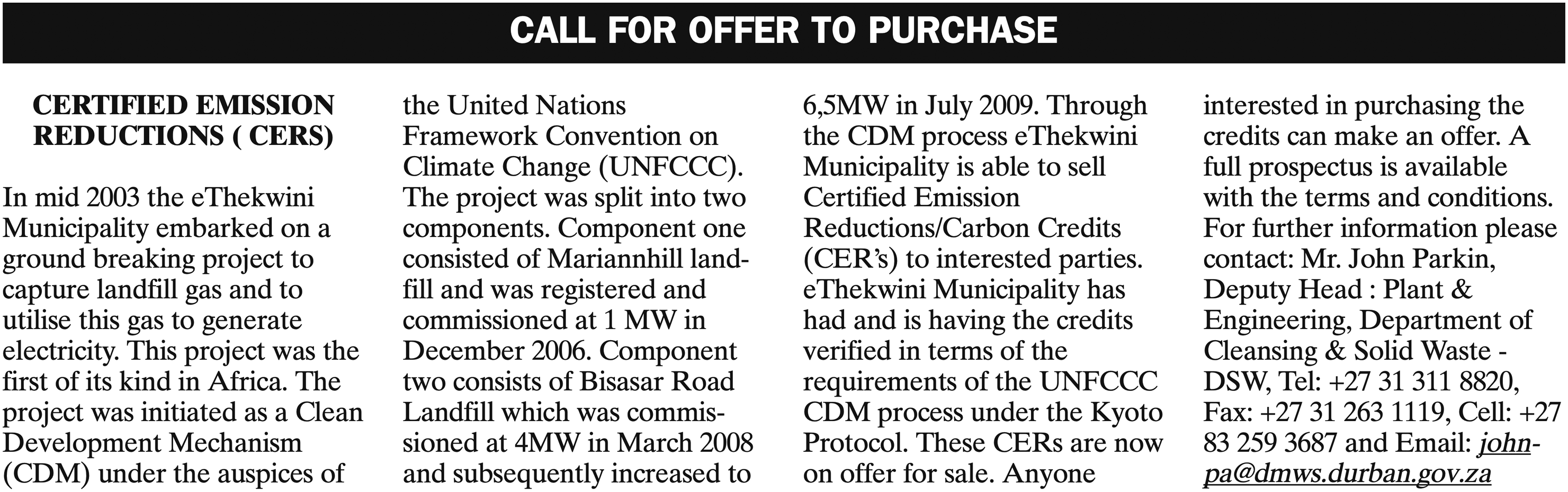
Call for offer to purchase Certified Emission Reductions (CERs) from eThekwini municipality generated from Mariannhill and Bisasar Road landfills (#2 and #3; eThekwini Municipality, 2010).
The original financial architecture subsequently collapsed completely, leaving the municipality to carry the bulk of the financial burden and with an uncertain financial future. Nonetheless, the project is up and running with a marginal climate mitigation effect, a continuous financial drain on eThekwini municipality, and lost hopes for new social investments but also with major consequences in terms of the urban socio-ecological trajectory that is now ‘locked in’.
Indeed, the Bisasar Road Landfill is still marred in controversy. Even though the ANC was committed to close the ‘racist’ dump, the site remained open, notwithstanding a very substantial pressure campaign, precisely because of its expected major source for profit through its waste-to-energy project (Bond and Sharife, 2012). Furthermore, throughout the 2000s, several dozens of nearby Kennedy Road shack dwellers picked rubbish and informally recycled; scores more shack dwellers informally picked materials from the dump until the municipality's Durban Solid Waste limited access (Bond and Sharife, 2012; see also Erion, 2006). Even as recently as August 2018, trucks were set alight, and two people were shot during protests outside the Bisasar Road landfill site after residents were chased from rummaging through refuse dumped at the site. 14 The waste-to-energy project has resulted in some limited job creation. According to one source, 109 temporary jobs were created during installation and 44 permanent ones (IOL, 2010); another source suggested that only 11 permanent staff and 250 temporary employment positions were created (Sangham, 2017: 144).
Conclusion: The success of a failure
This study investigated how urban ecological modernization projects articulate with landfill sites in South Africa that can be mobilized to extract methane gas to be flared and/or produce electricity and receive payments, potentially, through the CDM. The paper demonstrated how the CDM, examined through the lens of South Africa's CDM waste-to-value projects, functions as a geographical–discursive dispositifs that enrols particular knowledges, specific socio-technical solutions, and distinct socio-ecological imaginaries of what needs to be done. These projects nurture forms of urban ecological modernization and a ‘sustainability’ perspective focused on the dubious promises of market-based socio-technical investment. Despite its failure to curb carbon emissions and transfer climate finance from the Global North to the Global South, the CDM has been a success in terms of advancing, together with other initiatives, a neoliberalizing market-based approach to address the climate emergency, and in transforming socio-ecological relations around the privatization of waste. The enclosure of waste morphed, through particular socio-technical interventions, greenhouse gases into a pseudo-commodity, which, under the right institutional configurations, permitted the extraction of rent and turned CO2 into a liquid monetary asset.
At its core, the CDM, as well as what is likely to be a quite similar successor, re-enforces the process through which the ‘transition’ to a low-carbon world operates by means of developing semi-market actors through administratively complex and Kafkaesque institutions. This results in creating extremely tenuous and ‘abstracted’ relationships with the physical and biochemical dynamics – and social-ecological violence – of climate change (Silver, 2019). Whilst its impact on greenhouse gas reduction is negligible, the CDM has largely ignored, or effectively silenced, locally embodied intersections of social, environmental, and labour struggles to enclose, in this case, the commons of waste. Thus, what appears to be a failure in terms of projects realized, the price of CERs and volume of carbon emissions ‘avoided’, is a success in terms of solidifying a neoliberalizing response to climate change. Moreover, the economic–financial failure of the projects, in turn, re-enforced the role of the state, which had to secure the long-term financial viability of the project. Like with the financial system, the state invariably had to bail out the failing CDM projects at a considerable social and economic cost. Nonetheless, it seems that the silent death of the CDM has not yet resulted in changing the future trajectories of neither international climate mitigation efforts nor urban eco-modernizing strategies.
Highlights
Climate mitigation policies are analysed as urban political–ecological transformations.
South African landfills were mobilized by global climate finance through the now largely defunct Clean Development Mechanism (CDM).
Landfill-to-gas/energy projects enrolled specific neoliberal ‘solutions’ crowding out alternative possibilities in facing the climate crisis.
Formally, CDM might have failed, but it successfully naturalized a neoliberal market-based framework to approach the climate crisis.
Footnotes
Acknowledgements
This research was part of the wider research project ‘Turning Livelihoods to Rubbish? Assessing the Impacts of Formalization and Technologization of Waste Management on the Urban Poor’, funded by UK's ESRC/DFID Poverty Alleviation Programme (Grant ES/M009408/1). We are grateful to the project team for their support and feedback: Mary Lawhon, Nate Millington, Kathleen Stokes, and Anesu Makina. We also thank the African Centre for Cities of the University of Cape Town, South Africa, who hosted the team during the project. We thank stakeholders at a workshop at University of Cape Town, South Africa for their critical feedback including, Dr Suraya Scheba and Professor Harro von Blottnitz. We acknowledge thoughtful feedback from two anonymous reviewers, which further helped to improve the manuscript, and feedback from students at our Master's course in Political Ecology at The University of Manchester where this manuscript was discussed. Above all, we are grateful to the interviewees who shared their time and knowledge with us. Of course, we remain responsible for the content of the paper.
Declaration of conflicting interests
The authors declared no potential conflicts of interest with respect to the research, authorship, and/or publication of this article.
Funding
The authors disclosed receipt of the following financial support for the research, authorship, and/or publication of this article: This work was supported by the Economic and Social Research Council (grant number ES/M009408/1).