




Abstract
This article explores the intra-active collective politics of the Loweswater Care Project (LCP), a ‘new collective’ of humans and nonhumans that assembled in the English Lake District in 2007 to grapple with the potentially toxic blue-green algae (cyanobacteria) that were proliferating in Loweswater lake. The LCP was motivated by questions similar to those asked by the editors of this Special Issue on ‘Water Matters’ in their call for contributions and to which this article responds, namely ‘how can we acknowledge the agency of more-than-humans in our political ecologies?’ and ‘how can this help us compose better, more balanced, human–environment interactions?’ To answer these questions, the paper examines how the LCP put intra-active collective politics into practice, a form of ontological politics informed by the work of Bruno Latour on object-orientated politics and Karen Barad on agential realism. It explains the key role played in ontological politics by what Barad calls agential cuts and what Law refers to as a method assemblage, both of which can be used grasp the intra-acting agencies entangled in matters of concern. Two examples are given to illustrate this: first, the scientific modelling the LCP undertook to understand connections between land use and water quality, and second, the hydro-geomorphology survey it conducted of the catchment to grasp the links between hydrological processes, land forms, and earth materials. While the first example highlights how method assemblages perform agential cuts and craft realities and presences for new collectives to do ontological politics with, the second illustrates how the realities crafted by the hydro-geomorphology survey impacted on the LCP's sense of collective agency. The paper ends by reflecting on the ethical dimensions of intra-active collective politics directed at composing a better common world and on the issue of ‘care’, both of which require further attention.
Keywords
Introduction
In 2020, the UK's Environment Agency announced that all English rivers had failed to achieve ‘good chemical status’ as defined under the European Union Water Framework Directive and were heavily polluted (Laville, 2020). Held responsible for this state of affairs were profit-seeking privatized water and sewerage companies, who in 2021 alone, had discharged raw sewage into watercourses in England over 372,000 times (Laville, 2022). Failures in regulatory arrangements for monitoring, governance and law enforcement were identified as contributing factors to why they got away with it (HoC Environmental Audit Committee, 2022). Globally, water quality is declining at an alarming rate despite the ever-increasing number of procedures, regulations, scientific standards, laws, policies and prescribed practices put into place to safeguard this life-sustaining element (Damania et al., 2019).
To better understand why this is the case and grasp the multidimensionality of ‘waterworlds’ (Hastrup and Hastrup, 2017), different approaches have been developed in recent years under what are collectively referred to as ‘critical water studies’ (Mallinga, 2019). ‘Sociohydrology’ is one such approach. It considers human–water relations holistically and inclusively and foregrounds socio-cultural and socio-political dimensions that technocratic approaches tend to ignore. Sociohydrology looks at ‘both short-term and long-term consequences of shifts in water governance’, like those mentioned above in relation to the privatization of water in England (Di Baldassarre et al., 2019: 6330). Power relations, cultural beliefs, cognitive biases and trust are all key concerns here. Some socio-hydrology scholars have also become interested in the nonhuman dimensions of waterworlds and in how to account for water as ‘not wholly passive, inert or defined by utility but an agent in a network of agents’ (Smith, 2017: 100). Inspirational here has been Actor-Network Theory (ANT) (Callon, 1984, Latour, 1988, 1993, 2004, 2005; Law, 1991; Mol, 1999), which conceives of nonhuman agents as ‘actants’ that modify ‘other actors through a series of actions’ (Latour, 2004: 75). Also inspired by ANT but bringing in insights from process philosophy, dialectics and political ecology has been work carried out under the ‘waterscape’ perspective, among others (Karpouzoglou and Vij, 2017). An early example here was Swyngedouw's (1999) study of the urbanization of water in Ecuador, where he characterized water as a ‘restless hybrid’ that circulates through a ‘cyborg world’ where nature and society jointly co-produce ‘socionatures’.
In recent years, the primacy of matter in human–water relations has moved even further into the spotlight with the advent of ‘new materialism’ (Barad, 2007, 2010; Bennett, 2009; de la Cadena and Blaser, 2018; de Landa, 1997, 2002; Harman, 2009). In spite of differences in philosophy and approach, ANT and new materialism both share a commitment to going beyond understanding matter as a uniform, inert substance or a socially constructed fact, instead affirming its agentic force, processual nature, formative impetus and self-organizing capacity. In this article, written for the Special Issue (SI) on ‘Water Matters’, I would like to introduce an approach to tackling water pollution developed in Loweswater, the English Lake District, between 2007 and 2010 that was informed by both ANT and new materialism. It was pioneered by a participatory action group called the Loweswater Care Project (hereafter LCP), of which I was a member, to grapple with potentially toxic blue-green algae (cyanobacteria) and came to be referred to as ‘intra-active collective politics’ (Tsouvalis and Waterton, 2012; Waterton and Tsouvalis, 2015). Using the LCP as a case study, this paper will provide an empirically grounded response to two of the questions asked by the editors of this SI in their call for contributions: ‘how could we acknowledge the agency of water in our political ecologies?’ and ‘how could such an approach foster the composition of a better world of more balanced human interactions with the environment?’ (Smith, 2017: 102). Before responding to these questions, however, a few words about the LCP and how it came to embrace the philosophical ideas that informed its approach to water pollution are essential.
The LCP was formed in 2007 to investigate why cyanobacteria had become such a powerful player in Loweswater, a small lake situated near a hamlet of the same name, and what could be done to change this (relevant information about the events leading up to the formation of the LCP are provided in the ‘Context and Background’ section below). The LCP was the key element of a research project funded by the United Kingdom's Rural Economy and Land Use Programme (RELU), led by researchers based at Lancaster University. In the grant proposal for the project, the LCP had been envisaged as a ‘new collective’ as defined by Latour (2004): an association of humans and nonhumans that comes together in the name of a matter of concern (in this case, blue-green algae) to grapple with it in order to compose a better common world, a world where that matter no longer causes such concern and controversy. A ‘common world’ can therefore be described as an assemblage ‘of contradictory entities that have to be composed together’ (Latour, 2011: 7) to achieve their harmonious co-existence.
Latour's call for the need for new collectives is rooted in his his long-standing critique of ‘Science’, where the capital ‘S’ implies the dominant, taken-for-granted and official view of scientific knowledge as an objective, value-free and neutral form of knowledge. Still today, Science is widely regarded as delivering incontrovertible ‘facts’ ready for use by politics or policy. As the beacon of the Enlightenment, Science evolved based on dichotomous ways of ordering the world, separating Nature from Society, Subject from Object, Reason from Emotion, and Human from Nonhuman. According to Swyngedouw (1999: 14), the problem with binarization was that once it became hegemonic, it was no longer just a dominant epistemology but turned into a dominant ontology, the view that the world actually was ontologically divided into ‘things natural and things social’. Consequently, Nature came to be understood as a unity existing outside of and separate from Society, accessible only through Science, through which it could be fully known and represented. Due to Science downplaying and side-lining other ways of knowing and relating to the world, it has had far-reaching depoliticizing effects (Tsouvalis, 2016, 2019).
Since the 1970s, ANT scholars have worked hard to debunk the ideology of Science (Callon, 1984; Latour and Woolgar, 1979). Their studies have shown that ‘the world’ is not ‘a solid continent of facts sprinkled by a few lakes of uncertainties, but a vast ocean of uncertainties speckled by a few islands of calibrated and stabilized forms’ (Latour, 2007: 245). What Latour means here is that scientific ‘facts’ are fabricated; that they are skillfully crafted in laboratories, at conferences, through peer review- and other processes. During these ‘trials of force’, as Latour calls them, and as a result of the forging of alliances between humans and nonhumans (actants), ‘facts’ gain weight or reality, allowing them to become ‘reliable witnesses’ in politics and policy (Latour, 2004: 75). Science obscures this, leaving us only with the ‘facts’, facts that we commonly mistake for reality per se, a reality separate and distinct from Society. In that way, Science alienates us from the multiple, dispersed agencies involved in the making of the world and in the making of matters of concern. This makes tackling matters like climate change, species extinctions, biodiversity loss, water pollution and the like difficult. In what is by now a classic STS text, We Have Never Been Modern (1993), Latour both illustrated and contested how nonhumans have historically been conceptualized, institutionalized and represented through the constitutional form and associated juridical system characteristic of Modernity (Latour, 1993). Concerning human–water relations, for example, Science underpins what Linton (2014) has referred to as ‘Modern water’ – a hegemonic way of knowing and relating to water embodied in particular forms of hydrological expertise that conceive of water chiefly as a ‘resource’ that needs to be ‘managed’. A decade later, Latour elaborated on what needs to be done to change this in The Politics of Nature: How to Bring the Sciences into Democracy (2004). He suggested that the Modern constitution that gave rise to Science is too exclusive as it is open only to humans with specific qualifications and forms of expertise. Nonhumans are excluded from this constitution and its political- and decision-making arenas, which they can only enter as incontestable ‘facts’: representations of Nature provided by Science (Latour, 2004). To change this, Latour proposed that we replace the Modern constitution with an ‘object-orientated democracy’, a democracy where objects have equal rights of expression and representation; where they play an active part in ‘a democratic republic of heterogeneous associations’ (Latour, 2005: 4). ‘New collectives’ are essential to bringing such a republic about. It is through these collectives that matter can be brought back into politics, resulting in what Latour refers to as Dingpolitik or ‘thing politics’ (Latour, 2004: 4). Dingpolitik does not rely on better, more accurate representations of the world ‘out there’ to tackle the problems faced by Society. Rather, it is concerned with changing how the world is configured. In other words, Dingpolitik is an ontological struggle (Hinchliffe et al., 2007), a struggle referred to by Stengers (2001; 2010) as ‘Cosmopolitics’ and by Waterton and Tsouvalis (2015) as ‘intra-active collective politics’. The latter notion brings me to the concept of ‘intra-action’, which comes from another theory that informed the LCP's approach to blue-green algae in Loweswater: Karen Barad's agential realism (Barad, 2007, 2014).
Agential realism affirms the ontological inseparability of intra-acting agencies. It holds that phenomena or objects do not precede their interaction but emerge through intra-action, meaning that everything is part of a ‘mutual constitution of always already entangled agencies’ (Barad, 2007: 33; emphasis added). It is, therefore, impossible for humans to act as neutral, detached, objective observers as Science would have it, looking in on ‘the world’ from the outside. Intra-action and the dynamism of matter are generative ‘not merely in the sense of bringing new things into the world but in the sense of bringing forth new worlds’; they drive the ‘ongoing reconfiguring of the world’ (Barad, 2007: 170).
The LCP provides the first example where a conscious decision was taken to put these complex philosophical ideas into practice as far as I am aware. To reach this decision considerable preparatory work was needed as researchers had to familiarize potential LCP participants with these complex ideas. The LCP was a heterogeneous, transdisciplinary group made up of local residents with diverse backgrounds and professions, farmers, business owners, ecologists, limnologists, sociologists, geographers, agronomists, Government- and NGO representatives and others. It was open to everyone. All local participants were concerned about what they commonly called ‘the algae problem’. They wanted to be part of the LCP because they were worried about the impacts of the algae on the ecology, on social relations, and on the survival of the local community, which was heavily dependent on tourism income; as one resident explained, ‘who would want to come to see a dead lake?’ Most future participants initially expected that the researchers from Lancaster University were here to ‘solve’ ‘the algae problem’ through Modern Science. After several initial meetings (some of them held in a local pub before the LCP was established), where the researchers explained that ‘the algae problem’ could not be solved in this way and that a different approach was needed to tackle it, there was sufficient support for this ontological experiment to go ahead. One of the first things the LCP did as a collective was to jointly agree on some key principles of Latour's work (2004) that they wanted to adopt, including that:
understandings of nature are not self-evident; all knowledge and expertise need to be debated; uncertainties in knowledge need highlighting and accepting; new connections are valuable; and doubt and questioning must be extended to all representations brought before the LCP, including scientific ones.
These principles were written down and revisited frequently. They engendered a critical disposition within the LCP towards new knowledge, ‘facts’, connections, associations and realities that emerged over time, and led to lively discussions and sometimes heated debates. Conflict and disagreement were welcome here as they were recognized to be highly conducive to intra-active collective politics and in the case of the LCP led, over time, to increased respect and understanding concerning why certain groups of people intra-acted with Loweswater in specific ways (e.g. farmers trying to make a living, or agency representatives trying to implement national policy objectives, laws and regulations).
Another decision LCP participants took early on was that the aims of the group would be to:
work collectively to identify and address catchment-level problems inclusively and openly; gain a better understanding of the diverse challenges faced by the Loweswater catchment; and seek economically, socially and ecologically viable ways forward and put them into practice.
Between 2007 and 2010, the LCP met fifteen times, roughly every two months. Meetings lasted an entire evening. They were preceded by a buffet dinner and were generally attended by between 25 and 35 people. The duration and regularity of these meetings, their informality and occurrence in a familiar setting (the Loweswater Village Hall), and the LCP's working methods fostered trust and helped participants gain a deep understanding of the ‘the algae problem’. Intra-active collective politics is and must be practiced as a slow form of politics, for ‘when you go too fast you do not feel the possibility of new creations, new connections’ (Stengers, 2002: 252). Stenger's’ point about ‘feeling’ the possibility of new connections is worth emphasizing here. It reminds us that forming new associations and reconfiguring existing ones in efforts to create a better common world relies as much on ‘sensing’ as it does on ‘knowing’; on ‘intuition’ as it does on ‘comprehension’.
The number of ‘things’ LCP participants wanted to explore in connection with ‘the algae problem’ increased over time as the complex intra-actions of these ‘things’ with other ‘things’ became apparent. For example, concerning maintenance issues, questions initially directed at leaf litter ending up in river channels and blocking them because they were no longer dredged (see below) soon led to questions about other ‘things’ finding their way into the lake, such as phosphorus (P) from leaking septic tanks (contained in, for example, faeces, dishwasher tablets and detergents). The feeling that fish numbers in the lake had declined because of the algae – backed up by stories of how plentiful fish had been in Loweswater in the past – led to research that established several new and unexpected connections. Firstly, apart from the algae, an unusually large number of phantom midge (Chaoborus) had made Loweswater their home, and it was likely that they were competing with the fish for food, thereby reducing their numbers. Secondly, the lake had been aggressively stocked with certain types of fish by the Victorians and, in the late 1970s and early 1980s, by the National Trust. This raised questions about how ‘natural’ the number of fish present in Loweswater that local people still remembered had been, and whether ‘the algae problem’ could indeed be held responsible for their decline (Tsouvalis et al., 2012).
Many papers have been written about the LCP and its findings and achievements (e.g. Norton et al., 2012; Tsouvalis and Waterton, 2012; Tsouvalis et al., 2012; Watson et al., 2009; Waterton and Tsouvalis, 2015, 2016; Waterton et al., 2015) and it is not my intention to repeat them here. In this article, I want to probe more deeply into a question that has not been previously explored but is highly relevant to this SI on ‘Water Matters’. This question is how did the LCP put ontological politics into practice? More specifically, how did it unravel algae ontologically and how did it find actants that were intra-acting with cyanobacteria? In response to the first question, the short answer is that it performed what Barad (2007) calls ‘agential cuts’. In response to the second, it mobilized what Law (2004) calls a ‘method assemblage’. Both of these notions are explained in detail in the next section. After that, some essential background information is provided about Loweswater, followed by two sections analysing how specific elements of the LCP's method assemblage figured in its intra-active collective politics with algae (scientific modelling and a hydro-geomorphology survey), and finally, the Conclusions. Here, I elaborate on the issue of ‘care’ and discuss a number of ethical issues raised by ontological politics. These need yet to be fully answered. This article aims to significantly contribute to the fields of new materialism and Science and Technology Studies (STS) by providing insights into what doing ontological politics entails based on concrete empirical examples. As already mentioned, it responds to two key questions this SI addresses: ‘how to account for the materiality of water’, and ‘how to grasp the multiple and dispersed human and nonhuman agencies that co-constitute waterworlds’.
Performing agential cuts through a method assemblage: Crafting ‘realities’ for ontological politics
As noted above, agential realism holds that everything is entangled with everything else and that matter is inherently inseparable. This poses a conundrum for ontological politics, which is aimed at composing a better common world. In order to compose, reconstitute or rearrange a matter for the better requires understanding the kind of intra-actions and trials of force that have made ‘it’ a matter of concern in the first place. This can only be done by disentangling ‘it’ from other matters, but how? Barad (2007: 348) offers us a solution: by making ‘agential cuts’ in reality. She defines agential cuts as the result of any act of observation that separates, objectifies and imposes boundaries, thereby providing ‘a contingent resolution of the ontological inseparability within the phenomenon …’ (Barad, 2007: 348). Considering what Latour and other STS scholars have taught us about the fabrication of 'facts', I suggest that this can only be done by mobilizing what Law (2004) calls a ‘method assemblage’. A ‘method assemblage’ is ‘the enactment or crafting of ramifying relations that generates presence, manifest absence and Otherness, where it is the crafting of presence that distinguishes it as a method assemblage’ (Law, 2004: 42).
The idea that presence is crafted through a method assemblage serves as a reminder that Reality is not ‘out there’, waiting to be discovered and represented through Science. Rather, realities are made ‘in-here’, as Law puts it, within specific disciplines, through specific, tried and tested methods, through the use of previously crafted reality statements that have survived trials of force. The ‘in-here’ or ‘hinterland’ as Law also calls it, influences how we approach the world and the questions we ask about it. In the process of crafting and re-crafting realities, a method assemblage creates new versions of the world. It makes new signals and new resonances, new manifestations and new concealments, and it does so continuously. Enactments and the realities that they [method assemblages] produce […] are made and remade. This means that they can, at least in principle, be remade in other ways. (Law, 2004: 143)
This is how method assemblages and the agential cuts they perform open-up possibilities for intra-active collective politics. They present us – by making present – with the inter-agentivity and vibrancy of matter (Bennett, 2009), giving us opportunities to intra-act in other ways. However, while method assemblages define ‘an overall geography – a topography of reality-possibilities’ (Law, 2004: 34) by rendering certain classes of realities and reality-statements as thinkable and real, they also render others as ‘less thinkable and less real [or] completely unthinkable and completely unreal’ (ibid: 33). Therefore, as certain realities are made present, other, related ones, are ‘simultaneously being made absent, pushed from view’; indeed, for Law, ‘presence is impossible without absence’ (ibid: 149). Before providing the reader with examples to illustrate these ideas and to show how the LCP's method assemblage figured in its ontological politics with algae, a few words about Loweswater and the history of the LCP follow.
Context and background
In this section, I briefly introduce Loweswater and the matter of concern of blue-green algae that led to the formation of the LCP. In 2007, around 45 permanent residents lived in Loweswater and there were eight farms with land in the catchment (compared to 22 in 1941; Bennion and Winchester, 2010). All farms had high-quality fertilized, intensively used grassland, and kept some livestock (sheep, ewes, cattle and horses). For tourists, there was a camping barn, a B&B, a hotel and a holiday cottage. Loweswater is a rather small and shallow lake, measuring only 0.6 km2 in area. It is 16 m deep at its deepest point. The area of land bounded by watersheds draining into the lake – the ‘catchment’ – measures roughly 7.6 km2. Many streams, locally known as ‘becks’, feed into Loweswater, passing on their way to the lake through mixed lowland and upland (partially wooded) land with steep-sided valleys to the north-east and south-west and gently sloping or level fields at either end of the lake. Loweswater is the only Lake District lake that does not drain towards the sea but into another lake, Crummock Water. It has a slow turnover time, retaining water for around 150–200 days (Grasmere, which is of a similar size, retains water for only 30 days). This tempo creates favourable conditions for the algae that live in Loweswater and flourish in its nutrient- and mineral-enriched water – Loweswater has been classified as ‘eutrophic’ (Maberly et al., 2006).
Algae are tiny organisms of extraordinary species variety, with estimates ranging from 30,000 to over one million different species worldwide. Loweswater's algae are cyanobacteria, a form of bacteria, as their name implies. From the late 1990s onwards, algal ‘blooms’ began to frequently occur in Loweswater, the result of millions of these tiny organisms rapidly reproducing and rising to the surface, literally turning the water into a pea-green soup (Figure 1).
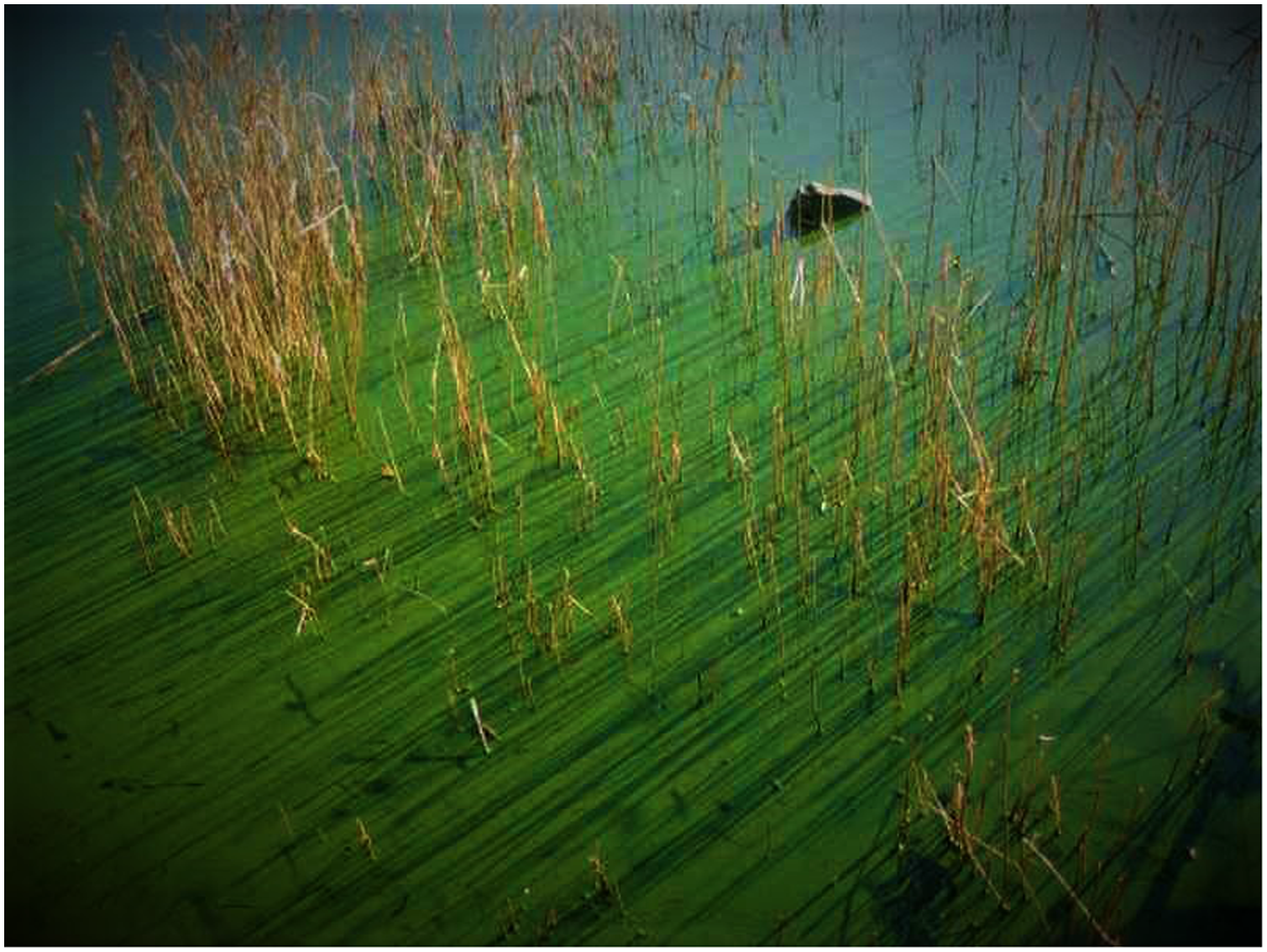
Algal bloom in Loweswater, February 2008. Picture taken by the author.
Algal blooms can be dangerous, for occasionally when the algae die, they release toxins fatal to mammals (Codd, 2000). Algae can also be deadly to other organisms when alive as they consume oxygen, and when present in great numbers, can suffocate other aquatic lifeforms such as fish (Tsouvalis et al., 2012). Hence the fear of local people to end up with a ‘dead lake’. Gradually, the abundance of algae and their regular and frequent blooms became a matter of concern for the community and regulatory agencies. Latour notes that a matter of concern brings ‘people together because it divides them’ (Latour, 2005: 13), and this is exactly what happened in Lowswater when people began to ask: who is to blame for this state of affairs?
In early 2000, there was an uncontested understanding at play in Loweswater that phosphorus (P) was the main nutrient controlling phytoplankton production and that any P entering the lake was rapidly incorporated into algal biomass (Maberly et al., 2006; Norton et al., 2011). Evidence from a lake sediment core taken in 2000 was taken to indicate that raised P levels in the lake had resulted from anthropogenic sources with an emphasis on farming practices: nutrient applications to fields (fertilisers, manures etc.), pesticide usage and the inappropriate storage of animal feed or waste (Bennion et al., 2000; Haygarth, 2005; Heathwaite and Johnes, 1996). In 2001, on the initiative of a local farmer, farmers in the catchment established the Loweswater Improvement Project (LIP) to address ‘the algae problem’. They worried about the lake and the tensions the algae had caused, and they feared the repercussions from agencies with responsibilities for pollution in the area. Despite the lake's relatively small size, its governance arrangements are complex. Although farmers make the key decisions regarding land use, they do so in the context of national and international policies, regulatory frameworks and incentives of several large public and charitable organizations (including the Lake District National Park Authority (LDNPA), the Environment Agency (EA), Natural England (NE) and the National Trust (NT)) (who owns the lakebed of Loweswater and a proportion of the surrounding land (Watson et al., 2009)).
The LIPs history and its activities have been discussed by Waterton et al. (2006). Noteworthy here is that the LIP teamed up with ecologists from the Centre for Ecology and Hydrology (CEH) at Lancaster and, between 2001 and 2004, tested soil nutrient levels, created buffer zones of semi-natural vegetation, re-routed waste waters through farmyards, and installed new septic tanks and wastewater systems on some properties adjacent to the lake. In 2004, Lancaster University with funding from RELU explored and confirmed the benefits of expanding the LIP to include local residents, institutional stakeholders and others concerned about the lake (Waterton et al., 2006). A larger grant from RELU in 2007 enabled the LCP to form.
Below, I critically examine the role of the LCP's method assemblage in its ontological politics, starting with scientific modelling. Scientific modelling was undertaken to grasp intra-actions of land use and algal growth. This example highlights the complexity of this method and the considerable hinterland it relies on to perform agential cuts. It also explores the ‘made’ nature of models, their relationship to the ‘real world’; and their role in the crafting of ‘presence’ and ‘absence’ through a qualitative interview conducted by the author with one of the scientists involved in the modelling process, a limnologist.
Land use change and algal blooms: Performing agential cuts through scientific modelling
The purpose of scientific modelling is to understand, define, visualise or simulate real-world processes and events. Scientific models can be defined as inscription devices that enable the transformation of material substances and processes into visual displays like figures and diagrams (Latour and Woolgar, 1979). Accordingly, models have material-discursive dimensions. They produce determinate meanings and material beings while simultaneously excluding the production of others (Barad, 2007). Models also have histories. They are the product of complex trials of force, processes of making and remaking, and rich hinterlands of realities (Law, 2004). In order for them to work, they require the input of previously crafted data that is relevant to the questions at hand, in this case: ‘how are land use and algal growth in Loweswater connected?’ ‘How much phosphorus ends up in the lake from the land?’
Phosphorus (P) has long been known to play a key role in algal growth and eutrophication. P is a chemical element found on Earth in numerous compound forms and locations, for example, as phosphate ion (PO43−) it is present in water, soil and sediments. P is the second most abundant and essential element in the body of mammals after calcium, primarily found in their bones and teeth. It is also present in their excrement, and leaves their bodies after they die, finding its way back into the earth. P in soil is often in short supply and because it is essential to plant growth, many farmers apply P fertiliser on their land to increase yields. Surplus P can find its way into rivers, lakes and oceans from land, where it can be incorporated into the sediment, stored internally and recycled. This is the case in Loweswater (Reynolds and Davies, 2001), meaning that even if external sources of P are controlled here, P pollution in the lake will continue. To better understand the complex intra-actions of land use and water quality in Loweswater, the LCP asked a professional aquatic ecology team to monitor and model them. Making their models work required many different types of data, including
data on land cover and associated land uses; a digital map of the catchment (created using a geo-referenced, hand-held, geographical information system (GIS), an Ordnance Survey MasterMap and local knowledge); disaggregated vegetation categories aggregated into land cover type categories; farm-level land management data (interviews); estimates of P losses from different land cover types (determined using export coefficients); data on P load from septic tanks (interviews); daily hydraulic discharge data from Loweswater (scientific apparatuses); continuous daily rainfall data (written records (local residents), automatic rain gauge); maximum and minimum air temperature (weather station located on a water quality monitoring station placed on the lake; this also collected daily wind speed-, air temperature- and relative humidity data); daily cloud cover information (a met station situated 30 km2 south-east of Loweswater); and more (see Norton et al., 2012). A calibrated
Modelling, therefore, depended on a vast method assemblage and hinterland. Furthermore, to grasp how P runoff and lake water quality were connected, not one but three intra-acting models were employed. In other words, outputs from one model were fed ‘into the next, so that farm nutrient budget information fed into the runoff model and nutrient outputs from the runoff model fed into the algal production model’ (Norton et al., 2012: 66; a detailed description of the three models employed can be found here). A quote from an account of one of these models – the Generalized Watershed Loading Function (GWLF) model – provided in a paper by a scientist involved in the process illustrates the complexity of this whole operation. Italics are used to highlight where ‘crafting’ was involved, and
How did scientists describe the making of agential cuts through scientific modelling? What did they see as the purpose of modelling? I explored these questions with a limnologist from the aquatic monitoring team, first asking him what he thought about the relationship of models to the real world. He explained that a model is not meant to represent the real world, it's meant to be a simplification of the real world, but the simplification is meant to be such that it's cutting out the stuff that we don’t have to know about. (L/2009; emphasis added)
It is interesting to note here that the limnologist uses the same term to describe how models simplify the real world that Barad uses to explain the purpose of ‘observation’ – to ‘cut out’ stuff (or make ‘agential cuts’). By ‘cutting out stuff,’ ‘realities’ are crafted and severed from the seamless fabric of the Universe. However, how do scientists know what ‘stuff’ they ‘don’t have to know about’, as the limnologist put it? They rely on their hinterland, on realities previously made through trials of force and associations forged between humans and nonhumans. This hinterland provides them with information about which ‘things’ carry weight in their discipline, and which ones do not. An example that illustrates this hinterland was provided when the limnologist described the development of one of the three models, the PROTEC model, which, according to him, ‘kind of encapsulated the brain and understanding of [name of the inventor of the model] on how algae grow in lakes’ (L/2009).
The role models play in the crafting of realities became even more apparent when I probed more deeply into their purpose during the interview. The limnologist explained that while they could help uncover things that we don’t understand as well as we thought we did, they also highlight gaps which then feed back into your knowledge […]; things that you hadn’t thought about before because they hadn’t surfaced. (L/2009; emphasis added).
Here, again, we are reminded that ‘scientific reality’ must not be mistaken for reality per se; that there is no ‘unity’ that we have access to as Science makes us believe (Latour, 2004). Stengers defines scientific reality as the ‘selective grasping of those aspects of reality that seem relevant to the issue at hand’ (Stengers, 2002: 261). This is why ‘searching’ is such an important element of scientific activity, and even the failure to find what one is looking for – or to find the wrong ‘thing’ – can be inspirational. This is why ‘being wrong’ about some ‘thing’ is highly valued by scientists. For the limnologist interviewed, ‘being wrong is the biggest breakthrough’, the best thing about being a scientist because that gives you a new perspective. If you’re […] wrong during an experiment […] that is telling you something […] If [being wrong] gave you an unexpected answer, the unexpected answer is the gold dust that you are looking for. It can give you a new perspective on how things work. (L/2009; emphasis added)
Finding ‘gold dust’ and gaining a ‘new perspective on how things work’ is the pinnacle of scientific activity. It produces ‘a new and reliable link with the world [and] the creation of such a link is always an event, something they [scientists] hope for but cannot master or decide’ (Stengers, 2002: 261). In the next section, I explore what happened when LCP participants were confronted with unexpected new links, and how these links or realities figured in their intra-active collective politics with algae. This section brings us into contact with deep-time and Loweswater's ancient fabric, which matter in Loweswater to this day. The hydro-geomorphology survey of the catchment was the element of the method assemblage used to establish these new links and craft these new realities.
Deep-time and the mighty force of High Nook
‘Past’ and ‘future’ are iteratively reconfigured and enfolded through the world's ongoing intra-activity. […] Phenomena are not located in space and time; rather, phenomena are material entanglements enfolded and threaded through the spacetimemattering of the universe. (Barad, 2010: 261)
Since every actant is entirely concrete, we do not find its reality in some lonely essence or chaste substrate, but always in an absolutely specific place in the world, with completely specific alliances at any given moment. (Harman, 2009: 15–16)
‘Catchments’ or ‘watersheds’, as their name suggests, collect and drain rainwater. Water is co-constitutive of many modes of coexistence and figures in innumerable processes. Water can take on gaseous, liquid and solid forms and is essential to the survival of all living organisms. In catchments, water sustains life and co-produces landscapes by contributing to rock weathering, soil erosion and landslides. Sometimes, there is too much of it, resulting in waterlogged soil and flooding. Sometimes, there is too little, resulting in a draught. Many questions were asked by LCP participants about these different dimensions of water and how water ‘management’ figured in ‘the algae problem’.
A common hypothesis of local residents was that because the Environment Agency (EA) no longer dredged the outlet of the lake, Dub Beck, it had become clogged up with sediment, leaves and debris, making it difficult for water to exit the lake. In an interview conducted in 2008, the EA confirmed that Dub Beck was no longer dredged ‘on financial grounds’, and that this had become ‘a bone of contention with the farming community’ (EA/2008). At a meeting in 2008, the LCP decided to find out more about this issue. A small research project was commissioned by the LCP, which was paid for by the RELU grant and carried out by a hydro-geomorphology consultant, Nick Haycock, and the owners of the lakebed, the National Trust.
Hydro-geomorphology is an ‘interdisciplinary science that focuses on the interaction and linkage of hydrologic processes with landforms or earth materials and the interaction of geomorphic processes with surface and subsurface water in temporal and spatial dimensions’ (Sidle and Onda, 2004: 597). Haycock's remit was to investigate how the geology of Loweswater was connected to the flow and maintenance issues of the lake. He presented his findings to the LCP in 2010. Below, I use the transcript produced from Haycock's presentation (recorded with his permission; Haycock, 2010) to show what he discovered while walking madly around the catchment to try and get my eye on things to do with water, things to do with the landscape, and how we think the uses of the landscape have been changed in the way that water is used and what the implications are for the lake. (Haycock, 2010)
Prominent in Haycock's method assemblage, therefore, was his ‘skilled vision’ (Grasseni, 2007) and hinterland, which he used to perform agential cuts. Let us join him on his walk around the waterworld of Loweswater.
Past and present ‘enfoldings’: Controlling water volumes and flows
Haycock immediately noticed ‘things’ that suggested that many attempts had been made here to control water volumes and flows over the years. Setting out at the north-western end of the lake, where Dove Beck enters Loweswater, he noticed that another stream called Dub Beck flowed through ‘a straight channel’ here, indicating that Someone has had a great idea of trying to drain the valley! […] This practice in the Lake District [dates] back to around the 12th Century and the Monastic community in the Lake District, which was very, very aggressive at straightening rivers … (Haycock, 2010)
Right from the start of his presentation, Haycock took LCP participants back in time by 800 years! However, his time-travelling adventures had only just begun and soon his listeners would have to grapple with deep-time and geologic events that stretched their imaginations. For the time being, however, Haycock remained with the evidence he had found of monks ‘messing around with, as he called it'. For example, where Whittern Beck entered the valley, he discovered ‘this wonderful, elevated channel that must be two metres above the valley floor’ (Haycock, 2010). He told astonished LCP listeners that a similar but slightly higher channel recently found near Ullswater had been designated as a World Heritage site. However, he cautioned, while such channels might be considered precious historical artefacts, functionally and ecologically, they are a ‘disaster zone’: what happens in the summer is [that] the water is skidding down this channel, and then the channel leaks like a sieve, and the water is just disappearing. [The channel] can’t be live with invertebrates or an aquatic community. (Haycock, 2010)
Just how big a role monastic ‘messing around with water’ played in ‘the algae problem’ was a persistent question of LCP participants. While the presence of algae in Loweswater was first noted in the scientific literature in the early 1930s (Pearsall, 1930, 1932), a study carried out by Pennington (Pennington, 1981) showed that high algal productivity in the lake during the summer months could be documented as far back as medieval times. Therefore, a potential connection between the algae and the drainage activities described by Haycock could not be ruled out. Haycock also mentioned more ‘recent’ evidence of ‘people trying to drain the landscape’ (Pearsall, 1930, 1932), for example, during the 1830s and 1840s. Then, there was ‘a big push for livestock [and] big grazing pressures’, which lead to drainage attempts throughout the Lake District. From the 1930s to the 1950s, ‘a lot of the secondary Lake District drainage … was [also] agricultural grant led’, he continued (Pearsall, 1930, 1932). This for him suggested that the need for well-drained agricultural land had long been a defining feature of human–water relations in this area, including in Loweswater. These historical-material intra-actions, LCP participants now realized, still mattered in Loweswater's waterworld to this day, helping the algae to proliferate. While humans could perhaps be considered as the key actants in these processes, their agential powers faded into insignificance when compared to that of mighty High Nook and its debris fan.
Lake-level changes, geological activity and colossal storms – Ontological politics oscillating between hope and despair
When the LCP first got together, many local people were convinced that the lake's water level had risen. A farmer who had grown up in Loweswater in the mid-1950s observed during a semi-structured interview I conducted in 2009 that ‘the lake level […] looks to me as if it could easily be a metre higher’ because ‘on the lake edge, where we used to walk along, now it's lake (laughs)’ (TR (transcript) 15/farmer/2009). Some local people interviewed mentioned a small ‘island’ or rock formation near the Waterend side of the lake that had once been visible but was no more, leading to the conclusion that it must have become submerged due to the rising lake water level. A farmer from Waterend confirmed that they hadn’t seen the rock since the late 1990s, describing it as ‘not very high but you would sit on a stone, forty or fifty yards from the bank’ (TR16/farmer/2009). Similarly, a local resident who had moved to Loweswater in the early 1970s mentioned this ‘huge stone … in the middle’ of Loweswater that had been there for years, thinking it had gone because the water level had risen as a result of the outlet of the lake being blocked (TR17/resident/2009). The view that the non-dredging of Dub Beck, the rise of the water level, and the proliferation of the algae were connected was widespread. Haycock's hydro-geomorphological survey of Loweswater put a spanner in the works of such reasoning: This dry area here [pointing at a slide-projected map] looks to me like it's an old shoreline. Possibly the lake was higher at some point [implying that the water level had gone down], probably in the last 60-odd years. [Haycock, emphasis added]
Haycock found ‘all sorts of things that suggested that the lake level had been lowered’ (Haycock, 2010), including trees and recent vegetation cover. Although he admitted that he couldn’t be 100% sure ‘whether this is true’, what he was ‘seeing is that lake levels have been going down’ (Haycock, 2010). To lend weight to this claim he relied on his skilled vision and hinterland of realities, but because the issue obviously matter to LCP participants, he also expanded his method assemblage to include a comparative study of the shape of Loweswater as found in old maps dating from 1860, 1930 and 1938. This revealed that ‘the shore was a good hundred metres down the channel in 1938’, leading him to conclude that ‘from 1938 to now [2010], something has happened, […] the water level has gone down’ (Haycock, 2010). These findings generated lively discussions and debates, not just about who was right and wrong, but also about how such an enormous amount of water could have been lost – if indeed it had been lost! – and what the consequences of this would have been for ‘the algae problem’. Haycock’s method assemblage and the agential cuts it had performed added ‘another piece of the jigsaw puzzle to understand what's going on’ in the lake (Haycock, 2010). This piece, too, became part of the slow but lively ontological politics of the LCP. However, more was still to come.
All around the catchment, Haycock had found evidence of geological activity. However, one area stood out: High Nook, a stream south-west of Loweswater that discharges downstream of the lake but whose debris fan aquifer feeds Loweswater (Haycock, 2010). For Haycock, High Nook was ‘the biggest thing we found’, a key actant in Loweswater's waterworld: High Nook and this massive set of land [delta] at the bottom of Loweswater […] that's the feature that holds Loweswater up. When that debris fan was formed, Loweswater was formed. […]. So the relationship of what's going on in this valley and what's going in Loweswater is really important. (Haycock, 2010)
Haycock told LCP participants about the ‘really colossal storms in the Lake District around about 1460’ that had forced huge amounts of debris into the valleys. Although the debris was later ‘washed out’ by subsequent storms, it greatly impacted on High Nook and its debris fan. The ‘big storm’ of 1465 had ‘resulted in the flood plain level going up two and a half metres of material, in one event!’, exclaimed Haycock, and still today, he said, bringing his listeners back to the present, when too much water comes down High Nook it can’t all get around Maggie's Bridge; some of it actually disappears up the valley and goes into Loweswater. [As a result] the water level keeps on rising … And it's not until High Nook goes down that Loweswater starts draining. (Haycock, 2010)
High Nook, therefore, intra-acted with Loweswater in powerful ways. Moreover, it proved to be a formidable adversary of the algae. According to Haycock, High Nook is ‘just basically shunting out a huge amount of material, scouring the bed out, clearing off all the algae’. In comparison, he described Dove Beck, coming out of Loweswater, as ‘just in no hurry at all, it's got no energy, it can’t scour anything’. Here we get a glimpse of how the agential force of water combined with that of rocks and sediment can overpower organisms like algae.
Haycock's study introduced LCP participants to time scales and agential forces that could be difficult to comprehend: All the hard mountain landscape is very, very old. All the softer material you see in the valley, the lake, the elevations and the debris pads, they are only seven thousand years old […] So they are all contemporary, from a geological point of view, they are really fresh, vibrant, active, still forming, still growing, still doing all the things they want to do (Haycock, 2010).
The realization that deep-time still mattered in Loweswater and that the lake was part of a ‘young’ valley that still does ‘all the things it wants to do’ dispelled the myth that dredging the lake's outlet would solve Loweswater's algae problem. Haycock put it bluntly when stating that the dredging of Dub Beck was ‘fairly irrelevant; it's High Nook that controls how freely it [the lake] can drain’ (Haycock, 2010).
Haycock's presentation raised questions about local people's experiential knowledge (the reasoning behind the disappearance of the small ‘island’ or ‘rock’) and brought actants into the LCP that operated at spatial and temporal scales that were hard to imagine. The latter led to the question of whether the LCP could do anything about the ‘the algae problem’ when the algae were clearly connected to rivers intra-acting with Loweswater during storm episodes, causing fluctuations in water levels, millennia-old glacial debris fans, valleys eroding high up in the fells, monastic and modern drainage features, and more (for details see Haycock, 2010). Making these realities present and realising their importance could at times lead to hopelessness and despair among LCP participants, profoundly disturbing their sense of collective agency: if the processes that ‘controlled’ cyanobacteria were so ancient, so geological, and spread over such vast temporal and spatial scales, what could the LCP possibly do to change matters? However, when Haycock suggested that fencing off particular sites of erosion in the fells might help, discussions became by turns positive (erecting fences was something the LCP could conceivably ‘do’) and fatalistic (how could fences possibly make a difference to processes of such epic proportions?). With the number of participants in the LCP's intra-active collective politics steadily rising, humans recognized their limitations and spotted opportunities for composing a better common world in this beautiful valley and around this unique waterworld.
Conclusions
In this article, I have tried to answer two questions asked by the editors of this SI on ‘Water Matters’: ‘how could we acknowledge the agency of water in our political ecologies?’ and ‘how could such an approach foster the composition of a better world of more balanced human interactions with the environment?’ (Smith, 2017: 102). To do so, I have provided two empirical examples from the LCP, a new collective that formed in Loweswater, the English Lake District, in 2007 in response to the matter of concern of blue-green algae. Through these examples, I have tried to show how ontological politics was put into practice here, and below, I outline some steps that were taken as a result of this slow form of politics to compose a better common world, one where algae are less dominant.
The approach developed by the LCP was informed by Latour's critique of Science and key principles from his work, and Barad's theory of agential realism. The latter, as explained, affirms the ontological inseparability of intra-acting agencies and holds that phenomena or objects do not precede their interaction but emerge through intra-action. In other words, agencies are always already entangled. I have argued that to disentangle them and put intra-active collective politics into practice requires the making of ‘agential cuts’ (Barad, 2007), and this, as I have shown, can be achieved through a ‘method assemblage’ (Law, 2004). The LCP's method assemblage enabled it ‘to enact and depict the shape-shifting implied in the interactions and interferences between different realities’ (Barad, 2007: 122) and obtain ‘a contingent resolution of the ontological inseparability within the phenomenon’ (Barad, 2007: 348) it was grappling with, namely blue-green algae. The specific elements of the LCPs method assemblage that I focused on in this article were the scientific modelling of land-use-water intra-actions and the hydro-geomorphology survey of the catchment.
Through the agential cuts performed and the realities crafted, LCP participants were able to intra-act with ever more actants that co-constituted ‘the algae problem’: rivers and river channels; sediment; rocks; soil; rain; sheep; excrement; phantom midges; past and present policies, regulations and water management practices; septic tanks; detergents; and more. Ontological politics as I have emphasised needs to be a slow form of politics. This tempo enabled LCP participants to get a feel for the algae and grasp its many different dimensions, multiple associations and the countless actants they intra-acted with. As a result, LCP participants realized that power and agency overflow the category of deliberating human subjects; that they course through collectives that include other entities, and through heterogeneous networks that extend beyond the present and into deep time (Clark and Yusoff, 2017).
Undertaking intra-active collective politics could be challenging for all LCP participants, but especially so for scientists, whose methods were critically examined and ‘facts’ questioned regularly. Collaborating with LCP participants who tried their hand at citizen science activities like water monitoring could also be demanding. However, such collaborations can be hugely beneficial for scientists and have been found to encourage them ‘not to judge away, as mere opinion, what is outside their boundaries’ (i.e. their hinterland; Stengers, 2002: 263). To find out whether this had been the case for scientists participating in the LCP, I asked the limnologist whom I interviewed how he had experienced working in the collaborative fashion of the LCP. He explained that the RELU work is right at one end of what I do, it's right at the extreme. That's why I said to X once […] that I couldn’t cope with this because it's too difficult. (Stengers, 2002)
However, he felt that participating in the LCP had added something important to his work, although he was ‘not so sure how to get to grips with “it”’. When asked to elaborate on this, he described this ‘extra thing’ as ‘kind of unknown knowledge that so far science hasn’t really been able to know about or couldn’t make use of’. Law (2004) refers to this as ‘absent’ or ‘other’ knowledge. Like the LCP's limnologist, many local people too went out of their comfort zone as LCP participants. Some, as noted above, became ‘citizen scientists’. Others undertook interviews or conducted surveys to learn more about how local septic tanks were maintained or what detergents people used – both being key actants in Loweswater's waterworld. One study carried out by a local resident that shows just how broad the LCP's interests had become looked at the impact of tourism on the catchment and the local community (funding for six small research projects that LCP participants could apply for had been factored into the project's budget. For examples of work undertaken see the following reports: Bennion and Winchester, 2010; Davies and Clarke, 2010; Webb, 2010).
When feedback was collected from LCP participants in 2010 to find out more about what they thought the benefits of working in the ways the LCP had done had been, replies included that they had
revealed the complexity of problems of the lake, leading to the realisation that a solution for algal blooms may be difficult or even impossible (local resident, five meetings attended); exploded a number of false assumptions (local resident, six meetings attended); and led to the realisation that interactions between people and the environment are entirely interdependent (local district councillor, four meetings attended).
Intra-active collective politics is about changing a common world for the better, and many practical steps were taken by the LCP between 2007 and 2010 to reduce the force of algae in Loweswater. These included replacing leaking septic tanks and improving existing ones, changing farming practices, establishing reed beds, using P-free detergents and more. These steps have been detailed in various papers and reports (see references cited in the Introduction section). When the University's involvement with the LCP ceased in 2010, local residents formed the Loweswater Care Partnership, later to become the Loweswater Care Programme under the auspices of the West Cumbria Rivers Trust. In 2012, this Programme obtained funding from Defra to take further practical steps to prevent P from entering the lake. For example, improvements were made on five farms located in the catchment, including putting up fences to prevent livestock from accessing the lake, creating drainage channels to facilitate run-off, building new cattle and sheep sheds and constructing roofs over yards (see https://westcumbriariverstrust.org/projects/ the-loweswater-care-programme). The LCP's intra-active collective politics also improved social relations. Farmers were no longer blamed by certain local residents and agency representatives for the lake's pollution – after all, who were they but one actant among many that intra-acted with the lake? A significant breakthrough in this regard occurred when some farmers collaborated with the National Trust, with whom they barely spoke when the LCP first met, to remove vegetation from the lake's outlet.
The word ‘care’ has appeared in all the names under which the participatory action group that started out as the LCP in 2007 has operated. Indeed, more care-ful human–water intra-actions have been its lasting legacy. According to Puig de la Bella Casa (2011: 87), ‘interests and other affectively animated forces – such as concern and care – are intimately entangled in the ongoing material remaking of the world’, and she suggests that we add the notion of ‘matters-of-care’ to our conceptual repertoire of ‘matter-of-concern’ and ‘matters-of-fact’ (the latter notion being used by Latour to describe the kind of ‘facts’ provided by Science). I agree with that. The formation of the LCP was motivated by ‘care’: care for the lake and the many lifeforms it supports; care for the people who live and make a living there; care for the broader environment of which this waterworld forms part, and care for many other ‘things’. This suggests that care is a key dimension of ontological politics directed at composing a better common world. This invites us to reflect on what this means for a point made earlier, namely that our knowledge and understanding of the world – of matter and how it matters in matters of concern – will always be incomplete. Vis-à-vis presence, there will always be absence and otherness, realities that have not yet been crafted and others that figure but can never be made present. In short, we will never fully grasp ‘the world’. We might try to ‘impose structures onto life and being’, but will inevitably find ‘that neither life, nor being, follow our designs’ (van de Port's, 2020: 28).
This raises some challenging ethical questions that scholars advocating ontological politics have yet to fully address. For example, for whom do we want to compose a better common world? Who does we stand for, and what does better mean in a given context? Ontological struggles inevitably produce winners and losers, and Loweswater is no exception here. If the measures taken by the LCP against algae are successful, algae numbers in Loweswater will decline, meaning that some of these organisms will die. As a result, other actants could gain force and increase in number, for example, fish. A large fish population could, in turn, adversely affect Loweswater's phantom midge population, and so on and so forth. Who the winners and who the losers are of ontological struggles is difficult to foresee, and because of that, notions like we, better and care need further critical attention. Perhaps the answers to these questions cannot be found solely through reasoning and logic but by following the intuition that better, for example, means forging associations and intra-actions that create a world where loss – and, therefore, suffering – is no longer the common denominator of matters of concern like biodiversity loss, species loss, habitat loss, loss of homes-, lives- and livelihoods. Surely, a better ‘common’ world is also one where not one group of actants dominates other actants to the detriment of all – whether they be humans, microbes, animals, plants or insects. Whitehead once observed that we live ‘in a buzzing world, amid a democracy of fellow creatures’ (Whitehead, 1978: 50). Ontological politics is about acknowledging this and making the world a better place together with them. It is about providing democratic spaces and processes where these fellow creatures can matter, where theirs as well as our voices can be heard. This demands humility on our part and a slow pace of proceeding, which will allow us to feel what is at stake and for whom, and to forge new connections that could have better outcomes for all.
Highlights
Provides an empirical example of the possibilities offered by ‘doing politics with things’ (Dingpolitik, Cosmopolitics, ontological politics, intra-active collective politics) to compose a better common world where humans and nonhumans alike can thrive (Loweswater, the English Lake District, where the proliferation of potentially toxic blue-green algae in Loweswater lake had begun to constitute a matter of concern).
Explains the role played by agential cuts and method assemblages in putting intra-active collective politics into practice by crafting new realities that can provide opportunities for reconfiguring human–nonhuman associations.
Provides detailed examples of how method assemblages and agential cuts work in ontological politics: scientific modelling of connections between land use and water quality and a hydro-geomorphology survey of the catchment.
Explores ethical questions pertaining to ontological politics and emphasises the importance of ‘care’ in these endeavours.
Authors’ note
Judith Tsouvalis is also affiliated at School of Computing and Communications, InfoLab21, South Dr, Lancaster University, Bailrigg, Lancaster LA1 4WA.
Footnotes
Declaration of conflicting interests
The author(s) declared no potential conflicts of interest with respect to the research, authorship, and/or publication of this article.
Funding
The author(s) disclosed receipt of the following financial support for the research, authorship, and/or publication of this article: This research was funded by the Rural Economy and Land Use (RELU) programme, an unprecedented collaboration between the Economic and Social Research Council (ESRC), the Biotechnology and Biological Sciences Research Council (BBSRC) and the Natural Environment Research Council (NERC).
