




Abstract
Eco-urbanism encapsulates a range of approaches to the management of urbanisation processes and environmental imperatives in contexts of rapid industrial and economic change. The paper focuses on two eco-urban initiatives in China and the UK over a temporal lens stretching from the mid-2000s to the early 2020s, in order to critically engage with the question of how eco-urban projects develop and often undergo radical changes over time, as well as being changed through significant ruptures, periods of stasis and fluidity in the actor-networks involved in project visions, financing and development. Our comparative approach identifies cross-cutting processes operative across two projects at different scales and in different techno-political contexts. The paper argues that longitudinal analysis is key to enabling a view of transitional trajectories as unfolding, and as a way of moving past oft-repeated assessments of specific projects according to a ‘failure/success’ binary. In order to do so, the paper considers eco-urban projects through a theoretical lens that views projects as unstable assemblages exhibiting change over time on the one hand, but that also recognises the dynamic resilience of geographical imaginations around eco-urban projects, that means that these projects endure (albeit often in different guises) over time.
Introduction
The notion of eco-urbanism is concerned with the multiple facets of urban ‘sustainability’ as they emerge across different geographical contexts in attempts to reconcile urban, environmental, economic and political imperatives. Eco-urban ideals have long been used in specific urban projects, from garden cities (Sharifi, 2016), eco-cities (Register, 1987; Roseland, 1997; Cugurullo, 2018), to low-carbon cities (Hodson, Marvin and Bulkeley, 2013) and other initiatives. Many of these projects and the ‘labels’ attached to them have been characterised by conceptual diversity and fluidity (de Jong et al., 2015; Joss et al., 2019), and urban scholars have, over the past two decades, produced a significant critique of eco-urban approaches. Although a comprehensive review of this body of critique falls outside the scope of this paper (but see Joss, 2015), scholars have highlighted issues associated with project failure (Chang, 2017b); the commercialisation of eco-city projects and ‘greening’ of profit-driven urban strategies (Hult, 2015; Christophers, 2018); the spatial complexities involved in defining eco-urbanism as low-carbon and sustainable (Holgersen and Hult, 2021); and the international circulation of one-size-fits-all urban visions, often elaborated by corporate experts and consultants, and parachuted into different national, regional and socioenvironmental contexts (Rapoport and Hult, 2017).
In this paper, we extend the critical emphasis that has developed over the past two decades of research on eco-urbanism in two ways. First, we deploy an international, comparative approach across two new eco-urban projects, one in the Global East and the other in the Global North (Shin, Lees and López-Morales, 2016; Müller, 2020). This is meaningful because much recent research on eco-urbanism has focused on single-case approach, and where larger-scale comparative studies have been attempted, they have tended to be either large-scale studies, or based on surveys (Joss, 2010, 2011) or cross-national comparisons (Li and Qiu 2015, Yin, Olsson and Håkansson 2015). There has been relatively little focus on establishing comparative insights across two discrete sites or projects, especially when the comparison cuts across the Global East and North. This is what we propose in this paper. Additionally, scholars have also noted the need to move past top-down narratives to include a more central focus on horizontal, city-to-city interactions in delivering change (Lee and Koski, 2015). We use comparative urban analysis to establish a theoretical framework that can identify commonalities and differences between multiple cases in different (across East and North) geographical, political and urban contexts. The common denominator to these contexts is the operationalisation of specific ideas around eco-urbanism and its implementation, and the workings of the fluid ‘socioenvironmental state’ (Nightingale, 2018) in attempting to manage processes of urban and environmental change towards pathways identified by state actors as transformative.
Secondly, informed by work in urban political ecology that is sensitive to the importance of the temporal spectrum and its dynamic nature (Evans, 2007; Hinchliffe, 2008; Cullen, 2020), we introduce a longitudinal perspective into our analysis of eco-urbanism. We note that many studies of eco-urban projects and their development use a limited temporal frame, focusing on a few years of project development at best. This is a key methodological problem, because while it is useful to focus critique on a project's early stages, in the case of eco-urbanism an initial flurry of critique has not generally been followed by longer-term analyses as projects develop through years or decades. This can lead to a narrative construction of new urban projects as existing in a simplistic ‘steady state’ (Meerow and Newell, 2019). This, in turn, has led to calls to engage with the temporal dimensions of urban change and governance, and with the politics of time as they are involved in change processes (Raco, Durrant and Livingstone, 2018). Instead, as Chang (2017a) shows in her analysis of Chinese eco-city projects, narratives of the ‘failure’ of individual projects mask the globalising processes that constitute eco-urbanism, and which mean that ‘failed’ projects continue to impact and influence future urban directions and strategies. In their work on Chongming Island (near Shanghai), the location of the failed 2000s/2010s Dongtan eco-city project, Xie et al. (2022) have employed a microhistory approach that shows how socio-natural relations change over time and through the complex processes of eco-urban and other forms of development. Others (Hodson, Evans and Schliwa, 2018; Truelove and Cornea, 2021) have likewise highlighted how heterogeneous spaces that include project failures can usefully be considered as spaces of potential transition and change. Other areas of urban research have started to undertake analyses which move away from point-in-time approaches, as seen in work on urban sustainability transitions (Larbi et al., 2021); housing affordability (Baker, Mason and Bentley, 2015), urban greening and wellbeing (Astell-Burt et al., 2022), urban education (Ramlackhan and Wang, 2021), urban migration (Chen and Fan, 2018) infrastructure (Ramakrishnan, O’Reilly and Budds, 2021), and the informal city (Marais et al., 2018). We extend this focus to eco-urbanism, and argue that in order to fully understand processes of processes of eco-urban transition and change at a range of scales, empirical work across different urban contexts is needed. Much of the focus in urban political ecology-informed analyses has been on rich excavations of the complex interplay of materialities, sites, ideologies and narratives. What we add is what we would call a political ecology of time, sensitive to the ways in which the socio-environmental state and its effects unfold over time.
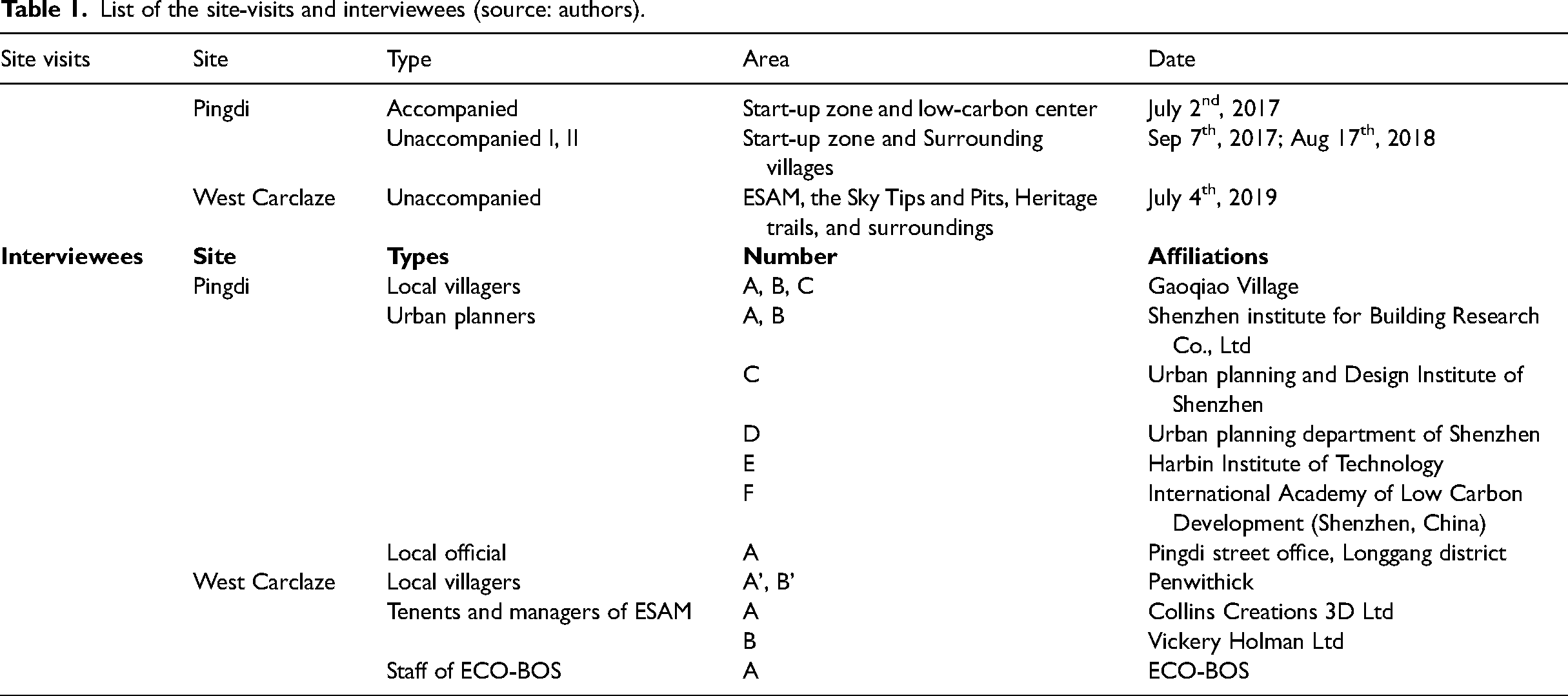
Our methodological approach was based on data collected through archival research and on-site observation (Table 1). We conducted three fieldwork visits to Pingdi from July 2017 to August 2018, and fieldwork visits to West Carclaze in July 2019. Interviewees included local residents, project-related employees, officials and planners (Table 1). Interviewee selection was purposeful, based on analysis of planning and project documents and media reports. Additionally, we carried out analysis of government policies, plans and related documentary material focused on the projects themselves as well as on the implementation process.
List of the site-visits and interviewees (source: authors).
To address the need to engage with the fluid and dynamic development of eco-urbanism across scales and over extended temporal spans, we develop a conceptual framework which brings into conversation three distinct but related theoretical approaches: studies of transition, theories of assemblage and understandings of resilience as applied to eco-urban projects themselves. We apply this framework to analysis of two eco-urban projects, in Pingdi (Shenzen, China), and West Carclaze (Cornwall, UK). Both projects have been developed over a multi-decadal time span. They are also located in sites which were discursively constructed as parts of broader rationales for eco-urban development: in China, as part of the country's pivot towards ecological urbanisation, and in the UK as part of national government-mandated eco-town strategies. In turn, both projects are rooted in broader trajectories, in both China and the UK, which aim to change and transform the city and make it greener as a way of tackling the socio-environmental externalities of hyper-rapid economic-industrial development and industrialisation (China), and the socio-economic and environmental issues associated with a largely deindustrialised and despoliated post-industrial, post-mining landscape in Cornwall, UK.
We interpret the longitudinal unfolding of the two projects through a tripartite conceptual framework. First, studies of transition are used as a lens through which to understand the non-linear change pathways that were centred on Pingdi and West Carclaze over a multi-year timespan. Second, we utilise theories of socio-technical assemblage to characterise the dynamically unstable and changing actor-networks of decision-making in eco-urbanisation projects over a temporal timespan which includes obstructions and changes in transitional trajectories. Third, after investigating the changing actor-networks and exogenous influences, we leverage the concept of resilience to understand what we term assemblage stability over time: the enduring nature of the socio-technical assemblage including discrete events and changes in transitional pathways. The paper then moves on to examine the Pingdi and West Carclaze cases: we also explain how the projects’ transitional pathways were interrupted and subsequently changed. We then provide analysis and discussion of these cases through our conceptual framework.
Eco-urban transitions, assemblage and resilience
Longitudinal transition pathways in eco-urbanism
Studies of transition analyse processes of socio-technical change. This can serve to identify transformational pathways in specific technical and societal contexts (Geels, 2002, 2019; Truffer and Coenen, 2012). This large body of theory can leverage the analytical perspective afforded by the Multi-Level Perspective (MLP), which explains transitions as occurring at three distinct but interrelated, largely abstract ‘levels’ (Geels, 2002, 2019). These are: the niche level, where radical innovations can be fostered and at times protected; the regime level, where change is incremental (although change can be more rapid if niche innovations can affect the regime); and the landscape level, a structural, material and spatial scale where change occurs much more slowly. Transitions are longitudinally understood to occur along pathways that encompass a range of possible trajectories, where the range is a bounded spectrum of decision-making that changes over time. In Bailey and Wilson's (2009) analysis of low-carbon economy transitions, for example, the spectrum of decision-making is bound by the extremes of radical eco-centrism on the one hand and neoliberal techno-centrism on the other. There exists a range of transitional pathways (and opportunities for these pathways to change) in between these two extremes.
As will be shown below, our two empirical examples can be considered from a perspective informed by transition theory in three ways, as a basis for further comparative analysis. Firstly, both eco-urban projects can be described as innovative in intent: when they were initially proposed, both contained elements of innovation and a break from the mould. The original proposal for Pingdi eco-city in the early 2010s was focused on transitioning a polluted industrial area towards a low-carbon and sustainable urban future. Likewise, as early as 2006, West Carclaze was an early local prototype of sustainable development visions (predating the national eco-towns initiative) aiming to transform a former clay mining area into mixed-use and low-carbon eco-communities. Secondly, both projects are cases in which transformative visions, constrained by the boundaries of political, practical and financial possibilities, changed over time and thus came to represent dynamic transitional pathways, expressed longitudinally (Bailey and Wilson, 2009). Thirdly, both cases are examples of the spatialisation of transitional pathways and the niche level of urban governance, as will be discussed at the end of this section. Therefore, while the national, political and economic contexts (and the project scale) are different across both cases, there are striking commonalities between the two when considering them through a transitional, longitudinal lens that focuses on (changing) eco-urban visions and the relation of these to governance in two different contexts. It is here that our theoretical framework can be used for analysis: by establishing a dialogue between literatures that understand the interplay between processes of transition, urban projects as shifting assemblages of actors over time, the resilient but adaptive qualities of visions that aim to transform the urban.
Our focus on transitional pathways as they focus in place in both Pingdi and West Carclaze links often aspatial and abstract notions of urban development and societal change to the specificities of place and specific sites. This is important in the context of transitions theory and the MLP, both of which have faced a number of critiques over the past 15 years (Coenen and Truffer, 2012; North and Longhurst, 2013; Feola, 2020). While much of this critique has focused on the role and comparative aspects of case studies and the need to spatialise the MLP (Coenen and Truffer, 2012; Roberts and Geels, 2019; Rotondo et al., 2020), other studies have highlighted how the focus on specific scales can highlight development contexts and historical trajectories, in which transitional change is more likely to be fostered and enabled across the different levels of the MLP (Hodson and Marvin, 2012; Truffer and Coenen, 2012). Furthermore, the urban spatial context has been identified as a particularly promising scale to focus on (North and Longhurst, 2013). We explicitly spatialise our analysis to root it in the geographical context of both Pingdi and West Carclaze, and in the inter-related scalar interactions with national and other geographical scales of governance. Our understanding of assemblages around both projects is rooted in understanding transitional change as happening through a patchwork of processes (policy, political, economic, socio-cultural, technological) that can be seen both in terms of the levels of transition at which they occur and in terms of their socio-spatial embeddedness (Murphy, 2015). Notwithstanding this, some authors have sounded a warning bell about conflating geographical specificity in studies of transition with generalisable knowledge about why such specificity matters (Kaika, 2017; Hansen and Coenen, 2015). Nonetheless, we argue that this study highlights not only that place-specificity matters but that it matters precisely because the interactions between local urban contexts, other scales of governance, and other factors (e.g. the local and global economy) determine the composition of the project assemblage and therefore the likelihood of a specific transitional trajectory and the boundaries of the transitional pathway.
Eco-urban assemblages
We understand the two projects presented below as socio-technical assemblages. While there is an extensive literature on assemblage theory and the empirical application of notions of assemblage, our use of the concept is based on studies that have linked assemblage with the city (Brenner, Madden and Wachsmuth, 2011; McFarlane, 2011b, 2011a; Tonkiss, 2011). In particular, we refer to assemblage to denote emergent ‘relationalities of composition’ (McFarlane, 2011a, p. 206). As McFarlane (McFarlane, 2011a) has argued, urban assemblages can be understood as defined in four broad ways. The first is a processual lens, that is, focusing on how the processes of assembling happen. Secondly, relationality describes the shifting interrelations between human and non-human actors in shaping assemblages. Third, assemblages can be seen as defined by mobility, which is both translocal and tied to the shifting nature of the actor-network itself. Lastly, assemblages are determined in large part by unequal relations of power, resource allocations, and the like, which contribute to determining the pathways taken by specific assemblages as they evolve over time (a point that our empirical analysis will further elucidate). In particular, we draw on work by Cowley et al. (2018) that shows how these dynamics opens up assemblages to the possibility of being reshaped at the project scale, while the definition of ideals and aims around urban development may still be in flux. In the case of Pingdi and West Carclaze, the multiple actors involved in both projects formed shifting, ambivalent actor-networks that nonetheless perdured over the timescale considered. Their overarching focus remained on the materialisation of eco-urban ideals (although this materialisation was defined in different ways at different points over the projects’ timeline). In this sense, we see the two projects analysed here as ‘situated bodies of practices, into which human actors are differently enrolled’ (Cowley et al., 2018, p. 55). In addition, although our study focuses on two material cases, viewing them as assemblages enables us to move beyond considering urban projects as defined by spatial boundaries, and set more by ‘types and lines of activity, whereby spatialities emerge through the actor-networks that connect places’ (Blok, 2013, p. 9). Thus, using an assemblage lens, both cases can be seen as ‘contingently shaped both by local factors and by broader (policy) discourses’ (Cowley et al., 2018, p. 55).
The final point we wish to make regarding our use of an assemblage lens is that it is particularly helpful as a way of examining eco-urbanism. Both cases presented here focus on visions of environmentally sustainable urban environments. In Pingdi, this is against the backdrop of ecological imperatives in the urbanisation processes in Shenzhen and the Pearl River Delta. In contrast, West Carclaze proposal came about in the context of reshaping a landscape that was deeply impacted by the mining industry. An assemblage approach is useful because, as argued by Blok (2013), it enables the conceptual holding together of human and non-human actors, where the risk is that the broader ecological context would otherwise ‘remain unnoticed backdrops to city life’ (Blok 2013). In turn, the scalar and time-horizons of both projects come into sharper focus when viewed as unstable but emerging assemblages. By linking a transitions perspective and its multi-level focus with our identification of project-focused assemblages, our analysis moves beyond a flat ontology typical of some of the work on actor-networks (Geels, 2010), and towards a more nuanced conceptualisation of the extension of the project assemblage across different levels of governance on the one hand, and the spatio-temporal context on the other.
Resilience of the changing project-focused assemblages
The third part of our conceptual framework is based around the notion of resilience. In environmental research, resilience is often defined as the capacity of systems to return to an initial state after experiencing a shock or series of shocks (Adger, 2000; Quinlan et al., 2016). The direct application of this notion to social enquiry has been critiqued (Kaika, 2017; Meerow and Newell, 2019), and we are consequently conscious of the need to: a.) remain aware of the political nature of policy and practice discourses around socio-technical and urban resilience (Cretney, 2014); b.) the need to challenge the assumption that a ‘steady’ or ‘initial’ state of affairs was ever in existence regarding the urban project-focused assemblages under consideration (Welsh, 2014; Meerow, Newell and Stults, 2016). In the context of this research, we focus on 1) discursive resilience: by this, we mean the continued existence and adaptability of critical guiding discourses that are central to the projects we analyse; 2) the resilience of the temporally dynamic eco-urban assemblages under consideration.
The two projects analysed here have changed considerably over the extended time-horizon chosen for analysis. We argue that when considering urban assemblages, it is useful to think about the resilience of the assemblage proper rather than of a specific iteration of the project. This effectively sidesteps the pitfalls inherent in analysing a long-term urban project through analysis which is limited to the project's initial claims and narratives. In this sense, our analysis incorporates those characteristics of assemblages, such as process, relationality, mobility and unequal relations (McFarlane, 2011b), that would otherwise not fit neatly into analyses of system resilience. Focusing on projects as assemblages rather than on their specific constitutive parts at any one point in time thus enables an incorporation into analysis of elements of change and dynamism, which are central to both studies of assemblage, and theories of transition. Indeed, the two projects analysed in this paper underwent significant changes and transitional ruptures, whereby original and even subsequent project ideas and actor-networks underwent modifications and (at times) periods of stasis. Meanwhile, what remained stable was the assemblage itself, which was organised around the core idea of eco-urban projects rooted in specific sites. Although the relational and compositional geometry changed over time, we show that the assemblage remained stable and resilient.
We analyse two eco-urban projects which are contextualised within significant national strategies to develop eco-cities and eco-towns, albeit on vastly different scales: the Chinese eco-city initiative (Chien, 2013; Liu and Lo, 2021), and the UK's eco-city programme (Tomozeiu and Joss, 2014; Warwick, 2015). While the Chinese context is characterised by strong state steering, while in the UK the overall governance structure is more decentralised and devolved, there are nonetheless cross-cutting questions about how eco-urban projects in different socio-political and economic settings can sustain, evolve and deliver urban sustainability transformations. Furthermore, there are key questions around how analysis of transitional urban assemblages can be understood so as to better evaluate their capacity for longitudinal resilience in processes of managed urban change.
Two eco-city projects in the UK and China
Our analysis is based on two empirical case studies: Pingdi (Shenzhen, Guangdong, China) and West Carclaze (St Austell, Cornwall, UK). Both are parts of broader trends that saw a renewed interest, from the mid-2000s onwards, in building cities or towns along eco-urban lines (Fitzgerald and Lenhart, 2016); both are responses to national policy directions and changing governance rationalities (Levenda, 2019) and were characterised by political projects focused on urban change (Joo and Seo, 2018), as will be shown in this section. Both projects also changed, over the subsequent 15 years, as national policies changed (in the case of West Carclaze) or were translated at a local municipal level in specific ways (in the case of Pingdi) (Figure 1). The projects also responded to discourses linking the city with environmental imperatives. In the case of Pingdi, the eco-city project was seen as part and parcel of attempts to restructure economic development and to direct it in a more ecologically sensitive direction. In contrast, the West Carclaze eco-town was an attempt to rethink urbanisation in a post-industrial context with significant legacies around industrial waste and despoliation.
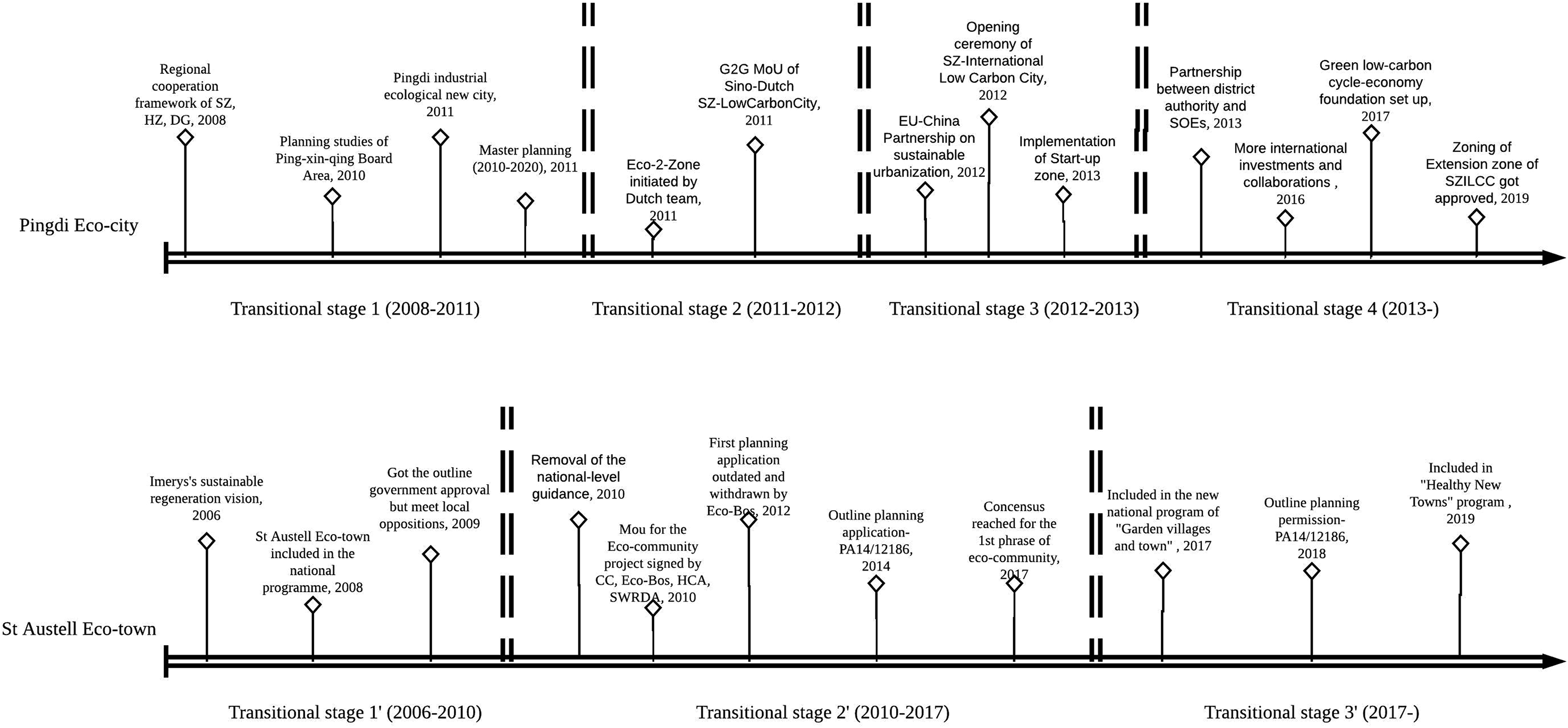
Development timelines and transitional stages of the Pingdi and West Carclaze projects (source: authors).
Pingdi eco-city, China
China's national policy landscape
China's focus on eco-urbanism from the 2000s stems from a recognition of the environmental effects of the vast socio-economic changes which have occurred in the country since the post-1978 ‘reform and opening up era’. These changes have occurred in large part as a result of the adoption of industrialisation, and associated urbanisation, as the key way to boost economic growth and national development. State-led ‘green developmentalism’ (Hong, Chien and Liao, 2020) has led to significant, if geographically uneven, achievements with regards to prosperity, but has also generated socioenvironmental externalities (Yu, 2021). Although China's eco-urban focus is primarily rooted in the 2000s, the Chinese government released the Chinese Agenda 21 as early as 1994, two years after the first Earth Summit (1992) (Bradbury and Kirkby, 1996). In 1996, the government also promoted a focus on eco-cities and eco-counties, and then from 1999 on eco-provinces as a way of promoting sustainable development at different scales (Wang et al., 2015). While the country's 10th (2001–5) and 11th (2006–10) Five-Year Plans showed a deepening focus on sustainable development, eco-cities were formally endorsed in the 12th (2011–15) Five-Year-Plan (Caprotti, Springer and Harmer, 2015). Notwithstanding this, the country saw the rise of multiple eco-city developments, such as the failed Dongtan eco-city near Shanghai (Chang and Sheppard, 2013), the Changsha-Meixi-Lake eco-city (Deng and Cheshmehzangi, 2018), Shenzhen-Guangming eco-city (Yu, 2014), and Caofeidian International Eco-City (Joss and Molella, 2013). Chief among these experimental projects (many of which did not make it off the drawing board) was the Sino-Singapore Tianjin Eco-City, a central state-led project involving intergovernmental collaboration and receiving significant, direct financial support from both the central government and Singapore (Caprotti, 2014; Caprotti, Springer and Harmer, 2015; Chang, Leitner and Sheppard, 2016).
Within this broad national policy context, other initiatives promoted trajectories towards ecologically sensitive urbanisation. Examples are the 17th National Congress of the Chinese Communist Party (2007–2012), which instituted ideas of ‘ecological civilisation’; the 2010 low-carbon city programme developed by the National Development and Reform Commission (NDRC), and the 2011 low-carbon eco-city programme by the Ministry of Housing, Urban and Rural Development (MOHURD). These eco-initiatives involved over 40 cities, and enlisted Shenzhen as a pilot city. As one of our interviewees, a planner (Planner D), noted: ‘The fast-paced urban development has provided Shenzhen with opportunities for trial and errors, this helped make Shenzhen a ‘Special Economic-Ecological (ECO2) Zone’ (Ch., 经济-生态双特区, ShuangTeQu)’. Within this national policy context, Shenzhen initiated and piloted varied eco-urbanisation projects in different urban districts. Pingdi became one of these eco-initiatives, focused on low-carbon economic aims, coinciding with a municipal strategic turn around industrial restructuring and upgrading (Xie, et al. 2020).
Transition from ‘Pingdi Sino-Dutch Eco-2-Zone’ to ‘Shenzhen International Low Carbon City’ (SZILCC)
The Pingdi project is located in Longgang district, northeast Shenzhen, in a river plain area where three cities meet: Shenzhen, Dongguan and Huizhou (SDH for short). Whilst Pingdi's recent history connected with the effects of industrialisation, the sociocultural history of the site is rooted in Pingdi's former wealth as a rice producing area, from the time of the settlement's founding by the Hakka people during the Ming Dynasty (1368–1644). This facet was brought up by an interviewee (Villager A), who stated that: ‘Its Chinese name Pingdi just refers to this plain natural terrain, and in old time, Pingdi was the most prosperous among the adjacent village of three cities for its rice production’. This situation (of transition from rural to urban, and from agriculturally productive to industrial development) changed from the late 1970s, with the beginning of the Reform Era and the wider Shenzhen urban area's key role in a pivot towards global manufacturing markets.
Industrialisation, from the 1980s onwards, signified change and transition from agriculture. Factories, migrant workers and environmental pollution were all highly visible consequences of this rapid change. Indeed, up to 2010, Pingdi's main industries (the manufacture of ironware, plastic products and electronic items) were carbon- and energy-intensive, and involved in emissions of high levels of pollutants. Pingdi's population of c.100,000 was composed of 80% migrant workers, and local housing conditions were poor, although a planning official stated that the relative wealth of local villagers was often an obstacle to further development: ‘However, the villagers are rich, and struggling for rights via their collective ownership of lands, and this created varied problem for further developments’ (Planner A). At the start of the 2010s Pingdi was, therefore, economically underdeveloped compared with Shenzhen's central districts. However, it is precisely this indigenous socio-environmental history, intertwined with the undesirable effects of industrialisation, that made Pingdi an attractive location for eco-urban initiatives aimed at sustainable urban transitions: these initiatives developed during four distinct temporal stages.
At the beginning of the first period (2008 to 2011), the Pingdi project primarily emerged from a regional cooperation framework involving SDH. The framework was enshrined in the Outline Plan for the Reform and Development of the Pearl River Delta, which had been legitimised at the national and provincial scales and functioned as a blueprint and strategic outline for city-regional integration (Zhang and Sun, 2019; Zhang et al., 2019). In early 2010, as part of a broader strategy to use the area as a demonstration zone for SDH cooperative development, Pingdi was included in the Planning and Development studies of Ping-xin-qing Border Area strategy by Longgang district authority. As part of this, Pingdi was envisioned as a new industrial eco-city. By mid-2011, the National Development and Reform Commission (NDRC), Shenzhen city government and Longgang district had also designated Pingdi as a pilot ‘industrial-ecological new city’. At this stage, the primary eco-focus of Longgang government was ‘exploring and experimenting ways in which urban areas with high emissions industries could be restructured’ (Urban planners B, F).
As plans for Pingdi developed, an initial envisioning process for what the future of Pingdi could look like took place, and a Public-Private Partnership (PPP) model for the eco-city was elaborated. This involved investment from Shenzhen Urban Investment and Financing Platform (SZUIFP), Longgang District Urban Construction and Investment Cooperation (LDUCI), and private sector actors. Master planning was a key part of this development process: as de Jong et al. (2013) show, Shenzhen and Longgang district governments had previously rejected two proposals put forwards by local planning institutes for Pingdi's development, but in June 2010 a master plan started to be developed by a Chinese and Dutch group of academic (Harbin Institute of Technology and Shenzhen Graduate School) and non-academic (the Next Generation Infrastructures Foundation and the Dutch-owned, Beijing-based Dynamic City Foundation architecture group) actors.
The second stage was 2011-12, and was characterised by a change in focus from Pingdi as a regional development scheme, to a new project identity as a ‘high-profile Government-to-Government (G2G) collaboration, like Tianjin Sino-Singapore eco-city’ (Planner A). The Chinese and Dutch planning team drafted a master plan in 2011 In 2011, after the collective efforts of Chinese and Dutch planning teams, a drafted master plan was produced. Its main focus was on a vision of a world-class ‘green knowledge area’ based on an integrated spatial development strategy linked to a special economic and ecological zone (termed the ECO-2-ZONE) (Li and Lin, 2022). In December 2011, the teams signed the first official Sino-Dutch collaboration document about Pingdi. This signified a definition of the project as a Sino-Dutch Low Carbon City, although the agreement was mainly limited to technological and academic support. The lack of a robust collaboration mechanism led to difficulties with implementation and, foundationally, financing and investment (de Jong, Wang and Yu, 2013; Zhan and de Jong, 2018). At the end of this period, both Shenzhen and Longgang governments had to take stock of the fact that both the Dutch and Chinese central governments would not be providing direct financial investment, and that resources needed to come from local government and the private sector. As stated by a planning official (Planner B), ‘We have to fight it out by ourselves.’
The third transition period was from 2012-13, and saw a widening of the Pingdi Sino-Dutch collaboration to include: a.) a broader range of international actors other than from the Netherlands; b.) partnerships between city government and State-Owned-Enterprises (SOEs). The overall guiding strategy for Pingdi remained focused on sustainable and climate-friendly initiatives, including transforming the industrial base into low-carbon enterprises, promoting a low carbon lifestyle and international collaborations on low-carbon aspects of the project. The year 2012 was a critical time for the start of the Pingdi project's implementation: it underwent significant transitional changes relating to the international arena. In May 2012, prime minister Li Keqiang witnessed the signing of a Joint-Declaration on an EU-China partnership on urbanisation, and the EU committed financial support of €9.3 m (Delegation of the EU to China, 2012). Pingdi was one of the 17 flagship pilot projects. Subsequently, the NDRC and local government broadened the scope of involvement in Pingdi to more international actors over and above Dutch ones. This included knowledge exchange initiatives, such as the Sino-US research community on low-carbon building. As a result of this broadening international actor network, which is prominently characterised by expanding and engaging more international partners, as carefully mapped by Cheshmehzangi et al. (2018), the Pingdi project was rebranded as the ‘Shenzhen International Low Carbon City’ (SZILCC), inaugurated on 21 August 2012. At the level of SOE involvement in Pingdi, Longgang government organised a public-private consortium enabling their participation. Indeed, Pingdi's flagship eco-city convention centre was designed, built, and managed by Tejianfa, a municipal-level SOE. 1 The convention centre was started in 2013, with support from the SZILCC leadership committee, as well as the district government and LDUCI (Zhan and de Jong, 2018).
The fourth transitional stage stretches from 2013 to the time of writing and is characterised by the project being in full-fledged implementation stage. The collaborative mechanisms instituted during the previous transitional stage seem to have contributed to project progress. Indeed, by 2015 there were already 50 projects using the PPP mechanism, including examples such as the Cuifang building retrofit for carbon reduction project (jointly funded by NDRC and Tejianfa), and the c.CNY 5.1bn (c.USD 730m) investment by Shenzhen Overseas China Town Company (a public corporation which is a subsidiary of the Shenzhen-based Overseas Chinese Town Enterprises SOE) in repurposing and retrofitting existing buildings, including into a high-end hotel, apartments, office spaces, and waterfront public spaces (Urban planners C and D). Besides these foundational projects, SOEs also functioned as negotiating platforms with private investors, attracting over 20 enterprises and CNY 24bn (USD 3.43bn) investments in the health and biotech sectors, biomass energy, and intelligence equipment industries (SmartCityWeb, 2013).
Another salient feature of the fourth transitional stage was local government focus on spatial and industrial restructuring in Pingdi. Key parts of this were: a.) a CNY 1bn (USD 140m) foundation, set up by the Longgang government, to support innovative enterprises with low energy consumption and a low carbon emissions profile (Liu, Liao and Li, 2017); b.) the design and adoption of a PPP mechanism (termed a ‘whole-village land adjustment strategy’) as a negotiation platform for conversion of land tenure from rural collective ownership to urban with state ownership (Local official A; urban planner E; local villager C); c.) international participation, although this started only post-2016 and in limited form, with the involvement of a range of actors including C40 Cities, the World Bank, the Nuremberg, Germany-based holding company Tucher Group, the International Space University, a French academic institution, and a range of NGOs. Therefore, from inception in 2008 to the time of writing, several transitional phases can be identified, and while the overall Pingdi project has exhibited considerable resilience and stability as an eco-urban project assemblage, nonetheless the overall composition of the assemblage (in terms of actor-networks) as well as its envisioning and materialisation, underwent significant changes over time as a result of continued tensions and negotiations in the context of a growth-focused project (Shin, Park and Sonn, 2015).
St Austell eco-town, UK
The UK's National eco-town policy landscape
The English eco-town initiative was launched in 2007 by the then Labour government (1997–2010), under the remit of Department for Communities and Local Government (DCLG). The initiative has societal as well as environmental aims, including the provision of 240,000 homes (at least 30% affordable), by 2016 (DCLG, 2009). The policy aimed for eco-towns to feature a minimum of 5000 homes with low-carbon characteristics, while being sensitive to local character, accessibility and the delivery of other planning objectives such as regeneration.
The eco-towns initiative started through a call for formal proposals at the local level, and in July 2009 four pilot sites were selected out of a submitted 57: the Town and Country Planning Association (TCPA) was involved in rating the proposals. Financially, the UK government contributed £60m to the shortlisted eco-towns, with St Austell being awarded £9 m (BBC, 2010). Additionally, eco-towns were expected to DCLG Growth-Point funding for infrastructure and community projects. During 2007–09, much of the focus was on elaborating the national eco-towns policy framework, establishing local criteria, and conducting impact assessments.
The national policy landscape underwent a profound change as a result of the election of the 2010–15 Conservative-Liberal Democrat coalition. The introduction of a ‘localism’ agenda focused less on direct state intervention, and more on market dynamics, except in large-scale infrastructure projects. There was a shift towards devolution of authority and power, and contractionary, ‘austerity’ fiscal policies (Lowndes and Pratchett, 2012). More planning powers were devolved to local authorities, communities and economic partnerships, to address local housing and environment challenges. Funding for the four eco-towns that were initially chosen stalled, except for the North West Bicester eco-town, which was authorised to continue development to its original standards (Douglas, 2014). In this light, in the early to mid-2010s, much of the literature on eco-urban planning in the UK considered the eco-town initiative to have been largely unsuccessful (Douglas, 2014; Tomozeiu and Joss, 2014).
A critical change that affected the development of sustainable urban planning in the UK occurred in 2017, under the Conservative leadership of Theresa May (who had become prime minister after David Cameron's 2016 resignation). May's government (2016–19) largely maintained continuity in domestic policy and supported political narratives aligned with ‘roll-back’ neoliberalism, decentralisation and localism (Dagdeviren, Donoghue and Wearmouth, 2019). Nonetheless, in 2017 May announced a new focus on locally-led garden villages and towns, administered by Homes England and sponsored by the Ministry of Housing, Communities & Local Government (MHCLG). The UK government committed to £19m in support of delivering 17 projects over two years. The main aim was to build 48,000 homes to tackle the national housing crisis (Parham, 2017), a significant revision downwards from the initial 240,000 homes stipulated in the 2007 eco-towns initiative.
Transition from St Austell eco-town to West-Carclaze garden-village
West Carclaze is a community located on the periphery of St Austell, Cornwall. St Austell has long been associated with mining, initially tin mining and then, from the mid-eighteenth century onwards, mining for China clay (Gilbert 1838). The local mining economy reached its peak (in terms of production) in 1988, employing 6,000, and was then negatively affected throughout the 1990s and 2000s, with production halving by the time of the 2008 global financial crisis. This was mainly due to increased market competition, particularly from Brazil, and the availability of alternative white pigments (Cornwall Council, 2018). Embedded in this prosperous centuries-old economic history, nature-culture interrelations remain influential and constantly (re)shape the landscape. What remains are the former industrial lands, the striking scenery, and dramatic scars (pits, heaps of waste material, wastewater laced with mica sediments), which have become a cultural legacy, symbols of Cornish post-industrial heritage (Bartolini and DeSilvey, 2020). As Pinch (2003: 46) argued with regards to the political ecology, environmental history and continuing legacy of the area: ‘For over two centuries the UK's china clay mining industries has disfigured the moorland heaths […] which overlook […] St Austell. Open cast mining has disgorged vast waste streams of quartz sand, granite rubble and mica residue onto the surrounding countryside. Village communities […] have had to wrestle with a precarious paradox; a livelihood dependent on the vagaries of global market demands for this specialized industrial mineral, which has to be literally dug out from the very environment in which they live.’
At the time of writing, employment in clay industry is less than 2,000, and social deprivation associated with deindustrialisation is significant. The West Carclaze eco-town project was part of the process of envisioning transition away from the negative externalities of deindustrialisation, as part of the process of materialising processes of capitalist development in an unstable landscape (Taft, 2018), and responded to the changes in national eco-urban policy directions outlined above. It is in this light that plans for West Carclaze eco-town developed, stalled, and changed, in three distinct but interrelated phases stretching from 2006 to the early 2020s.
The St Austell eco-town initiative, part of the national eco-town strategy, was the focus for the first transitional phase (2006–10). As early as 2006, Imerys, the French corporation that was the principal mining operator and landowner in St Austell, announced a restructuring strategy for the locality. This focused on regeneration based on sustainable mixed-use eco-communities, and can be considered an early local eco-urban prototype that predated (but informed) the eco-town project that was soon to follow. By 2008, Imerys’ proposal for a china clay community was one of the four winning bids to the national programme, as outlined above, and was thus delineated as a national eco-town project. A private joint venture (ECO-BOS) was set up by Imerys and Orascom, an Egyptian construction company (with a track record of planning and developing sustainable urban developments) to facilitate the development of the eco-town. The St Austell eco-town plan was given outline government approval in July 2009. The plan was for an eco-town with 5000 eco-homes, with an overall zero carbon rating, technologies such as rainwater harvesting, and renewable energy infrastructures based around solar and wind power.
However, the St Austell project ran into controversies linked to suitability and sustainability. A locally-organised ‘No Eco-town’ group campaigned against it, and a demonstration by c.100 people opposed to the eco-town plan was held on 16 October 2010 (BBC, 2010). Some affected residents argued that ‘few of the new homes would be affordable’, that ‘there would be a lack of local job opportunities’, and that ‘the eco-town would generate additional traffic pressure on the greater St Austell area, and cause potential damage to local villages, green areas and natural habitats’ (Local residents A and B). Additionally, the eco-town proposal was criticised for not seeming particularly well connected to existing planning frameworks such as the Local Development Framework for Cornwall.
The second transition stage occurred from 2010 to 2017, and was focused on a move from uncertainty and stagnation, to a reshaped project in the guise of the West Carclaze eco-community. From 2010, an independent board, formed by local councillors, the multinational engineering and design firm Parsons Brinckerhoff, and previous councillors with credibility among locals, started to review the eco-town plan. After a significant pause, in February 2012 the initial planning application from ECO-BOS was deemed outdated and was subsequently withdrawn. This reflected the shift in national policy landscape outlined above, including a restriction in project financing.
In December 2010, a Memorandum of Understanding (MoU) was signed for an eco-community project. The signatories were Cornwall Council, ECO-BOS, HCA, the South West Regional Development Agency, and the European Union. As part of this collaboration, the Employment Space for Advanced Manufacturing (ESAM, completed in 2018) was built on land donated by ECO-BOS: it aimed to deliver a 2,289m2 Gross Internal Area of BREEAM Excellent Employment Space. It was co-sponsored by European Regional Development Fund (£6.2 m) and a local (county) public sector match (£2.7 m). In July 2013, funding of £1.4 m was granted to Cornwall Council from MHCLG to prepare a new planning application for the eco-community, from then on referred to as the West Carclaze eco-community. ECO-BOS submitted a new outline planning application (PA14/12186) for a smaller-scale but the more mixed community to the Local Planning Authority in December 2014. This included 1500 homes and a local town centre incorporating retail, health and community facilities, a primary school, employment and public spaces, and associated infrastructures. Meanwhile, ECO-BOS worked with a community land trust to oversee the developments of local green infrastructures in the designated open space: a China Clay Heritage Park. Similarly to the previous eco-town initiative, there was also a two-year process of engagement with residents. This included socio-environmental assessments, public consultation roadshows, and Eco-Community newsletters sent to 23,000 homes across West Carclaze and the wider St Austell area (Staff member A). There were further consultations on several planning scenarios, but the nature-culture elements became central to debates among local stakeholders: ‘It would be strange to many of us that wake up in the morning and find the tips gone. We struggled and managed to remain the tips as they are.’ (Local resident B). Overall, then, the 2010–17 period saw transition from a time of uncertainty and stalled development, and from a project assemblage focused on a national eco-town project, to a smaller-scale development with more local involvement and renewed strategic direction.
The third transition stage (2017–2020) was centred on the development of West Carclaze as part of the national garden village initiative, coupled with the development of local partnerships. In 2017, the new national garden village programme incorporated West Carclaze. The national programme made available £6 m across 14 separate projects, as well as government guidance and brokerage to resolve barriers to delivery was made available.
In September 2018, outline planning permission was granted by the Local Planning Authority after a four-year assessment period. The proposal enshrined an earlier focus on local communities by envisioning West Carclaze as a Cornish garden village that not only provided new energy-efficient homes and long-term regeneration opportunities. Its design also valued the local post-industrial landscape as a way of preserving a deeply rooted local sense of place. ECO-BOS scheduled the first phase of development to start in 2020, and at the time of writing site preparation work was progressing. As part of the garden village project, Cornwall Council was awarded £3 m from MHCLG to proceed with planning transport, energy and water connections, and public spaces for residents. During the 2019 site visit there was evidence of land being prepared, with staff telling us that one building and related transport links was being built in and around the ESAM technology park (Staff member B). However, only a few ESAM spaces were occupied, with less than four enterprises (ESAM tenants and managers A and B). Work on a 9MW solar park near the tips was also underway: this aimed to provide long-term carbon offsetting for the garden village.
Eco-urbanism and transitional assemblages
Although situated in two distinct socio-political and environmental contexts, Pingdi and West Carclaze hold significant comparative commonalities. Both projects are examples of what could be termed ‘sustainability fixes’ (Scanu, Cloutier and Trudelle, 2021) aimed at reconciling economic and ecological goals within the context of the workings of China and the UK as socioenvironmental states (Nightingale, 2018). From a transition perspective, there are ruptures in development pathways, as well as changes in actor composition and collaboration mechanisms: this is in response to exogenous influences and local endogenous impacts. We argue that both cases highlight not only the importance of place-specificity, but also the corresponding interactions between local urban contexts, multilevel governance, and other factors in local and global political economy in determining the composition of the project assemblage and therefore the likelihood of their transitional trajectories and boundaries.
In order to further understand the emergence and continued existence of transitional assemblages in both projects across the same timeline, we highlight, below, several commonalities. These commonalities are related less to the specific types and iterations of project specifics, since these are naturally socio-politically and site-contingent. Rather, they are related to the thematics that emerge from employing our analytical lens, which includes viewing project development in a comparative framework that sees urban development as the result of shifting assemblages changing dynamically over time, while the overarching vision for these remains resilient, but not monolithic over time. These thematics include the spatial and scalar aspects of project development, temporal variance in assemblage composition, and the discursive resilience of eco-urban projects and visions for urban-sustainability within each assemblage.
Spatial and scalar changes in project development
When analysing the transition process involved in the Pingdi and West Carclaze cases, the spatial relationality between human and non-human actors is significant. In both cases, external shocks and endogenous influences acted as the critical transition points, which created several transition ruptures along the development trajectory. In Pingdi, external and endogenous factors also played an essential role during the transitional process. The initial impetus came from the integrating regional focus on linking the development frameworks of Shenzhen, Dongguan and Huizhou. Then, in 2010, NDRC and Shenzhen designated Pingdi as a pilot eco-urban site, and Longgang district government sought collaboration and investment with Dutch partners. From 2011, closer partnerships with the quasi-state sector (represented by SOEs) arose as a result of the Dutch government's hesitation about project scope and its depth of involvement. Thus, the Pingdi eco-city project also exhibited significant changes in terms of the composition of the project assemblage over time, and changes as the actors involved in the assemblage varied over time, including those active at multiple (local, regional, national, international) scales.
West Carclaze encountered a significant external shock, in the election and the subsequent introduction of the localism agenda after 2010. During the first (pre-2010) phase outlined above, the UK government deployed a national eco-town planning policy and associated commitment to investment in the programme. However, the decade after 2010 saw the retreat of central intervention, causing the project scale to shrink from 5000 to 1500 homes. The rollback of the DCLG's role resulted in decreased direct investment and the maintenance of minimal support in subsequent project iterations. The West Carclaze project subsequently became reliant on local authority efforts, and the overall project assemblage took on a more local character as a result of changed governance arrangements and changes in the actors who took part in the project. In the rest of the section, we explore the cross-cutting themes connected to a longitudinal analysis of eco-urban project assemblages.
Temporal variance
When viewed through the temporal lens, what becomes clear is the continued development and change, over time, of actors involved in each project. During the transitional process in both cases, there were comparable (but contextually different) project-focused assemblages. For example, as outlined above, the West Carclaze project assemblage changed from a pre-2010 quasi-partnership of government departments, local councillors, and private developers, to a more locally-oriented actor network at the time of writing. This network includes Cornwall Council, as well as investments from the EU, the UK government, local (county-level) financial matches, and private sector landowner and developer ECO-BOS, with the latter taking back leadership of the project and acting as mediator between the various actors. As commented by an ECO-BOS respondent: ‘Our company is finally back in the driving seat, and it should be us. As we acquired most of the lands, and we now work closely with a community land trust, funding for a 114ha china clay heritage park providing close access to the heaps, that are both essential green infrastructures for local environment and wonderful public space for all residents’.
A temporal perspective (stretching from the initial eco-town vision, to its latest iteration as a garden village) shows that the West Carclaze project was embedded in different governance contexts, from one led by national governance to a more decentralised and devolved governance landscape throughout the 2010s and into the 2020s.
In Pingdi, the eco-urban project also involved a change, over time, in the actors involved in envisioning and delivering urban change. Assemblage composition transitioned over time from an initial prototype PPP as part of the regional development scheme, to an exploratory G2G collaboration between China and the Netherlands, and finally into the twin configurations of a project with an integrated PPP mode between government authorities, SOEs, and local villages, but with mechanisms to enable international collaboration (although the involvement of international actors in project development decreased over time). Likewise, the financial configuration of the Pingdi project changed over time, to include land revenue collected by municipal and district governments in their collaboration with private developers; private investment by actors such as Tejianfa and OCT; investment by SOEs (whose role became crucial, especially after 2013); the land-focused PPP mechanism that incorporated local villages into the project and which enabled the conversion of rural land into urban usage. Thus, the temporal and financial dimensions of eco-urban processes were deeply interlinked (Christophers, 2018) in both projects.
Project resilience
When considering the processes of change that both Pingdi and West Carclaze went through from the late 2000s to the early 2020s, it is clear that even though both projects changed in scope, governance frameworks, actor networks and in terms of the narratives within which the projects were established. At the same time, what is clear is that the overall project assemblage displayed a remarkable resilience throughout this time, and that this occurred across both projects. Even though the transitional phases we identified constitute points of significant rupture and change in the overall change pathway for both projects, there was a permanence associated with eco-urban visions for both Pingdi and West Carclaze. This is key, because even though several studies on eco-cities and eco-urbanism in the early 2010s highlighted project failures (Pow and Neo, 2010; Chang and Sheppard, 2013), a more extended longitudinal perspective enables to see moments of apparent ‘failure’ (such as the multi-year stagnation in the West Carclaze project after 2010) as part and parcel of longer-term processes of urban change. As Chang (2017a) has noted in her analysis of the ‘failed’ Dongtan eco-city near Shanghai, failure matters because even failed projects influence urban development pathways in subsequent projects or developments in the same location. This enables us to consider so-called ‘failures’ or ‘stalled’ projects in a frame which moves past a focus on stasis, and on simplistic success/failure evaluations, and moves towards understanding these moments as characteristic of long-term change pathways (Liu, 2018). Over a timespan of more than a decade, in fact, both projects have shown significant urban change on the ground, encapsulated within a dynamic and shifting project assemblage.
Our analysis shows that in both Pingdi and West Carclaze, a key aspect of project resilience is the resilience of the imaginations and foundational visions associated with the projects themselves. These visions were at once deeply territorialised, rooted in the specific context of Shenzhen's rapid urban development and Cornwall's post-mining landscapes, and also linked to more generalised notions of constructing urban environments that could tackle and ‘solve’ the urban ills, the industrial restructuring or regeneration, resulting from these specific geographical contexts. It is clear that even though both projects changed over time, these visions and imaginations were still central to each project assemblage over time.
Discussion and conclusion
Our investigation of the transitional trajectories of Pingdi and West Carclaze eco-urban projects can inform further work on the conceptualisation and practice of sustainability transformations in four ways. First, there is a need for studies of eco-urban change to be more explicit about the sinuous nature of transitional trajectories (involving points of rupture, stasis and change), when considering the perspective of long-range planning. Our comparative analysis of two eco-urban projects in the UK and China moved beyond previously well-explored but often static assessments and snapshots of eco-urban project blueprints and short-range implementation performance assessments, and adopts a longitudinal perspective on transitional projects. Both projects were based on overarching narratives involving strategic planning for regeneration and transformation. In the Pingdi case, these narratives were focused around restructuring an industrial urban area, and in West Carclaze around reimagining a deindustrialised China clay mining area in terms of a low-carbon, low-density urban future. Both projects were initially linked to government-enabled, high-profile visions and blueprints. Both Pingdi and West Carclaze experienced significant changes and setbacks, including a few years of stagnation in the case of West Carclaze. This meant changes in both partnership arrangements, the overall project actor network, and governance structures. The resulting narrative is not one of linear policy and project development, but a rather dynamic and complicated process of formulating and reconciling national and local initiatives. Additionally, both cases can be seen as existing on different ends of the industrialisation spectrum: West Carclaze being justified through the need to reimagine a landscape constructed as suffering from the ill effects of deindustrialisation, and Pingdi as part of a broader effort to tackle the environmental externalities associated with currently-occurring rapid urbanisation and industrialisation. Thus, studies of eco-urban development need to not be limited to short-term perspectives or case studies of projects and sites based on ‘snapshot in time’ approaches, but integrate robust longitudinal perspectives in their analyses.
Secondly, transitional ruptures, boundaries and path dependency characterised the temporal process of eco-urban change and depended on financial, political and practical possibilities. Time is a key component of the political ecology of socioenvironmental processes; our analysis is centered on a political ecology of time, where time is a key dimension through which projects related to the socioenvironmental state develop and change. Both projects are cases in which transformative visions changed over time under multi-level exogenous shocks and place-based endogenous constraints, and thus came to represent transitional pathways, expressed longitudinally. Our focus on a more-than-decadal period for analysis also reveals that each eco-urban area has been shaped and reshaped through transitional processes by varied actor-networks. This is a key finding, and contributes to the existing literature on eco-urban development because it helps to recast the analytical perspective so that it is not focused on any one specific point (whether of project ‘failure’, ‘success’, ‘tension’ or similar), but on the change process itself. Additionally, a perspective informed by a decadal, longitudinal perspective enables urban analysis to get comfortable with the sometimes lengthy periods of stasis or lack of progress which, considered in and of themselves, can often seem like the end of a project assemblage. Rather, as we point out, periods of stasis are part and parcel of the complex trajectories of urban development in areas, like Pingdi and West Carclaze, which are undergoing sometimes radical and often quite disruptive re-envisioning and reshaping processes.
Thirdly, both cases are examples of the spatialisation of transitional pathways and niche level urban governance. They potentially hold implications for other projects, including around influences at the regime level, and at the landscape level of nationwide urban policy. For example, in keeping with the Chinese practice of using urban pilots (Peng and Deng, 2021), the Pingdi project is meant to be a pilot, replicable model for other projects in Shenzhen and other Chinese cities. Furthermore, our case study-based focus is significant not just in the presentation of two geographically distinct cases for comparative analysis, but because these cases have enabled us to identify commonalities across different geographical, socio-political and environmental contexts more generally. These commonalities, in turn, can be applied to further research on transitional trajectories for urban sustainability or, potentially, other complex forms of urban change.
Fourth, and more broadly, our study has sought to understand the highly complex and temporally shifting nature of urban change, while remaining rooted in place specificity and granular local context. It is at this juncture (between local project sites and their materialities, national-scale government policy, ideological and socio-economic and political landscapes, and globally-circulating discourses, narratives and priorities around nature and the city) that the production of the urban by the socioenvironmental state can be understood as a fluid, messy, but explicable process. And it is at this juncture that it becomes necessary to deploy theorisations of urban development that bring different conceptual strands into productive conversations one with the other. While we acknowledge the potential analytical pitfalls of being theoretically eclectic, our analysis of eco-urban cases in the UK and China drew on theories of transition, assemblage and resilience to understand how eco-urban development occurs across dimensions of time, space, and relational actor-networks. In turn, the understanding enabled by using this multi-theoretical lens helps to bring into conversation multiple facets of the same phenomenon, from the material (including the technical and financial), to the discursive, to more diffuse but no less important national and global context.
Highlights
We adopt longitudinal analysis to assess eco-city transition process.
Practices and transitions of eco-city governance in China and the UK are compared.
The spatial dimension of transition has multilevel impacts on social assemblages.
Consistency and fluctuation of eco-city assemblages can reflect social resilience.
Footnotes
Acknowledgements
This work was funded by the National Natural Science Foundation of China (72104178), and the Research Program of the Tianjin Education Commission of China (2021KJ84). The fieldwork in China was sponsored by the ZhongjianDongfangGao's Scholarship for Resource Management Study (2017/18) of the Chinese University of Hong Kong. Part of this work was carried out at the University of Exeter under the support of the Global Scholarship for Research Excellence (2018-19) of the Chinese University of Hong Kong, and supported by the Department of Geography, University of Exeter.
Author contribution
Declaration of conflicting interests
The author(s) declared no potential conflicts of interest with respect to the research, authorship, and/or publication of this article.
Funding
The author(s) disclosed receipt of the following financial support for the research, authorship, and/or publication of this article: This work was funded by the National Natural Science Foundation of China (72104178), and the Research Program of the Tianjin Education Commission of China (2021KJ84). The fieldwork in China was sponsored by the Zhongjian Dongfang Gao's Scholarship for Resource Management Study (2017/18) of the Chinese University of Hong Kong. Part of this work was carried out at the University of Exeter under the support of the Global Scholarship for Research Excellence (2018–19) of the Chinese University of Hong Kong, and supported by the Department of Geography, University of Exeter.
