



Abstract
Urban political ecology now finds itself at a crossroads between gradual marginalization or renewed intellectual impetus. Despite some recent critical re-evaluations of the field, there remain a series of conceptual tensions that have only been partially explored. I consider six issues in particular: the uncertain relations between urban political ecology and the biophysical sciences; the emergence of extended conceptions of agency and subjectivity; the redefinition of space, scale, and the urban realm; renewed interest in urban epidemiology; the delineation of urban ecological imaginaries; and finally, the emergence of evidentiary materialism as an alternative posthuman configuration to new materialist ontologies. I conclude that a conceptually enriched urban political ecology could play an enhanced role in critical environmental research.
Keywords
I Introduction
It is difficult to pinpoint the precise moment when an intellectual project that might be characterized as ‘urban political ecology’ began to take identifiable conceptual and empirical shape. Earlier strands of work that point towards the emergence of urban political ecology include a reorientation of existing insights from neo-Marxian and feminist strands of political ecology from rural to urban settings, along with an extension of research from the global South towards the cities of the global North (see Gabriel, 2014; Zimmer, 2010). 1 As we shall see, however, this isn’t quite the full picture: if the determining feature of urban political ecology is taken to be the application of a neo-Marxian lens to the analysis of urban environmental change then there are clear intellectual antecedents to be also found within related fields such as history, sociology, and critical landscape studies. Mary Lawhon and her colleagues, for example, explicitly emphasize the origins of urban political ecology within neo-Marxian urban theory rather than the outcome of a shift of emphasis from the rural to the urban as suggested by Anna Zimmer, which remains the dominant historiographic perspective in the field (see Lawhon et al., 2014; Zimmer, 2010). This difference in emphasis between Lawhon and Zimmer is of interest since it helps us to elucidate where the ‘ecological’ dimension to neo-Marxian urban analysis might have originated.
A significant contender for the first fully articulated example of urban political ecology as a distinctive research agenda is Erik Swyngedouw’s study of water supply in Guayaquil, Ecuador, published in 1997, and based on fieldwork undertaken between the late 1980s and early 1990s (see Swyngedouw, 1997). If the conceptual and empirical parameters of urban political ecology were clearly taking shape by the early 1990s, the term itself can be traced to another essay by Swyngedouw, published in 1996, where he suggests that: … a rapprochement has begun to develop between ecological thinking, political economy, urban studies and critical social and cultural theory. This may provide the ferment from which a new and richer urban ecology or urban political ecology may germinate. (Swyngedouw, 1996: 67, emphasis added)
2
A parallel set of developments during the 1990s that has enriched work within urban political ecology is the path-breaking research on race, ecology, and the environmental justice movement (see, for example, Hurley, 1995; Pulido, 1994). And perhaps the first systematic overview of the emerging field is offered by Roger Keil, in a perceptive essay published in 2003, where he notes that urban political ecology serves not so much as a distinctive theoretical position in itself, but rather as a critical lens through which to explore a series of urban environmental and epidemiological developments (see Keil, 2003). Now is an apposite moment to reflect on the current status and future direction of the field, and build on a number of wide-ranging reviews that have recently been published (see in particular Doshi, 2017; Gabriel, 2014; Heynen, 2014; 2016; 2018; Loftus, 2019; Navascués, 2017; Tzaninis et al. 2021).
In the first phase of urban political ecology research, from the mid-1990s to the mid-2000s, there was a particular fascination with the multiple circulatory and relational dynamics underlying the construction of the built environment (see Braun, 2005; Keil, 2003). If we consider urban political ecology to be part of a longstanding strand of urban environmental research that places social power at the centre of its conceptual frame, then a number of different intellectual antecedents can be recognized. It makes sense, for example, to cast our net earlier to encompass works such as Friedrich Engel’s classic description of industrial Manchester, published in 1845, as one of the first attempts to apply systematic historical and political analysis to the urban environment. Or alternatively, we can draw on the late nineteenth-century social realist literature of Émile Zola, with his observations on the structural origins of urban squalor. In this sense, urban political ecology could be characterized as a longstanding social realist ‘mode of seeing’ that lies at the heart of the historiography of the radical social sciences. Yet ecological dimensions to the urban environment remained marginal to the flourishing of neo-Marxian urban research from the early 1970s onwards: the urban and environmental spheres have largely developed under a parallel yet somewhat contradictory dynamic, in which the burgeoning ecological agenda was widely conceived as a tangential, epiphenomenal, or even reactionary current within the class-based dynamics of urban political mobilization. In Manuel Castells’s magisterial survey of urban social movements, The city and the grassroots, for instance, alternate modes of political mobilization include feminist organization (Glasgow, Madrid, and elsewhere) and the nascent lesbian and gay movement (San Francisco) but ‘ecologists’ receive only a passing mention (Castells, 1983: 317).
Urban political ecology: a schematic historiography
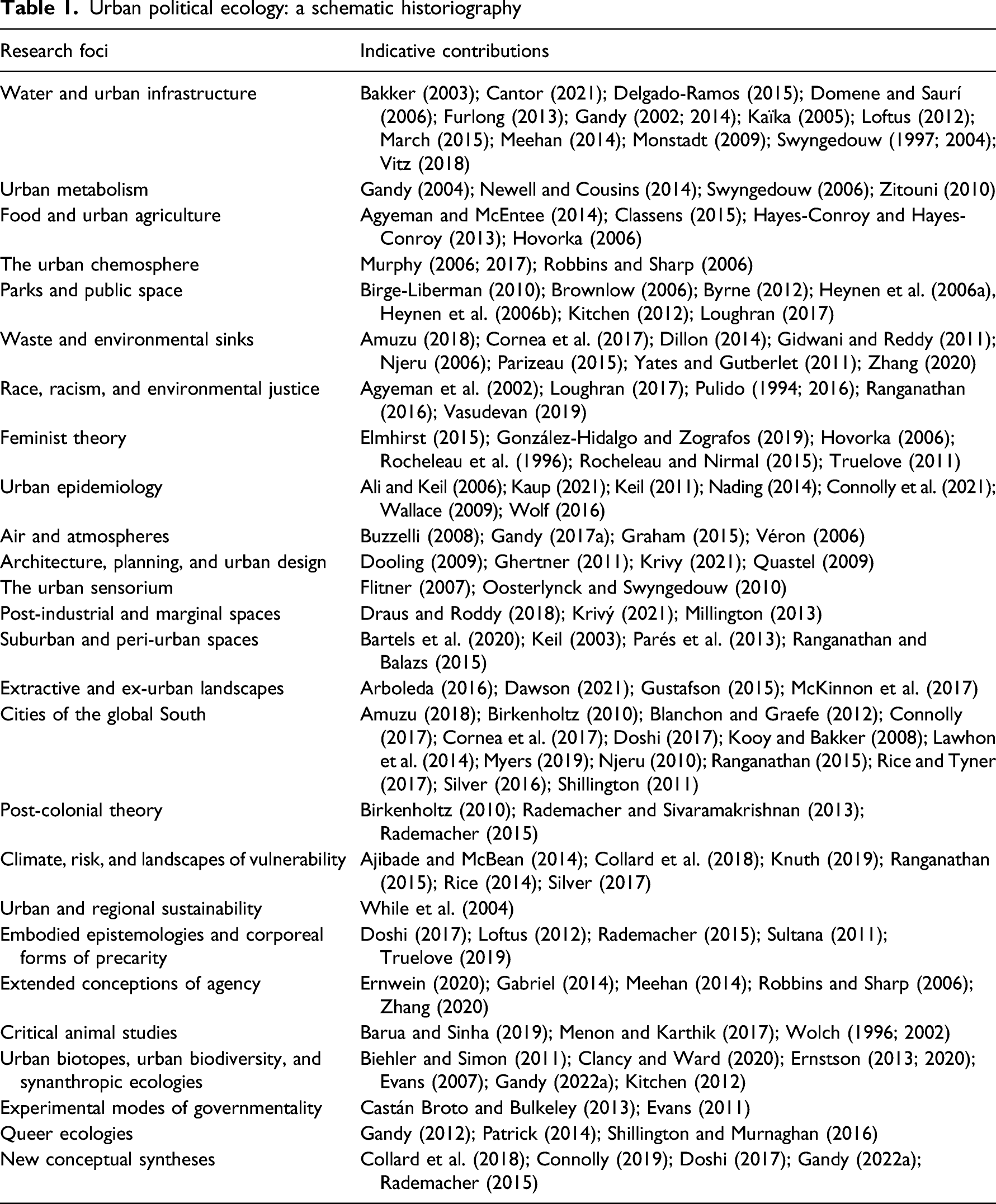
The ‘first wave’ of urban political ecology, if we use this temporal marker, incorporates at least six intellectual strands: the original insights of political ecology, with which urban political ecology has been closely associated from the outset; inputs from urban and environmental history; the Frankfurt School inspired critique of ideology, science, and technology; an elaboration of anti-essentialist materialisms that replaced dualistic conceptions of nature with a variety of relational and hybrid configurations; an emphasis on neo-Marxian interpretations of urban metabolism and the circulatory dynamics of capital and nature, reflected in studies of water, waste, air, and other life-sustaining components of the urban arena (with links to the cyborg urbanization thesis); and a range of investigations on the ground in response to racism, inadequate housing, toxic environments, and a host of other issues that had been systematically marginalized within systems-based approaches to urban ecology. Underpinning this first wave of scholarship was a focus on the multiple entanglements between capital, ecology, and social justice at a variety of metropolitan scales. The latent tension, however, between the centrality of capital and other explanatory insights was not resolved but rather displaced through an overwhelming emphasis on manifestations of social power within the urban arena. The interface between neo-Marxian urban theory and Latourian ontologies, for instance, and the emerging emphasis on socioecological forms of hybridity, was an early focal point for critique and wider reflection (see Grove, 2009; Holifield, 2009). Holifield (2009: 654), for instance, worried that a synthesis between neo-Marxian theory and actor-network theory would risk subsuming the distinctive insights of the latter within the all-encompassing analytical scope of the former.
The development of urban political ecology has been marked by a shifting geography of theory: early work was based especially in Los Angeles (led in particular by contributions from Mike Davis, Laura Pulido, and Jennifer Wolch), in Toronto (initiated by Roger Keil), and in Oxford (centred on the inputs of Erik Swyngedouw and his graduate cohort during the 1990s) (see Braun, 2005). Whereas the California-based research was more directed towards environmental issues in the Los Angeles metropolitan region, with links to questions of race, environmental justice, and the nascent field of critical animal studies, the Oxford cluster, led by Swyngedouw, originated in a more explicitly neo-Marxian theoretical idiom, and involved a wider range of settings for empirical investigations. In the next phase of development, from the early 2000s onwards, urban political ecology became a more dispersed intellectual network, with hubs of activity emerging at the University of Cape Town, the University of Georgia, the University of Manchester, the University of Minnesota, University College London, the University of British Columbia, and elsewhere. Whilst still predominantly Anglo-American in its institutional scope, we can also detect significant developments by the mid-2000s at universities dotted across Europe, including research institutes in Barcelona, Brussels, and other cities (see also Loftus, 2019). Writing in 2020, however, it is still apparent that urban political ecology research remains heavily underrepresented within the global South (outside of India and South Africa) which reflects the continuing institutional asymmetries that shape the global landscape of knowledge production. This is significant because urban political ecology has the potential to destabilize the preponderance of ‘developmentalist’ literature on urban environmental challenges in the global South (see Lawhon et al. 2014). Similarly, but for a different set of reasons, the urban political ecology lens has not filtered widely through urban scholarship in (and on) East Asia (exceptions include Chung et al. 2018). Despite these geographical limitations, however, the empirical scope of urban political ecology has steadily widened over the last ten years, along with additional conceptual insights derived from queer theory, feminist epistemologies, and critical race studies, as part of what has been termed a second, or even third wave of work (see Heynen, 2014).
Yet despite these significant advances, especially in terms of empirical work, the field of urban political ecology currently faces the prospect of a double marginalization: first, the larger field of political ecology remains marginal within urban environmental discourse, scarcely registering on the intellectual radar for dominant systems-based approaches within urban ecology, environmental engineering, landscape design, and cognate fields; and second, its neo-Marxian inflected conceptual terrain has found itself increasingly peripheral to recent theoretical developments such as multi-species ethnographies, new materialist approaches, and other emerging articulations of more-than (or other-than) human geographies. A question to consider is how the emerging emphasis on the specific role of cities within ‘global environmental governance’ squares with the specificities of an urban political ecology. Given the contemporary proliferation of environmental challenges, including their multiple manifestations within the urban arena, there is a danger that urban political ecology may find itself effectively excluded from these emerging debates. My aim in this article is to reflect on the possibilities for a productive conceptual synthesis between urban political ecology and a series of other intellectual vantage points.
In the remainder of this article I want to explore a series of challenges for urban political ecology in greater detail: the uncertain relations between urban political ecology and the practice of urban ecology as a sub-field within the biological sciences; the significance of expanded conceptions of agency, subjectivity, and other-than-human geographies of urban space; the implications of the neo-Lefebvrian redefinition of the urban realm; the challenge of urban epidemiology, including corporeal and zoonotic dimensions to the urban arena; the burgeoning interest in eco-criticism and the delineation of urban ecological imaginaries; and finally, the emergence of evidentiary materialism as an alternative posthuman configuration to new materialist ontologies.
II Where is the ecology?
To borrow a rhetorical refrain from Peter Walker (2005), in an earlier critique of political ecology, where is the ecology in urban political ecology? Can the term ‘ecology’ serve as more than a conceptual leitmotif or vaguely framed emphasis on urban ecosystems? What are the implications of a closer engagement between urban political ecology and the scientific domain of urban ecology? The urban political ecology literature has adopted a somewhat narrow conception of the epistemological complexities of non-human nature. There have been few attempts to directly combine ecological insights with neo-Marxian historical analysis in the urban arena. Partial exceptions might include William Cronon’s study of nineteenth-century Chicago or Debjani Bhattacharyya’s examination of the colonial reshaping of the Bengal Delta (see Cronon, 1991; Bhattacharyya, 2018). Whilst Cronon explores what neo-Lefebvrian scholars might now refer to as ‘operational landscapes’ for the provision of timber and other commodities, Bhattacharyya combines her analysis of ‘deltaic ecology’ with the tangled legalities of land acquisition. We should note, however, that both these studies emanate from the field of environmental history, focusing on the transformation of landscapes rather than a more tightly defined emphasis on urban political ecology.
Can we be more precise about the scientific challenges posed by ecology for urban theory? A lack of scientific curiosity within the urban political ecology literature has tended to occlude a systematic engagement with fields such as toxicology, epigenetics, ethology, and non-equilibrium ecosystem dynamics (see, for example, Landecker and Panofsky, 2013). Indeed, there has been an assumed degree of epistemological incommensurability even if the ontological terrain is widely shared. A closer engagement with scientific developments in ecology can help to illuminate specific dimensions to urban space such as the evolutionary dynamics of urban pathogens or the impact of light pollution on circadian rhythms for both human and non-human nature alike (see Gandy, 2017b). In the case of light pollution, for example, an urban political ecology research agenda could encompass the extractive zones, socio-technical pathways, and specific economic interests that are driving the exponential increase in artificial illumination, as well as a range of specific biological and psychological effects, including architectonic dimensions to the affective landscapes of late modernity.
During the twentieth century the concept of ecology within the biological sciences acquired more clearly defined spatial connotations through related terms such as ‘ecosystem’, ‘ecotope’, and ‘ecological zone’. The ‘urban ecosystem’ in particular has been the focus of a series of systems-based ecological models exemplified by the écosystème urbs of the Brussels school in the 1970s, the ‘industrial metabolism’ of the Vienna school in the 1980s, the ‘human ecosystem framework’ of the Baltimore school in the 1990s, and a number of related interdisciplinary research programmes (see Gandy, 2022a). The systems-based paradigm now dominates urban ecology yet there has been very limited engagement with this body of work from within urban political ecology, even from a historiographic perspective. This is not, however, a simple matter of the biophysical sciences and neo-Marxian urban theory talking past one another since systems-based models have flourished within the social sciences to become the ‘standard approach’ adopted in practice-oriented degree programmes in planning, design, environmental studies, and other fields. Indeed, we could argue that the systems-based approach to urban ecology, which constitutes a consistent conceptual counterfoil for urban political ecology, even if largely unnoticed by the dominant field itself, is now a quintessentially social sciences–based idiom that is gaining intellectual reach within the emerging resilience discourse of the ‘adaptive Anthropocene’. It follows, therefore, that a more rigorous engagement between urban political ecology and the biophysical sciences, which moves beyond the systems-based ecological paradigm, would mark the outline of a very different kind of research agenda.
Urban political ecology has also neglected the politics of urban ecology itself. In a North American context, for example, the period from the late 1960s onwards marked a partial reorientation of conservation biology away from concerns with game management and wilderness preservation towards the distinctive socioecological assemblages to be found in cities. At a political level, this reconceptualization of environmental discourse also began to encompass questions of race, corporeal vulnerabilities, and affective dimensions to metropolitan nature. In several European cities, by contrast, we find a twofold dynamic stemming from the politicization of existing strands of urban ecology and the concomitant ‘ecologization’ of aspects of land use planning. Some urban ecologists adopted a dual role as scientists and policy advocates to protect vulnerable biotopes or safeguard access to vernacular kinds of public space (see Lachmund, 2013). More recently, the rise of ‘citizen science’ connects with new geometries of knowledge production and scientific expertise (Lave, 2015). We can delineate an emerging interface between the study of novel ecosystems and new cultures of urban nature that valorize distinctive kinds of cosmopolitan ecologies (see, for example, Clancy and Ward, 2020). In South Africa, by contrast, urban biodiversity discourse has had a more complex relationship with both the post-Apartheid state apparatus and the alternative framing of a post-colonial conception of invasive ecologies (see Ernstson, 2020; Katzschner, 2013). In these different scenarios, we find that urban political ecology occupies a distinctive position in terms of exploring the intersections between urban ecology, as a field-based scientific practice, and the operation of social power within the urban arena.
IIl Agency and subjectivity
The urban political ecology literature insists on a distinction between different forms of agency: taking a lead from history, there is clearly a reluctance to inflate the agency of nature in relation to anthropogenic sources of environmental disturbance. As a result of retaining a clear dividing line between what we might term historical and bio-physical forms of agency, however, the field has been relatively slow to engage with more complex conceptions of subjectivity and emerging interest in more-than-human geographies (see Gabriel, 2014; Grove, 2009). The posthumanist emphasis on the decentring of the human subject, for example, has significant implications for conceptualizing the urban arena as a relational set of socioecological configurations. Similarly, urban political ecology has had little engagement with the shift from phenomenological to post-phenomenological insights in relation to architecture, landscape design, and ‘place-making’. The aesthetic manipulation of the urban realm has not been systematically explored in relation to (late) modern subject formation.
An expanded conceptualization of ‘extractive frontiers’ encompasses not just more distant locales but also to the shifting frontiers of non-human labour within the urban arena. A focus on non-human agency widens the conceptualization of the production of value under capitalist urbanization to include the contribution of animals such as the working horse of the nineteenth-century city, the valorized spectacle of animals in zoos and circuses, or the affective work of pets (see Barua, 2017). Similarly, we can consider the deployment of plants in urban space for the production of ‘metropolitan natures’ including metabolic aspects of air or water purification. More recently, the incorporation spontaneous forms of nature into landscape design opens up new kinds of extractive frontiers, including the production of less (human) labour intensive ‘post-municipal’ landscapes (see Ernwein, 2020). The neo-Marxian emphasis on the production of nature needs to be modified to take greater account of the domestication, enlistment, and ‘staging’ of non-human nature within the urban arena.
In the late 1990s it seemed that urban political ecology was poised to make a distinctive contribution to critical animal studies (see especially Wolch, 1996) yet subsequent years have seen only an intermittent engagement between neo-Marxian urban theory and non-human denizens of urban space. What insights might an urban political ecology lens bring to our understanding of the independent agency of nature? Although the Lefebvrian ‘right to the city’ has been elaborated within political ecology to encompass the ‘right to nature’, we hear little about the ‘right of nature’ to the city. Do crows or stray dogs, for instance, create urban space or merely thrive within it? In the case of stray dogs, there have been studies that link feral ecologies to specific factors such as uncollected waste, the presence of marginal spaces that can provide shelter, and the impact of mass pet abandonment (sometimes associated with forms of social and political upheaval). Research from Indian cities shows how non-human denizens of urban space such as dogs or monkeys reside within a diversity of relations rather than being allocated to specific biopolitical categories (Barua and Sinha, 2019; Srinivasan, 2019). There is clearly scope to extend an urban political ecology framework towards the ethical and biopolitical dimensions to the treatment of non-human others. The mass slaughter of animals, for instance, along with food processing industries, often occurs at or near the urban fringe, and poses a series of ethical as well as epidemiological questions (see, for example, Emel and Neo, 2015; Pachirat, 2011). The intersections between capitalist agriculture and the reconstruction of peri-urban food processing landscapes, along with elaborate infrastructure systems for the shipping of live animals, all form part of a natural focus for a critical political ecology of diet and nutrition (see, for example, Otter, 2020).
How should we conceptualize subject formation in response to environmental threats? In Stijn Oosterlynck and Erik Swyngedouw’s study of aircraft noise, for example, their analytical entry point is the ‘ontological foundation of the political’ rather than the delineation of the ‘noise sensitive’ human subject (Oosterlynck and Swyngedouw, 2010: 1579). In fact, urban political ecology is well placed to hold these contrasting intellectual vantage points in productive tension, combining subjective dimensions to the experience of soundscapes with structural aspects to the production of noise (see, for example, Flitner, 2007). Another example is the politics of sleep: in many cities, the combination of light pollution, excessive noise, and corporeal insecurity produces an extreme ‘sleep deficit’ among exposed populations. In Shaunak Sen’s documentary Cities of sleep (2015), for instance, limited opportunities for rest in Delhi become part of the political choreography of urban space. Lack of sleep, as one of the exhausted protagonists declares, serves as a delineation between ‘existing and not-existing’. In these and other instances of corporeal precarity the field of urban political ecology requires a combination of structural and affective modes of interpretation.
The intersection between urban political ecology and inter-subjective environmental phenomena invites a closer consideration of corporeal dimensions to social and political mobilization. The work of the philosopher Teresa Brennan (2004) is especially significant here in explicating the material dimensions to the affective experience of space as a multi-subjective field of interaction. Phenomena such as racism, misogyny, and homophobia emerge as historically situated and structurally generated forms of violence (see Gandy, 2017a). A materially grounded reading of affect, atmospheres, and other inter-subjective environmental phenomena sets up a distinctive conceptual position that differs from much of the ‘more-than-human’ or non-representational literature.
If we follow the recent call for ‘a more-than-human urban political ecology’ (Tzaninis et al. 2021: 232) then what are the conceptual and methodological implications? The focus on complex infrastructure systems during the first phase of urban political ecology led to a relative neglect of the socio-technical aspects of everyday life. A renewed emphasis on embodied practices, however, especially within the global South, has illuminated the co-existence of multiple and often partial networks that provide a variety of micro strategies for survival (see, for example, Doshi, 2013; 2017; Lawhon et al. 2014; Loftus, 2012; Monstadt and Schramm, 2017). Recent explorations of agency that combine insights from urban political ecology with object-oriented philosophy, Latourian inspired STS, and other fields include the role of ‘tool-power’ in urban infrastructure systems (Meehan (2014); the ‘micropolitics of everyday subject formation’ (Gabriel, 2014: 41); and cyborg inflected accounts of the role of specific materials in the production of informal housing (Ascensão, 2015).
Extended conceptions of agency within the political ecology literature include the path-breaking identification of ‘turfgrass subjects’ at the interface between ‘lawn communities’ and ‘lawn chemical economies’ (see Robbins and Sharp, 2006). There are commonalities here with research on the ‘urban chemosphere’ that frames the toxicological realm from both a structuralist and embodied phenomenological perspective. The feminist historian Michelle Murphy, for example, has explored the political and epistemological contours between ‘uncertainty’ and ‘inaction’ in relation to multiple forms of chemical exposure in the modern workplace (Murphy, 2006). More recently, Murphy introduces the term ‘alterlife’ as ‘a figuration of chemical exposures’ that is ‘as much about figuring life and responsibilities beyond the individualized body as it is about acknowledging extensive chemical relations’ (Murphy, 2017: 497). In a similar fashion to Brennan, we find that the affective realm is located within its material and historical context. The challenge for urban political ecology is whether it can articulate a structuralist yet post-phenomenological framing of corporeality that can accommodate inter-subjective dimensions to the affective experience of urban space.
An expanded conceptualization of the body-environment interface involves ‘unpacking the body’ (Guthman and Mansfield, 2013: 490). The concept of ‘trans-corporeality’, for example, introduced by the environmental humanities scholar Stacy Alaimo (2010: 2), emphasizes how ‘the human is always intermeshed with the more-than-human world’. Bringing the affective body into the analytical frame of political ecology highlights a different set of corporeal and elemental interactions. Similarly, aspects of affective resignation to ill health and environmental degradation have only been partially explored in the environmental literature (for exceptions, see Mah and Wang, 2019; Davies, 2018). Feminist and critical race studies have highlighted forms of ‘epistemic violence’ in relation to individual testimonies and the status of various forms of local knowledge (see Dotson and Whyte, 2013). There have been few explicit links, however, in the urban political ecology literature between variants of ‘strong objectivity’ à la Sandra Harding and the study of environmental justice.
The principal point of tension between urban political ecology and more-than-human geographies revolves around the question of agency. A reformulation of the conceptual terrain for agency and subjectivity points towards a modified neo-Marxian framework that can allow for the destabilization of the bounded human subject and new theoretical insights (see, for example, Arboleda, 2017; Ranganathan, 2015). We should be careful, however, to distinguish between an extended conception of agency à la Timothy Mitchell, which explicitly acknowledges differences between human and non-human forms of agency, and neo-vitalist ontologies that underpin what has been termed ‘new’ or ‘speculative’ forms of materialism (see section VII below).
IV The question of scale
A key question for urban political ecology is what constitutes the city or urbanization as a focus of analysis. There are unresolved tensions between Castells and Lefebvre, for example, over the analytical and political status of the urban arena (see Brenner, 2000; Keil, 2003). 3 The neo-Lefebvrian impetus towards an expanded conception of urban space, led in particular by Neil Brenner and Christian Schmid, now encompasses various types of ‘ecological frontiers’ or ‘operational landscapes’ that seek to dispense with bounded or nodal conceptualizations of urban space. Brenner, for instance, refers to a ‘deep confusion regarding the specificity of the urban itself’ as part of his critique of the ‘traditional concepts of cityness, metropolitanism, or urban/rural binaries’ (2013: 90). A key intervention here is Hillary Angelo and David Wachsmuth’s call for a political ecology ‘not of the city but of urbanization’ (Angelo and Wachsmuth, 2015: 16). In particular, Angelo and Wachsmuth claim that urban political ecology scholarship ‘has been curiously quiet on the very feature of the contemporary urban world that should make it so relevant: the dimensions of urbanization processes that exceed the confines of the traditional city’. On closer reading, however, this critique of Kaïka, Swyngedouw, and other scholars represents a somewhat lopsided caricature of this earlier body of work, which clearly does locate the socioecological dynamics of urban space within a relational set of flows that extends beyond a bounded conceptualization of urban form. The focus of these studies has been on both ‘the urbanization of nature’ and ‘the nature of urbanization’ at a variety of spatial scales rather than a reified emphasis on the city as a spatial container (a charge perhaps better directed at strands of quantitative spatial science). It is instructive, for example, that Angelo and Wachsmuth’s critique of Swyngedouw’s work ignores his field-based research in Ecuador, Spain, and elsewhere. Swyngedouw’s exploration of the production of water scarcity in Guayaquil, for instance, is situated within a set of wider developments including agricultural intensification, rural precarity, and the emergence of the clientelist post-colonial state (see Swyngedouw, 2004). Similarly, Roger Keil has emphasized an extended conceptualization of urban space that he terms ‘the networked matrix’ encompassing not just suburban or peri-urban agglomerations, but also global patterns of interconnectedness (not least through his work on SARS and urban epidemiology) (Keil, 2011: 716). The core claim of Angelo and Wachsmuth (2015: 21) that urban political ecology ‘has naturalized the city as the sole analytical terrain of urban analysis’ is misplaced. In fact, the scale-oriented critique of urban political ecology had already been posed by Braun (2005) in terms of the material connotations, historical specificity, and analytical framing of urban nature; rather than a simplistic distinction between cities and urbanization Braun raises a wider range of conceptual vantage points for the study of urban nature.
But what is the ultimate anchor point for a scale-based critique of urban political ecology? The challenge is to reframe the dialogue between different critical traditions, including neo-Marxian analysis, in such a way that it does not become reductive. The fear of theoretical fragmentation, or some form of intellectual balkanization, could be read differently as the challenge of working towards a novel conceptual synthesis. Epistemological vantage points within urban theory often operate as spatial metaphors for the production of knowledge in terms of coordinates such as top/down, bottom/up, inside/out, or base/superstructure. What, in other words, is the ‘constitutive outside’ for urban political ecology to deploy Derridean terminology? Even if the land use category of ‘the rural’ is less demographically significant than in the past, it nonetheless holds a significant ideological hold over the political antinomies between metropolitan and non-metropolitan environmental discourse in relation to fields such as the post-carbon transitions, re-wilding, and ethical relations to the non-human.
The metropolitan scale remains relevant for urban political ecology in both material and symbolic terms. There are specific socioecological assemblages, including a variety of cultural and scientific interventions, that might be overlooked by ignoring either the micro scale of ‘sidewalk ecologies’ or disregarding the role of cities as both cultural and ecological refugia. Effervescent cultural and political spaces such as Berlin in the late 1920s or Lagos in the early 1960s are potentially lost within a capacious conception of the urban. 4 There is clearly a degree of analytical disarticulation between capital and the production of space if the question of scale becomes too generalized. The city, after all, is not an abstract container but a politico-administrative fact. A critical engagement with the threat of climate change, for instance, requires a simultaneous engagement with multiple scales as well as a focus on the location of ‘the political,’ whether this be movements, networks, or place-specific constellations of power. The charge of ‘methodological cityism’ levelled at urban political ecology can be contrasted with planetary urbanization’s own difficulties with what the German historian Sebastian Conrad (2016: 135) terms ‘methodological globalism’. ‘The global’, notes Conrad (2016: 140), ‘is not a distinct sphere, exterior to national/local cases; it is, rather, a scale that can be referenced even when we look at individual lives and small spaces’.
Interestingly, however, in a more recent intervention, Angelo and Wachsmuth (2020) emphasize the specific contribution of cities to global environmental policy discourse: the role of the urban arena as an experimental field, institutional interface, or focal point for reworking socioecological relations has resurfaced, suggesting that perhaps the neo-Lefebvrian and urban political ecology literatures were not so far apart after all. Indeed, the scale-based critique of urban political ecology has tended to overemphasize the historiographic roots of the field within political ecology rather than urban history, thereby focusing on functional rather than cultural or political dimensions to the production of urban space.
V From urban epidemiology to zoonotic cities
Although the urban political ecology literature has engaged with some aspects of urban epidemiology, notably in relation to global connectivity and SARS (see Ali and Keil, 2006), there has been more limited reflection on corporeal geographies and the human body as an ecosystem in itself, including interest in multi-species ethnographies (see, for example, Guthman and Mansfield, 2013). Another element within the literature is the relationship between specific topographies and the presence of quintessentially urban threats such as dengue fever (see, for example, Gidwani and Reddy, 2011; Mulligan et al. 2012; Swyngedouw and Heynen, 2003), although again, the discussion has been largely focused around the material ecologies of disease rather than the politics of the body per se. 5 The prevalence of insect vectors for disease is inseparable from the underlying topographies of urban space: it is no accident, for example, that the North American foreclosure crisis has been accompanied by the spread of West Nile virus and other pathogens associated with the mosquitoes that thrive in abandoned swimming pools (see Reisen et al. 2008). These material specificities would be lost if we were to reorient urban political ecology away from the micro ecologies of urban space itself. Epidemiological insights into urban space require a political ecology of cities and urbanization, not an overarching focus on the latter to the relative exclusion of the former. The specific pathogens associated with urban environments such as dengue, chikungunya, and Zika illuminate multiple domains of inequality and corporeal vulnerability (see Kaup, 2021; Patchin, 2020). The control of Zika, for instance, has led to militarized biopolitical interventions in Brazil, Puerto Rico, and elsewhere through the enactment of high-profile aerial insecticide spraying and other measures.
The urban political ecology lens connects with the history of biopolitical modes of governmentality and the use of epidemiological knowledge to promote intensified forms of residential segregation. Here we find essentialist discourses of differential corporeal sensitivity in relation to inadequate housing, exposure to environmental risk, and other threats. The handling of race within the field of urban political ecology is clearly more than a question of enlarging the environmental justice framework but also extends to the epistemic critique of posthumanism (see section VII below). In this sense I would argue that the connections between urban political ecology and critical histories of embodiment form part of a necessary conceptual and epistemological realignment.
The precise implications of what Braun (2005: 647) refers to as ‘rhizomatic biogeographies’ for the political ecology of zoonotic pathogens have yet to be fully explored. It remains to be seen if the recent engagement of urban political ecology literature with the Covid-19 public health crisis will produce distinctive epidemiological insights of wider significance for anthropology, biology, and other fields. One promising strand of investigation concerns the intersections between ‘extended urbanization’ and multiple scales of analysis (see Connolly et al. 2021; Wolf, 2016). An emerging focus on the ‘zoonotic city’ would of necessity extend to new patterns of land use intensification, emerging economies of scale in industrialized agriculture, and the mass movement of live animals (see Gandy, 2022b). Emerging epidemiological landscapes highlight uncontrollable dimensions to nature à la Frédéric Neyrat, thereby challenging a panoply of constructivist discourses that seek to subsume the contradictory dynamics of modernity within the ‘ecologization’ of urban environmental discourse.
VI Eco-criticism and urban ecological imaginaries
Although the first phase of urban political ecology owed much to the Frankfurt School tradition, and especially its critique of ideology and science, it has paid much less attention to aesthetic insights into the cultural and ideological dimensions to capitalist urbanization. If we consider urban ecological imaginaries to be a particular kind of cultural construct then what are the ideological implications for urban environmental discourse? Although the urban political ecology literature has occasionally highlighted the role of ecological imaginaries (see Gabriel, 2014; Millington, 2013), there has not yet been a systematic engagement with the rise of eco-criticism as a cultural counterpart to the Anthropocene. The articulation of an ecological imaginary moves beyond a critical engagement with representational tropes towards the cultural articulation of alternative environmental futures. Bruce Braun (2015: 103), for example, reflects on the ‘place of imagination’ in relation to the politics of the Anthropocene but is there a distinctive contribution to be made by urban political ecology? We should first pause to consider what an ‘ecological imaginary’ might denote in the context of urban environmental discourse. Is an ecological imaginary merely a variant on existing understandings of the social imaginary à la Cornelius Castoriadis or something significantly different? Can we interpret an ecological imaginary as a particular ‘structure of feeling’, as elaborated in the cultural Marxism of Raymond Williams, or are we dealing with something altogether different? I would suggest, drawing on the insights of both Castoriadis and Williams, that an ecological imaginary denotes an inter-subjective and historically specific framing of environmental thought, including in some instances the cultural articulation of potentially counter-hegemonic alternative worlds.
The development of cultural theory under the idiom of urban political ecology can offer a significant elaboration of eco-criticism as the fast emerging and arguably dominant mode of aesthetic engagement with contemporary cultures of nature. The recent emergence of eco-criticism has struggled, for instance, to articulate an ‘outside’ beyond the phenomenological realm of human experience and its ‘reigning abstraction’ of the environment (see Medovoi, 2013: 124–125). A synthesis between neo-Marxian theory and aspects of eco-criticism might provide a conceptual vantage point from which to critically evaluate cultural representations of urban futures. Consider, for example, the capacity for cultural representations of the future to hold agency in the present (see Hansen, 2015). Indeed, the neo-Marxian critique of future imaginaries has gained poignancy precisely because the utopian promise of earlier variants of a technological utopia have significantly faded. These debates are already underway within science fiction studies, driven in particular by the contributions of Darko Suvin, and at a later stage Fredric Jameson, yet an engagement with forms of cognitive estrangement as a focal point for a wider reflection on ecological imaginaries remains underexplored within urban political ecology (see Jameson, 2005; Suvin, 2016 [1979]). The question, therefore, is can urban political ecology offer a distinctive mode of cultural critique in relation to imaginary urban futures?
We can discern some tentative steps towards a distinctive voice for urban political ecology in response to neo-romanticist depictions of post-industrial wastelands, ‘spatial voids’, or other kinds of marginal zones. The lens of urban political ecology has brought questions of class, race, and landscape into dialogue through the identification of specific modes of ‘racialized abandonment’ (see, for instance, Bigger et al. 2018). Nate Millington contrasts a highly aestheticized vision of post-industrial urban ruins, overrun by nature and emptied out of human inhabitants, with a more embodied and relational engagement with marginal spaces (see Millington, 2013). Other examples include the analysis of the iconographic complexities surrounding the post-socialist transition where urban and industrial landscapes have been interpreted as a palimpsest of socioecological and material traces (see Krivý, 2021). In these and other instances the cultural trope of emptiness, which in itself can serve as a harbinger for forms of violent erasure, is replaced by an emphasis on more haptic interactions with both human and other-than-human geographies.
Can urban political ecology offer a distinctive contribution to critical discourses on the Anthropocene? Certainly, a more nuanced and historically situated conception of urban space is at least more implicitly present within the analytical framework offered by alternative monikers such as the Capitalocene or the Plantationocene. As for the dominant Anthropocene trajectory, as framed by the geophysical sciences, there is an evident tension between an adaptive Anthropocene, framed by the infinite malleability of nature, and a dystopian Anthropocene steeped in neo-Malthusian intimations of inevitable collapse. Bruce Braun (2014: 60), for instance, highlights the strategic dimensions to governing life, deploying a biopolitical analytical frame, to emphasize how the Anthropocene has engendered a characteristic mode of governmentality framed around the ‘modulation’ of natural processes (see also Swyngedouw and Ernstson, 2018). The rise of the adaptive Anthropocene offers multiple entry points for a radical ecological critique that can combine neo-Marxian analysis of global environmental change with critical race studies and other fields. Thus far, I would argue that urban political ecology has tended to underplay the ideological dimensions to political mobilization: intersections between racism, xenophobia, and anti-environmental discourse tend to be read off structural dimensions to the urban arena rather than considered in relation to deeply rooted race-based political projects. Although the techno-managerial realm of geo-constructivist discourse has been widely discussed, the concomitant resurgence of nativist anti-environmental politics has received far less attention in the urban political ecology literature.
VII From neo-vitalism to evidentiary materialism
It is surprising that urban political ecology has had so little to say about the neo-vitalist turn in environmental research. Despite the scientific evidence for neo-vitalism, and associated tropes of new materialism, being at best highly sketchy, the work of key proponents such as Jane Bennett, who draws extensively on the ideas of Hans Driesch, has become highly influential within geography, anthropology, and cognate fields (see, for example, Abrahamsson et al. 2015; Hoppe and Lemke, 2021). Bennett’s assemblage-based account of the North American blackout, for example, does not engage with the underlying causes of infrastructure failure. Although she is right to highlight the limits to ‘human exceptionalism’ (2005: 461), we do not learn why the system itself had fallen into such a ‘shabby condition’ (2005: 462). But even if the response of new materialists might be that urban political ecology is posing ‘uninteresting’ questions (such as the role of capital in environmental degradation), I would argue that a progressive political ecology, as part of its distinctive contribution to environmental discourse, should at least be aware of the history of the field. Urban political ecology has yet to engage with historiographic aspects to the origins of neo-vitalism such as the organicist ‘ultra conservatism’ of Jakob von Uexküll and other figures associated with early twentieth-century environmental ideas (see Stjernfelt, 2011). Understandably, some of the most trenchant critiques of organicist or obscurantist twentieth-century environmental thought have emerged within the critical leftist literature on nature and landscape in post-war Germany (see, for example, Trepl, 2012). Notwithstanding the philosopher Oliver Marchart’s case for a ‘Left Heideggerianism’, which is open to question, one might expect a more robust engagement from urban political ecology with the historiography of European environmentalism (see Marchart, 2007). There are commonalities here with the reappraisal of the colonial archive in the work of Achille Mbembe, Ann Laura Stoler, and other scholars, that resituates ontologies of knowledge in relation to wider choreographies of violence. Viewed from the perspective of post-colonial studies and critical race theory the intellectual legacy of neo-vitalism is far from benign.
A significant alternative to neo-vitalism is represented by the forensic turn in urban political ecology based on a conceptual synthesis between the role of organisms as ‘environmental sensors’ and the specific body of work associated with ‘forensic architecture’. The development of what might be termed ‘forensic ecologies’ is underpinned by a critical realist ontology but clearly moves beyond a restricted emphasis on the individual human subject (see Gandy, 2022a). The investigative skills of palynology, for example, can help to identify sites of violence etched into the vegetation history of the landscape (see Weizman, 2017). Furthermore, the emphasis on collaborative forms of knowledge production provides an epistemological dynamic that unsettles the relationship between laboratory-based science and grassroots research practice (see Lave, 2015). The boundaries of ‘detectability’ – note the productive tension here with Michelle Murphy’s notion of ‘imperceptibility’ – can be expanded to produce counter-hegemonic data, or even legal instruments, that can provide insights into different patterns of environmental degradation. The use of living organisms as posthuman ‘sensors’ presents a collaborative mode of more-than-human agency that is capable of producing data which is robust enough to withstand legal scrutiny (see, for example, Gabrys, 2018). Here we find potential intersections between political ecology and critical legal studies: earlier suspicion towards the role of law in progressive environmental campaigns, derived in part from the experience of fields such as labour relations and intellectual property rights, has in recent years been tempered by a shifting political context, marked by the rise of anti-environmental authoritarianism, the widespread undermining of independent judicial systems, increased levels of violence and intimidation against ecological activists, and the fostering of scepticism towards science and expertise of all kinds (see Lockwood, 2018; Middeldorp and Le Billon, 2019). The growth of interest in critical legal theory in geography, sociology, and other disciplines is indicative of a changing intellectual terrain in which an emphasis on the counter-hegemonic use of scientific knowledge has garnered fresh significance in urban and environmental discourse (see, for example, Santos and Rodríguez-Garavito, 2005). Furthermore, a renewed emphasis on causality, through the lens of evidentiary materialism, enables questions of culpability and legal liability to be directly addressed.
The growing threat of climate change requires an alternative conceptual framing to the interchangeable natures of geo-constructivist interventions or the recasting of meteorological phenomena as ungraspable hyperobjects. A distinctive contribution from urban political ecology can clearly move beyond a critique of resilience discourse and other techno-managerial paradigms, yet we still need to clarify the multi-scalar ontological domain that forms the basis of environmental concern. A relational, historically situated, and network-oriented conceptualization of capitalist urbanization can illuminate multiple types of extractive frontiers including diverse forms of environmental and epidemiological risk. In this sense urban political ecology provides a point of departure from systems-based conceptualizations of environmental change in which the role of historical agency is either rendered obscure or effectively restricted to the choice-based idioms of social psychology and related fields. A critically engaged urban political ecology also forms a counterpoint to emerging forms of ‘ecologization’ within environmental discourse that rest on the fetishization of an imaginary external nature as a blueprint or rhetorical leitmotif for the organization of human societies, including the provision of an ideological veneer for the speculative dynamics of the urban arena. Furthermore, an interdisciplinary engagement between urban political ecology and evidentiary materialism, underpinned by the forensic impetus within architectural theory and critical legal studies, offers the prospect for a more collaborative mode of epistemological work, including greater sensitivity towards alternative sources of knowledge. What if urban political ecology were to team up with forensic accountancy, for instance, and ‘follow the money’ behind different patterns of environmental destruction? The outcome of this conceptual and epistemological realignment might not only be more analytically incisive but also resonate more effectively with an anxious public sphere beyond the academy.
VIII Conclusions
Urban political ecology is clearly not a conceptual term in itself, nor does it represent a single theory or even one research agenda. ‘Why, then’, asks Bruce Braun (2005: 647), ‘do we need a specifically urban political ecology?’ Maybe we are in a better position now to answer Braun’s earlier (and most likely rhetorical) question some 15 years since his original intervention. When one looks back over the field it seems clear that the difference between ‘urban political ecology’ and the related, and in many ways, precursor field of ‘political ecology’, is not an important or interesting distinction to maintain. At one level, therefore, it is merely a matter of thematic emphasis, but possibly also an indication that ‘the urban’ has become both conceptually and materially more diffuse over this period. So, my answer to Braun’s question would be ‘perhaps’ since there are distinctive elements to the urban arena that ought not to be simply subsumed within the expansive field of political ecology.
The neo-Lefebvrian challenge to urban theory suggests that conceptual or material differentiations between urban and ‘non-urban’ spaces are of declining significance. My argument here is somewhat different: whilst I accept that there is a degree of blurring between various types of material entanglements that might once have been interpreted separately, there are nonetheless significant differences in terms of the ecological dynamics, and associated cultures of nature, to be found in different types of socioecological formations.
Is the question ultimately one of an articulation between ecology – broadly defined – and neo-Marxist analytics in the urban arena? In other words, does urban political ecology represent more than a mere extension of political ecology into the urban environment? What, if anything, is the distinctive contribution of urban political ecology to environmental research? Perhaps the prefix ‘urban’ is no longer needed, since the field has come full circle, under an extended characterization of the urban, back to its empirical roots in political ecology, so that the question is one of the limits (or opportunities) for neo-Marxian contributions to environmental analysis, and not really a question of ‘urban’ versus ‘non-urban’ at all.
In their current usage, the terms ‘political ecology’ and ‘urban political ecology’ clearly overlap to the extent that they often appear interchangeable. A fairly loose distinction between ‘political ecology’ and ‘urban political ecology’ is already evident in contributions from Mary Lawhon, James McCarthy, and many other scholars. There are new conceptual syntheses emerging such as ‘Gramscian political ecology’ and ‘megapolitan political ecology’ within which the prefix ‘urban’ appears to be largely superfluous (see Calvário et al. 2017; Gustafson et al. 2014; Loftus, 2013) Perhaps there is little sense, therefore, in any continuing attachment to a specific field named ‘urban political ecology’ with a different set of conceptual and methodological antecedents to ‘political ecology’ as a whole. Maybe we should simply return to Swyngedouw’s original call for a ‘richer urban ecology’ as an alternative terminology that avoids any restrictive demarcations and clearly allows for a range of new developments (Swyngedouw, 1996: 66). And yet in reviewing the current status of the field, I am left wondering whether there is something especially intriguing about urban environments and their socioecological dynamics, such as the global impact of urban zoonoses or the epigenetic effects of light pollution, that does lend itself to a modified yet complementary theoretical framework that is distinctive in certain respects from a broader emphasis on ‘political ecology’ tout court.
Can the term urban political ecology accommodate typologies that are framed around a transition towards ‘second’ or ‘third’ waves of scholarship as Nik Heynen and others have suggested? There are clearly continuities in terms of the emphasis on power, critical realist epistemologies, the self-conscious articulation of historical agency, and wider understandings of causality that connect between these on-going and interlinked areas of work. Heynen’s (2018: 446) recent call for a ‘heterodox imagining’ rather than his earlier emphasis on sequential waves of scholarship, allows for a diversity of perspectives, along with new modes of conceptual and investigative experimentation. If urban political ecology is to remain a relevant and intellectually generative field it needs to counter perceptions that it is not raising interesting questions or advancing innovative methodologies. Urban political ecology should not give an impression that the answer to any given research question is known in advance so that all cultural or material phenomena are effectively reducible to the exigencies of capital in the final instance. Clearly, urban political ecology retains the dynamics of capitalist urbanization as a pivotal dimension to explanation, but can a more nuanced conception of historical materialism engage with multiple points of causality? Can the implicit reductionism within some earlier studies be supplanted by a less androcentric materialism that can take account of feminist standpoint theory, multi-species assemblages, and other-than-human geographies?
What might a new configuration of urban political ecology scholarship contribute to our understanding of Guayaquil, the city that inspired the ‘first wave’ of work in the field, and has recently been devastated by the Covid-19 outbreak? This Ecuadorian metropole of nearly three million people is gripped by a public health crisis, among the worst in Latin America, but is also framed by the possibilities of what the art historian T.J. Demos refers to as ‘activist constitutionalism’ in the environmental arena (Demos, 2015). Of course, there are many thousands of medium-sized cities that might form the focus of critical analysis, as well as other permutations of urban form ranging from remote infrastructural outposts to vast littoral conurbations.
In this article, I have tried to avoid the pitfalls of a neo-nominalist historiography based on the circulation of terms rather than ways of thinking. In this sense, urban political ecology is better characterized as a network of ideas, scholars, activists, and research practices. In particular, I am interested in the significance of ecology, as a relational analytical framework, for the analysis of capitalist urbanization as a historical process. Neo-Marxian theory remains a vital analytical tool even if its articulation with other conceptual domains remains fraught, complex, or sometimes ill-defined. In any case, the question of what is ‘political’ is clearly not reducible to the neo-Marxian component of urban political ecology, as reflected in recent insights from queer theory, feminist epistemologies, and other fields.
In reflecting on future directions for urban political ecology we need to consider two intersecting processes in particular: first, the shifting geographies of urbanization; and second, the institutional landscapes within which urban theory itself is evolving. The intellectual terrain of urban political ecology is still heavily marked by what Edgar Pieterse terms the ‘gravitational pull’ of Anglo-American global theory despite the extending empirical reach of new urban and environmental research into the diverse metropolitan landscapes of the global South (see Pieterse, 2013; Palat Narayanan, 2021). Although alternative circuits of environmental knowledge production do exist – consider, for example, the regular book fairs held in Guadalajara and Chennai, for Spanish and Tamil language literatures, respectively – there remain formidable cultural, economic, and institutional barriers towards the dissemination of these works in the global North (see Collyer, 2018). If anything, the global production of academic knowledge is becoming more parochial in terms of the inward-looking dynamics of the Anglo-American sphere and more monopolistic in terms of tightening corporate control over publishing opportunities (including this journal).
I wish to conclude with a final observation on the urban political ecology literature that is seldom discussed: there is clearly a commitment to ‘slower’ modes of exposition such as the writing of books or more complex narrative forms, frequently drawing on long-term studies, including ethnographic engagements with specific sites. This emphasis on a gradual gestation of research and longer-term writing projects, often involving the use of archives, is suggestive of the expositionary influence of history within the field, thereby highlighting the ‘dual origins’ of urban political ecology within urban history and political ecology. These more ‘traditional’ modes of scholarship such as research monographs form a bulwark against the instrumental impetus of the wider academic landscape and suggest that urban political ecology has a protective role to play within the academy itself, not least in terms of strengthening the status of geography and cognate fields within the disciplinary hierarchy.
Footnotes
Acknowledgments
I would like to thank Noel Castree and the referees for their helpful feedback on an earlier version of my article. Thanks also to Esha Marwaha, Louise Moschetta, and Mathilda Rosengren for assistance with tracking down some of the sources. I am grateful for audience feedback from seminars held at Aarhus University, the Polytechnic University of Turin, and ETH Zurich. The research was supported by my ERC Advanced Grant Rethinking Urban Nature.
Declaration of conflicting interests
The author(s) declared no potential conflicts of interest with respect to the research, authorship, and/or publication of this article.
Funding
European Research Council
