




Abstract
An emergent polar futurism characterizes the contemporary built space of climate science in Antarctica, inaugurated in large part by the British Antarctic Survey's cutting-edge Halley VI research base. This article analyzes the spatial form, design, and use of Halley VI as well as the rhetoric surrounding it, seeing in Halley VI an expression of a particular “socio-technical imaginary” that implicitly gestures toward a tendential integration of climate science and global logistics. Alongside claims toward fostering a comfortable, communal life among its inhabitants, the imaginary embedded in Halley VI is one where climate research is subsumed within capital's broader aims to facilitate stable logistical movements and infrastructural durability amid chaotic, volatile conditions, a subsumption that bears in particular on the knowledge workers who inhabit the base. What a reading of the base's layout, interior, and lived-in uses exposes, the paper claims, is an implicit portending of a growing proletarianization of sensual experience and knowledge work among residents at the base, increasingly displaced as they are from the subjective core of the base's operations. This reading both extends and complicates recent calls in polar geographies to attend to speculative figurations of Antarctic futures, channeling Halley VI's polar futurism through structural determinants drawn out of literatures critically dealing with design, the history of systems sciences, and theorizations of ongoing restructurings of contemporary labor. The article suggests then that imaginaries of Anthropocenic futures such as those embedded in Halley VI's polar futurism might serve at once as speculative-projective tools and implicit sites for carrying out critiques of tensions and pernicious trends that underlie such Anthropocenic speculation.
Introduction
The 2016 exhibition, “constellation.s: habiter le monde,” at the arc en rêve centre d'architecture in Bordeaux, described itself as a “project that explores new ways of inhabiting the world [un projet qui explore les nouvelles manières d’habiter le monde]” (arc en rêve centre d'architecture, 2016). Among the various architectural novelties on display was the recently constructed Halley VI research station, the newest iteration of a British Antarctic Survey (BAS) base, originally established in 1956 on the Brunt Ice Shelf. The new base's flashy, sci-fi-inspired design boasts certain technical feats: sitting atop hydraulic legs that give the base mobility and allow it to be hoisted above layers of accumulated snow that left previous iterations of the base buried are detachable and deconstructable modules that aid in relatively rapid dis- and re-assembly (see Figure 1). These features, direct responses to the ice shelf's distinctly extreme conditions, most potently the threat of rapid ice shelf calving, complement a set of internal features that suggest their own “new ways of inhabiting the world” for the inhabitants within. Interior wall and lighting patterns designed in consultation with color psychologists, large, opportunely-placed window panels, alarm clocks fitted with light fixtures to produce artificial dawns, and scent-infusing Lebanese cedar walls all suggest a controlled environment, at once comfortable despite the bare, oft-hostile, icy surroundings and capable of directly mediating relations to those surroundings for the scientists, technicians, and operational laborers who reside on the ice shelf each year. Add to this an organization within the base of life, work, sociality, and recreation that claims to facilitate novel, even utopian, modes of communal social being. Halley VI fuses “new ways of inhabiting the world,” socially, technologically, and subjectively, all as part of a larger project of global climate research understood as crucial to sustaining life on Earth amidst present and oncoming climate crisis.
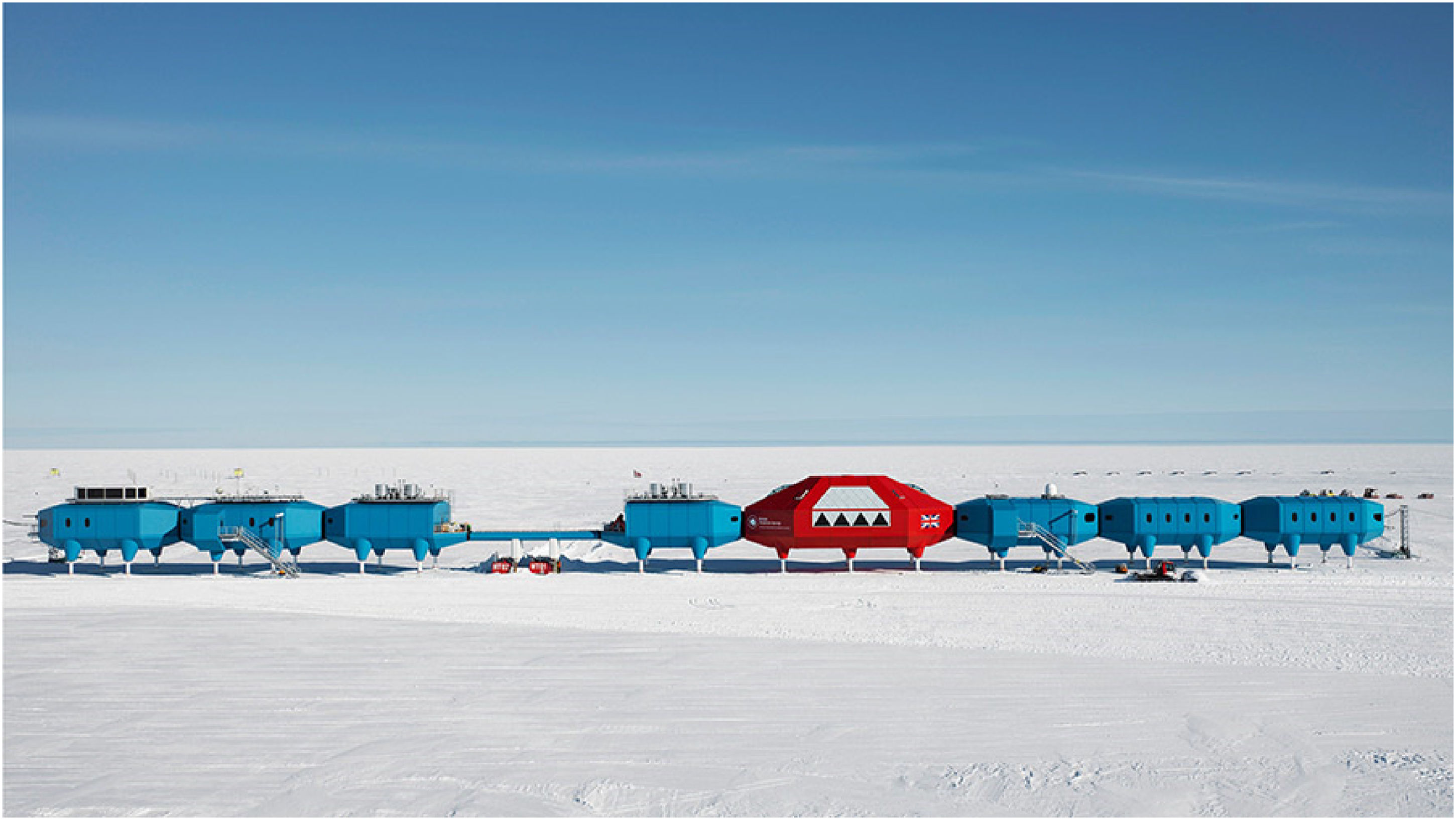
Full view of Halley VI from the outside, Source: Hugh Broughton Architects (Hugh Broughton Architects, 2022).
Halley is BAS's longest-running research station on the southern continent. Operational since the late 1950s, the physical space of the station is currently on its sixth iteration, previous iterations having been abandoned or demolished. Located amid exceptionally pristine conditions that make it an epistemologically privileged site for generating atmospheric measurements, Halley has long been an important site for climate and atmospheric research with global stakes and became perhaps best known as the point of discovery of the “Ozone hole” over the Antarctic (Slavid, 2015), credited to the fortuitously ongoing stream of Ozone measurements collected at Halley dating back to 1956 (Shanklin, 2010). The station, however, though ostensibly operable year-round, has closed during the Antarctic winter season since 2017 over fears of becoming separated from the larger Brunt Ice Shelf while otherwise inaccessible, this despite being, as per BAS, “the world's first re-locatable research facility” (British Antarctic Survey, 2022). Over the last half-decade and for the foreseeable future, what's been presented as a novel experiment in planetary inhabitance, fostering comfortable, human life amidst the conditions of the Anthropocene, largely houses increasingly automated machinery and scientific instruments running independently of human presence. Halley VI demands, then, alongside considerations of its futurist, utopian novelty a critical examination of the contradictions and implicit figurations embedded within, regarding the future of scientific and logistical labor.
In both its utopian novelty and what may be implicitly held together with that, Halley VI, as this article elaborates, comes to express a wider “socio-technical imaginary” (Jasanoff and Kim, 2009) that gestures toward futures of climate research and Anthropocenic planetary inhabitance and that informs design choices reiterated at climate research stations scattered across polar space (Slavid, 2015: 88–89). Halley VI acts as an expression of an imaginary that's outwardly utopian in its visions of future Anthropocenic life, but that forces us to ask what such utopian speculation carries with it, particularly in its linking of scientific practice and a managerial approach to ecological crisis. As I go on to show, imaginaries of Anthropocenic futures such as those embedded in Halley VI serve then at once as speculative-projective tools and implicit sites for carrying out critiques of tensions and pernicious trends that underlie such Anthropocenic speculation.
Regarding “socio-technical imaginaries,” Sheila Jasanoff notes, “Through deployments of labor and capital … imaginaries get embedded in the concrete artifacts of industrial civilization” (Jasanoff, 2015: 327). In begging the question of how to critically understand the implications of the imaginary that Halley expresses, Jasanoff's statement orients a focus in this article, drawing together concerns from a set of literatures, on structural determinants of sociality and subject formation and the social organization of labor, recognizing Halley's labor regimes as undergirding facets of the construction of a global “climate knowledge infrastructure” (Edwards, 2010: 19). Recent work in polar geographies, invoking prefigured futures projected out from forms of life in the polar regions, I suggest, can be usefully brought into conversation with structural determinants that channel and manage novel modes of subjectivity and sociality. The design and rhetoric around Halley VI present a helpful basis for meditating on these structural determinants, pointing to logics and organizational imperatives at play in the production and organization of laboring subjects. In that sense, said design offers a ground-level view of what's been widely problematized in historical, geographic, and sociological work on systems sciences, including global climate science research, as an oft-depoliticized managerial imaginary. This ground-level view opens onto insights into the undergirding labor infrastructures sitting behind global climate research, Halley presenting a pertinent arena for extending lines of thinking on contemporary trends within and restructurings of labor to a site of knowledge work couched within climate scientific and Anthropocenic imaginaries of future ecological extremes.
To develop these lines of thought, I perform in the second and third parts of this article, a reading of the Halley VI base and its imaginaries from within. Here, I argue that, in the context of an imaginary of climate science receding into efforts toward infrastructural management, the base's design effects at once what Bernard Stiegler calls a “proletarianization of sensibility” and a proletarianization of the work of knowledge production itself. Imagined amidst these proletarianizations are scientists, technicians, and operational labors collapsed into a global, logistical subject locatable anywhere or nowhere. The lavish, central social module becomes a focal point then of what's opened up by these proletarianizations, possibilities for a communal life beyond toilsome work in the logistical enclosures that climate volatility ostensibly demands. These possibilities however lie in ongoing tension with the social organization of knowledge work's proletarianization. Halley VI at once projects a humane communal life amidst climatic extremity and implicitly portends a growing marginalization of humans to the labors of climate science. Alongside claims toward fostering a comfortable, communal life among its inhabitants, the imaginary embedded in Halley VI is one, I suggest, where climate research is subsumed within capital's broader aims to facilitate stable logistical movements and infrastructural durability amidst chaotic, volatile conditions, a subsumption that bears in particular on the knowledge workers who inhabit the base.
This reading of Halley VI is framed in terms of the base's “polar futurism,” calling upon invocations of futures in polar geographies, as well as rhetorical framings of the base itself. Hugh Broughton, for instance, the head architect in charge of designing the base acknowledges science fictional inspirations, including Thunderbirds and Star Wars’ All-Terrain Walkers, stating, “In all seriousness however the futuristic nature of these buildings is a little inevitable” (Roberts, 2020). Conditions, this statement suggests, at the extreme cusp of human experience demand built spaces at the science fictional cusp of the human imagination. The base then invites witnesses and analysts to read it for the imaginaries it deploys and projects, and so, I aim, methodologically, in the first case, to perform a reading of Halley VI's design, through a look at design schematics, promotional materials, media objects, and other sources that develop a consolidated rhetoric around the base.
This practice of reading is strategic in relation to limitations to the possibilities afforded to researchers interested in polar geographies, especially in Antarctica. Halley, despite its centrality to the constitution of a global picture of climate and climate change, is at once hyper-remote and extremely small, receiving far fewer visitors from other bases than McMurdo, Scott, Ross, or other stations in the Antarctic. In the last six years, only a summer team numbering just a couple dozen people has gone down, less even since the beginning of the COVID pandemic. Even Halley's core scientific researchers are not necessarily present at the station—the head of the station's Clean Air Sector Laboratory, one of the main station projects, for instance, has never been to Halley but indicated to me that she knows her lab intimately as a function of networked information, including photographs, camera feeds, and the reports of often younger doctoral researchers circulating physically through the lab.
Taking cues from how Halley operates as a space of networked circuits of information, and from critiques of the presumption that presence in the extreme, remote Antarctic affords particular legitimacy to research endeavors (Howkins 2010; Neilsen and Philpott, 2018: 6), I draw on interviews I conducted remotely with a range of researchers and operations team members who have spent time at or whose work has intersected with Halley. 1 These include science and operations team members who have worked multiple seasons at the base, researchers who have developed active Halley research projects, previous Halley V station inhabitants, and researchers who have drawn on oceanographic and atmospheric data collected at Halley. During these interviews, I aimed to draw out a picture of day-to-day life and labor at Halley, of sociality and social dynamics, of shifts, trends, and future expectations in how work is conducted, as well as responses to the base design. Alongside my own interviews, I draw on the expansive interview materials found in the BAS oral history archives as well as BAS media materials documenting experiences of the Antarctic. And while this article focuses on contemporary design and interview materials, it falls into a larger research project that incorporates BAS archival materials, including base journals and on-base magazines, offering a composite sketch of older generations of British Antarctic life.
Out of these materials and in conjunction with ongoing work on polar geographies, a futurism that combines novel possibilities of technological mediation, social organization, and subject formation emerges, and one tied to the distinctly extreme polar settings for which Halley VI and its reiterations are especially suited. This futurism is heterogenous, even multi-polar, pointing at once to utopian possibilities for a communal, dis-alienated life under Anthropocenic conditions and toward the ever-further extension of ongoing structural trends in the constitution of global labor, logistics, and infrastructure. As such, to think in terms of the “polar futurism” of the Halley VI base is to think between the poles of seeing in the base a tool for prefiguring speculative-projective possibility and a tool of critique, recognizing what might perniciously lie behind that speculative-projective possibility as bearing upon imaginaries of planetary inhabitance.
Channeling polar futures through design, management, and labor restructuring
In positioning Halley VI at the cutting edge of Anthropocenic inhabitance, the “constellation.s” exhibition echoes features of recent scholarship on the Antarctic. Anthropologist Juan Francisco Salazar, for instance, points to Antarctica as a “laboratory for thinking alternative way of living in the Anthropocene” (Salazar, 2017: 152), a basis for a methodological emphasis on speculative practices outlined as such: “my concern has been to explore how futures are imagined and hoped for in relation to how novel forms of sociality emerge in extreme environments” (Salazar, 2017: 153). Futurity here is figured in relation to matters of sociality, part of an intervention into conceptual and methodological explorations of Antarctica's historico-geographies over the last two decades. Salazar, alongside Jessica O’Reilly, argue for the significance of Antarctic inhabitance, understood by way of ethnographic approaches to the continent, to contemporary Antarctic place-making. As they note, “In Antarctica … inhabitation is something lived and intentional, built by humans both from top-down governmental practices and bottom-up improvisations of everyday Antarctic life… As Antarctic people inhabit their polar places, their place work becomes attuned to the top-down governmental postures of Antarctic geopolitics. But more importantly, the everyday lives of everyday Antarctic people also resist this, creating other more quotidian, intimate places in research stations: this forms the core of inhabiting Antarctica” (O’Reilly and Salazar, 2017: 11). For them, recognizing distinct forms of social interaction and subject formation wrests totalizing pictures of Antarctic geographies away from sheer attention to symbolic, representational, legal, and governance structures which have all been crucial to critical scholarly characterizations of the Antarctic.
Such work has usefully made sense, for instance, of representational structures at play in the Antarctic, including the distancing effects of technoscientific mediations for visualizing the Antarctic (Yusoff, 2005: 389–390); the constitution of core objects of knowledge in Antarctica via technoscientific and narrative techniques (Antonello, 2017: 93–94); and values and expectations around the Antarctic as consolidated within imaginative narratives of the continent (Leane, 2012). The development of representational tools and strategies constituting a distinct Antarctic space-time has happened within a unique institutional, legal, and geopolitical landscape that has come under the attention of much of the work on Antarctic geographies. This work touches on legal geographies of the Antarctic going back to the International Geophysical Year and the establishment of the Antarctic Treaty System (Collis, 2010); the geopolitical performances of Antarctic built space (Collis and Stevens, 2004); and the stakes of Antarctic research stations for formally and informally establishing sovereignty on the continent (Dodds and Nuttall, 2015: 19), from early mapping endeavors (Dodds, 2002: 14–18) to a more recent environmental “paternalism” (Howkins, 2011: 182).
In turning toward ethnographic approaches to place-making to dislodge an over-emphasis on top-down structures, Salazar and O’Reilly note that recognizing the centrality of logistical and infrastructural considerations to life and knowledge production in extreme environmental conditions “might suggest that Antarctic settlements will continue to be mostly logistical nodes for (scientific) data traffic” or “outposts,” a term they draw on from the work of environmental historian, Steven Pyne (O’Reilly and Salazar, 2017: 22; Pyne, 2007). And yet, to this suggestion, Salazar and O’Reilly starkly disagree, seeing in ethnographic findings on the continent the seeds of alternative futures grounded in the bottoms-up development of novel modes of subjectivity and sociality, or what they call “experiments of human dwelling in extreme environments” (O’Reilly and Salazar, 2017: 22). 2
Sympathetic to the wish to dwell in alternative figurations of speculative horizons to those that overdetermine the future as inexorably catastrophic, I would suggest that the thinking reflected in O’Reilly and Salazar's work usefully avoids pitfalls warned against by others regarding Antarctic futures. Allesandro Antonello and Mark Carey have, for instance, critiqued a “Future Time” temporal sensibility emerging out of the analysis of ice cores that casts future climate catastrophe in near theological terms independent of ongoing human presence and intervention (Antonello and Carey, 2017: 194–198). The futures figured by novel modes of inhabitance evade such easy overdeterminations. At the same time, I wish to suggest that the production of novel subjectivities and forms of social life can’t be neatly analytically separated from the operations of logistics and infrastructure, a point usefully made by Sandro Mezzadra and Brett Neilson, when they claim, “Logistics actively produces environments and subjectivities, including those of workers and labor forces, through techniques of measurement, coordination, and optimization” (Mezzadra and Neilson, 2019: 151). It's with this in mind that I aim to read the futurism at play in the Halley VI design both for the kinds of novel possibilities of sociality that it attests to and for what it more implicitly, and perhaps perniciously figures regarding the present and future of scientific and logistical labor.
Halley VI stands out in the first place for explicitly inviting attention to design. The topic of design has only relatively recently entered conversations around Antarctic spatialities. Miranda Nieboer and Craig William McCormack note that only in the last couple of decades has the built space of Antarctica had more than a functional, utilitarian character (Nieboer and McCormack, 2017: 352), which is echoed in the spatial history of Halley. Up through Halley IV, iterations of the base were intentionally buried under accumulating snow, constructed out of interconnected wooden (and eventually steel and plywood-reinforced) huts, jutting up onto the surface through hatches, chimneys, and select office buildings (see Figure 2 for a diagram of Halley I). Halley V was the first elevated version of the base's physical space, though its boxy appearance and focus on stable, durable elevation by adjustable stilts retains the austere functionalism of prior iterations (Nielsen, 2017). As opposed to the first five iterations of the base, Halley VI was designed by a boutique architectural firm, Hugh Broughton Architects, which was given the project as the result of an international competition put on by BAS and the Royal Institute of British Architects in 2004 (Slavid, 2015). Halley VI then was the first version of the base that was designed and constructed externally to the immanent production of life and inhabitance among researchers and operational labors brought down to the Brunt Ice Shelf.
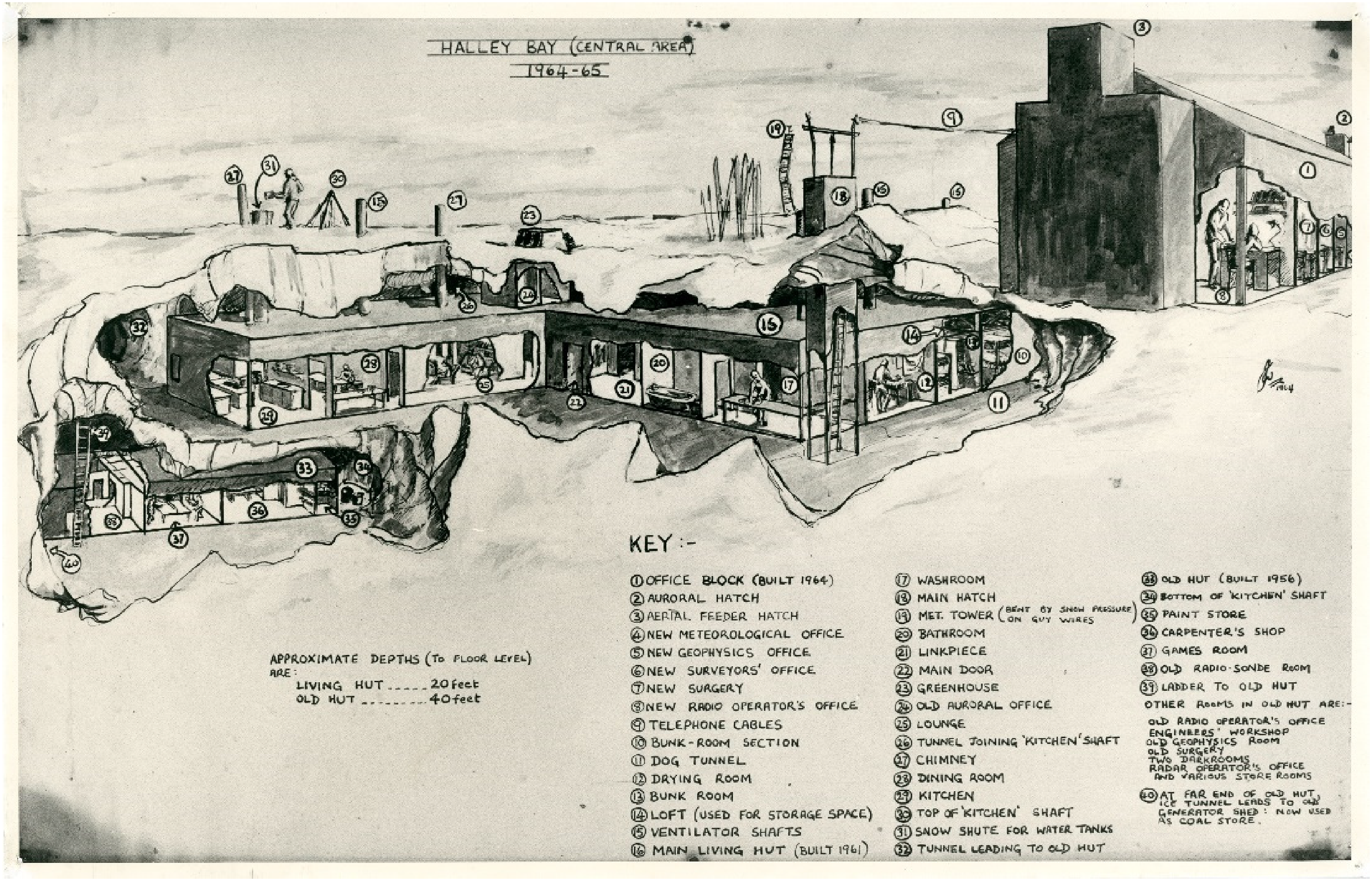
Sketch of Halley I from the 1964-1965 expedition. Reproduced courtesy of the British Antarctic Survey Archives Service. Archives ref. AD11/1Z/1964/1.
Architectural design has been a key object of inquiry in recent scholarship and commentary in STS and geography. In STS, the seminal edited volume The Architecture of Science (Galison and Thompson ed., 1999) laid significant groundwork for more recent analyses of design-centric interventions into spaces of technoscience (Thrift, 2006; Moore and Karvonen, 2008). Nigel Thrift notes, for instance, a growing emphasis at universities on performatively engendering novel social interaction and interdisciplinary collaboration in technoscientific spaces: “[New interdisciplinary science centers] are clearly meant to manipulate time and space in order to produce intensified social interaction so that all manner of crossovers of ideas can be achieved” (Thrift, 2006: 292). Interventions in contemporary political geography have brought their own critical perspective on the growth and impact of design-thinking. Kevin Grove argues, “Rather than reiterate modernity's promise of total predictive control, design proponents offer novel techniques for knowing and managing uncertainty and emergence,” engendering solutions to problems of environmental complexity that sit somewhere between “reformist interventions that sustain the political economic status quo” and “technique[s] to explore alternative modes of individual and collective life” (Grove, 2019: 2–3). Echoing this analysis, Maroš Krivý warns against assumptions that design-thinking takes a purely positivist approach to handling social and environmental problems. As Krivý suggests, “…the question to be asked is not whether the science of cities is positivist, but what kind of political rationality does ‘complexity’ … justify and normalize. What today passes in urbanism under the (scientific) banner of design is a knowledge, power and mandate to both surrender to and govern complexity” (Krivý, 2019: 5).
While Krivý's warnings target in particular analyses of urban design, they offer useful lessons for thinking about the spatial production of sociality and subjectivity more generally. As I demonstrate, Halley VI's polar futurism is not singular nor is it determinative. The architecture of Halley serves in the management of environmental unpredictability with the aim of stabilizing forms of work, social life, and subject formation under conditions of distinct environmental threat and inhospitability, but with a presumed flexibility toward trends and disruptions in the social and political economic constitution of regimes of knowledge work that at times stand in tension with the immediate appearance of utopian communal horizons. Halley's design explicitly figures its own attention to alternate Anthropocenic futures, acting in what Krivý identifies as design's governance of futures (Krivý, 2019: 4), but that's to say such futures are plural and open, even as they are managed.
Meeting environmental unpredictability with efforts at managing people, knowledge work, and technical systems, design at Halley plays a role in linking climate science and a managerial imaginary more generally. At a broader level, historians and sociologists of systems sciences acknowledge the role of systems-thinking at a wide scale in efforts to carve out a de-politicized space of analysis and social intervention aside from forms of contestation and human agency and portable across a range of modes of political economic organization (Heyck, 2015: 1, 9, 196, 202–203; Rindzevičiūtė, 2016: 2, 107–115). The concerns raised by these scholars are not simply that systems thinking understands itself overly much as neutral or aside from questions of politics but that it's actively neutralizing or de-politicizing in its impacts and implications, constructing a highly delimited space of politics as against what's taken to be a problem for systems management.
Resonant concerns abound in critical scholarship on systems modeling in the climate sciences (Yusoff 2009; Wynne, 2010; Hulme, 2011; Stengers, 2015: 72–75; O’Lear, 2016). Noel Castree identifies a critical position that sees science as involved in the capitalist mediation of nature, reifying categories available to capitalist enterprise and delimiting the field of possible change in response to diagnosed crises within any present order (Castree, 2015: 57–59). Such a position, Castree acknowledges, may very well have explanatory power in accounting for certain tendencies in Earth systems sciences. As Castree argues about recent efforts toward a new geoscience to fold humans and human societies into Earth systems frameworks, “In employing the metaphor of ‘system’ they frame the resulting knowledge for managerial use toward ends such as economic efficiency and social stability. They thereby instantiate certain beliefs and leave little or no space for key aspects of the social to be explicitly addressed—things such as power, value conflicts, emotion and affect, aspirations for new ways of living, and so on” (Castree, 2015: 66). What I will suggest going forward is that, keeping such critical analyses in mind, we can see Halley VI as metonymic of and gesturing toward a wider sensibility in the climate scientific activity that the base facilitates—an effort to manage relations between precariously placed humans and an extreme, potentially volatile environment toward the stabilization of human life and flows of information against the backdrop of environmental hostility.
And what's especially pressing in my reading of Halley VI is the implications that a managerial sensibility mediated through design has for the forms of subjectivity and sociality fostered within the base. Thrift's work, touching on the design of contemporary spaces of science, ultimately concerns the interaction of global circuits of commodity production and circulation with consumer subjectivity, drawing out the importance of affect, pre-conscious forethought, and aesthetic attunement to iterative consumer commodity production (Thrift, 2006). Such analyses help in reading the specific ways Halley VI aims to articulate its inhabitants within stabilized global circuits of value generation and informational accumulation. It's this, the specific creation of global, logistical subjects, engaged in an interactive, communal life, that I highlight in the second part of this paper. Here I draw on the work of Bernard Stiegler, whose critical examination of the history and present of human technics offers a framework for thinking about what he calls a “proletarianization of sensibility,” a version of the subsumption of human sense, affect, and subjectivity under global market logics that Thrift thematizes.
But a proletarianizing subsumption of the being of Halley's inhabitants is not limited to questions of sensibility and subject formation. In the third part of this paper, I look at the social organization of networked labor at Halley VI, seeing, in tension with claims toward the designed production of a communal life on base, tendencies toward a decomposition of knowledge work that increasingly atomizes such work and marginalizes human inhabitants to the labors of infrastructural management that climate research at Halley increasingly entails. These tendencies are embedded in the same heterogenous and multiple imaginaries that project a utopian communal life. Researchers at Halley speak to the automation of climate observation and data collection processes, as well as basic facets of social reproduction, as among Halley VI's core innovations. In turning to a proletarianizing subsumption acting on regimes of labor, this section aims to consider a further fold to Stiegler's own critique, while extending lines of critical thought on automation discourse as obscuring tendencies toward labor precaritization (Benanav 2019); precaritization as itself a normative condition of work (Neilson and Rossiter, 2008); logistical labor as striving toward the eclipse of human subjects (Moten and Harney, 2013: 87–92; Mezzadra and Neilson, 2019: 153); and the combination of these trends in the development of labor regimes under logics of extraction (Arboleda, 2020: 86–93), to bear on the particular labor infrastructures of climate science.
Global subjects and a communal life
Yes, creating a “home away from home” has always been an important aspect of our work in Antarctica. At Halley we did this by imagining the day of a variety of different users of the base from the moment they woke up to the moment they went to bed.… What we didn’t do was fill the base with pictures of Britain—most people who work in Antarctica do so because they love the place and they don’t need lots of pictures of the English countryside to get in the way of that relationship. (Roberts, 2020)
For Hugh Broughton, the lead architect for Halley VI, the base's inhabitants, historically of English, Scottish, South African, and Australian origin, are, for the period they live and work at Halley, Antarctic subjects, not British. Moreover, they carry out a quotidian life as Antarctic subjects. What makes Halley VI a “home away from home” is not any kind of extension of British-ness, let alone British geopolitical space, into the remote reaches of the Antarctic, but the fact that a life of relative comfort and routine can be lived, despite the unique environmental conditions the base faces. A design sensibility that emphasizes comfort, stability, and communal being explicitly positions Halley VI on one end of tensions, myths, and expectations structured into built Antarctic space: between constructed domestic comfort and masculinist, frontiersman hardship, and between facets of often militarized hierarchy and gestures toward egalitarian classlessness (Collis and Stevens, 2004; Collis and Stevens, 2007).
Within the base, there exists a conscious division of leisure, work, and sleeping accommodations, different modules dedicated to each and a particular investment in the centrality of social leisure, justified in the context of the base's intention for long stays through the harshly sunless winters. Echoing Broughton's comments above, early Halley inhabitants joked about the extent to which the English homeland ought to be reproduced in the oft-harsh under-ice confines of Halley I, drawing on classic images of modern alienation and its deadening shuffle between work and home. 3 Their jokes implicitly imagine Halley's integrated life as resisting such alienation, communally holding together a range of activities and people. At an overarching level, a like imaginary sees the outer compartments of Halley VI funneling toward a joyous, communal center. But what kind of communal home is Halley and what kind of subject is imagined as occupying that home?
A defining quality of Halley VI's homey-ness, what's understood as facilitating the base's quotidian experience, is the manufactured sensuality within. This interior sensuality entails, among other things, the various features alluded to above, responses to the core psychological and physiological conditions that long-term Antarctic inhabitants face (Arendt, 2012; Palinkas and Suedfeld, 2008) and efforts to produce year-round cheer in the face of endless winter night and the surrounding blank ice's relative sensual emptiness. With an eye toward the effects of light exposure on mood and psychological health, Halley VI incorporates an array of lighting mechanisms worked on in conjunction with a color psychologist, including a “special alarm clock” set up to create the sense of an artificial dawn. Elsewhere, a comforting sensual experience, in moving through the base, is induced by globally sourced materials, such as the Lebanese Cedar with which the “upper level of the social module is lined,” intended to remind residents of the aromas of plant life where there otherwise is none (Roberts, 2020).
Alongside these inner infusions, the base windows serve as architecturally-mediated productions of “direct” sensual connectivity to the surrounding landscape, an ongoing reminder to inhabitants of place-fulness. Speaking in an interview about a separate, similar Antarctic project, the New Zealand-led Scott Base, Broughton claims, “Central to Māori values is a sense of shared responsibility for the mauri, or life force of the environment, and for the health and well-being of all people who depend upon it for their survival and this connectivity will be a key feature of the interior design. For example, windows are carefully placed to make the most of natural light and reinforce connections with the Antarctic landscape” (Roberts, 2020). The windows at the Scott Base are positioned here as an enactment of indigenous values concerning embodied, sensual, and unmediated connection to the surrounding environment, values that would then instill the base residents with a kind of responsibility for and attachment to the objects of their research. Within this framing, what are proffered as indigenous values stand in for what scientific ways of investigating and knowing the world fail to fully offer, an affective and ethical relationality to natural objects, a relationality that mechanisms such as the positioning of windows intend to produce. Like the Lebanese Cedar walls, indigenous values in this formulation become then one among a range of entities, including the on-base scientists themselves, dis-placed and dis-placable from particular histories, social formations, and land-based relations and brought to bear on the ice shelf's apparent blank canvas. Lacking clear spatial and temporal (or national/regional and period-based) identifiers, the base's design operates technically through sensual forms stripped away from their particularity.
Stiegler's arguments as to the relation of technics and time and the proletarianization of knowledge and sensibility offer a useful framework for drawing out the stakes of this. He argues that, “‘As a process of exteriorization,’ technics is the pursuit of life by means other than life” (Stiegler, 1998: 17). He reads technics then, thought in broad terms that encompass modern technology, as the uniquely and essentially human way of exteriorizing human life and power, of situating in the external world, as prosthetic extensions, facets of human consciousness that serve in turn to co-construct that consciousness. And as he claims, “There is no anticipation, no time outside of this passage outside, of this putting-outside-of-self and of this alienation of the human and its memory that ‘exteriorization’ is” (Stiegler, 1998: 152). The very movement to alienate facets of consciousness from one's immediate experience is, for Stiegler, the condition of possibility for thinking temporally forward, toward future encounter with such alienated consciousness (i.e., anticipation), and temporally backward, in the external encounter with consciousness's past forms (i.e., memory). In this way, technics and time for Stiegler are co-constitutive.
As Stiegler elaborates these arguments into a framework for tracking the development of modern technics, he argues that technics function to displace memory onto exteriorized apparatuses—writing displaces the memory of oral traditions of communication into a collection and ordering of graphemes; industrial mechanisms displace the muscle memory of various skills of laborers onto technical apparatuses; a computer program displaces the memory of steps of an intellectual process on to the computer itself (Stiegler, 2009: 34–37, 75–81). Each displacement of memory onto what Stiegler calls tertiary memory acts to decontextualize (and to a degree, in turn, to recontextualize) shared memory, divorcing memory from the habituating and individuating processes that produce it (Stiegler, 2009: 65–69). For Stiegler then, the disoriented and disorienting technics of the contemporary techno-logical age enact a decontextualization en masse, and one that could be understood to manifest in the industrial production and globalized distribution of artificial dawns, the “natural” aromas of shipped-in cedar tree wood, and like ways of engineering and in that way “proletarianizing” sense experience (Stiegler, 2017) literally dis-placed from recurrent sites of shared memory and place-bound, sensually mediated knowledge.
The externally produced design of Halley VI acts as a central mechanism of exteriorized, tertiary memory. It folds in formal and informal knowledges, dating back to the early days of Antarctic exploration, around human psychological, behavioral, and physiological responses to the Antarctic. It folds in historical recording apparatuses that have been crucial to decades of climate research undertaken at Halley. It folds in knowledge and mechanisms of social reproductive endeavors, at the scale of a research station, necessary for sustaining life on the ice, including newly-instrumentally handled means of converting surrounding snow into water, a process previously necessitating the labor of inhabitants. And, in negative, it folds in the limitations, failures, and ruins of past Halley bases, the memory of their short-lived-ness acting as a core motivation for central design features. At the same time, Halley VI's inherence of tertiary memory sits within the context of globalized commodity circulation, sweeping together these instances of exteriorized memory with dramatically decontextualized elements of sense, discourse, and material, fitting for a base positioned as central to logistically coordinating observation and representation of global climate. For the imagined subjects within, decontextualized sense experience and objects fill in a sensory landscape otherwise recognized as uniquely barren.
To the extent the base's decontextualizing moves also inherently entail recontextualizing ones, displacements of sense both from the realm of scientific knowledge production onto that of direct relationality and from sites of possible historicity onto the futural form of the base itself are part of the larger claims the architectural form of the base makes to conjure up a new vivid, communal life within. Or, to return to Stiegler's discussion, Halley VI doesn’t just inhere often-decontextualized tertiary memory but also tertiary anticipations, materially-grounded expectations as to the present and future use of the base that in certain cases, like the architectural exhibition mentioned in the introduction, are re-positioned as broader speculations regarding the future of human life in the Anthropocene.
These tertiary anticipations gesture toward the prospect of collective lives, shared social reproductive labors, and communal leisure. Base residents use shared bathroom, locker, and dining spaces. They likewise enter and exit modules through corridors specifically widened and imbued with natural light “to facilitate informal interactions as people pass” (Slavid, 2015: 29). Movement through the base, situated along a linear axis as conditioned by outer environmental conditions, necessitates that all residents, whether interpellated as scientists or operational laborers pass through the base's command modules, the infrastructural core, and thus recognize themselves as integrated into a vital whole. These claims toward a communal life cohere most forcefully in the base's visible center and its largest module, the social module (see Figure 3). Designed for both individual and social play, chat, and relaxation, the social module appears from within and without as the space to which activity and attention at Halley VI is funneled. Movement from either end of the base almost necessarily leads inhabitants through the space as an intermediary between work and sleep.
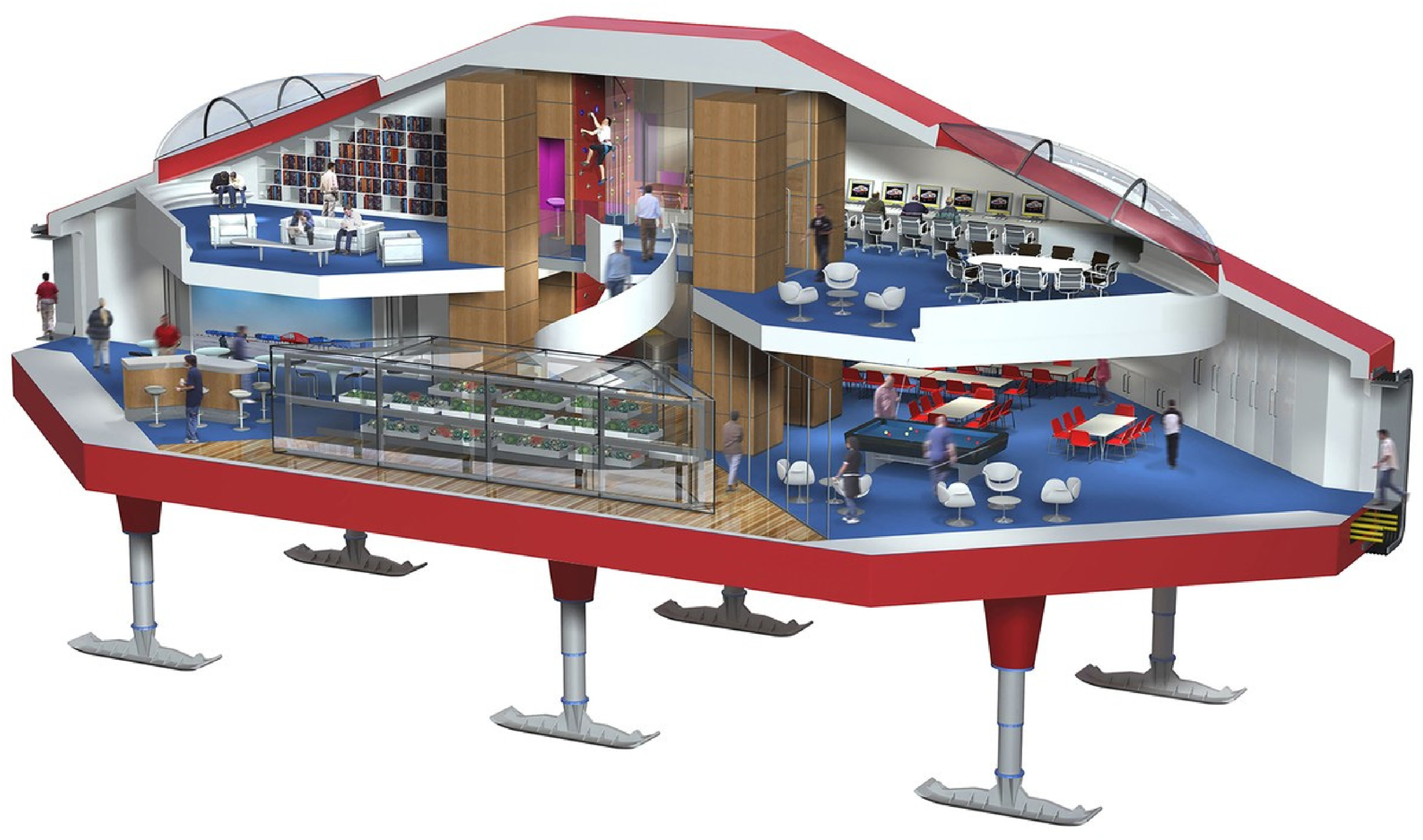
Early computer-generated model of the central module as initially designed. Source: Hugh Broughton Architects (Hugh Broughton Architects, 2022).
This vision of the life led at Halley is not entirely divorced from the realities of the base. As per discussions with those who have lived at Halley VI since its inauguration in 2013, inhabitants do eat together twice a day. Social reproductive labors such as base-wide cleaning are rotated among each inhabitant. Tapping into a long history of knowledge sharing among BAS crews, leisure time, while frequently an opportunity for individualized self-recreation, also frequently is taken up with efforts to learn the specialties of other inhabitants. One interview subject noted that among the unique, addicting qualities of Antarctic life was the opportunity to get close, intimate knowledges of skills and equipment you’d never have access to elsewhere, part of a mutual sharing of specialist capacities. Social divisions and clusters form such as those between science and operations team members but there are also routine, weekend, base-wide gatherings that serve in encouraging integration across different teams and inhabitants, along with annual customs and traditions distinct to Halley or to the Antarctic, including the celebration of Midwinter's Day and the exchange of gifts with the German Neumeyer station.
It's worth nothing though that these specific elements of an integrated, communal life, where found, are less the product of design choices and more the socially inscribed features and even long-constitutive traditions of Antarctic life, distributed to a degree across stations, that Halley VI's design aims to incorporate and re-project toward an imaginary of Halley's ongoing and future life and sociality. Such an imaginary rests on the availability of the base's sensual productions and communal forms of leisurely experience to the imagined subjects within. Once again, Broughton suggests that we should think of the base's inhabitants as uniquely Antarctic subjects. They’re induced to perceive the surrounding landscape by the windows, an effort toward an Antarctic place-fulness. This place-fulness though consists in the capacity to be filled in interchangeably by materials from anywhere, globally-sourced sensual productions, “indigenous” values, and networked residents who in occupying the space of the base likewise occupy a purported space of climate science's global perception. Sitting snugly alongside oft-invoked images of the scientist as paragon of global citizen, universal subject, and/or speaker of a kind of species-voice (Zakariya, 2017: 309–318), the Antarctic subject of Halley VI is a kind of global subject brought into the ever-shiftable, de-constructable, and technically-produced and enhanced particularity of the base's fold on Antarctic space. This is the form at Halley VI that a “proletarianization of sensibility” takes—a technical conditioning of routinized, though interchangeable forms of life, experience, value-formation, and perception even against the backdrop of ongoing shifts and the potential for catastrophic change.
Networked labor and the proletarianization of knowledge work
In an online video, titled “Halley Research Station – being there,” Halley VI's first Winter Base Commander, comments on the on-base generators, noting, “they provide our life support and the collection of science data for Halley VI” (British Antarctic Survey, 2013). This comment subtly suggests that, at an equal level, in-base residents carry out life, while Halley VI, as a whole, collects data. Halley VI acts as an instrumentally-equipped unit for knowledge production, itself primarily a matter of compiling streams of networked data.
Echoes of this attitude toward knowledge production course through the design of the base. Take, for instance, the climate observatory, a primary hub for meteorological and ozone research, which sits atop the southern-most module of the base and houses the now-famed Dobson spectrophotometer used in the discovery of anthropogenic Ozone depletion. The observatory presents—to the scientist within—an array of mediating channels for engaging with and observing objects of research, namely weather phenomena in the upper atmosphere and ozone content. Situated in the middle of the observatory is the bulky spectrophotometer, pointed directly upward through the observatory's roof and presently hooked up to computing infrastructure directly surrounding it that processes incoming ozone data. The scientist themself is most often positioned at the row of computers that sit atop a desk lining the wall opposite the staircase entry into the observatory. There, the scientist works with streams of meteorological data, taken from the upper atmosphere, and collected using a range of equipment, including satellites, radar devices set up on the ice shelf, and weather balloons launched at the station.
This setup enacts a flow of information that originates from instrumental contact with the outer terrain and atmosphere and channels results of that contact back through digital infrastructure through which the scientist captures and processes results. Networked computers make the latter stage of this circuit, the data processing and analysis which takes up much of the scientist's time, highly portable, a process even within the station that could be easily moved to the social or sleeping modules where necessary. As of 2021, the station's been closed for overwintering for five years, during which time scientists spend three months out of the year at Halley VI, and the remainder working from wherever their non-Antarctic “home” may be. Within the prime space for climate observation, the scientist appears less central than the long-preserved spectrophotometer, the base's only noted year-after-year inhabitant, though even that device, as recent research suggests, may be overtaken or at least heavily-supplemented by satellite observation (Zhang et al., 2021).
The de-centered scientist, portable across the base modules, is carried, in their normative activities within Halley's linear design, from the sleeping modules on one far end of the base to the science modules on the opposite end, and notably then through command and operations modules that sit on either side of the central social module (see Figure 3). Each major shift in focus within their everyday life—from rest to the work of knowledge production; from work then to leisure; from leisure back to rest; etc.—necessitates crossing through a threshold immersed within the vital, infrastructural operations of the base. From the perspective of operations and command—or that of the managerial staff, as well as the technicians, plumbers, cooks, and other on-site laborers—the scientific knowledge work itself sits, on the other hand, at one extreme end, less centrally integrated into the vital core of the base. And in fact, the base is split-able, across a centrally positioned bridge, that ties together power and drainage in normal conditions, while allowing each of the two sides to operate independently and sustainably from the other in case of emergencies. A split, within such a scenario, given the standard layout of modules across the linear axis of the base, would explicitly separate out science/knowledge from life, vitality, and sociality, as well as the brunt of day-to-day mechanical operations underpinning these things.
As noted above, social life most visibly and obviously happens in the central module. Postwar laboratory architecture, as Peter Galison and Caroline Jones argue, developed around the conscious construction of a center-periphery dynamic. Commenting on the Berkeley Radiation Laboratory, divided between a “multistory Central laboratory” and a “host of specialized buildings planned for the periphery,” they argue, “The center would secure participation in the group identity; at the periphery a subsidiary individuation could be sustained. This ‘center of thought’ would combine office spaces, small laboratories, a library, and the theoretical group” (Galison and Jones, 1999: 501). The expectations of the Halley VI center correspond in part to this older center-periphery dynamic, the social module acting as what the architects call a “social heart” that might cohere the group of inhabitants as a vibrant community, against which the outer modules, with bedrooms, small offices, specific laboratory spaces, a quiet reading room, and work stations for various kinds of on-base labor offer a degree of individuation, situating inhabitants into various roles and giving them spaces to psychically reproduce themselves with a degree of autonomy. But the actual makeup of those individuating, peripheral spaces, in their particularities, appears of course akin to the factory-laboratory center—offices, labs, work-stations—as if the older spatial “center” of knowledge production has been displaced outward into the base's periphery. Group identity, at Halley VI, coheres around a shared life pointing outwards toward subsidiary, individuating labors rather than a shared body of work pointing outwards toward the particular, subsidiary, individuating instances of scientific specialization and expertise.
And here I would suggest that the communal life Halley VI conjures forth hinges on, as the possibility opened by, a perceived marginalization of humans to knowledge work. In this perceived marginalization, base architecture elaborates an imagined proletarianization of knowledge work itself, to go alongside the Stieglerian proletarianization of sensibility among the inhabitants. Per Marx, the modern factory system, in “its use by capital,” acts as a kind of automaton, “itself … the subject, and the workers are merely conscious organs, co-ordinated with the unconscious organs of the automaton, and together with the latter subordinated to the central moving force” (Marx, 1976: 544–545). The worker's consciousness here appears incidental, their existence as organs subordinated to a larger “moving force” undifferentiated from that of the coordinated and coordinating “unconscious organs” of the factory's machinery. This framing of the factory as automaton calls to mind the base commander's comments noted above. Halley VI appears as the holistic unit of knowledge production, the networked being that acquires information, in which the individual scientist and technician acts as growingly marginal appendage, maintaining infrastructure and perceiving the incoming results of processes of data collection. As the steps of experimental and analytical processes become increasingly displaced onto the overarching technological apparatus, the labor of science increasingly becomes that of maintaining extant infrastructure.
This image of the base itself as unit of knowledge production, I would suggest, bears on its inhabitants. It's an image mobilized in ongoing discussions of Halley's automation of instrumentally-mediated observation and measurement practices, a factor highlighted consistently by interviewees as among the key visible shifts in social organization at Halley VI. Discussions among past and present Halley inhabitants point toward a general ambivalence around processes of automation, though all maintain that it makes sense, especially if maintaining the Antarctic as a pristine environment, a logic that's reigned over environmental conversations about the continent (Leane, 2016: 40; Salazar, 2017: 156), stands as a core concern. An operations specialist who works out of Halley VI, helping to develop the above-mentioned instrumental automation, noted to me the increasing capacity of the station to maintain regular flows of ever-more comprehensive data, even as environmental (and as of 2021, pandemic) conditions substantially reduce human presence at the base. His hope was to see sustained, comprehensive data extraction across Antarctica alongside diminishing human presence on the continent over time.
But such shifts also re-organize sociality on the base and in ways that, as certain interviewees express, cut against previously-discussed imaginaries of communal life and social integration. For one interviewee who had overwintered at both Halley V and Halley VI, a logic of automation embedded into the base design itself was the predominant point of comparison between the two. Even prior to the movement to automate scientific instrumentation, she noted Halley VI's automation of social reproductive labors specific to the Antarctic, including the conversion of ice into water, station refueling, and the hoisting of the base up above newly accumulated snow. Though acknowledging the significant easing of certain labors at Halley VI, she noted, Halley V was really reliant on the input from people. Halley VI became … more automated.… Halley V every summer, the whole station was required to hoist the legs.… Suddenly you went from a really labor-intensive station to one that was more automated.… What you lost [was] the morale of the team from having to do stuff.… A lot of us actually missed Halley V because we didn’t have the “woohoo” [moments].
For her, shared labors that implicated the full team of Halley inhabitants were also a site of social integration, belonging, and collective joy. As her comments went on to suggest, the relative togetherness of the base was a matter of social intentionality, though the streamlining of much of the base's scientific and social reproductive work risked atomizing individuals into their own specialties.
And as was alluded to earlier, scientists have not overwintered at Halley VI since 2016. For one scientist I spoke to—a glaciologist who studies the Brunt Ice Shelf and as such holds the expert say on whether the base is safe to inhabit at particular times of year—this meant those working out of the base spent an unusually busy 3 months there during the summer. When I asked him whether he appreciated the base design, he said it was great but unfortunately didn’t really serve those using the base under non-overwintering conditions, cooped up as they are while there in their projects and largely unable to make use of the substantial leisure space, nor the amenities designed to make the base feel like home during the nightless winters. And with regard to future overwintering, he suggested,
They invested resources into this automation that we’ve been working on the last couple years. Back in August 2015–2016, you need scientists there taking measurements… The more things that become automated, the less need there is for people be there. That could be the way science goes in Antarctica… You can do it just as well in the automated way to save logistical costs. I’m not sure [about re-wintering] to be honest, even when I say to give the green light…
The inhabitants of Halley VI then are squeezed toward longer days of work when they are on base and squeezed out of the base by the comparative costs with now-already established machines for longer and longer portions of the year. Halley VI's comfortable human home environment spends most of its time solely housing machinery. 4 And beyond that, the stresses on Halley's use as an overwintering station are only partially tied to direct geophysical threats. Social re-organization of necessary labors on base also plays a significant role.
Importantly, the marginality of humans to certain knowledge-producing processes equates neither to the absence of humans from those processes nor to the absence of social relations that configure wage relations, value generation, and political economic imperatives. Infrastructure, however, automated in its own right, requires some degree of ongoing maintenance; forms of “tacit knowledge” (Mackenzie and Spinardi, 1995: 75–79) continue to mediate interaction with experimental and computing apparatuses; certain aspects of knowledge production proliferate as others are displaced; and experimental procedures of particular kinds resist automation—the scientist quoted above somewhat wryly joked that the releasing of weather balloons into the atmosphere is one facet of base life that's yet to be automated.
These enduring shadows of the human in the backdrop of technological displacement point to a real subsumption 5 of human subjectivity under advanced capitalist logics within regimes of skilled knowledge and technical work. Broadly classable under the category of immaterial labor, these modes of work, mediated increasingly by information technology, Maurizio Lazzarato has argued, proliferate the necessity of subjectivity as that “raw material” worked on by the labor process. In the proletarianization of knowledge work, subjectivity still acts as applicable raw material, though exactly where and how this application of subjectivity occurs is continually reconfigured (1996: 134–136). Amidst the diffuse “factory” 6 of contemporary knowledge work, the physical presence of particular individuals is readily subject to relocation as a function of logistical calculation (akin to any job that interfaces with ongoing cycles of restructuring) while a subjective presence of those individuals is retained.
If Halley VI presents the appearance of a relatively privileged workforce, it also holds glimpses of the availability of knowledge work of all stripes to commented-upon trends of precaritization and the constitution of logistical labor regimes. For Brett Neilson and Ned Rossiter, “precarity” can be seen as a normative condition of work, Fordist regimes of temporal regularity and job security an exception distinct to particular periods and varieties of labor (Neilson and Rossiter, 2008: 54–57). Much of the labor cycling through Halley, especially mechanical and technician's labor, is already organized around relatively short-term, seasonally-structured contracts, even as scientific labor is edged out of the base. Neilson and Sandro Mezzadra point as well to common logics of logistical labor regimes, logics geared toward the overcoming of human subjectivity. They draw on the work of Fred Moten and Stefano Harney who, in commentary on logistical subjectivity tying contemporary regimes of work and logistics back to roots in the Transatlantic slave trade, claim of logistics that it “wants to dispense with the subject altogether” (Moten and Harney, 2013: 87). As Neilson and Mezzadra put it, “contemporary logistical systems … striv[e] for resilience, or fault tolerance, for an ability to go on operating despite breakdowns or interruptions, for the accommodation or avoidance of hindrances, whether they result from natural disasters or labor stoppages” (Mezzadra and Neilson, 2019: 153).
In this sense, Halley VI appears as a logistical system, a piece of infrastructure on the ice oriented toward ongoing accumulation and circulation of information, despite the geophysical precarity in which its situated, but also enabling a growing evacuation of the physical presence of human subjects via that very geophysical precarity. Automation is the watchword presented as a key fix for facilitating the ongoing functioning of this logistical system. Martín Arboleda's work on the centrality of extractive logics to contemporary capitalism offers a framework for making sense of this if we recognize this framework as extending beyond primary commodity production and implicating an extractive relation to data accumulation. Arboleda shows trends toward an increasing incorporation within extractive endeavors of a remote technical workforce and automated technological means of extraction, that at once squeeze and evacuate laborers present at sites of extraction (Arboleda, 2020: 91). Moreover, the image the comments of the scientist quoted above paint suggests dynamics not unlike what Aaron Benanav theorizes in his critical commentary on full automation discourse. Benanav's analysis takes stock of a world driven by the automation of particular tasks and labors toward ever further underemployment. He argues that full automation ought not to be seen as any kind of “technological fix” to social problems, including that of widespread subjugation to the wage relation, but rather as a facet of an ongoing restructuring of the category of “employment” itself. As opposed to a large-scale liberation from waged work, automation and technological development more generally have long been part of an ongoing and ever-renewing social abjection of different kinds of labor (Benanav, 2019). What's presented in Halley VI as an exceptional socio-technical accommodation of subjects to life in extreme and rapidly changing environmental conditions carries forward in the same space and set of imaginaries social reconfigurations of knowledge work increasingly subsumed as a facet of infrastructural maintenance.
Conclusion: critique and speculation in imaginaries of Anthropocenic life
Though Castree warns against a de-politicized, managerial framing of climate and geoscience, his exploration of the political implications of geoscience culminates in the claim that its incumbent upon critical scholars to engage directly with geoscientists to make explicit the political stakes of their work. He suggests that geoscientists find themselves in the curious position of consolidating a body of scientific knowledge inherently critical, even where they may not recognize it, of the capitalist world system (Castree, 2015: 68). This article has been an effort to think about potential, logistical constructions of climate and geophysical sciences, as bearing specifically on laboring subjects within a particular though globally significant arena of climate research. If knowledge workers in the contemporary geo- and climate sciences might be implicated in the construction of scientific knowledge as a valuable critical apparatus, they’re also implicated in and imposed upon by trends in the social organization of knowledge work.
At Halley, conversations with scientists and operations specialists suggest, at the very least, ambivalences over how to receive the novel Halley VI design and the ongoing social restructurings happening within the base, though nothing like outright contestation. For the most part, those working at Halley like at other Antarctic research stations recognize themselves as in a relatively privileged position overall, Antarctica a source of adventure, sweeping beauty, and even uniquely sublime experiences in an otherworldly landscape, but also of a relatively dis-alienated life, almost entirely free for BAS stations of money and exchange 7 and drawing people together, despite above-mentioned trends, through often shared productive and reproductive labors. This latter element of Antarctic life has, for some, served as its own critical vantage point, interviewees, as well as numerous former base inhabitants in the BAS oral history archives, attesting to difficulties in re-integrating into normative social relations after an Antarctic expedition.
In relation to the logistical construction of climate research, Halley's at once then a site of relatively muted questioning rather than contestation and conflict and one that remains an extraordinarily small, remote project, despite its significance to global climate modelling and public consciousness around environmental issues. Despite this, a bevy of oft-conflicting imaginaries inheres in the design, construction, and use of Halley VI that makes it worth thinking about as metonymic of larger configurations of climate research, especially as the base in its reception and in the rhetoric surrounding it signals its own visionary importance to thinking the question of future Anthropocenic life. Reading Halley VI for its explicit imaginaries of polar and, more broadly, Anthropocenic futures but also for the implicit dynamics lying within and behind those imaginaries aids in rendering the imaginaries at play in the base's polar futurism as, at once, speculative-projective tools in alliance with the works of other polar researchers such as Salazar and O’Reilly, and more expressly critical tools that uncover tensions and pernicious dynamics in the utopian claims of Anthropocenic speculation.
Highlights
The Halley VI base's polar futurism implicitly projects a tendential integration of climate science and global logistics.
The Halley VI base effects the production of a global, logistical subject amidst an outwardly touted communal life.
The possibilities for a communal life figured at Halley VI lie in ongoing tension with the restructuring of the social organization of knowledge work at the base.
Polar futurism's imaginaries of Anthropocenic planetary inhabitance serve at once as speculative-projective tools and sites of critique.
Footnotes
Acknowledgments
The author would like to thank the British Antarctic Survey staff and scientists who lent their time talking about the present operations of the Halley VI base, as well as the BAS archivists, who have been an enormous help in providing background information and documents to fill out historical context. The author would also like to thank the editorial team and peer reviewers who provided valuable feedback for getting this article to its current point.
Declaration of conflicting interests
The author(s) declared no potential conflicts of interest with respect to the research, authorship, and/or publication of this article.
Funding
The author(s) received no financial support for the research, authorship, and/or publication of this article.
