




Abstract
In 2018, Norway promoted itself as a ‘Datacentre Nation’. In terms of low cost, renewably generated sources of electricity and low ambient temperatures, Nordic countries and the data centre sector are potentially mutual beneficiaries – yet, there are also negative impacts associated with the necessary electric power production. With this as a starting point, for Norway and Iceland, we explore how data centre proponents promulgate similar techno-environmental imaginaries, but achieve differing degrees of stabilisation. To this end, we use three sources of imaginaries relating to data centre development in Iceland and Norway: those implicit in promotional imagery originating within the countries concerned; those implicit in international newspapers, as indicative of external perceptions; and those implicit in focus groups with the Norwegian and Icelandic public. We show how data centre advocates deploy visual imagery to create a promotional techno-environmental imaginary that marries nature with the digital in a symbiotic form, and we observe that this is largely consistent with the more mundane international imaginary of Norwegian data centres. For Iceland, however, the external imaginary is dominated by associations of excess energy consumption by bitcoin mining. For the publics questioned, there are multiple imaginaries of data centres, with significant notes of moral and other forms of scepticism. Looking ahead, we suggest that for long-term stabilisation of positive data centre imaginaries, conducive to investment, the capacity of Iceland and Norway to equitably supply sufficient renewable power will need to be addressed as a matter of urgency.
Introduction
The literature of critical studies of data, digitality and their infrastructures takes data centres as empirical probes for a wide range of geographical and spatially engaged science and technology studies (STS) themes (Hogan and Vonderau, 2019; Pickren, 2016). Highlighting assemblages of data processing infrastructure, Carruth (2014) refers to the way in which the data centres, constituting key nodes of ‘the cloud’, connect not only digital infrastructure, but the practices and values of individual users globally. Burrington (2016) describes how data centres often follow and repurpose existing infrastructure, reinforcing prevailing patterns of development. Johnson (2019a) refers to a particular example of this in Iceland, where cold war security measures are repurposed to provide data centre and other security. Vonderau (2019), as ourselves here, comments on the way in which the Nordics connect with digitalisation trends for purposes of state branding.
Particularly close to our present study is Johnson's (2019) observation of the way in which ‘imaginations of places meaningfully drive development interventions’ (Johnson, 2019b, p.1). However while Johnson (2019b) studies imaginaries of Iceland in relation to data centres, here we study imaginaries of data centres themselves. Still, a commonality in our work is that Johnson (2019b) also observes advocacy of a ‘natural fit’ between data centres and (in Johnson's case) the climate and geothermal energy landscape of Iceland. In this respect, our study can be positioned in terms of work on the integration of spatial and sociotechnical imaginaries, in particular how spatial imaginaries are brought to bear in the legitimation, framing, uptake and contestation of sociotechnical imaginaries as they travel across scales and contexts (Chateau et al., 2021, p.5).
Sociotechnical imaginaries, as collective, latent but potent ideas are studied by proxy: they are inferred from implicit norms, explicit themes, frames, discourses and cultural symbols – in particular, those that are oriented towards an idea of a desirable future. They may also have a spatial dimension, varying by locality (Mutter and Rohracher, 2021): indeed promotional Nordic data centre imaginaries are both techno-environmental and techno-spatial in that the naturally cold environment is located ‘in the North’. With the geographic boundaries of Norway and Iceland, we analyse the ways in which data centres are promoted and described in text and image, and argue that concerns relating to data centre growth, circulating in the public sphere, pose a risk to the stabilisation of proponent imaginaries and quite possibly to the sector itself.
We also show that how Nordic data centres are imagined by state and commercial actors is intertwined with how Nordic countries view their broader development futures, including development involving digital technologies and sectors. We observe how promotional imaginaries originating within the countries compare with those held externally, both per se, and as an empirical probe into the meaning of stabilisation with respect to imaginaries. As said, stabilisation matters because imaginaries are widely assumed to be performative, shaping expectations that in turn shape attention and investment among competing alternatives – hence the proliferating use of the concept (Rudek, 2022).
Our research questions concern: (i) the nature of data centre imaginaries relating to two exemplar Nordic countries, as inferred from directly relevant governmental policy documents, newspaper articles and the websites of data centre operators; (ii) how these imaginaries connect with broader imaginaries of Arctic and Nordic development, particularly relating to the two countries; (iii) how the imaginaries are variously stabilised and promoted; and (iv) the implications for public perceptions of data centre expansion. With regards to (i), the promotional imaginary, we pay particular attention to visual imagery because these have been shown to carry a lot of rhetorical weight even in financial reports (Davison, 2008). We say more about this later.
Regarding the structure of the paper, we first provide a short introduction to the materialities of data centres and their impacts. We then describe the methods of data collection and analysis, followed by detail on the promotional imaginary being used in Iceland and Norway, followed by the same for both supportive and destabilising imaginaries circulating in the public sphere.
The materialities of data centres
Data centres are the backbone of our modern digital lifestyles revolving around electronic mail, streaming of videos, remote work and social media. Nordic countries 1 aim to offer a favourable business environment for data centres, supplying low-cost renewable power, land and a cool climate. Hence, Norway's 2018 data centre strategy declares the aim of establishing the country as a key location for the sector (Nærings- og fiskeridepartementet, 2018). The Icelandic state similarly seeks data centre investment (Iceland, 2017). Such data centres increasingly underpin the economically and socially transformative action of information and communication technologies (DCMS, 2017). While these are often framed as a means of reducing the energy intensity of daily life (GESI, 2015), IT networks and data centres may already consume more power than the consumer devices that they support (Van Heddeghem et al., 2014). Such estimates are uncertain because ‘there is a strong tendency to push electricity consumption onto the network and data centre infrastructure where energy costs are less transparent to consumers’ (Corcoran & Andrae, 2013, p.1).
Although efficiency improvements continue across such systems, ‘energy use over the long run will continue to be a battle between data demand growth versus the continuation of efficiency improvements’ (IEA, 2017, p. 2). Indeed Andrae and Edler (2015) expect internet infrastructure to constitute 21% of global electricity consumption by 2030, with a projected range of 8–51% in the best and worst cases respectively. The magnitude of this consumption will only add to the challenge of achieving fossil-free energy systems internationally; at an estimated 3% of global GHG emissions, online services and their infrastructure are comparable in emissions terms to the global airline sector (Sovacool et al., 2022b). This has site-specific impacts as well as impacts at an aggregate level (Lally et al., 2019). Here, we take Norway and Iceland as examples of Nordic locations seeking to attract data centres, but which have experienced different patterns and degrees of development in the sector (Sovacool et al., 2022a).
In the Nordics, the remote location of renewable power infrastructure already reaches into the land of indigenous peoples (Össbo and Lantto, 2011; Szulecki and Overland, 2018). Moreover, a readily available renewable power surplus cannot be assumed, at least in Norway, which is dependent on hydropower and hence sufficient rainfall (Brenna, 2022). Ironically for commercial and state actors using climate change as a rationale for the northwards movement of the sector, the likelihood that climate change could pose challenges in terms of renewable power supply is now being realised. We knew at the time of our empirical work in 2021 that reduced rainfall had already impacted hydropower production in Norway. As of mid-2022, this has become serious to the point of the Norwegian Water and Energy Resources Directorate, as well as the country's largest bank, expressing concern that the politically contentious practice of electrical power export may need to cease in order to avoid power rationing (Brenna, 2022). This shortfall in electric power production relative to demand is now also being experienced by Iceland too, again in part due to low summer rainfall in the context of rising electricity demand (Sigurdardottir, 2022). Both pose risks for the European trading market for renewable power, though this is not something that we investigate here.
As energy consumption entails private costs, minimising power consumption is a high priority for data centres, whose main operating costs are electric power for running and cooling servers, alongside securing land (PWC, 2012). With low population densities, low ambient temperatures, surplus renewable power and international oceanic fibre-optic connections, the economic interests of Nordic countries and data centres concur. As Nordic states and data centres pitch for digital business, here we show how their public-facing, promotional presence emphasises the marriage of digital hardware and a pristine, specifically Nordic nature. We argue that the widespread use of natural imagery in promotional contexts points to an underlying imaginary of digital Nordic development. In contrast, the non-Nordic imaginary of the Nordic data centre is more prosaic in the case of Norway and expresses ethical doubts in the case of Iceland. Our second purpose, building on these observations, is to argue that the stabilisation of data centre imaginaries is relevant to public perceptions of data centres in the longer term, and thus their social sustainability and economic viability, with a performativity that holds the potential to both reflect and reinforce investment or disinvestment.
Stabilisation of sociotechnical imaginaries
Sociotechnical imaginaries are collectively held and publicly performed visions of desirable futures that have gained a position of being collectively shared through acts of power or coalition building (Jasanoff, 2015; Jasanoff and Kim, 2009). For Jasanoff (2015, p. 329), sociotechnical imaginaries occupy ‘a hybrid zone between the mental and the material, between individual free will and group habitus… between the fertility of ideas and the fixity of things.’ That is, imaginaries are directly unobservable but are held to shape institutions, policies and behaviour. Sociotechnical imaginaries are considered to justify and legitimise scientific and technological investment, and as such, imaginaries of data centres have implications for the development of the data centre sector and those affected by this in different ways. The concept of sociotechnical imaginaries has a long history, but was originally invoked to explain questions such as: ‘how do national S&T projects encode and reinforce particular conceptions of what a nation stands for’? (Jasanoff and Kim, 2009). The present study relates closely to the qualification introduced by Peet and Watts (2004), that is, environmental imaginaries, a concept that carries forward the normative dimensions of the contemporary notion of social imaginaries.
There is also a temporal element to imaginaries that is relevant here (Felt, 2015), which Felt (2015) posits as beginning with assembling a case for (or against) a technology or vision and beginning to make this publicly available. The subsequent stage involves multiple ‘rehearsals’ of this in multiple public arenas, over a sustained period of time, until a stable outcome is finally reached. This rehearsal process is essentially one of the repetition of themes, assisted by pictures, slogans and stories. Eventually at the third stage, the vision is able to withstand critique and becomes widely accepted. The final stage is transference, at which point the stabilised imaginary becomes accepted as part of a collective identity and is able to be mobilised in other technological debates 2 .
Felt's (2015) conception is idealised and in practice, there will often be some degree of instability and conflict among imaginaries of the same object. To take an empirically close example, Benediktsson (2021) observes this specifically in relation to renewable energy and nature in the sense of human-non-human relationships in Iceland. As Benediktsson (2021) points out, different imaginaries exist and function in different social groups. These groups have differing access to differing types of resource, including political power. Especially where imaginaries are contested, stabilisation is arguably chimeric and is rather a matter of degree. We find that it is not at all clear that data centre imaginaries in Norway and Iceland are yet stable or singular. Imaginaries and their (in)stability connect in part to the core STS theme of ‘closure.’ Closure and then stabilisation occur in technology when a consensus emerges that problems arising in the development of technology have been alleviated, and/or an agreement emerges concerning a dominant frame among relevant social groups (Misa, 1992).
Here we consider the extent to which closure and stabilisation have been achieved in socially consensual terms and also with reference to the general terms posed by Jasanoff (2015): (i) materiality, the idea of sociotechnical imaginaries emphasises that technologies can act as physical forces that constrain action or enhance an experience; (ii) meaning: technologies can provoke radically different reactions from different stakeholder groups; and (iii) morality: technologies can often have negative, pejorative impacts on society. Here we are interested in specifically techno-spatial imaginaries, in the sense of shared visions of the interaction of a spatial identity – the nation, region or smaller site – with a technology – the data centre. Summarily referring to the foregoing terms of Jasanoff (2015) as the 3Ms, we show illustratively how these are involved in promotional efforts towards stabilisation and also contribute to an arguably unstable imaginary centred on cryptocurrency mining for Iceland.
Having set the context of the study, we now turn to the methods by which we infer the attributes of the dominant promotional data centre imaginaries emanating from within Norway and Iceland, and those that originate externally, while also commenting on what ‘external’ means in this context.
Methodology
Analytically, we use methods of textual and visual analysis, described subsequently, applied to three different arenas of communication, from which imaginaries are inferred. In terms of data collection, the study thus uses a mixed methods approach, to provide a range of different arenas in which data centre imaginaries are studied: (i) among promotional actors within the countries; (ii) among the geographically external community, as indicated by the imaginaries within international newspapers; (iii) among the general public, as indicatively represented by focus groups with broadly representative members of the Icelandic and Norwegian publics
Regarding the first and second arenas, as a methodological premise, the study assumes that it is possible to distinguish between what we are describing as ‘promotional’ imaginaries, which seek to ‘sell’ the countries as desirable places to establish and operate data centres, and imaginaries that originate from third-party sources, that is, international newspapers. While we do indeed find the imaginaries in these two source categories to be distinct and different, justifying the premise, it should be noted that there are limitations to the methodological premise. In particular, while newsprint text is nominally journalistic in origin, there are instances of a blurring with corporate sources, particularly where financial sections of newspapers rely heavily on corporate press releases.
The latter notwithstanding, we first examine promotional material originating within the countries, namely commercial websites and promotional documents hosted by government agencies, focusing particularly on visual imagery and accompanying text. Sampling was purposeful in that we captured the most prevalent themes in the sources examined, rather than seeking to comprehensively reflect on all of these. Commonalities across such websites are strong, adding to the case for using an illustrative rather than comprehensive approach to sampling. It should be noted that there are other sources that we have not examined, such as television broadcasts, references in social media sources, informal blogs and trade/professional publications (print and digital).
To understand externally originating imaginaries, we used newspaper articles in the Nexis database, which covers a substantial number of newspapers published internationally, for the period 1 January 2015 to 1 March 2021. The search terms are English language, ‘Norway’ and ‘Iceland’ separately, in conjunction with the term ‘datacentre’. A large number of confounding articles were automatically and then manually excluded, for example, where ‘datacentre’ referred to a scientific institute. The number of articles manually inspected was 439 for Norway and 310 for Iceland. The numbers of articles found to be relevant within the chosen time period and hence coded are 57 for Norway and 73 for Iceland.
Regarding the third arena, public focus groups were used to probe data centre imaginaries prevalent within the countries but outside of those with a direct stake in promoting the sector: the focus group discussion was assumed to be indicative of imaginaries (plural or singular – we did not know what we would find) – circulating in the general populace 3 . Two online focus groups of eight people each were held in Iceland and Norway at the end of June 2021 (i.e. 4 groups and 32 people in total). One group was composed of people from ‘urban’ areas and one from ‘rural’ areas in each country, on the premise that location may influence attitudes toward any employment opportunities offered by data centres. Participants were recruited by market research firms (Norstat in Norway, Maskina in Iceland). The scripts for the focus groups are appended, one for Iceland as shown in online Supplemental material and one for Norway as shown in online Supplemental material. The scripts are largely similar but do differ in terms of a larger emphasis on cryptocurrency mining in the Icelandic case, reflecting relatively predominant reference to this in the international press 4 . As in all forms of questioning, different elicitation material may influence or induce differing directions in the discussion; however that the views expressed were heterogeneous within and between the groups does suggest that prior attitudes persisted 5 and were not simply shaped by our questioning.
In terms of data analysis, coding took account of context, that is, is meaning-based and qualitatively determined (Marinkova and Steibel, 2013). For the analysis of visual imagery, we used the cultural semiotic premise that treats photographs and video not as simple representations of objects, but which, ‘like all forms of communication … [are] at the same time received, or read, in the context of a stock of signs’ (Davison, 2008, pp. 798–799, citing Barthes, 1982). In advertising and promotional contexts, these images and signs are often repeated individually or along a theme, as a rhetorical act of persuasion (Davison, 2008). This may also be in contexts ostensibly privileging quantitative indicators, such as in financial reports (Davison, 2008). Indeed several authors have looked at the rhetorical role of image repetition in corporate reporting and advertising – for example, (Breitbarth et al., 2010) re UK and German corporate social responsibility reporting; also (Davison, 2008; McQuarrie and Mick, 1999).
The latter offer a broad typology of images as signs: ‘Iconic signs resemble their objects, usually through topological similarity (e.g. a photograph), leading to corresponding reactions. Indexical signs refer to their objects by virtue of a causal relation (e.g. smoke and fire), often involving some kind of existential contiguity between these signs and their objects. Symbolic signs bear an arbitrary relation to their objects constructed solely through consensus and convention (e.g. words and their meanings).’ (McQuarrie and Mick, 1999, p. 41). We view the Nordic imagery observed as primarily iconic, but with some indexical quality: the icy landscapes depicted do have a literal and material association with data centre cooling. We infer the imaginaries described accordingly.
Coding for both the promotional and newspaper material initially used the higher order codes of the material, moral and meaning dimensions of Jasanoff (2015); that is, theory was introduced at the coding stage (Cutcliffe, 2000). New codes were added as coding progressed. Overall the coding approach acknowledges the importance of prior theoretical considerations but seeks nonetheless to be grounded in the data (Timonen et al., 2018). The visual images are addressed in their context, that is, taking into account accompanying text and the purpose of the website or document.
In the next section, we characterise and discuss the data centre imaginaries that we identified, showing how the imaginaries are variously contested and noting also the relevance of Jasanoff’s (2015) three Ms.
The promotional imaginary: Digital nature symbiosis
In the promotional arena, visual material and associated captions commonly blend two themes to express an ecomodernist vision: on the one hand, digital technology; and on the other, pristine, specifically cold and Nordic, natural phenomena. A symbiotic blend is achieved by overlay and juxtaposition of text and messages. It is a fairly explicit form of anchoring (Moscovici, 2000) whereby the data centre is deliberately associated with Nordic nature (see Figures 1, e.g., used to promote Mo i Rana as a data centre belt in Norway, just south of the Arctic Circle). Here, the imagery connects data centre infrastructure with the aurora borealis, by representing data flows sky-flows and points of an aurora-like colour. While not unique to Norway and Iceland, the aurora is associated with these countries, as are the rugged, icy landscapes as shown in Figures 3 and 4(a) to (d).
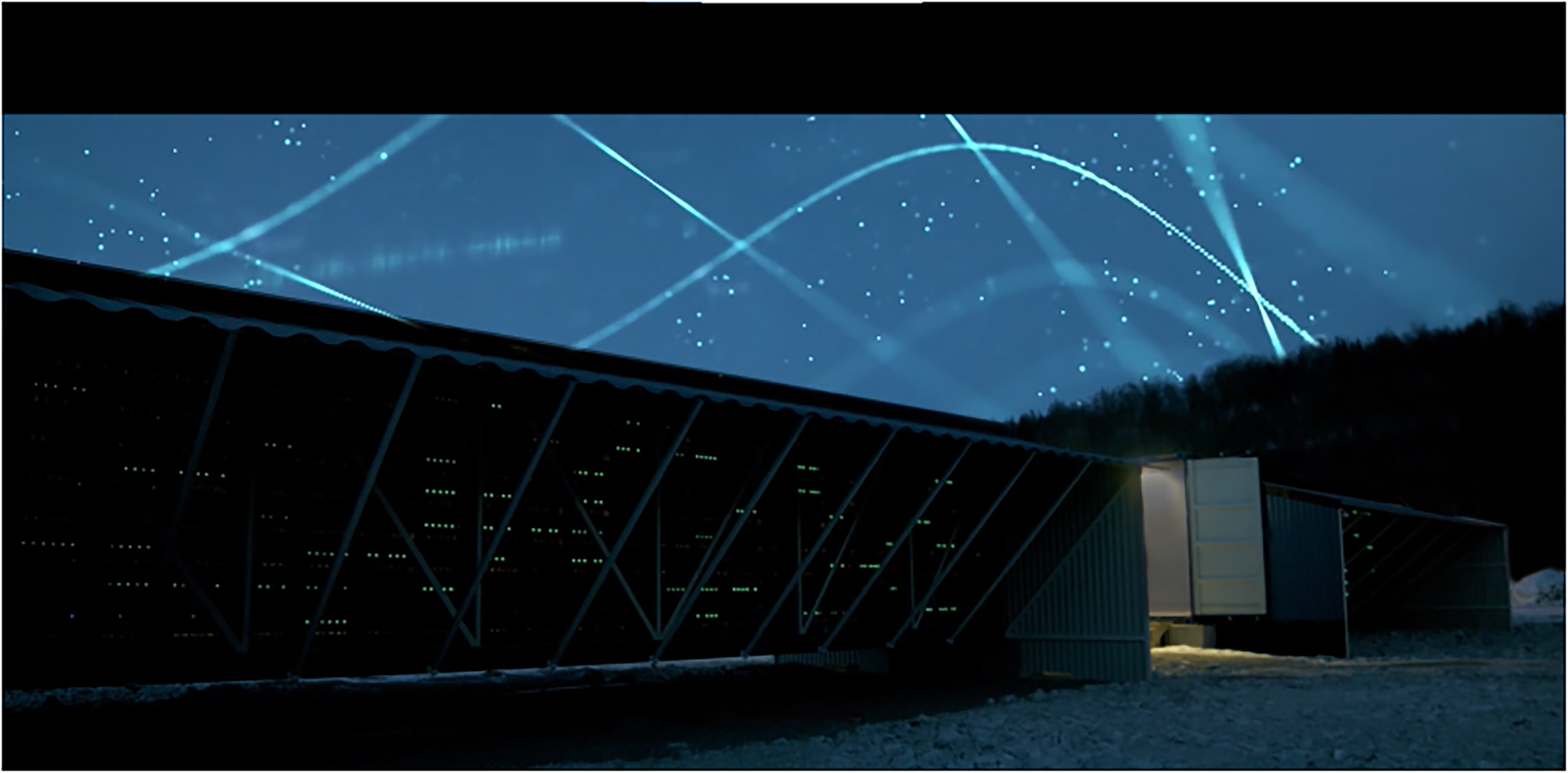
The first still from a promotional video for Mo i Rana as a prospective ‘datacentre belt’.
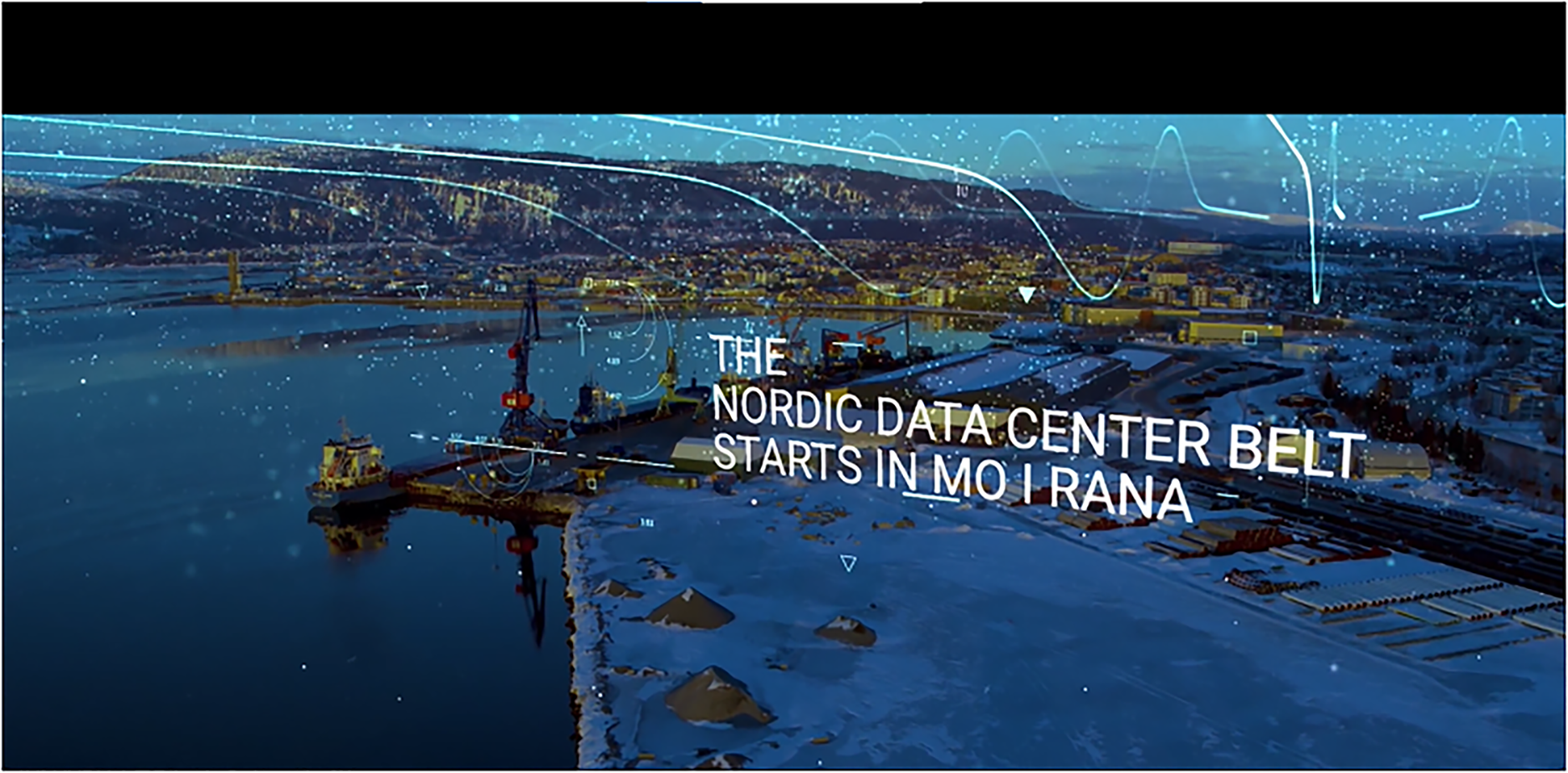
The second still from a promotional video for Mo i Rana as a prospective ‘datacentre belt’.
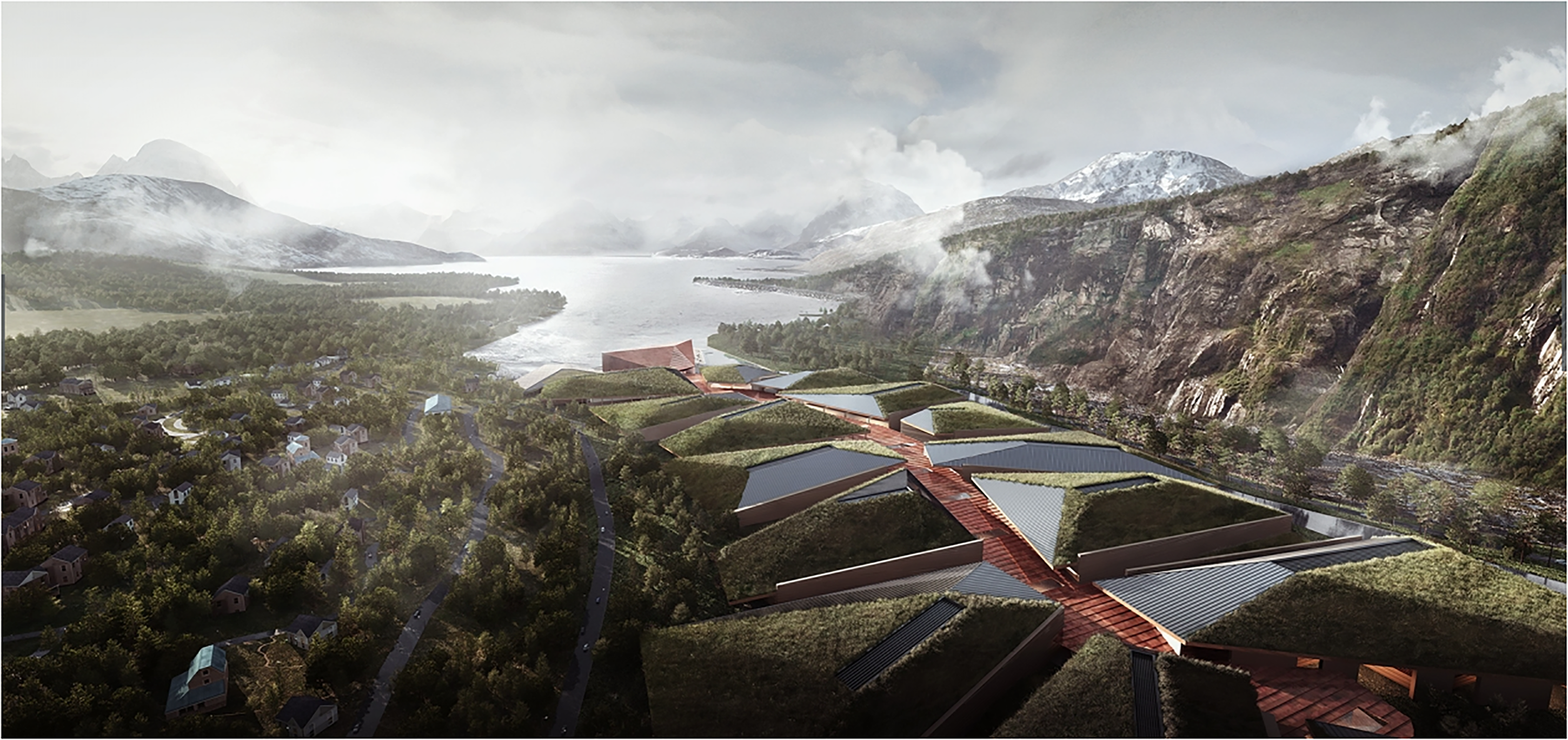
Architectural drawings of the Kolos data centre (Kolos, 2017).
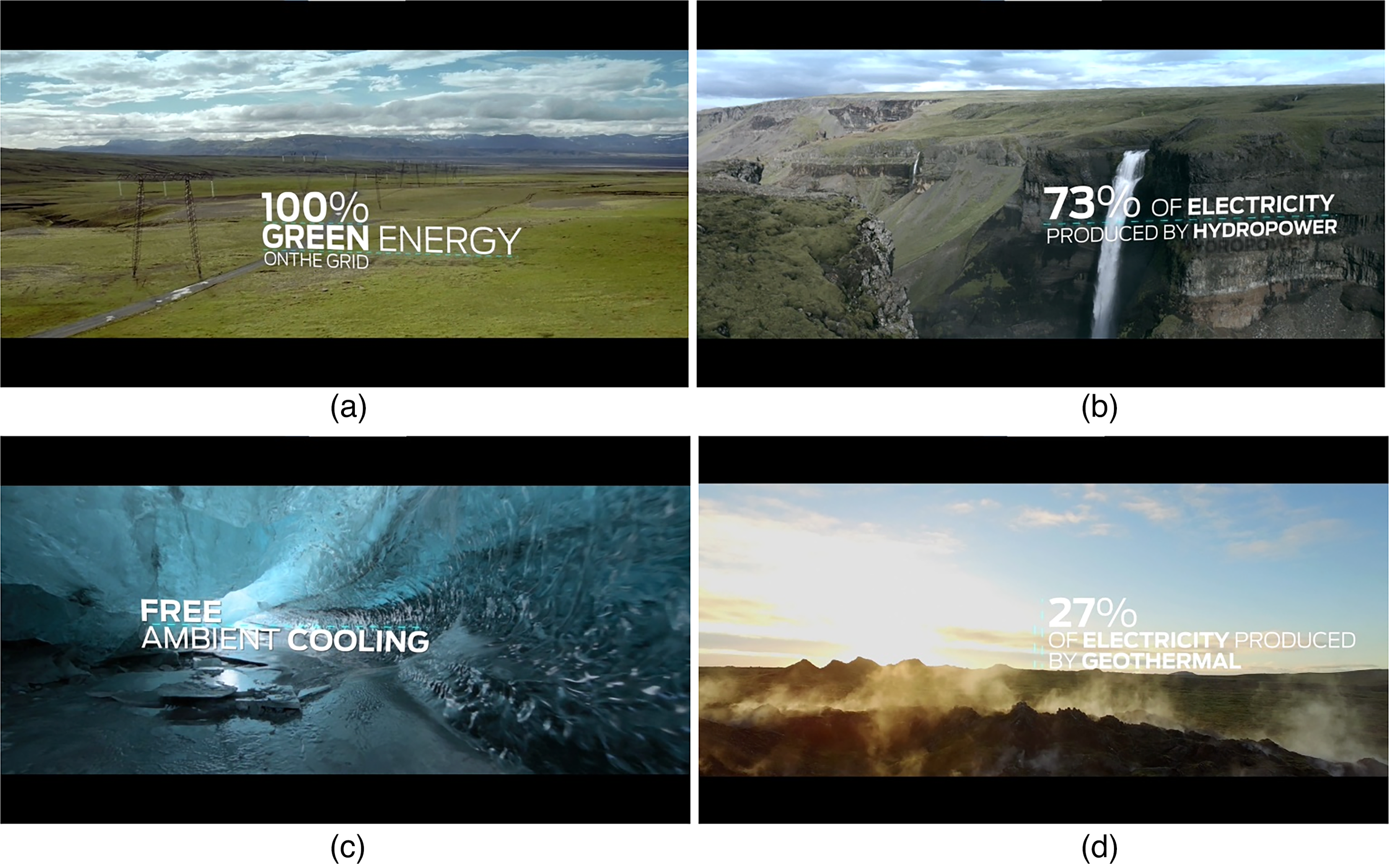
Invest in Iceland imagery supportive of the Nordic data centre imaginary.
There are obvious physical, material reasons for this: first, Nordic countries do have corresponding landscapes and the geographical context is that of the Nordics. Second, data centre technology and hence data centre operators and investors do benefit from the cold that is displayed: electric power for cooling constitutes a substantial fraction of data centre operating costs (approximately a third); hence ambient cold is literally valuable for data centres. Third, data centres need land and the imagery often depicts such space. Fourth, data centres need substantial electric power and hence natural features from which this can be generated are often displayed, particularly rivers and dams for hydropower; and geological features associated with geothermal energy in Iceland (with, not surprisingly, a preference for images of geological steam rather than flowing lava). In the case of Iceland, there is often also a reference to the island's geographical location as in between Europe and the United States. The aurora borealis also often feature as a specifically Nordic natural phenomenon.
The text associated with the imagery variously makes a reasoned case for moving north: the availability of surplus renewably generated power with long-term price contracts; land; a cool/cold climate; tax incentives (variously regarding income tax, depreciation allowances, social security, training grants, etc.); consequent effects on, for example, the total cost of ownership; cultural and leisure amenities; a highly educated workforce; fibre-optic signal latency in milliseconds, plus cable redundancy, to Europe and the United States.
The text and visuals combine to convey the meaning, above all, that the Nordics are an attractive place for data centre operators: that the two fit together naturally in all senses. Sometimes artistic illustration is used to emphasise this: the website of the proposed Kolos data centre (Kolos, 2017) highlights the natural Nordic environment, as is common across many of the commercial websites, but Kolos also commissioned aesthetically notable architectural drawings, currently hosted on the website of the civil engineering firm HDR (HDR, 2017) (see Figure 3). Again, the meaning conveyed is one of a ‘natural’ blend of the data centre and its environment. While the Kolos designs are notable, large data centres are more typically similar to goods distribution centres in appearance, that is, bland with a large occupied area.
Figures 4(a) to 4(d) provide further illustrative imagery, characteristic of Iceland: wide, open spaces that include electric power pylons; waterfalls falling from a central plateau; glaciation and ice tunnels; and geothermal heat rising from volcanic rock and pools. Again none are unique to Iceland, but taken together they are evocative of the country's distinctive landscape, and the features displayed are chosen to resonate with the needs of the data centre industry (space, energy and cooling).
Turning to Jasanoff's morality term, the key theme is one of nature as legitimating and robust 6 . The types of imagery used are those of nature as powerful, rather than nature as fragile. While the image of a sleeping arctic fox is used in the logo of the Arctic Council 7 , the natural imagery in data centre promotion tends to be of large landscapes, icescapes and powerful rivers. A less prominent but also notable theme is of the data centre in, or according with, the landscape. Regarding legitimation, we make this inference on the related grounds that the natural worlds displayed are apparently unaffected and unsullied by human activity. Nature is vast, strong, persists and – importantly – in the Nordics is cold; which is what data centres need: a reliable, secure and cold environment.
Heterogeneity in external imaginaries
Outside of the country, the imaginaries of Icelandic and Norwegian data centre deviate significantly from each other. For Norway, the external imaginary becomes much more differentiated, but nonetheless remains focused on the commercial and environmental benefits of the cold environment and renewable power. For Iceland, this stability is lost to a greater degree: a large proportion of the newspaper themes associate the country with cryptocurrency mining and its high energy consumption.
A prominent theme in the newspaper articles referring to Norwegian data centres is how data centres support and further business agility, flexibility and cost reduction in a time of increasing digitalisation and data processing as part of service provision – per se. This is not a Nordic-specific theme, but a materialities theme of globalising business development: a shift to cloud-based applications, co-location and hybrid on and off-site options in pursuit of relative cost reductions, resilience and data security that may or may not be serviced by a Nordic based data centre. Moreover, many articles referring to data centres in the countries of focus here are about competition among potential data centre sites, particularly Ireland relative to the Nordics and particularly from an Irish perspective 8 . Notably, of those newspaper articles referring to Icelandic data centres, cryptocurrency is the focus three times more often than the next frequent reference, which is to acquisitions and investments.
Other related materiality themes in the newspaper articles relating to both countries (materiality not being strictly separable from moral or meaning dimensions) concern business acquisitions and investments in the data centre sector (including the submarine cables that have become critical for digital business); anticipated drivers behind the rise of the sector such as the internet of things; the ongoing development of international fibre connections; and frequent references to power supply, including the value of corporate power agreements (between renewable energy generators and data centres) for the ongoing deployment of renewables generally; and the ongoing attractiveness of low Nordic electricity prices for cryptocurrency mining, particularly as hash rates (the number of calculations required to decrypt a coin) increase. Key among drivers towards EU location of data centres – including but not only the Nordics – are post-Snowden and GDPR-related data security and legislation (i.e. EU governmental and corporate intention to avoid surveillance by the US agencies and companies, a material concern with a strong ethical dimension).
Notable among the morality-referenced themes are, most prominently, the drive to reduce sectoral carbon emissions; followed by cryptocurrency-related concerns, though again primarily related to high power consumption and implicitly associated emissions, rather than the ethics of speculation. The power consumption of the data centre sector is often referred to as morally problematic: data centres are described as ‘power hungry’ (Reuters, 2018), ‘energy-guzzling heat machines’ (Bernal, 2019), with blockchain mining often singled out in this regard: “The power drain is already pushing miners to look for countries such as Iceland and Norway with cheaper electricity that comes from renewable sources. But the rampant growth in cryptocurrencies means that demand will start to outstrip supply.” (Adhikari and Swan, 2018)
The problem is not perceived as restricted to blockchain mining, though: the data centre imaginary for some has connotations of something beginning to be dangerously out of control: “By 2030, data centres and all internet-related activity - from streaming video to analysing -financial data to storing software, photos and emails - could use more electricity than all of China did this year, according to a study from the Western Norway Research Institute and Huawei Technologies. Iceland is becoming the bleeding edge of the world's newest power-hungry industry. Iceland's first environmentalist government is considering ways to slow the rise of data centres in the country by reviewing its rule book for adding new power plants. Many politicians say they worry the tech boom is putting Iceland's pristine nature at risk - the crux of its crucial tourism industry.” (Turner, 2018)
In the global eye of the newspapers considered, data centres have multiple meanings that are mixed and quasi-contradictory. They offer positive potential in place of Arctic resource extraction, but they also threaten eco-disaster. They have connotations of an advanced, materials-light economy, but they consume more energy than whole countries. The contradictions are reflected in The Daily Telegraph's summary of the BBC World Service documentary
9
: “’If data is the new oil,” asks this edition of The Documentary, “are data centres the new oil rigs?” We tend to think of the internet as something that exists only in a kind of ether, but in fact, for the internet to function, physical servers requiring lots of energy and constant cooling are required. Norway became rich from fossil fuels, and is now considering a bold new future based on data mining; its server sites can be cooled naturally amid the fjords and mountains, but does this impinge on the lands of traditional peoples?” (The Daily Telegraph, 2019).
Themes in relation to Iceland, already present above, mirror those of Norway, but with a more significant predominance of concerned bitcoin-related articles. The following passage from the National Post in Canada (April 2021) brings together several of these: material concerns regarding the declining availability of surplus renewable electricity (at least for now), and the business and moral uncertainties of bitcoin: “‘There could be very little excess energy in 2021 and 2022,’ said Hordur Arnarson, chief executive officer at Landsvirkjun, Iceland's national utility. “Because of the climate issues we see a lot of very interesting segments that are growing rapidly, and several of them need electricity.””…
“Growing concern about China's cryptocurrency clout is fuelling demand for mining locations elsewhere. Kevin O'Leary, the chairman of O'Leary Funds Management LP, told CNBC earlier this month that two kinds of Bitcoin will emerge, "blood coin" from China and "clean coin" mined using sustainable hydroelectricity, where the provenance can be proven, and that he would opt for the green one…
“While Iceland built a separate hydropower plant to allow for a new smelter in 2008, that courtesy won't extend to Bitcoin miners, according to Arnarson, the utility chief. "Nobody would build a power plant for Bitcoin," he said. "There's a lot of uncertainty about the future development." (Bloomberg, 2021).
Overall, there is much stronger anchoring of the Icelandic data centre imaginary to negative associations of cryptocurrency mining than there is for the Norwegian data centre imaginary. This is arguably problematic for wider societal perceptions of data centre development in Iceland, and (to our knowledge – bearing in mind the secrecy of the sector) – also reflects material differences in the development of the sector in the two countries.
In the next section, we turn to the imaginaries held within Iceland and Norway that are circulating among their publics, or at least those whom we questioned. We find these imaginaries to be heterogeneous and unstable relative to the promotional imaginary, in the sense that the publics hold concerns that to them are significant, though generally not top of mind outside of the research context.
An unstable public imaginary
We find more than one imaginary implicit in our public arena, illustrated by the focus groups: these imaginaries co-exist and appear labile and nascent (early stage), responsive to the information that we provided (appended), but (as said) also appearing to reflect pre-existing attitudes. The participants had an initial, basic awareness of the functions of data centres, but had nonetheless for the most part thought little about data centres per se. Materially, they associated them primarily with data storage for consumers and businesses and less so with high-performance computing. A few gave ‘crypto’ as a top-of-mind association. Several referred to ‘the cloud’ and security of data storage was also referred to. The initial imaginary in one of the Iceland groups was quite sceptical:
< What comes to mind when you when you see and hear that term [datacentres]?> “Dangerous artificial intelligence misuse and also convenience.”
“Basically solving equations to mine crypto currency”.
“I would rather focus on a datacentre that is more ethically… to me bitcoins are not ethical, just waste… its computational power isn’t being used to solve any problems.”
“And there's also a lot of questions because we don't know anything about them.”
Corporate clients of data centres are seen as the main beneficiaries, but also publics in various roles as consumers and users of, for example, government services. In terms of meaning, data centres are thus generally seen as a necessary and important part of modern, digitally mediated life. There was general approval of their employment potential, but also an expectation that this would be modest to low relative to, for example, aluminium processing plants. Illustrative views that reflected this general (but not complete) consensus would be: “I think that having a datacentre in Norway is probably better than having it somewhere else… If it's going to be the new oil, then the tax income would be a really important thing.” Norway group 1.
“I understand that there aren’t going to be a lot of direct employment jobs maybe around just working there, but I feel if it's some, then it's good. Because there are a lot of competent people in Norway who need jobs and who might benefit from working at those datacentres.” Norway group 2.
Morally, most participants in the Icelandic groups expressed moderate to strong disapproval of cryptocurrency mining, perceiving the energy consumption involved to be unjustified. This was replicated to a lesser extent in the Norwegian groups. Several people in Icelandic groups wanted greater government control and regulation of what data centres were doing, including in relation to cryptocurrency mining, and supporting infrastructure: “I think it's more of a risk if Facebook and Google start actually owning their own lines. Because they have a lot more power over them. That doesn’t sound very good… I think I’d prefer if it was government owned or something like that… they own the information, they’re transporting the information and if they’re also owning the infrastructure, then hmm, I don’t know.” Norway group 2.
“… it's almost like the power companies are mining money, quick money. But if the Bitcoin system collapses, all of a sudden you have a lot of power investments in Iceland, and you need to get that back from somewhere else.” Iceland group 2.
Other than cryptocurrency mining, there were two further main concerns. The first involved not the data centres per se, but corporate users of citizen and consumer data – the uses and misuses to which this data may be put, including security failure via hacking: “If you are offered to store your data for free, that means you are a sales product - like Facebook, because it's free. That means that information stored will be used by some to touch you and influence you.” Iceland group 2.
The second main concern related to power consumption and consequent, potential impacts on consumer electricity prices, perceived as including and consequent on the lower energy tax rates afforded to data centres relative to aluminium plants, and the likely eventual need for construction of additional energy supply and distribution infrastructure. It should be noted that these concerns were not ubiquitous: some participants wanted more information about this issue of power supply and the impacts on consumer costs, that is, themselves, including in relation to electricity tax discounts for data centre operators relative to aluminium plants, before coming to a definite view 10 .
While the latter ethic was notable and predominant, that is, self-interest, albeit collective in terms of the country, participants accepted and approved of the carbon emissions benefits of locating data centres in Nordic countries instead of warmer countries. This said, motives for this varied: while some held a universalist ethic (Schwartz, 2011), many were most concerned about climate warming effects close to home. Subsidiary concerns mentioned by individuals included possible effects of sub-oceanic fibre-optic cables on marine mammals; issues of sufficiency and there being no end to the sector's development; in the Iceland group, concern about the lack of public debate about the future role of data centres in Iceland and concern that this lack of debate might be deliberate.
From the above, we infer three competing data centre imaginaries in the public sphere or arena: the first is of data centres as broadly welcome, modest sources of modern economic activity that are sensibly locating in cool zones with renewable energy supply. That is, data centres as modern businesses with benefits for particular needs but ordinary consequences. This imaginary was more dominant in Norway. The second is of data centres as morally dubious, excessive consumers of renewable energy supply; this imaginary is anchored to cryptocurrency mining and was more prevalent in Iceland. The third is a morally sceptical, Norwegian variant of the first, in which data centres are seen as welcome and necessary economic activity, often deployed again for morally dubious activity, in this case, the processing of personal information for others’ financial gain. In the public mind, therefore, the distinctions hinge largely (but not wholly) on the activities of the data centres: the purposes to which the technology is put.
Implications for data centre futures
While it is not surprising that the imaginaries circulating outside of the promotional sphere are more heterogeneous than the advertising ideal, the internal and external deviation and critique suggests to us a lack of closure and hence stabilisation. As shown in Figure 5, the concerns raised in the public sphere echo, and shape, many of those raised previously, perhaps most notably that data centres are ultimately drivers of and driven by the practices and values of individual users globally, with impacts that are far from an ethereal cloud (Carruth, 2014). Stabilised imaginaries are interpreted spatially and culturally in divergent ways, which in turn shape public imaginaries that can then reshape heterogeneous national imaginaries in Iceland and Norway. As the multiple arrows of influence indicate, contestation occurs. It is far from clear that data centres will bring spatially distributed benefits: they often follow and repurpose existing infrastructure, be this buildings or power line routes, reinforcing prevailing patterns of development (Burrington, 2016). Johnson (2019a) refers to a particular example of this in Iceland, where cold war security measures are repurposed to provide data centre and other security.
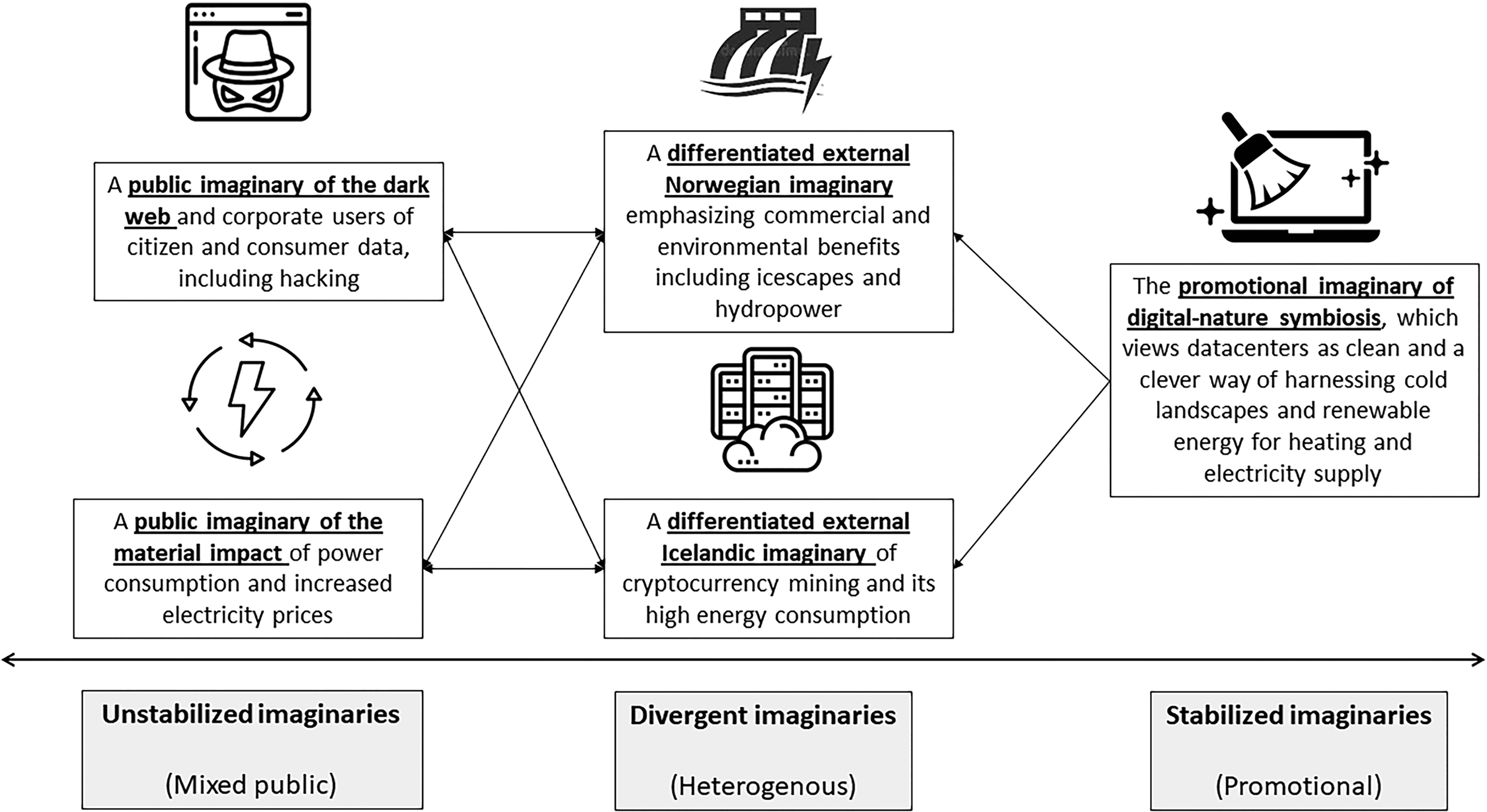
Visualising stabilized, divergent and unstabilised data centre imaginaries.
Just as climate change has disrupted rainfall patterns and hydroelectric power supply, so do they threaten to disrupt the idealised Nordic data centre imaginary, regardless of its use for state branding (Vonderau, 2019). Imaginations of places may ‘drive development interventions’, as noted (Johnson, 2019b, p. 1), but those imaginations can be disrupted by material change and both environmental and social concerns. In the case of Iceland, advocates of a ‘natural fit’ between data centres, climate and geothermal energy (Johnson, 2019b) are not necessarily mistaken – there are environmental benefits to be gained from locating data centres where they can make use of renewable energy, especially geothermal energy, which does not require the damming of valleys, or access roads through the lands of reindeer herders (Össbo and Lantto, 2011; Szulecki and Overland, 2018). Nonetheless, these benefits are relative and are also viewed in the public sphere as conditional, with publics apparently mindful of the purposes for which data centres are put. We do not anticipate a cessation of data centre development – far from it – but we do anticipate a phase in which states are more conditional and interventionist in their support of the sector.
Conclusions
For Iceland and Norway, data centre imaginaries are both techno-spatial and techno-environmental, with attributes that relate to place, environment and technology. Our main research questions have focused on the extent and forms of stability being achieved for such imaginaries as collectively held, institutionally stabilised, publicly performed, shared visions and understandings (Jasanoff, 2015). We suggest that the Norwegian data centre imaginary is more widely stabilised than the Icelandic data centre imaginary, but that neither align fully with their promotional ideals. There are marked differences between the internal, promotional data centre imaginaries and those of the observing, international press, despite some of the latter reflecting corporate interests uncritically. For publics, data centre imaginaries are quite mixed and include quite some scepticism.
That the external Icelandic data centre imaginary has for many become synonymous with bitcoin mining and problematic energy consumption should be grounds for concern among for those promoting the sectors nationally, at least to the extent that national acceptance or consensus on development directions is sought. In the international imagination, for Iceland, other Nordic development imaginaries are being crowded out. For Norway, data centres are more firmly viewed as potential catalysts for business ecosystem development in a more developed, mixed economy, both within and outside of the country.
The Icelandic state may be content in part to benefit from cryptocurrency mining, particularly if the renewable energy supply can be increased, but its public and external observers are more sceptical. Despite access to geothermal energy and an enviable socio-economic environment in terms of high-level indicators at least (OECD, 2019), Iceland's per capita CO2 emissions are higher than those of the UK, for example (OECD, 2020). As Sadowski and Bendor (2018) comment, changing the discursive dominance of existing imaginaries requires the creation and promotion of alternatives and we do not underestimate the challenges to this. As an energetically potent manifestation of digitalisation trends, how data centres are imagined will remain important globally.
More generally, the case is a reminder of the fragility of stability in the context of contemporary imaginaries. Our focus group discussions suggest that the power of the visual symbols and promotional text, issued by advocates and targeted at investors, usually external, does not touch public consciousness. The shared vision of a social life – data centre nations – is not yet a widely shared vision.
Does this matter materially for the sector and for the states involved? We do think that this is the case: that consumers of digital services are likely to become more critical of the impacts of providing those services and more expectant that commerce and state will take measures to mitigate their impacts. We acknowledge that this is a far cry from both the sector being held back in any particular location, or from consumers withdrawing from or avoiding the services of particular companies. Moreover, we would expect or at least hope for responses in terms of both policy and technological innovation that mitigate the problems referred to. Neither will happen without conscious decisions and choices.
Overall, we find the concept of imaginaries and their stabilisation useful in cohering and making sense of a broad range of attitudes of different types, including moral attitudes, in arenas that we think will become more contested over time. As combined techno-spatial and techno-environmental imaginaries, it remains to be seen how those Nordic data centres evolve in response to changing environmental conditions in the broad sense.
Supplemental Material
sj-docx-1-ene-10.1177_25148486221126619 - Supplemental material for Imaginaries on ice: Sociotechnical futures of data centre development in Norway and Iceland
Supplemental material, sj-docx-1-ene-10.1177_25148486221126619 for Imaginaries on ice: Sociotechnical futures of data centre development in Norway and Iceland by Paul Upham, Benjamin K Sovacool and Chukwuka G Monyei in Environment and Planning E: Nature and Space
Supplemental Material
sj-docx-2-ene-10.1177_25148486221126619 - Supplemental material for Imaginaries on ice: Sociotechnical futures of data centre development in Norway and Iceland
Supplemental material, sj-docx-2-ene-10.1177_25148486221126619 for Imaginaries on ice: Sociotechnical futures of data centre development in Norway and Iceland by Paul Upham, Benjamin K Sovacool and Chukwuka G Monyei in Environment and Planning E: Nature and Space
Footnotes
Declaration of conflicting interests
The author(s) declared no potential conflicts of interest with respect to the research, authorship, and/or publication of this article.
Funding
The author(s) disclosed receipt of the following financial support for the research, authorship, and/or publication of this article: This paper received funding from the European Union's Horizon 2020 research and innovation programme under grant agreement No 869327.

Supplemental material
Supplemental material for this article is available online.
Notes
References
Supplementary Material
Please find the following supplemental material available below.
For Open Access articles published under a Creative Commons License, all supplemental material carries the same license as the article it is associated with.
For non-Open Access articles published, all supplemental material carries a non-exclusive license, and permission requests for re-use of supplemental material or any part of supplemental material shall be sent directly to the copyright owner as specified in the copyright notice associated with the article.
