




Abstract
This paper conceptualises droughts as socioecological phenomena coproduced by the recursive engagement of human and non-human transformations. Through an interdisciplinary approach that integrates political ecology, material geographies and hydroclimatology, this work simultaneously apprehends the role of politics and power in reshaping drought, along with the agency of biophysical processes – soil, vegetation, hydrology and microclimate – that co-produce droughts and their spatiotemporal patterning. The drought-stricken Ladismith in Western Cape, South Africa, is the instrumental case study and point of departure of our empirical analysis. To advance a materiality of drought that seriously accounts for the coevolution of biophysical and political transformations, we alter the spatiotemporal and empirical foci of drought analyses thereby retracing Ladismith’s socioecological history since colonial times. In turn, such extended framework exposes the agency of soil, vegetation, hydrology and microclimate and their metabolic exchanges with processes of colonisation, apartheid, capitalist and neoliberal transformations of South African economy. We argue that the narrow pursuit of profits and capital accumulation of the few has produced a fundamental disruption between nature and society which contributed to transform Ladismith’s drought into a socioecological crisis. Whilst advancing debates on materiality, we note two fundamental contributions to the study of drought. First, our approach makes hydrological accounts of droughts less politically naive and socially blind. Second, it develops a political ecology of droughts and socioecological crises more attuned to the materiality of drought. We contend that apprehending the materiality of drought and the active role of its non-human processes can further understandings of the workings of power and the production of socioecological injustices.
Introduction: The socioecological complexity of drought
A multitude of disciplinary and theoretical perspectives has long explored the social and physical complexity of droughts. Physical and engineering scientists engaged with hydroclimatic issues (hereafter ‘hydroclimatologists’) consider droughts amongst the most devastating hazards, that have caused water shortages and severe famines in many regions across the world (Meza et al., 2020; Schiermeier, 2019; Van Lanen et al., 2013). For hydroclimatologists, drought hazard is a complex physical process, characterised by a certain intensity and duration, produced by the progression of below average precipitation, which leads to drier than normal soil conditions and, ultimately, reduced streamflow of rivers, meagre inflow of water into lakes or reservoirs along with limited groundwater recharge (Mishra and Singh, 2010). According to this framing, when encountering vulnerable systems, drought hazard can more easily escalate from conditions of below normal precipitation into a social and ecological disruption (Van Loon et al., 2016a, 2016b). More recently, due to increasing anthropogenic pressures, some hydroclimatologists have started to explicitly account for the role of human activities in the propagation of droughts (AghaKouchak et al., 2015, 2021; Van Loon et al., 2016a, 2016b). Although this recognition allowed novel ideas and methodological approaches to flourish, the politics and power dynamics underlying drought and its impacts remained unexplored across such studies (Savelli et al., 2022). Conceptually, the main contribution of the field is the understanding that, rather than static conditions, drought hazards are complex processes co-produced by the interwoven impacts of soil moisture variability, change in water flows, human activities, climate change and micro-climatic alterations (AghaKouchak et al., 2021).
Political ecologists, in contrast, have mostly emphasised the socially constructed nature of water scarcity as opposed to the absolute or physical scarcity (Akhter, 2017; Mehta, 2003). These scholars have critiqued hydroclimatologists for overlooking the social power embedded in socioecological transformations (Loftus, 2007) and have focused their attention on the relationships between nature, power and capital (Heynen et al., 2006; Swyngedouw, 1997, 2009). They have also shown that naturalizing the causes of drought is in itself a political act that shifts human responsibilities onto non-human processes (Kaika, 2003). Accordingly, a large number of studies have theorised the socio-economic and political processes that reshape drought and water scarcity, thereby generating uneven outcomes across societies and spaces (Bakker 2000, 2003; Kaika 2003, 2006; Mehta 2003, 2007, 2011; Millington, 2018). Such works employ concepts of production or social construction of water scarcity to expose the politics at play in the uneven experiences or manifestations of drought events.
Scholarship on the production of water scarcity has mostly focused on questions of water use, management and distribution, without engaging with the complexity of the drought hazard itself. By conceptualizing drought or water scarcity as socially produced, these studies seem to imply that independently from hydroclimatological conditions, if the social processes were different, droughts would not occur (Kallis, 2008). Yet, as Kallis (2008: 104) puts it, ‘one cannot just presume that a drought will not happen if politics are different without engaging with hydrometeorological and infrastructural specificities of the case’. In other words, work that theorises the social construction of drought and water scarcity has not yet unearthed the complex biophysical processes that co-produce, what hydroclimatologists define as, drought hazard, i.e. the process that gradually transforms reduced precipitation into parched soils, drying rivers and ultimately into socioecological disruption. Dismissing the ‘ecology’ (Walker, 2005), these studies reduce non-humans to objects that humans mobilise rather than active agents that interact, reshape, and coevolve with other socioecological processes (Rusca et al., 2017). As for the production of nature thesis, the production of water scarcity seems to have ‘squeezed out the productive role of ecological processes’ and dissolved the ecology’s heterogeneous realm into the unique category of water scarcity (Bakker and Bridge, 2006: 9).
Non-human (or post-human) geographies have begun to apprehend the active role of biophysical forces in co-producing socioecological transformations (Bakker and Bridge, 2006, Castree, 2003). These scholars have examined what they consider the unpredictable and unruly nature of ecological processes, and have conceptualised the body as the matter that experiences and enacts socioecological transformations (Bingham, 2006; Longhurst, 2001; Power, 2005, Tsing, 2012; Whatmore, 2002). Bakker and Bridge (2006) use the term materiality to define geographies that seek to animate the non-human, reconnect and redistribute agency across nature and society, and reconceptualise the ‘construction of nature’. In this light, the material forces are never intrinsically physical or natural, but rather historically contingent and relational (Bingham, 2006; Panelli, 2010; Power, 2005; Rusca et al., 2022; Tsing, 2012). Paradoxically, with the exception of a few scholars (Cousins and Newell 2015; Krzywoszynska and Marchesi, 2020; Lave et al., 2014; McClintock, 2015; Rusca et al., 2022), geographers have rarely engaged with natural scientists who work with material physical forces. Dismissing the physical and engineering scientists that do not consider politics nor power, geographers have not always been able to apprehend the agency of non-human forces and their implications on social processes.
By contrast, this paper employs an interdisciplinary approach that moves beyond binary conceptualisations of nature and society and accounts for the multiple social and ecological processes that transform a drought from conditions of below normal precipitation into socioecological disruptions. We do so by examining the case of Ladismith, a rural community located in South Africa’s Western Cape Province, which reached the verge of socioecological collapse after a severe and prolonged drought in the period 2015–2019. To consider droughts as reshaped by the interplay of distinctive socioecological processes, we have extended the temporal and spatial scales of our analysis. Here the use of critical history is crucial to understand how power, politics and non-human natures co-evolved and co-shaped each other overtime thereby creating specific conditions for drought hazard to unfold. Thus, this paper expands the analysis beyond the geographical area of Ladismith and goes back in time to unravel the politics of colonial dispossession, racial and economic segregation, capitalism and neoliberalism which have significantly interwoven with processes of soil moisture variability, vegetation cover, changes in surface or groundwater flow, and micro-climatic alterations of Ladismith’s area. In this way, we reveal the active role that multiple and interwoven socioecological processes have played in transforming Ladismith’s drought from a meteorological event into a dire socioecological crisis. In addition, by retracing the history and coevolution of Ladismith’s biophysical and social processes this work exposes the violent and unjust transformations that have reshaped drought in Ladismith.
Overall, by redistributing the agency between human and non-human natures, the paper contributes to debates on materiality and more specifically, advances understanding of droughts and their socioenvironmental implications. First, our engagement with hydroclimatologists makes critical geographers’ accounts of the production of water scarcity more attuned to the materiality of droughts. Such an interdisciplinary collaboration, we argue, is essential as it captures the ways distinctive biophysical processes can enable or constrain human practices and power relations (Lave et al., 2014). Second, our historical and political ecology analysis also advances hydroclimatological accounts of droughts by making them less politically naive and socially blind.
Understanding the complexity of drought: From the production of water scarcity to material understandings of drought
Drought as production of water scarcity
Political ecologists have long examined the role that human agency or social power plays in producing water scarcity and uneven experiences of drought (Bakker, 2000; Kaika, 2003; Mehta, 2003). Their studies have exposed the ways in which the processes of land and water dispossession, capital accumulation, privatisation, commercialisation, and resource management policies, contributed to reshape manifestations, experiences and representations of drought. Throughout this work, scholars have mostly conceived droughts as ‘production’ or ‘social construction’ of water scarcity (Ahlers, 2010; Akhter, 2017; Bakker, 2003; 2000; Higgins 2001; Kaika 2006; 2003; Loftus, 2007; Mehta, 2011, 2003; Millington 2018; Otero et al., 2011; Walker, 2014). Specifically, to avoid conceptualisations of droughts and water shortages as merely natural, Bakker (2000) employs Neil Smith’s notion of ‘production of nature’. She conceptualises the Yorkshire Drought of 1995 as the outcome of distinctive water management practices, such as meteorological modelling, water demand forecasting, and the regulatory practices of the water industry (Bakker, 2000). More recently, Millington (2018) has employed the case of the Sao Paulo water crisis (2014) to explain how scarcity was produced by the combination of existing infrastructural inequalities and the differentiated abilities of urban residents to store water. Mehta (2003) has long argued that social production of drought and water scarcity serves specific interests and political ends. For instance, in Greece, water was discursively constructed as a scarce resource and the drought became the justification to accelerate the implementation of controversial political economic transformations such as the liberalisation and privatisation of water services (Kaika 2003; 2006). This literature importantly shows that portraying scarcity as natural and chronic, rather than cyclical and human induced, has mostly served the interests of the elite. Indeed, depictions of natural water scarcity tend to ignore stark inequalities in access to, and control over, land and water resources (Mehta, 2003). Therefore, when scarcity is considered merely natural or as Akhter (2017) defines it, absolute, the political economic structure that reshapes uneven uses and distribution of water is concealed. Thus, political ecologists stress the fact that droughts are as much historical, political and context specific as they are natural (Akhter, 2017).
Overall, this scholarship devotes most of its attention to the distinctive socio-political processes that have materially or discursively reshaped the experiences and manifestations of drought. Similar to ‘the production or social construction of nature’ thesis, to state that water scarcity is socially constructed inevitably implies that society, social power or social interests do this construction onto something else i.e., nature (Castree, 2003). Thus, even though essential to expose the politics, this explanatory framework remains limited for two main reasons. First, it reasserts the ontological divide between nature and society (Bakker and Bridge, 2006; Lima Costa et al., 2017). Second, it reproduces what Haraway (2015) called the arrogance of the human. By considering nature as socially transformed, these theories have largely overlooked the agency of the non-human in socioecological transformations (Castree, 2003). In other words, conceptualizing water scarcity as socially produced conceals the productive role of the ecological and biophysical processes that co-produce drought or what hydroclimatologists define drought hazard. In turn, such conceptualisations have not seriously accounted for the agency of soil, vegetation, hydrology and atmospheric processes, nor for their social implications.
In response to critiques of the production and social construction of nature, post-human (also non-human) geographies have taken on the challenge of decentring the human and reconceptualised it in its entanglements with other non-human elements (Lima Costa et al., 2017). Drawing upon Haraway’s Cyborg Manifesto and Latour’s Actor-Network Theory, many post-human scholars have developed a relational approach to investigate the agencies of animal, gardens, mushroom and trees (Bingham, 2006; Panelli, 2010; Power, 2005; Tsing, 2012). Others have focused instead on materiality to emphasise the way any matter or material condition can enable and constrain social transformations. This literature emphasises that the material is neither pregiven nor intrinsic, but rather the historical product of both material and discursive practices. Through the recognition of these relations, the 'production of nature' becomes the ‘co-production of nature’, a process in which humans and non-humans coevolve and mutually reshape each other.
Drawing on these interpretations, we argue that decentring human agency and focusing on the material relationalities of drought constitutes a productive way to overcome the impasse of social construction and production of nature. However, we also insist that a focus on materiality alone, might prevent the apprehension of the agency of non-human elements and their social entanglements. Thus, in the following section, we engage with hydroclimatological understandings of drought as a way to capture the co-productive capacity of non-human elements involved in the production of droughts and socioecological crises.
Hydroclimatological understandings of drought
Many hydroclimatologists agree that droughts are events generated by the interaction of physical processes that change over time and across space (AghaKouchak et al., 2021). To illustrate, Van Loon et al. (2016a, 2016b), proposed a conceptualisation of drought propagation that accounts for complex spatiotemporal processes and dimensions (Figure 1). A drought is usually set off by prolonged atmospheric conditions induced by climate variability (AghaKouchak et al., 2015; Heim, 2002; Mishra and Singh, 2010). Thus, the first manifestation of a drought in a given geographical area often consists of a meteorological drought, which encompasses a prolonged condition of e.g., below average precipitation. This can (or may not) evolve into a soil moisture (or agricultural) drought, during which the soil becomes drier than normal for a prolonged amount of time and in turn unable to maintain the water required by the surrounding ecosystem. Subsequently, the latter conditions can (or may not) unfold into a hydrological drought, manifesting into reduced flow of rivers, meagre inflow into lakes or reservoirs, and limited groundwater recharge. Atmospheric conditions – such as a persistent lack of precipitation – influence both hydrological and agricultural processes. At the same time, hydrological and agricultural processes can also affect atmospheric conditions via feedbacks between soil moisture, vegetation and evaporation.
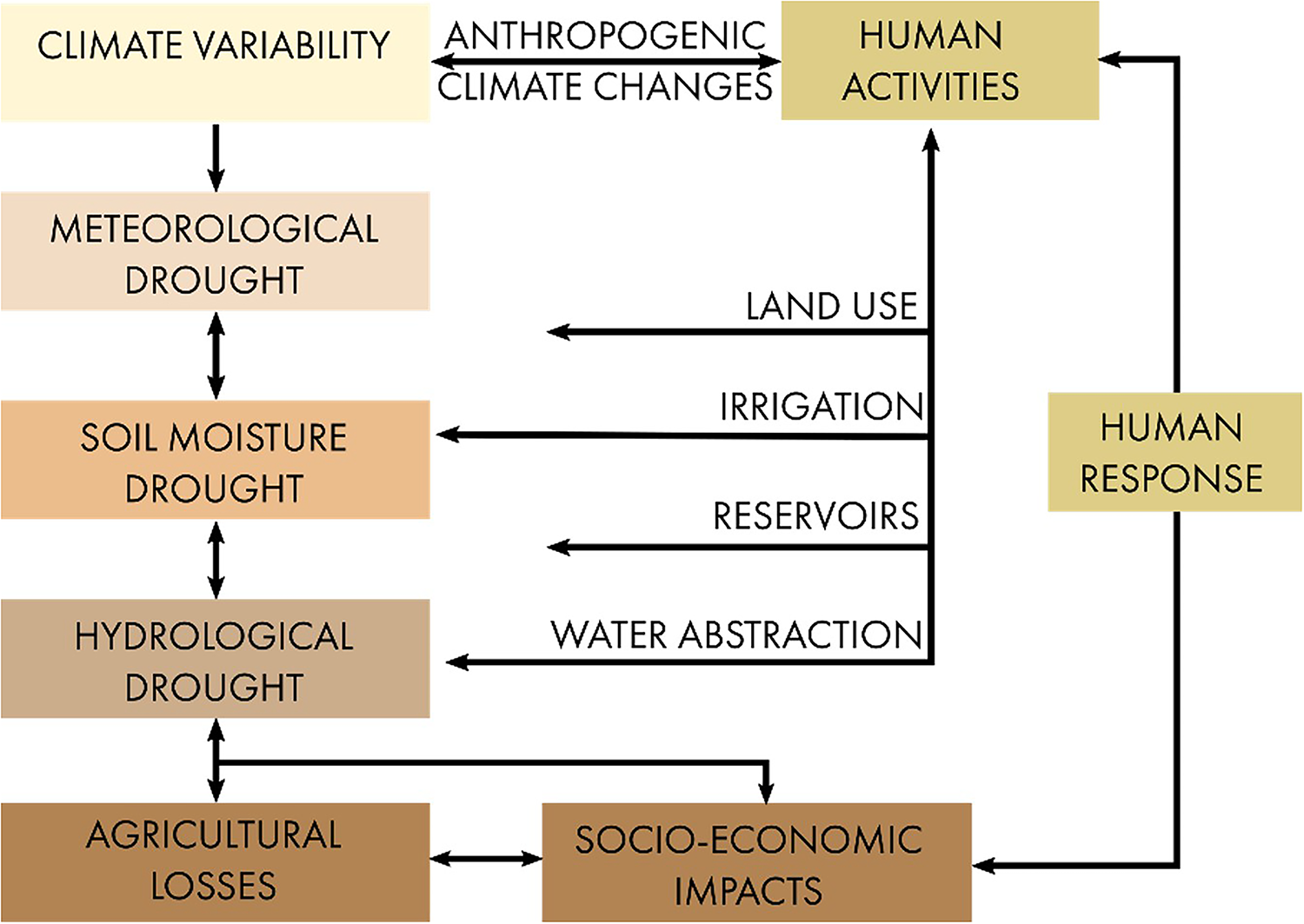
Drought hazard propagation. The diagram shows that human activities influence the way in which droughts propagate from the atmosphere to the ground through land use, irrigation, dams and reservoirs, as well as water abstraction. At the same time, droughts cause agricultural losses and negative socio-economic effects, which can re-shape human response to drought. Source: Van Loon et al. (2016a).
This complex web of interactions and feedbacks that characterises the propagation of drought further intertwines with human activities and their impacts. Van Loon et al. (2016a, 2016b) argue that including anthropogenic pressures is crucial for preventing the development of ineffective policies and unintended consequences. When the cascade of meteorological, soil moisture and hydrological droughts affect a vulnerable environment, the drought can produce socioecological impacts and engender a socioecological crisis (Heim, 2002; Van Loon et al., 2016a, 2016b) – which we define as disruption of pre-existing socioecological dynamics.
One could argue that hydroclimatological understandings of drought hazard propagation are at odds with political ecologies’ perspective on nature and society. Specifically, hydroclimatological studies often merge distinctive social processes into a limited number of variables and reduce major social changes to mere population statistics or economic growth. These apolitical interpretations of society perpetuate the nature-society divide, whilst also obscuring power relations embedded in every socioecological transformation (Savelli et al., 2022). Such approach plausibly derives from positivist theories and beliefs according to which the only valid knowledge is the one that can be observed, measured or experimented. However, whilst interdisciplinary collaborations present epistemological and ontological challenges (see the Methodology section below), they also offer new ways of apprehending the agency of non-human processes coproducing drought. Engaging with hydroclimatologists can open up new questions and possibilities for political ecology analyses to advance the materiality of water, in particular by attending to microclimatic conditions, soil, vegetation and hydrological changes. Below, we propose an interdisciplinary methodological approach to unravel the socioecological complexities of droughts and their resulting socioecological crises. Next, we examine the theoretical implications of our framework by examining the case study of Ladismith.
Methodology: An interdisciplinary approach to unravel the socioecological complexity of drought
To study droughts and their socioecological implications, we employ an interdisciplinary approach which integrates political ecology analyses with hydroclimatological studies. Political ecology is essential to critically investigate the processes through which unjust and destructive socioecological relations are created and reproduced (Krzywoszynska and Marchesi, 2020). Yet, a politically conscious understanding of socioecological transformations must acknowledge symmetrically the biophysical agency of non-human processes, their social constitution, and the dynamic interactions between human and non-human factors (Krzywoszynska and Marchesi, 2020; Lave et al., 2014; Rusca, 2022, Turner, 2016). Thus, whilst pursuing a political ecology analysis, this paper also engages with hydroclimatology and environmental data. Specifically, we use hydroclimatology to account for the agency of distinctive biophysical processes – soil, vegetation, hydrology and microclimate – co-shaping the temporal and spatial patterning of drought hazard and, as such, coproducing its socioecological unfolding. To seriously accounts for the coevolution of biophysical and political transformations, we expand the temporal and spatial scales of analysis and consider those social and ecological processes that over time have intersected and produced a specific droughtscape.
A productive interdisciplinary engagement is difficult as it implies an engagement with different ontologies and ways of knowing that are often perceived as not compatible. These differences require first of all, that each scholar possesses a basic understanding (and respect) of all the disciplines the research draws on. Next, an interdisciplinary effort needs to be based on common research questions that can be understood and addressed by each discipline. Last, such an engagement also requires social scientists to overcome stereotypical representations of physical and engineering science as ‘irreversibly’ positivistic (Rusca and Di Baldassarre, 2019). In our experience, the field of hydrology and climatology is more complex and characterised by a rich diversity of ontological, epistemological and methodological positions. In fact, within the prevailing positivist tradition, some hydrologists have warned against essentialist categorisations and absolutist notions of space and time. Among those, some recognise the ‘unavoidable subjectivity’ of modelling processes, the uncertainty in the research process as well as the importance of context (Beven, 2006, 2000; Pappenberger et al., 2007: 275). It is within this community, we contend, that possibilities of collaborations and debate can be initiated.
This interdisciplinary research uses Ladismith as an instrumental case study (Stake, 1995) to unravel the complexity of the socioecological processes that govern drought hazards. Throughout this case, the research garners insight about the transformation of a drought hazard from a severe hydroclimatological event into a far-reaching socioecological crisis. This rural area in the Western Cape is not only representative of a place that experienced severe and prolonged meteorological drought, but also of one that suffered a harsher and more persistent crisis relative to other areas affected by the same meteorological conditions.
To capture the socioecological transformation of the drought and its implications across the Ladismith area, our interdisciplinary approach employs a diverse set of qualitative and quantitative methods. Primary qualitative data were collected through 35 semi-structured interviews and field observations. We investigated diverse experiences of the drought as well as people’s behaviours, opinions and emotions, to extensively describe the crisis and expose its inequalities. The inclusion of different social groups such as white commercial farmers, male and female farmworkers, and other Ladismith inhabitants, have revealed different perceptions and experiences of the same crisis. Moreover, institutional actors disclosed the evolution of state-society relationships during the crisis, both from the government as well as the residents’ perspective. Qualitative interviews have been integrated with other primary data collected from an extended videography project. Filming in Ladismith established a participatory dynamic with the interviewees, who were able to share their stories more freely and take a lead in deciding what was relevant to visualise, where to film and why. Thus, the video-material provided a more contextual account of the drought and a more accurate representation of farmers’ along with farmworkers’ relation with the surrounding dry environment and vice-versa (Fantini, 2017; Rusca, 2018, Thomsen, 2015). The primary data was complemented by and triangulated with secondary data retrieved from a documentary analysis of major institutional documents, historical records and media articles relevant to the case study. Altogether this data provided insights into meanings and rationales of people’s experiences to facilitate a more accurate historical investigation around the political forces and powerful interests that have reshaped the materiality and diverse experiences of the drought.
Quantitative data consists of rainfall data series, assessments of land degradation, the status of river ecosystems, levels of water consumption and satellite images. This data was retrieved from local institutions and through extensive documentary analysis. Quantitative data served to examine and visualise the drought’s biophysical processes and their socioecological alterations throughout history. Rainfall timeseries characterise changes in meteorological conditions as well as the intensity of the latest meteorological event relative to other anomalies that Ladismith has experienced throughout the last century. Satellite images show the level of hydrological and soil moisture drought. Last, assessments of land degradation and the status of river ecosystems retrace changes of physical conditions of Ladismith’s land and vegetation. Assessments of land degradation derive from spatial analysis of remote sensing data, field observations and data sampling. 1 The most used indicators for land and ecosystem status are soil nutrients and biomass variations. These quantitative and visual transformations have been triangulated with literature on the historical geographies of the region, through which we examine the major socioecological changes that occurred over the last century.
The sensitivity of the case examined called for more reflexivity on the way we collected the data. During fieldwork, the most difficult aspect was to consider and cope with the power dynamics existing between the researcher (the lead author) and the diverse group of participants (i.e., Ladismith’s local authorities, white farmers, farm-workers and other inhabitants of the area). Neglecting those dynamics would have been both counterproductive and unethical (Sultana, 2007). Whilst staying in Ladismith, the researcher was aware of the power imbalance between her privileged position and that of the research subjects, and the likely discomfort and ambivalence that this imbalance could produce in her relationship with participants. One dimension was her white race and privileged socio-economic status relative to most of the interviewees. She was also acutely aware of her position as an observer of the lived reality of poverty and despair experienced by the population of Ladismith. To ‘blend in’ as much as possible whilst remaining conscious of the inherent power relations, the researcher undertook most of the fieldwork following the guidance and advice of local contacts.
Both local contacts and research subjects extended extraordinary hospitality to the researcher despite the physical and psychological burden that this work required. Videography also proved to be an effective tool to reduce power imbalances and ensure a more collaborative research approach. With very few exceptions, most of the farmers and farmworkers who took part in the documentary opened their doors, offered their time, and shared their most distressing stories. Many farmers and farmworkers were brought to tears in front of the researcher. Most of them were feeling shame and humiliation over their failure, financial struggles and inability to secure their families’ future. Notwithstanding their embarrassment, research subjects accepted to be interviewed, filmed and recorded. In some cases, this hospitality and generosity generated a sense of discomfort in the researcher who could not express her anti-colonial and anti-capitalist position in front of the people being interviewed, especially in presence of white farmers heavily affected by the drought. Throughout the fieldwork, reflexivity emerged in different forms of (un)learning the established research practices that would preserve biased and privileged understanding of reality. In turn the new practices involved deeper ethical considerations, destabilised the researcher’s epistemology, and gave space to other voices and perspectives such as the ones of desperate white farmers trapped in conditions of poverty and struggle.
The socioecological genesis of Ladismith's drought
To be able to account for the soil, vegetation, hydrology and microclimate transformations that coproduced Ladismith’s drought, this research alters the conventional spatiotemporal and empirical foci of drought analyses. Rather than limiting our assessment to the five years of below average rainfall and the resulting socioecological crisis, we retrace Ladismith’s socioecological history since colonial times. We first describe Ladismith’s socioecological characteristics. Then, we explain the ways in which processes of colonisation, apartheid, capitalist and neoliberal transformations of South African economy have closely interwoven with soil, vegetation, hydrology and microclimatic processes. In doing so, this extended framework of analysis importantly reveals that the recent drought also originated in deeply racial and gendered labour relations, processes of land and water dispossession, along with economic injustice. Over time, such unjust and destructive socioecological transformations have produced what Marx referred to as the metabolic rift which implies a fundamental separation between nature and humans for the ultimate achievement of profit and capital accumulation (Aslamy, 2021).
Ladismith’s socioecological features
Ladismith is a rural town situated within the Little or Klein Karoo valley, in the Western Cape province (Figure 2(c) shows the geographical boundaries of the study area). The name of the town reveals its colonial legacy, for Ladismith ‘celebrates’ the wife of Sir Harry Smith, a commander in the British Colonial Army which established the municipality in 1852. Ladismith counts approximately 7000 inhabitants of which about 80% are coloured, 7% black, and 11% white. Like other regions in South Africa, the town is characterised by highly unequal development across society’s diverse racial groups (Statistics South Africa, 2019). Colonialism, apartheid legacies and neoliberal policies in the post-apartheid government make South Africa one of the most racially segregated and unequal countries in terms of land and income distribution (Hall 2004; O’Laughlin et al. 2013). According to the IMF (2020), the richest 20% earns 68% of the total income, whilst the poorest 40% earns just 7%. These statistics are marked by deep racial divides, with the black and coloured communities overwhelmingly located in the poorest 70% and whites in the richest 10%. In addition, poverty is widespread, with almost 50% of the population living below the poverty line of $2 per person a day (NPC, 2011). Poverty is geographically concentrated in rural areas, even though it is growing also in urban settlements (Hall, 2004; O’Laughlin et al., 2013). In Ladismith, more than a quarter of the population has no basic livelihood and relies on limited subsidies from the government (Kannaland Municipality, 2020; Western Cape Government, 2017). Most of the land is owned and cultivated by privileged whites, whilst black and coloured people usually endure higher levels of poverty, unemployment and deteriorating financial conditions.
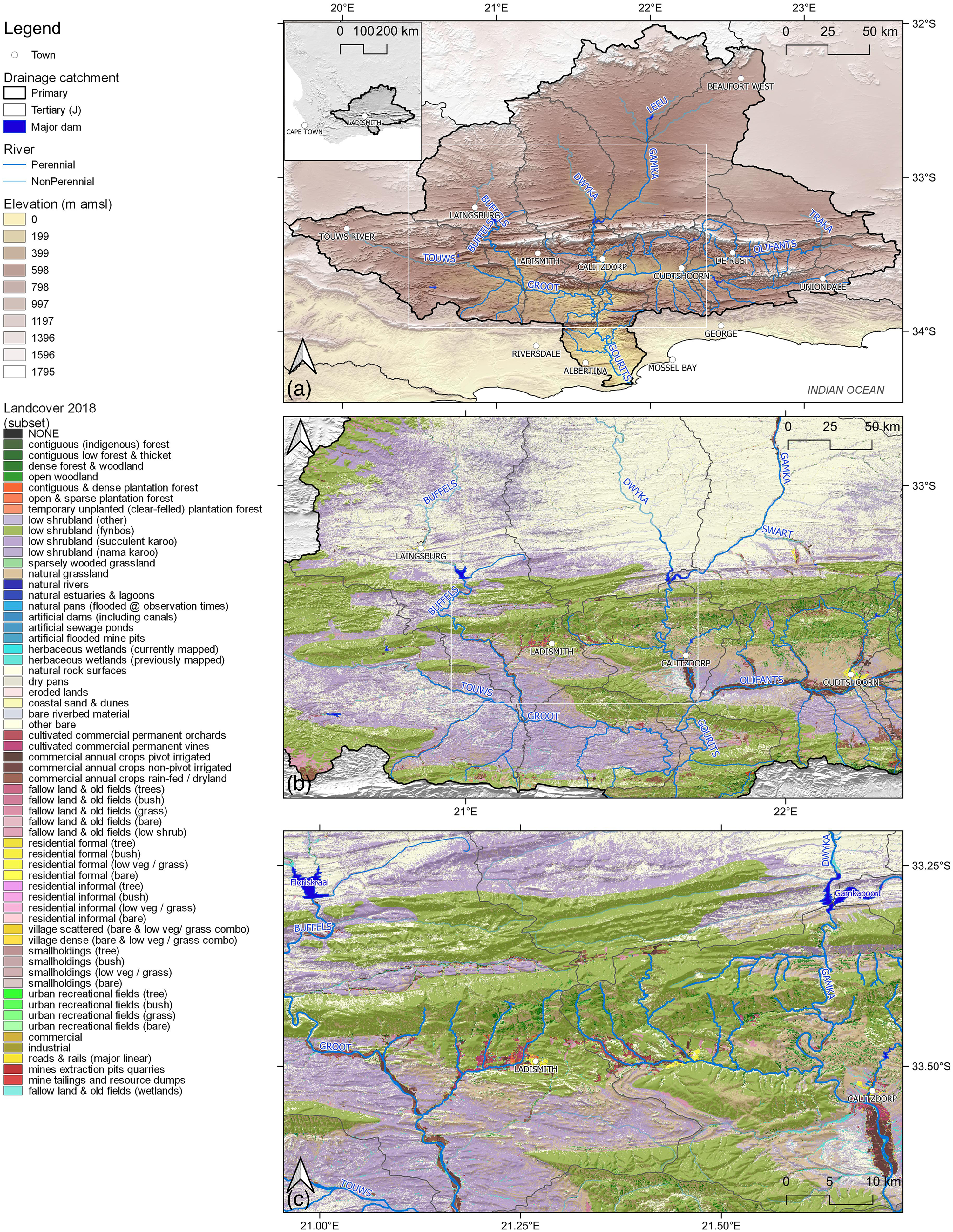
The primary river catchment of the study area showing (a) the topography of the Ladismith region which lies south of the Swartberg at around ∼ 500 masl. (b) The biome, or natural area around Ladismith consisting of fynbos and succulent Karoo shrubland that is often used as rangeland outside of protected areas. (c) Most of the cropland concentrated along smaller rivers flowing off the Swartberg, with some localised farm dam and wind pumps being used to access water. Source: Major rivers and catchment: Bailey and Pitman 2016; Elevation: Jarvis et al., 2008; Landcover: SANLC 2018.
Agriculture is one of the major economic sectors of the Klein Karoo valley and employs about 30% of the workforce (Kannaland Municipality, 2020). Agricultural practices shifted from subsistence agriculture during colonial times to commercial farming in the late twentieth century, when Ladismith became one of the biggest exporters of apricots and stone fruits in South Africa. 2 Figure 2 shows the ecological features that have been key for the development of these agricultural activities. Particularly crucial for its development were the valleys beneath the Swarthberg mountains, which according to South African geological studies were deep and fertile at least until the beginning of the twentieth century (Cupido, 2005; Le Maitre et al., 2007; O’Farrell et al., 2008). Moreover, the vegetation was rich and very diverse (Le Maitre and O’Farrell, 2008). The water sources of the areas have been equally important in enabling agricultural activities. Figure 2(a) delineates the Gouritz hydrological catchment, whose surface- and ground-water resources sustained most of the socioeconomic development of the area. Figure 2(b) and (c) show that much of the cultivated land is concentrated along smaller water courses like the Groot, Touws and Buffelskloof rivers which flow within the Gouritz catchment. Le Maitre et al. (2007) argue that in the earliest parts of the twentieth century these rivers had a perennial streamflow that supported fertile wetlands. Overall Figure 2 serves to highlight the importance that these biophysical factors had for the agricultural prosperity of the area.
Whilst agriculture is practiced by a large part of Ladismith’s population, the benefits are reaped by the white commercial farmers. This is because Ladismith’s racial divide is reflected in the organisation of its agricultural sector. Although most of the landowners are white farmers, farmworkers are mostly coloured or black people deprived of landownership and used as cheap labour (Piotrowski, 2019). Usually, coloured and black men are permanent farmworkers, whereas coloured or black women are more likely to be employed as seasonal labourers. These conditions, point out the intersection of racial and gender inequalities in Ladismith’s agricultural labour which place black and coloured women in more precarious situations than men. Generally, farmworkers and their family members face substandard housing conditions with limited water and sanitation services (Cordes et al., 2011). The minimum wage, 7 Rands per hour, is one of the lowest across South African employment sectors (Cordes et al., 2011). Furthermore, the farmworkers’ status is often exacerbated by exploitative and abusive practices perpetrated to various degrees by (white) farm owners or managers (Lilja, 2019).
The processes of land and water dispossession that have reshaped Ladismith’s vulnerabilities
A key step in the establishment and later expansion of white commercial agriculture has been the process of dispossession of the native population from the lands and the available water sources. The process of land dispossession was set in motion in 1652, when Dutch merchants settled on the lands formerly inhabited by the pastoralists Khoikhoi and the hunter-gatherers San. The Dutch and, since the nineteenth century also the British colonisers, settled in the area and seized the most fertile lands to farm (Piotrowski, 2019). During these centuries Europeans dispossessed, exterminated, or enslaved the Khoikhoi and San communities whose numbers drastically shrank (Cousins, 2016; Magubane, 1979; Piotrowski, 2019). Together with other black slaves from other Southern African regions, the native communities were segregated on inconvenient and smaller sized pieces of land (Piotrowski, 2019).
Land dispossession and territorial segregation became formally institutionalised via the Natives Land Act in 1913 and subsequently the Native Trust and Land Acts in 1936. Through these two pieces of legislation the colonial government set aside 13% of the land in South Africa to establish reserves for the native population. These acts also prevented natives from buying and/or owning land outside these reserves. Ultimately, by removing the indigenous population from their land, these laws dispossessed them of their water resources and allowed for recruitment of cheap labour for mines and farming activities (Cousins, 2016). Processes of dispossession and exploitation of black labour enabled the extraction of economic surplus from mining and agricultural activities, which entirely benefited (white) land and mine owners (Legassick, 1974). Through the twentieth century this capitalist form of production persisted and propelled a process of accumulation by dispossession whereby the labour force was subjected to extreme forms of extra-economic coercion.
Over time, a combination of violence and legal mechanisms allowed colonial and apartheid regimes to disempower and strategically proletarianise most of the black and coloured population. Consequently, the natives were deprived of most of their ability to acquire new skills and seriously constrained their capability to improve their socio-economic conditions (Du Toit, 2004; Moseley, 2007). Through the process of land dispossession, European settlers have engendered chronic vulnerabilities within indigenous populations (Piotrowski, 2019), which became disproportionally susceptible to droughts relative to other privileged social groups.
As of today, despite the process of land restitution and redistribution initiated in 1994, the unequal structure of South African land tenure persists and the precarious situations of rural livelihoods have not improved. Overall, only 9% of farmlands have been transferred to the dispossessed population, but many of these transfers are not fully implemented (Hall, 2004; Karriem and Hoskins, 2016; O’Laughlin et al., 2013). After more than 25 years of the post-Apartheid land reforms, the agricultural sector remains dominated by white commercial farming (Cousins, 2016; Moseley, 2007). The legacy of land dispossession is also visible in Ladismith where most of the lands are still owned by white farmers and, as one of the white farmers stated ‘farming is in our blood and if anyone wish to take our land, they must also take us with it’. 3
Land dispossession in South Africa went hand in hand with processes of water grabbing (Marcatelli, 2018). During the British mandate, water became a private commodity granted by a riparian law that linked the right of access to water with the ownership of the land. People without land titles could only access water through court litigations. When this was not possible, mostly due to financial reasons, some would remain without water access even for drinking purposes (Le Maitre and O’Farrell, 2008). In the long term, these riparian rights further increased socio-economic disparities (Marcatelli, 2018). Amid Apartheid these inequalities were further exacerbated, as the South African government attempted to control water resources to sustain the (white) national interests. In 1956, the Water Act attributed to the government the right to control the water sources that were deemed necessary for the economic development of the country (Le Maitre and O Farrell, 2008). This also included a right to expropriate land, including native ones, for the development of water works and infrastructure (Tempelhoff, 2017).
After the end of Apartheid, public authorities attempted to establish some equity in the management and distribution of water resources. In 1998, the Parliament of the South African Republic approved a National Water Act which kept the government as the main custodian of water resources and set both equity and efficiency as key policy objectives (Tempelhoff, 2017). However, despite the policy’s intentions, water access in Ladismith remains very much linked to land ownership and skewed along racial lines (Kemerink et al., 2011). The local irrigation boards continue to allocate water based on the extent of the farmers' land. As the head of an irrigation board in Ladismith explains: ‘Some people are higher up in the system because they inherited the farms or because they got them from well-known people and they were told: -These are your water rights! So, even if it is not really allowed by the Department of Water Affairs, they bought that farm and they say these are my water rights’. 4
Depending on the extensions and location of the land, some farmers have access to more reliable and generous water sources relative to other less privileged ones. In some cases, the most privileged farmers have built illegal dams and/or boreholes along the main riverbeds, significantly altering downstream water flow and reducing the amount of water available for other farmers. ‘Farmers here are used to get water from the canals and then, all of a sudden, there is one guy that put an irrigation pump in the river, and it is not legal and he cannot do that unless…’, as one of farmer admitted, ‘you got enough money and you can change a lot of things’. 5 Thus, privileged access to land and reliable water sources allowed certain farmers to further increase their capital by boosting their agricultural production and cultivating more profitable crops with higher water dependence like stone fruits, wine or vegetable seeds. The next section describes how, through the appropriation and commodification of nature, the narrow pursuit of profit has disrupted the metabolic exchanges that govern life and has produced a fundamental alienation of those who do not have any control over such socioecological degradation, and that suffer the most from it.
The development of white commercial agriculture and its socioecological implications
Ladismith’s ecological and hydrological characteristics, alongside the processes of land and water dispossession, have set the grounds for transforming sedentary farming into commercial agriculture and enabling trade of agricultural products within international markets. Throughout the twentieth century, the development of commercial agriculture has produced a metabolic rift, thereby irreversibly modifying Ladismith’s soil, vegetation, hydrology, microclimate and society.
In the beginning of the nineteenth century, colonisers were mostly interested in the mining industry whilst only a few farmers were essentially occupied with raising sheep and cattle or growing subsistence crops. Only towards the second half of the nineteenth century, did the colonisers’ interest shift from mining to commercial agriculture. When the British took over, they allowed free trading of agricultural products and thus triggered both the expansion as well as the diversification of agricultural activities. Approximately around the 1870s, Little Karoo’s agriculture introduced tobacco, wool, and lucerne (alfalfa), whilst discovering its potential for the ostrich industry (Figure 3).
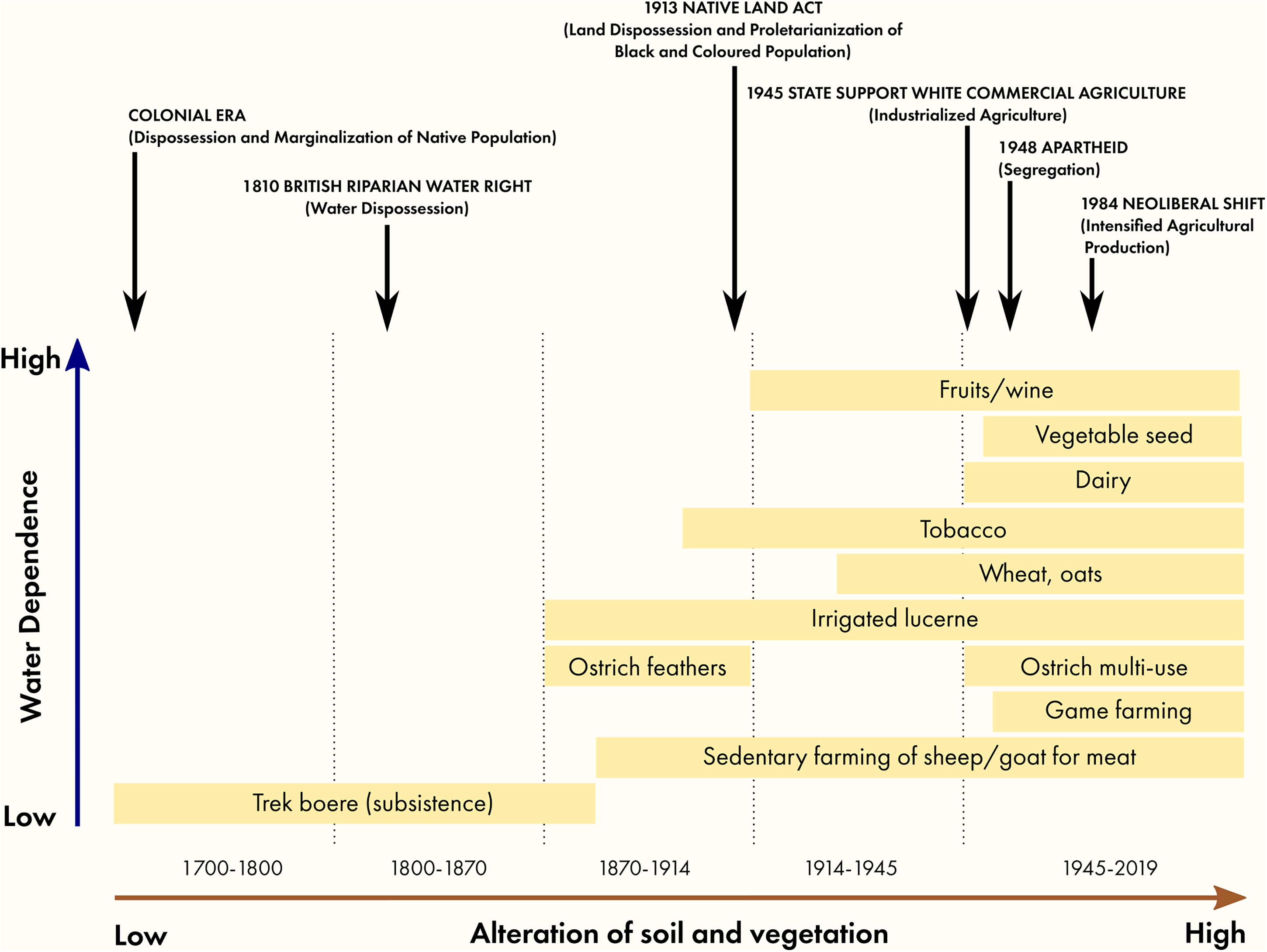
Political and agricultural shifts that reshaped Ladismith’s socioecological processes over time and across space. Source: adapted from Le Maitre and O’Farrell (2008).
Thereafter the agricultural sector experienced decades of instability due to national as well as global crises such as the Great Depression and World War Two. Only in the 1950s, amid the National Party administration, did South African agriculture benefit from substantial state interventions and regulations which further increased the white farmers privileged position. The government provided them funding and grants to further invest in agriculture and improve their socio-economic condition. As described by the Ladismith Agri Chairman: ‘I grew up in a country (where) if there was (any) trouble in the farming community the government would come and help you get through it. (In case of) flood, diseases, or any disaster, […] the government (would always) help’. 6 Beside securing lands and natural resources for white farmers, the Apartheid South African state invested in infrastructure such as railways, dams or irrigation canals, and provided financial support to facilitate the expansion of agricultural production and the diversification of agricultural products. Consequently, alongside the extreme racialisation of Ladismith’s agricultural sector, state intervention boosted livestock and crop production which severely degraded most of Ladismith’s lands in terms of nutrients as well as biodiversity (Cupido, 2005; Le Maitre et al., 2007, 2009a, 2009b; Murray, 2015; O’Farrell et al., 2008).
Various environmental studies have measured changes in the conditions of the soil through field assessment, data sampling and spatial analysis of satellite images (Smith-Adao et al., 2011). These studies report that before the expansion of commercial agriculture (i.e., at the beginning of the twentieth century) Ladismith’s valleys were considered still fertile and covered with dense biological soil crusts (Le Maitre et al., 2007). Biocrust is essential in stabilizing the conditions of the soil for it can reduce wind and water erosion, influence the balance between overland water flow and infiltration, and increase soil fertility (Belnap et al., 2004; Bowker, 2007; Le Maitre et al., 2007). However, the unsustainable grazing practices and intensive crop cultivation, have gradually damaged this biocrust, depleted the soil from its nutrients, increased its erosion and subsequently reduced the groundwater and surface water flows (Cupido, 2005; Hoffman, 2014; Murray, 2015; O’Farrell et al., 2008). Once the soil reaches this level of degradation, the water that usually percolates through the soil and recharges groundwater sources, would instead runoff over the surface and evaporate more easily. In the long term, an insufficient recharge of groundwater might reduce the amount of available water, whilst the socioecological transformations of the soil could potentially reduce evapotranspiration and result in drier micro-climatic conditions (Van Loon and Van Lanen, 2012).
In addition, the same environmental studies report that over the second half of the twentieth century the expansion of commercial agriculture has also caused a considerable loss of vegetation cover and a decrease in biodiversity relative to the first half of the century (Cupido, 2005; Hoffman, 2014; Le Maitre et al., 2007, 2009a, 2009b; Murray, 2015; O’Farrell et al., 2008). A spatial analysis of satellite images (Smith-Adao et al., 2011) found that besides fynbos in the mountainous areas, Ladismith vegetation has been almost entirely transformed in cultivated areas and/or used for livestock (Figure 4). As shown in Figure 4, about 80 to 90% of the thicket and shrubland has been severely to moderately degraded by grazing activities, whilst another 10 to 20% has been transformed for cultivation (Le Maitre and O’Farrell, 2008).
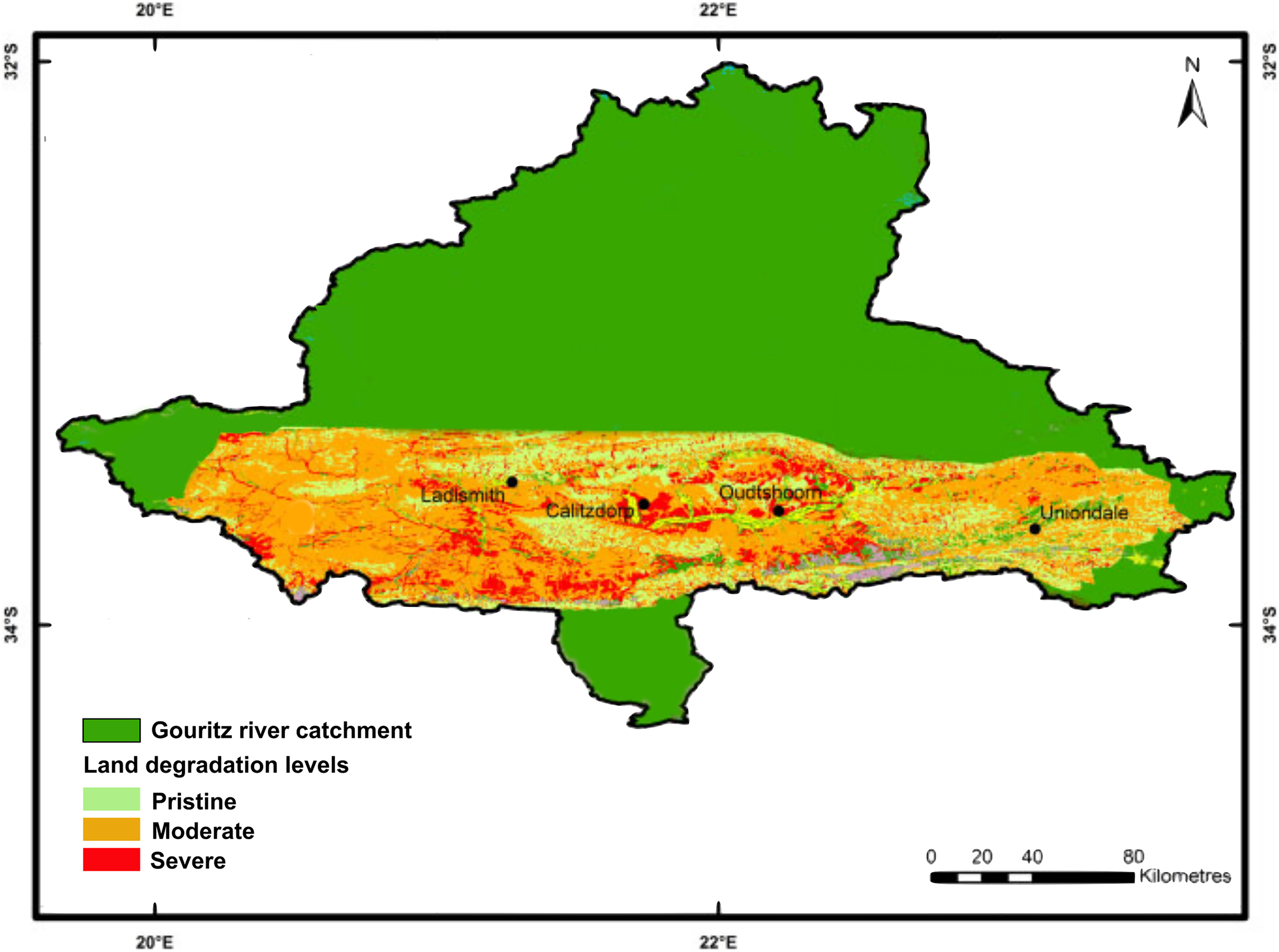
Levels of land degradation in the Klein Karoo area within the Gouritz river Catchment including: pristine, moderate and severely transformed land Source: adapted from Smith-Adao et al., 2011).
The vegetation and soil degradation further intensified throughout the latest political regime, when the agricultural sector experienced increasing deregulation and market liberalisation. In the 1980s, the governments embraced a market-oriented ideology, which was formalised with the 1995 White Paper on Agriculture. On paper, this policy aimed at building a strong economy and reducing inequalities by increasing income and employment opportunity for the poor (Viljoen, 2005). In practice, the new law phased out the government’s protective measures and subsidies, deregulated the sector, and liberalised the trade in agricultural products.
Since then, neoliberal policies have prepared the sector for international markets to the point that today ‘[i]t is all market oriented and lead by the market’. 7 As a South African researcher confirmed, Ladismith’s agriculture ‘is mostly about economic indicators, the strength of the currency, and the trade agreement that we have with other countries’. 8 Consequently, to reach the international market and remain competitive, farmers had to convert their grain crops into cultivations that were more appealing to international markets. Yet international markets often preferred crops which required more water, such as grapes and stone fruits, relative to other less appealing cultivations. However, the surplus derived from these exports was not equally spread amongst the farmers. Only those who could access more land and additional water were able to expand their production to more water dependent crops, reach international markets, and keep their profit margins. ‘Over time’, confirms a successful farmer, ‘we have managed to build some dams and changed the way we irrigate. By being more efficient our production increased. Before we were cultivating lucerne, now also grapes and stone fruits’. 9
Yet, whilst improving irrigation efficiencies and boosting agricultural production for some, these neoliberal measures also induced a sharp rise in the input prices, more financial pressure, and higher competition amongst the farmers, who felt abandoned by the government. With the hollowing out of the state, farmers lost an essential support for their agricultural activities. Some were significantly affected by increased transport costs which inevitably reduced their profit margins. Moreover, Ladismith’s farmers were also less productive and competitive relative to others across the Western Cape. In fact, the semi-arid environment, together with the high rainfall variability, and recurring droughts constrained the ability of Ladismith farmers to regularly achieve high yields. On several occasions, farmers had to rely on bank loans or, in the worst cases, they declared bankruptcy and sold their land. Often these lands were acquired by the most efficient and affluent farmers of the area, who became more powerful by accumulating additional land and increasing their profit margins. Thus, even though the number of farmers and farmworkers have been declining, the hectares cultivated remain fairly stable (Liebenberg et al., 2010; Murray, 2015). This means that the benefits of white commercial agriculture have been largely accumulated by the most successful farmers for which the profits have doubled. In fact, as Murray (2015: 35) claims, in Ladismith: ‘it’s a case of the strongest will survive’.
Ultimately, the process that made Ladismith one of the biggest exporter of stone fruits in South Africa, exerted an increasing pressure on Ladismith’s land and soil, alongside exacerbating the vulnerability of the farmworkers and the less ‘successful’ farmers. Whilst attractive for international markets, this highly-intensive and industrialised agriculture, became even less sustainable as the soil became less fertile, the vegetation shrank, and the water resources dwindled, due to the shift to water intensive crops. Figure 3 clearly points out the latest agricultural changes that have gradually increased the water dependency of Ladismith’s crops, especially in the last decade. Hence, alongside degrading Ladismith’s soil and vegetation, commercial agriculture also profoundly altered Ladismith’s hydrology.
Smith-Adao et al. (2011) reported that in 2000, the water demand in the entire Gouritz river catchment surpassed the available yield 10 by 10%. Since then, the level of water extraction remained so high that almost no perennial flow was left on the watercourses to ensure the life of local ecosystems. Figure 5 indicates that the ecosystem of the Buffelskloof, Groot and Touws rivers were moderately to severely endangered, and the rivers were at risk of completely or partially drying up. The streamflow that used to run through those rivers has been dammed, diverted into irrigation channels, and over-exploited for agricultural purposes, mostly through flood irrigation methods that require a considerable amount of water (Le Maitre and O’Farrell, 2008; Nel et al., 2011; Nongwe, 2008; Petersen et al., 2017; Smith-Adao et al., 2011). Groundwater resources have also been overexploited. Without accounting for illegal boreholes, registered users have been extracting more than 50% of the water recharge (Le Maitre et al., 2009a, 2009b). Unsustainable farming also affected the water quality of the catchments which has been deteriorating throughout the years. In fact, the return flow from irrigated areas in the Groot, Buffelskloof, and Touws catchments has also increased the rivers' natural salinity (Le Maitre and O’Farrell, 2008). As Figure 5 shows, most of the local rivers were already drying up in the years around 2010. Thus, they became more vulnerable to rainfall variability, and therefore increasingly prone to future droughts (Le Maitre and O’Farrell, 2008; Smith-Adao et al., 2011).
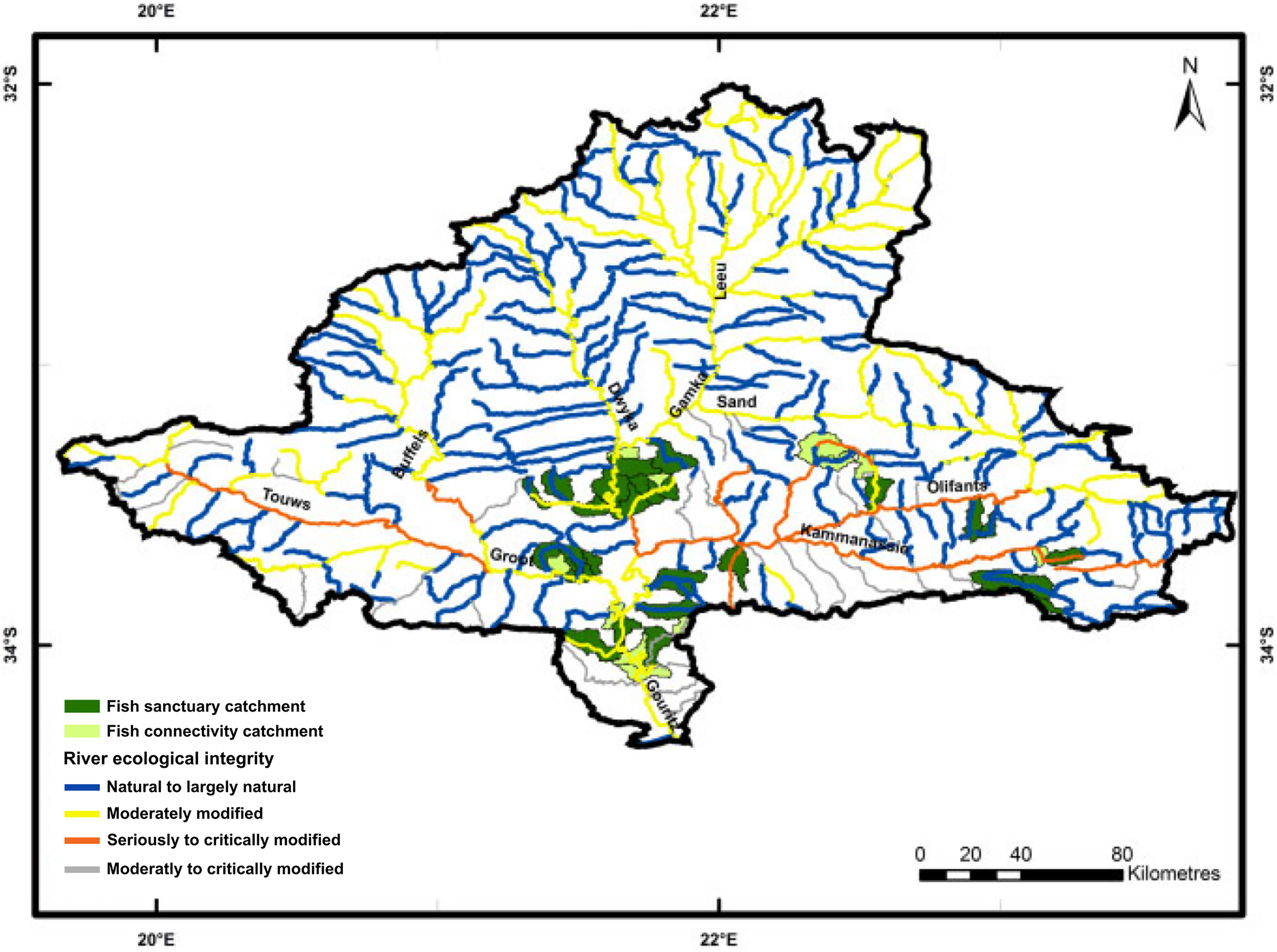
River conditions categories and fish sanctuary areas. Natural to largely natural about 51%; Moderately modified 32%; Seriously to critically modified 8%; Moderately to critically modified 9% Source: adapted from Smith-Adao et al., (2011).
The socioecological epilogue of Ladismith's drought
Droughts and water shortages have affected Ladismith since the beginning of the twentieth century (Joubert, 1931) for the town is located in a semi-arid region (Figure 6) which experiences recurring peaks of below-average yearly rainfall. Figure 7 displays the irregular rainfall timeseries with an average of 300 mm/year which shows the critically low levels of precipitation the town receives throughout the year. However, Ladismith experiences both intense rainfall events and extremely dry periods which often result in major destructive floods (i.e.,1981, 2003, and 2014) and droughts (i.e., 1920, 1930, 1960s, 1970s, 1997–2000, 2009–2011), with significant negative impacts for both the population and the agricultural sector (Le Maitre and O’Farrell, 2008).
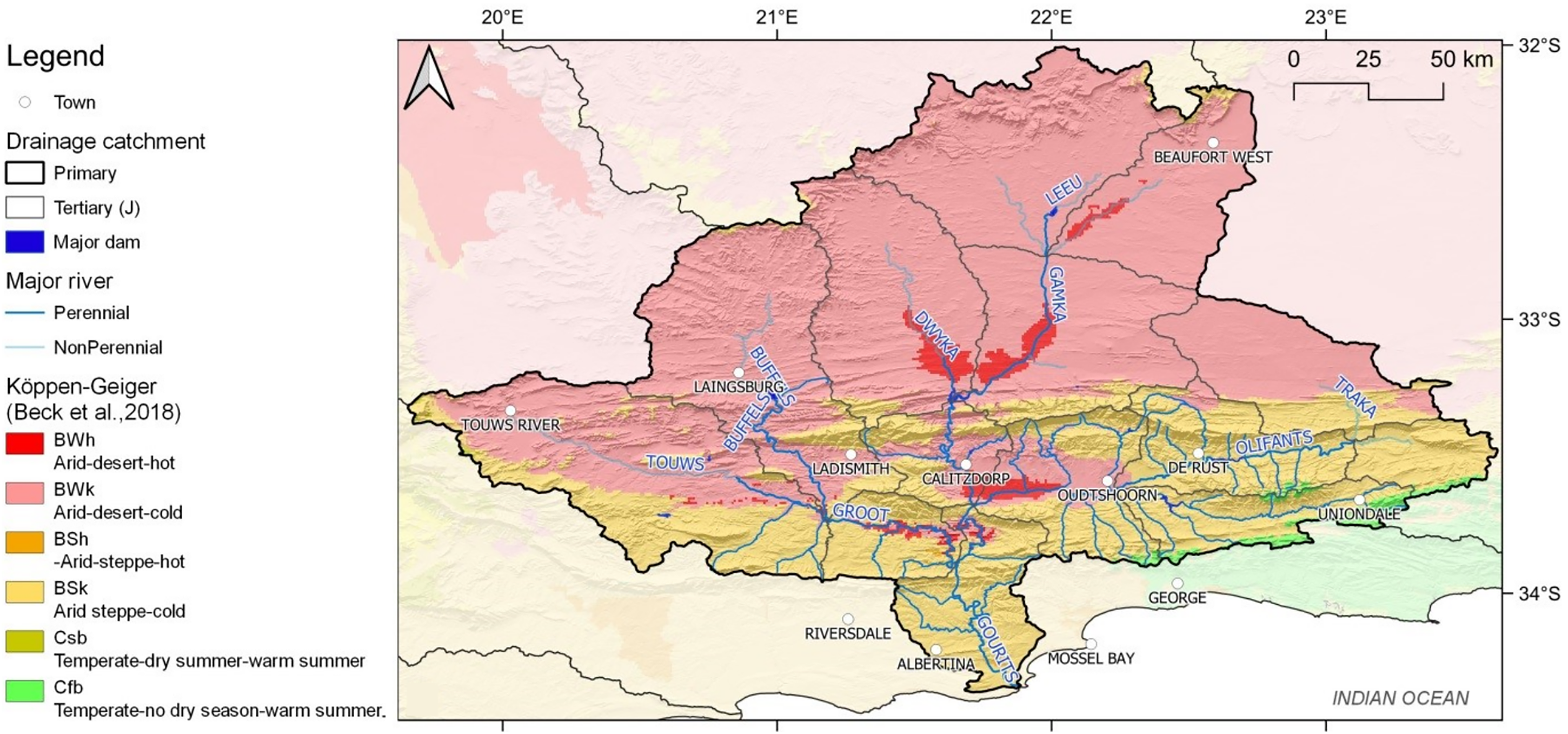
The Primary Catchment of the study area showing the Köppen-Geiger climatic classifications (Beck et al., 2018). The catchment straddles the semi-desert region of the Great Karroo (the north portion) and Little Karoo (the inter-mountain portion in where the town of Ladismith is found). The Köppen-Geiger provides an indication of the environmental boundaries in terms of precipitation and heat, with the study area being dominated by low precipitation and mixture of hot and cold temperatures. As a result, there are few perennial rivers and no naturally occurring surface water bodies. At present the catchment is dominated by cold desert conditions (pink shading). Source: Beck et al. (2018).
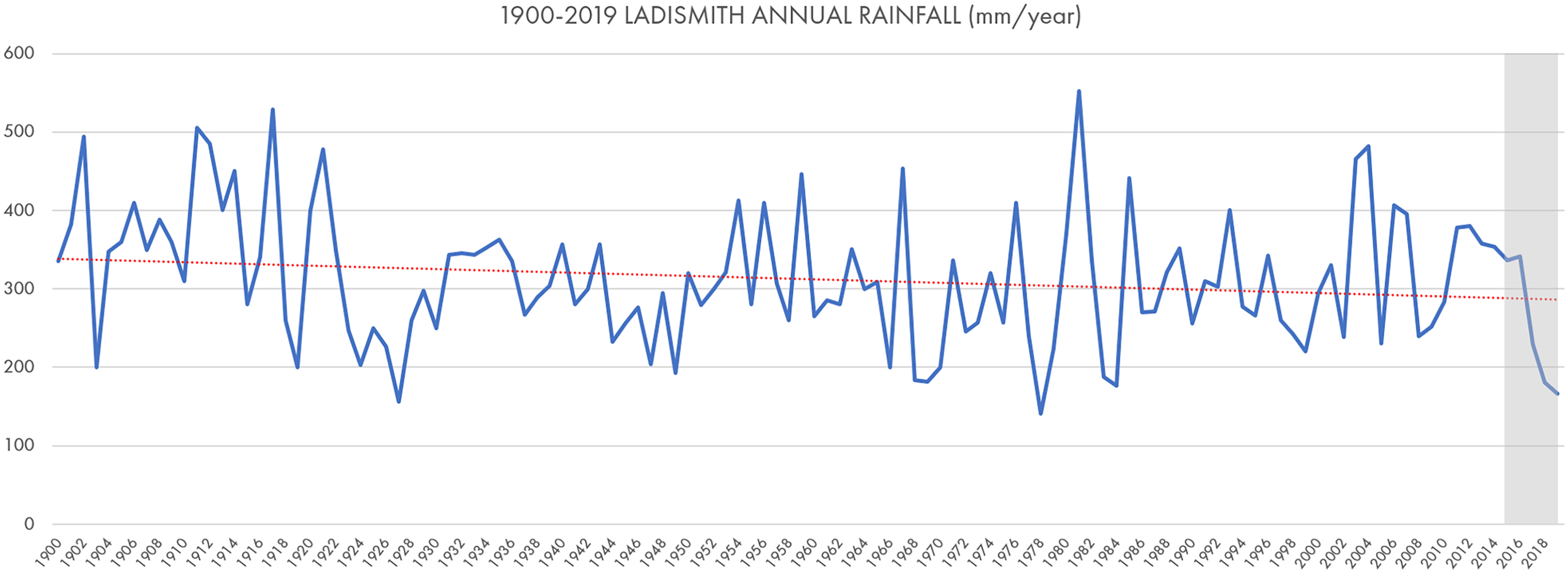
Ladismith Rainfall Timeseries in mm/year from 1900 until 2019. Drought years are identified as annual rainfall below the precipitation trendline (red dotted line). The latest drought (2015–2019) is highlighted in grey. Source: South African Weather Service.
Despite the familiarity with extreme weather events, the 2015–2019 meteorological drought (Figure 7, grey bar) constituted an unprecedented shock for the local population. Most of the farmers in the area describe this drought as the worst they have ever experienced 11 . Media headlines have depicted the study area as stricken or ravaged by the latest drought (Charlers, 2019; Felem, 2018). However, hydroclimatological explanations of drought hazard indicate that a meteorological drought does not always result in a socioecological crisis. As discussed in the section Hydroclimatological understandings of drought, a meteorological drought will propagate into a soil moisture drought, evolve into a hydrological drought and eventually produce a socioecological crisis only when affecting a vulnerable environment. Thus, the propagation of a drought hazard event into such a dire socioecological crisis can only be explained by considering the historical processes that have co-produced Ladismith’s socioecological vulnerability.
Here, the meteorological drought which started in 2015 did evolve into a severe soil moisture drought which shrivelled most of Ladismith’s arable lands. The soil moisture drought was indeed triggered by the reduction of precipitation, yet it manifested with that intensity because Ladismith’s land was already degraded by the agricultural transformations that had occurred since the second half of the twentieth century. Over time, the intensive crop cultivation had damaged the biocrust and in turn, increased the erosion alongside reducing the fertility of the soil. In addition, cultivations and grazing activities had also considerably curtailed Ladismith’s vegetation cover thereby exposing the land to further degradation. To reveal stress and changes related to the soil moisture drought, Figure 8 uses the Enhanced Vegetation Index (EVI) which is derived through a spatial analysis of satellite images. The figure displays a general EVI reduction across the study area especially after 2017. This analysis also highlights that the cultivated areas, with a lower EVI value, were much more affected by the soil moisture drought relative to the other vegetation. With these harsher conditions, the soil was neither able to absorb or maintain the water required for crops and vegetation to grow, nor was there sufficient water available to recharge aquifers or surface water. The heavy and extensive modification of local vegetation along with the degradation of the soil have very likely increased the severity of the soil moisture drought. As a farmworker observed: ‘Everything (was) dying… Even the bush of the Karoo, that is a tough plant, (could not) stand anymore, it (was) also dying…’ 12
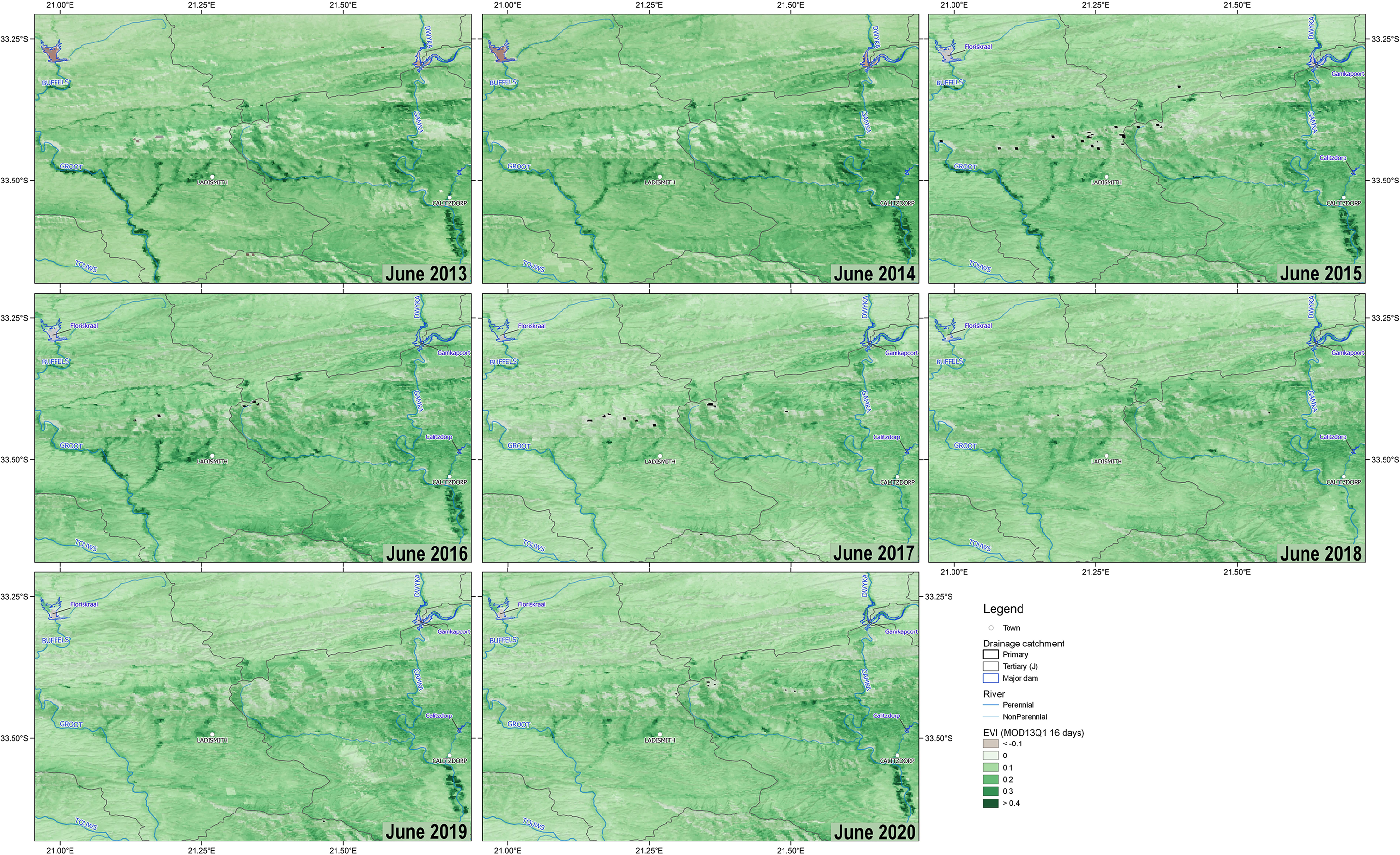
Enhanced vegetation index (EVI) of the Ladismith area (same extent as Figure 2(c) using MODIS 16-day product from 10/11 June of the respective year. Darker greens represent greater vegetation activity, open water and bare soil which have low EVI values. Two pre-drought years (2013 and 2014) show little year on year change. In 2015, the drought onset, some reduction in greenness is seen in the river channels only, however by 2017 there appears to be a general reduction in EVI across the region, including the areas of natural vegetation. However, areas of natural vegetation display less decrease in Enhanced Vegetation Index than human modified and cultivated areas. Vegetation activity begins to increase in 2019 and continues in 2020. Of interest is the increased EVI of the Floriskraal dam between 2016 to 2018 and a decrease again in 2019. As EVI is low for open water, this EVI increase suggested a decrease in the surface water extent, and subsequent vegetation growth, in across these three years, with 2019 seeing the return to open water conditions close to the dam walls. This decrease and then increase water supply are also displayed in the farming areas to Calitzdorp along the Gamka River. Source: Modis, (2021).
In turn, the soil moisture drought quickly unfolded into an extreme hydrological drought. The once perennial streamflow of Ladismith’s surface water sources, the Touws, Groot, and Buffelskloof rivers, dried up almost completely (Figure 6(d) and (e)). According to Ladismith’s population, rivers and wetlands were drier than ever. A farmer recounts that the Buffelskloof river was never empty before, but since the last drought it dried up ‘just like sand’ 13 . Instead of water, riverbeds were accumulating sand and the little amount of water left was not sufficient to sustain the plants, animals and micro-organisms of the river ecosystem. Yet not long before the drought, many Ladismith families could fish in those rivers or allow their cattle to eat green reeds along the riverbeds. In addition, since 2016 farmers received only one, instead of twelve, dam releases from the major regional reservoir, the Floriskraal Dam.14, 15 The Irrigation board regulating and controlling water allocations, started rationing and later on suspended the water releases as there was not enough water left in the Dam. Even the private dams used by farmers drained completely and many boreholes stopped providing regular and continuous yields. Consequently, farmers struggled to sustain their activities and labour force. Our analysis reveals that this dire manifestation of hydrological drought cannot be attributed to the precipitation alone, but must be seen in relation to the intensive agricultural development that has completely altered the local hydrology through the construction of artificial canals, dams, and boreholes, along with unsustainable levels of water abstraction (Le Maitre et al. 2009a, 2009b, Le Maitre and O’Farrell 2008; Nel et al. 2011; Nongwe 2008; Petersen et al. 2017, Smith-Adao et al. 2011).
As a result, in 2018 after a few years of below average rainfall, Ladismith plunged into an extreme socioecological crisis from which the population has not yet recovered (see Figure 9). The crisis was so far-reaching as to require humanitarian interventions. International and local organisations like Gift of the Givers and South African Water Warriors supported the municipality or the farmers most in need of water, food and fodder. Since 2018, the Western Cape Province also supported the affected communities with drought relief in the form of fodder for livestock.
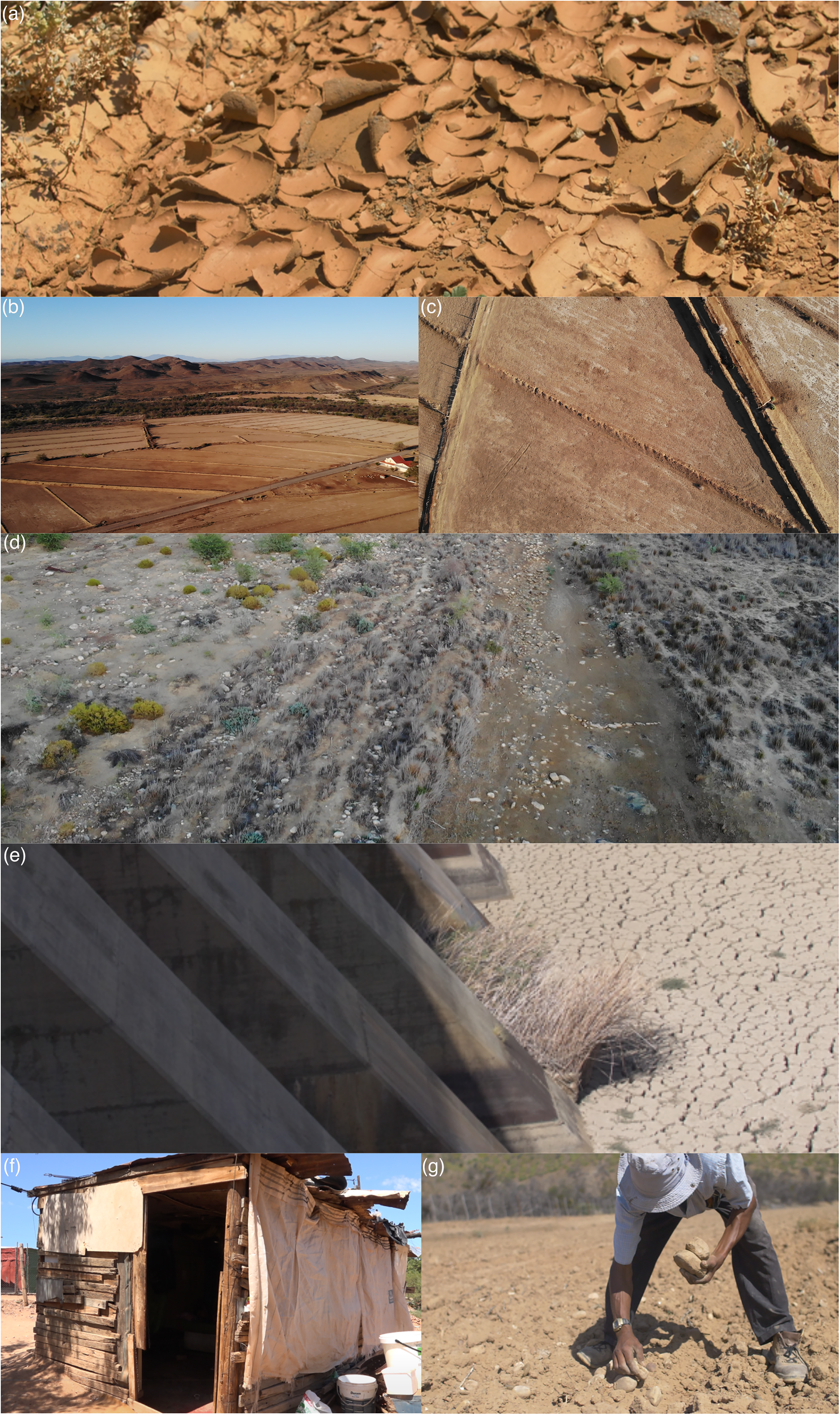
(a) Dried-up biological soil crust in Ladismith (Coordinates location: 33°28̍ 49̎ S 21°15̍ 09̎ E). (b) Aerial photography of uncultivated and dried lucerne field in Ladismith (Coordinates location: 33° 35̍ 37 ̎ S 21° 08̍ 35̎ E). (c) Aerial photo of dried and sandy soil in Ladismith (Coordinates location: 33° 35̍ 37 ̎ S 21° 08̍ 35̎ E). (d) Aerial Photo of dried Groot riverbed and dried reeds (coordinates location: 33° 33̍ 40 ̎ S 21° 07̍ 39̎ E. (e) Dried outlet of Floriskraal dam (Coordinates location: 33° 16̍ 30 ̎ S 20° 59̍ 00̎ E). (f) Farm workers dwelling in Ladismith. (g) Black farmworker collecting stones in a dry and unproductive field.
Institutions, the media, and the general public presented the farmers as the most affected community. The chairman of the Agri-Ladismith Board warned that more than half of the farmers were in financial trouble. Many of them, including the biggest producers, declared bankruptcy and put their farms up for auction. The agricultural board estimates that toward the end of 2019 farmers' annual unpaid loans amount to 300 Million Rands. From 2017 until 2019, lucerne producers lost about 2300 hectares of harvest, equivalent to 250 Million Rands. Stone fruit cultivators experienced up to 70% of harvest loss and many of their productive orchards have died off or had to be uprooted. Several vineyards have faced similar losses. The dairy industry has stopped milking and numerous farmers decided to sell off their livestock to the meat industry (Ladismith Agri, 2019). For some farmers it has been amongst ‘the most humiliating experience’ 16 of their life, many others felt powerless 17 and waited for a ‘miracle’ 18 that would bring them ‘the resources and the capital needed to invest, and get labour going on again’. 19 In some instances, newspapers have also reported cases of suicide amongst farmers that lost hope and capacity to face such desperate conditions (Patrick, 2019).
At the same time, this discursive construction of the drought conceals the privileged conditions of some farmers and the experiences of the most vulnerable and marginalised population. Indeed, although the drought has affected farmers like never before, as time progresses some are slowly developing alternative strategies to survive. In fact, whilst few were prepared to leave the country, others have improved their farming technology, switched to less water-intensive crops, invested into new boreholes or started a new business. For them, the crisis ultimately represented an opportunity to reinvigorate their activities and eventually their surplus. Landless workers, however, could not rely on the same resources and opportunities to mitigate the impacts of the drought on their livelihood. Hence, over 1400 farmworkers (of which 800 were seasonal) lost their job and their main source of income.
The impacts of the drought were even more severe for migrants coming from neighbouring countries who have limited rights and receive less support from the local government. 20 In general, the living conditions of farmworkers in Ladismith, and South Africa, have always been difficult and at times inhumane, yet the drought has further exacerbated farmworkers' vulnerabilities. As a seasonal worker recounts ‘before [the drought] everything was fine. I could support my family here, send my children to school, support my family in Zimbabwe. But as I'm speaking right now I am stressed because I cannot do that anymore as I'm not working. And I do not want that. So, my hope is that one day everything is [going to be] normal and that we [will]start working again. That is my wish’. 21
To survive the crisis, those farmworkers and their families that lived in the farms ended up sharing a small shack (less than 25 m2) made of wood, aluminium or other salvaged material, with other families. Many had to live on a state subsidy disbursed to the elderly or sick people within the household (up to 1750 Rands/month). Others asked for support from other family members or were forced to accept working conditions that are significantly worse than before the crisis (e.g., 44 Rands/day). Most of the farmworkers are forced to endure these very harsh conditions which barely support their basic needs. ‘[Farmers] keep on saying that they don’t have money to pay us, but they expect us to do a full job. And look at the wages that I earn at the end of the day… It’s not even what I’m supposed to get. It’s very bad’. 22
When media and institutions framed the drought as a tragedy for Ladismith’s farmers and their agricultural activities, they indirectly contributed to make the suffering of farmworkers and their families almost invisible, thereby aggravating their disadvantaged conditions. Thus, their vulnerability to drought was not just material but also a discursive process of Ladismith’s socioecological history. Overall, our exploration of the materiality of drought illustrated how the drought was both a product of historical dispossession and discrimination and one of the material conditions of the soil, vegetation, hydrology and microclimate. In Marx words, Ladismith’s advances in agricultural productivity not only ‘robbed the workers but also the soil’, vegetation, hydrology and microclimate of the area (Aslamy, 2021). Through violent expropriation, slavery and ecological destruction, the narrow pursuit of profit and capital accumulation in Ladismith caused a fundamental disruption between nature and society which eventually transformed the drought into a socioecological crisis.
Conclusion: the materiality of drought
In this paper, we have re-conceptualised droughts as socioecological phenomena coproduced by the recursive engagement of different human and non-human transformations. The interdisciplinary integration of political ecology, geographies of materiality and hydroclimatology, has generated new questions and forms of knowledge on the material and discursive worlds of droughts. We note three significant contributions of this approach to advance understandings of the materiality of drought.
First, an engagement with hydroclimatology served to further a critical geography of drought that is more attuned to the biophysical processes that coproduce droughts and their resulting socioecological crises. Our conceptual-methodological approach offers a novel way to broaden post-humanist perspectives in the field of drought hazard and beyond. Advancing what we termed the materiality of drought, we shed light on the way multiple, interwoven biophysical agents matter in socioecological transformations and drought-related crises. By enabling and constraining distinctive social processes, biophysical agents play an active role in reshaping uneven landscapes of environmental and social vulnerability. As shown in Ladismith, non-human processes have co-produced the drought hazard and transformed the reduction in rainfall of 2015–2019 into a severe socioecological crisis. At the same time, we show that the materiality of water, soil, climate and vegetation is always more than physical and historically contingent. Drought materiality is co-produced by human practices, wider political processes, and uneven economic development. The ‘messy and porous interpenetration’ (Moore, 2017: 308) between human and non-human natures reflects a social power that does not act upon nature, but rather develops through socioecological relations. Thus, based on our empirical account, we argue that our interdisciplinary approach reveals how non-humans matter in the way (uneven) social relations unfold (Lima Costa et al., 2017; Whatmore, 2002).
Second, building on this point, our interdisciplinary approach also entailed a reconsideration and reframe of the spatiotemporal and empirical focus of the analysis. This novel perspective enabled the reconceptualisation of drought hazard as a complex and long-term process rather than a static condition. Analytically, this engagement led us to broaden the focus beyond the time of water scarcity and transcend the manifestation of the event itself. By reconnecting nature and society through a critical history of the coevolution of human and non-human processes, this work traced the making of the metabolic rift at the origin of Ladismith’s socioecological disruption. In this way, the paper serves to demonstrate not just how ecology and society co-evolved to produce a specific droughtscape, but also how the making of the society-nature distinction itself formed part of this political history.
This brings us to our last point, concerning our contribution to the social production of water scarcity. Political ecology has mostly considered or defined droughts as the social construction or production of water scarcity. In this paper, we have proposed a political ecology approach that is more attentive to the materiality and the active role of biophysical processes in the production of droughts and socioecological crises. We contend that without such specific understanding, political ecologists overlook the agency of non-human elements alongside their social entanglements. Our novel conceptualisation considers drought as co-produced by human and non-human processes thereby showing that the social production of water scarcity alone cannot fully explain the politics of drought and its injustice. Capturing the power dynamics and the political changes that intersect with drought also requires retracing the agency of its non-human processes.
Highlights
Conceptualizing drought as socially constructed water scarcity may conceal the productive role of the biophysical processes co-producing drought.
Hydro-climatology expands the focus of drought's analyses beyond the time of water scarcity and transcends the manifestation of the event itself.
Through an historical perspective, the materiality of drought traces the making of the metabolic rift at the origin of Ladismith' s socioecological disruption.
Ladismith’s soil, vegetation, hydrology and microclimate, have contributed to reshape an uneven socionatural landscape.
Understanding the power dynamics that intersect with drought hazard requires retracing the agency of its non-human processes.
Footnotes
Acknowledgements
The South African Weather Service provided the meteorological data used in this paper. The authors gratefully acknowledge the contribution of Ladismith's inhabitants, without which this research would not have been possible.
Declaration of conflicting interests
The author(s) declared no potential conflicts of interest with respect to the research, authorship and/or publication of this article.
Funding
The author(s) disclosed receipt of the following financial support for the research, authorship and/or publication of this article: This work was supported by the European Research Council (grant number ERC Consolidator Grant No. 771678).
