




Abstract
This paper aims to explore how under authoritarian regimes, undergoing reform processes, divergent forms of environmental activism may emerge. Two severe cases of environmental degradation serve as our starting points: the marine disaster in the central coast of Vietnam in 2016 and the Mekong Delta's ongoing environmental degradation. While the former offers a case of rural grievances over mass fish death in Central Vietnam triggering protests on a national scale, the latter presents a continuum of environmental changes leading to serious impacts on deltaic livelihoods, albeit with no observable efforts of activism compared to the situation in other countries along the Mekong Delta. Drawing from in-depth interviews and participant observation with NGO workers in Vietnam who focus on environment and community development, we unravel the conditions, methods and rationalities behind their engagement (or lack thereof) with environmental activism in each case. We argue that the difference between the cases can be explained by tracing the process of politicising environmental grievances, taking into consideration culinary nationalism, anti-China nationalism and political opportunities under authoritarianism. Moving beyond current literature on activism under authoritarian regimes which relies mainly on institutional and/or social network approaches, our analysis helps further shed light on how contemporary environmental activism is mobilised in Vietnam from a geographically and politically grounded as well as culturally embedded position.
Introduction
Environmental activism has been challenged by the increasing complexity of environmental and societal issues, as well as a growing list of authoritarian political leaders and power configurations. In Southeast Asia, a region marked with a strong legacy of authoritarian regimes, scholars have focused on struggles of environmentalism in either illiberal democracies, such as Thailand or Myanmar (Simpson and Smits, 2018), or communist states like Vietnam (Bruun, 2020a). In Vietnam and China, formal NGOs as well as grassroots activists need to overcome restrictions from the central government. Such a context would hamper any confrontational tactics and, thus, require a more discreet modus operandi from activists, working through personal and institutionalised networks (Ho, 2008; Zhu and Ho, 2007). However, recent literature has suggested moving beyond this ‘first-generation’ discreet approach to civil society under authoritarianism, advocating for understanding of the wider opportunities and challenges posed by new methods of resistance (Yew, 2018).
On paper, the political space of civil society in Vietnam remains restricted. The reality, however, depicts a repressive state apparatus with varying degrees of tolerance (Wells-Dang, 2014). While political restrictions mould activism, activists are not necessarily inert actors being forced into de-politicised spaces. Rather, they engage in strategic framing and consciously select strategies deemed optimal (Wells-Dang, 2012). The strategies are at times embedded in the restrictive context while at other times ‘boundary-spanning’ or ‘transgressive’, breaking through the tame, constrained mould of activism in such a context (Wells-Dang, 2012). Hannah (2009: 87) theorised a ‘mutual colonisation’ relationship ‘where less than autonomous organisations may influence the state to the benefit of the citizenry, while at the same time such organisations are forced to operate under state restrictions’. Other works have addressed the pragmatic network-based advocacy practiced by these activists working for or associated with the more formal side of civil society (Vu, 2019; Wells-Dang, 2012), and nascent attempts at transnational activism (Dore et al., 2012; Thim, 2013). More recently, Gillespie and Nguyen (2019) and Vu (2017) investigated confrontational resistance where most participants were aggrieved citizens protesting what they deemed inappropriate use of public spaces and resources such as parks and street sidewalk trees.
This body of work depicts a dynamic landscape where civil society, with NGOs on one side and independent activists on the other (with mutual interactions), adapting their modus operandi to various spatial, cultural and political variables. Scale is another variable in this function of difference in materialisation between ‘formal’ and ‘informal’ civil society in Vietnam, shaping the different framings and expression of activism. Scholars have discussed the importance of boundary-spanning practices such as network forming (Wells-Dang, 2012, 2013), continual differentiation, formalisation and networking at multiples scales (Thim, 2013), or through the use of social media (Vu, 2017). In doing so, activists aim to be more responsive to oppression and censoring and still maintain a certain level of legitimacy for their cause.
In this paper, we are interested in the diverging forms of environmental activism under authoritarian regimes as well as the mechanisms behind these forms. We question and reveal the rationale and manner of how activists 1 decide to engage with the political discourse and take political actions differently in each case. While the topic of civil society in Vietnam has been explored, we offer a deeper explanation based on the mechanics of the environmental protests against a marine disaster in 2016 and how these evoked new ways of understanding how environmental activism works in Vietnam. We also look into the on-going struggles along the Mekong River, exemplified by the severe drought in 2016, which received considerable attention at policy levels yet little from the bottom-up. Our previous analysis found that despite their silence due to the political sensitivity, institutionalised actors did attempt to get involved and assert influence on the marine disaster (Nguyen Van Quoc & Trell, 2020). This prompted the question of the relationship between environmental politicisation and the corresponding public reaction, particularly from the communities at risk and the activists involved.
Here, politics are understood as internal affairs of the state or opposition to the regime, as well as the transformational responses to certain policies and practices of the state (Wells-Dang, 2012: 43). To politicise the environment is thus to amplify the contentious dimensions of environmental issues in combination with the alignment of attitudes towards such issues with existing norms and ideologies (Pepermans and Maeseele, 2016; Swyngedouw, 2010a). Our contribution here is threefold. First, in theorising the relationship between politicisation of environmental issues with aspects of culture and nationalism, we both learn from and enrich the growing literature addressing the intersection between political ecology, critical environmental justice and social movements. Second, the cases illustrate how lack of activism can provide as much insight as activism about how different drivers lead to different forms of activism (Haß et al., 2014). Third, our results did not serve to isolate Vietnam as a unique variable, but to position the country among cases of environmentalism against rising oppression (McCarthy, 2019).
In what follows, we present how activists initiated and participated in environmental activism under the (limited) legal recognition of civil society in Vietnam. We first look into the rationale for taking specific actions and/or engaging in specific cases of rid of “formal” civil society, considering that political identities and social struggles are embedded in issues of endangered food supply, livelihood as well as well-being. Then, we analyse the manner in which environmental issues are repackaged by different civil society actors into tropes of (in)securities at personal and social levels to leverage actions and non-actions. Our analysis pays attention to how food symbolism, nationalism and scales of activism influence the political process of civil society actors claiming justice and pursue counteractive solutions. The article concludes with discussion on the implications of these findings for theorisation of environmental governance in the face of authoritarianism.
Theoretical framework
To investigate the politics of claiming environmental injustice, we use three theoretical lenses. Firstly, we take cues from the environmental justice and social movement literatures, focusing on the influence of political opportunity structures and framing of environmental activism. Secondly, we draw from political ecology's conceptualisation of political action and subject formation motivated by environmental conflicts or injustices. Essentially, these two strands of literature are complementary, which allows us to address our cases most effectively. We are interested in environmental justice in specific relation to discourse and framing because the construction of environmental disasters is critical to the corresponding activism. Meanwhile, political ecology was developed out of an attempt to not only understand how cultural identities and values are developed and expressed on and within the environment but also the complex political economy behind such a process (Robbins, 2011a). Political ecology is thus capable of addressing the cultural element of mobilisation, that is, food and nationalism in Vietnam. It also allows interpretation about the possible impacts of different forms of activism. Thirdly, we place these theoretical understandings in the context of authoritarian regimes, both regionally and in Vietnam.
Critical environmental justice and its transformative conception
From the early 1990s, environmental justice research has started to follow more critical trajectories. Analyses thus shifted from patterns of environmental inequality themselves to distinctive ways that communities and activities translated these patterns into ‘grievances, attributed blame and advocated remedies’ (Holifield, 2015: 589). Critical environmental justice, as discussed by Pellow (2018), embraces multi-scalar methodological and theoretical approaches to environmental issues to more efficiently grasp the complex spatial and temporal causes, consequences and possible resolutions to environmental justice struggles (Holifield, 2015; Pellow, 2018; Svarstad and Benjaminsen, 2020). Environmental justice, as a utility of social movement frames and discourses, managed to bridge environment, labour, recreation and social justice issues by restructuring and repackaging ‘structurally separate but ideologically compatible issues’ into one environmental justice frame (Taylor, 2000: 562).
Faber et al. (2021: 2) argued that liberal-informed environmental justice scholarship originating in the United States and Britain, has mistakenly let ‘racism to subsume and become a metaphor for all forms of inequality impacting nonwhite groups’. This led to a mismatch in application to the Global South contexts and make environmental justice more subject to a ‘liberalist’ mentality (Álvarez and Coolsaet, 2020; Faber et al., 2021). As distributive, procedural and recognitional justice cannot address the fundamental processes that produce the problems, newer conceptions, that is, reparative and transformative justice, were developed to answer ‘how are actions corrective or compensatory?’ and ‘how do these actions transform systems of […] exploitation of people and nature?’ (Faber et al., 2021: 9).
These critiques show that critical environmental justice have certain intersections with political ecology's emphasis on environmental conflicts as contextualised by and played out through cultural differences, discursive representations and material practices (Le Billon, 2015). Svarstad and Benjaminsen (2020) commented that environmental justice helps specifying forms of justice, while political ecology complements with discussion on power versus participation as well as dynamics within ‘activist’ and/or impacted communities. This paper learns from these intersections to investigate the influence that tropes of injustice, authoritarian restrictions and civil society groups have on the manifestation of activism.
Political ecology and ‘the political’ of environmental movements
Political ecology stresses that environmental issues are political. It encourages exploring the conditions and change of social/environmental system through various forms of resistance, such as movements, political actions and social activism, with explicit consideration of power relations (Robbins, 2011c). While earlier political ecology research focused more on state institutions aiming towards counterhegemonic goals, more recent literature in the field has shifted attention to social movement dynamics (Heynen and Van Sant, 2015: 169), articulating the motivations, interests, subjectivities and actions of actors involved in the use of and control of resources (Bixler et al., 2015). This requires an attention beyond institutional approaches, specifically: Such questions of environmental politics – struggles over who has access to, use of, control over, or benefit from the environment; over how the environment is understood and valued; over how environmental issues are politicized or depoliticized – are central to political ecology (Bixler et al., 2015: 571).
Political ecology's empirical attention tends to the informal and unorganised politics of those suffering from impoverishment, exclusion or exploitation (Wolford and Keene, 2015). Here, ‘the political’ lies in ‘the terrain of dissensual dispute articulated by those who do not count […] and become excluded through this procedure of disavowal’ (Swyngedouw, 2014: 127). Thus, norms and popularly held ideas of fairness are more important than unfairness or grievances themselves to social mobilisation. To ‘do’ political ecology is to seek out the oft-hidden political in environmental concerns and define them as emancipatory struggles (Kenis and Lievens, 2014). In addition, environment conflicts should be seen from not only economic and ecological perspectives, but also cultural ones, as movements increasingly adopt a non-negotiable culture-over-economy stance (Escobar, 2006; Le Billon, 2015).
Furthermore, as Agrawal (2005: 16) suggested, presence or absence of activism, either in a single form or a combination thereof, renders different types of environmental subjects, ‘those for whom the environment constitutes a critical domain of thought and action’. This assertion ‘explores the way that people's behaviours and livelihoods (their actions) within ecologies influence what they think about the environment (their ideas), which in turn influences who they think they are (their identities)’ (Robbins, 2011b: 216). As such, our analysis shall reveal how engagement with environmental activism can transform involved individuals into differentiated types of environmental subject with distinctive awareness of and attitude towards environmental issues.
Environmentalism and political opportunities under authoritarian regimes
The prevalence of conflicts around environmental issues indicates that all human–environment interactions are unavoidably political (Le Billon, 2015), especially when environmental movements demand meaningful political reform (Xie, 2015). However, authoritarian and communist regimes, such as Vietnam, raise distinctive issues in this regard since they combine ongoing (if less severe than in the past) state capitalism – a blend of socialism and capitalism, rapid economic growth and pervasive environmental upheaval (Xie, 2015). Political opportunities (and constraints) and interactions between social movements could be useful for understanding how and why activism takes place in authoritarian regimes (della Porta, 2013).
As awareness of and communication about injustices and grievances do not directly translate to actions of resistance, political opportunities are also critical to materialisation of activism (Taylor, 2000). Activists are motivated to make use of such opportunities to take actions when (a) the political system is open, (b) they are capable of manipulating elite alignment within the polity, (c) they have elite allies and (d) repression is tolerable (McAdam, 1996). Opportunities also vary among civil society groups in accordance with how they position themselves among the formal-informal spectrum. On the formal side, Böhmelt (2014) understood political opportunities as the level of repression of autocracies on environmental NGOs. Authoritarian regimes ‘vary in character, […] degrees and mechanisms of responsiveness’ (Chen and Moss, 2018: 675). Yet, compared to other regimes, single-party regimes, those of China and Vietnam for instance, actually offer more political opportunity structures for the development of environmental NGOs (Böhmelt, 2014).
Meanwhile, for grassroots organisations/groups, Spires’ study in China (2011: 20) discovered that the state's tolerance for ‘illegal NGOs’ was closely linked to local level politics. Local officials are more preoccupied with their reputation that they refrain from telling superiors about problems, particularly the grassroots activism occurring on their watch. This feature allows such activism to take place in relative security. Quite similarly, the function of Xinfang 2 of holding local officials accountable often leads to coalitions between petitioners and upper authorities, encouraging collective action directed against rogue officials at the grassroots (Chen, 2011).
The state, be it democratic or authoritarian, as an environmental actor is more internally fractured than it is as a provider of welfare services, paver of roads or maker of wars (Robbins, 2008). Kenney-Lazar et al. (2018) exemplified this with ‘state spaces of resistance’ in Laos, where land-grabbing opponents capitalised on conflicting state ideologies of spatial zoning, institutional divisions and direct actions to resist privatisation plans. Southeast Asian's rural resistance, mostly grounded on environmental grievances, results at the local level involving variables such as solidarity, identity and social networks, and shifts at society levels including economic globalisation, agrarian transformation and political liberalisation (Turner and Caouette, 2009). These ‘fractures’ provide opportunities for resistance to take place, even in the face of heavy oppression.
Environmental activism in Vietnam and a framework for comparative analysis
Studies concerning Vietnamese environmental activism remains largely focus on protests against land grabbing in rural areas (e.g. Kerkvliet, 2014; Labbé, 2015; Nguyen Quang et al., 2015). Some others also pay attention to misuse of urban public space (Coe, 2015; Gillespie and Nguyen, 2019; Vu, 2017). 3 Fewer studies scrutinise state-affiliated NGOs’ involvement, or a lack thereof, with Mekong Delta development amid a complex background of regional geopolitics (Yasuda, 2015). With the exception of Kotsila and Saravanan's work on the biopolitics of diarrhoea prevention in Vietnam's Mekong Delta (2017) or Bruun's critical examination of the state and global aid (2020a, 2020b), there remains a research gap for linking empirical observations to popular theories within the broadly identified fields of environmental politics, namely environmental justice and political ecology (Holifield, 2015; Svarstad and Benjaminsen, 2020). Equally intriguing for us are the interactions between different categories of activist (i.e. NGOs, ‘semi-state civil society organisations’ (Pistor and Quy, 2013), or independent grassroots activists) when confronted with different environmental issues.
To this end, our research is interested in the rationale and manner of how activists decided to engage with the political discourse and take political actions differently in each case. We conceived activists in this paper as both grassroots activists and those working for institutionalised organisations such as NGOs. Our analysis shall take into consideration how some of our participants can flexibly switch between either sides of such a dichotomy. The answers to this question can provide not only insights into the methodologies and rationalities of civil society under political repression, but also specific factors influencing this process, leading it either towards a more discreet or explosive forms of activism (Dalton, 2015; Tranter, 2010). To explore this question, we employed a comparative case study approach, looking into the 2016 marine disaster together with the ongoing environmental degradation in Mekong Delta due to both climate change and hydroelectric dam development (Foran, 2015; Smajgl et al., 2015). Both are cases of threatened water-based resources being threatened, yet each receives quite different responses from activists, the central government and the impacted ‘communities’. 4 Both are also comparable as instances of environmental threats propelling citizens towards specific forms of resistance, or a lack thereof, based on food-related concerns (Bush, 2010; Mares and Peña, 2011).
Building on our previous articulation, politicisation is a process of filtering and defining how such issues will be addressed, and which perspectives of the environment and justice flow from them (Patsias, 2020). This process seeks ‘to disturb the socio-spatial ordering by re-arranging it with those who stand in for “the people” or the community’ (Swyngedouw, 2014: 132). Environmental issues are easily depoliticised due to a lack of privileged subject and specific objects functioning as the evident focus for environmental change (Kenis and Lievens, 2014: 540). Thus, environmental movements tend to lend themselves easily to discourse of ‘we are all in this together’, where consensus is preferred over dissensus (Swyngedouw, 2009; Urry, 2011). However, […] environmental questions are not only easily depoliticised, […] but could also become the terrain of politicisation par excellence. Because everyone can appropriate these questions and give them a specific content, a genuinely political space of plurality can appear, where conflict, contingency, and power can become visible and contestable as such (Kenis and Lievens, 2014: 545).
The ubiquity of ‘the environment’, as such, does not translate to only consensus-based depoliticisation but also spaces of activism or resistance. Our analysis references Patsias's approach (2020) to illustrate how different processes of politicisation can result in distinctive forms of activism, and the role of political opportunities in these processes. Accordingly, we pay attention to how activists made references to rights and justice, moving the public conversation from ‘I want to’ to ‘I have the right to’, and how a sense of ‘us’ versus ‘them’ was constructed by activists through expression of antagonistic interests and interest groups (Patsias, 2020: 7).
Our theoretical approach is summarised in Figure 1. We argue that the different processes of politicisation of environmental grievances led to different forms of activism in each case, particularly represented by the protests in marine disaster and transnational advocacy network of in Mekong Delta. The environmental subject(s) rendered by the respective forms of activism form (Agrawal, 2005) thus serve to influence the potential way environmental grievances are perceived and politicised.
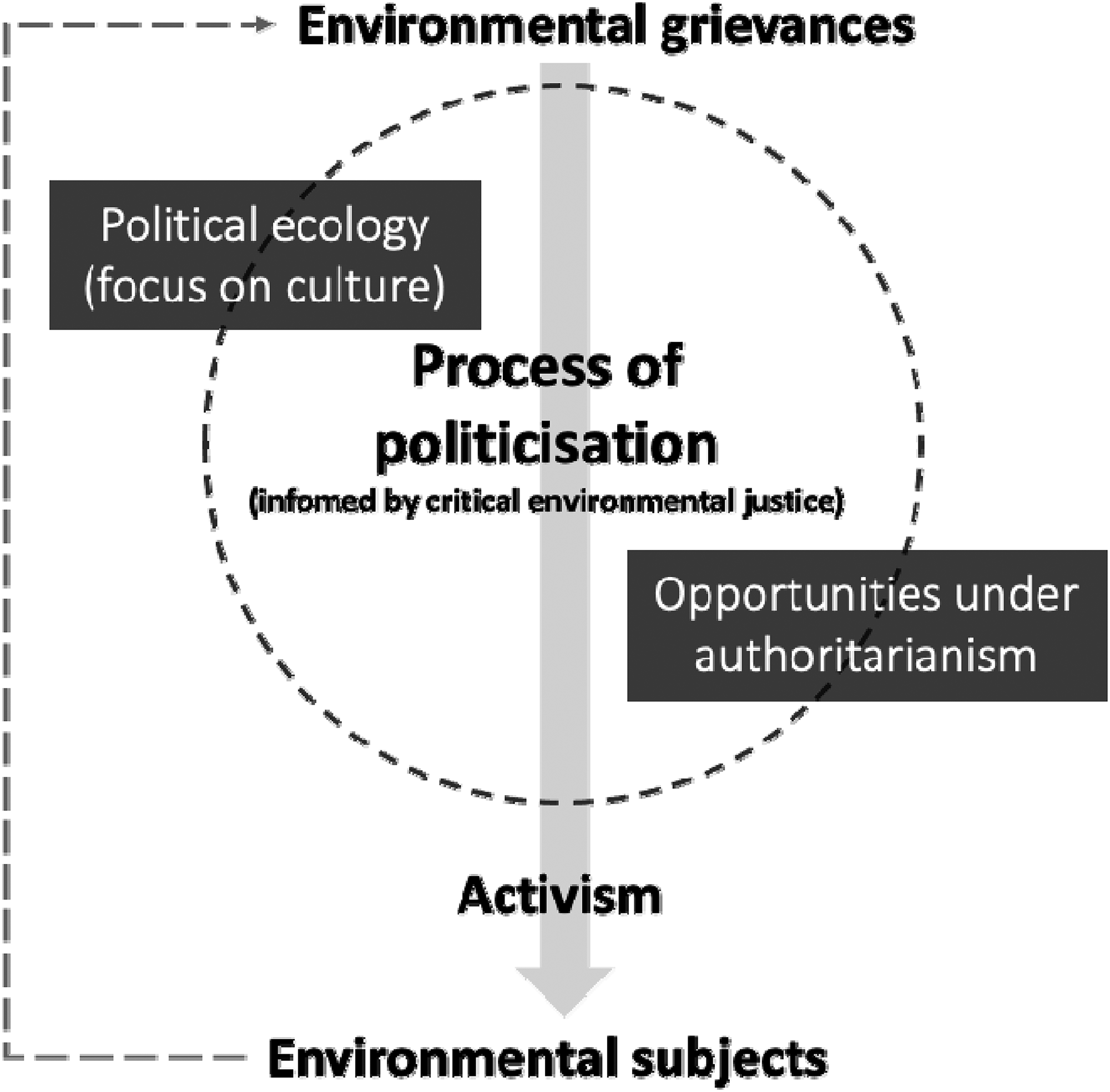
Theoretical framework. Source: Adapted from literature.
Case study methodology
We focus on two cases that share comparable grievances concerning food production, public perception of and attitude toward ‘China’, and limited space for political actions. These cases differ in the manifestations of public discontent regarding the disruptive protests of both rural and urban citizens in the marine disaster and a lack thereof in the Mekong Delta, and the presence of NGOs in the latter case and their absence in the former one.
The context of anti-China sentiments in Vietnam's politics
Resentment towards China has long been a defined trait of Vietnam politics. In ancient times, China was considered the biggest threat from the North. After a period of ‘communist brotherhood’, the Sino-Soviet split in the 1960s led Vietnam to lean towards the Soviet Union (Bui, 2017). Anti-China campaigns re-emerged, stemming not only from geopolitical conflicts, but also ‘the need to ‘reunify’ an internally divided population in the midst of a debilitating economic crisis' (Path, 2011: 204). Following the 1979 China–Vietnam border war, resistance to ‘Chinese invaders’ and anti-foreign heroism have been critical to nationalist politics in Vietnam (Vu, 2007). Adding to historical legacies is the ‘growing fear of China's rising power and influence that can work against Vietnamese interests and sovereignty claims in the South China Sea’ (Bui, 2017: 173). Most outstanding cases of political clashes include the anti-China rallies in 2011 against Chinese patrol ships harassing PetroVietnam's vessels (Bland and Hille, 2011) and in 2014 against the Chinese Haiyang Shiyou 811 oil rig on disputed territories (Bui, 2017).
Thus, anti-Chinaism is a ‘convenient’ material to construct nationalist discourse in times of crises. However, when framed by the government, these sentiments are not expressed as direct resentment towards China, but as the government's rational thinking, and efficient relief and unity building measures (Bui, 2017). Meanwhile, civil society activists provoke these sentiments to reconcile ‘Vietnamese who were once ideological enemies [pro-state or not] but are now uniting in the face of an aggressive China and a Vietnamese government perceived as meek and corrupt’ (Vu, 2014: 56). Our analysis focuses on how perception of China as an enemy-of-the-state played out in the two cases and influenced activism differently.
Data collection
The research's primary data draws from 19 semi-structured interviews and 6 unstructured interviews, conducted by the first author in 2018 and 2019 in Vietnam (Appendix A). Regarding the marine disaster, the sampling was response-driven (Goodman, 2010). Interviewees include NGOs-affiliated and independent activists to understand how their respective participation in the protest concurs or differs. NGO workers who did not participate in the cycle of protests were also interviewed since they, as suggested by Wells-Dang (2012), might still have awareness of and indirect involvement with the case. The key informants were identified through desk research and network of the first author, who had experiences working for an NGO in Vietnam. The key informants were activists willing to participate in the research and fully aware of political risks of being research participant. They informed other potential interviewees to actively contact the first author should they feel comfortable to share information or grant the right to contact them. The key informants offered advice on how research activities on the case might affect the researcher and potential interviewees, and whether the recruitment could move forward or not.
Regarding the Mekong Delta, snowball sampling was used to recruit interviewees working for relevant NGOs, as well interviewees residing in the research area. Following desk research, the first author contacted and interviewed senior staff and consultants of the Vietnam Rivers Network (VRN), which is a network of both NGOs, state-controlled scientific institutes and other actors working on issues related to riverine resources and sustainable development (Wells-Dang, 2013). The first author also attended a conference in May 2019 hosted by VRN on mobilising community-level resources to address the Delta's environmental degradation. 5 Participant notes and recording from this conference contribute to the dataset. Another six informal conversations with local residents during the fieldtrip in the provinces of Cần Thơ, Sóc Trăng, Trà Vinh and Long Xuyên were used in the analysis to complement the interview data. The first author's contacts at the DRAGON Institute of University of Cần Thơ suggested a local guide who had previously worked with researchers on fieldtrips related to environmental research. Based on discussion with the local guide and desk research, the first author selected several communes that appeared to have been greatly impacted by the 2016 drought. Influenced by budget, timing and the accessibility of potential interviewees, in the end, the first author visited five communes. 6
Regarding secondary data, in both cases, we used relevant keywords to collect news articles. VNExpress and Tuổi Trẻ were selected as these represent most-read newspapers that are fully online and the conventional ones with a growing online presence, respectively (Appendix C). The keywords (in Vietnamese) included dead fish, Formosa, marine disaster, sea/coastal pollution and Cửu Long Delta 7 drought, Mekong River drought, Vietnam National Mekong Committee (VNMC). A total of 99 articles were collected (Appendix B). We also collected secondary data from the website of VNMC and its allies within the network of NGOs working on Mekong-related issues, particularly the VNMC, and Mekong River Commission.
Our approach entails certain compromises. The reliance on key informants and the local guide shaped interviewee selection. In the marine disaster case, to reduce (political) risks and potential sanctions related to this research, the interview guides, participant information sheet and consent form are devoid of words that are politically sensitive in Vietnam, such as protests, democracy or corruption. Due to close monitoring around the area of the disaster, we decided not to interview activists based in the coastal provinces. The interviews were dominated by activists based in Hochiminh City and Hanoi, several of whom maintained constant contact with activists in the provinces. In general, while interviewees were outspoken, there remained certain hesitancy and scepticism about how helpful or risky it would be for their cause to get involved in this research.
In the Mekong Delta case, NGOs workers and consultants still needed to work in proximity with the central government and to be selective with the information and narrative they presented. With the local residents in Mekong provinces, to make sure that the interviewees felt comfortable, we went for a more informal dialogue. Apparently, it was not political fear but inundation of ‘research engagement’ that might have influenced the local residents’ responses. They were disappointed that they have not received any tangible benefits from engaging in previous research like ours. To respond, we explained how our research differed from others and rephrased our questions to avoid repetitiveness.
Data analysis
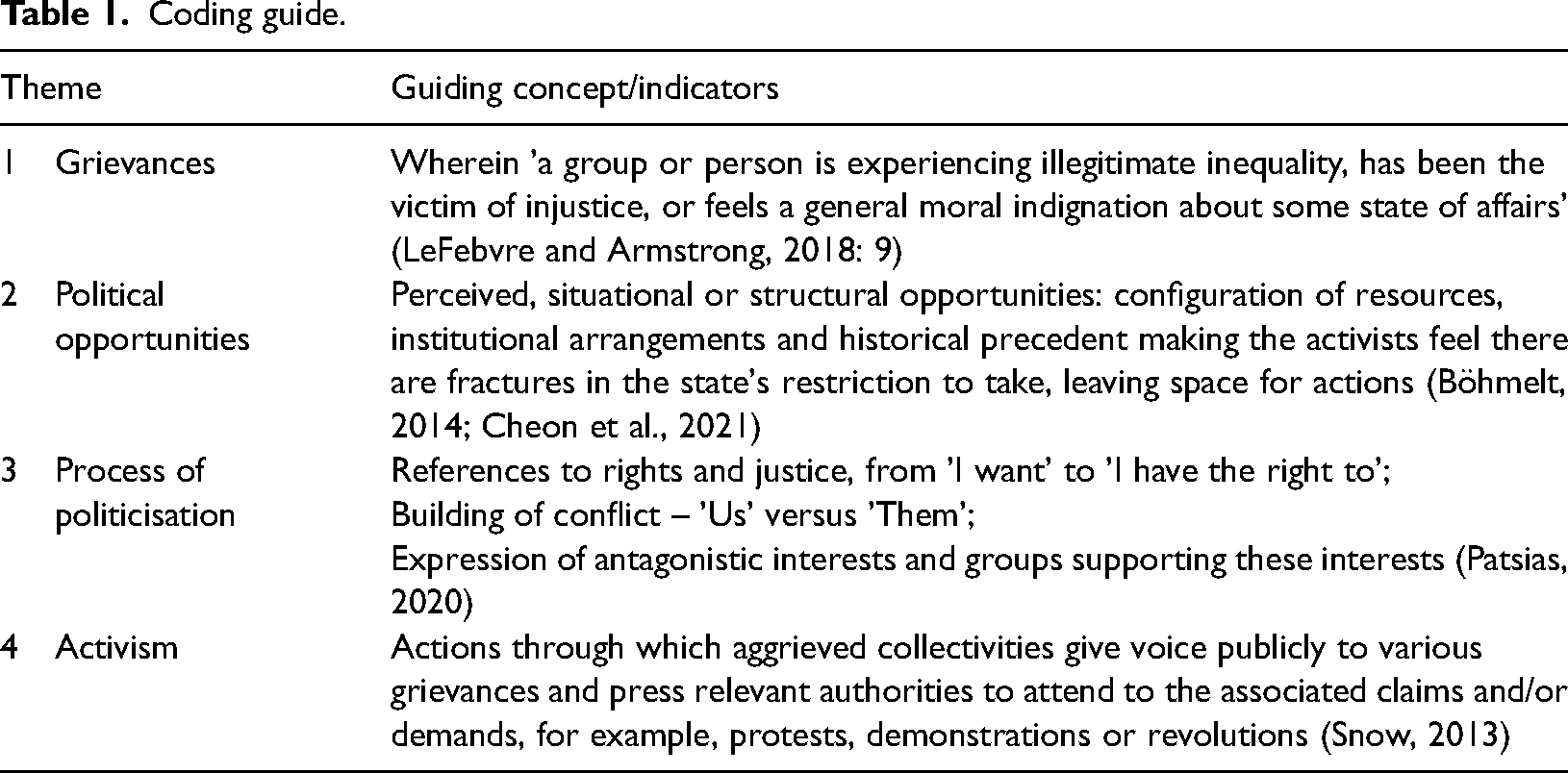
Using NVivo, we conducted a thematic analysis (Boyatzis, 1998). The transcripts were coded deductively. Through several iterations by grouping codes of higher or lower abstractness, and of similar, complementary, or opposing relationships, and integrating found codes (into pre-established ones), patterns among coded data were identified and served as the results for discussion (Table 1).
Coding guide.
Findings
The 2016 marine disaster and the multi-scalar politics of demanding transparency
In April 2016, a coastal pollution caused by Formosa Ha Tinh Steel Corporation (FHSC) led to mass fish death along the coastal line of Central Vietnam (Green Trees, 2017; Tuoi Tre Online, 2016). The villagers reported cases of food poisoning and loss of income; local fishery and tourism deteriorated, posing the threat of unemployment and insolvency for local workforce (Paddock, 2016; Thanh Nien, 2016; Tuoi Tre Online, 2016). Food safety became a concern for more urbanised areas (Thanh Nien, 2016). Between April and June 2016, protests and rallies shook the affected provinces, as well as urban centres in Hà Nội and Hồ Chí Minh City (South China Morning Post, 2016). These protests took place without engagement of formal NGOs, even those with an environmental focus. Social media saw the rise in popularity of the hashtag #ichoosefish [‘#toichonca’]. Despite being a Taiwanese corporate, FHSC's high employment of China-imported equipment and Chinese workers created an impression of a ‘Chinese’ company (Tuoi Tre News, 2014). On 30 June 2016, FHSC admitted to causing the mass fish death and offered a compensation package of 500 million USD to the national government (Thanh Nien News, 2016). Resistance efforts in the rural provinces lasted well into 2018 with emphasis on compensation claims (Nguyên Nguyễn, 2018; RFA, 2018) (Figure 2). Interviewees also shared that the pioneers/organisers of the protests in the cities gained tactical lessons from reports about the Hong Kong's Yellow Umbrella Movement in 2014, as well as their personal contacts with those involved in this movement. Activists in Vietnam also worked with activists in Taiwan in making sure the case received political attention in Taiwan (Hsiao and Hsu, 2020).
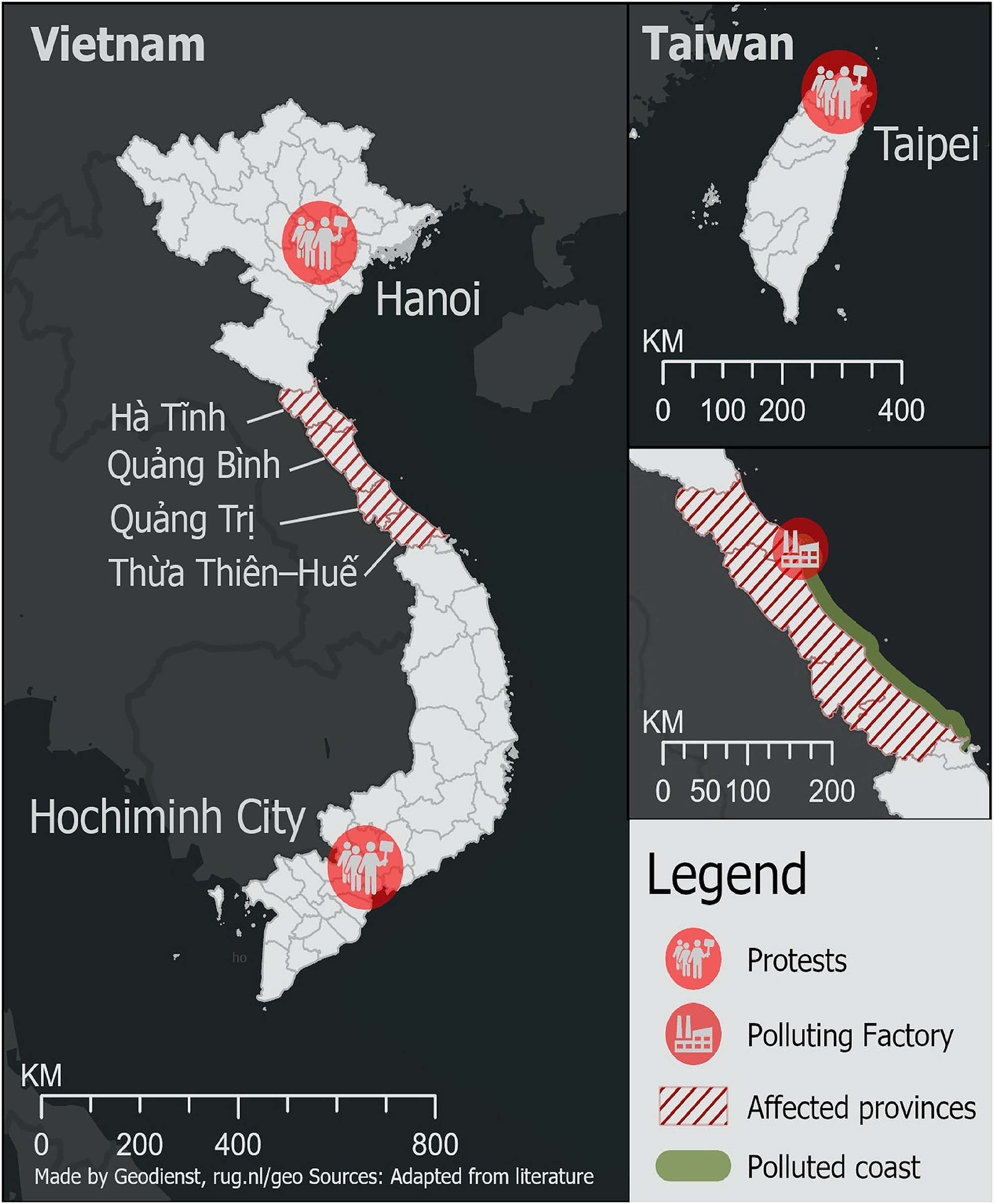
Locations of the mass fish death and main protests. Source: Adapted from green trees’ report, interviews and news articles collected from desk research.
A united front for grievances
By and large, our interviewees concurred that the fish death provided a rhetorical material to bind different aspects of one environmental disaster in a sensationalising and action-provoking manner. At its core, the fish death represented pragmatic concerns over the potential consequences of an environmental pollution. However, the public frustration was stronger rooted in the obscurity around the disaster, since there was a lack of information and clear guidance from the government, as captured in the popular slogan used by activists ‘Fish need clean water. People need transparency’. […] we were very frustrated then with the responses of the government, who kept buying time and shifting blame. Our focus was to practice our civic right, demanding the government to inform us […]. Back then it was not even about ridding of Formosa. [Interview 7, June 2018]
The imagery of fish death congealed public frustration that were both concurrent (from other issues around the same time) and accumulative (other issues building over time). Through the activist discourses, dead fish imagery was linked to tropes of cultural identity (fish sauce as essential to the experience of ‘being’ Vietnamese) and national identity and security (particularly anti-Chinaism) to deliver an indirect criticism to the government (Figure 3). This essentially created a ‘not against the (Communist) party, just concerned for the country’ façade to soften the political tone of the activism in the marine disaster.
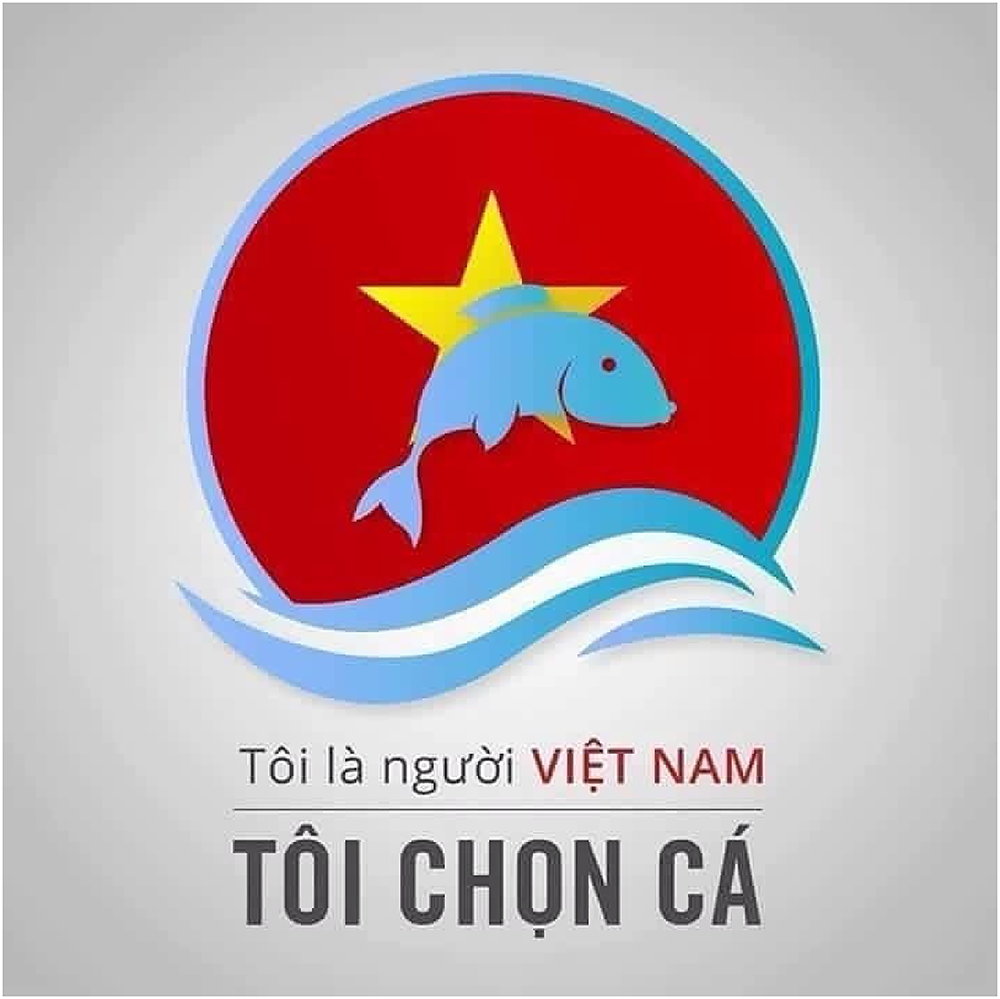
A popular post by online activists reading ‘I am Vietnamese. I choose fish’ combining images of fish and the national flag. Source: Part of data collected from Facebook using #ichoosefish.
Interviewees who protested in Hà Nội explained that the fish death helped ‘reunite’ the same network of activists who worked together on the tree felling case in 2015 in the same city (Interview 2, May 2019; 7 June 2018). Additionally, there was concern for the harms done to ‘the natural environment’, but also to ‘the environment of the Vietnamese’ and ‘the environment of democratic values’. In this sense, the fish death imagery allowed the rhetoric about ‘the environment’ to jump between nature – culture – nation interfaces. […] the frustration was from previous cases [as well], which were not handled well by the government […] The frustration was still there; people just didn’t want to take to the streets yet. When 2 or 3 contextual factors met, like the environmental impact, the Chinese involvement, and also the fact that the case was an opportunity for those who had been wanting protests to happen, people were easily triggered. [Interview 3, May 2019]
This quote also shows that the ‘Chinese involvement’ provided a Vietnam-versus-China narrative that conveniently masked, or at least outshone, the citizens-versus-government dynamics of the activism in this case. Culture, in this instance, manifested through the strong association of being a Vietnamese with consuming fish (sauce) and maintaining ‘independence’ from China as a threat, was not only tangible (FHSC's factories) but also intangible, that is, the affirmation the anti-Chinaism induced by historical legacies. This helped explain the rapid and ‘explosive’ mobilisation of protests in this case. Still, how did activists perceive/handle the threats of government oppression, as authoritarianism is marked with a stringent approach to activism?
Politicisation with apolitical tropes?
As the fish death acted to concentrate multiple grievances, #ichoosefish expressed an emboldened attitude against the (national) government. Such a ‘choice’ is intrinsically political, since it aims at ‘enunciating dissent and rupture, literally voicing speech that claims a place in the order of things, demanding “the part for those who have no-part”’ (Ranciere et al., 2001: 6). However, the activists affirmed that they were speaking up not only for locals suffering direct socio-economic losses from the disaster, but also for themselves as part of the food system, as well as part of ‘the Vietnamese’. In this sense, protesting and using hashtag to expression frustration were not political actions (in a disruptive sense), but ways to ‘practice their rights as citizens’ (Interview 2 & 4, May 2019). When people take it to the streets, it means they want to make sure their voice is heard directly by the government. They want no violence or chaos, they only want to do it peacefully, so the government need to protect them. (Interview 10, May 2019)
As such, the construction of ‘I have the right to’ with a façade of political neutrality is threefold. Firstly, the activists at the coastal areas claimed injustice for those suffering directly from the fish death. Meanwhile, urban activists employed ‘citizenship’ as a rationale for political actions. Thus, and secondly, for fear of political punishments from the national governments, activists working for NGOs affirmed that they participated in the resistant actions as an independent individual and an ‘ordinary citizen’ (Interview 5, July 2019), not as a leader of or with any relation to any groups/organisations. Thirdly, grassroots activists in the cities claimed that their actions were not motivated by ‘foreign influence or agenda’ (cf., Matejova et al., 2018), but merely out of their rights to being informed and listened to by the government.
The activism was constantly challenged by interventions from the government, namely cracking down on protests, portraying protestors negatively through state news, monitoring social media contents from ‘key opinion leaders’, as mentioned by interviewees, and maintaining a strict narrative of ‘experts know best’ (Nguyen Van Quoc et al., 2020b). These restrictions did deter participation in the protests. However, the activists were still motivated to take actions following the perceived success of the Green Trees movement in Hà Nội in 2015, where the city's government was more open to a compromise with opponents of the mass tree-felling plan (Interview 2, May 2019; Interview 7, June 2018). In addition, the more strong-handed repression from the government did not really come until the second wave of protest in Hồ Chí Minh City and Hà Nội, which was interpreted by activists as the government's underestimation of the fish death's impacts. This allowed the activists to protest and frame their grievances in a bolder and more provoking manner in the beginning. The 6700 green trees case and the death fish case, based on my observation, were talked about a lot by media at the time, when the government did not consider censoring as necessary. […] Actually, state media discovered the information [about the disaster] first and spread it. Initially, there was no response from the state, until there was a strong reaction from dissidents, or those known for having views in opposition to the state's. (Interview 4, May 2019)
Personalisation of dissension and multi-scalar actions
The activism in the marine disaster was marked with (a) the use of #ichoosefish to raise critical awareness around the disaster and mobilise both protesting and non-protesting actions (such as petitioning and donating) and (b) an unprecedented wave of protests on a national scale. The use of social media, particularly Facebook, to assign a variety of problem-making claims about the disaster allowed the development of a connection action network that was far more individualised and technologically organised than traditional collective actions networks (Bennett and Segerberg, 2012). The #ichoosefish was associated with different interpretations of the grievances, and allowed a variety of Facebook and Twitters users to form perception of and attachment to the marine disaster and its many consequences (Nguyen Van Quoc and Trell, 2020). The abstractness of environmentalism or anti-Chinaism thus became personalised, rendering a broader population of users acceptive to mobilisation. […] ‘environment’ is too generic and broad, so a specific narrative would be easier to attract attention. For example, tomorrow, no one would go out and protest against 30th April itself
8
[…] since there was no clear cause associated [with that date]. [Interview 3, May 2019]
The personalisation of dissension and the state's initial ‘softer’ restriction led to multiple protests in different cities in the countries, most notable of which were those in Hồ Chí Minh City and Hà Nội. The protests were targeted at FHSC, as well as the government, hence the slogan popular among protestors: ‘Fish need clean water. People need transparency’. However, interviewees nuanced the direct connection between grievances and actions, alleging that public frustration regarding China-related issues tends to be silenced by the national government (Interview 10, May 2019). Thus, while the anti-China sentiment was essential to mobilising actions, the activists refrained from framing the actions per se as such. This resonates with Vu's observation that ‘Hà Nội's close relationship with Beijing out of ideological loyalty and regime survival instincts has naturally put the [Communist] Party at great odds with widespread anti-China popular sentiments that the new nationalist movement thrives on’. (2014: 34).
‘Who are we to blame China?’: Between transnational advocacy and local non-activism in the Mekong Delta
Between late 2015 and mid-2016, the Mekong Delta was confronted by the most severe wave of drought and salinisation in 100 years, causing extreme economic loss and long-term impacts on the deltaic societies (Figure 4) (Directorate of Water Resources, 2016). How these impacts would exacerbate the already-unbalanced population distribution between urban and rural areas was a topic of concern (Hiệp, 2016; Tuâ´n et al., 2014). For the locals of Mekong Delta whose livelihood is dependent on agriculture and fisheries, the increasingly harsh and unpredictable climate, exemplified by the drought, has become detrimental to not only their earning but also domestic stability and life quality (Betcherman et al., 2019; Koubi et al., 2016). Thus, the Mekong Delta has been the focus of both local and national governments, with a variety of mitigation and adaptation measures discussed and implemented (Poelma et al., 2021). Environmental degradation in the region has also received ample attention from local and international NGOs, most likely due to its many implications for current and future development of not only the delta but also Vietnam. These implications form a complex web of pro-urban migration causing extra burden on the cities’ infrastructure and social system (Hiệp, 2016), vulnerability to China's acceleration of upstream hydro-electric dams construction (Foran, 2015) and threats posed by climate changes to the coastal areas of Vietnam as well as the whole country in terms of food and social security (Smajgl et al., 2015).
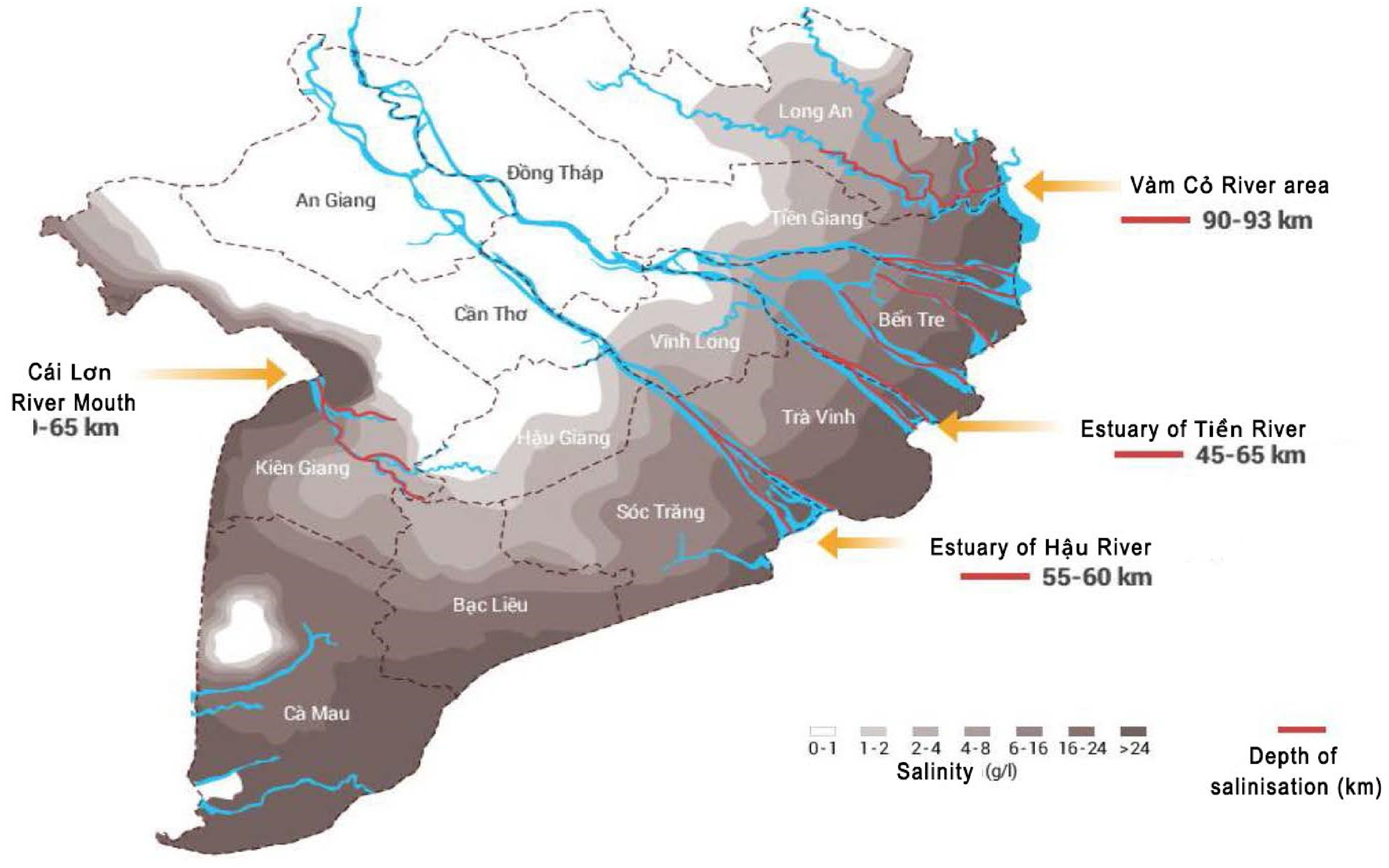
Surface and depth of drought (measured through salinity) as of 15 March 2016. Source: Disaster Management Policy and Technology Centre, 2016.
Complexity and ambiguity of grievances
As far as the drought was concerned, our interviewees were adamant about the urgency of a ‘Mekong (or Cửu Long) River issue’. However, there was no end to what constituted this broadly defined problem. As experts in their fields, interviewees could distinguish between climate change, industrialised agriculture and hydroelectric dams as potential causes. However, since such causes and their consequences could not be separated in reality, interviewees found great challenge in translating concerns over these causes into ‘factual’ policy languages. The drought was perceived not as a problem per se, but yet another illustration of the increasing complex situation of the delta. A former consultant for VNMC casted their doubt over accountability: Well, to be honest, assuming that there was no dam along the Mekong River, would Vietnamese themselves not proceed to destroy the delta? […] around 20 thermoelectric plants, countless illegal industrial zones, countless 3-crops-per-year rice fields with loads of pesticide, encouragement of intensive shrimp farming with hundreds of industrial shrimp ponds. We destroyed our own land. (Interview 16, September 2019)
What came next might be clear to both VRN workers and local farmers and fishermen. However, compared to the former, the latter did not necessarily see a need to problematise not only changing environmental conditions but also the responses from the government with varying degree of reliability, as interviews with locals indicated. Granted, farmers and fishermen were commonly depicted newspapers as either helpless victims of or persistent ‘adaptors’ to environmental hardship. However, such depiction largely focused on tangible causes (climate conditions, outdated legal framework) and glorifying locals’ adaptive capacity. Similarly, the increasing discussion over adaptation measures by scholars (Rutten et al., 2014; Smajgl et al., 2015) and government officials tends to highlight the less contentious side of the ‘Mekong issue’ and place an implied burden of self-salvation on the locals. The VNMC's consultant has been through similar experiences: […] while in Cửu Long River Delta, people don’t see [the consequences] right away. It happened gradually over time, and the locals adapt in a corresponding gradual manner. […] like if you say oh there's been no rain and water, it [China] would respond that it's not its fault. […] they say that what is the proof that the pollution was due to specific, instead of accumulative, factors? So yeah, we gave up. (Interview 16, September 2019)
This celebration of adaptation should be not confused with the reality, as observed by Biggs et al. (2009), of a deep historical distrust between farmers and state authorities over the best ways to ‘adapt’.
The non-politicisation of expertise and diplomacy
The Mekong Delta's development is the focus of both the VNMC and the VRN. VNMC is a member of the Mekong River Commission – an international treaty-based organisation working to promote sustainable resources use in the Mekong region (Mekong River Commission, n.d.). Similar to how MRC proclaims to be water knowledge and diplomacy platform, VNMC functions strictly as ‘an interdisciplinary agency responsible for assisting Prime Minister in directing and managing inter-sectoral, inter-provincial and transboundary activities’.
9
The focus on (scientific) knowledge generation and the committee's direct link to national government of VNMC indicates ‘an assumedly neutral natural scientific knowledge aristocracy’ (Swyngedouw, 2010b: 311). VRN, while being an open forum with a broad set of members working on river protection and sustainable development in Vietnam (VRN, n.d.), operates with a similarly expertise-centric approach. For instance, in the words of a VNMC's senior employee: We are mere participants; we don’t initiate any movements. We do research and policy lobbying, but we don’t actively join in any regional network to fight for rights […] Vietnam River Network is an NGO [network] that focuses more on technical issues, providing proofs for policy-related actions. (Interview 15, May 2019)
Thus, during the 2016 drought, politicisation rarely took place, at least by VNMC and VRN. While newspapers pointed out negative impacts of Chinese dams, they were also keen on expert proposals of potential solutions and depicting a diligent national government in negotiation with China's government to release water from the dams. In this sense, there was little space for conflict building and antagonising (Käkönen and Hirsch, 2009), especially when social media users were not massively involved in the process, not to mention the local governments’ deterrence when actions actually took place, as confirmed by the following quotes by VNMC's employee. They [WARECOD
10
] work on community issues, but they don’t use [communication platforms, such as social media]. They support communities, but to mobilise or gather [communities] is not their function. (Interview 15, May 2019)
We collected the signatures from the locals, while explaining to them oh the dams are harmful in this and that way. Then, somehow, the security forces get involved, saying [what we were doing] was not allowed. Consequently, all projects of [redacted] were suspended, even close to having the approval rescinded and being blacklisted. […] It was painful; everything was delayed. (Interview 16, September 2019)
These opinions are also confirmed by interviewees working at other NGOs, who argued that considering the context of Vietnam, it is more important for NGOs to secure deliverables than to unnecessarily ‘create conflict’ (Interviews 18 and 19, 21 May 2019).
Transnational advocacy network and political impacts
The work of VNMC and VRN is strongly focused on consultancy, which also pre-defines how they can affect policy changes. The actions taken by these agencies did not provide, nor were they expected to, a rhetoric that could activate bottom-up actions beyond their expert-bounded scope. A senior at VNMC contended that: The Mekong River Commission has this important principle called PNPCI [sic]. That would include information, pre-consultancy, and negotiation. […] Essentially, we [VRN] relied on this principle to try to provide information to and influence on the government. That's the limit [to our impact]. (Interview 15, May 2019)
Even when an NGO has a chance to do so, the broad scale of the drought, or any environmental issues in the delta, and a lack of discernible causes of loss, make such a task unfeasible. Decades of decentralisation and ‘participatory development’ have hardly led to collective empowerment but rather merely acted as tools to extend government control (Bruun, 2020a). Such limit was also acknowledged by a VNMC consultant: We can target a few hundred [people], but not thousands. The only way to reach that was for the provincial public broadcasts to talk about it. Otherwise, 1 or 2 NGOs cannot do much, not to mention the risks for those involved. All the farmers who were active in [redacted]'s activities were summoned by the security forces. (Interview 16, September 2019)
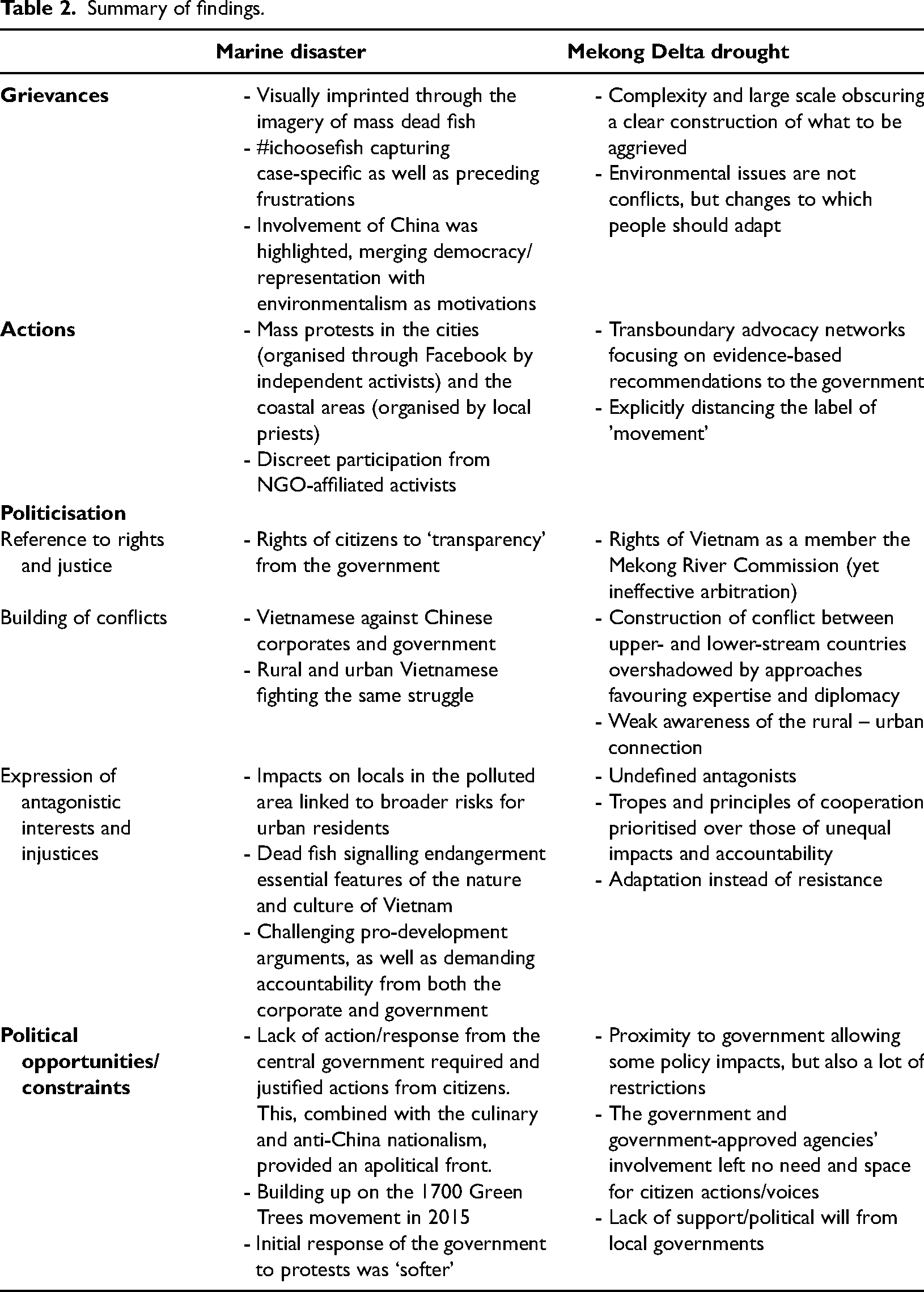
The lack of attachment to an environmental cause was also mentioned by local residents. They made similar claim to the NGOs workers about the multiple causes of the drought and other environmental issues and that as long as the government can provide them with a compensation scheme, they would keep trying to adapt to changing conditions. Such a claim is quite surprising, considering the dire impacts of environmental quality decline as reported by the newspapers. This possibly reflects how the popularisation of ‘adaptation’ as a solution by the government, academia, as well as newspapers has impacted the locals’ mindset. Thus, local activism led by communities and citizens remained lacking in this case. Table 2 provides a summary of findings from both cases.
Summary of findings.
Discussion
Both cases are strongly related to food security, geopolitics in relation to China, and the restrictive political climate. However, the different trajectories of (de)politicisation have led to distinctive forms of activism in each case. Under constraints imposed by the Communist Party-State of Vietnam, confrontational actions, such as mass protests demanding transparency from the government, are still feasible. Our findings show that such actions can possibly be stimulated by a framing strategy principally focused on culinary and anti-China nationalism, activists’ own perception of political opportunities and the diversity of activists from different backgrounds during mobilisation. Without this constellation of factors, it remains challenging for activists, especially those working with institutionalised NGOs, to step out of the strictly defined territory as stipulated by the government. By engaging with different forms of activism in response to environmental reality, locals and activists also learned to ‘secure and represent themselves politically’ (Robbins, 2011b: 216).
The imperatives of culinary nationalism and anti-China nationalism
We find that the construction of nationalism is critical to provoking unprecedented confrontational environmental resistance in Vietnam. Nationalism is a multi-faceted phenomenon; still, culture plays an undeniably critical role in its formation (Leerssen, 2006). The critical role of fish sauce to the Vietnamese’ cultural identity (Avieli, 2011) helped trigger discussion on the marine disaster beyond the polluted-polluter boundary, touching upon issues of food safety and anti-Chinaism on a national scale (Nguyen Van Quoc et al., 2020a). The popularisation of #ichoosefish went beyond culinary preferences to signal an intricate connection between fish as food resource and being a ‘nationalistic’ Vietnamese (cf. Allison, 2013). The sense of personalised victimhood allowed the activist framing to enhance not only sympathy-based but also culture-based resonance from the frame receivers (Buijs et al., 2011). The multi-faceted nationalism emerging from our analysis is constituted by two elements distilling the convergence of food politics, cultural cultivation and nationalism construction for the Vietnamese society: culinary nationalism (King, 2019) and anti-China nationalism (Vu, 2014). On one hand, ‘food may indeed reinforce essentialised notions of national identity, yet also simultaneously contest these ideas through the assertion of heterogeneous difference’ (King, 2019: 2). King 11 emphasised the perception of linkages between environment, culture and society from a food politics perspective. On the other hand, anti-China nationalism coincides with Leerssen's (2006) cross-national examination of cultural nationalism, and in this case, how ‘not being Chinese’ defines ‘being Vietnamese’ – a strong sense of ‘the other’ (Bui, 2017; Vu, 2014). The nationalism found in the marine disaster thus differs from the nationalism that is ‘articulated and justified in the name of frighteningly exclusive and often racialised iterations of “the people”’ and used by populist and authoritarian authorities to promote militant and economic discourses of common resources governance (McCarthy, 2019: 302).
By grounding their actions on these notions of nationalism, environmental activists in the marine disaster case were able to frame their argumentation as not-anti-government, justifying taking actions not only to themselves but also potential allies. This argumentation apparently rallied various supporters from different backgrounds and scales. Most noticeably, urban and rural citizens were united personalisation of grievance, instead of charitable sentiments for coastal locals suffering from the environmental disaster. The fish death thus embodied justice-oriented political momentum that food can generate (Sbicca, 2018). Moreover, anti-China sentiments solidified this momentum by reconciling the Vietnamese who may be ideologically different but are now uniting against an aggressive China, to whom the Vietnamese government's response was perceived as meek and inefficient (Vu, 2014: 56). By comparison, the causal chain of issues in Mekong Delta is longer, more complex and much less visible (Keck and Sikkink, 1998), making it harder to crystallise the argumentation around connotations with similar sense of urgency and ‘personalisability’.
Seizing opportunities: Diversity, hybridity and social media
Political opportunity as a concept is broad and subject to interpretation and social construction by movement (and other political actors) (Cheon et al., 2021). Our findings showed that perceived and situational opportunities played a critical role in mobilising protests, despite the institutional challenges. Activists saw the improper responses from the governments to the fish death as a justification for actions that otherwise would be socially and legally illegitimate. Reckoning that government's reactions would be less oppressive based on the precedent of the Green Trees movement in 2015 (Vu, 2017), the activists were emboldened in organising protests, especially in the cities (with higher level of political monitoring). The Green Trees movement of 2015, with similar focus on environment and transparency albeit at a smaller scale, provided a solid foundation upon which mobilisation was possible without the need to establish new networks of allies and supporters (Vu, 2017). Meanwhile, the Mekong Delta case is characterised by a less elastic circle of actors working around pre-established principles, yielding little space for other forms of activism other than policy recommendations and transnational advocacy.
The leadership and the constituency of activist groups are critical to seizing such opportunities for protests (Ganz, 2004). The marine disaster benefitted from a pool of diverse actors, allowing different strategies of mobilisation to take place in different socio-spatial settings (see Table 2). Equally important is the hybridity of employees from institutionalised NGOs discreetly participating as independent activists or using their institutional familiarity to garner non-public information. Aiding human resources was the strategic use of social media to attract public support for more ‘radical activism’, as seen in broad backing for and participation in the protests (Fan et al., 2020; Milstein et al., 2020). Activists have also engaged in ‘scale-jumping’, referring to civil society organisations bypassing the state to engage directly at the international level (Smith, 2004), particularly between Vietnamese and Taiwanese activists in the marine disaster. Adding to leadership and structure is the interaction between activists in Vietnam and Hongkong. The insights gained from the Yellow Umbrella Movement provided input for strategies, as well as a certain belief that similar actions of protesting could still take place in Vietnam. While more substantiation is needed, the international interaction between Hongkong and Vietnam appears to pre-condition the merge between democracy and environmentalism as motivations for engagement of informal civil society.
These conditions, however, did not apply to the Mekong Delta case. Specifically, the use of expertise as an appeal to objectivity of expertise (politics of unquestionable facts) (Pellizzoni, 2011), served to limit the activism to VNMC and related agencies ‘authorised’ to come up with solutions, not to charge up political debates. As these actors strictly defined their advocacy as unrelated to any radical/confrontational approaches, they worked within the norm of knowledge-based and ‘non-political’ civil society in Vietnam.
Politicisation and environmental subjects
To this end, the key difference between the two cases appears in how dissensus and discontent can be strategised to mobilise political actions. Even when the activists in the marine disaster strongly affirmed their actions are not political, the ‘successful’ mobilisation was largely supported by effective antagonising supporters and unifying them across socio-spatial scales. The Mekong Delta case, meanwhile, affirmed that presence of conflict in the politicisation processes is only as important as the content of this conflict, namely the ways of defining the boundaries at stake (Patsias, 2020). The focus on expertise and diplomacy at the expense of dissensus as the base for politics obscures ‘the political’ (Swyngedouw, 2015). This difference is further enhanced by insights from successful anti-dam movements in other countries along the Mekong River. For instance, the movement against the Myitsone Dam in Myanmar benefitted from framing the project emotionally as a threat to the country's national cultural heritage, aided by the political change in the country around 2010–2011. Meanwhile, the movement against the Kaeng Suea Ten Dam in Thailand ensured its success by actively responding to competing framings (Kirchherr, 2018).
Engaging in politicisation processes brought forward both policy outcomes and ‘transformative outcomes’. Radical transformations tend to result from conflicts, oppositional consciousness and resistance to hegemonic structures (Temper et al., 2018). Here, we call upon the concept of environmental subjectivities – ‘the lived experience of relating to the environment in a social context that recognises the effects of power and culture on individual practice’ (Ford and Norgaard, 2020: 47). Involvement in political actions of challenging others and social relations in which they are embedded allows these subjects to challenge and transform themselves, as observed by Calvário et al. (2017) in politicisation of environmental issues during austerity in Greece. Following these assertions, we argue that the ‘personalised and disruptive’ activism in the marine disaster facilitates the emergence of a culture of environmentalism (or environmentalism-through-culture) that dispels the authority of the state over environmental issues.
By comparison, the Mekong Delta's complicated reality combined with VNMC's consensus-based methodology moulded by institutional commitments has a dual impact. First, it keeps political debates and actions truncated for involved NGOs activists, and second, it might also disincentivise any local agency to speak up vis-à-vis political censorship. Such a narrow focus on policy-making and planning runs the risk of characterising adaptation processes as exclusively beneficial and primarily technical or managerial (Eriksen et al., 2015). Along these lines, Kaika (2017) warned that discourse on resilience and adaptation vaccinates citizens and environments so that they can take larger doses of inequality and degradation in the future. The emphasis on adaptation in Mekong Delta being inevitable and even desirable may thus yield similarly undesirable effects to locals.
Certainly, in both cases, the embeddedness of the activists and/or locals is not just a state of being, but rather a process of being in relation to the environment. For example, Doshi (2019: 129) looked into how middle-class conservation activism was motivated by aesthetic desires as well as concerns for air and water quality, while ‘slum residents’ environmental subjectivities were contoured by the logics of resettlement’. The formation of subjectivities within each of our cases is possibly differentiated through different embodied experiences through which activists and locals mobilise in relation to either fish death or drought as an ‘environmental problem’ (Doshi, 2019:119). While further investigation is needed, our findings on activism also allow certain peaks into the role of the state in the two cases, particularly in relation to Nightingale's proposal of ‘socioenvironmental state’ concept in defiance of the state as predefined actor acting as a dominant and resisted domain within society (2018). The marine disaster suggests traces of a socioenvironmental state. Struggles over claims of competence to govern, conflicting definitions of what constitute common resources, and different forms of ex- and inclusion come together to partly shaped the government's reactions. In Mekong Delta, meanwhile, the state's authority is not a given, but rather established in relation with processes of institutional alignment to promote the incontestable nature of expertise and uncritical pragmatism.
Conclusion
This article offers comparative insights into different forms of environmental activism in Vietnam. The argument we extend here is that different processes of politicisation of environmental grievances led to different forms of activism in the cases of marine disaster in the central coast and drought in Mekong Delta. Particularly, framing injustice, conflict building and naming of antagonists took place in a more ‘explosive’ and emboldened manner in the former than the latter case. This divergence, in turn, produced different environmental subjects whose relation to the state and the environment was decisive in their involvement, or lack thereof, in confrontational tactics. Environmental subjectivities also suggest how future grievances would be politicised by actors with different experiences of political engagement. Factors encouraging confrontational activism like mass protests are nationalism – expressed through food and culinary traditions as well as anti-China sentiments and empowered by social media, diversity and hybridity of involved activists, and explicit dissension over environmental injustice as the base for politicisation. In contrast, handling environmental issues as a function of expertise, diplomacy and (simplified) adaptation acts to dilute politicisation process. The government's authority over who gets to claim environmental justice, and how, is thus at the very heart of the debate. In this sense, our results provide insight into not only activism under authoritarianism but also how such activism can be shaped by different constructions of environmental justice. On the other hand, the results reflect the value of critical environmental justice in advocating for analysis going beyond institutions for a broader anti-authoritarian perspective (Pellow, 2018). The opportunities and challenges for activism presented in this paper should not be limited to Vietnam as a stand-alone unit among the global context, but patterns that might arise in the face of oppression and exclusion. We conclude that a deeper look into the enabling and disabling factors of confrontational environmental activism in increasingly authoritarian regimes, including both democracies and autocracies, around the world remains a topic worthy of further attention.
Highlights
Different forms of activism under authoritarian can be explained by tracing the process of politicising environmental grievances.
Factors encouraging confrontational activism are food- and anti-China-based nationalism, diversity and hybridity of activists, and explicit dissension over environmental injustice.
Handling environmental issues as a function of expertise, diplomacy and (simplified) adaptation acts to dilute politicisation process.
The two processes can make distinctive environmental subjects out of involved activists and locals.
Footnotes
Acknowledgements
This paper was made possible by the kind activists and locals who were willing to support the first author during fieldwork. The authors also give thanks to the anonymous reviewers and their feedback.
Declaration of conflicting interests
The author(s) declared no potential conflicts of interest with respect to the research, authorship and/or publication of this article.
Funding
The author(s) disclosed receipt of the following financial support for the research, authorship and/or publication of this article: This work has been supported by the Faculty of Spatial Sciences’ PhD Scholarship Programme.
