




Abstract
This paper focuses on informal civil society in an authoritarian context, particularly the unprecedented nation-wide protests and civic action in Vietnam, triggered by the industrial pollution and the resulting mass fish death on the central coast in 2016. We explore civil society actors' motivations and tactics to take action under political restrictions. Data was collected from semi-structured interviews with civil society actors. The findings illustrate how informal civil society in Vietnam is built on independent or partly NGO-affiliated individuals working together to promote non-violent change, although the process of doing so might involve challenging the government apparatus. The activists were motivated to take action by the dead fish’ symbolism of endangered livelihood, environmental protection, and to demand transparency from the government. Critical factors further contributing to the mobilisation of citizens included the combination of food symbolism and anti-China nationalism, the tactical use of Facebook by urban activists, and religious leadership in the rural areas. The protests resulting from the coastal pollution can be seen as boundary-spanning events through which Vietnamese civil society actors ‘invent’ spaces of (political) participation amidst limited ‘invited’ space.
Keywords
Introduction
On 1 May 2016, unusually large crowds gathered in Hanoi and Hochiminh City to protest against the then-unexplained mass fish death in coastal provinces remote from both cities (BCC Vietnam, 2016). Dead fish were observed in Ky-Anh District, Ha-Tinh Province, followed by similar phenomenon in the provinces of Quang-Tri, Quang-Binh, and Thua-Thien-Hue (CKV, 2016). The villagers suffered food poisoning and loss of income; local fishery and tourism deteriorated (Paddock, 2016). Food safety became a concern for major cities, such as Hochiminh City and Hanoi (Thanh Nien, 2016). The suspected pollution source was the Formosa Ha-Tinh Steel Corporation (FHSC), whose plants discharged untreated waste into the nearby sea. In April 2016, the Vietnamese government affirmed that there was no proof linking FHSC to the pollution, only to reverse their stance 2 months later (Minh and Nguyen, 2016). On 30 June 2016, FHSC admitted to causing the pollution and offered a compensation package of 500 million USD (Thanh Nien News, 2016). Between April and June 2016, protests and rallies took place not only in the directly affected provinces, but also in Hanoi and Hochiminh City, two most populous cities of Vietnam (Vice News, 2016). During this time, while official numbers were not recorded, eight 'waves' of protests (comprising a number of smaller protests whose quantity we unfortunately cannot verify within this research) could be distinguished in relation to the coastal pollution (Nguyen Van Quoc et al., 2020) 1 . These protests were met with the state’s oppression, including police brutality against activists, and reported harsh sentencing imposed on activists (Phuong, 2017).
Social media saw the rise in popularity of #ichoosefish, and the slogan “Fish needs clean water; people need transparency”, born out of public outrage against a controversial remark from a FHSC’s representative: “It’s either fish and shrimp or steel factories.” (Tuoi Tre Online, 2016). The pollution also drew public attention in Taiwan, where the Formosa Plastics Group (FPG), of which FHSC is an overseas subsidiary
2
, is infamous for serial environmental destruction (Einhorn and Carroll, 2019). Civic and legal actions against FHSC in Taiwan by a coalition of Taiwanese NGOs followed (Wu and Birsel, 2016). As such, the coastal pollution received strong public response on national and international scale (Figure 1). Alongside the 2009 anti-bauxite movement, in the context of authoritarian Vietnam, the coastal pollution case can be considered a rare occurrence of environmental protests exceeding the local scale and manifesting on a national level, in both urban and rural areas. Locations of FHSC steel plants, provinces where pollution occurred and protests
3
(Made by Geodiesnt, University of Groningen).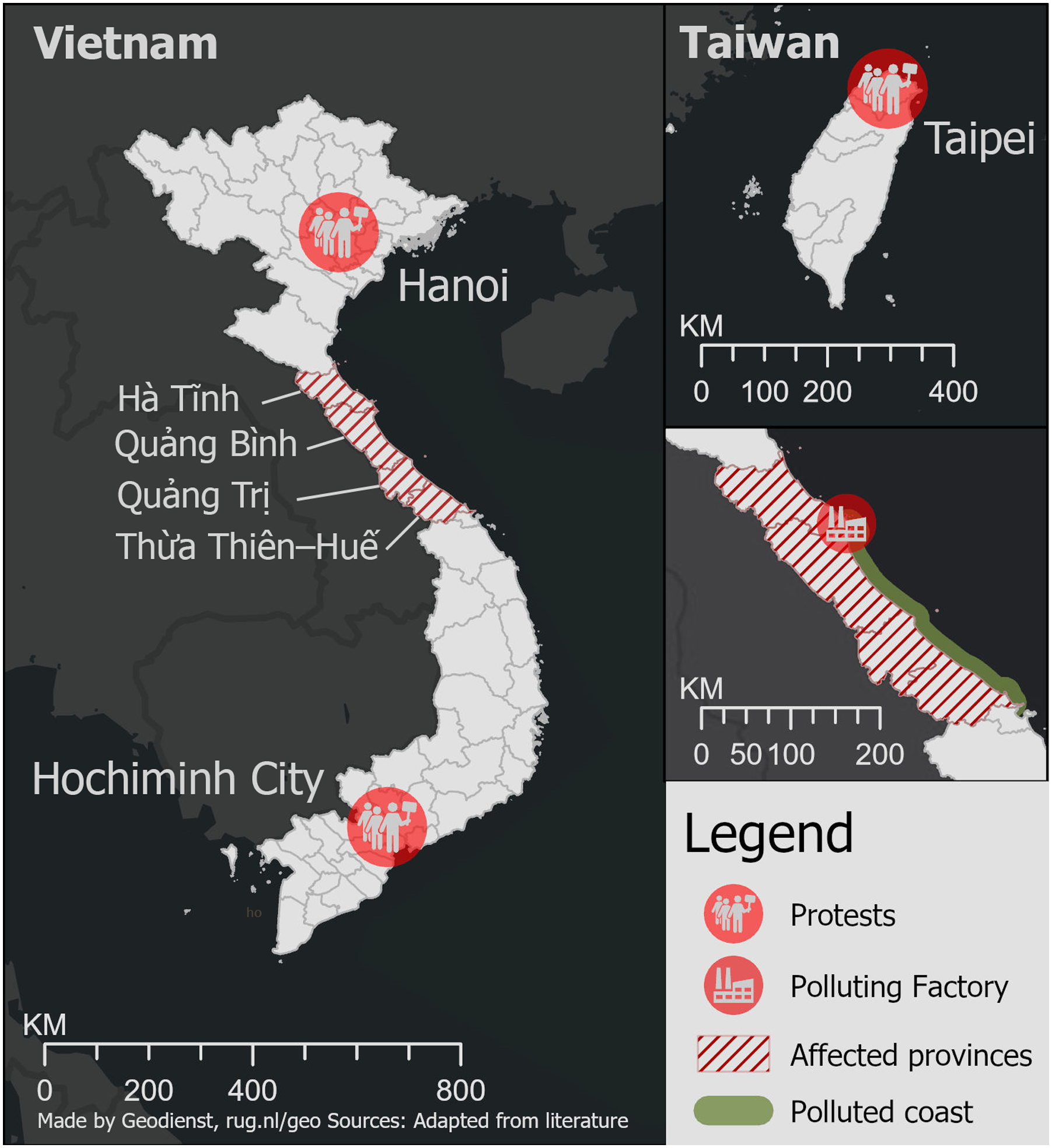
Despite the state’s restriction on political activities in public space (Gillespie and Nguyen, 2019), the coastal pollution triggered ordinary citizens to take to the streets. Such protests, as a form of socio-spatial practices, created ‘cracks’ in the otherwise ‘smooth’ non-confrontational façade of civil society in Vietnam. Wells-Dang regards civil society in Vietnam as “a process of collective action that occurs and develops when organisations and individuals join together to influence power and promote positive, non-violent social change” (2012: 24). In this process, civil society actors overcome government-imposed restrictions and develop interpersonal ties into civil society networks, which in turns facilitate collective action (Wells-Dang, 2012).
Since direct challenges to the single-party system remain taboo (Wells-Dang, 2010), civil society actors attempt to optimise political space to spread and reach their agendas. To do that, how grievances are communicated between civil society actors and beyond needs to be simultaneously political (aiming for collective actions/goals) yet apolitical (to avoid state sanctions), in response to the “stringent state control that deviates from informal practices, which actually allow a fair degree of voluntary civic action” (Ho, 2007: 20). Vietnamese activists have learned to, for example, craft social media content, claiming an explicit non-political stance (Wells-Dang, 2010). Depoliticising helps lower the cost of organising contention and maintain the balance between confronting authorities and organisational survival (Fu, 2017). These findings resonate with the relativity between the ‘invited’ and ‘invented’ spaces within which civil society actors operate (Cornwall, 2004).
Environmental issues, such as the coastal pollution, are apt instances to comprehend how civil society actors in authoritarian contexts take action as well as how political elements are concealed in the vanguard of such activism (Steinhardt and Wu, 2015). This paper seeks to understand how civil society actors, challenged by the political restrictions, persisted in advocating for what they deemed appropriate responses to environmental issues. Such a persistence, particularly the rationalities behind it, helps illuminate the essence and potential impact of civil society in illiberal contexts (Sa’di, 2015).
Theoretical framework
With the rise of market economy and globalisation, critical scholars have advocated for conceptualising civil society as a mediating sphere between state and market (Alagappa, 2004), since socio-political ideals cannot be entrusted to either state-citizens or market-consumption relationships (Jensen, 2006). In Vietnam, characterised by a mix of market economy and the rule of communist State-Party (London, 2014), civil society is constitutionally expected to be uni-dimensional, resulting from the formal structure of a centrally planned economy (Bach, 2013). However, the Party-State’s control over organisations, while imposing certain limitations, has also enabled other activities that might be considered illegal in organisations with less state oversight (Hannah, 2009). Therefore, when exploring civil society in the context of Vietnam, focusing only on formal structures risks overlooking the richness of actually existing civil society and its potential (Hannah, 2009; Wells-Dang, 2012). This paper thus espouses the functional approach proposed by Hannah (2009) and zooms in on actions taken by civil society actors.
In this paper, civil society actors are understood as those partaking in civic actions related to the coastal pollution, including both physical acts (protesting on the streets), and virtual acts (expressing discontent/support via social media). To investigate what motivated civil society actors to take action following the 2016 coastal pollution in Vietnam, we combined three lenses from the civil society literature: ‘classic’ concepts in social movements such as mobilisation, grievances (Klandermans, 2004), and (in)formality (Vu, 2017), civil society and authoritarianism (political neutrality versus sensitivity) (Gleiss, 2014), and spaces of resistance and/or citizenship (invited/invented spaces) (Cornwall, 2004; Miraftab, 2004).
From grievances to actions
Grievances refer to illegitimate inequality, injustice, and general moral indignation about some state of affairs (LeFebvre and Armstrong, 2018). In 2013, Ortiz et al. found that environmental (in)justice was one of the four major grievances driving global protests. Concerns about environmental problems lend themselves to universal rhetorics, enabling the ‘affected community’ to be defined more broadly. In contrast, social sources for discontent tend to pit one group against the other, so that protestors are unlikely to find a general rhetoric (Jasper, 1997: 285). The coastal pollution case, analysed in this paper, was centred around food (fish), which is relevant for health, survival and income, as well as politically entrenched and more “culturally bound yet so dependent upon material realities of the natural environment” than any resources required for human survival (Agyeman and McEntee, 2014: 217). Food can actuate civic actions through its symbolic dimension and political significance, being a major necessity for global population (Glasius and Pleyers, 2013). Food issues are often linked to perceived injustice (Bohstedt, 2010), thus making food a catalyst for raising problems beyond itself (Bush, 2010).
However, such grievances on their own are not enough to propel activists into action. Vu (2017) noted the essential role of local citizens in emphasizing the broader ecological implications of the government’s decision to fell 2700 trees in Hanoi, thereby attracting local NGOs, who previously had been hesitant to join coalition with independent activists. By harmonising local issues with a common root, activists successfully effected transnational mobilisation of Vietnamese and Cambodian organisations into a coalition network against Yali-Falls hydroelectric dam (Thim, 2013). Considering Vietnam’s stringent control on (resistant) collective action, aforementioned studies stressed the importance of political opportunities as perceived by, not granted to, activists (Tarrow, 2011). Then, how do civil society actors perceive political opportunity or carve out political space under authoritarianism?
Civil society actions as boundary-spanning practices
Cornwall (2004: 75) argues that to address issues of power and difference, one needs to distinguish between different ‘spaces of participation’ in what she terms ‘new democratic spaces.’ Invited spaces, affirmed from the top down, are restricted and imply a passive role for citizens (Leitheiser et al., 2021). Invited spaces can be limited to a sphere of compatibility with the vested political aims of the government, while the invented space is achieved through (power) struggle that moves beyond the goals and intentions of the authorities (Cornwall, 2004). These spaces are not mutually exclusive, nor is either necessarily restricted to a particular composition or network of civil society (Cahen et al., 2019).
Miraftab’s (2004, 2009) work helps our analysis, situated at the intersection of spatial planning and social movement studies, refrain from diluting the complex and fluid range of grassroots citizenship practices and acknowledge inclusion and participation beyond any capitalist or tokenistic definition thereof (2009). Compared to anti-neoliberalist conceptualisation, O’Brien’s (2003) work bears certain resemblance in its attempt to respect the blurred lines between many forms of resistance, yet with substantial consideration of the authoritarian contexts. Discussing the grey zones within which rural activists in China furthered their agendas under oppression, O’Brien discusses boundary-spanning contention, referring to “acts located near the boundary between official, prescribed politics and politics by other means” aiming to create “popular pressure that is arguably legal, permissible in some eyes but not in others” (2003: 51). Drawing on the work of the authors discussed above, we zoom in on the boundary-spanning activities by the civil society actors, following O'Brien’s conception, in the coastal pollution case, focusing not only on the different spatial contexts (urban and rural), but also political spaces of participation.
Civil society and political neutrality under authoritarianism
‘Depoliticization’ (which to an extent relates to O’Brien’s (2003) discussion on the perception of legality) is typical used to capture the interaction between civil society and the state in state-controlled contexts where activists are forced to abandon any confrontational mass-mobilization tactics common to democratic activism (Gleiss, 2014; Ho and Edmonds, 2007; Wells-Dang, 2012). The mutual colonisation between formal NGOs and the Vietnamese government (Hannah, 2009) and the similar contingent symbiosis between Chinese grassroots groups and authority (Spires, 2011) theorised a co-dependent civil society-state relationship, wherein the former can perform activism insofar as no direct challenge to the latter is posed, and the latter would turn a blind eye if able to conveniently claim credit for any of the former’s achievements. Civil society actors interact with the state accordingly, adapting to periodically stronger and weaker autonomy (Hannah, 2009). Even a seemingly formal structure, such as a registered NGO, might engage with both formal (i.e. providing policy consultancy to relevant government agencies) and informal (i.e., appropriating available formal channels to engage with local actors in an attempt to help them think differently and take more pro-active actions within political restrictions) activism (Vu, 2019).
The co-dependence between civil society and the state relies on a process of articulating and negotiating what can and cannot be accepted as ‘non-political’. As environmental issues can be framed as either contentious or technocratic (Patsias, 2020), they allow some sensitive elements to be concealed. Bypassing sensitivity leads to neutrality, circumventing the government’s monitoring, and incentivising supporters who would otherwise be discouraged by political risks (Gleiss, 2017). Depoliticization is thus embedded into civil society actions through civil society actors’ different interpretations of (in)formality (Vu, 2019) and neutrality (Gleiss, 2017).
Most of recent protests in Vietnam remained non-violent and rhetorically neutral (Kerkvliet, 2014). Criticism against the government tends to be delivered indirectly through the rhetorical focus on local communities and governments, as opposed to the Party State (ibid.). Anticipating the state-endorsed curb on physical action, civil society actors have utilised online platforms to diversify communication and increase outreach, albeit not without obstacles (Foust and Hoyt, 2018; Freelon et al., 2018). Social media, particularly Facebook, has been increasingly helpful as a political resource and arena for ‘elite’ civil society actors to raise awareness on socio-environmental issues (Bui, 2016).
To this end, this paper builds on the discussed literature to investigate why and how, against all odds, the coastal pollution protests materialised at different spatial scales. The framework, depicted in Figure 2 and operationalised in Appendix Table 2, summarizes the main concepts used in the paper and guides the data analysis and discussion below: the influences of resource availability and political context specific to Vietnam, the spatialised grievances propelled activists into multi-scalar and boundary-spanning action, and the ways in which this process was influenced by the activists’ perception of neutrality and (in)formality to navigate politically. Theoretical framework.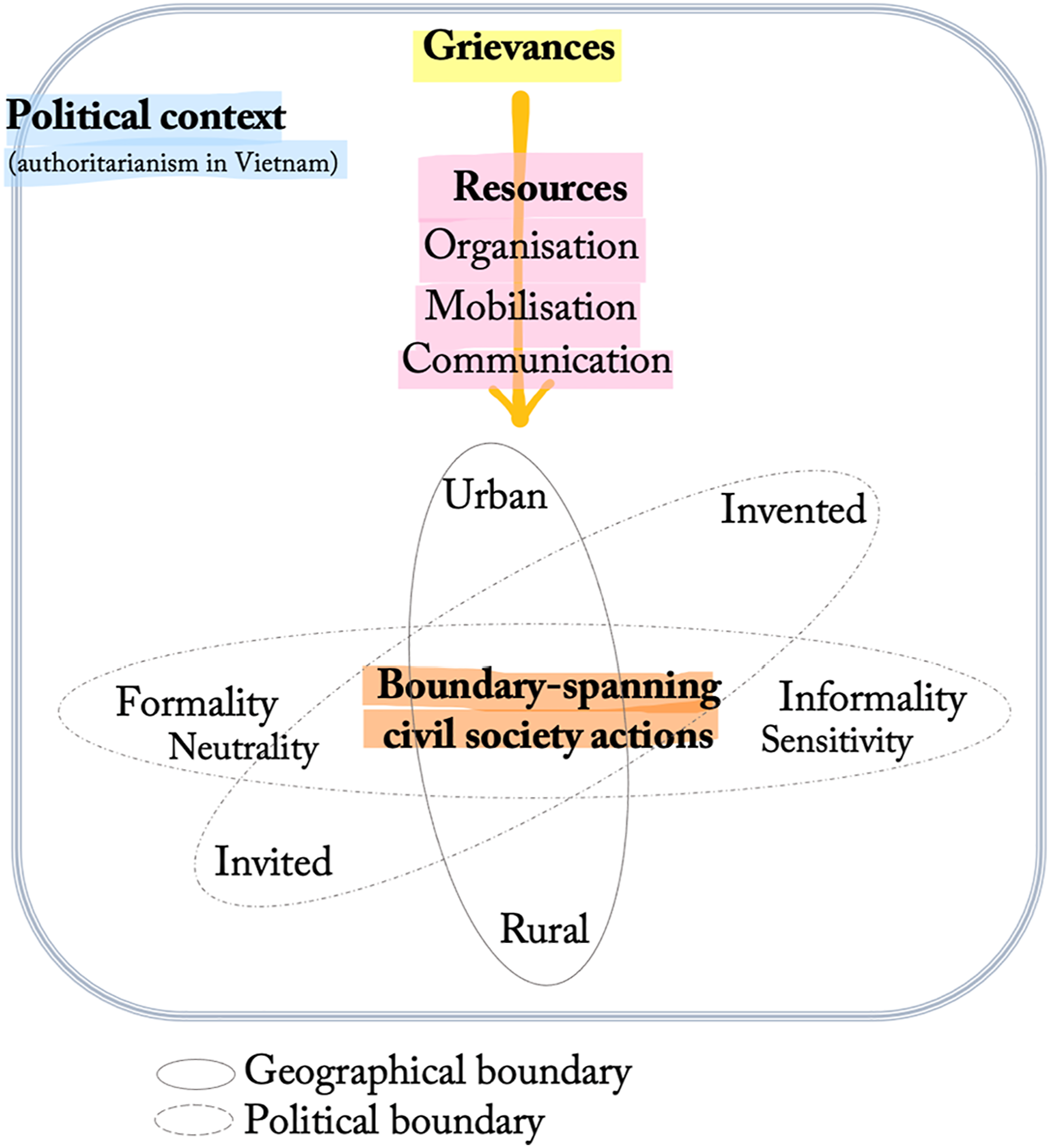
Methodology
Activism in the context of Vietnam and the 2016 coastal pollution case
As activists occupied physical and virtual spaces, they engaged in ‘direct presentation’ in response to the lack of institutional representation (De la Llata, 2020). Furthermore, the protests were mobilised through an invigorating narrative around (dead)fish, prompting the question on food’s role in activating civic actions. The coastal pollution case thus provides a peek into the otherwise 'smooth' surface of civil participation to generate discussion on the mechanism and conditions behind such rare occurrences of scale-shifting activism in Vietnam. The legacy of communist rule and centralized political decision making have a major impact on civic participation in political and economic decisions in Vietnam. Authoritarian governance emphasises hierarchisation of state–society relations and fragmentation of social forces, and environmental action and ethics primarily emanate from the state sphere (Bruun, 2020).
Due to FPG’s use of China imported equipment and Chinese workers, it was labelled and perceived incorrectly by some activists as a ‘Chinese’ company (Tuoi Tre News, 2014). In this sense, the anti-Chinaism in Vietnamese politics is another important contextual element relevant to highlight in relation to the protests, as outstanding cases of political clashes in Vietnam typically featured strong anti-China sentiments (Bland and Hille, 2011; Bui, 2017). Prior to the French colonisation, China had been the biggest threat for Vietnam from the North. Following a stint of ‘communist brotherhood’, Vietnam aligned with the Soviet Union upon the 1960s Sino-Soviet split (Bui, 2017). Anti-China campaigns started resurfacing, rooted in geopolitical conflicts and the need to reunify an internally divided population amidst a debilitating economic crisis (Path, 2011). Since the 1979 China-Vietnam border war, resistance to ‘Chinese invaders’ and anti-foreign heroism have been critical to nationalist politics in Vietnam (Vu, 2007). Nowadays, there is a “growing fear of China’s rising power and influence that can work against Vietnamese interests and sovereignty claims in the South China Sea” (Bui, 2017: 173). When framed by the government, anti-Chinaism is not expressed as direct resentment but rather as a background for the government’s rational thinking and efficient relief efforts as well as “unity building” measures (Bui, 2017: 184). Meanwhile, the use of anti-China sentiments by Vietnamese activists to call for action moves beyond the division between being pro-state or not, aiming to reconcile “Vietnamese who were once ideological enemies but are now uniting in the face of an aggressive China and a Vietnamese government perceived as meek and corrupt” (Vu, 2014: 56).
Data collection and analysis
This paper draws from twenty semi-structured interviews, conducted between April 2018 and July 2019 in Vietnam and Taiwan. Most interviews were conducted in Vietnamese, except one in English. The sampling was predominantly response-driven (Goodman, 2010). Interviewees include independent as well as NGO-affiliated activists in order to explore whether their participation in the protests differs. NGO-workers who did not participate in actual protest activities were also interviewed since they, as suggested by Wells-Dang’s work on civil society network in Vietnam (2012), were still aware of the case and might have been involved in an indirect manner. The key-informants were identified through desk research, e.g. from Green Trees’ report (Green Trees, 2017), and via the network of the first author. The key-informants advised potential interviewees to actively contact the first author or grant the author the right to contact them. The key-informants were activists willing to participate in the research and considered themselves to be fully aware of political risks of being research participant. The key-informants, mainly city-based, offered advice on how research activities might affect the first author and potential interviewees. The interview guides, participant information sheet, and consent form, were semantically devoid of words that are politically sensitive in Vietnam, e.g. protests, democracy, and corruption. Interviewees were asked to choose locations where they felt comfortable enough to converse, as well as how they want their opinions to be interpreted and presented in following publications.
Recruiting interviewees in rural areas was considered by some key-informants as too risky due to the state’s monitoring of the area at the time of fieldwork. Therefore, in addition to the interviews conducted in Vietnam, four interviews were conducted with NGOs workers in Taiwan (snowball sampling) who worked directly with rural activists in Vietnam (in April 2016 when they were still allowed entry into Vietnam) and engaged in legal actions against FPG in Taiwan (Hsiao and Hsu, 202). These interviewees also helped the Vietnamese fishermen who immigrated to Taiwan after being rendered unemployed by the coastal pollution. Taiwanese activists provided more details about the tactics and methods of Vietnam rural activists, whom we couldn’t safely recruit.
Figure 3 and Appendix Table 1 detail the interviewees. All interviewees were mostly active in urban areas, with four out of 16 Vietnamese interviewees involved in protesting activities in both urban and rural areas. From these four interviewees, one stayed in the affected coastal areas for an extended period working with local priests to provide local residents with financial support (see the results section for more details), while the other three commuted between the city of their residence and the affected areas to work with rural activists in a ‘guerrilla’ manner. Overview of the interviewees based on the characteristics of their involvement in the case.
4
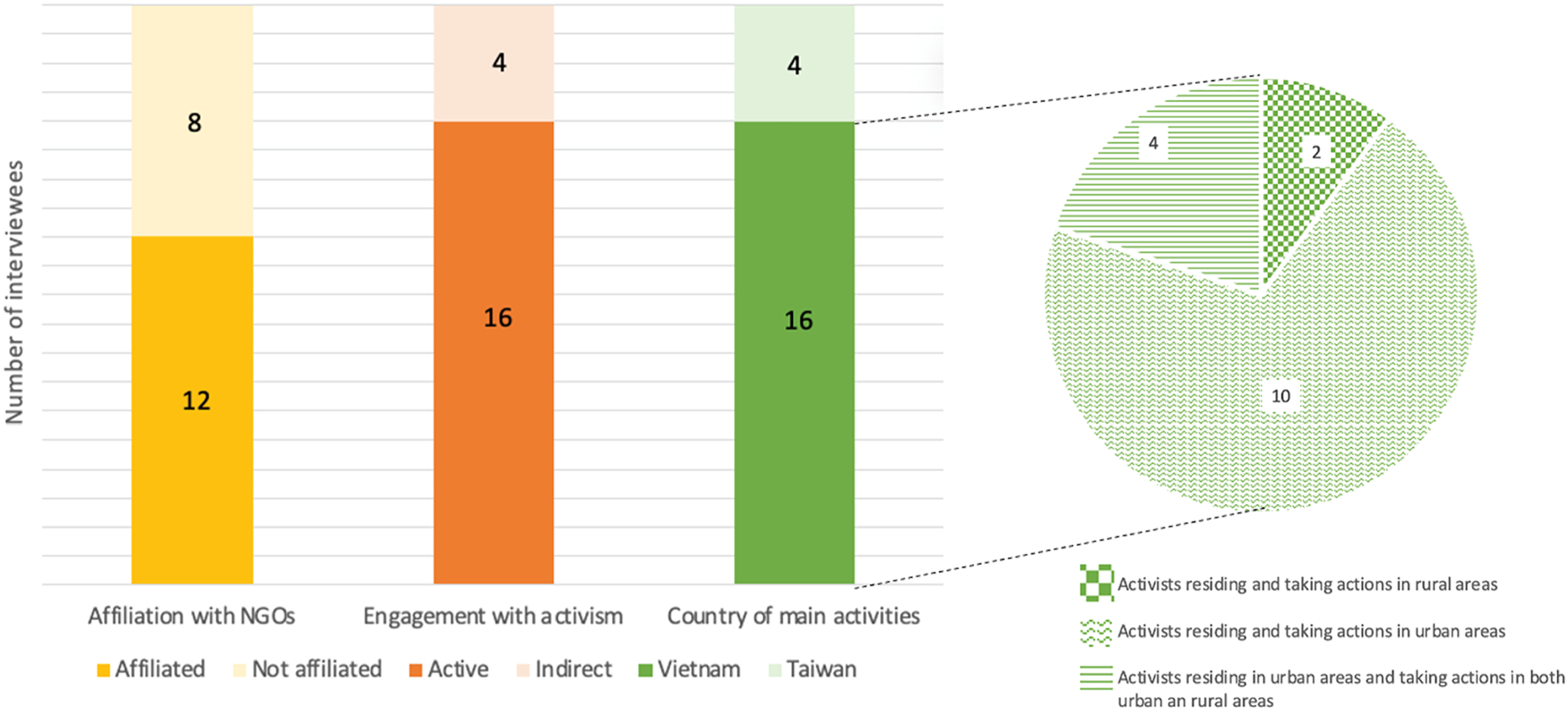
A thematic analysis was conducted using NVivo. The transcripts were translated from Vietnamese to English by the first author, a trained English-Vietnamese translator and interpreter. They were subsequently coded deductively based on the theoretical framework. Through several iterations by grouping codes of higher or lower analytical power, finding complementary or opposing relationship, and integrating “found” codes (into pre-established ones), patterns among coded data were identified as the input for discussion.
Ethical and epistemological considerations
Firstly, relying on key-informants limited the interviews to mostly urban-based activists. As such, the voices of rural protestors are limited in the paper and represented through the insights gained from the urban activists in Vietnam and activists in Taiwan who were in direct contact with rural activists and undertaking activities in the affected rural provinces. Secondly, scholars residing “in democratic states but maintain[ing] citizenship in authoritarian countries-of-origin may be forced to self-censor in order to maintain access to and protect their family members in the home country” (Chen and Moss, 2018: 675). Self-censoring impacted the first author’s data collection and findings discussion. The political sensitivity surrounding the case also made interviewing officials infeasible.
Thirdly, given the possible state harassment against interview participants and the authors, we strictly followed the ethical guidelines of the authors’ institution, which were continuously adjusted based on information from e.g. the key-informants in advance but also during and after the data collection. The data collection plan/approach was also formally approved by the institution’s Research Ethics Committee. During and following data collection, the authors have done their best to ensure the anonymity of participants by, for example, not connecting the age/gender of an interviewee to a specific quote (below) but only displaying the characteristics of the interviewees as a group (Figure 3). This also included following the key-informants' advice against contacting interviewees for follow-ups to avoid communication trails.
Results
Food-based grievances as action-triggers
In Vietnam, a single grievance is unlikely to mobilize civic actions, given the political risks (Thayer, 2014). Indeed, our interviews indicated that actions materialized after the mounting of several perceived grievances related to the fish death. The interviewees argued that the coastal pollution case triggered concerns about (i) food supply, livelihood, and public health at provincial and city levels, (ii) China as a threat to national security, and (iii) the national government’s lack of transparency. First, dead fish were linked to well-being and livelihood and the coastal pollution was seen as an infringement on personal rights, prompting people to stand up for themselves. Respondents opined that the citizens felt a shared sense of vulnerability, due to the personal connection with the food-related grievances. The explicit link between the coastal pollution and damage to the food supply was enhanced by a cultural connotation associated with ‘fish,’ which is particularly pronounced in the context of Vietnam: It [fish death] feels relevant. To everyone. You eat fish sauce, or salt and therefore you feel threatened. […] Climate change or pollution might be hard to perceive, and thus the virality would not be as strong. But dead fish though, that would concern people, for things that are closest to them. (Independent activist)
In comparison, interviewees in Taiwan stressed that the case was a violation of human rights as well as a caution for Taiwanese government about international environmental monitoring. In Taiwan, […] We don’t import [seafood] directly from Vietnam, so […] we are more focused [sic] on the transparency. […] we urge the [Taiwanese] government to play a more important role when it comes to monitoring our Taiwan-based or multinational companies whose mother company is a Taiwanese one. (NGO-worker in Taiwan).
The interviewees emphasised how the coastal pollution, as a threat to food supply and health and disregard for symbolic relevance of fish in Vietnam, triggered citizen actions beyond the largely rural areas at the source of pollution. The rural activists were mainly concerned with financial loss from dead fish or damaged salt fields, while the urban activists were motivated by environmentalism, nationalism, and governmental transparency. This [the accumulation of frustration] doesn’t include the direct victims of Formosa [the fishermen/rural inhabitants], since they obviously protested for their most basic needs. For the more distant people [citizens in larger cities], I feel, their motivation [to protest] originated from the fact of being controlled [by the government when it comes to speaking out against social issues] for so long. And the time had come for them. (NGO-worker).
Second, anti-China sentiments were emphasized by several interviewees as a major mobilising impulse. Due to FPG’s use of China-imported equipment and Chinese workers, it was labelled and perceived as a ‘Chinese’ company (Tuoi Tre News, 2014), and continuously referred to as such by interviewees. The perception of FHSC as Chinese provoked nationalist sentiments similar to those in the 2011 and 2014 protests (Bui, 2017): Formosa, despite being a Taiwanese firm, had capital from Chinese shareholders. When the Formosa project was pending for approval [in 2008
5
], many people had denounced it, due to the intended location being of critical military importance. […] The issue was, “Ah China is polluting this country.” Adding that to the existing anti-China sentiment (Independent activist)
Third, the interviewees had the impression that the local government of the affected provinces strictly followed “orders from above”, did not sympathize with the protesters and maintained a strong grip on local activism. The dead fish was thus considered a manifestation of long-felt frustration about the lack of platforms for citizens to (politically) express themselves in Vietnam, as well as the government’s apparent lacklustre display of willingness to make an example of FHSC, effectively reneging on its pro-people mantra: [T]here was a lot of restrained frustration, like our country has a lot of norms, which make people feel frustrated and oppressed […]. I think the large number of protestors [thought that] “I have had enough [of inadequate responses from the government]; the time has come for me to rise up”. (NGO-worker) […] a lot of people were angry with the government’s reaction [to the coastal pollution]. The government said it [the fish death] was due to natural causes, but people with a bit of knowledge, […], completely saw through that […]. (NGO-worker)
Since the government was deemed incapable of providing reliable information, citizen-activists were compelled to demand information through ‘taking it to the streets': When we [the citizens] took it to the streets, we simply just wanted to hear the responses [to the coastal pollution] from the prime minister and the government. […] The people wanted to know about the amount of the [polluting] waste, how much toxin there was, how environmentally destructive it was. They [the government] said nothing. (Independent activist).
When taken together, the discussed factors were sufficient to ignite citizen activism on a national scale, unlike previous cases’ local scale (Ortmann, 2017). The interviewees who joined the protests referred to their actions as “taking it to the streets” [“xuống đường”], highlighting the intensity with which grievances transformed into physical actions, as opposed to the virtual realm, e.g. posting protest-related content on social media. In Vietnamese, “xuống đường” carries a more casual connotation than the politically charged “protest” [“biểu tình”]. Environmental issues became more easily experienced as uniting and consequently more action-inducing (Jasper, 1997): [The thought of taking it to the streets came to me] super naturally. I didn’t think much. […] Essentially for me, I felt excited when I did it. […] Everybody felt like they had something in common. When we walked in crowds, sharing a common spirit, it felt very exciting. (NGO-worker)
Different tactics to initiate action under political restrictions
Public gatherings in Vietnam need to be approved by local governments, following Decree 28/2005/NĐ-CP. Most interviewees did not attempt to apply for this permit, as they deemed it a legal tool to prevent collective actions. Other interviewees claimed they just followed calls for actions posted on Facebook and considered applying for permit beyond their responsibility. Facebook was the most favoured tool to communicate or learn about grievances and call for actions or support such calls, while simultaneously labelling the activities and grievances ‘environmental’ and thus not anti-government. Such framing was considered by interviewees to have attracted a broad range of supporters, who would otherwise be discouraged by an explicitly ‘political’ tone.
During the urban protests, the interviewees attempted to maintain a low profile and to blend into the crowds to protect them from being singled out by the political police. They also deliberately maintained a sense of ‘disorganisation’ to prevent the government from identifying and sanctioning the organizer(s). Interviewees who claimed to have played organising roles contrasted this with the Hong Kong’s Yellow Umbrella movement, where decision-making proceeded around a centralised coordinator (Ho, 2020): We [protestors] were merely strangers […] [the government] always wants to prove that there must be an organisation behind the protest […] when everyone is a leader, like they lead [sic] each other, and there is no specific leader, yet they have a clear flow [sic], it would be very safe for all participants at the time. (NGO-worker)
In the cities, the protest-organisers were unknown or ‘faceless’', in the coastal provinces, the churches and the priests reportedly formed the backbone to the protests (Cantera, 2017), mobilising both Catholic and non-Catholic locals. Interviewees working with rural activists stressed the role of the priests for mobilizing and concerting actions among the less rural activists who might have less resources, both financially and politically, than urban ones. In addition to assisting some protesters in eluding the police in the affected provinces, priests from Vietnam participated in protests and press conferences in Taipei, to bring the coastal pollution to international attention. One interviews in Taiwan joined a diocese leader from Nghe An in meeting international NGOs seeking assistance.
Similar to the 1989 East German Revolution, the congregations in Vietnam mediated between a disaffected society and an oppressive state (Plaff, 2001). The leadership of the priests in the affected (largely rural) provinces were reported as “extremist” by the military’s news outlet (Trần and Trần, 2017). This might stem from the threat posed by local churches to the state, as a competing organizing force (Spires, 2011), and the bold nature of the actions taken by rural activists, e.g. demonstrating on national high-ways and besieging local government’ offices, as opposed to typically non-contentious resistance of faith-based charities (McCarthy, 2013). The community awareness [in rural provinces] mostly came from […] the Christian communities. The Priests preached to the parish on their environmental rights, as well as their duty to protect the environment. […] thousands of locals […] protesting and besieging Formosa for hours […] right after the morning mass. (Independent activist)
Interviewees stressed the relevance of Facebook, and to a lesser degree Twitter, as a ‘convenient’ tool for interested social media users to (also) virtually engage with the case and express their discontent (Authors, forthcoming). Facebook was the main source of information for protest-participants in Vietnam. For the organisers, the platform helped to coordinate action. Using public Facebook pages
6
, both pre-existent and born out of the coastal pollution related activities, the organisers could inform potential participants about times and locations of the protests without revealing themselves
7
: [Facebook-based mobilisation] was never explicit. There would be an agreement, like, “Hey let’s post [protest schedule] at 8 p.m.,” and everyone would do it simultaneously. Of course, the cybersecurity police could deduce that there was a group behind, but […] people shared things back and forth, which made it harder to track. (Independent activist)
Environmental grievances “typically transcend existing political boundaries and social cleavages,” whereas social threats are often based precisely on these cleavages (Jasper, 1997: 285). Interviewees relied on such transcendence to downplay the ‘political’ in their Facebook content. Most interviewees were sceptical of Facebook’s role in mobilising impacted residents in polluted provinces, citing the lack of accessibility to Internet among these residents, most of whom were fishermen and vendors. However, some explained that, also in rural provinces, social media did play a role in expressing discontent, in particular for the younger population: [older rural residents] might not be familiar with social media, but their children and younger relatives are smartphone users. In the Formosa case, they [the rural youth] did use social media. However, the connection with the cities was not strong, except for some groups who had direct contacts with groups cities. (Independent activist).
Navigating spaces of participation/resistance
The discussion above points to how the boundary-spanning effect of the coastal pollution activism manifested along the line between formality and informality, neutrality and sensitivity, and invited and invented spaces. Regarding (in)formality I had also stepped down at the time, which was why I could take to the streets. If I was still [working at an NGO] I would never dare. They [security forces] would catch me right away. [They might] even shut down the organisation. (NGOs worker)
Operating ‘independently’ and informally also posed risks, as a lack of validation by association with formal NGOs could expose civil society actors to even more oppression (Hannah, 2009), or lead to being framed as ‘traitors’ or ‘foreign agents’. Nevertheless, interviewees considered it crucial to construct/maintain a façade of political neutrality. Navigating the elusive neutrality/sensitivity line was critical to this façade. Interviewees remained vigilant about any ‘breaking’ moments in their interaction with the government, which might defy their ‘neutral’ stance. The government said they had received the compensation money from Formosa, so we had nothing left to do. […] if we persisted, it would appear as anti-government. It would not be anti-Formosa anymore […]. (Independent activist)
Although following the ‘deal’, the activists did question whether the acceptance of Formosa’s compensation tactically de-legitimised any call for civil society action. That said, interviewees also cautioned against impromptu or premature use of neutrality, which needs to be approached strategically, not imprudently. When civil society actors were too eager to claim their apolitical stance to avoid a direct stance against the government, more radical allies who deemed neutrality compromising were disincentivised to support these actors.
Discussion
Different tactics and means to mobilise civil society
The coastal pollution case illustrates the relevance of a ‘tipping point’ to mobilise action for environmental grievances. Results indicated different grievances being dominant in the rural and urban context: while democratic ideals, geopolitics and concern for own health stimulated urban activism, the direct injustice and threat to the livelihood provided substantial incentives to rural resistance. Concerns about food supply, livelihood and government transparency, compounded by preceding environmentalism and anti-China nationalism, yielded an unprecedented momentum for virtual and physical protests in the context of Vietnam. Considering how essential fish and more importantly fish sauce are to not only culinary but also national identity of the Vietnamese (Authors, forthcoming), the investigated activism exemplified how food symbolism could incentivise political activism through ‘not-against-government’ tropes of cultural and national identity. Environmental issues grounded on food symbolism, as such, allowed citizen-activists to exercise contestation advocating their rights and demanding governmental transparency without explicitly confronting the systematic misuse of power preconditioning the very issues at hand (Vu, 2017).
Recognition of intra-movement dynamics is critical to making sense of multi-scalar resistance (Turner and Caouette, 2009). The urban activists knew no specific initiator, while the rural actors rallied behind their spiritual leaders. Compared to protests focusing on urban environment, e.g. Green Trees movement (Vu, 2017), proximity to the root of grievances was less of a conducive factor to taking action. Compared to the rural activists, the mobilisation of (predominantly middle class) urban activists was characterised by the important role of communication technology (Johnson, 2019). Facebook, and to a lesser extent Twitter, played a key role in the transformation of grievances into action, in empowering activists through bolstering their awareness of citizenship rights (Vu, 2017), through which political norms can be challenged in the Internet age (Castells, 2012). Despite the unequal access to social media by rural and urban activists, the online sharing of grievances contributed substantially to their transformation into physical trans-local actions.
The coastal pollution case illustrates the relevance of religion and religious leaders in particular, for rural resistance and action. This suggests a development in rural activism, following peasant discontent in the 1980s, which was expressed more openly, yet protests remained local and rarely targeted the party-state, and rural resistance between 1960s–1980s, mostly articulated through everyday acts due to, paradoxically, extreme repression and peasants’ trust in the state’s benevolent intentions towards rural development (Trần Thị Thu Trang, 2009). Although stemming from concerns about livelihood, the eventual actions in our case relied on local priests’ invocation of moral and congregational commitment. This differs from religious charities’ subtle method of repurposing the state (McCarthy, 2013), suggesting that digital technology or social media are not always the most effective means to mobilize the masses. Rather, ‘preaching’ to a larger group with mutual beliefs can propel ordinary citizens (possibly spilling over non religious citizens) to join forces under political restrictions.
The processes leading to trans-local citizen actions in Vietnam bears resemblance to findings on informal civil society environmentalism in China (Johnson, 2019; Steinhardt and Wu, 2015). Particularly, Vietnamese activists were cautious against association with any formal civil society organisations (NGOs in particular), since it could politicise their individual activism and/or pose legal threats to their respective organisations. Successful trans-local mobilisation relied on the close linkages between the impacted rural communities and the urban environmentalists and concerns that go beyond environmental disputes that are narrow and localised to raise questions about participation transparency (Johnson, 2019) and challenge multiple forms of domination (Johnson et al., 2018).
Expanding the (political) space of participation for civil society in Vietnam
The coastal pollution activism has expanded the boundary within which civil society actors operate in Vietnam along three dimensions: rural-urban, formality-informality (and the closely associated sensitivity-neutrality), and the invented-invited spaces of participation. As protests are influenced by the very socio-spatial context they exist in (Della Porta et al., 2013), the coastal pollution related protests can be considered “dynamic spatial practices” on the local, national, and international scales, within which “resistance, insurgence and cooperation, and ‘legitimate’ and ‘illegitimate’ actions may be performed” simultaneously (Day et al., 2019: 1007). Civil society actors purposely moved across the spectra of formality-informality and sensitivity-neutrality to navigate within the restrictions imposed by authoritarian context. Actors need to constantly balance between appearing politically neutral (towards the state) while also appearing to stand up for the ‘right cause’ (to retain the support from fellow citizens and mobilize the masses). The perceived political risks required them to readjust their organising and mobilising tactics, as well as switching communication channels and contents displayed. The narrow ‘invited space’ of participation (legal action, civic platforms facilitated by the government) required activists to ‘invent’ spaces of collective action (protests and #ichoosefish). More importantly, the dynamics of invention appeared to be the success factor, combining the newly invented spaces of protest and #ichoosefish carved out by independent activists, and the hybrid space between formal and informal spheres utilised by NGO-workers who joined the protests as independent activists while using their institutional familiarity to gather undisclosed information.
Compared to previous environmental protests in Vietnam (Ortmann, 2017), civil society’ political space in our case was expanded by activists through certain techniques of ‘invention’ including performing public roles and engaging in civic actions in both physical and virtual public space (Parkinson, 2013). This case also illustrates the relevance of social media and digital technology in enabling citizens to put (local/national) environmental issues on the international display and discussion (Borton, 2022). Combined with the Green Trees movement of 2015 (Vu, 2017) and the 2018 protests against China’s special economic zones and cybersecurity laws (Reed, 2018), the coastal pollution formed a trifecta where informal civil society succeeded in challenging Vietnamese government’s restrictions and the 'socially accepted' mode of advocacy. While Vietnam has since increased the crackdown on activists (Civicus, 2019), environmental awareness among the Vietnamese (not necessarily associated with environmental politics) is on the rise (Sands, 2019). The replicability of this case’s relative 'success' remains ambiguous, relying on whether grievances can be rhetorically reworked, in the similar vein that #ichoosefish did, to stimulate actions in a politically restrictive climate.
Conclusion
This paper investigated civil society actions in the 2016 coastal pollution in Vietnam, specifically the ways that (environmental) grievances motivated citizen-activists to take actions, how such actions were organised in limited political space, and what the protests mean for the potential of informal civil society in Vietnam. The findings depict a dynamic and fragmented informal civil society, whose otherwise languid development was aggrandised by food symbolism, anti-China-nationalism and demand for governmental transparency. Informal civil society in Vietnam is built on independent or partly NGO-affiliated individuals, working together to promote non-violent change, featuring both anti-oppressive voices and critical anti-neoliberalism. In the urban, this process (of taking action) was significantly supported by the tactical use of social media, while religious leadership played a key role in the rural. The protests related to the coastal pollution case can be considered boundary-spanning events through which Vietnamese civil society actors ‘invented’ spaces and developed different tactics of (political) participation amidst limited ‘invited’ spaces. Acknowledging aforementioned limitations of this paper, further comparative and longitudinal research can examine in more details the role of faith and religion in mobilising rural activism, the conditions under which social media can still influence civil society despite the state’s censoring, the influence of not only international NGOs but also independent activist on civil society in Vietnam, and more importantly, how these factors allow spaces to be invented against all odds.
Footnotes
Acknowledgements
This paper was made possible by the kind activists who were willing to support the fieldwork. The authors also give thanks to the reviewers of this manuscript’s previous version.
Declaration of conflicting interests
The author(s) declared no potential conflicts of interest with respect to the research, authorship, and/or publication of this article.
Funding
The author(s) disclosed receipt of the following financial support for the research, authorship, and/or publication of this article: This work has been supported by the Faculty of Spatial Sciences’ PhD Scholarship Programme.

Notes
Appendix
(17 interviewees agreed to recording, two requested to have notes taken, and one allowed only partial recording).
List of interviewees and their involvement in the case.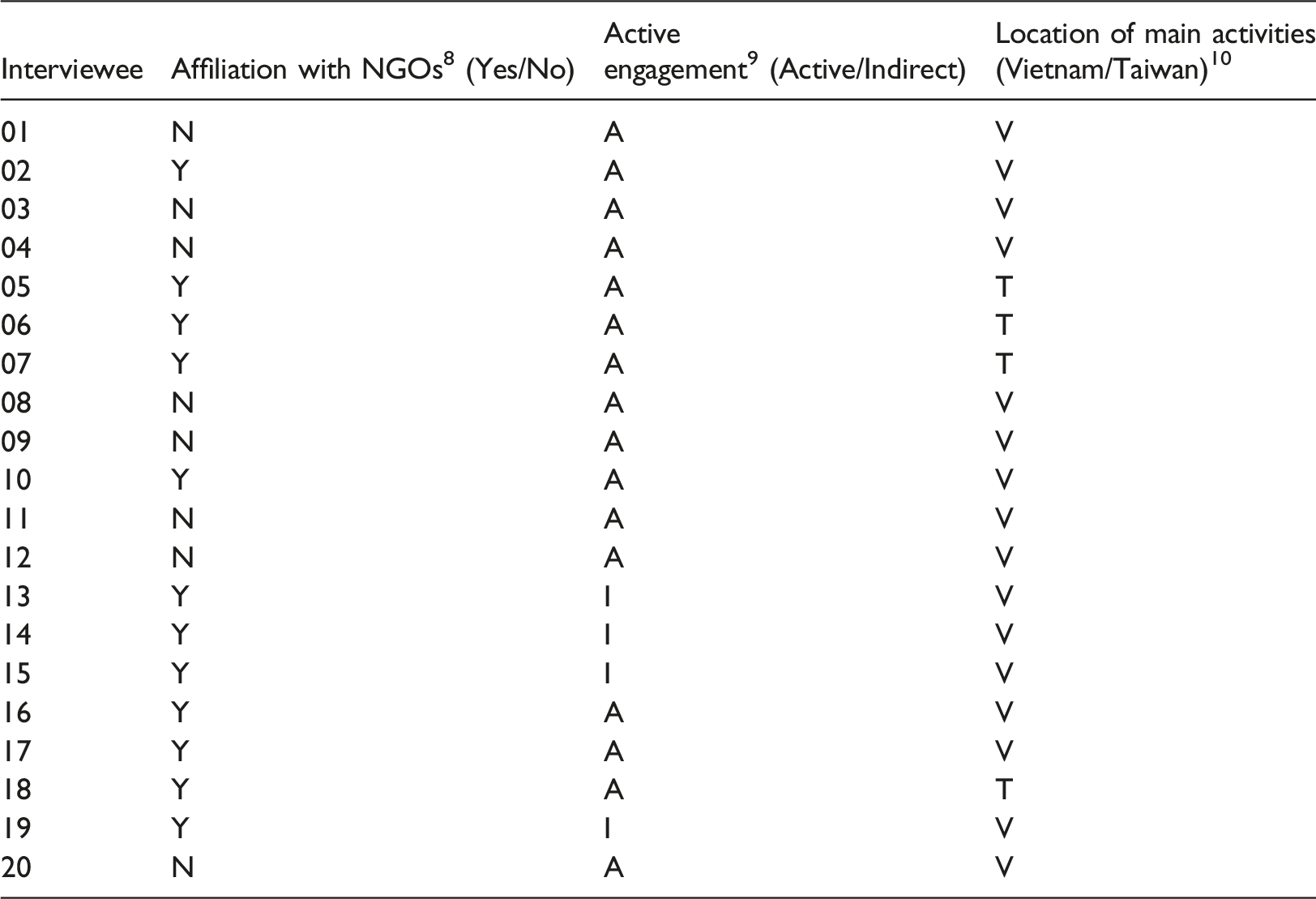
Interviewee
Affiliation with NGOs
8
(Yes/No)
Active engagement
9
(Active/Indirect)
Location of main activities (Vietnam/Taiwan)
10
01
N
A
V
02
Y
A
V
03
N
A
V
04
N
A
V
05
Y
A
T
06
Y
A
T
07
Y
A
T
08
N
A
V
09
N
A
V
10
Y
A
V
11
N
A
V
12
N
A
V
13
Y
I
V
14
Y
I
V
15
Y
I
V
16
Y
A
V
17
Y
A
V
18
Y
A
T
19
Y
I
V
20
N
A
V
Coding guide.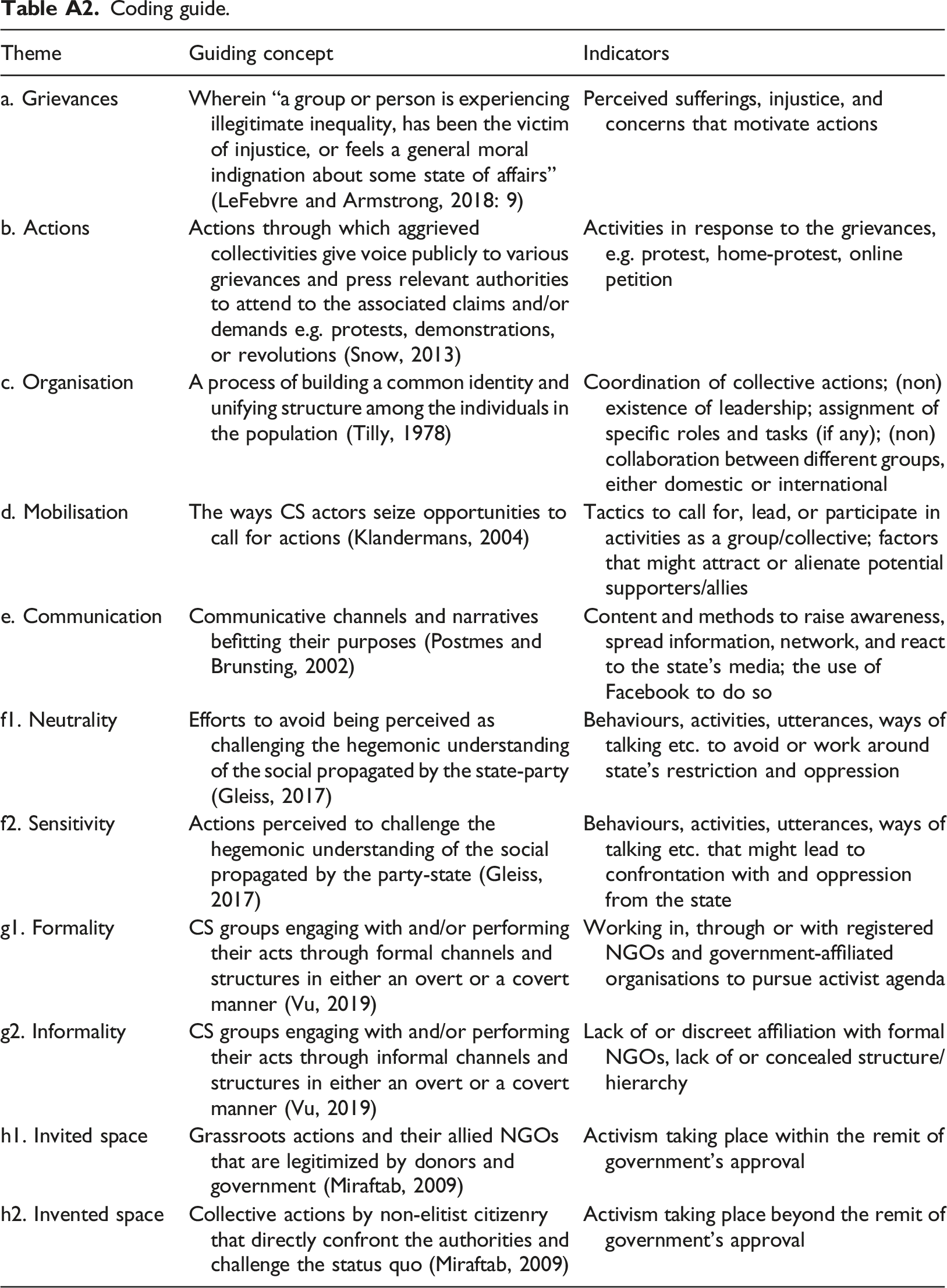
Theme
Guiding concept
Indicators
a. Grievances
Wherein “a group or person is experiencing illegitimate inequality, has been the victim of injustice, or feels a general moral indignation about some state of affairs” (LeFebvre and Armstrong, 2018: 9)
Perceived sufferings, injustice, and concerns that motivate actions
b. Actions
Actions through which aggrieved collectivities give voice publicly to various grievances and press relevant authorities to attend to the associated claims and/or demands e.g. protests, demonstrations, or revolutions (Snow, 2013)
Activities in response to the grievances, e.g. protest, home-protest, online petition
c. Organisation
A process of building a common identity and unifying structure among the individuals in the population (Tilly, 1978)
Coordination of collective actions; (non)existence of leadership; assignment of specific roles and tasks (if any); (non)collaboration between different groups, either domestic or international
d. Mobilisation
The ways CS actors seize opportunities to call for actions (Klandermans, 2004)
Tactics to call for, lead, or participate in activities as a group/collective; factors that might attract or alienate potential supporters/allies
e. Communication
Communicative channels and narratives befitting their purposes (Postmes and Brunsting, 2002)
Content and methods to raise awareness, spread information, network, and react to the state’s media; the use of Facebook to do so
f1. Neutrality
Efforts to avoid being perceived as challenging the hegemonic understanding of the social propagated by the state-party (Gleiss, 2017)
Behaviours, activities, utterances, ways of talking etc. to avoid or work around state’s restriction and oppression
f2. Sensitivity
Actions perceived to challenge the hegemonic understanding of the social propagated by the party-state (Gleiss, 2017)
Behaviours, activities, utterances, ways of talking etc. that might lead to confrontation with and oppression from the state
g1. Formality
CS groups engaging with and/or performing their acts through formal channels and structures in either an overt or a covert manner (Vu, 2019)
Working in, through or with registered NGOs and government-affiliated organisations to pursue activist agenda
g2. Informality
CS groups engaging with and/or performing their acts through informal channels and structures in either an overt or a covert manner (Vu, 2019)
Lack of or discreet affiliation with formal NGOs, lack of or concealed structure/hierarchy
h1. Invited space
Grassroots actions and their allied NGOs that are legitimized by donors and government (Miraftab, 2009)
Activism taking place within the remit of government’s approval
h2. Invented space
Collective actions by non-elitist citizenry that directly confront the authorities and challenge the status quo (Miraftab, 2009)
Activism taking place beyond the remit of government’s approval