




Abstract
This paper addresses the alliance between some urban agriculturalists, developers, and the local state in promoting a certain type of ‘green urbanism’ through what we call ‘impermaculture’. Impermaculture is a model of urban agriculture whereby some urban farmers approach their impermanence – the possibility of their operations being replaced by higher value developments – less as a threat to be avoided, as traditionally understood in the literature, and more as an intended modus operandi to which they are committed. We discuss how they use lightweight and portable growing containers, planter beds, greenhouses, and livestock pens to operate within and enhance contemporary regimes of development in global North cities. We identify a spatio-temporal impermanence that stands in contrast to classic understandings of sustainability fixes as either a form of greenwashing or as spatial fixes involving the sinking of capital into construction of a ‘greener’ built environment. In what follows, we develop a conceptual framework that will facilitate these contributions and provide a language for discussing cases of impermaculture in Portland, Oregon and Vancouver, British Columbia. We discuss how urban agriculture is mobilized as part of the sustainability fix in the two cities. We first demonstrate how impermaculture emerges as a means of stabilizing the fix which is always prone to coming apart, or fracturing. We then draw on two examples – goat husbandry in Portland and temporary gardens in Vancouver – to demonstrate how urban agriculturalists are embracing and leveraging impermanence. This ‘impermaculture by design’ not only marks a new form of urban agriculture in the neoliberal city but shores up and temporally rescales the sustainability fix while providing urban agriculture initiatives stability.
Introduction
There are few practices more commonly associated with fixity in place than agriculture. From its historical role in the development of settlements to its metaphorical prominence in descriptions of stability, attachment, and prosperity (‘putting down roots,’ ‘bearing fruit,’ etc.), agriculture is understood as the epitome of permanence. Yet, crops are parts of wider spatial, social, and biophysical metabolisms through which seeds and nutrients circulate to sustain life. This spatial dialectic of fixity and flow is intertwined with temporalities ranging from generations-long cultivation of fields and raising livestock to relatively short-term cycles of sowing, harvesting, and fallowing. These general conditions have a specific character in urban contexts and, as we will discuss in this paper, specifically in neoliberalized cities of the contemporary ‘global North’. As Demailly and Darly (2017) suggest in their discussion of gardening in Paris, urban farmers, community gardeners, and other agriculturalists requiring a significant amount of space are increasingly only able to access land on temporary leases from developers and other landowners and they are aware that they may be required to move on short notice so the lot they are cultivating can be developed. Certain forms of urban agriculture in global cities are increasingly ‘nomadic’ (Demailly and Darly, 2017: 337) and ‘intermittent’ (Demailly 2018). 1
Indeed, urban agriculture as impermaculture has become normalized in contemporary global North cities to the extent that some urban farmers and community garden organizers have increasingly incorporated impermanence and portability into their plans, technologies, and business models. 2 They use portable containers and planter beds that rely on technologies intended to make them as light and mobile as possible, including some that do not use soil as a growing medium, and easily dismantlable, like mobile livestock pens and quickly-disassembled greenhouses (Samangooei et al., 2016). As Demailly and Darly (2017: 339) argue, these land-tenure conditions and cultivation technologies ‘promote new human and non-human relationship[s] where the “rootedness” of nature becomes less important than its ability to cope with displacement’. The term ‘cope with’ is valuable in their study, which largely focuses on urban gardeners who would rather remain in place, instead of being swept along by development forces, thus paralleling the oft-cited case of urban gardening in New York City (Smith and Kurtz, 2003; Staeheli et al., 2002). The model we discuss as impermaculture contrasts with this traditional understanding in the literature of the ‘incommensurable’ (Schmelzkopf, 2002), often fraught relationship between urban agriculturalists and developers or other landowners. Under impermaculture, urban agriculturalists do not have a primarily contentious relationship with the prevailing development regime. Rather, while they are still displaced from time to time, their displacement is not forced by landowners and resisted by agriculturalists. Rather, impermaculture is a relatively new model in which the agriculturalists are involved from the beginning. They farm, garden or graze certain plots of land, in collaboration with the owners, accepting that at some point they will move on when the land value of a plot rises to the level where it is profitable to develop. In doing so they recognize that their farming of the plot is intended by the landowners to contribute to its development potential. Thus, in this model, urban agriculture is not incommensurable with development, but is baked in from the start.
In this paper, we draw upon and add to the nascent work on nomadic urban agriculture by focusing on practitioners who approach impermanence less as a bug in the system and more as an intended feature (Bach and McClintock, 2021; Demailly and Darly, 2017). Specifically, we are interested in the alliance between some urban agriculturalists, developers, and the local state in promoting a certain type of ‘green urbanism’ by fully investing in impermaculture as a model to enhance land value. In this sense, the impermaculture model is an element of a wider ‘sustainability fix’ through which local development regimes seek to balance growth imperatives with responses to growing public demands for ecological regulation. This fix has been identified as characterizing numerous urban regions worldwide (Temenos and McCann, 2012; While et al., 2004), and has incorporated various forms of urban agriculture (McClintock, 2018; Stanko and Naylor, 2018; Walker, 2016). Green, tactical, and DIY infrastructures, like temporary and ‘pop-up’ urban gardens, farms, and grazing areas, represent a particular enfolding of formerly radical and oppositional ‘takings’ of land into a formalized profit-oriented economic model of land-banking, tax-reduction, and branding that benefits local development elites. Impermaculture thus involves the mobilization of urban agriculture on two levels: gardens and other spaces of food production are materially and discursively integrated into green development projects; and they are increasingly (re)designed for their literal mobility in anticipation of their deracination and/or transport to new sites.
Specifically, we make two related contributions. First, we contrast new green entrepreneurial models, modalities, and mobilizations with the ‘seesawing’ cycle of urban fallow, gardening, bulldozing, and development, widely characteristic of urban agriculture in years past (Drake and Lawson, 2014; McClintock, 2014; Schmelzkopf, 2002). Second, we conceptualize nomadic agricultural practices as part of an emergent model of impermaculture that is becoming a necessary piece of a more generalized sustainability fix. Our study reveals a spatio-temporal impermanence that stands in contrast to classic understandings of sustainability fixes as either a form of greenwashing or as spatial fixes involving the sinking of capital into construction of a ‘greener’ built environment. In what follows, we develop a conceptual framework that will facilitate these contributions and provide a language for discussing cases of impermaculture in Portland, Oregon and Vancouver, British Columbia. We first discuss how urban agriculture is mobilized as part of the sustainability fix in the two cities, before discussing how impermaculture emerges as one method of stabilizing the fix which is always prone to coming apart, or fracturing. We then draw on two examples – goats in Portland and temporary community gardens in Vancouver – to demonstrate how urban agriculturalists seeking stability for their endeavors are embracing and leveraging impermanence. This ‘impermaculture by design’, we argue in the final section, not only marks a new form of urban agriculture in the neoliberal city but contributes to the sustainability fix in new and important ways that are both spatial and temporal.
Dynamic urban landscapes, sustainability fixes, and mobilized greening
A combination of canonical political economy approaches to urban development and ongoing discussions of urban sustainability fixes provides a basis for analyzing contemporary urban agriculture as part of green development and the role of impermaculture in cities like Portland and Vancouver.
Urban agriculture and the land market
Scholarship on urban agriculture to date has drawn a clear picture of its historical role in the urban development process. Home gardens notwithstanding, urban agriculture's physical location has typically been a function of land value, and therefore spatially uneven (Drake and Lawson, 2014; McClintock, 2014). Collective, guerrilla, and community gardeners, non-profit and commercial urban agriculturalists alike opportunistically cultivate the ‘lumpengeography’ (Walker, 1978: 32) or ‘urban fallow’ (Clark, 2001) of cities – devalued, vacant spaces awaiting reinvestment during periods of economic stagnation. As geographers have long explained, these fluctuations of capital result in unevenness. The built environment, explains Harvey (2001, p. 247) ‘is both a crowning glory of past capital development and a prison which inhibits the further progress of accumulation’. In search of a ‘spatial fix’ (Harvey, 2001), capital continually ‘seesaws’ from one space of opportunity to another, its ebbs and flows resulting in uneven patterns of development (Smith, 2008). A variety of mechanisms – housing policies, taxation, zoning, and bond-ratings, among others – mediate this spatial fix, channelling flows of residential and industrial capital in and out of particular parts of a city, influencing what activities are allowed in particular areas (Hackworth, 2007; Smith, 1979; Walker, 1978). Land may remain vacant if held by speculators hoping to sell to developers when the ‘rent gap’ – the difference between a site's actual and potential market value – widens (Smith, 1979). In other cases, it is the developers themselves who hold onto the parcels, awaiting the right moment to build.
Urban agriculture's uneven emergence is therefore both spatial and temporal, with larger gardens and urban farms concentrated in those disinvested parts of the city where vacant land is prevalent. But these same processes of uneven development also create obstacles to urban agriculture's expansion, undermining its long-term stability. When land values increase, a parcel's rising exchange value eventually trumps its various use values as a garden, pasture, dog run, playground, etc. At these moments, gardens and other commons become hindrances to development (Schmelzkopf, 2002; Smith and Kurtz, 2003; Staeheli et al., 2002). Capitalism's cycles of booms and busts therefore both enable and constrain urban agriculture's possibilities.
An ‘unexpected romance’ blooms: urban agriculture and the sustainability fix
With the rise of the sustainability paradigm, urban agriculture has taken on new valence and is imbricated in a different kind of fix. Cities – particularly those with politically liberal or progressive populations – have come to rely on what geographers have dubbed a ‘sustainability fix’, ‘a necessary rather than contingent condition’ of neoliberal urban entrepreneurialism (While, Jonas, and Gibbs, 2004: 554). Through the ‘selective incorporation of environmental goals’ (While et al., 2004: 552), growth coalitions of developers, entrepreneurs, consulting firms, non-profits, planners and policymakers attempt to balance the entrepreneurial imperative of economic growth and public demands for ecological regulation, particularly in politically progressive cities (Goodling, Green, & McClintock, 2015; Macdonald & Keil, 2012; Nciri & Levenda, 2020; Temenos & McCann, 2012). Investment in green infrastructure, manufacturing and services appeals to green consumers and investors alike, assuaging public anxiety about the environment while laying the groundwork for ongoing accumulation of capital. Positive associations with sustainability, in turn, tend to shield green investments from critique. A post-political, ‘empty’ signifier, sustainability thus obfuscates both the political economic processes driving green (re)development and the uneven distribution of benefits that result from it (Davidson, 2010; Goodling et al., 2015; Gunder, 2006; Rosol et al., 2017; Swyngedouw, 2007).
Where gardens and development were once viewed as incommensurable, the two now go hand in hand. Urban agriculture, one journalist opined, has become the fruit of an ‘unexpected romance’ between the ‘newest odd couple’ of urban growers and real estate developers (Holt, 2015). Urban agriculture increasingly serves not only as a transitional land use, but also as one that is folded into new development, real estate marketing and municipal branding. Rooftop gardens crown new condo developments throughout the global North, appealing to the ‘local’ and ‘artisanal’ taste and aesthetic of foodies and to the environmental values undergirding urban sustainability efforts (Carfagna et al., 2014; Johnston and Baumann, 2014). Gardens, fruit trees, and other forms of urban agriculture have become an integral component of post-industrial green design, figuring into redevelopment projects that anchor mixed-use developments by transforming brownfield sites into verdant, ‘livable’ spaces of consumption (Bunce, 2017; Stanko and Naylor, 2018; Walker, 2016). Green growth coalitions mobilize this symbolic ‘sustainability capital’ (McClintock, 2018) to competitively promote a city's reputation as a hotbed of sustainability and livability in hopes of attracting new investment, skilled labor, and green consumers, just as developers use it to enhance the attractiveness and selling price of their developments (Bunce, 2017; Checker, 2011; Dilworth and Stokes, 2013; Gould and Lewis, 2016; Lang and Rothenberg, 2017; Montgomery, 2020; Quastel, 2009).
As Ekers and Prudham (2015, 2018) indicate, work is needed on conceptualizing the salience of the sustainability fix concept in analyzing contemporary (urban) development. For them, some uses of ‘fix’ – including ‘sustainability fix’ – are much less conceptually specific than the usage developed by Harvey in his discussion of capital's search for a spatial fix to avert a crisis of accumulation. Yet, they see potential in thinking through how ‘neoliberal environmental fixes involve the intensified marketization, commodification, and financialization of “nature” along with attendant forms of rescaling environmental governance in ways that facilitate expansion in the scale and scope of capital accumulation’ (Ekers and Prudham, 2015: 2441). Thus, detailed cases studies, such as the ones we provide below, can shed critical light on ‘how the reproduction of capitalism is increasingly taking place through reconfigurations of socio-natural relationships and, more specifically, through the production of nature’ (ibid.).
The majority of extant and burgeoning efforts aimed at ‘greening the city’ rely on market mechanisms like tax incentives (Ekers and Prudham, 2015, 2018). In this context, then, investment in green infrastructure and design, and the leveraging of sustainability capital – whether to increase market values within particular neighbourhoods or to make a city more competitive – blurs the line between environmental stewardship and economic growth in ways that largely benefit elites. But such a sustainability fix is just that: a fix, inherently temporary and always prone to fracturing. At the same time as cities enroll urban agriculture in their efforts to meet their sustainability goals and brand themselves as green, related land speculation and development pressures constrain the production of urban agricultural space. In cities where land is expensive and desirable, increasing densification (through infill and growth management, for example) aligns with green planning goals, but threatens the availability of vacant land and backyard space that might have been used for food production. Such ‘contradictions between the twin goals of economic development (in a consumption and housing-driven economy) and environmental sustainability (through local food production)’ (Walker, 2016: 171) become starkly apparent when a growing rent gap triggers investment in devalued neighbourhoods where gardens abound, as evidenced by a rapidly growing body of literature placing urban agriculture squarely within wider processes of green gentrification (Alkon et al., 2020; Anguelovski et al., 2019; Joassart-Marcelli and Bosco, 2018; McClintock, 2018; Quastel, 2009; Safransky, 2014; Sbicca, 2019; Stanko and Naylor, 2018). In more abstract terms, the sustainability fix begins to fracture as capital flows back in in search of a spatial fix. Such contradictions, we argue, are a defining feature of the sustainability fix and its valorization of urban agriculture as sustainability capital.
Green growth machines: New impermaculture arrangements
As we have suggested, urban agriculture in contemporary global North cities is marked by an increasing impermanence that is characteristic of and wrapped up in an emerging market-oriented ‘green urbanism’. Yet, it is important to emphasize that numerous types of agricultural activities in cities – from growing vegetables in officially designated community gardens, to guerrilla gardening in vacant lots, to fruit tree cultivation and harvesting, small-scale animal husbandry, and permaculture – have always experienced pressures to uproot themselves when ‘higher and better’ uses are proposed. 3 This longstanding ‘tenuous relationship between community gardens and urban space' (Drake and Lawson, 2014, 135) has been a repeated object of struggle. Drake and Lawson note that some urban agriculturalists accept that they may eventually be forced to vacate their plots, but others resist displacement and fight for more stable tenure, in part by arguing that permanent urban agriculture is a valuable part of urban space and not a land use that is out of place.
Contemporary impermaculture, as we conceptualize it, differs from the traditional tension-filled relationship between development and farming. It involves urban gardens and farms being willingly enrolled into development agendas by practitioners, in partnership (or cliental relationships) with the local growth machine. In this model, urban agriculture is no longer merely a stopgap, remediator, or in-filler of vacant urban spaces. Rather, it is actively and systematically deployed as the first step in new development projects, often for symbolic, aesthetic, and legitimising purposes – part of what Summers (2019: 3) calls an ‘economy of symbols’ in the aesthetics of urban development, ‘used … to attract commerce, customers, and residents' (Ibid., 20–21). Take, for example, London's Nomadic Community Gardens, a non-profit that creates community gardens in mobile planters, which they ‘construct … on site or move them into place from another site’.
4
In a section of their website entitled ‘For the Developers’, they note that, Our gardens offer core partnership benefits to developer and community. For landowners we: Save money on costly land sheriffs; Help demonstrate to local councillors on planning forums a legitimate way of offsetting the potential impact the development might have on the area; Create a substantial and sustainable ‘conduit’ between developers and residents; Provide great opportunity for publicity, P.R and exercising corporate responsibility; Offer the potential to inspire staff participation in the project.
5
Nomadic Community Gardens operates in Shoreditch, an area of East London that has become (in)famous for its ‘creative industries’-inspired gentrification in recent years (Harris, 2012; Pratt, 2009). The role of urban agriculturalists in development-friendly impermaculture parallels the role that some artists have played in gentrification in London and other cities. While many artists understand but resist or subvert their role as harbingers of gentrification, others (from those working in creating seductive advertising for developers and the local state, to those who create, curate and participate in arts festivals in gentrifying neighbourhoods) are fully embroiled in producing the attention and attraction that legitimates redevelopment and entices prospective investors. Artists are structurally positioned within the gentrification process, a particular aspect of the wider ebb-and-flow dynamic of the capitalist urban land market. Some see partnering or working with developers as one of a limited number of opportunities to continuing engaging in art-making, which they argue has a positive social value. Thus, many accept funding, supplies, space or political support to install public art to engage in their practice even as they acknowledge that their practice may create the conditions for their own eventual displacement and that of communities with whose interests they may well identify (Mathews, 2010). It is clearly difficult, then, to fully distinguish the radical, reformist and neoliberal connotations of art in development, just as it is to distinguish them in the context of urban agriculture and development (Barron, 2017; McClintock, 2014; Walker, 2016).
Nonetheless, by focusing on the case of urban agriculturalists who have fully committed to impermaculture partnerships with the growth machine, we can contribute to literatures on urban agriculture and urban development by unpacking this new mobile form of ‘pump-priming’ in which the sustainability fix travels the routes of new development, arriving in advance to start the process of aestheticization, branding, and legitimating. As Ekers and Prudham (2015) suggest, neoliberal sustainability fixes not only involve continual searches for new forms of commodification of nature, but they achieve their goals through processes of rescaling. In the urban context, this rescaling entails the extension of promising models of commodification over wider territories. We argue below that such rescaling is temporal as well as spatial.
In what follows, we draw on data collected as part of a relational comparison (Ward, 2010) of urban agriculture and its role in sustainable development in Portland and Vancouver (McClintock et al., 2018, 2021). Both cities offer important empirical insights into how urban agriculture is leveraged as sustainability capital, as well as how impermaculture relations emerge from – and respond to – the contradictions of the sustainability fix. Our study included: a review of online media and government documents; mapping and spatial analysis of ∼4300 gardens; mail and Internet surveys of ∼1400 home gardeners in the two cities; semi-directed interviews with 63 policymakers, organization staff, and practitioners; and four focus groups with a total of seven urban farmers and 17 community gardeners. 6 Interviewees and focus group participants were selected based on a purposive sample of stakeholders who have been active in shaping and implementing urban agriculture projects and policies in our study cities. In this paper, we draw primarily on our interview and focus groups, as well as on media reports related to urban agriculture projects we have deemed exemplary of impermaculture. Interviews were recorded and transcribed, and transcripts and documentary materials coded for a priori and emergent themes.
Impermaculture in Portland and Vancouver
Since the early years of the new millennium, Portland and Vancouver have vied for the titles of ‘greenest’ and ‘most sustainable’ city, winning accolades for their innovative planning and firmly establishing themselves in the global ‘referencescape' (McCann, 2017) of neoliberal green sustainable development. These efforts have been led by local growth machines comprised of municipal agencies, developers, universities, property owners, businesses, and non-profits (Goodling et al., 2015; Huber and Currie, 2007; Temenos and McCann, 2013). Relatedly, the cities have become renowned for their pioneering work in municipal food policy and planning (Coplen and Cuneo, 2015; Mansfield and Mendes, 2013; Mendes, 2008). Both centre food systems within their sustainable development plans (McClintock et al., 2018, 2021; McClintock and Simpson, 2016). The Multnomah Food Action Plan, for example, touted the ‘the economic development potential of the local food system including food production, food distribution, and local food as tourism’ in metro Portland, via urban farms, farmer incubator programs, farmers markets, and ‘the development of a “local food” brand’ (Multnomah County, 2010). With its Greenest City Action Plan, Vancouver proclaimed its goal of becoming the world's ‘greenest city’ by 2020 and pledged that the city would be a ‘global leader in urban food systems’ (City of Vancouver, 2012).
Within this context, policymakers, planners and marketers have codified and instrumentalized urban agriculture, leveraging it as a symbol of municipal commitment to a broader sustainable development agenda. As a former member of the Portland/Multnomah Food Policy Council describes it, urban agriculture is ‘a quality-of-life feature’ that the city capitalizes on: ‘It's an image thing, a brand, to be embracing chickens and urban agriculture’. 7 Urban boosters have long tapped into agrarian and pastoral imaginaries to attract homebuyers to new suburban developments often named for the very farms destroyed for their construction (Bell, 2006; McClung, 2000; Norris, 1999). The sustainable development paradigm and New Urbanist design strategies incorporated increasingly widespread public concern for the environment into this longstanding association between agrarian pastoralism and quality of life (Trudeau, 2013; Zimmerman, 2001). Urban agriculture thus transposes a rural idyll to the urban landscape, a symbol of both the ‘livability’ and ‘sustainability’. It differs, however, in that that actual agricultural production – rather than solely its memorialization – is leveraged as symbolic capital.
Furthermore, urban gardens and farms also serve as a benchmark metric to demonstrate progress in attaining these same goals (McClintock et al., 2018, 2021). As one urban agriculture program manager remembers it, Vancouver city officials ‘were just practically giving plots away to meet their target’ of 2010 gardens constructed in time for the 2010 Olympic games.
8
A pithy headline in a Portland news weekly summed up the role of the local government in promoting urban agriculture: ‘How does your (urban) garden grow? Answer: with the city's help’ (Chen, 2005). This observation could just as easily have been made of Vancouver. To meet sustainability targets, both cities have updated zoning regulations and adapted ordinances to facilitate the expansion of urban food production in community gardens and on urban farms alike
All municipal investments in sustainability infrastructure may result from ‘a reinforcing cycle’ between residents’ demands and policymaking (Jeffries, 2008), but urban agriculture offers political gains at a low cost As one Vancouver municipal staffer explains, ‘Basically, you had a number of community actors that were kind of whispering in the ears of different influential figures in the City to … get things moving’ on community gardening and urban farming policies. These commitments produced ‘a feel-good story’ representing the ‘type of greening that commissioners and political figures can step up in front of and say, “Look, this is what we’re doing, we have support”’. 10 As one Vancouver community activist observes, ‘people talk about community gardens so much in Vancouver, you know. It's on brochures constantly’. But as he sees it, urban agriculture not only functions as sustainability capital to be leveraged for political gains and urban branding, it also serves as a smokescreen to obscure the underlying entrepreneurial logics underpinning the sustainability fix: ‘A community garden suggests some kind of community engagement, some kind of authentic connection to neighborhood without ever having to compromise any of the kind of capital-inducing flows that [a] neoliberal urbanist approach is predicated on. I think they play a vital role, actually’. 11 As we describe below, such fixes are frequently unstable – unable to bear the weight of their internal contradictions.
The sustainability fix fractures
Land in Portland and Vancouver is in high demand and thus commands a high premium. Urban agriculture advocates generally agree that densification and skyrocketing land prices are primary obstacles to their practice. Commenting that vacant land is quickly sold off for development, an urban farmer in Portland noted that although that city's urban growth boundary protects ex-urban farmland, ‘it's just making the construction in the city really dense’ and thus limiting spaces for growing. 12 In Portland's inner neighbourhoods, ‘Stop Demolishing Portland!’ yard signs have appeared in response to the construction of newbuild ‘skinny homes’ on freshly subdivided lots. A former chair of the Portland/Multnomah Food Policy Council warns, ‘Urban agriculture is going to get pushed out, there’ll be less space for growing things closer into the core. You’ve seen it all around Portland, even little homes with big yards getting torn down and a four-plex going up’. 13 Vulnerable to the interrelated pressures of limited space, rising land values, and insecure tenure, urban agriculture's place in the landscape is indeed precarious.
Portland's Cully neighbourhood is illustrative. Straddling the boundary between inner and outer Northeast Portland, Cully is suburban in form and feel. The lots are spacious, many as large as a quarter-, half-, and one-acre. With the Urban Food Zoning Update opening residential lots for commercial food production and sales, Cully – which comprises Oregon's most ethnically diverse census tract – has become a top destination for young, mostly white urban farmers and other ‘urban homesteaders’. Given both the size of lots and the agglomeration of market gardens in the neighborhood, most Portland real estate listings that include mention of ‘urban farm’ are for properties in Cully. However, prices are rapidly increasing and the large lots that attracted the farmers in the first place are ripe for subdividing. One urban farmer we spoke with, a relatively early gentrifier, has been in Cully long enough to see the impact of the name that she and others have made for the neighborhood: ‘We get a lot of new people coming in with big money that are now buying these small houses for like 400 thousand [dollars], when like two, three years ago they were maybe like 190 [thousand]. So, that's starting to change’. 14 Indeed, median home value increased more than 203 percent since 2000, compared to 90 percent citywide, and demographic change is well underway (City of Portland, 2018; Cultrera et al., 2020).
Vacant land in Vancouver is also in short supply. Urban agriculturists may envision a weedy, empty lot tucked between dilapidated apartment blocks downtown as an ideal site for a garden, but, in the words of a former Vancouver Food Policy Council chair, ‘it's actually not vacant … It's not this “marginal land”. A developer already owns it and they’re waiting’.
15
Tenure is therefore as precarious for urban agriculturalists as in Portland. A headline in 2017 proclaimed: ‘Pace of Vancouver development killing Downtown Eastside urban agriculture’ (Britten, 2017). Plans to remove the Georgia and Dunsmuir viaducts, as well as the development of the False Creek Flats, forced Sole Food Street Farms, a social enterprise focused on providing opportunities for Downtown Eastside residents with barriers to employment, to shut down several of its sites, including a sprawling farm in the parking lot of BC Place stadium. The organization's founder and executive director Michael Ableman described the situation in dire terms: ‘Our operation is, physically, as homeless as the people we employ’ (quoted in Britten, 2017). Nonetheless, Sole Food is perhaps Vancouver's most well-known urban farm, since images of their iconic site – 3 ha of greens in the shadow of the futuristic stadium and a gleaming skyline of new-build condo towers – have featured prominently in media and in the city's Greenest City publications. The inflow of capital, and the gentrification that follows, not only threatens the availability of land for cultivation, but also risks displacing urban farmers who, while generally highly educated, barely make ends meet. As the former head of the Vancouver Urban Farming Society observes, Urban farmers themselves are super poor and house insecure and living—I know lots of folks that are farming that are well below the poverty line. So they’re experiencing it themselves and trying to get by. So to think about how they can turn their business into something … is incredibly challenging.
16
Given the capitalist logics of urban land markets that keep vacant tracts out of reach, many urban agriculturalists have hung their hopes on the public sector to provide free or subsidized access to land. Just as with private land, however, the New Urbanist push for density and astronomical land values curtail ready access to public land. Many, if not most vacant, publicly owned parcels are already slated for development, tied to existing zoning or land banked for future sale or transfer. A planner with the City of Vancouver who was involved in developing the city's Food Strategy explains that it is vital to recognize that ‘cities are really competitive terrain’ despite the desire and intent to support urban agriculture on the part of policymakers, ‘so that means we do need to make different decisions about what we can support and where and how long is reasonable to enter into a lease agreement on a community garden on a piece of land that we know is probably going to be turned over’. 17 In the end, the high demand for land and its associated value as real estate constrains the capacity of green municipalities to dedicate space to urban agriculture.
Nonetheless, many urban agriculture organizations and businesses have adapted to these development cycle pressures by incorporating short-term and temporary forms of urban agriculture into their programmatic plans and business models. Both anticipating an inevitable move and recognizing that urban agriculture can prime the pump of development, urban agriculturalists, in collaboration with green growth machine actors, have re-imagined and re-designed their production practices for their literal mobility, that is, in anticipation of their deracination and/or transport to new sites. Sole Food's speedy departure from BC Place and reestablishment at a nearby site was made possible, in part, by the organization's use of mobile planting boxes (Figure 1), designed to be quickly moved with a forklift. Such ‘impermaculture by design’ has paradoxically emerged as a quest for stability and permanence for their initiatives, an adaptation to the contradictions of the sustainability fix in which it played a part. We turn now to two examples where urban agriculturalists have entered what they see as temporary ‘win-win’ arrangements with growth machine actors.
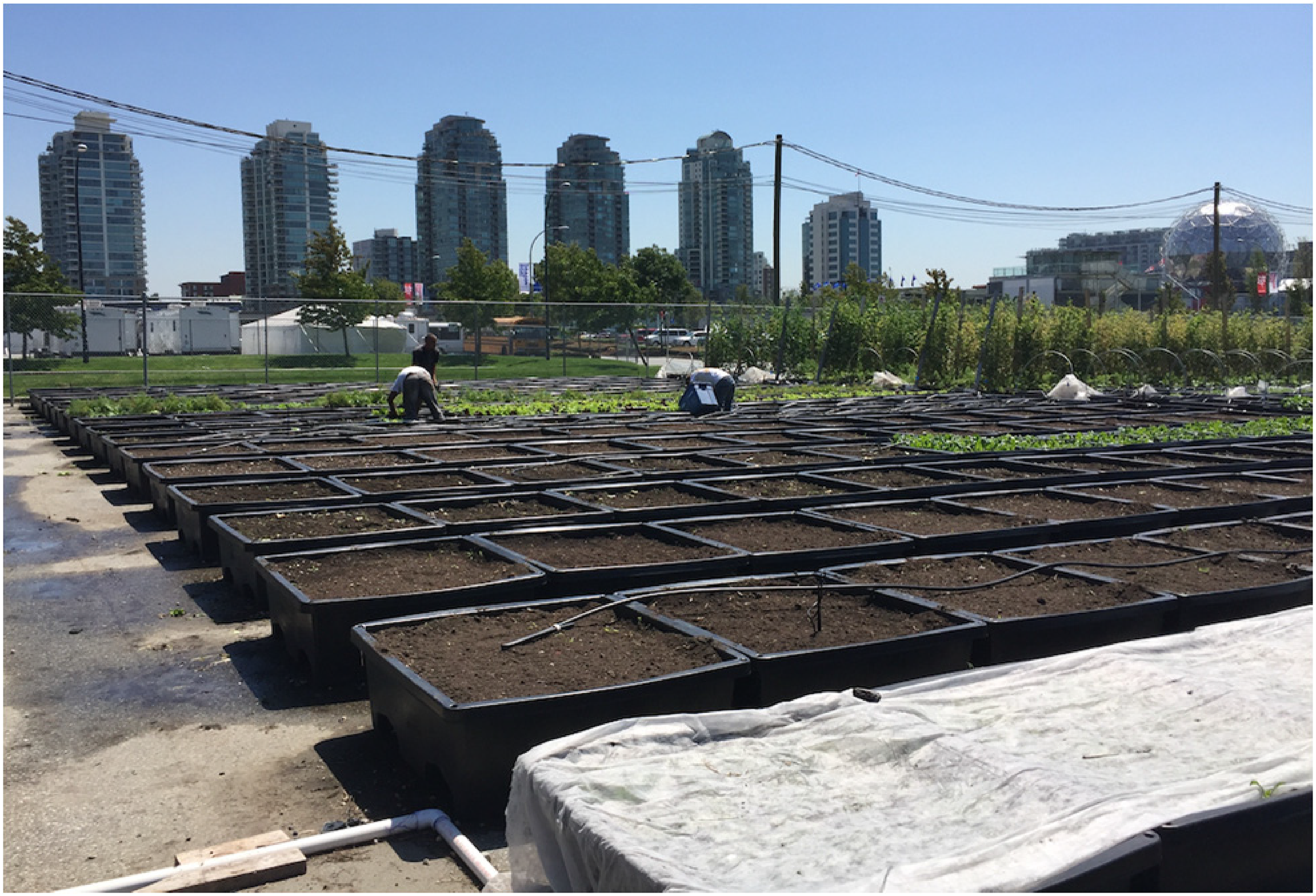
Mobile planter boxes used by Sole Food Street Farms in Vancouver, July 2016. Photo by Nathan McClintock.
Caprine capital in Portland
The case of urban livestock in Portland's gentrifying Central Eastside Industrial District is an illustrative example how urban agriculturalists have adapted to their eventual displacement while benefiting developers. In 2010, on the recommendation of a local landscape architect, commercial real estate developer Killian Pacific contracted a herd of goats to clear brush on one of their properties, a vacant city-block straddling the Central Eastside and the Buckman neighborhood. Eventually, a local business owner purchased his own herd and came to an arrangement with Killian Pacific to graze them on the vacant block, saving the developer money on the annual goat rental while making the goats a year-round addition to the neighborhood. A year later, he sold the herd to a group of three neighbors who formed a non-profit to collectively manage them with the help of more than a dozen volunteers. With development immanent, the group also began actively searching for a new home for the goats.
The fourteen caprines – by now named the Belmont Goats after one of the streets bordering the site – had become local celebrities, with people of all ages coming to pet them and watch them frolic on their playground of wooden pallets, planks, and old office furniture (see Figure 2). Signs hanging from the chain link fence listed visiting hours and warned visitors not to feed the goats, but also identified each one by name, with a photo and extensive description of its personality traits. Part of the goats’ appeal, explains one of the herd's co-owners, was how they transgress normative understandings of what to expect in the city, providing passers-by with ‘that juxtaposition, of “Why is there this field of goats in the middle of the city?”’ Playing the role of ‘a rural oasis herd’, the goats appealed to visitors on aesthetic and emotional levels: for many, they served as an agrarian counterpoint to the urban landscape, and for some, tapped into nostalgia for a rural upbringing. Visitors described the experience as ‘their goat therapy. They would come by once a day or once a week and leave all their outside crap outside the fence, and just come in and sit for an hour. So people really did use it as this weird rural pause in their urban day’. 18
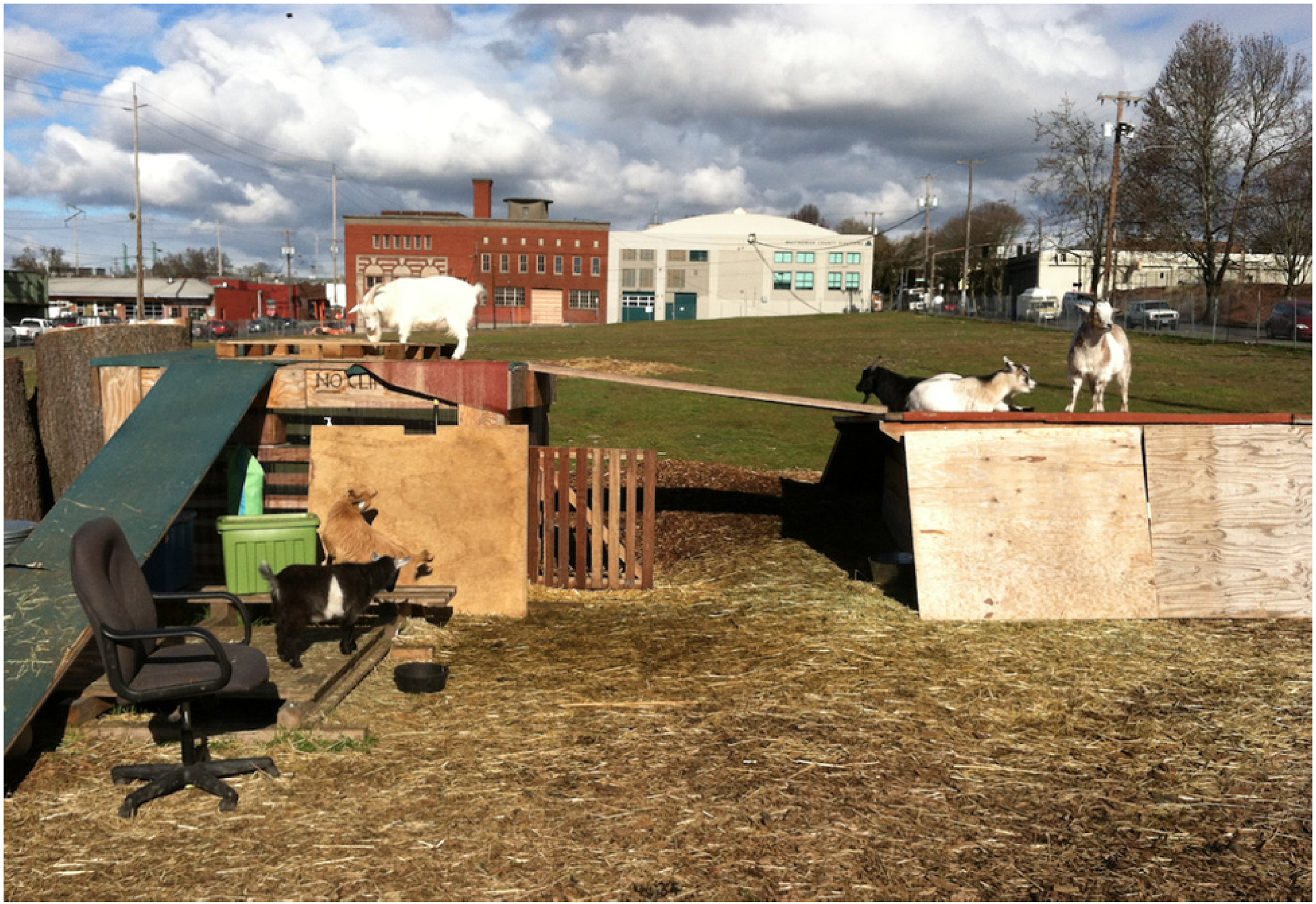
The Belmont goats at their original home in Portland's Central Eastside Industrial District, February 2014. Photo by Nathan McClintock.
When Killian Pacific announced that they would begin moving forward with their planned development, an article in a local news weekly wryly described their displacement – and urban agriculture's role in the seesawing of vacancy and development – in terms that resonated with many readers: ‘You know the story: Rents are rising, condos and apartments are reshaping the landscape, there's that one vegan grocery store. Next year, the vacant lot Bambi and other goats call home will be developed. The herd will have to move on’ (VanderHart 2013). In October 2014, after two years at the site, the herd's owners packed up the goats and moved them to a vacant parcel owned by the Portland Development Commission in Lents, a diverse neighborhood in East Portland that was ripe for gentrification. When that site was developed two years later, the herd moved to a second city-owned site in Lents. With development of that site looming, they moved yet again in 2018, this time to a ¾-acre public right-of-way in North Portland.
The goats thus met the same fate as other urban agricultural initiatives, their impermanence and mobility inevitable, given ongoing development. But more than simply a story of serial displacement, the Belmont Goats played an important role in the redevelopment of the Central Eastside site, as well as in the redevelopment of Lents where they later moved. Unlike ‘classic’ cases where sites of food production are ultimately bulldozed, paved over and erased from the urban landscape, the goats were symbolically mobilized as sustainability capital. They were folded into the $60 M high-end, mixed-use development throughout the duration of project and remain so today. Images of the goats adorned marketing materials and signage during the project's planning and construction. A large neon goat, visible at night from several blocks away, was even affixed to the construction crane in the photograph. The architect and developer christened the 97,000 sq ft, 247-unit development ‘LOCA @ The Goat Blocks’, a term that combined ‘a multiple pun on location, locavore, and crazy’ (Gallivan 2014) and that paid homage to the site's previous tenants. While the animals departed more than eight years ago, the name ‘Goat Blocks’ remains peppered throughout the development's signage, as are stylized images of the goats (see Figure 3).
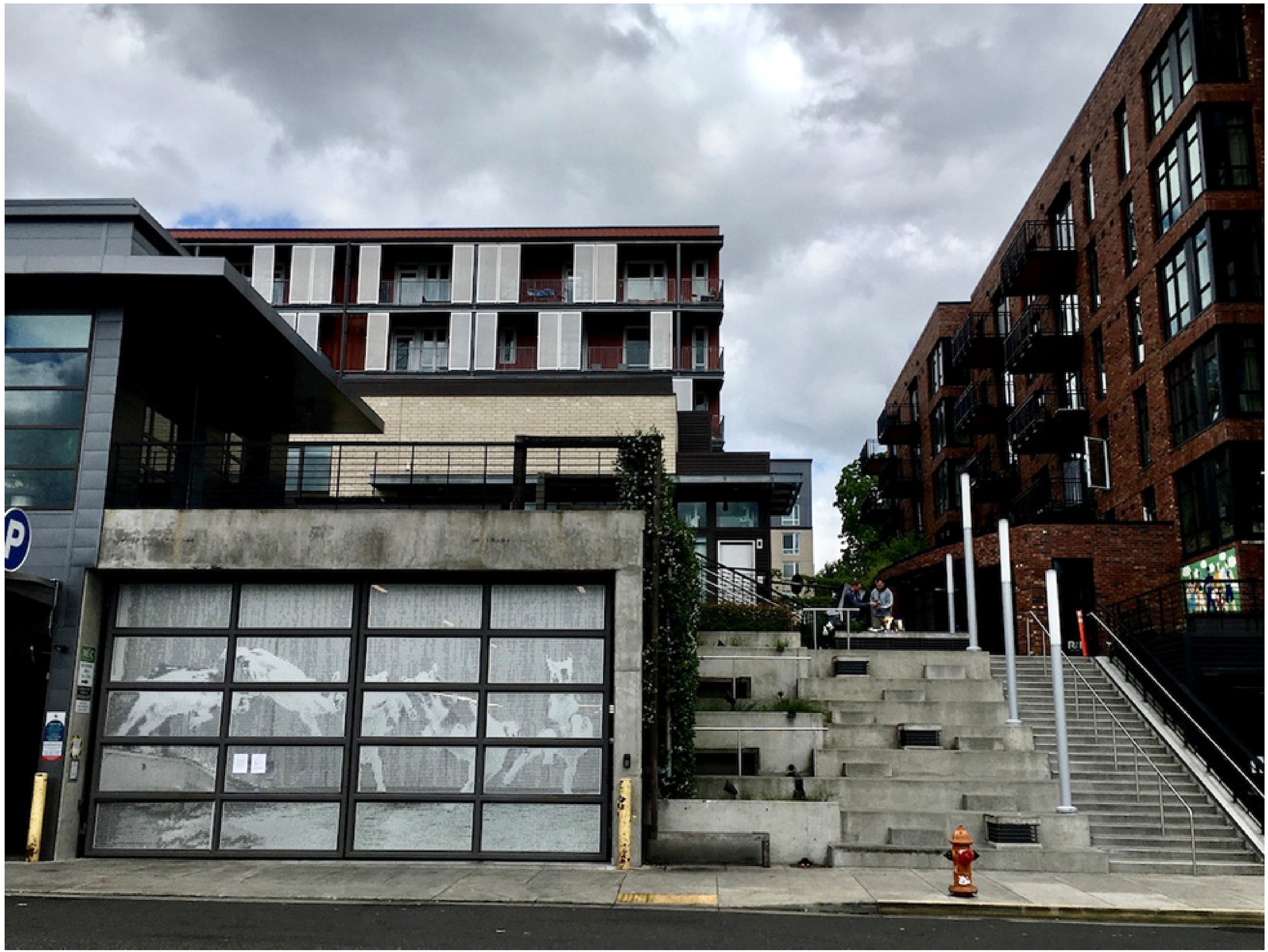
The Goat Blocks in June 2022. Photo by Eugene McCann.
While some saw the imagery as a way to honor the erstwhile urban livestock, many people were put off by what they saw as their appropriation, that is, using their images to greenwash the replacement of an agro-pastoral land use with a high-end development, a ‘higher and better use’. Indeed, one disgusted journalist remarked, Remember when Portland out-Portlanded itself by having a whole two-acre meadow dedicated to a herd of goats? Those were happy times. And in unsurprising news, the developers who bought the goats’ old home have built a huge, overpriced apartment building on top of it. Where we once had a lovely goat field, there's an apartment building very few can afford, and a sad reminder of the good old goat days. (Holley, 2017)
More than simply a reminder of the good old days, however, the goats functioned as sustainability capital of the sort that developers, municipalities, and other green growth machine actors have leveraged for the better part of a decade. For Killian Pacific, the goats – or rather, their images and the memories and emotions they triggered – were emblematic of the livable, local, and green lifestyle that Portland is known for and, critically for the developer, appealed to the eco-habitus of the affluent and urbane class of consumers willing to pay a premium for green living – in this case, young tech professionals interested in hiking, local food, and craft beer (Rubinger, 2018). But Killian Pacific was not the only actor leveraging this urban agro-pastoral imaginary. The Portland Development Commission also used the symbolic power of the Belmont Goats to highlight the Lents Town Center Urban Renewal Area in East Portland. According to the herd's co-owner, the goats’ move to Lents came about thanks to a request for proposals by the development commission, hoping ‘to find interim uses to draw attention to this neighborhood [Lents] in the hopes of spurring development’. 19 While impossible to quantify the extent to which the goats contributed to the widening of the rent gap in Lents, the neighborhood is gentrifying rapidly, despite concerted efforts to stave off displacement (Brunelle et al., 2016). A 2020 audit by the City of Portland – which invested nearly $200 million to spur development in Lents between 2000 and 2018 – revealed a 63 percent rise in property values during this period, as well as a decline in home ownership by people of colour from 51 to 41 percent (City of Portland, 2020). While the goats’ arrival in Lents was clearly welcomed (and subsidized) by the City, longtime residents may have also viewed them as a harbinger of impending gentrification, as people have viewed other forms of urban agriculture in Portland (Hern, 2016; McClintock, 2018).
While many in Portland's Buckman and Central Eastside neighborhoods were irked that Killian Pacific appropriated images of the Belmont Goats imagery for their construction and marketing of the high-end condos, the herd's owners viewed the relationship pragmatically. They accept their impermanence, mobility and mobilization by the growth machine as ‘part of the game’. The herd's co-owner continues, I get why it's a little weird to kick out the goats and then put goats all over their [Killian Pacific's] stuff. But I personally don’t begrudge them, because they really did more than they needed to, to let us be there for as long as we needed to before we had a spot to go.
Incentivizing impermanence in Vancouver
Urban agriculturalists become ‘nomadic’ not only by entering into temporary land use agreements with developers, but also by incorporating production technologies such as mobile raised beds and vertical growing structures that are temporary and easier to move. Community Garden Builders (CGB, formerly Shifting Growth), for example, is an organization that builds temporary community gardens on private land awaiting development throughout metro Vancouver. CGB's website documents ten active temporary garden projects and eleven decommissioned projects constructed at various sites undergoing development. 20 One of their premiere East Vancouver sites was ‘The Drive Temporary Community Garden’, located at the corner of Commercial Drive and East 12th Avenue on a gravel lot that had once held a gas station. Built in October 2013, the garden operated for four years. More than a hundred neatly spaced, knee-high gardens beds filled the lot. Like the others built by the organization, the site was at once organic and industrial, with its raised beds ripe with produce on a busy corner beneath LRT tracks. A turquoise shipping container emblazoned with organization's name – ‘shifting growth’ – in stylish lowercase letters together further emphasized the garden's transitional, mobile nature (see Figure 4). The garden was decommissioned in late 2017, when developer Wesgroup moved forward with a ‘brand new, mixed use development [that] offers retailers a prime corner site on one of the busiest commuter intersections in the city’. 21
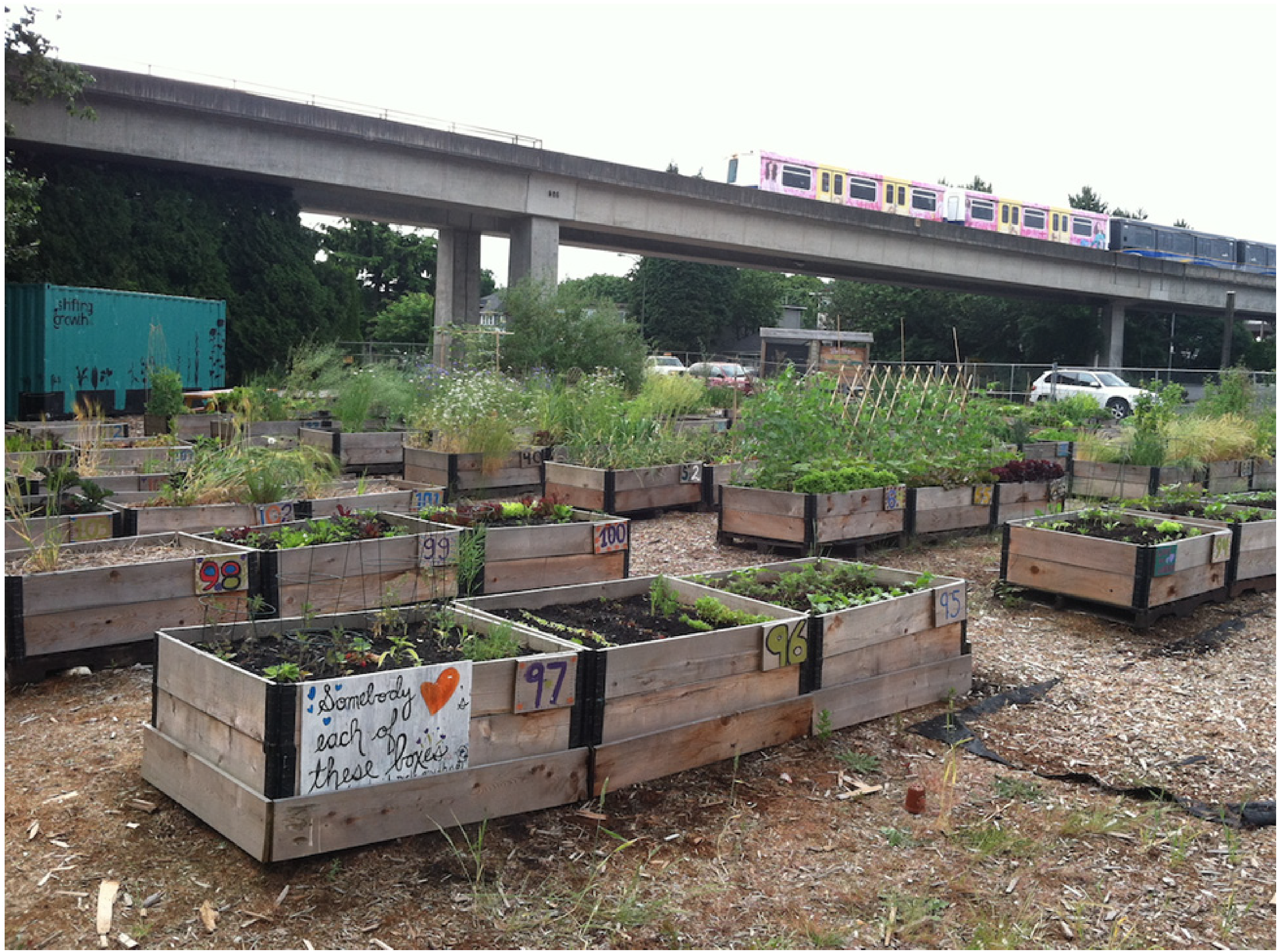
The drive temporary community garden constructed by shifting growth in East Vancouver, June 2015. Photo by Nathan McClintock.
If gardens such as those established by CGB/Shifting Growth were born of the unlikely romance between urban agriculturalists and real estate developers, the state has played an important role in fostering their union. A tax incentive has spurred impermaculture arrangements across Vancouver. The incentive allows private landowners (usually a developer like Wesgroup) who build farms or gardens on vacant land to temporarily reclassify the property from ‘business or commercial’ (Class 6) to ‘recreation or non-profit’ (Class 8). This allows them to pay a lower property tax rate to the BC Assessment Authority. 22 For urban farmers and community gardeners, the arrangement provides much needed access to land. CGB/Shifting Growth's founder explained that this arrangement of converting vacant lots into gardens is ‘a feel-good project. A number of the landowners realize the value it brings, both from the community itself – the people using it – and the value that comes out of that’. But he is also clear that it ‘really only makes sense in Vancouver because of the high value of land. … No landowner will just do this out of pocket, that will never happen, I don’t think. … And that's why this really is a great formula’. 23
For the owners of vacant lots who partner with organizations such as CGB/Shifting Growth, the benefits of the tax incentive are clear. At one-third of commercial taxation rate, the savings are substantial. Temporary gardens constructed on the vacant property on Seymour Street in Yaletown, for example, saved the Onni Group nearly $19,000 in taxes over the two years they were there before the developer began construction of a high-end tower called The Mark. Just a few blocks away, a community garden at the corner of Davie and Burrard Streets saved Prima Properties Limited $212,740 in 2009 alone (Williams 2010). Between 2007 and early 2009, gardens were added at five sites assessed at $88 million, leading to a tax savings of $650,000 (Fumano 2019). Reclassification ramped up that year, with gardens constructed at total of eight sites in 2009, but slowed down to just two in 2010, two in 2011, and none in 2012 (Stueck 2013).
While the Great Recession may have prompted a spike in reclassification, market saturation also led developers to seek out organizations such as CGB/Shifting Growth. With plans to redevelop a lot on East Hastings Street, the London Drugs company cleared a 22,000 square-foot site, which required demolishing several existing businesses. However, the company scrapped plans to build The Alba, a 108-unit development, due to a glut in condo construction. They turned to Shifting Growth, which built the Hastings North Temporary Community Garden on the site in August 2013, saving London Drugs $60,000 to $74,000 per year in taxes (Stueck 2013). The garden remained until November 2017, when new development plans were approved (O’Connor 2017). That same year, Wesgroup purchased five sites, cleared them, and contracted Shifting Growth to construct gardens. As one observer noted, the demolition of the existing buildings, clearing and grading the site, and construction of the gardens proceeded quickly and were completed by the end of October, ‘the point on the calendar when the BC Assessment Authority folks turn up to determine the classification of the property’ (Garr, 2018). By the end of the following year, temporary community gardens were present on 28 privately owned sites across the city, saving landowners $2.9 million in taxes (Fumano, 2019).
Such temporary land use conversion is not without its critics. Many argue that the incentive robs city coffers, leading others to shoulder fiscal burdens. A 2014 opinion piece in the Vancouver Sun charged, ‘Letting a short-term urban farm occupy the space lets land owners avoid paying higher taxes. Already, urban farms are costing residents tax revenue which goes toward things such as bike lanes and park maintenance. Don’t think that income from the farm's yields will offset the lost revenue’ (Mirko 2014). Some have expressed concern that the gardens simply greenwash or divert attention away from land speculation. For instance, former Vancouver city councillor Peter Ladner, who had spearheaded the creation of 2010 community garden plots in time for the 2010 Olympics, commented: ‘Many of today's faux-community so-called ‘gardens’ are clearly little more than tax dodges whose main function is to lower holding costs of undeveloped property’ (quoted in Fumano, 2019). Another commentator emphasized that the ‘thirty-day notice clauses in agreements requiring gardens to be removed from a developer's private property render … [green] justifications for this program a fiction’ (Hyman, 2019). Developers’ needs were privileged over concerns for food security, which advocates had foregrounded when initially pushing for the policy.
Few of the urban farmers we spoke with, however, took issue with the ways in which their gardens are entangled in the development process. Many saw Vancouver's tax incentive program as a win-win. From their perspective, the diverse benefits – tangible and intangible – that their projects bring to the City far outweigh the costs associated with municipal support. The former manager of a large urban farm in Vancouver, for example, was unequivocal in his support of the tax incentive program, which he sees as beneficial to developers, agriculturalists, and the broader community: ‘We’re obviously all for it for many reasons. If you rethink what growing in the city provides to the community as a public amenity – and obviously that help up social economic, environmental benefits – then, in my view, that reduction in taxation is entirely merited and returned to the community at large’. 24 Sole Food Street Farms’ founder echoed this sentiment, adding, ‘I happen to believe it is important and essential for land owners, in this current real estate environment, to have an incentive to be able to make land available to us and so I have no issue with the fact that those who leased to us have gotten a tax benefit’. 25 Not only do he and others see the incentive as a necessity, but one that is well-deserved, resulting in a win-win for both urban agriculturalists and developers.
While these urban farmers hope for secure land tenure at some point in the future, they nevertheless leverage the impermanence of their production systems, as the same former farm manager discusses: We have a package that we send to developers before we get into a relationship with them. And it's like a flipbook with pictures … You give them the package and you say, “One, we’re movable. Two, there's a tax break. Here's how land value goes up inside a garden” … you spell out the whole thing. And then you put at the end of it, “We will also provide our consulting services when you decide to develop and you want to put a farm as part of your development.”
Discussion: Rethinking urban agriculture and the sustainability fix through impermaculture
The examples of Portland's Belmont Goats and Vancouver's temporary gardens illustrate how impermaculture arrangements differ from other forms of urban agriculture, and the diverse ways that such arrangements have become normalized, structured and integrated into development logics. Their emergence mirrors the classic ‘seesawing’ pattern of urban agriculture taking root when and where there is no immediate ‘higher and best use’, functioning as a temporary placeholder or stopgap in the lumpengeography of (re)development and thus imbricated within capital's spatial fix and resulting processes of uneven development. However, in Portland and Vancouver, as in other entrepreneurial green cities (Montefrio et al., 2021; Montgomery, 2020; Sbicca, 2019; cf Stanko and Naylor, 2018), urban agriculture projects such as these are mobilized by local growth machine actors as sustainability capital; gardens and goats are tallied as benchmarks of sustainability, images of urban gardens and farms are integrated into local, regional, and global marketing and branding efforts. More than simply greenwashing development, impermaculture arrangements such as these prime the pump for new development by starting the process of aestheticization, branding, and legitimating (re)development before concrete is ever poured.
In the case of the Belmont Goats, developers incorporated the goats into the architectural plans, construction signage, the crane, and the name of the development itself, leveraging urban agriculture's symbolic power to market the new apartments, a power derived from the public's affective associations with the animals, whether related to the emotions arising from childhood memories, nostalgia for a lived or imagined agro-pastoral experience, or peace of mind that a little ‘goat therapy’ offered. The farm animals remain central to the Goat Blocks branding, generating value in a city where artisanal and agrarian imaginaries appeal to the eco-habitus of consumers. Indeed, the herd's eventual nomadism from site to site may also resonate with this imaginary, given nomadism's inherent association with pastoralism. 26 Similarly, the construction of temporary gardens in Vancouver results in the transformation of vacant lots covered in concrete, asphalt, or gravel into productive green spaces, both appealing to aesthetic preferences and meeting community members’ demand for garden plots and urban farmers’ need for land. Developers, for their part, benefit not only from a substantial tax break, but also from the publicity – images of garden beds integrated into their signage, websites and other branding.
Our interviewees clearly view their relationship with developers and commercial property owners in pragmatic terms, less an unlikely romance, and perhaps more a marriage of convenience that provides them with the one thing that seems nearly impossible to obtain in the entrepreneurial green city: land. Rather than struggling to hold on to their farms and gardens as land values rise and/or framing their interventions as a contestation of capitalist urbanization – a ‘re-appropriation’ of vacant land or ‘claiming a right to the city’ as documented in numerous studies of urban agriculture (Adams and Hardman, 2014; Bach and McClintock, 2021; Purcell and Tyman, 2015; Tornaghi and Certomà, 2018) – many practitioners engaging in impermaculture arrangements readily accept and adapt to these market logics because they are convinced of the social and environmental benefits of urban agriculture.
27
Some are more circumspect and view such relationships as a Faustian bargain; the former director of an urban agriculture non-profit in Portland, for example, described meeting with a real estate broker in hopes of developing a collaboration: We bolster home values and, in some ways, we bolster the gentrification of Portland, because we are contributing to that image of Portland as being eco, sustainable, groovy. Urban food production is a part of that image. So, we’re facilitating it. It's a selling point for us. To try to get money out of the real estate business. Which is why I did it, but I did it going like, “Shit!”
28
Impermaculture arrangements, we suggest, arise from this contradiction. Or, put differently, impermaculture both contributes to the sustainability fix and emerges as a fix of the sustainability fix itself. In paradigmatic green cities such as Portland and Vancouver, where land is limited, market values exorbitantly high, and gentrification rampant – due in some part to the entrepreneurial green policies and branding that attract investment and global prestige – impermaculture arrangements have emerged out of necessity, where urban agriculturalists seeking space and stability have adapted their practices to ‘cope with displacement’ (Demailly and Darly, 2017: 336) that is inevitable in the green city. 29 Put differently, in an attempt to guarantee their survival – their permanence – these urban agriculture initiatives have adopted a business model that embraces impermanence. At the same time, at little to no-cost whatsoever, developers have much to gain by engaging urban agriculturalists, from alleviating their tax burden to helping to attract potential investors and buyers in a market where green amenities are increasingly the norm and even expected.
While there is room for more empirical work to assess the extent to which this business model bolsters the gentrification of green cities, impermaculture nevertheless serves as a useful theoretical waypoint for understanding the sustainability fix and its role within wider green entrepreneurialism and green gentrification more broadly. What becomes clear in examining impermaculture (or other temporary, DIY, and pop-up, green infrastructures) is that the rescaling of accumulation (and associated modes of environmental governance) central to the sustainability fix is not only spatial, but also temporal. Impermaculture, as we have defined it here, refers to urban agriculture's literal deracination and planning for its displacement. Under these new arrangements, gardens are designed to be physically uprooted and moved (or simply cleared away) to make way for the very development they attract. In keeping with urban agriculture's ‘classic’ relationship to the Harveyian/Smithian spatial fix and seesawing of investment, impermaculture often emerges in the urban fallow following capital's retreat. But, by design, it then quickly accompanies capital's search for new frontiers of investment, symbolically valorized as sustainability capital to draw the attention of potential gentrifiers and investors to a particular site and its surroundings, generating a rent gap to be exploited. It is at this point, the spatial fix (the influx of capital) and sustainability fix (the leveraging of symbolic sustainability capital) converge.
There are also temporal dynamics at play. While attracting attention (and capital) to a new location, impermaculture simultaneously accelerates the widening of the rent gap, thus shortening the lagtime in the seesawing cycle of investment, disinvestment, and reinvestment. Moreover, temporary, mobile urban agriculture infrastructure or practices, which are by design quickly set up and easily removed, allow developers to await optimal market conditions before beginning construction. With little to no investment – covering the costs of construction of garden beds, for example, or granting a short-term lease to an urban agriculture organization – developers can extract additional profit from a site while protecting themselves from condo gluts or other crises of overproduction/underconsumption. Impermaculture thus contributes to a sustainability fix not only by generating value through its symbolic power, but also by helping to modulate the speed of capital investment into the built environment, temporally rescaling the spatial fix.
In sum, impermaculture does important and diverse work at different scales. Concretely, it serves as a strategy of survival for urban agriculture initiatives, while subsidizing development. More abstractly, it shores up the fractures in the sustainability fix by guiding capital to new spaces of accumulation. At the same time, it accelerates this spatial fix, contributing to its temporal rescaling. Finally, as a theoretical construct, impermaculture pushes understandings of the sustainability fix in new directions by returning our gaze to the mechanisms underlying the fix itself and to its spatial and temporal configurations. In this way, impermaculture draws our attention to ‘the category, constitution, and functioning of fixed capital’, which Ekers and Prudham (2018, pp 18) argue is missing from much literature on the sustainability fix, adding clarity to how and when sustainability and spatial fixes articulate. Importantly, it highlights the necessary, functional roles of mobility and impermanence therein.
Highlights
We examine the rise of a new form of urban agriculture in the entrepreneurial ‘green’ city and its role in the sustainability fix
We advance the notion of ‘impermaculture’ to describe the rise of increasingly mobile and temporary approaches to urban food production
Urban agriculturalists are willingly enrolled in processes of urban development through impermaculture arrangements with growth machine actors
Impermaculture both contributes to a growing rent gap and modulates the flow of capital into the built environment
Impermaculture demonstrates that sustainability fixes are both symbolic and material, spatial and temporal
Footnotes
Acknowledgements
We are grateful to Amy Coplen for her assistance with transcriptions and coding, and to our many interviewees for sharing their time and thoughts with us.
Declaration of conflicting interests
The author(s) declared no potential conflicts of interest with respect to the research, authorship and/or publication of this article.
Funding
The author(s) disclosed receipt of the following financial support for the research, authorship and/or publication of this article: This work was supported by the National Science Foundation (grant number 1539750) and the Institute for Sustainable Solutions, Portland State University (Sustainability Research Stimulus grant).
