




Abstract
This paper argues for engaging in multispecies storytelling with plants to better conceptualise the ethics and contested ecologies associated with biodiversity loss. It focuses specifically on proteas, the iconic species of South Africa's threatened fynbos biome, to explore the possibilities of an ethical dialogue between human and more-than-human diversities, and to consider what might be gained from understanding plants as both agentic in contested ecologies and as storytelling figures worthy of attention. The paper draws on John Ryan’s conceptualization of phytography as a way of engaging in multispecies storytelling with plants. It teases out interwoven botanic and human histories, and the ways in which iconic proteas have written themselves into the narratives of their human interlocutors in the context of European settler colonialism, conservation, floral nativism and post-apartheid nation-building. The case for phytography is developed through an examination of the corporeal rhetoric of proteas in two examples. The first concerns the Mace Pagoda, a protea that resists narratives of extinction by writing back its percipience, agency, and resilience into human stories of anthropogenic habitat loss. The second focuses on botanical traces that result from absence, specifically the non-appearance in recent years of proteas in the Cederberg area of the Western Cape. The paper suggests that absence is a form of corporeal rhetoric through which plants write themselves into narratives of rapid climate change and multispecies loss. The final section of the paper explores questions of ethics that emerge from engaging with plants as storytellers, reflects on the kinds of human-plant relationships that are possible in the context of environmental catastrophe, and examines the possibilities that phytography provides for more-than-human engagements with plant life.
Introduction
What if you were a teacher but had no voice to speak your knowledge? What if you had no language at all and yet there was something you needed to say? Wouldn't you dance it? Wouldn't you act it out? Wouldn't your every movement tell the story? In time you would become so eloquent that just to gaze on you would reveal it all. And so it is with these silent green lives.
This paper argues for engaging in multispecies storytelling with plants to better conceptualise the ethics and contested ecologies associated with biodiversity loss. It focuses specifically on proteas – the iconic species of South Africa's threatened fynbos biome comprising the sclerophyllous or small-leaved, evergreen shrubs and heath that dominate the vegetation of the mountains and coastal forelands of the southern Cape. The paper emerges from an attempt to think through the seemingly intractable problem of how to engage ethically with endangered wildflowers in the context of contemporary South Africa, where conservation is embroiled in colonialism, apartheid legacies and white supremacism, and where contemporary extremes of inequality require that human livelihoods are prioritized over nonhumans in political discourse and policy. In this context, the environmental logic that gains most traction politically is one in which nature is commodified to conserve it; in the case of wildflowers, this translates as sustainable harvesting (McEwan et al., 2014) and (eco)tourism.
In approaching the question of the survivability of endangered wildflowers differently, and to explore the possibilities of an ethical dialogue between human and more-than-human diversities, I shift perspective towards plant agency to consider what might be gained from understanding proteas as both agentic in contested ecologies and as storytellers worthy of our attention. I approach storytelling as a political undertaking that constructs an ethical relation to and in the world (Haraway, 2019) and I explore the extent to which this might open possibilities for an ethically different environmental politics (Harris, 2022). As Van Dooren (2014) argues, inter-species stories can reconnect humans with the ongoing impacts of environmental destruction. Knowing the stories of other species enables human interlocutors to see differently, and to be drawn into new kinds of relationships and ethical obligations. Yet while knowing the stories of other species is important, human understanding is limited because they are unable to inhabit the perceptual worlds of more-than-human organisms. The profound otherness of plants adds further challenges to relational and empathic ethics. The question of how we come to know plants, and what kind of ethics emerge from this, is central to my concerns here. Specifically, I reflect on the challenges of listening to plants and of foregrounding plant agency in multispecies storytelling in the fynbos biome.
Relative to fauna, plants have until recently eluded academic notice in relational geographies and multispecies ethnographies. It is difficult to imagine them as independent agents, they are easily taken for granted (Head and Atchison, 2009), and their agencies are performed in indirect, subtle ways (Hitchings and Jones, 2004). Human relationships with plant life have been understood largely as consumptive, with wildflowers known as constituents of wildernesses visited for leisure purposes or extracted for adornment and decoration (Goody, 1993). Aristotelian hierarchies of nature, which position plants as passive, insentient beings without consciousness (Bergson, 1911: 111–112), 1 have limited understanding of their habits, preferences and sensibilities, created an assumption of greater ethical distance between humans and plants compared with humans and animals, and made it harder to conceive of plants as ‘alien kin’ (Schneekloth, 2002). More-than-human geographies have sought to counter these habits of neglect, responding to an ethical imperative to understand the agency of plants (Pitt, 2015; see also Ingold, 2013; Marks, 2012; Schiebinger, 2007), their social lives (Head and Atchison, 2009), their affective and organisational agency on humans (Ginn, 2014; Hitchings and Jones, 2004; Jones and Cloke, 2008), their evolution with people and mutual reliance for survival (Head et al., 2012), and the particular and complex ways that plants have of doing things (Brice, 2014; Hall, 2011; Jones and Cloke, 2002). Anthropologists and ethnobotanists have also contemplated medicinal plants as agents/actants/beings (Gibson, 2018a, 2018b).
My focus on proteas seeks to extend recognition by social scientists that attending to plant difference is important in ‘illuminating our interconnectivity as well as our interdependence’ (Head et al., 2014: 866). Despite this recognition, with the exception of orchids (Dixon et al., 2003) and trees (Kohn, 2013; Rival, 1998; Wohlleben, 2015), ‘plant blindness’ (Balding and Williams, 2016; Margulies et al., 2019) still ensures that plants are rarely considered to have sufficient appeal as iconic species in broad-scale conservation politics. Theorizing plants as lively political subjects has also proven difficult because Western scientific approaches to knowing them as species limits creative capacity for understanding them relationally (Margulies, 2018). However, proteas are ‘flagship’ conservation species (Bowen-Jones and Entwistle, 2002) in South Africa because they are typical of locally important habitats, endemic and symbolic of regional and national allegiance; at high risk of extinction, which inspires significant local awareness; a keystone species in the ecosystem; and distinctive, easily recognised, and charismatic (Lorimer, 2007). They are thus an ideal species with which to tell stories.
In what follows, I first outline an approach to storytelling with proteas, drawing on Ryan’s (2020) conceptualization of phytography as a way of engaging in multispecies storytelling with plants. I then consider interwoven botanic and human histories, and the ways in which iconic proteas have written themselves into the narratives of their human interlocutors in the context of European settler colonialism, conservation, floral nativism, and post-apartheid nation-building. I develop the case for phytography through examples of storytelling with two species of protea. The first concerns the Mace Pagoda, which I suggest resists narratives of extinction by writing back its agency and resilience into human stories of anthropogenic habitat loss. The second focuses on botanical traces that result from absence, specifically the non-appearance in recent years of Snow Proteas in the Cederberg area of the Western Cape. I suggest that absence is a form of corporeal rhetoric through which plants write themselves into narratives of rapid climate change and multispecies loss. In the final section of the paper, I explore questions of ethics that emerge from engaging with plants as storytellers. I reflect on what kinds of human-plant relationships are possible in the context of environmental catastrophe and examine the possibilities that phytography provides for more-than-human engagements with plant life.
Multispecies storytelling and ways of listening to plants
As Haraway (2008, 2019: 10) argues, storytelling is a fraught, but necessary practice for narrating the complexity of nonhuman assemblages and their wider ecologies; ‘it matters what stories we tell to tell other stories with'. Storytelling has become a device through which to counter the biopolitical tendencies of contemporary conservation discourse, especially within extinction studies (see, e.g. Rose et al., 2017) where narratives shape the stories that are told, ‘making claims about what matters, where the violence occurs, and how we might respond to it' (Garlick and Symons, 2020: 301). Such storytelling is compelling in the dual sense of making things relatable in ways that they otherwise are not and in prompting action. It is also central to the politics of crafting charisma. As Yusoff (2010: 76) argues with reference to polar bears, locating them in ‘our narratives of their worlds (forever swimming in the sea of melting ice) ’ has ensured that they top the charismatic megafauna index of international conservation organisations. However, Yusoff (2010: 76) also asks if such charismatic species are ‘too located in our narratives of their worlds to allow them any other spaces to practise in'.
To countervail this, I draw on phytography as a way of engaging in multispecies storytelling with plants. Ryan (2020: 98) – a poet and cultural botanist – conceptualises phytography as a kind of human-plant co-authorship, ‘our writing about their lives and their writing about themselves’. It involves writing not simply about plants but with them – more-than-human life writing composed in dialogue with plants – and writing back – signifying the ways in which plants write their own lives, sensorially and materially, irrespective of human mediation. This conception of phytography offers social science a way out of the conundrum posed by the challenges of listening to plants and recounting their stories as human interlocutors. Some degree of anthropomorphism is inevitable when nonhumans become narrative agents in human stories (Weik von Mossner, 2017). However, Indigenous methodologies have long cultivated empathic anthropomorphism to foster empathy with plants (Arnold et al., 2021), and anthropomorphism may be desirable ‘to counter the narcissism of humans in charge of the world' (Bennett, 2010: xvi). As Ryan (2020: 99) argues, careful and strategic forms of anthropomorphism can offer insights into the complex lives of plants through different focal points, including: particularization (attention to individual plant characters), percipience (plants as intelligent, responsive, and agentic beings), corporeality (plants as embodied individuals located in time and space), temporality and seasonality (the changeability of flora over time and seasons), emplacement (the influence of place on plantness and vice versa), language and signification (the interpellations, interpolations, and communicative modalities specific to vegetal life), historicity (the intertwining of botanical and human histories), and mortality (the decline and demise of plants as meaningful events prompting human mourning, memorialization, and elegy).
I suggest that phytography enables geographers and other social scientists to counter the instrumentalization, utilitarianism and reductionism in their dealings with plants by developing ‘more-than-human life writing attuned to their intelligence, sentience, and other complexities' (Ryan, 2020: 100). Instead of reducing plants to their uses and appearances, negating their diverse capacities, phytography ‘engages “the botanical imagination” as the relational, intercorporeal, and dialogical opening of narratives to vegetal being' (ibid.) Human interlocutors imagine plants as auto/biographical subjects, while plants imagine them back in an interplay of imaginings; as human interlocutors write the lives of plants, ‘so they write their own lives – and ours' (ibid.), creating diverse shared narratives. This multispecies storytelling shifts away from textual representation and interweaves human storytellers with the creative agencies of plants. In positing this approach, I also acknowledge the longer histories, different ontologies, and rich storytelling practices of Black and Indigenous peoples (see, e.g., Crawford, 2019; Nxumalo, 2016; Simpson, 2011; Yunkaporta, 2020) that are disruptive of Eurocentric, colonial norms of ‘objectivity’ and knowledge (Sium and Ritskes, 2013). 2 Indigenous ontologies understand ‘plants [as] our oldest teachers' (Kimmerer, 2020: 213), but most humans have lost the ability to learn from them. Phytography enables an ethic of relatedness that permits humans to hear the stories that plants tell. While phytography did not guide my original engagements with proteas and their stories, in what follows, I use phytography to tell stories with proteas, enabling them to write back into human narratives. I reflect on what might be learned from listening to proteas, and on the possibilities that multispecies storytelling opens for doing environmental politics differently.
My arguments are informed by diverse sources encountered through research over two decades, during which I have travelled, hiked and dwelled for periods of time in the fynbos biome. I draw on evidence from my own encounters with proteas – visual, haptic, olfactory, and gustatory – in the mountains and coastal forelands of the Western Cape. I also draw on information gleaned from collaborations and conversations with fynbos researchers, conservationists, botanists, farmers and flower-pickers, and from lay and expert accounts found in the archives and publications of conservation organisations (Botanical Society of South Africa, Flower Valley Conservation Trust, Protea Atlas Project/South African National Biodiversity Institute), regulatory bodies (CapeNature), and the protea industry.
Protea as icon: Interwoven botanical and human histories
The starting point for my phytography is to consider the interwoven histories of proteas and their human interlocutors. Proteas evolved to attract pollinators and have exerted a force of attraction on humans by appealing to cultural expectations about beauty (Pavord, 1999; Pollan, 2001). Their political agency has often gone unnoticed, but proteas have long been embroiled in high-stake politics, social transformation, and everyday lives in South Africa. Their ‘exotic’ aesthetic exerts a powerful biophysical force that binds them to the emotional worlds of humans. This has shaped complex histories of encounter that interweave colonialism, collecting, commodification and conservation, and has ensured the protea's iconic status in South Africa.
Proteas grow wild in South America and Australasia, but by far the greatest concentration and diversity (approximately 400 species) is found in South Africa's Cape Floristic Region 3 (CFR). Known locally as sugarbushes, they are the CFR's most recognisable species. The first recorded reference is found in Clusius’ Ten Books of Exotic Life Forms (1605), which includes a woodcut of a Protea neriifolia (Oleanderleaf protea), one of the Cape's most common proteas first encountered by Europeans in 1597 (Egmond, 2010; van Ommen, 2009). The genus Protea 4 was named after the Greek god Proteus 5 by Linnaeus in 1735 using samples sourced through Dutch imperial botanical networks (Grove, 1995). The name captured the extraordinary biodiversity witnessed by colonial botanists – a plant that is versatile, adaptable and assumes many forms. 6 However, it also encapsulated the difficulty of containing this abundance of complexity within rigid taxonomies – proteas are often elusive because they grow in extreme locations or have irregular lifecycles; they are difficult to grasp because of bewildering diversity, with seed-dispersers and rhizomatic species sometimes appearing exactly the same. This complexity meant that it took a long time to classify proteas – by the time Linnaeus published Species Plantarum in 1753, only six species were identified – and South African taxonomies are still refined regularly (Rebelo, 2001, 2004; Victor et al., 2015).
This process of (re-)naming and classifying was part of the colonial violence that destroyed much of the Indigenous knowledge of people who inhabited the Cape for thousands of years prior to the arrival of Europeans. Recent ethnobotanical research with people of Khoi and San descent suggests that some species of protea have been used since the Later Stone Age as foods and medicines (De Vynck et al., 2016). These include Protea obtusifolia and Protea repens whose copious nectar is a source of carbohydrate attractive to humans, insects and birds. Nectar from Protea repens is also used as a remedy for chest disorders, and the bark of Protea caffra for stomach ulcers and diarrhoea (Coetzee and Littlejohn, 2001; Van Wyk et al., 1997). Proteas have thus long written-back into human/more-than-human stories through their diverse haptic, olfactory and gustatory significations.
Most of South Africa's wild proteas are found in the fynbos biome of the CFR, home to approximately three quarters of the country's threatened plants, and the smallest and richest of the world's six floral regions (Ashwell et al., 2006). The CFR covers only four percent of southern Africa, but 44 percent of its plants are found here. In 2004, it was designated a UNESCO World Heritage Site and is listed by Conservation International as one of the world's ‘biodiversity hotspots’ – the most abundant and threatened reservoirs of plant and animal life on earth. It has the world's highest plant biodiversity – Table Mountain alone supports more species than the entire United Kingdom (Black, 2017) – comprising approximately 9600 plant species, of which around 70 percent are endemic (Manning, 2008). Proteas attract more attention from policymakers, scientists and the public than any other South African plant. 7 They inhabit political spaces of biopolitics, evoking memories of various originary pasts, becoming contested symbols of regional and national identity and, at historical junctures, transferring from the botanical to the socio-political in (de)politicizing colonial dispossession, racism, and nationalism.
Colonial amateur botanists recognised that Cape flora were not only unique but of ‘extreme antiquity' (van Sittert, 2010: 1). Proteas are relics of Gondwanaland and among the oldest plants on earth, possibly dating back 300 million years. Extinction was implicit in colonial narratives of the CFR's uniqueness and antiquity and provided Cape botany with its urgency and raison d’être. 8 Colonialism – ‘the literal planting and displanting of peoples, animals, and plants' that inscribed ‘a domination into blood and soil founded in the fantasy of molding ecosystems with godlike arrogance' (Mastnak et al., 2014: 367) – destroyed much of the fynbos, but also inspired native plant advocacy. Fin-de-siècle botanists, mourning ecological destruction, wrote of being ‘penetrated by a gloomy impression that the South-western Flora is dying out, and is doomed to extinction' (Bolus, in van Sittert, 2010: 1); in the mid-1890s, they called for the creation of refuges for the ‘living memorials of the prehistoric past before they give out under conditions of man's occupation and become extinct' (MacOwen, in van Sittert, 2010: 1).
From the end of the 19th century, informal traders from disadvantaged communities began to pick wildflowers and sell them in central Cape Town (Boehi, 2016; Rabe, 2010). Colonial urban elites began simultaneously to appropriate indigenous flora as a marker of identity, and to promote the cultivation of scientific and aesthetic appreciation of indigenous vegetation in relation to imperial patriotism, local nationalism, and civilisation (McCracken and McCracken, 1988). This identification with indigenous flowers was simultaneously ideological – providing a sense of regional identity and allegiance within a new and fractious settler national state – and practical – protecting and prioritising their own land use against competing uses by impoverished people (van Sittert, 2003).
The protea, threatened with extinction by over-harvesting, was used to depoliticise land appropriation by white people, the dispossession and forced removal of Africans and descendants of slaves, and the prohibition of subsistence land use – all in the name of conservation. Kirstenbosch National Botanical Garden – the scientific and activist hub for ‘floral nativism’ – was established in Cape Town in 1913, the same year that the Native Land Act dispossessed Africans of all but 7% of South Africa's land (Boehi, 2016). Lobbying by local white residents, amateur botanists and wildflower enthusiasts culminated in the Flower Protection Bill of 1905 and the Wildflower Protection Ordinance of 1937 (Davis, 1990). The latter had disproportionately negative effects on Black
9
flower-pickers whilst simultaneously creating a valuable commodity from what were previously considered ‘weeds’ on white-owned farmland (Acocks, 1953). Statesmen began to refer explicitly to proteas as a natural asset. Proteas figured as diplomats in political spectacles to project positive images of the apartheid state abroad (Boehi, 2016), while botanists began referring to them as endangered species worthy of conservation and part of a ‘unique biome type’, ensuring their status as a ‘passionately protected icon of national, natural rootedness' (Comaroff and Comaroff, 2012: 99). The King Protea (Protea cynaroides) was proclaimed South Africa's national flower in 1976, prompting poet and prominent anti-apartheid activist Don Mattera (2007, orig. 1983) to write:
In post-apartheid South Africa, proteas still inspire diverse passions and provide ‘the vital motivating energy that compels many people to get involved in biodiversity conservation' (Lorimer, 2007: 927). However, while biodiversity conservation has gained some traction across the Western Cape's diverse population, and conservation-in-practice now has many Black trainees and leaders, conservation science remains a (colonial/white) racialised claim to authority and often struggles to connect with Black environmental publics rooted in resistance and fighting injustice (Green, 2020). In the highly charged racial politics of conservation, Black South Africans are still accused of posing existential threats to fynbos (Boehi, 2010).
These interwoven human and plant histories culminate in a present-day scenario of vulnerability and threatened extinction. Thirty-five species of protea are currently considered ‘endangered with extinction’, forty-six are ‘vulnerable to extinction’, and seventy-six are ‘rare’ (http://www.iucnredlistorg; van Deventer et al., 2015). Most proteas are poorly known, and some are so rare as to have been seen by only a few people. Other proteas, once common, are now reduced to a few populations in tiny, protected areas. Many have such minute habitats that ploughing a field or building a single house could destroy the entire population. Climate change is generating a multitude of more abrupt changes, with the fynbos biome identified as one of five most at risk globally and facing localised extinctions of a third of its species (Warren et al., 2018). Reduced rainfall and extreme droughts, higher annual temperatures, fewer cold days, more frequent and more intense fires, ‘invasive’ species, rising sea levels and more frequent storm surges will render many currently climatically suitable areas unsuitable for specific protea species, even within protected areas.
Against this backdrop, proteas have become storied objects in the contested political ecologies of the CFR. They embody vulnerability and impending loss in a context in which only 10% of the CFR is in highly protected reserves (Rouget et al., 2003) and, over the coming decades, human land transformation and fragmentation is likely to destroy most unprotected natural habitats. However, I suggest that proteas also inspire ‘a sense of curiosity about the intimate particularities of these disappearing others' (Van Dooren, 2014: 8). They challenge us to move beyond thinking of them as objects, assets or ‘an abstract Latin binomial(s) on a long list of threatened species', but as a ‘complex and precious way of life' (ibid.: 8) with creative agencies that enable them to write back into our narratives of them. In what follows, I explore examples of proteas writing back through forms of corporeal rhetoric.
The corporeal rhetoric of proteas
Scientists have long understood that plants communicate with each other, for example through mycorrhizal networks – underground systems created by fungi that connect individual plants together and transfer water, carbon, nitrogen, and other nutrients and minerals – and chemical messaging, and with other organisms such as pollinators (Baldwin and Schultz, 1983; Baluška et al., 2006). If plants exchange information between themselves and with other organisms, then it is reasonable to postulate that they can do the same with humans. Of course, there is nothing new in this since Indigenous ontologies have for millennia recognised the botanical world as endowed fully with voice(s) (see, for example, Arnold et al., 2021; Clarke, 2011; Geniusz and Geniusz, 2015). Although plants do not speak in linguistic terms familiar to us, they nevertheless communicate, give voice and signify through other sensory formations perceptible to us (Gagliano et al., 2017; Ryan, 2017). Accepting that ‘human-plant communication takes place on an unmediated corporeal basis beyond the delimitations of what is prescribed normatively as language' (Ryan, 2017: 131), it is possible to reflect on what plants might be communicating. In what follows, I explore two examples of corporeal rhetoric – the elusiveness of the Mace Pagoda and the absence of flowering Snow Proteas – that also narrate botanical particularization, percipience, temporality and emplacement.
Writing with the elusive Mace Pagoda (Golden Protea)
One of the loveliest flowering plants I have seen in all my wanderings was the Golden Protea… Each flower is in the axil of the bright golden leaf which forms a protecting hood, transforming it into a torch-like bloom of exquisite loveliness, capped by a flattish spread of young silvery leaves tinged with mauve.
Writing with the Mace Pagoda (Mimetes stokoei) (Figure 1) offers insights into the complex lives and corporeal rhetoric of proteas through numerous phytographical focal points. As Stokoe's reverie suggests, the first concerns its particularization. The Mace Pagoda is one of the most charismatic proteas, strikingly unusual – a tall, elegant evergreen with cylinder-shaped inflorescences containing golden flowerheads – an ‘almost fabled plant' among botanists and conservationists (Rourke, 1976: 12) and a liminal figure in multispecies stories of critically endangered fynbos wildflowers. The Mace Pagoda is also profoundly emplaced. Endemic to the Kogelberg Nature Reserve to the south-east of Cape Town, it has only ever been found in one 10 m2 location in the Paardeberg mountains, where the climate, altitude, slope aspect, subsoil and localised weather conditions are favourable (Slingsby and Johns, 2009a). It is seen extremely rarely, and its human interlocutors have struggled to understand its temporality and seasonality, twice declaring it extinct, only for it to reappear sometimes decades later. The Mace Pagoda is the best-known example of several species of protea that have become adept at evading human attention for long periods of time, including the Diminutive Clusterhead (Sorocephalus tenuifolius), the Swartberg Sugarbush (Protea oderata), and the Villiersdorp Ridgecone Conebush (Leucodendron comosum homaeophyllum), ‘rediscovered’ in 1987, 1999 and 2002, respectively. It exemplifies the complexity and inconstancy of proteas, with a temporality and seasonality incommensurate with colonial/Western framings that pose challenges for human comprehension. The Mace Pagoda's resistance to narratives of extinction writes back its percipience, agency and resilience into human stories of vulnerability to anthropogenic habitat loss.
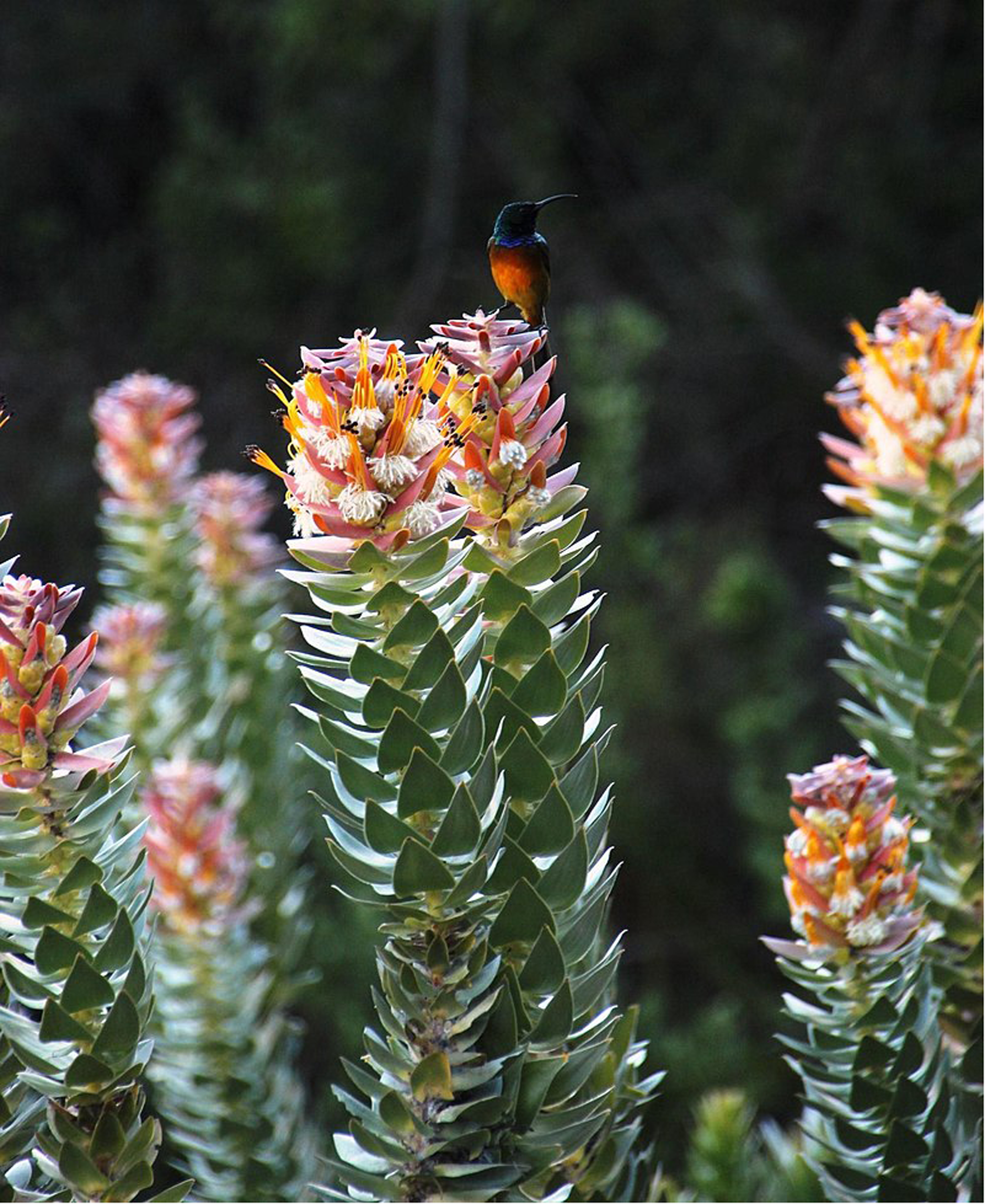
Cultivated specimen of the Mace Pagoda, with orange-breasted sunbird, photographed 3 March 2015, Kirstenbosch National Botanical Garden (Source: Tony Rebelo – https://www.inaturalist.org/observations/11023088 CC BY-SA 4.0; accessed 08/12/21).
Writing with the Mace Pagoda interweaves botanical and human stories. The first European to record its existence was a working-class amateur botanist from Yorkshire, Thomas Pearson Stokoe, who emigrated to Cape Town in 1911. Stokoe, a neglected figure in histories of Cape botany (cf. Slingsby and Johns, 2009a), 10 encountered a single stand in the Kogelberg in February 1922 and sent specimens to the Royal Botanic Gardens at Kew, which named Mimetes stokoei in his honour. Commonly known as the Mace Pagoda, Stokoe (1951) named it the Golden Protea. He undertook numerous subsequent collecting trips but was unable to relocate it. Unlike professional colonial botanists, whose attentions were focused largely upon the regulation of wildflower harvesting (primarily by excluding poor Black people), Stokoe's notes reveal that he engaged closely with Cape Town's Black flower-sellers and ‘the metis of Black working-class botany' (van Sittert, 2010: 2), respecting their knowledges of local plant communities. In July 1925, Stokoe came across a Mace Pagoda among wildflowers being sold in the Adderley Street flower market in Cape Town. The flower-seller initially refused to disclose where it had been found – collecting sites were closely guarded secrets for people whose entire livelihoods depended on bringing the most exotic specimens to market. However, Stokoe persuaded the vendor's supplier to take him to the source in the Kogelberg. They found only ten plants, all of which seemed to be old, senescing and dying. The Mace Pagoda's mortality as a meaningful event became part of its storytelling: in 1959, the year in which Stokoe died, Mimetes stokoei was declared extinct, prompting mourning and elegy among botanists and conservationists (see Rourke, 1976).
The story of the Mace Pagoda's apparent extinction helped inspire efforts by the South African government to curb the general deterioration of fynbos by making better use of its horticultural potential. In 1964, the Department of Agriculture established an experimental protea farm at Oudebosch in the Kogelberg and, as its home was being remade into a laboratory, the Mace Pagoda made an unexpected and fleeting reappearance in 1966. The story of its almost immediate demise is not formally documented. Published accounts explain that the second ‘extinction’ was because of there never having been more than a dozen plants in existence, it being a short-lived and erratic flowerer and having diminishing capacity for adapting to a changing, warmer, drier environment (Rourke, 1976, 1984). The role of Cape Town botanist and conservationist, Marie Vogts, and her Oudebosch researchers is occluded in these explanations, but details can be pieced together from cryptic information on herbarium labels and curious anomalies in published accounts. 11
An influential advocate of protea horticulture as a form of conservation (Vogts, 1982), Vogts was charged with developing Oudebosch as a permanent collection of horticulturally important protea species and a place of active scientific research. The secrecy concerning the Mace Pagoda's location meant that she and her researchers had no idea that Oudebosch was located precisely where Stokoe's senescing protea had last been seen. Burning the natural vegetation to clear the ground for the nursery enabled a single specimen to resprout (Rourke, 1976). Disastrous attempts to protect this with a wooden tripod resulted in both being snapped in a storm in 1969 (Slingsby and Johns, 2009b). The only known Mace Pagoda was thus inadvertently destroyed before it had chance to flower and produce seeds. Clearing, trampling and possible Phytophthora infection during construction of the nursery (Thomas, 2010) were thought to have destroyed any other seedlings. 12 Mimetes stokoei was again declared extinct and the Oudebosch protea nursery was transferred to Tygerhoek, where a new protea breeding program was started in 1973. Vogts spent the next 20 years atoning for her role in the Mace Pagoda's demise by raising public awareness about threats to proteas and the fynbos biome. The Kogelberg came under the jurisdiction of CapeNature in 1987 and was declared a nature reserve.
The Mace Pagoda was not seen again for over 30 years but reappeared in 2001 following a devastating fire in the Kogelberg Reserve. The Kogelberg is thought to have been negatively affected by increased frequency and intensity of fires associated with climate change, increased unplanned fires associated with population growth, and lack of capacity and resources to prevent and control veld fires (Gumbi, 2011). Four days of hot, dry winds in December 1999 fanned blazes much hotter than the region's usual seasonal wildfires and burnt more than half of the reserve to ash. However, fynbos has evolved to survive fire, and some species of protea exploit its capacity for clearing space and returning nutrients to the soil. The Mace Pagoda is one such particularized and percipient protea, recruiting ants to bury its seeds, which lie dormant until a fire hot enough trigger
The Mace Pagoda has written itself into botanical knowledges, which now understand its elusiveness as part of a natural cycle of regeneration in which fire plays a part. Most protea species thrive on a single hot wildfire every 20 years or so but are not adapted to more frequent fires. On 17 March 2011, a fire in the Bot River Estuary spread rapidly through ‘invasive’ plants into the Kogelberg's high valleys, destroying the remaining Mace Pagodas that had appeared after the 1999 blaze. Now considered critically endangered rather than extinct (Rebelo et al., 2006), the Mace Pagoda remains a liminal figure of life apparently on the cusp of extinction, but still inter-braiding its creative energies with human storytelling. Amateur botanists are constantly alert to its possible re-emergence. Sightings recorded on social media and citizen science sites in March 2020 ‘on private land not too far from the original population’ (https://www.ispotnature.org/communities/southern-africa/view/observation/796787/possibly-mimetes-stokoei) may be the result of efforts by local enthusiasts to conserve the Mace Pagoda by grafting it onto Leucospermum conocarpadendron hybrid rootstocks (Blackhall-Miles and Ram, 2015). Time will tell whether the increased frequency of fire has made it impossible for the Mace Pagoda to regenerate naturally, but the Mace Pagoda will bide its own time in letting us know.
The Mace Pagoda exemplifies how plants speak in the form of corporeal rhetoric, writing themselves into multispecies storytelling as a material or immaterial trace. As Ryan (2017: 137) argues, the residue or impression of the plant endures both in the environment that is rendered in the narrative and in the content of the narrative itself. In the case of the Mace Pagoda, the Kogelberg is a locus of botanical presence and absence. The trace of the protea manifests as ideas, emotions, and affectivities in the personal and collective memories of people – flower-sellers, botanists, hikers and other enthusiasts. This trace, a form of corporeal rhetoric, exists irrespective of whether the Mace Pagoda is present. As discussed below, other proteas are engaged in similar forms of corporeal rhetoric narrating the degradation of floristic diversity within the fynbos biome.
Writing with the snow protea: Botanical traces and multispecies climate vulnerability
The spring wildflowers of the Cape West Coast and Cederberg, at the northern-most extent of the fynbos biome, have a worldwide reputation. This area of South Africa receives little rain throughout the year, but after the winter rains from May to July/August, the normally dry landscape experiences a ‘super-bloom’ that carpets the mountains and veld with wildflowers, including ten genera and 61 species/subspecies of protea that grow in the area. 13 This annual spectacle attracts hundreds of thousands of tourists and generates vital income for the regional economy. A wildflower show has been held regularly since 1940 in Clanwilliam, a small town in the Cederberg, and now takes place annually at the end of August. In 2017, the show was cancelled 14 because, for the first time in living memory, there were no wildflowers. The area, like much of South Africa, was experiencing a third year of extreme drought: the rainfall for the first seven months of 2017 was the lowest for 64 years, and the absence of proteas and other wildflowers was a response to rapid climate change.
Absence is a form of corporeal rhetoric through which the Cederberg proteas write themselves into the story of a region where average temperatures have warmed significantly over the past 30 years and the effects of climate change are likely to include more frequent extreme weather conditions and increasing temperatures (Mukheibir and Ziervogel, 2007). Most climate models predict a reduction in rainfall, especially during peak rain seasons, and an increase in surface temperature of 1°C to 3°C (Cartwright et al., 2012). This is likely to have wider ecological impacts in a region where moderate temperature and lack of drought is thought by some scientists to be a factor in species proliferation and high biodiversity. As drought conditions worsen, the effects on proteas are uncertain and predictions are difficult because of the high levels of biodiversity, as well as topographic and geological complexity and limited understanding of species tolerance (West et al., 2012). Drought-tolerant acacias could out-compete and displace proteas and other species (Crous et al., 2012) leading to greater fire-risk, soil erosion and run-off, but this is by no means certain because many species of protea are also drought tolerant. Yet the corporeal rhetoric of proteas isolated on remote mountain peaks, clinging to the vestiges of a once more favourable climate, suggests they are at greatest risk.
The Snow Protea (Protea cryophila) grows exclusively in a 25-km strip along the snowline in the Cederberg mountains, appears to be a relic of the glacial maximum 15 and is restricted to mountain peaks like Sneeuberg that receive full sun. It communicates with its rodent pollinators through the pungent, yeasty smell of its large white flowers positioned conveniently at ground level, which normally bloom from mid-summer and take a full year to open (Figure 2). However, the Snow Protea is no longer flowering, is classed as critically endangered 16 and is narrating the story of climate change. A serotinous protea, its flowerheads turn into fire-protected woody cones and plants accumulate long-lived canopy-stored seedbanks. Every 10–25 years, fire destroys the plants, but the cones survive to release their seeds in snow. The Snow Protea is profoundly emplaced and relies on a delicate combination of factors – flowering, pollination, frequency and seasonality of fire, and post-fire weather conditions; it is thus considered by botanists to be an indicator plant species of climate change in high altitude environments of the fynbos biome. A slow growing protea, the current absence of flowers suggests that it cannot keep pace with climate change, receding snowlines and biodiversity loss. This absence deprives the Snow Protea's pollinators of a vital food source and, without the subnivean microclimate created by snow, rodents and fungi struggle to survive.
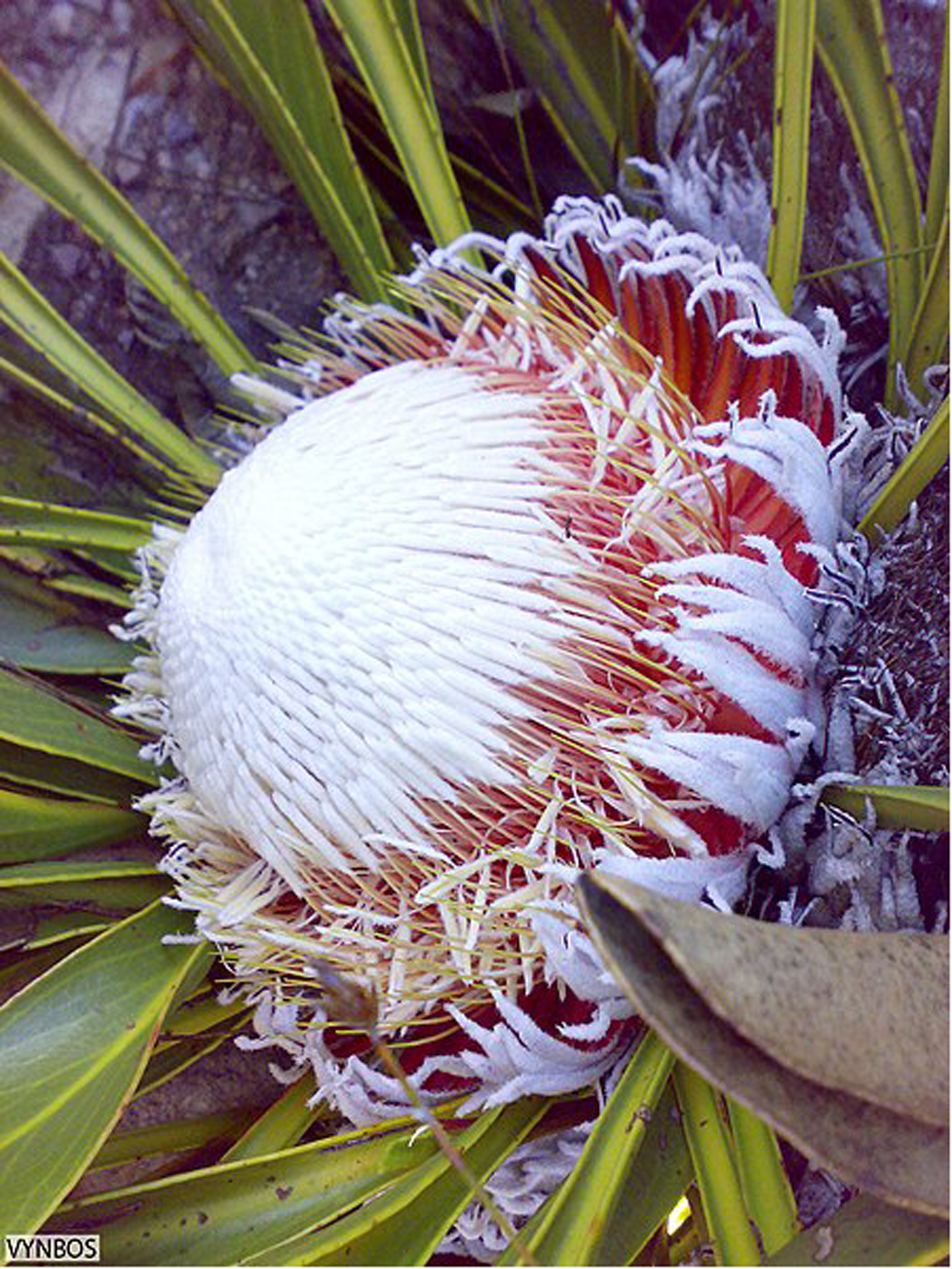
Snow Protea on Sneeuberg photographed in Feb 2014 (source: Chris Vynbos, https://commons.wikimedia.org/wiki/File:Protea_cryophila_15460838.jpg#/media/File:Protea_cryophila_15460838.jpg CC BY-SA 4.0; accessed 08/12/21).
Through its failure to flower, the Snow Protea is narrating ecological stress and multispecies vulnerabilities to which humans are profoundly connected. Fynbos has always been intimately associated with human occupancy of the southern Cape. It occurs naturally around catchments and plants help prevent direct runoff by retaining water in the high wetlands, releasing it slowly throughout the year and ensuring that up to 80 percent of rainfall flows downstream into rivers, reservoirs, and natural aquifers. The Cape Peninsula was first settled by Khoi and San peoples approximately 2000 years ago because of the fresh drinking water produced by Table Mountain, which they named Camissa – ‘the place of sweet waters' (Lindow, 2018; Mountain, 2003). Water was also the reason Europeans settled close to Table Mountain. Cape Town's fresh drinking water is still provided by catchments in the fynbos mountain ranges located east and north-east of the city (Otto et al., 2018). In 2017, as the wildflowers failed to bloom in the Cederberg, reservoirs fell to critically low levels and officials in Cape Town designated a ‘Day Zero’ to mark an exact time the city's water taps would be switched off. Urgent behaviour change by Capetonians ensured that Day Zero never arrived, but rapid climate change is ensuring that what once seemed predictable and reliable is now unpredictable and unstable, creating precarity and casting humans, proteas and other nonhumans into shifting assemblages where everything is in flux, including the ability to survive (Tsing, 2015).
The threat of Day Zero triggered renewed debate about how to manage Cape Town's future water supply in the context of extreme drought, but protecting the fynbos as a vital water provider was not considered. The corporeal rhetoric of the Snow Protea and countless other absent proteas in damaged ecosystems went unheeded. Instead, government officials proposed drilling boreholes into Table Mountain's aquifers. This would usually require detailed environmental impact assessments and management plans, especially in conservation areas. However, the future emergency of Day Zero enabled the provincial government to significantly relax requirements. Almost all of the 222 planned drill points fall within fynbos ecosystems listed as threatened under the National Environmental Management Act; 141 fall within formally protected areas (Slingsby, 2018). Ecologists, biologists and conservationists have warned that depleting aquifers threatens biodiversity and will harm dozens of wetland species; damage caused by drilling and pipelines risks wiping out endemic species, including proteas, that are hyper-adapted to micro-scale locations (Nordling, 2018). Nevertheless, in August 2020, city officials began pumping water from eight of twelve planned boreholes near the Steenbras Dam in the Kogelberg mountains.
It is too early to assess the ecological and environmental impacts of tapping the aquifers, but the corporeal rhetoric of proteas elsewhere tells of catastrophe: since the 1990s, Banksia proteas have exhibited extensive die-back following drilling of the Swan Plain aquifer near Perth, Australia (Groom et al., 2000); the only known surviving subpopulation of Protea roupelliae hamiltonii is similarly struggling because of water table depletion in the montane grasslands of South Africa's Mpumalanga Province. 17 In the CFR, there are fears that some critically endangered fynbos species may have already disappeared (Welz, 2018). Traces of extinct species are already written into human narratives of mourning: ecologist, Jasper Slingsby, used social media to draw attention to the banal violence of destruction with a valediction to the Wemmershoek Erica: ‘Goodbye… How many thoughtless flushes were you worth?'
Proteas as harbingers
Just as Proteus of Greek mythology could predict the future, phytography enables interpretation of the corporeal rhetoric of proteas as a prediction of future scenarios. The Mace Pagoda and the Snow Protea are not singular figures, but harbingers for the entire fynbos biome. Protea flowerheads comprise ecosystems in themselves, with as many as 2000 insect visitors on one inflorescence, including beetles and mites transported between flowerheads by nectivorous birds, mammals, and insects. Many species of protea are reliant on bird, rodent and arthropod pollinators, while proteas sustain thousands of insect species, birds, amphibians, reptiles and small and large mammals sustaining, in turn, the apex predator of the mountains, the Cape cheetah. Other predators, including mongooses and genets, feed on protea nectar (Steenhuisen et al., 2015). Thus, when proteas fail to flower, they portend potentially catastrophic species depletion and biodiversity loss, and future scenarios that may not suit their multispecies kinship assemblages, including humans. For as long as I have been researching in the Western Cape, those working closely with fynbos have claimed that proteas are behaving differently and unpredictably. Farmers claim that cultivated flowers are blooming later than previously. 18 Conversely, botanists suggest wild proteas are flowering earlier by three to five days with each degree Celsius increase (Daru et al., 2019), or not at all. Proteas are not simply behaving differently in situ but are also ‘moving uphill to their preferred temperature ranges in cooler locations' (email correspondence, climate change biologist 14/08/20). However, species like the Snow Protea, adapted to high altitude habitats, have nowhere else to go to escape increasing temperatures and aridity. The seeds of other species are carried on the wind to new locations, but only those that become rooted in cooler areas are surviving.
If phenological responsiveness to climate occurs independently among species, some aspects of plant-animal associations, including that of protea and pollinators, may be modified, leading to phenological mismatch (Daru et al., 2019). Mace Pagoda, and other species of protea that rely on ants burying their seeds to protect them from predators or fires, may disappear if their ant kin are displaced by heat-tolerant species that do not bury seeds. Proteas are migrating, but modelling suggests that a substantial number of species may lose all suitable range, many may become extinct even in protected areas, and abundance will decrease by more than 60 percent by 2050 (Lee et al., 2005). Their extinction also means the extinction of those aspects of human lives that are co-constituted through these experiences of the world – livelihoods derived from wildflower harvesting and tourism, the healing powers of nature spaces and biodiversity, and even the future viability of urban water supplies. Yet the deep historical record, which posits that climatic changes millions of years ago could be one of the factors that prompted the hyper-diversification in the CFR (Sauquet et al., 2009), suggests that proteas able to adapt and survive might, in the longer term, enable biodiversity to regenerate. As Tsing (2015: 20) argues, ‘indeterminacy … is frightening, but thinking through precarity makes it evident that indeterminacy also makes life possible'. Continued engagement with the storytelling of proteas is thus important for recognizing those lives with which humans are entangled (Collard, 2012), and for reversing the legacy of neglect that might allow them to ‘flourish beyond human interference and needs' (Pitt, 2018: 270).
Phytography and the ethics of writing with/listening to plants
Of the G20 countries, South Africa ranks highest in terms of ecosystem damage, with 0% intact and 40% considered fragile (Green, 2020). Cape Town metropolitan area is identified as a global crisis area, destroying its natural heritage faster than any other city (Rebelo et al., 2011). Attending to the corporeal rhetoric of proteas prompts the question: what kind of human-plant relationships are possible in the context of unfolding environmental catastrophe? Proteas are often represented as generic, ordered into taxonomies by botanists and conservationists, ranked by perceived rarity or vulnerability, and isolated from their habitats when they appear in influential databases, field-guides and herbariums. The realisation that capitalism and climate change no longer create the conditions for life (Tsing, 2015) in Cape Town, one of Africa's wealthiest cities, ought to represent a profound unsettling of the philosophical foundations underpinning ideas about progress. The city's water crisis exemplifies the overwhelming evidence that humans, as well as proteas, live on the brink, yet such is the scale of the ecological crisis that human abilities to envision survival in and life after the crisis are impaired. Instead, as discussed, solutions are being sought that threaten to further destroy biodiversity and worsen the catastrophe. The complexity and scale of the current crisis present significant challenges in creating knowledge about possible future forms of life and dwelling yet doing so is a task of extreme urgency.
Some scientists are paying attention to proteas as narrators of this catastrophe, becoming better attuned to what they foretell and providing fresh impetus to learn their ways. For example, The Protea Atlas, initiated by the South African National Biodiversity Institute, comprises thousands of records contributed by citizen scientists and is one attempt to learn what proteas reveal about the impacts of climate change. The Atlas has seen proteas emerge as a flagship group for scientific species distribution models responding to climate change and has identified eleven previously unknown species. 19 The protea's abundance of complexity, their remarkable variation in size, leaf form, adaptability to fires and other functional traits that determine how they are responding to climate change make them ideal research participants. Proteas are revealing that current fire intervals may be too short for slow-maturing, non-sprouting species like Mace Pagoda to set seed, but some species provide hope that survival may be possible at higher ambient temperatures in the future by germinating at temperatures 3.5°C above those at present (Allsopp et al., 2012). With scientists predicting shifts in the ranges of nearly all 300 protea species near Cape Town by 2050 (email correspondence 14/08/20), the Atlas provides a means for humans to become more attuned to their habits and preferences, and to be able to follow and learn from them. This is important because, as one botanist explains, refuges and protected areas that are fixed in place may no longer be appropriate and may need to be able to move where critically endangered species are likely to be in future, with ‘protected “connectors” that will allow species movement to new areas' (email correspondence 14/08/20). However, such encounters with nonhuman nature do not necessarily promote ethical consideration centred on feelings of connection, it is not inevitable that increased understanding of proteas and attuning to their stories will lead to an ethic of care, and acts of care in which humans take responsibility for nonhuman others by attempting to meet their needs do not always equate with ethical regard (Pitt, 2018). The attempts to protect the Mace Pagoda that led to its destruction in a Kogelberg storm is a case in point.
Phytography provides one creative way of responding to the challenges of listening to plants by allowing relationalities between humans and proteas to be interpreted in new ways, which may also create new accountabilities and obligations, and by enabling the imagining of an ethos of life attuned to its materiality, including ecological and nonhuman demands (Haraway, 2016; Tsing, 2015; Tsing et al., 2017). It embraces botanical lives, requires heterogenizing and an empathic regard for individual plants as subjects with particular lifeworld experiences. This is fundamentally different to preoccupation with botanical life through homogenizing, taxonomic ordering, and mapping of nature (Ryan, 2020). While not a wholesale rejection of botany, phytography seeks to counter reductive botanical approaches to plants. It promotes dialogue with emerging forms of botanical research on plant signalling, cognition and behaviour, which destabilizes human exceptionalism and promotes a ‘posthumanist appreciation of plant life' (ibid: 102). Phytography creates potential for collaborating and co-authoring narratives with plants, notwithstanding their profound otherness, and thus aims to generate empathic regard. It makes it possible to understand ways in which proteas ‘speak’ in a form of corporeal rhetoric about environmental change that humans cannot predict or control. It also requires a profound reorientation, including openness to learning from the ontologies of Indigenous peoples. This is challenging in the context of South Africa, where colonial genocide resulted in significant losses for Indigenous peoples, languages and cultures, and where diversity of ethnicities and ancestral heritages intersect with complex migration histories to generate status uncertainty and political complexity (Guodaar and Bardsley, 2021). Consequently, it is extremely difficult to connect storytelling with proteas with the stories, meanings or linguistic practices of the diverse inhabitants who have occupied this landscape and related to these plants over time. However, acknowledging that ‘Plants were here first and have had a long time to figure things out’ (Kimmerer, 2020: 246) is a useful starting point for phytography oriented towards seeing plants as teachers rather than subjects. Phytography challenges both scientific and literary representations that are at odds with understanding proteas as companion species – ‘full partners in worlding, in becoming with' (Haraway, 2008: 301) – and too dismissive of their own storytelling agency. It involves relating ethically to plants as storytellers with tales that are worth listening to while also being attuned to the lively relationalities in which they are situated. Engaging with proteas as storytellers is an important shift towards avoiding locating plants solely in human narratives of their worlds.
Sitting at the top of Sneeuberg with a Snow Protea that has refused to flower for several years, and reflecting on what this communicates, prompts questions about what it means for this specific way of life to be ending. What does its loss mean for its specific multispecies communities? ‘How are “we” called into responsibility… and how will we take up that call?' (Van Dooren, 2014: 147). Might mourning its absence help deeper acknowledgement of the impacts of genocidal colonialism on Indigenous peoples who knew them first? At the very least, being drawn into this relationality countervails the construction of difference that has allowed, and continues to allow, some humans to justify domination and destruction of plant (and human) life. Phytography also enables a critical ambivalence – our storytelling vegetal interlocutors are simultaneously proximate and distant, familiar and estranged from their listeners. Proteas do not necessarily relate to humans, value connection, or assume that relatedness is always an ethical good. They are skilled at evading human attention. Their withdrawals and disappearances are potent messages that require consideration, and acknowledgement that care also emerges from recognition that in certain assemblages their agency might be curtailed, damaged or lost. Learning to write with proteas, however, recognises them as ‘percipient co-contributors to multispecies worlds' (Ryan, 2017: 143) and may provide an opening to a more inclusive politics of the future.
Conclusions
This paper has sought to extend recent recognition of the agency of plants to explore ways in which proteas figure as storytellers in contested ecologies. While inter-species stories can reconnect humans with the ongoing impacts of environmental destruction (Van Dooren, 2014), the profound otherness of plants presents challenges for relational and empathic ethics. Humans can never fully understand proteas because they are unable to inhabit their perceptual worlds – to us, like their namesake in Greek mythology, proteas can be elusive tricksters and not always reliable narrators. However, drawing on Ryan’s (2020) conceptualisation, I argue that phytography, pivoting on the dialogical interplay between writing-with plants in a collaborative way and remaining vigilant to their writing-back, provides a way of engaging ethically with proteas.
Adopting a phytographical approach, I suggest that proteas have long written-back into human stories through their the multispecies worlds, and diverse haptic, olfactory and gustatory significations that have seen them become iconic figures in narratives of colonialism, conservation, floral nativism, post-apartheid nation-building and contested ecologies. Proteas assemble other liminal figures in the telling of lesser-told stories of life-worlds bound up with theirs: of the agency of Black people in first knowing and commoditising wildflowers, and the importance of their botanical expertise in bringing proteas to wider attention. They reveal the destruction to biodiversity brought about by deficiencies in colonial scientific knowledge. As storytellers they enable knowledge-making about biodiversity loss and the impacts of anthropogenic climate change without erasing past and present injustices, opening possibilities for an alternative, decolonialising environmental politics. Proteas are not solely the storied objects in human histories, but storytellers capable of inspiring curiosity among diverse publics concerned with their threatened ecologies. They translate the enormity of species depletion and biodiversity loss into something meaningful to publics and provide ‘a temporary bridge that allows communication and understanding among the constituencies of scientists, policymakers, and citizens' (Slocum, 2004: 431). The examples of the Mace Pagoda and Snow Protea illustrate how proteas engage in forms of corporeal rhetoric that enable us to move beyond thinking of plants as objects, assets or threatened species, but as a complex and precious way of life with creative agencies that enable them to write back into our narratives of them. They communicate about life on the cusp of obliteration, defying human narratives of extinction by disappearing for decades only to reappear when environmental conditions are favourable.
Writing with proteas enables human interlocutors to see differently, and to be drawn into new forms of relationality and ethical obligations, which may help countervail the construction of difference that has allowed, and continues to allow, some humans to justify the domination and destruction of plant life. It ‘extend[s] our sensory capacity to both notice and respond to environmental change' (Yusoff, 2010: 76). However, I also argue, following Ryan (2020), that the material inscriptions through which proteas express their lives come into being regardless of our textual or linguistic intercessions. Phytography, therefore, enables a critical ambivalence and acknowledgement that proteas do not necessarily relate to humans, value connection or assume that relatedness is always an ethical good.
Engaging with the corporeal rhetoric of plant life underscores the importance of writing with plants to evoke ‘new biosocial possibilities and a politics of the future that more fully recognises plants as percipient co-contributors to multispecies worlds' (Ryan, 2017: 143). This is significant because, as Yusoff (2010: 77) argues, there is not yet an adequately developed vocabulary that describes the interdependence of multispecies flourishing and destruction within environmental change. Nor does the conceptualisation of climate change as a human-centred, human-instigated global practice ‘properly represent the biophysical world as an already full space of that which is not exclusively “ours” to make'. Phytography provides a means of navigating the challenges of listening to plants and of foregrounding plant agency in multispecies storytelling in the fynbos biome. As Ryan (2020: 116) argues: ‘As all kinds of plants … write the narratives of their own lives, the onus is on the human author to sense, listen, wait, and allow their voices to come forth'. Deeper recognition of and learning from Indigenous ontologies (e.g. Hayman, 2015; Todd, 2017) may provide further routes to listening to plants as storytellers and knowing them as kin.
Attending to plants as storytellers disrupts the binary world inherited from colonialism and apartheid of subjects (citizens) and objects (nature/natives). It opens possibilities for a different kind of eco-politics, an alternative to conservationism shaped by unacknowledged legacies of colonial racism that rebrands white supremacy as politics that claims to speak in the name of nature (Green, 2020). Attempts to address injustices by commodifying nature to conserve it cannot resolve these legacies: both humans and nonhumans remain ‘victims of the gods of reason' that demand technical efficiency, economic productivity and scientific objectivity (Stengers, 2020: xiii). Writing with and paying heed to proteas as storytellers helps rethink science not as a racialised claim to authority, but as a form of enquiry that embraces ‘encounters of humans, technologies, and modes of doing politics, with this planet's planes of existence in rock, water, and life' (Green, 2020: 17), including vegetal life. While ‘telling the needed stories, building the needed worlds and muting the deadly ones’ (Haraway, 2019: 18) is critically important, I argue that hearing the needed stories also matters: ‘Plants answer questions by the way they live, by their responses to change; you just need to learn how to ask' (Kimmerer, 2020:158).
Plants are playing a key role in today's most urgent environmental political issues – biofuels, carbon economies, food, and livelihood dynamics (Head et al., 2014). They remain fundamental to human survival. Forms of dialogue between human and more-than-human diversities are needed to reflect on multiple understandings of the world. Proteas narrate more-than-human time, detachment, precarity, adaptability, and resilience, the need for wisdom and eternal patience, and that ‘everything has its time and arrives when it is necessary' (Alem Rojo and Alvarez, 2016: 93). 20 They might teach us to learn, to unlearn, and to learn to wait in ways that modern time does not permit. They might gather us, encourage us to embrace more-than-human worlds, and to dwell with them to better comprehend the unfolding ecological crisis. There is much to be gained – by botanists, conservationists, climate scientists, citizen scientists and other publics – from writing with and learning to listen to plants, and an urgency to doing so if we are to find ethical routes to mutually habitable life.
Highlights
Advances more-than-human and nonhuman geographies to consider plant agency in contested ecologies
Uses phytography to conceptualise plants as agentic storytellers
Argues for engaging in multispecies storytelling with plants to better conceptualise the ethics and contested ecologies associated with biodiversity loss
Uses case studies of proteas to answer questions of how we come to know plants and what kind of ethics emerges from this
Footnotes
Acknowledgements
I would like to thank the many people in the Western Cape who have taught me so much about proteas over the years, and who have helped me reconcile with all that I don't know and have still to learn. I am especially grateful to my friend and collaborator, Professor Alex Hughes, who generously read and helpfully commented on two versions of this paper and offered encouragement at critical moments. I would also like to acknowledge my friends and collaborators at Flower Valley Conservation Trust in South Africa, particularly Kirsten Watson, Lesley Richardson and Roger Bailey, as well as my long-time research partner, Dr David Bek. The impulse to write this paper came at a time of significant loss and grieving. A premature sketch of some of its ideas was all that I could manage in response to an invitation to present them at the Department of Geography, Cambridge University. I am grateful for the generous response these rudimentary ideas received. The final version owes much to the generosity of Dr Kate Lewis, who provided encouragement as well as perceptive comments, and of colleagues in the Geography Department at Durham University, who participated in a Work in Progress workshop scheduled at a very busy time in the teaching programme during the Covid-19 pandemic. I am especially grateful to Ben Anderson, Sage Brice, Harriet Bulkeley, Hannah Dickenson, Andrew Dwyer, Greta Ferloni, Karen Lai, Jessi Lehman, Aya Nassar, Jeremy Schmidt, Anna Secor, Marcin Stanek and Helen Wilson for their insights and inspiration. Any errors are, of course, my own. Finally, I would like to thank three anonymous reviewers and the Editor for their generous, constructive and helpful responses to the paper.
Declaration of conflicting interests
The author(s) declared no potential conflicts of interest with respect to the research, authorship and/or publication of this article.
Funding
The author(s) received no financial support for the research, authorship and/or publication of this article.