




Abstract
Water infrastructures are often living infrastructures, whose operation relies on processes involving other-than-human living beings. This article considers the materiality of waterscapes by attending to this liveliness. We argue that critical water research can benefit from situating social relations and water transformations within more-than-human worlds. Our conceptual framework brings hydrosocial scholarship into conversation with more-than-human geography. This opens avenues for interdisciplinary water research that weaves together ecology and qualitative social research. The analytical potential of such a framework is explored through an empirical account grounded in two constructed wetland projects in rural India. These infrastructural assemblages engage humans, other living beings and objects in webs of material-semiotic processes. We present three stories of intra-action that focus on particular plants, microbes and animals within these waterscapes. Our analysis highlights the crucial importance of other-than-human living beings in the production of waterscape knowledge and suggests a need to go beyond the problematisation of ‘uneven’ waterscapes. Approaching waterscapes as more-than-human collectives prompts us to consider the power relations that underpin waterscape knowledge and the politics of multispecies justice. A focus on more-than-human infrastructures opens up the possibility of interdisciplinary water research that is better attuned to the hybrid nature of social and ecological processes, as well as the politics embedded therein.
Introduction
The waterscape concept is an approach to water research that emphasises the co-production of water and society (Bouleau, 2014; de Micheaux et al., 2018; Karpouzoglou and Vij, 2017; Swyngedouw, 2004). The research developed along these lines examines the power relations, infrastructures, material flows and representations that shape hydrosocial relations across time and space (Acharya, 2015; Boelens et al., 2016; Budds, 2016; Linton, 2010; Rusca et al., 2017; Swyngedouw, 2004, 2015). Within this field, a focus on water infrastructures has highlighted how they are powerful shapers of sociopolitical arrangements (Aubriot and Prabhakar, 2010; Meehan, 2014; Taylor and Bhasme, 2021). Building on this critical epistemology of water and society, hydrosocial research has focussed on developing case studies and undertaking historical analysis to critique the contingent and often profoundly inequitable nature of waterscapes.
This paper argues that other-than-human beings deserve more attention in hydrosocial scholarship. Water infrastructures function through both human and other-than-human doings. To give some examples: conventional wastewater treatment harnesses the metabolic labour of microbial ‘communities’; rivers are frequently called upon to carry wastewater to other locations downstream, while the aquatic life within them reworks this pollution (often with disruptive ecological consequences); and constructed wetlands rely on a complex wetland ecological community to purify water. If these examples appear to suggest a subordinate relation – nature put to use for human ends – the reality is more complex. As more-than-human life becomes enmeshed in water infrastructure, the intentions and lifeways of other living beings produce infrastructural arrangements that exceed or subvert the intentions of water engineers and managers (Wakefield, 2020). The entanglements that emerge in these more-than-human infrastructures create various forms of human and other-than-human vulnerabilities and power relations, which reveal a broader political and ethical set of concerns for waterscape studies.
Two constructed wetland projects form the empirical foundation of this article, both designed by teams of scientists and engineers, and built to treat wastewater in villages in rural India. In exploring these wastewaterscapes we were struck by the complexity of more-than-human relations. This experience animates the theoretical conceptualisation presented here. A lack of acknowledgement of more-than-human relations risks overlooking how these relations stabilise, or provide the means to contest, waterscape injustices. It also limits the potential for careful engagement with the knowledge and methods of ecological science (Krause and Strang, 2016; Swanson, 2017). Hence, greater attention to living beings in waterscapes holds the potential for richer methodologies as well as a revitalised ethical critique.
Inspired by more-than-human geographies and other multispecies studies, this article approaches the waterscape as a site of more-than-human agency, where material transformation and the production of water knowledge unfold through relations between people, other living beings and technologies. We aim to demonstrate the value of attention to more-than-human life within hydrosocial research. In the following sections, we first present our theoretical alloy of waterscape and more-than-human approaches. We then describe the empirical context of the two sites and the methodology developed in this research, before telling three stories of intra-action. We adopt Karen Barad's term ‘intra-action’ (Barad, 2007) as it speaks to the indivisibility of water and more-than-human lives. The concluding section builds upon the theoretical and empirical material to consider interdisciplinary methods, waterscape knowledge and ethics.
A more-than-human waterscape
Introducing waterscapes
The waterscape is a political ecology perspective on watery socionatures, initially detailed by Eric Swyngedouw in his work on the politics of water in Guayaquil, Ecuador and Spain (Swyngedouw, 2004, 2015). Swyngedouw describes the waterscape as ‘a manufactured landscape, one that is wrought, historically and geographically, from a mesmerizing mixture of local, regional, national, and international socio-economic and political-ecological processes and struggles’ (Swyngedouw, 2004: 3). While there is fluidity in how a waterscape lens can be used (Karpouzoglou and Vij, 2017), a common approach views the waterscape as an assemblage of waters, discourses and imaginaries, people, institutions and infrastructures. In this way, waterscape scholarship is able to engage with hydrological and hydraulic processes (French, 2019) as well as the cultural politics of water conflicts (Acharya, 2015; Baviskar, 2007). This article contributes to two under-emphasised foci in critical water studies; wastewater (see Ghosh, 2018; Karpouzoglou and Zimmer, 2016; Mukherjee, 2020; Zimmer, 2012) and water quality (see, e.g., Gorostiza and Sauri, 2017; Karpouzoglou et al., 2018; Rusca et al., 2017; Sultana, 2013). The waterscape concept is a flexible theorisation of waters (and their relations) as evolving socio-natural assemblages.
Swyngedouw emphasises that waterscapes are also a lens to explore power (Swyngedouw, 2004: 3). The political ecology tradition understands power as multi-faceted and relational (Ahlborg and Nightingale, 2018; Svarstad et al., 2018). To describe the outcome of power relations, critical geographers commonly use the concept of unevenness (Budds, 2016; Meehan, 2014; Taylor and Bhasme, 2021). An uneven waterscape is a common summation (e.g., Rusca et al., 2017; Sultana, 2013: 348; Truelove, 2011). This unevenness may be the result of elite or capitalist interests, but also reflects the ‘role of gender, class and race as key variables in producing uneven water infrastructure development and differentiated access to water’ (Rusca et al., 2017: 139). With a focus on these dynamics, vulnerable waterscapes have been offered as a feminist political ecology perspective (Hanson and Buechler, 2015). The concept of vulnerability establishes that unevenness is not only a matter of material distribution but also the power relations and affects generated through engaging in waterscapes.
The combination of both material and meaning-making processes is another strength of waterscape accounts. This is aligned with the traversing of social and biogeophysical sciences that is part of the political ecology tradition (Walker, 2005). We refer to this combination as material-semiotic, following feminist and STS scholars (Haraway, 1988, 2008; Lien and Law, 2011). Waterscape processes are simultaneously material (relating to the movement or transformation of matter) and semiotic (as they carry meanings across relations) (Castree, 2005; Law, 2019; Swyngedouw, 2004). As an example of how this coshaping of matter and meaning applies to water, Farhana Sultana emphasises that ‘depending on what else is present at the molecular level, or dissolved in it, or carried with it, water comes to signify very different things’ (Sultana, 2013: 348). These significations lead to the designation of ‘good and bad water’, signifying the promises and contradictions of development. It follows that attending to materiality in a waterscape – as this article does – will exceed the material, and raise questions about the power relations that underpin competing knowledge claims about wastewater and the implications of these knowledge politics.
While waterscape analysis typically considers an assemblage that includes human actors, waters and water infrastructures, this framing is at risk of overlooking a key point. (Waste)water assemblages are not only hydrosocial (in the sense of meshing waters and human social dynamics) they incorporate a wide variety of more-than-human life. These living beings are important agents in (waste)water transformations and representations. Microbial labour is the standard mechanism for water and wastewater treatment (Kadlec and Wallace, 2008), while particular microbes signal poor water quality. There is also a wealth of life that interacts with wastewater flows, without impacting treatment processes. A more-than-human perspective is therefore a generative approach to political ecologies of water.
The relevance of more-than-human approaches to the waterscape
More-than-human research 1 highlights the agentive and political capacities of other-than-human beings and forces (Bennett, 2009; Braun, 2004; Country et al., 2015; Haraway, 2008; Srinivasan, 2019; Tsing, 2013). By emphasising the capacities of varied beings and objects, more-than-human scholarship fosters a different understanding of action in social worlds; one influenced by a broader turn to relational approaches (Anderson et al., 2012; Rocheleau and Roth, 2007; Whatmore, 2002). While a recent ‘turn’ in social research, many of the key theoretical claims of this scholarship are pre-figured by diverse Indigenous ontologies and knowledge systems that do not subscribe to the modern social–natural separation (Country et al., 2015; TallBear, 2011; Watts, 2013). This is a point often overlooked in more-than-human scholarship (Sundberg, 2014; Todd, 2016). A review of more-than-human approaches connecting to water and political ecology more broadly, suggests two overlapping ways of approaching action that are relevant to our wastewaterscapes; through other-than-human presence in collectives or assemblages (including multispecies infrastructure), and participation in knowledge-making processes.
Juanita Sundberg's work on the politics of the USA–Mexico border illustrates the potential for more-than-human political ecology. Her research traces the relations between ocelots and desert landscapes in order to locate power in collectives (Sundberg, 2011). In Sundberg's case, the focus is on the struggles over lives and well-being that unfold between competing border enforcement and nature-inclusive collectives. She suggests that, to develop more-than-human political ecologies, ‘concepts like network, assemblage, or collective are used as analytical tools’ (Sundberg, 2011: 321). These tools can visualise ‘how unique and historically contingent associations between entities—humans, animals, plants, machines, devices like maps or diagrams, and other things—gather in ways that stabilize a particular socio-political order’ (Sundberg, 2011: 321). The concept of more-than-human collectives provides a way of thinking through an extended concept of politics; diverse beings and materials figure in political action through their contribution to interrupting or holding together a ‘socio-political order’, which is always a collective, more-than-human achievement (Fleming, 2017; Sundberg, 2011).
Socio-political orders in many parts of the world are shaped by colonial orderings, logic and power relations. In this context, work that engages with Indigenous ontologies and analytics 2 is often sensitive to the more-than-human nature of waterscapes. Within this scholarship, bodies of water are engaged as living or metaphysical beings (Aigo et al., 2020; Povinelli, 2016; Stewart-Harawira, 2020; Te Aho, 2019; Wilson and Inkster, 2018; Yates et al., 2017). There is also close attention given to the life supported by water, such as fish (Country et al., 2015; Parsons and Fisher, 2020; Todd, 2017, 2018; Woelfle-Erskine, 2017). This scholarship reflects a vibrant struggle to both continue ancestral ways of relating to water and reshape the collectives that are included within water management as a step towards decolonisation (Parsons et al., 2021).
Another conceptual manoeuvre that has brought more-than-human analysis into waterscapes is a focus on infrastructure. Atsuro Morita's research on multispecies flood infrastructure in the Chao Phraya Delta (Morita, 2017) explores how the cultivation of floating rice blurs the boundaries between infrastructure and the environment. Morita suggests that infrastructure has a ‘capacity for rendering multispecies relations explicit’ (Morita, 2017: 739). A growing body of literature engages with the ‘infrastructural turn’ to argue that infrastructures often encompass multispecies relations, whether or not this is acknowledged (Barua, 2021; Carse, 2012; Enns and Sneyd, 2021; Krieg et al., n.d.). These infrastructures are a particular form of multispecies collective that is highly significant in waterscapes.
The generation of waterscape knowledge in many cases requires paying attention to more-than-human vitality. More-than-human relations are crucial within many Indigenous knowledge systems (Barker and Pickerill, 2020; Fisher and Parsons, 2020; Watson and Huntington, 2008). Given the importance of knowledge politics to waterscape studies, the possibility for more-than-human approaches to shed new light on processes of knowledge production is significant. As Actor-Network approaches within STS argued, the production of scientific fact requires assemblages of more-than-human entities, but these entities may not act as expected (Sayes, 2014). As knowledge is employed to do political work, close attention to the other-than-human beings in these assemblages may be used to analyse and critique dominant knowledge.
A particular example of more-than-human involvement in knowledge production is the concept of biosensing. Emily Johnson investigates the development of standardised testing kits for environmental testing using living organisms, for example, mussels, plants or insects (Johnson, 2017). In this biosensing the connection between living bodies and knowledge is clear ‘it is the labor of living itself that produces knowledge of a changing world’. Hence, ‘biosensing appropriates and enrols nonhuman life in cognitive and communicative endeavors’ (Johnson, 2017: 15). The ethical implications of these communicative endeavours depend on the more-than-human assemblages they are part of. Biosensing, in Johnson's telling, is an example of the kind of Anthropocene biopolitics we should hope to avoid. Appropriating living beings to act as sensors, implies intentionally subjecting them to possible ‘trauma’ (Johnson, 2017: 10). But this does not preclude positive enrolments of living beings into knowledge production. Caterina Scaramelli's ethnography of multispecies encounters used to know water quality in Boston (Scaramelli, 2013) is suggestive of these possibilities (see also Gabrys, 2018; Gramaglia and Sampaio da Silva, 2012). Recognising that knowledge production may be built off other-than-human labour and suffering is just one reason for ethical consideration of multispecies relations.
Close attention to the ethics of more-than-human relations has generated a wide diversity of theoretical approaches to ethical action in more-than-human worlds (Arboleda, 2017; Collard et al., 2015; Gandy, 2019; Haraway, 2008; Kirksey and Helmreich, 2010). These include positive conceptions such as multispecies cosmopolitanism (Mendieta, 2010; Srinivasan, 2019), response-ability (Haraway, 2008) and care (de la Bellacasa, 2017; Krzywoszynska, 2019). More-than-human scholarship also offers critical perspectives on more-than-human biopolitics (Helmreich, 2007; Srinivasan, 2014; Wakefield, 2020), and more-than-human labour (Barua, 2019; Battistoni, 2017). In sum, more-than-human theorising offers a way to frame relationalities between humans and a more-than-human social world, in order to interrogate the ethical and political dimensions of these relationships.
Introducing and exploring waterscapes: Sites and methods
This research is grounded in two rural villages in India: Hasampur, Uttarakhand, and Bettavalli, Karnataka 3 . The contemporary wastewaterscape is similar in both villages, following a pattern of water use and infrastructure development that is fairly typical across their respective regions. Open drains guide wastewater, under gravity, out of the village to fields or ponds. However, many drains are blocked by sediment, rubbish, grasses, construction materials and plants springing up from seeds in kitchen waste. There are ongoing programs for building new concrete drains and cleaning out the blocked ones, but not always reliably. Development projects of electrification, borewell digging and piped surface water supply over the past decades have brought water more readily to hand in both villages, hence increasing wastewater flows. By volume, wastewater is largely generated by cleaning bodies, clothes and kitchenware. Livestock ownership is common in both villages. A rough estimate suggests that in total these cows are responsible for a greater share of water use than the human residents of Hasampur (Goyal and Singh, 2018). In addition, inappropriately sized pit toilets built under the Swachh Bharat Abhiyan program are contributing human sewage to wastewater as they quickly fill and overflow (a situation that is not unique to these villages (Bhallamudi et al., 2019). This ‘blackwater’ is the primary wastewater concern for local people in Hasampur 4 .
All wastewaters are complicated mixtures of dissolved and suspended matter including H2O, nutrients, contaminants, microbial life, and sediment. Wastewater infrastructures serve two key purposes, the movement of wastewaters, and ‘treatment’; the material transformation of wastewaters into ‘treated’ water (and sludgy byproducts). In this context, projects to reshape local wastewaterscapes have recently been implemented in each village 5 . In both projects, one component is a constructed wetland, a particular water treatment technology. Through treating wastewater, these projects aimed to contribute to improving water quality and enhancing options for water conservation and reuse. The driving force of these infrastructure improvements has come from transnational partnerships of scientific organisations. This is not a typical institutional arrangement for waterscape transformation. At the same time, panchayat 6 politicians and residents in each village have prior experience in navigating similar external projects, brought about through NGOs, Corporate Social Responsibility or research ‘outreach’ activities. Our involvement with these villages and wastewaterscapes comes out of our involvement in these constructed wetland building projects. The waterscape concept is applied over and within a variety of scales (Boelens et al., 2016; de Micheaux et al., 2018; Swyngedouw, 2015; Zimmer, 2012). The close spatial focus adopted in this article allowed for a detailed exploration of social and ecological relations in each wastewaterscape.
Constructed wetlands are engineered systems that rely on ‘natural’ processes to improve water quality. In these engineered structures, ‘natural’ processes are a key part of the wastewater treatment process (Kadlec and Wallace, 2008; Wetzel, 2001). Water flows through a tank filled with stone or brick, which quickly becomes home to diverse communities of microbes, fungi, plants, and animals (Kadlec and Wallace, 2008). While the majority of the treatment performance of a constructed wetland is facilitated by microbial biofilms beneath the surface, the wetlands are planted with wetland plants (Canna lily in the case of these wetlands) for both aesthetic and performance reasons. In Bettavalli, two parallel constructed wetlands are the final stage of a treatment chain for sewage from the toilet block of the primary school. After passing through the wetland, the water flows out into the drain. The Hasampur constructed wetland takes water from the village drains, and discharges water to an adjacent pond.
This pond is significant to the story. Discourses around ponds play a role in reshaping Indian waterscapes, even when the historical role of ponds for irrigation water has been replaced by tubewells with electric pumps, and their water quality has been degraded. Ponds are supported by the state development apparatus, and their construction and maintenance are linked to rural employment schemes 7 . As many scholars have explored, ponds also have a hefty historical-cultural relevance (Aubriot and Prabhakar, 2010; Mishra, 1993; Mosse, 1999; Zimmer et al., 2020). Ponds carry the weight of both appeals to traditional water management (Agarwal and Narain, 1997; Mishra, 1993; Taylor and Bhasme, 2021), and renewed efforts to combat dire water scarcity projections (Mehta, 2005). Their valorisation takes on a logic which is difficult to challenge. The ‘rejuvenation’ of the pond was seen as a key outcome of the wetland construction in Hasampur. The design and implementation of the Bettavalli constructed wetland was also influenced by the powerful national discourses on water scarcity and conservation in India (Mehta, 2005), a scale mismatch given the generally adequate water supplies in this village. These are wastewaterscapes strongly shaped by developmentalities (Deb, 2009; Srinivasan and Kasturirangan, 2016), and multifaceted power relations.
More-than-human waterscape research is strengthened by a methodological approach that draws from various disciplines, combining social and ecological research methods (Haraway et al., 2016; Strang, 2018; Tsing, 2013). The importance of interdisciplinary work for critical water studies has been repeatedly emphasised (Krause and Strang, 2016; Rusca and Di Baldassarre, 2019). The findings of both social and natural science methods are crucial for conveying the richness of more-than-human waterscapes. In the context of this article, this means bringing together focus group discussion, participant observation and microbial and chemical water quality testing methods.
Data generation was carried out in three field visits, in November 2018, May and June 2019, and February and March 2020, as part of an ongoing research project. Methods were developed by Elliot Hurst, in consultation with the co-authors. Focus groups were chosen as an approach that participants would find practical and comfortable (Liamputtong, 2011; Vissandjée et al., 2002). These focus groups were recruited with the assistance of local residents, with subsampling to include caste and gender as axes of difference. In February and March 2020, nine focus groups were chosenin Bettavalli and eleven in Hasampur. Discussions took place in Hindi (Hasampur) and Kannada (Bettavalli) and were guided by three Indian research assistants. Three topic guides were used, one concerning general wastewater issues and the others on wastewater animal encounters and judging water quality. Transcripts were translated to English by those who conducted the interviews. This translation meant some loss in the nuance of the conversations, but this was a pragmatic and necessary compromise for analysis. The second method of data generation was a participant observation, carried out by Elliot. Notes of conversations with project team members, research processes and waterscape observations form a key part of the analysis. In relation to this observation work and to the analysis more broadly, reflection on our positionality as researchers is important (Sultana 2007; Sundberg 2014). Elliot Hurst and Rowan Ellis were travelling to India from the United Kingdom and gained legitimacy and access to local people through their connection to the wetland constructed projects. Elliot's position as a white (settler/pākeha), male researcher contributed to smooth interactions with project teams at both locations. Anu Karippal's position as a female researcher from the Global South, particularly South India, her familiarity with the native language Kannada, as well as her participation in previous research in Bettavalli all played a significant role in facilitating interactions, especially with local, female informants.
Ecological research methods that contributed to the analysis in this article include water quality sampling, genetic analysis using qPCR, and ecological observation. Water quality sampling was carried out over 7 months at Hasampur and 11 months at Bettavalli, with sample collection and analysis being carried out by project research teams and generously shared. Besides this primary data, the analysis also draws upon secondary data from published literature on constructed wetlands, water quality and wetland ecology.
In theorising and describing more-than-human wastewaterscapes, this article takes biological organisms as its focus, and hence sets aside other non-living beings and materials. To highlight living beings in this way is not to deny the capacities and potentialities of non-living materials. In the case studies we present the material and chemical properties of water, stone, broken brick and sediment,which are also crucial to water quality transformations and habitat-making. A decision about which beings, materials and forces are relevant in thinking about water is both a situated and a political choice. Highlighting living beings, and hence differentiating between living and non-living is a particular ontological position (De Wolff, 2017; Ingold, 2011: 67; Povinelli, 2016; TallBear, 2017), and one which we approach with some caution.
One justification for our focus on biological organisms is empirically derived; in the wastewaterscapes that we focus on here, specific beings occupied a significant role in human understandings and experiences around wastewater. Our focus on other-than-human beings makes visible the liveliness of wastewaterscapes, but we acknowledge that this is a result of our methodological and analytical choices. Our conceptualisation is not intended as an ontological claim. The results of this perspective are shown in the next section, as we present three stories of intra-action that explore the entanglements of microbial, plant and animal life in these wastewaterscapes.
Lively wastewaterscapes
Attentiveness to Escherichia coli unravels waterscape knowledge
Water quality can be known through the intra-action of water with living beings. The technical evaluation of the projects by their respective scientific teams relied upon material-semiotic capacities of living beings; their material actions and ability to signal particular realities. E. Coli is a bacterium that was first identified in 1885, from faecal samples. Its role within the human microbiome (Eckburg et al., 2005) suggested a potential for E. coli as a water quality indicator (Ashbolt et al., 2001). Though most strains of E. coli are not harmful to people (and some are beneficial), the presence of human gut bacteria in water used for drinking indicates flow patterns that could spread water-borne diseases. In the first decade of the 20th century, E. coli was introduced for water quality testing in London, UK. The exact testing method has changed alongside changes in technology yet testing for E. coli remains a standard part of water quality standards worldwide (Ashbolt et al., 2001). Making visible the presence or absence of E. coli brings it into a testing apparatus that signals the risk of sewage pollution.
E. coli testing both relies upon and reveals the abundance of microbial life in water. Testing methods rely on propagating living E. coli bacteria. The Colilert® process was the method of analysis for E. coli at both sites. A water sample is collected and as soon as possible afterwards a customised reagent powder is added. The water is poured into a standard clear plastic container, resembling an ice-tray, and incubated for 24 hours. During this time, a chemical compound in the reagent is metabolised by E. coli bacteria, using a specific enzyme (β-glucuronidase) which only E. coli produces 8 . Using this tailor-made food source, E. coli are able to multiply, while other bacteria starve. This metabolic process also releases a molecule (4-methylumbelliferone) which, under UV light, emits a fluorescent blue glow (see Figure 1) (Colilert - IDEXX US, n.d.). Counting the number of glowing ‘wells’ allows finding an estimate of the E. coli numbers in the water sample to be calculated.
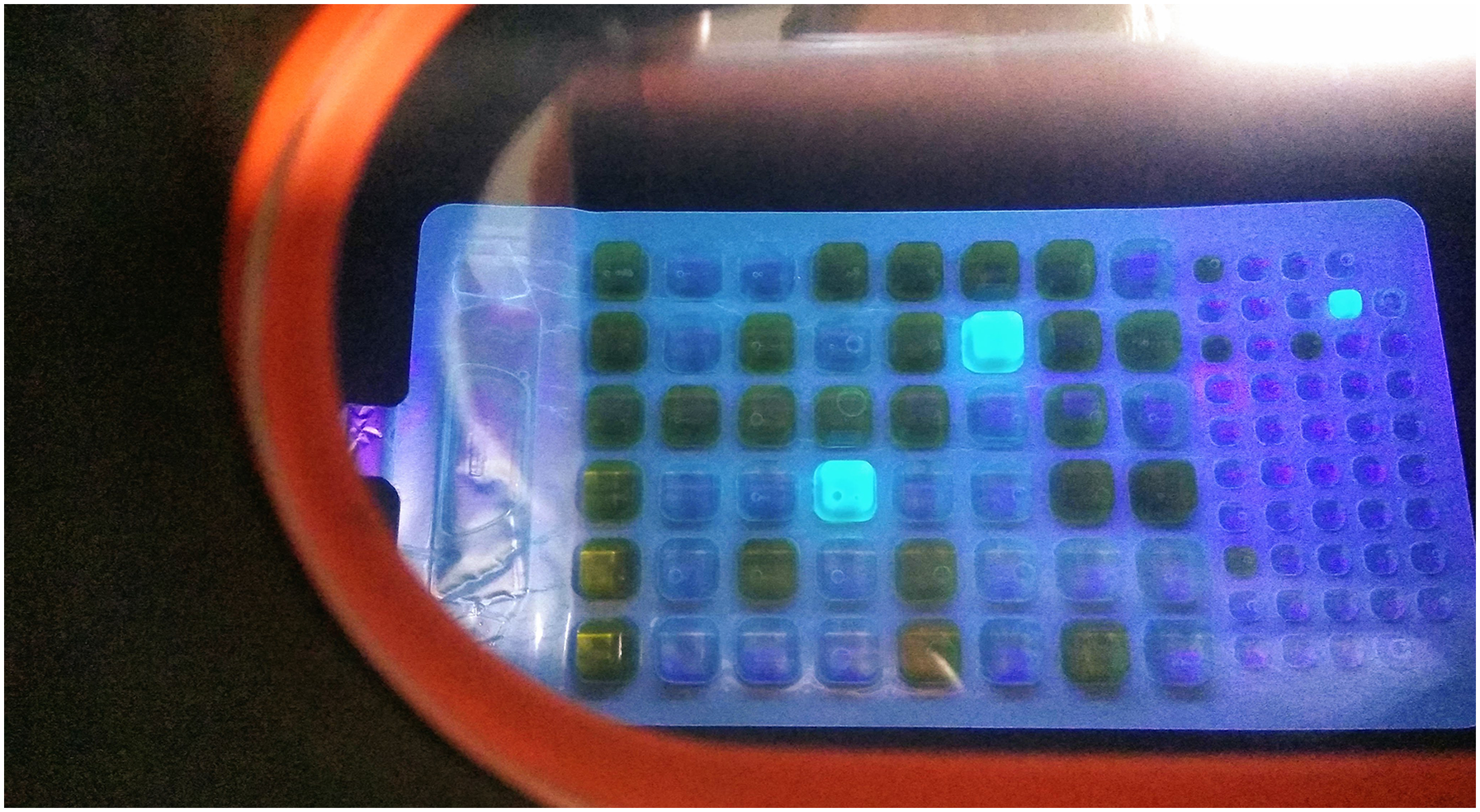
Colilert tray under UV light.
The water coming out of the Hasampur wetland had an average E. coli count of 3.2 × 10⁶ MPN/100 ml 9 . To put this more prosaically; a cup of this water contains approximately 10 million E. coli bacteria. And yet, this is just a small fragment of wastewaterscape liveliness. This water was also tested using eDNA analysis 10 . Using 16S markers revealed only 0.13% of the microbial genetic material in the outflow sample came from the family of bacteria that includes E. coli (Enterobacteriaceae), with a total of 49 different bacterial genera 11 distinguished in the water sample. These genetic traces suggest a web of material metabolic transformation. Through their metabolic processes: decomposing organic carbon compounds, transforming nitrogen, and building slimy biofilms, the microbial communities of the constructed wetlands are the main agent in wastewater treatment, as they are in many other wastewater treatment systems (Truu et al., 2009). Attending to the scale of microbial life makes it abundantly clear that the waterscape is thick with living beings. The Colilert® test, with its propagation of E. coli life and colourimetric reactions, makes one fragment of this life visible.
While E. coli's material presence is certain, its ability to represent the pollution of a particular wastewater flow is ambiguous. The use of E. coli as an indicator is backed up by an assumption that E. coli is a gut bacterium, and does not survive long outside of this niche. However, microbial ecologists have discovered that this assumption can not be universalised. E. coli will also live happily in aquatic environments and soils, particularly in tropical climates (Jang et al., 2017; van Elsas et al., 2011). A World Health Organisation report concludes that for analysing faecal contamination ‘alternative indicators… may be preferable’ (Ashbolt et al., 2001: 305).
The work of Arce-Nazario (2018) on water supply systems in Puerto Rico, provides an illustration of the socio-political consequences of misapplied methods and standards. E. coli may be found in Puerto Rican streams without any sewage pollution, unlike in the mainland USA (where Puerto Rico's water quality standards are devised). The use of E. coli to diagnose unsafe water systems is a ‘misreading of Puerto Rican ecology’ (Arce-Nazario, 2018: 467). As more about E. coli lifeways is understood, its part in a standard testing assemblage should be questioned. ‘While compliance methods provide an apparently objective view of the distribution of risk, they draw definitions of environmental risk from a narrow perspective’ (Arce-Nazario, 2018: 476). In the case of Puerto Rico, this meant designating community-managed water supplies as unsafe. In our case, high concentrations of E. coli are likely to indicate sewage pollution. At the same time, environmental E. coli increases the likelihood of failing to meet water quality standards – creating the misguided impression of a malfunctioning infrastructure and muddying water quality results. Closer attention to the life of E. coli reveals the selectiveness of E. coli testing, the ecological knowledge that it excludes, as well as the uncertain water quality knowledge it generates.
And yet, two decades on from the World Health Organisation's recommendations, E. coli is tested in these Indian wastewaterscapes, and many others. What are the constellations of knowledge, technology and politics that have rooted E. coli so firmly in the practices of a variety of actors? We can offer two conjectures. Firstly, despite its flaws, E. coli is included in Indian water quality standards, defined by Pollution Control Boards at national and state levels (Bureau of Indian Standards, 2012). These standards are made through consideration of WHO organisation guidelines, and also the standards of countries of the UK and USA (Bureau of Indian Standards, 1973). In this way, as knowledge follows pathways laid down by colonialism, the behaviour of E. Coli bacteria in one climatic zone is universalised. Standards can become goals in themselves, detached from the way that materials become pollutants in specific contexts.
Besides the solidity of national standards, another factor nudging towards E. Coli testing is the technology available for it. The Colilert® method described above is an easily implementable method requiring a simple set of equipment and reagents, all produced by an American company (Colilert - IDEXX US, n.d.). The simplicity of this test reflects the product development that has gone into it because of the widespread use of E. Coli as a water quality testing parameter. In contrast, testing for some of the other bacteria that the World Health Organisation recommends requires microbial assays that require more specialised equipment and skills (American Public Health Association, 2005). E. coli testing follows a well-worn groove determined by legal and technological constellations, which create and legitimise a particular way of knowing water quality. In contrast, we agree with Arce-Nazario, who argues for a ‘geographic, multi-scale method in defining good drinking water’, including social research (Arce-Nazario, 2018: 478). The example of E. coli highlights the need to develop appropriate water quality measures by thinking through the specificities of a particular waterscape and the uses and flow paths of water within it. Sampling and propagation make the presence of E. coli bacteria visible, but pay insufficient attention to their significance.
Wetland and crop plants signal water quality
Crop and wetland plants manifest the material-semiotic knots of waterscape action. Unlike E. coli, which is only visible through technical processes, the intra-action of wastewaters and plant bodies is read by both scientific teams and local people. In a more-than-human waterscape, agency lies not only in the material transformations involving plants, but the representations that plants play a part in enacting. Reading plant health can be used to attest to the quality of particular water, or to the transformations of water quality taking place in wastewater infrastructure.
For farmers in Hasampur who do not have their own tubewell, the village pond, where wastewater flows collect, is a source of irrigation water that does not require paying for the use of someone else's well (Focus group (henceforth FG) 1, 6, 9, 11: Hasampur). Technical water quality testing is not readily available for determining whether this water is suitable for use. Given the mixture of human and animal wastes that is known to flow into Hasampur pond, its suitability for irrigation is questionable. For those who use the water, this question is answered through ‘trial-and-error’ (FG1, 6: Hasampur). If, as is generally the case, crops grow well, then it follows that the water quality was fine. But, when using the pond water, water quality could not always be assured. One focus group participant told of a case where, after applying pond water, plants turned black. They concluded that the water quality was to blame, and so stopped using this water (FG1, 6: Hasampur). This simple story encapsulates how water quality is understood practically; intra-action of plants and water create meaningful signs for human observers – who may then shift their practices. In this trial-and-error approach, the growth processes of crops signal water quality to farmers.
The possibility of reading water quality through plants is not limited to those who do not have access to scientific methods. Mirroring farmers’ attention to their crops, scientific teams at both sites carefully tended to wetland plants. The constructed wetlands at both sites are planted with Canna lily (Canna indica), a plant native to South America, introduced to India by colonial horticulturists. Such plants are intended to improve the efficiency of the treatment process. Plant growth processes take up nutrients, storing them away in roots, rhizomes, shoots and leaves. Plants also reshape microbial assemblages, passing exudates and oxygen from their roots into the surrounding environment (Kadlec and Wallace, 2008; Zheng et al., 2020). Hence, Yang et al. (2007) found that nitrogen retention improved from 59% to 76%, when comparing a non-planted control wetland to one planted with Canna indica 12 . The small difference between these two percentages suggests a distribution of labour: most of the material work in constructed wetlands is being carried out by bacteria and fungi, or physical–chemical interactions, rather than plants (Kadlec and Wallace, 2008). But bacteria are invisible, both too small to see, and hidden beneath the wetland surface. Because of this, plant bodies are used to judge water quality transformations.
Working alongside scientific teams allowed us to see how the health of the canna plants became a proxy for wetland performance, and hence water quality improvements. On a cloudless May day, with temperatures pushing 40°C, Dinesh 13 (a scientist working on the constructed wetland project) explained that this is when the wetland performs best. Looking at the tall canna plants, with thick green leaves, and crowning stems of orange-yellow flowers, it was easy to agree. According to his account, a few months earlier the flow of water through the wetland was disrupted by an accumulation of sediment. At that moment the wilting of plants was a memorable sign that showed immediately that something was going wrong. Dinesh was drawing on a lifetime of plant interactions to interpret the health of the canna, and judge the constructed wetland performance. When we looked at the healthy plants, we were doing the same. Through paying attention to canna, conclusions about treatment efficacy were made. (Figure 2)
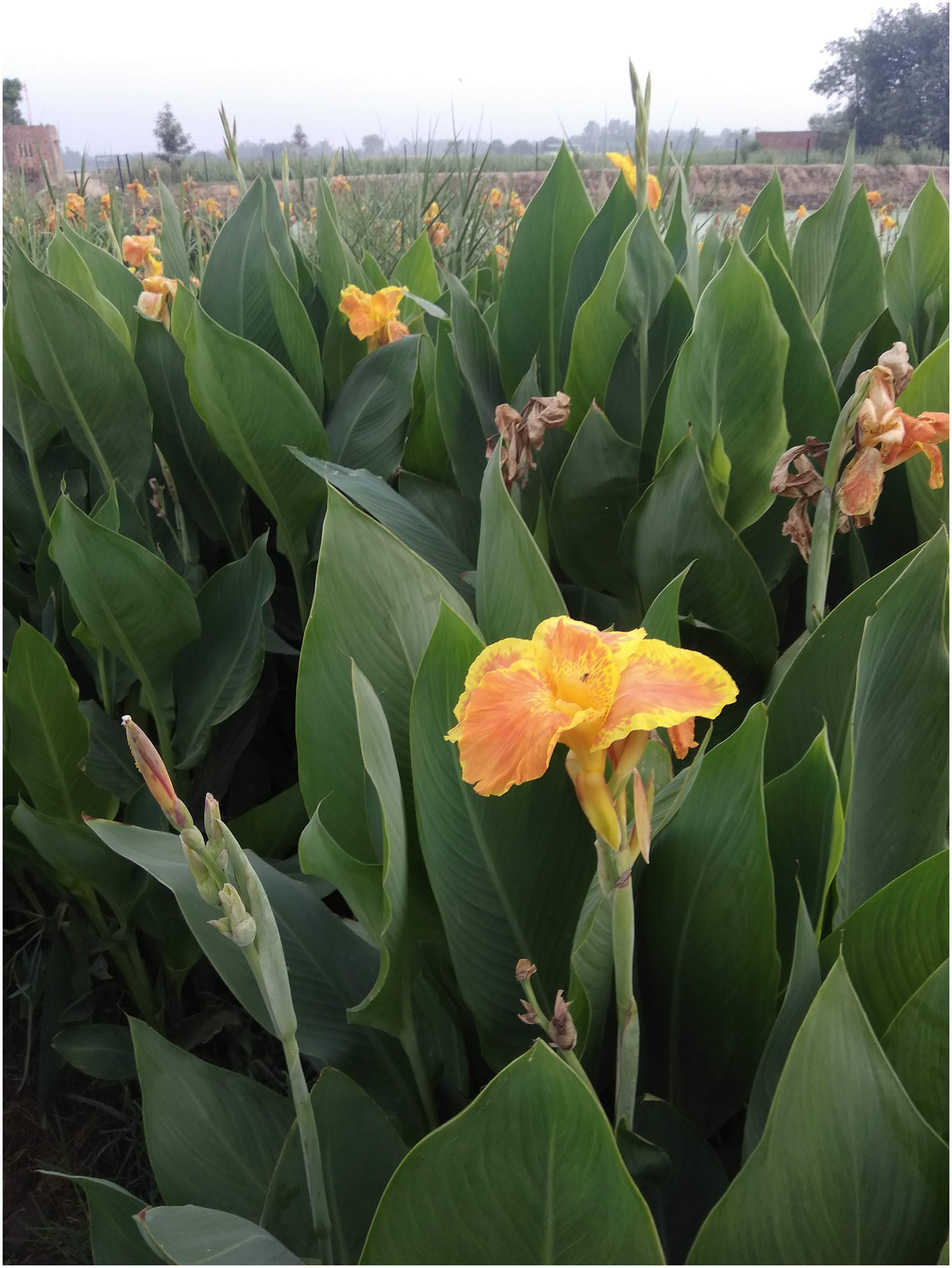
Canna lily growing in the Hasampur constructed wetland.
Healthy plants suggest good water quality treatment, but plants are not always healthy. In October 2019, canna in Bettavalli wetland was infected by a rust disease, with many leaves covered in orange and brown spots, before withering and dying. Damp and crowded growing environments are ideal conditions for rust fungus, and this is exactly what the wetland design created. When this issue was raised in a project meeting, one person estimated a 20–30% reduction in water quality treatment performance.
The uncertain patterns of life generate unreliable knowledge. Analysis of temporal trends in water quality results showed that canna health was not an unequivocal signal of wetland performance. The Hasampur wetland, while indeed producing a significant reduction in Biochemical Oxygen Demand in May, had performed equally well the previous November and December, when the canna lily was small and sparsely distributed. The predicted performance reductions due to canna rust also could not be seen when analysing the water quality results from Bettavalli, partly due to the high variability between sampling dates. Hence, judgements about wetland performance based on canna aesthetics produced a different conclusion than those from technical analysis.
Meanwhile, farmers also worked with uncertainty. Despite all members of the focus group reporting no issues with crop production, one farmer summarised his position thus: ‘So far, nobody has tested the water here. If it is tested, then we will know whether it is good or bad. That has to be told by the experts’ (FG6: Bettavalli). Judging water quality from crops is complicated by the possibility of other factors influencing crop growth. Farmers pointed out that fertilisers and manure are more important than water for ensuring a healthy crop (FG 6 and 8: Bettavalli. FG 6 and 11: Hasampur). ‘Trial and error’ was one approach to this uncertainty. Despite uncertain links between signals from plants and water quality, the interaction of plants and waters and people was a relation through which water quality knowledge emerged.
Snakes embody a waterscape of uneven vulnerability
In a scoping survey about wastewater problems, the fact that a quarter of respondents mentioned snakes came as a surprise. The survey scheme had tick-boxes for mosquitoes, bad smells, and diseases; snakes were not part of our conception of wastewater issues. The households bringing snakes into the discussion were (with one exception) those living closest to the pond. The connection between snakes and wastewater was confirmed in focus group discussions in May 2020; asking what animals could be seen around the pond almost always brought snakes into the discussion (FG 4 & school discussions: Village 2. FG 1,3,4,5, and 7: Hasampur).
Snakes figure prominently in both urban and rural landscapes of India (Narayanan and Bindumadhav, 2019; Whitaker and Whitaker, 1992). India has around 285 species of snakes (Whitaker, 1992), many of which live in close proximity to people, threading lifeways through both rural and urban spaces. One harmful consequence is that an estimated 1 million people suffer snake bites annually which, combined with healthcare systems often poorly equipped to manage bites, results in close to 50,000 deaths each year (Mohapatra et al., 2011). The vast majority of snake bite morbidity and mortality comes from four species of snakes, including the cobra (Narayanan, 2016). Beyond health impacts, snakes have a strong cultural and religious significance in many parts of India and are a significant part of urban and rural ecologies (Narayanan and Bindumadhav, 2019).
Though local people mentioned varied species, a good proportion of these snake sightings are likely to be of the Checkered Keelback watersnake, Xenochropis piscator 14 . Whitaker (1992) suggests this is the most common of watersnakes, and indeed ‘probably the most common and abundant’ of all snakes in India: ‘prolific, adaptable and found almost everywhere’ (Whitaker, 1992: 22–24). This snake is non-venomous and harmless to humans. However, the Checkered Keelback's response when excited is commonly mistaken for a cobra (Whitaker, 1992). Water snakes feed on frogs (plentiful in the pond and wetland), and other small animals. One woman living in a house adjacent to the wetland pointed out that snakes could be heard as well as seen, by the sound a frog makes when seized in a snake's jaws. People also reflected on whether changes in the wastewaterscape, such as the constructed wetland installation, had influenced snake numbers. From a local perspective, snakes are a significant part of the wastewaterscape.
What are the results of this concern? How do wetland snakes and people interact? In an attempt to keep the question as neutral as possible we asked ‘how do you relate to snakes?’. The answer, more often than not, was laughter and a simple reply. As one man put it ‘We don't need to relate to them, we just kill them’. (The ‘we’ doing the killing is a gendered subject, women spoke more of feeling afraid). The danger of snakes was not provided as a justification for this killing. One person mentioned a fatal bite that had occurred ‘long ago’ (FG1 – Male respondent: Hasampur), but it was also explained that snakes were ‘treated the same if dangerous or not’ (FG7: Hasampur). Regardless of the threat to humans, an encounter between snakes and people generally ends badly for the snake.
With further discussion, this killing of snakes was delineated; snakes are dealt with based on a spatial ordering of household spaces and ‘here and there’ (generally in or around water bodies). Women cheerfully recounted seeing the snakes ‘sunbathing’ on the banks of the pond (FG1 – Female respondent: Hasampur). It was also clarified that snakes were left alone when they were seen ‘just passing by’ or going ‘here or there’ (FG1,4 10 – Female respondents: Hasampur). The killing of snakes takes place when they come into or near houses. Given the lack of other justifications, this spatial logic appears to be all the reason necessary for killing snakes (for more on human–animal spatial orderings, see Philo and Wilbert, 2000). These interviews gave no sense that snakes are hated in general; there are areas where snakes are tolerated, and others where they are not.
The spatiality of human–snake encounters opens a broader question about the spaces created by wastewater. Snakes are present because the wastewaterscape has been shaped in a way that they benefit from: there is standing water to swim and hunt in, the wetland and pond verges are home to numerous frogs (the frogs in turn benefitting from plants, dampness, insects and so on). A typical approach to wastewater is to get it out of the village (or city) as quickly as possible (Illich, 1985). However, in rural India, this approach must compete with the village pond. As previously explained, pond construction and rejuvenation have a powerful constellation of political support. Yet, the political discourse around village ponds is silent on the other beings that ponds attract and the diverse lifeways that ponds support (Hill et al., 2018). The political-institutional support for pond building overshadows their links with snakes and other problematic species 15 . Framed using the conceptualisation of more-than-human agency developed by Sundberg (2011), pond-building collectives are dominant in rural development. The uneasy collective of snakes and people that are impacted by these collectives do not have the power to shape waterscapes to best manage snake–human relations.
The story of snakes cannot be disentangled from how wastewaterscapes are shaped by ideas of water conservation and traditional technologies. Because of the guiding of wastewater into wetlands and ponds, water-snakes and waste-waters are tied together. Because ponds are located in close proximity to houses, encounters between snakes and people take place. These encounters are stressful for both people and snakes, but, in the vast majority of cases, worse for the snake, whose curiosity, desire for food or a cool place, and inability to read human territorial divisions have deadly consequences.
Confluences and conclusions
More-than-human assemblages are central to how wastewaterscapes are designed, justified, and contested. The stories of intra-action presented above have shown how particular microbes, plants and animals all come to matter in wastewaterscapes. Their role as material-semiotic actors is evident in the ways they transform matter and shape waterscape meanings. Plants and E. coli shape the knowledge that emerge within the waterscape, and hence conclusions about the effectiveness of wastewater infrastructures. Meanwhile, the presence of snakes distributed vulnerability unevenly through the waterscape, uncovering the uneven relations of power through which Indian waterscapes are constructed. These three examples are a tiny fraction of the life around these constructed wetlands. What emerges from drawing together the threads of these stories?
Developing critical perspectives on waterscape knowledge through attention to more-than-human processes is a significant contribution of this article. Knowledge claims are central to the power dynamics in these wastewaterscapes; aligning with previous waterscape studies that have shown the importance of knowledge in stabilising and (re)creating power relations (Aijaz and Akhter, 2020; Bouleau, 2014; Parsons and Fisher, 2020). Speaking of informal settlements in Delhi, Karpouzoglou and Zimmer argue ‘the relations of power at play legitimise or de-legitimise different ways of “knowing wastewater”’ (Karpouzoglou and Zimmer, 2016: 2). In the wastewaterscapes we examined, the knowledge of distant experts exerted disproportionate influence on the design and evaluation of the waterscape. The power of such claims reflects a discursive field that is generated and sustained in the context of structural inequities generated by capitalist, colonial and caste relations. While significant for the interventions and oversights of the constructed wetland projects, this expert knowledge was not mobilised to overpower other ways of knowing, as the example of plant signalling highlights. More-than-human assemblages are the foundation of multiple forms of knowledge production in waterscapes. Hence, applying a more-than-human lens to waterscapes is a tool for unpacking these knowledge claims and the unequal power relations upon which they rest. More-than-human approaches, including those grounded in Indigenous ontologies (Fisher and Parsons, 2020; Yates et al., 2017), draw attention to the assumptions that underpin knowledge claims surrounding water, and reveal those claims as incomplete and contested.
Drawing certain knowledge from a messy uncertain world requires simplifications and omissions. The case of E. coli shows that the concept of water quality used to judge water infrastructure, simplified and generalised the varied lifeways of E. coli bacteria. Triangulation and secondary data revealed that water knowledge was less certain than claimed. Different ways of reading treatment performance (from plants and technical methods) appeared to co-exist, without being fitted into a single narrative. Another simplification occurs in the frequent presentation of constructed wetland ‘biodiversity’ as a positive benefit (De Martis et al., 2016; Hsu et al., 2011) 16 . This is a twisting of the complex relations between people and other animals. The complexities of wetland ecologies did not matter enough in these infrastructure projects. The erasure of uncertainty from knowledge claims stabilises hierarchical relations between expert and non-expert knowledge, foreclosing other possible knowledge configurations as well as stabilising relations of power tied to expertise (Mitchell, 2002).
Close attention to the living beings within these assemblages generates findings that allow for a critical perspective on knowledge claims. To do this requires holding methods in tension. By this, we mean using both social and natural science methods to generate data, while simultaneously subjecting these methods to a critical reflexivity inspired by social research and critical physical geography (Biermann et al., 2018; Sultana, 2007; Swanson, 2017). For example, water quality results were important for questioning the parallel reading of wetland performance from wetland plants, even while some of the parameters measured in water quality testing were poorly matched to these wastewaterscapes. Our approach contextualised living beings (microbes, animals, and plants) and sensing methods, through social research and secondary data. Our mixed-method engagement with water quality data, local interviews and ecological literature revealed where simplifications had taken place. Countering ecological simplifications has symmetry with arguments made by political ecologists who caution against the simplifications of social worlds at play within socio-ecological projects (Forsyth, 2008; Robbins, 2011; Taylor and Bhasme, 2021). These simplifications deserve critique; particularly as constructed wetlands, ‘nature-based solutions’ and related concepts become more widely applied to reshaping waterscapes (Cooper, 2020; Dalwani and Gopal, 2020; Wakefield, 2020).
The reading of water quality from plants brings us back to the concept of biosensing, where ‘nonhuman life enables us to mark the boundary between conditions conducive to life and those destructive of it’ (Johnson, 2017: 10). Farmers would surely prefer to know if water is conducive to life before using it for crop irrigation. But the case of canna perhaps hews closer to the more hopeful possibility articulated by Johnson that ‘recognizing these entanglements and expanding our sensorium in the face of ecological degradation will lead to new regimes of care’ (Johnson, 2017: 11). Some processes of knowledge production are more liberatory than others. Biosensing may be part of a project of biopolitical governance, but this does not imply that creating knowledge through more-than-human relations is best avoided. Rather, it suggests the need for careful engagements with living beings to generate knowledge of waterscapes, and orient towards multispecies flourishing (Collard et al., 2015), while recognising that care is ‘shot through with asymmetrical power relations’ (Liboiron, 2021: 114; Martin et al., 2015: 627).
A more-than-human analysis stretches the normative and ethical frameworks behind waterscape studies. If water was not ‘ecological’ a human exceptionalist approach (Srinivasan and Kasturirangan, 2016) would be more tenable, but when water appears disconnected from ecologies, a subset of water flows and relations have been severed from a lively waterscape. The idea that only humans deserve moral consideration in waterscape studies is untenable. Waterscape accounts are critical of uneven development and the power relations that produce unequal access to space and resources, but this emphasis on (un)evenness and (in)equality does not translate smoothly to a more-than-human framework. A broadened ethical consideration raises tensions that do not allow easy resolutions (Haraway, 2016). Snakes and people need to co-exist; this is not impossible. Yamini Narayanan and Sumanth Bindumadhav's exploration of ‘posthuman cosmopolitanism’ in Bangalore includes hopeful stories of people learning to distinguish between venomous and non-venomous snakes in order to live alongside them (Narayanan and Bindumadhav, 2019). The more-than-human entanglements of the wastewaterscape necessitate a reflection on multispecies justice (Celermajer et al., 2020).
This should not diminish concerns about social justice. Indeed, thinking about more-than-human relations strengthens the concept of human (and non-human) vulnerability in waterscapes (Joronen and Rose, 2020). Reshaping waterscapes means reshaping habitats and lively places. As the cases of snakes and E. coli in Hasampur highlight, the living beings that associate with water can be a significant contributor to how the potential for harm is generated and experienced. Mosquitoes and wild boar were also raised as waterscape issues in these study sites. The resulting vulnerabilities often map to axes of difference such as caste, gender or wealth. Hence, the creation and exacerbation of human difference are still important. There can be no ‘just’ waterscape where other-than-human life and its entanglements with human life do not matter.
What are the possible politics that might orient waterscapes towards multispecies flourishing? Juanita Sundberg's account highlights the crucial role of more-than-human collectives in stabilising socio-political orders, as well as the exclusions that such stability often requires (Giraud, 2019; Sundberg, 2011). Testing apparatuses are stable as long as E. coli is treated as a reliable indicator, which the standardised technology of the Colilert and national water quality standards both signal. Farmers hope for a stable relationship between healthy crops and irrigation water, as part of an agrarian politics dense with its own complexities (Narasimha Reddy and Mishra, 2010). Wetland designers hoped for a stable collective of healthy wetland plants, transformed wastewater flows and satisfied residents, that would both produce a stable transformation of wastewater, and also signal a modern and ecological approach to wastewater treatment. However, the presence of snakes and canna infections as part of the wastewater collective undermined this design. Snakes do not have the same level of political power and coalition-building ability as human-led project teams. However, over the full lifespan of this wastewater infrastructure, perhaps it is the actions of other-than-human beings that will most profoundly shape this corner of the waterscape. The politics of building flourishing waterscapes relies upon generating and caring for certain more-than-human collectives, while destabilising others.
Highlights
We describe a more-than-human waterscape framework, where critical water research is strengthened by incorporating a relational multispecies analysis.
This framework opens avenues for interdisciplinary methodologies that integrate social and ecological approaches to water research.
We demonstrate this framework through three empirical stories of intra-action focussed on particular microbes, plants and animals.
Assemblages of humans, other beings and technology are crucial to the production of waterscape knowledge.
A more-than-human political ecology approach illuminates the uneven power relations that inhibit multispecies justice.
Footnotes
Acknowledgments
We sincerely thank the focus group participants and other residents of the two villages for their conversation, offers of tea and the humour with which they contributed to this research. This work would also have been impossible without the support and translation work of Dr Durba Biswas, Anjali Rao and Kumar DS, as well as the team of researchers at Hasampur (Rajesh, Omkar, Subash, Shweta, Jhalesh and Asha). Jhalesh also conducted the E. coli analysis in Hasampur. Dr Daniel Read and Dr Andrew Singer at UKCEH Wallingford helped with the eDNA method and Holly Tipper did the analysis. We would also like to thank Dr Daniel Fisher, Dr Krithika Srinivasan, Irene Leonardelli, Dr Rebeca Ibanez Martin, Iryna Zamuruieva and two internal reviewers for their careful reading and generous comments that all clarified and improved the article.
Declaration of conflicting interests
The authors declared no potential conflicts of interest with respect to the research, authorship, and/or publication of this article.
Funding
The authors disclosed receipt of the following financial support for the research, authorship, and/or publication of this article. This work was supported by the Scottish Government.
