




Abstract
The role of philanthropic capital in biodiversity conservation is rapidly changing. Philanthropists increasingly seek to bankroll solutions to the biodiversity crisis, scaling up the size of their ambitions and gifts to help close what scientists and policymakers call the “biodiversity financing gap.” This paper interrogates the rising prominence of philanthropic capital in conservation governance, focusing on a class of actors I call “philanthro-environmentalists.” Unlike big, international NGOs and philanthrocapitalists, philanthro-environmentalists do not engage market-based, for-profit approaches to finance conservation. Rather, they engage a “dollars for policy” approach that leverages the power of their philanthropy to improve public conservation outcomes. Taking Chile as a case, I trace how a transnational network of philanthro-environmentalists is using a novel mechanism known as Project Finance for Permanence to exact substantial political and fiscal commitments from the state in exchange for substantive philanthropic support for a mega conservation initiative in Chilean Patagonia. I argue that Project Finance for Permanence targets policymaking as the primary site of philanthropic intervention, affording philanthro-environmentalists greater control over state conservation governance. Yet, I also argue that this case raises serious questions about the limits and implications of leveraging philanthropic capital to solve public environmental problems. Bridging literatures on conservation governance and conservation finance, the paper contributes new conceptual insights into the evolving dynamics of philanthropy-state relations in an age of biodiversity crisis.
Keywords
Introduction
The role of philanthropic capital in biodiversity conservation is rapidly changing. A growing number of philanthropists seek to bankroll the biodiversity crisis, increasing the size of their ambitions and gifts to help close the “biodiversity financing gap”: the difference between the total cost of meeting global goals for biodiversity conservation and the actual amount spent by national governments and other sources (BIOFIN, 2018). For example, nine philanthropic foundations recently launched the “Protecting Our Planet Challenge,” pledging an unprecedented US$5 billion to support the 30 × 30 Campaign for Nature. It includes US$1 billion from the Bezos Earth Fund, US$500 million from both the Rainforest Trust and Wyss Foundation, and additional commitments from Bloomberg Philanthropies, the Gordon and Betty Moore Foundation, and the Rob and Melani Walton Foundation (Philanthropy News Digest, 2021). It follows the Wyss Foundation's previous pledge of US$1 billion to support the same campaign (Wyss Foundation, 2018). Philanthropic capital is considered especially key in the global South, where the greatest conservation gains are concentrated but where national governments often cite a lack of fiscal and administrative capacity to pursue such gains (Balmford et al., 2003; Waldron et al., 2013).
Recent studies estimate the annual biodiversity financing gap at US$300–400 billion (Meyers et al., 2020) or US$598–824 billion (Deutz et al., 2020), while suggesting that philanthropic capital is neither unlimited nor easily scaled up and thus does not hold the same potential as private capital for closing the gap. At the same time, these studies concede that philanthropic capital is “highly catalytic for mobilizing private sector financial flows” (Deutz et al., 2020: 18). This reflects the reasoning behind blended finance and capital stacking: philanthropists should front capital for conservation finance at earlier, riskier stages so private investors can reap the benefits of market-rate returns at later stages. 1 As so-called “early” and “patient” capital (Mantell and Scoonover, 2018), philanthropy is now contemplated as a stabilizing force for financial capital, yet it has a much longer history as a supplemental funding source for domestic public budgets that represent over half of all spending for biodiversity conservation (UNDP, 2018). Although philanthropic support for public conservation is not new, the pace and scale at which it is marshaled and some of the methods by which it is instituted are new, prompting important questions about the impacts on contemporary philanthropy-state relations.
This paper investigates the rising prominence of big, international philanthropic foundations (BIPFs) in conservation governance, focusing on a class of actors I call “philanthro-environmentalists.” Philanthro-environmentalists differ from two other actor classes already receiving significant scholarly attention—big, international conservation NGOs (BINGOs) and philanthrocapitalists—in that they do not engage market-based, for-profit approaches to finance conservation. Rather, they engage a “dollars for policy” approach that leverages the power of their philanthropy to improve public conservation outcomes—a practice that might be called “philanthropic conservation finance.” Taking Chile as a case, I trace how a transnational network of philanthro-environmentalists led by Tompkins Conservation and The Pew Charitable Trusts is using a novel philanthropic conservation finance mechanism known as Project Finance for Permanence to exact substantial political and fiscal commitments from the state in exchange for substantive funding for a new initiative called the Route of Parks of Chilean Patagonia. I argue that Project Finance for Permanence targets policymaking as the primary site of philanthropic intervention, thereby affording philanthro-environmentalists greater control over state conservation governance. Yet, I also argue that this case raises serious questions about the limits and implications of leveraging philanthropic capital to solve public environmental problems. The paper is informed by thirteen months of field-based research in Chile, conducted between August 2017 and December 2019, including participant observation at 17 governmental or philanthropic events and 79 semistructured interviews with current and former government officials, philanthropists, foundation staff, NGO staff, private conservation advocates, and environmental activists. Participant observation and interview data are supplemented with document analysis of relevant government files and agreements, policy reports, news stories, foundation webpages and press releases, and donor-targeted literature and pamphlets.
The paper begins with a review of the literatures on conservation governance and conservation finance and places philanthropy in relation to the state and other private actors. Next, it introduces the Route of Parks of Chilean Patagonia and conceptualizes two phenomena that I argue are more salient than prevailing concepts for understanding this unique case: “philanthro-environmentalism” and “not-for-profit conservation finance.” Then, I show how the concepts operate in the context of Chile's new Route of Parks Fund, a Project Finance for Permanence deal led by Tompkins Conservation and The Pew Charitable Trusts. The Route of Parks Fund is characterized by a “dollars for policy” approach, as well as the influence of donor anxiety and anchor funders; the penultimate section considers how these are altering the power dynamics and political stakes of contemporary philanthropy-state relations. The paper concludes with a brief reflection on how philanthropic conservation finance broadens existing understandings of conservation finance and its role in addressing the accelerating biodiversity crisis.
Placing philanthropy in conservation governance and conservation finance
Geographers conceptualize modern conservation governance as a networked set of power relations involving the state, the market, and civil society (Corson et al., 2019; Holmes, 2011). A robust literature concludes that decades of neoliberal policy trends have enabled market and civil society actors to shape conservation governance at multiple scales (Dempsey, 2016; Duffy, 2006; Youdelis, 2018). This literature has paid significant attention to the role of BINGOs (Brockington and Scholfield, 2010a, 2010b; Corson, 2010; Holmes, 2018; MacDonald, 2010; West, 2006), but far less attention to the role of BIPFs (Diallo, 2015; Holmes, 2012; Ramutsindela et al., 2011). Yet, BINGOs rely on BIPFs as a major source of financial and program support: Conservation International has received US$395 million from the Gordon and Betty Moore Foundation (Hance, 2016) and The Nature Conservancy has received over US$150 million from the David and Lucile Packard Foundation (Lehren and Siegel, 2018). Many BIPFs now operate globally, have ambitious policy agendas, and wield serious political-economic power. To speak of the outsized impacts of BINGOs on modern conservation governance, then, necessarily implicates BIPFs. BIPFs and BINGOs work together through transnational alliances linking donors’ money and ideological motivations to the projects and advocacy of conservation groups. These transnational alliances increasingly include partnerships between BINGOs and extractive corporations like Shell and De Beers (Enns et al., 2019), reflecting thickening ties among civil society's NGO, corporate, and philanthropic sectors (Ramutsindela, 2009).
Philanthropy has been subjected to numerous scholarly critiques, including that it is an instrument of the ruling elites that reinforces capitalist hegemony and their own cultural dominance (Arnove, 1982; Roelofs, 2003). Historically, philanthropy has been key to forming bourgeois subjects, who in turn have helped legitimize capitalism through more philanthropy (Prudham, 2009; Spierenburg and Wels, 2010). The benevolent portrayal of philanthropic elites serves to elide and normalize the negative effects of capitalism that produce their wealth and the need for their charity in the first place, such as labor exploitation, income inequality, and environmental degradation (INCITE!, 2017; Kohl-Arenas, 2016). Philanthropy is also critiqued for pursuing projects that reproduce American geopolitical hegemony. Especially since the Cold War, powerful U.S.-based foundations have promoted and advanced American imperial and foreign policy interests through their activities abroad (Schramm, 2006; Vogel, 2006). A third critique is that despite purporting to stimulate societal change, foundations often preempt it through funding practices that favor politically safe issues and groups over more progressive ones (Guthman, 2008). Writing on “philanthropic colonization,” Barker (2008: 40) shows how the Ford and Rockefeller Foundations co-opted U.S. environmentalism “by channeling the movement's work away from more radical ventures during its formative years.”
Such critiques are now being extended to address philanthropy's growing involvement in state environmental governance (Betsill et al., 2021). As public–private conservation partnerships proliferate and BIPFs work to shape new policy frontiers like marine conservation and species rewilding (Mallin et al., 2019; Zamboni et al., 2017), scholars are asking whether philanthropic influence risks “dictating the terms of cash-strapped public conservation efforts” (Delfin and Tang, 2006: 424). By exploring issues of transparency, accountability, and agenda setting, they suggest that philanthropy is transmuting the disproportionate power of wealth into disproportionate political and institutional power (Fortwangler, 2007; Gruby et al., 2021). Several studies focus on the ways in which philanthropy has historically engendered land dispossession and forced removal of Indigenous peoples in the name of conservation (Milgroom and Spierenburg, 2008; Spence, 1999) and continues to sponsor projects that local communities describe as undemocratic and disenfranchising (Jones, 2012; Louder and Bosak, 2019). 2 Other studies invoke Harrison’s (2004) concept of “governance states” to illustrate the influence of external networks of governance actors, including BIPFs and BINGOs, on national environmental agendas in the global South and how this undermines state sovereignty and territoriality (Duffy, 2006; Holmes, 2010). Corson (2011: 709) finds that in Madagascar these governance actors take control of boundary mapping and other conservation territorialization processes, affording them a “‘state’ authority to decide the rights and acceptable uses associated with Madagascar's new protected areas.” Writing on a public–private conservation partnership in Mozambique's Gorongosa National Park, Diallo (2015) argues that the U.S.-based Carr Foundation simultaneously challenges and bolsters the state's sovereign authority over its people and territory by performing key public functions like jailing and punishing suspected poachers.
Separately, a burgeoning literature within geography traces how biodiversity conservation is rendered investable through two modalities rapidly gaining favor with BIPFs and BINGOs: philanthrocapitalism and the financialization of conservation. Philanthrocapitalism merges capitalist means with philanthropic ends and can be defined as “the use of business and market-based tools, techniques, and methods to address intractable social problems” (Jenkins, 2011: 765). Holmes (2012) summarizes the ethos of philanthrocapitalism as such: the same skills and attitudes that make successful capitalists will make ideal philanthropists, and capitalist solutions benefit philanthropy because they are inherently efficient and innovative. Although the novelty of philanthrocapitalism is debatable (Katz, 2005; McGoey, 2014), scholars agree that it exerts considerable influence over the current generation of donors and foundation officers. This is evident in the rise of impact investing, a branch of social finance that envisions “a new, ‘moral’ financial system where investor dollars fund socio-environmental repair while simultaneously generating financial returns” (Cohen and Rosenman, 2020: 1259). Impact investing is the primary way philanthrocapitalists engage in and facilitate the financialization of conservation, using “mission-related” or “program-related” investments that align donors’ “social (charitable) and financial (portfolio maximizing) missions” (Rosenman, 2018: 147). Recent research reveals a philanthrocapitalist turn in conservation, documenting both the discourses that promote markets as the best way to improve conservation outcomes and an increase in the number of donor-based projects tied to returns-seeking activities (Holmes, 2015b; Koot and Fletcher, 2020; Mallin et al., 2019; Tedesco, 2015). Holmes (2012) argues, however, that the discursive impact of philanthrocapitalism remains greater than its financial impact because of how it reimagines the relationship between the state, the market, and civil society. As BIPFs globalize, they bring this increasingly dominant discourse to bear on higher scales of governance and decision-making.
The financialization of conservation refers to the conversion of biodiversity and natural resource protection into capitalized, tradable assets through market-based instruments like biodiversity offsets and payments for ecosystem services. Dempsey and Bigger (2019) call this “for-profit conservation finance” (FPCF), underscoring that private, returns-seeking capital is just one variety of conservation finance that exists alongside public and philanthropic varieties. 3 FPCF proponents liken it to a paradigm shift for conservation funding that swaps a demand for capital driven by conservation need for a supply of capital driven by investor appetite (Huwyler et al., 2014). Critical scholars, however, differ on whether and how FPCF is generating investment returns. Whereas some frame conservation as a spectacular frontier for financial capital (Büscher and Fletcher, 2015; Sullivan, 2013), others contend that the economic boom of FPCF is still largely promissory (Barbesgaard, 2018; Dempsey and Suarez, 2016). Still, others argue that FPCF's actually existing returns derive from activities that are neither directly related to conservation nor necessarily financial (Dempsey, 2017; Silver and Campbell, 2018). For instance, Kay (2018) observes that shareholder profits generated by private equity firms in the U.S. come from projects that target working landscapes instead of protected landscapes, and rely on three revenue streams that are not by definition finance: real estate sales, public monies, and commodity production.
Asking why FPCF retains its appeal despite a lackluster track record, a new body of scholarship finds it is not purely reducible to market success or failure (Asiyanbi, 2018; Cavanagh et al., 2020). Rather, FPCF possesses more-than-financial powers of discourse, ideology, subject formation, and even morality that also serve to reinforce conservation's financialization. Asiyanbi (2018) and Cohen and Rosenman (2020) argue that pro-market discourse and ideology lend crucial legitimacy to nature financialization projects like REDD+ in ways that are not typical or required of financialization projects in other sectors. Similarly, Dempsey and Bigger (2019: 528) find that “marrying” conservation with accumulation entails a massive capacity-building effort to reorient “subjects, territories, and social relationships” toward capitalist ideals by eliminating economically and environmentally wasteful conduct. Lastly, scholars have begun to study how morality and moral performance shape value creation in the financialization of nature (Ouma, 2020; Ouma et al., 2018). Studying farmland investments, Kish and Fairbairn (2018: 569) analyze the everyday moral narratives of two different investor groups—mainstream agricultural investors and impact investors—to demonstrate how they “play a pivotal role in expanding the financial penetration of nature.”
Taken together, these more-than-financial powers “can have enormous cultural and political disciplining effects on the conservation movement and on environmental governance” (Dempsey and Suarez, 2016: 666), especially as they infiltrate the logics and practices of those who supply the vast majority of global conservation funding: state and philanthropic actors. In what follows, I argue that this is precisely what is happening with Chile's Route of Parks: an FPCF approach was not adopted, but philanthropic actors are nevertheless internalizing and promoting its metrics-based, entrepreneurial spirit for their own political ends. Although the extant literature overwhelmingly emphasizes “the shifts in philanthropy-driven conservation from donation toward profit-oriented finance models” (Mallin et al., 2019: 2), my findings suggest that conservation philanthropy's traditional donation model is innovating as well. The Route of Parks highlights related phenomena I call “philanthro-environmentalism” and “not-for-profit conservation finance,” which also merit investigation. The next section introduces the case study and conceptualizes both phenomena.
Philanthro-environmentalism and not-for-profit conservation finance in Chile
American fashion executive turned conservation philanthropist Douglas Tompkins moved to Chile in 1991 after souring on a career he likened to “making stuff that nobody needed” (Langman, 2012). Having sold his founding stake in The North Face and Esprit brands, Tompkins settled in the remote coastal fjords of northern Chilean Patagonia and began amassing land for private conservation projects through his California-based foundation Conservation Land Trust (later renamed Tompkins Conservation). 4 By the mid-2000s, he and his wife Kristine McDivitt Tompkins, a former executive at the Patagonia Inc. brand, had protected more private land than anyone else in history (Saverin, 2014). In March 2017, following years of planning and Tompkins’ sudden death in a kayaking accident, McDivitt Tompkins and Chile's President Michelle Bachelet launched a first of its kind, public–private conservation partnership in Chilean Patagonia. The partnership adds 10 million acres of national parklands to the public conservation system, SNASPE, including a joint donation of more than a million acres of Tompkins Conservation's private parklands and 2.4 million acres of adjacent public lands (CONAF, 2017; MMA, 2017). It also increases the level of protection on 6.6 million acres of neighboring forest and national reserves by reclassifying them as national parks.
These new parklands now form part of a regional conservation territory known as the Route of Parks, protecting a total of 28.4 million acres in 18 national parks (see Figure 1). This historic project constitutes the largest addition to SNASPE since 1969 and the largest private land donation ever received by a national government (CONAF, 2019). Also the largest philanthropic gift in Chilean history, it comes in a funding area where domestic philanthropy and state fiscal spending are markedly weak. Yet, the donation was not without controversy. The Tompkins’ philanthropic activities in Chilean Patagonia have always been controversial, with local communities, Santiago's political class, and national business elites united in questioning their true motives for owning so much land (Azócar, 2017; Franklin, 2021; Holmes, 2015a). 5 Although the donation repudiated a number of conspiracy theories about the Tompkins—including that they were working to establish a new Jewish state in Patagonia, or building a site to store nuclear waste, or plotting to seize the region's freshwater resources (Interview 8, 23 February 2019)—public scrutiny of their actions endures. Some informants explained this as a consequence of Chile's neoliberal development model, where foreigners’ monopolization of land for extraction is commonsense but foreigners’ monopolization of land for conservation is not (Interview 39b, 7 October 2019). Other informants explained this as a consequence of Chile lacking a culture of conservation philanthropy, suggesting that it justifies ongoing intervention from external BIPFs (Interview 15, 18 March 2019).
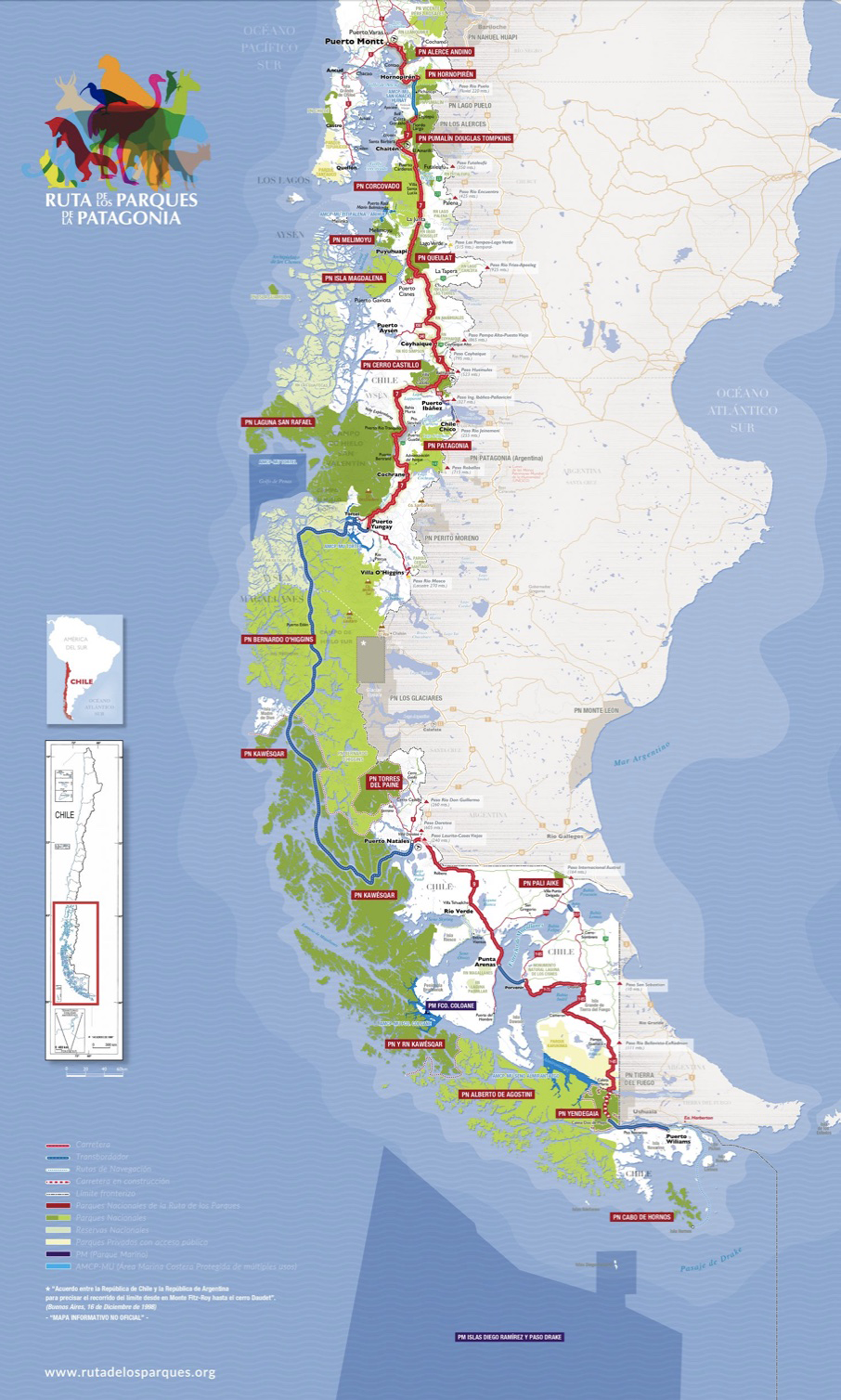
Map of Chile‘s Route of Parks. Source: Reprinted with permission from Tompkins Conservation (2020).
Importantly, the Route of Parks was designed and masterminded by Tompkins Conservation, not the state. It is perhaps more accurately understood as a private–public partnership, given that the Foundation proposed its major elements. This included identifying which public lands should be donated as “match,” and how the project would be marketed as a state strategy for local economic development. Explaining the Foundation's donation philosophy, a senior staffer said, This is how we do it, we get a map and we go to the government. We say, “look … I have 220,000 acres here in the Chacabuco Valley, you have the Tamango Reserve with 70,000 acres and the Jeinimeni Reserve with 395,000 acres. Notice that here is some public land, and there is more public land, and over there is some military land. How about we donate everything and make a national park?” That is how we work, we never donate alone. We go in with a proposal, including public lands of various types and our own donation. (Interview 58, 17 October 2019)
Philanthro-environmentalism
Philanthro-environmentalism combines a general philanthrocapitalist ethos with the traditional donation model, lauding business-minded philanthropy as more effective at conservation problem-solving than governments and NGOs without engaging financialization practices to get results. They therefore display certain continuities and discontinuities with philanthrocapitalists. Both premise that philanthropic elites, by virtue of their economic status, hold proper authority to diagnose socio-environmental problems and prescribe the right solutions on behalf of society at large. This affects the kinds of projects that get funded, and where, privileging elite perspectives on what ultimately counts as socio-environmental progress (Cohen and Rosenman, 2020; Hay and Muller, 2014). Both shape conservation discourse, ideology, and subject formation by importing capitalist rationalities of “efficiency, accountability, and quantifiability” (Tedesco, 2015: 15) into philanthropic projects—even when those projects are not overtly market-oriented. Both also justify their interventions through a politics of morality (McGoey, 2012), with philanthro-environmentalists claiming a moral responsibility to do something about biodiversity loss. Tompkins, for example, saw philanthropy as his way of paying rent for living on an increasingly beleaguered planet (Mark, 2019). Finally, both share deep ties to “extractive finance” (Dempsey and Bigger, 2019) that are not easily effaced. As discrete afterlives of financial accumulation, philanthro-environmentalism and philanthrocapitalism put excess wealth to work in service of morally just causes, but wealth that often ironically derives from financial speculation, extractivism, or both. 6
Philanthro-environmentalism is distinguished from philanthrocapitalism in several significant ways. First, it foregoes the use of newer financial instruments that “blend profit-making and charity” (Rosenman, 2018: 149) by continuing to employ the traditional donation model. The split is less around return on investment—philanthro-environmentalists also prize this, though they adopt a more expansive, extra-economic definition—than around the kinds of solutions sought. Whereas philanthrocapitalism focuses on market-based solutions to maximize the power and impact of philanthropic investments (Bishop and Green, 2008), philanthro-environmentalism focuses on political and technical solutions such as legislative advocacy, policy reform, and scientific research to achieve the same ends. This correlates with a second distinguishing feature: the scale of intervention. Philanthrocapitalist projects often advocate bottom-up approaches such as microfinance, targeting local communities and NGOs as new market subjects in charge of their own opportunity (Mitchell and Sparke, 2016). Philanthro-environmentalist projects exhibit a more top-down approach, however, targeting the state apparatus itself. For example, The Pew Charitable Trusts, a key partner of Tompkins Conservation in Chilean Patagonia, pursues projects that “lay the foundation for effective policy solutions” and “encourage responsive governments—at the local, state, national and international levels” (personal communication, 12 September 2019). 7 In short, philanthro-environmentalists seek to discipline state conservation behavior by bankrolling structural changes in the political register, and they do not anticipate financial gain beyond customary tax deductions.
A third distinguishing feature concerns the motivation for charitable action. Philanthro-environmentalists desire to enact or defend specific nature imaginaries. Often, these imaginaries are based on settler-colonial understandings of “terra nullius” and “pristine nature” that fetishize the landscape aesthetics of the prototypical frontier: vast expanses of alpine or montane “wilderness” (Cronon, 1995; Denevan, 1992; Hendlin, 2014). The Tompkins have directed their charitable action toward projects and geographies that befit settler colonial nature imaginaries: species rewilding and national park creation in remote South America. These projects uphold fortress-style logics of who and what “belongs” in conservation spaces that are actively produced to appear remote, untouched, and sublime. Their specific interest in Chilean Patagonia can be explained by what Mendoza et al. (2017) call the “Patagonian imaginary,” a master image of the region that coalesces “around transnational regimes of representational value pertaining to tourism, the outdoor industry, and environmentalism” (p. 95). As Chilean Patagonia becomes more integrated into the global green development project, it attracts increasing attention from other donors who likewise wish to shape the region's trajectory through conservation philanthropy. 8
Lastly, philanthro-environmentalism has roots in the philanthropic and environmental movements of the U.S. Progressive Era, which evolved both on account of and in reaction to industrial capitalism (Hays, 1969). Philanthro-environmentalists share this ambivalence toward capitalism, sometimes defending the value of conservation on economically instrumental grounds, other times arguing that nature is worth protecting because it is intrinsically valuable. Although the Tompkins began emphasizing the economic benefits of conservation-based tourism when developing a public policy proposal for the Route of Parks, they had spent the previous two decades justifying their philanthropy through the dogma of deep ecology. 9
Not-for-profit conservation finance (NFPCF): Project Finance for Permanence
Philanthro-environmentalists occupy an important position within conservation history. In the United States, they donated land and cash for early park creation and pushed Congress to establish the National Park Service by 1916—a governance model later replicated around the globe. Over the last half-century, they have gifted a total of US$700 million in the U.S. alone (Mackintosh, 2018). These gifts represent what I call “not-for-profit conservation finance” (NFPCF), that is, funding for conservation that is neither profit-oriented nor interest-bearing and typically originates from public and philanthropic sources. Philanthro-environmentalists practice NFPCF, yet some donors are now innovating on the traditional donation model by importing Wall Street strategies that afford them greater control over how their gifts are managed and safeguarded. One example is Project Finance for Permanence (PFP). PFP was developed in the United States by former investment bankers and management consultants affiliated with the Linden Trust for Conservation, the Gordon and Betty Moore Foundation, and Redstone Strategy Group (Linden et al., 2012). They also share connections to the Wall Street firms Goldman Sachs and Merrill Lynch, the global consultancy McKinsey & Company, and the BINGOs World Wildlife Fund (WWF) and The Nature Conservancy. PFP applies Wall Street's strategy of project finance—used to coordinate complex and costly capital projects such as airports and dams—to guarantee full and permanent funding for public conservation, addressing what private actors identify as a major limitation in current conservation practice: the tendency of national governments to create protected areas unsystematically with incomplete funding and an incomplete vision of permanence.
Under PFP, donors help states close the financial gap in their conservation systems in exchange for durable and measurable political commitments guaranteeing the perpetuity of these systems (WWF, 2018). The model depends on a fully private fund, fed by philanthropic capital and controlled by a third party, with the state regarded as one among many project stakeholders. As one informant noted, “it is a proposal from the private sector to the public sector, but the fund is not public–private, it is private” (Interview 58, 17 October 2019). PFP deals are typically configured as trusts, and administered one of three ways: as endowment funds, where funding is provided upfront but only investment returns are disbursed; as sinking funds, where funding is provided upfront and disbursed completely over a predetermined time horizon; or as revolving funds, where funding is provided piecemeal and disbursed periodically (Redstone Strategy Group, LLC, 2011; WWF, 2015). This approach to conservation finance differs from other fully public or fully private approaches by brokering public–private partnerships between philanthropic donors and nation states. PFP has been applied in six countries to date: Bhutan, Brazil, Canada, Colombia, Costa Rica, and Peru (Nance, 2016). Tompkins Conservation and The Pew Charitable Trusts are now collaborating to implement the world's seventh PFP deal in Chilean Patagonia.
If philanthro-environmentalism better explains the behavior of Tompkins Conservation and The Pew Charitable Trusts in Chile, then NFPCF better explains their chosen method. Project Finance for Permanence aims to produce more efficient conservation outcomes and subjects using a novel form of strings-attached philanthropy instead of returns-seeking finance. In this sense, PFP does not embody what Cohen et al. (2021: 2) recently termed “reparative accumulation,” where “the project of socio-ecological repair [is made] into a site for the extraction of financial rents.” Yet, it endeavors to finance socio-ecological repair just the same by imposing its own form of elite-led “solutionism” onto the public domain. The strategies and activities of these BIPFs reveal a crucial dimension of philanthropic conservation finance that must also be taken seriously: its increasing pursuit of political and policy returns.
The Route of Parks Fund: Protecting Patagonia Forever
Chile's PFP deal, the Route of Parks Fund: Protecting Patagonia Forever, will fundraise US$65–85 million to help the state finance and manage 17 of the 18 national parks in Chilean Patagonia. 10 It was formally announced by President Sebastián Piñera in May 2019, just weeks after Tompkins Conservation finalized its donation. In a press release, McDivitt Tompkins called the PFP deal “a keystone to our commitment with Chile post-donation to ensure the well-being of Patagonia's national parks and the local communities” (Tompkins Conservation, 2019). The Route of Parks Fund will be administered as a sinking fund, with philanthropic spending gradually ramping down over a period of 15 years as state fiscal spending gradually ramps up. The deal will be strictly philanthropic, excluding additional funding sources that other PFP deals have included such as multilateral aid. Contributions are primarily expected from foreign donors and the Tompkins’ personal contacts, but domestic donors are also being targeted—a first for any PFP deal. 11
PFP follows Wall Street's project finance model. Funding commitments are first solicited from donors, then conditioned by stakeholder agreements negotiated between donors and the state, and finally collected in a single, all-or-nothing “closing” (Linden et al., 2012). Figure 2 describes the PFP process in greater depth. Chile's PFP deal is unfolding in three phases: deal design, deal closing, and fund disbursement. Currently in phase 1, the process is led by a transnational coalition including Tompkins Conservation, The Pew Charitable Trusts, and the Santiago-based certified B corporation Balloon Latam, in cooperation with WWF and the Chilean state. This coalition conforms to the PFP best practice of involving at minimum a high-capacity conservation NGO, an anchor funder (discussed below), and a national government (Redstone Strategy Group, LLC, 2011). Full details about the Full details about a PFP deal are not publicized until closing. This PFP deal was originally projected to close in mid-2020, but was delayed by the October 2019 political uprising and subsequent constitutional reform process, as well as the ongoing COVID-19 pandemic. One detail that is known, however, is that Chile's PFP deal is being brokered at the highest scale of government—in the General Secretary of the Presidency, led by two advisers who are “basically, the right hand and left hand [of the President]” (Interview 47, 9 September 2019). This distinguishes it from other public–private partnerships, which are typically brokered by the ministries and not by the President directly. 12 By temporarily subsidizing national parklands in Chilean Patagonia, the Route of Parks Fund leverages philanthropic capital to very specific effect: incentivizing the state to improve its political and fiscal commitments to conservation through a “dollars for policy” approach.
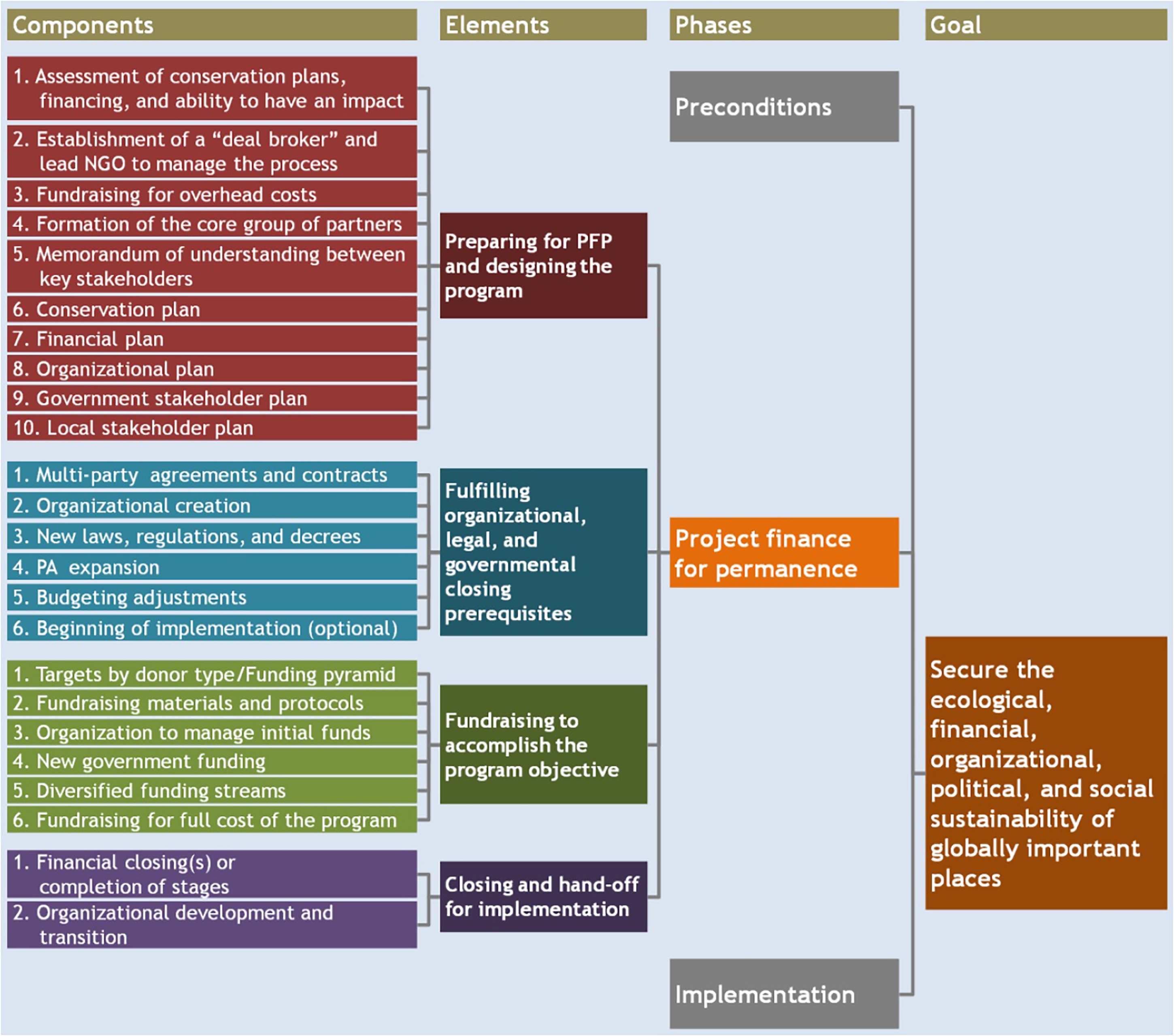
PFP process description. Source: Reprinted with permission from Redstone Strategy Group, LLC, (2011).
Dollars for policy
The Route of Parks Fund will be institutionalized in a non-governmental entity controlled by a mixed board of directors, including BIPF and state actors. It will supervise the state's compliance with the stakeholder agreements over the life of the fund and disburse payments as it fulfills predetermined milestones in parks management, community development, and sustainable financing. As one informant noted, the fund “disburses over time per conditions that are, in general, based on performance. In fact, they often call it ‘pay for performance’” (Interview 47, 9 September 2019). This exposes the primary objective of Project Finance for Permanence: disciplining state conservation behavior through philanthropy. I call this a “dollars for policy” approach. According to the founding director of the Route of Parks Fund, PFP is “about securing permanence in action and deed from governments and using money as part of the leverage to make it happen” (quoted in Avery, 2019). More than a supplemental funding source for public conservation, PFP is a powerful policy instrument compelling particular kinds of state action that reflect the priorities and preferences of transnational philanthro-environmentalists. PFP deals not only center philanthro-environmentalists’ interests by design, they center philanthro-environmentalists’ influence over public policymaking. Specific reforms happen not as an organic result of the national democratic process but because project stakeholders negotiate these reforms with select state actors as a prerequisite of deal closing.
In Chile, project stakeholders seek to reform the notoriously weak institutional capacities of the National Forestry Corporation (CONAF), which administers the public conservation system SNASPE. A senior staffer at The Pew Charitable Trusts observed: It's the biggest issue, without a doubt. It's a park service, CONAF, that lacks the minimum financing to manage [its parks]. We have cases of paper parks. For example, the new Kawésqar National Park: in only the terrestrial part—6.9 million acres, the size of Belgium, an entire country, with 3000 islands—a park ranger visits four times a year but lives in Puerto Natales. Zero infrastructure, nothing. That is the reality. (Interview 49, 9 September 2019)
Beyond increasing SNASPE's revenue streams, donors seek to increase SNASPE's public appropriations from the state. Chile spends less on conservation than practically any other country, with SNASPE ranking ninth among the ten most underfunded conservation systems in the world (Rivera, 2019). 14 In Chilean Patagonia, where 90% of SNASPE's national parklands are concentrated, state spending on national parks averages just US$5.1 million annually (Tompkins Conservation, 2019). The Route of Parks Fund will use philanthropic resources to help close SNASPE's financing gap over the short term, but once the sinking fund expires the state must maintain everything implemented under the deal. For example, as one informant noted, if 200 additional park rangers are hired over the 15-year period, “the state has to allocate more resources to ensure these new personnel are permanent” (Interview 46, 6 September 2019). Moreover, the Route of Parks Fund is designed to allow “donors the possibility of obtaining additional commitments and financial resources from the government” (The Pew Charitable Trusts, 2019) into the future, endowing these transnational philanthro-environmentalists with indefinite leverage over the Chilean state apparatus. The reshaping of public fiscal commitments to conservation is arguably the most consequential and enduring feature of PFP and its dollars for policy approach.
Donor anxiety and anchor funders
The Route of Parks Fund reflects a growing anxiety that the state cannot properly or permanently steward Chilean Patagonia's expanding national parklands without ongoing intervention from the philanthropic sector. This anxiety is especially prevalent among the Tompkins’ personal contacts who supported their private conservation projects and now fear their fate as state-owned national parks. “It's like the challenge of integrating West and East Germany when the Berlin Wall comes down” (participant observation, 5 September 2019), said one donor, comparing Tompkins Conservation to West Germany and CONAF to East Germany. Several donor friends convinced a reluctant McDivitt Tompkins that a PFP deal was necessary, warning “if you don't provide the money, which donors will contribute to take care of these parks, it's going to be a disaster” (participant observation, 5 September 2019). One friend in particular, Forrest Berkley, a philanthro-environmentalist and former investment banker, takes credit: I was the person who browbeat, in her words, Kris Tompkins into supporting this initiative, to secure her legacy and Doug's legacy. And I was the first person to commit to make a major philanthropic contribution to this initiative. Why did I do this? Well, I did this for a couple of reasons. First, because under U.S. tax law, I can deduct my contribution from the income on which I have to pay taxes! [The audience laughs.] But more importantly, I want this project to succeed in this country, which has so much to offer of the natural world and so much to lose. (participant observation, 5 September 2019)
Berkley is a prototypical example of what the architects of Project Finance for Permanence call “anchor funders” (Redstone Strategy Group, LLC, 2011): high-profile donors who play an outsized, catalytic role in a PFP deal, thereby exercising disproportionate power over it. In addition to contributing money, anchor funders lend their connections and credibility to attract contributions from peer donors and buy-in from the stakeholder state. Failure to identify at least one anchor funder before launching a PFP deal is considered a threat to its overall success (WWF, 2015). In Chile, anchor funders like Berkley and The Pew Charitable Trusts are deeply involved in rolling out The Route of Parks Fund. According to one coalition member: Anchor funders, people who contribute more money [and] have greater decision-making power … aspire to a higher level of control over the design of the [PFP] institution. This is something that is already happening with some anchor funders who are becoming more involved in the project, but it isn't more than that. They are not going to receive any money. (Interview 47, 9 September 2019)
Despite its not-for-profit character, Project Finance for Permanence nonetheless projects capitalist rationalities of efficiency, accountability, and quantifiability onto philanthropic interventions and the state-level subjects of these philanthropic interventions. The Route of Parks Fund, while not an overtly market-oriented finance mechanism, leverages market ideals to discipline state conservation behavior as more metrics-based and entrepreneurial. Calling the fund a “very tasty carrot,” Berkley also explained that it wields a heavy stick: “what the government needs to do is improve park revenues, and through other transfers, the government needs to grow its financial contributions to park operations” (participant observation, 5 September 2019). Furthermore, the dollars for policy approach disciplines traditional philanthropy's long-standing custom of open-ended giving. Berkley, again, explained: How can a person who is being asked to donate to this process have some assurance that the money will actually be well-spent and the process will be well-managed? The key to that is to not make this open-ended philanthropy. The key is not to just hand the government and say, go at it, do what you want. The key, instead, is to have standards … And so, that is a way of holding the feet to the fire, as we say in American [sic], of the people who are actually spending the money, to make sure they spend it well. Because if they don't, the way the PFP process works is they don't get their allocation until they clean up their act. And that is not very common in U.S. philanthropy. This is very unusual, but it's a way of, in essence, trying to bring business practices to bear to improve government. (participant observation, 5 September 2019)
Philanthropy-state relations in an age of biodiversity crisis
Targeting policymaking as the primary site of philanthropic intervention, Project Finance for Permanence affords philanthro-environmentalists greater control over state conservation governance in the name of more efficiently addressing the biodiversity crisis. According to its architects, “By bringing in a large amount of funding from outside of the conservation region and well beyond that available to local parties, a PFP deal can … draw out new financial resources and commitments [from the state]” (Linden et al., 2012: 49), including changes to legal, regulatory, and fiscal regimes. This dollars for policy approach evinces what Mitchell and Sparke (2016: 734) call the incentivization schemes of contemporary “millennial philanthropy,” using “relatively short-term investments in an attempt to leverage long-term changes in programming.” The Route of Parks Fund is by any standard a short-term investment, intended to yield politically significant changes to Chile's conservation programming that are not just long-term but permanent. This represents agenda setting in the extreme: Wall Street's formula for all-or-nothing financial dealmaking is harnessed by philanthro-environmentalists as “a way of holding the [state's] feet to the fire,” as Berkley suggests. Such agenda setting has several implications for contemporary philanthropy-state relations.
First, it indicates that BIPFs like Tompkins Conservation and The Pew Charitable Trusts are becoming more interventionist, both in terms of identifying which socio-environmental issues are “problems” and prescribing the appropriate solutions that BINGOs and nation states must implement with their money. Their interventions tend to favor very specific imaginaries of nature and conservation, reflecting the ideological and aesthetic preferences of philanthro-environmentalism. Describing why The Pew Charitable Trusts is working in Chilean Patagonia, one senior staffer said, we “decided a while ago to try to conserve relatively untouched, large spaces on the planet in the face of increasing biodiversity loss and erosion of natural heritage and one of these is [Chilean] Patagonia” (Interview 49, September 2019). Recent efforts to protect the region have mainly been driven by BIPFs, according to one CONAF employee: A certain level of international attention has managed to permeate the country's political authorities. If it had been up to us, from a technical perspective, [the Route of Parks] might not have been the best area in which to work. However, given the interest that exists there, from private financiers who contribute money, well, we have to capitalize on that interest. (Interview 46, 6 September 2019)
Second, the particular nature of agenda setting in both the Route of Parks project and Route of Parks Fund indicates a more profound attempt at philanthropic statecraft. These philanthro-environmentalists are not only influencing state policy, they are also privately producing public goods on the state's behalf. The Tompkins spent decades cultivating private conservation projects in Chilean Patagonia in the style of U.S. national parks, promising to one day deed these projects to the public domain. Their promise was fulfilled in 2017 when Tompkins Conservation made its historic donation and proposed the Route of Parks as a way of modeling a post-donation conservation standard to the state. The Route of Parks Fund gives teeth to this standard by leveraging philanthropic capital to reconfigure and rescale state conservation behavior through transnational stakeholder governance. Describing the purpose of the fund, a senior staffer at Tompkins Conservation said, “as you strengthen the parks, the state begins to get better and better. That's the idea” (Interview 58, 17 October 2019). This kind of philanthropic statecraft equates stronger parks with a stronger Chilean state, seeking to build capacity through gift conditionality much like how monetary lending seeks to build capacity through aid conditionality. Gift conditionality vests these philanthro-environmentalists with disproportionate authority to determine the purpose and objectives of state-owned protected areas as public goods, not least because the gift itself is a public good they made possible. 15 As with aid conditionality, gift conditionality (re)inscribes uneven and neocolonial relations of power between BIPFs headquartered in the global North, governments in the global South, and their broader publics. Philanthropy-state relations thereby come to resemble creditor-state relations; the Chilean state engages these BIPFs as it would other international actors offering financial investment in exchange for governing concessions and structural reforms.
Third, philanthropic statecraft and agenda setting are yielding mixed results in Chile. Conservation and the biodiversity crisis are largely absent from the policy platforms of the country's major political parties, and from the legislative priorities of Congress and the Executive. The PFP deal compels the Chilean state apparatus to act on these, however, in ways it otherwise would not: increasing fiscal appropriations to SNASPE, ensuring park revenues stay in the parks, expanding parks personnel, and mandating biodiversity management plans in each national park. Local activists, scientists, and even some bureaucrats have long demanded such actions, yet a chronic lack of political will has created a governance vacuum that a transnational network of philanthro-environmentalists is now eager to fill. That this transnational network is compelling state action on its own, mostly from outside the body politic, is redolent of Harrison’s (2004) concept of “governance states” and his claim that a global set of external actors compete with state authorities along a sovereign frontier to influence national policymaking. Although philanthropic statecraft and agenda setting may well yield positive results for conservation in Chile, the end does not justify the means. Philanthro-environmentalists’ logic of gifting for impact is ultimately a logic of gifting for political power premised on the privilege of wealth and the circumvention of established channels of the national democratic process to deliver transformative policy reforms. In this way, the PFP deal sets a dubious precedent for modeling how philanthropic actors can expect to engage the state on conservation and perhaps other issues moving forward.
Conclusion
The Route of Parks of Chilean Patagonia draws attention to the public–private conservation partnerships aimed at addressing global biodiversity loss, and the rising prominence of BIPFs in these partnerships. Yet, as philanthropy comes to play a more prominent role in bankrolling biodiversity protection, this case also suggests that bankrolling is no longer enough for some donors. Philanthro-environmentalists increasingly seek to get their hands on the state apparatus itself, leveraging their money and influence to exact structural changes in the political register. This is a different objective than those emphasized in the philanthrocapitalism literature, but it reflects a growing trend of donors positioning themselves as policy activists (Callahan, 2017). A variety of philanthrocapitalism, philanthro-environmentalism asserts the necessity of deploying philanthropic capital to solve the governance failures associated with public conservation. It targets the state apparatus from the top-down, mixing the traditional donation model with Wall Street strategies that grant donors more control over the impact of their gifts. In Chile, Tompkins Conservation, The Pew Charitable Trusts, and other philanthro-environmentalists are using Project Finance for Permanence and its dollars for policy approach to secure full and permanent protection of the Route of Parks. An example of elite-led “solutionism,” dollars-for-policy philanthropy is a novel and exaggerated form of strings-attached philanthropy that baldly privileges transnational donor power in state environmental decision-making. The uneven and neocolonial political dynamics of this, however, raise serious questions about the limits and implications of solving public environmental problems with philanthropic capital.
Project Finance for Permanence subverts typical expectations of an FPCF mechanism and is therefore more appropriately understood as a mechanism of NFPCF. Chile's Route of Parks Fund provides a clear example of how NFPCF operates in practice. Neither the Route of Parks Fund nor its donors have profit-oriented ambitions. Instead, they are motivated by extra-economic ambitions like the desire to affect policy, hold political leaders accountable, and solve complex socio-environmental problems more efficiently. These are consistent with a logic of “gifting for impact,” where a certain set of material results are expected from a donation even if financial gain is not. Nevertheless, the use of financial language to describe the Route of Parks Fund is highly intentional. Donations, while not technically investments, are treated as such to discipline state conservation behavior as more metrics-based and entrepreneurial, and philanthropic intervention is structured as a “deal” whose all-or-nothing closing maximizes each donor's leverage over it (Linden et al., 2012). Ultimately, an imperative of return-on-investment manifests in the Route of Parks Fund through leverage. Philanthropic capital is always yoked to more-than-financial powers of discourse, ideology, subject formation, and morality; PFP leverages this capital to impose philanthro-environmentalists’ more-than-financial powers onto the public domain. Project Finance for Permanence, and NFPCF more broadly, serve to clarify that conservation finance encompasses much more than the private, for-profit projects that have so far dominated scholarly analysis. Attending to other varieties of conservation finance—philanthropic, state-based, or hybrid—and the myriad ways in which the public, private, and third sectors articulate with one another through these varieties to confront the accelerating biodiversity crisis is an important task for future critical-geographical research.
Highlights
This paper contributes new conceptual insights into the evolving dynamics of philanthropy-state relations in conservation governance and conservation finance.
Philanthro-environmentalism is a variety of philanthrocapitalism that mixes philanthropy's traditional donation model with Wall Street strategies to improve public conservation.
The Project Finance for Permanence deal that philanthro-environmentalists are brokering with the Chilean state is an example of elite-led “solutionism” to the biodiversity crisis.
Dollars-for-policy philanthropy is a novel and exaggerated form of strings-attached philanthropy privileging donor power in state environmental decision-making.
Footnotes
Acknowledgments
I wish to thank Eric Sheppard, Kelly Kay, Helga Leitner, and Sam Nowak, as well as editor Nik Heynen and the anonymous reviewer, for their generous and generative feedback on earlier drafts of this paper. I am especially grateful to my research informants and interlocutors in Chile. Any remaining errors are mine alone.
Declaration of conflicting interests
The author(s) declared no potential conflicts of interest with respect to the research, authorship, and/or publication of this article.
Funding
The author(s) disclosed receipt of the following financial support for the research, authorship, and/or publication of this article: the Fulbright-Hays Doctoral Dissertation Research Abroad Fellowship (#P022A180034), AAG-CLAG Student Field Study Award, Tinker Foundation Field Research Grant, and UCLA International Institute Fieldwork Fellowship.

