




Abstract
This paper investigates the ways that ‘cleaning up’ Indian cities impacts those who rely on accessing waste on city streets for their livelihoods. I focus on low-income Dalit women recyclers in Ahmedabad, India as they navigate material and discursive shifts in urban waste management emanating from the national Swachh Bharat Abhiyan and 2016 Solid Waste Management Rules, and the municipal privatization and mechanization of solid waste management practice. The study is informed by 10 months of ethnographic research and a series of interviews and group discussions with women recyclers between 2016 and 2018. Using a feminist embodied Urban Political Ecology approach, I suggest the imagining and production of the ‘clean and green’ world-class city is affecting Dalit women recyclers’ work in two ways. First, I argue that emerging cleanliness governance mechanisms and solid waste management practices are re-spatializing and masculinizing waste labour in the city. I show how spatial, discursive and temporal shifts in solid waste management are producing new challenges for Dalit women recyclers in accessing waste, intensifying their physical and financial burdens and requiring more precarious adaptations to generate daily incomes. Second, I explore women recyclers’ own clean city aspirations, expressing a desire to experience the ‘clean and green’ city and a simultaneous sense of betrayal as their livelihoods, communities and bodies are excluded from its imagining and material production. I suggest that an embodied intersectional analysis of waste labour reveals how the imagining and production of clean and sustainable ‘modern’ cities can cause damage to socially marginalized and gendered bodies as they are displaced from work and denied the substantive experience of urban citizenship in the ‘world-class’ city. Attention to embodiment thus deepens an understanding of the complexities and contradictions invoked in urban environmental governance and infrastructural transformations, informing the imagining and production of more equitable and reparative urban futures.
Introduction
The landscape of solid waste management (SWM) in Indian cities is currently shifting as urban cleanliness has emerged as a major social and political imperative in the multi-scalar visioning and goals of producing ‘world-class cities’ (Baviskar, 2020; Cornea et al., 2017a). Although urban solid waste collection in India has long been a formal obligation for Urban Local Bodies (ULBs), municipal actors have never entirely fulfilled this role in Ahmedabad, India. Instead, waste collection and recycling have largely been performed by a combination of actors, including municipal workers (safai kamdars) engaged in sweeping roadsides and transporting waste deposited in community waste bins to the dumpsite and a large population of self-employed informal recyclers (or waste pickers) who collect recyclable materials (e.g. paper, cardboard, plastics, metals, electronics, etc.) from roadsides, doorsteps, community waste bins and landfills/informal dumpsites (Luthra, 2020a; Sannabhadti, 2019). Scholars and activists have documented the contributions of informal recyclers as being highly coordinated and efficient in providing services, often at zero cost to municipalities (Chikarmane, 2016; Chintan, 2011; Gill, 2010; Luthra, 2020a). Yet, despite these longstanding contributions to urban service provision and in ‘cleaning up’ urban public spaces, these ‘informal’ workers and systems of solid waste collection and recycling are often framed as ‘unorganized’ or ‘traditional’, especially in contrast to recent trends in techno-managerial neoliberalized approaches to governing and managing urban solid waste (Dias and Samson, 2016).
Informal recycling has been conceptualized as ‘infrastructural’ to cities, as this precarious labour is essential to enabling capitalist accumulation and consumption, but workers themselves are ignored, excluded and exploited (Bauman, 2004; Baviskar and Gidwani, 2019; Gidwani, 2015: 576). Scholars, activists and NGOs have documented the stigmatization, precarious conditions of work and life and occupational health threats experienced by informal recyclers around the world (Chikarmane, 2014; Parizeau, 2015a; Uddin et al., 2020; WIEGO, 2016; Wittmer, 2021). In India, the stigmatization of recyclers is further complicated and reproduced by the enduring structure of caste, a relational and hierarchal system of social classification and power based on ‘structures of cultural, hereditary, and ascriptive traits,’ which ‘afford some groups high status while others are subordinated, exploited, and even humiliated’ (Baviskar and Gidwani, 2019; Harriss, 2012; Kornberg, 2019: 48–49). The perceived embodied and ritual impurity of untouchability is linked to subcastes of Dalit people whose bodies are affiliated with ritually polluting occupations like waste work (Gill, 2010; Luthra, 2020b; Reddy, 2018). Dalit recyclers in Ahmedabad thus continually experience both the physical threats and perceived ritual pollution associated with waste work, where ‘untouchability’ is ascribed to their bodies, labour and access to urban spaces.
Hierarchies of caste and class also have important intersections with gender in India's informal waste economy. In Ahmedabad, the role of picking waste on city streets is largely feminized, as an estimated 95% of the city's 50,000+ waste pickers are women from Dalit communities 1 (Mitra, 2009; SEWA, 2016). The literatures on informal recycling in India indicate that women play a major role in urban informal waste economies and that the flexibility and independence of this work are important for low-income Dalit women in balancing daily productive and reproductive labours (Bagchi, 2016; Beall, 1997; Wittmer, 2021). Yet, despite their dependence on this work, women's recycling labour occurs at the bottom of local informal waste hierarchies; women access the lowest value and least desirable materials, have the lowest incomes and highest exposures to health threats, harassment and exploitation (Joshi, 2018; Kabeer, 2015). Women recyclers thus occupy a precarious social location whereby the devaluation of their bodies and labour is continually reproduced through interlocking systems of power (patriarchy, caste, capitalism, colonialism, neoliberalism) as they navigate a highly visible and stigmatized occupation in public space.
This paper uses a feminist, embodied Urban Political Ecology (UPE) approach to investigate the governance of solid waste and urban cleanliness in Ahmedabad, India by exploring women informal recyclers’ reflections on their work through the emergence of a ‘new waste governance regime’ in Indian cities (Gidwani and Corwin, 2017: 46). This regime is comprised of a suite of class-biased governance mechanisms and discourses aiming to modernize and ‘clean up’ cities by solving the ‘problems’ of solid waste through techno-managerial and capital-intensive fixes (Baviskar, 2020; Demaria and Schindler, 2016; Gidwani and Corwin, 2017; Kornberg, 2020). I focus here on low-income Dalit women recyclers’ experiences in Ahmedabad, India as they navigate material and discursive shifts in urban waste management emanating from the national Swachh Bharat Abhiyan (SBA) (Clean India Mission), the revised national SWM Rules, and the rapid scaling-up of privatized and mechanized municipal SWM collection and practice. I suggest the imagining and production of the ‘clean and green’ world-class city is affecting Dalit women recyclers’ work in two ways. First, I argue that emerging cleanliness governance mechanisms and techno-managerial approaches to modernizing SWM practice are re-spatializing and masculinizing waste labour in the city. I show how spatial, discursive and temporal shifts in SWM are producing new challenges for Dalit women recyclers in accessing waste, intensifying their physical and financial burdens and requiring more precarious adaptations to generate daily incomes. Second, I explore women recyclers’ own clean city aspirations, expressing a desire to experience the ‘clean and green’ city and a simultaneous sense of betrayal as their livelihoods, communities and bodies are excluded from the imagining and material production of the clean, world-class city. This study attends to women recyclers’ narratives as expert knowledges of urban change and waste management. I argue that an embodied intersectional analysis of waste labour reveals how the imagining and production of clean and sustainable ‘modern’ cities can cause damage to socially marginalized and gendered bodies as they are displaced from work and denied the substantive experience of urban citizenship and belonging in the ‘world-class’ city. Attention to embodiment thus deepens an understanding of the complexities and contradictions invoked in urban environmental governance and infrastructural transformations, informing the imagining and production of more equitable and reparative urban futures.
The paper proceeds with an explanation of UPE and my application of a feminist, embodied approach to UPE in analysing women recyclers’ experiences of Ahmedabad's shifting waste landscape. I discuss the methods of data collection and provide an overview of waste management practices and governance mechanisms touching down in Ahmedabad. I then turn to respondents’ narratives about their work through these shifts in waste governance, highlighting the changing metabolisms of SWM; the material and everyday impacts of cleanliness discourses; and the intersections of urban imaginaries, language and citizenship. The paper concludes with a discussion of the usefulness of an embodied UPE approach for investigating urban environmental governance, outlining five key lessons emerging from women recyclers’ experiences of ‘clean city’ governance.
Conceptual approach
Solid waste is one of the most urgent environmental crises affecting growing urban populations in the Global South. In the decades since India's economic liberalization in 1991, global capitalist commodity production and urbanization processes have contributed to both sharp increases in the amount of municipal solid waste in cities and simultaneous shifts in the composition of urban wastes towards non-biodegradable materials 2 (Doron and Jeffrey, 2018; Gidwani, 2015). The growing and often visible prevalence of solid waste in cities has been widely problematized and framed as threatening local ecologies, public health and hygiene and aesthetic visions of ‘world-class’ cities (Baviskar and Gidwani, 2019). Owing to colonial constructs of order/disorder and cleanliness as well as developmental, capitalist and Nehruvian post-independence discourses of modernization via technical expertise, current approaches to governing waste and cleanliness in India tend to render solid waste as a technical problem to be managed through capital-intensive, technological solutions (Chhotray, 2011; Datta, 2015, 2019; Gidwani and Reddy, 2011).
Contrary to these developmental techno-managerial framings of waste, solid waste and urban cleanliness are not merely managerial issues. A growing body of scholarship engages the complexity of actors, meanings and social, cultural and political forms that mediate the production and management of solid waste in the Global South (Cornea et al., 2017a; Fredericks, 2018; Gill, 2010; Millington and Lawhon, 2018). Studies interrogate dominant forms of ‘modern’ SWM premised in neoliberal solutions like the privatization and formalization of waste collection (Fahmi and Sutton, 2010; Luthra, 2018a; Miraftab, 2004a; Parizeau, 2015b); the privileging of technological interventions for waste disposal (Demaria and Schindler, 2016; Kornberg, 2019; Reddy, 2013); and the environmental activism of urban elites in cleaning up ‘disorderly’ urban spaces and populations (Baviskar, 2020; Gidwani, 2015; Gill, 2010; Kornberg, 2019). This work demonstrates that pursuits of SWM and urban cleanliness are deeply embedded in structures of power and cultural forms through which powerful actors reproduce and privilege their own particular priorities and visions of urban spaces and futures. Engaging with the materiality and social constructedness of waste and waste labour in urban India thus enables an exploration of the complexity of the social relations, environmental politics and governance practices pertaining to urban SWM at multiple scales. I suggest that an embodied UPE is essential for investigating and articulating the ways in which symbolic and material processes of ‘cleaning up’ the city touch down unevenly and are navigated by socially differentiated, gendered, classed and casted workers who live and work in the urban margins.
An embodied UPE of waste
UPE is a field of inquiry that views the city as a ‘hybrid’ of society and nature (Swyngedouw, 1996). Drawing upon the metaphor of metabolism, UPE scholarship foregrounds social-cultural and political-economic power relations to reveal the ways that highly uneven material flows of resources, infrastructures and labour are continually reproduced and contested within urban environments (Gandy, 2004; Heynen et al., 2006; Swyngedouw and Heynen, 2003). Scholars advancing UPE have recently called for feminist, postcolonial and anti-racist methodologies and theorizations of urban metabolisms and infrastructures in the Global South (Baviskar, 2020; Doshi, 2017, 2018; Prouse, 2019, 2021; Sultana, 2020a; Truelove, 2019; Truelove and Cornea, 2021). To this extent, Doshi (2017) calls for a grounding of UPE in embodied and everyday lives, and a ‘more rigorous treatment of the body as a material and political site’ in UPE (125). This paper aims to respond to this call by attending to the scale of the body and everyday life in articulating the contours of low-income, Dalit women recyclers’ social location (i.e. of interconnecting gender, caste, class and occupational identities), local power geometries and everyday navigations of the city as crucial sites for analysing material and discursive transformations in the urban waste landscape.
An embodied UPE of waste is intended here to situate the complexity of Ahmedabad's infrastructural configurations and world-class aspirations in the intimate, everyday geographies and navigations of women recyclers as they labour in a stigmatized, precarious and increasingly strained livelihood (Baviskar, 2020; Desai et al., 2015; Doshi, 2017; Sultana, 2020a, 2020b; Truelove, 2019). Women recyclers’ evocations, perceptions, memories, aspirations and improvizations are privileged in this analysis of a moment of socio-natural urban transformation with the aim of revealing important but often obscured insights into the ways that power functions through the imagining and discursive-material production of urban cleanliness and modernizing SWM. This approach thus enriches critiques of exclusionary urban development by enabling a grounded analysis of the ways that urban environmental governance and class-biased pursuits of urban greening can constrain and cause harm to marginalized urban inhabitants. This work thus advocates for reparative and incremental approaches to sustainable urban development and SWM practice (Bhan, 2019; Bhan et al., 2020; Lawhon et al., 2014; Ramakrishnan et al., 2021), starting with already existing forms of labour involved in cleaning up the city.
Data and methods
This paper draws on interview data and participant observation in Ahmedabad as part of a larger mixed-methods study over 10 months between 2016 and 2018. The study began with a survey 3 (n = 401) of women recyclers in 10 randomly selected areas of the city, 4 which informed semi-structured interviews (n = 45) with a subsample of respondents about their everyday routines and work, well-being and organizing. Survey participants were all women observed collecting recyclables; all survey participants identified as Hindu 5 and were predominantly Schedule Castes. 6 Participants were between 16 and 80 years of age, with 45 being the average age and most were born in Gujarat state and were either from Ahmedabad itself (60%) or migrated to the city to live with their marital families and/or to seek work opportunities. Almost half of the survey participants had little or no formal education (47% self-identified as ‘illiterate’) and had started working with waste either as a child, after marriage, and/or in a time of dire financial crisis.
After 1 year, I pursued follow-up visits (n = 36) and a series of group workshop discussions 7 (n = 12) with women recyclers to track changes in their work and to discuss and verify preliminary findings. I also rely on insights from interviews with local activists and NGO employees in Ahmedabad (n = 11), and a discourse analysis of media and policy documents. All conversations with participants were conducted in Gujarati, so I worked closely with a local freelance interpreter (fluent in Gujarati, English and Hindi, with a background in feminist research) as I developed my Gujarati language skills. Together, we also observed and participated in participants’ day-to-day activities (e.g. collecting waste, sorting materials and visiting their homes). We sought out and approached women from the survey who had expressed interest in speaking with us more and conducted walking interviews, hung out with women at their homes during a break, or most often, sat with women and helped to sort the day's collection while we chatted. As sorting materials before selling is an essential yet time-consuming part of recycling work, participating in sorting was usually the most convenient way for us to chat with women without being a burden on their time.
This study relies on repetitive visits and interactions with women recyclers both during their work and in some of their homes/neighbourhoods, where I took detailed notes and had daily debriefing sessions with the interpreter where we documented our observations and reflected on the ways our presence and positionalities affected these exchanges. As a white woman researcher with relative affluence to participants and in working with a local interpreter, occupying an insider-outsider position of affluence and educational status relative to participants), we employed critical strategies (e.g. field notes, journaling/prompts, debriefing sessions and communicating with colleagues and advisors) to continually think about the intersecting subjectivities and power relations informing our interactions and the production of knowledge in the study. The interpreter and I both continually reflected and discussed the ways our physical presence, worldviews and prior experiences influenced this work, while understanding that participants were actively defining our social locations according to their own values and views (Miraftab, 2004b; Rose, 1997). Because participants in this study often experience marginalization and vulnerability within the spaces of institutions, organizations, communities and households, we intentionally positioned ourselves as learners in relation to their expertise, emphasizing that we were there to learn from them and by arranging to meet at their convenience. Building rapport over multiple visits with interviewees was a process of spending time, chatting and encouraging questions to make the research questions and processes relevant/useful to participants, and to ensure that we were being accountable and worthy of the trust we were trying to build (Lahiri-Dutt, 2017; Nagar, 2002; Pacheco-Vega and Parizeau, 2018). Crucially, I maintained an ethical commitment to always doing what I said I would do – whether in volunteering with local organizations, returning to visit participants, to discuss study findings or to give women hardcopies of photographs I took for them.
Waste governance in Ahmedabad
Until recently, garbage from Ahmedabad's households and businesses was dumped daily outside of the gates of residential and commercial enclosures into community waste bins or small local dumping sites dotted throughout the city. Informal recyclers access and glean any recyclable materials from these public spaces, which they then sell to local pithawallahs (scrap dealers) to earn a daily income. These ‘informal’ waste and recycling services have taken diverse forms, often combining strategies to independently coordinate among individual workers collecting in the same areas (Wittmer, 2021), and among those who provide door-to-door waste collection services, 8 whether organized independently through occupational/kinship networks (Kornberg, 2020) or through a local NGO, union or cooperative (Luthra, 2020a; Moora and Barde, 2018; Samson, 2015). Municipal waste workers and street sweepers (safai kamdars) then come and clean the streets and pick up/ transport the waste from the urban dumping spaces (community bins, public waste bins, roadsides, open areas) in trucks or smaller four-wheeled vehicles (chhota hathis) to Ahmedabad's Pirana dumpsite, a massive open dump in the south of the city.
Waste collection and recycling have thus always relied on the informal labour as comprehensive municipal household waste segregation, collection and recycling service provision do not exist. In this hybrid system, the municipal workers and self-employed informal recyclers often co-exist together, enabled through kinship networks and arrangements between workers in the same occupational areas or from the same communities. 9 In addition to informal arrangements, a local cooperative of women recyclers organized by the Self-Employed Women's Association (SEWA) was contracted by the self-governing ward of Vejalpur in 2004 to undertake door-to-door waste collection services with 300 women members (Acharaya and Parasher, 2008). However, after the 2008 delimitation of Vejalpur into Ahmedabad, the Ahmedabad Municipal Corporation (AMC) cancelled the contract in favour of a pilot programme where waste was to be collected by private companies using vehicles in Vejalpur and other select areas of the city (Times of India, 2009). The AMC's pilot project was aligned with broader neoliberal trends in Indian cities and elsewhere at the time, focused on ‘formalizing’ SWM through Public–Private Partnerships (PPPs) (Chaturvedi and Gidwani, 2011; Fahmi and Sutton, 2010; Miraftab, 2004a; Parizeau, 2015b). Through various models of privatization, solid waste is increasingly being reimagined by state, municipal and corporate actors as a ‘new’ market opportunity or commodity for capital accumulation, where the right to the waste ‘resource’ in municipal bins is made available to private contractors for a price (Gidwani and Corwin, 2017).
These shifts in SWM are also taking place within the wider discursive context of the SBA, the flagship programme of PM Narendra Modi and the ruling neoliberal Hindu Nationalist BJP party. Introduced in 2014, the SBA is a multi-scalar response to elite citizens’ concerns about the hygienic hazards and poor aesthetic image associated with urban waste, sewage and open defecation (OD) in Indian cities (Doron and Raja, 2015; Gidwani and Corwin, 2017). Two of the SBA's major areas of focus are the elimination of OD through a toilet-building campaign and the introduction of ‘modern and scientific municipal solid waste management’ across the country (GOI, 2015:10). The campaign's perceived success is attributed to its targeting of youth through social media and its support via celebrity endorsements and massive investments from the private sector, as many of the solutions to waste management and public sanitation were expected to be delivered by private companies and ‘swachhata entrepreneurs’ – a term Modi uses to encourage private actors backed by capital to invest and make money in India's ‘emerging’ waste business (Doron and Jeffrey, 2018; Gidwani and Corwin, 2017; Modi, 2015: n.p.).
Although the PM introduced the SBA's goals at its launch as being ‘no place for politics,’ the aim to ‘clean up’ urban citizens and citizen’s behaviours are rooted in elite notions of hygiene, visions of ‘world-class’ cities and neoliberal modes of governance, as citizens are enrolled into the visioning and discursive reproduction of a particular aesthetic ideal (Baviskar, 2020; Fredericks, 2018; Luthra, 2018b; PMO, 2014). The SBA thus has important implications in its reproduction of hegemonic modes of citizenship, whereby the moral and behavioural politics of cleanliness become an avenue for expressing one's status as a moral and modern citizen (Doron, 2016; Jeffrey, 2015; Luthra, 2018b). In addition, despite the national scale of the SBA, places closely associated with Modi like Gujarat state 10 and Ahmedabad (it's largest, most prosperous city), have become key sites for the accelerated uptake of the campaign's goals to demonstrate the particular kind of urban cleanliness (and cleanliness citizenship) the SBA aims to advance. 11 This focus on achieving and showcasing cleanliness in Ahmedabad makes the city an important site in which to examine the ways that SWM governance mechanisms are touching down in the everyday lives of citizens.
As the SBA mission gained momentum in the mid-2010s, the Ministry of Environment, Forest, and Climate Change (MoEFCC) revised the national SWM rules. The revised 2016 SWM Rules formally designate ULBs as responsible for waste collection and promote its ‘formalization’ via capital-intensive, expert-led and mechanized systems 12 (Krishna, 2017; Luthra, 2020a; MoEFCC, 2016). The AMC's response to the new rules was a call for tenders for door-to-door waste collection and transportation to expand the city's PPP pilot project across all zones of the city (AMC, 2016), with the goal of achieving a ‘fully mechanized [waste] transportation system’ in order to ‘ensure timely and efficient removal of waste from its collection point’ (AMC, 2020: 3). At the time of this research (2016–2018), Ahmedabad was undergoing these significant changes pertaining to both the discursive promotion of urban cleanliness and the formalization of SWM through PPPs and mechanized service provision. Women's informal recycling labour is situated at the intersection of these political programmes and projects that are re-shaping the urban waste landscape and so I now turn to women recyclers’ embodied experiences through this moment of change.
Embodied materialities of SWM in Ahmedabad
When I asked women recyclers to tell me about their work in the early months of 2017 and 2018, interview participants unanimously spoke about recent and ongoing challenges associated with their access to waste in the city and their increasing struggles in generating daily incomes. The following traces the micropolitics of Dalit women recyclers’ access to waste and income generation strategies in terms of interconnecting social, spatial and temporal elements.
Emerging actors and access to waste
The recent privatization and mechanization of SWM in Ahmedabad have shifted the material flows of solid waste and recyclables in the city as emerging corporations and entrepreneurial actors sanctioned by the municipality threaten to displace informal women recyclers situated at the bottom of local waste hierarchies: The vehicles come and pick up the waste from everywhere and we do not get any! After two rounds, I get Rs.40–50 when I used to get Rs.100–150. I feel so frustrated— I am tired of walking long distances hoping to find materials, but nothing comes!
40-year old woman working as a waste picker since childhood
The Swachh campaign has flourished, it is very popular. But we can't get enough material now. These chhota hathi 13 men are coming, going to different spots, and collecting waste and they have their own people to segregate the recyclables, so they don't allow us to touch anything (…) I suspect my work will be totally extinct soon— there is almost no money in it these days.
22-year old woman working as a waste picker for 8 years
The AMC's privatized contracting system has thus introduced new sources of competition into women recyclers’ everyday lives. This tension is compounded further by both the sanctioned status that these new private enterprises hold and recent changes to local SWM regulations which incentivize these actors to maximize their claims to recyclable materials: It is not only here that the chhota hathis are more and more, but everywhere … the government is giving work to people and they come and get the waste early in the morning and we cannot say anything to them – we have no right to stop them as they have proper jobs. It is difficult for me to get anything here now.
45-year old woman working as a waste picker since childhood
The chhota hathis come and get the garbage from the bins and they don't allow us to touch it. Sometimes we quarrel with them about this … but the people living in these housing societies always support these people now and never people like us.
55-year old woman working as a waste picker for 35+ years
Although previous to the new contracting system, some waste pickers accessed materials from municipal vehicles, bins and transfer stations, these informal arrangements relied on a lack of rules and supervision in a system where the municipal employees were paid a salary regardless of the amount of waste they collected – the trucks simply completed rounds of picking up and dumping waste materials at the dumpsite. However, the new privatized collection system has introduced tipping fees for private contractors, where payment is based on the weight and volume of waste coming into the dumpsite in each truckload (Sannabhadti, 2019). In this system, contractors are incentivized to stake and maintain a claim to waste to maximize the weight of their vehicles, often segregating recyclable materials inside of the truck to generate an additional profit.
Further, despite women recyclers’ histories of collecting recyclables in the same places for many years (even decades), they held a common perception that these newcomers in the trucks are entitled to the garbage because of their sanctioned position and formal jobs. Women recyclers said that they rarely attempted to claim recyclables because of both the contracted workers’ sanctioned status and their fear that residents would support the formal workers with ‘proper jobs’ over their own informal claims to waste.
Women recyclers’ experiences of the shifting material flows and micropolitics of SWM in Ahmedabad highlight the ways that formalization and mechanization have simultaneously masculinized waste work in a context where operating equipment and driving vehicles (whether cycle rickshaws or trucks) are jobs predominantly performed by men. In Pune, India, Narayan and Chikarmane (2013) note, ‘each time the technology of waste picking changes – from sacks to handcarts to trucks … there is a real danger waste picker women will lose out to new entrants – mainly men entrepreneurs – attracted by new opportunities as the process changes’ (88). Increasing competition for women recyclers is thus not only rooted in the informality of their work and sanctioned status of new private-sector entrants, but also their intersecting identities as low-income Dalit women who do not operate heavy equipment and vehicles in this sociocultural context: Men can use pedal lorries, so it is easier for them to carry [recyclables] that way. They always get the valuable, heavy stuff and then women pick through the rest (…) I used to drive a pedal rickshaw when I was unmarried! My father was an alcoholic and not earning, so I used to come to work with my mother— she picked waste and I would drive his pedal rickshaw to carry the sacks … but now, after my marriage, it is a very shameful thing for a daughter-in-law to do, so I can't drive it anymore. Now, I just pick the waste myself and carry the sack on my head—this is the feminine way to do this work.
25-year old woman working as a waste picker for 5 years
Although modernizing waste management through technological interventions and mechanization is a priority in the SBA's vision of clean and green cities and in the mandates of the 2016 SWM Rules, these interventions obscure important social-cultural norms of gender, class and caste and thus have the effect of displacing workers and/or precluding them from participating in ‘formalized’ opportunities.
Shifting spatial and temporal dimensions of access to waste
Women recyclers’ narratives also highlight new spatial and temporal challenges affecting their access to important occupational spaces and in safely navigating the city for work. First, Ahmedabad's community waste deposit bins, important sites for women recyclers to access waste (Figure 1), are being removed from the city. While previous to the SBA and new SWM rules, household waste in Ahmedabad was discarded on a daily basis into the public domain, often into these community bins dotted through urban commercial and residential neighbourhoods. However, these bins are perceived as an eyesore – they often fill up quickly, overflow, attract animals and sometimes fires are set inside the bins to reduce the volume of waste (Vreeland et al., 2018). With the new 2016 SWM rules mandating the creation of door-to-door waste collections systems (MoEFCC, 2016) and the AMC's compliance with these rules in its new PPP-based collection system (AMC, 2016), municipal officials in Ahmedabad recently announced plans to remove all the city's 1054 community waste bins in order to ‘give the roads a new look’ (Times of India, 2018). This strategy aligns with municipal priorities of beautifying and ‘rehabilitating’ physical city spaces (Ahmedabad Municipal Corporation, 2018; Smart City Ahmedabad, 2018: 12); however, the project of waste bin removal for city beautification is another key mechanism through which women are losing access to important occupational spaces they depend on.
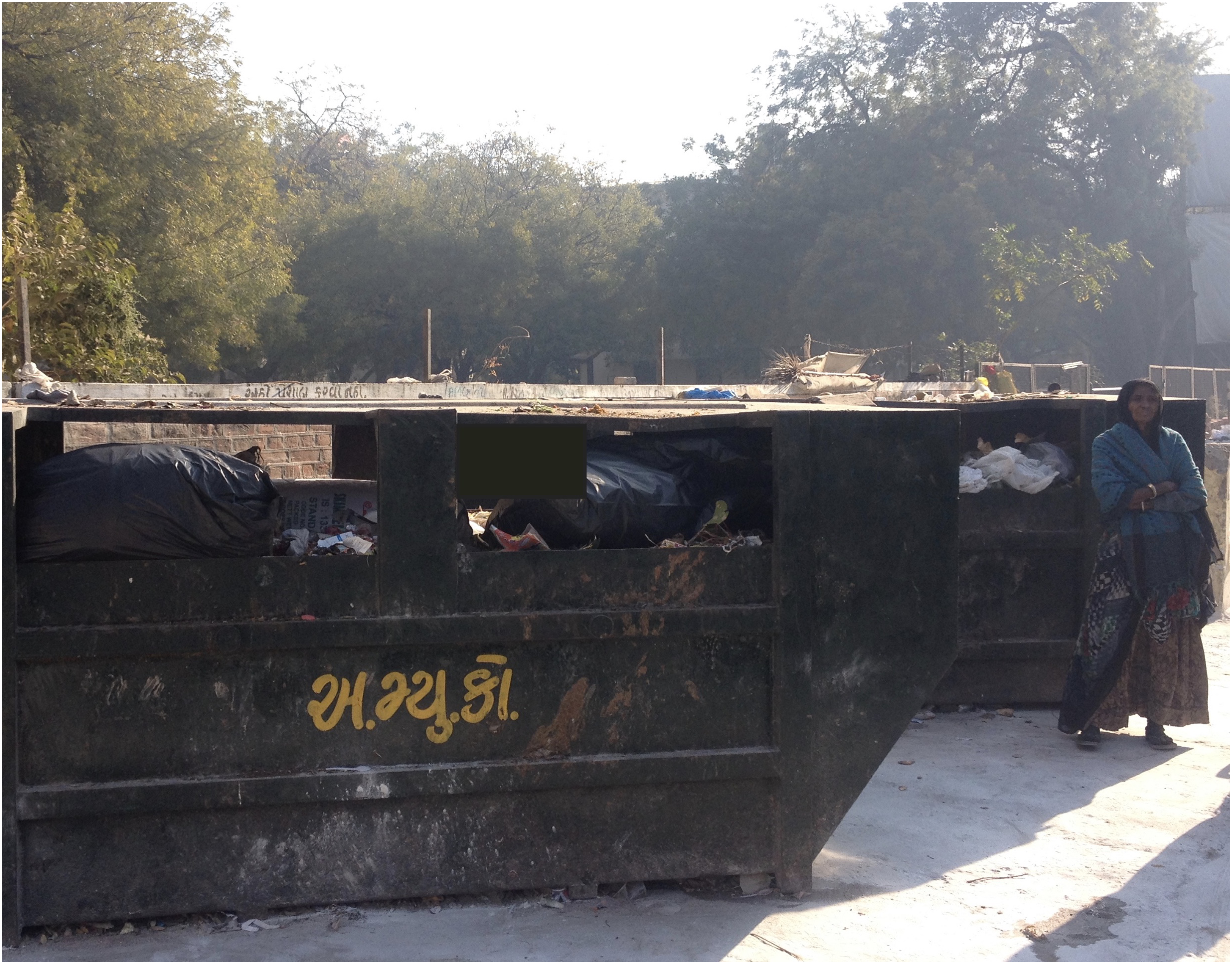
Image of a woman recycler standing in front of a community waste bin where she was collecting recyclables in 2016. Photo by the author.
Second, the aesthetic project of keeping waste ‘out of sight’ is coupled with new temporal mandates by municipal officials requiring overnight waste collection in areas around college campuses, late-night eateries and tourist areas (Times of India, 2017). Previously, these sites served as important spaces for women recyclers to collect a high concentration of discarded packaging and beverage containers early in the morning. This new overnight scheduling of waste collection in these popular areas again diminishes women recyclers’ access to materials: We women go out to pick waste by 4:00am, early in the morning. But these AMC trucks start at 11:00pm and finish at 3:00am, so we are getting much less material now. It's all gone.
Q: why don't you go and work at 11:00pm?
Oh no no. We cannot go outside at that time, at night. We feel afraid of the darkness, the drunken men and the harassment at that time.
45-year old woman working as a waste picker since childhood
Women recyclers frequently complete their waste collection work early in the early morning, from just before sunrise until the streets start to fill up with vehicles and people. Most women recyclers noted that they cannot go out on the streets too early in the morning (or late at night) because threats of harassment and violence make it physically and socially unsafe for them to do so (Datta, 2020; Desai et al., 2017; Joshi, 2018; Mahadevia et al., 2016). The perceived threats and fears associated with working in the dark were especially expressed by younger and unmarried women, but avoidance of working in the dark was a common practice across all age groups, where almost all participants perceived that it was impossible for them to go out and collect recyclables at night and to compete with the trucks.
Embodying ‘clean city’ discourses
The widespread recent uptake of aesthetic cleanliness discourses and linked claims to modern citizenship promoted in the SBA have led to changes among citizens in their disposal of waste, as littering, burning waste and waste picking are increasingly understood as unclean, shameful and deviant behaviours to be disciplined (Jeffrey, 2015; Luthra, 2018b). However, women recyclers’ experiences highlight the ways that these ideological and behavioural shifts can promote the physical and discursive exclusion of those whose bodies and labour are not valued within emerging forms of aesthetic modernity and citizenship.
Anti-littering campaigns and waste disposal
Women recyclers frequently attributed their material challenges in accessing waste to recent anti-littering discourses and changes in waste disposal practices in the city. Because of this Swachh Abhiyan, people have become very clean and they do not throw any garbage outside. People do not let us inside the [residential] societies to pick up waste either— big bins are put inside and they throw the waste there now. It is a Rs.500 fine for people if they throw their waste outside, so people are very afraid and conscious of this. Now, I just pick up whatever I can get on the roads, what else can I do? I used to get 3 bags [daily], but now, I just get a single bag.
45-year old woman working as a waste picker for 30 years
“Modi has made our work very difficult and our lives miserable! Before all of this ‘clean city’ business, everyone used to throw their waste outside and we were able to get the recyclables. But now, everyone must keep the waste inside but if we go inside the societies to search for materials, they will blame us for stealing. It is not possible (…) waste pickers are not allowed inside, it has always been that way, so the amount [of waste] that I get has decreased a lot.”
60-year old woman working as a waste picker for 30 years
Women recyclers frequently linked their increasing struggles to access waste in public spaces with their Dalit identities. Until recently, waste was ‘thrown over a conceptual boundary’ from the ‘inside’ spaces of the home associated with purity and cleanliness into the ‘outside’ spaces of the disorderly public domain (e.g. community waste bins, roadsides), with the effect of freeing individuals from the moral obligation and symbolic pollution associated with their garbage (Cornea et al., 2017a: 738; Kaviraj, 1997; Doron and Raja, 2015). However, SBA campaigns promote the notion that citizens must take responsibility for the cleanliness of public spaces (i.e. not littering) as an expression of their modern citizenship identity (Desai et al., 2015; Jeffrey, 2015; Luthra, 2018b). SBA cleanliness discourses and local SWM rules now stigmatize and punish the act of littering; waste is now required to be kept hidden inside the gates of residential and business enclosures, until waste collection vehicles come to collect it (Figure 2). Yet, ‘outside’ spaces are women recyclers’ main point of access to materials as their bodies and labour are associated with physically and ritually polluted ‘outside’ spaces (Gill, 2010; Kornberg, 2019; Luthra, 2020b). The shift of waste materials from outside to inside spaces has a significant impact on women recycler's incomes due to the embeddedness of the perceived embodied impurity of untouchability in mediating their access to physical city spaces. While waste materials can be shifted to ‘inside’ spaces to express one's modern citizenship, Dalit women recyclers’ bodies and labour remain linked to the physical and ritual pollution of ‘outside’ spaces and they are not able or willing to enter ‘inside’ spaces to claim waste materials.
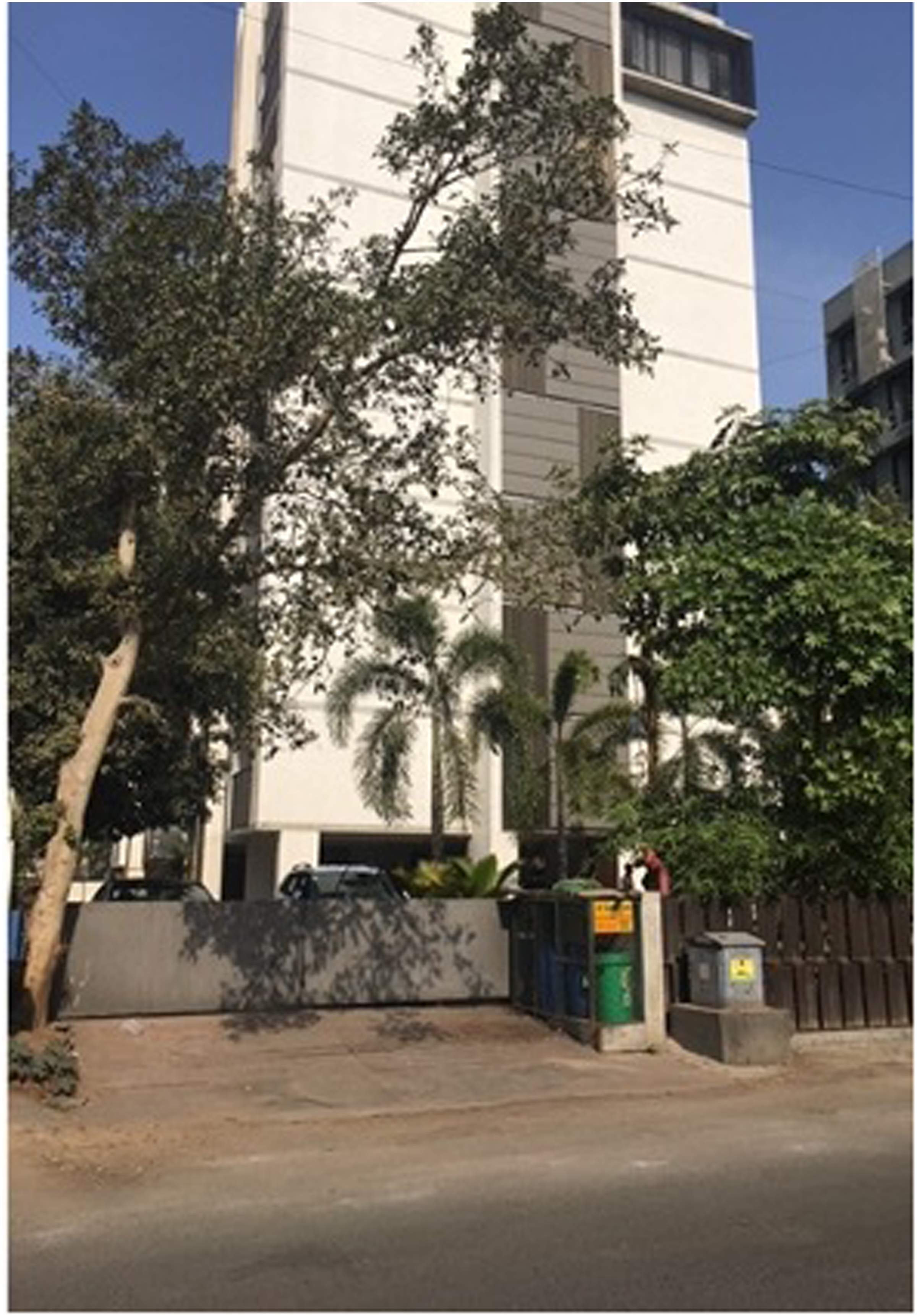
A residential building with waste bins situated just outside of the gate in a locked cage. Photo by the author.
While some respondents noted challenges in accessing waste materials moved ‘inside’ due to the external enforcement of these norms (e.g. by guards stationed at the gates or by residents/business owners), most referenced their own internalized understandings of their access to space in association with caste and gendered norms, as well as perceptions of safety: My mother taught me the two key factors of this work: one, do not steal anything from anyone— it is only your own hard work that will pay you (…), and two, do not show your thighs to anyone— you will meet many people who will try to take advantage of you. Many men ask us [recycler women] to come inside to get good waste materials, but I never go inside. I just remember my mother and leave such places.
42-year old woman working as a waste picker since childhood
For women recyclers, the invisibility of ‘inside’ spaces can be associated with various threats, most notably, the threats of being accused of theft and various forms of harassment and violence. The visibility of ‘outside’ spaces was thus important for maintaining one's self-presentation of respectability and dignity and in mediating the stigmas and social threats associated with waste picking labour, both in society and in one's community and household (also see, Joshi, 2018). Changing cleanliness discourses and the re-spatialization of the urban waste landscape are acting to further displace women recyclers and are compounding their challenges to earning incomes, safety, security and dignity in their already precarious work.
Swachhata entrepreneurialism and ‘waste as a resource’
Entrepreneurial discourses pervading SBA messaging have led to an increasing number of actors collecting recyclable materials to generate a profit (Gidwani and Corwin, 2017; Luthra, 2018b; Udas-Mankikar, 2018). Residents and businesses also increasingly understand that they can make a little extra money by selling their recyclable materials to these emerging actors, including raddiwallahs (informal, itinerant buyers using hand carts/cycle rickshaws) and new private businesses operating online recycling pick-up services: The materials were always outside of the shops before. But now everyone knows that the plastic and papers are useful to have— that they can make money from it. People are selling their stuff to the raddiwallahs themselves now and they don't allow us to pick it up! But I cannot force them to give me these things—obviously, it is not in my hands.
45-year old woman working as a waste picker for 12 years
The last six months have been very bad for my business. I have been taking loans from the pithawallah because I cannot make enough money to survive. I work all morning and go to different places and I can't find material. People are not throwing the things outside anymore, they are selling it themselves now. I have also heard that people sell their recyclables online!
32-year old woman working as a waste picker for 4 years
The popularization of the SBA's entrepreneurial rhetoric and commodification of waste produce tensions regarding who waste is a resource for as these discourses disrupt and displace the ‘necessary labour of those who depend on waste for their livelihoods’ (Luthra, 2018b: 130–131; Desai et al., 2015). Women recyclers’ experiences in Ahmedabad highlight particular gendered tensions embedded within these territorial navigations and claims to recyclable materials as the entrepreneurs and workers engaging in new forms of formalized-mechanized waste collection and recycling work in the city are predominantly men. The entrepreneurial emphasis of the SBA must therefore be understood as being masculinized, providing benefits for male entrepreneurs and workers in more lucrative and protected forms of both formal and informal waste/recycling work. Further, while women recyclers and raddiwallahs used to co-exist with their own market segments of recyclables, new forms of competition are emerging between these actors as an increasing number of men are entering the raddiwallah market and residents are selling their recyclables instead of disposing of them.
Coping strategies, improvizations and increasing precarity
Women recyclers were actively responding to the emerging challenges to their work and I observed an increasing uptake of various coping strategies and improvizations by study participants over the 2 years of the study. However, many of the strategies women were using to maintain daily incomes were straining already-precarious physical and social infrastructures of work, entailing further risks and increasing physical and mental burdens: When I don't get anything on my usual route, then I’ll go further away. I walk along the road only, so it can become a very long route.
60-year old woman working as a waste picker for 42 years
I just pick up what I can find on the roadside— papers, cardboard, plastics, but those chhota hathis take all the better, higher value things these days. What can be done? I am getting much less material in the morning now, so I have started going out for an extra round in the evenings.
45-year old woman working as a waste picker since childhood
Women recyclers’ adaptations to the shifting waste landscape frequently centred around these kinds of individualized functional improvizations and self-provisioning strategies of working longer/walking further, going out for extra shifts and taking on financial risks via loans from pithawallahs and local moneylenders to make ends meet. In contexts of prolonged precarity, the multidimensional burdens associated with these kinds of intensive productive strategies combine with women's reproductive work in the home, compounding the daily workloads, stress and physical ailments that may already threaten their well-being (Kabeer, 2015; Parizeau, 2015a; Wittmer, 2021).
In the second round of interviews, some women said they were trying to diversify their income-earning strategies in response to their declining recycling incomes. For example, 10 recyclers (or 28% of the 36 women I could reconnect with) had taken up an additional income-earning strategy during the 8 months that passed between my visits. In addition to their waste picking work, these workers had found opportunities doing additional iterant work as outdoor sweepers for commercial complexes, sorting waste for a nearby pithawallah or shopkeeper, or home-based garment-finishing (snipping loose threads for local garment factories). Despite most participants continuing solely with waste picking work, these additional livelihood strategies highlight the entrenchment of gender and caste-based norms in women's work opportunities, as most of the jobs taken up in addition to waste picking work were still associated with cleaning and waste (i.e. sweeping sorting recyclables), while other opportunities (i.e. garment finishing/thread snipping) were based inside the home, a space associated with femininity and the work of social reproduction. Women recyclers’ shifts towards these alternative forms of labour are thus unlikely to affect transformative changes in their experiences of social or structural power inside or outside of the home (Kabeer, 2008; Mahmud and Tasneem, 2014). Rather, these adjustments (i.e. of working more, walking longer distances, taking ever-increasing loans and taking on additional itinerant cleaning jobs and home-based work) serve to reinforce the exclusions of low-income Dalit women workers and highlight the trade-offs, challenges and impossible decisions women make in their everyday navigations of precarious work in the urban margins (Kabeer, 2015; Sultana, 2020b; Truelove, 2019; Wittmer, 2021).
Imagining and embodying the ‘clean city’
Women recyclers frequently made use of popular terminology associated with local SBA campaigns (e.g. ‘Swachh,’ ‘clean city,’ ‘clean and green,’ ‘Modi’) in describing the challenges to their work. In some cases, these terms were leveraged sardonically and with frustration: There are good changes in this work— we get a lot less waste now! It is a ‘clean city’ now, isn't it?!
45-year old woman working as a waste picker since childhood
In using the English phrase, ‘clean city,’ she was making her rejection of this popular rhetoric explicit with reference to the obvious uneven impacts the production of the ‘clean city’ has had in her life. However, these references to swachh terminology and rhetorics were often more nuanced as women recyclers expressed their contradictory feelings about the simultaneous changes to the city and their livelihoods: Because of this Swachh campaign, people are keeping their houses and societies very clean. It feels good that the roads are clean and the city is looking good, but it affects our work— we cannot get any material!
22-year old woman working as a waste picker for 8 years
There is strict government instruction now not to keep our city dirty— we have to keep it clean now! I am impressed with the government for telling people to keep everything clean and saying that we should leave our filthy work, but I feel helpless at the same time!
50-year old woman working as a waste picker for 10 years
These excerpts challenge the notion that imaginaries of clean and modern ‘world-class’ cities are held exclusively by elite actors and instead, point the divergent and shifting environmental subjectivities, political agency and contradictory desires that emerge in the visioning and production of the ‘clean city’(Baviskar, 2020; Doshi, 2017, 2018). In this way, women recyclers might internalize popular aesthetic values and aspirations of the SBA as urban citizens, while expressing a simultaneous feeling of betrayal by modern cleanliness governance, as their livelihoods and settlements are discursively and materially excluded from the ‘clean and green’ world-class city.
The complexities of urban citizenship and belonging expressed here certainly highlight the shortfalls in the provisioning of infrastructures and opportunities that are ‘felt keenly as a breach of the contract between state and citizens’ (Baviskar, 2020: 199). However, women recyclers’ internalization of dominant aesthetic norms and their aspirations for a clean city may also be interpreted, not with resignation, but in terms of the ‘performative possibilities’ of their appropriation of these popular notions and norms (Ghertner, 2015: 16). To this end, Ghertner (2015) argues that the internalization and expression of dominant aesthetic ideas by those in the urban margins are ‘experiments in the seeable and the sayable aimed at garnering recognition as legitimate subjects of discourse,’ even against all odds (16). In other words, despite the contradictory violences and dispossessions the SBA and SWM governance produce for women recyclers, their participation in dominant aspirations for a ‘clean city’ enables them to subjectively reposition themselves as part of the clean, modern, world-class city.
Conclusion: Embodying waste work in the ‘clean city’
This paper has explored low-income Dalit women's experiences of informal recycling labour in urban Ahmedabad as a suite of SWM and urban cleanliness governance mechanisms have been rolled out and are re-shaping the city's urban waste landscape. A feminist UPE analysis of Dalit women's work with waste in the aspiring ‘clean city’ highlights the embodied, everyday impacts and implications that these material and discursive experiments with urban cleanliness and SWM are having for those who rely on accessing waste in public spaces for their livelihoods. The following discusses the usefulness of an embodied UPE approach for investigating environmental governance and infrastructural transformation and outlines five key lessons emerging from the knowledges and experiences of gendered, classed and casted labourers for deepening understandings of the complexities and contradictions of urban environmental change in practice.
First, attention to embodiment in waste labour reveals the ways that popular imaginaries and governance mechanisms intended to produce clean, sustainable, modern cities are reproducing insecurities and causing harm to gendered, classed and casted bodies engaged in marginalized labour activities. Dalit women recyclers’ narratives and emotions pertaining to their work highlight the damage that current approaches to governing SWM are having on women recyclers’ bodies. The re-spatialization and masculinization of waste labour in the city via changes in the tools, temporalities, actors and spaces through which waste is to be accessed and collected is requiring women recyclers to take on increasing burdens and stresses as they adapt to more risky, strenuous and precarious strategies to cope with decreasing incomes. Because SBA messaging is perpetuated via a biopolitics of shame, I emphasize that women recyclers’ adaptations to maintain daily incomes may further stigmatize their labour and bodies as they seek out potentially hazardous forms of waste in more risky urban spaces (Baviskar, 2020; Doshi, 2017). Women recyclers’ experiences of tension, dispossession and preclusion from participating in new forms of waste work in Ahmedabad, therefore, highlight the need for intersectional analyses of worker experiences in the context of techno-managerial urban governance programmes and infrastructural development, especially in the context of contemporary economic, social, health and ecological crises (Ramakrishnan et al., 2021; Sultana, 2020b; Truelove, 2019; Truelove and O’Reilly 2021). Embodying UPE can help to articulate these intersections, where projects aiming to modernize urban spaces and citizens can be understood as obscuring important dimensions of identity and power and continuing to reproduce material, spatial and social exclusions for gendered, classed and casted workers.
Second, an embodied UPE analysis of waste labour makes an important political contribution by connecting supposedly ‘neutral’ techno-managerial SWM solutions with the ‘intimate, meaningful and power-laden embodiments’ of the most marginalized forms of waste labour in the city (Doshi, 2017: 126; Cornea et al., 2017a). By engaging with the micropolitics of the intimate and experiential, this approach privileges Dalit women workers’ perceptions and experiences of cleanliness, dirtiness, nuisance, dignity and modernity. This paper thus contributes to critiques of popular sustainability-oriented ‘clean and green’ terminologies used and reproduced in the neoliberal political imagining and production of the world-class city and advances a more nuanced and robust understanding of these discourses from differently situated actors (Baviskar, 2020; Desai et al., 2015; Doshi, 2018). To this end, the embodied scale also points to the emotions of women recyclers, frustrated by the lack of opportunities afforded to them in their continued abandonment by the municipality and state in the creation of rules and opportunities aimed to quickly (and arguably, superficially) modernize Gujarati cities and demonstrate a ‘swachh’ city for others to follow.
Third, an embodied approach to analysing waste labour and governance points not only to the preclusion of women recyclers from opportunities to work in emerging neoliberal SWM systems but is also useful in the consideration of contestations and solutions to these exclusions. Organizing informal recyclers to formalize their activities has been promoted as a key path towards their inclusion in municipal SWM, with many successful case studies worldwide (Dias and Samson, 2016; Gutberlet, 2008; Kabeer, 2008; Narayan and Chikarmane, 2013; Samson, 2009). However, studies also point to the challenges of organizing informal recyclers, whether due to internal power dynamics and social differences among workers (Samson, 2019), or organizational challenges in professionalizing workers to make them recognizable within established neoliberal, privatized SWM systems (Millar, 2018; O’Hare, 2019). Working from embodied everyday experiences of informal workers and organizers can promote an understanding of the particular and situated challenges of securing dignified livelihoods and improving working conditions for women workers. Further, Cornea et al. (2017b) argue for increased attention to the everyday ‘practices, rationales, normative orientations, interests, and imaginaries’ of a diverse local governance actors who are often the ‘key implementers of urban environmental politics’ to make UPE analyses more policy relevant (2). An everyday UPE of the local governance of SWM and organizing may also be particularly salient in Ahmedabad, especially given the challenges local organizations have faced with the municipality explicitly favouring mechanized waste collection through PPPs in the city's race to lead the nation in urban SBA achievements.
Fourth, women recyclers’ explanations of their simultaneous aspirations and occupational challenges show that attending to embodiment and emotion in UPE can promote deeper understandings of the complexities and contradictions involved in urban environmental governance and the implications for urban citizenship in practice. Women recyclers’ internalization of the SBA's aesthetic norms while experiencing livelihood dispossessions because of its implementation reveals the ways that ‘bodies are sites for the formation of political subjectivities with sometimes contradictory desires’ (Baviskar, 2020; Doshi, 2017: 127). This paper grapples with the possibilities of an embodied UPE to hold the ‘performative possibilities’ of simultaneous aspirations, appropriations of popular discourses and the realities of livelihood exclusions (Ghertner, 2015: 16). The embodied lens thus works across dichotomous framings of inclusion/exclusion and informal/formal to provide a more nuanced analysis of substantive citizenship experiences as marginalized workers may internalize and leverage popular discourses as part of claims-making and a politics of belonging.
Finally, emerging from these embodied complexities, this study contributes to the re-imagining of more equitable urban futures by starting from what already exists. Emerging scholarship on reparative urbanisms advocate for incremental approaches and reparative relations that centre and begin with the real and tacit ways in which people individually and collectively navigate work and life in the urban margins (Bhan, 2019; Bhan et al., 2020; Lawhon et al., 2014; Ramakrishnan et al., 2021). An embodied UPE of marginalized waste labour can thus contribute to this reparative project by re-imagining waste management systems that privilege the infrastructural labours that already exist, rather than invisibilizing them. Such an approach would bring together worker perspectives and needs alongside understandings of historical and ongoing power geometries and the structural violences that Dalit women recyclers continue to experience in the shifting urban waste landscape and the aspiring ‘clean city.’
Highlights
The imagining and production of the ‘clean and green’ city are re-spatializing and masculinizing waste labour in urban India;
Spatial, discursive and temporal shifts in municipal SWM are threatening Dalit women workers’ livelihoods and daily incomes;
Women recyclers adapt to urban waste management transformations with more strenuous and precarious improvizations;
Women recyclers also envision and desire a ‘clean city,’ despite simultaneous exclusions from its current imagining and production;
Embodied gendered and casted analyses of urban natures are essential for understanding the complexities and contradictions of urban environmental governance and transformation.
Footnotes
Acknowledgements
This work was generously supported with funding from the Society of Woman Geographers, SSHRC and the Canada Research Chair in Gender, Justice and Development. This research would not have been possible without the expertise and assistance of Mubina Qureshi with Neha Chokshi, Bhagyashri Jadeja, Kajal Joshi, Viral Pandya and Kajal Shah. Special thanks to Dr Kate Parizeau, committee members at the University of Guelph and colleagues at the Gujarat Institute of Development Studies. I am also grateful to Lyla Mehta and three anonymous reviewers for their time and helpful comments which were essential in improving this article. Finally, I am humbled and deeply grateful to the women who spent their valuable time with me and allowed me to listen to their stories and learn about their lives.
Declaration of conflicting interests
The author(s) declared no potential conflicts of interest with respect to the research, authorship, and/or publication of this article.
Funding
The author(s) disclosed receipt of the following financial support for the research, authorship, and/or publication of this article: This work was supported by the Society of Woman Geographers, Social Sciences and Humanities Research Council of Canada, Canada Research Chairs, and the Queen’s University Postdoctoral Research Fund.