




Abstract
Over the years, cities have figured as exemplary places for neoliberal urban policies which tend to appropriate the right to the city through city-branding policies. However, as this article demonstrates, there are important claims of the right to the city raised by newly arrived refugees in the city of Athens. Although most refugees reside in overcrowded state-run camps on the outskirts of the city, there are many cases in which refugees enact the production of collective common spaces, occupying abandoned buildings in the urban core and claiming the right to the centre of the city. In this context and following the Lefebvrian notion of the right to the city and the spatial analysis on commons and enclosures, we explore the actions of refugees, and the way they engage in commoning practices that not only strive against the official state policies, but also often contest city-branding policies. In particular, we focus on the area of Exarcheia in Athens, which is an emblematic case of the conflicted nexus between investors’ and refugees’ right to the city.
Introduction
On 26 August 2019 on a morning TV show, the spokesperson of the Greek Police announced that ‘the police will suck up all the scum from Exarcheia progressively like a vacuum cleaner’ (Skai, 2019). On the same day, a massive police operation evicted four refugees’ squats in the Exarcheia neighbourhood in the centre of Athens, arresting 143 residents of the occupied buildings.
Although academic literature on refugees and urban space has addressed gentrification (Murdie and Teixeira, 2011; Newman and Wyly, 2006) and migrants’ housing (Darling and Bauder, 2019; Hatziprokopiou et al., 2016; Maeckelbergh, 2012), there have been few studies that link recent city-branding policies with the recent ‘refugee crisis’. This article attempts such an examination by focusing on Athens, a nodal spatial location along the recent refugee path called the ‘Balkan corridor’. During the years 2015–2019, more than 1.2 million refugees mainly from Syria, Iraq and Afghanistan (Asylum Information Database and European Council on Refugees and Exiles, 2018) followed the ‘Balkan corridor’; Athens is one of the main hub cities on this route. The study of refugees’ housing usually focuses on state policies or charitable actions by NGOs (Gabiam, 2012). Emerging literature has focused on immigrant activism (Agustín and Jørgensen, 2019; Della Porta, 2018; Squire, 2018; Trimikliniotis et al., 2015), and on new ‘sociabilities of emplacement’ enacted by collaboration between refugees and local solidarity groups (Çaglar and Glick Schiller, 2018: 213). This article highlights a new angle on those practices: the ways in which refugees’ commoning practices are able to contest not only official state migration policies, but also major entrepreneurial projects and city-branding practices at the heart of urban centres. Exploring this much-neglected angle of the refugees’ right to the city, we shift the discussion by centring it specifically on refugees’ right to the centre of the city.
The study presented in this article concerns the examination of the Exarcheia neighbourhood, a central area in Athens, which is a key location (see Figure 1b) for researching the conflict between investors’ and refugees’ right to the centre of Athens. Although the vast majority of the newcomers-refugees from the Middle East and North Africa are settled in remote areas in state-run camps, the Exarcheia neighbourhood is a notable exception, as it constitutes a ‘point of entry’ for refugees to the city beyond official state policies. During the years 2015–2019, a network of occupied buildings in Exarcheia hosted hundreds of newcomers, who experimented with practices of commoning, self-organisation and claiming their right to the centre of the city. At the same time, Exarcheia has recently become a controversial city-branding location and investment/development project area. Specifically, the Exarcheia neighbourhood has become a representative example of the new right-wing government city-branding slogan of ‘return to normality’.
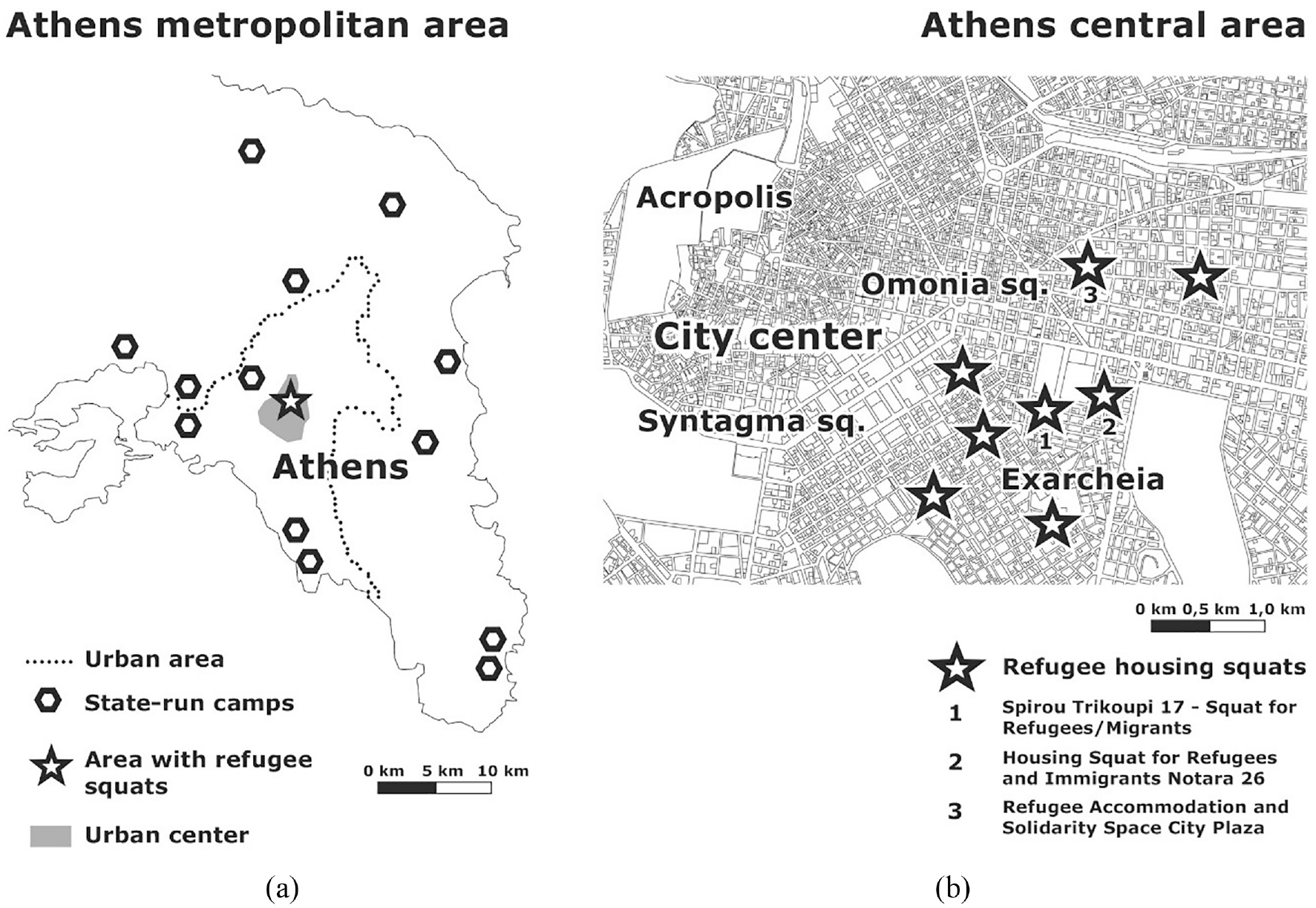
(a) State-run camps (on the left) and (b) refugee housing squats (on the right) in Athens.
In order to analyse the examined case of refugees’ and investors’ right to the centre of the city, our study is based on the critical urban theory of city branding (Kaika, 2010; Knierbein et al., 2010; Rossi and Vanolo, 2012), the Lefebvrian (1996 [1968]) concept of ‘the right to the city’ and related literature (Harvey, 2008; Merrifield, 2011; Simone, 2005) and the discussion on urban commons and enclosures (Chatterton, 2016; De Angelis, 2017; Stavrides, 2016).
Methodologically, the research was based on direct observation, ethnographic analysis and in-depth interviews with refugees in Athens. We conducted archival research on the reports of human rights organisations and collected material from refugee solidarity groups. Direct observation was conducted between autumn 2018 and summer 2019 when we conducted weekly visits to 13 state-run camps in the perimeter of Athens and 10 self-organised housing projects in the Exarcheia neighbourhood in the city centre. During the same period, we conducted 45 semi-structured interviews with refugees, on average two interviews per housing structure, i.e. two per camp or squat. We also held several informal conversations with refugee NGOs’ volunteers and activists from refugee solidarity groups. The interviews lasted between one and four hours. They were conducted in English and Greek, and interpreters were used when there was a need for translation from Arabic, Urdu or Farsi. The interview participants were 55% males and 45% females; they had lived for more than six months in Athens; and their countries of origin were Syria, Iraq, Iran, Pakistan and Afghanistan. The names of the research participants have been changed in order to protect their identities.
The structure of the article is as follows. The next section discusses a range of theoretical approaches to city branding, commons and the right to the city. In the following two sections, we discuss the emerging refugee squats and the city-branding processes in the case of the Exarcheia neighbourhood in Athens. In the final section, we present the conclusions reached on the ongoing conflict between investors’ and refugees’ conceptions of the right to the city.
Who has the right to the centre of the city? Theoretical approaches to city branding and refugees’ urban commoning
So-called ‘city branding’ has been one of the dominant neoliberal urban transformation strategies in recent decades. Flagship mega projects, iconic buildings, global events and local culture, history and landscape have all become parts of the city-branding kaleidoscope (Kaika, 2010). These are the processes through which the ‘image’ of a city is ‘launched’ in the global competition to create a ‘good reputation’ and to attract the so-called ‘creative class’, as well as new investments, tourists, students and high-income residents (Belabas et al., 2020; Braun et al., 2013; Swyngedouw et al., 2002). To achieve this goal of an emerging entrepreneurial city, local authorities increasingly pursue policies that resemble business and marketing strategies, seeking to promote the city as an attractive product (Knierbein et al., 2010). In fact, the city is treated as a ‘commodity’, while the targeted residents, tourists and investors are treated as ‘customers’. According to the supporters of city branding, the city is a commodity product which should be advertised to demonstrate its advantages, and places that fail to be promoted face the risk of economic decline (Kotler et al., 1993). While city-branding policies concern mainly the regeneration of urban centres, critical approaches to these policies point to an important consequence of city branding: the dispossession of undesired social groups like squatters, homeless people, low-income residents and migrants (Rossi and Vanolo, 2012). At this point, the question arises as to who has the right to the city and specifically to the centre of the city.
Against the neoliberal policies of city branding, there is a rich body of critical urban theory literature on ‘the right to the city’, a concept that was introduced in the homonymous work of Lefebvre (1996 [1968]). Lefebvre (1996 [1968]: 173–174) conceptualises the right to the city as a ‘superior form of rights: right to freedom, to individuation in socialisation, to habitat and to inhabit. The right to the oeuvre, to participation and appropriation (clearly distinct from the right to property), are implied in the right to the city’. These features of the right to the city are particularly important in the examination of refugees’ squats vis-a-vis isolated state-run camps in the case of Athens. Important for our research on the refugees’ or the investors’ right to the centre of the city, as a superior form of rights, is the Lefebvrian concept of ‘centrality’. In Lefebvre’s (1996 [1968]: 179) words, the right to the city is the right to the ‘urban life, to renewed centrality, to places of encounter and exchange, to life rhythms and time uses, enabling the full and complete usage of these moments and places’. Also, in a later work, Lefebvre (1996 [1968]: 34) considers the centre of the city as the crucial location for claiming rights, and emphasises that the right to the city ‘would also cover the right to the use of the centre, a privileged place, instead of being dispersed and stuck into ghettos (for workers, immigrants, the “marginal”)’.
Several critical urban theorists have extended and deepened the discussion of the right to the city during the last few decades. For example, Harvey (2008: 23) argued that ‘the question of what kind of city we want cannot be divorced from … what kind of social ties … we desire’, highlighting the transformative character of the right to the city which is ‘a right to change ourselves by changing the city’. Responding to the same consideration, Simone (2005: 324–325) asked ‘who has the “right” to do what in […] cities’ and argued that the right to the city should include people ‘as creators of life and not just consumers or victims’. In this respect, Simone’s comment is extremely crucial for examining refugees’ right to the city beyond victimisation or entrepreneurialism. Merrifield (2011: 475) emphasised the right to the urban centre, pointing out that the right to the city should be considered ‘not a simple visiting right … no tourist trip … at a gentrified old town … but a right to participate in life at the core’. Moreover, as Mitchell and Heynen (2009: 616) argued, the concept of the right to the city has a significant ‘capaciousness’ which ‘is valuable because it allows for solidarity across political struggles … focusing attention on the most basic conditions of survivability, the possibility to inhabit, to live’. Finally, Garbin and Millington (2018: 151), focusing on Congolese migrants’ protests in central London, pointed out that claims for the right to the city include an ‘inventiveness’ in order to ‘claim rights that do not formally exist, that are not granted to them and whose possibilities remain, as yet, unbounded’. In the case of the examined neighbourhood of Exarcheia in Athens, we will show how ‘capaciousness’ and ‘inventiveness’ open up new avenues for solidarity practices between locals and newcomers, as well as between different nationalities, in transnational common spaces.
At this point, in order to examine the features and aspects of the emerging refugees’ common spaces, we draw particular attention to the literature on commons and especially on ‘urban commons’ that has recently enriched the radical spatial vocabulary. The discussion around the commons often refers to a specific range of models – private (Welch, 1983), state (Ophuls, 1973) and collective (Ostrom, 1990) – for managing ‘common pool resources’ (e.g. resources without a clearly defined ownership status). However, beyond the managerial resource-based discourse, numerous critical theory scholars (De Angelis, 2017; Federici, 2012; Stavrides, 2016; Tsavdaroglou, 2020) have recently emphasised the verbal form of commons, the so-called ‘commoning’, that further describes the social relations that have the ability to produce and reproduce, constitute and reconstitute, invent and reinvent the commons. This theoretical shift marks a variety of studies that highlight the productive and transformative character of commons. According to Chatterton (2016: 407), commons ‘are full of productive moments … and create new vocabularies, solidarities, social and spatial practices and repertoires of resistance’. An important analysis that proposes to rethink urban commons through the prism of the right to the city is offered by Stavrides (quoted in An Architektur, 2010). As Stavrides suggests, commons ‘can be produced through encounters that make room for new meanings, new values, new dreams, new collective experiences. And this is … a way to see commons beyond the utilitarian horizon’ (quoted in An Architektur, 2010). Under this prism, Stavrides (2016) conceptualises the common space as a threshold open to newcomers. This analysis is particularly interesting in the examination of refugee squats as urban commons of newcomers, since, as Stavrides (2016: 56) underlines, ‘thresholds explicitly symbolize the potentiality of sharing by establishing intermediary areas of crossing, by opening the inside to the outside’. Our analysis illustrates the potentialities of common spaces / squats in Athens, in sharp contrast to the state-run camps, to open up the inside of the city, the centre of the city, to the newcomers-refugees.
For the purpose of our research, it is also important to stress that according to several scholars (De Angelis 2017; Dellenbaugh at al., 2015; Jeffrey et al., 2012), commons represent the antipode of private and state enclosures, of the multiple market-led or state-led physical, political and social borders and of different historical and social processes such as the British ‘enclosures acts’ of common lands in the transition from feudalism to capitalism or the border closures in the Balkan countries during the recent refugee crisis. However, as Balibar (2004: 109) reminds us, ‘borders have changed place’, as not only are they ‘at the edge of territory’ but they ‘have been transported into the middle of political space’. Yet, as Nicholls and Uitermark (2017: 3) have emphasised, where there are borders there is resistance; and if the ‘political’ is the place of encounter with the ‘police’ (Rancière, 1995), then the question of the possibility of the Athens refugee squats to claim the right to the city centre against the urban internal borders of police-controlled state-run camps becomes crucial.
Using this analytical approach, we will examine the neighbourhood of Exarcheia in Athens, a highly contested location where the newcomers-refugees struggle against spatial exclusion and segregation, claiming their right to the centre of the city. Their claim is enacted through commoning practices of sharing, mutual help and self-organisation that create a counter example to both the enclosures enacted by state immigration policies and the marketisation of city branding.
‘Say it loud, say it clear! Refugees are welcome here!’: Refugees’ housing commons in Exarcheia
Athens has received a large number of refugees during the last three decades, initially in the 1990s from Eastern European countries, then in the 2000s from Africa and central Asia and more recently from the Middle East. One of the differences for the most recent arrivals is that the Greek state, following the European Union’s mandates (Government Gazette, 2018), undertakes the responsibility to organise refugee camps for the newcomers. Subsequently, Greece must follow the European standards for the hospitality of refugees, which determine that ‘only by making housing equally accessible to refugees … as well as stimulating multicultural living environments will integration succeed’ (ECRE, 2007: 2). Over the period of 2016–2019, 13 state-run camps were created in the Athens metropolitan area, on former military bases or in abandoned industrial buildings, all of them at great distances from the urban centre (see Figure 1a). Therefore, state-run camps are isolated ghetto-like spaces, cut off from the urban social life, while numerous reports (Greek Council for Refugees, 2019; Refugee Support Aegean, 2018) have documented the inadequate living conditions of refugees. According to the reports, and our personal observations, state-run camps are overcrowded, with poor hygiene conditions, where most of the refugees suffer from psychosocial distress. At the same time, the limited public transportation to the urban centre and the dramatically restricted access to education, hospitals, local markets and employment opportunities show that in state-run camps there is no room for the refugees’ right to the centre of the city (see Figure 1a).
For instance, as Mahmud a Syrian refugee who lives at Ritsona camp, describes: The camp is very far from the city, in the middle of nowhere. Even if someone wants to go to the nearest bus stop, he or she has to walk at least half an hour to get the bus and then another hour to get to the city centre.
Fatima, a refugee from Iraq who is a nine months’ pregnant and lives in the Elefsina camp, explains that: It is very difficult to be pregnant here … The camp is in an industrial area of the port. It smells of petrol all day. There are many pregnant women in the camp and many have had miscarriages. We are far away from everything. We are also far from the hospital. The doctor visits only during the morning hours and there is no female doctor … We really suffer from the fact that we are not safe. (Refugee Support Aegean, 2018)
Thus, the Athenian refugee camps constitute a ‘regime of marginality’ (Wacquant, 2007: 67) defined by the way that life is ‘kept at a distance from the ordinary social and political world’ (Agier et al., 2002: 318) and by policies that aim to ‘separate, segregate and manage specific populations or groups of individuals’ (Martin et al., 2020: 745) who have no ‘right to have rights’ (Arendt, 1967: 296). A number of scholars (Dalal, 2018; Oesch, 2017; Ramadan, 2013) have emphasised the agency of refugees who have the potential to contest, subvert and reshape the spatialities of the camps regime. We argue that in the case of Athens, this contestation manifests as a physical move of the refugees’ presence away from the camps, and a claim of their right to be present and live in the centre of the city. From 2015 onwards, refugees who refuse to live in the camps have occupied abandoned buildings in the city centre in collaboration with local solidarity groups, and have attempted to transform them into collective housing projects.
According to estimations by the municipality of Athens (Georgiopoulou, 2017), around 3000 refugees currently live in more than 15 occupied buildings / squats (see Figure 1b). In contrast to the isolated state-run camps, the most important spatial element of the occupied buildings is that they are located in the centre of the city, in or around the perimeter of the Exarcheia neighbourhood. Exarcheia is a highly politicised site where urban social movements, political and social centres and anarchist and radical left groups create an alternative and counter-culture area (Arampatzi, 2017; Tsavdaroglou, 2018). Moreover, Exarcheia hosts several university buildings, and so has played a key role in the protests mobilised by the student movements that shaped the country’s modern political history. Neighbouring Exarcheia to the East is the high-income residential neighbourhood of Kolonaki, as well as Syntagma Square, the seat of the Greek parliament, ministries and embassies. To the North, Exarcheia neighbours low-income neighbourhoods, and to the West it neighbours the central square of Athens, Omonia Square. Thus, Exarcheia is located in the midst of mixed land uses and socio-economic constituencies and has therefore become a significant hub for high-impact demonstrations and uprisings, such as the anti-dictatorship uprising in November 1973 and the youth uprising that followed the murder of Alexandros Grigoropoulos by a police officer in December 2008.
Although Exarcheia is not a homogeneous neighbourhood and not all local residents welcome the squats, it is in this contested neighbourhood that numerous refugee housing occupations flourish, with the support of local and international anarchists and left-wing solidarity groups. There are two main reasons why refugee squats have emerged in Exarcheia. First, the political background of the neighbourhood, with its plethora of anarchist and left-based housing occupations, social centres, bookshops, community gardens and older migrant-solidarity groups, provides a relatively safe social place for the newcomers, as well as the material and knowledge support for the new squatted buildings. Second, Exarcheia is a very central neighbourhood, thus refugees have access to social services like schools, hospitals and employment opportunities. The first refugee housing projects were created in the autumn of 2015 to cover the immediate needs of the refugees who were crossing Greece, as Athens was a main hub between the country’s eastern island borders and the northern borders with Balkan countries. After the closing of the Balkan corridor in spring of 2016 and the opening of state-run camps, refugee squats multiplied as new refugee solidarity initiatives occupied abandoned buildings in Exarcheia to host the growing number of refugees. In the words of Lafazani (2017), who is a member of the Refugee Accommodation and Solidarity Space City Plaza (see Figure 1b): the decision to squat came as a ‘radical answer’, activating a multi-scale response to the re-establishment of borders. What we proposed–namely, co-habitation in dignified conditions in the heart of the city–went against the social and spatial exclusion of the camps.
As we suggest, these squats can be seen as forms of housing commons, since their organisation is based on commoning practices of solidarity, togetherness, mutual help and self-organisation (Agustín and Jørgensen, 2019; Lafazani, 2018; Squire, 2018; Tsavdaroglou, 2018). In order to clarify this argument and better understand the character of these squats, we cite here the words of Alireza, an Iranian refugee squatter. As he explained to us in front of a squat banner saying ‘Say it loud, say it clear! Refugees are welcome here!’: Exarcheia is more than a place of immediate shelter and basic humanitarian aid for migrants … it is a place where the vulnerable can find community, where those that have been … ostracized by the state can decide – together – how they wish to live their lives. (Personal interview, 21 August 2019)
This testimony sketches the basic features of common spaces, which according to several scholars (Chatterton, 2016; De Angelis, 2017; Federici, 2012) are community, commoning and a common pool resource. Specifically, the commoning practices of solidarity, mutual help and experiences of cohabitation create the emerging transnational refugee community of Exarcheia neighbourhood, which is established in specific spatial forms of the occupied buildings – housing projects, neighbourhood daily life and the various protests for the refugees’ rights.
As Ramiz, an Afghan refugee, described: The main reason that I really like Exarcheia neighbourhood is that I feel safe in this area. I know that if I am arrested by the police or if fascists attack me, there will be people around the neighbourhood who will protect and support me. I would do the same if I saw someone else threaten a refugee or an anarchist and leftist comrade. I mean that there is a strong feeling of solidarity, that we are a nice family in the Exarcheia neighbourhood and in the refugee squats. (Personal interview, 28 August 2019)
Javed, a refugee from Pakistan, added that: In other neighbourhoods, where only Greeks are living, when they understand by the colour of my skin or my clothes that I am a refugee, they do not seem very friendly. In Exarcheia there is no such discrimination. Regardless if I am local or refugee, I can walk around freely without others looking at me in a strange way. People in Exarcheia are friendly, kind and want to learn about my country, my language and my culture. It is this sense of solidarity and care that has prompted me, even though I am a foreigner, to participate in demonstrations and protests both on issues concerning refugees but also in protests of local political groups. (Personal interview, 28 August 2019)
Thus, common space here is not defined only by a shared ethos and abode, but also by the creation of what Rancière (2006: 42) calls a ‘common world’, which ‘is always a polemical distribution of modes of being and “occupations” in a space of possibilities’. In the case of refugees’ housing occupations, the principles of sharing often interlink ‘with antiauthoritarian, antiracist and feminist values and principles’ (Spirou Trikoupi 17 – Squat for Refugees and Migrants, 2019; see Figure 1b). In addition, as a statement by the Housing Squat for Refugees and Immigrants Notara 26 (2016; see Figure 1b) emphasises, there is a sharp distinction between the squats and the state-run camps and the squats have declared their refusal to collaborate with the state or with NGOs. As it stresses, ‘this project doesn’t stand for philanthropy, by the state nor private, but rather for a self-organised solidarity project, wherein locals and refugees-immigrants decide together’ (Housing Squat for Refugees and Immigrants Notara 26, 2016: 2). This cohabitation, which transcends the mainstream discourse of refugees’‘victimhood’ (Mezzadra, 2010: 128), reveals pockets of agency amidst the sharing practices of refugees as commoners that strengthen and empower social and political consciousness. Yet, it should be stressed that by commoner we do not mean a ‘category of sameness’ (Jeffrey et al., 2012: 1249) that refuses differences, but, as per Hardt and Negri (2009: 124), an ‘affirmation of singularities’ that produces the common space in a non-‘homogenisation process’ (Stavrides, 2016: 33). Indicative are the words of Syrian refugee Ramiz, who lived for two years in state-run camps and then moved to City Plaza, the Refugee Accommodation and Solidarity Space squat: At the squat we are like the fingers of a hand. Each finger is different from the other, although all together create the palm. Thus, we have different countries, languages, religions, genders, but we are all together, united, we are fighting together, so we are not weak. If you are alone in an isolated camp out of the city, you are weak. There is care and love here, people care if you need a lawyer, if you need a doctor, and most of all they look you in the eyes with love. The walls of your container residence in a camp will never look at you with love. (Personal interview, 12 April 2019)
It should be noted, however, that the process of self-organisation in the refugee squats requires a lot of effort and commitment. Power relations are always there, and power struggles between groups of different ethnic origins, or gender power relations, often become obstacles to participation in decision-making processes. As Lafazani (2018: 902) outlines: many, perhaps due to the sociopolitical structure of their countries of origin and through the process of crossing the European borders, carry a sense of subalternity face-to-face with … European solidarity activists. They do not perceive themselves as equal interlocutors who can be involved in decision-making processes.
Thus, usually a model of subgroups with mixed nationalities and genders is followed in the daily jobs like cooking, cleaning, childcare and security/safeguarding shifts. Many housing squats organise women’s groups and workshops in order to increase awareness of gender issues. Specific rules like the prohibition of alcohol, drugs and any form of violence are common principles in most of the refugee housing projects, decided by the members of the community. Therefore, common space does not suggest the absence of principles and boundaries, but on the contrary, as Stavrides (2016: 31) argues, ‘common worlds tend to be defined … as worlds with recognizable boundaries. In them, belonging crafts consent and consent crafts belonging’. Overall, the features of the common space derive from a procedure of continuous negotiations with the multiple identities and perceptions of the commoners-residents of the refugee squats. In the words of Ahmed from Syria, who lived at the Housing Squat for Refugees and Immigrants Notara 26: My stay at the squat taught me how to communicate and especially how to accept the other. I come from a country that has only one point of view, the point of view of the dictator, which everyone should obey. Here, I learned how to accept different points of view, to accept the other. To accept your point of view and you to accept my point of view, as if we are two friends who care about each other, who listen to each other. The squat offers me the opportunity to meet people of many nationalities and break down [my own] prejudices and stereotypes. (Personal interview, 17 March 2019)
Another crucial feature of refugees’ squats concerns the practice of collective appropriation against private property. According to Mayer (2013: 2), squatting practice ‘is prefigurative of another mode of organising society and challenging a paramount institution of capitalist society: private property’. As the squatters of the Refugee Accommodation and Solidarity Space City Plaza (2018) emphasise, ‘we are not claiming ownership of the building, we are simply using it … City Plaza is a workshop of solidarity and resistance’. What is interesting in the case of the Athenian squats is that the Lefebvrian concept of appropriation against private property is enriched with transnational solidarity, abolition of national borders and the emergence of the right to cohabitation. In the words of Amira, a Syrian refugee resident in the Housing Squat for Refugees and Immigrants Notara 26: The squat is a great example of solidarity for all refugees without national borders. It doesn’t matter what is your nationality, no one asks you. We are solidarity people in a big house. However, this house has some special features, it’s not like privately owned houses, here there is no room for bosses, this is a collective house, and this is very important. (Personal interview, 12 February 2019)
All in all, the refugee squats in Exarcheia enact the Lefebvrian ‘right to the city’ connected to notions of habitation, appropriation, freedom and socialisation as well as to the potentialities of productive and transformative commoning relations. According to Dikeç (2002: 96), the right to the city ‘implies not only a right to urban space, but to a political space as well’. In fact, the bottom line in the aforementioned features of the refugee squats is that they constitute an explicit political struggle not only for the refugees’ right to housing but for a political, collective and transnational right to the city centre, for a ‘renewed right to urban life’ (Lefebvre, 1996 [1968]: 158). For instance, as a statement by the Refugee Accommodation and Solidarity Space City Plaza (2019) underlines, there are two main goals in this endeavour: ‘to create a space for safe and dignified housing for migrants in the centre of the city’, and ‘to function as a centre of struggle in which political and social demands by migrants and locals will interweave and complement each other’. Thus, a renewed political and social right to the city centre emerges. According to the analysis of Geuder and Alcântara (2018: 130), ‘protests produce centrality and appropriate existing centralities to make their claims’. In a similar way, we argue that the Athenian refugee housing commons must be seen as a constant social and political struggle that produces centrality manifested in the appropriation of abandoned buildings in a central neighbourhood.
Return to normality? Foreclosing refugees’ right to the city centre
Several cities in the Global North are promoted through city-branding policies as ‘tolerant’, ‘cosmopolitan’ and ‘superdiverse’ (Hassen and Giovanardi, 2018), and define ‘migration and diversity as an asset that strengthens their economy and global positioning’ (Belabas et al., 2020: 2). Other cities cultivate practices of hospitality towards refugees and endorse pro-immigrant policies in ways that allow them to proclaim themselves to be ‘welcoming cities’ (Watson, 2019) or ‘sanctuary cities’ (Darling and Bauder, 2019). Yet, it is important to note that the process of city branding should be equally co-created by different stakeholders, particularly residents, since they can ‘make or break the whole branding effort’ (Braun et al., 2013: 23). It seems that these two aspects of city-branding strategies – public participation and tolerance to refugees – are not included in the case of Athens.
In fact, the sustainability of refugee housing common spaces in the centre of Athens is threatened by state policies that aim to criminalise, control and suppress the refugees’ squats. In April 2019, police brutally evicted four squats in Exarcheia where around 300 refugees lived. A refugee woman described the police operation as follows: I suffer from psychological problems. My doctor instructed me to not stress myself. Yesterday in the morning we woke up by the sound of shouting and suddenly … police entered the place we were sleeping in. Some of us got pushed. I had two panic attacks the last two days. Half of my body got paralysed from the fear. I am still under shock. (Infomobile, 2019)
These police operations are not unusual, as the area of Exarcheia has been targeted by police several times since the 1980s. A nexus of state and mainstream media, exercising a ‘politics of fear’, constantly misrepresents and stigmatises the neighbourhood as a centre of ‘anomie’ (lawlessness) and as an ‘avaton’ (no-go area), in order to ‘discipline the “public” by making an example of those who transgress certain normative boundaries’ (Koutrolikou, 2016: 175). After its election in May 2019, the right-wing ‘Nea Dimokratia’ government promoted its central goal of a ‘return to normality’. After 10 years of severe austerity and financial crisis and strong social movements, and four years of the left party ‘SYRIZA’ in government, the new right-wing government promises to restore ‘normality’, and Exarcheia has become once again a site of symbolic significance for the state to show its power. It becomes a novel material and symbolic city brand for the revanchist return to normality. As the current Prime Minister Mitsotakis (2017) announced, ‘if we cannot control our inner Exarcheia then we cannot face the true Exarcheia of social life’. At the same time, the newly elected right-wing mayor of Athens, Kostas Bakoyannis (2019), has argued that: our plan for Exarcheia is to make it a model neighbourhood. Our starting point is to end the ‘we must’ discourse. It is now time for the ‘we will’ discourse to begin. ‘We will’ end the hostage situation in the [Exarcheia] neighbourhood.
It thus comes as no surprise that shortly after the elections the new government announced a plan to evacuate 23 squats in Exarcheia, 12 of which host refugees and 11 of which host anarchist groups. Meanwhile, the Minister of Public Order and Citizen Protection announced a reinforcement and permanent presence of 250 riot police officers in the area of Exarcheia to protect the evicted buildings from anarchists’ attacks (To BHMA, 2019). At the same time, a new metro station in the central square of Exarcheia is foreseen in the medium-term planning, while the proposed urban renewal plan provides financial incentives for new businesses and incentives to renovate aging buildings. Finally, the Exarcheia renewal plan aims to remove the School of Architecture from the historic buildings of the National Technical University of Athens, and to convert the space into a new section of the nearby National Archaeological Museum. However, these university buildings, at the corner of the Exarcheia neighbourhood, constitute a vital assembly space for students and political groups, especially during times of protests and uprisings. Between 2015 and 2020, the university buildings hosted hundreds of homeless refugees. This tremendous transformation of the university space from a central place of commoning to a sterilised museum, from lived space to spectacle, evokes Lefebvre’s (2014: 204) thesis: [t]he historic center has disappeared … All that remains are, on the one hand, centres for power and decision making and, on the other, fake and artificial spaces. It is true, of course, that the city endures, but only as museum and as spectacle. The urban, conceived and lived as social practice, is in the process of deteriorating and perhaps disappearing.
Concomitantly, Athens is increasingly transforming into a ‘hot’ tourist destination, with Exarcheia being the second favourite area in Athens on the Airbnb platform (Roussanoglou, 2017). Thus, it seems that the marketisation of the neighbourhood is already happening, with rental prices rising more than 30% in 2018 (Roussanoglou, 2017). While foreign investors buy old buildings and convert them into tourist apartments, there are more than 780 units in the Exarcheia neighbourhood available on Airbnb (Roussanoglou, 2017). To sum up the big picture, Athens as the locomotive of the Greek tourism industry reached more than 5.1 million tourists in 2018, becoming one of the 15 most popular European city destinations for international visitors (Euromonitor International, 2018).
In this context, the neighbourhood of Exarcheia has been discovered by investors and the state as a new profitable area. As becomes clear, the Athenian city branding policies follow the global trend that ‘forecloses … politicization and evacuates dissent’ (Swyngedouw, 2007: 10). In the case of evictions of refugee squats in Exarcheia, the foreclosure entails the restriction of the refugees’ right to the centre of the city. Therefore, the struggle of who has the right to the centre of the city is an ongoing and unpredictable process.
Entrepreneurial city branding versus refugees’ city commoning
Between the sub-systems and the structures consolidated by various means (compulsion, terror, and ideological persuasion), there are holes and chasms. These voids are not there due to chance. They are the places of the possible … The conditions of the possible can only be realized in the course of a radical metamorphosis. (Lefebvre, 1996 [1968]: 156)
This study of the refugees’ squats in the contested area of Exarcheia in Athens demonstrates that even in the centres of entrepreneurial investments there are possible ‘holes and chasms’ to be triggered. The examination of conflicts between the refugees-commoners’ and the investors’ right to the city in Athens points to four main arguments which, we hope, open up new perspectives and radical imaginaries for critical geographies.
First, the state policies in Athens aim to criminalise and stigmatise refugees’ squats and make legitimate the eviction operations and the enclosures in isolated state-run camps outside of the city. Thus, city branding accompanies and reinforces the exercise of a politics of fear and xenophobic rhetoric. The neighbourhood of Exarcheia became a paradigmatic example of the violence that a call for a ‘return to normality’ can entail, as this return to normality was enacted through a combination of city branding and brutal police operations against refugee squats. These practices are an antithesis to the response that several cities (i.e. Cincinnati, Glasgow, Munich, San Francisco, Sheffield, Toronto) of the Global North have launched in response to the refugee intake. These cities have launched policies to rebrand themselves as ‘diverse cities’, ‘welcoming cities’ or ‘sanctuary cities’ whereby the refugees themselves are encouraged to participate in ‘urban rebranding efforts’ (Watson, 2019: 984). In the case of Athens, however, recent city-branding policies have aimed solely to secure the physical and social enclosures of refugees in state-run camps at the urban periphery, excluding them from the right to use, live in, be part of and be active producers of the city centre.
Second, the case of Athenian refugee squats made clear that refugees have the ability to challenge dominant state policies of marginalisation and claim the right to the city centre. The examined area of Exarcheia is an interesting case study, as the refugees contest the regulatory norms of state-run camps – the fencing, the mobility restrictions, the internal borders and the securitised policies. At the same time, in the examined area a common space is created by refugees through commoning relations that are based on horizontal practices of solidarity, sharing and mutual care, and that have allowed the refugees-commoners to create a sense of intimacy, belonging and trust. These crucial elements of refugees’ commoning are remarkably productive and transformative, as they have produced collective claims for the right to the city centre.
Third, our analysis shows that the refugees’ practices for collective production of alternative housing (e.g. clandestine squats) share many characteristics in common with what Lefebvre identified as claiming the right to the city: namely, freedom and socialisation, appropriation against private property, habitation. Claiming freedom, many of the refugees refuse to accept the spaces allocated to them in state-run camps at the city’s outskirts as their living spaces, and relocate to the city centre. In search of alternative forms of habitation, they enact appropriation against private property institutions and practices, which often take the form of squats of abandoned buildings in the city centre in collaboration with local solidarity groups. Once occupied, these buildings become novel forms of habitation with strong elements of commoning and cohabitation. Hundreds of newcomers experiment with these forms of co-living and togetherness, often together with local and European activists. Apart from meeting housing needs, these housing forms become significant tools for refugees to participate in the urban social and political life. Therefore, though precarious, vulnerable and ephemeral, these new forms of cohabitation produced by refugees claim a right to the city; they act, ‘cry and demand’ (Lefebvre, 1996 [1968]: 173) freedom of movement, appropriation of housing, cohabitation and collective participation in a ‘renewed urban life’ (Lefebvre, 1996 [1968]: 158). Given these characteristics, we argue that the Lefebvrian concept of the right to the city is most appropriate for understanding and explaining the refugees’ self-organised housing practices.
Fourth, important here in understanding how the Athenian refugees’ squats highlight the Lefebvrian ‘renewed centrality’, that is, a renewed right to access and change the city centre, is the concept of ‘thresholdness’ (Stavrides, 2016) as a critical feature of common spaces. Through the notion of ‘thresholdness’, we can approach common spaces not as places demarcated by homogeneous groups with a common political or social basis, but as porous ‘thresholds’ open to difference and to the newcomer. Therefore, in our analysis we aimed to enrich the concept of the right to the city by bringing to the fore the way the reinhabited abandoned buildings in the centre of Athens became common spaces constituted as threshold passages through which refugees could inhabit the city centre and participate in urban social life. Thus, the city centre emerges as ‘the possibility of reinvention’ (Simone, 2016: 212) and a threshold space that ‘opens the possibility of studying practices of space-commoning that transcend enclosure and open towards new commoners’ (Stavrides, 2016: 5). Indeed, the occupied common spaces made accessible and opened the centre of Athens by welcoming refugees as newcomers-commoners, while reshaping the city centre as a potential threshold of solidarity to refugees. At this point, it is important to notice that the refugees’ housing squats in Athens’ Exarcheia are connected to the strong political tradition of the neighbourhood and their sustainability is based on the solidarity activities and continuous support of affinity political groups. Therefore, the violent attempt by the state to ‘squash’ Exarcheia and to ban the refugees’ right to the centre of the city is an ongoing process. Exarcheia has always been a contested neighbourhood, shaped by the relation between authoritarian oppression policies and threshold practices for new imaginaries. Thus, there are local histories of self-organised structures, memories of solidarity and repertoires of resistance that uphold the potentiality to reactivate the paths for a transnational and threshold right to the centre of the city.
Overall, we argue that refugees’ common spaces demonstrate not only the possibility for generating hindrances to city-branding policies, but also a remarkable ‘capaciousness’ (Mitchell and Heynen, 2009: 616) and ‘inventiveness’ (Garbin and Millington, 2018: 151) for a new transnational right to the city. The ‘capaciousness’ and ‘inventiveness’ become evident in the way the refugees’ right to the centre of the city is exercised, a right that is not taken for granted, nor an institutionalised right, but on the contrary is forbidden in violent ways by the authorities. Admittedly, and beyond the city branding / city commoning binary, the most important qualities of ‘capaciousness’ and ‘inventiveness’ concern the way they emerge as locals and refugees from many different countries, and, across a wide range of ethnic, religious, language and cultural background groups, find ways to communicate and negotiate their multiple identities. These encounters and everyday practices include mixed ethnicity groups carrying out daily shifts of building maintenance, language lessons, awareness groups on gender issues, tolerance and understanding towards different cultural customs, common principles against physical and psychological violence and abuse, as well as non-hierarchical decision-making processes based on consensus. Through these capacious and inventive qualities and modes of communication, the newcomers create bridges of mutuality, solidarity and reciprocity and participate in the evolving communities-in-the-making that establish the experiments of housing common spaces. Subsequently, the commoning experiences of solidarity, togetherness and cohabitation among people of different nationalities nurture a fertile ground for transnational struggles for the right to the city centre.
Footnotes
Declaration of conflicting interests
The author(s) declared no potential conflicts of interest with respect to the research, authorship and/or publication of this article.
Funding
The author(s) disclosed receipt of the following financial support for the research, authorship and/or publication of this article: This scientific publication is an outcome of the RE-HOUSING project, which has received funding from the European Union’s Horizon 2020 research and innovation programme under the Marie Skłodowska-Curie grant agreement no. 795992.
