



Abstract
The intensifying extraction, privatization, and conservation of maritime spaces are transforming seascapes globally. Amidst rapid coastal change and the ambiguous reconfiguration of oceans as frontiers are coastal dwellers who occupy the shadows of these seascapes. In contrast to the capture of high-profile marine species, the harvest of the edible nests of balinsasayaw (swiftlet, Aerodramus fuciphagus) remains largely concealed at the interstitial spaces between land, coast, and sea. In the Philippines, harvesters known as busyador negotiate social relations, political networks, and karst systems to extract these lucrative nests. Despite the nest industry growing in value in Southeast Asia, we show how the busyador struggle in precarious social relations and spaces peripheral to coastal governance in northern Palawan Island. Building on the concept of ‘seascape assemblages’, we emphasize the importance of the less visible human-nonhuman relations that shape the nest harvest and trade. We trace the marginal social histories of the balinsasayaw by highlighting the precarious nature of the harvest, revealing how the busyador are subject to unfair working conditions, dispossession, and violence. We argue that as state actors and local elites reconfigure oceans as frontiers for development and conservation, struggles over labour and tenure rights, livelihood opportunities, and justice at sea are disregarded.
Keywords
Introduction
Globally, maritime transitions are transforming seascapes through the extraction, privatization, and conservation of oceans (Barbesgaard, 2018; Choi, 2017; Mansfield, 2004). Many coastal dwellers occupy the ‘shadows’ of these rapidly changing seascapes. As a metaphor, shadows denote the increasing marginalization and concealment of human-nonhuman relations by extractive practices and governance interventions (Bryant et al., 2011; Plumwood, 2008). In this paper, we bring light to these shadows through the stories of nest harvesters, locally known as busyador 1 , involved in the seasonal harvest of the balinsasayaw's (swiftlet, Aerodramus fuciphagus) edible nests in northern Palawan Island, the Philippines (Figure 1). 2 Despite the edible bird's nest (hereafter ‘nests’) industry booming in Southeast Asia, the busyador experience precarious labour conditions in the context of declining yields and contested coastal governance (Thorburn, 2015). As the harvest unfolds across the liminal spaces of sea, karst caves, and forests, the busyador and the balinsasayaw are subject to erratic regulations and enclosures that marginalize the trade into the shadows of Palawan's seascapes.
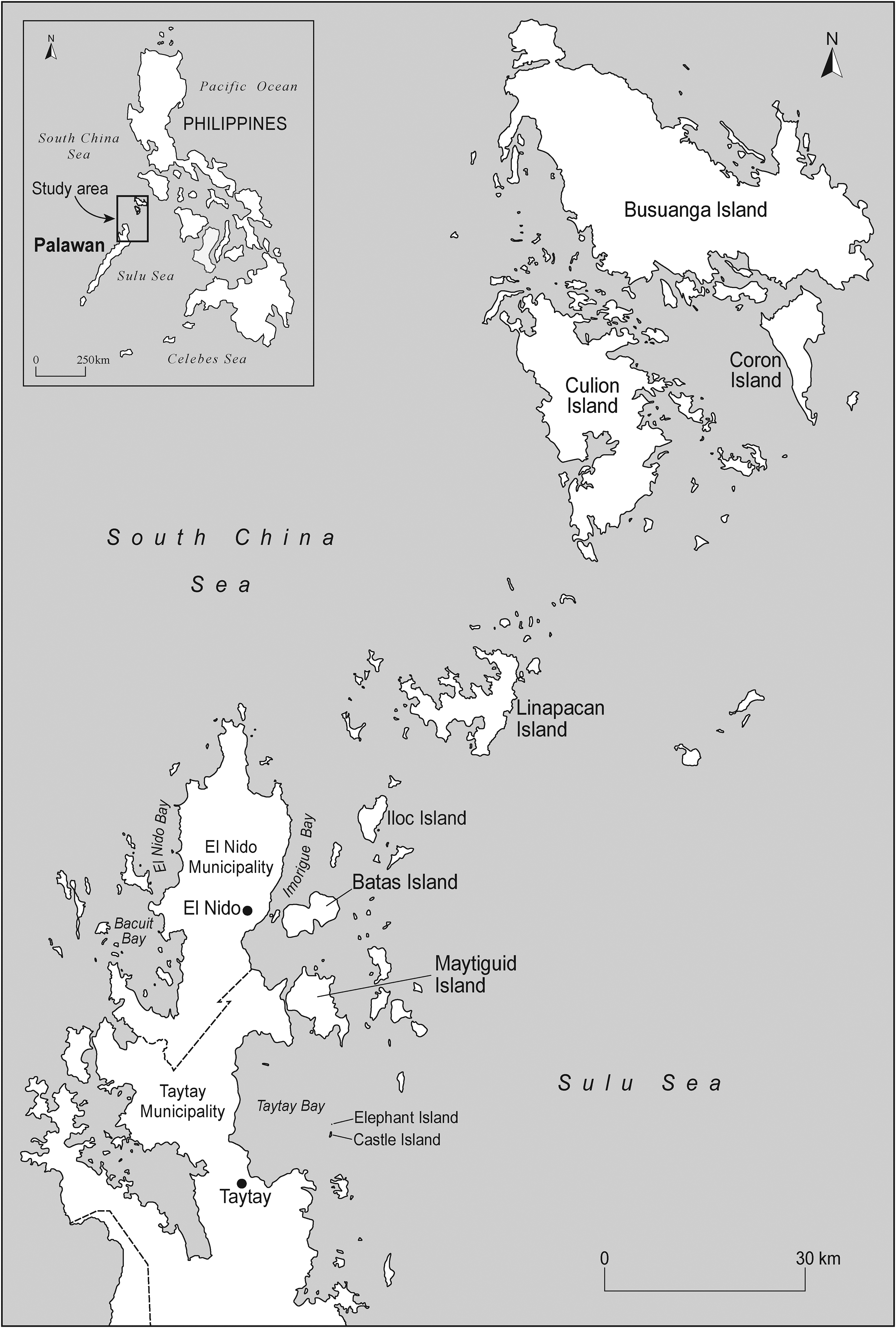
Map of northern Palawan, Philippines. Copyright Chandra Jayasuriya.
The balinsasayaw shape the rhythms and movements of the busyador who access complex networks of karst caves and holes, locally known as butas, in search of nests. From the harvest to processing and consumption, the nests enter commodity circuits that generate and transform their value over time and space (Blussé, 1991; Thorburn, 2014; see Appadurai, 1986 and Foster, 2006 for more on commodity flows). Consumption of the nests has long been associated with good health, virility, and social prestige in China and elsewhere in Asia (Jordan, 2004; Thorburn, 2014). The nests’ value and meaning shift as they move from karst caves (and farms in Malaysia, Indonesia, Thailand, and Vietnam) to consumers in urban metropoles such as Manila, Hong Kong, Guangzhou, and elsewhere in uneven political economies (Blussé, 1991; Jordan, 2004; Lau and Meville, 1994). At the extractive end, the seasonal harvest (traditionally from May to June, extended from December to June) entails intensified exploitation and low-value generation with considerable risk and uncertainty. Further along the commodity circuit, a kilogram of high-quality white nests (∼120 nests) reaches prices between USD2,000–3,000 (Thorburn, 2014). The changing political economies of nest production and exchange bring together the busyador and their families, coastal karst caves, and forests with nest traders and consumers around the world.
Our paper examines the political and ecological tensions, contradictions and alignments of the trade that emerge in and constitute what we call ‘seascape assemblages’. Following Indigenous thinkers’ long histories of engaging with complex human and nonhuman relations along coastal spaces (see, e.g. Ingersoll, 2016; Todd, 2014), we understand seascapes in terms of the unintentional coordination between human and nonhuman entities that gather and fall apart in assemblages within and beyond the ocean (Bear, 2012, 2017; Brown, 2015; McNiven, 2003; Peters and Steinberg, 2019). Seascape assemblages are shaped by changing multispecies interactions, where entities temporarily converge or are forced apart through their interactions with other assemblages (DeLanda, 2016; Tsing, 2015). We argue that seascape assemblages are partly co-constituted by shadows — the ‘in-between’ spaces of socio-natural interactions that involve complex material entanglements and historical political economies (Bryant et al., 2011, 460). In integrating shadows with the notion of seascape assemblages, we aim to show that while shadows emerge through uneven political economies shaped by complex seascape materialities, they strategically shield and protect certain practices and relations, making them “always partial and situated” (Potter et al., 2020, 15). The dangers of living in the shadows of seascapes involves navigating indeterminacy to survive.
Frontier imaginaries emerge from historical and contemporary beliefs, ideas, and practices that place the lived experiences of peoples and places into the shadows. We engage the notion of the frontier by exploring the less visible, human-nonhuman dimensions of seascapes that challenge the idea of stable and linear production of capital in so-called ‘resource frontiers’ (Fabinyi et al., 2019; Havice and Zalik, 2018; Steinberg, 2018). Our analysis reveals that coastal and marine governance interventions involve the production of shadows in uneven political economies, which intensify the nest harvest, driving labour precarity and ecological destruction. Contributing to the literature on the political ecology of oceans governance and geographies of the sea (Bennett, 2019; Campbell et al., 2016; Peters and Steinberg, 2019), we pay attention to the complexity of the human-nonhuman relations concealed within the shadows of Palawan's northern seascapes. We show that while the shadows of capitalism render marginal certain social relations through commodification and extraction, they cannot be separated from how seascapes are known, lived, and produced, and ultimately give meaning to and shape the practices of coastal dwellers. In making visible the contested social and material relations within shadows, we contribute to exposing the injustices and intersecting power dynamics that turn certain seascape entities into commodities and enable their over-exploitation and alienation from local places and people (see Dauvergne, 1997; McLean et al., 2018; Plumwood, 2008).
We develop this argument by examining how the value and meaning of the nests unfold through the interactions of three interconnected seascape assemblages. First, we define and introduce how we use seascape assemblages to critically examine the power configurations in and of oceans. Second, we present the social histories of balinsasayaw and the harvest as emergent luray (nest) assemblages. Then, we analyse the edible bird's nest political economy by drawing on two nested assemblages: i) capital assemblages involving private and state actors seeking to harness value from the harvest, turning nests into commodities by dividing them into ‘class types’, while granting coherence to concession and licensing systems; and ii) governance assemblages centred around the relationship between the nest trade and coastal governance, development, and biodiversity conservation. We demonstrate how a combination of laws, political acts, and economic relations work together to marginalize the busyador. Our analysis reveals how the harvest continues in the shadows of coastal governance, enmeshed in secrecy and acts of concealment.
Methodology
Fieldwork took place in Manila and Palawan from July-August 2018 and included semi-structured interviews, informal conversations, secondary data, and historical policy analysis. Interviews were conducted by the first and fourth author in English and Tagalog with the assistance and translation to Tagbanua and Cuyonon from a Tagbanua Indigenous leader (who was invited but declined to be a co-author). Seventy-five interviews were conducted with: busyador, coastal dwellers and local traders (40), state (15) and non-state actors (20) involved in the trade's management, as well as coastal governance (donors, civil society organizations, and academics). Most busyador whom we interviewed identified as Cuyonon, and former harvesters as Indigenous Tagbanua. Others were of different ethnicities under the broader heading of ‘Christian migrant’. Interviews in Tagalog, Tagbanua, and/or Cuyonon languages were transcribed and translated into English. Participant identities and locations are anonymized. Courtesy calls and prior informed consent certificates were attained at the municipal level and with barangay (the smallest administrative division) officials in northern Palawan. We contacted participants through local referrals from barangay captains and other local actors. Interviews ranged from twenty minutes to three hours and a half, depending on the interest and time availability of research participants, with most lasting an hour and a half.
The interviews concerned the history and cultural meaning of the harvest, trade system, regulatory practices, and commodification processes. Participants discussed the harvest's institutional framework, cave tenure, and governance interventions, environmental degradation, and harvest decline. The secondary data and historical policy analysis of the nest harvest and coastal governance helped us construct a timeline of key events and understand the complexity of the institutional context and actors. Moreover, informal conversations with barangay captains, field assistants, busyador and their families, and community members were essential in understanding place-based experiences with the nest trade. We coded the data for emerging themes. Our findings are partial and constrained by the strategies of secrecy and concealment surrounding trading relationships and concerns regarding the legality and control over the nest trade and karst caves.
Seascape assemblages
Assemblage thinking denotes processes of formation and relations enabling certain socio-material orderings to emerge, be sustained, or be disrupted (Anderson and McFarlane, 2011). Seascapes are open assemblages shaped by the social and material relations of human-nonhuman entities within and beyond oceans (Bear, 2012, 2017). Assemblages work together to create coastal realities (Peters and Steinberg, 2019); namely, the unstable associations between diverse entities that cohere and generate outcomes based on the agency and interactions of constituent parts (Deleuze and Guattari, 1987). We anchor these seascapes as cultural, lived, and embodied — home to coastal people and other nonhuman beings (McNiven, 2003). Central to our analysis of seascape assemblages is how political economies intersect and shape human-nonhuman relations (Lambert et al., 2006; Satizábal and Dressler, 2019).
Bear (2012) analysis of the scallop fishery in the Cardigan Bay argues assemblage analysis goes beyond notions of scale. The concept opens analytical space to understand that what happens at sea is not limited to water but to the multiple associations that permeate and influence sea socio-materialities. The impossibility of fully domesticating and/or controlling human-nonhuman relations at sea shapes the depth of meaning and complexity of practice (Lehman, 2013). For instance, marine resource management that focuses on controlling boat and tool use as a strategy to police boundaries and resource users cannot fully control nonhuman entities, like the movement of fish and birds (Bear and Eden, 2008; Connolly, 2017). Analysing the emergent properties (and limitations) of these territories of control and conflict requires engaging with the complexity of seascapes, not only in the form of water but in “unrecognised and unanticipated ways” (Steinberg and Peters, 2015, 261).
Power intersects and shapes seascapes. Yet, power is actively constrained by the fluid and changing materialities of oceans, enabling certain socio-natural orderings within and beyond the coast to endure (Bear, 2012; Lehman, 2013; Satizábal and Dressler, 2019). As Boucquey et al.'s (2016) analysis of Marine Spatial Planning demonstrates, how dominant discourses and practices assemble human-nonhuman entities provides critical insights into how their agency and power unfold in practice. Assemblages are not flat entities where power is distributed equally (Bear, 2012). Rather, as Kinkaid's (2019a) feminist critique highlights, understanding how colonial and unequal socio-material orderings are sustained has the potential to unsettle broader power relations. They suggest assemblage thinking must further engage broader power relations grounded in historical processes of domination and exclusion: “historical structures do not merely serve as some abstract ‘legacy’ or ‘context’ for contemporary socio-spatial orders and symbolic-material economies but are the very substrate on which inequality and ‘social difference’ are continually and actively assembled, transformed, and reproduced” (Kinkaid, 2019b, 484). This is particularly relevant for oceans, considering their centrality in shaping colonial and capitalist modes of production, circulation, and accumulation (Campling and Colas, 2018).
Building on this critique and calls for critical research on the nonhuman relations of coastal spaces (Bear, 2017), we examine how political economies are drawn into seascape assemblages to render shadows where the life of coastal dwellers is precariously sustained. As Bryant et al.'s (2011, 460) suggest, engaging shadows involves analysing the liminal places produced by and subject to the multifaceted processes of marginalization, subordination, and overexploitation that emerge through seascapes assemblages. Drawing on Plumwood (2008, 146–147), we understand shadows as “… all those places that produce or are affected by the commodities you consume, places consumers don’t know about, don’t want to know about, and in a commodity regime don’t ever need to know about or take responsibility for”. Bridging seascape assemblages and shadows allows us to delve into and beyond the ocean's surface to examine the production of difference. The politics of such difference involves the emergence of socio-material orderings that have historically marginalized and concealed the presence of coastal dwellers. This is partly enabled by the impossibility of fully knowing, mapping, or following the relations within seascapes. Here, marginality is not about being powerless, but speaks to uneven power relations and struggles. Importantly, not all actors in the shadows are marginalised, some temporarily occupy them and work to control and intensify exploitation. All of these social relations are immersed in the changing materialities of seascapes, which can temporarily expand or reduce shadows, making some parts more or less visible.
In northern Palawan's seascapes, the political economies of the edible bird's nest trade gather busyador lives and livelihood struggles, the production and exchange of nests, scaled regulations, and the movement of birds and capital. They also involve the material and liquid processes of land and sea forging spectacular karst formations and associated human-nonhuman relations. Here, karst limestone formations are one of the solid manifestations of oceans emerging from the sedimentation of calcite from marine and freshwater, skeletal debris (e.g. shells, bones, and reef build-up), and the evaporation of droplets of water compacted by the pressure and movement of water through geological time (Hallock, 1996). The caves, coasts, and inland areas nourish the Indigenous Tagbanua (Tandulanen and Calamian) and Cuyonon as well as the balinsasayaw and other species they have historically harvested. 3
Numerous political and economic projects have imagined oceans as ‘frontiers’ (i.e. opportunities for resource extraction and capital expansion) that draw new governance and regulatory frameworks that aim to control and reshape human-ocean relations (Havice and Zalik, 2018; Steinberg, 2018). In the twentieth century, Palawan recurrently emerged as an ecological frontier, the fishbowl of the Philippines, and the last frontier, imaginaries that conceal the historical and social dimensions of Palawan (see Rubis and Theriault, 2019). These political projects have worked to connect and realign Palawan's seascapes to the global political economies of development and conservation (Eder and Fernandez, 1996; Guieb, 2014a). In the 2000s, for example, Palawan emerged as a Coral Triangle ecoregion, the Amazon of the seas, a global marine biodiversity ‘hotspot’ in need of large-scale marine conservation (Spalding et al., 2007). Such discourses and imaginaries not only place the relations between coastal people and oceans in the shadows but also produce and extend them. In connecting the material and ecological value of these places to global markets, frontiers enforce an idealized and simplified understanding of coastal places in ways that render less visible the uneven political economies and injustices that the busyador negotiate living in the shadows of large governance projects (Bryant et al., 2011; Plumwood, 2008). Recently, frontier narratives have fed into an emerging national and global ‘blue economy’ political agenda that supposedly aims to facilitate inclusive and socially just economic and environmental outcomes (Azanza et al., 2017; Brent et al., 2020). Perversely, however, a blue frontier with oceans of financial value is now intensifying the expansion of conservation enclosures, resource extraction, and coastal development (Satizábal et al., 2020). As oceans are abstracted into new management categories to assemble new actors, capital, and forms of extraction (Brent et al., 2020; Choi, 2017), shadows are used and produced to expand capital with detrimental outcomes for coastal dwellers and marine environments.
Frontier notions work to conceal past and present waves of contestations over meanings, rights, access, and control over marine resources and social spaces (Fabinyi, 2020; Havice and Zalik, 2018; Rubis and Theriault, 2019). These so-called frontiers are shaped, constrained, and enabled by development and conservation political economies (Tsing, 2005). Although the reconfiguration of Palawan's seascapes into notional ‘frontiers’ highlights how oceans are framed as resources for investment, we focus on how the relations constituting seascape assemblages are obscured by frontier imaginaries. 4 Moving beyond these imaginaries requires attention to the relations between human and nonhuman entities central to understanding the social history of seascapes. Building on the concept of ‘seascape assemblages’, we examine the political economy of the nest trade, focusing on the shadows produced by state and private interventions that conceal not only emerging forms of violence and resistance, but also the connective social tissue of these seascapes. Palawan's coastal region is thus less a frontier than a complex seascape whose materialities and social interactions often defy processes of enclosure.
Northern Palawan's seascapes
Northern Palawan's coast and island groups include spectacular karst cliff formations shaped by water and winds from the Sulu and the South China Seas (Figure 2). These movements give life to the islands and cave systems that shape coastlines, fishing grounds, and tropical lowland forests (Bird et al., 2007). The east coast in the municipality of Taytay accounts for the largest production of nests, particularly the cave complexes in Elephant and Castle Island (Figure 1; Fabello, 2011). In the west of northern Palawan, the municipality of El Nido has historically been central to the production of the nests and was renamed in 1954 from Bacuit to El Nido (‘the nest’ in Spanish) (Anda, 2016). Harvested caves also exist across a smattering of small islands and further north in Busuanga and Coron (Fabello, 2011; Saragpunta Foundation and PAFID, 2001). These cave systems are shaped by assemblages of diverse vegetation and animal species, including balinsasayaw, bats, hawks, spiders, snakes, guano, sand, and soil. In the caves, busyador encounter deities (diwata), sacred lakes with ancestral rights, and indigenous burial grounds with recorded cremations dating to the Late Paleolithic (Lewis et al., 2008; Saragpunta Foundation and PAFID, 2001).
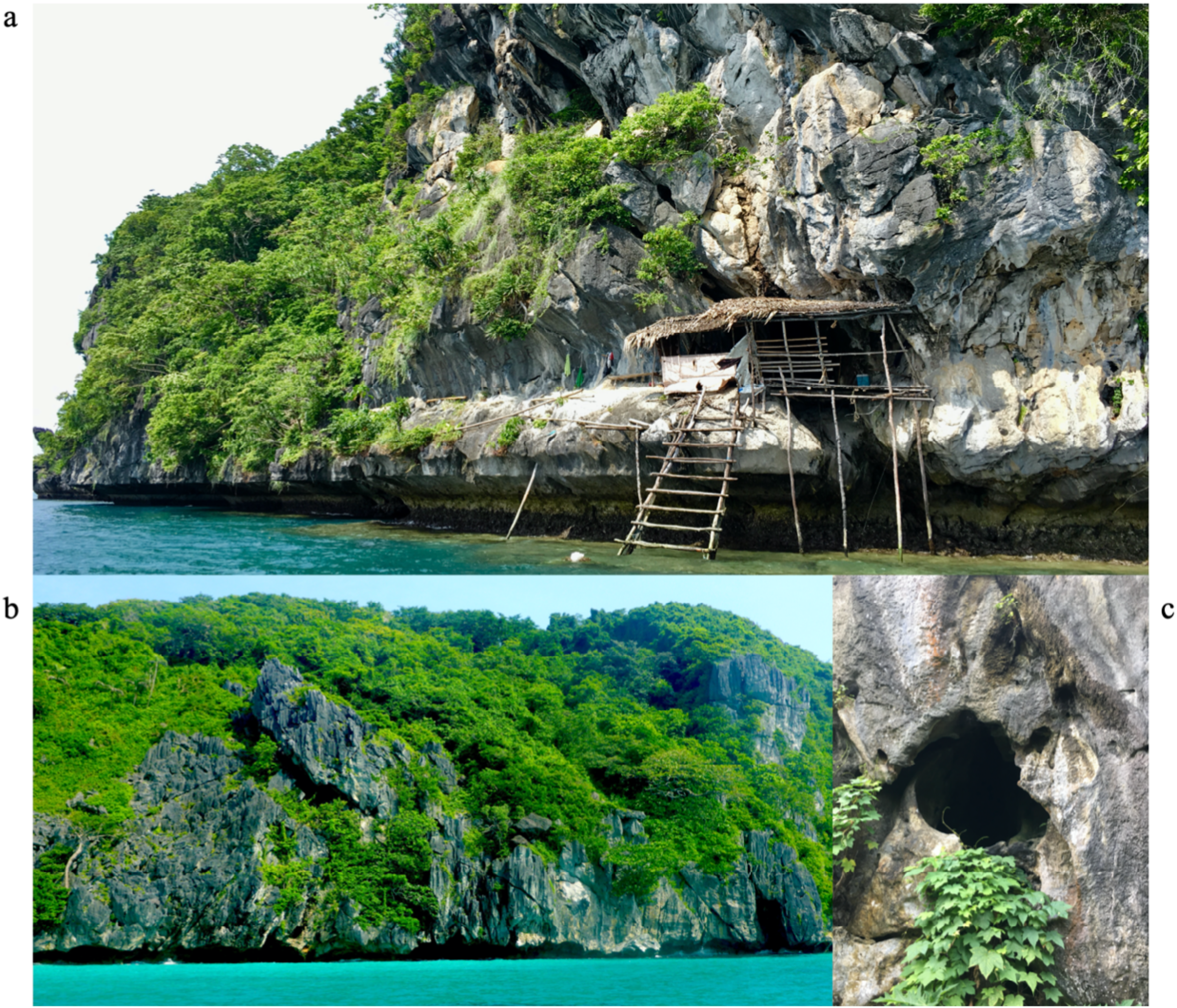
Limestone cliffs in seascapes of northern Palawan: a) limestone cliffs, b) harvest collection point, and c) entrance to cave butas. Copyright Jessie Varquez (a,c) and Paula Satizábal (b).
The Indigenous Tagbanua Tandulanen and Calamian are the peoples of these seascapes (Guieb, 2014b). 5 As elsewhere on Palawan, the Tagbanua have harvested and traded nests (luray) since pre-Hispanic times and held tenure over specific cave systems (Dalabajan, 2001; Warren, 1981, 138). Since the nineteenth and early twentieth centuries, migrants from Cuyo, Agutaya, and Cebu (the Visayas) and elsewhere settled along the coast where they commingled and competed with the Tagbanua over access to and use of marine resources, nest harvest, and land for swidden farming (uma). Over time, the main livelihood activities included a fluid complex of fishing, swidden, copra farming (for coconut oil), livestock rearing, tree cropping, and varied wage labour opportunities (Eder, 2004; 2009). Coastal livelihoods follow the rhythms of lunar cycles, water, and monsoons (Fabinyi, 2012, 21–52). The Amihan (northeast monsoon) persists from November to May or later, bringing cool and dry winds from the northeast, low to moderate rainfall, and consistent winds often making offshore fishing difficult (Dalabajan, 2001). It is during this ‘drier’ season that the busyador harvest the nests (December to May/June), cashew (kasoy) (February to May/June), and fish close to the shore. The overall income of the busyador tends to increase during this drier season, with March being the most prosperous month of the year. The Habagat (southwest monsoon) emerges in late June to December, bringing a ‘rainy season’ of high humidity and south-westerly winds, increasing the risks of flooding and typhoons. From July to August, stronger winds and heavy rain reduce livelihood opportunities, leading to degrees of hardship and reliance on the ‘barter’ of cashew nuts for rice and other products. Most uma rice stores have been consumed by June or July and families await the rice harvest in late August or September. From June to October, fishers catch crab using artisanal traps around mangrove areas. The fishing season starts in August, targeting multiple species using gillnets and hook-and-lines for subsistence and commercial purposes. Other seasonal livelihood opportunities include tourism and hired labour.
Luray assemblages — The social lives of balinsasayaw
The movements and life cycles of balinsasayaw shape the lives of Tagbanua and Cuyonon busyador. These small swiftlets (9–16 cm) have narrowed wings and dark brown and olivaceous feathers and a life expectancy of three-to-five years. They roost in large groups inside the karst caves across South and Southeast Asia (Caabay and Cadigal, 2014; Canuto, 1937). Individuals use echolocation to navigate dark spaces producing echo-clicks. Groups fly out of their roosting caves after dawn, foraging for insects in forest and riverbank vegetation, returning to their caves before sunset (Vermeulen and Whitten, 1999, 35). Balinsasayaw fly, feed, and roost across caves, air, oceans, and forests.
Balinsasayaw are monogamous birds whose breeding season falls during habagat just when the abundance of insects increases. Breeding pairs build U-shaped cup nests from the salivary laminae they secrete and thread using their beaks (Babji et al., 2015; Dacuan, n.d.). These nests are translucent white or yellowish, depending on the breeding pair, the age of the nest, and its exposure to sunlight or breeze (Caabay and Cadigal, 2014; Marcone, 2005). Breeding pairs remain faithful to their nesting sites, leaving worn marks on the walls (Caabay and Cadigal, 2014). Nesting cycles take between three to four months when nestlings are ready to fledge (Vermeulen and Whitten, 1999, 35). They use a multi-brooded reproductive strategy, raising as many chicks as they can during each breeding period, often laying two eggs at a time and breeding up to three times per year (Caabay and Cadigal, 2014). However, producing nests and feathers demands much energy, which in the long run reduces the fertility of balinsasayaw (Lim, 1999, 57).
The art of harvesting nests
Experienced busyador engage in Patalbod (or talbod) — following balinsasayaw and discovering cave butas. This involves waiting at sea or on top of coastal cliffs or mountains during dusk or night-time and tracking balinsasayaw as they fly back into their butas. Successful and failed discovery attempts are often shared with pride, as finding nests requires experience, patience, and luck. In the words of one busyador: “Patalbod involves watching at night, especially during the full moon, our ancestors would climb the cliff and observe where the balinsasayaw were going. If they entered a cave, they would follow the birds… they did that every year, but now not anymore.” (No. 29, August 25, 2018). Discovered and inherited butas are treasured by busyador, who often name them after their distinctive characteristics or memories. Busyador often guard their cave entrance or keep their location secret to prevent unwanted intrusions and nest theft. Elders act as knowledge keepers of a cave's customary laws, a now dwindling tradition relegated to the shadows (De Vera and Zingapan, 2017). Nevertheless, fathers and their sons, nephews, and/or sons-in-law share harvesting rights and knowledge regarding each cave (including the number and the quality of nests) through storytelling and shared harvesting practices. The nest harvest is a collective endeavour, generally performed by family groups. However, many busyador harvest their butas on their own. Knowledge is produced and transmitted from experienced busyador to trusted newcomers within their groups. Busyador also spend time recollecting and mapping out the volumetric extent of the harvest, where families and groups delineate and use territorial markers to claim exclusive rights over parts of cave systems.
The art of harvesting nests requires conquering the fear of darkness, tight places, and heights in complex karst systems. These systems provide the socio-material substance within which the nests are harvested, casting the shadows of the seascape assemblage. Busyador are predominantly men with small and lean bodies who are trained by their families at a young age. As children, they first harvest caves with small and narrow butas inaccessible to adults and learn how to become skilled rock climbers and harvesters. A busyador who started harvesting when he was 12 notes: “When I was new in doing the harvest, it was very hard for me, and I was scared… Those who taught me, told me not to be afraid and I tried my best to overcome my fear and learn… it's just a matter of practice and being mindful of what we do” (No. 43, August 20, 2018).
The sole female busyador we interviewed performed the harvest in the 1960s. Starting as a six-year-old, she stopped at the age of ten because she could no longer enter the smaller butas suitable for children and or enter the adult butas scantily clad. She recalled: “The girls can harvest if they want but only in the children butas. We could not enter the adult butas because we would have to climb partly naked” (No. 22, July 31, 2018). Rather than harvest, women cleaned nests by hand, and some played an active role in the processing and trading of the nests –– a labour pattern that partly aligns with pre-existing gendered divisions of labour. However, as we show, the management of the harvest through a concession system has dramatically reduced women's involvement in the harvest
In the past, the Tagbanua busyador also burned incense (parina) and performed ritual offerings, known as sagda, giving chicken or pork to the diwata (benevolent deities) in the coastal forests where the birds eat. Tagbanua Babalyan (spiritual medium, healers), Cuyonon albularyo (traditional healers), and the busyador often performed rituals to ask permission to enter the caves, fulfil the harvests and plead for their safety during the climb. A Tagbanua woman whose father was a busyador notes: “My ancestors had a ritual, unlike the busyador now. They had to burn incense first… a ceremony… they said to the Diwata ‘don’t be angry at us, don’t get mad at us, we are just getting the nests for our livelihood” (No. 45, August 19, 2018). These offerings highlight the relational connection between human and nonhuman entities from forests and coastal caves that comprise the socio-material basis of seascape assemblages.
Busyador climb without aids up cave walls or using an elaborate system of climbing ropes and/or bamboo ladders and poles. There is always the risk of injuries and death when harvesting nests. Accidents happen when a rock falls, someone falls asleep, or loses their hold. As a result, older busyador are frequently excluded from the harvest. This creates anxiety among elderly busyador, who often expressed fear or frustration of not being able to continue in the harvest. As an elder busyador notes: “I want to keep doing the work. But I also worry. My first cousin fell and died inside that cave. We were the only two entering that cave” (No. 50, August 12, 2018).
Before using battery-powered flashlights, the Tagbanua and Cuyonon busyador burned saheng resin (or saleng, Canarium luzonicum, and C. asperum) wrapped in dried nipa (Nypa fruticans) leaves as torches to illuminate cave walls and butas during the harvest. They craft different tools for the harvest Using rubber bands, they attach flashlights to the head or shoulders and affix modified and sharpened metal forks as tines to the end of bamboo poles. Known as sungkit, the tines are used to carefully pry the nests from the cave walls and hold them to prevent them from falling or touching other surfaces. While several busyador prefer to climb barefoot, most use modified sandals wrapped with rubber to protect their feet from sharp karst rocks (Figure 3). Moreover, the busyador conceal their presence from balinsasayaw to prevent the birds from flying away from their roosting caves. This involves restricting artificial fragrance use (e.g. soap, shampoo, perfume, or food) inside the caves. Traditionally, incense (parina, kamanyang) and saheng were burned to remove any trace of human scent to ensure that the birds return to nest again. The caves should only be visited during the daytime when balinsasayaw are feeding outside of the caves. Several of these practices are rarely practiced today, which exposes the intensifying harvest and the changing relations of this multispecies assemblage.
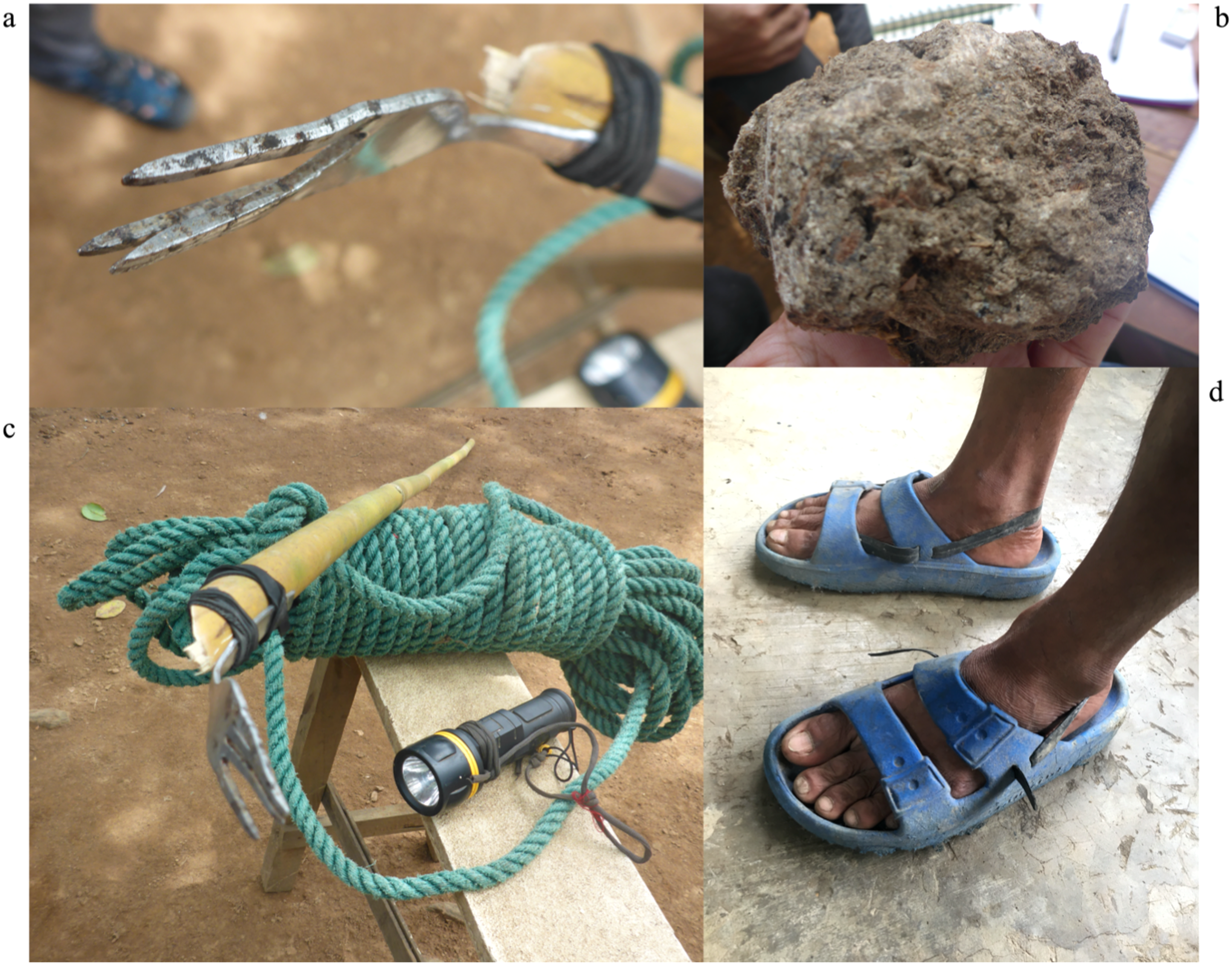
Busyador harvesting tools: a) modified fork, b) saheng (resin), c) sungkit (bamboo pole), rope, and flashlight; d) modified sandals. Copyright Paula Satizábal (a,b, c) and Jessie Varquez (d).
The harvesting season varies spatially and temporally. Busyador move from cave to cave on land and sea, often hiding their butas from thieves to protect their harvest. The season begins with a two-day limpia (cleaning) between December and January when the busyador go back to their caves and remove old nests. Jack (2015) suggests the cleaning and removing of debris from the walls helps the balinsasayaw build new nests with fewer obstructions. Following the limpia, in Taytay, the harvest season starts in the third week of January, where 15-day break intervals follow seven, three-day harvesting periods. The season closes during the second week of May to ‘let the chicks fledge’ (paliparan), a crucial practice to ensure the sustainability of the harvest Several areas also have a final collection period in August known as pinaliparan, during which abandoned nests are harvested. Depending on the cave complex, different harvesting periods across northern Palawan have extended from their traditional May-June period to December-May (Cadigal, 2014).
While several busyador are careful not to harvest nests with eggs, nests are often taken with little consideration of the balinsasayaw's reproductive capacity (as noted by Fray Luis de Jesús in 1624, see Blair and Robertson, 1903–1909: 307). Harvested nests are soaked in water to soften and loosen nest strands to manually clean them by carefully removing mixed feathers and other ‘impurities’ with tweezers. The nests (luray) are claimed to boost the human body's energy and strength, attributes perceived by Chinese traders centuries ago, and, more recently, Cuyonon and other migrant traders (De Vera and Zingapan, 2017). At the extractive end, the busyador consume the leftovers, sinisa, from the cleaning process. Sinisa are often mixed in water infusions, porridges, and smoked inside coal-burnt coconut shells for suob and binat (i.e. postpartum care and sickness) to treat stomach aches, feet swelling, and arthritis. Many busyador also feed sinisa to roosters to increase their strength during cockfighting, a common post-harvest game when busyador have more income.
In this seascape assemblage, the remnant sinisa highlights the precarity and marginality of busyador. To sustain their livelihoods, busyador must carefully hide information about the location and availability of nests in their butas. The relations between balinsasayaw, the nests and busyador challenge land and sea binaries. Here, space is relational, connecting the temporal dynamics of human and nonhuman entities in coastal forests, sea, and limestone caves with the seasonal rhythms of oceans. The social geographies of balinsasayaw within these limestone caves constrain these relationships, opening access to certain individuals whose bodies, knowledge, and climbing skills enable them to negotiate shadows and harvest the nest. The centuries-old harvest continues and now intersects with the assemblages of contemporary social relations and political economies.
Nest(ed) political economies
Originating from northern Palawan and elsewhere in Southeast Asia, edible bird's nests are one of the most expensive animal products globally — enacted as an iconic, ancient, and ‘exotic’ commodity (Hobbs, 2004; Thorburn, 2014). The nests (known in Chinese as 燕窩 yànwō) are a key ingredient in bird's nest soup, a prestige food item in Chinese cuisine and one with several claimed health benefits (Babji et al., 2015; Valli and Summers, 1990). The nest industry's form and character connect with historical forms of government control, migration, and patron-client trade relations. The two nested assemblages of capital and governance show how the historical art of harvesting nests has been shaped, constrained, and transformed through competing state, private, and customary control amidst coastal development and change.
Capital assemblages
The trade and bartering of edible bird's nests go back to the Tang Dynasty (618–907) when they were exchanged for porcelain wares, ceramics, and silks, among other handcrafts (Harrison, 1959; Valli and Summers, 1990). In the Philippines, there is evidence of bartering nests from the Song Dynasty (960–1279) (Lau and Meville, 1994). Across Palawan, the Indigenous Pala’wan and Tagbanua provided Chinese merchants and Tausug from the Sulu Archipelago with luray, beeswax, rattan, and other products in exchange for goods they could not access or manufacture (e.g. salt, metal implements, plates, and bowls), thereby becoming further entangled in global resource and capital flows (Warren, 1981, 8–9; Blair and Robertson, 1903–1909: 305–307). In the 18th and 19th centuries, the nest trade rapidly expanded and intensified with several attempts to reorganize and control it (see Blair and Robertson, 1903–1909: 307). The state eventually subjected the nests to taxes, concessions, and other regulatory controls detached from the changing realities of these seascapes (e.g. 1935 and 1987 Constitutions (Article XII, Section 1 and Article XII, Section 2, respectively)).
The regulatory legacies of the Spanish (1565–1898) and American (1898–1946) colonial era overlap with indigenous customary rights to nests and cave systems that were inherited across generations (Canuto, 1937; Dalabajan, 2001). In Bacuit, El Nido, caves were also sold, and the busyador were required to pay an annual license to the municipal government (Canuto, 1937). However, in 1919, considered a booming industry, an ordinance from the Palawan Provincial Board gave exclusive rights to harvest the nests to the highest bidder, known as the ‘concessionaire’ (typically local Chinese traders and middle-class families), giving them control over the trade and labour of the busyador. In 1927, municipal districts were given the authority to enforce license taxes for the harvest (Act No. 3379). The Secretary of Agriculture and Natural Resources held the jurisdiction to protect and regulate the harvest and established a closed season from May 1 to June 30, Administrative Order (AO) No.1, 1929. For instance, in 1932, AO No. 29-1 expanded the closed season from April to June, determining it was illegal to harvest and trade more than 10g of the nest without a license (Canuto, 1937, 387). Busyador were forced to sell their harvest to concessionaires who managed the harvest, covering the busyador's food and guard expenses. These patron-client relationships enmeshed the busyador into economic dependencies and debt with concessionaires. Management interventions sought to reorganise relations within this assemblage by establishing the authority of the concessionaire and the payment of taxes, while also relying on the knowledge and skills of the busyador to perform the harvest.
All of this sparked an influx of ‘thieves’, locally known as sindikato — disenfranchised busyador who were expelled from the harvest on the account of looting or whose relationship with the concessionaire turned sour because they had entered the butas to harvest and sell nests prior to the busyador. These apparent infractions highlight the impossibility of fully controlling the movement of the busyador, and the growing use of violence to stop sindikato from harvesting and trading nests in the shadows. In Taytay, the concession bidding process was concealed from the public until 1986; one concessionaire was given the exclusive privilege to harvest and trade the nests. Conversely, in Bacuit, the bidding process was competitive, and recognized cave owners’ hired wage laborers — the traditional busyador. The concessionaire would clean, weigh, and prepare nests for trading, excluding women from the cleaning process and paying busyador for their harvest depending on the quality of the nests — whiter, cleaner nests had higher value (from 2–31centavos/g) (Canuto, 1937, 386). Control was enforced by reducing the time that busyador were directly accessing the nests, while also trying to eliminate the role of women in post-harvest. In 1932, nest traders joined efforts to build a corporation and a store in Manila. In monopolizing the industry, traders blocked the concession, monopolised the bidding competition, and put an end to the bidding system in 1937 (Canuto, 1937). Both the busyador labelled as sindikato and nest traders have resorted to ‘shadow plays’ by relying on hidden forms of trading and moving between various shades of legal and illicit transactions to access capital.
The nest's capital assemblages in northern Palawan have historically intersected with other actors’ political networks seeking to expand opportunities for capital accumulation. In the late 1940s, Cuyonon migrants came to these seascapes working in commercial logging and fisheries. They also began harvesting and buying caves from Tagbanua busyador. From a mix of middle and lower-income families, Cuyonon and several migrant busyador began dominating the harvest In certain areas, several busyador worked as wage laborers for relatively wealthier busyador who were paying license fees. For instance, the busyador we interviewed (32) were Cuyonon and argued their ancestors discovered their butas. Intensifying capital flows and political claims facilitated the concealment of Tagbanua histories of the harvest through processes of exclusion.
From 1940 to 1990, migration to Palawan exceeded four percent per annum, with most migrants seeking safety and new livelihood opportunities (Eder, 2009). In 1949, Taytay's municipal waters, including river mouths and tributaries, were leased by the local government to the San Diego Fisheries Enterprises for five years (Taytay Municipal Resolution No. 29 1949 and No. 25, 1950), which granted them exclusive rights to operate fish corrals and fishponds (Guieb, 2014a, 318). As small-scale fishers were dispossessed from their fishing grounds and coastal livelihoods, they turned to the shadows to join the growing tide of sindikato in the area (Rivera-Guieb and Jarabejo, 2001). To counter the growing ‘theft’, in 1963, the Municipal Council of El Nido prohibited the harvest outside the main harvesting periods (Municipal Ordinance 11). The term ‘busyador’ could only be used to denote ‘legal’ harvesters who had registered their caves at the Treasurer's Office. These busyador were classified based on the number of caves they accessed, and many were forced to pay a Real Property Tax fee in two 50 percent instalments. 6 Any new caves were assigned a tax declaration certificate and listed in the Treasury Office — a practice that seldom happened given the extent of the earlier dispossession of caves. It became illegal to bring unregistered companions within 100 m from the beach and cliffs surrounding registered caves. All buyers were required to keep a record of the nests provided by the busyador. These and other regulatory practices threatened the customary, collective nature of the harvest Individuals violating these rules were fined (between PhP100–200) or punished with three to six-months of imprisonment. These management rules further constrained the nest harvest and expanded shadows of dispossession as many Tagbanua busyador lost access to their ancestral caves.
In the 1970s, the caves in northern Palawan were (again) reorganized in a bidding system developed to increase municipal level profits, as the value of the nests fell after a ban by a now stridently Maoist China on the consumption of luxury goods, including edible bird's nests (Jordan, 2004). The busyador who could not afford the cave tax payments continued to work as indentured laborers for registered cave owners, further losing control over their caves and livelihoods. Caves were soon auctioned to the highest bidders, as middle-class busyador were displaced by prominent capitalists, generally financed by Chinese traders; just as new coastal developments began encroaching upon karst formations bringing new actors into these seascape entanglements (Capistrano, 2010). The grabbing of caves was contested and led to local uprisings that stopped the bidding process in Cabugao (Coron Island) (Saragpunta Foundation and PAFID, 2001). However, the bidding system persisted in the cave systems where the harvest was lucrative, particularly in El Nido and Taytay, and often involved high-profile politicians bidding from as far as Manila. Capital loomed larger than custom. In other areas, individual permit holders performed the harvest and traded the nests locally. In 1987, a fixed closed season was established in Taytay from May 1 to June 30 (Municipal Ordinance No. 69, 1986 Ordinance 12, 1987). The displacement of busyador destroyed many of the customary and trading relations within these seascape assemblages, while some have been precariously sustained deep within the shadows.
In the mid-1980s, as wealth and consumption increased in China, the nest trading price rose, and production/trade volumes expanded approximately ten percent per annum (Jordan, 2004; Thorburn, 2014). The nests soon travelled from northern Palawan to the north outside of the country (illegally) and from Puerto Princesa and Manila to Malaysia, Indonesia, and Thailand (legally and illegally). From there, the Palawan nest trade reached markets in Singapore, Hong Kong, elsewhere in China, Taiwan, and even India. Reprocessed Palawan nests are now found at Duty Free, medicine shops, and dried seafood stores across Southeast Asia, Asia, and Chinatowns globally (Figure 4). In 2015, a bowl of bird's nest soup in Hong Kong cost between USD30–100 (Babji et al., 2015). The ‘pure’ character of Palawan nests affords them a higher quality, making them and these seascapes the target of institutional frameworks that facilitate market-driven appropriation and extraction (see also Campling and Colas, 2018).

Edible bird's nests in duty free (Photo Chiang Mai, 2018). Copyright Paula Satizábal.
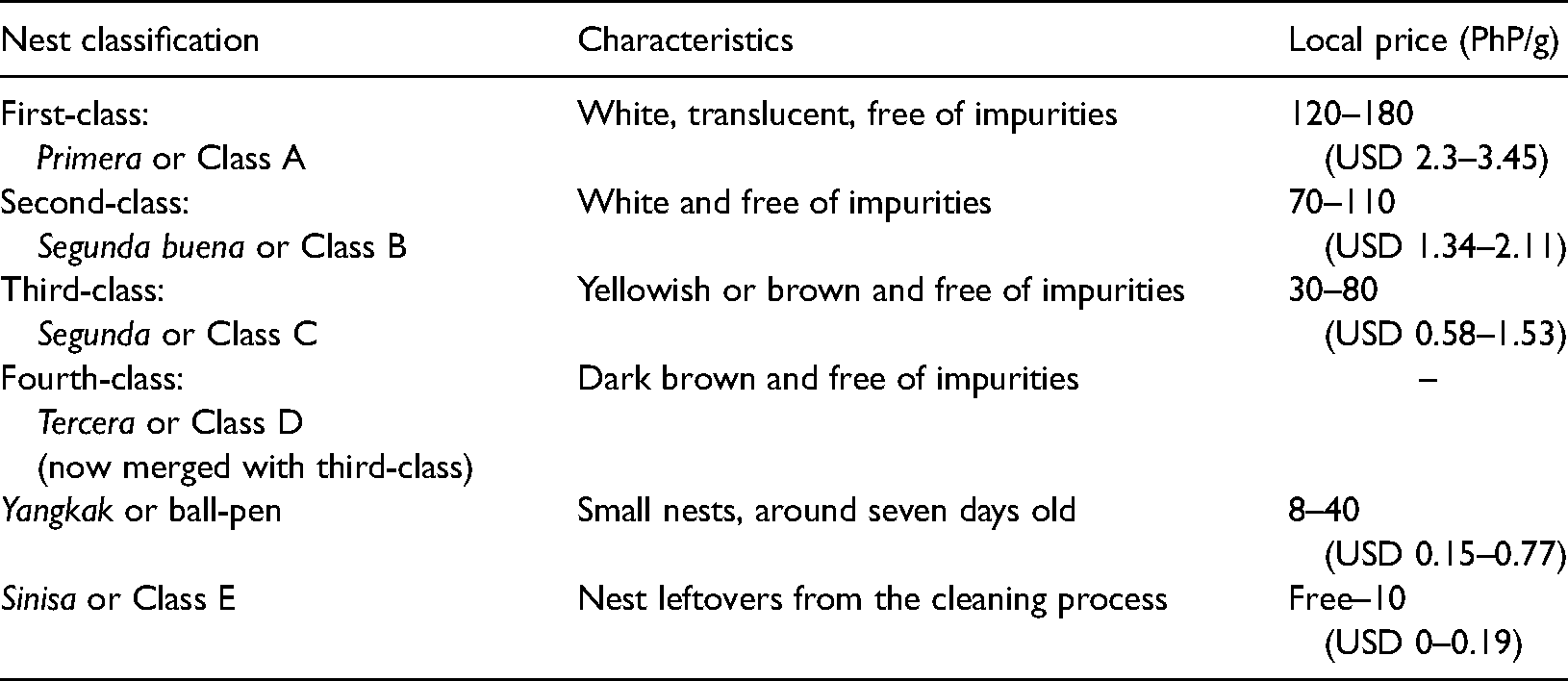
Concessionaires and traders enforce nest classification systems. In 2018, nests were classified into four categories with prices ranging from PhP30 to 180/g (Table 1) and varying in time and space. Several busyador claimed the concessionaire or caretaker often unjustifiably classify nests in lower classes and weight. Considering busyador have complex mental maps of the quality and number of nests inside their butas, many found this devaluation denigrated their practice. This cultivated knowledge comes from the busyador and balinsasayaw being faithful to their butas, nesting sites and the consistency displayed by the quality of the nests built by balinsasayaw breeding pairs. Occasionally, the busyador are drawn by capital, preferring to sell their harvest ‘illegally’ to local traders paying higher prices, having to hide their nests from guards and concessionaires, while facing the risk of getting caught and denied access rights to their caves. As one busyador explains: “Busyador… engage in illegal harvests because of the very small income they had… the price was very cheap… that's why busyador will go home with debts… many were syndicating the nests” (No. 41, August 12, 2018).
Nest classification system in northern Palawan.
Considering the rising prices, nest scarcity and declining harvests positioned hired guards as central to their protection (also restricting fishing in surrounding waters). However, several of these guards ended up joining the sindikato or helping the busyador hide nests or butas for more lucrative sales later, a common practice in these intricate cave systems. Concerning relative decline, the intensifying quest for nests has increased the violence and risks experienced by the busyador during the harvest, as concessionaires and their caretakers know how many nests are available in each butas. Although sindikato are not new, the presence of high-powered guns have increased the dangers the busyador experience during the harvest. To hide within the shadows, the sindikato bring food and stay inside the caves for days. As a busyador recalls: “We see them inside the caves armed and hiding… sometimes ten… they bring water and food… Suddenly a gun is pointed at you… I begged them not to shoot me because I have a family… I told them we are just the same, what you get is your own and what I get is mine…. I told them further that I do not mind if they steal and that they are not stealing from me but from [the concessionaire]” (No. 38, August 12, 2018).
These encounters reveal the precarious nature of the harvest and the violence of the capital assemblage. Contemporary dynamics of patron-client relations, concession and licensing systems, and the growing ‘theft’ all threaten the coherence of the customary relations of the harvest. Thus, control and trade interactions within the capital assemblages of edible bird's nests reinforce the separation between the busyador and their caves, adding pressure to intensify the harvest and transform customary relationships and practices while also relying on the skills and knowledge of the busyador. Here, the social labour behind cave registration, concession, and licensing systems has mobilized capital and been used as a political tool by local governments to discipline and subordinate the labour of the busyador to profit from the harvest and privilege the interest of nest traders (i.e. powerful trading families). Capital and regulatory forms are thus brought together and cohere in practice, territorializing (i.e. creating borders to manage and control, see Peters, 2020, 2) the harvest and enabling historical processes of domination to endure through governance assemblages.
Governance assemblages — Conflicting seascapes
In 1986, the end of the Marcos regime ushered in decentralized governance in the Philippines, and witnessed the emergence of new coastal and marine governance assemblages in northern Palawan. Working with the national government, provincial agencies, local government units (LGUs), and non-governmental organizations secured international donor aid to implement a range of community-based resource management interventions (Dressler et al., 2018). Northern Palawan saw the proliferation of interventions focused on marine protected areas (MPAs) in the 1980s and 1990s (Pomeroy and Carlos, 1997; White et al., 2002). Declared a UNESCO Biosphere Reserve in 1990, from 1992 onward, the island province was subject to the Strategic Environmental Plan (SEP or Republic Act 7611) under the Palawan Council for Sustainable Development (PCSD). The SEP gave the PCSD greater authority and oversight of conservation interventions, leading to considerable jurisdictional friction with the national Department of Environment and Natural Resources (DENR). Partly due to these designations, Palawan emerged as a biodiversity ‘hotspot’ from the end of the 1990s, first regarding land but then extending to oceans from the 2000s onwards (Spalding et al., 2007). Concurrently, the capital assemblages of marine resource extraction and development continued to accelerate alongside the regulations brought together through the governance assemblage. The expansion of capture fisheries (including sea cucumber, trochus, and live reef fish), aquaculture, and tourism development has intensified and intersected with the nest harvest (Fabinyi et al., 2019; Saragpunta Foundation and PAFID, 2001).
Amidst these changes, the LGU-administered bidding system only applied to productive cave systems in Taytay and El Nido and was governed through taxes and lease agreements. For instance, in Taytay, the bid lease increased from PhP30,000 in 1986 to PhP2,600,000 in 1999 (Cadigal, 2014, 64). In 2001, the National Cave Resources and Protection Act (Cave Act, Republic Act 9072) and the Wildlife Resources Conservation and Protection Act (Republic Act 9147) gave the DENR national jurisdiction over the management of caves and wildlife (including balinsasayaw) in coordination with LGUs and the PCSD. These interventions sought to reorganize the harvest considering cave and wildlife conservation and challenged the management and control of local LGUs. In 2003, the PCSD became the implementing agency of the Cave Act and associated rules, regulations, and annual permitting. 7 However, the Taytay LGU ignored the new management and granted permission to start the nest harvest season in 2004. The PCSD saw this as a breach of its legislation, PCSD Resolution No.04-230, 2004, highlighting the lack of cooperation from the Municipal Police in Taytay to fully implement the Caves Act.
In 2004, the PCSD, the Philippine National Police-Criminal Investigation and Detection Group (CIDG), and the Philippine Navy raided Elephant Island in Taytay Bay to arrest between 71–78 busyador, cave guards, and three police officers for the violation of the Cave Act. As a political strategy, the PCSD used the Act to claim authority over the caves and profit from the harvest (see Cadigal, 2014, 65). As experienced by one busyador: “We did not know what was happening… that morning while we were having coffee a rubber boat loaded with two squads from the PCSD and CIDG… reached [the cave complex]. The soldiers jumped to the land and with a megaphone told us to drop down to the floor. I was watching them… some people were crying… others were afraid… We were there perhaps for more than one hour… It was harassment. It was the first day of the harvest… They took us directly to Roxas and from there we were fetched by the Navy and transferred to Puerto Princesa City. There was no explanation…. When we arrived, we were held in the barracks… The Mayor processed our release… we were many, almost 78” (No. 46, August 13, 2018). The PCSD secretary praised the raid as a “splendid job… for and on behalf of the Council” (PCSD Resolution No. 04-229).
The raid represents a moment of rupture aimed at reorienting governance and capital flows — a violent encounter between the busyador, the municipal government, and provincial actors. Busyador were caught between the ongoing power struggles of the Taytay LGU and PCSD that was likely further entangled in inter-family-clan politics grasping for slippery capital. In response, a Memorandum of Agreement for the joint management of the caves was negotiated between PCSD and the LGUs in 2005. The agreement established the revenue from the harvest should be directed to the protection, development, and management of cave resources. The LGU held 80 percent of the share, and the PCSD held 20 percent. This transition increased the number of permits, including the registration of caves, concession/individual permits, transport, and wildlife collection permits. The PCSD demanded creating a busyador cooperative in Taytay, which managed the concession from 2006 to 2010 and was financed by a powerful trading family. The cooperative did not last long once taken over by a concessionaire (2011–2015) who was also financed by a local political family. In El Nido, the bidding increased ten percent per year and was also financed by powerful trading families.
The roles of the LGUs and the PCSD have done little to protect the balinsasayaw and ensure the sustainability of the harvest. As Cadigal (2014, 66) highlighted, the role of state agencies “starts with the bidding process and ends upon the collection of the bid amount”. One official noted with current levels of overexploitation, the harvest will be gone in five years. By extension, the Cave and Wildlife Act has enforced the management of caves as if separate from oceans, coasts, and people. The limited understanding of the population dynamics of balinsasayaw exposes how management has remained focused on profit, neglecting the participation of the busyador in supporting the sustainability of the harvest. Capital and governance assemblages actively constrain the harvest and the lives of the busyador via government regulations and trading relationships that territorialize the caves to secure means of production. These assemblages have enabled new actors (including migrant busyador, concessionaire, caretaker, sindikato, guards, LGUs, and PCSD) to compete for access and control over the nests.
Past and present attempts to reorganize the harvest violate the rights of Tagbanua and Cuyonon busyador in the shadows of these seascapes. However, their presence is vividly imprinted in the walls from the sooty smoke of burning torches and saheng inside the caves from the past. As one busyador recollects: “Sometimes I’ve been to the caves that are not familiar to me, but I know that the elders went there because of the rising smoke that marks the rock that could not be removed… it is burnt and sticks to the rocks.” (No. 38, August 12, 2018). Many cave systems have the names of past and present busyador inscribed into the walls, both as a personal signature and territorial marker. One Tagbanua woman showed with pride the names of her ancestors who harvested luray dating back to 1938 (Figure 5). The walls of the karst caves and the stories of busyador hold a history of the harvest confined to the shadows.
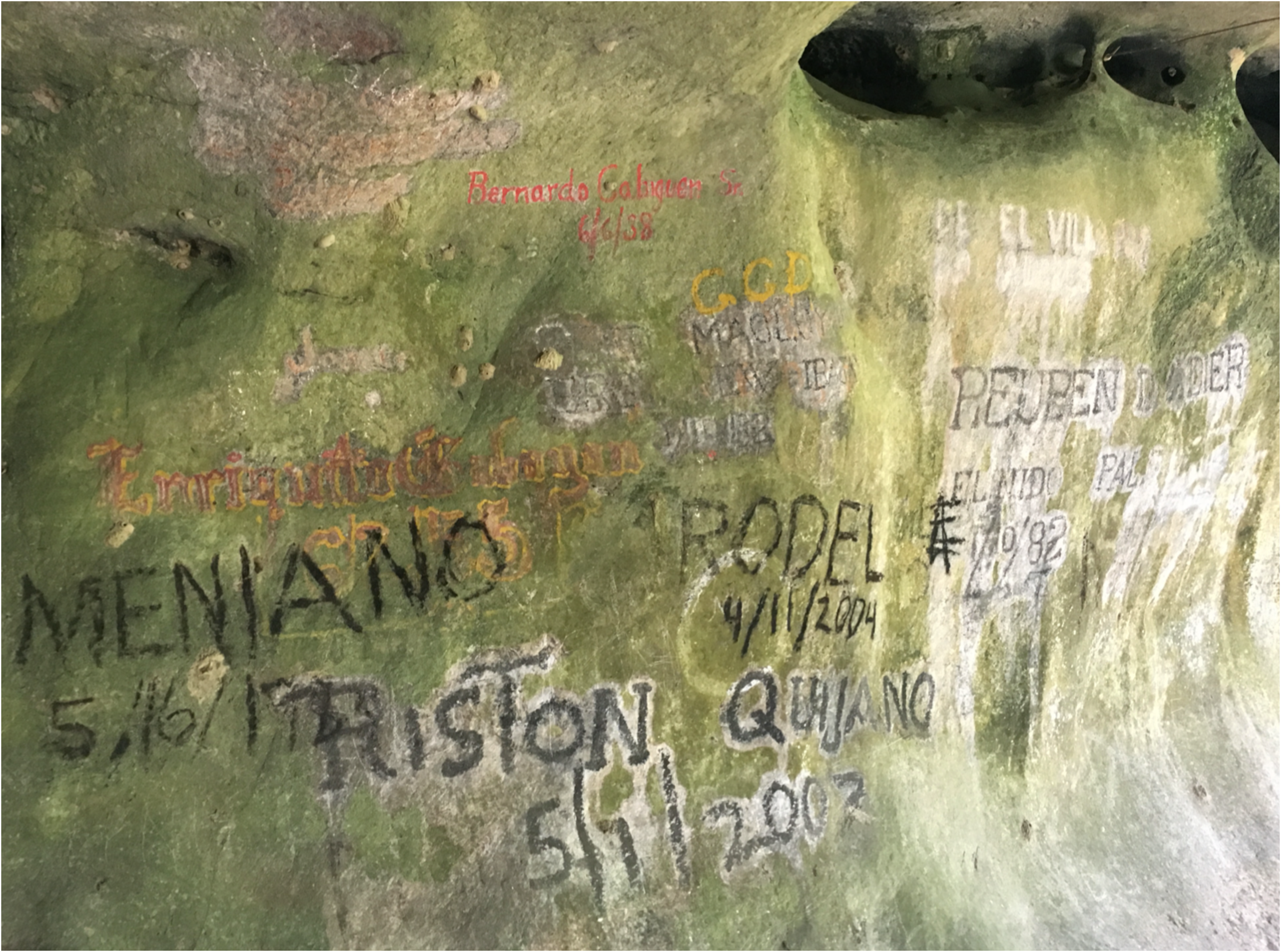
Busyador names in walls. Copyright Jessie Varquez.
The ruins within seascape shadows
The intensifying nature of the nest harvest, the expansion of commercial agriculture, and coastal tourism development are powerfully reorganizing coastlines, social relations, and livelihoods for the production of profit and capital accumulation. Here, assemblages of luray, capital, and governance collide in ruinous shadows and deepen the marginalization of coastal dwellers. As marginal, liminal spaces, shadows obscure the connection between places, human and nonhuman entities with powerful social and material consequences (Bryant et al., 2011; Potter et al., 2020). In these shadows, the political economy of the nests circulates and deepens capital and governance interventions, accelerating exploitation and concentration of wealth in fewer hands.
In the ruins
The dramatic decline in the abundance of balinsasayaw is inseparable from the history of environmental degradation and gradual dispossession of the Tagbanua busyador from the seascapes of northern Palawan. In Taytay, the volume of harvested nests has decreased from 80.5 kg in 2011 to 62.03 kg in 2014 (Cadigal, 2015, 29). Partly due to increased regulations, the reduction in the volume of nests traded has negatively impacted the livelihoods of concessionaires and the busyador. Concessionaires are under pressure to recover their financiers’ investments and manage the harvest (covering food, license fees, guarding, transport expenses, and labor), which has reduced the services they offer to the busyador. Under pressure, the busyador often harvest more to recover the cost of transport and guarding the concession caves. One concessionaire appealed to the municipal LGU, requesting a reduction in the lease fee: “I cannot afford it anymore. Actually, it is a violation of the contract, I cannot afford to pay the yearly amortization because of the declining production… Every year I request to see a study of the system. Why is it declining?… until now there is no action” (No. 39, August 9, 2018).
Due to the sustained bidding system, the practice of paliparan (letting the birds fly) has reduced considerably. Concessionaires add pressure on the busyador to harvest as much as possible, including nests with chicks or eggs and smaller nests. As one busyador expressed: “Because there is a very low production… If we do not get the nest, they [the concessionaire] will be angry with us… sometimes I pity the chicks, so I placed them in the rocks where they can be safe” (No. 46, August 13, 2018). A new trading class, known as yangkak or ‘ball-pen’ (denoting the small size), has emerged from these intensifying practices. Yangkak includes small nests around seven days old and are bought between PhP8–40/g. Sinisa, nest leftovers, are now also traded in several areas (Table 1). In the urge to increase profits, concessionaires have also started hiring ‘extras’: individuals who, initially ‘banned’ from the concession for stealing, now sweep areas already harvested to ensure no nest is left behind. They sell their harvest at higher prices than the busyador. This shift has contributed to the dramatic decline of the harvest, and like sindikato, ‘extras’ are not associated with particular butas, yet their precarious labour contributes to the dispossession and economic marginalization of the busyador. Both sindikato and extras experiment with and create new knowledge that allows for the skilful hiding and location of more nests within the shadows. In contrast, the busyador are acutely aware of the damaging impacts of the intensifying harvest, noting: “We are the owners of a cave, we do the utmost care and diligence in picking nests and in harvesting to the rocks, we are very careful in the breeding area, nest must not be touched or pressed by the hands, hands must not have sweat because birds are very sensitive” (No. 49, August 13, 2018). The intensifying harvesting dynamics and uneven power relations created by the concession system limits the opportunities that the busyador and balinsasayaw have to survive within these seascape assemblages, increasing the conflicts among the busyador, extras, sindikato, and concessionaires.
Many busyador have stopped paying registration fees on caves no longer ‘productive’, subsequently losing their harvesting rights. Simultaneously, coastal developers have been granted permits (by the PCSDs and DENR) to build sizable high-end tourism resorts along El Nido's coast and islands. While several busyador have managed to negotiate with resort managers and guards to access balinsasayaw nesting sites, most busyador must use less accessible and dangerous routes to access their caves to hide from guards or tourist guests. As a busyador notes: “before the islands were bought, we were the ones guarding the place. But now that the islands have been sold [the harvest] is prohibited there… we have another way in from the other side… but it is very difficult… there are many guards” (No. 30, August 27, 2018). The busyador complaints regarding this at the Municipal Office have fallen on deaf ears.
The expansion of commercial agriculture and coastal tourism development (Fabinyi, 2010) has also contributed to degrading the habitat and survival of balinsasayaw while reducing local access to caves. For example, the use of chemicals in paddy rice has limited the balinsasayaw food sources (Caabay and Cadigal, 2014; Manchi and Sankaran, 2010). Several busyador point to pesticides killing a greater number of swiftlets inside the caves. As one noted: “The birds are really less… I think it is because of the sprays of insecticide in irrigated rice farms… Sometimes when we get in the cave the birds are already dead… That is why they gradually diminish little by little” (No. 43, August 20, 2018). In the past decades, northern Palawan has also experienced more rainfall during Amihan (northeast monsoon) (Matsumoto et al., 2020). Busyador argued that butas’ walls are more humid, which lowers the quality of the nests, as they become yellowish or end up falling. Their observations also highlight an increased number of cockroaches and snakes predating on the nests, which is likely linked to poor waste management in coastal areas associated with the (pre-COVID-19 pandemic) growing influx of tourists (Llanto, 2018). Other busyador have noticed balinsasayaw flying away from intensively harvested butas to new caves for roosting. Similarly, the presence or absence of birds in roosting locations is not entirely controlled by harvesters or state agencies but shaped by the swiftlet's agency as they shape the trade's regulatory frameworks (see Connolly (2016a) for farmed swiftlets in Malaysia). The changing dynamics highlight the relationality of forests, coasts and people, and the relations being disrupted as the reproductive success of balinsasayaw decline and the busyador are further marginalized.
The region is also expected to accommodate an emerging ‘blue economy’ agenda. The blue agenda will increase the number of MPAs and expose busyador seascapes to new coastal management regimes involving management plans that advocate abstract business initiatives that aim to ascertain the financial value of ecosystem services (e.g. coral reefs, mangroves, fish stocks, see Satizábal et al., 2020; Song et al., 2021). So far, this process has had limited participation from coastal dwellers, including the busyador, while opening space for private sector tourism that directly shapes coastal and marine governance (Whisnant and Reyes, 2015). Current discourses and imaginaries of marine conservation and private sector tourism abstract out the busyadors’ existence and use of the islands’ limestone caves for the harvest (Satizábal et al., 2020).
As harvests decline, several busyador are drawn into the tourism sector. On land, the busyador now transport tourists using tricycles and at sea by converting fishing boats into tour boats for ‘island hopping’. There have been attempts to promote visits to the caves (often with the busyador) as a tourism activity (e.g. El Nido Tour B: Caves and Coves). Many also work in the construction and maintenance of hotels, further increasing their reliance on tourism. These households now rely on externally harvested vegetables, rice, and fish from other municipalities as their primary food source. Powerful elite families once involved in the trading of the nests have also diversified their investments, owning hotels and restaurants, in several cases sustaining patron-client relationships with the busyador. As the Tagbanua leader and wife of a former busyador notes: “Upon the arrival of resorts, it became harder to catch fish close by; the fishing areas are far away now, before [the relocation] the seashore was just in front… it is expensive, because there are booming tourists, in the market the price of products is higher… we are forced to buy… it is very hard really” (No. 35, August 25, 2018). All these dynamics have squeezed the busyador out from their caves, land, and coasts. However, even within the ruins of capitalism, deep in the shadows the nest harvest continues, largely concealed and precariously sustained.
As the ‘wild’ nest harvest declines within these seascape assemblages, the production, and trade of domesticated ‘farmed’ balinsasayaw have expanded across the region (see Connolly, 2016a, 2016b; Lim, 1999; Thorburn, 2014). Despite the trade's expansion, farming is curiously absent in northern Palawan or much of the Philippines (apart from Mindanao). In 2011, China banned the edible bird's nests from Indonesia, Malaysia, and other unknown origins, due to the high concentrations of toxic nitrite found in adulterated farmed nests. The ban was lifted in 2015 after new quality control and traceability mechanisms were established (Babji et al., 2015; Thorburn, 2015). Inadvertently, the ban elevated the branding and value of Palawan's nests as high-quality ‘exotics’ –– a scarcity value from ruins. However, farmed nests are now ‘illegally’ entering Palawan from Mindanao, Malaysia, and Indonesia and rebranded as high-quality nests from El Nido (Cadigal, 2014). This is enabled by the ways in which commodity circuits obscure the social relations between the nests, places, and busyador that form in these assemblages (see also Satizábal and Dressler, 2019).
The reduction of government income from ‘wild’ and legally ‘harvested’ nests finally prompted the PCSD Scientific Advisory Panel to discuss how to improve management practices in 2017. The Panel provided a list of recommendations, which included exploring nest farming opportunities, strengthening the link between tourism to the harvest and volume of the harvest, and conducting a value-chain analysis and reassessment of the concessions (PCSD, 2017, 22–23). The potential economic benefits of nest farming to the busyador remains unclear. However, in promoting farming without addressing existing power asymmetries, farming practices will likely privilege elite capture through their landed influence over regulatory frameworks (Connolly, 2016b). Such political and economic asymmetries are likely to further exclude the busyador from commodity circuits as their harvesting knowledge and experiences would no longer be needed to secure the capital of the harvest and trade.
Even within the ruins of the harvest, the abstract and discursive value of the nests is enabling new capital assemblages adding value to farmed nests, rebranding them as wild and abstracted out from lived realities (see Fletcher et al., 2021). These assemblages emerge as an extension of the imaginaries of northern Palawan's seascapes from which governance assemblages shift and intensify by seeking to capture value from these new transactions. Amidst these assemblages, the busyador are dispossessed and further concealed within the shadows of Palawan's seascapes.
Discussion and conclusion
Intensifying maritime political economies are reorganizing northern Palawan's seascape assemblages through a convergence of resource extraction, development, and conservation with powerful consequences for human-nonhuman entities and relations. Over time, Palawan's seascapes have co-produced human-nonhuman relations across marine, coastal, and inland spaces. How the balinsasayaw and the busyador are nested within the luray assemblages has nourished knowledge, harvesting practices and rituals, tenure, and social relations that, until recently, have been carried through generations of Tagbanua and Cuyonon harvesters. As the Cuyonon harvest displaced Tagbanua access to ancestral caves, the trade's political economies, conservation, and development threaten to dismantle the nourishing elements of the harvest. In this sense, the relational precarity experienced by the busyador is inseparable from how spaces, resources, and peoples are imagined and represented within capital and governance assemblages.
The nest harvest survives in its ruins, hidden and concealed in the shadows of these seascapes, reproducing itself through the work of the elusive busyador, limestone cave butas, oceans, coastal forests, and balinsasayaw. Together, the nest, harvest, and busyador are nourished by how these elements work together and are difficult to control and extinguish. The lives of busyador and balinsasayaw challenge the divide between coastal and marine spaces and categorizations of oceans as isolated management entities. The memories of harvest are materialized in the walls of cave butas that balinsasayaw and busyador occupy and embody Tagbanua and Cuyonon lifeways along northern Palawan's seascapes. However, the growing absence of Tagbanua busyador and the profound precarity of the busyador (including sindikato and extras) in these seascapes, exposes their dispossession from land and sea in mounting ‘blue economies’. As coastal environments transform, these socio-ecological processes are further reconfigured through varied forms of conservation and development, which push coastal dwellers to rely more on tourism and foreign investments to sustain local livelihoods.
In the context of a hidden and neglected indigenous history, the nest industry is fraying socially and ecologically because of patron-client relations with deeply unequal distributions of wealth between consumers, traders, and producers. However, we also highlight the ‘practices of care’ sustained by the busyador who manage their caves in ways that nurture the presence of the balinsasayaw. Different practices and temporalities draw together the luray assemblages of limestone caves and lifeways, where paliparan (letting the birds fly), concealing the busyador bodies and smells, and not harvesting nests with eggs, have emerged to support the sustainability of the harvest. Through these practices, the busyador learn from their kin and rely on knowledge of forests, oceans, and limestone caves to inform their harvesting practices. Harvesting dynamics and balinsasayaw populations are sensitive to environmental changes within caves, oceans, and inland forest vegetation. Despite this, capital and governance assemblages bypass the social and ecological history of the luray to repeatedly impose registration fees and concession systems that continue to deny customary rights to caves, giving management control to concessionaires financed by powerful trading families. These top-down management strategies intersect with intensifying coastal political economies, which have fuelled the stealing of nests while dispossessing the busyador from their caves. How best to capitalize from the harvest is central to these assemblages as they disregard the livelihoods of the busyador and sustainability of the harvest. Ubiquitous sindikato enter the caves to sell the nests outside of the concession system and actively subvert management strategies while threatening the livelihoods of the busyador. Chaos and violence are the result.
All these impacts contribute to destroying the livelihoods and lifeways of the busyador. At least figuratively, this enables balinsasayaw (framed as wildlife) and limestone caves to be reconfigured as needing protection, allowing new state actors to enter and compete for control over the harvest. The raid exposes how legislation connects the harvest to Provincial environmental governance actors and ‘local’ agreements doing little to ensure the protection and sustainability of the harvest. The extras hired by concessionaires intensify exploitation, opening family caves to strangers that harvest all the nests they can find, regardless of their size, having chicks, or eggs, making it difficult for balinsasayaw to reproduce. This transition drives the decline of the harvest, emerging from an imposed and perverse cave management regime that has fixed lease costs based on the previous year's bidding process and not on the status of balinsasayaw populations. These seascape assemblages are sustained through the concealment of different actors and the support of seemingly untraceable circuits of value that have nothing to do with protecting the harvest.
Our use of ‘seascape assemblages’ sheds light on how the social marginalization of the busyador and their precarious livelihoods have emerged within and between the expanding shadows of coastal development and conservation in Palawan. In examining the changing relationships of the busyador and balinsasayaw in the liminal spaces of shadows, analytically we move beyond structural political economy to reveal the power dynamics shaped by the complex materialities of seascapes and hidden human-and-nonhuman agency (Pauwelussen, 2020). As corrosive political economies intersect human-nonhuman relations between land, coast, and sea, the situated struggles and agency of the busyador and balinsasayaw remain largely constrained to the shadows of seascape assemblages in northern Palawan. These shadows are not invisible or fixed, they are elusive and vaguely seen, however at times, and from certain places, their complexity is revealed. By moving beyond frontier imaginaries, we have highlighted the social dimensions of these seascapes, exposing several ways in which access to and control over people and places have been contested and concealed by capitalist interests. While several have benefited from participating in the tourism economies of northern Palawan, the maritime transitions in this region reveal the inequalities faced by the busyador, reinforcing the dispossession of caves and coastal livelihoods. Although the nest harvest continues due to the intricacies of cave systems and the persistence of balinsasayaw and the busyador, the existence of both is in decline. Critically engaging with the history of violence in the shadows of these seascapes is crucial to unsettling the meanings and practices that reinforce certain socio-natural orderings that feed the production of marginality within the shadows.
Highlights
Frontier narratives reinforce imaginaries of stable and linear production and exploitation of capital in oceans.
Challenging understandings of Palawan as a frontier, we build on ‘seascape assemblages’ to highlight the importance of human-nonhuman relations.
These seascape assemblages temporarily gather balinsasayaw, caves, busyador, nest traders and consumers.
A ‘shadows’ metaphor emphasises the practices of concealment and marginalisation, which obscure seascapes’ human-nonhuman relations, violence, and resistance.
Uneven political economies reorganise seascapes, harnessing capital through resource extraction, development, and conservation, increasing the precarity of the busyador.
Footnotes
Acknowledgements
We are grateful to the busyador for sharing their stories and time with us. We thank interview participants for their time and insights. We are deeply thankful to the support and guidance given by Ched Limsa (former executive director of the Nagkakaisang Tribu ng Palawan (NATRIPAL)), Barangay Captains and local research assistants during our data collection in Northern Palawan. We thank Chandra Jayasuriya for drawing the map.
Declaration of conflicting interests
The author(s) declared no potential conflicts of interest with respect to the research, authorship, and/or publication of this article.
Funding
The author(s) disclosed receipt of the following financial support for the research, authorship, and/or publication of this article: This work was supported by the Australian Research Council (grant number Discovery Grant (DP): 180100965).
