




Abstract
Legal frameworks have historically used a colonial territorialist approach to governing ocean space. The United Nations Convention on the Law of the Sea (1982) represents a theoretical departure from colonial territorialism. Instead, UNCLOS employs a functionalist logic approach that is based on principles of sovereignty and consent and uses administrative reasoning as a basis for decision-making. This paper investigates what ontological principles are employed in the development of UNCLOS and asks how these are reproduced in other frameworks. I consider whether ontologies can be extrapolated and studied as latent but agential positions in ocean law and governance frameworks and examine how they might be obstructive to the development of effective regional ocean governance. Lastly, I ask whether ontological principles can be reformed, and through what type of interventions this might be achieved. Results show that tenets of colonial territorialism persist in UNCLOS as terrestrialising practices that are reappropriated towards marine communities. Further, that there are fundamental ways in which ontological principles are obstructive to conservation goals in ocean governance frameworks. Lastly, while the structural reproduction of ontological principles between frameworks resists intervention, evidence suggests that interventionist legal mechanisms that displace anthropocentrisms may offer distinct opportunities for reform.
Introduction
In his classic text Land and Sea, Carl Schmitt argues that: Every basic order is a spatial order. To talk of the constitution of a country or a continent is to talk of its fundamental order, of its nomos… It presupposes clear dimensions, a precise division of the planet. The beginning of every great era coincides with an extensive territorial appropriation. Every important change in the image of the Earth is inseparable from a political transformation… (1942, pp. 37–38)
1
The 20th-century development of ocean science prompted such an era. Greater knowledge of the characteristics and ecologies of the high seas generated a radically changed ‘image of the Earth’. Through scientific study, the vast and relatively featureless oceans of the past were attributed properties of their own. Newly discovered properties were subject to ‘extensive territorial appropriation’. Not since the Treaty of Tordesillas (1494) gave rights of stewardship over the world's oceans to Spain and Portugal had the high seas been subject to a reterritorialisation of this scale. 2 If 20th-century ocean science prompted a new era, then its nomos (i.e., its spatial order) are characterised by the ways in which law and governance seize, divide, and distribute ocean resources. It follows that the delineation of ocean resources – the boundary-making developed in law and governance – can be analysed as a characterisation of this nomos. If a spatial order presupposes ‘clear dimensions’ and ‘a precise division of the planet’ this rests on the belief that a boundary can be constructed.
Ocean boundaries employ ontologies in their conception that can be extrapolated and studied as latent but agential positions in ocean law and governance. Established work offers examples of disciplinary ontologies of the oceans: a resource basin to be exploited (e.g., international environmental governance); a system to be studied (e.g., natural sciences); and a wilderness to be protected (e.g., international environmental law) (Cardwell and Thornton, 2015; Steinberg, 2001). These ontologies institutionalise oceanic environments as external to human societies, a backdrop to human pursuits. When marine environments are included in governance frameworks, their inclusion is problematic. Methods of delineation developed for land-based ecosystems attempt to ‘terrestrialise’ ocean space, are maladapted to fundamental characteristics of the oceans (e.g., fluidity and depth), and fail to account for dynamic biotic and abiotic marine communities that shift over space and time (Cardwell and Thornton, 2015; Mansfield, 2007; Steinberg, 2001).
These facts have prompted an oceanic turn in geography (Anderson and Peters, 2014; Boucquey and St Martin et al., 2019; Steinberg and Peters, 2015; Winder and Le Heron, 2017) and anthropology (Hastrup and Rubow, 2014; Helmreich, 2009; Thornton, 2015; Thornton et al., 2010). These scholars aim to reconfigure the conceptual separation of land and sea through engagement with, and development of, alternative ocean ontologies. There have been some important inroads made to develop work on new materialist ocean ontologies as an empirical project. Recent scholarship analyses contemporary scientific and political productions of ocean space (Anderson and Peters, 2014; Bruun and Steinberg 2018; Lehman, 2016), and the agency of the nonhuman in reforming ocean governance frameworks and practices (Bear, 2014; Campbell et al., 2016; Fairbanks et al., 2018). Critical analysis rethinks conventional enclosures as a division of ocean space, but rather as connections between spaces that are relational and event-based (Steinberg, 1999), or as an assemblage that ‘reinterprets enclosure as an emergent process offering indeterminate outcomes and possibilities for communities and environments’ (Fairbanks et al., 2018). Recent work considers the effects of environmental change on coastal baselines that are both ‘fundamental to the international ordering of space’ yet subject to maladaptive methods (Sammler, 2020 p. 605). Yet, there is still very little work on how historically formed disciplinary ontologies of the oceans obstruct good governance (exceptions include Boucquey et al., 2016, Burns, 2019, Peters, 2020, and Sammler, 2020).
In a recent theoretical contribution, Peters highlights the importance of critical attention to the ontologies underlying territorial modes of ocean governance ‘where it has become a naturalized mode of thinking’ (2020 p. 5) This raises the question: Can these ‘naturalised’ ontologies be revised? I agree with Peters that the critical examination of ocean ontologies is an important project. More specifically, I am interested in geophilosophies that place humans and land at the centre (the philosophical bases of ontologies that externalise oceans) and their agency in ocean law and governance frameworks. This paper is situated as an empirical contribution to the literature on ontological reform in ocean governance. I have three aims. First, to identify what I call ‘ontological principles’ that are used in ocean law and governance frameworks. I define an ontological principle as (a) an implicit rule derived from a set of existing (Westphalian) ontologies and (b) an ontological device that operates without evidence of critical awareness in the conceptual stages of ocean law and governance development. 3 Secondly, I examine the mechanics of how these ontological principles act as devices that reproduce ocean ontologies. Lastly, I consider the implications for reform.
My focus on the reproduction of ontologies across law and governance explores their structural nature. Here I depart from the claim that the so-called ‘third phase’ of ocean governance that represents current practice, is necessarily reforming the ‘first phase’ establishment of 20th-century ocean governance frameworks. 4 I am less optimistic about the project of reform. I see lasting reform of 20th-century ocean governance frameworks as first requiring the institutionalisation of alternative ocean ontologies. Yet to achieve this requires the de/reterritorialisation (Deleuze and Guattari) of a set of ontologies that have been re/institutionalised in ocean law and governance since Roman times (see Steinberg, 1999, 2001). This paper offers evidence that terrestrialising ontologies of the oceans, for example, are structurally embedded in ocean law and governance and are systematically reproduced even when governance design has explicitly sought to reform normative approaches.
I evidence this claim through three nested, scaled case studies that explore the question of ontological reform in law and governance frameworks. Using a combination of critical discourse analysis (CDA) and critical reasoning I examine three specific frameworks: 1. United Nations Convention on the Law of the Sea (henceforth LoS) (1982); 2. Marine Managed Areas (MMAs): Best Practice for Boundary Making (The National Oceanic and Atmospheric Association, 2006 (henceforth NOAA); and 3. The Coral Triangle Initiative on Coral Reefs Fisheries and Food Security's (henceforth CTI-CFF) Regional Plan of Action (RPoA, 2016). I approach the case studies in order of their chronology to consider how ontologies are reproduced over time. The first case study investigates how – through what discourses and practices – LoS constructs ocean space. LoS was chosen because of its greater capacity as a legally binding international framework to produce and institutionalise representations of ocean space. The second case study examines NOAA's best practice manual – a detailed set of ocean boundary-making practices for areas within a coastal state's territorial sea. Because of its focus on conservation, the manual consults scientific delineations of ocean space that offer alternative ocean ontologies that are not people-centred and land-based. I consider to what extent best practice both conforms to ontological principles in LoS and informs the development of regional frameworks. Lastly, the CTI-CFF RPoA forms a central case study. As a comparatively new regional framework, it offers an opportunity to examine how international law and global standards such as NOAA's best practice guide inform ontological reproduction in regional ocean governance. This particular framework was chosen for a number of reasons. First, the framework is designed to govern an area with many ecological features that resist land-based ocean ontologies and result in atypical ocean boundaries. Because of the region's importance as a centre of global marine biodiversity regional boundaries are determined by scientifically delineated marine ecoregions (see Figure 1. red dashed line). Further, as an archipelagic region, the Coral Triangle's territorial sea and exclusive economic zone (henceforth EEZ) is determined with reference to a marine baseline drawn between major land points (rather than determined wholly by a coastal baseline, see Figure 2).
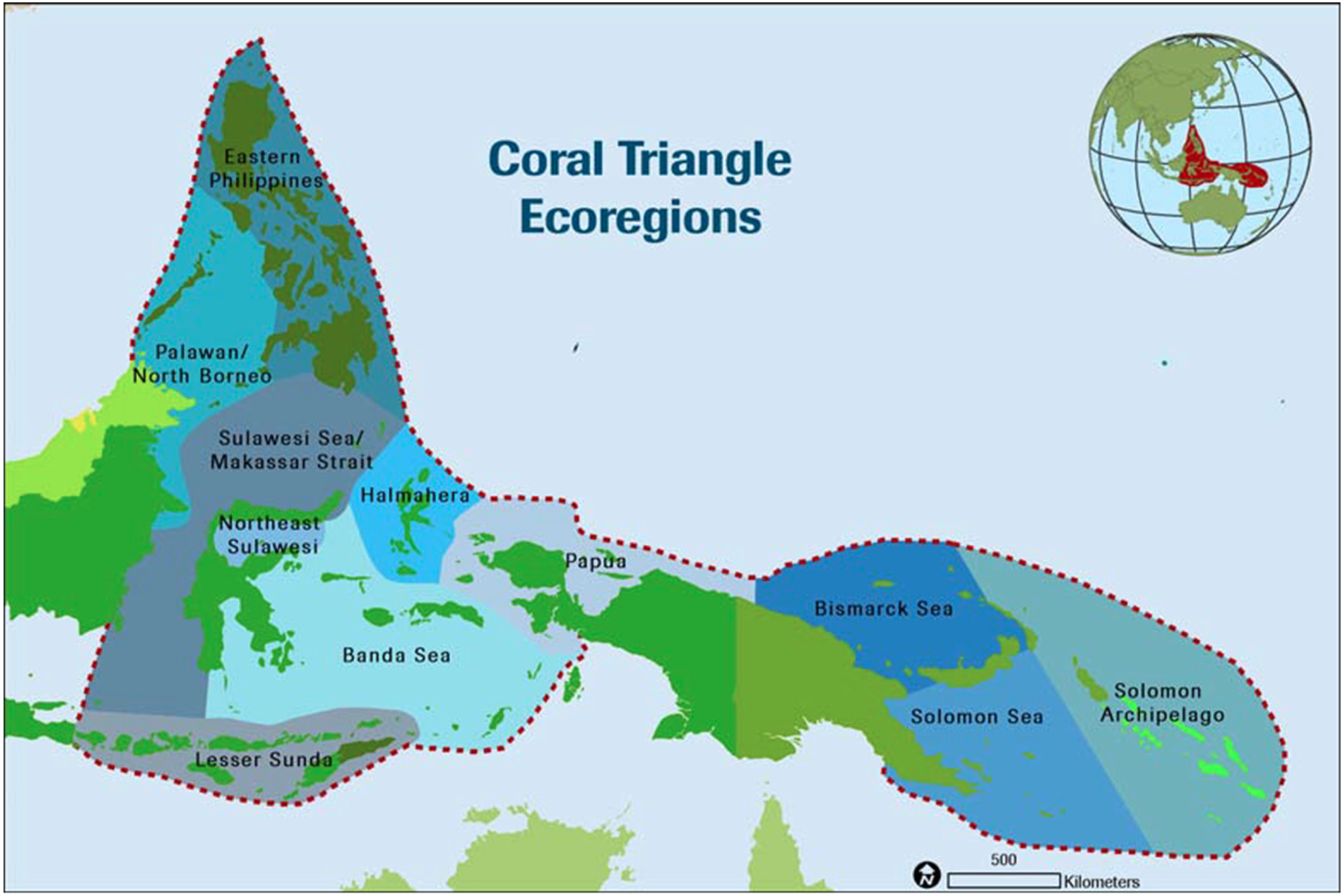
‘Ecoregions are defined as “large areas containing geographically distinct assemblages of species, natural communities, and environmental conditions”’. (Green and Mous, 2008 p. vii).
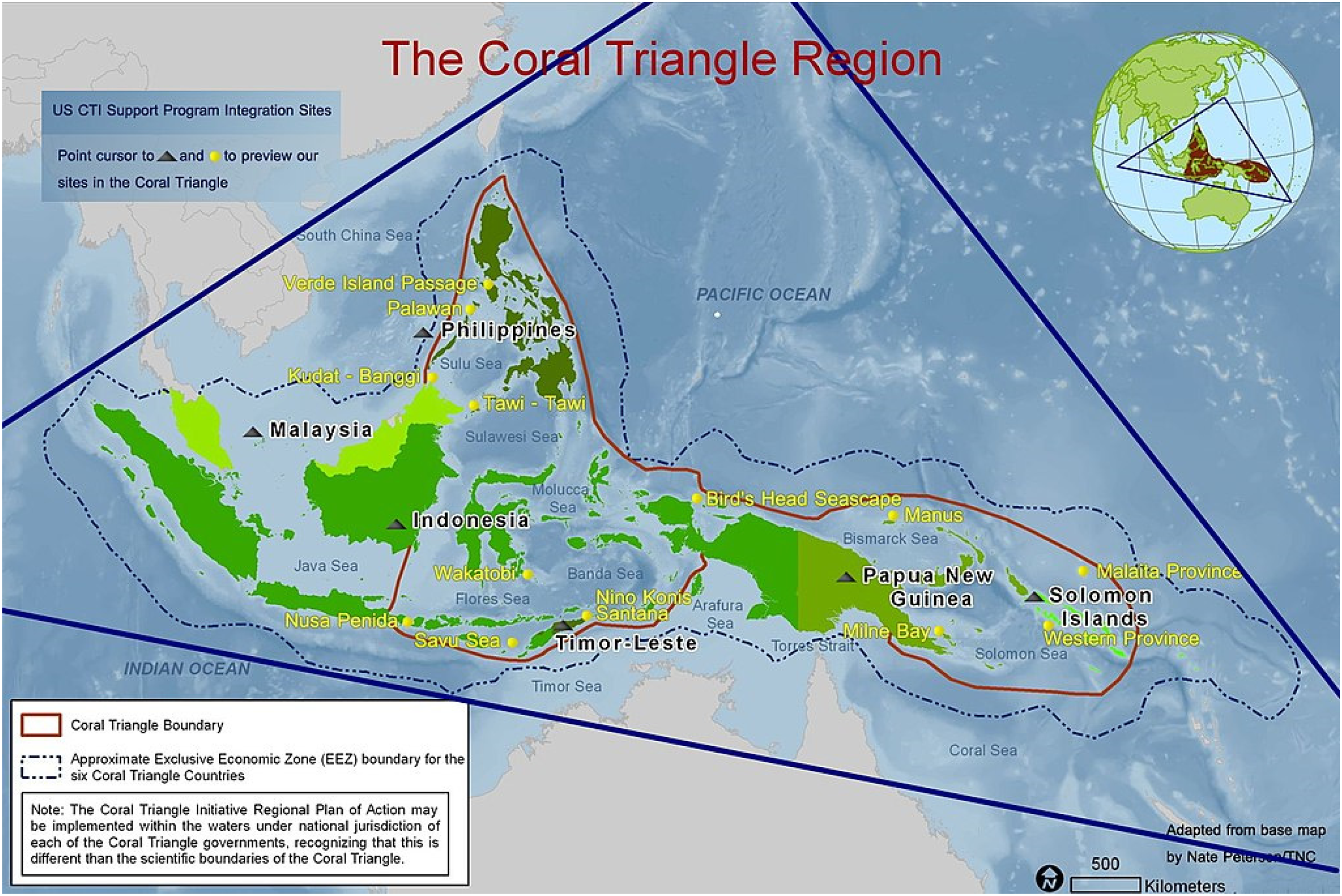
Map of the coral triangle region (CTI-CFF, 2014).
Secondly, the CTI-CFF is a multi-lateral partnership with a high level of local and indigenous representation. The partnership is actively engaged with alternative (indigenous) ecological ontologies and traditional management approaches in the development of its governance frameworks.
The remainder of the paper includes a methods section in which I discuss my use of CDA and critical reasoning. The results section is structured around the analysis of the three case studies. Results focus on the first two aims of the paper to identify ontological principles and to investigate through what mechanisms these principles are reproduced. This is followed by a discussion and conclusions section that concentrates on the final aim of the paper, to ask what the results of the study imply for ontological reform.
Method
My use of CDA takes a Foucauldian approach informed by the work of Paul Ricoeur (1971) and Maarten Hajer (Hajer, 1997; Hajer and Versteeg, 2005) to ask how power is exercised through language in law and governance frameworks? I do this to examine the power relations represented by ocean ontologies, through analysis of who or what is represented in these ontologies? The question of representation is especially important as analysis engages most with what isn’t represented – the omissions, gaps, and suppressed premises. As Fairbanks et al. (2018, p. 152) intimate of discourse in marine spatial planning, it is precisely in these ‘silences’ that conflicts between discourses arise and disrupt.
By extension, I also consider my own positionality (Rose, 1997) as a researcher and producer of situated, or partial, knowledge (Haraway, 1991). Textual analysis of formal institutional documents can make developing a working relationship with the text difficult. Individual authors are erased, and law and policy documents are invested with their own powers and identities, making it harder to see where and how the text participates in knowledge production, and to reflect on one's own position in the process.
I rely on linguist Norman Fairclough's ‘Analytical Framework for CDA’ (1995, 2011) which offers a five-step method for conducting CDA. Within this framework, I focus on structural, interactional and interdiscursive analysis. The structural analysis consists of the analysis of the order in which discourses are presented (and developed) within a text. This was especially important for analysing the formal and technical structure of a legal convention such as LoS where structure can explicitly define legal power (e.g., in the distinction between preambulatory (non-binding) and operative (binding) sections). An interactional approach to CDA analyses text as a hybrid of different genres, discourses, and styles. I investigate LoS as a hybridisation of concepts from previous ocean governance regimes. This approach was also useful for tracking power relations across different frameworks, where hybridised discourse in one framework could be defined as developing from the omission of certain actors or spaces in earlier frameworks. Lastly, the interdiscursive analysis considers ‘the ongoing working of relationships between [different discourses] in texts and interactions’ (Fairclough, 2011, p. 5). I use this approach to identify mechanisms in discursive relationships that work to reproduce discourse.
My method is further informed by a small body of work specifically interested in the CDA of environmental law (Gellers, 2015; Lange, 2011). Gellers suggests four guidelines for CDA of environmental law: 1. Analysis should capture both ‘text and practice’, expanding materials for analysis beyond ‘texts or elites’ to include, e.g., nonlinguistic practices and built spaces; 2. Materials should be ‘intertextually and intratextually … combed through for manifest and constitutive references to other works’ (2015, p. 488); 3. Analysis should focus on the extent to which the materials reveal power differentials, perpetuate dominance, and impact the pursuit of justice; 4. Analysis should include discourse ‘across temporal and spatial planes’ (ibid). While to some extent these follow Fairclough's Analytical Framework for CDA (e.g., Principle 2 aligns with Fairclough's ‘interactional’ approach) there is specific thought given to the unique power relations in environmental legal discourse. In particular, the emphasis on including data from historically and geographically diverse sources, as well as nonlinguistic practices, aids the inclusion of nonhuman communities and marginalised spaces.
There was, however, an important limitation to CDA of the legal frameworks I study here. It proved an insufficient method of analysing the discourse of legal principles and pre-ambulatory clauses both of which proved central to identifying ontological material. The main reason for this failure was the inability of CDA to identify underlying arguments in legal principles but more specifically suppressed premises. Instead, I used critical reasoning to identify and code stated and suppressed premises, inferences, and conclusions in legal principles. This aided the identification of what I define above as ‘ontological principles’ – a mode of reasoning that is structural in nature (deriving from the reproduction of a set of existing ontologies) and employed without critical awareness. Maarten Hajer states that ‘[discourse analysis] allows for a better understanding of controversies, not in terms of the rational argumentation, but in terms of the argumentative rationalities that people bring to a discussion’ (2005, p. 301). As Hajer suggests, applying critical reasoning (if not CDA) reveals discursive controversies (i.e., conflicts and oppositions) and it is in these controversies that ontological material is most identifiable (for example, where there are fundamental oppositions between principles).
Results: overview
Each of the three law and governance frameworks analysed differs in its aims and scope. I include a paradigm-shifting work of international law (LoS), a technical guide for best practices in ocean boundary-making (NOAA), and an innovative regional governance framework developed by a collective of small island states (CTI-CFF). Yet, each framework employs the same ontological principles in the conceptual stages of its development. I define an ontological principle as (a) an implicit rule derived from a set of existing (Westphalian) ontologies and (b) an ontological device that operates without evidence of critical awareness in the conceptual stages of ocean law and governance development. The research identifies three such principles: land-based methods; people-centred approaches; and the omission of open-ocean and deep-sea environments. First, land-based methods refer to the reappropriation of methods that are designed to govern relatively static environments that do not move over space and time. 5 Secondly, people-centred approaches refer to the ways in which ocean environments are conceptualised and governed around human settlements. Lastly, while areas beyond national jurisdiction (ABNJ) have become a recent focus of ocean conservation, the omission of open-ocean and deep-sea areas from law governance frameworks impedes this effort. Marine protected areas (MPA) in ABNJ represent a tiny fraction of the total areas under governance. 6 Ocean law and governance remain almost entirely focused on the area from the coastal baseline up to and including the continental shelf.
Established work on ocean ontologies identifies some similar ontological themes. Land-based approaches, for example, have been criticised as maladaptive in anthropology (Cardwell and Thornton, 2015), geography (Steinberg and Peters, 2015), and marine policy (Maxwell et al., 2015). I suggest an ontological principle differs where it becomes an implicit rule, and where this rule can be tested (i.e., identified as reproductive) through empirical study and comparative analysis. An ontological principle points to the ways in which certain ontologies are structurally embedded as fundamental conceptual framings and elucidates their reproduction. I suggest the advantage of positioning the evidence this way is that it allows investigation into which ontological approaches are central to specific disciplinary practices.
In the following section, I examine baselines as the primary concept around which ocean space is conceived and represented in LoS. I analyse the types of baselines used for ocean boundary-making in LoS and identify two discursive themes: the conceptualising of ocean space around terra firma in cases where land is absent; and a theme of ‘precision’. The section ‘Best practice for boundary-making’ examines two features of NOAA: (a) the discursive relationship between ‘MMAs’ and ‘MPAs’; and (b) the discursive relationship between practices of ‘accuracy’ in NOAA and ‘precision’ in LoS. I conclude with evidence that marine managed and MPAs are discursively positioned interchangeably, despite their distinct purposes. Further, the concept of ‘accuracy’ is a fallacious concept; not only because it does not accurately represent ocean space, but because – as a land-based method – it cannot. The section ‘The Coral Triangle regional plan of action’ explores the discursive conflict between the ‘people-centred’ ethos of the CTI-CFF “Principles”, and the ‘science-led’ approach to the framework's “Goals and Targets”. I show results of the coded analysis in which I use critical reasoning to examine the “Principles and Goals” of the framework. I evidence the reproduction of ontological principles and examine why these situate ‘human-centred’ and ‘science-led’ (i.e., nonhuman-centred) approaches as mutually exclusive. I conclude with a summary of evidence to compare and contrast findings from the three case studies.
LoS baselines and boundaries
The United Nations Convention on the Law of the Sea (1982) is a 360 clause, 9 annex agreement. Results concentrate on analysis of Parts II to VII which concern the zoning of the sea using baselines and boundaries and thus offer the clearest examples of spatialised practices within the Convention. A baseline is a concept in marine management that uses topographic features as a reference point for ocean boundary-making. The coastline and continental shelf form the two main reference points. A nation's coastal baseline is measured from the low tide water line and determines the boundary of the territorial sea, the contiguous zone, and the EEZ. The continental shelf, including the slope and rise of the shelf, occupies a position that is both baseline and boundary. It acts to mark both the extent of land and the beginning of the high seas, both rationalised around the shelf's geological history as dry land (see Figure 3).
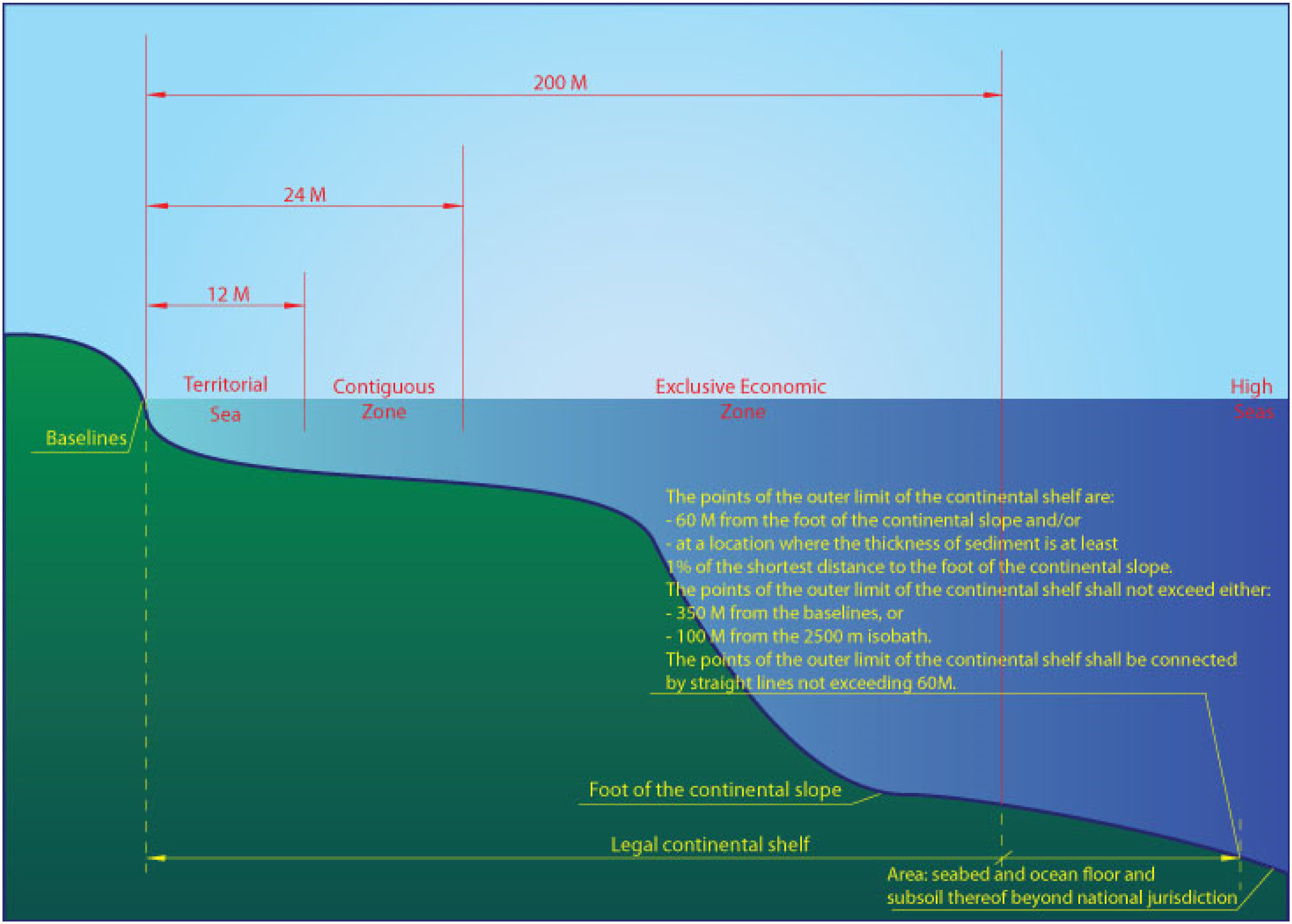
Marine zoning in LoS.
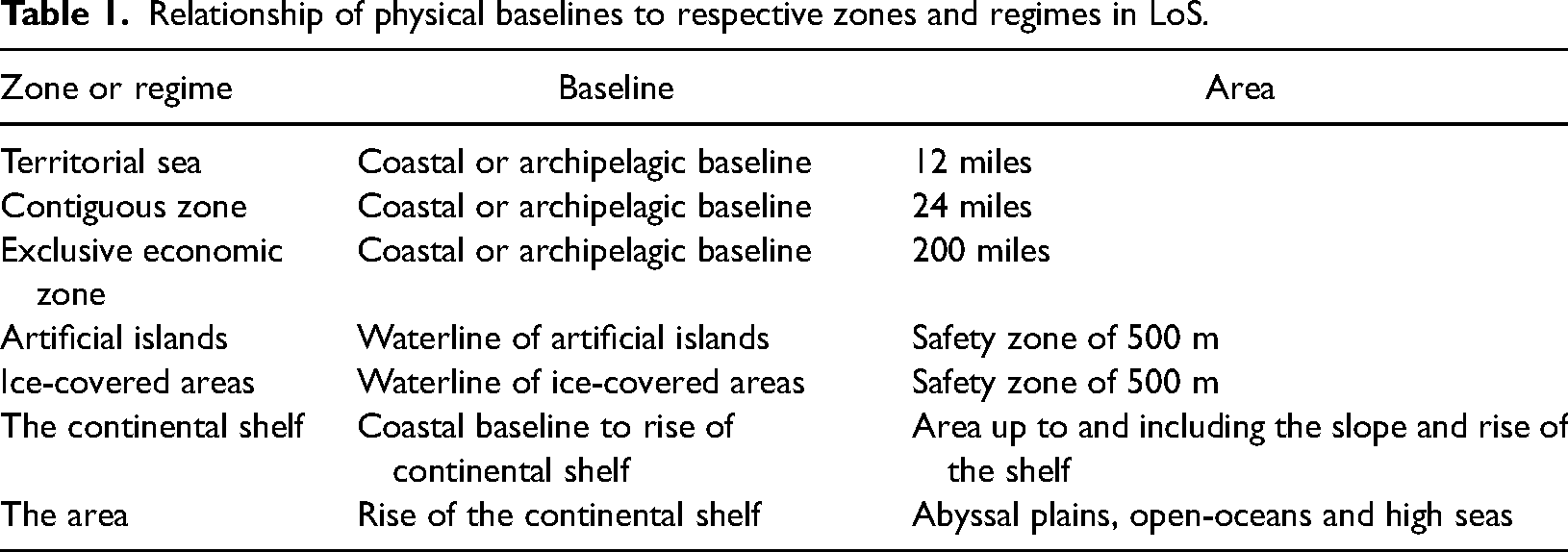
There are several characteristics of the discourse relating to coastal baselines that point to the use of ontological principles. First, the coastal baseline is a fundamental concept with several clauses dedicated to its subject (Articles, 5, 7, and 14 of Part II Section 2. Limits of the Territorial Sea). Yet, a structural analysis (i.e., CDA of the arrangement of discourse in a text) shows that the legal and discursive emphasis is placed on the boundary. This is important because, by contrast, the concept of a baseline is presented as an entirely presupposed concept on which every spatial definition in LoS relies, but which is rarely specified, and obscured in the Clauses themselves (i.e., the sub, sub, sections of the Convention). 7 The lack of emphasis given to baselines in the framework might be explained by the fact that, as Article 5 specifies, the legal onus is on coastal states to delineate the low water line on which the coastal baseline is based. This does not, however, detract from the effect of this treatment of baselines in the framework, which is to re/institutionalise an ontological approach to conceptualising oceans which is land-based, people-centred, and excludes the high seas. This is achieved by presenting a fallacious premise as fact: that coastal baselines and ocean boundaries bound water, whereas they do instead bound the bottom ocean topography as land (extending from the coastal baseline to the limits of the continental shelf) (Table 1). 8
Relationship of physical baselines to respective zones and regimes in LoS.
Other examples exist in clauses relating to artificial islands and ice-covered areas. A coastal state has the right to construct artificial islands, installations, and structures within the EEZ (Article 60 of Section 3. Part V Exclusive Economic Zone) and to establish a ‘safety zone’ around the artificial feature not normally exceeding 500 m (Article 60; Article 260 Section 5. Scientific Research Installations or Equipment in the Marine Environment). In the case of ice-covered areas within the EEZ, states are afforded special law-making powers which extend sovereign rights (Article 234 of Part XII Section 8. Ice-Covered Areas). In practice, each artificial island or ice-covered area serves as a defacto coast, illustrating the necessity of terra firma in the rationalisation of ocean boundaries. The perimeters and location of ice-covered areas, however, can change due to melt and drift, destabilising boundaries and unsettling sovereign claims (Bruun and Steinberg, 2018; Tsaltas, et al., 2010).
Archipelagic baselines are another example. As Article 47 (Part IV Archipelagic States) states: An archipelagic State may draw straight archipelagic baselines joining the outermost points of the outermost islands and drying reefs….The drawing of such baselines shall not depart to any appreciable extent from the general configuration of the archipelago.
Thus, yet further evidence that, despite the form baselines take, they are in principle – and as a matter of administrative practicality – rationalised geologically. An exception to this is the use of straight baselines as a method for disciplining ‘unstable’ areas of the coastline. In this case, special provisions are made for cases in which: 1.‘… the coastline is deeply indented and cut into’; ‘…if there is a fringe of islands along the coast…’; 2.‘… the presence of a delta and other natural conditions the coastline is highly unstable…’. (Article 7. Part II Section 2. Limits of the Territorial Sea)
The conclusion to draw from this provision is that straight baselines are used when the coast no longer presents an administratively reasonable point of reference. The premise that a coastal baseline can be faithfully projected seaward to form an ocean boundary is brought into question. The purpose of the straight line is to obscure the paradox that is inherent in the premise of bounding water as land – and to lead the eye away from the terrestrialisation of the sea. Secondly, the use of straight baselines to standardise (and sanitise) coastscapes highlights the dilemma of representing natural environments in boundary-making. Environments are assessed and organised hierarchically based on their potential to produce administrative ‘stability’. It follows that every baseline in the Convention presupposes that ocean boundaries should be conceived around terra firma. Yet, the absence of an ocean-tethered concept of boundary-making means that subsequent boundaries do not represent the marine communities that LoS is in part designed to conserve. 9 The fluid environment is not secondary to the process of boundary-making, it does not contribute to the process at all.
Another presupposition found in the Convention is that environments should be governed (spatially) around human political geographies. This ontological principle – a people-centred approach – exists at a fundamental level and I draw a distinction between this and the State-based approach that is an explicit element of LoS. The former is most identifiable at the implementation stage when maladaptive ontologies create empirical problems. Examples that illustrate problems with both land-based methods and people-centred approaches are the many transboundary issues that have plagued the implementation of conservation aims in the Convention. LoS attempts to address these problems in a number of Articles. In particular, Articles 63 and 64 (Part V Exclusive Economic Zone). For example, Article 63.1 states that: Where the same stock or stocks of associated species occur within the exclusive economic zones of two or more coastal States, these States shall seek, either directly or through appropriate subregional or regional organizations, to agree upon the measures necessary to coordinate and ensure the conservation and development of such stocks without prejudice to the other provisions of this Part.
And, Article 64.1 states that: The coastal State and other States whose nationals fish in the region for the highly migratory species listed in Annex I shall cooperate directly or through appropriate international organizations with a view to ensuring conservation and promoting the objective of optimum utilization of such species throughout the region, both within and beyond the exclusive economic zone. In regions for which no appropriate international organization exists, the coastal State and other States whose nationals harvest these species in the region shall cooperate to establish such an organization and participate in its work.
Resolution 70/75 (2015) builds on Articles 63 and 64, with a more detailed set of operative clauses for the sustainable management of highly migratory and straddling fish stocks against overfishing. Interdiscursive analysis of Articles 63, 64, and Resolution 70/75 shows a fundamental problem. The method of boundary-making used in the Convention cannot bound ocean communities that move over space and time. In this example, I suggest the problem arises at the point of empirical testing when ontological approaches are tested through implementation. Discursively, the problem is acknowledged in Articles 63 and 64 through the discourse of ‘agreement’, ‘coordination’, and ‘cooperation’ between parties. What this language does is acknowledge a problem to ‘coordinate’ around, and narrativise a fundamental problem as solvable through ‘agreement’ and ‘cooperation’, whilst placing the burden of this ontological conundrum (to develop a scientifically informed management plan for the conservation of marine species around existing boundaries) entirely on member states.
If baselines and boundaries are viewed as territorialising devices their purpose in the Convention is to bound nonhuman resources within a set of land-based and people-centred zones organised around the borders of sovereign states. The boundary-making practices of LoS reappropriate colonial territorialist ontologies towards nonhuman marine communities through terrestrialisation, anthropocentrism and lack of representation. In the next sections, I examine two further frameworks, to explore how the reproduction of ontological principles obstructs governance aims.
Best practice for boundary making
MMAs: Best Practice for Boundary Making (NOAA, 2006) forms the international standard in ocean boundary-making. It is analysed as part of this research to understand how conformity to ontological principles in LoS shapes boundary-making in MMAs. The guidance for producing boundaries is structured around a tripartite process: 1: ‘conceptualize the MMA’; 2. ‘describe the marine boundary’; and 3. ‘generate the digital boundary’ (p. 9). This section presents an analysis of the first stage of the process, to ask how boundary-making is conceptually framed. I discuss two central points. First, is the interdiscursive relationship between MMAs and MPAs. Second, the concept of accuracy in the conceptualisation of boundaries.
While the discursive structure of NOAA suggests that the framework has the capacity to conceptualise new boundaries, in practice this largely involves the conceptualisation of an MMA around existing boundaries, specifically: (a) relevant legal frameworks (LoS) and (b) an inventory of existing boundaries and jurisdictions.
10
Further, interdiscursive analysis of the Manual's boundary-making for ‘MMAs’ and ‘MPAs’ shows that under current best practice the conceptualisation guidelines for an MPA follow those for an MMA, despite their distinct aims: … marine protected areas, which include no-take and other types of conservation areas, fall within the larger category of marine managed areas. Marine managed areas encompass both protected areas and those not necessarily established primarily for conservation purposes. Since the term marine protected area applies to many of the examples in this manual, protected often appears in the discussion, and readers can usually substitute managed for the purposes of this best practices manual. [my emphasis] (p. 3)
A further point states that: To promote the development of sound legal boundary descriptions, this best practices manual includes management areas not necessarily established for conservation purposes. (p. 5)
These examples show that at the conceptualisation stage marine managed and MPAs are positioned interchangeably in order to ‘promote the development of sound legal boundary descriptions’ meaning that (a) boundary-making for MPAs takes the same form as best practice for MMAs – even though the aims of each instrument may be opposed; (b) MMA stakeholders are likely to be more powerful (e.g., commercial stakeholders); and (c) boundary-making is, therefore, likely to serve the interests of MMAs. The discursive relationships evidence power relations that structurally impede the representation of the marine communities for conservation at the conception stage.
This simplification of boundary-making practices is orientated around the reduction of ‘boundary misunderstandings and litigation’ (p. I), with a strong emphasis on boundary ‘accuracy’. The Manual opens with the statement: ‘a law or regulation for a marine area cannot have its fully intended effect if the boundary description is vague, inaccurate, or incorrectly represented on a map’ (ibid). This is reinforced throughout the conceptualisation stage, such as the modelling of the boundary (Stage D of conceptualisation), which states that: a boundary must meet the requirements, or purpose, of the MMA, be unambiguous administratively and legally, and serve both the user and mapping communities ….Here, the boundary developer should understand the legal, management, and technical consequences of using particular boundary components—including straight lines, buffers, shared components, shoreline, and geographic features and place names—and use the knowledge gained in previous sections to develop appropriate boundaries. (my italics, p. 22)
The objectives of the conceptualisation stage are summarised as follows: to ‘create boundaries that are clearly defined and thus easy to interpret’, to develop boundaries in relation to ‘common boundary’ practices, and to produce ‘legally defensible boundaries by using unambiguous terms and precise locational references’ (pp. 22–23). If we are to substitute the term MMA with MPA (as the manual states are possible) several contradictions become apparent. First, conceptualisation practices prioritise the ‘accurate’ or ‘unambiguous’ delineation of a marine boundary over the ‘protection’ of a marine area. This emphasis conceptually separates boundary development from the spatial representation of marine communities. Secondly, the emphasis on the ‘legal consequences’ (p. 22) of boundary development point to competing aims: the boundary must meet the conservation ‘purpose’ of an MPA but only in so far as it is ‘unambiguous legally’. Analysing this guidance (substituting the term MPA for MMA) suggests that there are boundary development aims, and conservation aims, that are mutually exclusive.
To address the dilemma of legal ambiguity the guidance relies on the use of straight boundary lines. For example, the Manual states that: straight boundary lines specifically defined as either geodesic or rhumb lines with visible on-water reference points are generally easier to enforce and understand than other types of boundaries. (p. 26)
Further, under ‘jurisdictional issues’ it states that: [the straight line] is the easiest to create and enforce if properly defined. (Table 5, p. 26)
Under ‘digital mapping issues’, that: [the straight line] is the most easily mapped if properly defined. (ibid)
And, under ‘other considerations’, that: using straight-line segments to create a simple polygon is easiest to depict and enforce…[even though it is acknowledged that] a polygon may generalize the area you plan to manage. (ibid; my italics)
This approach necessitates that boundary-making is wholly concerned with avoiding litigation. Boundary development that is designed to improve accuracy (i.e., the political stability of the boundary) must by definition work to exclude destablising nonhuman geographies (whether terrestrial or marine). The logic used to justify straight boundary lines draws directly from reasoning used in LoS (i.e., the use of straight lines to ‘stabilise’ archipelagic and coastal baselines). The discursive structure of straight-line discourse is also similar. The statement that ‘a polygon may generalize the area you plan to manage’ (ibid) is an understated endnote, similar in discursive style to the presentation of coastal baselines in LoS. This ontological reproduction points to an important empirical problem. While both frameworks present the argument that straight lines promote accuracy and avoid ambiguity, the interdiscursivity of the frameworks suggests instead that straight boundary lines represent a writing out of detail – an administrative solution to competing political and conservation aims within the guidance.
The exception to this, and where the Manual differs from LoS, is in its greater engagement with the ambiguities of the coastal baseline. While LoS uses the low tide water mark as the coastal baseline, the Manual uses the shoreline as a boundary itself. This presents distinct problems: [the] shoreline is a common reference feature but one of the most complex to portray accurately … natural processes such as tides, weather, and climate can significantly change the location of the shoreline over time. If the MMA boundary's intent is to reflect these natural changes, then using shoreline features in the boundary description may be appropriate. (pp. 24–25)
Further: The boundary developer must also understand that referencing the shoreline in the boundary description creates the additional burden of having to update the ambulatory shoreline continuously. (ibid)
Importantly, this makes provision for boundary-making that moves over space and time. What is particularly interesting in this example is the adaptive approach boundary-making takes in response to ‘natural changes’, which implies that boundary-making in the framework has the capacity to respond to environmental change, such as sea-level rise. 11
In summary, there is a high level of interdiscursivity between NOAA and LoS due to conformity to ontological principles that dictate the boundary conceptualisation process. To make a marine boundary ‘unambiguous’ is to exclude competing actors. In this particular case, those competing actors are ostensibly ocean communities and their capacity for movement – communities that are entirely absent from the conceptualisation process. While the consultative stage of boundary conceptualisation with stakeholders has the capacity to include marine scientists, and while the discursive interests of the Manual show that it, like LoS, is designed to ‘protect and manage resources within the marine environment’ (NOAA, p. 5), the prioritisation of commercial interests within the framework precludes any meaningful inclusion of marine scientific ecoregions. In short, the ontological principles used in NOAA obstruct the conservation aims of the framework.
The Coral Triangle regional plan of action
The Coral Triangle Initiative on Coral Reefs Fisheries and Food Security is an initiative established in 2009 as a nonbinding agreement between the nations of Malaysia, Indonesia, Philippines, Timor-Leste, Solomon Islands, and Papua New Guinea. This section discusses the analysis of the CTA-CFF's main framework for implementation, the RPoA (2016). Specifically, it discusses the results of critical reasoning applied to the Principles guiding the framework, and relevant Goals and Targets set in relation to ocean boundary-making.
The Coral Triangle region is an exceptional case of ocean boundary-making that is delineated around scientifically defined marine ecoregions. The scientific boundary is in part designed to better facilitate governance of the region as the global epicentre of marine biodiversity for a large number of species (Barber, 2009; Veron, 2009). While the scientific boundary does not delimit waters under national jurisdiction, it informs delineation of the exclusive economic zone which delimits the area of CTI-CFF implementation. What the EEZ represents is a regional ocean governance boundary that is conceived around the region's marine communities for the express purpose of conservation. The CTI-CFF is an exciting interventionist example of ocean governance reform that offers geographic, place-based, representation to both scientific delineations and subsistence fisheries.
However, while many aspects of the CTI-CFF work against conventional ocean governance, analysis of the CTI-CFF's RPoA identifies a number of competing aims that undermine the framework's conservation objectives. First, the development of environmental governance regimes (e.g., seascapes) that are both ‘ecosystem based’ and ‘people-centred’; and secondly, practices of ocean boundary-making that, whilst purportedly based on ‘solid science’, are precluded from prejudicing existing political boundaries between nations. Research suggests that, while the Coral Triangle region was conceptualised around scientifically informed ocean-boundaries, and while the representation of such boundaries has been a primary concern of the CTI-CFF RPoA, these boundaries are, in law, subordinate to the boundaries of competing governance frameworks such as LoS.
Principles
Of the nine “Guiding Principles” of the framework, seven were analysed as relevant to the conception and delineation of marine environments. These are: Principle 1: CTI should support people-centred biodiversity conservation, sustainable development, poverty reduction and equitable benefit sharing… (p. 7) Principle 2: CTI should be based on solid science. Solid science and data on fisheries, biodiversity, natural resources, and poverty reduction benefits should form a basis for establishing goals and implementation activities. In the absence of conclusive scientific information, the precautionary principle/approach will apply. (ibid) Principle 6: CTI should recognize the transboundary nature of some important marine natural resources. Goals/activities should take into account the transboundary nature of some marine resources and threats (land- and sea-based) to these resources (e.g., shared fish stocks, migratory sea turtles and marine mammals, IUU fishing, live reef fish trade). Transboundary activities under CTI should not prejudice recognized boundaries or ongoing negotiations on legal boundaries between nations. (p. 8) Principle 7: CTI should emphasize priority geographies. Goals/activities should help focus resources and investments on priority geographies (e.g., large-scale “seascapes” requiring prioritized attention, identified through ecoregional assessment processes). (p. 9)
These Principles were analysed using critical reasoning to identify stated and suppressed premises, inferences, and conclusions, and to interrogate the underlying logic of legal principles and some preambulatory clauses (see Appendix 1). The results of the analysis can be summarised as:
The framework is ‘people-centred’. The framework is based on ‘solid science’ in the absence of which ‘the precautionary principle will apply’. The framework ‘recognises the transboundary nature’ of marine resources, but this should not prejudice ‘legal boundaries between nations’. The framework aims to focus resources and investments on ‘priority geographies’.
Goals, targets, and annotations
Goals and Targets were analysed on the basis of their engagement with ocean boundary-making (see Appendix 2). Results can be summarised as follows:
There are existing ocean boundaries in the region that need to be recognised by the framework (i.e., any conflicting delineations will require transboundary negotiations). There are a number of stakeholders that will be consulted in the delineation of ‘priority seascapes’, including ‘government’, ‘key partners’, and ‘local community and stakeholders’. Goal 2, to develop an ecosystems-based approach to fisheries management (EAFM), may be inconsistent with the Principles of the Framework. For example, the concept of an ‘ecologically meaningful boundary’ may be incompatible with the suppressed premise of Principle 1. ((a) i.) that the Framework ‘should not support biodiversity conservation for its own sake’ (see Appendix 1). Scientific bases for ‘the formulation of EAFM policies’ and the spatial mapping of climate change data may be inconsistent with the premise that the Framework should be ‘people-centred’.
The Principles guiding the RPoA reproduce ontological principles identified in LoS through discourse such as ‘people-centred’ and ‘priority geographies’ (that prioritise land-oriented, ecosystem service-based geographies). The Goals, Targets, and Annotations consolidate this discourse in the empirical aspects of the framework through regional and national policy (goals and targets), and the empirical practices that action the framework's goals (annotations and regional actions). It is in the Annotations to Targets that conflicts between theory (i.e., the Principles) and practice (i.e., the Annotations and Regional Actions) are most evident. A closer analysis of the goals and targets shows that as the aims of the framework are refined, there is a shift from the premise that the framework ‘should support people-centred biodiversity conservation’ (Principle 1) to discourse that highlights the balance between human and nonhuman actors in ecosystems. This is especially evident in EAFM Goals and Targets in which ‘biotic, abiotic and human components of ecosystems and their interactions’ are highlighted (Goal 2).
There are two devices used in the Annotations that highlight this shift in discourse. First, scientific knowledge is positioned as the locus of the nonhuman (in so far as the nonhuman is rendered measurable for human goals, like food security). This is exemplified in Regional Action 2 of Goal 3, which states that: Special collaboration and external assistance from leading institutions will be required to analyse key information not addressed in previous spatial analysis exercises, such as spatial mapping of (i) areas with climate change resilience characteristics; (ii) fisheries-based food security data; and (iii) poverty data overlaid with data on climate change vulnerability of marine ecosystems. (p. 32)
Here, ‘key information’ – a euphemism for the nonhuman – needs specialist (scientific) analysis to ascertain where the resource might (as in (i) and (ii)) and might not (as in (iii)) sustain increased exploitation. The conservation of nonhuman species is repositioned only in so far as they sustain human populations. Secondly, in the absence of scientific knowledge, Principle 2, and Annotation 1.1 of Goal 2, Target 1 deploy the precautionary principle as a proxy for the nonhuman (by which I mean the precautionary principle represents nonhuman groups when science cannot). The inclusion of the precautionary principle points to fundamental inconsistencies in the Framework's ‘people-centred’ conservation approach. As discourse progresses from the conservation goals set out in the legal principles, to the implementation phases of the Annotations and Regional Actions conservation goals fail to translate. Marine communities are increasingly obscured behind terms such as ‘key information’, ‘specialist analysis’, and ‘the precautionary principle’. While people-centred approaches are standard in conservation instruments, the gradual ‘writing out’ of nonhuman communities that are explicitly accounted for in earlier sections points to a fundamental conflict in this approach that structurally impedes the Framework. In this particular case, ontological principles may obstruct the Framework from accounting for nonhuman communities. This creates problems in the implementation phase because it is at odds with the indigenous animistic cosmologies of the region that politicise and spatialise human–environment relations very differently. This also shows that, despite community consultation, the framework's dominant logic is formed from a reproduction of Westphalian ontological approaches. I suggest the empirical difficulties of these conflicting aims are recognised in the use of the precautionary principle, that acts as an intervention to the imbalance of power relations (between humans and nonhumans). In particular, it draws attention to the framework's ultimate reliance on the interventionist roles of legal principles and scientific data to delimit the concentration of power given to human actors. This suggests that while the use of ontological principles might not be explicitly recognised, the empirical problems created by them are recognised in the framework's development.
Discussion and conclusions
The results evidence what I have termed ontological principles. I define an ontological principle as (a) an implicit rule derived from a set of existing (Westphalian) ontologies and (b) an ontological device that operates without evidence of critical awareness in the conceptual stages of ocean law and governance development. The three principles I identify are (a) the use of land-based methods, (b) people-centred approaches, and (c) the omission of open-ocean and deep-sea environments.
I suggest that the central mechanism of ontological reproduction is a set of colonial territorialist logics that rationalise the principles. The cycle of reproduction suggested by the results is shown in Figure 4. I connect the cycle of reproduction to what I suggest is its historical basis in anthropocentric ontologies of nature arising from the European enlightenment (Latour, 1993, 2004) used to rationalise the exploitation of natural (and othered) resources and people during the colonial period (Said, 1995; Steinberg, 2001) now institutionalised in Westphalian human–environment relations (Blanchette, 2015; Neimanis, 2017; Probyn, 2016). In this section, I explore aspects of this reproduction, including the reappropriation of colonial territorialism in LoS, the structural nature of the principles, and implications for reform.

Ontological reproduction in ocean law and governance frameworks.
Colonial territorialist logics
The ratification of LoS followed a sustained project to establish more equitable maritime economies. Mirasola notes that ‘pollution and overfishing became understood by an increasing number of developing countries as an externality of colonization by dominant marine powers’ (2016, p. 46). The conceptual approach to boundary-making in LoS is driven by ‘functional logic’ (Johnston, 1988). This concept is specifically employed in opposition to the colonial territorialist approaches of former frameworks in which coastal seas were established as an extension of territory. Whereas colonial territorialism relies on a logic of force, the Convention relies on the principles of sovereignty and consent: In the contemporary period [of ocean law], imperial conquest and the colonial style have given way to the principle of consent in the delimitation of international boundaries between neighbours. At sea, and to some extent in outer space, the concept of territoriality has yielded to the much greater specificity inherent in a functional approach to boundary-making. (ibid, p. 18)
The key concept driving the functional logic approach to boundary-making is “administrative reason”: According to the functionalist approach to ocean boundary-making, the making of the boundary should be strongly influenced by the administrative reasons for the boundary in question and by the anticipated administrative problems associated with its maintenance. (ibid, p. 227)
It is on this basis – its ‘functionality’ in an institutional setting, and its representation of ‘administrative reasoning’ – that LoS constructs the ocean boundary as a ‘rational’ representation of the principle of consent. 12
While functional jurisdiction in ocean boundary-making represents a reformist act of diplomacy in its recognition of sovereign rights, it is also a conceptual approach that I suggest has reappropriated certain tenets of colonial territorialism towards biotic and abiotic ocean communities. This is not to say that ocean resources were not subject to extractive politics prior to LoS (Figure 4 makes the claim that the ontological principles are only possible because they rest on a historic foundation of extractive ontologies of nature) but that specific logics previously directed towards colonised peoples were redirected seaward. These logics represent a set of fundamental power relations operating in ocean law and governance that hegemonise the nonhuman.
If colonial territorialist logics provide a foundation for the ontological principles, then they also play a central role in their reproduction. This is recognisable where ocean law and governance terrestrialise ocean space by replicating the land-based methods of the terrestrial ‘metropole’; where there are identifiable colonisers (people) that territorialise (indigenous) ocean communities for the extraction of resources, and where governance excludes those areas (the open-oceans and deep-seas) that cannot be rationalised as anthropo-terracentric. Despite the postcolonial ethos of the Convention, there are distinctly colonial logics at play in the disciplining of irrational, politically disorganising oceanic communities through discourses of ‘precision’, ‘accuracy’, ‘rational’ boundary-making, and administrative ‘reason’. The question of non-consent that the functional logic approach to boundary-making aims to avoid has from this position merely shifted from people to non-peoples.
Structural reproduction and reform
The insights gained here into how ontological principles reproduce suggest that ocean ontologies in law and governance are structural (i.e., a deeper set of logics that underpin and are deduced from observable events (Smith, 2009)). The strongest evidence to support this claim comes from analysis of the CTI-CFF framework, where the reproduction of ontological principles obstructs the aims of the framework, despite these aims (and many other characteristics of the framework) being interventionist by design (e.g., indigenous consultation; science-led regional delineations). This raises questions like: can alternative ontologies and methods really make interventions within a system of law and governance that is ontologically opposed to conservation aims? If the ontological principles (a) obstruct law and governance aims and (b) are reproduced despite interventionist approaches this suggests that any project of reform would need to address the foundations on which they rest, as well as the mechanisms of their reproduction. 13
This result sits counter to some studies of ocean law and governance reform. Fairbanks and Campbell et al., for example, suggest that analysing existing structures using alternative methods of social organisation can act as an intervention to existing power relations. In this case, assemblage theory is used to de/reterritorialise conventional ocean enclosures: As MSP is more formalized and embedded in U.S. oceans governance, opportunities for alternative de- and reterritorializations or interventions might similarly formalize and embed themselves in governance…although the MSP assemblage might be increasingly formalized in governance, that does not mean that the opportunities to enact or perform enclosure differently are “formalized away” over time. In fact, the opposite might be true (Fairbanks et al., 2018: p. 156).
The results of the present study, though, would suggest that if interventions did not address structural reform, and were not allied to existing ontological principles, they might be difficult to implement and sustain. In this particular study, Fairbanks and Campbell et al. rethink MSP as an assemblage, but one that concentrates on human actors (arguing that nonhuman groups are sufficiently represented in stakeholder consultation and data). 14 This suggests that this particular intervention while challenging the distribution of power between human actors, is still allied to the ontological principles discussed here, which may limit interventions of assemblage-making that consider nonhuman actors more explicitly.
The results are allied to other work, such as Peters (2020), who argues: the need to critically understand the ontologies (the regimes of what we believe exists) and geophilosophies (the geographically informed modes of thinking) that underscore ocean governance and management to make sense of its past successes and failures, its present functioning, and its future directions. (2020: 8)
Peters also highlights the need to: … go back and engage critically with [colonial] histories in the context of present day and future oriented governance and management strategies to [not only] unsettle such approaches…[but] reorient entirely approaches to ocean governance through decolonisation. (ibid)
The results of this study support both these aims by (a) evidencing the ontological principles at work in ocean law and governance and (b) showing how colonial territorialist logics are central to the reproduction of these principles. Further that interventionist aims that are not allied to these principles do not necessarily translate to empirical reform. In the case of the CTI-CFF framework, this was true, despite its experimental design being based on (what I would describe as) some of the most hopeful interventions. This would suggest that ontological reform may require engagement with colonial territorialist ideas. Indeed, I would suggest this is a moral imperative in postcolonial regions where the ontological principles used in normative modes of law and governance are fundamentally incompatible with indigenous cosmologies. Lastly, I would suggest that poststructuralist reorganisations of particular spheres of ocean law and governance may not offer solutions to the problem of ontological reform in normative law and governance. In this particular case, I am unconvinced by the argument that thinking and doing can be disconnected from historic contexts and simply ‘done differently’ in an institutional setting. 15
Going around the problem?
The problem of reform in ocean governance might benefit from an examination of a dilemma in environmental law that relates to an absence of nonhuman rights in environmental legal frameworks. Conservation frameworks must rely instead on human rights to support arguments for the conservation of nonhuman actors or environments through legal principles such as the common heritage of mankind, the benefit of mankind, and common concern (e.g., LoS, Section 2., Principles Governing the Area: Article 136. Common heritage of mankind; Article 140. Benefit of Mankind). This structural anthropocentrism works against the most basic aims of conservation law. If the subject of conservation can only be protected in law by situating it in relation to human rights, it is only ever conserved as a resource for future use (Birnie et al., 2006; Redgwell, 1999; Stone, 1996). Interventions in environmental law attempt to remedy this lack of legal standing by developing rights for nonhumans. The state of Ecuador, for example, has recognised the Rights of Nature in the rewriting of the Ecuadorian Constitution in 2007/08, creating a legal instrument to better protect old-growth forests from deforestation. At sea, emerging work on animal rights considers whether giving property rights over the high seas to marine species might be possible (Bradshaw, 2020). These emergent legal mechanisms bypass the issue of ontological reform to provide discrete remedies to specific problems. While this might not offer a holistic solution it can be an effective intervention. Nonhuman rights address the reliance of conservation arguments on human rights. They also radically reconstitute the power dynamics between humans and nonhumans within the political economy of environmental governance, allowing nonhumans to be represented in their own right.
Johnston argues that: Baselines and seaward limits should be regarded as “dysfunctional” when they seem to obstruct rather than facilitate the globally approved purposes which the relevant zone and regime are designed to serve. (Johnston, 1988: 227)
I show evidence that the reproduction of ontological principles in ocean law and governance frameworks can obstruct central aims and objectives, and that this should be considered a serious point of dysfunction. The use of the precautionary principle in the CTI-CFF framework (as it is situated discursively) recognises an ontological problem in the framework's people-centred approach to conservation. While it does not prevent the reproduction of this approach, what it does do is limit this approach in a meaningful way. What analysis of the CTI-CFF framework suggests, though, is that conservation governance design would be more robust if it were less anthropocentric – a ‘precautionary principle’ that is represented in the ontological bases of such regimes. Legal interventions, such as nonhuman rights, that challenge and decentre anthropocentric practices might go further than the precautionary principle to disrupt the structural reproduction of the ontological principles of ocean governance.
Footnotes
Declaration of conflicting interests
The author declared no potential conflicts of interest with respect to the research, authorship, and/or publication of this article.
Funding
The author disclosed receipt of the following financial support for the research, authorship, and/or publication of this article. This work was supported by Jesus College, University of Oxford, (Charles Green Award, Norman Ellis Award).