




Abstract
The term control used to be central to the scholarship on modern water management. More recently, however, scholars have remarked that the world is too unstable and capricious for control to ever fully succeed. They propose that technologically facilitating water to flow depends instead on care. Building on this, we here propose that holding on to a single catch-all theoretical concept, even if it is ‘care’, does not suffice. Instead, analytical terms are better adapted – and re-adapted to local specificities. To exemplify this, we here present the case of the Huallabamba, a canal that makes horticulture possible in the arid valley of Motupe on the Pacific coast of northern Peru. In this case, while ‘control’ was hard to find, ‘care’ took different forms: the tinkering that compensates for the not-quite-modern character of the infrastructures; the adaptive managerial style necessary given the absence of information; the watchful, hands-on cuidar of the men who walk along the canal high up in the Andes, repairing what is broken, cautious lest they anger the spirits; the listening to and singing for water in the catchment area; and the activism that resists the invasion of mining companies. This open-ended list is not meant to travel as a theoretical grid, but rather to inspire others to propose locally salient analytical terms to explore the sites and situations in which they are involved.
Introduction
This article presents versions of and variants on care that we disentangle from an ethnographic inquiry into a large-scale irrigation scheme in the desert of Northern Peru. Here, water keeps flowing downstream to the catchment area of the irrigation system, even if all around there are mismatches, cracks and threats. The term ‘water control’, widely used by engineers as well as social scientists writing about irrigation, was not particularly salient in this situation. As an alternative, we considered writing about ‘water care’, in line with earlier work that insists that water realities are too unstable and too capricious to ever be fully controlled. However, as the four of us, in offices and on walks in the Netherlands, talked about the fieldnotes that Carolina had made in Peru, we started to doubt the salience of drawing diverse ways of working and living with water together under a single cluster-term. 1 Yes, ‘care’ is suitably suggestive of adaptability, but the specificities of its diverse versions merit further exploration. Elevating a single term, any term, to the status of a solid, transportable theoretical concept, risks hiding such specificities – and some of them (marginal, harder to grasp for outsiders) more than others (calling out for attention, written about before). This article, then, has two aims. For one, it presents versions of water care that we learned about in Peru's Motupe region; and then two, it advocates a scholarly style in which analytical terms are not imposed on ethnographic realities but disentangled from them.
For some considerable time the term ‘water control’ has served as a boundary concept, a term that allows people from different disciplines, including engineers, development scholars, and their critics, to talk to each other about infrastructural variants, organizational formats, user participation, system performance, equitable distribution, and other concerns relevant to irrigation. Originally, the term comes from engineering, where ‘water control’ depended first and foremost on huge irrigation infrastructures – storage reservoirs, lined canals, weirs – that all have to be designed and built for an irrigation system to take shape. It then came to include the recurring measurements that ensure the scheduling of water delivery in accordance with the water requirements of various crops. 2 Subsequently, social scientists pointed out that there is more to irrigation than technical provisions of a hydrological and/or agricultural kind. For one, as irrigation infrastructures are huge and costly, building them also depends on the ability to mobilize money. In addition, for irrigation schemes to work, appropriate social institutions are required. 3 Someone has to take on board the necessary operational tasks and the long-term maintenance – but who? Here, water bureaucracies were inclined to hold on to their ‘administrative control’, while researchers from the social sciences showed that it usually makes more sense to shift ‘practical control’ from public agencies to farmers. 4
The social scientists who tried to convince development and cooperation organizations that irrigation warrants suitable managerial processes beyond material infrastructures, discussed how to best achieve and share such societal ‘control’. Other social scientists sought to widen the meaning of the term and pointed out that infrastructures and institutions are pervaded by relations of power that impact where water does and doesn't flow. To engineering and managerial preoccupations with efficiency and productivity, they added political concerns to do with justice and equity. 5 And then there were those who proposed that improving ‘water control’ is hardly tantamount to improving life. They doubted the wonders of development and were suspicious of the modernization that it promised. Some of these even discarded all large irrigation schemes as imperialist projects 6 . In their writings the term ‘water control’ is still used, but this time round it does not point to an ideal that is hard to achieve, but to a neo-colonial scandal. In line with this, they understood the faltering of ‘control’ as a consequence of the savvy resistance of smallholders and landless farmers, revolting against being controlled along with channelled water. 7 Hence, as it figured in entirely different propositions, the term ‘control’ fuzzily got transformed and took on different meanings, but it became ever more engrained as a boundary concept.
At the same time, elsewhere, the salience of this term was being questioned. This was notably the case in the field of science and technology studies, where scholars blurred the contrast between modern technology (designed to offer control) and the adaptive bricolage (making-do with what is to hand) that used to be attributed to premodern Others. Those involved showed that even the most impressive technological systems were put together in non-linear, tinkering, bricolage-kind of way. 8 Added to this, once in use technologies are not necessarily immutable. When they travel, or when they are being used in intractable places, they may turn out to be surprisingly adaptable instead. 9 What is more, however seemingly durable the materials that technologies are made of, give or take a few years, or a few decades, and their fragility shows. As technological systems tend to crumble in unpredictable ways, their ongoing functioning depends on persistent maintenance and repeated repair. 10 The materials involved are likewise capricious. Take water: it may flow forcefully, churn, seep through cracks: how could that ever be fully controlled?
As the term ‘control’ was called into question, other terms were sought. Out of feminist scholarship came the suggestion of importing the term ‘care’. While bricolage had designated the pre-modern working style of others-elsewhere, care referred to the working style of others-within, notably women. It was unusual to link care to technology as earlier theorists had defined care as affective and hence standing in contrast to the functional style of engineering. The feminist scholars involved pointed out that in typical care work – mothering, nursing, doctoring – emotional attuning and technical skills go together 11 . Building on this feminist work, in the present project we started out by writing about ‘water care’. However, we quickly became apprehensive. We did not want propose ‘water care’ as the next catch-all-term, similarly salient everywhere. We did not want to suggest a successor boundary concept, allowing for communication across disciplines concerned with irrigation. Universalising theories, or so it seemed to us, unduly inherit a generalizing approach from engineering. As engineers moved their schemes across the globe, irrigation infrastructures are quite similar from one place to the next. In line with this, the models, guidelines developed by managerially oriented social scientists were also meant to ensure proper water control anywhere. 12 Critical social scientists, in their turn, took ‘power’, ‘development’ and ‘irrigation’ to be more or less the same, and similarly susceptible to criticism, from one site to the next. This shared dream of a global reach, be it of concrete or concepts, troubled us. 13
Would it be possible, we started to wonder, to let go of the propensity to hold on to big container terms, tasked with absorbing contradictory concerns? Would it be possible to do academic work and yet hold on to the specificities of a particular situation, a particular site? The present article gives this a try. This means that our case is not simply an empirical example, an instantiation of something of which it is the case. Instead, it forms a source of theoretical inspiration. Below, we present stories about the Huallabamba, a canal that captures water high up in the Andes from streams that, left to themselves, would flow out into the Amazon. Each of these stories inspires us to outline another version of, or another variant on, ‘water care’. The investigation of another canal, even a proximate one, redirecting water from the Andes into another valley somewhere along the coast of Peru, would have resulted in different stories, and inspired other analytical specifications. Hence, if we hold on to the term ‘care’ here, it is not to come to a conclusion about what this entails, but rather to invite a conversation. We present an open-ended list of care-s in the hope that others, drawing on other cases from elsewhere, will add to it and propose further theoretical terms for addressing what is at stake in their particular site and situation. 14
Here is a short overview of what follows. First, we talk about the tinkering invested in the overall infrastructure of the Huallabamba canal and the Motupe irrigation system. These infrastructures do not live up to the modernist ideal: there is no storage reservoir, only part of the system is canalised, not all canals are lined and time has worn out the canal banks. Repair is repeatedly called for and tinkering is ongoing. Second, we present the adaptive ways of working we came across in the newly built office of the Motupe Water User Association (WUA). Here, well-educated engineers are in charge of system operation, but their information systems falter so their managerial control is leaky. This means that the engineers are not able to steer the vigilantes working high up in the mountains, but, crucially, have to trust them. The adaptive care of the engineers, then, includes letting go. The vigilantes, in their turn, open and close gates to regulate intake, clear out debris from the canal bed and try to repair whatever is broken. But they do more than just repairing. They themselves call their work cuidar, which suggest watchfulness – and they insist that they, in their turn, are being watched over by greater powers round about them, the mountains, the spirits. Do these care? An open question. Higher up in the Andes, finally, is the catchment area of the canal, an amazingly beautiful landscape. A local elder who, after some resistance, was willing to speak to us had no dreams of control. Instead, he talked about listening to, and dancing for, the water. And, that too, about the urgency of activism against the invasion of mining companies.
Huallabamba and the promise of irrigation
In the Peruvian coastal region of Motupe farmers do not just grow their own food and crops for local markets, but also large amounts of fruit and vegetables for export – mostly mangos, avocados and grapes. 15 This is an impressive achievement if only because Motupe is a desert where most years there is hardly any rainfall. Fields are irrigated with water that comes down from the Andes. The main river feeding into the irrigation system is the Chiñama, that in its turn receives water from the Huallabamba canal. The Huallabamba is a trans-basin conversion canal. It is located at roughly 2.500 meters above sea level and receives water from the Totoras and Tambillo streams, tributaries of the Amazon, that it transfers from the Atlantic basin into the Pacific basin through 22 km of mostly concrete infrastructure.
The Totoras and Tambillo streams rise in the paramo. This is a 140.000 hectares area of wetland with bogs, wetland vegetation, pastures, lakes and centuries old shrubs and undergrowth that store water. Even during the dry months from April to November, when there is no rain, water still flows into the Totoras and the Tambillo, thanks to the ability of the paramo vegetation to ‘harvest’ water droplets from high altitude mist and clouds. 16 Hence, the Huallabamba canal directs water to Motupe all year round. At least it has done so far. Population growth, pine tree cultivation and ever more grandiose mining ambitions put the paramo at risk – and Motupe agriculture along with it.
The Huallabamba canal is located in the municipality of Cañaris. Cañaris people were resettled here as part of the Inca mitimae strategy to pacify local chiefdoms. Throughout colonial and republican times their descendants have largely maintained their communal organization, traditions and distinct Quechua dialect. 16 During much of the 20th century roughly half of Cañaris was administered by a large hacienda; while the rest of Cañaris was the territory of the indigenous community of San Juan de Cañaris. After the Agricultural Reform of 1968, the hacienda lands were transferred to former peons who formed their own community, Tupac Amaru de Cañaris. Today, Cañaris has around 13.000 inhabitants who live in 106 hamlets divided over the two communities. During the construction of the canal, in the 1930s, an encampment to accommodate civil engineers and supervisors was built in the Tupac Amaru hamlet of El Sauce, the midway point of the Huallabamba canal. It was used several times again during later repair projects in 1964 and 2008. The population of the hamlet also expanded due to the construction of the canal, as workers were offered a piece of land to cultivate. Some of them stayed on and married into one of the local families
The construction of the Huallabamba canal fell between two periods of massive water development in Peru. In the 1920s the irrigated area on the coast was seriously extended, while later, from the second half of the 1940s onwards, large public works were built that combined irrigation and hydropower. In that later period, American engineers were flown into Lima to instruct their Peruvian colleagues on multi-purpose water development schemes. 17 They brought with them the Tennessee Valley Authority (TVA) model, a notoriously high modern project (and for this reason used as a case in Seeing like a State, James Scott's book from 1998). In Peru, the adoption of this model led to the formation of a large state water bureaucracy for the planning, regulation and administration of water supplies. The Huallabamba plans, however, were made just a bit earlier, for water to be used by the large haciendas of the valley. If the TVA model is taken to set modern standards, the Huallabamba system does not quite meet these. 18 For instance, it lacks a regulating reservoir. Instead, it was designed as a deep trapezoid conveyance canal that assembles water from incoming streams depending on availability. It diverts this water through a concrete canal bed and drops it into the Chiñama river down below. There are gates that may be opened to prevent overflow, but there is no way to add extra water if supplies are scarce. Overall, it is difficult to regulate water quantities going into the canal. Beyond the canal, water runs on a porous riverbed until it reaches the irrigation command area; while along the way it is used by people living along the edge of the river – hence there are additional, variable losses. And even before water enters the canal, it may locally have been diverted elsewhere, as the Andeans living in the catchment area have a long tradition of manipulating and transforming small streams and flows in ways that are immeasurable and invisible for, and largely misunderstood by, the engineers and bureaucrats working from and in the coastal regions. 19
The measurement devices that were installed in the Huallabamba canal and near the beginning of the command area are both broken. They no longer allow the engineers in the valley to know how much water to expect. The years have taken their toll in other ways as well. There are cracks in the concrete. In subsequent repair projects, different styles of brickwork and concrete lining have been used. Altogether, the canal bed looks like a patchwork of cement, stones and stucco, interspersed with unlined, vegetation covered, stretches. Worse, a landslide in 2008 took out a 50 meters long section of the canal. Contractors hired by the regional government did not manage to restore the stretch. Two years in a row, harvests of annual crops failed, while some farmers, to avoid losing seed and effort, simply did not sow. Fortunately, the seasonal rains saved at least most of the orchard trees. Exasperated even so, several Motupe leaders mobilized material and machinery to create a temporary aqueduct, made from giant plastic tubing. The maximum volume that may safely pass this tube is 1,3 m3 per second. Hence, since 2010, of the 8 cubic meters of its maximum original capacity, hardly more than 1 m3 of water falls into the Chiñama river every second. In this way, around 800 litres reach the command area. 20
It is thanks to the Huallabamba canal that there is export agriculture in Motupe, but the term ‘water control’ doesn't quite fit what is going on here. For a start, the original design of the canal already demanded adaptive usage. Now, what with the broken measurement devices, crumbling canal walls and temporary plastic tubing ‘control’ is even more elusive. The materials that technologies are made of, tend to fall apart. 21 This they may do slowly, over the years, or speedily, in an immediate response to excessive rain or landslides. Maintenance and repair are required to ensure ongoing functionality. This means that, if the Huallabamba canal makes the irrigation of Motupe valley possible, this is only true to the extent that it receives care. If ‘water control’ is a matter of calculation and predictability, such ‘water care’ is adaptive and responsive. This, then, is the first version of ‘water care’ that we learned about when studying the case of the Huallabamba canal. It takes the form of tinkering. It involves concrete, stones, tubes, rocks (and so on) as well as muscles, tools, skills, money, efforts (and so on). A lot of it has happened in the past, but if it hadn't happened – if nothing had been built, if no repairs had been done, no plastic pipe had been inserted and so on – there would, here, now, be no water flowing out into the Motupe valley. A lot of it, likewise, is happening now, day by day, ongoing. Without repair and maintenance there is no irrigation. 22
Engineers managing the system
It is 8 o’clock at the WUA office in Motupe. A daily gathering of farmers is hanging out near the front door. Some are talking and laughing, others seem more anxious. They are there because they need to ask for extra-ordinary water turns; to register their water rights; or to warn about the need to repair broken bits of canal in and around their fields. Some farmers just come to meet and catch up with each other and to talk about matters to do with farming and water in the wider Motupe region. The new building of the WUA is made of concrete and still under construction. It is more spacious than the old mudbrick one and has several offices, though not all of these are furnished. In the middle there is a meeting hall where water users gather to make decisions collectively. Until recently, irrigation was mostly presided over by local elites, which on the Northern coast of Peru meant farmers with large landholdings. Now, at least in Motupe, at least on paper, all water users are allowed to vote and be elected. Leading positions, however, tend to be filled by people who do not just own farming land, but have also been trained as engineers. This is also the case in Motupe. Here, ingeniero Fernandez, the president of the board of the WUA is an agricultural engineer. Supported by several staff members, he also works as technical manager in charge of operations. The previous general manager of the WUA, ingeniero Santos, an agricultural engineer as well, presides over the Local Water Authority (LWA) of Motupe; a subsidiary of the national government agency in charge of water rights administration. The LWA office is located at the same crossroad as the new WUA office.
The scheduling of irrigation turns depends on a combination of rights and operational practicalities. Like most others in Peru, the Motupe irrigation system does not provide a continuous flow to its users. Instead, water is rotated among secondary canals. There is a fixed water rotation among the subsidiary Irrigator Commissions (see Figure 1) and each sector receives water for several days a month, depending on the size of their command area. However, since the water volume of the Huallabamba canal fluctuates and monthly operational flows are established with a wide margin of uncertainty, there is often additional water to distribute. The Irrigator Commissions’ schedulers debate with the president and board of the WUA on how to do this in monthly meetings at which ingeniero Santos is present as well, for this is quite a task. There is a lot to reckon with. Farmers typically use only a part of their land for fruit orchards, sow another part with a seasonal crop, and leave a third uncultivated. They change what and how much they cultivate from one year to another, and in allocating water, schedulers take this into account. They consider the surface area to be irrigated, the crops growing in the various fields and their stage in growth. Beyond legally accorded water rights, they also keep an eye on potential crop failure (this is what some of the farmers at the door come to warn about). When surpluses of water are large enough, even people without water rights are granted an irrigation turn. In the process of scheduling many calculations are made, but added to this, there are negotiations, complaints, pressures, friendships, empathy. There is a deeply felt sense that all involved should somehow be able to feed their families.
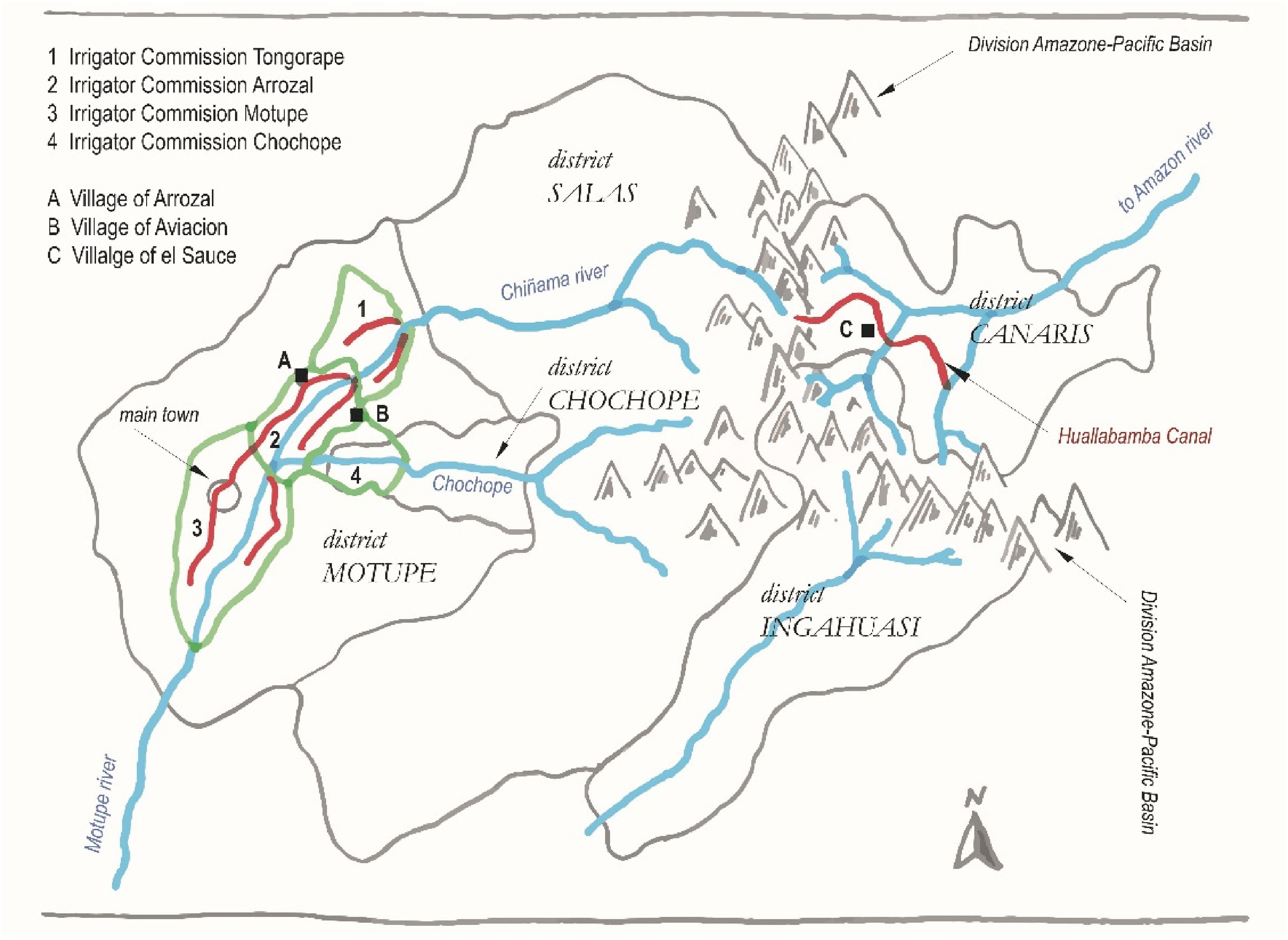
Motupe-Huallabamba irrigation system (drawing by the authors).
Elsewhere, we have described how this distributive system affects those most marginal to it. We did so by following the case of Cecilia, an excedente or water surplus irrigator on community land who, even though she has no water rights, was still able to vocally point to her water needs. Using the “cracks in the system” as well as the benevolence of the engineers allowed her to sustain her family by growing maize and mango. 23 Here, we will not reiterate this, but just note that allocating water is not a matter of straightforward managerial control (of water), but rather involves a great deal of responsive care (for families, neighbours and the plants they grow). That said, rather than going downstream to tertiary canals at field level, we now move upstream. In order to allocate water judiciously, the engineers of the WUA and the LWA would want to know how much water there is to allocate. But it isn't easy to figure out the quantities that arrive at the intake of the Motupe irrigation system. This is a real problem. Ingeniero Fernandez of the WUA explains, somewhat embarrassed, that they cannot make precise calculations due to the damaged state of the canal. Water is measured at the midway point of canal Huallabamba but: “the water loss after the measuring weir can be huge. More may be lost than passed on to the valley”. The measurement device in the valley, situated near a place called Marripon that is located above the main intake structure of the Motupe Irrigation System, is broken. Hence, measurements are done by eye, phoned in, and noted down in the notebook of the WUA secretary.
There are also difficulties in assessing the water volumes reaching the canal. Obviously, the engineers cannot control rainfall high up in the Andes, but neither can they predict this. The forecasts of SENAMHI, the National Weather Service and Hydrology of Peru, are too vague says ingeniero Fernandez: “There is one SENAMHI meteorological station in Cueva Blanca [a village in the Paramo, the catchment area], you know. But the information is not trustworthy because there are no personnel and the machines are not calibrated. The information we get is general: for the Northern mountains of Peru, the probability that it will rain on Monday, Tuesday, etc, is this or that. But rainfall can be so specific, it can be raining in Rumichaca and not in Totoras.” The engineers only get knowledge about rainfall from the vigilantes, the men who are employed by the WUA to monitor the canal. In this way the information flows in the wrong direction. The vigilantes, after all, are supposed to be on the receiving end and taking orders from the engineers. According to ingeniero Fernandez, the work of the vigilantes is most relevant during the rainy season, from December to March. “We have identified four to five critical points along the Huallabamba canal. They [the vigilantes] have to inspect these critical points, and then they report to us. Then we can make decisions here. In times of the rainy season we have to communicate daily, already at six in the morning we are calling. How much has it rained? Are there clouds? Do you think it is going to rain or not? How much water is going through the measuring weir? Depending on whether the water is too high or too low, we tell them [the vigilantes] to discharge the water into the gully below the canal, or to let it pass to Motupe.”
This, then, is the official story: the decisions are made by the engineers in the office. “After they report about rainfall, the vigilantes wait for instructions on what to do.” However, in practice this is not what happens. Engineer Fernandez admits as much in the very same conversation. The problem, he says, is that most of the time the engineers cannot phone the vigilantes; when the latter are working close to the canal there is no phone signal. To communicate, the vigilantes have to climb to the top of a nearby mountain. Hence, in practice, they are necessarily the ones to call to the office. Most days, they only get to this after their work, once they have done what urgently needed doing. They have closed some gates and opened others with an eye on protecting the infrastructure and assuring the water flow to Motupe. They may also have attended to the collapse of a canal bank or taken out a rock obstructing the flow. They try to fix problems when they encounter them. If the vigilantes were to wait for instructions, gates would be opened or closed far too late and problems would only exacerbate. Hence, whatever the official story, whatever the protocol, the engineers don't engage in ‘water control’. Instead, they ensure that the vigilantes are paid and entrust them with the triple task of reporting on the weather, adapting the canal's intake and, to the best of their abilities, keeping the water flowing. They care, the engineers do, by being modest rather than trying to unhelpfully impose orders. They care by letting go, by accepting the limited reach of the technologies that were meant to accord them with power and oversight. They care by bestowing trust on the vigilantes who are supposed to be their subordinates. 24
Walking the trail
Next to supervising local water use, Amancio and Emilio have to ensure that the canal doesn't overflow. As ingeniero Fernandez already told us, this is especially important in the rainy season. In times of heavy rainfall the water from the incoming streams, combined with overland flow along its course, may exceed the capacity of the canal. This is all the more pressing since, after the 2008 landslide, as we mentioned above, one part of the canal has been replaced with plastic tubes that carry only a fraction of what the canal was designed to do. When too much water comes in, Amancio and Emilio open the appropriate overflow-gates to divert water into a gully. Sometimes it rains in the headwaters of one stream and not in those of the other. The vigilantes know which stretches are in critical condition, which overflow-gates are operational and which others have been cemented shut as they were so dilapidated that they were losing water permanently. In times of need, they can reach Rumichaca (the Quechua word for stone bridge; the starting point of the canal) in little more than an hour and a half. Both the Tambillo and Totoras streams are tricky: they may turn into torrents that damage the intake structures and cannot be crossed. When this happens, Amancio and Emilio get trapped between the two streams and have to stay out overnight. However stormy the weather, they rest on the canal bank or sleep in nearby caves.
All year long, Amancio and Emilio walk the canal. This usually means that one of them walks upstream, and the other downstream – eleven kilometres out, before they each turn to walk back home again. As Amancio put it when we walked with him: “We walk the entire course of the canal. Especially when if it rains, it is a twenty-four-hour job. The entire day, the entire night.” Amancio takes a flashlight and a radio along. He walks on yankis, rubber sandals that people in the Andes make out of discarded car tires. He considers these to be more comfortable than the closed shoes that he puts on when he goes to the city. 25 It helps that he enjoys walking in the area, he tells. But the slopes are steep. And with the rains, the rocks get slippery and any misstep can be your last Added to this, the runoff and debris coming from uphill, if not quickly diverted, may flood the canal very fast Overflows risk destabilizing the canal's embankments. As fast water carries debris along, Amancio and Emilio have to regularly remove stones and rocks that might obstruct the water flow. Sometimes there are small landslides to clear away. If need be, the men descend into the canal, stand on its bottom, and remove accumulated obstructions with their bare hands. If rocks are too large, they use a pickaxe to break them into smaller pieces. Sometimes they have to ask other men from the village to give them a hand. Occasionally, they use dynamite to blow up rocks that are too hard to break with an axe. It is dangerous to work with dynamite, it requires watchfulness. But Amancio doesn't mind, he says, he is proud to be entrusted with the dynamite. And if he does not help the water to keep flowing, who else will?
Caring for the water of the Huallabamba canal involves a lot of hard physical work. It always has done. Amancio knows this from his parents. His father worked as a labourer in the construction of the canal, his mother brought food to the work parties. She did this again during later rehabilitation projects. During the construction, the supervisors hired musicians to play. The workers were led down the slope with a rope around their waste to chisel the canal out of the rock. “You were hung in mid-air,” Amancio laughs, “but with your music”. However, the hard work wasn't always fun. When walking the canal with Amancio, we stopped at a rundown wooden cross, erected in memory of a friend who, during the second canal-wide rehabilitation project, got hit by a small stone avalanche. The material needed for the repairs was quarried, using dynamite, from rocky slopes above the canal. This was easier than hauling rocks over many kilometres along the canal course, but riskier. Amancio witnessed the tragedy: “We told him to move away, yelled that there would be an explosion but José did not want to listen. He thought he was protected because he was using a helmet, the rocks killed him immediately. There he was, like one of those chickens before dying. No one dared to pick up the body. Later I came with one of my brothers and we carried him back to the encampment in a wheelbarrow.” Some years before this accident, Amancio lost his little sister to the canal. This happened during the rainy season, while his sister was collecting fodder in a field on the high bank of the canal, near El Sauce. “Suddenly, the water increased while she was dragging a bunch of pasture that fell into the canal and pulled her in.” Her body was found five kilometres downstream by people from the neighbouring village. She was wedged between the canal wall and a large rock that had fallen into the canal bed as a result of those same rains.
The canal takes lives. 26 And it affects people in other ways as well. Amancio tells that sometimes people lose their minds or suffer from seizures after they drink water directly from the canal, or after they enter nearby caves, or crawl into certain holes on the canal embankment. “One man, Valentin Locero, appeared from the gully and drank from the canal. He then crouched and never came up. He had an attack, an epilepsy, and he died. That mountain, at kilometre seven. It is known to be bad.” Amancio specifies the location of each mountain, cave and hole along the canal in metric terms. Even when talking about mysterious events. “At kilometer-thirteen-plus-650 there are a few holes. One man, Laureano Zapata, who had worked on and off on the canal for 45 years got into one of them”. These holes, to the best of our knowledge, are formed when seepage or underground run-off erodes the soil below the canal bed. We saw a few of them around kilometre 8: they had a small opening, just large enough for a human body to pass through, but after that there was a chamber at least 4 meters deep that widened as it went deeper – like the shape of a drop of water. Once inside this hole: “Laureano found something like a village, with streets and everything. He was scared and afraid of not being able to leave the place. At the very moment he managed to get out, water came gushing in. He lost his sanity. When we talked we had to yell into his ear… many shamans have come to see him. Nobody could help him.”
The Huallabamba canal has more than three dimensions. Cuidar el agua also includes relating to spirits. 27 Bad, like those of the mountain at kilometre seven, or good, as the case may be. At some point, Amancio points to a face-like shape in the canal wall. He approaches it carefully and with a warm smile points out its features: “Look, those are his two eyes, there is the nose and the mouth.” He gently wipes the stone face with a piece of cloth. “I always clean it,” he says, “He looks like he is trying to come out of the stone…he is our patrón … and he is watching you”. Patrón translates into English as ‘boss’. This word was formerly used for the hacienda owners – who would humiliate the workers, make them eat from dirty plates, rape girls or allow the workers in their hacienda to do so. But the face is not that kind of patrón, it rather resembles a village notable, who asks for respect and obedience, but who, in his turn, provides support and protection to those under his guard. With such a patrón one has a two-way relation: unequal but balanced. Hence, the face in the canal benevolently watches over those who care for the canal. And Amancio, while vigilant and respectful, is not afraid of walking the canal. The patrón is there to guard him and, what is more, he has been baptised: “Others in the village, they tell me I am crazy, or that I work with the devil. I think that the devil shakes when he sees me. I work here every day. I do my job. I have to take care of the canal!” Or, as he puts it in Spanish: Tengo que cuidarle!
The cuidar that Amancio and Emilio engage in is not of a motherly kind. Instead, it belongs to a masculine care tradition: it includes opening heavy gates, sleeping in caves, braving bad weather, handling rocks, using dynamite and scaring off the devil. The water flows that are being cared-for are not ‘dependents’, they are not made small in the process. Instead, they are to be respected. They are forceful, they take lives. But they also give life. This turns the cuidar at hand into a matter of reciprocity. At some point Amancio picks up a loose piece of concrete and crumbles it in his hand to indicate its decay. He says: “This canal gives so much and now look at it.” Diverting water to Motupe, the Huallabamba canal allows an entire valley full of farmers to grow food for their own tables and fruit for export. It even gives villagers from high up in the mountains jobs in the lowland in times of harvest Amancio walks the canal every day – doing his very best to allow the water to keep on flowing. He wonders what will happen after he stops, sooner, maybe later. Next year, he says, he turns 65. His concern is that the canal that gives so much, while needy, is not properly cared for.
Cuidar may be translated into English as care, and is similar in that both are unusual words to use in relation to hydraulic infrastructures such as Huallabamba canal. However, as Amancio talks about it, cuidar for Huallabamba is more than just managing and mending a hydraulic infrastructure that turns water into a resource. Amancio and Emilio offer practical care that the canal reciprocates, but beyond that, their cuidar involves an emotional attachment to the canal as a living companion. 28 While the engineers downstream mention vigilar and monitorear when they talk about the work of the vigilantes, Amancio's cuidar, like that of fellow Cañariacos, is a matter of what in Quechua is called uyway – a reciprocal nurturing. Uyway tends to be translated into Spanish as crianza. In line with that translation, researchers used to connect it to raising cattle. But people in the Andes use uyway more widely: in connection to persons, notably children, and in connection to seeds and other living beings, a category that includes water. It is a mutual relationship in which nurturing calls for being nurtured in return. 29 Overall, then, it might make sense to list cuidar as a kind of care here – an observant, respectful, watchful kind of care. But the words do not quite fit. The world that is called up when Amancio talks about his’ and Emilio's cuidar for the canal, is not so easy to translate into English. For this is a world in which canals, damaged or dangerous, are invariably needy. Mutuality rather than efficiency stands out as the ideal here. And in this world water is not a resource, but a lively creature, giving as well as taking. 30
Listen how the water speaks
Ingeniero Fernandez, the president of the Local WUA, told us about Silvano. Silvano, he said, listens to water, he can hear it speak. No, the engineer wasn't making fun of indigenous people and their superstitions. He actually hoped to have a chance to participate in next year's harvest ceremonies in Cañaris. A few years ago, he had been up there, invited by local community leaders, who had astutely contacted the water authorities on the coast as potential allies in their resistance to plans to expand mining. After all, mining high up in the mountains contaminates all water, not just that relevant to the communities living in the Cañaris, but also that of the Huallabamba canal. (Mining messes up things in other ways as well: the landslide of 2008 mentioned above was due to the construction of roads meant to allow for mining operations.) And yes, they had become allies. Ingeniero Fernandez had travelled to Cañaris to defend the case of the community against exploration for possible copper mining. His tone was still respectful. “Silvano says that he listens to water. I don't know how he does it, but there is something about the wind that announces rain; about different kinds of wind that tell him what the weather will be in the days to come. There is also something about the sounds of the waves hitting the edges of the lake, the whistle of winds through the grasses, streams falling on stones. Hearing all this, he seems to be able to predict things.” Having said that, ingeniero Fernandez prudently put himself at a distance from these abilities by turning them into a part of Silvano's ‘culture’: “Or at least that is the belief.”
We (here this is, once again, Carolina and Andres) spoke with Silvano when he was visiting his son, who works in an agro-export company processing mangos. After having said hello to us, Silvano started to talk in Quechua – knowing fully well we would not understand him. He spoke Quechua for fifteen minutes – making the point of our ignorance and the asymmetry between the languages of those who had lived longest in the land and the language of the invaders, the colonisers. 31 Then he came round and shifted to Spanish – remaining formal. Asked about the paramo, he named the three lakes in his area. Then he started to list the Quechua names of the plants growing there. These plants, he said, provide us with natural remedies, and they all have names, just like you have a name. When asked about the waters feeding the Huallabamba canal, Silvano used his body to explain their course (see Figure 2).
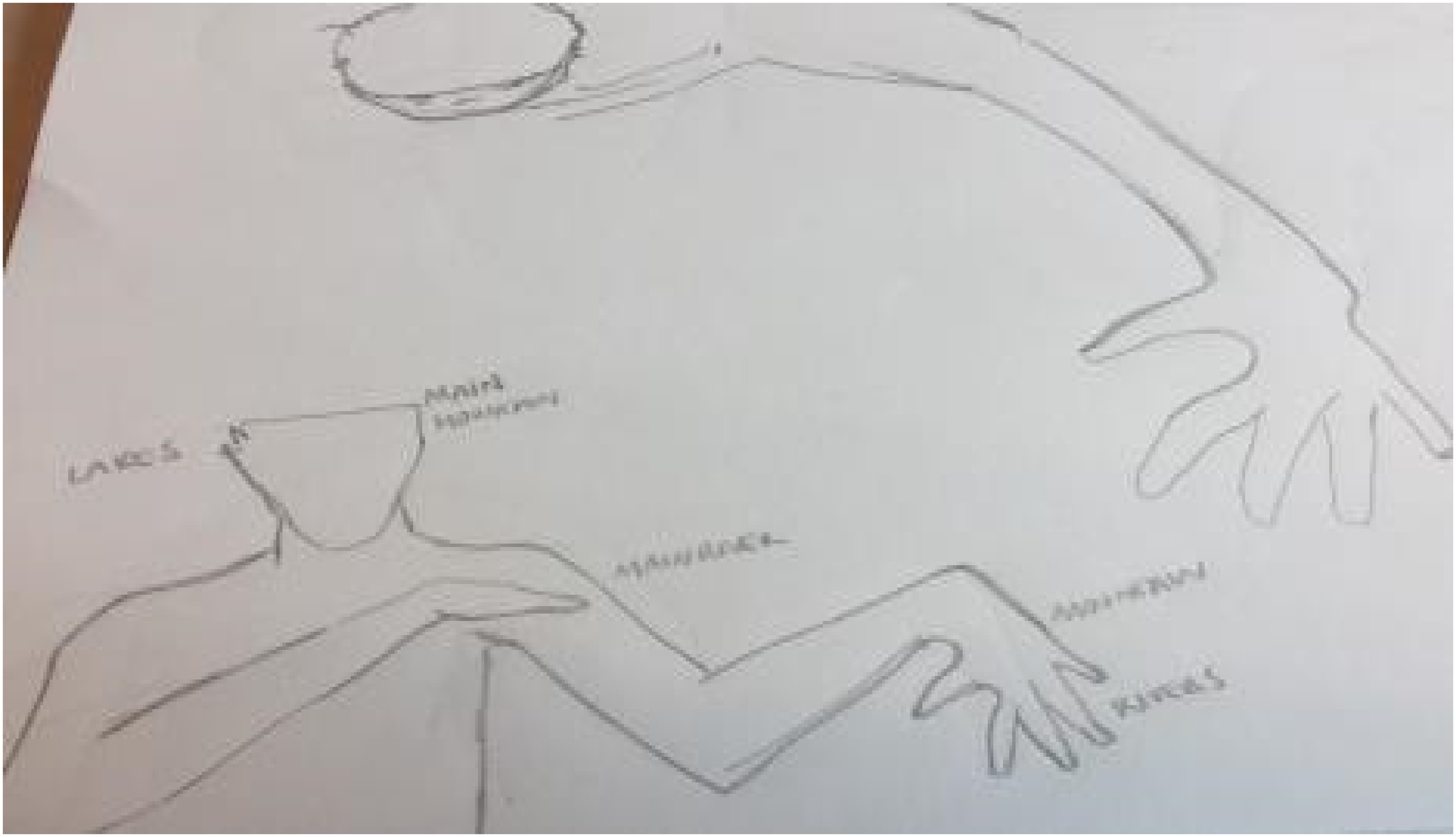
Signalling silvano (drawing by authors).
He started with his hand. “Up there, there are springs, from which little by little a small river is formed. These small rivers are united by mountains. Like this hand.” He raises his hand to make a mountain. His head stands for a bigger mountain, the mountain where he lives, Cueva Blanca. From there a river flows (his arm) and meets the other mountain (his hand) and new rivers are formed (he gestures below his torso). In this way, Silvano continues, three rivers are formed, Cueva Blanca, Totoras and Cerro Solautana. These are the rivers that feed canal Huallabamba. The water comes from above 4500 − 5000 meters, from these three lakes (again his head). All this water goes to the Huallabamba canal. And then Silvano adds: “The origin of these streams are the lakes, these are not made by humans, only God left us these lakes…this no-one can make.”
There is no ‘water control’ high up in the Andes: humans cannot make water. But if God provides the water we crave, humans still need to contribute. “When the river makes a sound,” Silvano says, “it says: cuídame (take care of me). When a river flows from above into a pond, and when you listen to this falling water, it says: cuídame. If you take care of me, I will give you life. If you take care of me, I will be here all your life. But if you do not take care of me, I will stop flowing. I will soon come to an end.” This, then, is what humans need to contribute: they need to give water care. 32 That is to say, once again we provisionally use the English word ‘care’ here, but the cuidar Silvano refers to does not quite fit with English notions of ‘care’. It takes the shape of community rituals, of festivities. People sing, play and dance for the water. 33 “We dance in a great circle,” Silvano explains. When asked what they sing, Silvano answers in Quechua. A friend later translated this into Spanish for us as De todo, de todo cuidemos al agua como a nuestra madre. Of which in English we might make: “Out of everything, everything, we care for water as for our mother.” As words uttered in one tongue are translated twice into another there are losses, things transform. Hence, we do not claim to faithfully represent Silvano's reality, there are equivocations all around. But if cuidar is not quite care, it certainly isn't control.
“The rains and the rivers,” Silvano says, “are not quiet, not silent. They cry and scream, like us, like human beings.” And then he starts to complain about the people from the plains. Literate people and politicians. “They trample the paramo and act as if they do not want to know it. They are deaf for what it says. Those who are supposed to know about the paramo are the most ignorant. The most unwilling to listen. But we, we who do not know how to write, how to read, we respect the paramo. Care for it.” Silvano insists that while he cannot read or write, he knows how to listen to water in lakes, among rocks, in the wind. Politicians cannot do this, they don't live up in the Andes. “They don't know reality. They are more interested in making money. But we are not going to eat money, right? We are farmers. We live from our maca, oca, maschka (Andean tubers) cebada, trigo (barley, wheat) quinua, tauri, chocho (Andean grains). This is our food, meant for our subsistence. What will happen when there is no water? Who will suffer most?” Without water nothing will grow. Silvano goes on to explain: “The lakes are mothers of the rivers. If a human being does not have parents, how he can be born? The lake is the mother of the river. The grasslands are its bed. The vegetation is its blanket, so that the river can sleep, right? There we go: if you don't have a blanket how can you sleep? It is as if you left me alone on my own, I wouldn't be able to live.” At this point Silvano shifts to Quechua again and starts singing.
After a while he adds in Spanish (here translated to English): “The sound that a river makes when speaking is ch’aq. You have to listen carefully. Not everyone can listen when the water is talking, you have to feel it here,” and he touches his chest “What can people on the coast listen to, eh? Water that is pumped around does not talk. Maybe people who come from somewhere else might learn to listen to the water, if they concentrated, but for us, it goes quickly. We sit down on a rock next to a stream and listen to how the water speaks. And the winds as well, all the winds of the mountains in the watersheds. Have you not heard how the grasses whistle? The wind announces when it is going to rain. It announces when it is going to rain or when it is not going to rain. When the wind is strong it starts dancing: tssttt tstttttt.” Silvano imitates the sounds of the wind on the paramo. The high areas where the water that irrigates the Motupe valley comes from. But if high up in the Andes caring for water includes listening, singing and dancing, it also includes activism. Spreading stones on the road so that the trucks of the mining companies cannot pass them. Gathering in meetings to vote against mining permits – even if the companies try to bribe voters; even if they offer jobs in a setting where jobs are extremely scarce. It involves contacting water authorities down in the valley who, although literate, might still be allies. 34 Ask them to come up and add their weight. As ingeniero Fernandez put it: “The mayor of Cañaris is a friend, he always invites me to his meetings, we have good relations”.
Conclusion
In irrigation studies the term ‘water control’ used to figure as a boundary concept that allows people from different backgrounds to talk to each other. More recently, the salience of this term has been questioned. The term ‘control’, after all, presupposes a world that allows for control. A world that, with the aid of appropriate technologies and proper management, may be tamed. But where to find such a world? To underscore that in practice things tend to be fragile and processes non-linear, various scholars have suggested that it makes more sense to set ‘control’ aside as a hubristic illusion and to talk, rather, of ‘care’. This would be more adaptive, include mending, be not just skilful but also affective. Building on that suggestion, we have here sought to take a further step. For the term ‘care’, in its turn, risks being turned into a catch-all concept, an analytical tool tasked as suitable everywhere. Hence, we here ventured to let go of ‘care’, or rather used the term loosely, as the heading for a heterogeneous list of versions of, or variants on ‘care’. For the efforts that we encountered in our ethnographic inquiries along the Huallabamba canal, took seriously diverse and interestingly specific shapes. We wanted to attune ourselves – and you, reader – to these specificities and learn from them. We hoped to contribute to an academic style in which local realities are not covered up by globally travelling terms, but are allowed, instead, to inspire new ways of thinking. 35
The list of care-s that ensued started with the demanding work done to build the canal and fit it in the Andean landscape. This work involved a lot of adaptable tinkering: with the variable intake, with differences in height to negotiate, with the effects of disasters due to dynamite, weather or road construction. Where large concrete structures crumbled, patching these up remedied the problems – but never fully, only so far. The care of the engineers working in the office of the WUA, was different. While it was their task to regulate water flows, they had come to trust the vigilantes who were officially their subordinates. They did not just trust them with practical tasks, but also with making decisions. Their care, then, took the form of supporting the vigilantes while letting go of control. For the viligantes in their turn, as they worked on the steep and slippery borders of the canal, care involved hours and hours of hard physical work. They had to watch out and guard themselves against dangers like falling rocks and currents that sweep people away. But their watchful cuidar reached further. Their world was not just damaged and dangerous, it also contained spirits – some benevolent, others not. They had to be vigilant, as the devil himself might be out to take away their sanity. In the paramo, finally, there is wisdom in listening to water – to how it speaks. Here, care is widened to involve singing and dancing. And, crucially, it requires countering short-sighted politicians, who are only interested in money. This care is long term, respectful of the all too easily ‘forgotten’ fact that all life depends on water, not just today and tomorrow, but for ever.
These variants of care cannot be reduced to one another, they move in different directions. They engage with different materials, or immaterials. They have different time frames, payment schemes, return gifts. Different hopes are invested in them. Ingeniero Fernandez cannot listen to water. Silvano needs allies in fighting mining companies. Amancio and Emilio live with layered memories tied to every spot along the canal. The original designers of the canal are long since dead, and yet, so far, water still moves downstream to irrigate agricultural fields. The specificities of all these variants of care deserve to be recognised on their own terms, because if they are not attended to, cherished, differentiated, there is a risk that they will disappear. There is no need to add them up into a generalizable model. Why should scholarly work take the shape of forceful attempts to make terms strong and stable enough to travel everywhere? We do not seek to make school with a catch-all term. What would be grand, instead, is if our stories were to help widen the conceptual and the political space to shape human-canal relations more attentively, better attuned to local specificities, more caringly. What would be grand is if you were inspired and emboldened by them to attend to the specificities of the sites and situations relevant to your research.
Footnotes
Acknowledgements
We are grateful to the Eating Bodies team at Amsterdam University for their comments and support and to John Law for encouragements and edits. Furthermore, we thank friends and collaborators in Motupe, for their cooperation and contribution to our work.
Author's note
Andres Verzijl, IHE-Delft, the Netherlands.
Declaration of conflicting interests
The author(s) declared no potential conflicts of interest with respect to the research, authorship, and/or publication of this article.
Funding
The author(s) disclosed receipt of the following financial support for the research, authorship, and/or publication of this article: this works was supported by the European Research Council [AdG09 Nr. 249397] and the Dutch Research Council [W01.65.338.00].