




Abstract
This article examines how social and economic structures of historic plantation development manage to persist over time and to rearticulate over space. In the early 1900s, the historic plantation sugar economy in St Bernard Parish, Louisiana, suddenly collapsed. Despite efforts by local elites to seize this moment to finally launch a diversified industrial development path, the parish nevertheless sank again into a new cycle of plantation domination and dependency. The dominating sugar sector was broken up only to be rapidly replaced by a vast new monopoly—in, of all things, systematized fur production—whose land tenure and labor regime nearly replicated that of the earlier plantation estates. I examine this folding-over-anew of the plantation, from sugar to fur, in two ways that contribute to recent growing literature on persistent plantation geographies. First, I draw upon theories of Caribbean underdevelopment to identify three persistent conditions of plantation economy. Upon the collapse of sugar in St Bernard, the conditions of estate-based land monopoly, racialized extra-economic labor coercion, and external market/primary commodity dependency constrained the possibility of structural transformation and rearticulated in a new commodity regime based in fur. Second, I turn to consider the experience of workers bound up in the new fur economy who were not, in the main, the debt-bound black workers from the old sugar plantations but a racially and spatially marginal group known as isleños. I draw on a unique set wry folk ballads that isleños maintained as part of local oral tradition to examine the voices of trappers themselves as they negotiated the rearticulating structures of the neo-plantation regime. Thinking with McKittrick's concept of plantation “spaces of encounter,” I find these neo-estate workers forged fraught spaces of discursive and material autonomy that at times resisted, and at times reproduced, the ongoing plantation regime.
By the first decade of the 1900s, the Louisiana sugar economy was in decline. Aging soils and rampant cane disease undermined production in the plantation regime that had dominated practically everyone and everything in the state's southern parishes for over a century. Abroad, meanwhile, expanding U.S. empire incorporated new lower-cost sugar dependencies that made competition practically impossible (Sitterson, 1953: 343–360). For the most part though, Louisiana planters, who frequently conflated the lordly patrician vision they held of themselves with the continued possession of their estates, stubbornly hobbled on. In St Bernard Parish, however, sugar did not decline—it collapsed. And the plantations were not defended but broken up. Unlike much of the sugar belt, St Bernard had been dominated by a single distantly-located conglomerate of British investors which held monopoly control of the railroads, cane mills, and all but the smallest plantation estates. Far less sentimental to patrician imaginaries, the conglomerate sold off its lands, dismantled its mills, and quit the region altogether. Local elites who sought to establish industry cheered the sale that, to them, portended the ouster of monopoly and the end of stagnation. Land developers moved in to break up the estates for small market vegetable and citrus farms while others were lured in by the State's recent decision to sell off millions of acres of coastal marshlands, the planned conversion of which promised still more vast expansions of rice and vegetable farming. Pointing to these developments alongside new canning and fertilizer plants, the newspapers predicted the parish would soon be “a leader among the industrial centers of the state” (Daily Picayune, 1 September 1911). Rather than stagnating plantation backwardness, the possibility of an alternative development path seemed finally within reach for St Bernard.
Less than a decade later, however, this optimism had faded and a stark contradiction remained. The markers of the historic plantation economy had been removed—the vast estates broken up and sold off to small farmers, the foreign monopoly investors decamped to other territories, and not a single acre remained sown in sugarcane. And yet, the parish nevertheless sank again into a new cycle of plantation domination and dependency. The dominating sugar sector was broken up only to be rapidly replaced by a vast new monopoly—in, of all things, systematized fur production—whose land tenure and labor regime nearly replicated that of the earlier plantation estates, albeit neatly transposed. Muskrat fur stood in for sugar as the new plantation commodity while the recently-sold outer marshlands, organized into vast “ranches,” replaced the former riverfront estates. And a new racialized trapping labor force, working on shares and debt-bound to the landowners, replaced the former cane harvesters debt-bound to the plantation commissaries. The social and economic structures of the plantation had rearticulated in St Bernard—embracing new spaces, new populations, and new labor and commodity regimes.
Geographers have recently traced the persistence of plantation structures in the present following Katherine McKittrick's (2013: 4) initial conceptual insight: that the plantation is a logic, one which “folds over to repeat itself anew” in new spaces, institutions, and territories. In these sites, the logic of the plantation continues to operate, “normalizing the uneven production of space” and covering over “contemporary sites of uninhability” (McKittrick, 2013: 9). In empirical work, geographers have traced the folding-over-anew of plantation logics in the contemporary policies and practices of the United States Department of Agriculture which maintain the monopolization of land in white hands; in the lasting imperatives of Mississippi planters to value their industrialized cotton crop over and above human lives through pesticide use; and in the re-articulation of earlier 19th-century agrarian epistemologies as “plantation empirics” by 20th-century agro-industrialists (Van Sant, 2016; Williams, 2017, 2018). McKittrick (2011) herself examines both the trans-location and the extension of plantation logics in her reading of Gilmore's (2007) Golden Gulag: first, in the movement of the cotton industry out of the South and into the California central valley and, second, in the rise of the prison industrial complex that followed. Bledsoe (2017, 2018) draws upon theories of Afro-pessimism to extend McKittrick's framework still further, arguing that slavery too operates as a persistent logic of colonial domination, and, by consequence, marronage acts of resistance and survival necessarily remain persistent practices among black communities.
In this article, I examine the folding-over-anew of the plantation in St Bernard in two ways that contribute to this growing literature. First, drawing upon theories of Caribbean underdevelopment, I examine the conditions of plantation economy which remain persistently embedded in local economies and reproduce plantation economic structures. In St Bernard, I identify three conditions of the historic plantation economy that, upon the collapse of sugar, constrained the possibility of structural transformation. These conditions swiftly undermined the path toward agricultural diversification and domestic industrialization that local elites imagined only to then rearticulate in a neo-plantation regime based in fur. Second, I turn to consider the experience of workers bound up in the new fur economy who were not, in the main, the debt-bound black workers from the old sugar plantations but a marginal group of Spanish-speaking descendants of Canary Islanders known as isleños. I draw on a unique set wry folk ballads that isleños maintained as part of local oral tradition to examine the voices of trappers themselves as they negotiated the rearticulating structures of the neo-plantation regime. Thinking with McKittrick's concept of the plantation grounding ongoing “spaces of encounter,” I find that workers forged fraught spaces of discursive and material autonomy within the ongoing plantation regime even while these spaces at times also served to reproduce the regime itself. Examining the experience of these neo-plantation workers is an attempt to contend with what McKittrick calls our “collective history of encounter.” Attending to both the embedded structures of plantation economy and the fraught spaces of encounter together, I conclude, points toward paths for not only surviving within the ongoing plantation regime but also dismantling it.
The persistence of plantation economy
To insist upon the persistence of the plantation in the present appears, on its face, to commit a serious error of analysis. It seems to present the plantation as a crude transhistoricism, a certainty always and forever enduring without the possibility of change or end. The plantation, McKittrick (2013: 9) writes, appears as somehow both “a ‘backward’ institution that we have left behind” yet also one that “moves through time, a cloaked anachronism, that calls for the prison, the city, and so forth,” suggesting that “the sociospatial workings of antiblack violence wholly define black history.” But in fact, holding these contradictions in tension, McKittrick reveals, allows seeing the plantation as a source of dynamism. By casting it as “the penultimate site of black dispossession, antiblack violence, and racial encounter,” the plantation is also the site of “innovative resistance,” one from which to articulate a “black sense of place” and to imagine alternative “plantation futures” (McKittrick, 2013: 8). Where McKittrick poses the persistence of the plantation in order to call forth the dynamism of Black Geographies, here I turn my attention to the dynamism of the plantation itself. How is it that the plantation, as a socioeconomic regime, persists?
For Clyde Woods and Bobby Wilson, the plantation's structures persist as part of cycles of capitalist development. In the Mississippi Delta, Woods (1998) describes a distinct plantation development tradition, a pattern in which a regional ruling bloc of planter elites faces repeated bouts of crisis, launched by the resistance of oppressed black and poor white peoples in fortuitous conjunction with economic crisis, against which planter elites then mobilize to establish a new regime of accumulation and an effective social explanation to stabilize it. It is this cycle—between the hegemonic “plantation” and counter-hegemonic “blues” development traditions—that gives shape to the region's development path. Wilson (2000), meanwhile, examines how “race-connected practices” in Alabama, first put into place by plantation slavery, restructured alongside subsequent capital restructuring. Between the late 19th century and the early 20th century, this restructuring was principally defined in Birmingham by the efforts of local capitalists to maintain an extensive regime of accumulation while adapting to a new competitive mode of social regulation as the region industrialized. In the process, race-connected practices transformed from severe domination that, in sharecropping and convict leasing, imitated chattel slavery to a wage labor system marked by strict racial and spatial segmentation. For Wilson, it is this cyclical transformation, between regimes of accumulation and modes of regulation, that reconfigures race-connected practices and the possibilities for black political action (Wilson, 2002). Both Woods and Wilson arrive at a cyclical model of plantation persistence by beginning (quite reasonably) with the assumption of continuity between present and past.
For another set of theorists, however, in a different plantation context, the starting point is the expectation of radical disjuncture. Development economists Lloyd Best and George Beckford each observed that, in the postcolonial Caribbean, plantation structures seemed to persist not so much for lack of sufficient transformation, but despite significant transformation. The structural conditions of the historic plantation economy persisted in the Caribbean not just despite emancipation but despite decolonization, nationalization of the plantation sector, and even, in the case of Cuba, the complete severing of imperial ties. For Beckford, the persistence of plantation economy is a dynamic process of underdevelopment. Structural conditions established as part of the economy's initial colonial development stubbornly remain in its organization, not just inhibiting but actively holding down development. 1 These persistently embedded conditions, or, as Best (1968) calls them, “the rules of the game,” work to reproduce dependency and maintain external economic control. They persist insofar as, in moments of crisis or rupture in the plantation economy, they constrain the possibility of economic transformation (Best and Levitt, 2009: 25–27). These crisis moments, including such radical disjunctures as emancipation and decolonization, come at specific moments in the boom/bust cycle of staple economies (Best and Levitt, 2009: 20–22). Perhaps most remarkably, plantation economic conditions persist even despite collapse in the traditional plantation staple, usually by articulating in a new replacement staple. Despite beginning with disjuncture, these theorists nevertheless arrive also at a cyclical model of plantation persistence—based on a staple cycle rather than a Marxian formulation of capitalist crisis. The distinction, however, is to place the emphasis on the dynamism of plantation economic structures. While it comes at the expense of overlooking the dynamism of black political action revealed by Woods and Wilson, revisiting this work—on which, in part, McKittrick (2013: 3) builds herself—nevertheless comes with the benefit of isolating the specific tendencies that motor enduring plantation economies.
Like the postcolonial Caribbean, the collapse of sugar in St Bernard appeared, at least at the time, also to be a moment of radical disjuncture and, at least for some, a moment of possibility for economic transformation. In this section, I highlight three persistent conditions of plantation economy in Best and Levitt's model to draw out the intractability and insidious malleability of plantation economic structures in St Bernard and the south Louisiana sugar belt more generally. These conditions are general in character to most staple economies, but they are given particular form by the managing institutions of the plantation economy (Best, 1968: 287). They include: (1) resource monopoly, specifically the monopolization of land in large estates; (2) an extra-economically coercive labor regime, namely one rooted in racialized chattel slavery, encomienda, or indenture and enduringly typified by combinations of racialized violence and debt peonage; (3) dependence, on export-oriented staple commodities (typically just one) and on extra-regional markets (again, typically just one) both for venture capital and for the disposal of the staple with the result that practically all land and all capital is dedicated to the staple. In St Bernard, these three conditions of historic plantation economy constrained the possibility of a post-plantation future. In the moment of sugar's collapse, they constrained the possibility of severing or diversifying from dependency on external markets, of breaking up land monopolies, or of developing functioning labor markets. Instead, they militated toward the establishment of a new export staple, in fur, and a new cycle of (under)development under the same legacy conditions.
Decline and transformation
In its first decades, sugar's decline in Louisiana resulted in widespread abandonment of the sugar belt, rather than transformation. Disinclined to diversify or to sell their lands piecemeal, planters stubbornly preferred to hold their estates intact even at the cost of laying fallow (Sitterson, 1953: 358–359). Black former estate workers moved rapidly to the cities. The less numerous, and predominantly white, small farmers who owned parcels on the estates' margins typically remained and diversified their crops (Saville and Dugas, 1936, Smith, 1938). While St Bernard's population (Table 1) held steady between 1900 and 1920 (–1%), the black population declined by more than a quarter (–27%). In the lower districts of the parish (Wards 4–7), where the plantations had been most concentrated, the overall population plummeted (–43%). Unlike most of the sugar belt, here the plantations had indeed been sold off, and thus the average farm size dropped from 208 to 68 acres (Table 2), more steeply than in any other sugar parish.
Population change: St Bernard vs. All primary sugar parishes in Louisiana.
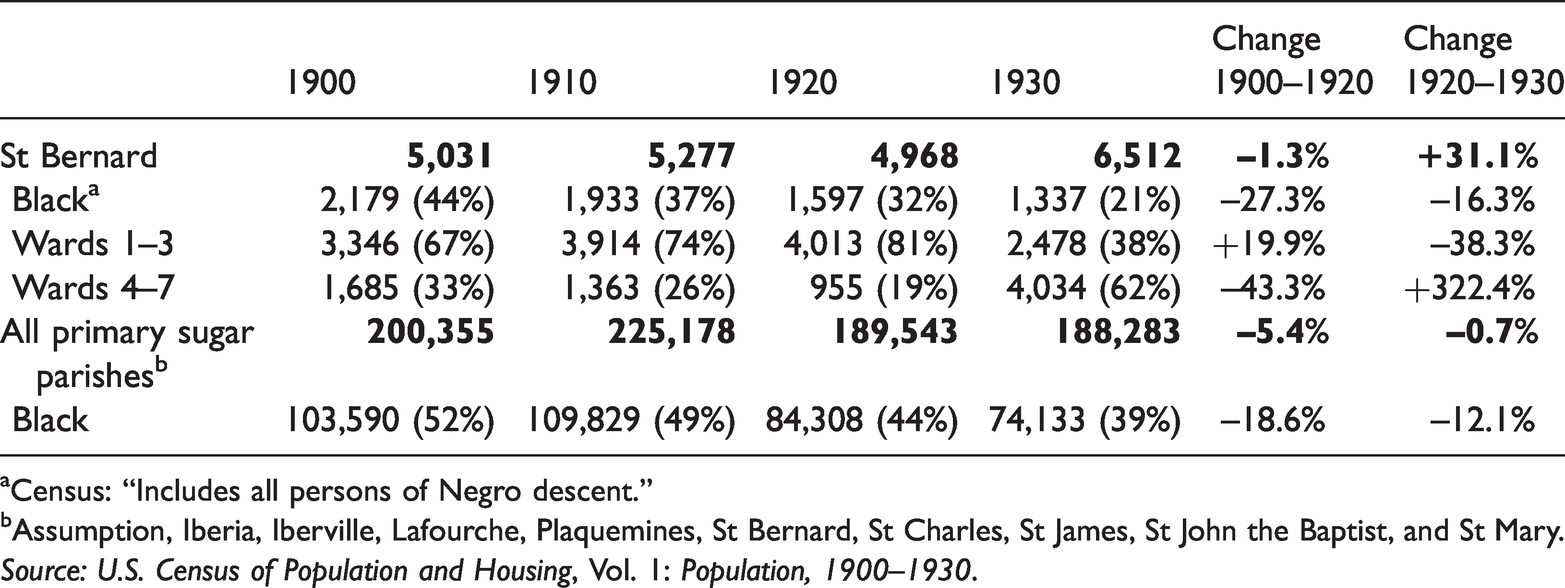
Census: “Includes all persons of Negro descent.”
Assumption, Iberia, Iberville, Lafourche, Plaquemines, St Bernard, St Charles, St James, St John the Baptist, and St Mary.
Source: U.S. Census of Population and Housing, Vol. 1: Population, 1900–1930.
Change in farms, farmers, and farmland: St. Bernard vs. All primary sugar parishes.
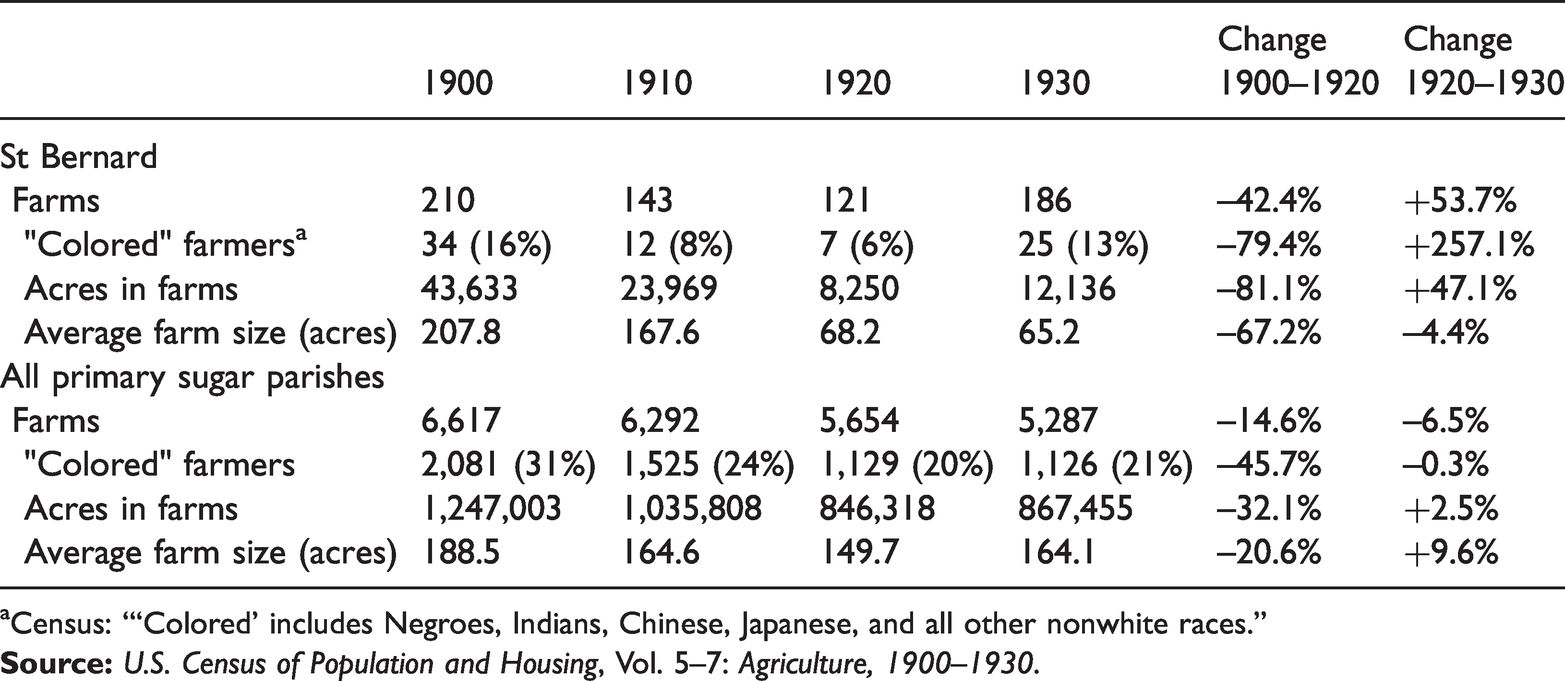
Census: “‘Colored’ includes Negroes, Indians, Chinese, Japanese, and all other nonwhite races.”
The depth of this nadir in the sugar sector, however, was a well of possibility for economic transformation overall. The breaking up of the former plantations promised a radical restructuring of the lower parish around domestically-marketed truck produce and comparatively high value citrus, expanded independent small farming, and the proliferation of industrial facilities in tandem (packing and shipping, canning, derivative production lines, etc.). The far greater boon to such a transformation, however, was the organization of five vast marshland reclamation projects in the parish during this same 1900–1920 period. Each project encompassed more than 10,000 acres of would-be rich polder land out of the uncultivable marsh, well surpassing the earlier plantations in extent (Figure 1). The promise then, of St Bernard after sugar, was not only a radically reorganized but also a massively expanded agricultural economy.
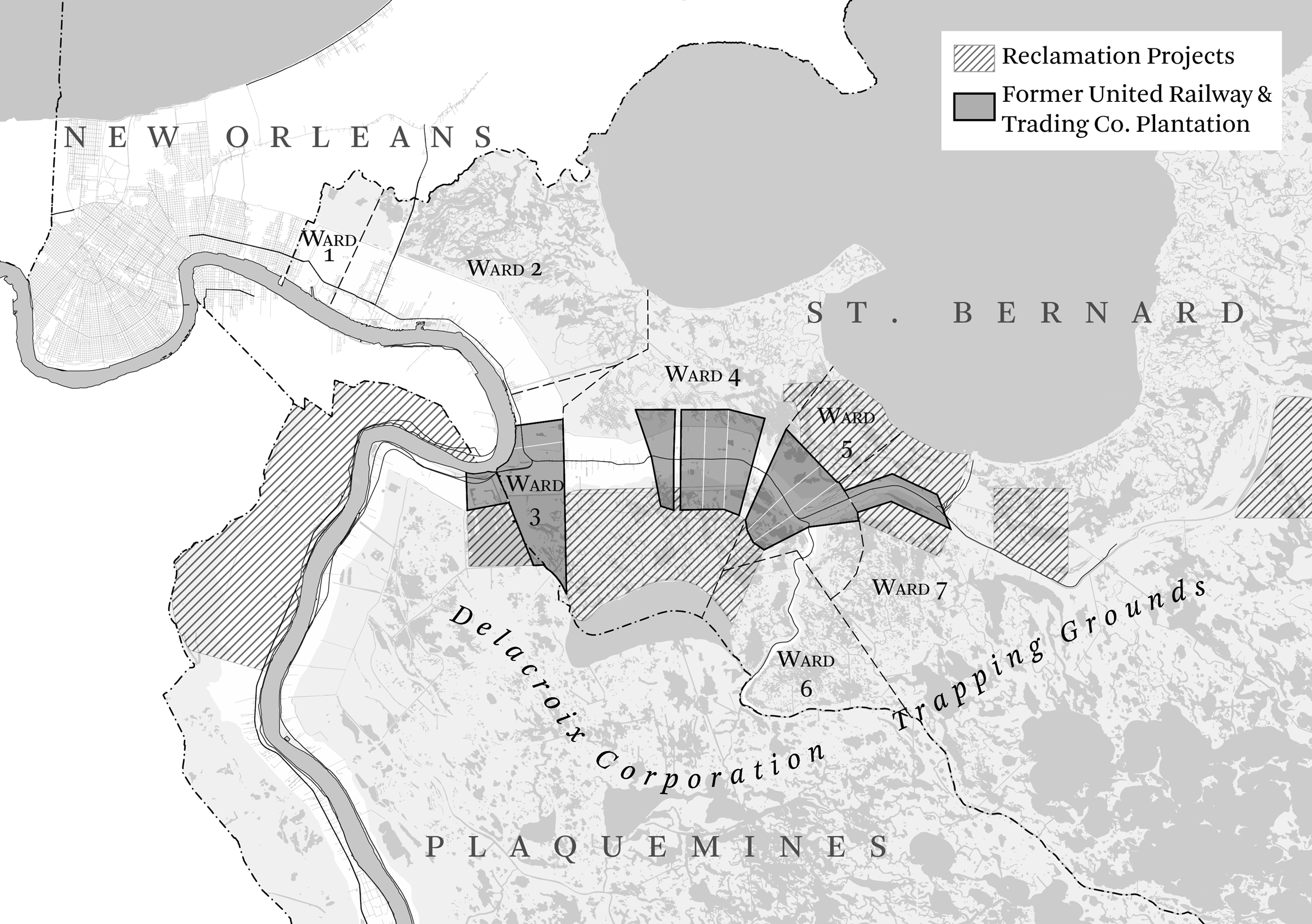
Major land developments in St Bernard, 1910s–1930s.
Though some transformation occurred in the following decade, away from monopoly and staple dependence and toward small-scale domestic production, its scale fell far short of the promise. By 1930 (Table 2), the parish had rebounded both in the number of farms, from 121 to 186 (+54%), and in total farm acreage, from 8,250 to 12,136 (+47%). In both instances, this was in sharp distinction to the continuing stagnation in the sugar belt overall. Average farm size too continued to fall (68.2 to 65.2 acres) while in the sugar parishes overall the trend toward smaller farms reversed itself (growing from 149.7 to 164.1 acres). Although never numerous in St Bernard, the modest number of independent “colored” farmers nevertheless increased, from 7 to 25. Though each of these metrics still lingered below their level of 30 years prior, on the eve of sugar's decline, they nevertheless exemplified significant transformation. The 1930 agricultural census, notably, registered no acres planted in sugarcane, cotton, or rice at all, while continuing to list thousands in market vegetables. Large-scale, monocultural, export-oriented plantation agriculture was effectively dismantled; in its place, a diversified, small-producer alternative had been at least modestly established. But what of the massive expansion promised by marshland reclamation?
Reclamation and the failure of expansion
By the 20th century, reclamation was well-trod engineering practice in the backwaters of inland river valleys and had long been supported by the U.S. Department of Agriculture (Harrison, 1961; Teele, 1924; Wright, 1907). The reclamation of coastal wetlands into polders, however—into dike-protected blocks lying often below sea-level—was largely unprecedented in the United States. Moreover, the challenges presented by Louisiana's low-lying marsh coast were complicated, expensive, and risky. Highly organic soils were prone to subsidence. Drainage necessarily relied on expensive pump (rather than gravity-fed) systems. And regular hurricanes threatened saltwater inundation (Colten, 2017; Harrison and Kollmorgen, 1947a, 1947b). These challenges, though, could usually be mitigated through technical or organizational adjustments. The successful New Orleans Lake Shore Land Co. reclamation project, for example, incorporated enlarged storage basins, more detailed soil surveys, and specified higher-value crops in combination with higher-value land uses like suburban and resort residences to offset these costs (Okey, 1918: 26–30). The state's difficult landscape made reclamation difficult, but not impossible. More difficult were the challenges that stemmed from the lingering structures of Louisiana's historic plantation development. Ultimately, it was these structures that undermined reclamation in St Bernard.
Given similar material constraints, the development of polder lands shared certain economic imperatives with that of the earlier plantations. Both required large tracts of land to offset the high costs of their supporting infrastructures. Costly steam engines, whether driving a sugar mill or a drainage pump, demanded vast acreages and high returns to retire these fixed costs. But the means of meeting the fixed costs of a sugar mill were constrained by the peculiarities of a single crop. Pump-drained polder lands permitted an array of crops, provided they could obtain high market value. Sugar also required large seasonal labor gangs during the harvest that often went unemployed the remainder of the year. Polder lands, meanwhile, were free to use small farming and diversified crops that better spread labor over the year. In practice, reclamation projects typically planned small truck, citrus, and rice farms (Harrison and Kollmorgen, 1947a; Okey 1914, 1918). Thus, despite a similar form and technical constraints, pump-drained polder lands allowed a degree of independence from plantation dictates.
And yet, polder reclamation did not escape the imperatives of capital under plantation economy nor of its captured state institutions. As the State sold off wetlands for reclamation projects in the 1890s–1910s, it did so with little planning or oversight. Instead of coordinating project location or subsidizing drainage infrastructure to public benefit, the highly tax-averse state (reflecting planter interests) chose to sell off marshlands with no restrictions as to tract size or feasibility, nor even to maximize return to the state by selling lands at auction. Rather than a development project, land sales were, for the ultra-conservative state, a revenue replacement scheme in lieu of taxes. Typical buyers of marshlands were, like the British backers of the earlier sugar plantations, large speculative investors from outside the region who showed little interest in the long-term success of reclamation. Even before completing construction of basic infrastructure, they looked to transfer the cost, risk, and oversight of the project onto the unwitting small farmers who purchased the drained lands through a convoluted tax and finance scheme. At the behest of developers, local governments set up taxing districts on the planned polder lands. Taxes collected in these districts were high as revenues were used not only to maintain drainage infrastructure but also to pay off bonds issued to cover the costs of initial construction. Crucially, these bonds were typically purchased by the reclamation developers themselves. As a result, once lands were sold—even if drainage infrastructure was not yet completed—responsibility for payment on the bonds fell to the small farmers (Harrison and Kollmorgen, 1947a: 686–690). What began as a local development project became, like the earlier plantations, a capital extraction project.
This arrangement also led to fateful contradictions as it intersected with the persistent stigma of the plantation system. Recruitment of prospective farmers who might settle on the polder lands (and thereby retire the bonds and underwrite the costs of drainage) was severely limited by local partners of the reclamation investors. These partners conceived of small farming as a fundamentally white pursuit, and settler recruitment as a means of whitening the state. In promotional literature and on the ground, recruiters explicitly sought out Anglo-Saxon and German settlers from the Midwest (Harrison and Kollmorgen, 1947a: 704–705). The thousands of long-resident, black prospective farmers, so many of whom had recently departed from the sugar plantations, were beyond consideration. More capacious still, this disqualification extended also to the many marginal populations on the coastal fringes who, in the peculiar labor arrangements of plantation sugar in Louisiana, had historically worked alongside black estate workers to service the plantations' seasonal labor needs. These included Indigenous Chitimacha and Houma, mixed-race Creoles, and, in St Bernard, isleños—Spanish-speaking descendants of Canary Islanders (Guillotte, 1982: 25–26; Speck, 1976: 5). Their marginal existence and historic association with the plantation rendered these groups racially suspect—as one contemporaneous journalistic account judged, the St Bernard isleños were “a strange mixed race with Spanish dominant” (T-P, 10 November 1915)—and, to developers, fundamentally unfit for settlement (Harrison and Kollmorgen, 1946, 1947a: 704–705). As a result practically all of St Bernard's existing farming population was disqualified.
The compounding contradictions of heavy debt burdens and hindered settler recruitment rapidly undermined reclamation projects like the Terre-aux-Boeufs Drainage Sub-District 1A, an area encompassing the 85,000 acres of the Phillips Land Company. In 1917, the sheriff of St Bernard threatened to seize the lands for nonpayment of drainage district taxes. Only 3% of the district had yet been reclaimed by the company and sold to farmers. As a result, the bulk of the tax burden in the district continued to fall on the development company. The company, filing suit against the sheriff, refused payment reasoning it was the beneficiary of bond payments, not the payer (T-P, 17 July 1917).
Such contradictions were but symptoms of more deeply problematic issues wrought by the persistent conditions of plantation economy. Miserly governance by a state withered under historic planter rule ensured that reclamation relied upon external investment, not just for capital but for (inevitably ill-considered) planning as well. And, despite the breakup of one land monopoly, in the former sugar plantations, another even larger land monopoly was extended over the marsh by speculators and ill-fated developers. Finally, functioning markets in labor and property were handicapped by the racial exclusion of prospective small farmers, undermining the already flawed financing structure of reclamation projects. Though projects faced real technical and financial challenges, it was the contradictions which stemmed from a confluence of persistent plantation conditions that were ultimately fatal to reclamation and diversified development in St Bernard.
A new plantation staple
If, on the one hand, historic plantation conditions undermined the development of new infrastructure projects and forestalled alternative paths to diversified agricultural development, on the other, these failings gave room, and incentive, for those very same conditions to reanimate in a new, replacement staple.
After a decade of trying, the Phillips Company, like most reclamation developers, never managed to drain and settle more than a very small portion of its lands. The vast remainder of its marshland holdings, however, had by no means lain idle. The marsh hummed with the informal subsistence and market activity of hunters, trappers, fishers, and moss gatherers. As seasonal work dried up on the declining sugar estates, marginal plantation laborers—especially those who, like the isleños, were plantation-dependent but not plantation-bound—pushed farther into the marsh. As they did so, they not only incorporated a range of seasonal subsistence practices but also developed the conditions of a substantive alternative economy to that of the plantations. Pushing into the marsh, the former cane-grinders burned the wetland prairies, leading to the proliferation of lower-order grass species—the preferred food source of muskrats. The marsh soon teemed with fur-bearing rodents with some densities ranging as high as 50 per acre and trappers claiming daily captures in the hundreds during the winter season (O’Neil, 1949: 45–83). The foundations of this alternative economy developed further as growing demand from northern markets for the comparatively inexpensive fur drove average pelt prices from 8 cents in 1915 to $1.25 in 1928 (Arthur, 1928: 410). This successful effort to establish an alternative economic life-world outside the plantation met significant challenge; however, when elements of that seemingly-faded economic structure reasserted themselves to ensure that fur would serve instead as a veritable staple crop to a renewed plantation regime.
After repeated bouts over delinquent tax payments, local political elites persuaded the Phillips Company into an informal arrangement. The former would “keep the taxes paid up” in exchange for a long-term lease on the company's undeveloped marshlands (T-P, 11 April 1926). What followed on the Phillips lands, and on at least one million acres across the coast, was the organization of fur production in the model of the plantation. Using their political and police power—key participants in the scheme included the parish judge, sheriff, and district attorney—the local partners enclosed the marsh through a combination of legal injunctions and violent enforcement by private guards, allied sheriffs' deputies, and conservation officers. The “fur ranching” company that lessees soon formalized, known eventually as the Delacroix Corporation, divided the vast estate among contracted trappers who resided in company camps and worked tracts of approximately 100 acres on shares. Often assigning daily quotas, the company fined trappers for each day they were unable to work. The company held exclusive right to all pelts trapped and to determine when and at what price they would be sold. Trappers, typically, were entitled to only 30%–50% of the sale to the company, at a price that was inevitably lower than that of the open market. In addition, the right to trap was often contingent on the payment of a lease or “association” fee due at the season's opening. Like sharecroppers in cotton, cash-poor trappers frequently resorted to loans to enter the trapping grounds. Once there, trappers were effectively bound by the debt for the season and, in the event of a poor crop or low price, to the next season. 2
The neo-plantation venture of the Delacroix Corporation far surpassed that of earlier sugar plantations. Not only did it comprise a territory many times vaster than all of the earlier plantations combined, the value of its “crop” surpassed that of the earlier regime as well. In the banner years of 1926 and 1927, the total value of pelts harvested on the Delacroix Corporation's lands amounted to $1.5 million and $2.9 million, respectively. And even after a devastating flood wiped out much of the breeding stock, the company continued to average more than $400,000 in annual revenues (O’Neil, 1949: 68). By comparison, in 1900 and 1910, all sugar products for the entire parish had yielded $114,502 and $94,175, respectively (Bureau of the Census, 1902, 1913).
The reclamation-turned-“rat ranch” venture brought together again the elements of plantation economy in St Bernard by (a) leveraging extra-regional investment, on which the region was dependent, to (b) secure a vast new land monopoly and, in turn, to (c) compel labor gangs to work a new primary export staple under a racialized system of extra-economic coercion. Notably, it was not the outside investors who sought to re-assert the plantation system, nor even to establish a plantation-style export-oriented monoculture. It was only after the proposed venture in diversified small-scale agriculture was undermined by the persistent conditions of plantation social and political organization that the components of a plantation system were re-established by local agents of that persistent regime. It was not so much, then, that plantation organization was re-imposed on St Bernard but that the conditions of the historic plantation economy remained embedded, and with the emergence of a new staple they were redeveloped and expanded.
Resistance and the ongoing spaces of plantation encounter
Marshdwellers in St Bernard intensely resented the enclosure of the wetlands and the impositions of a renewed plantation regime. Most notably, that resentment boiled over in 1926 when a mass armed uprising by isleños successfully drove out the fur ranch bosses (Gowland, 2003). The tendency to herald this action as triumphant, however, is short-sighted. In the first place, it overlooks the fact that the action ultimately conformed to the grim fate of most briefly successful peasant rebellions. As Scott (1985: xvi) notes, these efforts seldom bring about “what the peasantry had in mind” and more often meet with even stronger reprisals from an even “vaster and more dominant state apparatus.” Indeed, after the uprising, conditions only worsened for trappers in St Bernard (Beals and Plenn, 1935; Kane, 1944: 178–180). Second, isolating the uprising as a singular event overlooks the fact that scattered “trappers' wars,” as newspapers called them, were consistently waged across the coast during the early 20th century. And third, such a perspective foregrounds acts of outright resistance at the expense of the much broader spectrum of “everyday politics” in peasant and subordinated societies that span a range of acts, subtle and outright, from strategic support for a dominating regime to tepid compliance, and from an indifference to its rules or a practice of making-do within them to, yes, intentional opposition and challenge (Tria Kerkvliet, 2009).
While the tactics and targets of more everyday isleño resentment and resistance may be discerned in the scattered but consistent newspaper accounts that document trespass, arrest, vandalism, and other confrontations in the marsh, these accounts alone lack the wider context and depth of isleños' motivation much less their more subtle acts of everyday politics. For this reason, I situate the experiences of domination, resistance, and everyday isleño politics in this section through an analysis of décima folk ballads, a pan-Hispanic tradition adapted in unique variants by the St Bernard isleños. The informally structured songs were composed collectively by the largely illiterate population and often discuss the struggles of marsh work and the contours of a shifting moral economy. Like the corridos of northern Mexico and Texas, linguist and folklorist Samuel Armistead (1992: 20–21) explains, the Louisiana décima was particularly important “as a vehicle of ‘purely local and most often personal [satire], directed at the human weaknesses of some well-known member of the community or at some general quality or condition of the community as a whole'” (qt. Paredes, 1966: 157). The songs thus include often biting criticism of property, labor, and other economic relations in the marsh, operating as a kind of “hidden transcript”—“a social space in which offstage dissent to the official transcript of power relations may be voiced” (Scott, 2008: xi). While the tradition is effectively extinct, I draw upon the work of Armistead (1979, 1992) and Raymond MacCurdy (1975) who documented more than two dozen décimas, recorded between the 1940s and 1980s but whose subject matter largely pertains to the 1920s–1930s.
Together, the tactics of everyday resistance and the hidden transcript of décima critique comprise a much broader terrain of subaltern political action. On this terrain, isleños plotted not so much to overthrow the encroaching plantation regime as to grind away at the gears of its machinery, to carve out spaces of accommodation and autonomy, and to articulate a critical narrative of a just political economy. At the same time, this terrain can be broadened still further following McKittrick. To cast this moment in St Bernard as the folding-over-anew of the plantation, from the cane fields to the marsh, is to cast it as one among many historic and ongoing “protean plantation futures,” rather than a conflict isolated from the present by the past or from its own preceding history by geographic dislocation. It recasts the marsh not simply as a space of confrontation and renewed domination, where plantation dichotomies were mercilessly re-inscribed, but one among many “spaces of encounter”—spaces that “hold in them useful anti-colonial practices and narratives” (McKittrick, 2011: 950). 3 This recasting is not a bid to reify or romanticize the practices and narratives of isleños in this moment—indeed many we would not want to retrieve—but to uncover “a collective history of encounter,” a recognition that “it is precisely within our collective plantation futures that fractured and multiple (black and non-black) perspectives on place and belonging are fostered and debated” (McKittrick, 2011: 948, 950). In the décimas they sang, and the everyday resistance they practiced, isleños articulated a distinct perspective on the place they came to occupy in their most recent plantation encounter and they carved out fraught spaces of discursive and material autonomy, at times undermining and at times reproducing the structures of the plantation regime.
Getting-by within monopoly
In the project to enclose the marsh, to convert it from “the lands of no one into the lands of someone” (McKittrick, 2013: 8), state land sales and lease agreements enclosed the space legally. But its eventual monopolization—by just two companies—was secured in practice by the constant patrols of private guards, sheriffs' deputies, and state conservation officers. Many of these were drawn from among the relatively better off and more politically-connected isleños who came to be known as torneros—one among many internal social divisions in the “grids of racial-sexual management” extended over the marsh by an unfolding plantation logic (McKittrick, 2006: 130). In the view of trappers, there was little to distinguish the different patrols, all of whom threatened arrest and demanded dubious fees. Indeed, many patrols were often deputized (or simply masqueraded) with the authority of another. To isleños, they were best defined collectively as company and political flacks, Canarians who had abandoned their class. A trapper sings: I know those people from el Torno who go around in gangs: the ones who charge for licenses and wear those yellow coats. … Those people from el Torno forget the times when they were poor: All covered with mange and eating cabbage stalks.
In practice, these divisions within the tight-knit community largely amounted, for better or worse, to patronage arrangements. Policing the thinly populated marshes, patrolmen exercised a capricious authority that frequently reflected the harsh whims of their employers, but other times it opened them up to pliability and patronage appeal. In one décima, trappers from two different isleño communities compare their respective dispositions toward state conservation agents. One singer from Shell Beach offers, “they don't harm you at all;” after arresting Severino, “they paid his trip home/and gave him fifty cents.” Tony came home “with five dollars extra / and half drunk too” (original emphasis). A singer from Delacroix is more contemptuous of the enforcement agents, preferring defiance to patronage. “Let [the agents] come,” he offers while counseling to another: “Go out back behind the woods / and you'll catch yourself a mink” (“Conservation” in Armistead, 1992: 35–36). Knowing and negotiating this capricious enforcement landscape was essential to maintaining economic well-being. In another décima, a trapper recounting the agents who collect fees for the company in different sections of the marsh—José on the Island, Adam at Pointe-à-la-Hâche, Juanillo in the Picán—notes with a wink that “Tony Molero's son, / they assigned him from the school to here. / And he said he doesn't come to your house / unless you send for him” (“La guerra de los Tejanos” in Armistead, 1979: 155–156).
Perhaps predictably, capricious policing also developed into politicized protection rackets in the trapping lands. After describing acts of repeated arbitrary harassment by conservation authorities—arrest, equipment seizure, repeated charges for fines and lease payments—one singer asks: “How do they expect me to vote / in support of ‘Pelicán' / if [Agent] Miller goes around town / interfering with earning a living?” (“De la licencia” in MacCurdy, 1975: 574–575, trans. MacCurdy). “Pelicán” is likely the nickname of a parish police juror, a local elected official akin to a county commissioner. Making accommodations to such rackets, through vote-buying or paying off officials for access to land, was a kind of making-do among trappers to secure a living (and, indeed, among the guards too). Patronage, though, born of monopoly enforcement by factions of an otherwise close ethnic community, also inured isleños, trappers and guards, to the trapping companies in exchange for a bare standard of living. But, if the alternative was total exposure to volatile markets, the relative security that patronage afforded was likely attractive to some if not many landless trappers.
The patrols hemmed the trappers in effectively, even despite their relatively small number. But the marsh was vast, unfenced, and largely unmarked. Professed boundaries were not well known even to the landowners, given a lack of surveys and the homogeneity of the prairie landscape. Trappers regularly exploited this ambiguous landscape, professing sometimes real, sometimes disingenuous ignorance of property boundaries to avoid prosecution while at the same time leveraging intimate knowledge of the labyrinthine waterways to trap illicitly. Landowners, however, also exploited this ambiguity. Securing court injunctions against trespassing on their lands, company guards regularly leveraged ambiguity in the landscape to extend their authority throughout the marsh. Both of these competing strategies are perhaps at work when a trapper sings of his arrest: In nineteen thirty-seven, February the eleventh, they caught me setting traps on the marsh at Muddy Bayou. … When we got to Delacroix, Everyone crowded around as if there had been a murder: “Gentlemen, what did I do?” (“Mil nuevecientos treintisiete” in 1975: 586–587, trans. MacCurdy)
Giving the location and date of his arrest so precisely, the trapper is quite possibly winking to the audience, presumably of fellow trappers, that he was knowingly trespassing and violating conservation regulations (the 1936–1937 season closed on 1 February) before going on to mock his captors with feigned incredulity. Alternatively, the trapper may indeed have been working his traditional grounds and earnestly ignorant of the trapping season's dates (which occasionally changed from year to year) while his arrestors may have exploited the ambiguity in legal boundaries—spatial and temporal—to flaunt their arbitrary authority. While such tactics as the former provided trappers some measure of autonomy from company dominance, eluding enforcement was far from a sustainable strategy. The goal for trappers remained to escape the company monopoly by securing land of their own.
Some succeeded in establishing their own independent trapping grounds. These few, however, were scattered individually throughout the marsh as, typically, one could purchase only the tract to which one had been assigned by the company. As a result, the landowners' monopoly, and the corresponding systems of capricious enforcement and patronage, continued to exert itself. An organizer for a nascent trappers' union complained: …although some of us own lands, we can't trap on them. The big companies have bought or leased all the lands surrounding our tracts and secured injunctions against our trapping on their territory. We have court orders allowing us to cross their lands to get to ours, but we can't tell where the boundaries of our lands are and we can't afford to have them surveyed. If we take muskrats from their lands we'll land in jail, and the risk is so great that it is hardly worthwhile to try to trap at all. (T-P, 4 December 1933)
Carving out autonomy from dependence
Most trappers never found a way off company lands. The coercive sharecropping arrangements that bound them there were broadly twofold. First, though many had nominal lease-to-own agreements with the company, payment on these leases was due in cash within the first weeks of the trapping season. Cash-poor, trappers relied on the initial batch of pelts they trapped in those weeks to make payment. But since the company both set the price and asserted exclusive purchase rights, and since trappers' all paid at once, the price offered for these initial pelts was inevitably low. In addition, deductions were made for equipment, board, and fines. Companies, meanwhile, bundled the initial pelts and held them until prices rose, profiting from the difference. As a result, trappers rarely made significant progress toward the purchase of lands and often fell into debt. In either case, whether out of debt obligation or sunk investment, trappers were under pressure to return each year. The second means of coercion stemmed from an inability to make payments due to falling pelt prices—driven largely by monopolism and export price dependency. Trapper Bernard Gonzales explained: When we began buying lands in 1926 and 1927 pelts were selling for as high as $2 each. Now they bring 15 cents apiece. With the notes calling for the same amount of money, it is impossible for us to meet payments. (T-P, December 1933) And poor John, Paul's son, he could do nothing but cry: “So much money I have paid, and I have nowhere to trap.” … He walked up and down [the Island] drinking his tears: “After I've paid the note, they want to take the marsh away from me.” (“La guerra de los tejanos” in Armistead, 1979: 155–156)
Such losses, in the face of falling pelt prices and rising debt obligations, were a collective experience on Delacroix Island. “The Island is no longer the Island / as it once was,” goes one mournful refrain, “the muskrat just fifteen cents / and the ferret nothing but a nickel” (“Y la Isla no es la Isla,” in MacCurdy, 1975: 570). For the company, meanwhile, the mounting defaults constituted a gain. Not only would the leased parcels remain in company possession, but also trapping labor could be redeployed at the company's will. The trapper stripped of his land goes on to lament, “They told me to take the land down below Bayou Plato,” a distant poorly accessible tract from the main isleño settlement where he would likely be forced to stay for extended periods in a company camp rather than return home nightly (Armistead, 1979: 155).
The most common means of subverting the exclusivist buying arrangement was to secretly bootleg the pelts. Selling them discretely to third-party merchants brought higher prices, but also the threat of prosecution. A safer and more widespread response was for trappers to simply increase their production by whatever means possible. For many years per-acre production in the state was highest in St Bernard. Unlike other fur-trapping districts, marshdwelling isleño families often worked the grounds together as a household unit. Rather than living in company camps, where they were subject to rent payments and company surveillance, isleño families either worked out of their own homes or towed self-built cabins out into the marsh. Working together, men and boys ran trap lines while women and children skinned and stretched the pelts while also preparing meals that obviated board fees (Kammer, 1941: 35–37). This strategy was fraught. On the one hand, the increased earnings it brought were inherently minimal, given the company monopoly that controlled pricing and laid claim to half the take. Moreover, the practice bound the labor of whole families over to the trapping enterprise. On the other hand, the strategy carved out spaces of reproductive autonomy for isleños even within the wider trend toward increasing capitalist subsumption. In fact, maximizing cash revenues from trapping via household production may well have been a shrewd strategy in light of the waning ability to practice subsistence agriculture on lower Terre-aux-Boeufs where, by the late 1930s, soil subsidence and saltwater intrusion had rendered nearly all land uncultivable (Kammer, 1941: 34; Kane, 1944: 174).
The most fraught narratives and practices among trappers, however, were those that stemmed from the restructuring of race and space in the new fur economy.
Contending with racial–spatial logics
Race is both historically and geographically specific. And, as part of U.S. capitalist development, Wilson (2000: 29) notes, it is “constantly reconstructed by ruling elites in their quest to exploit the working class and maintain hegemony” as they also “constantly chang[e] the technical and social conditions of the labor process to increase production and ensure their domination over the means of production.” In St Bernard, the repeated remaking of isleños' racial position played an important function in reproducing the conditions of capital accumulation. At times, isleños maintained the stability of the planters' labor system and reified the racial discourse that secured elite hegemony on the basis of black subjugation. At others, they carved out spaces of refuge and autonomy outside of it. Just as often, though, these spaces were captured by elites as new wells of accumulation, and the cycle begun again.
Historically, planters in St Bernard had organized a distinct labor process in plantation sugar and, with it, a distinct racial–spatial logic. At its core were black laborers bound to the plantation estate by slavery and, later, by debt bondage. The highly seasonal labor requirements of sugar, however, made difficulties for planters given this fixed labor force—pre-emancipation, it required the maintenance of an overly large workforce, much of which then stood idle in off months; post-emancipation, the risk loomed of a strike among plantation workers at the harvest that could (and not infrequently did) ruin entire crops. Thus, as a stabilizing measure, St Bernard planters maintained a contingent labor force among the isleños living nearby, who were compelled into seasonal labor by the frequent insufficiency of their own small plots. As a result, isleños came to occupy a distinct role in the racial–spatial logic of the plantation system as racially and spatially marginal, both subordinate to their white employers and yet distinct from their black fellow plantation laborers. The upshot was a condition of dependency, where not-quite-white isleños always had reason to ally with white landowners even as landowners had always reason to subordinate them as a class. In this role, they reproduced the plantation labor system year to year and reified the plantation racial–spatial logic of blackness which bound enslaved laborers to the condition of bondage and circumscribed black spatiality to the plantation estates.
The decline and eventual collapse of sugar, though, displaced plantation laborers and reshaped the racial–spatial logics of the plantation. While the spatiality of blackness was displaced and transformed, from the plantation to the urban centers—where city elites locked in new racial–spatial boundaries—the spatiality of isleño identity was also displaced and transformed, from the plantations' margins to the outlying marsh where they worked to forge an alternative economic existence. When the folk historian Alcée Fortier (1894: 204–208) first visited them there, he found a distinctly racialized other living in the uninhabitable—they were “yet children of nature” who lived “entirely” by hunting and fishing; the women were “very dark, owing as much to the hard life which they lead as to their natural complexion.” Fortier wondered aloud (p. 206): “how could human beings in a civilized country live in such dwellings!”
As McKittrick (2006: 121–141) notes, the logic of the plantation repeatedly constructs the “uninhabitable” in order to transform it into the “conquerable and profitable.” And indeed, three decades after isleños' displacement into the marsh and Fortier's visit soon after, land owners looked to enclose the marsh as pelt prices spiked. Prior to enacting enclosure by force, they did so by embracing the racial–spatial arrangement that had rendered isleños ideologically, and in many ways practically, a marsh people, and the marsh an isleño place. White landowners gladly asserted that isleños were a people exclusively fit for marsh work in order to leverage greater labor control and, insidiously, trappers gladly embraced the corollary, that marsh work was the exclusive province of isleños, in order to secure the work and the territory for themselves. In a Faustian bargain, landowners protected the trapping grounds as the exclusive right of isleños so long as isleños trapped exclusively for them.
The fraught nature of this dependent method of enclosure was at the root of the 1926 uprising. The paternalistic landowners had initially secured possession of the marshlands by organizing trappers into a “protective association” (in reality, more a protection racket) and disguising themselves as friendly local intermediaries to the supposedly distant corporate landlord (Gowland, 2003, Jeansonne, 2006: 32–61). When, however, landowners began demanding a greater portion of trappers' take and greater control over the labor process, and trappers refused, they abandoned this ethno-racial dependency pact for a strategy of division by importing scab trappers—largely Francophones from Terrebonne and Lafourche parishes—to undermine resistance. The most popular and widely documented décima, “La guerra de los tejanos,” recounts the ensuing uprising, when isleños banded together explicitly as an ethnic bloc to drive out the landowners, their armed guards (the “tejanos”), and the scab trappers. While the effort succeeded, forcing the landowners to give up their title, the old arrangement soon repeated itself as two union leaders, Manuel Molero and Adam Ansardi, transformed themselves into landowners in the image of the old bosses and reanimated the plantation strategy of labor discipline by racial division. We won the marsh, we gave it to Manuel Molero; but he didn't return the favor because in our place he put lots of outsiders (extranjeros). … And they directed everything there was to the benefit of Manuel Molero, and what little good [land] was left Adam Ansardi gave it to the negroes. (MacCurdy, 1975: 581–582)
This racial division among laborers was not just a re-assertion of old plantation divisions but a re-articulation and expansion of plantation logics—incorporating new populations, in new roles, and in new spaces. Many, if not most, of the “negroes” identified in the décima, identified as “mulattoes” by Beals and Plenn, were likely Indigenous Houma trappers who migrated into the area during this period, following the muskrats, and who were commonly believed to be mixed-blood people of European and African heritage by non-Indigenous people on the coast (Speck, 1976). Subsuming Indigeneity into the plantation-originated social category of blackness circumscribed them, per the reconfigured marshland plantation logic, as racially and spatially ineligible for marsh work, eroding the possibility of labor solidarity among St Bernard trappers. Canarians, no longer content with their marginal and dependent racial–spatial position, increasingly strove for white racial recognition. The Houma, interestingly, made a similar but different move in the face of similar encroachments on their lands in Lafourche and Terrebonne parishes by reclamation and fur companies. Rather than seeking white status, the Houma asserted their Indigenous identity in the face of discrimination, not only to seek recognition as such but also, pragmatically, to avoid the social costs of amalgamation with the most oppressed caste of plantation society (Fischer, 1968; Gregory, 1982; Speck, 1943). 5 This complicated problem of recognition-seeking among “inbetween peoples” on the margins of plantation society is well documented in Louisiana (Brasseaux, 2005; Domínguez, 1986; Giancarlo, 2019; Jolivétte, 2007; Woods, 1972). It is also one that I contend is crucial to reproducing the racial–spatial logics of the plantation, especially where the historic plantation regime found it essential to maintain marginal reserves of plantation labor.
In another décima, a trapper describes the growing salience of membership in whiteness in the increasingly monopolized and tightly policed marsh. After having been arrested for trespassing and trapping out of season, the trapper describes his long journey with the arresting deputy to the jail at Pointe-à-la-Hâche. Along the way, friends make various entreaties to free him. Arriving first at Yscloskey, Emilio offers to post his bail on the spot, but to no avail. In Plaquemines, the union leader-turned-company boss Ansardi announces, “They caught him trapping / and I'll put him in jail.” But another friend pleads that the trapper is his cousin and that it was not Ansardi's but Marquillo's marsh he had been trapping. Again, no success. Finally, before the sheriff, José intervenes: “Look this one is white / I want parole for him.” Only then does the sheriff, “very courteously,” relent. “This white I'll set loose,” he announces, before adding “[but] on account of race/no black boys” (Este blanco yo lo suelto / por raza, negritos no). The song then abruptly ends, “and with this I'll say goodbye…” (“Mil nuevecientos treintisiete” in MacCurdy, 1975: 586–587). Thus after three entreaties—appeals made through money, kinship, and whiteness—it is only after the latter that the trapper is freed. Negotiating the everyday landscape of a renewed cycle of plantation development became a negotiation of the plantation's renewed racial regime, one which Canarians increasingly negotiated through appeals to white membership.
Conclusion
In this article, I have worked to build upon McKittrick's initial conceptual insight—that the plantation persists. Where, for McKittrick (2013: 3), insisting on the persistence of the plantation brings to the fore the “differential modes of survival” by those oppressed under that ongoing regime, in this article I turned my attention toward examining the insidious means by which the plantation, as a socioeconomic structure, manages itself to persist. I traced the persistence of the plantation socio-spatial regime in St Bernard at a particular moment in history when it seemed, at least to some, that it had disappeared altogether. I examined this plantation persistence in two ways. First, by drawing on models of Caribbean underdevelopment, I highlighted how three historic conditions of plantation economy—resource monopoly, racialized labor coercion, and external market/primary commodity dependency—remain stubbornly embedded and constrain the possibility of structural transformation in St Bernard and instead rearticulated a neo-plantation regime in marshland fur production. Second, thinking with McKittrick's concept of the plantation grounding ongoing “spaces of encounter,” I found that fur estate workers forged fraught spaces of discursive and material autonomy within the ongoing plantation regime even while these spaces at times also served to reproduce it. The nature of this resistance is especially fraught among those positioned marginally to the base of plantation domination, rooted as it is in the negation of blackness. But it nevertheless comprises a part of what McKittrick calls our “collective history of encounter” with the plantation.
If insisting upon the plantation's persistence reveals modes of plantation survival, tracing the means of the plantation's own survival, I contend, points to the means of plantation's dismantlement. The conditions of plantation economy are embedded but not intractable, and their implications not inevitable. They may fold-over-anew in very similar form, as in St Bernard's fur economy, or they may give structure to a new and quite different commodity regime like oil—which rapidly took over South Louisiana after the brief boom in fur—as Best's longtime collaborator Kari Levitt traced in Trinidad and Tobago using the plantation economy model (Best and Levitt, 2009: 179–231). But there is, Levitt (2005: 57) insists, a “special feature” of plantation economy; that is, “the free labor of a Caribbean peasantry born of struggle against the plantation system” which, unlike inert commodities, continually resists domination and dependency. Again and again, that struggle has worked to chart a “new world peasantry” (Hughes, 2020), a “plantation road to socialism” (Taylor, 2017), and other viable alternatives to colonially embedded development paths. The ongoing spaces of plantation encounter too are fraught but not foreclosed. Dismantling the plantation will require careful consideration of when and where these efforts are charting spaces of autonomy and when, contrarily, they are reproducing paths to plantation dependence.
Highlights
Conditions of historic plantation economy remain embedded, constraining the possibility of structural transformation and rearticulating in new commodity regimes. The historic conditions of the plantation sugar economy in St Bernard rearticulated in a neo-plantation regime based in fur. Racially and spatially marginal workers on the neo-plantation fur estates forged fraught spaces of discursive and material autonomy. Persistent conditions of plantation economy and fraught spaces of encounter are two means by which plantation structures were reproduced.
Footnotes
Declaration of conflicting interests
The author(s) declared no potential conflicts of interest with respect to the research, authorship, and/or publication of this article.
Funding
The author(s) received no financial support for the research, authorship, and/or publication of this article.