



Abstract
This article reinvigorates a pivotal arena of scholarship in human geography and the social sciences: metabolism. It does so by staging an encounter between political economic and biochemical readings of metabolism, fleshed out through three complementary concepts: metabolic work, metabolic shifts and metabolic politics. These concepts, respectively, specify how metabolism is rendered into a productive force, account for the asymmetric effects that emerge as a result, and reveal how such effects become object-targets of power. Together, they enable grasping the material and political dynamics of metabolism whilst advancing the social sciences' concerns with the economization, transformation and governance of life.
I. From geographies of metabolism …
That metabolism has been a pivotal arena of scholarship in human geography would hardly be contested. If one set of approaches, emerging during the turn of the millennium, deployed metabolism to grasp urbanization and its transformation of nature (Swyngedouw and Heynen, 2003), then another body of work, engaging its corporeal and biochemical dimensions, has grappled with the metabolic to specify the dynamics of industrialization and its consequences for the living and material world (Guthman, 2011; Huber, 2017b; Stassart and Whatmore, 2003). Engagements with an altered metabolism, referenced by both these sets of approaches, are salient. The quest to transform nature into a productive force, particularly in the realm of capitalist food production and agriculture, has not only led to a wholesale remaking of life but has also generated a suite of environmental, health and climatic concerns (Malhi, 2014) that are not anticipated by, nor always legible within, the logics by which they originate (Landecker, 2024). These concerns have political and intellectual implications. At the same time, they cut across disciplinary realms that geographers increasingly call for studying in conjunction rather than in isolation (Guthman and Mansfield, 2013).
Emphasizing transformation and change, crossing bodily and environmental divides, metabolism demands syncretic modes of inquiry. Yet, different lineages of scholarship on metabolism, as Newell and Cousins argued in this journal 10 years ago, had begun to ‘stagnate’. Privileging specific aspects of the concept through ‘their canonization’ and ‘habitual use’, scholarship on metabolism was caught in siloes and, therefore, losing its usefulness and charge in addressing matters of geographical concern. What was needed, Newell and Cousins went on to state, were ‘new thoughts, ideas and applications’ so that analyses of metabolism and the material transformations the concept indexes could become ‘more inclusive, and yet still politically engaged’ (Newell and Cousins, 2014: 20). Taking up Newell and Cousins’ call, this article furnishes avenues for reinvigorating geographical engagements with metabolism. Focusing on life in the aftermath of industrialization, primarily rapid innovation in capitalist food production and agriculture in the Global North, the article opens up conversations on how metabolism might serve as a vital analytic for apprehending what has been one of human geography’s most enduring of preoccupations: the economization, transformation and governance of the living and material world.
It is important to mention, at the outset of the argument, that metabolism is not a unitary concept. There are at least three salient approaches to the metabolic in geography and the allied social sciences, each of which invoke the concept and its associated phenomena differently. A first set of approaches, emerging from industrial ecology, and marginal to this article’s impetus, take metabolism to be a totality of technical and socio-economic processes in any given territorial entity. These processes are often depicted through inflows of energy and outflows of waste, exemplified by early writings on the metabolism of cities (Wolman, 1965) and codified by the ‘Vienna School’ into analyses of urban ‘material-flow’ (Fischer-Kowalski, 1998; Fischer-Kowalski and Hüttler, 1999). A second set of critical political economic and ecological approaches, drawing on Marx’s adoption of the 19th century term Stoffwechsel, specify metabolism as a dialectical process of transforming raw materials into ‘things’ via human labour. Such products in turn are mobilized through hybrid socio-natures to reproduce uneven relations of power (Heynen et al., 2006; Swyngedouw, 2006a). Metabolism is seen as ‘always already a process of nature in which neither society nor nature can be stabilized with the fixity implied by their ideological separation’. And whilst altered metabolisms set up habitual circulations of life and materials, they simultaneously express ‘a sense of creativity’ that might, at opportune moments, be opened up for more just change (Smith, 2006: xiv).
Writing politics into the dynamics of metabolism, often missing in industrial ecology (for a discussion, see Newell and Cousins, 2014; Huber, 2017b), political economic approaches are characterized by several themes. One notable strand, emerging from environmental sociology, pertains to the ‘metabolic rift’: capital’s separation of a social metabolism from a natural one which in turn disrupts conditions of life and forges an antagonistic schism between town and country (Clark and Foster, 2009; Foster, 1999). A further arena is the vibrant field of urban political ecology (UPE), where metabolism becomes a crucial analytic for understanding how nature is produced under capitalism (Gandy, 2018; Swyngedouw, 2006a), and the ways in which nature’s transformation and circulation are inexorably linked to the dynamics of accumulation (Gandy, 2004; Loftus, 2012; Swyngedouw and Kaika, 2014), whether that undergoing alteration involves materials (Gustafson, 2021; Huber, 2017b; Lawhon, 2013), bodies (Guthman, 2011) or organisms (Boyd et al., 2001).
A third, relatively more recent set of approaches, steeped in Science and Technology Studies (STS) and more-than-human geography, invokes thinking about metabolism from biochemical processes. Their objects of explanation are knowledge practices leading to the industrialization of metabolism itself and political questions that emerge in its aftermath (Landecker, 2013b, 2024; Stassart and Whatmore, 2003). Paying close attention to histories of science, these approaches call for drawing distinctions between the 19th century term Stoffwechsel, which referred ‘more narrowly to the chemical process of nitrogen turnover in muscular tissues’, and the later term ‘metabolism’, concerned with an organized set of biochemical reactions converting substances into different forms and generating energy for the cell. Stoffwechsel, the historian of science Hannah Landecker argues, was replaced with metabolism only in later 20th century translations of Marx who, therefore, ‘could not have had the broader biochemical understanding of metabolism that contemporary authors tend to read back into his work’ (Landecker, 2023: 79; emphasis added). STS and histories of science, therefore, account for a different set of material transformations to that of political economy (but see: Guthman, 2011, 2012, 2015). Their emphasis is less on cities and landscapes, and it has more to do with the processes and relations between bodies and materials in environments replete with industrialized effluents that are increasingly mired in the quotidian but profound materiality of industrialized eating (Landecker, 2023: 57; also see: Mol, 2021). Processes of ingestion, absorption and assimilation are taken to be eventful, with bearings on the production (Beldo, 2017; Blanchette, 2020; Landecker, 2011), assembly (Abrahamsson and Bertoni, 2014; Cusworth, 2023; Landecker, 2023; Zhang, 2020) and regulation (Hinchliffe et al., 2016; Kirchhelle, 2020; Landecker, 2013b), of life itself.
It is an encounter between the latter two critical bodies of work that this article stages. It is less tethered to the older literature on metabolism in industrial ecology, although the industrialization of life and the quandaries that emerge in its aftermath are central to the article’s empirics. No doubt, an encounter between political economic and STS-derived approaches entails tensions, as the ontology and politics espoused by these literatures do not seamlessly map onto one another. Notable here are political economy’s concerns that STS and more-than-human geography, although poignant in elucidating what worlds are made by tinkering with the metabolic, do not always address the question ‘“why things as such” are produced in the way they are – and to whose potential benefit’ (Kirsch and Mitchell, 2004: 702). Yet, such an encounter can be generative. It can help the discipline to go beyond ‘false standoffs’ between old and new materialisms (Barua, 2018b; Castree, 2002), and it might entable metabolism to ‘remain alive and vibrant’ as a core analytic in human geography (Newell and Cousins, 2014: 20). The encounter staged here can also be timely, both for understanding issues of significant social and political concern and for reviving important analytical currents that have remained latent in the discipline. In its early inceptions, political economic accounts of metabolism emphasized that further development of the concept required ‘great sensitivity to and understanding of physical and biochemical processes’ (Swyngedouw and Heynen, 2003: 902). Barring notable exceptions (Guthman, 2011), engagement with the sciences of biochemistry has been sparse. Whilst sensitive to the biochemical, STS and allied more-than-human approaches have, on the other hand, tended to shy away from matters of economy (but see: Landecker, 2019b). A critical exposition of metabolism thus comes at an opportune moment, and a metabolic geography attuned to the insights of both these traditions warrants further development.
The remainder of this article outlines directions rapprochement might take. It proceeds by developing three interrelated concepts that enable specifying the dynamics of metabolism, particularly those associated with transformations in food production and agriculture, which summon both political economic and biochemical dimensions of metabolism and, together, offer up a suite of analytics to understand metabolic processes in their totality, albeit as one that is partial and contingent. The first concept, metabolic work, refers to the transformative capacities of living bodies and the ways in which they are harnessed for economic ends. Work reveals the practices and conduits of rendering metabolism into a productive force under capitalism. It therefore furnishes critical perspectives for conceptualizing how an altered metabolism has arisen and how the metabolic configures economic arrangements through the mediation of work. Dynamic effects arise when nature is transmuted into a form amenable for accumulation, not all of which are anticipated in the quest to render metabolism productive (Landecker, 2024). To this end, the second concept, metabolic shifts, signifies trans-scalar alterations and fraught effects that result from the redistribution of materials and a wholesale remaking of life. As a concept, a metabolic shift complements that of metabolic work in that it foregrounds phenomena not discernible through the optics of rendering life into a productive force. Both metabolic work and metabolic shifts have attendant regimes of administering the living and material world. If the former is associated with a biopolitics of improvement and productivity, the latter signals an emergent mode of governance responding to quandaries thrown up by an altered metabolism. The third concept, metabolic politics, therefore accounts for the techniques and strategies through which transformative capacities of living bodies and the circulation of materials are becoming object-targets of contemporary regulation. A metabolic politics can be read as a response to the disruptive effects of a metabolic shift induced by the industrialization of the living and material world.
In other words, the three concepts complement and emerge from one another. Metabolic shifts become vital for understanding the corporeal, environmental and economic ramifications of metabolic work, whilst metabolic politics points to dispositifs of power intervening in metabolic phenomena. Although there is scope for developing other concepts to account for what is at stake, this related and interdependent triad helps apprehend the dynamics of metabolism at a number of scales, from bodies to assemblages, to landscapes and atmospheres. At the same time, the three concepts retrieve the metabolic in both a biochemical and political economic vein. Together, they offer insights into the spiraling concerns generated by innovation and intensification in capitalist agriculture and open up pathways for the future development of metabolic geographies.
II. Metabolic work
The concept of metabolic work is crucial not just for apprehending the material politics and economies of industrial farming but also for opening up political questions regarding uneven social relations that constitute capitalist food production. There is a distinct history to the concept in geography and the cognate social sciences. The term ‘metabolic labour’ was coined by Les Beldo (2017: 118) to refer to a ‘distinct kind’ of corporeal ‘labour’ performed by other-than-humans that had to do with ‘[transforming] one substance to another in a way that anthropologic machines cannot yet duplicate’ (Beldo, 2017: 119). Beldo’s specification of metabolic labour, resonating with wider scholarship on the subject (Barua, 2018a; Battistoni, 2017), brings other-than-humans into the production process and frontstages questions regarding exploitation and expropriation sometimes sidelined in accounts of more-than-human agency. The concept has precursors in feminist political economy, notably Ariel Salleh’s concept of ‘meta-industrial labor’ or the work performed by unpaid constituencies, including caregivers, peasants and indigenous communities in regenerating biotic processes and sustaining metabolic ‘flows’ (Salleh, 2010: 205, 212). Delving into what subtends and lies beyond the ‘hidden abode’ of production (Fraser, 2014; Marx, 1976), Salleh draws attention to those kinds of human labour that capital marginalizes as non-economic but parasitizes upon for its valorization. Such labour is ameliorative, in that it is seen to undo the antagonistic schisms between nature and society that capital creates in the form of a metabolic rift (Salleh, 2010).
In its contemporary form, metabolic work, however, is not always directed at undoing harms. Rather, the rendition of bodily metabolism into work in regimes of capitalist production is increasingly about harnessing transformative capacities of bodies – and not only those of humans – for purposes of accumulation. Its contours can be grasped in a twofold sense. First, metabolic work is corporeal, in that it relies on the ways in which bodies incorporate materials and produce themselves as commodities. This is analogous to the ‘body work’ performed by dancers, boxers and athletes (Wacquant, 1995), albeit ‘without the same humanist intentionality of entrepreneurship’ (Barua, 2018b: 653). Metabolic work is most clearly evinced in the industrial production of organisms for food, for it is such organisms’ very bodies that are generated as a result of the production process. Here, an organism, whether animal or plant, consumes old use values and produces new ones ‘in their bodies’ own materiality’ (Wadiwel, 2018: 535). This might be read as a substantiation and extension of Marx’s visceral observation that work is not just something done by the worker but constitutes an activity that reproduces the worker themselves (Marx, 1977). A living organism caught up in a process of continuous making and unmaking of materials, therefore, realizes value through ingestion and absorption. On the other hand, the realization of value from the commodity form arising from metabolic work is contingent on slaughter. Along with liveliness, death therefore becomes an integral dimension of such economies (Gillespie, 2020).
Second, metabolic work also entails deploying other-than-humans to channel processes of material transformation but without necessarily reproducing their bodies as commodities. In such instances, metabolic capacities are harnessed to achieve specific economic ends such as the reuse of industrial byproducts or the disposal of waste (Dickinson and Johnson, 2022; Zhang, 2020). Common to both these dimensions of metabolic work – the production of bodies as commodities and the deployment of metabolic capacities to institute other economic projects – is the process of conversion: the bodily and biochemical enactments of organisms as they transmute substances from one form to another. Rather than Beldo’s (2017: 112) specification of metabolic labour as ‘that which remains after human labor is subtracted from the equation of “production” of animal flesh’, metabolic work might be better understood as a process of co-production where conjoint actions of humans and other-than-humans are enrolled into processes of transmuting materials or rearing commodities.
Here, one must exercise caution in treating metabolic work as a Physiocratic allusion to intrinsic biology being the source of use values and of wealth. Rather, in capitalist farming, material and temporal imperatives of accumulation are enacted and put to work at the level of the body (Cooper and Waldby, 2014). By modulating metabolism, streamlining capacities to transmute, directing and intensifying processes of growth (Cseke, 2024), bodies and the fields of transformation they are enmeshed in, become the loci of production and accumulation. This understanding of metabolic work has sparked a different set of formulations of staple political economic categories (Wadiwel, 2018, 2019). For instance, if analyses based on a factory model of work, including Marx’s vivid account of the working day in the first volume of Capital (Marx, 1976) show how time of the labourer is divided into work and leisure, then the time of metabolic work – particularly for intensively farmed livestock – equals life itself (Wadiwel, 2018: 536). Bodily growth and the work done to produce commodities are no longer separable in time. As a consequence, relative surplus value or the reduction of labour-time for the production of the same use value is achieved not just by increasing the productivity of human labour but also through metabolic intensification that reduces the ‘growing time’ needed by farmed animals to produce themselves as commodities (Wadiwel, 2019). Work is deflected onto other-than-humans, with consequences for the ways in which surplus is realized (Barua, 2020).
A metabolic reading of work in fact furnishes openings for further syntheses between Marxist political economy and Foucauldian analyses of biopower (see Anderson, 2012; Rajan, 2006; Rose, 2007). If the industrialization of metabolism involves an anatomo-politics or discipline and improvement of the body and its enrolment into systems of production (Foucault, 1998), it is also a condition where, in the instance of intensively farmed organisms, the time of bios or life becomes synonymous with the time of production. Biopower, therefore, becomes a question of the subsumption of life by capital (Negri, 2017). Such subsumption can be ‘formal’, where capital responds to the exigencies of nature but, increasingly, is ‘real’, where life itself is rendered into a productive force (Boyd et al., 2001). The consequences of such subsumption are that beings cannot survive outside a technosphere or the large-scale networked technologies that underlie and make accumulation and extraction possible. And yet, as STS scholarship reminds us, the rendition of metabolism into work is a situated practice: bodies have to be aligned with their food, forms of agreement need to be cultivated and unwanted beings removed (Welk-Joerger, 2022). There may also be instances when metabolic propensities remain obdurate or spark their own sets of unanticipated concerns.
Furthermore, metabolism calls for understanding productivity and subsumption transversally, that is, in a vein that cuts across phenomena, practices and domains. If Foucault’s analyses of biopower oscillate between the contained body and the structured population, then the industrialization of metabolism reveals how work becomes a distributed activity. It no longer resides in the body but is ‘extended’ and ‘co-constituted with extra corporeal objects’ (Bauch, 2011: 211). For instance, the transmutation of materials by industrially farmed animals is accompanied by significant investment in optimizing feed, including practices of rendering the latter nutritious, absorbable and transformable. Much of this is driven by the quest to lower ‘feed conversion ratios’, a statistic deployed by industry to measure the rate at which farmed animals convert feed into body mass. Whilst histories of this statistic need to be written, and there is ample room for ethnographies examining its operation in practice, scholarship indicates how lowering this ratio cheapens metabolic work and, therefore, commodity production (Boyd, 2001). Such cheapening has gone hand-in-hand with the industrialization of farmed animal diets, not only of fodder but also of a retinue of additives, supplements and enzymes to render feed digestible, and whose origins sometimes lie outside of the food industry (Landecker, 2023). Metabolic work, therefore, becomes machinic in that it unfolds through an assemblage and via heterogeneous practices aimed at increasing yields, shortening turnover times and raising profits. In contrast to the bipolar strategy of biopower, interventions happen in a suite of processes and across a retinue of bodies, internal and external environments, materials and things.
Whilst metabolic work brings political economic accounts of metabolism into engagement with the concerns of STS and more-than-human geography, it is worth outlining points of analytical tension. Notable here is the old debate as to whether capitalism conditions corporeal and material processes according to its own presupposed ‘logics’ or whether the latter emerges through a suite of practices that have to be assembled, ordered and codified (Braun, 2005). Political economic insights have however long appreciated that metabolic processes of consumption and absorption need to be understood via ‘myriad scalar ramifications directly connecting bodily scales with extra-bodily socionatural scalar processes’ (Heynen, 2006: 132), where the body is understood as a ‘dense site of biochemical processes, rather than a container of them’ (Guthman, 2015: 2524; emphasis added). Such specifications suggest that metabolic work, therefore, is not independent of the technological and economic context that brings bodies into being although agency tends to rest on the side of capital (Braun, 2015). STS and more-than-human scholarship looking at visceral practices of eating argue that relations between an ingesting body and its food are not simply given. Rather, they need to be actively fostered and calibrated (Mol, 2021; Whatmore, 2002). However, the question of what motivates the constitution of such practices is sometimes elided. Future specifications of metabolic work could generatively build on what each perspective has to offer and also draw from science studies that situates metabolism in history (Landecker, 2013a). For instance, scholarship suggests that the rendition of metabolism into a productive force is closely tied to the rise of the science of intermediary metabolism. The latter’s realization that all cells, whether those of humans, plants or microbes, are ‘chemical consumers and producers’ and that there is a ‘biochemical unity of metabolism across species’ has been pivotal in linking metabolic abilities of different organisms ‘into novel chains of production’ (Landecker, 2019b: 538).
Directions future scholarship on metabolic work can take are exemplified by Hannah Dickinson and Elizabeth Johnson’s (2022) expositions of biomaterial ingestion. Although not invoking metabolism directly, Dickinson and Johnson show how efforts to remediate ecological harms of industrial farming and environmental change operate through a ‘paradigm of digestion’. Waste shrimp-cells from intensive farms are re-appropriated to produce the biomaterial chitosan, which is then promoted as a dietary supplement promising to help people lose weight and also to support broiler chickens to digest whey in their diet. At work is a ‘circular, digestive economy’ in which metabolic work is a central thread (Dickinson and Johnson, 2022: 48, 52). A similar logic is at work in the metabolic journeys of surplus materials from the dairy sector (King and Weedon, 2019). Through acts of eating, fraught conditions of the world ‘are not only drawn towards’ bodies – human and other-than-human – ‘but into them’. The political consequence is that metabolic work is made to create spaces of absolution, where patterns of endless consumption can be imagined without consequence (Dickinson and Johnson, 2022: 56).
Going beyond the industrial farm, Amy Zhang’s research on waste management in China shows how the metabolic work of other-than-humans can be used to channel urban circulations. Zhang’s ethnography focuses on the enrolment of the black soldier fly, a winged arthropod originating in the Americas as a living technology to process organic matter, including municipal food waste and animal manure. Posited as remedying ‘a dysfunctional urban metabolism’, metabolic work becomes central to circular visions of waste transformation in cities (Zhang, 2020, 2024). Such visions mobilize the ameliorative potential of metabolic work, in a register resonant with Salleh’s formulations of meta-industrial labour and as an antidote to harms inflicted by a metabolic rift (Salleh, 2010). However, what is instituted in practice is the circulation of novel forms of value. Fly larvae are imagined as a protein-rich food source for livestock and even a nutrition supplement for people. These imperatives naturalize a techno-utopian imaginary, and they render invisible the role played by human labour in municipal waste disposal. Bringing corporeal and political economic perspectives into conversation, Zhang argues that in circular urban economies, metabolic work can ‘uphold a fiction of biocapital’: fostering an ‘illusion that nature generates value and remediates environments without human intervention’ (Zhang, 2020: 79).
Metabolic work thus offers a set of critical insights for understanding how the transformative capacities of living bodies are brought into the fold of economic activity and how metabolic processes, in turn, have bearings on economic arrangements. It is a form of work that entails co-production and commodification, where the latter is simultaneously a process of ‘co-modification’ of the lively bodies and materials enmeshed in processes of transmutation (Swyngedouw, 2006b: 25). Metabolism becomes metabolic work when it is deployed for specific ends: to produce bodies as commodities, to repurpose materials and sequester harms, whilst simultaneously opening new circuits of value-generation. Whether its creative potential might be mobilized – politically – for other ends (Smith, 2006) remains to be seen. Metabolic work is both corporeal and distributed, exceeding the confines of an autonomous body. Like human labour, there are specific histories to metabolic work, just as metabolism is situated in history (Landecker, 2013b). With the subsumption of biological processes by capital, metabolic capacities can themselves become a productive force, illustrated by the above examples of industrial farming. Subsumption however is never complete: as decades of social science inquiry have long harped, life escapes attempts to rein it in. The industrialization of metabolism therefore generates fraught, uneven, effects that are not always legible through the biocapitalist script in which they originate, and in order to grasp these effects one needs to turn to the concept of a metabolic shift.
III. Metabolic shifts
Metabolic shifts might be understood as the effects that emerge with the massive redistribution of materials and bodies, nutrients and toxins as nature is industrialized and altered into a form appropriate for valorization. The term metabolic shift was coined by Jason W. Moore (2014) as a counterpoint to the more prevalent notion of the ‘metabolic rift’ (Foster, 1999). The latter, Moore argues, introduces a dualist separation of Nature and Society in its account of capitalist transformations of nature. An altered metabolism, for Moore, is not a schism. Rather, it is a reconfiguration and shift in the processes of life-making within the web of life (Moore, 2017).
Non-dualist accounts of a transformed metabolism have long been hallmarks of human geography, a discipline where questions of nature and the environment have never been external to its canonical concerns. It is therefore not surprising that geographical specifications have, since their inception, argued that an altered metabolism is the producer and product of ‘socio-natures’ (Heynen et al., 2006; Swyngedouw, 2006b), where the social and the natural ‘are truly conjoined and can only be “thought” together’ (Ekers and Prudham, 2017: 1379). What the analytic of a shift offers, beyond Moore’s attempts to develop a relational theory of capitalism-in-nature (Moore, 2017), is a way to account for the dynamic effects that emerge as a consequence of turning life into a productive force. The concept of a metabolic shift, therefore, furthers understandings of phenomena that result from the excesses of capitalist production and the rendition of metabolism into work, notably in terms of how a reconfiguration of metabolic processes results in fraught and turbulent circulations and how these in turn spatialize and reconstitute or cement uneven relations of power.
One way of specifying metabolic shifts and, therefore, altered metabolic processes in non-dualist ways is to invoke political economy’s argument that metabolic phenomena constitute and are constituted by ‘assemblages’, where materials cross boundaries between entities and environments of diverse kinds. Altered processes ‘form specific sets of linkages’, which are provisional unifications, characterized by ‘forms of instability’ (Marvin and Medd, 2006: 313, 322). A metabolic shift, then, is not about the transformation of one single entity – for instance, livestock or feed – but of an entourage of materials, bodies and environments involved in processes of production, material circulation and byproduct generation. A vital dimension of such transmutations is acceleration. STS scholarship, for instance, draws attention to the effects of the synthetic, industrial production of metabolites – the intermediary or end product of a metabolic process. Over a million tonnes of the metabolite methionine are produced annually to fortify livestock feed. Methionine enables converting soy and maize into animal biomass, thus speeding up metabolic work or the transformation of feed into bodily protein. The rate, scale and volume of industrial methionine production have now bypassed long-evolved pathways by which sulphur circulates through food webs. Incorporated into human tissue, more methionine now enters the food chain than at any other time in history, inducing a drastic shift in the extent to which materials of industrial origin have begun to reside within human bodies (Neubauer and Landecker, 2021). Synthetic nitrogenous compounds such as metabolites in fact abound in industrial agriculture run by a grain-oilseed-livestock complex (Weis, 2014). Without their application, it is estimated that roughly half the world’s food might not be produced (Smil, 2002).
Shifts can therefore become durable and create new path dependencies. They can take assemblages in particular directions as ‘products of transformed nature and embodied “dead” labour’ are ‘enrolled again in subsequent assemblages’ (Swyngedouw, 2006b: 23). Re-enrolment can entail repurposing and reuse of byproducts whose subsequent metabolic journeys often produce fraught bodily and environmental conditions (Huber, 2017a, 2017b). Given metabolism entails interlocking processes – both chemical and economic – such shifts garner momentum and have cascading effects. For instance, the cheapening of nitrogen, which makes the scaling-up of synthetic methionine production possible, has resulted in the cheapening of an entire gamut of food commodities. This in turn results in what Marx called the cheapening of the working body (Marx, 1976), which, as indicated by metabolic work, could be human or other-than-human (Guthman, 2011; Huber, 2017a; Patel and Moore, 2018). Nitrogenous products such as fertilizers that are not directed at cheap grains get routed toward suburban consumers and their lawns. Exposures to such substances are known to cause a range of bodily ills (Robbins, 2007). In a similar vein, nitrogen metabolized by livestock can become effluents, producing industrial ecosystems with altered structures and functions (Boyd, 2001), and even influencing biospheric metabolic processes at planetary scales (Malhi, 2014). In each of these directions taken by an assemblage, the biochemical matters in terms of what effects materialize, where and when (Landecker, 2019b). No doubt such undesirable materializations are the result of a quest to accumulate and to revive the scale of profit, but it is not that capital simply orchestrates relations from above. The phenomena and processes at stake matter and their uneven geographies demand scrutiny.
Trajectories of assemblages, encapsulated by shifts, therefore, are not abstract. They constitute specific and situated material pathways in which food and drugs, nutrition and toxicity do not cleave but ‘travel together’ (Landecker, 2019b: 531). What further work might elucidate is to show how such trajectories spatialize, creating landscapes of dysbiosis and toxicity. The rise of antimicrobial resistance as a result of chemical milieus generated by the industrialization of metabolism in the poultry sector, even prior to the widespread use of antibiotics, is a case in point (Kirchhelle, 2023; Landecker, 2019a). What metabolism foregrounds is not just the hidden abode of industrial factory production, a domain in which capital exercises uncontested power over massive flows of raw materials, energy and waste (Huber, 2017a, 2017b), but the background to this abode (Fraser, 2014). The latter is in fact becoming a chemical medium of inhabitation: a ground of exposure that is fast conditioning present and future life (Landecker, 2011).
Such deleterious effects of shifts can ramify and act in multiple directions. There is growing awareness that human obesity might be linked to antibiotic (ab)use (Blaser, 2014), not just through direct consumption but via their widespread administration in the livestock sector. Similarly, exposure to environmental toxins can become non-caloric pathways to obesity (Guthman, 2012). As a concept, a shift thus distributes attention to the constitutive role of metabolic phenomena. Landscapes altered by the industrialization of metabolism are no longer a passive background or mere site into which unanticipated outcomes of biocapitalist production spill over. Rather, they become the foreground of metabolic causality (Guthman and Mansfield, 2013; Landecker, 2016). However, as political ecology reminds us, exposure is in no way an even or apolitical phenomenon. The rise of metabolic disorders is closely linked to colonial logics and forms of racial capitalism that aim to profit from vulnerable bodies historically marked out for wearing out (Berlant, 2007; Hatch et al., 2019; Murphy, 2017).
The directions taken by assemblages transgress assumed or imposed order and are seldom fully contained. In this sense, shifts point toward open metabolisms. If metabolic work foregrounds the labour rendered invisible when circular economies are instituted, then shifts challenge the very notion of circularity and its seductive ability to imply closure and return to a point of origin (Hopwood et al., 2021). Recent STS scholarship on residues is particularly illuminating in this regard. Residues are remainders of metabolic processes. Not all residues can be brought back into the fold of production and neither is their continued metabolism always desirable (Landecker, 2019b). Attending to their fraught effects, which can entail lag times between exposure and manifestation, calls for undoing ‘methodological approaches that privilege space over time’ (Guthman, 2012: 956). Furthermore, the future conditions residues herald are immensely political: where they are allowed to rest or remain without remediation are typically landscapes and bodies that unevenly bear the brunt of harms (Boudia et al., 2018).
Operating in ways at once voluminous and miniscule, metabolic shifts constantly reproduce order at new scales. STS scholarship has drawn attention to the ways in which the industrialization of farming results in both an ‘inscaling’ of shifts, where organisms are altered at a cellular, microbial level, and their concomitant ‘outscaling’, where anthropogenic, resistant, microbes proliferate across biotopes the world over (Kirchhelle, 2023). What makes altered metabolisms difficult to grasp if methodological commitments do not focus on assemblage is that notions of proximity and distance, insides and outsides, get complicated and fold into one another. For instance, metabolic disorders expressed in human bodies are not just contingent upon what people are exposed to but also on the exposures to which human food – including livestock and poultry – is subjected. Similarly, practices of feeding forward – repurposing byproducts and waste – which are hallmarks of circular economies of industrial farming, mean that the outsides of commodities become increasingly visible in the insides of things (Landecker, 2023). The latter may not be in here in the farm but out there in a spatially distant location (Barua, 2024b). Shifts therefore involve a complicated churning of the world – where a retinue of bodies and materials fold (plicare) into one another (com-).
Metabolic shifts, then, are not about the separation of nature and society – as denoted by the term rift – and neither do they entail closure or return to a point of origin – as imagined by notions of circularity. Shifts proceed elliptically, churning bodies, materials and landscapes, folding them into one another and taking assemblages in new directions whilst enabling uneven relations of power to endure or amplify. Analytically, shifts foreground understandings of what comes after the transformation of metabolism into work. They are, to use Hannah Landecker’s evocative expression, the ‘aftermath’ or ‘the second crop’ that emerges when metabolism is industrialized (Landecker, 2024). Shifts draw attention to accelerations and the different directions a living and material assemblage can take as nature is selectively augmented, connected anew and converted into a form amenable for accumulation. This can have cascading effects, where the cheapening of commodities cheapens the worker and concomitantly the environment writ large. Their contours are not always anticipated by nor legible through the biocapitalist logics in which they originate, but the dynamic effects of shifts are becoming object-targets of emerging forms of governance. The latter might be specified through the concept of metabolic politics.
IV. Metabolic politics
If metabolic work draws attention to the harnessing of metabolic capacities for economic ends, and shifts foreground the dynamic and disruptive consequences of altered, industrialized, metabolic pathways, one also needs to reverse this formulation to ask what are their political effects? What kinds of interventions are put in place to govern a massive redistribution of materials and bodies and on what capacities do such interventions act? If knowledge of metabolism in the industrial period was framed by manufacturing and energy, then knowledge of metabolism in the post-industrial period, from which most examples in this article are drawn, is ‘suffused with environmental risk, regulation, and information’ (Landecker, 2013b: 497). This transition, one could argue, is giving rise to a dispositif that could be termed metabolic politics: a form of power that aims to regulate the transformative capacities of bodies, channel and code the pathways of materials, whilst streamlining them for economic ends. It entails responding to the excrescences of altered metabolic processes that in turn are becoming conditions for new ways of regulating the living and material world (Barua, 2024a).
Steeped in formulations of metabolism as a process of exchange between nature and society, the term ‘metabolic politics’ has been previously deployed to specify the politics of urban infrastructure and provisioning (McFarlane, 2013). Resonating with political economy (Guthman, 2012, 2015), other uses of the term range from specifying the constitution of a ‘digestive subject’ as a means of disciplining bodies (Wurgraft, 2014) to the governance of human and other-than-human lives by regulating nutritional and toxic exposures (Barua et al., 2020). Adam Searle and colleagues propose the concept of a ‘metabolo-politics’ that acts as an ‘intermediary cluster of relations’ between the anatomo-politics of disciplining bodies and the biopolitics of governing populations (Searle et al., 2024: 786). The latter chimes with a wider body of work on regulating industrial livestock metabolism that highlights how interventions are beginning to simultaneously target life at different scales (Ormond, 2020), from the microbial to the planetary (Folkers and Opitz, 2022; McGregor et al., 2021), in order to bring about regulatory effects.
If these formulations are broadly focused on how alignments between bodies and nutrients become object-targets of power, then another set of evocations on the ‘politics of metabolism’ looks at the ways in which race, gender, colonialism and class ‘articulate through, and shape, metabolic processes’ (Meloni and Stead, 2020; Hatch et al., 2019). As the historian Chris Otter argues, metabolism has historically been a mosaic of differential forms, organized hierarchically to produce ‘uneven bodies’, and their reproduction has been a ‘fundamentally nutritional process’ (Otter, 2020: 169). These differential forms should not be taken as given. Rather than the outcome of one history that is uniform and singular, scholars read metabolism through situated practices and the variegated geographies through which they unfold (Davies, 2019).
Delineations of a metabolic politics therefore need to ask what kinds of interventions emerge in the aftermath of an industrialized metabolism, how controls intersect with historically specific configurations of power and what political economic arrangements they subtend. One avenue for doing so, and therefore building conversations between STS and political economy, is to read scholarship on cross-scalar interventions in livestock metabolism (Folkers and Opitz, 2022; McGregor et al., 2021) through work furthering Foucault’s unfinished discussions on environmental modes of power that act on circulations and ways of life (Anderson, 2012; Foucault, 2008; Gabrys, 2014; Lemke, 2021). In such a reading, metabolic politics can be seen as an ‘environmental type of intervention instead of the internal subjugation of individuals’ (Foucault, 2008: 260). It proceeds through the allocation of bodies and materials in distributed rather than enclosed space and involves the canalization of circulations crossing porous internal and external environments in order to bring about ‘specific effects’ (Foucault, 2000: 362). Such steering of materials is simultaneously about streamlining and enhancing economic processes, whilst unevenly distributing risks and containing harms.
Recent formulations of the concept of metabolic politics highlight ways in which the latter varies from the biopolitics of populations and the anatomo-politics of the body (Barua, 2024a). If the episteme of biopolitics, that is its modes of thinking, questioning and calculation, is centred on the population in need of discipline or correction (Legg, 2006; Lemke, 2011), then that of a metabolic politics gravitates towards a living and material milieu, that is, an environment of circulations entailing an ensemble of entities. The fields of visibility of metabolic politics are constituted by a (bio)chemical (Landecker, 2013b, 2019b), nutritional, microbial (Searle et al., 2024) or even geo-chemical gaze (Barua, 2024a), whose lineaments are not just populations – whether of people, plants, microbes or animals – but also the intersections of bodies and environments and the traffic of materials through them. What such a gaze generates is a ‘metabolic map’ of ‘enzymatic and energetic conversion between different kinds of matter’, where bodies are connected ‘across taxonomic boundaries’. The scope of this gaze is simultaneously economic: it renders a milieu ‘legible as an economy of nutrients, energy and elements’ (Landecker, 2019b: 531, 536).
Furthermore, the techne or tactics of governance of metabolic politics gravitates towards regulation rather than discipline. As Hannah Landecker argues, the governance of post-industrial metabolism entails a shift from a concern with manufacturing to the regulation of manufacture. It is ‘a regulatory zone, not a factory system’ (Landecker, 2013b: 496). This resonates with Foucault’s prescient observation that with the becoming-environmental of power, ‘action is brought to bear on the rules of the game rather than on the players’ (Foucault, 2008: 260). If bio- and anatomo-politics, and their concomitant political economies, focus on the products of manufacture, with metabolic politics the emphasis expands to the process of manufacture and the journeys of byproducts. This is evinced in the case of pollution from industrial farms and the metabolic shifts they trigger. To minimize greenhouse gas emissions, technologies now aim to ensure that pollution-causing nutrients are absorbed by the animal body as it converts feed into protein and to optimize what byproducts are generated as a result (Barua, 2024a). The rules of the game in this emerging dispositif are neither static nor deterministic. They operate less through a command-and-control logic and gravitate towards ‘multiple, iterative, and even faltering materializations’ (Gabrys, 2014: 37) of metabolic processes. This however does not mean that players become unimportant. Throughout many parts of the world, the industrial farming sector employs cheap, racialized human labour (Cseke, 2023; Stuesse, 2016), and cheapening the other-than-human worker is very much part of the impetus to increase profit (Patel and Moore, 2018).
Accounts of how a metabolic politics unfolds in practice (Barua, 2024a) can be further applied to a burgeoning literature on the breeding of ‘climate friendly’ cattle (Cooper, 2017; Folkers and Opitz, 2022; McGregor et al., 2021; Ormond, 2020; Searle et al., 2024). Driven by the public’s desire for low carbon meat and dairy, bio-engineering and management practices now aim to intervene in cattle’s rumens and produce metabolizable feed in order to reduce methane emissions (Ormond, 2020). Such interventions target metabolic work and, due to the latter’s distributed character, act on assemblages rather than oscillating between ‘the body as one pole’ of biopower ‘and the population as the other’ (Foucault, 2003: 253). Intervening in the rumen disaggregates the body and distributes the sites and object-targets of intervention. At the same time, such action reimagines bodies as porous, always in articulation with its surrounds, and resituates them as loci in a planetary ecology of nutrient cycles, achieved by drawing connections between cattle metabolism, that of enteric microbes and the metabolism of the atmosphere (Cooper, 2017). Here, the pathways of methane molecules thread connections between diverse bodies and sites, performing the role of ‘interscalar vehicles’: entities that draw together processes and scales usually kept apart, but whose journeys arrive at destinations that foster new forms of visibility, action and intervention (Folkers and Opitz, 2022). In contrast to the contained body of anatomo-politics, metabolic politics, focused on material pathways, re-envisions the body as a locus in a field of transformations, enabling the above connections to be visualized and interventions to be planned, although the scalability they promise to achieve is often not realized (Searle et al., 2024).
Such a politics of steering conversions and responding to the exigencies posed by metabolic shifts, however, does not appear from nowhere. Over much of the 20th century, microorganisms have been at the centre of efforts to improve feed conversion in livestock (Welk-Joerger, 2022), steeped in variegated and differential biocapitalist dispositifs of power aiming to optimize bodies for economic production. With dilemmas emerging in the aftermath of the industrialization of metabolism (Landecker, 2024), and concerns thrown up by climate change, notably in the form of greenhouse gas emissions from the industrial livestock sector, other elements are being illuminated and pre-existing forces are getting rearranged. Metabolic politics thus emerges as older or contemporaneous dispositifs morph. However, metabolic solutions to curb methane emissions can be promissory. Seldom realized, they can assist in the expansion of emissions and a strengthening of established political economies of meat (McGregor et al., 2021), whereby relations of capitalist production that generate shifts in the first place continue to proliferate. In many instances, interventions to remediate metabolic harms may not be put in place at all. Bodies and landscapes can be subject to continued exposure and allowed to perish (Hecht, 2023), thus pointing to the provisional and situated nature – rather than hegemony – of the dispositif of metabolic politics.
Uneven and incomplete institution marks one important arena of future inquiry into metabolic politics. The latter’s attendant political economy is another dimension that merits further scrutiny. Interventions in the rumens of livestock, and the harnessing of metabolic capacities to channel pathways of nutrients, can equate to a socio-ecological fix (Cooper, 2017), where bodies become integral to the circulation of capital, whether by absorbing surplus production or by being rendered into sites of capital investment when limits to accumulation are reached (Guthman, 2015). The formation of such fixes, as Michael Ekers and Scott Prudham argue, ‘needs to be understood as an inherently metabolic process’, where ‘lively nonhuman entities and processes’ are afforded an ‘active, constitutive role’ (Ekers and Prudham, 2017: 1371, 1373). Acting upon cattle’s rumens, one might therefore contend, is a ‘metabolic fix’. This is not simply about adding the adjective ‘metabolic’ to the term ‘fix’ but about thinking capitalist imperatives from the material churnings of metabolism, for the deployment of bodies to overcome problems posed by emissions and effluvium is an iteratively instituted corporeal process. The metabolic work of living organisms plays a crucial role in both the generation of excess byproducts and in the absorption of surplus. In turn, as Samantha King and Gavin Weedon’s tracking of the metabolic journeys of dairy byproducts illuminates, emissions and effluvium can eclipse their assumed, subordinate, roles in the livestock sector. They can be eventful, placing ‘new demands’ on the bodies and industries aiming to minimize toxicity and maximize value (King and Weedon, 2019: 89), therefore furthering new and unforeseen metabolic shifts.
Metabolic politics can thus be seen as an emergent dispositif of power. It is a response to the exigencies generated by metabolic shifts and entails managing life ‘not in but into’ an environment of ‘industrial effluent and industrialized eating’ (Landecker, 2013b: 515). Such management of the living and material world cuts across practices, phenomena and domains. Just as a shift is an alteration of assemblages, the object-target of metabolic politics too is the assemblage, operating through modulation and control rather than discipline and containment, where optimizing material transformations is as much a part of its attendant political economy as is increasing productivity. Metabolic politics illuminates economic arrangements that emerge not only from biopower (Anderson, 2012; Negri, 2017) but also from ‘biofallibility’ or 20th century biopower’s ‘[overestimation of] the comprehensiveness of [its] own efficacy’ (Landecker, 2024: 2). It is by no means a dispositif that has become dominant, overriding norms of discipline and securitization. Neither should an analysis of metabolic politics derived from a parochial set of Western particulars be universalized and assumed to have the same form everywhere (Barua, 2024a). Rather they need to be seen as situated, parochial, practices whose regulatory effects are specific to government and place. Elucidating the forms emerging dispositifs may take, in their geographical heterogeneity, is likely to yield dividends for future social science inquiry, especially in light of the unprecedented remaking of life that has unfolded with the industrialization of biology.
V. … To metabolic geographies
By drawing political economic and STS scholarship into conversation, this article has sought to reinvigorate human geography’s engagements with metabolism. Through a series of examples from Western capitalist food production and agriculture, it has furnished a set of situated analytics for apprehending a phenomenon of bodily, environmental and planetary transformation that is crucial for understanding the politics and futures of the living and material world. Political economy, drawing on a lineage of understanding metabolism as Stoffwechsel, provides vital insights into how the industrialization of metabolism produces fraught socio-natures, co-modifying all parties – human and other-than-human – caught up in asymmetric processes of exchange. STS and more-than-human geography, concerned with the more recent sciences of metabolism, complement these insights by showing how corporeal practices of ingestion, conversion and assimilation, and material phenomena of texture, residue and reactivity become eventful. They make a difference to economic practices centred on metabolism. No doubt conversations between these approaches are not seamless. There are tensions in terms of method and analysis but, as this article has shown, conversations between these fields can be much more productive than what those wedded to intellectual silos might want to concede. The concepts fleshed out in this article prompt a difficult dialogue across epistemology and by doing so, renew the purchase of metabolism as a vital analytic in human geography and allied disciplines (Newell and Cousins, 2014).
Concepts of metabolic work, shifts and politics and their interrelations.
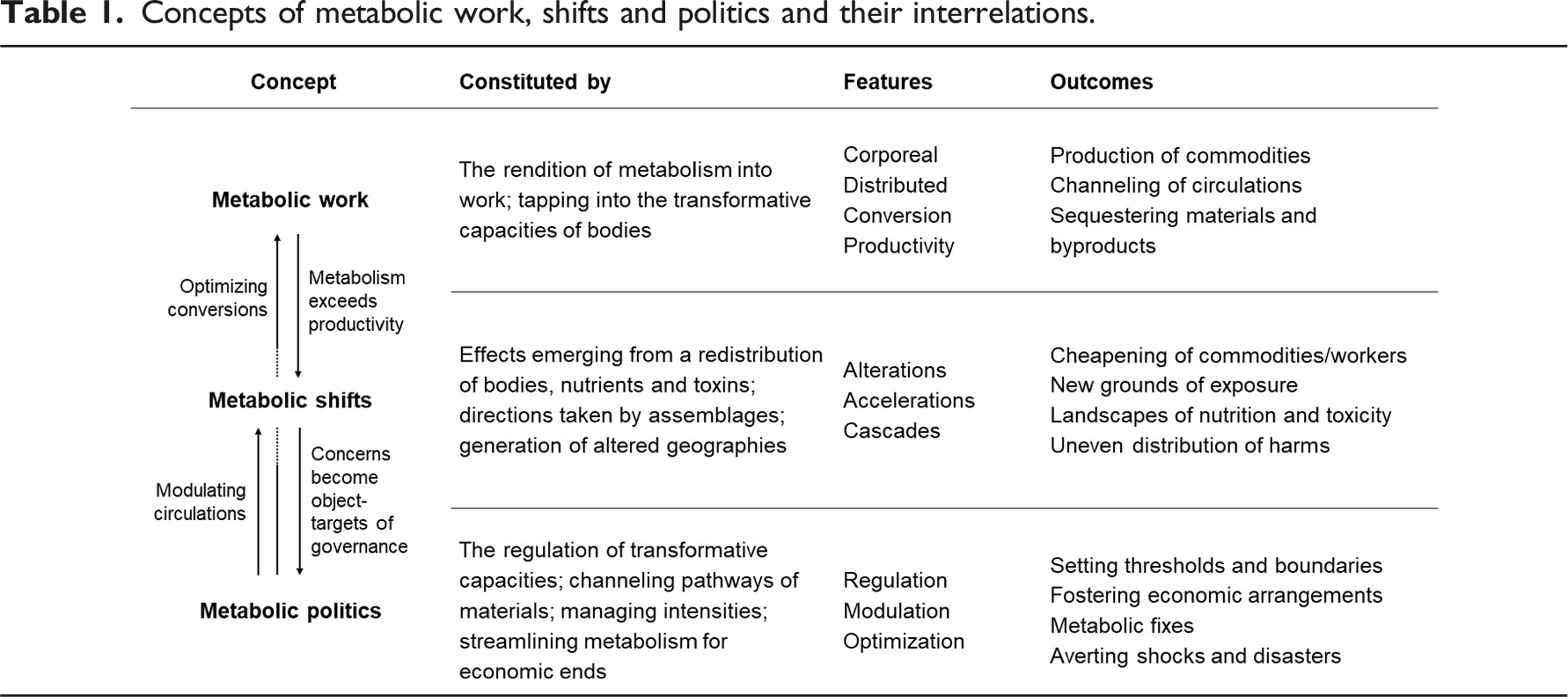
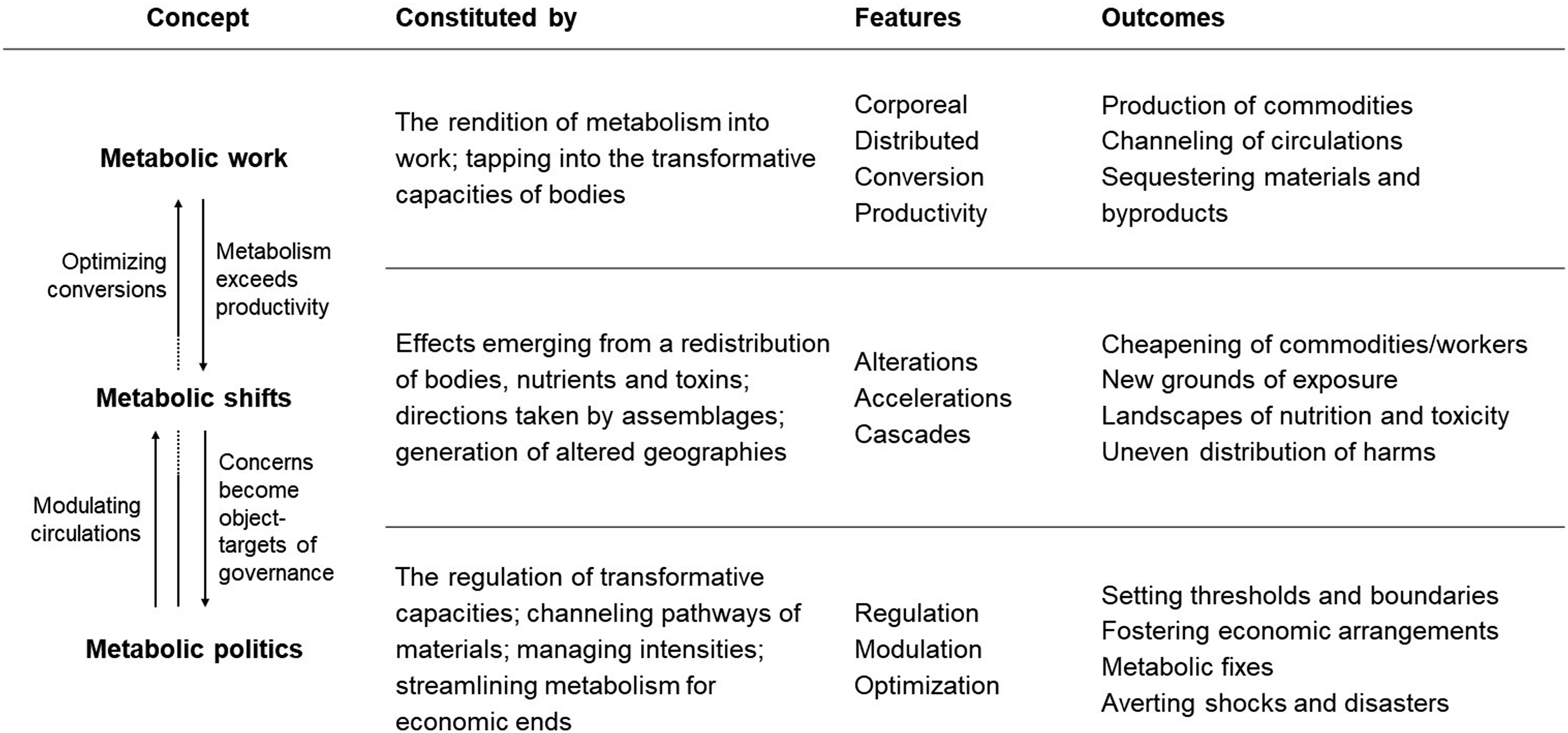
The spillovers of metabolic work and of a biocapitalist script of rendering life into a productive force are encapsulated through the concept of a metabolic shift: a massive redistribution of nutrients and toxins that has dynamic, distributed and asymmetric effects. Always already a production of nature (Smith, 2006), a metabolic shift is not the cleaving of nature and society but their reconstitution as fraught socionatures at a number of scales, from cells to organisms to the biosphere (Swyngedouw, 2006a). If critical political economy emphasizes the dynamics of capital as the producer of shifts (Moore, 2014), then the biochemical attunements of STS (Landecker, 2011) and political economies of the body (Guthman, 2011) surface a world of materials often kept hidden from public view but which have major consequences for environmental justice and future livability. Metabolic shifts are often illegible through, and unanticipated by, the biocapitalist logics of productivity in which they originate. The alterations, accelerations and cascades, and the landscapes of dysbiosis and disenfranchisement, to which the concept propounded here draws attention, become vital for understanding the material politics of conditions emerging after the industrialization of metabolism.
The economies set in motion through metabolic work and the material redistributions constitutive of metabolic shifts may become object-targets of contemporary governance. Regulatory apparatuses are sited as a response to recalcitrant and unanticipated effects of the industrialization of life, and such apparatuses might be understood through metabolic politics. The concept takes as a starting point what has otherwise been posited as findings of a swathe of inquiry on biopower: that life escapes attempts to rein it in (see Landecker, 2024). On the one hand, metabolic politics is about modulating metabolic work, but the impetus is not on improving productivity alone. Streamlining conversions, managing effluents and optimizing byproducts become crucial to the political economies of transforming metabolism into metabolic work. On the other hand, it is about intervening in the disruptive effects of metabolic shifts: regulating the material, chemical and economic journeys of assemblages across time and space and over different sites and scales. Metabolic politics is not necessarily hegemonic, in that it has not displaced disciplinary power and neither are its contours universal. Geographers need to be cautious in over-stretching its reach (see Barua, 2024a), and ought to be mindful that in lieu of a metabolic politics, it is forms of governance resting on denial, ignorance and simplification that are fast becoming prosaic across many parts of the world (Hecht, 2023).
This interrelated triad helps grasp metabolism as a totality, albeit one constituted by partial and provisional alignments. The article has been more explicitly concerned with industrial farming, and its arguments are perhaps most relevant to this realm. Nonetheless, it furnishes a relational grammar that fosters thinking from and not just about the metabolic, heralding a move from geographies of metabolism to metabolic geographies where composites of thought and method take both the ‘stuff’ of metabolism as well its political economic exigencies and consequences seriously. This move helps invigorate an analytic that has had an important history and uptake in geography (Newell and Cousins, 2014), and the discipline, one could argue, would benefit from more critical engagement in this arena. This is not least because the spatiotemporal, material and political dynamics of transforming, economizing and administering life that metabolism encapsulates rests at the heart of troubles thrown up by an altered planet.
The ways in which the synthesis and conversation offered here might be expanded cannot be rendered into a manifesto, but some propositions for a metabolic geography can be put in place. First, there could be more investment in developing qualitative ‘metabolic methods’ in both political economy and STS that take the biochemical seriously. Metabolism urgently calls for moving beyond dyadic ‘multispecies’ approaches that have become commonplace in social science accounts of the living world. It steers inquiry into assemblages and phenomena cutting across materials, bodies, environments and things. Here, calls for a chemical geography are particularly salient and might be built upon (Barry, 2017; Romero et al., 2017). Second, the grammar outlined here could be pushed toward fostering new engagements with urban metabolism (Gandy, 2004), an arena that has been outside this article’s scope. Nascent formulations provide visceral insights into metabolic urbanization (Barua, 2024b), and some of the early urban political ecology scholarship on bodies, fat and infrastructure offers further conceptual resources (Marvin and Medd, 2006). Third, critical rapprochement needs to account for different geographies through which metabolism inheres. It is vital to diffract metabolism from the Global South and look beyond European genealogies of biopower and the industrialization of life. This would entail attending to colonial and postcolonial histories of the metabolic (Davies, 2019; Meloni and Stead, 2020), building on nascent work (Read, 2024), as well as further interrogating how the politics of metabolism becomes pivotal to the production of uneven, racialized, bodies (Hatch et al., 2019; Vaughan, 2019).
This article has tended to emphasize life; death and slaughter are implicit rather than overt in this account. Necropolitical dimensions of metabolism demand closer scrutiny and could constitute a fourth avenue for further developing metabolic geographies. There is a body of work that asks such questions through notions of molecular colonialism (Murphy, 2017) and slow death (Berlant, 2007), that provide important starting points. Perhaps the most salient, and fifth arena of possible investment, is to build on the politics of administering life in the aftermath of industrialization that has been outlined here. If life’s capacity to escape attempts to rein it in ought to be starting points of inquiry and not its findings (Landecker, 2024), then it is vital to assess how dispositifs might be responding to the fraught effects of excess. They may proceed through denial and simplification (Hecht, 2023), not solely by rendering phenomena technical. At the same time, disruptive effects have the potential to give rise to spaces of dissent and political agitation. In this sense, one might think of metabolic justice and how the aftermath of the industrialization of metabolism could become a moment for creativity and change (Smith, 2006).
Metabolism is no doubt an enduring human geographical concern. The discipline has made vital contributions to developing metabolism as an analytic and in specifying metabolism as a phenomenon. It is important that geographers continue shaping debate and discussion on altered metabolisms and their implications for grasping the economization, transformation and governance of the living and material world. As evinced here, there is no dearth of resources for doing so; and human geography’s long-standing unease with the all too human worlds of the social sciences certainly acts to its advantage. In turn, metabolic geographies can open up exciting avenues for future disciplinary endeavour that cuts across silos and these might help overcome some of the impasses scholarship on the Anthropocene has reached. This article has furnished insights for doing so, and some of this work is already underway. The point is to expand it.
Footnotes
Declaration of conflicting interests
The author(s) declared no potential conflicts of interest with respect to the research, authorship, and/or publication of this article.
Funding
The author(s) disclosed receipt of the following financial support for the research, authorship, and/or publication of this article: This work was supported by the European Research Council Horizon 2020 Starting Grant Urban ecologies (uEcologies, Grant No. 239759).
