



Abstract
We use case studies of the Diné in the United States of America, and the Musahar people in Nepal, to understand how indigeneity is enacted in relation to the developmental and conservationist impulses of the dominant American and Nepalese states. We mobilize the concept of ‘waterscapes’ as assemblages of practices, technologies, emotions and worldviews, to unpack how geographical scales are produced and contested through symbolic and material practices. We find that the Diné of the Navajo Nation have socially differentiated engagement with the techno-legal assemblages embedded in the US Western water law and the water development infrastructure, e.g. the Glen Canyon Dam, that enables the tourism economy. The Musahar people, much like the Diné, have been excluded from their customary livelihoods as global-scale conservation was enacted in their waterscapes through techno-legal assemblages including the Chitwan National Park and water development and conservation policies for the Narayani River. In both the United States and Nepal, centralized agencies of the US federal government and the Nepali state tend to perpetuate exclusionary geographies of access to water and Indigenous livelihoods in the waterscapes. The national and international scales, at times, violently constrict local-scale Indigenous spaces. But the oppositional symbolic and material practices, of both the Diné and the Musahar, destabilize the dominant ontologies on local waterscapes. This paper demonstrates that across vast distances of history, geography and wealth, indigeneity does not just get repressed or occluded by the dominant state but is instead constantly reimagined and re-enacted in creative ways by the Indigenous People themselves.
Introduction: Indigeneity across the Global North and South
Indigenous Peoples and indigeneity have come to occupy an expanded discursive space in conversations around questions of human environment relations. This is especially so in terms of access to what modern discursive formations predominantly classify as ‘resources’, e.g. land, water and forest, to name a few (Coombes et al., 2012a, 2012b). Water with its fluid materiality and its protean socio-cultural valence offers a refreshing lens to apprehend Indigenous socio-natures and how they interact with modernist resource management regimes and paradigms, with which they most often have an uneven power relationship (Wilson, 2014). Our concern is how power and socio-political dynamics are imbricated in Indigenous water geographies, and we mobilize the concept of ‘waterscapes’ to frame the problematique of uneven relations between Indigenous and modern/statist socio-natures (Karpouzoglou and Vij, 2017; Menga and Swyngedouw, 2018; Swyngedouw, 1999). But the Indigenous waterscapes too tend to be an outcome of cross-scalar processes embedded in the statist, hegemonic discourses on development, conservation and politics of recognition and contestation, over and through water. Accordingly, we argue that scalar politics that produce local, national and global spaces of conservation, development, water resources and life spaces are central to understanding Indigenous waterscapes.
Indigeneity, as an umbrella term for defining and recognizing Indigenous Peoples, has a contested meaning from criterial definitions speaking to Indigenous perspectives on the non-human world, or as First Peoples, to relational definitions drawing upon how Indigenous People get produced through their relations to the colonial and post-colonial states and societies (Merlan, 2009). To capture the complexity of the ‘Indigenous’ category, we draw upon the case studies of the Diné (Navajo) people from the United States at the heart of the Global North, and the Musahar people from Nepal’s Terai region, in the Global South. The point of bringing in two Indigenous communities into the analysis across such vast terrains of political, historical and economic differentiation is to point to certain commonalities of Indigenous experience, across the Global North and South. But equally, the concern is also with explaining how global and national imperatives of development and conservation induce an internally differentiated negotiation of the hybrid present, through migration, remittances, entrepreneurship and of course also – by many – a dogged advocacy and propagation of traditional knowledges, values and cosmologies. We deem the Diné and Musahar to be not hapless victims of colonial excesses or conversely heroes of avant-garde politics and benign environmental futures but rather political subjects with deeply contested modes of being and becoming Indigenous (Coombes et al., 2012a, 2012b).
In the section on Indigenous waterscapes, we classify the literature on Indigenous People in three thematic areas and explain how conceptual framings of waterscapes and assemblages may be relevant to those. In addition, we outline our understanding of geographical scale, as it weaves into Indigenous waterscapes. After explaining the methodology for, and the historico-geographical context of research with the Diné and Musahar people, we proceed to engage with the evidence on differentiated engagement of the Diné with the national developmental imperatives, in the section titled, ‘Developmental waterscapes in the Navajo Nation’. The section following that outlines the evidence on Musahar’s contestation of globally inspired conservation models within their local waterscapes. In both the sections on the Diné and the Musahar, we point to differentiated and diverse strategies through which the Indigenous People stake out a claim to identity, livelihoods and life spaces. We conclude with some reflections on how indigeneity for both the Diné and the Musahar is a constant process of reclaiming ontological space for themselves against the encroachments of national and global-scale developmental and conservation imaginaries, respectively.
Indigenous waterscapes
As Indigenous Peoples’ struggles for recognition, and negotiating colonial, neo-colonial and post-colonial injustices has gained greater scholarly attention, the concept of ‘indigeneity’ has seemingly replaced ‘Indigenous Peoples’ as a central analytical category (Radcliffe, 2017). While indigeneity refers to the quality of being Indigenous, it also marks a shift towards more critical analyses according to Radcliffe (2017), something that is consonant with our ambitions. Merlan (2009) calls indigeneity a geocultural category which presupposes the modern (Western) societies as the ‘other’. Merlan (2009) surveys the difference between static criteria and relational understandings of indigeneity, but we find ourselves more in agreement with Radcliffe (2017, p. 221, 2018), who defines indigeneity ‘as the socio-spatial processes and practices whereby Indigenous Peoples and places are determined as distinct (ontologically, epistemologically, culturally, in sovereignty, etc.) to dominant universals’. This relational approach to indigeneity helps us move beyond the particularistic foci of cultural ecological-type engagements with Indigenous Peoples within specific contexts, towards a more comparative framework. The comparative analyses help us understand how the heterogeneity of Indigenous experiences spawns differentiated subjectivities within Indigenous populations across the Global North and South.
Possession/dispossession, ownership/rights, authenticity/culture, relationship to land and resource are some of the common tropes around which Indigenous human–environment relations are articulated and understood (Howitt et al., 2009). In fact, a common denominator amongst the criterial definitions of indigeneity is the notion of a spiritual or elemental relationship between Indigenous Peoples and their physical geographies (Menjil, 2019; Merlan, 2009; Shaw et al., 2006). Coombes et al. (2012a, 2012b) define three broad themes of: (1) political ecology of neo-liberalism; (2) deliberation within claims settlement and (3) propertization of socio-ecological relations. These three themes we propose have framed scholastic inquiry regarding Indigenous human–environment interactions.
Perreault (2013), in a political ecological mode, investigates the livelihood dispossession of Indigenous communities in the Bolivian Altiplano. He calls for greater attention to nature’s materiality in the processes of dispossession and accumulation, as he illustrates how the livelihood dispossession is a result of the accumulations: of toxic sediments on agricultural fields; water and water rights to the mining firms and territory to the mining corporations. Curley (2018, 2019), in a comparably political ecological mode, describes how the energy economy of the Diné people, particularly their continued commitment to coal-based energy, is embedded in their moral economy and a desire to correct historical wrongs inflicted by US colonialism. Wilson (2014), illustrating the ‘deliberation within claim settlement theme’, outlines how Koyukon Athabascan people of Ruby Alaska simultaneously exercise their own culturally informed hydro-social relations while still strategically building alliances to engage with the state to gain its recognition for their rights. Wainwright and Bryan (2009) document a cartographic-legal strategy by the Mayan people in southern Belize and the Mayangna community in Nicaragua. They demonstrate how the cartographic-legal strategy propertized the lands on the terms of the state. They argue that the struggle to challenge the state’s ‘claims of sovereignty over a given territory, therefore, is blunted by the explicit goal of formulating claims that can be recognized by the state’ (p. 164). In each of these three themes, or debates, Coombes et al. (2012a, 2012b) describe as a fundamental shortcoming: the inability or unwillingness to entertain ontological pluralism and multinaturalism that are foundational to the Indigenous Peoples’ experience, memory and claims on places and spaces, including waterscapes. We hope that in our narrative we will be able to highlight the Diné and Musahar peoples’ waterscapes that emerge at the interface of their diverse ontologies and those of the modern states of the United States of America and Nepal, respectively.
Within critical research on water geographies, a number of concepts have been mobilized to capture the interface between water, technology, society and power relations, e.g. water as an uncooperative commodity in the context of urban water supply (Bakker, 2005), waterscape in the context of national water development (Swyngedouw, 1999), urban waterscape (Loftus and Lumsden, 2008), hydro-social territorialization (Boelens et al., 2016, Mustafa and Tillotson, 2019), hydro-hazardscapes (Mustafa, 2013), the hydro-social cycle (Boelens, 2014; Linton, 2008; Linton and Budds, 2014), to name a few. Of all of the different concepts that seek to denaturalize and repoliticize water, the waterscape concept most closely follows the socio-natural attributes of water, where materially it flows, seeps, evaporates, appears and disappears, in a cultural, social and symbolic landscape. The waterscape concept points to the ephemeral, transgressive, material and discursive convergence of historical and social relations through water (Karpouzoglou and Vij, 2017; Swyngedouw, 1999). Loftus and Lumsden (2008), for example, use the concept to understand how the South African state enrolled water in a particular neo-liberal world view, and thereby attempted to change the way people not only produced themselves, but also the socio-natural frameworks of human environment relations. We too argue that the U.S. and Nepali states see water instrumentally as a ‘resource’ into the service of certain (modern, in the sense of ‘Western’) ontologies of human–environment relations and visions of development and conservation. We propose that those visions and their ontological assumptions are mediated by certain scalar politics of producing Indigenous and national spaces.
Spatial scale in the common uncritical parlance is understood as a hierarchical spatial structure that sequentially frames/contains progressively smaller scales from global to national to regional-local, for example. In the more critical tradition, however, geographical scale is not ontologically given but is rather a contingent outcome of socio-spatial relations. In other words, scale does not frame spatial politics and processes but is rather produced by them (Flint, 2016; Leitner and Miller, 2007). Mustafa and Tillotson (2019), for example, demonstrate how the Jordanian state, through its water development policies, produced the nation-state scale historically and contemporaneously. They argue that while dams and canals in the past were deemed essential to territorializing the Jordanian state in a geographically contiguous topographic sense, contemporaneously, the state’s hydro-territorialization impulse is manifest more in a spatially networked topological register linking subnational waterscapes with non-contiguous urban and international water users and markets. Marston et al. (2005), however, critique the inevitable verticality implied in the critical conception of scale. They instead call for dispensing with the concept altogether and replacing it with a horizontally dispersed spatial imaginary that celebrates the emergent, the fluid, the local and the differentiated relations therein. We, however, maintain that discussions about scale as produced are really discussions about power relations, and power relations do indeed have a vertical axis (Flint, 2016; Hoefle, 2006; Jonas, 2006). Our concern is with how Indigenous waterscapes are embedded within and are an outcome of uneven power relations between the Indigenous Peoples and the metropole. The scalar politics that inhere in those power relations will inevitably have a vertical dimension, and we hope to document that verticality in this paper.
The term assemblage refers to a collection of relationships between heterogenous human and non-human entities (Muller and Schurr, 2016; Mustafa and Talozi, 2018). Waterscapes is seen as assemblages of practices, technologies, emotions and worldviews – all related to water and are also repositories of symbolic and material practices (Acharya, 2015). Indigenous waterscapes are accordingly characterized not just by lack of say, access to domestic water or the infrastructure of indoor plumbing (Dietz and Meehan, 2019), water quality hazards (Gagnon, 2016) or antipathy towards dams and mass water diversion projects (Jackson and Barber, 2016) but also by unique relationships and water ontologies, which put Indigenous communities at odds with the modern water engineering perspectives and worldviews (Brigido-Corachan, 2018; Jackson, 2006; McGregor, 2012; Smith, 2012). How states recruit technology and neo-liberal ethos to (re)produce configurations of human environment relations and statist spaces is well understood, what has not been featured as much are the oppositional constructions of different human–environment relations by the subaltern and the Indigenous (Acharya, 2015; Forsyth, 2008) with the exception of the literature cited above. Indigenous ontologies are not in reaction to dominant Western ontologies (Emdin, 2011). Indigenous ontologies of human–environment relations existed prior to colonialism and have survived colonial attempts at their elimination. The Indigenous Peoples’ retelling of their own stories of human–environment relations, e.g. foundational myths that reject human–nature/environment/divine trichotomies or dichotomies, is therefore an affirmation of a foundationally different ontology to the Western one, and not a ‘reaction’ to the colonial epistemic violence. Following Mustafa (2005), we argue that, just as in a hazardscape, it is not just the gaze of power that fashions the materiality of hazardous spaces but also the lived reality and oppositional struggle of the vulnerable and the subaltern that fashion the waterscape. For our purposes, waterscapes can be repositories of multiple assemblages, including techno-legal ones that we point to in our case studies. This paper points to how the interactions with the national to global, developmental and conservationist enterprises in the US and Nepal are differentiated within the Diné and Musahar societies, and how scalar politics indeed elucidate the contours of those power laden waterscapes.
Method and context
This study applied a case study approach to uncover the complex politics of Indigenous waterscapes by undertaking in-depth interviews and participant observation facilitated by Indigenous researchers with whom the team members had a prior relationship. This approach is appropriate where numerous variables are to be analysed but only a few cases are available for in-depth analysis of complex issues (Yin, 2014). The research method was guided by Indigenous epistemologies (Smith, 2012), in which Indigenous voices, values and issues were at the centre during the data collection and analysis process (Menjil, 2019). We conducted a total of 37 semi-structured (25 in Nepal and 12 in Navajo Nation) and 6 group interviews (5 in Nepal and 1 in Navajo Nation) with a diverse group of community members, tribal leaders, elected officials and government officials in LeChee Chapter, Navajo Nation (Figure 1), and Nawalparasi district, adjoining Chitwan National Park (CNP), Nepal (Figure 2). While the semi-structured interviews lasted between 20 minutes and an hour, the group interviews were much longer (30 minutes to 2 hours) depending on the size of the participants in each group. The group size ranged from 3 to 15 participants. With consent from the participants, most of the interviews were audiotaped, but for some who did not want to be recorded, the researchers took notes during the interview. The interviews were later transcribed verbatim. Ethical research authorizations were obtained from the home institutions of each of the authors as well as the Navajo Nation Human Research Review Board (NNHRRB). This publication too has been reviewed and whetted by the NNHRRB.
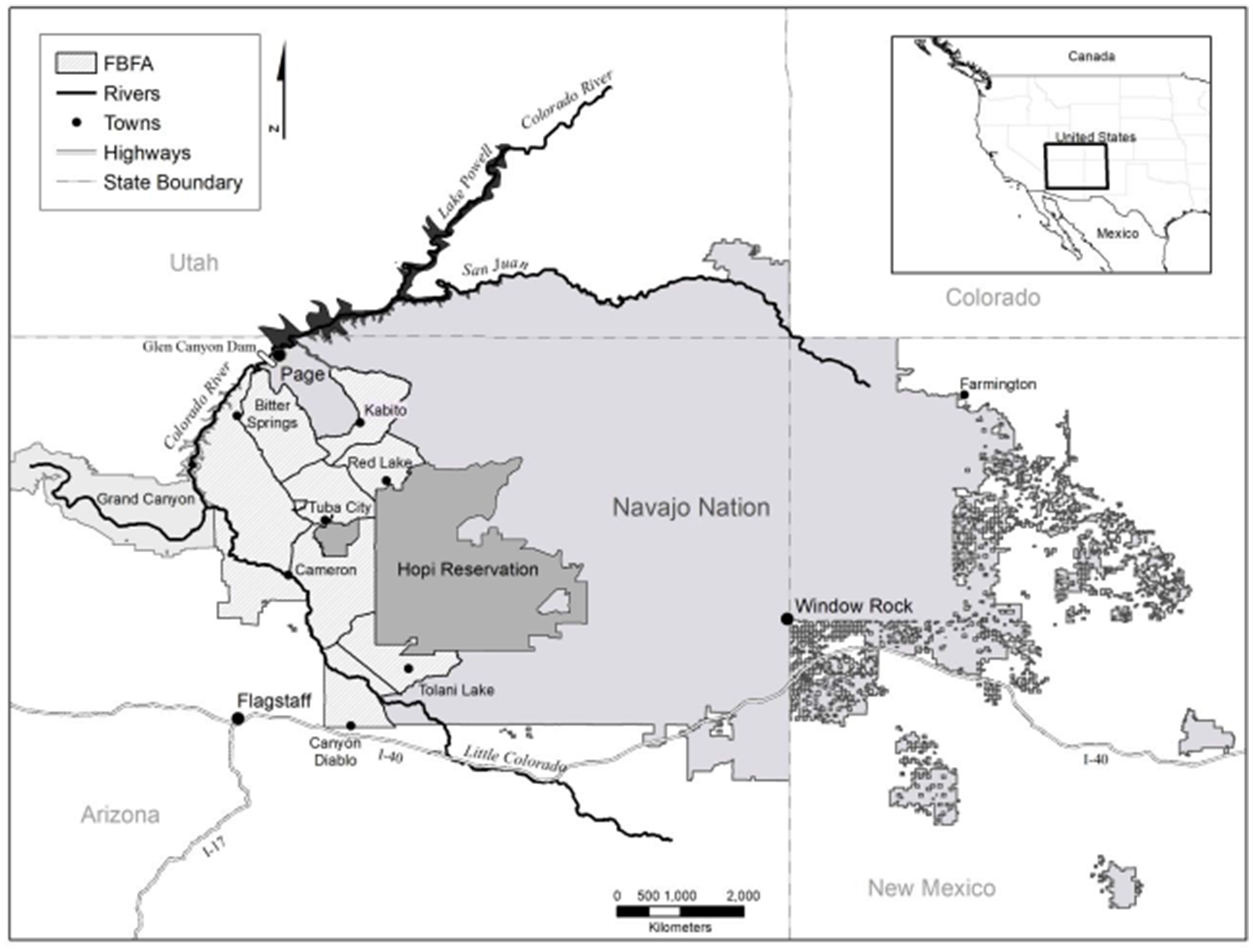
Navajo Nation Reservation in the Western United States.
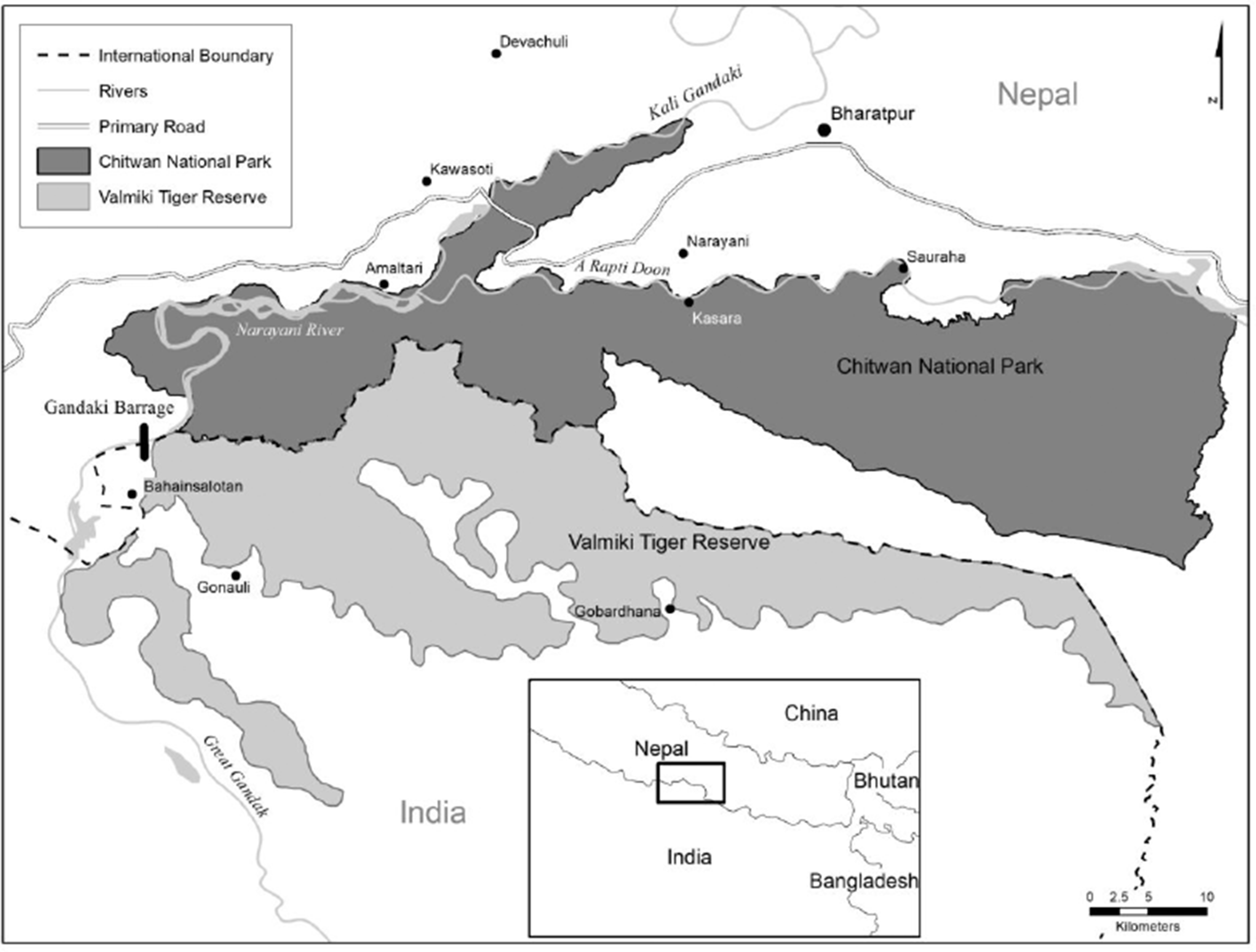
Location of the Chitwan National Park, Buffer Zone and surrounding areas.
The Diné (Navajo) peoples are the largest Nation in the US, and they mostly reside in southwestern United States, including Arizona, New Mexico, Utah and Colorado. The Diné have been settling in this region for centuries prior to their first contact with Spaniards in the 1580s. For the next two centuries, the Diné resisted and fought against Spaniards for their survival (Iverson, 2002). The Long Walk (Hweelde Baa Hane) forced by the treaty with the US is one of the most influential events in the history of the Diné people. During the Long Walk (forced march) in the 1860s, the Diné were forcibly removed by the US federal government from their lands because of their resistance to the European settlers. The collective trauma caused by the Long Walk has shaped the identity of the Diné people today. Following the continued atrocities by the US government and the people’s resistance, a treaty was signed between the Diné leaders and the US government in 1868, which is known as the ‘old paper’ by the Diné (Ault, 2018). The treaty recognized the Navajo Nation as a sovereign nation within the US. Currently, over 250,000 Diné live on the reservation, according to the Navajo Nation Government (2020). The Navajo Nation government is the most sophisticated form of Native American government that has a comparable government structure to any democratic government in the world with three branches, including executive, legislative and judicial (Navajo Nation Government, 2020). The Navajo Nation has been divided into 5 agencies (regions) and 110 chapters (equivalent to municipalities).
Being rich in natural resources, including coal and uranium, the Navajo Nation had been a site of various mining and energy-related projects. The Navajo Generating Station (NGS), a coal power plant, was one of the major projects; however, the plant has been decommissioned recently because of coal energy being economically less viable. As a consequence, about 700 Diné lost their jobs, and the government lost a major source of revenue. The Nation’s government is currently developing and exploring renewable energy, such as solar, wind and biofuel, and tourism for economic development (Navajo Nation Division of Economic Development, 2018).
In the Western United States, especially in the states of Arizona, Utah, Colorado and New Mexico, which surround the Navajo Nation territory, the prevalent water allocation regime is Prior Appropriation (Getches, 1997). The Prior Appropriation doctrine implies a first in time, first in right principle of access to water. The doctrine is an artifact of the initial European colonization of the Western United States by mining interests, who had to divert water from nearby streams to undertake mining operations. The doctrine means that water is treated as a transferrable and fungible property separate from the stream in which it flows or the land upon which it is used. The doctrine further only recognizes a water right once water is diverted from its natural channel and put to beneficial (productive) use. According to a US Supreme Court decision in Winters vs. United States 207 US 564, 1908, the Native American tribes have the seniormost water right of any other water appropriator. Despite this favourable Supreme Court ruling, the Native American tribes, including the Navajo, have not been able to perfect (take advantage of) their senior water right because of: (1) the narrow definition of beneficial use, by almost all the Prior Appropriation states, whereby the preferred (by Native Americans) instream uses of water are not deemed beneficial and (2) because of lack of federal financing for any water projects that may finance the infrastructure for any water diversion (Mustafa, 2013). It must also be borne in mind that while water is devolved to the state level in the US, it is also considered an item of interstate commerce, thereby allowing the US Congress to have jurisdiction of major water projects, insofar as they may impact conveyance or management of water over state lines. Native American reservations like the Navajo Nation are technically sovereign entities in a treaty relationship with the federal government of the United States. Sandwiched between the national-scale and state-level jurisdictions, the historico-legal geographies have a significant imprint upon Indigenous communities, specifically Diné waterscapes. We shall outline how the subaltern Diné, discursively and materially, negotiates the gaze of power of the American State and its developmental imaginaries in the Navajo Nation waterscapes.
Musahars are one of the most marginalized Indigenous groups in Nepal. The 2015 Constitution of Nepal recognized the rights of 59 Adibasi Janajatis (Indigenous nationalities) and Dalits (formerly untouchables). Among them, Musahar are the most disadvantaged and marginalized Indigenous groups in Nepal’s central Terai, who belong to the bottom of the caste hierarchy system that was abolished by law, but still continues to be practiced in Nepal and India. The livelihoods of Musahar, along with another Indigenous People called Bote, have been traditionally based on rivers (fishing, ferrying) and forest resources. Unlike other Indigenous groups of Terai, such as Tharus, Musahar are traditionally forest dwellers and did not hold formal land ownership for centuries (Paudel et al., 2007), and their settlements are cyclical, as they build their huts on the riverbed for about eight months and move onto the commons or the land owned by the Tharus, during the monsoon season when the river swells. Bartering system (exchange of goods and services) was central to their traditional livelihoods prior to the 1950s, where Musahars along with the Botes exchanged the fish and ferrying service for food with the Tharus. The livelihoods of Musahar and Bote have been impacted by two major interventions within the last five decades. First, the conservation projects implemented by the government of Nepal and the international and national non-government sectors. When the government established CNP in 1973, they were displaced from the Narayani River banks because they were considered a threat to the park and aquatic ecosystem of the river. The park further prohibited them from fishing and collecting resources from the forests and disrupted their traditional livelihoods. Second, after the eradication of Malaria in the 1950s, the hill people migrated to Terai and captured private farm land and communal forest land that had been used by the Indigenous groups for generations. This further marginalized Musahar and Bote (Paudel et al., 2007).
The present day territory of Nepal was never directly colonized by the British Raj in India, though about half of its historic territory were ceded to the British India and now form part of India. Nevertheless, Nepal did borrow much of its developmental and governance models from colonial India (Jones and Langford, 2011). Nepal had been a deeply feudal polity where the social order was driven by the Legal National Code of 1854, the Mulukhi Ain, which applied Hindu law and mores of social stratification to the ethnically diverse populace of the kingdom (Gellner, 2007). Despite many political transitions, from the overthrow of the Rana autocracy in 1951, to the institution of a constitutional (though partyless) monarchy in 1962, to the revolution of 1990 that saw the resurrection of national political parties, to the 10-year long Maoist movement during 1996–2006, to finally the most recent ascendancy of the Communist Party of Nepal (CPN) in 2006 and the promulgation of a new constitution in 2015, the caste and ethnicity questions have remained at the heart of the Nepali polity.
The power and privilege of the high-caste elites, namely Brahmins, Chetris and Thakuris, remained unchallenged in Nepal right up to the 1990s revolution, when the pious intention and some would say official fiction, of singular Nepali nation, under the reality of high-caste domination was finally broken. As per Gellner (2007), if 1962–1990 was a time of nation building, since 1990 has been a time of ethnicity building, where the previously excluded and marginalized ethnic and caste identities started staking out claims on the state in ethnic and caste idioms. The ascendance of the CPN Maoist, the abolition of the monarchy in 2008 and the implementation of the current constitution of Nepal in 2015 gave legal recognition to multiple ethnicities and castes in Nepal (Dahal and Ghimire, 2012), including, most importantly, for our purposes, 59 recognized Indigenous groups as Indigenous Nationalities (Adibasi Janajatis) and Dalits within the country. In the Terai region of Nepal, around the CNP where the research for this article was undertaken, Tharu, Bote and Musahar people are the three major ethnic groups, of which we shall focus on the weakest Musahar group, in relation to the state and the other two relatively better-off groups of Tharu and Bote. But for now we turn to an account of the developmental waterscapes in the Navajo Nation.
Developmental waterscapes in the Navajo Nation
The Diné people, like all other Indigenous People in North America, were subjected to sometimes physical and other times culturally genocidal policies by the European colonialism. Following the military defeat of almost all Native American resistance within the United States by the second half of the 19th century, the state policy towards Native Americans settled into benign neglect, within their allocated, legally sovereign nations (reservations). The ambition, however, remained that of eventual assimilation of the native populations into the national-scale cultural and to some extent political complex of the American state (Curley, 2019). From strong evangelical inroads into Indigenous communities, to the Indian Placement Program, for Indigenous children run by the Mormon Church of Latter-day Saints, the intention was mostly to alienate the children from their own culture and language and to socialize them into dominant Christian spiritual and White European cultural traditions. For many of the middle-aged Diné elders, the often traumatic experience of being taken away from their parents, punished for speaking their own language, or just being Diné was foundational to what they perceived to be dysfunctionalities in the Navajo Nation’s interactions with the US federal government on water issues, among others. For example, speaking of unfavourable negotiating position of the Navajo Nation with the federal government on Navajo Hopi Little Colorado River Settlement (NHLCRS), a tribal water expert lamented: We have no way to develop it [the Little Colorado]. We don’t have the knowhow. We don’t have the tools. And we have corrupt people who, I think have given up. Go back to the social side for a moment. Now when your mamma had her mouth washed out with soap for speaking her language, she didn’t teach you her language. She has–and this has been for generations that you’re speaking of–this enormous self-hatred. When you hate yourself [you] know what happens is you hurt what you most love. I don’t know how to explain it but we’re trying to work with it. (Elder J, 4 April 2019)
To pick up the strand on the negotiations on the NHLCRS that Elder J was talking about, according to Yazzie (2013), the negotiations between the Navajo Nation, Hopi and the United States essentially involved quantification of the Diné water right and minimization of it, from what it could be under the Winters doctrine discussed above. The point of such settlement negotiations, much the same as the 2005 San Juan River Water Settlement between the Navajo Nation and the state of New Mexico, was and continues to be, to quantify, Native American water claims, so as to free up water for appropriation by the states for non-Native American populaces’ economic development and growth. This quantification of tribal water rights is something that Curley (2019) refers to as a form of colonial enclosure. These enclosures have the necessary techno-legal assemblage of water-pumping installations, pipes and storage facilities, enabled and legitimized by legal doctrines such as Prior Appropriation, practically irrigable acreage and minimal need. One such technological assemblage that the state of New Mexico got was a pipeline from the San Juan River to supply water to Gallup, New Mexico. The Navajo were to benefit from the pipeline for drinking water, but never did, because Arizona refused to give its consent to inter-basin transfers from its share of Colorado River water, which was a prerequisite for the water project to benefit the Navajo Nation. Perhaps edified from that experience, or lobbying by the anti-settlement activists, and despite the exhortations of some elements within the Navajo Nation, the Navajo Tribal Council rejected the NHLCRS in July 2012. Elder J still urged mobilization of the Navajo Nation government on planning and visions for the utilization of whatever water that the Diné may be able to lay claim from a future NHLCRS, e.g. Just ran through some numbers. How much are we gonna drink? You know, how much is the livestock gonna need? How much are the farms gonna take? You know? And it’s not rocket science, but nobody is [paying attention]. That’s what’s so crazy, why is nobody doing this? . . . Cause we’ve broken our heads on trying to get [them]- to see the vision . . . The vision is basically all along the [Little Colorado] river that we have alluvial wells powered by the sun, and we have irrigated pasture. And we have beautiful pastures we can put the livestock on. We can build the soil, we have rich, fertile soil. We can rotate, you know, grow the corn and squashes there [speaks in a quiet and excited voice] and the wildlife will love it. (Elder J, 4 April 2019)
For many Diné, the lessons of a modern leisure economy are well learned, and the ambitions are consistent with the developmentalist mantra of entrepreneurship and staking out a claim on the economic pie. In such thinking, the Navajo Nation government and society’s communitarian ethos emerge as an obstacle to development, e.g. We encourage young people to go and be successful somewhere else but not here … We are much more inclined to let the non-native be entrepreneurial than our own. (Momo, Diné professional/businessman, 27 March 2019) I can understand that [the city of] Page gets the business and the Reservation does not. The laws on the reservation need to change in order for there to be development. They have to open up the reservation to be more business friendly. (Daniel, Diné businessman, Page, 2 April 2020) The reason why we say the American legal system is patrilineal is because it comes from Europe. There, before the democratic-republic system was implemented they had kings. They had [speaks Navajo], where his thoughts, his feelings, his spirituality was law. And he’s the one that sits on that throne. And his queen, to the public, was subservient, … So, [for] the Navajo, the legal system [on the other hand] is viewed as a balance between the feminine and the masculine. (Edward, Diné rancher & Chapter official, Circa April 2019) Right there, that part of the river started to flood, and started to go underwater. In Navajo culture, flood means adultery. So, when that happened, back in the 60’s and 70’s, the old folks and the medicine people that were alive then, [said] now there is going to be divorce. Now there’s going to be adultery, because that was one of the natural laws that we were told. (Elliot Diné storyteller, 30 March 2019) Can you imagine what they would’ve done to the river with all the pollution and throwing in all the debris in the river. We are trying to preserve that landscape and watch out for the medicinal and edible plants not destroyed by the Escalade … The whole lake (Lake Powell) has ruined our heritage just for the electricity and the water. There is no respect for our heritage. No inventory was ever taken of what was lost. No picture was taken. The only picture is on the bottom where a guy was standing. No one ever talks about us. We belong to the land. (Diné Group interview participant, Circa April, 2019) You know, some even say that nice, beautiful colour, that mist, that softness- so together, that’s what the Navajo husband and the Navajo women signify. And if they allow something to get in between that, it can destroy that natural, powerful energy right there. That’s when floods are created. (Elliot, Diné storyteller, 30 March 2019) My grandmother told me we can’t bring people in the canyons but we can’t find jobs anywhere. We have had to sacrifice part of our culture for money. My grandmother does a ceremony to protect me as I go into the canyon for work. We have to balance our culture and our jobs. (A Canyon guide, Circa April 2019) We believe this [Colorado] Rriver is sacred and won’t let our children swim in it at certain times. But the tourists don’t understand the rhythm of our offerings. When the River was low they had space for offerings but now that it is high there is no space for offerings. Tourists insist they should be allowed in all the time … my parents would never have gotten into the water. But we are not as good. We asked the Navajo Parks & Recreation to give us $5 above what they charge the visitors. We could use that money in the Chapter to help the tour company as well as do things in the community. … They say that they can’t do that. (A Navajo Nation Chapter Official, 30 March 2019) In the ten year that I have been trying to do it [start a river rafting business on the Colorado River], the Park Service has always been against me. Regulate, restrict and preserve has always been their mantra and has been for most environmental organizations. So, they have a very paternalistic attitude, and they consider themselves the custodians of the Navajo tribe. (Momo, Diné businessman/professional, 27 March 2019) We have water [supply] up to here, the chapter house, but past here, there is no running water and we have to haul it. The NTUA [Navajo Tribal Utility Authority] charges a lot of money for water. Power was extended here about 5 years ago … Navajo Nation is allotted a certain amount of water but we are unable to move the water to where we needed it because it is expensive to move. (A Navajo Chapter Official, 30 March 2019)
The Diné engagement with the colonial developmental gaze in the waterscape is multidimensional and operates either through (1) competitive insertion into the tourist and developmentalist economy; (2) reluctant co-option into the dominant European leisure economy, while refusing to cede symbolic legitimacy to the Western environmental and developmentalist narratives; and lastly (3) though re-enacting and retelling different stories about the waterscape and stubbornly staking out an alternate ontological claim upon the waterscape. While the first two features of Diné’s waterscapes are illustrative of the ‘political ecology of neo-liberalism, as per Coombes et al. (2012a, 2012b), the allegiance to the alternate ontology, however, is key to symbiotically producing the Diné identity and reproducing the waterscape with it. With this polychromatic view of the Diné waterscapes, we turn to the conservation waterscapes in Nepal below.
Contested conservation waterscapes in Nepal
The world famous CNP is home to many iconic, but endangered and/or threatened species, such as Royal Bengal Tigers (Panthera tigris tigris), gharial (Gavialis gangeticus) and one horned Asian rhinoceros (Rhinoceros unicornis), to name a few. The national park was historically a royal game reserve (Figure 2). The area experienced a state-sponsored migration from the hills, following the success of the malaria eradication programme starting in 1951. The state further nationalized all the forest lands in the country through the Nationalization Act 1957, which formally undermined existing local management regimes and led to accelerated deforestation. Water on the other hand was declared a public resource under the 1992 Water Resources Law (Jones and Langford, 2011). The CNP was established in 1973, specifically to protect the habitat of the Asian rhinoceros. The park has had comparable issues of exclusion and dislocation of local populations (Dhakal et al., 2011), adversarial relationship between the park management and the local communities (Jana, 2007), especially the Indigenous communities (Jones, 2007), as have been documented in case of other national parks and wildlife reserves elsewhere (Jana 2007; Lam and Paul, 2014). In the case of CPN, however, anti-poaching and patrolling of the Park boundaries has been militarized. The Department of National Parks and Wildlife Conservation (DNPWC), the civilian agency in charge of the CNP, does the day-to-day monitoring, management and programming including captive breeding and tourist regulation, but the enforcement is actually undertaken by the Nepal Army that is stationed within the Park and works with DNPWC officials. The security posture of the military may be suited to anti-poaching operations against armed violators, but the brunt of its exertions is, in fact, felt by the local Indigenous communities of Tharu, Bote and Musahar people, more so the latter two, whose livelihoods are dependent on the forest and aquatic resources. We go to others’ houses to work [as domestic help]. Men go for wage labour in the town. When there is not enough work in the town, the men reluctantly are compelled to go fishing to feed their families. There is a danger of wild animals like rhino, tiger and bear while we go fishing. The army and prasashan (administration) torture our people. If the army [personnel] find our people, they burn and destroy our fishing net. (Musahar woman, Village Gaire, Buffer Zone CNP, Circa December 2018) Tharu and Bote are more civilized and developed and they both claim themselves to be more Indigenous to Nepal and they see the Musahars as migrants from India who are unclean and uncivilized. They won’t even eat the food cooked by the Musahars. One of the dynamics I understood was that the Bote were in a dilemma. They wanted to have an organization [to engage collectively with CNP] but not with the Musahar. That was not just a political thing but also a cultural one. (A Thinktank researcher, Kathmandu, 17 December 2018)
The Musahar along with the Bote have a historical and cultural connection to the Narayani River and the waterscape around CNP: Like a bird flies in a certain direction, finds its food in that direction and raises its children in that direction we Musahar people also need the river. We used to be critical to this country. There were no roads, so kings and queens would ride with us, across rivers. We were the ones who transported food and goods that people needed, and in return we were paid with rice, wheat, fruits, vegetables, etc. by the farmers. This country was built on our labour. But now that the roads have been built and they don’t need us that much, they won’t even let us sit by the river. (A Musahar elder, Gaire Village, 11 December 2018) Wherever one lives and launches boats from is home [in our thinking]. You have a right to it. Ours was Ghat (Boat port or crossing points). Those were the days when we would go to the land (farming villages) and people would say that Ghatewar (boat men) have come. They would give us pride and respect us. … When I was ten years old (50 yrs ago) there were so many gharial along the rivers that you could not count. There were dolphins too. But then they started building factories. Upstream cities started becoming bigger and throwing pollution in the river. India also built the barrage downstream, which obstructed the gharial’s migration. They built lots of hotels near the river which also caused pollution. And not to mention that there is also less water [None of these things have anything to do with us]. (Musahar elder, Gaire village, 11 December 2018)
The state’s waterscape view is informed by global-level conservation orthodoxies of protected areas and neo-colonial orthodoxies of natives as the threat to trophy fauna (Robbins, 2019; Thing et al., 2017). As a think tank researcher said: People from Canada and the US can go to the river but not us who actually live here. The contemporary environmentalism is anti-Indigenous People … it is a complete misunderstanding of how local people interact with the environment. [As a child] I saw my father yanking a goat from the mouth of a tiger. We never went to the state to complain about the tiger. Now people go to the state to complain in the state forest. Tigers and the rhino are now state owned and hence they [Indigenous People] equate them with the state. We couldn’t complain to the forest before, because it was just the forest and its animals. (a think tank researcher, Kathmandu, 17 December 2018)
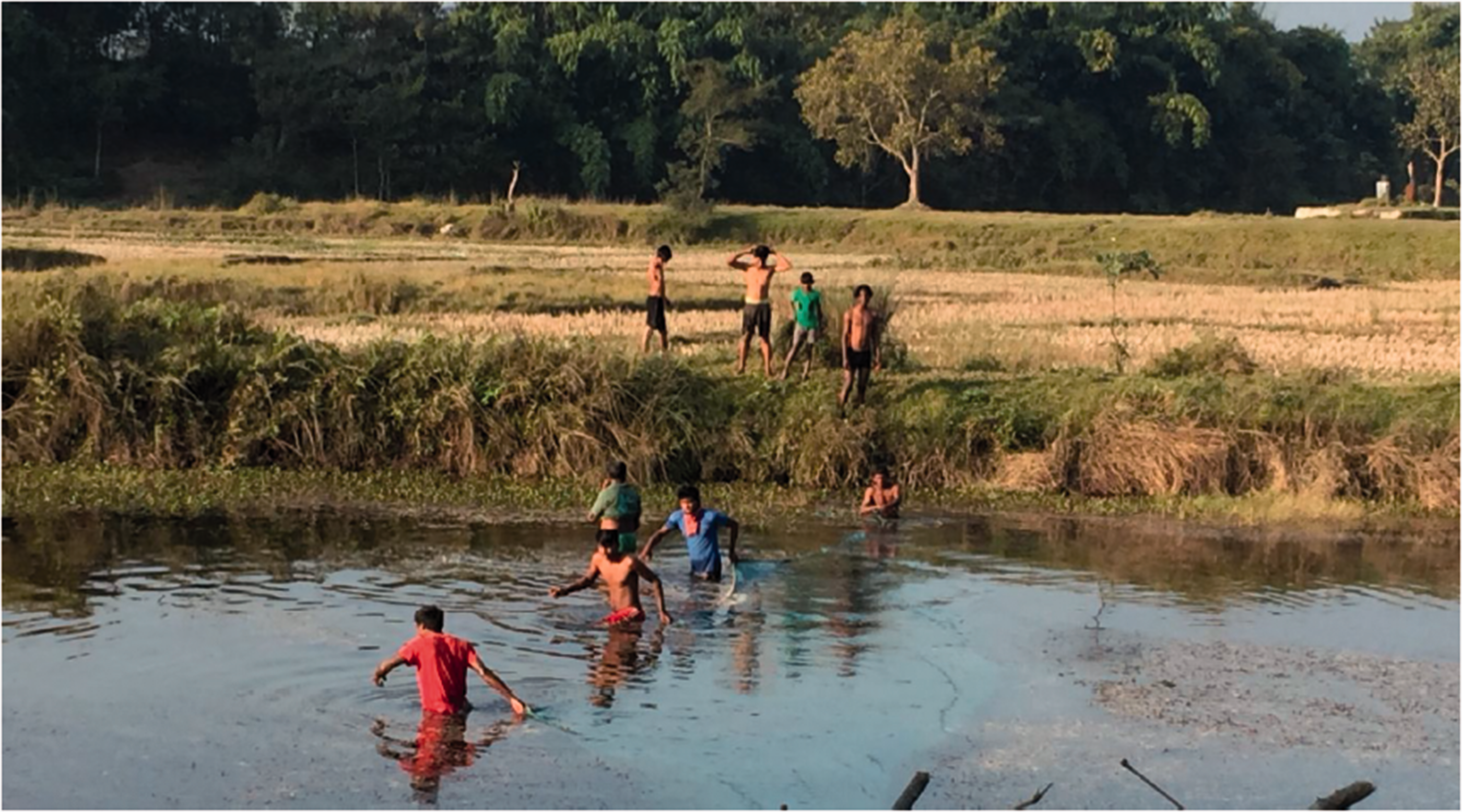
Musahar men fishing in a constructed fishing pond within the Buffer Zone.
To the Musahar, much like the Diné, their ontological approach to the so-called environment and fauna was very different from what the dominant conservationist discourse could accommodate. As an interviewee said, ‘the gharial, rhino and tiger, are our gods. How could we hurt them?’ (Musahar fisherman, Nagarpalika, 13 December 2018). The Musahar, like most locals in the Tarai, watch with undisguised bemusement, the tourists’ fascination with the Asian rhino or tigers. The animals are integral to their cosmology, with whom they have a spiritual and a functional relationship, that oscillates between ritual reverence and collective harassment of the animals, when they threaten their livestock, lives and crops. But almost never does that relationship descend to fatally hurting the animals. Even with mass conversions of the local people to Christianity by evangelical movements, the local cosmology has not been occluded in everyday conduct: Yes, we used to have belief in Hindu gods. Now most people have faith in Jesus. They have built a church for us. The people working for Christianity have … helped us in many ways. We also pray to jungle, water and offer the gods with hens and goats. We also pray to wildlife like rhinos, leopards etc. We eat all kinds of meat, but not dolphins or crocodiles. We respect them as they are also adapted to fishing in water like us. (G10 Musahar, Circa December 2018) We feel positive about the tourists. They come to see our rhino, tiger etc. I do think though that tourists are the reason we cannot fish in the river. We used to chase away the animals while fishing and as we went about our daily work. This must have made the tourists angry and so they stopped our fishing. (G11 Musahar, Nawalpur, Circa December 2018) Poor couldn’t and the rich didn’t want to start the homestay. So, most of the homestays are run by medium people. We are 3 Magar households, 3 Thakuri households, 1 Gurung household and 15 Tharu households running the homestay in Piprahar village. (a Tharu homestay owner, Piprahar village, Circa December 2018) Traditionally our culture was for entertainment and festive purposes but now it has been linked to livelihood. Women are more involved, especially in management and investments in hotels and homestays. Women have been empowered. (Tharu community activist, Raj Kumar Mahato, Circa December, 2018)
The conservation waterscapes are contested to varying extents by the Tharu, Bote and Musahar people in the ‘deliberations around claim making’ register. They are further negotiated through increased participation in the tourist economy around the CNP, in the political ecology of neo-liberalism register (Coombes et al., 2012a, 2012b). In both of those registers, the production of global-scale conservation geography through CNP, and national-scale securitized and ethicized geographies of inclusion and exclusion are negotiated through alternate ontologies on water and environment, as well as through rule breaking by the Musahar on fishing in the river, and more by co-option into the tourist economy by the Tharus and the Botes, and through international migration by all three.
Conclusion: Scalar politics and convergences in Indigenous waterscapes
Indigeneity in the United States and Nepal is not only produced through historic and contemporary interactions with the state, it is materially and symbolically enacted through techno-legal assemblages. Indigeneity is not just a pre-existing condition but is rather relational. Difference is produced symbolically through material spatial and discursive interactions (Nightingale, 2011). Symbolic meanings of particular practices are (re)produced through embodied activities and mediated through assemblages. For the Diné, the emblematic techno-legal assemblages are the water control and transfer infrastructure, legally enabled by the Western water law regime. Prior Appropriation, Winters Doctrine, river settlements and requirements to divert water for beneficial use are legal tropes that enable the encroachment of the national-scale capitalist development on to the local-scale life worlds of the Diné. Glen Canyon Dam and Lake Powell, along with the legacy of plumbing poverty from Bennett Freeze, are the assemblages that materially inscribe and produce the dominant national scale onto the Diné spaces and material practices. Along the way, their engagements are variegated ranging from attempts at competitive assimilation to contesting the entire national developmental gaze, by telling different stories and enacting different ontological claims upon the waterscape.
In Nepal too, from indigeneity clauses of the constitution to the legal regimes that nationalized the lands and water to enable the implementation of conservationist enclosure spaces like the CNP, there are techno-legal assemblages that materially inscribe the international conservationist gaze onto the life spaces of the Indigenous populations. Here again, like in the case of the Diné, the interaction with the enclosure spaces and the tourist economy around the CNP is ethnically differentiated with the Tharu doing economically much better than the Bote and Musahar people. The Musahar too defy the regulatory gaze of the national park security forces or the alternate infrastructure of fishing ponds to enact their culturally and spiritually animated practices with the river and aquatic life. The waterscape again gets symbolically reproduced in opposition to a gharial habitat alone through Musahar’s defiant practices.
Across vast geographical and historical spaces, from the one of the most hyper-developed to one of the least developed countries (UN DESA, 2018), offer discouraging comparisons in exclusions, oppressive scalar politics of national water development, tourism and international conservation. Those scalar politics in both instances are implemented by centralized national-scale agencies, e.g. the BIA, NPS and, to a lesser extent, Navajo Nation agencies in the case of the United States. In case of Nepal, the DNPWC, Nepalese military and international conservation NGOs are the active inscribers of international and national scale on to the local-scale life spaces of the Bote and Musahar. Equally, there are encouraging and refreshing symbolic and embodied practices that destabilize the dominant ontological assumptions about socio-natures of rivers, forests, animals, dams, lakes and piped water systems. Glen Canyon Dam may be a National [scale] Recreation Area, but it is a locus of Diné personal and local [scale] spiritual life. The Asian Rhino or gharial might be elements of global [scale] biodiversity, but they are deities to the Musahar. The techno-legal assemblages spawned by national- and global-scale imperatives exclude and occlude local-scale Indigenous material practices, claims and identities. The Diné and Musahar also have internally differentiated but oppositional engagements with those assemblages to reappropriate ontological space. The history of colonial domination or encroachments of the national and international-scale conservation discourse may have devalued Indigenous ontologies. But those ontologies are being retold and re-enacted by Indigenous subjects, as we have demonstrated. Within the waterscapes, the Diné and Musahar are not just subjected to the gaze of power but are, in fact, active agents who constantly reframe, reimagine and reproduce the where and how of indigeneity.
Highlights
Indigeneity in the United States and Nepal is materially and symbolically enacted through techno-legal assemblages. For the Diné (Navajo) people, the water infrastructure and the Prior Appropriation doctrine are the building blocks of developmental waterscapes that they live and contest. For the Musahar people in Nepal, the CNP and the accompanying regulations that exclude them from the river are techno-legal instruments of encroachment upon their local-scale waterscapes. Both the Indigenous People draw upon their alternate ontologies of nature to contest the encroachment of national and global-scale developmental and conservation gaze.
Footnotes
Acknowledgements
We would like to thank Dhan Bahadur Chaudhary and Naya Sharma Paudel for their assistance in the conduct of the fieldwork and their insights on the indigenous question in Nepal. A vote of thanks is also due to the research participants in the Navajo Nation and Nepal who opened their homes and hearts to us. We hope that we do justice to their stories.
Declaration of conflicting interests
The author(s) declared no potential conflicts of interest with respect to the research, authorship, and/or publication of this article.
Funding
The author(s) disclosed receipt of the following financial support for the research, authorship, and/or publication of this article: The field research for this manuscript was funded by the PLuS Alliance between King’s College, London, Arizona State University and University of New South Wales.