




Abstract
Communities adjacent to polluting industrial facilities understand and evaluate risk in often ambivalent and contextualized ways, not only balancing economic and environmental concerns but also reflecting cultural practices, social worldviews, and trust relationships. In this case study of the Antwerp petrochemical complex, the largest in Europe, a residents’ survey and interviews are used to examine how two middle-class communities coexist with the nearby petrochemical plants. The findings show that citizens in both communities are generally aware of the environmental impact and public health risk but are predominantly accepting of the industry. For both communities, the most important factor explaining acceptance is the perceived socio-economic benefit for the community, while a direct individual benefit in terms of employment does not play a significant role. In one community, risk acceptance is further strengthened by trust in companies’ risk management, while in the other community, trust in regulators is more critical. The different results for both communities stress the importance of a socio-cultural perspective on risk and underline the criticality of relationships of trust. The article further discusses the implications of these findings for environmental decision-making, considering the delicate balance and the significant minority of the population who is less accepting. The present study adds to the risk perception literature by providing one of the first quantitative analyses explaining industrial risk acceptance, instead of perception, using the increasingly contested petrochemical industry as an exemplary case.
Introduction
Yes, I think that [economic dependence] is one of the reasons why all the community and protest movements have died out. In the beginning, you had people who were independent of the [chemical] industry, but now, everyone knows someone who is dependent on it. (Berendrecht-Zandvliet resident, Male, Age 60–70) One could argue against the industry due to disadvantages such as safety risks, and the people here actually acknowledge those risks, but the people here deem job opportunities more important than the safety risks involved. (Antwerp Port Authority Representative, Male, Age 50–60)
While several petrochemical complexes around the world are contested, with fenceline communities protesting against activities—e.g. in the United States (Blodgett, 2006) and China (Deng and Yang, 2013)—the social contract appears to uphold with regard to the Antwerp petrochemical complex. This integrated complex emerged in the post-war period and rapidly expanded in the 1960s and 1970s to its current size of about 3000 ha. It is home to four refineries, three steam crackers, and more than 30 global companies in the downstream oil and chemical sector, including global players like BASF, ExxonMobil, INEOS, and Total. This makes it the largest petrochemical complex in Europe, supporting more than 20,000 direct jobs, and—unlike many European counterparts—still attracting further investment (Antwerp Port Authority, 2016).
At first sight, the lack of visible environmental protest or activism seems to be justified, with the port area meeting most European environmental regulations (Antwerp Port Authority et al., 2017). While this can give some comfort, only a small number of common air pollutants are permanently monitored using a limited network of fixed stations, and extreme events are often not regulated. For example, the typical refinery-related chemical compound benzene is measured in five fixed monitoring stations spread over the 120 km2 Antwerp port area and only evaluated against annual limit values (Flanders Environment Agency, 2016).
More generally, this science-based regulatory approach has received a lot of criticism for being based on risk assessments with inherent weaknesses. Moreover, scientific expertise is always contingent on power and inevitably embedded in institutional, social, and cultural dimensions (Bocking, 2004; Tesh, 2000). Consequently, all decisions and regulations regarding environmental risks are of a political nature (McKechnie, 1996). We have come to increasingly recognize that it is impossible to define safe thresholds to a toxicant, and that thresholds only establish “socially acceptable” levels of risk (Boudia and Jas, 2014). In addition, there is still uncertainty about less common toxic pollutants that are not measured and monitored, and to which illnesses are sometimes (disputably) attributed (Brown et al., 2011).
Adherence to environmental regulations can thus give a false sense of safety. This concern is supported by studies indicating that the Antwerp port region is affected by a disproportionate health impact caused by environmental pollution. A recent study identified the Antwerp region as one of the 29 European regions with the largest public health burden from exposure to benzene (Jephcote and Mah, 2019). Further, according to the European Environmental Agency, four of Europe’s 500 most polluting industrial facilities in terms of damage to health and the environment are located in the Antwerp petrochemical complex (European Environment Agency, 2014). Finally, despite advanced emergency response management, chemical incidents and emergencies can never be ruled out entirely. The recent history of fires and explosions at European chemical plants—e.g. an explosion at the BASF plant in Ludwigshafen (Germany) causing five fatalities in 2016 and a fire at the Lubrizol plant in Rouen (France) sparking local health concern and protest in 2019—shows that also in the tightly regulated European petrochemical industry, zero accident risk is an illusion.
Given the ever-present environmental and accident risk, the public acceptance of the petrochemical industry is never self-evident. It may seem surprising that there has been no substantial environmental movement or protest focusing on the environmental impact of the Antwerp petrochemical complex, especially since strong local activism on traffic-related air pollution has recently successfully influenced a major infrastructure project (Wolf and Van Dooren, 2017) and led to large citizen science projects (Van Brussel and Huyse, 2019). However, there are signs that also the acceptance of the petrochemical industry might be changing slowly. In the wake of worldwide protest against shale gas extraction, in June 2019 a local citizen initiative Antwerpen Schaliegasvrij (Antwerp Shale Gas Free) emerged to protest against the planned €3bn INEOS investment in the port of Antwerp (http://www.schaliegasvrij.be/). The movement claims the planned petrochemical plant would process shale gas and asks the local government to take a firmer stance against a company using this technology. While mainly focusing on the origin of the plant’s feedstock, they also encouraged citizens to lodge an objection to the planning application for the plant, a call that was widely covered in local and regional media but eventually could not prevent the application being approved. It is hard to predict whether this small-scale protest will gain ground and lead to a more permanent movement and increased activism. Much depends on the extent of latent concern about the impact of the petrochemical complex on the port communities, which might not have led to public criticism yet because it can be easily dismissed as self-defeating by other community members. Therefore, this study comes at an interesting time.
The present case study of the Antwerp petrochemical complex wanted to assess and explain the acceptance of industrial risk, looking at factors of risk perception, economic benefits, and social trust. A quantitative residents’ survey was carried out in two distinct middle-class “petrochemical communities” adjacent to the complex, allowing for comparative statistical analysis. The survey was complemented with a small number of interviews to better understand, qualify, nuance, and “humanize” the survey results. Finally, recommendations were formulated for improved environmental decision-making.
In the next section, an overview of the literature on public risk perception is presented, focusing on environmental risk, followed by a summary of empirical studies on petrochemical communities. Afterwards, the case study and research methods are introduced. Subsequently, the results are presented, followed by a concluding discussion.
Changing theories of public risk perception
For a long time, the different public perception of environmental and industrial risk, sometimes leading to protest, criticism, or resistance in the public sphere, was seen as a pure problem of public ignorance. Explaining scientific and technical information effectively would bring citizens’ ideas about risk closer to the experts’ ideas (Tesh, 1999). The suggested conflict between experts and lay people, or between objective and subjective risk, was linked to the psychometric paradigm. This psychological perspective on public risk perception addresses the cognitive and attitudinal processes through which risks are interpreted at the individual level. The model defines three categories of determinants that are critical to individual risk perception: (1) the novelty of a risk, (2) the “dread” of a risk (i.e. the perceived lack of control and catastrophic potential), and (3) the level of trust in experts and organizations (Fischhoff et al., 1978; Slovic et al., 1991). The psychometric paradigm formed the basis for a number of public opinion surveys on risk perception from the 1960s onwards and strongly inspired official risk communication strategies (Bickerstaff, 2004).
However, this citizen–expert dichotomy, with “subjective” citizens on the one hand and “objective” experts on the other, has been criticized both in the risk society literature and in several discourses categorized under the socio-cultural paradigm. Risk society theorists take a moderate social constructivist view on risk, acknowledging that risks are real, but that their interpretation and evaluation—by the public and by scientists—is at the same time socially constructed (Ekberg, 2007). Beck (1992) already pointed out that scientists’ monopoly on rationality is broken when it comes to the study of risk, since the definition of risks is based on a framework of probability statements and because one should apply an ethical point of view to discuss risks meaningfully. It follows that technical risk experts are often mistaken in their empirical accuracy and that, instead, there is no universal and neutral way of describing risks, and even less so to assess their acceptability.
While risk society theorists acknowledge the social construction of risk at a societal level, they do not consider the contextualized construction at a local level. Since the numerous quantitative public risk perception surveys applying the psychometric paradigm could not account for the wide variability and inconsistency in the findings for different places and people, a socio-cultural “empirically grounded” approach became increasingly popular in the 1980s and 1990s. This approach rejects separable and individualized understandings of risk and examines the relational and active construction at the local community level (Irwin et al., 1999).
The socio-cultural perspective is based on the idea that environment and culture are contingent, rather than distinct and separate (Kondo et al., 2014). It follows that risk perception is never the result of an individual interpretive process. It is dynamic and discursively negotiated and should be examined from a relational perspective (Irwin and Wynne, 2003). In other words, risk perception is socially and culturally constructed, rooted in everyday direct sensory and bodily experience, social relationships, and interpersonal interaction and conversation (Wakefield et al., 2001; Wynne, 1992). Bickerstaff and Walker (2001) call this the “localization” of people’s understandings of environmental risk within the immediate physical, social, and cultural landscape.
The socio-cultural perspective is essential to understand an industrial community’s acceptance of risk, which is often based on a trade-off between the risk and the (in)direct economic or social benefits of a polluting activity. This pragmatic risk acceptance aligns with one of the critiques on the risk society literature, arguing that it emphasizes risk avoidance and as such obscures the possibility of an “acceptable” or “tolerable” risk (Ekberg, 2007). Indeed, local cases of industrial pollution do not have easily identified culprits, causes, effects, and solutions. They are far more complex issues, with residents’ accounts of (acceptance of) local pollution and risk often diverging from the way in which the problem is conceptualized by “outsiders” (Burningham and Thrush, 2004).
Since information is often limited or difficult to understand in these contexts, also in the socio-cultural paradigm, trust is a vital element. Social theories of risk are inseparable from theories of trust, and when risk and trust combine, they invariably relate inversely (e.g. Lash, 2000). Trust expresses the extent to which one expects the other to act in line with one’s own needs and interests and can be viewed as a mechanism to reduce the complexity faced by people (Siegrist et al., 2001). A predominant paradigm in industrial risk perception is that citizens are heavily dependent on the industries themselves and on the controlling or regulatory bodies in protecting them from possible harm (Ter Huurne and Gutteling, 2009). A high level of trust in companies and regulators has been shown to have an important influence on the acceptance of a nuclear waste repository (Flynn et al., 1992) or hazardous waste disposals (Groothuis and Miller, 1997). However, it has also been noted that an increasing dependence on trust can produce its opposite in anxiety and doubt (Ekberg, 2007).
In summary, local pollution issues and evaluations of risk are inextricable from wider assessments of local life and community-specific relationships of trust. Therefore, we should never try to interpret these situations through the lens of environmental risk alone, but always apply a local sustainability perspective in which environmental, social, and economic issues are seen as linked (Burningham and Thrush, 2004).
Research on petrochemical communities
The rise of the socio-cultural paradigm has led to many qualitative accounts of how various social, cultural, and institutional factors are shaping risk perception in the context of people’s everyday lives (Bickerstaff, 2004). A range of empirically grounded accounts have focused on petrochemical communities, communities that are directly affected by, and often depend substantially on, one or more petrochemical plants. A lot of these studies do not discuss risk acceptance but describe the everyday and bodily experiences of living in a polluted toxic environment (Auyero and Swistun, 2009; Davies, 2018; Wiebe, 2012) or focus on environmental justice struggles, knowledge justice, and the role of experts (Allen, 2003; Allen et al., 2017; Ottinger, 2005).
Some ethnographic studies have focused specifically on risk acceptance, with residents’ accounts usually confirming the pragmatic acceptance rationale of refraining from challenging a polluting industry that is vital for a community’s economic and social survival. In Teesside (England), pollution was seen as “an inevitable fact of life, the price that had to be paid for jobs”, despite the lack of trust in public authorities (Phillimore and Moffatt, 2004: 176). In a focus group study in Cefn Mawr (Wales), the pragmatic acceptance of the town’s petrochemical plant was obvious, in a context of fears that insinuating environmental problems constituted by the factory could lead to closing it down (Burningham and Thrush, 2004). And in Sarnia (Canada), interviews with residents showed that “air pollution was considered a trade-off for economic affluence” (Atari et al., 2011: 486).
Two communities that have been examined more thoroughly from a risk acceptance point of view are Ludwigshafen (Germany) and Grangemouth (Scotland), subject of a concerted German–British research effort in the early 2000s. The dominant rhetoric recorded in Ludwigshafen, home to the BASF headquarters, was one of deeply engrained trust, well-founded in long-sustained knowledge, combined with pride in being associated with something gigantic and pioneering (Phillimore and Bell, 2005; Phillimore et al., 2007). The longevity and familiarity of the industry, its sustained economic vitality, and its improving environmental performance over the years had led to an unusual loyalty and acceptance. However, beneath the surface, very subtle shifts were noticed. On the one hand, these were explained by cutbacks in employment, outsourcing and subcontracting that caused some economic uncertainty, and fears about risk and safety. On the other, fallen tax revenues had led to cuts in public services. For a minority of people, both contributed to a perception of decreasing economic benefits and increasing risk, starting to jeopardize a long-established, implicit social contract. In Grangemouth, the major Scottish petrochemical center, the balance had already tilted in the early 2000s, with public doubts about the economic security and environmental safety provoking increasingly vocal local opposition (Phillimore et al., 2007; Schlüter et al., 2004). Furthermore, the town had lost direct control over the industrial tax revenues paid by industry, due to a local government reorganization, and the petrochemical industry was increasingly perceived as a block on development and economic diversification. From a sense of belonging to a fortunate town, the mood had changed to a sense of belonging to a place stigmatized by outsiders combined with considerable unease and even distrust of regulatory authorities.
The shift toward empirically grounded, qualitative accounts of public risk perception in petrochemical communities does not mean that quantitative methodologies have become irrelevant. While large population studies have shown to be ineffective, small-scale surveys are still useful to help identify the key factors explaining risk perception and risk acceptance at community level and estimate their relative weight. For example, a Chinese case study applied a questionnaire to residents neighboring two chemical industrial parks in Dalian and found that acceptance mainly depended on three factors: the perceived economic benefit for the community, the trust in the stakeholders, and the level of information sharing and openness (He et al., 2018). The most extensive survey research has been carried out by the team of López-Navarro, mainly reporting on communities surrounding the petrochemical complex of Castellón (Spain). Among other things, they showed that living closer to the petrochemical complex was correlated with having less trust in companies and perceiving more risk (López-Navarro et al., 2015) and that there is only an indirect effect of trust in public institutions on risk perception, by conditioning trust in companies (López-Navarro et al., 2013). In their most recent article, the Castellón results were compared with the results for communities surrounding the petrochemical complex of Tarragona (López-Navarro et al., 2018). The Tarragona residents showed a more positive appraisal of the economic impact, a lower risk perception, and more trust in companies, altogether pointing to a better balance. The authors specifically pointed to the Tarragona companies’ effective communication channels, contributing to trust, as part of the explanation.
These examples show how a community survey can help reveal the community-specific combination of determinants that explains risk perception and risk acceptance. As such, these studies do not conflict with a socio-cultural, local sustainability perspective on risk, but are complementary to grounded, qualitative, ethnographic accounts. Before explaining the methodology in more detail, the specific socio-historical context of the Antwerp petrochemical complex will be outlined, providing essential information to interpret and understand the findings of the empirical study.
The Antwerp petrochemical complex
Antwerp has always been an important location in the developing global oil and chemical industry. As early as 1861, it became the first petroleum port on the European continent (Vanthillo et al., 2018). However, it is especially the petrochemical revolution after the Second World War that had an enormous effect, with the port’s industrial area increasing from roughly 300 ha shortly after the war, to about 3000 ha in the mid-1990s (Blomme, 2003).
Since Antwerp’s port was not destroyed in the Second World War, it had a crucial competitive advantage, attracting the refineries of Total (1951) and Esso (1953), followed by foreign chemical companies (Ryckewaert, 2010; Vanthillo et al., 2018). However, the post-war breakthrough of the petrochemical industry and the massive growth of port activities quickly bumped into physical constraints (Vanthillo et al., 2018). This led up to a concerted Ten Year Plan (1957–1967), which aimed at a rapid expansion of the port based on a planned approach that distinguished clearly between industrial and transshipment areas (Ryckewaert, 2010). The supply of large areas for industrial settlement turned out to be a crucial competitive advantage during the 1960s, attracting several German chemical firms among which especially BASF was an important player. It acquired a very large area of industrial land in the far north of the expanded port area, starting production in 1967 (Ryckewaert, 2010). After the selling or conceding of much of the land on the Right Bank of the Scheldt River, from 1963 onwards some petrochemical companies started to settle on the Left Bank in the territory of the municipalities of Beveren and Zwijndrecht. From the beginning, functional links with the industry on the Right Bank were maintained, with some of the plants being physically connected by pipelines (Devos, 2003).
After the rapid growth in the 1960s, the 1970s oil crises caused a considerable slowdown. The Antwerp petrochemical complex entered a state of stability, with a focus on subcontracting relationships in the 1970s and the surge of specialty chemicals installations in the 1980s and 1990s. It did not experience growth over the last decades in terms of new entrants but did transform internally through new investments and maintained its importance as a production center (Vanthillo et al., 2018).
Today the Antwerp petrochemical complex is a mature industrial complex, with established economic relationships, high sunk costs of capital-intensive chemical installations, integrated complex value chains, a co-evolving network of downstream operations and suppliers, and a wide range of industry-specific services and institutions in the region (Vanthillo et al., 2018). The port of Antwerp claims to be the largest integrated petrochemical cluster in Europe, with two major refineries, four steam crackers, and more than 30 companies operating in the oil and chemical sector, including at least 10 top global players 1 (Antwerp Port Authority, 2016).
The port of Antwerp actively tries to attract new investments, a strategy that seems to work. In January 2019, the British multinational INEOS announced a €3bn investment in an ethane gas cracker and world-scale propane dehydrogenation unit. This would reportedly be the largest investment in the European chemicals sector in 20 years (INEOS, 2019). In October 2018, Austria-headquartered Borealis had already announced a €1bn investment in its Antwerp plant (The Brussels Times, 2018). These recent announcements confirm the persistence of strong agglomeration forces that fuel new investments and keep operations at a stable level (Vanthillo et al., 2018).
The environmental record of the petrochemical complex is extensively discussed in the Port’s Sustainability Report (Antwerp Port Authority et al., 2017) and in the Flanders Environment Agency’s report on air quality in the Antwerp agglomeration (Flanders Environment Agency, 2016). Emissions decreased significantly since the beginning of the 21st-century and continue to do so. Particulate matter, SO2, and NO2 concentrations are somewhat higher than in the rest of Flanders—also due to traffic—but all European limit values are met. The measurements for refinery-related BTEX compounds (benzene, toluene, ethylbenzene, and xylene) also respect the limit values. Additionally, the Flemish Center of Expertise on Environment and Health carried out a human biomonitoring campaign between 2002 and 2006, in which no particular higher presence of pollutants in people living next to the port area was detected (Schoeters et al., 2012; Schroijen et al., 2008). However, in the Introduction was already mentioned that the compliance with European environmental regulations can give a false sense of safety. Only a small number of common air pollutants are monitored and regulated through a limited network of fixed stations, with often no set threshold values for extreme events. Moreover, the risk assessment science that supports the regulatory approach has inherent weaknesses, and environmental limit values and regulations are the result of political decisions contingent on power relationships (Bocking, 2004; McKechnie, 1996; Tesh, 2000). In addition, some studies indicate that the Antwerp port region is affected by a disproportionate health impact caused by environmental pollution. The Antwerp region was identified as one of the 29 European regions with the largest public health burden from exposure to benzene (Jephcote and Mah, 2019). Furthermore, the European Environment Agency identified four facilities in the port of Antwerp—the refineries of Total, ExxonMobil and Gunvor, and the BASF plant—that are among the 500 most polluting facilities in Europe in terms of damage to health and the environment (European Environment Agency, 2014).
There are several community organizations in the Antwerp area that work on environmental issues but none of them focuses on the petrochemical industry. Some initiatives exist to bring industry and local community stakeholders together, but all but one 2 only welcome representatives from local government or civil society organizations (Van Berendoncks et al., 2016). Though direct public participation is limited, the petrochemical industry in Antwerp is not publicly contested and seldom subject to public debate. However, as mentioned in the Introduction, in 2019 a new small-scale grassroots movement emerged in response to the planned €3bn INEOS investment. This movement, Antwerpen Schaliegasvrij (Antwerp Shale Gas Free), mainly focuses on the contested shale gas feedstock the planned facility would use, but also tried to influence the planning application process, to no avail. The present study on risk perception and acceptance was carried out before the new movement emerged but might still give an idea of the potential for further protest based on latent concerns.
Case study communities
Two of the communities closest to the petrochemical complex are Berendrecht-Zandvliet in the north and Zwijndrecht in the south (Figure 1). Demographic and socio-economic data show that they have a relatively similar composition in terms of gender, age, origin, income, and educational level (Table 1). Compared to the Flemish average, both communities have fewer people of foreign origin, slightly above average incomes, and fewer people with a higher education degree (especially in Berendrecht-Zandvliet).
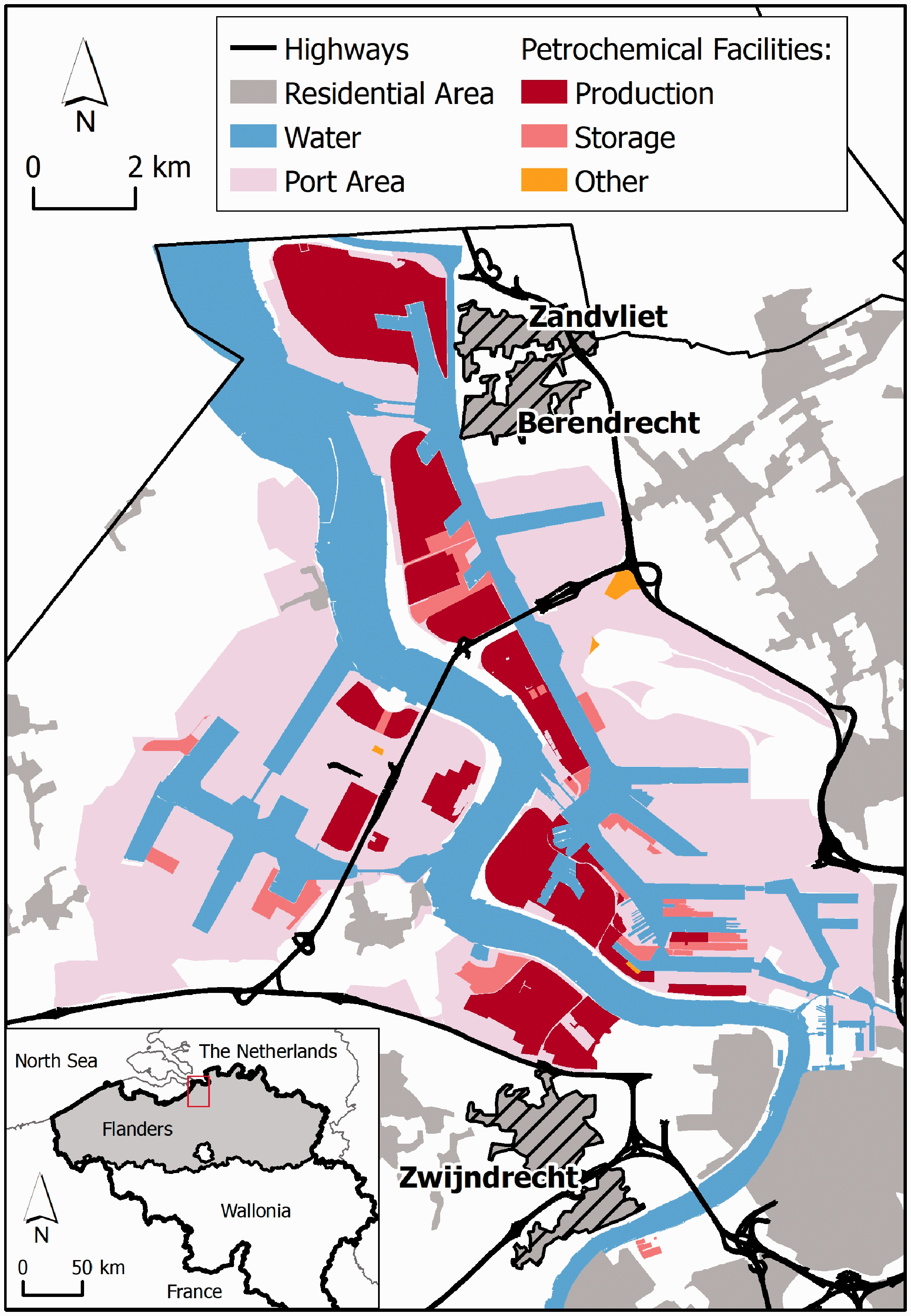
Antwerp port area with indication of petrochemical activities and nearby residential areas.
Demographic and socio-economic statistics on the communities of Zwijndrecht and Berendrecht-Zandvliet.
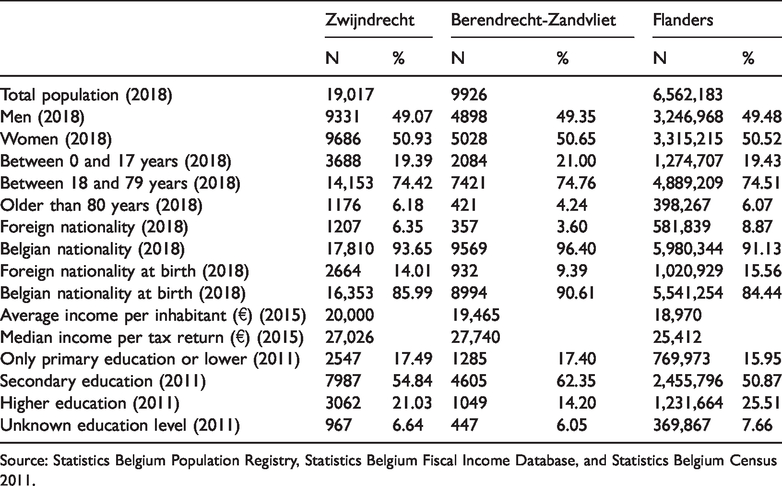
Source: Statistics Belgium Population Registry, Statistics Belgium Fiscal Income Database, and Statistics Belgium Census 2011.
While both communities can be considered average middle-class communities, their spatial, historical, and institutional context is rather different. The twin villages of Berendrecht-Zandvliet are relatively isolated and closed communities, surrounded by the port and a highway. Historically, they were agricultural communities lacking any relation with the city of Antwerp. The villages were threatened by evacuation and demolition in the port expansion plans of the 1960s, lost a large part of their agricultural land, but were eventually safeguarded (Ryckewaert, 2010). Institutionally, the villages lost their independence in 1977, when they were incorporated in the city of Antwerp’s territory. They now function as an urban district of the city of Antwerp, with very limited local powers. They are only separated by the Scheldt-Rhine Canal from the petrochemical plants of BASF, Solvay, and the Gunvor Refinery. Especially BASF appears to have a close relationship with the community. It is the only petrochemical company in the port that maintains a neighbor platform in which the company discusses its activities and local impact with a group of residents representing the nearby communities. The platform is composed of about 20 citizens and five company representatives—including the CEO of BASF Antwerp, underlining the importance for the company. They convene about three times a year, all participants can put topics on the agenda, and every meeting concludes with a roundtable discussion (Van Berendoncks et al., 2016). Reports of all meetings are publicly available on the BASF website. 3 This initiative is clearly part of a broader strategy on community outreach since BASF Antwerp also publishes a half-yearly community magazine and operates a 24-hour helpline. 4
The community of Zwijndrecht is located on the Left Bank, bordering the southern edge of the petrochemical complex. A cluster of about 10 smaller petrochemical plants lies in the municipal territory, north of the main residential area. Zwijndrecht has developed from a rural community into a suburban commuter town, functionally part of the Antwerp urban agglomeration and dissected by several east-west oriented highways and railways. Although the port and the petrochemical complex occupy a substantial area on the Left Bank, in people’s minds the Right Bank is still taking all the decisions (Deforche et al., 2013). Part of the explanation for this lies in the historical port–city connection on the Right Bank, but the current institutional organization also contributes to the imbalance. Maritime activities on both riverbanks are managed by the Antwerp Port Authority, a public limited company with the city of Antwerp as the only shareholder. However, with regard to land and industrial policy, it is only responsible for the Right Bank. On the Left Bank, this responsibility is taken up by the Left Bank Development Corporation, whose shares are divided among the Antwerp Port Authority, the Flemish Region, and several Left Bank public authorities, among which the Municipality of Zwijndrecht. Since operations of large industrial plants are regulated by the Flemish Government and environmental permit procedures administered at the provincial level, both complying with European legislation, local governments only play a minor role. Therefore, it is no surprise that the Municipality of Zwijndrecht is tacitly accepting the situation, barely mentioning the industry in its policy plans (Municipality of Zwijndrecht, 2019). At the same time, the municipal personal income tax is kept at the fourth lowest level of all Belgian municipalities (Federale Overheidsdienst Financiën, 2019), made possible by the substantial financial returns from property taxes on the industrial land and the income from the municipality’s shares in the Left Bank Development Corporation.
Methods
This case study wanted to assess industrial risk acceptance in two communities neighboring the Antwerp petrochemical complex and explain the acceptance by looking at factors of risk perception, economic benefits, and social trust. Based on the literature review and the lack of widespread environmental protest, it was hypothesized that the environmental and public health risks caused by the Antwerp petrochemical industry are largely accepted by nearby residents (HA). Three possible explanations were posited: the risks are considered to be very low (H1); the economic benefits are considered essential for the community (H2); and the risks are considered “under control”, supported by a high level of trust in companies and/or public authorities (H3). All explanations were expected to be valid to some degree and the analysis aimed at assessing their relative weight in explaining risk acceptance. The results were expected to be different in the two communities, given their historical, social, economic, and institutional context.
A residents’ survey was chosen as the main empirical method, to not only identify the factors that lead to risk acceptance but also quantify their relative importance. It was supplemented by a small number of qualitative interviews that were intended to help understand, qualify, nuance, and “humanize” the quantitative survey results.
Quantitative survey
A six-page questionnaire was developed on different aspects of the risk environment and risk acceptance. For five key constructs—Environmental Impact (H1), Public Health Risk (H1), Community Economic Benefits (H2), Trust in Companies (H3), and Trust in Public Authorities (H3)—validated measurement scales were used, consisting of different items. These were largely based on the work of López-Navarro et al. (2013, 2016) and adapted to the objectives of this study. To measure the constructs, respondents were asked to indicate their level of agreement with a series of statements on a five-point Likert scale.
The other survey questions used in the analysis dealt with Risk Acceptance (HA), Future Risk Acceptance (HA), and the Personal Economic Relationship (H2) with the industry in the form of employment. While the first two questions had to be rated on a five-point scale going from “Completely unacceptable” to “Completely acceptable”, the question on employment needed further processing. Respondents were asked whether they knew anyone who works or has worked in the petrochemical industry in specific relational categories. To compute scores, a weighted sum was calculated by assigning greater weights to closer relatives or friends. 5 All survey questions used in this article can be found in Appendix 1.
The two target areas for the residents’ survey were defined as the urban district of Berendrecht-Zandvliet 6 and the Municipality of Zwijndrecht. In both areas, 1000 citizens between 18 and 79 years old were randomly sampled from the municipal population registers in January 2019. The age of majority threshold was used to include respondents that are allowed to vote and to decide themselves where to live, while people aged 80 and older were excluded because other survey projects show a very high non-response in this age group. The Zwijndrecht sample eventually consisted of only 956 unique citizens, since the municipality accidentally sampled some citizens twice.
A first version of the questionnaire was presented to a selection of local stakeholders (see below) and tested in a pilot study with six residents. Their suggestions were used to adapt the questions and lay-out of the questionnaire. A final self-completion six-page printed questionnaire in Dutch was distributed by mail in March 2019, addressed to a specific person. Participants could also complete the survey online in Dutch or English through Qualtrics software. Finally, 282 correctly completed questionnaires were returned, of which 190 online and 92 manually completed, and 133 in Berendrecht-Zandvliet and 149 in Zwijndrecht. This corresponds to respective response rates of 13.3% and 15.6%, which are relatively low compared to similar survey research on environmental pollution in Flanders, where the response rate was about 40% (Verbeek, 2018). This can be interpreted as a sign of low concern or low awareness.
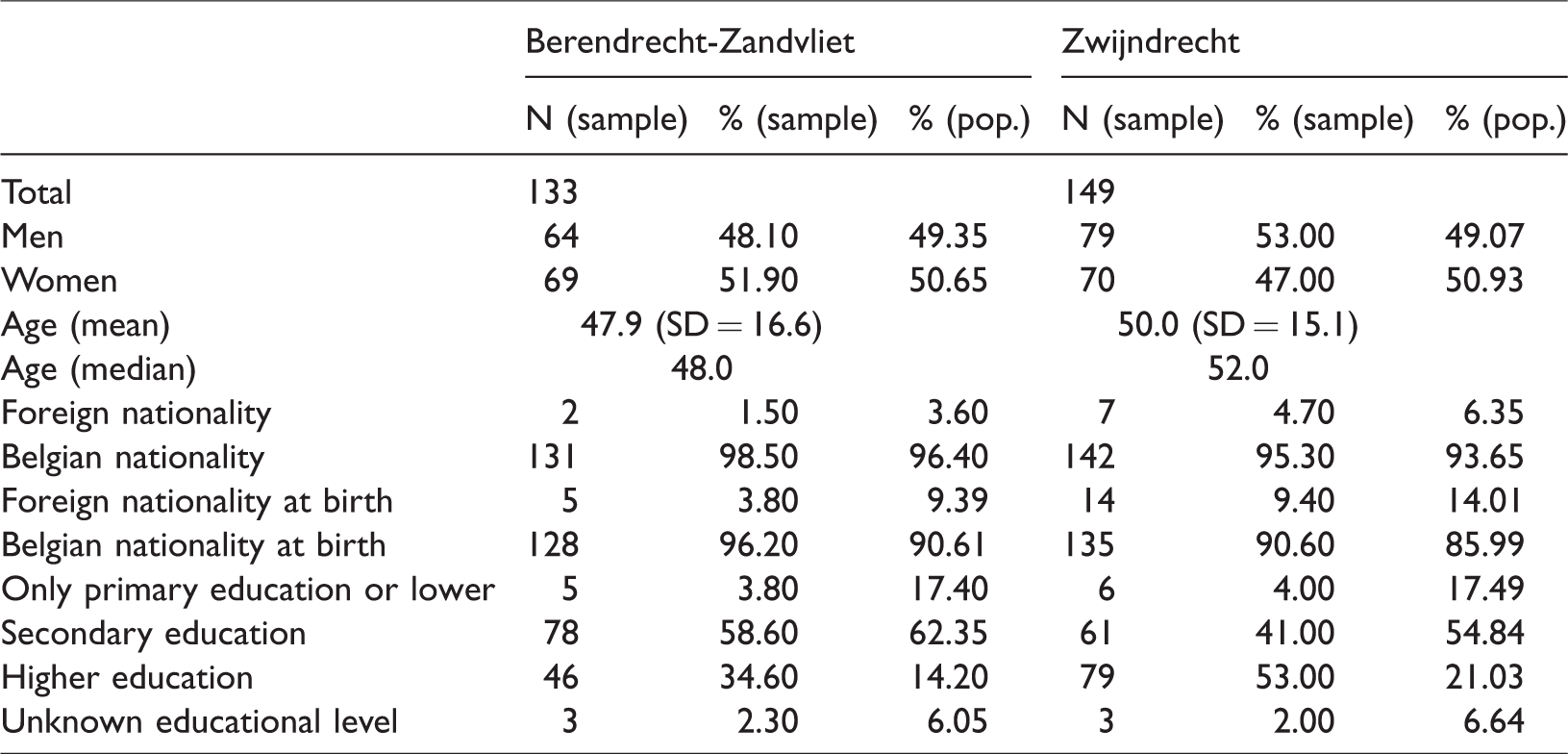
Although relatively small, the samples for both communities can be considered as quite representative (Table 2). In terms of gender and foreign origin, the samples resemble the target populations very well. In terms of age, both samples have an equal distribution, with about as many people from the upper half as from the lower half of the 18–80 range. The representative response from older generations is a strength of the sample, since this group is often missed with online surveys. The biggest deviation from the target populations’ characteristics can be noted for educational level, with a much higher share of higher educated people and a much lower share of people without education in both samples. This is a common limitation of survey research, in Flanders and elsewhere (Demarest et al., 2012).
Sample characteristics and comparison with target populations.
Qualitative interviews
A first series of interviews, carried out in November 2018, targeted eight important local stakeholders of the Antwerp petrochemical complex, such as the Port Authority and environmental organizations. The aim of the semi-structured interviews was to discuss the stakeholders’ knowledge, opinion, and policies on environmental and public health risks associated with the Antwerp petrochemical complex. The interviews helped to define the research objectives and case study communities.
A second series of interviews was carried out in January 2019 and targeted six residents from the two communities (three from each). The initial aim of these interviews was to discuss a draft of the survey questionnaire, but during the discussion all residents spontaneously started to elaborate on their answers, which yielded valuable information on the local embeddedness of opinions and attitudes.
The interviews were all carried out by the author. They were recorded and afterwards transcribed in Dutch and translated to English.
Results: explaining public risk acceptance
The analysis focused on the differences and similarities between both communities in terms of the risk environment and the different factors explaining risk acceptance. The quantitative survey results were interpreted, qualified, and nuanced by looking at the distinctive historical, social, economic, and institutional context of the two communities and by using the interview data.
First, risk acceptance and the constructs of risk assessment, perception of economic benefits, and social trust were analyzed separately. The non-parametric Mann–Whitney U test and the parametric t-test were used to compare the results for both communities, since there is disagreement on which test is most suitable to analyze Likert scale questions and associated constructs (e.g. Harpe, 2015).
Second, a multivariate ordinal logistic regression model for risk acceptance in both communities was developed. It provides insight into the relative importance of the different determinants in explaining risk acceptance. An ordinal logistic regression model was used since the dependent variable has ordinal answer categories. All independent variables could be considered as continuous.
Predominant acceptance but latent concern
The analysis of the two questions on risk acceptance confirmed the basic hypothesis (HA), with similar acceptance levels in both communities (Table 3 and Figure 2). A majority of people is accepting or neutral toward the current risk, though a significant minority of about 30% of respondents in both communities deems the risk unacceptable, pointing to some latent concern.
Difference in average scores on current and future risk acceptance in the two communities.

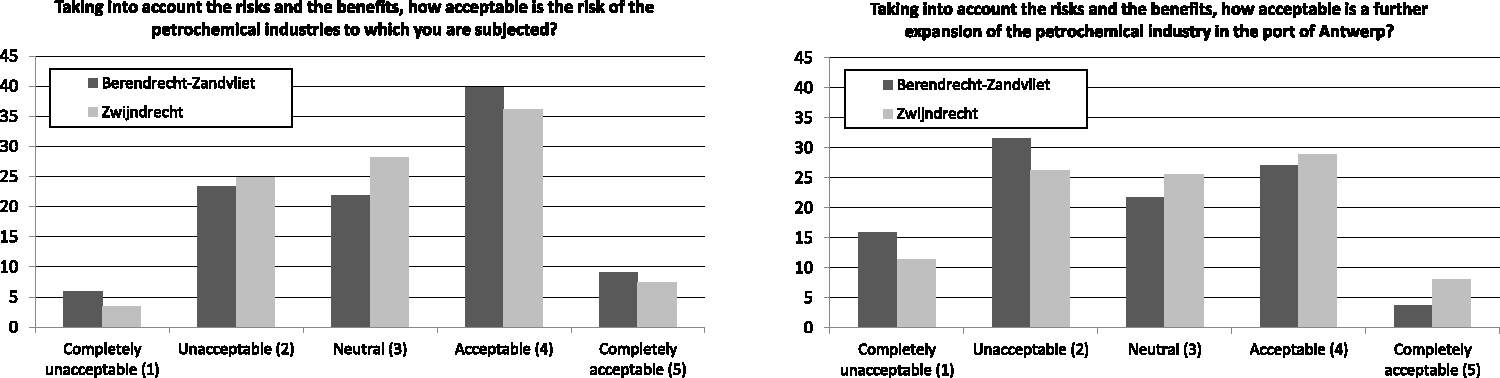
Answer frequencies on questions on current and future risk acceptance.
Looking into a further expansion of the petrochemical complex and a potential increase of risk, acceptance is much lower and opinions are more divided. In Berendrecht-Zandvliet, there is a higher share of people who think it is unacceptable than who think it is acceptable, while in Zwijndrecht both groups are of equal size. However, the difference is not statistically significant.
In general, the interviews with residents confirmed the acceptance of the industry. The argument of the age of the petrochemical complex was often mentioned, with respondents arguing that people should not complain if they moved to the communities when the industry was already operating. For example, one resident said: I also think, if you don’t accept the industry, then you shouldn’t come to live here … you know you are going to live close to the petrochemical industry, you know there are some risks involved, but you also know that everything is strictly regulated and controlled, so everything will stay within limits. … It has been here for such a long time, the people that have known the situation before are now dead or in a care home. (Zwijndrecht resident, Female, Age 30–40)
This argument relates to the longevity and familiarity of the industry, leading to a sense of “inevitability”, a feeling that was particularly strong in Ludwigshafen (Phillimore and Bell, 2005). It goes together with the perception of a fine balance between the costs and benefits, leading to a pragmatic accepting position of the current situation, observed in similar studies around the world (e.g. Atari et al., 2011; Burningham and Thrush, 2004). It was further illustrated by the following statement: I think it is a bit nuanced. On the one hand, there are a lot of people working there, and the petrochemical industry arrived here before we came to live here. So, I think I shouldn’t complain about it. But on the other hand, yes, it’s there, and it affects you in some way, so … there is a kind of balance. (Berendrecht-Zandvliet resident, Female, Age 60–70)
Widespread acknowledgement of environmental impact and risk
While the spatial context and relation with the petrochemical industry are very different for both communities, no significant differences could be noted in terms of the evaluation of environmental impacts or public health risk (Table 4). In general, the risks are acknowledged in both communities. With regard to environmental pollution, especially the presence of air pollution, noise, light pollution, and odors is confirmed. Regarding public health risk, respondents generally agree they are exposed to a higher risk and think this might pose a problem toward future generations. However, they are not very worried about it and definitely do not think the risk has increased in recent years, which is in line with the decreased pollution levels reported by the Flanders Environment Agency (2016).
Difference in average scores on the individual items and constructs on environmental impact and public health risk.
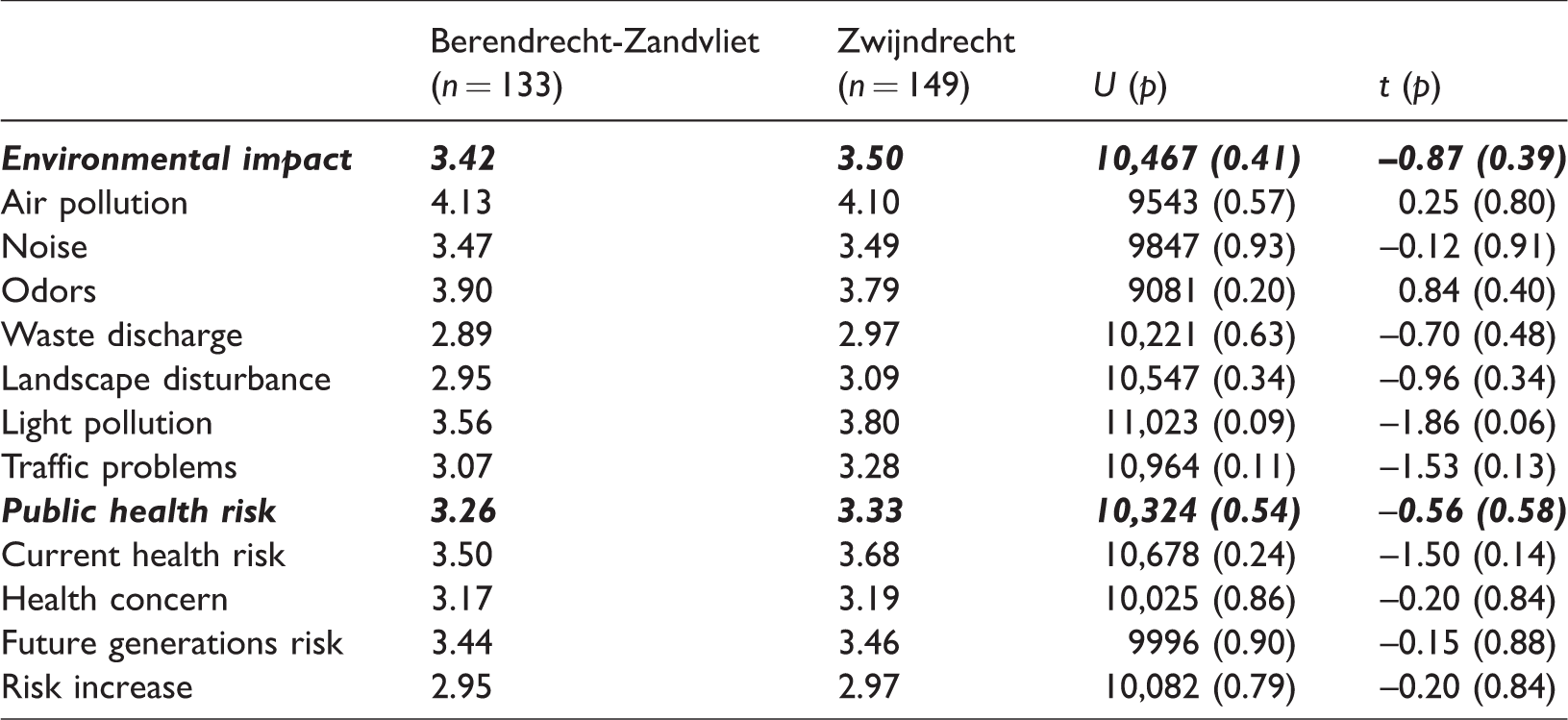
The widespread acknowledgement of a certain environmental impact and elevated public health risk puts the first explanatory hypothesis (H1) in perspective. A denial of substantial risk cannot be the only explanation for risk acceptance. This concern about environmental pollution and health risks was confirmed in the interviews. For example, one resident said: They also say, when something happens, an explosion for example, and the wind blows towards us, that we have to keep doors and windows locked but that there is no danger for our health! … Personally, I think there is always a risk […] They do pollute the environment, indeed, but agriculture also pollutes. (Zwijndrecht resident, Male, Age 60–70)
However, this quote shows that the acknowledged risk is immediately put into perspective and qualified, pointing to the relativity of pollution in an urbanized region where there are many sources of pollution. This view was echoed by another resident, who said: Yes, I think that if you live here, it won’t be as healthy as living somewhere in the Ardennes in a forest, so yes, you can’t ignore it, but well, living in the Antwerp city center in a busy street is also unhealthy, so well, it’s not worse than that. (Berendrecht-Zandvliet resident, Female, Age 60–70)
Appreciation of economic benefits
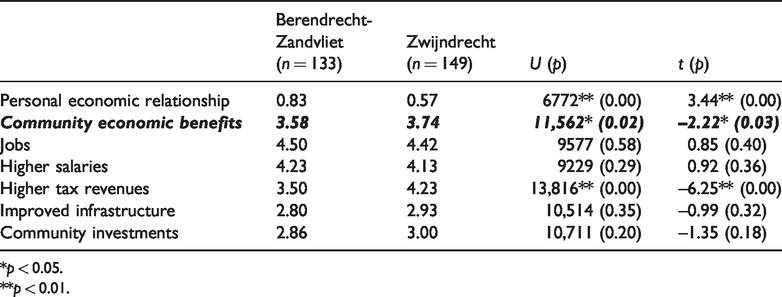
With regard to economic benefits, respondents of Berendrecht-Zandvliet have a closer personal economic relationship with the petrochemical industry than respondents of Zwijndrecht (p = 0.00**) (Table 5). It can be explained by the historical context of the two relatively isolated villages that had to give up their agricultural land but got well-paid jobs in the petrochemical industry, particularly BASF, in return. This historical firm–community relationship was described as follows by one of the interviewed residents:
Difference in average scores on personal economic relationship and the individual items and construct on community economic benefits.
*p < 0.05.
**p < 0.01.
The industry that used to be here was the food industry. Canned food factories, breweries, sugar factories, those kinds of businesses (…). When the port expansion came, it had a big impact as everyone who could and wanted to work, could earn three times as much if they would work for BASF. BASF hired everyone who was a bit skilled. (Berendrecht-Zandvliet resident, Male, Age 60–70)
Zwijndrecht, contrarily, is a suburban municipality, well connected to the city center of Antwerp and the wider region, giving easy access to a variety of jobs and decreasing the dependence on the port industry.
In terms of community economic benefits, respondents from both communities firmly agree that the industry brings jobs and higher salaries and slightly disagree with the effect on infrastructure and community initiatives. However, there is a marked difference in the response to the question on tax revenues. These are significantly more felt in Zwijndrecht than in Berendrecht-Zandvliet (p = 0.00**), explaining the significantly different score for the overall construct (p = 0.03*). The results show that citizens equally value the contribution to the economic prosperity of their community, regardless of their personal economic relationship with the industry. This finding supports the second explanatory hypothesis (H2).
The positive economic image of the petrochemical industry was confirmed in all interviews. Several respondents stressed the importance for the local, regional, and national economy. The industry is particularly known for its high salaries, illustrated by following quote “In general, everyone knows that when you work in the petrochemical industry, you have a very good salary” (Zwijndrecht resident, Female, Age 30–40).
The pronounced difference in the valuation of tax revenues in both communities appears to be caused by the institutional mismatch discussed earlier. In Zwijndrecht, the interviewed residents clearly acknowledged the tax revenues for their municipality, though the good use of this money was often questioned. This qualification of the quantitative result is perfectly captured by following statement: The municipality imposes so many taxes on them [the petrochemical companies], especially in Zwijndrecht, because they live from these tax revenues, that’s true … so in a way it also goes to us, though it’s a different question what they do with all this tax money. (Zwijndrecht resident, Male, Age 60–70)
In Berendrecht-Zandvliet, where all tax revenues flow to the Antwerp city council, several residents acknowledged that the community does not experience any of the benefits of the tax revenues paid by the industry and even suggested institutional reform. For example, one resident said “They would better separate Berendrecht and Zandvliet again from the rest of the city … because if you see which companies are located in this district, it would be another story!” (Berendrecht-Zandvliet resident, Male, Age 50–60).
Ambiguous trust relationships
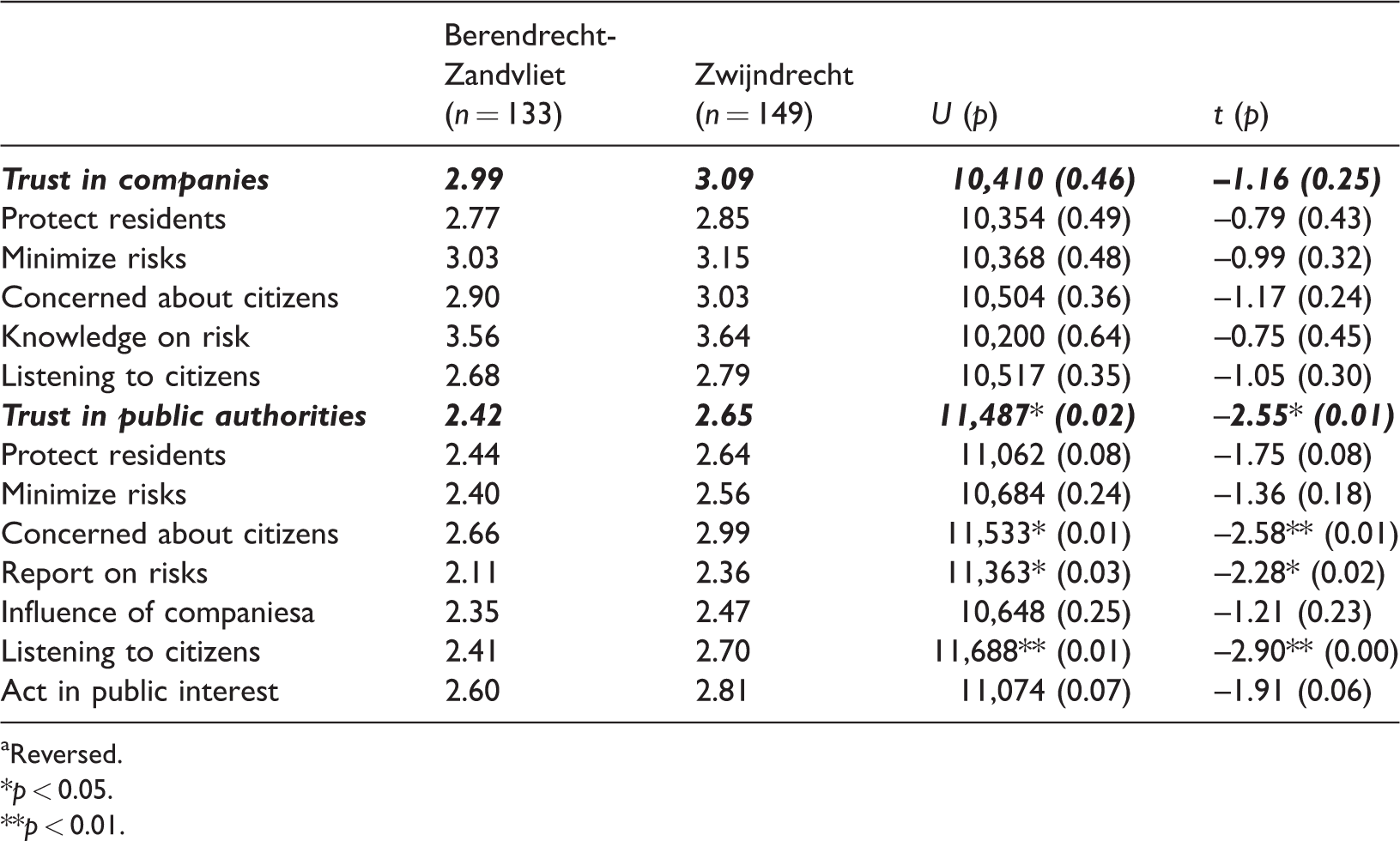
Remarkably, when it comes to risk management, trust in companies is higher than trust in the government (Table 6). There is no significant difference between the two communities for trust in companies, but the level of trust in public authorities is significantly higher in Zwijndrecht (p = 0.01*). This is mainly due to different answers on the statements related to communication with citizens, which might be explained by the institutional context. In the independent Municipality of Zwijndrecht, the local government is close to the people, while the city council of Antwerp is physically and mentally far away from the Berendrecht-Zandvliet residents. Since trust in both companies and public authorities is not particularly high, the third explanatory hypothesis is not fully confirmed (H3). However, this does not exclude that differences in trust can influence risk acceptance.
Difference in average scores on the individual items and constructs on trust in companies and public authorities.
aReversed.
*p < 0.05.
**p < 0.01.
The interviews with residents echoed the ambiguity of the survey results. Most residents believe that companies are willing to care for the immediate environment but are at the same time suspicious about the truthfulness of their concern. This nuanced view was expressed as follows: BASF has started here as a small company with all their workers from Berendrecht or Zandvliet and then, yes, they have grown, but I think they are still a bit concerned about the community […] so to the extent possible they will protect us, but if it doesn’t suit them, then I think we won’t count. (Berendrecht-Zandvliet resident, Female, Age 60–70)
Another resident echoed this view, pointing to the main aim of a company of making profit: I don’t fully trust the companies. Why? Because, yes, they are obliged to do a lot of things and take a lot of things into account, but a company is still thinking about the budget all the time. You can’t ignore that. (Zwijndrecht resident, Female, Age 30–40)
While the previous statement already mentioned the importance of environmental legislation, another resident even put it more firmly: “If you would let all factories do what they want to, without any control or legislation, they wouldn’t be so responsible anymore, then we’re all dead tomorrow” (Zwijndrecht resident, Male, Age 60–70).
The importance of environmental regulations was often mentioned but was not reflected in a higher trust in public authorities. It appeared that residents do not attribute environmental legislation (solely) to the government. One resident of Berendrecht-Zandvliet described the work of public authorities as “invisible” and suggested that all regulations are devised together with the companies: I trust companies more than the government, because I know what they are doing and I don’t know what the government is doing […] yes, they provide the framework and the legislation that companies should follow, but that is also devised together with the companies. I don’t think the government itself does a lot. (Berendrecht-Zandvliet resident, Male, Age 50–60)
This last quote captures the slightly higher trust in the companies due to sheer familiarity with the industry, while the government is a distant or invisible actor. This unusual loyalty and trust is very similar to what was found in Ludwigshafen (Phillimore and Bell, 2005).
A delicate balance
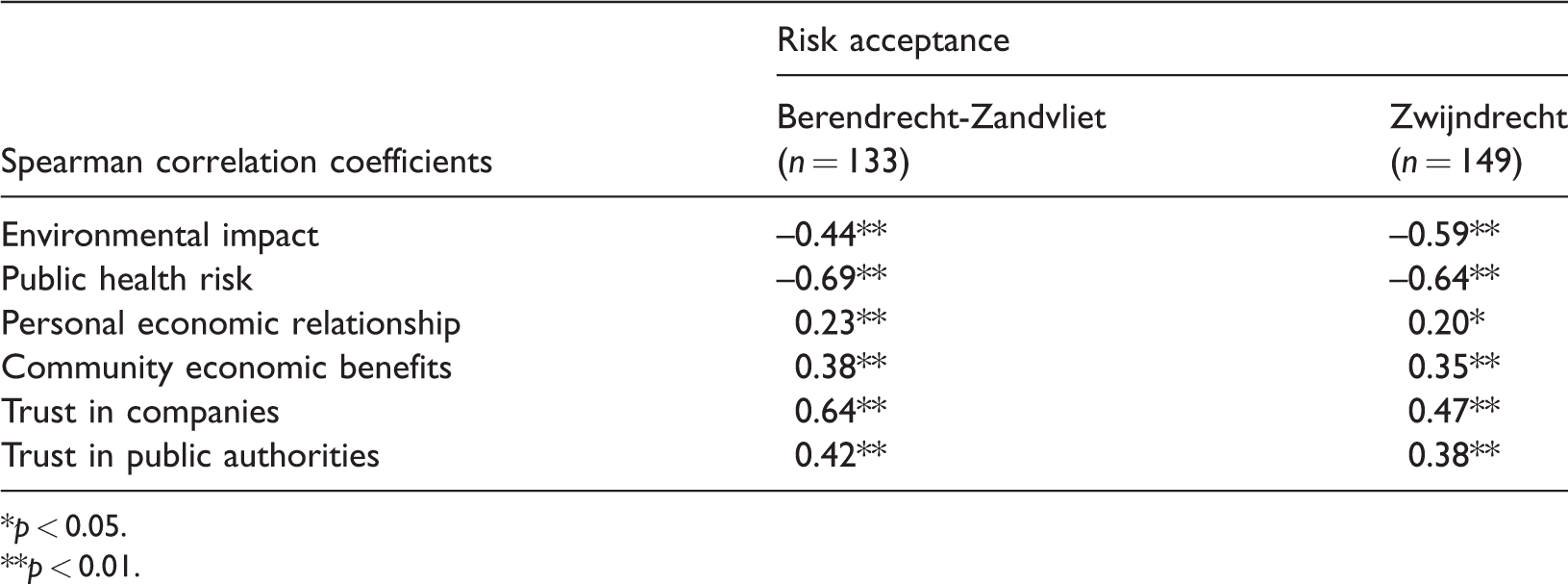
To explain the relative effect of the different determinants on risk acceptance, first correlation coefficients were calculated (Table 7). Unsurprisingly, the perception of the environmental impact and public health risk has a strong negative association with risk acceptance, with the more personal impact of public health risk having the strongest association. More surprising were the results for the economic indicators, with the perception of economic benefits for the community having a stronger association with risk acceptance than the personal economic relationship. Finally, the two constructs of trust demonstrate a strong positive correlation with risk acceptance, with trust in companies having the higher coefficient.
Correlation coefficients.
*p < 0.05.
**p < 0.01.
However, since several of these determinants are associated with each other, two multivariate ordinal logistic regression models were developed to identify the most important predictors of risk acceptance in both communities (Table 8). Both models are moderately strong (0.5 ≤ R2 ≤ 0.7) and explain a significant part of the variation in risk acceptance (p = 0.00**). The parallel line test also shows that the proportional odds assumption holds so the models can be considered valid. The beta coefficients were standardized, providing a comparative analysis of the relative weight of different predictors.
Multivariate ordinal logistic regression model for risk acceptance in both communities, standardized beta coefficients for covariates.
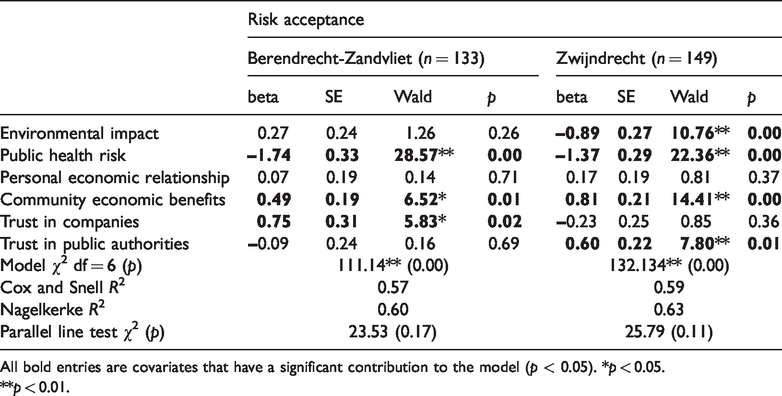
All bold entries are covariates that have a significant contribution to the model (p < 0.05). *p < 0.05.
**p < 0.01.
While the explanatory power of both models is similar, they reveal different patterns. In both communities, the perception of a health risk is by far the most important (negative) predictor for risk acceptance and is highly significant. The perception of an environmental impact is only a significant negative predictor in Zwijndrecht. This can be interpreted as Zwijndrecht residents taking environmental impact into account when evaluating risk acceptance, even if they do not believe in a health risk. In both models, several positive predictors balance the negative ones. The evaluation of economic benefits at the community level is the most important economic predictor for risk acceptance. The strength of a personal economic relationship to the petrochemical industry does not explain additional variety. Finally, while in the case of Berendrecht-Zandvliet trust in companies contributes to risk acceptance, in Zwijndrecht it is trust in public authorities which helps to accept the risk.
Discussion: the need for a community perspective on risk
Most studies on petrochemical communities have focused either on explaining risk perception in a quantitative way (e.g. López-Navarro et al., 2013) or on analyzing risk environments and coping behavior through grounded, qualitative accounts (e.g. Phillimore et al., 2007). The present study adds to this body of research by explaining risk acceptance through a residents’ survey, supplemented with qualitative interviews that helped to interpret, understand, and nuance the results. Instead of following a risk avoidance paradigm, adhered to by many risk society theorists, the work is based on the possibility of an “acceptable” or “tolerable” risk (Ekberg, 2007).
The findings on two middle-class communities adjacent to the Antwerp petrochemical complex confirmed the hypothesis of a relatively widely shared acceptance. This acceptance could be explained by a delicate, community-specific balance of costs, benefits, and trust. The findings support a socio-cultural perspective on risk, with understandings and evaluations of risk being relationally and actively constructed at a local community level (Bickerstaff and Walker, 2001; Irwin et al., 1999).
The importance of a community perspective on risk was reaffirmed when considering the influence of the economic relationship on acceptance of the industry. In both communities, the perceived community-wide economic benefits were more important for predicting acceptance than individual economic dependency. While the pragmatic acceptance of industrial risk as a trade-off for economic affluence has been extensively discussed before (Atari et al., 2011; Phillimore and Moffatt, 2004), this study is one of the first to explicitly compare the relative importance of individual versus community economic benefits.
Besides employment, an important component of the community-wide economic benefits is indirect benefits through tax revenues. The loss of direct control over industrial rates due to local government reorganization was found to be one of the main reasons for growing unease in Grangemouth and Ludwigshafen (Phillimore et al., 2007; Schlüter et al., 2004). This study provided for an interesting comparison between one community (Zwijndrecht) functioning as an independent municipality directly reaping the benefits, and another community (Berendrecht-Zandvliet) seeing tax revenues flowing away to a much larger governing body. It is very likely that this institutional difference has contributed to a higher valuation of tax revenues by respondents from Zwijndrecht, and consequently a greater appreciation of community economic benefits. Moreover, together with the proximity of the local government, this tax revenue aspect might be associated with the level of trust in public authorities, which was found to be greater in Zwijndrecht, significantly contributing to the community’s risk acceptance.
This interpretation of trust conflicts with the traditional role attributed to trust in situations of industrial risk. According to that view, citizens need to rely on regulators or industries to overcome the problem of access or complexity of information and to protect them from possible harm (Ter Huurne and Gutteling, 2009). Consequently, it would be the work of regional and international authorities that could lead to trust, since they established and enforce the environmental regulatory framework. However, in the present study, citizens interpreted “public authorities” as “local authorities”, with trust invoked by the belief in a correct trade-off of risks and benefits. Although underrating the role of other government levels, this local interpretation still fits Siegrist et al.’s broader definition of trust, expressing the extent to which one expects the other to act in line with one’s own needs and interests (2001).
In the case of Berendrecht-Zandvliet, trust in companies plays a particularly important role. One explanation for this effect is the long-shared history and mutual understanding between the villages and the BASF plant, an aspect mentioned in several interviews. This might have led to an unusual loyalty to and trust in BASF, similar to what was found in Ludwigshafen (Phillimore and Bell, 2005). However, the longevity of the industry itself might not be the only factor. It seems likely that the communication efforts of BASF also have a large effect on risk acceptance in Berendrecht-Zandvliet. BASF is the only petrochemical plant in the Antwerp port area that has set up a dedicated neighbor platform, together with a community magazine and a helpline. This explanation is line with previous research that stressed the importance of effective company–community communication for public risk acceptance of a petrochemical plant (López-Navarro et al., 2018).
Strengths and limitations
The present study is the first to have investigated risk perception and acceptance of the largest European petrochemical complex, at a time when the petrochemical industry is increasingly contested due to its role in the plastics crisis and shale gas extraction. The comparative residents’ survey provides an insight into the different factors that define a community’s acceptance of a nearby high-risk industry. Additional analysis of the historic and institutional context of the two communities, and a small number of qualitative interviews, helped to interpret and understand the survey results from a socio-cultural perspective, but also pointed to a greater ambivalence.
However, the study has some inevitable limitations. First, only a few specific predictors were investigated, excluding other community-specific aspects like place attachment, social network, and personal sensory experiences of pollution, which could all be important underlying factors. Second, while the interviews provided some explanation and interpretation, the pathways from the different predictors to risk acceptance were not systematically investigated. It is impossible to firmly state why trust in companies or trust in public authorities has different effects in the two communities, though some plausible interpretations were discussed. More in-depth qualitative interviews could be carried out to gather additional layers of information and explanation, adding to the quality of the analysis. Finally, the study focused on only two communities, making it impossible to evaluate which patterns are community-specific and which are typical of these kinds of places. However, the use of previously validated constructs on environment impact, risk, economic benefits, and trust could facilitate future comparative international analysis.
Policy implications
While the Antwerp petrochemical complex is accepted by a majority of people in nearby communities, the present analysis shows that this feeling is not shared by everyone, and that most people are concerned about a future expansion. Logically, the multivariate models do not only explain what the most important predictors are for accepting the risk, but also for not accepting the risk. The concern about a public health risk among the non-accepting minority is unsurprising, but this group is further characterized by a lower belief in the community economic benefits of the industry and a lower level of trust in companies (Berendrecht-Zandvliet) and public authorities (Zwijndrecht). These findings can give inspiration for strategies to achieve wider (future) acceptance among the community. Strategies are diverse and can range from reduction of emissions and stronger enforcement of environmental regulations, to better communication about public health impacts and economic benefits, as well as working on the trust relationship.
Continuous efforts to enforce and tighten the environmental regulatory framework at national or international level remain crucial for guaranteeing minimum environmental standards. However, given the precarious balance of environmental risk, economic prosperity, and trust in risk management, it is in the interest of all parties that more is also being invested in local community engagement in environmental decision-making. Finding a fair balance is ultimately a normative question, requiring some form of democratic deliberation, ideally between citizens, companies, regulators, local governments, and experts.
BASF’s neighbor platform is a step in this direction, but it also falls short in several ways, since it is not independent, only includes the company and the community, and merely focuses on sharing information and building trust, instead of inviting citizens to actively engage in decision-making. To achieve real procedural justice, we should move to more democratic, independent, and pluralistic decision-making platforms, where environmental, social, and economic issues can be addressed together, as such contributing to local sustainability (Burningham and Thrush, 2004). They could also give voice and recognition to those who have real concerns about the risk and are less accepting.
These platforms could, for example, take the form of the institutionalization of public oversight of high-risk facilities, an idea suggested by Schlosberg (2009). Such permanent advisory committees could provide a platform for participation, information sharing, and discourse across difference, with representatives from the industry, public authorities, and the local community working together. The present study supports the view that in a quickly changing petrochemical industry, where new challengers and technologies are bringing disruption and causing public concern, such local democratic decision-making platforms should be established proactively, to ensure a continuing relationship of trust and maintain a fair balance of economy and environment.
Highlights
A residents’ survey and interviews were carried out in two middle-class communities next to the Antwerp petrochemical complex A relatively widely shared acceptance of the complex was found, resulting from a delicate balance of costs, benefits, and trust Community socio-economic benefits had a much larger effect on risk acceptance than individual economic benefits through employment Trust in companies was generally larger than trust in the government and was strengthened by a close socio-historical relationship Trust in the government’s risk management was separated from environmental legislation and mainly depended on the local institutional situation
Footnotes
Acknowledgements
I am indebted to Professor Rosemary-Claire Collard and the three anonymous reviewers for their constructive comments. I thank all survey respondents, the local stakeholders in Antwerp who shared their time and experience with me, and the volunteers who were willing to take part in a pilot study. Thanks also to Alice Mah (PI for the Toxic Expertise project), Calvin Jephcote, David Brown, and Thom Davies for their advice during the research process and their feedback on earlier drafts of this article. Finally, I am grateful to the practical assistance of Chris Waite and Patricia Verbeek in carrying out the survey research. An early version of this article was presented at the AESOP 2019 conference in Venice.
Declaration of conflicting interests
The author(s) declared no potential conflicts of interest with respect to the research, authorship, and/or publication of this article.
Funding
The author(s) disclosed receipt of the following financial support for the research, authorship, and/or publication of this article: This project has received funding from the European Research Council (ERC) under the European Union’s Horizon 2020 research and innovation program (Grant Agreement No. 639583).
