



Abstract
This article introduces the concept of “noxious deindustrialization”—employment deindustrialization in areas where significantly noxious industries are still operating—and explores some implications of this paradox by studying community–industry relations in the Scottish petrochemical town of Grangemouth. In the heyday of “Boomtown Grangemouth” during the first three decades after World War II, there existed an implicit social contract between the local industry and community in which male fenceline residents had widespread access to secure and well-paid employment in the factories, but the community had to accept the related pollution and hazards. This social contract gradually declined since the late 1970s due to a combination of automation, rising qualification barriers and associated long-range recruiting, and outsourcing to a partially itinerant workforce. For the Grangemouth community, this trend led to the current situation of employment deindustrialization coupled with the continuing exposure to the socioenvironmental damage and hazards engendered by operating petrochemical plants. We argue that noxious deindustrialization—with its dystopian corollaries of rising inequality and precarity, cumulative environmental degradation, and loosening community ties—is happening both globally and in local areas and that Grangemouth is a dramatic example of noxious deindustrialization on a local level, where the phenomenon has put a strain on community–industry relations.
Introduction
“I grew up amid Manchester’s smokestacks. I want to put the factories back” is the title of a Sunday Times interview with billionaire businessman Jim Ratcliffe, in which the CEO and main owner of petrochemical company INEOS states his vision for a fracking-powered 1 Brexit that will deliver manufacturing jobs to the areas of the United Kingdom (UK) most hit by deindustrialization (Arlidge, 2017). Indeed, “smokestack nostalgia” (Cowie and Heathcott, 2003) has played a major role in recent public debates in many Western countries, as the heyday of post-World War II (WWII) industrial growth is widely remembered as a time of rising prosperity and security (Tomlinson, 2017). However, as this research contributes to show, operating factories do not come with such benefits anymore.
“Grangemouth has got all the symptoms of a town that industries left it,” 2 asserted a retired petrochemical worker from the Scottish town hosting INEOS’ refinery and petrochemical complex. At first blush, this claim seems paradoxical, even absurd, for a place where the smokestack fumes are visible throughout the day and an orange glow shines all night, where the smell of chemicals is familiar to all inhabitants just as much as the flames and vibrations produced by heavy flaring. 3 Yet, the participant was referring to a very real phenomenon that we call “noxious deindustrialization,” that is, employment deindustrialization in areas where significantly noxious industries are still operating.
The “noxiousness” in noxious deindustrialization is a translation of the Italian word “nocività,” which indicates the property of causing harm. Through its use by the Italian labor movement, the word came to refer to production-induced damage against both human and non-human life (Feltrin and Sacchetto, 2021). Noxiousness thus understood goes beyond emissions and accidents to encompass the hazards for mental and physical health engendered by the rising social inequality, precarious work patterns, and loosening community ties associated with noxious deindustrialization.
In our definition, noxious deindustrialization is an on-going and self-reproducing process linked to operating plants. Therefore, noxious deindustrialization differs from the toxic legacies of past production—for example, the longstanding contamination of soils and waters (Mah, 2012)—and from the social disruption caused by deindustrialization—for example, rising rates of depression and drug addiction (McIvor, 2017)—after the factories have closed. Additionally, as employment deindustrialization is measured by the share of manufacturing in total employment in a given area, noxious deindustrialization is a scalable concept: it can be applied to particular fenceline communities—that is, communities exposed to the localized noxious impacts of the industry—as well as to the national, regional, and global levels. As shown below, noxious deindustrialization is happening on a global level too.
In this article, we deploy the concept of noxious deindustrialization to innovatively connect deindustrial studies with political economy on the one hand and environmental justice studies on the other hand. In political economy, deindustrialization most often refers to declining shares of manufacturing in total employment, regardless of industrial output (e.g., Benanav, 2020; Rowthorn and Ramaswamy, 1997). 4 “Noxious deindustrialization” is thus, more precisely, “noxious employment deindustrialization,” but the shortened phrase is used throughout the article for the sake of brevity. Deindustrialization thus defined can very well coexist with continuing or even growing industrial production. This understanding is quite different from the one offered by deindustrial studies, which venture beyond the statistics to foreground the human costs of deindustrialization through recounting the lived experiences of workers and industrial communities facing plant closures (see Mah, 2012; High et al., 2017).
The main focus of environmental justice studies, instead, is the uneven distribution of the burdens caused by polluting and hazardous industries (Davies, 2018; Lerner, 2012). Therefore, while deindustrial studies focus on the sufferings brought to communities by factory closures (e.g., unemployment and weakening community ties), environmental justice studies conversely foreground the strains generated by operating factories (e.g., environmental degradation and health effects). These two sets of problems are usually seen as mutually exclusive, yet—if deindustrialization is understood in terms of employment shares rather than as plants shutting down—they can be visited upon populations simultaneously.
Deindustrial studies have not detected the phenomenon of noxious deindustrialization, as they have focused on the localized impacts of factory closures more than on the macro-employment patterns analyzed by political economy and the unequal distribution of industrial burdens analyzed by environmental justice studies. However, our research shows that the insights developed by deindustrial studies on the crises experienced by deindustrialized communities—in terms of the betrayal of former social contracts (Phillips, 2013), deindustrial ruination as a protracted and multifaceted decline (Mah, 2012), demoralization and loss of purpose (McIvor, 2017), and enduring nostalgia (Cowie and Heathcott, 2003)—usefully contribute to make sense of noxious deindustrialization too.
This research explores noxious deindustrialization through the perceptions of fenceline residents in Grangemouth, Scotland. Through waves of automation, long-range recruiting, and outsourcing, employment deindustrialization has indeed occurred in the very capital of the Scottish petrochemical industry. In the three post-WWII decades, the Grangemouth branches of British Petroleum (BP) and Imperial Chemical Industries (ICI) substantially contributed to the local employment and tax revenues that made the town thrive. This constituted the basis of an implicit social contract between the community and the petrochemical industry in Grangemouth, that is, an understanding of mutual obligations that was seen as broadly acceptable by both parties. Yet, as our findings show, changing employment and fiscal patterns gradually unraveled the social contract towards the current situation of noxious deindustrialization, in which the fenceline community no longer significantly benefits from the industry in terms of jobs and public services, but is still exposed to its socioenvironmental noxiousness.
In a nutshell, this article argues that noxious deindustrialization is happening both globally and in local areas, and that Grangemouth is a dramatic example of noxious deindustrialization on a local level, where the phenomenon has put a strain on community–industry relations. This research thus makes an original contribution to the existing literature by introducing and exploring a new concept that connects deindustrial studies to political economy and environmental justice studies.
The first section of the article is a methodological note. In the second section, we discuss noxious deindustrialization on a global scale and relate the concept to different bodies of literature. In the third section, we analyze the fraying of the post-WWII social contract between the Grangemouth community and the petrochemical industry. The final section describes how the paradox of noxious deindustrialization is experienced by the Grangemouth residents who participated in this research.
Methodology
This research combines a discussion of general trends with an in-depth study of community–industry relations in Grangemouth. The thesis of noxious deindustrialization on a global scale is supported by an analysis of statistics, secondary sources, and our previous multi-site research for the Global Petrochemical Map. The exploration of noxious deindustrialization in the case of Grangemouth is based on original fieldwork conducted between April and October 2019. We chose Grangemouth as an iconic case study of a petrochemical town in the UK, as part of a larger comparative study, “Toxic Expertise: Environmental Justice and the Global Petrochemical Industry,” examining petrochemical industrial communities around the world.
The Global Petrochemical Map is an online public resource including 75 reports on petrochemical complexes across the world that was launched by the Toxic Expertise project in 2019. 5 The Map’s cases were selected based on geographic distribution, economic significance, and the intensity of community mobilizations and industrial disputes. The reports supply information on industrial production and histories, fenceline communities, health and environmental impacts, community mobilizations, and industrial disputes for each case.
Fieldwork in Grangemouth featured three focus groups and ten semi-structured interviews with a total of 30 participants, 10 females, and 20 males. The focus group members volunteered to share their views after we publicized a call for participants offline and online (e.g., via flyers and social media groups). The focus groups included local residents from a range of age groups—with the youngest being in their thirties and the oldest in their seventies—and backgrounds, including current and previous industrial workers. Participant sampling in the focus groups reflected those willing to engage in the discussion and with the free time to do so. Meanwhile, the one-to-one interviewees were selected because of their roles as community activists, public officials, or workers with experience in the petrochemical industry. They were contacted through their institutions or through “snowballing” from previous participants.
The interviews and focus groups explored the participants’ understandings of the evolution of community–industry relations in Grangemouth. The questions revolved around perceptions of Grangemouth as a place to live, of the benefits and burdens related to the petrochemical industry, of the evolution of employment and environmental trends, of the role of public authorities, and of potential solutions to the problems flagged by the participants. Both the focus groups and interviews were semi-structured and open, driven by the participants’ concerns. Research on Grangemouth also incorporated statistics, reports by public authorities, documents released by the industry, and news articles.
Noxious deindustrialization and the erosion of Fordist social contracts
The petrochemical sector expanded spectacularly during and after WWII, in the so-called “Fordist” phase of capitalist development (Neilson and Rossiter, 2008). In the context of the Fordist class compromise, implicit community–industry social contracts were established in several localities, with residents gaining access to well-paid, secure jobs in exchange for the acceptance of pollution and hazards. Such social contracts differed widely depending on contextual factors and their benefits were unevenly distributed, as the Fordist compromise itself was built on manifold global exclusions along gendered, racial, imperial, and environmental lines (Brand and Wissen, 2021). 6 However, class struggles and competitive pressures, particularly from the 1970s onwards, resulted in the gradual erosion of many community–industry social contracts. This section analyses two trends that contributed to such erosion, employment deindustrialization and cumulative noxiousness, with a focus on the petrochemical industry. The outcome of these tendencies combined is noxious deindustrialization.
A debate is underway on whether employment deindustrialization on a global scale is caused by automation, and on whether the latter poses a danger of endemic joblessness. Some authors argue that threats to employment levels are due to the prowess of digital technologies (e.g., Schwab, 2016). However, Aaron Benanav has shown that profit-driven technological change has led to global employment deindustrialization and growing underemployment in recent decades not because of exceptionally high productivity gains but because of exceptionally low output growth (Benanav, 2020). In other words, global economic growth is so slow that even modest productivity gains are faster, and thus have an impact on employment.
Nonetheless, automation and slow growth are best seen as interrelated, as Alexis Moraitis and Jack Copley note in their sympathetic critique:
Benanav’s contention that it is stagnation rather than automation that is the cause of low labor demand creates an unnecessary dichotomy between these two processes, overlooking their intrinsic link. In fact, today’s downturn mirrors yesterday’s high productivity growth. In capitalism, stagnation is not the radical opposite of technological progress, but its necessary outcome (Moraitis and Copley, 2021).
The combination of automation and slow growth leads to employment deindustrialization as a global phenomenon, as countries that never reached high levels of industrialization “import” deindustrialization together with cheap manufactured products (Rodrik, 2016).
Automation is a longstanding trend in the petrochemical sector, a typical capital-intensive branch (Hanieh, 2021). Programmable logic controllers and distributed control systems started to be deployed in the 1970s (Seborg, 2009), while the most recent innovations are categorized as “Industry 4.0,” that is, the articulation of the Internet of Things, cloud technology, and big data in productive processes (Schwab, 2016). Digitalization represents a leap forward in the automation of the collection, processing, and communication of information, but also in the surveillance of the workers (Moore et al., 2018).
In a context of low or negative output growth, the erosion of jobs affected by technological change advances more rapidly than the creation of new employment elsewhere in the economy at comparable relative wages and conditions. As most people still need to work for a living, the outcome—rather than mass unemployment—is a relative decrease in the share of secure, core workers and increasing precarity in countries and sectors that used to guarantee certain levels of job security to parts of their workforces (Benanav, 2015).
The dualism between direct employees and outsourced workers existed in the petrochemical industry even in the heyday of the vertically integrated Fordist company, for example, in the construction of the plants and in periodical maintenance. Since the neoliberal rise of “lean manufacturing”, however, a widening range of tasks has been assigned to contract workers through a bewildering array of juridical forms that varies depending on national regulatory frameworks. These tasks include “peripheral” activities such as cleaning, catering, gardening, and security but have come to also encompass logistics and a significant share of all-year maintenance (Lafuente Hérnandez et al., 2016). On average, outsourcing means shorter tenures, lower wages, and worse conditions relative to in-house jobs. This arrangement further fragments the workforce, makes it more geographically mobile, heightens the competition among workers, and weakens union leverage. Unsurprisingly, outsourced workers tend to be those most exposed to workplace hazards (see Rebitzer, 1995).
While outsourcing is a general trend, the petrochemical sector presents some specific characteristics. The first is that “In continuous or process industries, in which human labor – particularly maintenance – is disconnected from the automatic functioning of the machines, it is even more difficult to distinguish between core ‘productive’ activities and ‘auxiliary’ ones” 7 (Lafuente Hérnandez et al., 2016: 153). Secondly, petrochemical plants need to periodically halt production for weeks to perform major maintenance and renovation works. During such shutdowns, the ratio of outsourced over in-house workers increases significantly, as specific and itinerant professional figures are brought in the host plant, some of them highly specialized. In fact, the outsourced workforce is itself steeply stratified, from relatively unskilled tasks (e.g., cleaning and hazardous maintenance) to highly skilled ones (e.g., specialized technical maintenance).
Additionally, technological change in large-scale industry contributed to transforming the skills composition of its workforce. In fact, automation is based on the objectification of workers’ previously “clandestine” knowledge (Alquati, 1963), which—before being incorporated in the machines—could only be gained through learning-by-doing on the job. Instead, the codified knowledge required to operate highly automated industrial systems must be acquired through formal education. There is thus a generalized shift from particularistic to universalistic skills in the core workforce of large-scale industry (Charnock and Starosta, 2018: 338). As a consequence, fewer fenceline community members are able to make inroads in it, because the fewer jobs available are awarded not based on geographical convenience and informal, localized mechanisms of skills transfer, but according to rankings in formal, deterritorialized educational proficiency.
On the other hand, the petrochemical industry has increasingly become the target of concerns over the noxiousness caused by greenhouse gases and plastic waste—impacting on the global environment—and industrial hazards and toxic emissions—mainly threatening petrochemical workers and fenceline communities on a local level.
For what concerns its localized collateral damage, the petrochemical sector underwent numerous high-profile accidents that resulted in many deaths of residents and workers, such as the Flixborough disaster in the UK (1974), the Los Alfaques disaster in Spain (1978), and—by far the worst—the Bhopal catastrophe in India (1984). Less visible but just as deadly, the “slow violence” of toxicity (Nixon, 2011) has also taken a high toll on residents and employees exposed to carcinogenic substances such as benzene (Jephcote and Mah, 2019) or vinyl chloride (Markovitz and Rosner, 2002).
In recent decades, health and environmental standards have overall improved due to increasing regulation. Yet, green techno-fixes in large-scale industry have been offset by output growth and the cumulative nature of environmental degradation. It is the accumulation of noxiousness that has led to today’s planetary ecological crisis, with its well-known predicaments including global heating, biodiversity loss, soil depletion, persistent plastic pollution, etc. Such accumulation makes moderate improvements in the environmental performance of large-scale industry insufficient to tackle the ecological crisis. This probably contributes to explain the apparent contradiction that environmental sensibility is more widespread today than when industry was in fact more polluting. As a major contributor to climate change and toxic pollution, the petrochemical industry is still unsustainable and unhealthy, according to environmental campaigners and public health experts (Azoulay et al., 2019; Mudu et al., 2014).
The disembedding of the workforce from local communities lowers the latter’s incentives to overlook industrial noxiousness and—combined with the general increase of public environmental awareness—enhances the likelihood of community–industry tensions, as documented in many cases across the world (e.g., Allen, 2003; López-Navarro, 2020; Sun and Huang, 2020). Consistent with the key thesis of environmental justice studies, the noxious burdens of the petrochemical industry tend to fall disproportionately on minority and low-income communities (Lerner, 2012). In North America, framings around environmental racism are foregrounded as many sites were built in the proximities of minority communities (e.g., Davies, 2018). In these cases, the local communities never benefited from a relatively favorable social contract, as their members had little access to jobs in the factories’ core workforce. In Europe, the plants are more often located by communities whose members used to have widespread access to employment in the factories. Today these communities remain mostly working class, albeit less industrially employed, and thus class-based framings are more prominent (e.g., Bush et al., 2001).
If yearly CO2 emissions are accepted as an admittedly simplistic proxy for noxiousness, the intersection of employment deindustrialization and noxiousness on a global scale—global noxious deindustrialization—can be visualized in the graph below (Figure 1). The graph includes both total and industrial CO2 emissions because it is useful to consider not only the noxiousness released by industrial production directly, but also the noxiousness generated by industrial products when used by their consumers. The proxy is indeed simplistic, because it is possible to imagine a situation of noxious deindustrialization in which CO2 emissions are brought to net zero, but the ecological crisis persists due to other forms of noxiousness (e.g., fossil fuels could be substituted with nuclear energy, but this could generate its own environmental degradation). However, comparing manufacturing employment and CO2 emissions still allows for some useful observations. Global noxious deindustrialization (base year = 1991). Source: ILOSTAT and Climate Analysis Indicators Tool.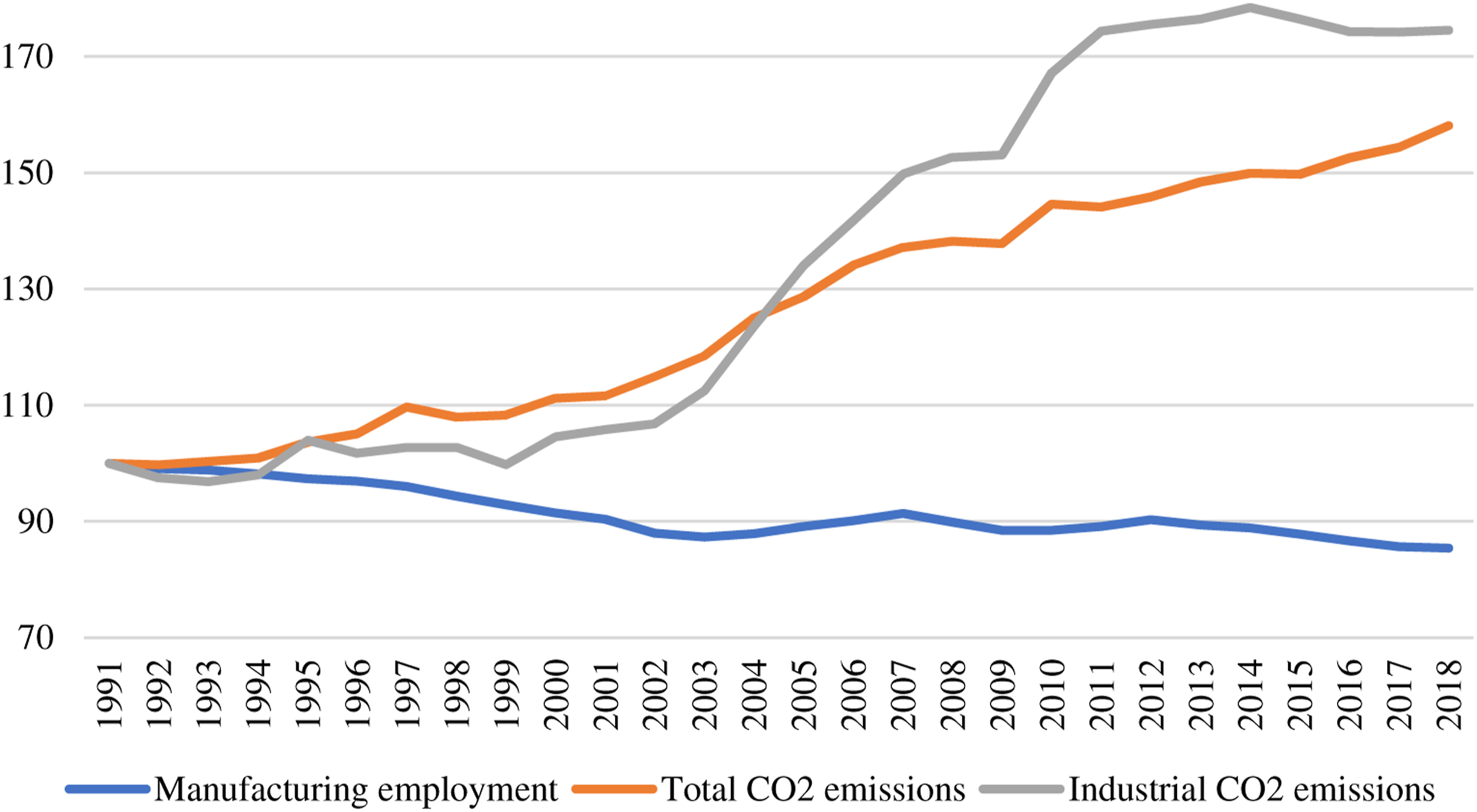
ILOSTAT estimates on the global share of manufacturing employment are available from 1991 only. According to them, the figure has slowly declined from 16.4% in 1991 to 14% in 2018. In the same period, total yearly CO2 emissions increased from 23 to 36 billion tons, and yearly emissions generated by industrial production rose from 4.4 billion tons to 7.6 billion tons. 8 Since the dawn of capitalism, the global share of manufacturing employment and CO2 emissions have long increased in tandem. However, as Figure 1 indicates, at some point of the second half of the 20th century, there has been a decoupling between the two historical series: the share of manufacturing employment peaked while yearly CO2 emissions continued to soar despite improvements in the environmental performances of industry, mainly due to the rise in global output over this period. Of course, these global trends are iterated in extremely different ways across countries, depending on the timing and scale of national-level industrialization.
Behind the dry statistics lies the ruination of the livelihoods and modes of existence of millions of households and thousands of communities foregrounded by deindustrial studies (see High et al., 2017; Mah, 2012; McIvor, 2017; Phillips, 2013). On a local level, indeed, noxious deindustrialization was a key factor in the erosion of the post-WWII community–industry social contract in sites where such compromise used to be in place. While unevenness, context, and exceptions should be stressed, our research for the Global Petrochemical Map confirmed that such localized developments are far from rare.
The concept of noxious deindustrialization thus provides a bridge between the analysis of general employment trends and their effects in terms of inequality and precarity (the domain of political economy), the in-depth study of the fragilization of former industrial communities (the domain of deindustrial studies), and the investigation of the unequal environmental and health burdens of industry (the domain of environmental justice studies).
Grangemouth is a dramatic example of noxious deindustrialization, as the steep fall in the quantity and quality of industrial jobs available to the locals—coupled with a decline in tax revenues—unfolded in the shadow of the uninterrupted operations of the largest petrochemical complex in Scotland. Research on community–industry relations in Grangemouth in the early 2000s concluded that: “Today this is a town in crisis. In a mood of growing pessimism and distrust, public doubts about the economic security and environmental safety of the town have provoked increasingly vocal local opposition to planning applications which would extend activity in chemicals while economic diversification is denied” (Schlüter et al., 2004: 715). In the following sections, we show how—15 years later—community–industry relations deteriorated even further.
From Scotland’s Boomtown to dumping ground? The erosion of the community–industry social contract
Grangemouth’s industrial zones, located in the Falkirk Council area, constitute Scotland’s main petrochemical center. In 1919, the chemical plant Scottish Dyes Ltd was established and in 1928 it was bought by ICI. Grangemouth’s original refinery, instead, was built in 1924 by the Anglo-Persian Oil Company, which would become BP 30 years later. The refinery increased its capacity in the 1940–1950s and further expanded in the 1970s after the discovery of North Sea oil. In 1951, BP also established its petrochemical plants at the site. The town grew around its industry, with housing built by the council and BP to shelter a burgeoning workforce.
In the 1990s, the former ICI site was restructured, downsized, and later divided between a number of companies. In 2005, BP sold its refinery and petrochemical plants to INEOS, a private company founded by Jim Ratcliffe in 1998, which swiftly rocketed to the top 10 chemical companies worldwide. Additionally, INEOS owns the two power stations servicing the industrial complex. Since 2011, the refinery belongs to Petroineos, a 50:50 joint-venture between INEOS and PetroChina. In 2017, INEOS also acquired the Forties Pipeline System, which delivers almost 40% of the UK’s North Sea oil and gas production (Thomas, 2017). According to the company, its assets in Grangemouth produce nine million liters of fuels per day and over 1.3 million tons of chemicals per year, contributing 4% of Scottish GDP (INEOS, 2020a). In addition to INEOS’ assets, Grangemouth hosts the plants of other chemical companies (CalaChem, Fujifilm, Syngenta, and Versalis), the largest container port in Scotland, and some non-chemical factories.
The overarching theme of our fieldwork was Grangemouth’s decline relative to the three post-WWII decades, when it was called “Scotland’s Boomtown.” During an interview, one of the first women in Grangemouth to have worked on the shopfloor of a petrochemical plant recalled: Grangemouth was a great place to grow up because the Council were forward-thinking, and you didn’t really have to leave the town for anything. We had superb sports facilities. […] The Council here were very accommodating to the industry because they knew what side their bread was buttered on. With the high taxes and things and I don’t think they got away with anything, but they were appreciated much more so than they are now.
9
The boom period was followed by a multifaceted decline—in prosperity, population, reputation, community cohesion, industrial jobs for the locals, employment terms and conditions, tax revenue, public services and transport, housing and infrastructure, industry contributions to the community, activities in the town center, etc.—leading to a self-reinforcing downward spiral: “Like a cancer, the whole thing is feeding off itself, you know?” 10 commented a community volunteer during a focus group. This story of ruination is strikingly similar to those of former industrial towns, and yet industry in Grangemouth is alive and well.
In Grangemouth, post-war nostalgia overwhelmingly coincides with BP nostalgia (and to a lesser extent ICI). In “the golden years,” BP was “a good company to work for,” “something to be proud of,” “helpful and supportive,” “family oriented,” “part of the community,” “at a different level,” “just incredible,” “you know, great.” Compare and contrast with comments on INEOS—“very bad neighbors,” “hard-headed,” “secretive,” “ridiculous”—and Jim Ratcliffe—“loose cannon,” “very immoral,” “bully-boy,” “absolute rat.” BP and ICI’s paternalism towards the community—their local social clubs and large donations to events, projects, and individuals—is often contrasted to INEOS’ “bare minimum,” “tick box,” “too little, too late.” 11 Yet, the main points of comparison are that during BP and ICI’s early age most workers employed in the industry resided in Grangemouth and the town received abundant tax revenues relative to today.
The decline of local employment in the petrochemical industry is the complaint that was most often foregrounded. As a civil servant noted, “When Grangemouth grew, particularly in the petrochemical sector, people didn’t have cars and things, so there is some fantastic footage […] and everyone is commuting to work locally by bicycle. […] You’d think it was Beijing in terms of that, so the people that did work in the area worked and stayed in the area.” 12 The slow-motion downfall of Boomtown Grangemouth began with BP’s piecemeal privatization, which occurred between 1977 and 1987. This was accompanied by a restructuring of employment that reduced the quantity and quality of jobs available to the locals. A charity worker, the son of a BP operator, reflected on such rise in employment precarity: “You weren’t given that life-changing career option that everybody else had been given. […] Thatcher didn’t want to do that.” 13
This process gradually brought the number of direct employees in the complex from 5500 in the 1980s (Phillimore et al., 2007: 76) to about 1300 today (INEOS, 2020b). 14 A dramatic step in this trend occurred in 2002, when BP suddenly cut its workforce by 700 (Lyon, 2017: 38–40). According to Scotland’s Census data, in 1961, in Grangemouth, manufacturing in total employment stood at 55%, with “chemicals and allied industries” constituting a staggering 44.5% of total employment. 50 years later, manufacturing in total employment had been dashed to 13%, a fraction of what it used to be.
The long-term decline in local employment for the petrochemical industry was due to three interrelated tendencies: increasing automation, qualification barriers and associated long-range recruiting, and outsourcing. Automation diminished the number of jobs available 15 and, of the remaining jobs, the in-house ones required qualifications that were more difficult for local residents to attain, while the less qualified ones were outsourced to a partially itinerant workforce of contract and agency workers. INEOS hosts a number of apprenticeships from local schools; 16 yet, the scheme can hardly reverse the general trend of decreased quantity and quality of local employment in the industry.
Wages and conditions have also generally declined for INEOS’ in-house workers, especially after Unite the Union was defeated in an industrial dispute that culminated in October 2013 (Lyon, 2017; Ratcliffe and Heath, 2018). On this occasion, INEOS threatened to close the site if the workers did not accept the withdrawal of their final salary pension scheme, a 3-year freeze on wages and industrial action, and other deteriorations in terms and conditions. As the union gave in, workers were made to reapply for their own jobs on the new terms and the two leading Unite shop stewards—Stevie Deans and Mark Lyon—were pressured to quit and sacked respectively, in a setback that became emblematic of the relative decline of a formerly solid union power. A labor activist asserted that: “It was just a culture of fear in the company amongst the workforce.” 17
The workers’ disaffection with INEOS was such that an estimated 30–40% of the direct employees quit in the period after the dispute, mainly to take jobs in the North Sea and the Arabian Gulf. However, this did not mean a significant rise in employment opportunities for the locals due to the qualifications and experience required. Instead, the remaining employees worked longer overtimes while the new recruits came from as far as Wales, where the Milford Haven Refinery had recently been decommissioned. As shift workers take 12-h shifts (day and night), overtime shifts result in extremely long working weeks. Moreover, due to the pension scheme reform, early retirement is now a costly option. The overall result is the paradox—from the workforce’s standpoint—of older workers doing long hours and traveling from remote locations while the local youths struggle to find employment in the plants on their doorstep.
These changes in employment patterns have put a major strain on community–industry relations: “It was a boomtown. Well, no longer it’s a boomtown. […] Technology changed and now there are so many programmable logic controllers and then, of course, they outsourced a lot of their staff to contractors. Now, they used to have boilermakers, electricians, fitters and everything in-house,” 18 “What we have now is what we refer to as DIDOs or Drive In and Drive Out. People drive into work and they drive out at night. They take their well-earned cash with them, and they spend it elsewhere.” 19
The downward trend in employment was paralleled by a decline in tax revenue. Many participants underlined the fact that tax receipts diminished abruptly after Grangemouth, up to that point “the Kuwait of Scotland,” was incorporated in the Falkirk Council area in 1975. Non-domestic rates were thus spread across Falkirk, which at the time was suffering from its own earlier deindustrialization. Since the early 1990s, non-domestic rates have been pooled by the Scottish government and then redistributed, and Grangemouth does not receive significant extra revenue for the presence of the petrochemical industry. Less prominent in the interviews was the fact that business taxes and taxes on high incomes in the UK were lowered between “the good days” 20 and the present ones. However, some participants mentioned tax avoidance, as INEOS moved its headquarters from the UK to Switzerland in 2010 and partially returned to the UK in 2016, after the corporation tax rate was cut (Miller, 2017). Additionally, the company kept important holdings in tax havens such as the Isle of Man (Financial Times, 2019). Jim Ratcliffe himself changed his residence to tax-free Monaco. With less tax revenues came fewer public services, poorer maintenance of the existing infrastructure, and a scarcity of resources to revitalize the town center: “There are empty flats that are falling to bits, empty shops and one in four retail properties are empty.” 21
The overall picture drawn by the interviewees is thus one of frustration and decline, with the fear that the area has been turning from “Scotland’s Boomtown” to “Scotland’s dumping ground” surfacing at different times. This is also reflected in perceptions of weakening community spirit and attachment to Grangemouth: We used to have a wee kind of pathway, a secret pathway into the back of the BP and everything when we were kids, and we had a great childhood there. I was quite surprised a couple of years ago. My own nephew who stayed over in the old town and another young guy that I met, they never had the same feelings about Grangemouth. They always wanted to get out.
22
The intermeshing memories of a cohesive community and industrial infrastructure are typical of “smokestack nostalgia” in other deindustrialized communities, yet in Grangemouth the smokestack fumes never left. The next section analyzes the current reality of noxious deindustrialization in the petrochemical town.
The paradox of noxious deindustrialization: Living with deindustrial decline and industrial noxiousness
In the participants’ narratives, when jobs and taxes from the industry made Grangemouth thrive, most locals were happy to put up with the burdens of living with their difficult petrochemical neighbor, but such tolerance has decreased together with the perks, even if it is generally accepted that the environmental record of the industry has improved over the decades. The burdens mainly relate to pollution, hazards, haulage traffic, social stigma, and a blockage to economic diversification and the construction of new housing. Additionally, the fenceline community has learned to live with the permanent hum and orange glow at night.
Emissions in 2018 across Grangemouth industrial sites (kg).
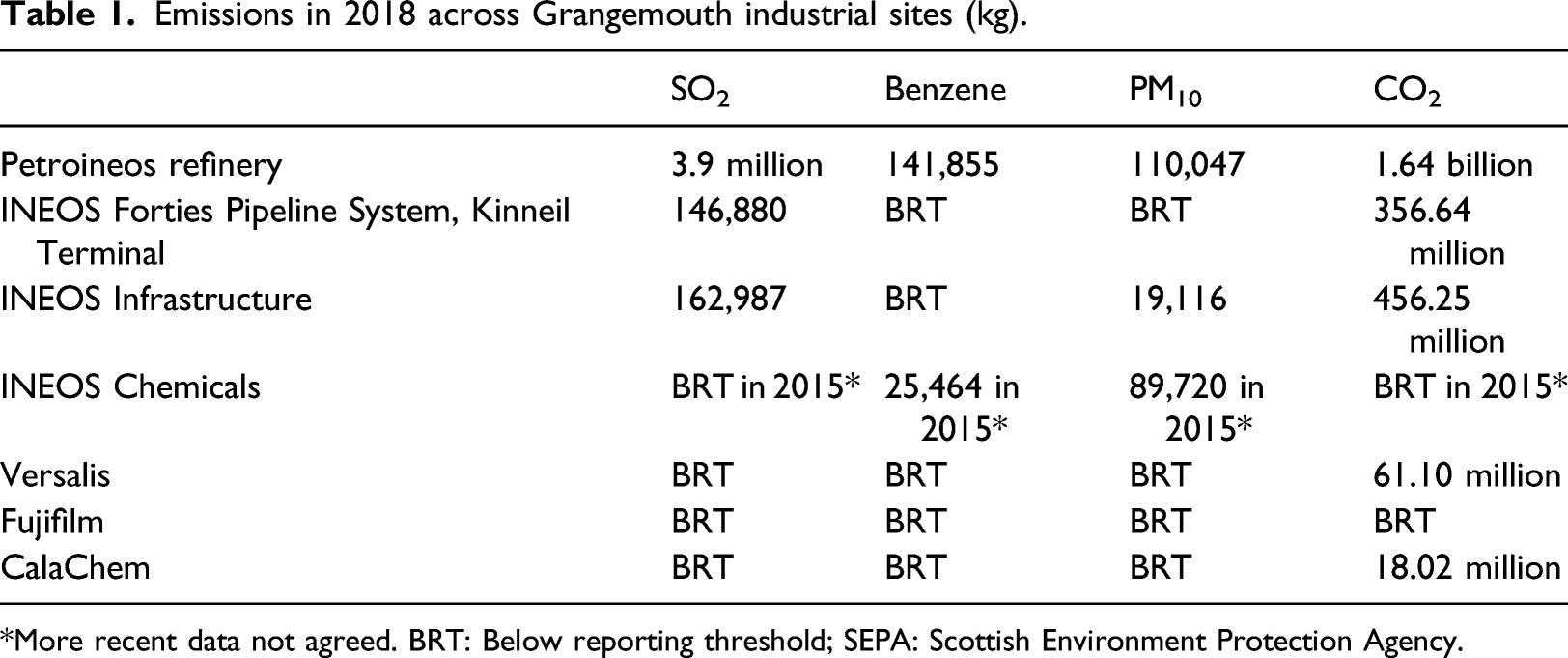
*More recent data not agreed. BRT: Below reporting threshold; SEPA: Scottish Environment Protection Agency.
Emissions 2002–2018 Petroineos refinery (kg).
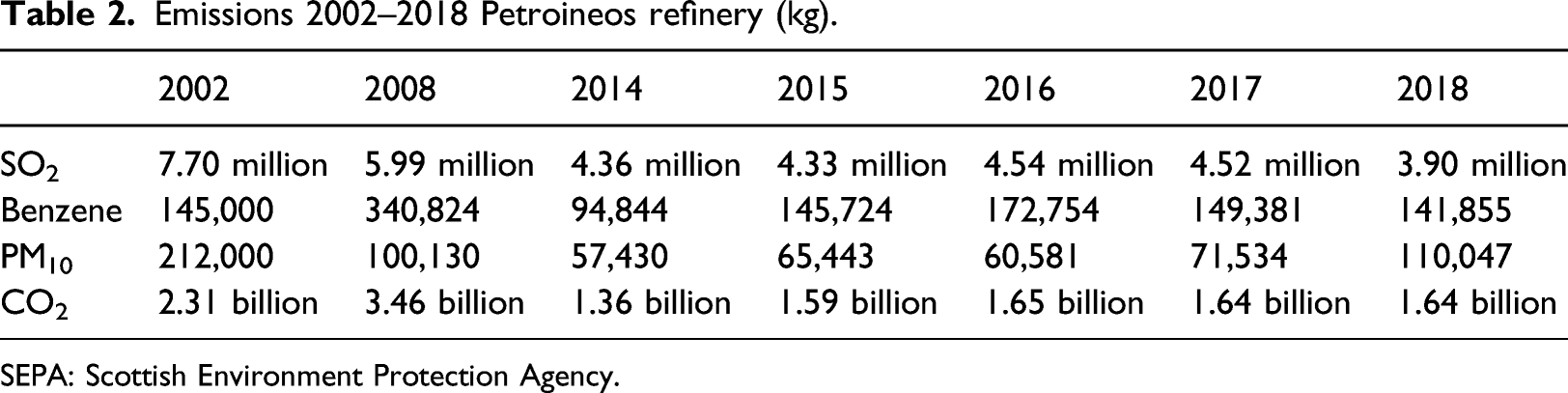
SEPA: Scottish Environment Protection Agency.
Air quality has also been a key concern, with Grangemouth declared as an Air Quality Management Area in 2005 to tackle sulfur dioxide (SO2) emissions from the refinery. The overall data trends point to declining levels of SO2 emissions at the refinery since 2002 (Table 2). However, in 2018, Petroineos was granted a derogation by SEPA from the European requirements to reduce SO2 emissions at two source points (SEPA, 2020a). Moreover, despite an overall decline in emissions since 2002, there were gradual increases in particulate matter (PM10) emissions at the refinery from 2014 onwards, while emissions of benzene, a known carcinogen, are at similar levels in 2018 as they were in 2002 (Table 2). Overall, this data shows that the petrochemical industry in Grangemouth is still a major polluter in terms of both greenhouse gases and toxic emissions.
A considerable source of complaints among the locals is heavy flaring, which is reported to happen frequently and sometimes for days. Between July 2019 and July 2020, SEPA recorded 17 flaring incidences at INEOS sites in Grangemouth (SEPA, 2020b). Some nearby residents suffer from sleep deprivation because of the noise, vibrations, light, and smells that it entails: “You can hear the flares going up […] and then you shut all of your windows because it’s absolutely stinking of sulfur, which can’t be healthy,” 23 “You actually felt your house shaking,” 24 “There’s no peace.” 25 Due to flaring, SEPA rated INEOS Forties Pipeline System’s environmental performance as “very poor” for 2017 and 2018 (SEPA, 2020c).
There are no published epidemiological studies about the health effects of the industry for Grangemouth specifically. Several participants expressed concerns about suspected health effects—particularly cancers and respiratory diseases—and frustration over the difficulties of verifying them: Angus: It’s the amount of people going down with cancer. Has it got anything to do with the industry? I don’t really know. Fiona: How could you prove that? Angus: You never will prove it.
26
Additionally, noxious deindustrialization appears to impact on mental health through precarious employment patterns and weakening community ties. For instance, a participant in his thirties suggested that: “The mental health in the area has plummeted. I mean as folk were saying about the social clubs, now even the pubs are dead, so nobody is being brought together for anything.” 27
Another oft-quoted burden is industrial hazards. The last fatal accidents in Grangemouth date back to 1987; yet, there have been high-profile non-deadly accidents in recent years (Food and Water Europe, 2017). Even if the risk of an industrial disaster appears to be low, it is potentially severe due to the high concentration of hazardous substances. A frequent concern is that the shrinking of the workforce, the outsourcing of maintenance, and the aging of the plants could eventually result in major accidents: “The local knowledge is kind of getting lost by cutting back and cutting back and so the safety.” 28 There were also fears over the fact that, after the 2013 industrial dispute, INEOS dismantled the plant-by-plant system of Unite health and safety representatives (see Lyon, 2017: 144).
The participants’ most prominent complaints were about local environmental impacts but, while the majority would probably not describe themselves as “environmentalists,” some added concerns about the role of the industrial complex in global environmental degradation, citing climate change, plastic waste pollution, and the damage caused by Syngenta’s pesticides. An example of converging local and global environmental grievances relates to fracking. INEOS—the biggest holder of UK fracking licenses—has been lobbying public authorities to deregulate fracking. Yet, as a result of the Scottish government’s moratorium on it, the company imports fracked ethane from Pennsylvania, USA by ship. To store such gas, it inaugurated in 2016 the largest ethane tank in Europe thanks to a £230 million UK government loan guarantee and a £8 million Scottish government grant (INEOS, 2016). INEOS took the Scottish government to court, challenging their anti-fracking policy, but lost the case in 2018 (The Scotsman, 2018). Several participants expressed dismay at the prospect of the additional environmental damage and hazards that fracking would cause: “The only customer for the fracked gas is the INEOS plant. That’s it. They want to destroy our countryside, put old people at their knees, your insurance goes through the roof and all these earthquakes that are happening, like in Blackpool, and deliveries coming in and fire and all the rest of it for one man’s greed.” 29
Participants also cited a range of economic burdens. In fact, proximity to the industry comes with restrictive regulations on the siting of new facilities within the “consultation zones,” also known as “blast zones.” For example, other Scottish communities receive benefits from wind and solar farms, but these are difficult to install in consultation zones. A significant part of the housing stock in Grangemouth is made of flats that were built as council houses. According to the participants, these houses are no longer appealing to the core petrochemical workforce and those that are still council-owned are allocated to marginalized people from elsewhere in Scotland who, due to budget constraints, are not adequately supported to integrate. This leads to perceived high incidences of drug abuse and anti-social behavior.
When asked how the industry benefits the community, participants were divided among those who believe there are no significant benefits at all and those who think that the remaining jobs and spending by the workers are meaningful advantages. There was, however, a quasi-consensus over the notion that benefits had declined to such an extent that they were outweighed by the burdens, as these interactions illustrate: Ewan: But if it had shut what would be the impact on Grangemouth? For Scotland, I don’t know, but for Grangemouth I don’t think it would have a great impact. There wouldn’t be mass unemployment because a lot of the people [who live in Grangemouth] don’t work here anymore. James: Quieter roads. Nicola: Less light pollution might be good. Ewan: You’d get loads of houses down there.
30
Daniel: Grangemouth gets absolutely zero financial benefit for any of this other than guys buying a pie down in Greggs or a pint at lunchtime or anything else. We get nothing, not a thing and that’s fact.
31
The participants were very aware that changing employment and taxation patterns were part of broader national and indeed global trends. Yet, they also pointed at some local specificities: Grangemouth’s community–industry relations started to decline from a particularly high place and thus the fall was more painful, the concentration of industrial infrastructure and associated burdens is unique in today’s UK, and INEOS’ business strategy is perceived as exceptionally aggressive. In fact, while the interviewees knew that INEOS is not the only polluting industry at their fenceline, they tended to single it out as a target of discontent. This was confirmed by an independent consultation commissioned by the Falkirk Council: “Of all industry that operates within Grangemouth, INEOS was overwhelmingly seen as negative” (Community Links, 2019: 27).
Many participants stated that, despite half-yearly briefings to the community liaison group and other initiatives, for example, with schools and associations, INEOS Grangemouth does not communicate enough with residents, consider their views, or act transparently. One of the latest conflicts concerned INEOS’ plans to shut Bo’ness Road, a key public road that runs throughout its complex, which triggered a campaign against the closure. Some also noted that enhanced communication without substantial changes is unlikely to help. For example, an urban planner said: “If you had 6000 employees who live locally then that’s your publicity. If people met up at the BP social club then that’s your publicity. That’s gone now.” 32
The contrast between Jim Ratcliffe’s confrontational attitude and extravagant wealth versus the demoralization and “abject poverty”
33
existing in Grangemouth engenders strong feelings of injustice: Mark: But it’s the levels of social injustice that I feel with living in the town that circumstance in the years has eluded us locally of the monies that probably made life really tolerable in the town. David: Well, to hear that and when you actually hear the wealth of INEOS…
34
While Ratcliffe was declared the UK’s richest individual in 2018 with a wealth of over £21 billion (Smith, 2018), Grangemouth includes five areas falling within the most deprived 10% of Scotland (Falkirk Council, 2020). Fuel poverty was described as particularly paradoxical given the proximity of the refinery: “We’re giving food parcels out and people say, ‘Is there anything we can eat cold’? because they can’t afford the power to heat it up, so what do you do? I mean it is heart breaking.” 35
A widely held opinion is that Ratcliffe has a disproportionate amount not only of wealth, but of power too. In little more than a decade, INEOS acquired the infrastructure that produces 4% of Scotland’s GDP, refines 80% of its fuel, and delivers almost 40% of the North Sea oil and gas (Thomas, 2017). This is aggravated by the fact that INEOS is a privately owned company and thus its majority owner and CEO Ratcliffe does not face the same accountability requirements of public companies, not to mention state-owned ones. Frustration at this concentration of power emerged on several occasions: “It would bring tears to your eyes to hear what this town is like for people who live in it and I guess again, some of that is coming back to INEOS and holding the town to ransom,” 36 “They’ve also got the North Sea pipeline now, so he’s got a stranglehold on Scotland really,” 37 “Why the Scottish government allowed that to happen, I don’t know.” 38
The latter comment points to the skepticism towards public authorities—seen as unwilling or unable to stand up to the industry—displayed by several respondents including one public official: “They don’t have the authority, so it’s like this big beast is just out of control.”
39
Such feeling of powerlessness is projected not only on public institutions but also on the community itself: Daniel: The people of Grangemouth, it’s almost like it’s beating them down. They don’t come to meetings and they don’t want to get involved with things, you know? Fiona: Perhaps they’re scared to. Daniel: No. I just don’t think they’re on the level to complain about it. Rachel: I think they just feel that they’re banging their head against a brick wall.
40
A contract worker summarized the experience of noxious deindustrialization as follows: I’ve lived in Grangemouth for all my days. […] I watched the industry go downhill and what I feel more about INEOS now is there’s more people coming into the town to work and the people in the town can’t get the jobs. […] We’ve got to put up with the noise, the smell, and the danger most of all. I mean I’m two minutes from the refinery and the noises and the sky lighting up at night can be quite scary. […] I shouldn’t have to travel away from the town to get work when that’s on my doorstep. I just don’t think that it’s right.
41
Conclusion
There’s jobs and there’s prospects so please have no fears, There’s building of oil rigs and houses and piers, There’s a boom-time a-coming, let’s celebrate – cheers (McGrath, 2015: 152).
These are the promises made by fictional oil businessman Texas Jim in The Cheviot, the Stag and the Black, Black Oil, a 1973 petro-drama in which playwright John McGrath warned about the negative social and environmental impacts of oil-based capitalist development in Scotland at the time when North Sea oil was being brought on stream. Ironically, such boom-time promises arrived when the golden age of Boomtown Grangemouth, with its abundance of jobs and prospects, was approaching its end.
This article has introduced the concept of noxious deindustrialization, a paradoxical state of affairs in which a population undergoes the loss of industrial jobs without losing the industry itself and the associated noxious burdens. This could constitute the basis of further work on the unevenness of noxious deindustrialization based on contextual factors. For example, it would be important to investigate experiences of noxious deindustrialization in areas less prosperous than Scotland. Another interesting distinction is that between cases in which noxious deindustrialization is functional to the long-term survival of an industrial complex and cases in which it is a transitional phase towards the full closure of the factories. There are also hybrid combinations of these two possibilities, in which—in a given area—some plants downsize their core workforce so that they can remain competitive while others are shut down. A further issue is the different timings of noxious deindustrialization, both in terms of the pace of the process and of the historical timespan in which it takes place in different areas. Moreover, parallel processes of automation, precarization, and continuing noxiousness can be studied in sectors other than manufacturing, such as mining or logistics.
Acknowledgment of noxious deindustrialization has implications on how we think about the so-called “jobs versus environment dilemma,” that is, the notion that, if something is to be gained in terms of good jobs, something must be lost on the side of health and the environment. Such dilemma is particularly relevant to large-scale industry, which is both an ideal-typical provider of secure, well-paid jobs and an ill-famed environmental felon. The understanding of the jobs versus environment dilemma as a zero-sum game has been criticized as too pessimistic by the advocates of “just transitions” based on positive-sum games in which industry is transformed to be sustainable and provide good jobs at the same time (although the social and political transformations needed for this to happen are often underestimated). In a way, however, the zero-sum game position is also too optimistic. This is exactly because it fails to take into consideration the reality of noxious deindustrialization: a negative-sum game in which industrial job losses and environmental degradation progress simultaneously.
Local community concerns vis-à-vis major industrial installations are often dismissed as selfish and in contradiction with the general interest, as the famous acronym Not In My Backyard (NIMBY) indicates. In the case of Grangemouth, the locals are asked to put up with the burdens of the petrochemical industry in the name of national prosperity, while receiving increasingly few local benefits. Recent critical appraisals of NIMBYism posit that local populations are not inherently critical towards proximal polluting industrial activities, but may become so due to the loss of socio-economic gains or the acceleration of social or environmental burdens (e.g., Jerolmack and Walker, 2018). On the other hand, in the current ecological crisis, local criticisms of highly polluting sites can become more aligned with the “general interest”—always an open and contested notion—than their defense.
Certainly, the shiny patina of nostalgia makes for an idealized past just as the starkness of proximity makes for a disenchanted present. Yet, the dystopian picture of steep social inequalities, employment precarity, cumulative environmental degradation, and weakening community ties—with their associated risks for physical and mental health—that is painted by noxious deindustrialization is something one can be forgiven to be worried about. All the more so because, if the combination of automation and slow economic growth spurs employment deindustrialization onwards—a very real possibility on a global level—noxious deindustrialization will become more widespread and severe. Employment precarity and environmental degradation are far from incompatible.
While many participants longed for a return of Boomtown Grangemouth, we suggest that going back to a romanticized golden age of industrial capitalism is both impossible and undesirable. It is impossible because the imperatives of market competition force companies to cut costs and raise productivity, no matter the pleasant or distasteful personality of their CEOs. It is undesirable because the output growth necessary to re-industrialize employment, particularly if one speaks of the petrochemical sector, would be incompatible with the sustained reproduction of life on the planet. A way forward could rather be based on wealth redistribution, shorter working hours, and a just transformation of production and consumption towards sustainability. The former is necessary to make the latter two socially sustainable. A participant noted: “Grangemouth has already transitioned away from the high-paid jobs, so we’ve started that transition and it’s not been just. […] We need something else.” 42
Footnotes
Acknowledgments
We thank all the participants in this research, as well as the other members of the Toxic Expertise team: Thom Davies, India Holme, Calvin Jephcote, Loretta Lou, Thomas Verbeek, and Chris Waite. We also thank Charlotte Bez and Jack Copley for their precious feedback.
Declaration of conflicting interests
The author(s) declared no potential conflicts of interest with respect to the research, authorship, and/or publication of this article.
Funding
The author(s) disclosed receipt of the following financial support for the research, authorship, and/or publication of this article: This study was funded by the European Research Council under the European Union's Horizon 2020 research and innovation program (Grant Agreement No. 639583).
