




Abstract
This paper presents the results of the ‘Beyond the Peace Walls’ pilot project, which examined the role of urban parks in Belfast, a city marked by a history of sectarianism. It explores the interface of culture, inclusivity and belonging through the concept of ‘shared spaces’ following the rationale that has guided policy-making in Northern Ireland since the signing of the Good Friday Agreement in 1998. By examining the alternative narratives of the historical role of public parks, as spaces of community making, alongside recent efforts to overcome sectarianism, it investigates how the lived experience of parks articulated through the concept of ‘shared spaces’ is understood by policy-makers and local communities. The research draws on material collected in conversations with park goers framed by comparative analysis of research undertaken in other segregated cities to explore the extent to which urban design curbs or reinforces segregation. Findings reveal ongoing tensions between the neutralisation and the signification of space underlying place restructuring in Belfast rejecting the claim that parks are ‘neutral’ compared to other ‘interface’ locations. We argue that parks are not neutral spaces: people have very clear understandings of the demarcation of space within parks, even if the markers are not visible for all to see. Signifiers are perceived through gestures, language, names and activities, while shared spaces embody historically informed values and constraints. We also suggest that formal planning and management of shared spaces in Belfast need to be constantly evolving to meet the fluid needs and aspirations of the city’s population, while taking into account the historical and affective relevance of physical and ethno-political segregation.
Introduction
The idea that parks offer a natural locus for peaceful co-existence, underpinned by a historically located sense that ‘nature’ is separate from ‘culture’ and therefore neutral, has inspired research and policies worldwide in recent years (Ali, 2007; Bollens, 2018; Byrne and Gormley-Heenan, 2014; Mell, 2019). This paper questions the assumption of a ‘natural’ association between parks and peace by highlighting the cultural signifiers that are often an intrinsic part of such spaces. Located in East Belfast, an area known for its loyalist allegiance, the mural in Figure 1 illustrates the cultural loci urban green spaces can hold.
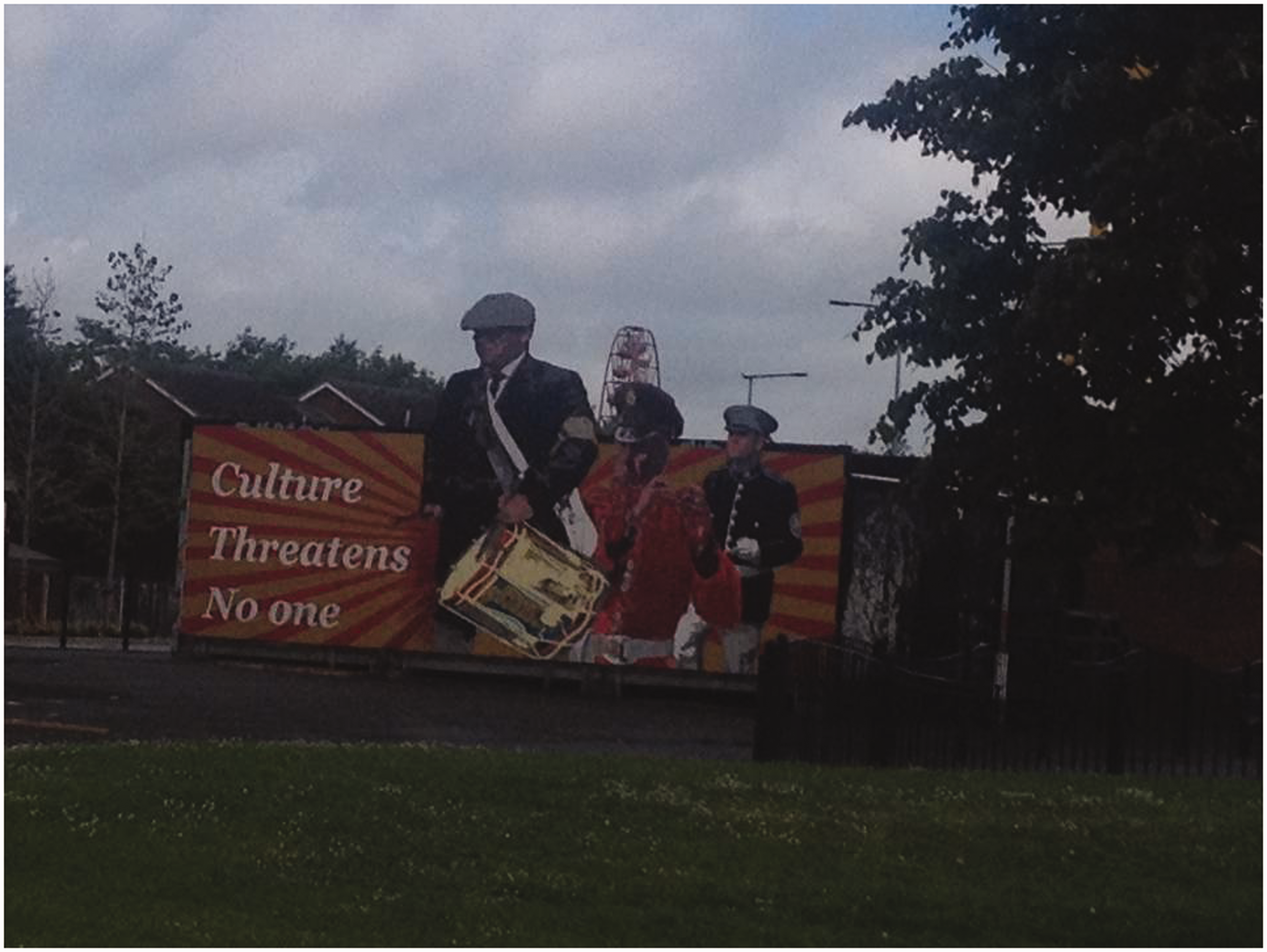
Orange Order mural, Newtownards Road, East Belfast.
The image depicts the pageantry of Orange Order 1 parades boldly emblazoned with the words ‘Culture Threatens No One’. The drummers’ heads and shoulders rise in relief beyond the boundaries of the frame, bigger than life, while orange and yellow stripes echo the rhythm of their drums, pregnant with the signifiers of Belfastian politics. Against this backdrop, the following paper explores how shared spaces, namely public parks, are perceived within a city with a history of geographical and cultural segregation, and questions whether such green spaces can actually promote inclusivity. Here, the denomination of parks will be used to refer to green shared spaces within the urban context that are part of everyday activities, regardless of size. Green space and parks are purposefully used interchangeably in the paper. Parks are discrete classifications within a local government context with specific form, function and management, while green space is the broader collection of places and spaces that are located across the city of Belfast. Although the paper focuses predominately on ‘parks’, it situates these dialogues within a broader appreciation of green space discourses within academic debate. As a consequence, the presentation of parks is implicit within green space discussions but green space, per se, is reflective of a wider understanding of landscape. Both terms are thus appropriate to the following discourse.
The motivation to explore the potentially reconciliatory power of parks is drawn from the perception of parks as neutral and inclusive spaces (Dunnett et al., 2002; Gilmore, 2017; Lang, 2017; Risbeth, 2001), that they can act as physical buffers between areas of historical separation (Stevens, 2007), and that their physical and natural surroundings can have an impact on people’s wellbeing (Abdelmonem and McWhinney, 2015; Byrne and Wolch, 2009; Henderson, 2013; Keshavarz, 2013).However, within a growing discussion on how green spaces can be permeated by cultural, socio-economic and ideological differences (Ali, 2007), there is still limited understanding of how park users view the sharing of green spaces in Belfast, a city with a legacy of sectarianism. This paper extends these insightful contributions and frames the analysis conducted in this paper around two aspects specific to Belfast. First, it tries to understand ‘post-violence’ urban planning by tapping into subjective experiences of everyday use of green spaces. Second, it assesses perceptions of natural and cultural signifiers in light of local policy proposals.
This paper presents the results of a pilot project conducted in June 2017, which examined whether parks in traditionally segregated areas of Belfast can be reconceived as spaces of inclusivity and community engagement. Specifically, we ask whether shared spaces should be free of cultural or political symbols, and if so, whether the removal of sectarian symbols would affect their use in a city with Belfast’s history of ethno-nationalist conflict (Bollens, 2018; Mell, 2019). We will start with a brief introduction to Belfast’s socio-political context, including the conflict known as The Troubles and the Good Friday Agreement.A brief analysis of the policy framework in contemporary Belfast with a focus on the ‘A Shared Future’ document will illustrate how the city provides a unique case study in which to explore the supposed neutrality of green spaces.
We will then present our methodological and theoretical approach, including Lefebvre’s city-oriented typology and Abdelmonem and McWhinney’s three-way classification of spaces. Next, we will unpack insights from Belfast residents regarding their understanding of shared green spaces. In a scenario where discussions of the city’s historical (and everyday) sectarianism have been replaced by the emerging understanding of multi-community inclusivity in formal policy, the process of engaging park patrons in a reflexive conversation about shared use promotes greater awareness of the potential of these spaces. Findings reveal ongoing tensions between the neutralisation and the signification of space. In other words, while formal planning strives to meet the needs of the city’s changing population, including the provision of locally specific amenities that accommodate pluralist activities, it also has to take into account the established history of physical and socio-cultural segregation in the city. Finally, we argue that the potential of parks as shared spaces can only be achieved by taking into consideration the affective dimension of cultural markers projected onto these landscapes, and that ongoing dialogue with the public is crucial if Belfast City Council 2 is to achieve its ambitious agenda.
Background context to Belfast
The Troubles refer to an ethno-nationalist conflict in Northern Ireland, which commenced in 1968 and ‘officially’ ended in 1998 with the signing of the Good Friday Agreement (Murtagh, 2011). The conflict concentrated on the religious and political divisions of two distinctive communities: those who wish to see Northern Ireland remain part of the United Kingdom (Protestants/Unionists/Loyalists) and those who call for a unified Irish state (Catholics/Nationalists/Republicans). However, not all Roman Catholics in Northern Ireland are Irish nationalists in their politics and not all Protestants are loyalists (O’Leary and McGarry, 1996).
By the late 1960s, following an increase in violence, defensive architecture in the form of ‘peace lines’ and ‘walls’ was built at community boundaries, commonly known as interface zones, to separate predominantly Republican and Nationalist Catholic neighbourhoods from predominantly Loyalist and Unionist Protestant neighbourhoods. While peace walls are the physical manifestation of the division, derelict spaces are also seen as interface zones: an abstract ‘no-man’s’ land between communities (Bollens, 2018). These less visible signifiers are frequently located alongside murals, flags and military/police infrastructure as explicit visible reminders of the city’s political divisions, having been created by both the city’s authorities and by local communities (O’Dowd and Komarova, 2011). Thus, interface areas and peace walls became landmarks where division and violence would catalyse. For example, the interface of Shankill and Springfield Roads in west Belfast was considered a critical junction for the construction of a peace wall when that policy came into being (Shirlow and Murtagh, 2006). Today, communal separation persists as these two neighbourhoods retain their own public swimming bath, pubs, schools and real state agencies, despite their proximity.
Such historical knowledge is crucial to the contemporary understanding of the ways that ‘space’ and ‘place’ are perceived and used in the urban context as both are intrinsically connected with notions of shared space (Reid, 2008). The conflict had a number of related, albeit unexpected, outcomes such as the location, type and quantity of housing, which had to follow the lines of segregation, and class-related unfoldings, which complexifies the dynamics of conflict. The literature indicates that Catholics experience more socio-economic disadvantage than Protestants, with 22% of Catholic households living in poverty as opposed to17% of Protestant households (Nolan, 2013: 12).
In 2005, seven years after signing the Good Friday Agreement, the government of Northern Ireland released the document A Shared Future: Policy and Strategic Framework for Good Relations in Northern Ireland (henceforth, ASF), promoting ‘a shared society defined by a culture of tolerance’ (OFMDFM, 2005: 3) following the core principles in the 1998 Good Friday Agreement.Of interest to this paper, is its approach to ‘culture’ and its emphasis on the qualifier ‘shared’, a term that has become ubiquitous in policy-making in Northern Ireland. Its use is pervasive in the document, qualifying matters of concern for shared futures, education, spaces, workplaces, communities and services. The rationale is that city policies will deliver shared outcomes by promoting trust, tolerance and inclusiveness through cross-community interactions. In Belfast ‘shared’ implies interactions specifically between Protestant/Catholic communities, rather than interactions amongst the population as a whole. The ASF, however, downplays the challenge of addressing its other key concept, ‘culture’, opting for a rather ambiguous positioning: ‘Culture is multifaceted: it’s about education, planning, and the arts, among others’ (OFMDFM, 2005:
3
1.1.8). Yet, when it comes to celebrating Irishness, the document clearly articulates both acceptable and unacceptable outcomes (Rallings, 2014), albeit the line between the two is unclear. For example, on page 19 under the heading ‘A Shared Future’, the document states: ‘It is also clear that whilst some of the practices are “popular”, in that members of the community welcome the appearance of flags, bunting and painted kerbstones, some displays are not’…‘The inappropriate display of flags and emblems, particularly paramilitary displays, can lead to economic damage and can discourage investors, business and employment’. (OFMDFM, 2005: 19) The removal of “inappropriate and aggressive” displays of flags (specifically paramilitary flags and any other displays which have the effect of intimidating or harassing), murals and painted kerbstones is best undertaken as a common project with agencies working collaboratively with the police, elected representatives and local communities as part of environmental improvements with a view to enhancing the areas economically and building trust. (OFMDFM, 2005: 18)
The process: Methodology and theoretical framework
With a common interest in the role of green spaces and parks for social inclusion, wellbeing and everyday lives, we decided to conduct a pilot study to gain some insights on how shared public spaces were perceived in a city with a history of segregation. Our distinct backgrounds, namely urban planning and anthropology, and experiences with green spaces (cf. Lang, 2015, 2017; Mell, 2019), informed our approach and produced a fruitful interdisciplinary engagement. The pilot study consisted of qualitative analysis of short (in-situ) exchanges with visitors to seven Belfast parks over a seven day period including weekdays and weekends, mornings and afternoons in June 2017. Parks were situated across four broad areas in the city: Alexandra Park in north Belfast was chosen because it houses a peace wall dividing the park in two, and Victoria Park was relevant because of recent redevelopment carried out in the area. The additional parks were selected because of their distinct characteristics resulting from their geographical location in the city (Figure 2).
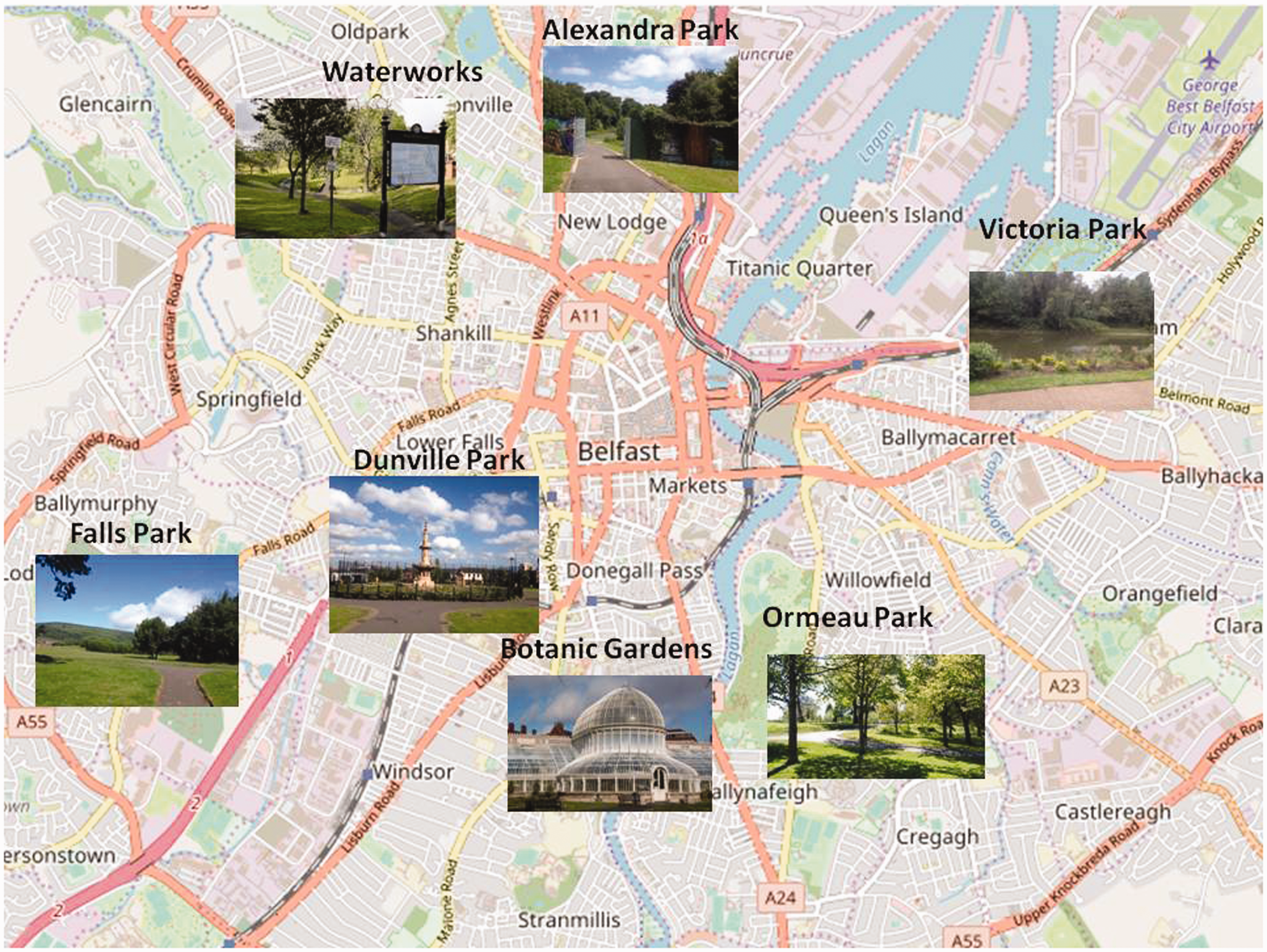
Photo collage of parks visited in Belfast.
The characterisation of parks as segregated, pluralist or contested spaces was informed from participants’ commentary, hence the overlaps. Parks’ size also varied, with the smallest being Dunville Park, which stretches over one block next to the Royal Victoria Hospital by Falls Road, and Ormeau Park (100 acres or 0.40 square kilometres), the largest. Consequently, the number of participants also varied from 4 (Dunville Park) to 32 people (Falls Park), amounting to a total of 97 interactions, in a vox populi style, lasting between 5 and 15 minutes with randomly chosen participants. The anthropologist approached visitors by telling them she was conducting research on people’s perceptions of green spaces and asking them for their collaboration. These brief interactions served as relevant mediation between the researcher and the green space being analysed, and as a complement to other methods, such as participant observation and document analysis. In addition, they provided an underlay for occasionally longer conversations. The researcher’s positionality was also significant; as a non-British and non-Irish anthropologist, she stood outside the familiar polarised categories associated with Belfast’s history. Interactions were not recorded and no personal information, such as name and occupation, was taken.
4
While we acknowledge that the different socio-economic status of the park location may impact people’s attitude towards shared spaces, we did not collect related information to assess that impact. Interaction with park goers included some, but not necessarily all, of the following prompts:
Where the park figures in their everyday; Reasons for visiting the park; How safe they feel; How local they are; Whether they feel a sense of community in the park; Whether they find that green spaces in general bring communities together; and Whether they think that green spaces are more neutral than other shared spaces.
In addition to walking with people during exchanges, we also observed how embodied practices, such as walking the dog, jogging, pushing a pram, running after children, carrying shopping or riding a mobility scooter, informed people’s engagement with both space and infrastructures within parks. These data helped us to organise our participants’ reactions using the three-way classification developed by Abdelmonem and McWhinney (2015: 41):
Those who support pluralist and inclusive shared spaces; Those who abide by segregated spaces; and Those who are contesting current uses of shared spaces.
Rather than being informed by their geographical location, parks were categorised according to how park goers situated themselves regarding that space. This rationale came from the ethnography itself, which pointed to a rather idiosyncratic and fluid perception of belonging (Müller-Funk, 2019) and ran counter to Lynch’s (1981) assumption that location and meaning are symbiotic in all cases. In addition, Lefebvre (1991) provided relevant insights on the intersections of spatial planning and the politics of place, and the potential impact of the transition from exclusionary to inclusionary places. Thus, our understanding of politics of place, following Lefebvre, can be conceptualised through three specific approaches:
Spatial practice: an approach that provides continuity with and understanding of the physical world around us – the official Belfast City Council approach would be one example of this process. Representations of space – referring to codes, signifiers and experiences that influence our current understanding of space. This approach implies a more abstract perception of space, albeit one with direct impact on our lived experience. Representative space – more complex understanding of the lived experience of space. An appreciation of the role of coded signifiers in interface parks such as Alexandra Park, and the changing nature of Newtownards Road following the completion of the Connswater Greenway where the landscape has changed following investment in both defensive and inclusive architecture, are examples of ‘representative space’.
Within this discussion, Lefebvre posits that interpretations of both place and space become subject to intensified locational and societal evaluations associated with segregation, a point also illustrated by Neill (1999). It follows that place and space are part of an ongoing process of production and re-negotiation. Newman (1973) also examined this principle arguing that the physical architecture of a location directly influences its societal meaning. Such a process of perceptual evolution in terms of how we use space questions how urban areas are planned, managed and interacted with (Nagle, 2009). Lefebvre and Newman consider both the subconscious or invisible histories of landscape, as well as the pivotal role that the physical environment plays in interactivity, including instances of city-wide violence/unrest. This perspective can be transposed to discuss how the decisions being made by communities in terms of their interactions with the physical landscape modify how people engage with parks (Abdelmonem and McWhinney, 2015). However, the roles of inter- and intra-cultural exchange that underpin interactions with ‘landscape’ in Belfast, relating to Lefebvre’s conception of spatial practice, remain difficult to control (Nagle, 2009: 333). The experiential nature of Lefebvre’s ‘representative space’ is potentially a more apt lens to debate landscape interactions in Belfast, as it aligns lived experience with ongoing assessments of identity and the evolving planning policies in the city.
In terms of the broader theoretical debate, the literature on the politics of public space and how cities and countries worldwide have dealt with the legacy of sectarianism (cf. Ali, 2007) is vast. By engaging with work related to other divided cities with comparable histories of segregation, namely Jerusalem (Safier, 2001; Yiftachel and Yacobi, 2003), Istanbul (Dagˇtaş, 2016; Eken, 2014; Ozturkcan et al., 2017), Nicosia (Gaffikin et al., 2010), Johannesburg (Murray, 2011) and Rio de Janeiro (Caldeira, 2002; Goldstein, 2003; Steinbrink, 2014), and specifically Bollens (2018) for Belfast, we were able to gain a more nuanced appreciation of how shared spaces resist, reinforce and transform territorial divergences.The next section will locate the public park historically and within the policy framework for Belfast to then present the tensions that emerged as we engaged with selected concepts and authors.
Urban green spaces as shared spaces: Historical and current views of the public park
Belfast historically invested in its landscape with a series of Victorian parks being developed from the mid-1800s onwards, providing recreational and aesthetic amenities for its populace. Belfast is therefore comparable to industrial cities across the UK where investment in public gardens and parks was associated with economic prosperity and philanthropy within the city’s merchant class (Bollens, 2018). However, the role of parks as civic spaces was challenged from the 1960s onwards with the escalation of The Troubles when investment in the city’s parks diminished as securitisation became the prominent public space discourse, and parks became increasingly militarised (Mitchell and Kelly, 2012). Thus, public space became a metaphorical and physical battle ground between divided social groups, the British government, and the Northern Ireland military and police force, namely the Royal Ulster Constabulary: RUC, and Police Service Northern Ireland: PSNI (Shirlow, 2006).
In the post-Good Friday Agreement landscape, there has been a greater emphasis placed on the value of landscapes as communal amenities. The release of The Belfast Agenda (2017) 5 illustrates this vision for parks with Belfast City Council promoting their inclusion within the shared ambitions for the city, with a focus on moving beyond divisions and breaking down territorial boundaries associated with insularity (Murtagh, 2002). To achieve this, the agenda promotes cross-political buy-in for strategic and ward-level development objectives, which aim to balance the city’s proposals by attracting investment to support the delivery of city-level projects. Moreover, the agenda argues for spatial parity in the provision and access to high-quality green/open space across the city to ensure equitable access to amenities. The Belfast Agenda could, however, be described as promoting a utopian future that is at odds with the other approaches to development due to ongoing spatial, social and economic divisions that populate the rhetoric of segregation within communal discourse (Murtagh, 2011).
The potential for conflict between emerging forms of citizenship and ongoing attachments to ethno-cultural tradition are points of interest in research on contested territorialities (Bollens, 2018). For example, Gezi Park in Istanbul attracted protests in 2013 by those opposed to the construction of a shopping centre on a public park next to Taksim Square. At first the protests were localised and mostly focused on the felling of trees attracting Turkish nationals (Eken, 2014), but later they acquired global dimensions becoming a platform for free speech and secularism during central government crackdowns. The Gezi Park protests gained multi-regional support (Ozturkcan et al., 2017) and divergent agendas (Dagˇtaş, 2016; Letsch, 2014) revealing how pluralistic identities can align with the specific aim of preserving a public space. As the movement grew, it became hybridised as it engaged with: feminists, anarchists, socialists, workers’ unions, environmentalists, and LGBTQ activists, as well as those who found themselves protesting alongside these groups for perhaps the first time: secularists, high school and university students, anti-capitalist Muslims, Turkish ‘aunties’, soccer fans, nationalists, and shanty town dwellers. (Dagˇtaş, 2016: 12)
The consideration of parks as shared spaces in Belfast therefore stands in opposition to the discourse of ‘territorialised spaces’(Murtagh, 2002), which are marked by explicit community boundaries. If landscapes in Belfast ‘acquire meaning with the help of cultural codes’ (Vogt, 2013: 37), then it follows that the promotion of shared spaces could only be achieved through the removal of such symbols (Rallings, 2014), a process Belfast City Council has been accused of in their redevelopment of Laganside, the Girdwood hub or the Sirocco site. Tensions between the neutralisation and signification of space were reflected upon in a number of conversations we held with park goers, hence the need to re-examine landscape at the local scale. To that end, we will focus on recent developments on shared spaces before turning to the insights offered by visitors to parks in Belfast.
Belonging and the contentious investment in shared spaces
Renewed economic growth following a period of industrial decline in recent years has been described as a ‘post-conflict renaissance’ in Belfast (Murtagh, 2011), which translates into urban regeneration to deliver more mixed-community neighbourhoods, alongside a rejuvenation of Catholic and Protestant communities in an attempt to redress perceived historical imbalances in terms of funding and development attributed to segregated areas of the city, i.e. the Upper Ardoyne. Globalisation and economic liberalisation have also led to direct impacts on the use, value and development of urban spaces (Murtagh and Keaveney, 2006). This revised city ‘image’ is propagated by a reduction in crime and investment by businesses fuelling economic growth, which in turn boosts real estate prices (Belfast City Council, 2017). However, changes also bring unpredictable outcomes and may reinforce the divisions they are trying to erase. The first point of contestation is therefore that while the rationale that ‘material prosperity will overwrite tribal allegiances’ (Murtagh, 2011: 1120), the broader narrative of conflict in Belfast has been centred on perceptions of sectarian spaces, often informed by class or economic dynamics, as well as by religious background.
The literature examining urban development in Belfast suggests that socio-spatial segregation is informed more frequently by income than by political–religious affiliations (Shirlow and Murgtagh, 2006), even if other variables, such as age also influence how residents or investors view inclusivity/exclusion across the city. Studies have used the concept of the ‘ethnocratic’ city to illustrate the interplay between class and political–religious allegiances, i.e. the connection between capital and ethnicity in the context of a ‘globalizing culture and economy’ (Yiftachel, 2006: 190). In their study of the politics of space and territory in Israel, Yiftachel and Yacobi (2003) use the concept of ethnocracy as a bridge between the Israeli political regime and ‘Israeli-produced spatial reality’ (678). They also argue that the concept of ‘mixed city’ is a form of ‘urban ethnocracy’ that leads to dominant groups appropriating city apparatus to buttress its domination and expansion. The tensions that emerge from this ethnocratic configuration impact access to land, as well as economic and political resources. Murtagh and Keaveney (2006) problematise the concept of integration in the context of Belfast through an analysis of how ‘shared space’ is used to legitimise a particular form of space management aiming at neutralising contested territorialities. Furthermore, shifts to the service economy and changes in access to the housing market, exacerbated by migration into Belfast, are in part responsible for further spatial transformations across the city (Murtagh, 2011).
A second point of concern is that while there have been attempts at promoting neutrality in access to space in Belfast this is not always seen as rational by local stakeholders (Murtagh, 2002). Local planning officials may be employing what Lefebvre (1991) calls a ‘savoir’ of how places function and can be integrated with each other; however, local communities hold deeply held ‘connaissance’ of how they work individually, communally and politically. In Belfast, these locations can be identified as specific roads, interfaces or neighbourhoods, which are all embodied with socio-political coded signifiers (Nagle, 2009). Thus, although Belfast City Council is planning for growth, gaining community support for such measures has remained difficult due to the interplay of complex communal histories and localised narratives associated with specific locations.
In sum, the literature points to a gap between the ways in which development is structured within local planning frameworks and the experiential and community-centred understanding of place (Graham and Healey, 1999). Furthermore, while the city’s spatial configuration has changed, underpinned by policy-maker attempts to reduce traditional Catholic/Protestant binaries, they have also inadequately led to new forms of segregation related to class (Murtagh, 2011). Consequently, there is a growing commentary arguing that capital investment and mobility are reinforcing ethnic and class-based divisions in some parts of east and west Belfast, themes explored in the following sections through our in situ interactions with park users.
Segregated spaces and interface locations: Margins, walls and cultural markers
Changes have been for the better, but there is still segregation. Schools are still segregated, so while that lasts, the divisions will too.
– Participant in Alexandra Park
A ‘signifier’ is a physical sign, symbol or marker, which may be different from the meaning associated with it: the signified or mental concept (De Saussure, 1915). The role of cultural signifiers, and how they affect human behaviour, has been the subject of a whole body of literature on the politics of representation (cf. Lynch, 1960). Suffice it to say, for the purpose of this study, that the peace wall in Alexandra Park (Figure 3) and the mural on Newtownards Road (Figure 1) are not only pregnant with meaning, acting as physical manifestations of the division in the city, but they can also articulate how ethno-cultural practices influence the behaviour of people in public spaces.
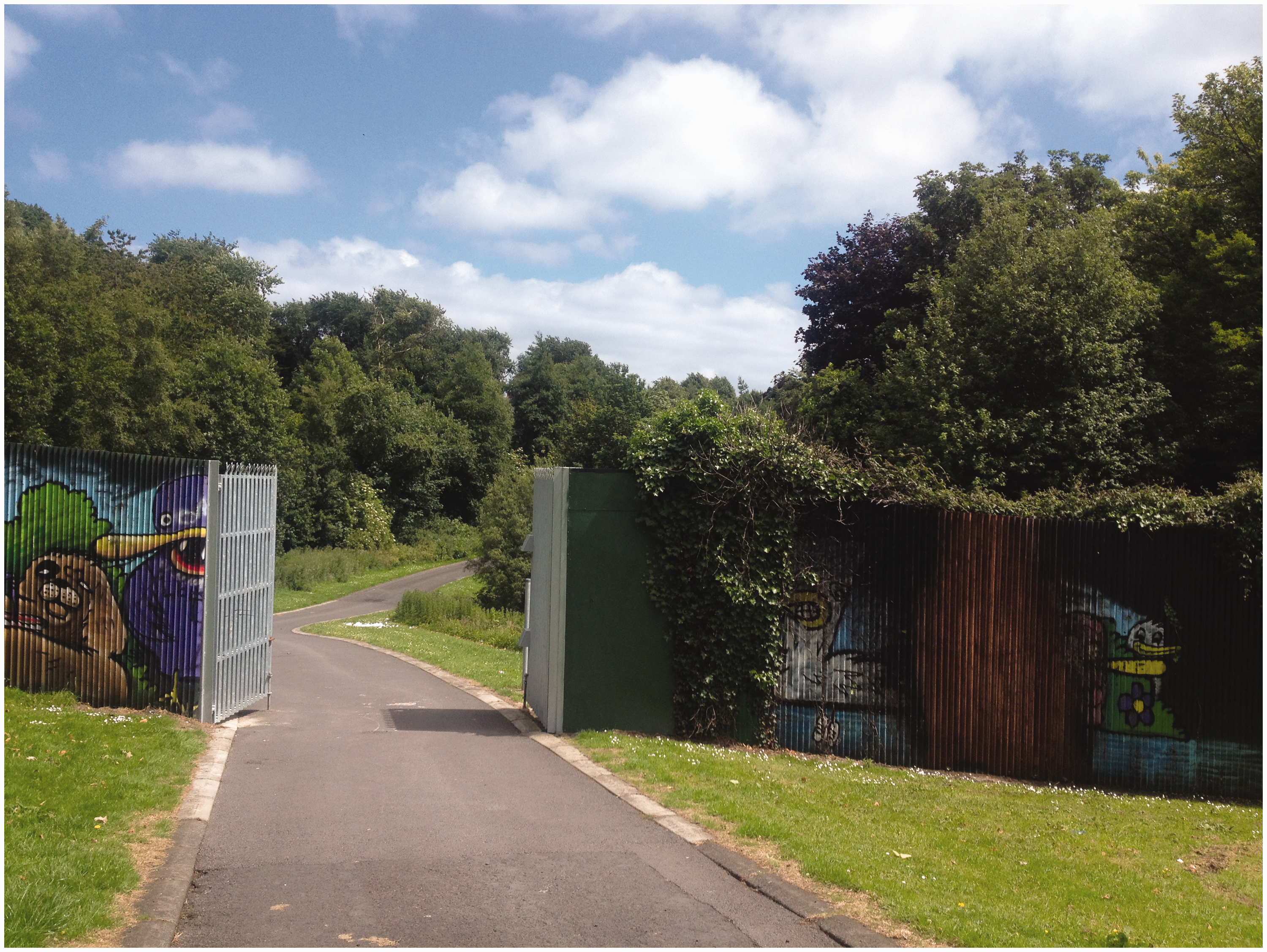
Peace Wall at Alexandra Park, in North Belfast.
Alexandra Park is located in North Belfast and the layout of the park includes two children’s playgrounds, a large grassed hill and a pond with swans. A peace wall, erected in 1994, divides the park into two sectors: one used predominately by Protestants and one by Catholics. During The Troubles the peace walls were an effective strategy to deter violence, but today, the segregationist nature of these ethno-political markers is said to hinder community dialogue. As a discussion point, the wall actually served as a prompt to elucidate park goers’ opinions regarding their vision of urban planning. Some participants stated that segregating markers make them feel safer and that having a clearly marked city layout takes away any ambiguities concerning cultural/political affiliations: ‘The wall makes the park safer because people know where they belong: if you are on this side of the park, you assume people are Catholic’. The majority of participants abided by the boundary erected with the wall. A woman in her 50s believes the park is quite mixed, but when asked about the wall, she explained: ‘I stick just to this side. There’s no reason to go to the other side. I feel safe here but I don’t know if the wall should be removed’. A woman in her 70s who walks through both sides of the park does not think it is a good idea to remove the wall: ‘It could be a hassle when it comes to 12th July. 6 It might make people feel insecure’. Another participant, a woman in her 50s who has lived locally all her life, feels that the construction of the peace wall has acted as a physical manifestation of the ethno-cultural demarcations of space. However, she is quick to add that ‘the wall is a necessity; it used to be terrible with fights between the two sides. It’s safer with the wall there’.
While divisions in Belfast are historically embedded, new attitudes are evolving which see sectarianism as parochial and in opposition to modern Belfast (Shirlow, 2006). A woman in her early 30s, who was brought up in the Catholic side of the park said that if the wall was removed, she would be more likely to use the whole park. As long as there are markers, she will be reminded of the divisions: ‘I always stayed on this side of the park and never questioned it’. Another woman in her early 30s who was brought up on the Catholic side of Alexandra Park and never went to the other side thinks the wall should be removed: ‘It’s a barrier, and if they leave it like this, the country will never move on’. A man in his 70s, originally from rural England, walks throughout the park but prefers the Protestant side because ‘it’s greener and more overgrown’. He thinks the wall causes division: ‘They should get rid of the wall, they never should have put it up in the first place’. He feels a sense of community in the park but his involvement ‘stops at the park gates’. However, for Jake and Pat (not their real names), who first met at Alexandra Park and have been friends ever since, the park is their community. Jake, a Protestant, goes to Alexandra Park every day on his mobility scooter to get fresh air and meet Pat, a Catholic. Jake likes the park because ‘it’s like a secret glen, something out of a story book’. He thinks the peace wall could be removed, but the gates should get locked every night. When asked if green spaces bring communities together, he said: ‘Look at me and Pat, he’s a Catholic and I’m a Protestant; we meet in the park every day and we get on like a house on fire’.
Jake usually spends over four hours driving through this park and Waterworks, another park one block away from Alexandra Park. Located close to the main east-west road, Waterworks has flowerbeds at the entrance, a big artificial pond with ducks and a pond dedicated to fishing. The pathway from the gate follows the pond and rises into the distance against the backdrop of Cave Hill and the Black Mountain. One section of the upper area is close to the Westland estate, a Protestant estate and a participant in his 30s says he feels slightly wary of the fact that the park is so close to a loyalist area. Another man in his 30s explains that the park actually has one playground for Catholics and another for Protestants. A woman in her 70s who goes to Waterworks regularly but does not live locally explains that she never goes to Alexandra Park because she feels intimidated by the graffiti on the peace wall. Some participants suggested that teenagers are more likely to express their ethno-cultural allegiances by starting fights, which can escalate into communal violence. A middle-aged couple walking their dog gave their views on the park: The park is a lot cleaner but there is a problem with youngsters drinking and taking drugs; it would help if there was more policing. Ten years ago [it] was much worse, but after the fishing club opened, more people started coming and the bad elements drifted out.
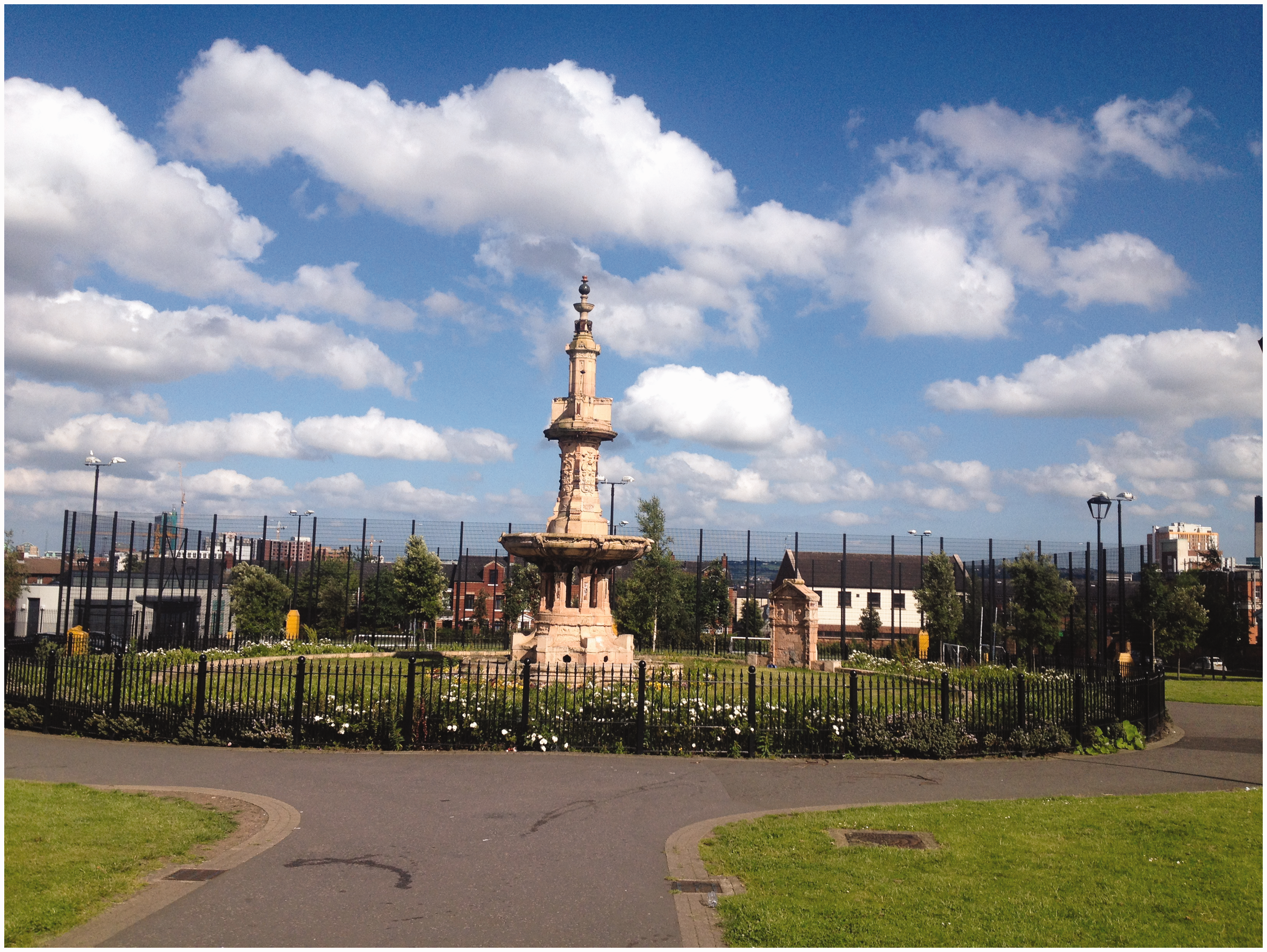
Water fountain in Dunville Park, in West Belfast.
We are told that the park has always been popular amongst locals and had a protagonist role during The Troubles: ‘There used to be a lot of bushes and people even hid weapons and themselves in the greens, that’s why the police removed them’. The quote above illustrates the idea that Eken (2014: 430) observed in the context of Gezi Park rethinking how a place can have different memory maps depending on individual and/or collective lived experience. By identifying existing signifiers of communal meaning one may be able to establish the spatial parameters used in narratives about parks in Belfast. This process is not static as Lynch originally proposed (Neuman, 1998), following instead a ‘logic of becoming’ (Eken, 2014: 434) where cultural signifiers become increasingly fluid within the frameworks of city-planning and communal interactions. This fluidity became evident as we witnessed participants in Alexandra Park changing their minds about decommissioning the peace wall. A woman in her 30s who normally walks all over that park explains that she lives in an area where houses are very expensive and is a short drive away. She described her background as ‘mixed’, and added that her family did not care for religious divisions and always had mixed friends and neighbours: You can always tell people’s religion because it’s connected to the area where they live, so if you see someone leaving through a certain gate you know where they live and what religion they are. One gate in this park is the Protestant exit, another one is the Catholic’s; the third gate faces the new housing state, so it’s mixed. The north has pockets of neutrality. More mixed areas tend to be more middle-class because people actually choose to live there and can afford to choose. Here is like a silo, more contained. The Botanic Gardens are more neutral because of the people who go there, and so is the south of Belfast.
Pluralist spaces and pluralist activities
The main entrance to the Botanic Gardens is located by Ulster Museum, where on an ordinary weekday the observer can see many park workers attending to the rich array of botanical specimens, while students from Queens University, local residents and tourists walk by. A short distance to the south-east is Ormeau Park. There are public toilets by the entrance, tree-lined Victorian walkways, people cycling, walking and running. Many of the walkers are clearly young professionals. Ormeau Park and the Botanic Gardens seem open to pluralist activities, with a population that mirrors that diversity, something that was observed in Victoria Park, located in an area historically associated with Loyalists but which has recently undergone redevelopment attracting a far more pluralistic public. Thus, the behaviour of patrons in the Botanic Gardens in the ‘neutral’ University Quarter, or at the C.S. Lewis Square on the Connswater Greenway near the entry to Victoria Park, is observably different from that of park users in West Belfast.
That said, the concept of pluralism should be problematised, something that Gaffikin et al. (2010) do by distinguishing disputes around perceptions of class, ethnicity and power, which they define as pluralism-related issues, and disputes encompassing pluralism and sovereignty, which are specifically related to ‘rival claims of national belonging’ (494). Belfast would be classed in the latter category, and a city like Rio de Janeiro, where there is no official segregation but a de facto separation between the elites who live ‘in the asphalt’ and the poor working classes inhabiting the informal settlements or favelas (Goldstein, 2003) could be an example of a mixed city with a pluralistic population segregated according to historically complex racial and class-based hierarchies. The segregated enclaves are both cause and effect of the violence that is part of everyday life in Rio and hinder the consolidation of democracy and citizenship (Caldeira, 2002). Another example is Johannesburg where policy-making is still informed by traits inherited from the apartheid era, resulting in a scenario of inequality, informal settlements and housing shortage (Murray, 2011).
There are commonalities running through these examples, not least the geopolitics of space and the capital that produces it at the local and global scale (Smith, 2008). Following Smith, space is not a container wherein people live, but it is constantly being produced by our everyday lives. Moreover, when comparing the cities of Belfast and Nicosia (Cyprus), Gaffikin et al. (2010: 505) note that ‘shared’ sits alongside ‘cosmopolitan’ and ‘neutral space’, represented by Belfast’s city centre, a symbol of consumerism and modernity that strives to reflect the principles of contemporary urban design and public policy. Similarly, the concept of ‘rooted cosmopolitanism’ used by Safier (2001) in the context of Jerusalem to refer to ‘an inclusive and pluralist world-view’ (156) implies that intergroup conflict can be transcended through respectful negotiation, which would lead to peaceful co-existence. Yet, Safier (2001) describes Jerusalem as ‘a mosaic of competition, contention and periodically escalating tensions’ (151), and therefore subject to constant evolution.
At the other end of the spectrum, Belfast’s ‘ethnic’ spaces are encapsulated in residential enclaves duly demarcated by peace walls. Thus, another commonality regarding divided cities, regardless of whether disputes are over ideological world-views, national allegiances, language or class, is that people resort to signifiers to mark their territories, which in turn reproduce the opposing histories that segregated those spaces to start with. In addition, disputes in these mixed cities suggest that the production of space is always political, even when they seem to work at multiple personal and/or local level. A loyalist in his 60s walking his dog in the Botanic gardens said he has no time for ‘all these divisions’: Life is too short. All this talk about “community”; what matters is your neighbour. If your neighbour needs help you go and help. Some parks in Belfast are next to housing estates, and then you get the anti-social behaviour. The solution is in sports. There’s no division in Ireland when it comes to sports. Here, there is the bowling club, jiu-jitsu, GAA [Gaelic Athletic Association] and summer camps for kids, and they all attract different publics. My kids do the summer camps every year and really enjoy them. But because of the locality, people tend to be Catholic. Just when it comes to sports you get a mixed public. There is more tolerance now. – a man in his 40s. There were always mixed people here, and a mixed graveyard. There used to be people from Shankill road [predominantly loyalist] coming here to play football. – a man in his 50s. In the past, a Protestant couldn’t come here [to Falls Park]. Even now, I can’t see a Protestant coming here, unless he was playing football with the League, just like I wouldn’t go to Woodvale Park. But the younger generation doesn’t care, thank God. There is a music festival here every year, which I go to.It has become more popular all the time and people come from all over whether they are Catholic or Protestant. The DJs are from all over. Also, the festival puts money back into the park. – a man in his 20s.
Contested spaces: Divisions beyond ethno-political allegiances
We’re all nationalists here.
– participant at Falls Park
Generational differences notwithstanding, territorial belonging in Belfast is still visually obvious through the murals, flags and physical infrastructure that demarcate public space (Figures 5 and 6).
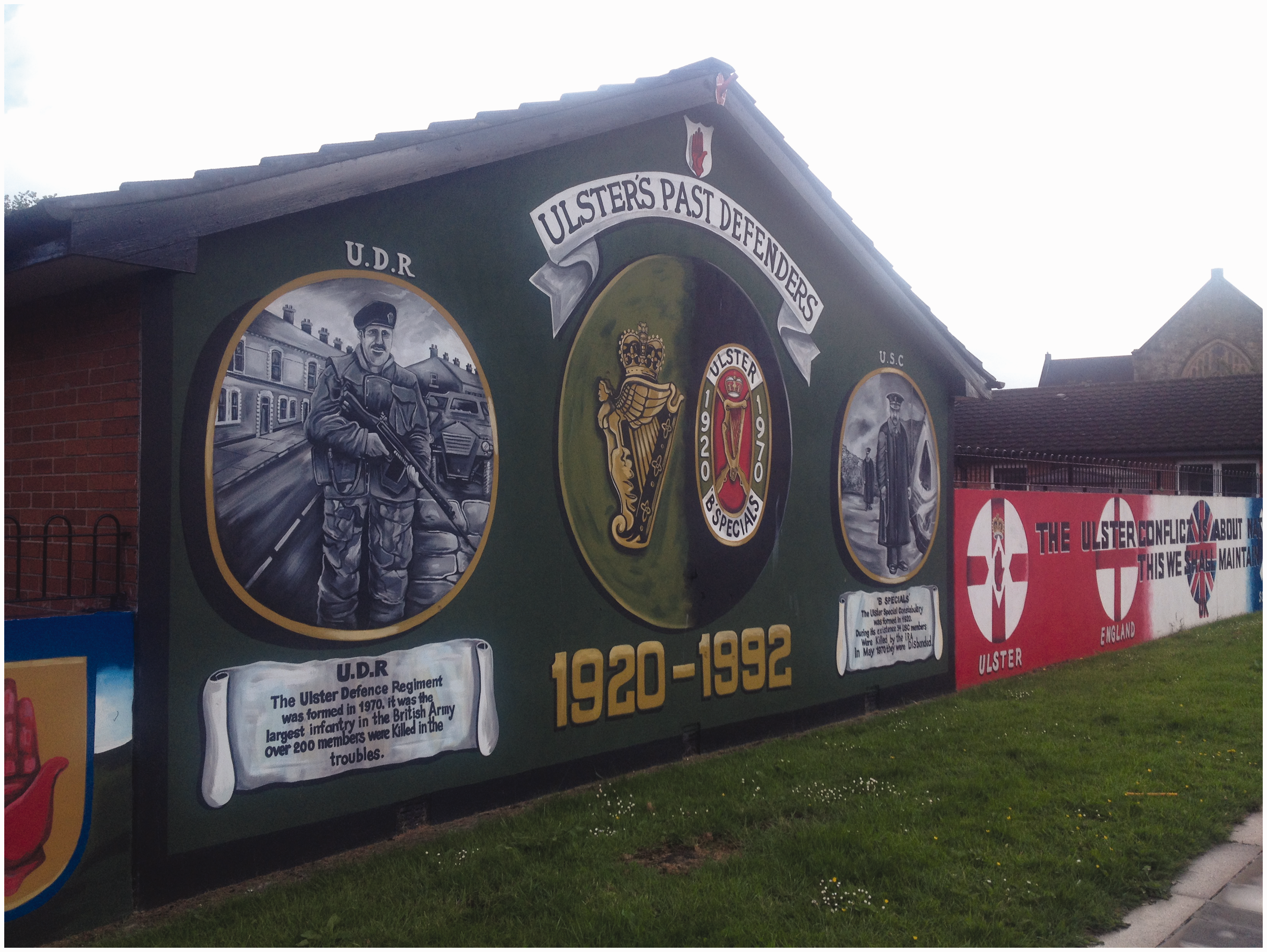
Mural in East Belfast.
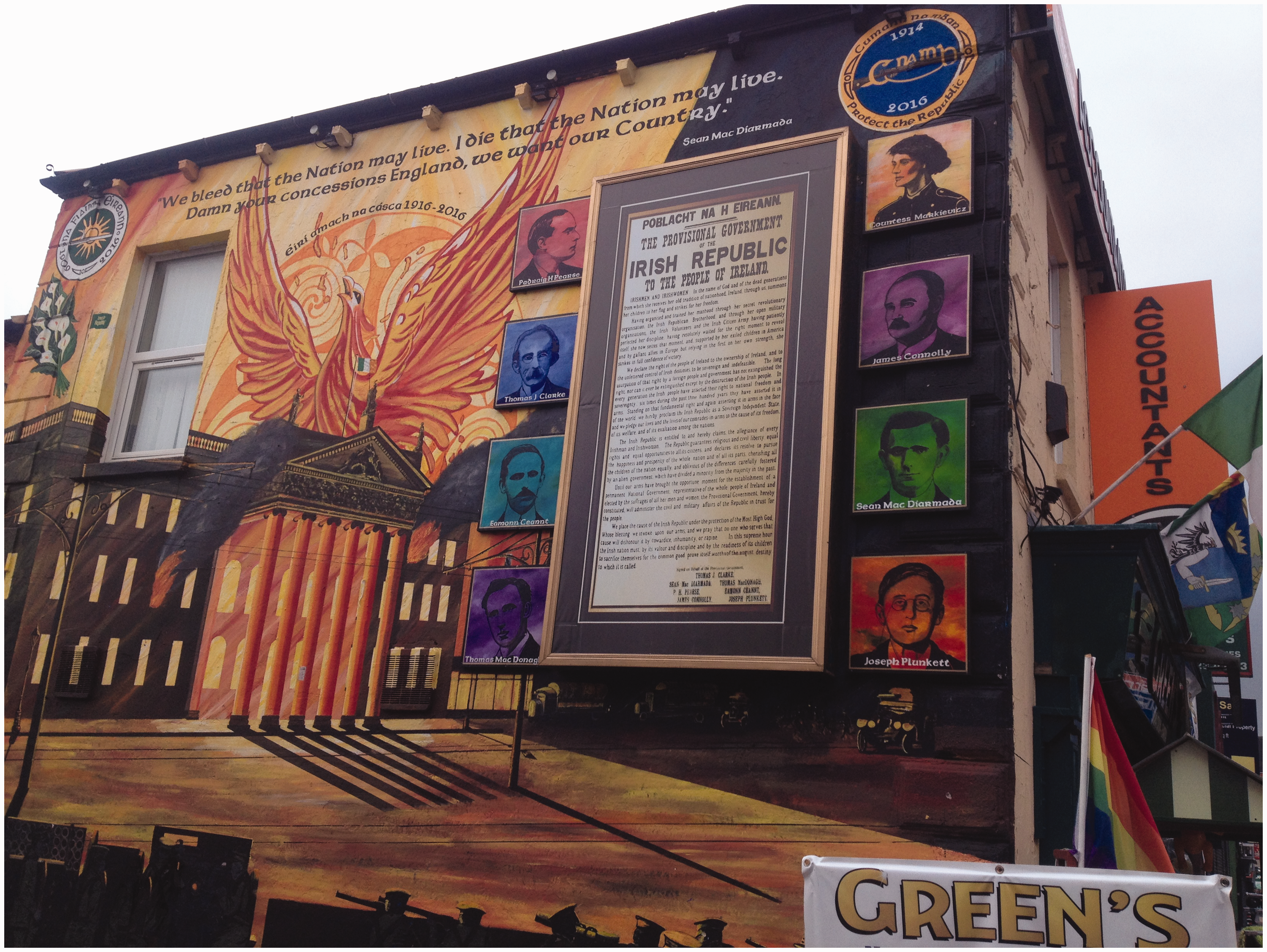
Mural on Falls Road, in West Belfast.
Over the years, such forms of territorial belonging have been informed by the political struggle and shaped by community interpretations of the actors and actions that forged this segregated city. The attachment of such agency to specific locations provides key signifiers of ethno-political belonging, which in many parts of Belfast are essential to ongoing communal interpretations of place (Neill, 2006). In the west of the city, Falls Park is located in a historically segregated area, as evidenced in the quote that opens this section. A local resident in his 30s, who was walking his dog in the park, gave his views on the changes seen in this shared space: ‘During The Troubles only locals came here, but now it’s much more used’. Another local resident in his 40s, who was with his child in the playground and has been coming here all his life had a different view: ‘Only Catholics here! I wouldn’t go to Woodvale Park and they wouldn’t come here. But there are some mixed communities, like Asians, who come here. I also go to Dunville Park and to Waterworks’.
Contentions over the use of shared spaces in Belfast are not, however, always about ethno-political allegiances. Contrary to the overall opinion that investment in sports equipment and grounds represents a significant improvement to parks, it is a new football pitch that is causing friction in this park. The all-weather Gaelic football pitch, under construction in 2017, was causing dissatisfaction amongst many park goers: ‘Hate doesn’t describe what I feel about that’, a woman in her 30s told me as she pointed to the view (Figure 7):
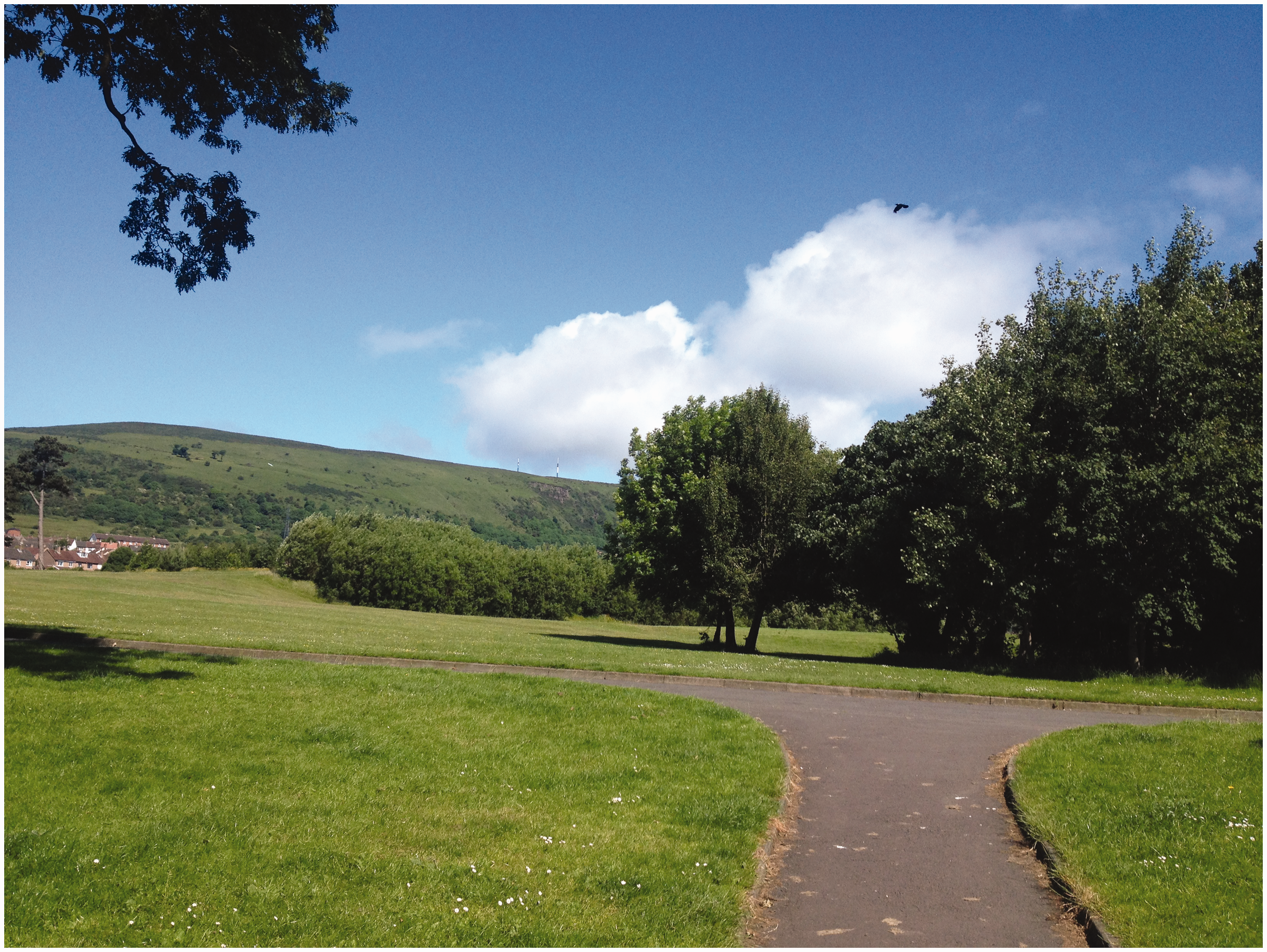
Area in Falls Park where the new football pitch will be.
We will still be able to see the mountains, but those trees will be gone, and the view will be just a flat field with plastic grass. There has been no public consultation and this is a done deal because it’s a profit-making venture. There is a ‘Friends of the Falls Park’ group but nothing can be done now. It’s all coordinated by the GAA and they have all these figures stating people’s opinions. The fences around the pitch will be 20 feet high and they will build a car park over some of the green area.
A man in his 70s is also very unhappy with the new football pitches, and with the GAA behind the project. He claims that the community was not involved in the decision-making process. The GAA produced leaflets for distribution telling people about a public meeting, but by some accounts they were never received and consequently no one, apart from those pushing for the project, came to the meeting. Why do we want artificial grass in a park? And they are building a big road cutting through the top end. The park was much better when I was a kid. There used to be a cooler [local slang for the Falls Park outdoor swimming pool]right over there where there is that overgrowth and if you took off your jeans you may not find them when you got back.
Natural and cultural signifiers: How threatening are they?
Some locations are just stuck. (Burns, 2018: 84)
In the novel Milkman (2018), a coming-of-age fiction set during The Troubles, Anna Burns provides a valuable insight regarding the perception of parks by someone who was a teenager during The Troubles. In the account by the author, bushes in her local public park ‘clicked’ as hidden cameras registered the presence of potential enemies, and interface roads were locations where ‘you give yourself away’ (Burns, 2018: 74). Regardless of whether bushes in public parks indeed had hidden cameras or not, what is significant in her account is the element of suspicion associated with shared spaces in divided cities, an insight that chimes with the comment by a woman in her early 50s who I met in Falls Park. When asked about the neutrality of shared spaces, she described the roundabouts in the city as tension-ridden places and contentious no-go areas during the marching season 7 (July and August) because they mark the divisions between affiliations and indicate where people live.
By contrast, people’s answers to our question as to whether parks are neutral were generally positive, as with a man in his 20s who said that ‘in the streets you get the flags, but not here [in the park]’. People used a number of idioms to describe the effects that parks had on them, and the relations held therein: The greenery makes you feel calmer. – a woman in her 30s in Waterworks You get your head showered. You get away from it all, you chill out. Look at what is around us: the Black Mountain joins the Divis Mountain there. There is a wonderful tourist information centre there run by the National Trust. There are Neolithic sites. You should go there! – a man in his 40s in Falls Park Nature brings the best out of people, if you have that in you. It’s supposed to bring you closer to god. – a woman in her 50s in Alexandra Park People are more neutral [in parks] because they are not where they live, and divisions here are about where people live. Look around here, you can’t tell where people are from. It’s a neutral place. – a woman in her 40s I wouldn’t go to a park in a Protestant area because if someone asked my name they would know I’m a Catholic, so I don’t think green spaces are more neutral. You can’t just chit-chat if you go to a park in a Protestant area.
The ongoing promotion of a ‘common civic identity’ (Bryan, 2003: 264) is being used to foreground discussions of development in an attempt to define a combined ‘Belfastian’ perspective (Nagle, 2009). However, attempts to redevelop a site or move a community boundary can cause conflict within and between communities, and more recently, economic transformations have added another element to the tension. The regeneration of the former Girdwood hub army barracks and the ongoing negotiations over the redevelopment of the Sirocco site are two such examples (Cunningham, 2014; Neill, 2010; O’Dowd and Komarova, 2011).
We therefore suggest that parks in Belfast are being subject to a shift away from homogenous understandings of communal representations to one that is more heterogeneous, incorporating evolving understandings of plural co-existence. In this context, everyday experience is critical in the re-conceptualisation of parks as spaces with alternative social, ethno-cultural and environmental meanings (Nagle, 2009). From a reading of Lefebvre, and moreover, using Lynch’s (1981) assessments of social signifiers to inform our understanding of urban form, we can argue that amenities within parks are being attributed with meaning that influences their utility and their spatial configuration in terms of how people access them, and how they sit within an individual and communal consonance of place (Mell, 2019).
There are also ongoing discussions within Belfast City Council looking at how local community leaders have started to assess the impact of changes in socio-economic and demographic profiles on communal interactions and understanding of space. New communal allegiances are being tied to other locations or activities, such as sports and community gardens, signalling alignments not necessarily based on existing ethno-political affiliations.
Conclusion
This paper started with a discussion on the supposed neutrality of parks and harmfulness of cultural signifiers. Over the last 20 years, Belfast has seen policies shift from the construction of walls to prevent sectarian interaction and improve neighbourhood safety to the proposals for the removal of these cultural markers to create shares spaces. However, old habits die hard and many view shared spaces with scepticism. By suggesting that certain displays of cultural belonging, such as flags and graffiti, should not be permitted, the city’s authorities imply that culture can be threatening and should be neutralised. The findings of this pilot study, however, suggest that not only the concept of culture used by policy-makers is ambiguous in the sense that some but not all displays of cultural belonging should be avoided, but also public opinion is wide-ranging. While participants appeared very open to dialogue, a significant proportion of them elaborated on how cultural markers are part of landscapes that are familiar to them, in many places providing a supportive and relatable communal consonance. This is central to the understanding of shared spaces in Belfast, where behaviour based on cultural signifiers remains visible even if it is increasingly frowned upon by planners.
From the interactions it became clear that parks are not neutral spaces: people have very clear understandings of the demarcation of space within parks, even if the markers are not visible for all to see. Signifiers are perceived through gestures, language, names and activities, such as the gate a park user chooses to exit from. Thus, cultural signifiers are not going to be absent by simply removing signs, as stated in the ASF document under ‘Tackling the Visible Manifestations of Sectarianism and Racism’. Equally relevant is the fact that some cultural signifiers are actually meaningful to people and may be part of a community’s history, such as the water fountain at Dunville Park. As for the wall in Alexandra Park, seen by some as a boundary between the more domesticated part of the park and its overgrown area, it makes some people feel safer and more likely to use that green space.
Findings reveal that discussing shared use with park users nurtures reflection on the local specificities of each park, while place-related memories celebrate forms of collectiveness that go beyond ethno-political allegiances. By exposing the tension between the neutralisation and the signification of shared spaces in Belfast, we reject the claim that parks are depoliticised or ‘neutral’ spaces compared to other ‘interface’ locations. We argue that while there are recurring affects associated with greener landscapes, shared spaces embody values and constraints, which are both historically and economically informed. Formal planning and management of shared spaces in Belfast need to constantly evolve and make community-informed decisions to meet the needs and aspirations of the city’s population, while taking into account the historical and affective relevance of physical and ethno-political segregation in the city.
Highlights
There is a constant re-negotiation of segregation-related rules reflecting a processual updating of how parks are viewed and used Formal urban planning and management needs to evolve accordingly to meet changing needs and aspirations of the city’s population The process of discussing shared use with park goers nurtures reflection and unveils local specificities and personal histories related to each park Physical structures within parks are attributed with meaning, which influences their utility and spatial dynamics
Footnotes
Acknowledgements
The authors are grateful to the School of Environment, Education & Development at the University of Manchester for the seed corn funding that enabled the authors to carry out a pilot study in Belfast in 2017. We would also like to express our gratitude to all park goers who offered their insights on shared spaces and to the three anonymous reviewers who provided valuable suggestions for the final draft of this paper. All photographs were taken by Luciana Lang.
Declaration of conflicting interests
The author(s) declared no potential conflicts of interest with respect to the research, authorship, and/or publication of this article.
Funding
The author(s) received no financial support for the research, authorship, and/or publication of this article.
