




Abstract
The scientific case for co-ordinated global governance of the climate system is firmly established, but how does this fit with a politician’s mandate as a democratically elected representative? What role do national politicians think they can and should play in climate governance? This paper tests these questions empirically, using data from interviews with 23 Members of the UK Parliament, and a focus group of civil society advocates, conducted between 2016 and 2018. A global goal to limit climate change has been agreed through the 2015 Paris Agreement. Yet while the Agreement sets a clear goal, the means to achieve it remain firmly at the level of the nation-state, with each country assuming responsibility for its own national plan. Thus national administrations, run by elected politicians, have a crucial role to play. This study shows that, while Members of the UK Parliament have an understanding of the challenges posed by climate change and wider changes to earth systems, few have yet been able to operationalise this understanding into meaningful responses at the national level. The study highlights two, linked, reasons for this. First, politicians’ ability to act – their agency – is limited by the practicalities and procedures of everyday politics, and by the norms and cultures of their working life. Second, UK politicians feel little pressure from their electors to act on climate change, and have to work to justify why action on climate change carries democratic legitimacy. The paper concludes with a discussion of the implications of this research, in the light of the recent high-profile climate protests and declarations of a ‘climate emergency’. It argues that politicians, working with other stakeholders, need support in order to articulate the scale and significance of global climate governance, and craft responses which build democratic support for further action.
Introduction
It is the spring of 2018. I’m sitting in a café in the House of Commons, right next to the River Thames, with a newly elected politician. I ask him what he thinks about climate change. ‘It’s terrifying’, he replies. ‘Where we’re sat right now might well be under water, right next to the Thames. I wouldn’t fancy our chances’. In my mind’s eye, I picture a submerged Palace of Westminster, and I think that he may well be doing the same. ‘Why isn’t that discussed much by politicians?’ I ask. It is as if this question breaks the spell, and he veers away from the underwater palace, moving the discussion onto electoral cycles, the economy, the health service. We are back on firm ground.
There is a growing body of evidence (IPCC, 2018; Rockström et al., 2009a) that human activity has influenced earth’s planetary systems to such an extent that the planet is entering a new and different geological era, the Anthropocene (Biermann et al., 2012a). One of the most significant impacts is the change to the planet’s climate system brought about by anthropogenic emissions of greenhouse gases (IPCC, 2018). Whereas earth’s climate had a long and turbulent history before the arrival of our species, the past 11,700 years, the Holocene era, has been remarkably stable. During this period, complex human societies have developed, with the advent of agriculture, large settlements, and more recently, nation-states, democratic government, industrialisation and globalised economic systems. As the planet moves out of the stable climate of the Holocene, into an era characterised by greater instability, the implications for human society are both profound and uncertain (Rockström et al., 2009b).
Better understanding of these changes has led to calls for governance of earth systems: purposeful, co-ordinated action by humans, aiming to limit changes to the climate and other earth systems, to allow human societies to continue and flourish. Prominent among these are the calls for ‘planetary stewardship’, which advocates a system of governance ‘built around scientifically developed boundaries for critical Earth System processes’ (Steffen et al., 2011: 757) and the Earth System Governance project, which calls for an expanded role for the United Nations organisations, to strengthen action at multilateral level, set global standards and co-ordinate national action (Biermann et al., 2012b).
The research presented here investigates how one particular influential group, national politicians, understand and respond to this challenge. What role do national politicians think they can play in the governance of the climate? I begin with a discussion and critique of the way in which scientific researchers, and others, have advocated for global governance of earth systems. Following a description of the methodological stance, I present empirical data from a focus group of civil society advocates, and interviews with 23 Members of the UK Parliament (MPs) to examine the question of how national politicians respond to climate change. Finally, I discuss the implications of this evidence, in the light of recent high-profile protests and political declarations on climate change. I conclude that researchers and practitioners alike must focus attention on building a political case for climate action within countries and local areas, rather than assuming that politicians will act because scientific evidence shows that such action is necessary.
The case for global governance of the climate system
Over the past decade, there have been increasingly urgent calls from the scientific and research community for a co-ordinated process of global governance, to limit anthropogenic interference with earth systems, particularly the climate system. Below, I discuss an example of such an approach – the framework of ‘Earth System Governance’. I argue that such initiatives would be strengthened if more attention was paid to questions of political agency, and to the need to develop democratic legitimacy. This is illustrated through discussion of climate politics in the UK, a country often seen as a leader, though recent policy implementation has stalled.
Earth System Governance
Earth system governance is defined by one of its architects, Frank Biermann (2014a), as ‘the societal steering of human activities with regard to the long-term stability of geobiophysical systems’ (59). Governance is understood as the process by which humans try to manage their impacts on earth systems, in order to ensure continued benign conditions for human societies. Much work in this area has been carried out through the Earth System Governance project, launched in 2009 under the auspices of the International Human Dimensions Programme on Global Environmental Change, and now part of the Future Earth (2018) initiative.
Biermann stresses that earth system governance has both an analytical and normative dimension. It is an analytical project, studying ‘the emerging phenomenon of Earth System Governance as it is expressed in hundreds of international regimes, international bureaucracies, national agencies, local and transnational activist groups, expert networks, etc’ (Biermann, 2014a: 59). It is normative, in that it proposes ways in which governance processes could be reformed, to better manage earth systems. For example, over 30 scholars from the Earth Systems Governance project co-authored a paper in the lead-up to the 2012 United Nations Conference on Sustainable Development, putting forward nine areas in which, they argued, major governance reforms were needed. The paper concluded that Swift transformative structural change in global governance is needed. We need a ‘constitutional moment’ in the history of world politics, akin to the major transformative shift in governance after 1945 that led to the establishment of the United Nations… Earth system transformation calls for similar, if not even more fundamental, transformations in the way societies govern their affairs. (Biermann et al., 2012b: 57)
While much research on earth system governance has focussed on multilateral institutions, there is also analysis of state and non-state actors, including national and local government, NGOs, business stakeholders and citizens; and an assertion that governance is multi-layered and polycentric (Bernstein and Hoffmann, 2018; Biermann, 2014b; Kuyper et al., 2018).
Political agency
Advocates for global governance of earth systems tend to underplay issues of political agency: who has both the power, and the motivation, to bring about fundamental change? For example, summarising his call for improved earth system governance, Biermann (2014a), while acknowledging the role of non-state actors and national governance, states that ‘Effective international cooperation must be a basis for Earth System Governance in the Anthropocene. A concerted effort is needed to bring these institutions in line with the exigencies of the changed political context of Earth System transformation’ (60).
The reasoning behind this statement is clear. Earth systems must be managed through international co-operation. However, such statements radically underplay the question of political agency. Who has responsibility, and power, to act? The phrase ‘a concerted effort is needed’ is written in the passive voice, without indicating who is making the effort, on whose behalf. Similarly, the Planet Under Pressure declaration states that ‘fundamental reorientation and restructuring of national and international institutions is required’ (Brito and Stafford-Smith, 2012: 8), without stating who requires it, and who will bring it about.
There is an assumption that it is possible for actors – including multilateral institutions, national governments and other interests including social movements – to translate scientific evidence into appropriate, agreed responses. Maarten Hajer coins the phrase ‘cockpitism’ to describe the illusion that governance of earth systems can be managed in this way, by committed actors – pilots, in this analogy – assessing all the evidence at their disposal, and having the freedom to respond accordingly in order to steer the planet, as aeroplane, into a safe landing (Hajer et al., 2015).
Yet, in stark contrast to the cockpit analogy, the question of who the actors are, and what agency they have, is complex and contested. As has long been argued by scholars of science and technology studies, it is not simply a case of ‘translating’ evidence into action. Reactions to scientific evidence are complex and situated, influenced by social and institutional norms and cultures (Demeritt, 2001; McNeil, 2013; Wynne, 2010).
It is not that there is no discussion of agency within this research field. Much has been written about the role of different institutions in driving change, including, for example Biermann’s (2014b) survey of those individuals, organisations and networks participating in decision-making; Oran Young’s (2017) work on networks and social capital; John Dryzek and Haley Stevenson’s (2011) work advocating a more deliberative democratic approach to global environmental governance, and many political theoretical accounts of politics in the Anthropocene (e.g. Eckersley, 2017; Purdy, 2015; Wapner, 2014).
A missing perspective in these studies, however, is an understanding of how politicians and other decision-makers understand their role, and the extent to which they feel themselves to be protagonists in this debate. Why would a politician, civil servant or other decision-maker decide to expend time, energy and social capital on questions of global climate governance, rather than other issues?
Put another way, it is widely known that anthropogenic climate change poses a grave threat to human society. Why, then, are politicians and other senior decision-makers not prioritising this issue in all their statements and actions? To date, there have been few attempts to answer these questions, as highlighted in a review by Lauren Rickards et al. (2014) into the role of senior decision-makers in climate action.
This first limitation of much research into global climate governance links to a second limitation: the question of democratic legitimacy. The ability, and willingness, of national legislators to respond to demands for climate governance depends on the political conditions within which decisions are made. This, in turn, depends on whether politicians feel that they have a mandate, from their electorate and others.
Democratic legitimacy
Advocates of global governance to regulate the climate and other earth systems are rarely explicit about how calls for reform relate to democratic processes at the local, national or international level. Such calls are often presented as a precondition of human society, something that must be done, given the weight of scientific evidence. The question of how reforms can be brought about, democratically or otherwise, is not specified.
Andrew Dobson (2010) describes this approach, stating what ‘must’ be done without specifying how, as attempting to play ‘a card that will trump political debate and discussion’ (765). Yet to the extent that action relies on legislation or policy change, politicians need to steer reforms through formal political processes. Put bluntly, what if calls for governance of earth systems do not garner democratic support? How should a politician respond if scientists call for urgent action, but publics, including those whose votes they depend upon, do not prioritise the issue? In this situation, politicians are left with the tricky job of crafting a case for action, on an issue that is not front-of-mind for voters (Willis, 2018).
This paper does not argue against recommendations for strengthened, multilateral governance. Rather, the analysis suggests that more emphasis must be placed on the processes by which such governance could be brought about, and how reforms can be steered through national political systems, in ways that engage electorates and develop a mandate for further action. In other words, researchers must address the ‘politics gap’ identified by Ian Bailey and Piers Revill (2015). Below, these issues are discussed with reference to a specific example: the case of climate governance, and its implementation in the United Kingdom.
The case of climate change in the UK
The Paris Climate Agreement of 2015 can be seen as a step towards global governance of the climate, in that 195 countries reached agreement, following previous failed attempts, notably at Copenhagen in 2009. The agreement declared that ‘climate change represents an urgent and potentially irreversible threat to human societies and the planet … deep reductions in global emissions will be required’ (UNFCC, 2015: 1). A goal was set to limit global average temperature rise to between 1.5 and 2°C.
However, the Agreement also highlighted the limitations of governance through international consensus. While a global goal was agreed, there were no legally binding commitments or targets agreed for individual states. Each state instead assumed responsibility for developing its own plan, or ‘nationally determined contribution’ (NDC). The Paris framework offers each state the opportunity to shape their own response, to fit national circumstances and democratic possibilities. Yet so far, the sum total of all actions pledged through NDCs does not match the Paris ambition of holding global temperatures below 2°C, with analysis of current NDCs showing that, even if they are implemented in full, the ambition will not be met (Fawcett et al., 2015). As a result, the agreement has been criticised as too weak (Allan, 2019).
The UK is in a relatively strong position to respond to the Paris Agreement. It has statutory targets on carbon reduction, enshrined in the 2008 Climate Change Act, passed with cross-party political support, and amended in 2019 to set a target of net-zero emissions of greenhouse gases by 2050.
However, the means by which this goal will be reached are not clear. Targets need to be met through policies and action to reduce emissions in energy, transport, buildings and land use, for example. The Committee on Climate Change (2017, 2019), established as an independent adviser under the Climate Change Act, has repeatedly criticised government for a so-called policy gap saying that further policies are required if targets are to be met. However, in the decade following the introduction of the Act, neither of the two main political parties in the UK paid much attention to the issue, and there were fears cross-party consensus may be eroding (Carter and Clements, 2015; Farstad et al., 2018).
In short, despite a comprehensive international agreement, and a strong legislative framework for domestic action, the period from 2008 to 2018 was marked by limited political activity on, or commitment to, climate issues in the UK, and underachievement against targets set.
In recent months, activist pressure on climate change, particularly the school strikes, the global climate strike of 20 September 2019 attended by an estimated four million people worldwide and the new protest movement Extinction Rebellion, has contributed to growing public awareness and concern (Barasi, 2019). Politicians have replied with strong articulations of the climate challenge. More than 200 local governments, along with the Scottish, Welsh and United Kingdom parliaments, have declared a ‘climate emergency’, with some introducing very ambitious targets, such as net-zero greenhouse gas emissions by 2030 (Climate Emergency UK, 2019). It is not clear yet how this will translate into government policy or strategy. I will discuss possible outcomes in the concluding section.
Both the ‘silent decade’ of 2008–18, and the recent strong statements in support of climate action, show that responses to climate change must be understood in the context of the complexities of national politics. The study described below uses data from a study of UK politicians, to investigate this question.
Method
Methodological orientation
This study aims to supplement macro, structural descriptions of governance, with a more fine-grained, contextual account of the ways in which national politicians experience the issue of climate change, as one of a number of earth system challenges. To do this, the study takes a mixed-method approach, inspired by what Sanford Schram (2013) calls ‘phronetic social science’.
The term ‘phronesis’ refers to an Aristotelian categorisation of knowledge, described as ‘the practical wisdom that emerged from having an intimate familiarity of what would work in particular settings and circumstances’ (Schram, 2013: 369). As such, it can be distinguished from episteme, or universal knowledge; and technē, or practical application of knowledge. Following this approach, this study aims to uncover politicians’ phronetic knowledge. It scrutinises their understandings of the possibilities and constraints of their role, or what Schram et al. (2013) refer to as ‘“unconsciously competent” expertise’ (371).
Phronetic social science can be used to illuminate and problematise the workings of power within political and governmental settings. For example, Steven Griggs and David Howarth (2012) use the approach to examine the concept of ‘sustainable aviation’ in UK government policy. They argue that consultation processes presented as consensus-building exercises conceal fundamental value-conflicts between different actors, in this case, the government, the aviation industry and campaign groups. Thus, in the words of Bent Flyvbjerg et al. (2012), In phronetic social science, ‘applied’ means thinking about practice and action with a point of departure not in top-down, decontextualized theory and rules, but in ‘bottom-up’ contextual and action-oriented knowledge, teased out from the context and actions under study by asking and answering the value-rational questions that stand at the core of phronetic social science. What is applied is not a theory, but a philosophy of engagement. (286)
Research process
This paper reports on two datasets: first, a focus group discussion with representatives from NGOs who work closely with politicians, and second, 23 narrative interviews with current and former MPs. Each of these stages is outlined below.
Prior to the interviews with politicians, a focus group was held, comprising representatives from NGOs, six individuals who work directly with MPs on climate change. The discussion was hosted by the think-tank Green Alliance, in February 2016. Representatives from Christian Aid, Green Alliance, the Royal Society for the Protection of Birds, the World Wildlife Fund UK and Greenpeace took part. Comments made were non-attributable. I asked them about their experiences of working with politicians on climate change and their views on what motivates politicians. The discussion was recorded, transcribed and coded using NVivo software.
I then interviewed 23 current and former MPs, between February 2016 and April 2018. Participants were selected to provide a balance of age, gender, political party, seniority and length of time served as an MP, as well as previous experience working on climate issues (see Table 1). Known ‘climate sceptic’ MPs (defined as those who publicly state that they do not accept the scientific consensus, as represented by the Intergovernmental Panel on Climate Change (IPCC)) were not approached. This is because the research investigates how MPs try to understand and act on climate change, rather than examining the reasons for rejecting the issue altogether. Although this is an important question, a different research strategy would be needed for this group. Though climate sceptics are influential, they are small in number, with only 5 MPs out of 659 voting against the Climate Change Act in 2008.
Interviewees’ background and experience.
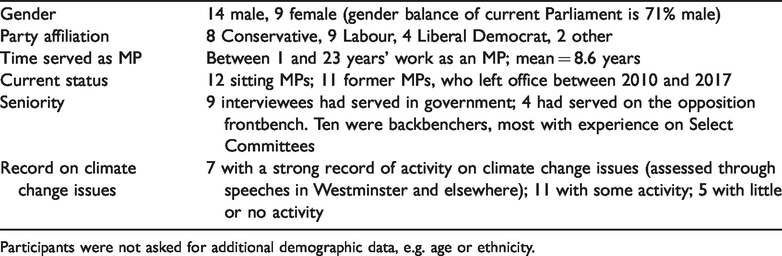
Participants were not asked for additional demographic data, e.g. age or ethnicity.
Interviews were conducted under conditions of anonymity, following a written ethics protocol, and were recorded, transcribed and coded. Riessman’s (2008) narrative method was used, focussing on eliciting narrative, with the interview conducted as a free-flowing conversation. As Todd Landman (2012) notes, ‘narrative analysis can illuminate the ways in which individuals experience, confront and exercise power’ (28), and so is particularly suited to phronetic social science.
The interviews were designed to investigate politicians’ accounts of how they navigate their working life, and within this, whether or how they consider the issue of climate change. I asked interviewees how they responded to the scientific consensus on climate change, as established by the IPCC. I then asked them to reflect on the ways in which the issue of climate change was understood, shaped and acted on in political life.
Results
The combined methods used in this study reveal a consistent picture of the way in which politicians respond to climate change. While there were some differences between political parties (see Carter, 2013 for a discussion of the positions of the main UK parties), these differences were not marked; instead, a consistent pattern emerged, reinforced by the focus group data.
The pattern can be summarised as follows. Most politicians accept the science of climate change and do not question the scientific consensus established by the IPCC. (Note that as detailed above, the small number of known ‘climate sceptic’ MPs were not interviewed for this study.) However, while politicians accepted the science, they downplayed the consequences. Most also show a reluctance to discuss the far-reaching implications of climate change for human society or more radical proposals for mitigation. Questions of agency and democratic legitimacy, discussed above, conditioned their understanding, and their conception of plausible responses to climate change.
Below, evidence for politicians’ understanding of the science of climate change is first reviewed. Then the themes of agency and democratic legitimacy are explored.
Accepting the science, downplaying the consequences
Politicians generally accepted and acknowledged the scientific consensus, as represented by the IPCC. However, this acceptance was coupled with a notable reluctance to open up discussion on the material significance of climate change. In each interview, politicians were prompted to consider the significance of climate change. As the interviewer, I noted the scientific consensus, as reflected by the IPCC, and stressed the implications of this, by saying, for example, We’ve had a stable climate for twelve thousand years; we risk not having a stable climate any more. In those twelve thousand years, that’s when we’ve done everything from agriculture onwards. Human society as we know it has been formed in those twelve thousand years. The shift we’re talking about is really profound. Do you think that politicians, or society more widely, have taken that on board?
However, despite this acceptance of the evidence, the interviews revealed a striking reluctance to open up discussion on the significance of climate change.
Despite acknowledgement of the problem, no interviewee offered further comments or questions about the science of climate change, or its impacts. All interviewees found ways to move the discussion on to other topics. One former MP said that, during his time in Parliament, he had never heard the issue ‘strongly articulated’: Even those of us who I strongly advocated action, I don’t think we, I’m trying to think back to a time when it was ever really strongly articulated like that … it’s almost like they don’t want to think about that. I’d say that’s even true of people who think we need to grip it, it’s like it’s such a frightening thought that it’s easier to just assume and believe, be optimistic.
MPs’ responses to climate change therefore combined an acceptance of the issue, coupled with a reluctance to open up discussion on its implications. The sociologist Kari Norgaard (2011) labels this ‘socially organised denial’, which she defines as ‘not in most cases a rejection of information per se, but the failure to integrate this knowledge into everyday life or to transform it into social action’ (11). Researchers of the climate science community have found similar responses among scientists, who tend to downplay the implications of their findings (Brysse et al., 2013; Head and Harada, 2017).
Part of the reason for this, for MPs, may lie in the difficulties of developing a full understanding of the implications of climate change. One veteran politician explained this by distinguishing between ‘agreement’ and ‘understanding’, as this exchange shows: Interviewer: The science is pretty settled, most politicians agree with that scientific consensus. Interviewee: Sorry, I need to qualify that. Agree without understanding. It’s become the politically correct thing to do … but do they understand what it means? Most politicians will have a sort of sense, when they’re appointed into a role, broadly what the issues are, but I think the reason that the commitment grows is that they get the data, they get the evidence, they see what’s going on, and go, bloody hell, this is going to be disastrous. I suspect that for most politicians, just routinely experiencing the media, then they would hear environment and climate change in no particularly separate box from health, education and transport, the business world, Europe: it’s just one of a range of issues that are political and of the day, and something needs to be done. And actually when they go into it, and have to start getting their head round it, they realise that this is this big massive transformative thing that could happen.
Agency
As outlined above, while interviewees accepted the science of climate change, they tended to downplay its implications. They were reluctant to discuss more radical solutions, such as the proposals put forward by earth system governance advocates. This can be explained only in part by a lack of understanding of the evidence. Data from this study show that responses are conditioned by politicians’ understanding of agency: their own agency, and the wider ability of institutions and states to respond in full. From the vantage point of the national politician – even the most committed, fearless politician – the agency of individual politicians, and governments, is limited. To put it in the earthy language of one veteran ex-minister interviewed, ‘motivation isn’t just a set of beliefs, it’s about an ability to implement … it’s all very worthy, but what the fuck can you do?’.
Limitations to agency are both practical – what is achievable within the framework of current laws and procedures – and also cultural: how politicians understand social and cultural norms. These are discussed in turn below.
Most interviewees highlighted practical and procedural difficulties in responding to climate change. In particular, they drew attention to the lack of ‘fit’ between large-scale, earth-system challenges, and the daily practice of politics. Bluntly, politicians are realistic about the extent of their power. This is partly a function of the UK system, in which the Government has almost exclusive power to initiate legislation, leaving backbench and opposition MPs relatively powerless, with roles largely as influencers or protesters, as more than half the interview sample pointed out. 1 However the limitations of the government’s power are also front-of-mind for politicians. As one said, ‘The punters, the populace think that the politicians, the prime minister for example, is all-powerful. Actually, they absolutely are not. I’m not saying they have no power, but they can’t just do it’.
Politicians also identified less tangible but nonetheless very significant constraints on agency. Interviews revealed the ways in which MPs’ responses to climate change were conditioned by social and cultural norms, and institutional practices. Specifically, those who speak out on climate change were regarded by their colleagues as outsiders, not part of the political mainstream. I asked one MP, who was in Parliament when the 2008 Climate Change Act was passed, whether it was discussed much. She replied, ‘a little bit, not very much. It was seen as something by the obsessives’. A former MP, who had campaigned actively on climate change and environmental issues, said ‘I was known as being a freak’.
While all interviewees reported that there was a small minority of MPs who champion climate issues, they also pointed to a more widely shared reluctance to engage, particularly from elements of the Conservative party, but also reported across party lines. One explained it as follows: There’s a kind of obdurate hostility which is culturally quite difficult. And just as there’s a kind of cross-party group and an understanding, who see the science, recognise intellectually, there’s a huge group that does not, that sees it as peripheral, wet, liberal, lefty, interfering, non-business.
NGO representatives described the same phenomenon. They reported that climate change was not seen as an issue that an ambitious MP would champion. One described how it might look to a government minister wanting to develop their personal power and influence: If you’re [a cabinet minister] and you broadly think that climate change is happening and you should do something about it, you walk into cabinet and you start saying right guys what are we going to do about climate change, you’ll just get laughed out of the room, because they want to be talking about the economy, and building stuff, and bombing people. It’s just not a serious sort of cabinet issue for the big bruisers. [If] you’re trying to build your base in a party, you absolutely don’t do that by talking about airy fairy climate change. You do that by talking about jobs and the economy.
These findings are consistent with previous research on politicians, which show that MPs’ outlooks and actions are influenced by institutional and cultural contexts. For example, studies on gender in the House of Commons (Lovenduski, 2012; McKay, 2011; Malley, 2012; Puwar, 2004) demonstrate that the norms and rituals of parliament condition and constrain action. New institutionalist thinkers refer to this as a ‘logic of appropriateness’ (Chappell, 2006: 223). Institutions like Parliament should be seen, they argue, as ‘collections of interrelated rules and routines that define appropriate actions’ (Chappell, 2006: 161; see also Douglas, 1986; Lewis and Steinmo, 2012). In short, the agency of individual politicians is constrained not just by law and procedure, but by social and cultural norms.
These norms can also be seen among the wider political community, including representatives from NGOs and advisory groups. One MP, a veteran climate campaigner, criticised those outside parliament for crafting messages to appear credible and reasonable to politicians: ‘…people coming in, basically telling MPs what they want to hear … It made me so angry’.
This interviewee vividly described how experts, when talking to MPs, ‘don’t want to sound like an outlier … it’s something about this place, I think, once you get inside one of those Committee rooms’.
NGO representatives also reported how they crafted messages that they believed would resonate and appeal to politicians. One focus group participant described the NGOs’ attempts to present climate action as an economically beneficial strategy, comparing their messages to that of corporate consultancies: ‘I think the environment community, we’ve chased ourselves round to pretend that we’re McKinsey and EY, and it’s been really helpful in winning the overall argument, shifting how climate change is perceived’.
Political scientists refer to this process of crafting messages as ‘framing’, in which politicians and other political actors, consciously or not, shape an issue to fit with dominant ideologies, a sense of what is achievable, prevailing norms and assumptions, and so on (Benford and Snow, 2000; Cobb and Coughlin, 1998; Kingdon, 1995).
Thus, the evidence presented here shows a tendency to focus on immediate, technical solutions, rather than considering the full implications of climate change for politics and society. Politicians and those who interact with them seek ways of addressing climate change which fit with the working practices of Parliament and the institutions of policymaking. Interviewees were eager to give examples of possible approaches, such as incentivising renewable energy, and promoting public transport.
This reluctance to linger on the ‘big problem’ of climate change, and a move instead to ‘little solutions’, seemed to be a result of politicians’ understanding of their agency, or room for manoeuvre. They would prefer to propose practical solutions which fit with social, cultural and institutional norms. Yet it leads to questions about whether such solutions add up to a sufficient response to the problem. It certainly precludes discussion of the arguments put forward by more radical critics (e.g. Jackson, 2011; Klein, 2015) that climate change requires a fundamental rethink of economy and society.
Democratic legitimacy
Politicians’ responses to climate change were also conditioned by their understandings of their representative role. The relationship between an elected politician and those that they represent is complex, and the subject of much debate in political theory (for a summary, see Dobson and Hamilton, 2016; Mansbridge, 2003). Recent work by Michael Saward (2010) argues that representation should be seen not as a static fact, but as a dynamic exchange between representatives and those being represented, in which a politician (or anyone else seeking a representative role) can make a ‘representative claim’, which in turn is accepted or rejected by others: ‘Political representation is not simply a fact of political life, or an achieved state of affairs, resulting from elections. Rather, at a deeper level, representation is a dynamic process of claim-making and the reception of claims’ (8).
Data from this study fit with Saward’s conception of representation as claim-making. MPs reported consistently that they felt little or no pressure from most people they saw themselves as representing, to work on climate issues (note that interviews were conducted before the climate protests of 2019). Thus, if they saw the need to act on the issue, they worked to construct a claim, demonstrating how their stance on climate change could be justified in terms of their role as an elected politician.
Evidence for the lack of pressure to act on climate change was strong. Typical comments included I’ve knocked hundreds, literally thousands of doors, and had tens of thousands of conversations with voters … and I just don’t have conversations about climate change. When you go around with your clipboard asking what are your top priorities, you always know it’s health, economy, education, crime, stuff like that, and environment always comes very [low] down.
Others, however, persisted, despite the difficulties. Interviewees discussed the ways in which it was possible to address the issue, through developing an account of how a certain course of action would serve the interests of the people they claim to represent: in Saward’s terms, developing a ‘representative claim’. A separate paper (Willis, 2017b) offers further details of this claims-making process.
Four types of claim can be seen. First, some MPs made a cosmopolitan claim, saying that it is in the interests of the human species as a whole to act, and therefore it should be a concern for all politicians. I often started off with that sort of fairly internationalist viewpoint … a lot of the impacts of climate change are going to hit other places before they hit here. [My constituency] is not likely to be one of the first places to be hit particularly badly. So what? I just happen to be here. I talk for example quite a bit about … domestic flood risk. I don’t see it as one of the biggest consequences of climate change, in reality, but “your house is going to flood if we keep doing this and you will not be able to get insurance for it, so we need to do something about it” … is a powerful message. In [my area], the green economy, the offshore wind, presents an opportunity. I’m happy to use an economic argument if that means that more people will come on side … I change the language to be much, much less extreme.
As these examples show, it is not straightforward for politicians to make a case for why, as elected representatives, they should act on climate change. However, politicians know that action is necessary, and so develop strategies for building support. Below, I discuss how researchers and practitioners could better use politicians’ knowledge and experience, and support them in developing stronger responses to the challenge of climate governance.
Conclusion: The role of national politicians in global climate governance
This conclusion begins with a consideration of the implications of this work for research. In particular, it discusses the role of phronetic social science in developing an understanding of the national politics of climate governance, stressing the importance of contextual accounts that acknowledge the motivations, assumptions and (lack of) power of actors within governance systems. It then responds to the current moment in climate politics, and suggests ways in which the learning from this study could be applied in order to better support national politicians to respond to the global challenge of climate governance.
The research challenge: Linking global governance to national political realities
The results from this study indicate that there is a need to focus more attention on the ways in which global issues are experienced, shaped and implemented by decision-makers at the national level. There is a considerable gulf between the extent and reach of governance mechanisms proposed by advocates of ‘earth system governance’, ‘planetary stewardship’ and similar projects, on the one hand, and the more limited efforts of these politicians to craft a manageable and meaningful agenda for climate action, on the other.
Rather than lingering on the subject of complex global challenges, the politicians in this study acknowledged the evidence, but then turned to what they perceived to be achievable actions. This may be a well-meaning attempt, even a tactical choice, to frame difficult issues in ways that are less threatening and more amenable to action: better to do something than nothing at all. The obvious drawback to this strategy is, of course, that the stability of earth systems is not a matter that can be negotiated away. How can research both explain this discrepancy, and suggest responses?
The research presented here only considers politicians in one legislature. MPs operate under the political traditions, constitutional and legislative particularities of the UK system. Given that no major economic powers currently have a national climate plan compatible with their Paris pledges (Climate Action Tracker, 2019), it is reasonable to conclude that a commitment to far-reaching action is eluding most political groupings. However, the reasons for this may differ across different political systems.
Comparative studies would reveal whether different political systems result in different strategies by individual politicians. For example, in the UK, MPs are elected to represent a geographical constituency, which could explain their efforts to link the global issue of climate change to the needs of their local area. Strategies may well be different in a different political system, such as proportional representation based on a national list, as used in Scandinavia, for example; or in federal political systems like Germany or the US. Comparative research across different legislatures would confirm the extent to which the UK case is generalisable.
This study illustrates the possibilities of phronetic research (Schram et al., 2013) and its focus on developing a close understanding of people’s (in this case, politicians’) lived experience and innate understandings. If advocates from the scientific and research communities want politicians to make more significant efforts to address global challenges, they will need to work with them, drawing on their phronetic knowledge to understand the possibilities and constraints of their role. Such an approach would, in turn, allow all sides to challenge their assumptions, and work together to develop the ambitious yet workable plans that are needed if climate goals are to be met.
As Noel Castree and others have argued (Barry, 2012; Castree, 2017), doing this will require better interdisciplinary working, involving collaboration with critical social sciences and humanities scholars. The study presented here is one such example. Yet the working methods, language and publication habits of different disciplinary groupings can make such collaboration challenging.
Implications for current climate politics
The fieldwork reported in this paper concluded in spring 2018. Since then, as described at the start of this paper, there has been a remarkable upsurge of political attention on climate change. By September 2019, 4 countries – the UK, Norway, Sweden and France – had written a target of net-zero emissions into law, and 15 others had non-binding net-zero targets, or were considering legislation (ECIU, 2019). Meanwhile, four countries – the UK, France, Canada and Ireland – had declared a ‘climate emergency’, alongside hundreds of states, provinces and local authorities worldwide (Climate Emergency UK, 2019).
A recent analysis of the Twitter activity of MPs shows a sharp rise in mentions of climate, from an average of 1 mention per day, from the Twitter accounts of 577 MPs, up to 7.8 mentions per day in May 2019, peaking with 160 tweets on 1 May, when the UK Parliament declared a climate emergency (Ebrey, 2019). There have also been marked shifts observed in public opinion polling on climate (Barasi, 2019).
These rapid changes suggest that some of the issues facing the MPs I spoke to in 2016–18 are being addressed, particularly the concerns that interviewees had about speaking out on climate. As the research cited above shows, MPs now seem less inclined to tailor their message for fear of being seen as too extreme.
So far, however, the new political focus on climate has been largely declarative, not substantive. This is not necessarily a criticism: it is too early to say whether radical action will follow radical targets and commitments. However, previous phronetic analyses would suggest that the success, or otherwise, of this new climate politics – in terms of its translation into action resulting in lower greenhouse gas emissions – will depend on the ability of different system actors to exert influence over the definitions both of the problem and the proposed solution. Griggs and Howarth’s (2012) study of the ‘sustainable aviation’ debate uncovered a complex struggle to define and own this concept. There are now signs that similar struggles are afoot to define and own the concepts of ‘net zero’ and ‘climate emergency’.
For example, the Scottish Government’s ‘Programme for Scotland’, published in September 2019, commits Scotland to a target of net-zero emissions by 2045, while continuing to support oil and gas exploration in the North Sea. Introducing a programme to reduce emissions from oil and gas extraction, entitled the Net Zero Solution Centre, they make the bold claim that the North Sea will become ‘the first net zero hydrocarbon basin in the world’ (Scottish Government, 2019: 50), distinctly at odds with protesters’ insistence that the only feasible path to net zero is to ‘keep it in the ground’. An analysis by Sophie Yeo (2019) of the actions of local governments who have declared a ‘climate emergency’ shows that, so far, the response has been to repurpose existing programmes, rather than reorientate overall aims and working practices in line with the ‘emergency’. In line with the findings of the study presented here, this suggests that politicians accept the need to act on climate, but feel that they have to shape action in ways which they believe to be manageable and appropriate.
Directions for research and practice
The results from the study presented here suggest some fruitful areas for collaborative research and practice. First, discussions of agency could be reshaped to include a more explicit articulation of power relations and vested interests which may constrain politicians (Geels, 2014; Oreskes and Conway, 2012; Phelan et al., 2012). The fossil-fuel divestment movement, now gaining considerable traction, is one example of this. Efforts to uncover and quantify public subsidies for carbon emissions, so-called fossil fuel subsidies, are another (Coady et al., 2017). Previous research indicates that climate policy becomes highly politicized once incumbent industries are challenged (Stokes and Breetz, 2018), so issues of power relations and associated political conflict are likely to increase over coming years.
Second, some promising collaborations are emerging around proposals for democratic innovation, particularly deliberative processes which allow for dialogue between citizens and politicians, as well as other actors including scientists. Deliberative processes allow politicians and publics to debate the implications of climate change, and co-create responses (Dryzek, 2002).This approach has already been used in Ireland (The Citizens’ Assembly, 2018), as well as a number of local areas in the UK. In June 2019, the UK Parliament confirmed that they would hold a Citizens’ Assembly on climate change, to be run in early 2020.
Last, there is a need to study and learn from existing and proposed political strategies for climate action, to investigate which climate strategies have built stronger democratic mandates for national and international action. For example, has the German Energiewende, or Energy Transition, with its focus on local action by citizens, social enterprises and municipalities, increased understanding of, and support for, significant climate action? Proposals by some US Democrats for a Green New Deal have undoubtedly raised the profile of climate in US politics; to what extent has this enabled politicians on the left to embed climate issues into their core political project?
Given the magnitude of the climate governance challenge, researchers and advocates may well be tempted simply to raise the volume, placing further demands on national politicians to accept and implement their proposals, without acknowledging the limitations they face. The research presented here shows, instead, the value of developing an understanding of the motivations, outlooks and knowledge of national politicians, to craft politically feasible responses which build a democratic mandate for change.
Highlights
Scientists and activists call for governance of the global climate, a co-ordinated effort to steer the planet towards sustainability. This approach neglects the complexities of agency and democratic legitimacy. The paper presents phronetic research investigating how UK politicians understand and act on climate change. The paper concludes that there is a need to work with politicians to understand and act on the constraints of their role. The research also shows that more attention needs to be paid to the way in which climate action can achieve democratic support.
Footnotes
Declaration of conflicting interests
The author(s) declared no potential conflicts of interest with respect to the research, authorship, and/or publication of this article.
Funding
The author(s) disclosed receipt of the following financial support for the research, authorship, and/or publication of this article: This work was funded by the Economic and Social Research Council (grant number ES/J500094/1).