




Abstract
Anthropocentric climate change presents an existential threat through impacts such as rising sea levels, effects on agricultural crops and extreme weather events. However, governments, businesses and communities struggle to wean off fossil fuel dependency. In this article, we argue that this is due to the grip of fossil fuel hegemony. To explain this grip, we draw on the theoretical perspectives of new materialism to examine how fossil fuels and politics interact in upholding Australia's fossil fuel regime. Our analysis, based on 70 qualitative interviews conducted with politicians and political advisors, fossil fuel executives and experts and environmental activists, shows three processes – establishment, entrenchment and encroachment – through which political-material entanglements lock in a fossil fuel-based future. These processes are both discursive, with politicians and industry downplaying, if not outright denying, the climate emergency and material, with investment in new mines and infrastructure even while the negative ecological impacts of fossil fuel use gather pace.
Introduction
The Intergovernmental Panel on Climate Change’s (IPCC, 2021) report on the physical science of climate change presents stark evidence that greenhouse gas emissions from human activity are responsible for increases in temperature of approximately 1.1°C since 1850–1900. Irreversible physical effects of climate change, such as melting glaciers and polar ice, ocean acidification, sea level rise and increased risks of heatwaves, floods and droughts, have already occurred. Unless there is an immediate and drastic reduction in greenhouse gas emissions, these impacts will further worsen, threatening the survival of much of the life on the planet (IPCC, 2021).
The early hopes that the economic pause during the COVID-19 pandemic might generate a lasting shift to renewable energy sources were short-lived, with fossil fuel consumption quickly returning to pre-pandemic levels after an initial slowdown (Smith et al., 2021). In line with the revival of the global economy, the fossil fuel hegemony was reinstated within the broader process of the ‘return to normal’ (Nyberg et al., 2022; Wright and Nyberg, 2015). Hegemony, as understood by Gramsci (1971), is the process of winning the active and passive consent of key actors in forming a ruling bloc. The bloc establishes dominance through consensus rather than force. The hegemony produces a given order, so that one way of doing things comes to be seen as the only reasonable or ‘common-sense’ way of doing things (Gramsci, 1971).
Investigations of fossil fuel hegemonies in different nations have emphasised how actors construct a common sense around the use of fossil fuels by building coalitions (Levy and Spicer, 2013) and linking actors’ interests to the fossil fuel industry (Nyberg et al., 2013). These strategies are entangled with historical processes, ecosystems and discourses which reify particular arrangements of extraction (Johnson et al., 2021; Lecavalier and Harrington, 2017). To explain these entanglements, theoretical approaches grouped under the term ‘new materialism’ point to ways of understanding human beings as enveloped within, and dependent upon, relations with nature (Coole and Frost, 2010; Dolphijn et al., 2012; Fox and Alldred, 2016). In these theoretical approaches, the ‘natural’, ‘social’ and ‘technical’ worlds are conceived as an interconnected, co-constituted and ever-changing web of relations (Barad, 2007; Braidotti, 2013; Conty, 2018; Haraway, 1990; Latour, 2005).
This new materialist emphasis on relationality appears particularly useful for broadening our understanding of the operation of fossil fuel hegemony in Australia. As a nation-state with significant fossil fuel reserves within its territory, Australian politics is shaped by its geologic capacity (Yusoff, 2013). This was demonstrated in February 2017 when then Treasurer, and later Prime Minister, Scott Morrison, carried a piece of coal into parliament, claiming that calls to move away from coal use represented ‘coalophobia … [a] pathological, ideological opposition to coal being an important part of our sustainable and more certain energy future’ (Hansard, 2017). Emblematic of Australia's ongoing failure to legislate effective climate policies, the symbolic use of coal as a prop for the nation's prosperity is indicative of the ways in which the ‘rock’ has been bound to the nations’ identity. Within this context, then, new materialist approaches provide a means for thinking through the ways in which the politics and materiality of fossil fuels are entangled in a specific place – fossil fuel rich Australia – at a time when the impacts of climate change can no longer be ignored.
Drawing on 70 interviews with politicians, business leaders and environmental activists, this paper examines the material and discursive processes that uphold fossil fuel hegemony in Australia in the face of the climate crisis. It shows that the ways in which participants discuss the materiality of fossil fuels, and the infrastructure, built environments and industries that their use has enabled, had an active and constraining role in the political solutions to climate change that were being proposed. These material aspects were entangled with a national identity linked to the exploitation of natural resources, constant economic growth and notions of progress. This contributes to understanding how what we refer to as political-material entanglement influences the material conditions of life and the politics of nation-states as well as the potential emancipatory practices that can disentangle the hegemonic grip.
Fossil fuel hegemony
Fossil fuel hegemony is reproduced through the continued extraction, exchange and use of fossil fuels. A number of case studies from different international contexts explore the impacts of fossil fuel hegemony on local politics, including the success of the fossil fuel sector in delaying climate action in Australia (Wright et al., 2021), the scalar politics of fracking in the UK (Nyberg et al., 2018a) and the Standing Rock Sioux's fight against the Dakota Access Pipeline (LeQuesne, 2019). These examples of fossil fuel hegemony represent a world view in which fossil fuels are synonymous with economic growth and human development.
Fossil fuels are an important element within the broader industrial capitalist system and manifest in the built environment, through technologies, infrastructures and policies that both enable and ensure compliance with their continued exploitation (Carton, 2017; Davis et al., 2010; Hudson, 2017; Nyberg et al., 2018b). From investment in large-scale infrastructure such as power generators, roads and mines, to smaller scale everyday items such as computers, mobile phones, medical devices, banking systems, home cooking and heating, fossil fuel-dependent products and infrastructure have infiltrated every part of contemporary life in almost every part of the world (Bridge et al., 2018; Harvey and Knox, 2012). Fossil fuels can therefore be understood as a foundational material for the prevailing sociotechnical imaginary (Jasanoff and Kim, 2015), and have played an important role in creating places (cities, regions, nation-states), with their particular convergence of histories, practices, material objects, buildings, infrastructures and landscapes, as they are today (Amin and Thrift, 2002; Atkinson, 2005; Massey, 2005).
As well as impacting the built environment, the entanglement of fossil fuels and politics affects the policies that governments use to attempt to address climate change (Fox and Alldred, 2020). Governance under a fossil fuel regime is often influenced by lobbyists who aim to sway lawmakers to uphold the interests of corporations rather than citizens (Scott, 2018; Wright et al., 2021), even as activists seek to counter that influence, from both within and outside of corporate, political and territorial structures (Barr and Pollard, 2017; Brown and Spiegel, 2019; Wright et al., 2012). In this context, sovereignty and state power are recognised as operating not only at the biological level over individual bodies and populations, that is, biopower (Foucault, 2009), but also at the geological level, termed variously geopower (Yusoff, 2013; Yusoff et al., 2012), ecogovernmentality (Beuret, 2021) and mineral sovereignty (Walker and Johnson, 2018). These ‘new’ forms of power do not represent a clean break with what has come before, so much as an extension of the operation of power into the geologic arena. Thus, in Australia as in other colonised territories, fossil fuel hegemony builds on earlier forms of power such that it is possible to trace a connection to the oppression of Indigenous populations, land grabs and resource extraction that were important elements of the colonial project (Howlett and Lawrence, 2019; Kraushaar-Friesen and Busch, 2020; Parson and Ray, 2018; Rickards and Oppermann, 2018; Roche et al., 2019; Whyte, 2018).
The geographies created by the hegemonic position of fossil fuels have been defined as the ‘fossil fuel landscape’, a landscape which ‘embodies and therefore legitimizes a particularly fossil fuel-dependent mode of commodity production, resource extraction, ecological degradation, etc. through which historically specific socio-economic relations are reproduced’ (Carton, 2017: 47). Likewise, the effects of extracting and burning fossil fuels include the destruction caused by techniques such as strip mining, mountain top removal and open pit mining, toxic waste dumps and oil spills or the physical effects of climate change seen, for example, in extreme weather events and rising temperatures (Armaroli and Balzani, 2011; Burns, 2007; Lima et al., 2016; Tarr, 2014).
Even if all fossil fuel use were to stop today, the fossil fuel era's toxic legacy would remain. Current climate models indicate that temperatures would peak about a decade after cessation of CO2 emissions, but other impacts, such as decreased ice-sheet cover, thawing permafrost and ocean warming, will continue for centuries (Dvorak et al., 2022). However, in the face of all evidence, fossil fuel hegemony works to lock in a fossil fuel-based future, through investing in new mines and infrastructure, and downplaying, if not outright denying, the climate emergency. Thus, the hegemonic position of fossil fuel use is evident across multiple domains, with influence from, and impacts on, humans and non-humans alike. Below, we employ the work of new materialists to understand this political and material entanglement.
New materialism, fossil fuels and climate change
While there is no singular definition of new materialism, the theoretical approaches gathered under this name share a number of common positions. These are summarised by Fox and Alldred (2016: 4) as follows: first, new materialists view the world as ‘relational, uneven, and in constant flux’; second, ‘nature’ and ‘culture’ both ‘have material effects in an ever-changing world’ and, finally, human and non-human life and inanimate objects alike have ‘a capacity for “agency”’. A new materialist perspective, therefore, invites us to consider matter's emergent, generative potential; to examine agentic capacities beyond the limits of human cognition or intentionality (Barad, 2007; Conty, 2018; Coole and Frost, 2010). Drawing on insights in the field of quantum mechanics that indicate the influence of observation on the behaviour of sub-atomic particles, Barad (2007: ix) explores processes of mutual constitution through the concept of entanglement: To be entangled is not simply to be intertwined with another, as in the joining of separate entities, but to lack an independent, self-contained existence. Existence is not an individual affair. Individuals do not preexist their interactions; rather, individuals emerge through and as part of their entangled intra-relating.
Although Barad's agential realism cannot be directly substituted with actor-network theory, it shares a concern with relationality that can also be traced through the concept of assemblage, which views bodies, things and ideas as contingent and emergent, interacting in networks which are always in flux (Bennett, 2010; DeLanda, 2006; Deleuze and Guattari, 1988; Fox and Alldred, 2015, 2022; Latour, 2005). Other scholars from the field of science and technology studies approach the interactions between, and interdependence of, society, knowledge and technology through the concept of co-production (Hilgartner et al., 2015; Jasanoff, 2004; Jasanoff and Kim, 2015; Miller and Wyborn, 2020). Similarly, anthropology and archaeology, with their interest in material culture, approach entanglement through their interest in understanding how humans, and the things that humans make, interact over time to (re-)make humans (Hodder, 2014; Ingold, 2013; Miller, 2010). While each of these approaches can trace a different philosophical genealogy, what they share is an interest in understanding the relationships and interactions between the various forces – both material and discursive – that converge in a specific space-time. Some of the forces of interest to us include fossil fuels, histories of industrialisation, colonialism, capitalism, politics, human and non-human biology, weather patterns, ocean currents, glaciers and so on that react to increased temperatures in particular ways, all of which combine to create the current ecological crisis.
In such approaches, we begin to see how the material-political entanglements of fossil fuel hegemony bring together, and create, specific spatio-temporal effects. The longer that the use of fossil fuels continues, the more entrenched their effects become in the world ecology, in a process of ‘inscriptive energetics’ (Otjen and Otjen, 2019) or ‘inhuman becoming’ (Yusoff, 2013). Burning coal, for example, links the present moment with the deep past, when the plants that became fossilised in the form of coal first grew (Folkers, 2021). Energy, from the bio-energy of animals or human populations to the energy generated through burning fossil fuels or harnessing the motion of wind or water, has been central to the operation of political power and territorial conquest (Bridge et al., 2018; Cederlöf, 2021; Rickards and Oppermann, 2018). This ‘energopolitics’ (Boyer, 2019; Daggett, 2019) interacts with historical systems of order, power and injustice, which have influenced the location and severity of toxicity and environmental change (Brown and Spiegel, 2019; Godfrey and Torres, 2016; Liboiron, 2021; Luke, 2020; Newell, 2021).
In this way, we suggest that new materialism can add important insights into how fossil fuel hegemony operates: it is not only that fossil fuel use is supported by a world-shaping hegemonic position, but also that fossil fuels have infiltrated and co-created a particular way of ‘being human’. At the same time, human use of fossil fuels encroaches on the world ecology, creating a climate crisis that threatens both human and non-human life. In a world that is increasingly coming face to face with the effects of climate change brought about by the industrial age, understanding the material-political entanglements of fossil fuels (coal, oil, gas) and fossil fuel hegemony (politics, identity, discourse) has never been more urgent.
Context and method
Taking Australia's fossil fuel hegemony as a case study, we show how politics and fossil fuels are entangled in the specific space-time of early twenty-first century Australia, with its assemblage of vested political interests, fossil fuel deposits, historical-legal colonial legacies and energy infrastructures, to name a few of the human and non-human forces at play. The specific form of colonialism that is present in Australia, settler colonialism, involves both the original invasion and the continuing presence of a non-Indigenous population (Veracini, 2010; Wolfe, 2006). As with other settler-colonies, resource extractivism has played an important role in the imposition of colonial power, and fossil fuels are closely tied to the establishment of the Australian nation-state. Coal mines were established in the early years of colonisation, and this history is tied up with local identity in coal mining towns (Baer, 2016; Della Bosca and Gillespie, 2018). Thus, coal mines are part of the process of colonisation, a legacy of dispossession which continues today through the complex negotiations that occur between Indigenous native title holders and mining companies (Langton and Longbottom, 2012; O’Faircheallaigh, 2021). At the same time, the legal myth of terra nullius – the notion that, despite all evidence to the contrary, the continent was ‘nobody's land’ – has repercussions which continue to be experienced in contemporary Australia, including in the way in which native title operates under common law (Strelein, 2009). According to the Parliament of Australia, coal, petroleum and mineral resources are the property of the Crown, and not of the landholder, leading to contestations over land use and access (Galloway, 2012; St John, 2014). This, in effect, leads to a legal separation between the surface of the earth and the resources that lie below it.
Fossil fuel hegemony is evident in numerous policy decisions and political tussles, and successive Australian governments have demonstrated themselves to be complicit, to varying degrees, in upholding the interests of fossil fuel companies, often at the expense of Australia's own citizens (Brett, 2020; Wilkinson, 2020). This was evident when, despite calls to move away from fossil fuels in the wake of the devastating 2019–2020 bushfires, which burnt upwards of 17 million hectares and were exacerbated by climate change (Richards et al., 2020; van Oldenborgh et al., 2021), the government reaffirmed its support for the fossil fuel industry by calling for a ‘gas-led recovery’ from the COVID-19 economic downturn (Chambers, 2020; Macdonald-Smith and Fowler, 2020; O’Malley and Foley, 2020). Other policy proposals to address climate change have sidestepped calls for divestment from fossil fuels by, for instance, financing carbon capture and storage (Taylor, 2021). In addition, the former Australian government's response to the IPCC's 2021 report on the physical science of climate change was to repeat its mantra of ‘technology, not taxes’ and to continue business as usual (PMO, 2021). Taken together, these examples demonstrate a failure, on the part of Australia's political elite, to imagine and enact a fossil fuel-free future (Wright et al., 2013, 2021).
Our analysis draws on 70 interviews conducted with key informants such as politicians and political advisors; industry lobby groups; energy, coal, oil and gas industries; the environment/NGO sector; and unions (see Table 1). These interviews were part of a broader research project that set out to identify key issues hindering and helping an effective low carbon transition in Australia's energy sector, and were conducted between 2019 and 2020. Participants provided written consent for participating in and recording interviews. To protect the identities of the interviewees, quotes are provided with reference to the category to which the interviewee was assigned.
Categories/positions of interview participants.
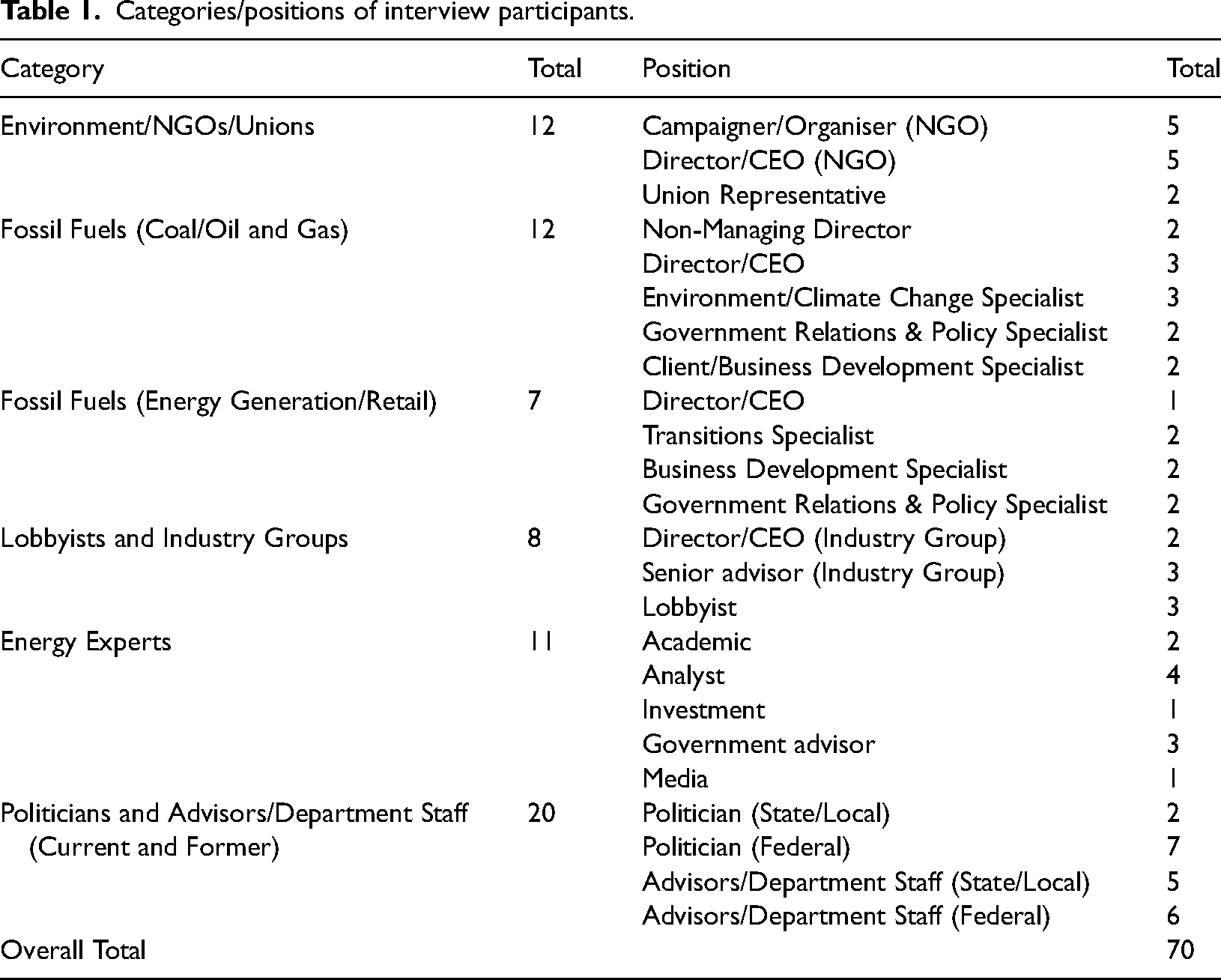
Following Fox and Alldred's (2022: 7) approach to new materialist social enquiry, the interviewees were considered as ‘key informants’ or ‘insider sources of knowledge about a setting’. The interviews lasted for approximately one hour, with the shortest interview lasting 23 minutes, while the longest took place over two sessions and lasted for a total of 113 minutes. The interviews were semi-structured, with a set of questions that revolved around the broad topic carbon transition, while leaving flexibility for participants to offer new insights on the issue that the researchers may not have anticipated (Galletta, 2013).
Interviews were transcribed by a professional transcription service and uploaded to the qualitative analysis software program, NVivo. They were then coded by the lead author using an inductive approach with an initial set of descriptive codes. Once approximately half of the interviews were coded, these initial codes were reviewed by the rest of the research team, and refined with reference to the literature. When all interviews were coded, a second review and refinement process was undertaken, and the codes were gathered together under a number of emergent themes. Through this analysis, the interviews revealed a number of processes that work together to uphold Australia's fossil fuel hegemony in the face of the climate crisis. Here, we outline these processes as establishment, entrenchment and encroachment (Table 2).
Identifying themes in the interview data.
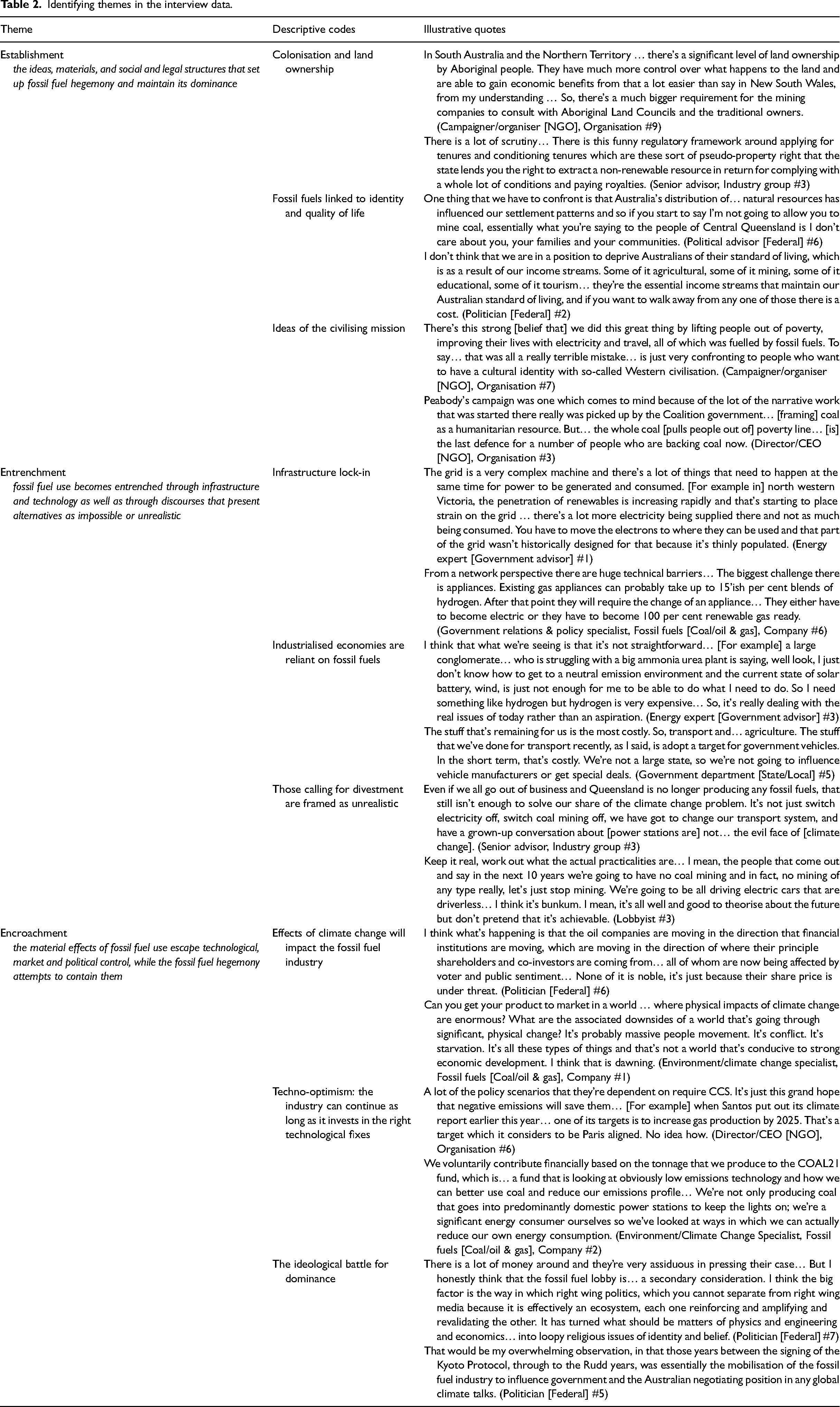
Establishment describes both the ways in which fossil fuel hegemony was established in Australia, and the collection of ideas, materials and social and legal structures that continuously re-establish its dominance. The discussion of entrenchment shows how fossil fuel use becomes ever more entrenched, both materially through infrastructure and technology as well as discursively though dismissing existing alternatives as impossible or unrealistic. The section on encroachment explores the expansion of fossil fuel and how the material effects of fossil fuel use escape human control. There are, of course, counter-hegemonic forces, including the impacts of climate change, that challenge the fossil fuel hegemony. Even so, the hegemony maintains its dominance by claiming that those material effects can be brought back under control by the very technologies, markets and politics that enabled them to emerge in the first place. These three processes, together, allow us to explore how fossil fuels and politics are entangled in Australia's fossil fuel hegemony, with dire consequences for the world ecology.
Establishment: Fossil fuels, land and identity
Fossil fuel hegemony draws on the founding myths of colonialism in Australia, as well as on complementary notions of progress and the ‘civilising mission’, to continuously (re)establish its position. These include the erasure of Indigenous heritage and land ownership, and the notion that the fossil fuel industry has been part of the ‘civilising’ process in Australia, alongside the claim that the industry has a moral imperative to engage in similar ‘civilising’ processes elsewhere. In this way, fossil fuel hegemony justifies its position by claiming that the use of fossil fuels is integral to the very possibility of being (a ‘modern, civilised’) human.
Colonialist conceptions of land ownership and value are demonstrated by links made between coal mining and identity. One lobbyist, for example, draws on the myth of terra nullius in order to downplay Indigenous land claims, a topical point of contention in new mine developments: If you ever want to bore yourself, go out there, it ain't pristine land, let me tell you. … All it's had is cows and kangaroos, seriously, trampling over it for a couple million years. It's not prime country in any stretch. (Lobbyist #2)
In this example, any Indigenous heritage is erased, while land desired by the mining company is framed as neither desirable nor useful for any other purpose. The mining company itself, on the other hand, is depicted as providing new value to the land, making use of a good which has been ‘trampled’ on ‘for a couple million years’.
This view of the industry as adding value is further developed around the civilising myths of colonialism, as demonstrated when this company executive emphasises the opportunities the company provided: We’re the biggest employer in the area, we do a lot with the Indigenous people all the way from preschool through to [adulthood] … we take them through training and then we’ve got a mentor support type thing … as they build up their careers. Not all of them make it, but we’ll train them, because some of them, it's just not a lifestyle they can deal with. But as you get more [Indigenous employees] at the mines to support the people coming in, the more it works. (Fossil fuels [Coal/Oil & Gas], Non-Executive Director, Company #3).
The association of extraction of materials from underground with concepts of progress and civilisation is expressed in a different way elsewhere in the same interview. Here, the interviewee suggests that to move away from fossil fuels would be to regress ‘back to the Stone Age’, as they ask rhetorically, ‘Are you prepared to give up on your phones and your bags and your glass… your iPhone, where do you think that's coming from?’ (Fossil fuels [Coal/Oil & Gas], Non-Executive Director, Company #3). Thus, the link between fossil fuels and technological development is embedded in history, with the benefits experienced in the now, in people's everyday lives.
Similar discourses are used to frame the continued extraction of fossil fuels as a moral imperative. Placed within a worldview that ranks populations along a scale of development, fossil fuels are described by managers in the coal/oil and gas industries as bringing the same quality of life that Australians enjoy to developing nations: The mines that are producing coal that are exporting into places like Asia … they’re countries that are aspiring to have what we have and it's all right for us to sit here and say “oh we can be holier than thou”, but a number of these developing nations are just aspiring to have the same quality of life. The only … affordable way they can achieve that at the moment is by coal-fired power stations. (Fossil Fuels [Coal/Oil & Gas], Environment/Climate Change Specialist, Company # 2). There is a general acceptance that the grade of Australian coal … is of a better quality than, say, your Indonesian or your Chinese coal. It has a less carbon intensive footprint, and so less emissions. (Fossil Fuels [Coal/Oil & Gas], Environment/Climate Change Specialist, Company # 1).
Politicians, political advisors and lobbyists make similar arguments, combining nationalist sentiment and pro-fossil fuel stances with other common discourses in Australia such as the separation of city and country, depictions of activists as immature or unrealistic, and notions that there are no credible alternatives to fossil fuels. One political advisor, for example, claims that people in inner Sydney ‘have no idea where power comes from’ (Political Advisor [Federal] # 1), while a lobbyist claims that activists campaigning to stop a new mine development ‘didn't even know where it was’ (Lobbyist #2).
In some cases, however, the connections between coal mining and identity have a more immediate effect on local communities. When towns and regions have been economically dependent on coal mining for generations, the prospect of a low-carbon transition can evoke feelings of grief. As one industry representative states, people ‘gain their identity and their family's identity from…building the station, supporting the station, being employed by the station. It's a multi-generational identity change’ (Fossil Fuels [Energy Generation/Retail], Transitions Specialist, Company #1). Such places also face internal divisions, when the interests of mining companies, and those employed by them, come into conflict with others in the community who are concerned with health and environmental degradation: I think the coal mining companies have done an exceptional job at… drawing a wedge between … the community generally and the mining workforce in a town. We saw those divisions during the [mine application and approval process] where you had one half of the street sponsored by opponents and one half of the street sponsored by the miner. (Politician [Local] #1).
In this way, we can see that the concepts of national pride, progress, development and civilisation, the founding myths of Australia, and messaging by media, industry and politicians work together with the built environment, everyday consumer products and economic dependence on fossil fuels, to create the conditions for continued fossil fuel hegemony. That is, the process of continually reasserting the need for fossil fuels, defined here as ‘establishment’, is not merely a rhetorical device. It also has a material history, visible in local economies, decisions around land use, infrastructure and the use of everyday products and technologies, which will continue to impact on the climate for many years to come.
Entrenchment: Fossil fuel infrastructure
Reliance on fossil fuels is constantly reinforced through the process of entrenchment. Once again, this is both a material and a discursive move: fossil fuels are entrenched in existing infrastructure, such as coal-fired power stations, petroleum-based transport and gas cooktops in homes, which are described as essential to everyday life. The construction of the electricity grid specifically around the need to distribute electricity from large coal-fired power stations is a prominent example of this entrenchment. This historical process, which continues to impact on how energy is generated and distributed today, is described thus by a government energy expert: If you look across the Eastern seaboard, we designed the power system based around the existing generation standards which were located close to the fuel. A lot of them are coal, so they’re located close to coal centres. Where it's hydro, they’re all related around the hydro … We built the entire power system to ship from those generation centres to the demand centre. The renewables are distributed in other areas where there's land and there's access and better-quality renewable resources. We haven't really built the grid or the power system around that. (Energy Expert [Government Advisor] #2).
As indicated in the above quote, some have historically been less dependent on coal for power generation, with their grid designed around technologies such as hydropower. Representatives from these areas described this as an advantage, since they ‘never had the same economic reliance [on coal]’ (Advisor/Department Staff [State] #2). Other industries, however, such as manufacturing, agriculture and transport, are still entrenched with the use of fossil fuels. Reducing emissions from these industries remains a difficult task, with one government department representative pointing out, ‘The stuff that's remaining for us is the most costly’ (Advisor/Department Staff [State] #5).
Another area of infrastructure that is entrenched within the fossil fuel hegemony is Australia's housing stock. State policies are attempting to address issues of unequal access to rooftop solar, for example, through grants to assist with the costs of installation or programs to install solar panels on public housing. Meanwhile, energy experts also point out the challenges of the existing reliance on gas for cooking: It's going to take a while before we are able to transition out of gas for home heating and cooking, for example, into either electrifying it or moving to hydrogen. That won't happen overnight. It's a big retrofit of 10 and a half million homes. (Energy Expert [Investment] #1).
This is illustrated in the discussions around the ability of the Australian electricity grid to handle increased input from renewable sources. One oft-cited event is the 2016 blackout, caused by storm damage, experienced by South Australia – a state which has a strong reliance on renewable energy. Fossil fuel industry representatives often invoke the 2016 blackout to discuss the limitations of renewable energy sources: As some of the traditional coal fired generation fleet is retired, there’ll be trigger points at which there’ll be a real wakeup call… South Australia's had its blackout so that already has galvanised a lot of thinking around renewables. So I think there’ll be some trigger points over the next few years where the fragility that's in the current system will become really obvious to everyone. (Fossil Fuels [Energy Generation/Retail], Business Development Specialist, Company #4).
As one participant notes, the threat of blackouts has been mobilised by the fossil fuel industry and politicians to make the issue a ‘political whipping horse’ (Energy expert [Investment] #1). By contrast, one government department representative expresses anger at such approaches, instead arguing that the 2016 blackout was a learning opportunity on what can happen when governments do not adequately plan for ‘the disorderly exit of coal’ (Advisor/Department Staff [State] #2). Indeed, South Australia has seen significant government investment in battery storage and grid re-design in the following years.
The interviewees generally recognise the role that government can and should play in providing leadership in the transition to a low-carbon future, whether that be through direct investment or policy. However, politicians and political advisors who have since left parliament point out the significant lack of leadership in Australian politics, claiming that both the major parties are in denial. Indeed, rather than stepping out of the way and allowing industry to do the work of transition, politicians have intervened publicly in decisions made by both fossil fuel companies and energy generators, to push for the continuation of fossil fuel extraction and use, even as those in the business world plan for the transition: I mean QBE [a major insurance company] was getting out of coal and [Federal National Party member] Matt Canavan immediately sort of jumped into the Financial Review [major financial daily newspaper] and had a go … So when you’re making decisions like that, you need to be thinking about what government reaction is going to be and bringing government along on the ride. (Advisor/Department Staff [Federal] #3).
The government has also, very publicly, intervened when companies have proposed closing aging coal-fired power stations, as in the case of Liddell power station in NSW: September 2017, the then prime minister [Malcolm Turnbull] uttered fateful words in parliament when he said ‘we are in discussion with the owners of Liddell about extension’. … which then set off a chain of events that resulted in [AGL's] then CEO tweeting back to Tony Abbot saying we will close Liddell on our own timetable or something to that effect … the retweet and the likes and the comments were spinning like an odometer going to 100 kilometres an hour. [I thought,] this is not going to end well. (Fossil Fuels [Energy Generation/Retail], Transitions Specialist, Company #1).
The entrenchment of the fossil fuel industry is also seen in key arguments presented about investment in renewables. One participant suggests that this investment is dependent on income generated through fossil fuels: [I] wanted to build a renewable portfolio… [but] we weren't competitive in our energy pricing, so we weren't winning customers. We went out and bought a coal fired power station… we’re constructing [a] windfarm… and we’re doing that, ironically, because we bought coal; we got competitive on price; we won customers, and then we could support the development. (Fossil Fuels [Energy Generation/Retail], Director/CEO, Company #2).
In addition, when interviewees emphasize the importance of baseload power and deny the potential for battery storage, pumped hydro or other proposed solutions to cover that gap, the only ‘reasonable’ alternatives they present involve ongoing fossil fuel use. This leads to proposals to switch from reliance on one fossil fuel – coal – to reliance on another – gas: There's no solution for dealing with the intermittency that we see and the instability that we see currently that's viable other than gas-fired power stations. … gas-fired can just keep on keeping on. It's relatively cheap. So, to that extent we still see there will be a strong need for gas-fired power stations … [until] 2030, I suspect 2050 really, a long way away. (Fossil Fuels [Coal/Oil & Gas], Client/Business Development Specialist, Company #6).
The combination, here, of rhetoric which aims to entrench the place of fossil fuels in the energy mix, of energy infrastructure which has historically been developed around the location of fossil fuel deposits, of government interventions that support – rather than phase out – ongoing fossil fuel use, and of investment in alternative energy sources which is dependent on fossil fuel-based income, demonstrates how fossil fuels become entrenched through both discursive and material processes.
Encroachment: When material exceeds control
The fossil fuel lock-in that occurs through the process of entrenchment is only part of the story. The materials themselves – coal, oil and gas – have a life outside of human use. The non-human life of fossil fuels is evident in the moments in which the material effects of their use exceed human structures of political and market control. As the resulting climate crisis becomes increasingly hard to deny, fossil fuel hegemony seeks to contain these effects through the promise of market and technological fixes such as carbon trading and carbon capture and storage. Thus, encroachment is a dual move of fossil fuels encroaching upon the earth system in ways that humans do not control and, contradictorily, the fossil fuel industry expanding into new arenas in an attempt to gain control.
Interviewees from the environmental and energy expert categories note two forms of encroachment that can be traced directly to coal-fired power. First, coal mines expand through space, altering the landscape, a process made worse when multiple mine approvals lead to cumulative impacts: Now the mines have encroached so much… It was the great, big open-cut mega mines. That's where everything changed… The NSW government under any iteration has never shown any interest in looking at the cumulative impacts economically, socially, environmentally, culturally, traditionally from an Indigenous end, nothing. They’re not interested. (Energy Experts [Media] #1).
Second, coal-fired power generates ‘quite a nasty toxic legacy’ in the form of ash dumps, and closure of power stations ‘will cost billions of dollars’ in rehabilitation (Campaigner/Organiser [NGO] #1). Thus, unless emissions are drastically and immediately reduced, local communities will face worsening physical effects of climate change: They’re at the vanguard that are at the front of the line of these things… they’ll be the ones who will be working out how to put seawalls in. They’ll be the ones trying to deal with land use effects of heatwaves or flooding or the variations in climate. (Energy Expert [Academic] #1).
At the same time, the fossil fuel hegemony is encroaching ever further into non-human life, in efforts to contain the negative effects of fossil fuel use. Proposed technological fixes include investment in carbon capture and storage and capturing fugitive gas for use in electricity generation. Rather than promoting renewable energy, which is viewed as unrealistic, technological fixes purportedly allow continued use of fossil fuels, with industry advocates arguing that exponential change is entirely possible: The pace of change will increase. The technology and the customer premises will just grow and grow and grow. Coordination and aggregation of that is going to become really, really big, very quickly, a lot bigger than a lot of people think or realise. (Energy experts [Government Advisor] #2).
Alongside technological fixes, attempts to contain fossil fuel encroachment in the form of emissions have been made by utilising market mechanisms such as carbon pricing. On a domestic level, there has been strong resistance from the fossil fuel industry to pricing carbon, while on the international stage the politics of who is accountable for what continue to obscure climate action and allow the ongoing encroachment of industrial impacts. In our interviews, business leaders for the most part express an openness to the idea of a carbon price, despite many of the same companies having successfully lobbied against it previously. This represents a shift in industry sentiment that is supported by one government expert, who states, ‘industry is starting to see what's coming internationally and likely to be imposed internationally, from investors, shareholders… [and] law cases’ (Advisor/Department Staff [Federal] #5). However, lobbyists representing the fossil fuel industry note they are ‘not a big fan’ of such policies, recalling that ‘it seems to have killed a couple of prime ministers… so in a sense it's been and gone’ (Senior Advisor, Industry Group # 1). Domestically, politicians demonstrate strong resistance to any approach that would make fossil fuel exporters responsible for the emissions created by end users of their product (known as Scope 3 emissions). One politician argues that holding Australia responsible for coal burned elsewhere would be ‘the equivalent of holding the government of Japan responsible for carbon dioxide that comes out of Toyota cars in Australia,’ (Politician [Federal] #4), while a union representative argues that ‘all you can do is try and do your bit to reduce emissions in your country consistent with your international obligations’ (Union Representative #1).
It is then evident that the various changes to policies and markets that have been proposed to help curb emissions have at times been fiercely fought by the industry, with politicians regularly acquiescing. This leads to a situation in which emissions continue to rise, and the fossil fuel industry continues to expand, encroaching in terms of both its market and political influence, and its material effects on infrastructure, land use and climate impacts. With little chance to counter fossil fuel hegemony, it is local communities and ecosystems that are likely to be left to deal with the toxic effects left in its wake.
Discussion: Material-political entanglements
The findings above outlined our analysis through three key processes – establishment, entrenchment and encroachment – in which the material and political are entangled in maintaining fossil fuel hegemony. We have approached the interviews as entry points into developing an understanding of the intra-actions between matter (fossil fuels and the infrastructures that their use both requires and enables, as well as the physical effects that burning fossil fuels creates in the world ecology) and meaning (the legal framework of land ownership and resource extraction, discourses of progress and civilisation, national borders, political interventions in the market and techno-optimism). Thus, the paper traces how (a) colonialism in Australia is linked with the materiality of coal and discourses of civilising indigenous communities (establishment), (b) the built infrastructure justifies increased fossil fuel use by entangling renewable energy and associated discourses with fossil fuel continuation (entrenchment) and (c) the climate crisis and its impacts allow for expansion of fossil fuel industries to tackle the crisis (encroachment). Thus, the materiality of fossil fuels is entangled with discourses which construct a temporal linearity from the past colonisation, present ecological crisis and future solutions. These three entanglement processes have both practical and theoretical implications.
The establishment of fossil fuel hegemony in Australia is closely tied to the settler-colonial project. Settler colonialism, here, is understood as a form of colonisation that involves both the imposition of political power, and the permanent movement of people. This movement refers both to the ‘settlers’, those ‘founders of political orders [who] carry their sovereignty with them’ (Veracini, 2010: 3), and to the ‘natives’, who are subjected to settler colonialism's logic of elimination through processes of frontier homicide, spatial removal and assimilation (Wolfe, 2006), all of which may be mobilised at different times and places in the never-ending settler-colonial project.
There are two manifestations of the settler-colonial project that are key to the process of establishment. The first, territorial conquest, is evident in the way in which interviewees particularly from industry and lobby groups deny Indigenous heritage and claims to the land. This echoes other studies, both from Australia and other colonised territories, which show how territorial conquest for the purposes of resource extractivism is linked to the operation of colonial power (Howlett and Lawrence, 2019; Johnson et al., 2021; LeQuesne, 2019; Parson and Ray, 2018; Roche et al., 2019; Whyte, 2018). In this worldview, land holds value as a resource, which is controlled and manipulated by humans; other potential intra-actions between the land and human life must be guarded against. In the Australian context, this conquest was achieved through the legal myth of terra nullius or no-man's-land. This erasure of Indigenous heritage is ongoing: in 2020, when expanding an iron ore mine in Western Australia [WA], mining company Rio Tinto destroyed parts of Juukan Gorge, an Aboriginal rock shelter dating back 46,000 years (Hepburn, 2020), while Woodside's proposed Scarborough Gas Field, also in Western Australia, puts World Heritage-listed Murujuga Aboriginal rock art at risk (Chang, 2021).
The second manifestation of the colonial project in the process of establishment centres around notions of progress and the ‘civilising’ mission. These narratives can be traced in other case studies, for example, in Rickards and Oppermann's (2018) examination of nation-building, in which electricity infrastructure and air conditioning govern the relationship between climate and body in Australia's tropical north. In our study, fossil fuels were described as essential, not only because they provide the energy to run air conditioning, big screen televisions and the internet, but also because they provide a barrier between contemporary life and the threat of a return to the ‘stone age’ or to buildings made from ‘sticks and mud’ rather than ‘steel and concrete’. Fossil fuels, that is, have become an integral element in human becoming, one which is ‘tied into being toward the geologic, conceptually, ontologically, and materially’ (Yusoff, 2013: 792). From this basis, fossil fuel exports to developing nations can be justified as bringing those populations into the human fold; in a memorable quote from 2014, former Prime Minister Tony Abbott described coal as ‘good for humanity’ (ABC, 2014).
Fossil fuel hegemony is further entrenched through infrastructure and the built environment, even when the energy market appears to be moving away from fossil fuels. Thus, the process of entrenchment is both a material and discursive process. The electricity grid was historically designed around the geologic and energetic potential of fossil fuels, part of the carbon-based, resource-making process in which ‘carbon transforms the relations and conditions of production, putting people, places and ecological systems into particular configurations that give shape to carbon resources’ (Bridge, 2011: 829). Alternatives to fossil fuel hegemony are framed in one of two ways: either as a threat to the Australian way of life or as something to be done slowly, deferred to an unspecified future. While there are significant technical and political challenges inherent in any such transition, the point here is that the fossil fuel hegemony mobilises continued fossil fuel use as the only reasonable option.
The entrenchment of fossil fuels as resource, which has been so central to the processes of industrialisation, rests on the fiction that capitalism is ‘an exogenous, rather than endogenous, actor in relation to the web of life’ (Moore, 2015: 178). These market-based mechanisms have evolved alongside fossil capitalism, and are themselves ‘a concrete expression of the power relations with which the fossil fuel landscape is imbued’ (Carton, 2017: 45). Thus within the capitalist mantra of growth, ‘the politically proffered “solution” to climate change in almost all nations appears to be more capitalism’ (Nyberg et al., 2022: 21), and it becomes common sense to address the failure of the market by turning carbon emissions into a ‘fictitious commodity’ (Polanyi, 2001 [1944]). Similarly, organising responses to climate change around the ‘logic of containment’ results in a situation in which ‘no solution to climate change is presented, only a less bad outcome’ (Beuret, 2021: 824). This is an outcome that is foremost harming those most vulnerable to the climate crisis in a form of ‘climate apartheid’ (Rice et al., 2022).
Encroachment occurs when the fossil fuel hegemony frames the continued use of fossil fuels as the only technological option. By constructing a dominant linearity, proponents of fossil fuel hegemony define themselves as defenders of progress in securing the future. Even when a turn away from coal seems inevitable, because of the impact of climate change, international pressure and movement in the market, the hegemony proposes technological ‘fixes’ such as carbon capture and storage, or a shift from reliance on one fossil fuel (coal) to reliance on another (gas), or the use of fossil fuels to secure a renewable future. This type of encroachment was in full display during a press conference following the release of the 2021 IPCC report, when then Prime Minister Scott Morrison re-hashed many of the same arguments outlined throughout this paper: that the developing world has the same right of access to industrial development as already-developed countries (‘the Australian approach is not to deny them…but to enable them’); that Australia is doing its fair share (including the false claim that Australia's emissions are going down, while emphasising the developing world – and especially China's – is increasing emissions); and that calls to commit to certain policy solutions will not work, while technological advancement will (‘technology not taxes’) (PMO, 2021). More than just sidestepping responsibility, this approach rests on a belief that humans are separate from, rather than entangled with, nature; that the land is composed of resources that humans can exploit, rather than viewing it as part of a whole world ecology; and that economic transactions can continue to externalise the impacts of industry, separating emissions from exports or valuing jobs over the climate, rather than recognising that there is no ‘outside’ to which these impacts can be pushed.
Australian fossil fuel hegemony is not alone in these processes of establishment, entrenchment and encroachment, with similar dynamics apparent in other colonised nations. For example, as Lecavalier and Harrington (2017) have shown, India has had a similar reliance on coal, although the development of a ‘grey’ (illegal) market in coal illustrates further difficulties in managing the encroachment of coal once it is established and entrenched. Canada, too, struggles to deal with the politics of supporting climate action while naturalising the exploitation of its bitumen oil reserves (Kraushaar-Friesen and Busch, 2020). These studies, as well as our own, suggest that new materialism provides important insights in understanding the relationship between the historical development of resources and the ways in which they are entangled in human economies, which has potential, therefore, to understand how they might be disentangled.
Humans and fossil fuels have emerged together, in a ‘geoformation of subjectivity’ that is the ‘result of the capitalisation of fossil fuels’ (Yusoff, 2013: 784). The forces unleashed through these processes have already resulted in changes that are dangerous for human and non-human life forms, with the physical effects of climate change now being experienced in changing weather patterns, rising sea levels, increased temperatures and species extinctions (IPCC, 2021). Political and technological responses have so far proven unsuccessful in stopping the increase of greenhouse gas emissions, let alone in bringing them back to safe levels. In tracing establishment, entrenchment and encroachment, as they occur in this case study, we have provided a useful example of how new materialism can enhance our understanding of hegemonic forces in this moment in time, in which we stand on the brink of climate catastrophe.
Conclusion
This article has examined how the entanglement of politics and matter works to maintain the hegemonic position of fossil fuels in Australia. Drawing from insights provided by new materialism, we have shown how political-material entanglements create a feedback loop which makes transitioning away from fossil fuels and towards a low carbon economy an almost impossible task. Even with popular support for climate actions and renewable energy being price competitive, there is inertia in the system, through both policy uncertainty and built infrastructure. Perhaps most importantly, inertia also presents in the physical effects of fossil fuel use. In many ways, the damage has already been done: landscapes have been altered, toxic waste is already present, and emissions pay no heed to national borders, policies or markets. The way out of the fossil fuel lock-in is by imagining, enacting and bringing into being a different way of being human – one in which human beings are recognised as a part of, rather than separate from, the world.
This requires disentangling the present moment from fossil fuels, and in so doing, developing an ethics of mattering, where humans intra-act ‘responsibly as part of the world’, becoming ‘responsive to the possibilities that might help us flourish’ (Barad, 2007: 396). These disentanglements are, necessarily, both material and discursive, promoting an alternative worldview where marginalised peoples’ histories provide directions for the future, where non-human actors in the form of rocks, rivers, trees and air have a standing, and where progress is not measured solely in economic terms.
Highlights
Australian politics is shaped by both its colonial legacy and the significant fossil fuel reserves within its territory.
The colonial legacy lends strength to discourses including the belief in the ‘civilising mission’ and ideals of progress.
The legacy of fossil fuel use leads to infrastructure lock-in, technological inertia and economic dependence.
The fossil fuel hegemony insists that the industry itself can contain its material effects, downplaying the role of alternatives.
These material-political entanglements have an active and constraining role in Australia's political solutions to climate change.
Footnotes
Declaration of conflicting interests
The author(s) declared no potential conflicts of interest with respect to the research, authorship, and/or publication of this article.
Funding
The author(s) disclosed receipt of the following financial support for the research, authorship, and/or publication of this article: This work was supported by the Australian Research Council (grant number DP180102064). The views expressed herein are those of the authors and are not necessarily those of the Australian Government or Australian Research Council.
Ethics approval
The Human Ethics Review Committee at the University of Newcastle approved these interviews (Approval: H-2018-0240) on 7th August 2018.
