




Abstract
An emerging body of work has critiqued the concept of climate adaptation, highlighting the structural constraints impeding marginalised communities across the Global South from being able to adapt. This article builds on such work through analysis of debt-bonded brick workers in Cambodia, formerly small farmers. It argues that the detrimental impacts of climate change experienced by farmers-turned-workers across the rural – urban divide is due to their precarity. In doing so, this article draws on a conceptualisation of precarity which recognises it as emerging from the specific political economy of Cambodia, and as something that is neither new, nor confined to conditions of labour alone. As such, in looking to precarity as a means of conceptualising the relations of power which shape impacts of climate change, we advance a ‘climate precarity’ lens as a means of understanding how adaptation to climate change is an issue of power, rooted in a specific geographical context, and mobile over the rural–urban divide.
Introduction
Cambodia, in keeping with regional and global trends more broadly (Krellenberg et al., 2016), is undergoing a rapid process of urbanisation. Between 1998 and 2018, the country’s urban population grew by an estimated 197% (calculated from National Institute of Statistics (NIS), 2016), a key factor in which have been the agricultural pressures engendered by climate change. Cambodia is repeatedly cited as one of the most climate insecure countries globally (see UNDP Cambodia, 2014). The result of repeated environmental shocks and stresses over recent decades has contributed to a process of rural–urban migration, as smallholder farmers, who constitute the mainstay of the country’s agriculture (Beban and Gorman, 2017; Ovesen et al., 2012), are forced to find non-farm work to sustain their livelihoods under changing conditions (Bylander, 2015a, 2015b; Parsons, 2017).
Migration is well established as a form of climate change adaptation in literature on Cambodia (Bylander, 2015b) and more widely (Black et al., 2011; McLeman and Smit, 2006; Tacoli, 2009). Furthermore, more recent work has developed this focus, highlighting the complexity of articulating factors, which may include climate change, that drive population movement (Adger et al., 2012), including a focus on more subjective causal factors (see Parsons, 2019). Beyond opening up the ontological basis for understanding climate change adaptation, research has also highlighted the problematic assumptions of unconstrained agency which underpin earlier approaches to climate adaptation, looking instead to how power structures adaptive efforts (Adger et al., 2003; Ribot, 2011). In this vein, we suggest that there remains scope to better theorise power as a relational phenomenon, thus highlighting how climate change mediates livelihoods through broader structures (Taylor, 2015). This is particularly pertinent given the wealth of literature which theorises power in labour relations outside climate literature.
This article therefore looks to address this lacuna through a focus on debt-bonded brick kiln workers in Cambodia, forced to migrate from rural livelihoods across Cambodia due to agrarian distress, which is affected by climate change. In following the trajectories of small farmers-turned-debt-bonded brick workers, we highlight that rather than escaping climate change-induced shocks that plagued their livelihoods in rural areas, they are forced to confront it once again on the kilns, in the form of heavy and unseasonal rains. These rains force work to stop on the kiln, and compel debt-bonded workers to increase their borrowing from kiln owners for daily expenses during such periods. Consequently, the impacts of climate change continue to deepen the livelihood insecurities of farmers-turned-workers across rural–urban spaces, highlighting the structural constraints preventing migration being an effective form of adaptation.
In order to develop our understanding of power in this regard, we draw on the concept of precarity to situate both the material relations and experiences of farmers-turned-brick-workers in relation to climate change and to the wider economy.
Whilst human security approaches have been the predominant means of theorising power within literature on climate change adaptation (see O’Brien et al., 2007), as Taylor argues, ‘… work within the human security and environmental change paradigm tends to identify the centrality of power and inequality without providing clear analytical tools with which to analyse them’ (2013: 320). Drawing on literature which conceptualises precarity as being both an issue of the labour market (Waite, 2009) and a concept that is broader in scope in capturing lived experiences (Ettlinger, 2007), we suggest that precarity offers a more spatially and structurally coherent approach for exploring adaptation to climate change, or the inability to do so. Rather than being a phenomenon from which people escape, the impacts of climate change are shown to span the rural–urban divide, as small farmers from villages become brick workers in and around Phnom Penh, complicating notions of fleeing from climate change-distressed rural livelihoods.
This article also contributes to a dearth of literature which conceptualises precarity outside of the Global North (Munck, 2013), and in particular, outside of countries that have undergone a Fordist labour regime (Millar, 2017). We thus look beyond the normative underpinnings of precarity when applied to Global North, Fordist cases, to re-root this concept in the particular context of ‘unfettered and intense marketization’ and the ensuing labour market engendered in the Cambodian context (Springer, 2010: 6). We ultimately develop a ‘climate precarity’ lens, which looks to better theorise relational power in the study of climate adaptation. This builds on approaches foregrounding vulnerability (see Taylor, 2013), but draws instead on the concept of ‘precarity’ as a means of better situating smallholder farmers-turned-brick workers in relation to the broader political economy.
Overall, this article offers two distinct contributions to literature on climate change adaptation and on precarity, respectively. Firstly, the article builds on the work of Taylor in particular (2013, 2015), moving beyond his focus on agrarian spaces alone, to suggest that climate change adaptation is a process borne out over rural–urban spaces and is most aptly understood through the relational power of those ‘adapting’, where power is understood as being forged and reproduced by broader structural determinants. From this standpoint, the discussion of power vis-à-vis climate change adaptation is linked to a rich discussion of the changing relations of power within the labour market and economy of the Global South. Secondly, the article develops the lens of precarity to suggest that when it is situated in a regional political economy, it offers a means of understanding the particular subjective experience and objective relations of a faction of the labouring poor. The article thus ultimately utilises the ‘climate precarity’ lens put forward here, as a means of drawing on the conceptual insights of precarity as both subjective and objective to better understand the vulnerability that climate change poses from a structural perspective across space. We argue that the agency and choice implicitly afforded to those that suffer the impacts of climate change within adaptation literatures proves to be largely normative in the case under examination here.
The article is structured as follows. First we look to literatures on climate change adaptation and precarity respectively to develop an approach which draws on the latter body of work to advance the former. We then highlight the research methods underpinning the analysis in this article, before moving to an overview of the broader political economy of Cambodia’s transition. The rest of the article explores precarity and climate change across the rural and urban. The conclusion looks to draw the various strands of the article together and move towards a new framing of climate precarity as a means of developing a more coherent approach to understanding climate change as an issue of power.
Climate change adaptation
The concept of climate change adaption has its roots in policy discourses emanating from the Intergovernmental Panel on Climate Change (IPCC, 2001) and elsewhere, and their recognition of climate change as a sustained and worsening problem threatening human development (see also The World Bank, 2010). The IPCC’s own definition of ‘adaptation’ is as follows: ‘Adaptation to climate change refers to adjustment in natural or human systems in response to actual or expected climatic stimuli or their effects, which moderates harm or exploits beneficial opportunities’ (IPCC, 2001: 365). The IPCC concurrently suggests that ‘Adaptation can reduce vulnerability’ (IPCC, 2007: 14). The implication is that ‘harm’ or ‘vulnerability’ is caused by climate change itself, thus positing adaptation to climate change as a means of reducing such harm or vulnerability. Conversely, a body of critical scholarship over the past two decades has highlighted differentiated vulnerability as existing prior to instances of climate change (Ribot, 2011), the limited nature of ‘adaptation’ in engendering processes of structural transformation (Adger, 2001; Pelling, 2011), and the problematic pervasion of technocratic approaches to adaptation (Bassett and Fogelman, 2013) at the behest of attention to how structural inequality impedes their success (Adger et al., 2003; Kelly and Adger, 2000; O’Brien et al., 2007). Most notably, the shift from adaptation to transformation in recent years (Eriksen et al., 2015; Pelling, 2011) has highlighted the limits of adaptive approaches, revealing ‘a fine line and considerable tension between accommodating change and consciously creating alternatives’ (O’Brien, 2012: 673). The transformative turn has stressed a need to move beyond adjusting to climate change, as indicated by adaptation, and to look instead towards changing the very systems that inhibit adaptation (O’Brien, 2012; Pelling, 2011).
Such critiques have done much to develop the approaches initially put forward by multilateral agencies; yet, there remains within such literature an inadequate theorisation of power relations. Specifically, those with insufficient power to enact adaptation or transformation are more often understood to be ‘vulnerable’ (for example, see Kelly and Adger, 2000; O’Brien et al., 2007); yet, this is often used descriptively, understood as embedded in rather than produced by a wider set of power relations. Thus, the emphasis is on adaptation and transformation as separate questions to that of power in the face of climate change. As Ribot argues (2011: 1160), ‘Adaptation efforts are noble, necessary and long overdue, but there are grave risks in calling these efforts “adaptation” rather than “vulnerability reduction”’.
In this vein, Taylor (2015: 82–83) looks to recast vulnerability as relational, suggesting that whilst ‘authors recognise that what they term climate change adaptation is inherently a question of power because “adaptation” hinges upon the ability to transform prevailing socio-ecological relations’, an analysis of the underpinnings of such power is too often ‘reduced to a static notion of inequality that requires appropriate social policies’. He argues for a conceptualisation of vulnerability that locates it within a broader system of power, drawing on the notion of ‘adverse incorporation’ (Hickey and du Toit, 2007; Mosse, 2007) to highlight how vulnerable people are not merely ‘outcomes of inequalities in market access or public goods’, but instead how ‘subordinate groups are incorporated within profoundly unequal power structures’ (Taylor, 2015: 86). Taylor goes on to suggest therefore that ‘households are rendered vulnerable not simply because of a lack of assets, but because they are fundamentally dependent on other social actors to turn their existing assets into tangible livelihoods and meaningful lives’ (2015: 86).
This conceptualisation of power as central to adapting to climate change offers a strong path ahead for two reasons. Firstly, it is relational vulnerability as opposed to climate change that is foregrounded as the reason behind inadequate adaptation, thus Taylor avoids a form of environmental determinism that is implicit in much of the early IPCC approach in seeing adaptation as a solution to vulnerability. Secondly, the theorisation of power stresses the need to understand local contexts, to better elucidate the particular ‘unequal power structures’ within which vulnerable people are incorporated. Such an approach heeds the call for ‘a more grounded and localized understanding of climate change’ (Brace and Geoghegan, 2011: 284) which is central to understanding the complexity of power and thus of adaptation at the local level.
Yet, Taylor’s approach is confined to an agrarian setting, where he argues that ‘This task [of theorising power] is particularly important when we consider climate change adaptation in agrarian environments because the latter regularly display deep-rooted inequalities in control over key productive resources such as land, water, labour and credit’ (2013: 321). Whilst this is an apt assertion vis-à-vis the particularities of the agrarian context, we suggest that the increasing phenomenon of rural–urban migration as a means of overcoming rural distress, prevalent across Southern countries more broadly (Breman, 2007; Bryceson, 1996; Bylander, 2015b; Rigg et al., 2016; Tacoli, 2009), requires a more spatially expansive understanding of power relations vis-à-vis the broader economy – a focus that is not necessarily inherent within ‘vulnerability’ approaches.
In developing this further, scholarship from critical agrarian literature has highlighted the fact that the structural transformations taking place across the Global South have seen industrialisation emerge without the absorption and transformation of former peasantries into waged workers, as was the case in England in particular (Bernstein, 1996; Bernstein and Byres, 2001). Instead, millions of small farmers find themselves tied to markets and unable to reproduce themselves through agricultural production alone, due to a complex and articulating array of factors such as contracting rural labour markets, declining commodity prices, the withdrawal of state subsidies for chemical inputs and irrigation, and environmental change (Araghi, 2009; Bernstein, 2010; Weis, 2007). Such farming households are primarily forced to reproduce themselves through waged work, largely in the non-farm sector, and struggle to do so, forced to travel away from rural areas in search of opportunities (Breman, 2007; Murray Li, 2009; Rigg et al., 2016). Yet industrialisation and services sector growth across most countries in the Global South have not absorbed the burgeoning migrant labour populations from rural areas (Araghi, 2009; Bernstein, 2006). Such farmers-turned-labourers are thus best understood as being part of the proliferating ‘surplus’ labour population emerging from capitalist transformation, where they are surplus to the needs of capital (Li, 2009).
As such, the ‘vulnerability’ that Taylor (2013, 2015) identifies in agrarian settings requires some extension to capture the particular conditions of surplus labour across rural–urban spaces. Specifically, whilst ‘vulnerability’ in Taylor’s rendering and elsewhere (see Mosse, 2007) is expanded to be relational, the concept lacks the academic genealogy of broader work which has looked to theorise power vis-à-vis markets as they exist in urban and rural areas. Instead, ‘vulnerability’ is primarily used to indicate the risk of becoming poorer, as opposed to the structures that forge power relations with regard to the workings of the market (Green, 2006). We therefore look to the burgeoning literature on precarity as a means of moving towards a spatially and structurally coherent conceptual lens through which to understand power in relation to climate adaptation.
Precarity and climate change
Recent decades have seen increasing scholarly and activist interest in different notions of precarity. The term (‘précarité’) was first employed by Bourdieu (1963) in his research on temporary workers in Algeria, where it was specifically used to describe the experience of short-term, insecure work. It was later resurrected by him in a critique of the rise of such labour conditions across France in the 1990s (Bourdieu, 1998). The term in both these cases is taken to refer to a sense of insecurity stemming from the particular labour market condition of short-term, irregular work, where such work is implicitly juxtaposed by the prior promise of more secure work under the Fordist regime.
The concern with precarity can be seen as part of a broader body of work spanning the social sciences which explores the livelihood trajectories of the poorest during the past few decades, as Global South economies have undergone a structural transformation and become rapidly liberalised.
In the development literature, the livelihoods approach (Ellis, 2000) has most notably addressed this question. Drawing on Sen’s capabilities framework (1999), the livelihoods approach examines the trajectories of the poorest, focusing on the issue of power through the concept of multidimensional capitals – human capital, economic capital, social capital and so on – as a means of understanding why some are able to forge successful trajectories out of poverty where others aren’t (Scoones, 2009). This approach has faced a number of critiques, and for our purposes here, the most notable comes from advocates of a relational poverty approach (see Bernstein et al., 1992), which highlights an understanding of power relations as being forged through the relationships between individuals and broader structures of power that shape social life, such as class, ethnicity, race, and gender. This contrasts the more assets-based approach advocated in much of the livelihoods literature, though not all (Scoones, 2009). Crucially, more recent decades have seen a burgeoning of relational poverty concepts (Hickey and du Toit, 2007; Mosse, 2003; Pattenden, 2016), and precarity certainly falls into this broader turn.
The concept of precarity has been taken forward by scholarship highlighting the shifting nature of work under late capitalism, largely focused on the Global North. As Waite tells us (2009: 416), ‘Precarious work can be conceived as differing from “standard work” that is generally seen as full-time employment with extensive statutory benefits and entitlements’. Most notable in recent years is Standing’s development of precarity through his conceptualisation of the ‘precariat’, where he argues that a new class of labour in-the-making is evolving, characterised by workers lacking forms of labour security such as the promise of employment, of protection in employment against dismissal, of sufficient income, and so forth (see Standing, 2011: 10). This approach implicitly builds on the previous relational turn in development studies thinking to highlight how workers in the neoliberal era are adversely incorporated into burgeoning new circuits of accumulation (see Hickey and du Toit, 2007). Notwithstanding the numerous critiques of Standing’s work in particular (see for example Breman, 2013; Frase, 2013), several alternative and opposing views of precarity have emerged.
The first is around the ontological underpinnings of precarity, as a condition linked to the specific types of work that have flourished in post-Fordist economies, or as a more general malaise. Butler’s work (2004, 2011: 13) most notably advances the latter thesis; she draws on the work of Berlant (2007) to suggest that precarity is both ‘a structure of affect’, and ‘a heightened sense of expendability or disposability that is differentially distributed throughout society’. Ettlinger (2007: 323) too advocates such an approach; she argues ‘that precarity crosscuts spheres of life; it infuses life’. Both Butler and Ettlinger thus transcend the link between precarity and labour market conditions inherent in earlier approaches, to suggest that it is better understood as emanating from the subjective experience of life under late capitalism more broadly. In seeking to bridge the divide between these ontological positions, Strauss (2018: 625) suggests that the concept of precarity encompasses both ‘labour’ and ‘life’: life is inherently precarious, but human societies and economies are organized in ways that render some lives more precarious than others, often but not exclusively through the capitalist wage relation and the division of paid and unpaid labour.
Thus, in developing our own conceptualisation, we draw on the work of Strauss to understand precarity as both labour and life, and to blur the distinction between the two (see also Millar, 2017).
The second debate on precarity centres on the focus within much of the literature on the Global North, and the implications of this with regard to how precarity is understood. The first implicit assumption which emanates from a Global North focus is that the apparent rise in precarious jobs documented in recent decades is the result of a post-Fordist labour regime, where Fordism in post-war US, or the equivalent era of Keynesian statism in Europe, is seen as a period of relatively stable job creation (Millar, 2017; Waite, 2009). Yet, as Neilson and Rossiter argue (2008: 54), ‘If we look at capitalism in a wider historical and geographical scope, it is precarity that is the norm and not Fordist economic organization.’
Moreover, the notion that un-precarious jobs are thus a normative goal for the wider labour movement requires some challenging. Millar suggests that the implicit focus on Fordism as a point of departure in work on precarity stems from its North-focus (2017: 6), Precarity appears new and exceptional only from the perspective of Western Europe and other highly industrialized countries, where the Fordist–Keynesian social contract was strongest in the years following the Second World War. In contrast, for most workers in the global South, precarity has arguably always been the norm even if it has not been called by this name.
Echoing this thesis, Munck (2013: 752) argues that There is little cognisance that the type of work described by the term ‘precarity’ has always been the norm in the global South. In fact, it is Fordism and the welfare state which is the exception to the rule from a global perspective.
Such critiques highlight both the need for further perspectives from the Global South, and point towards a dismantling of the very underpinnings of precarity as something that is necessarily worsening or exceptional. Breman and van der Linden (2014) have argued more broadly that the normative ideal of secure and waged work that underpins concepts like precarity globally has in fact been a historical exception.
The third and final debate around precarity that we look to address here is around the issue of agency. One of the central critiques of Standing’s notion (2011) of the ‘precariat’ is his conceptualisation of their agency, or lack thereof. As Paret (2016: 178) argues, Standing depicts the precariat ‘as a transformative agent that will lead from below, or as a disorganised force that must be saved from above’. Paret argues for an approach which better foregrounds ‘precariat struggles’ (2016: 178) as a means of taking more seriously the forms of resistance enacted by such marginalised workers (see also Coe, 2013; Coe and Jordhus-Lier, 2011; Herod, 1997; Paret and Gleeson, 2016). Whilst we certainly heed such a call, we focus here conversely not on such struggles, but rather on the forces that constrain worker agency and thus constitute worker precarity, whilst noting that such analysis leaves out the ways in which the worker agency, understood in the broadest of terms, may also shape trajectories of capitalism (see Katz, 2004).
We therefore adopt a conceptualisation of precarity where it is understood as both reflecting the adverse incorporation of labourers into broader circuits of accumulation, manifest in the specific conditions of an insecure labour market, and also as indicating a more subjective ontological experience. Furthermore, we explore precarity in a Global South context, Cambodia, with a view to understanding the specific ways in which precarity has emerged in the country’s particular power relations, and how this constrains the agency of those experiencing precarity. In linking this back to the earlier discussion around climate change adaptation and surplus populations, the use of precarity in both its labour-related and more subjective renderings allows us to capture the notion of agrarian vulnerability and urban insecurity, thus enabling us to explore how precarious rural smallholders become debt-bonded urban labour. The term ‘precarity’ is privileged over ‘vulnerability’ given the former’s implicit assumption of such precarity being reproduced by a wider political economy, where the latter is even in Taylor’s rendering relational but in an agrarian setting. Therefore, climate change adaptation across both rural and urban spaces is recast as an issue of precarity, and thus understood to emerge from broader structural determinants of such precariousness, within the particular context of Cambodia.
Field methods
This article is part of a broader research project entitled ‘Blood Bricks’, which examines the nexus between climate change and modern-day slavery in Cambodia (Brickell et al, 2018). Specifically, the project focuses on how climate change-induced rural indebtedness leads small farmers from villages across Cambodia to urban, insecure work as debt-bonded labour in Phnom Penh’s Brick kilns. The project’s emphasis is on the particular ways in which climate change deepens livelihood insecurity, leading to insecure labour relations on brick kilns, and the everyday experiences of such insecurity.
Research methods comprise two stages, firstly: semi-structured interviews with 51 brick kiln workers across 30 brick kilns in the environs of Phnom Penh. Accessing workers on kiln sites proved to be difficult given their restricted mobility and the continual presence of kiln owners. Interviews were therefore conducted using a convenience sample, and ethical and practical considerations were taken in choosing not to undertake a purposive sample. These were supplemented by 31 further qualitative interviews with other actors such as kiln owners, union leaders, former kiln workers, residents around the kilns and Buddhist monks to both triangulate information and provide additional perspectives. Analysis draws on qualitative data to take seriously the lived experiences of workers on brick kilns, highlighting perceptions, narrative accounts and commentary from other actors to enliven the perspectives of kiln workers. Secondly, a total of 308 quantitative surveys were conducted in three villages that comprise high levels of out-migration to brick kilns. Village A is located in Kampong Cham province and situated along the banks of the Mekong river, Village B in Prey Veng province around 50 km east of the Mekong river, and Village C in Prey Veng province just under 10 km east of the Mekong river. All brick-sending households were surveyed in each village, and then a randomised sample of other households was also sampled. These surveys were further supplemented by qualitative interviews with a sample of labour-sending households and other figures in the three villages.
Data collection comprises both qualitative and quantitative data; however, the former is primarily drawn on in order to develop the arguments in this article. All interviews were conducted in Khmer, the researcher is a proficient Khmer speaker and was accompanied by a local Cambodian research assistant throughout who was fluent in Khmer. Interviews were later transcribed into English. The extreme vulnerability of those interviewed and the power asymmetry between workers and interviewers was also a key area of concern. Care was therefore taken to ensure that kiln workers provided informed consent as far as possible, no children were interviewed, and that interviews could be ceased at any time if workers felt uncomfortable. Given the fact that debt-bondage is outlawed in Cambodia, care was also taken to ensure anonymity throughout the research, and so all interviewees’ names have been changed to protect their identities, and no locations are specifically disclosed.
Precarious ‘surplus’ populations in Cambodia: An overview
Cambodia has undergone a rapid economic transformation over the past two decades. Following the devastating reign of the Khmer Rouge in the latter half of the 1970s, the country underwent a period of stagnation during the 1980s, under the Vietnamese dominated People’s Republic of Kampuchea, only to be plunged headfirst into marketisation following the entrance of the UN in 1991, and the subsequent election of a domestic government (Hughes, 2003). Cambodia’s annual growth has remained relatively high from 1999 to the present day, not dipping below 5%/annum except for 2009 following the global financial crisis (World Bank, 2017). In this period, the country has undergone a rapid process of economic liberalisation, forged by the state government and articulated with the conditionalities of various multilateral aid packages that it has accepted (Springer, 2010). This has involved the rapid proliferation of privatisation and deregulation, including land titling, tax incentives for foreign capital, and the concurrent burgeoning of foreign direct investment into export-oriented enterprises (Springer, 2010).
In recent years, Cambodian capitalist accumulation has been dominated by a relatively small elite characterised by rapid land concentration, and driven by the appropriation of natural resources within the country and an influx of foreign capital from outside. As Springer (2010: 4) argues, … what makes ‘actually existing’ neoliberalism in Cambodia distinctly Cambodian is how local elites co-opted, transformed, and rearticulated neoliberal reforms. This has been done in such a way that it reinforces existing patron-client relations through a framework which ‘asset-stripped’ foreign resources brought in to support the building of the liberal peace … thus increasing the exposure of the average citizen to corruption, coercion, and violence.
The impacts of this type of growth on rural Cambodia have been particularly profound, as rural space has also been transformed through neoliberal policies. In particular, the extent of land privatisation is of note here, with the human rights organisation LICADHO having estimated that by 2012, 2.1 million hectares of land had been transferred from public to private hands through land concessions, 400,000 people had been adversely affected; and this was understood to be a conservative estimate (LICADHO, 2012). Thus, extensive land titling benefiting external capital has eroded rural livelihood strategies, as formerly communal land that provided an important source of natural wealth for poorer rural villagers, through fishing, foraging and cultivation, has now been privatised (Gironde and Peeters, 2015). Cambodia has also never undergone a Green Revolution-style programme of state-sponsored agrarian intensification, thus support for developing agrarian productivity or funding agrarian infrastructure from the government has been scant (Beban and Gorman, 2017). Instead, the shift to a neoliberal regime of development has seen the commodification of land and agricultural inputs render agrarian production increasingly expensive (Beban, 2014; Parsons, 2017). Rural households are thus shifting to new methods of farming designed to increase yields, and decrease reliance on labour. Alongside this, the out-migration of younger household members to find work in the non-farm sector is leading to tightening rural labour markets, thus rural mechanisation is on the increase (Chhun et al., 2015).
Furthermore, this is all in a context where Cambodia is routinely named by global indices as one of the most climate insecure countries in the world (for example, Morton, 2014), driven by a combination of increasing climatic and environmental shocks (UNDP Cambodia, 2014), and poor social protection in the face of this (Cook and Pincus, 2014). Cambodia is undergoing a period of climatic change, with temperature increases engendering complex impacts across the country, and across Southeast Asia more broadly (Thoeun, 2015). Rainfall has also altered to vary from long-standing patterns. The immediate impact for the millions of smallholder farmers across the country is an increase in extreme weather events, notably floods and droughts, and more erratic patterns of weather in general (Eastham et al., 2008; Västilä et al., 2010). Regional data also highlight that a formerly bi-modal pattern of rainfall, affording farmers with peaks in both July and September during the first half of the 20th century, has increasingly become mono-modal, with a single peak in September, therefore limiting scope for double-cropping among farmers relying on rainfall alone (Kimkong and Paradis, 2015). This has varied impacts across the country, as whilst regions surrounding the Tone Sap lake rely on seasonal flooding for their rice crop, the increasing variability and extent of such flooding, combined with the impact of water infrastructure such as dams, means that farmers are increasingly vulnerable to the impacts of flooding (Arias et al., 2012). As such, climate change is exacerbating the uncertainties inherent in rainfed agriculture as a livelihood in Cambodia.
The overall outcome is that social reproduction in rural areas has become increasingly difficult, and agriculture itself constitutes a decreasing share of national growth (Hill and Menon, 2014; World Bank, 2015). Thus, as Murray Li (2009) argues, poor, rural Cambodians are rendered surplus to the requirements of capital more broadly.
Despite significant growth in garments, tourism and construction in particular, urban industrial and services-sector growth has not been able to absorb those leaving rural areas behind (Dennis and John, 2011). As such, migration from rural Cambodia is both internal and cross-border, as rural households are forced reproduce themselves across space (Parsons, 2017; Parsons and Lawreniuk, Forthcoming; Rigg et al., 2016). Precarity in the Cambodian context is thus characterised by the inability to reproduce yourself in rural areas due to poor access to land, ecological stresses and poor state support (Beban and Gorman, 2017; Cook and Pincus, 2014), and low waged, insecure work, that is devoid of social protections in urban and peri-urban areas (Derks, 2008; International Labour Organisation (ILO), 2012).
Precarity in the village
The majority of precarious debt-bonded brick workers began their lives as smallholder farmers in villages across Cambodia. Kiln interviews revealed that in almost all cases, rural farming households incurred unsustainable debt in rural areas, and then sold these debts to brick kiln owners. In return, whole families moved from rural households onto kilns, to work off the consolidated debt-bond over years and even decades.
Looking first to the villages that comprised high levels of out-migration to brick kilns, household reproduction is shown to be experienced as a precarious endeavour. Specifically, precarity in the village is manifested through the adverse incorporation of smallholder farmers into broader circuits of capital, particularly microfinance capital, and felt through the inability of smallholder households to reproduce themselves through agrarian production or rural labour, with the impacts of climate change upon agriculture rendering such livelihoods increasingly insecure. Adaptation to climate change is thus a normative rather than actually applicable concept, in a context where the agency of such households is severely restricted.
The primary structural driver behind precarity is debt. Fifty-six per cent of households surveyed reported that one or more member of the household was indebted, and field findings revealed that the two main drivers for indebtedness were agricultural expenses associated with seeking to increase yields, and medical expenditure. Looking first to the former, the majority of households in our survey did not cultivate cash crops; 1 only 14% of households across the three villages reported doing so. As such, the majority of households undertook primarily rice cultivation, largely for subsistence needs, with minimal sales to local markets. Households were looking to expand rice yields through purchasing chemical inputs, and using a less labour-intensive method of rice production. Yet, despite savings in terms of labour costs with the new method, households faced increased expenditure on chemical inputs, requiring credit in many cases. Furthermore, households with irrigation (as opposed to rainfed agriculture) were more likely to be indebted across the surveyed villages. The lack of state support for such upscaling reflects the legacy of Cambodia’s lack of Green Revolution, and the sudden marketisation that proliferated in rural areas instead. As such, the burden and concurrent risk of improving agrarian production, from what remains primarily subsistence across the country (Beban and Gorman, 2017; NIS, 2016), falls on individual households. Credit therefore represents both a means of enabling increased production, and a significantly individualised risk.
This is a particular issue in the face of climate change and its impacts on agricultural productivity, with climatic and environmental changes being widely experienced by the villagers surveyed. Overall, 99% of respondents agreed that there had been notable environmental changes in their village over the past five years. Moreover, the material impacts of this upon household reproduction, and the ability to repay debts incurred to increase agricultural production, were shown to be profound. Both kiln workers and householders in villagers repeatedly cited either droughts or floods as a cause of failed harvests, and erratic rainfall patterns are identified as a key symptom of climate change along the Mekong delta region more broadly (Arias et al., 2012; Västilä et al., 2010). As such, debts incurred to undertake productivity-raising were thwarted by the impacts of climate change, leaving households without the means to repay such debts.
In addition to this, the second most common reason cited for taking on debt was health expenses. Despite a state-led and donor-backed ‘Health Coverage Plan’ which has been rolled out across Cambodia since 1996, health provision for the poorest remains scant (Jacobs and Price, 2006). As a result, out-of-pocket health expenditure for Cambodian households is shown to represent a significant cost, and one that can have catastrophic effects on the poorest households (Dalal et al., 2017; Damme et al., 2004). A single occurrence of bad health is thus enough to tip a poor household into indebtedness (see Krishna, 2010).
Yet, beyond the drivers for taking on debt, it is particularly pernicious nature of microcredit in Cambodia which is also crucial to forging precarity among rural smallholders. Initially set up in the mid-1990s as a means of enabling demobilised soldiers to reintegrate into society through small enterprises, microcredit has seen a considerable expansion in Cambodia, rising from 300,000 consumers in 2005 to nearly 1.6 million in 2013 (Bateman, 2017). Over the past two decades, the industry has been structurally transformed from a one-off development project funded by the United Nations Development Programme (UNDP) to a deregulated, fully commercial banking-led entity by 2009, and more recently to a global financial industry (Bateman, 2017), thus signalling a shift in its scope from developmental to for-profit. This has resulted in the character of financing also changing, with loan amounts and rates of interest both climbing, as well as a wider remit for who is eligible. Despite the initial aims of the UNDP-funded programme, loans are now shown to be used for everyday consumption needs (Bylander, 2014, 2015a), and even for paying off loans from private lenders (Ovesen and Trankell, 2014). As such, the developmental potential of microcredit is increasingly being called into question, and instead, as Ananya Roy suggests in her treatise on ‘poverty capital’ (2010); the poor become transformed into a new frontier for finance capital.
In linking this broader landscape of debt to the case at hand, farmers-turned-brick workers’ precarity is shown to be constructed through the articulation of climate change, ill health, and inadequate state support for agrarian productivity or public health; and microfinance. Smallholders’ adverse incorporation into both the agrarian economy and into the system of financial accumulation, represented by microcredit, cements their material precarity vis-à-vis the market. This notion of precarity marries most closely with approaches identifying it as emanating from particular labour market conditions (Bourdieu, 1998; Waite, 2009); yet, precarity in this case is expanded beyond more dominant conceptions of the industrial or services-sector labour markets within such literature, to include rural smallholders as representative of those that struggle to reproduce themselves through a combination of subsistence and commercial production, and waged work.
Crucially, in building on Munck’s call (2013) to look beyond the post-Fordist setting of the Global North in conceptualising precarity, this struggle for social reproduction in rural Cambodia is understood to emerge from the particular structural transformation underway in Cambodia. As set out earlier, the country has seen a shift from a predominantly agrarian economy dominated by subsistence producers in the 1980s to neoliberalism, with growth driven by industrial and services sectors comprising relatively low levels of labour absorption, poor working conditions and low wages (Hughes, 2003; Springer, 2010). This has come alongside a concomitant rise in rural wage rates, the impacts of climate change, and scant state support in terms of social protections and agrarian development (Cook and Pincus, 2014; Parsons, 2017). The precarity of rural smallholders is therefore manifested in their adverse incorporation into broader systems of accumulation, as farmers and labourers, and as debtors, as the subjective experience of such precarity foregrounds the sheer lack of agency experienced by rural smallholders in light of their broader structural constraints. Sangha,
2
a former smallholder farmer who is now tied to a brick kiln through debt bondage, highlights his experiences, We do farming, for which we need capital to buy the fertilizer. If we do not have money, we have to borrow from them [microfinance lenders,] and I sold my land to pay off my debts to them … it was very difficult to grow rice in dry season because we didn’t have enough water. It was also successful, but for this we needed to use a lot of capital, so we borrowed the money to buy oils, fertilizer, and it was difficult to pay this back. The rainwater isn’t even enough to grow short-term rice…It has been like this every year since my grandparents’ generation. It’s difficult to grow dry season rice. It is easy at first when there is enough water but this time of the year, there isn’t enough water. Some people have money to drill wells; people who don’t have enough money have to watch their rice goes bad. people who left to work for the [brick] factories were very poor and couldn’t continue growing rice due to irregular rain. So that is why they had to go out and find work to earn a living and to pay back their debts.
Research highlighted how kiln owners use existing kiln workers to recruit indebted households from their natal villages. Rural indebted households ask kiln owners to pay off their all local debtors, and in return, the whole family moves to the brick kiln to work off the consolidated debt bond. Crucially, the different levels of indebtedness between brick and non-brick households were stark. Average loan amounts among non-brick households was US$814.72, whilst among brick households it was US$1380.93. To put this in context, Gross National Income per capita in Cambodia in 2016 was US$1140 (World Bank, 2016). Therefore, the decision to approach kiln owners needs to be understood within the constrained context in which smallholders are operating, forged by unsustainable debts. As Bylander (2015a: 544) argues, credit in this instance represents a form of coping with the problems of reproducing oneself in rural Cambodia, rather ‘than offering them meaningful opportunities to improve their ability to make a living at home’. Once the coping mechanism of local credit becomes unsustainable, shifting debts to debt-bondage offers a new coping mechanism for smallholders. As such, in linking this back to the broader discussion of climate change adaptation, research clearly indicates that the structural constraints faced by smallholders in the study villages render individualised adaptation measures a normative ideal at best. Or rather, debt bondage is shown to the adaptation cost of smallholder farming in a context of climate change.
Ultimately, structural precarity underpins why smallholders are unable to adapt, and also to constitute their need to adapt, as their inability to reproduce themselves through agrarian production because of climate change is itself a manifestation of precarity. Therefore, the very notion of adapting is rendered somewhat futile, given the entanglement of agency within a broader set of structural constraints. In this vein, smallholder families’ move to brick kilns represents a choice in a context where there are few others. Climate precarity, understood as a lens through which we can highlight the problems of climate change as experienced by precarious smallholders, therefore offers a glimpse into the complex and articulating constraints of climate change adaptation. Beyond the rural, research revealed that labour migration to brick kilns served to reproduce and even deepen precarity as opposed to alleviating it. Furthermore, the vagaries of climate change remain forceful in deepening precarity for debt-bonded labourers on brick kilns. Climate precarity is thus forged and reproduced across space.
Precarity on the kiln
Life as a debt-bonded brick worker on brick kilns located in the environs of Phnom Penh is difficult and unsafe. Brick work is made up of several stages: firstly, workers in rural or peri-urban areas undertake excavation of clay sites. These are usually rural lands that are purchased by kiln owners, often from indebted families that go on to become debt-bonded brick workers themselves. Excavated clay is then taken to kiln sites, where it is left in large mounds. Workers transport excavated clay from these piles into brick-moulding machines, with different kilns comprising different levels of mechanisation with regard to the transportation and moulding of clay. Once moulded, bricks are left to dry in the sun, and stacked in a particular patter which affords each brick sufficient exposure to air. Air-dried bricks are then transported to kilns, where they are fired for several days. Kilns are often make-shift structures built with bricks, which comprise one or more large openings for workers to continually stoke fires and add fuel. Once fired, hot bricks are taken out and left to dry once again, before being picked up by middlemen that transport them on to construction sites across Phnom Penh. Within this broader set of activities, brick workers are forced to work long hours, expose themselves to unsafe conditions in the form of brick dust, smoke emerging from kilns, heat from kiln fires, and also to use unsafe machinery, particularly brick-moulding machines that have been shown to cause amputations.
Kiln workers and their families live and work on kiln sites, work is paid piece rate, on a daily basis, and kiln owners (Bassett and Fogelman, 2013) take a cut from wages in order to contribute to repayments towards kiln workers’ debts. Therefore, working families look to increase their productivity and through this, their repayment rate to kiln owners. They are not allowed to leave kiln sites until debts are repaid, and if they ask to do so in order to visit family in their home village, it is not uncommon for kiln owners to insist that one or more family members, often a child, remain on the kiln as ‘collateral’. Brick workers are also compelled to bring their families with them to the kiln. This is often because kiln owners reported preference for families over single workers as they are less likely and able to flee kilns. Unionisation and resistance among brick workers was not evident. An interview with representatives from the Building Workers’ Trade Union of Cambodia highlighted the difficulties of organising among brick workers given their isolation and relative incarceration on kiln sites, and the kiln owners’ reticence to allow union representatives on-site. Furthermore, interviews with brick workers continually highlighted feelings of gratitude towards kiln owners for having paid off their mounting debts. There was conversely little evidence of resistance towards kiln owners.
Brick workers are ultimately compelled to undertake unsafe work, and prevented from leaving kiln sites through disciplining force of debt bondage. Yet, bonded brick workers should not be viewed as isolated from Cambodia’s wider economic development. Debt-bonded brick workers are part of Cambodia burgeoning construction sector, which has been a key driver of the country’s growth for over a decade, and largely financed by foreign capital flows (Hill and Menon, 2014). Construction has climbed steadily in its contribution to GDP in Cambodia, and in 2016 it was the largest contributing sector to the country’s 7% GDP growth (World Bank, 2018).
Phnom Penh’s literal ascent has demanded cheap bricks at a rapid rate, fuelling the brick industry. More specifically, our research traced bricks from kilns comprising debt-bonded labour to eight high-profile construction projects across Phnom Penh. As Roesch et al. have highlighted with regard to India, in industries such as brick-making, the particularly time-consuming and unsafe working conditions required mean that capital looks to forge a pliant and immobile labour force. They do so by seeking out particularly vulnerable populations, specifically those adversely incorporated into the economy due to social stigma and economic marginalisation in the Indian case. In this case, it is families adversely incorporated into circuits of microfinance debt that are rendered sufficiently precarious for kiln owners to exploit. Indebtedness becomes debt bondage; a transition exacerbated by the impacts of the climate. As such, the drive for cheap bricks in Phnom Penh has led to conditions where severe labour exploitation is engendered.
Debt-bonded brick workers are thus shown to be contributing to profits in the construction sector for both domestic and foreign capital, through a severely exploitative labour relation (Guérin, 2013; Lerche, 2007). This labour relation is best understood as unfree, a form of severe exploitation (Banaji, 2003; Lerche, 2011) where agency over the type of work and conditions of work are inhibited for the worker. ‘Unfreedom’ in this regard is understood as part of a broader continuum of labour relations, as Lerche argues (2011: 7), most of the labour relations which today are classified as unfree labour share characteristics with a wider set of relations, both with regard to the underlying processes which lead to their creation by capital and concerning conditions of work and pay for labour.
This concept thus sees unfree labour as being reproduced by the broader workings of market capitalism, rather than constituting an exception to it or an anachronism (Brace and O’Connell Davidson, 2018; LeBaron, 2014; Strauss and McGrath, 2017).
In deploying this concept through a precarity lens, precarity is shown to manifest both in the material adverse incorporation of workers into construction sector growth, and from the experience of such adverse incorporation – the subjective experience of unfreedom, which sees workers’ agency and mobility constrained through debt bondage. Yet, is such precarity still shaped by climate change? Our research highlights that it is.
Having seemingly left a livelihood where the vagaries of climate change profoundly impacted success, kiln workers find that such vagaries follow them to the kiln. Brick kilns in the environs of Phnom Penh were almost all uncovered, so that for the periods when bricks were left out to dry, both after being moulded and after being fired, they are exposed to the elements (Figure 1).
A female worker removed fired bricks from a kiln. (Photograph by Thomas Cristofoletti, 2017, copyright Royal Holloway, University of London)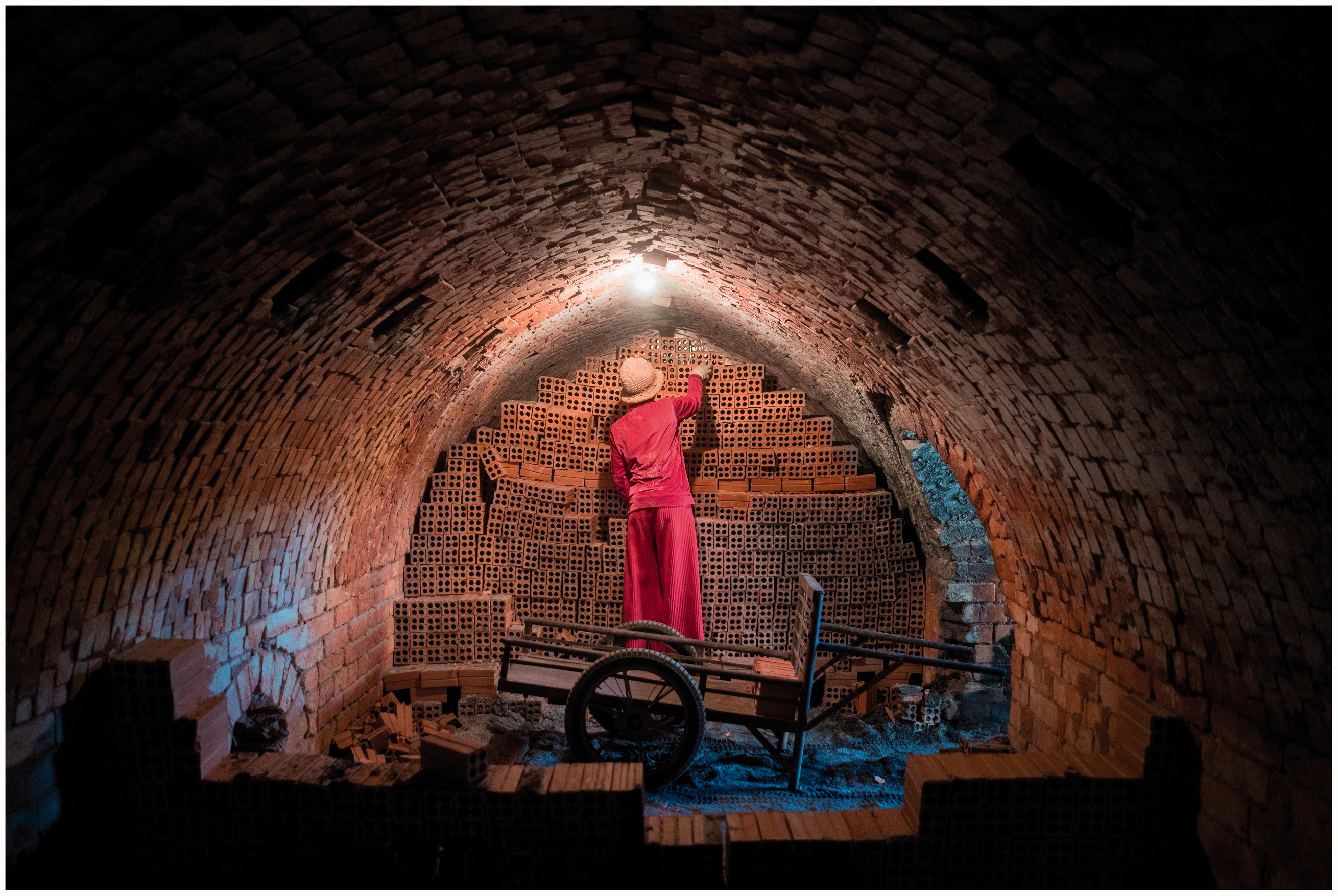
Rainfall is therefore an issue, bricks cannot be left to dry when there are rains for fear of degrading the quality of bricks. As such, in these periods work stops, and immobile workers are forced to borrow increased amounts from kiln owners for their daily expenses, therefore deepening their indebtedness. Piseth,
4
a debt-bonded kiln worker, highlights the despondency of this situation: During the wet season, we can work only 2–3 days within the period of a half-month … We’re just sitting and waiting for the rain to pass, then we break up (clay) soil, and collect it for being crushed. This is our hardship. Even though we want to leave, we’re not permitted … I try to borrow a small sum, 5,000 Riels (around US $1.25) from any of my relatives. For our boss, as he feels pity when we have nothing to eat he [loans] me 5,000 Riels or 10,000 Riels (around US $2.50). The rain this year seems like ... It’s different from the past. In the past years, the rain had its own months and seasons. For example, it was raining only 1 to 2 months, and it stopped raining for 4 to 5 months. For this year mostly it has the storms and it’s often raining. It’s often raining so, I can’t really work at the brick kiln. If there are no rains and storms, I could continuously work and have the money.
Conclusion
In drawing together the different threads of this article, we suggest that a climate precarity approach offers a means of reconciling the rich conceptual insights of precarity, understood as simultaneously subjective and objective, with debates around climate change adaptation. The article explores the case of debt-bonded brick workers in the environs of Phnom Penh, formerly indebted smallholder farmers, to highlight that material precarity, specifically the adverse incorporation of smallholders-turned-brick workers into broader circuits of accumulation, renders their livelihoods more exposed to the changing vagaries of the climate. Crucially, in both rural and urban areas, precarity is shown to be forged through the adverse incorporation of smallholders and brick workers, first into the agrarian economy, then into circuits of debt-based accumulation through microfinance, and finally into construction sector accumulation. The material relation of precarity constrains the agency of farmers and brick workers such that adapting to climate change is rendered normative at best. Otherwise put, debt bondage is the adaptation cost of climate precarity.
The article has ultimately suggested that calls for adaptation need to reconstituted, in line with the work of Taylor (2015), to better conceptualise how vulnerability is shaped by broader relations of the market. In shifting from a vulnerability to precarity focus, the article draws on the lens of precarity, increasingly deployed by geographers over the past decade or so as a means of capturing both the particular labour market conditions emerging in post-Fordist countries under neoliberalism, and the subjective experiences of everyday life in the current era more broadly, to begin the task of theorising power. The article has contextualised rural indebtedness and labour migration within the broader context of Cambodia’s particular transition, where the encroachment of markets in rural areas, combined with low labour-absorption in urban work, has engendered dispossessed labour migrants. We have concurrently also focused on developing the lens of precarity, looking beyond its current geographical underpinnings to re-situate it within the particular context of Cambodia’s transition, and moving beyond the ontological divide in deploying it both as a means of capturing labour market conditions, and the subjective experience of precarious life. Overall, rather than adaptation to climate change, we suggest that a fruitful path ahead is to deploy the concept of climate precarity, which asks instead how precarity is constructed and experienced, and how climate change articulates with and often exacerbates this process.
Finally, the article also speaks implicitly to literatures on climate mitigation, understood according to the IPCC as a ‘human intervention to reduce emissions or enhance to the sinks of greenhouse gases’ (2018: 773). In highlighting how climate precarity is forged through social relations and deepened, rather than created, by climate change, the novel approach offers scope to address how mitigation strategies can look beyond emissions/sinking greenhouse gases alone, to a more holistic view of mitigating the impacts of climate change upon people through addressing the structures that render them precarious. This is a fruitful path for future research, and ties our approach into broader literature on climate and environmental justice (see Martinez-Alier et al., 2016) which looks to address the uneven distributional impacts of climate change upon the world’s population. It also links to Marxist ecology (Foster, 2000; Marx, 1976), which foregrounds capitalism as a system driven by exploiting labour and appropriating nature, thus highlighting anti-capitalist struggles as the means of addressing exploitation and environmental degradation.
Highlights
The article initially suggests that climate change adaptation literature does not focus enough on the constraints faced by the working poor in the Global South in seeking to ‘adapt’ to the impacts of climate change. This article draws on the concept of ‘precarity’, understood as both a structural labour market condition and a subjective experience, to develop a ‘climate precarity’ lens. The article explores how smallholder farmers in rural Cambodia become indebted due to structural poverty exacerbated by climate change, and how the move to urban areas sees them face similar conditions, as the vulnerabilities exacerbated by climate change follow them to brick kilns. The paper thus explores a severe case of precarity through such farmers-turned-bonded labourers to highlight the structural constraints facing many in the Global South vis-à-vis climate change. In doing so it advances ‘climate precarity’ as a means of focusing on the structural constraints facing many that are vulnerable to climate change.
Declaration of conflicting interests
The author(s) declared no potential conflicts of interest with respect to the research, authorship, and/or publication of this article.
Funding
The author(s) disclosed receipt of the following financial support for the research, authorship, and/or publication of this article: This article is based on research from the study entitled: `Blood Bricks: Examining the Modern Slavery-Climate Change Nexus in the Cambodian Construction Industry' (2017-2019). This was supported by the Economic and Social Research Council (ESRC) and Department for International Development (DFID) [ES/R00238X/1]. We would like to thank the ESRC and DFID for the funding. Katherine Brickell would like to thank The Leverhulme Trust for their support in providing the time to work on this, and other writing, as part of her Philip Leverhulme Prize (PLP-2016-127). Laurie Parsons would like to thank the British Academy in providing time to work on this research through his Postdoctoral Fellowship scheme [ref: pf170152]. Access requests to underlying research materials should be addressed to rdm@royalholloway.ac.uk.