




Abstract
This paper develops a novel approach to mapping diverse forms of participation and public engagement, using the example of the UK energy system. It builds on emerging systemic accounts of participation, which go beyond a focus on individual instances of participation, to gain an understanding of broader patterns and connections. Our approach, which forms part of an emerging family of methods that seek to map across multiple forms of public involvement in issues and systems, draws on systematic review methodology and a relational co-productionist conception of participation. The findings of a systematic mapping of public participation related to the UK energy system 2010–2015 are presented, comprising 258 cases in total. The mapping analysis reveals patterns as to the what (energy objects and issues), how (procedural formats) and who (publics) of energy participation in the UK, which go far beyond the conventionally assumed forms and sites of public participation around energy. Implications for how the dynamics of ‘whole system’ energy participation are represented and the role of approaches to mapping participation in governing energy transitions are considered.
Introduction
Rather than being somehow marginal, public participation is increasingly institutionalized within (Pallett and Chilvers, 2013) and constitutive of (rather than separate from) science, democracy and environmental governance (Chilvers and Kearnes, 2016). Indeed, it is now hard to find attempts to govern environmental change which do not include some element of public participation (Munton, 2003). Participation has become an institutionalized and routinized part of science policy making (Brown, 2009; Wynne, 2006), in some cases required by law or acknowledged as necessary for the achievement of particular policy goals. Thus, regardless of one's normative stance on the effectiveness and necessity of participation, its prevalence means that understanding participation is an essential element of understanding environmental governance and policy making in the 21st century.
While the challenge of engaging publics around pressing policies and projects has often been conceived as a problem of extension (Collins and Evans, 2002) – the need to invite publics into decision-making processes, through techniques such as deliberative public dialogues – it has been argued that it is better to think about this as a problem of relevance (Marres, 2012) – the need to account for the multiple ways in which publics are already engaged around a given issue or object, and to interpret their relevance to policy questions. The study reported on in this paper is one of the first to put into practice this understanding of participation as a problem of relevance at a system-wide level, by attempting to identify and map all participation processes of relevance to the UK energy system in a given time-span.
Energy systems and the broader academic literatures around them also illustrate well the current limitations of academic and policy understandings of participation and attempts to intervene in or orchestrate forms of participation. While academics, policy-makers and businesses have been working on low carbon transitions in earnest, the role of publics in both consenting to and enacting these transitions has been generally de-emphasized or taken for granted. While energy social science is a broad and growing field with many topics of interest and debate, an interest in public participation and the role of publics has been a significant part of this emerging literature (Sovacool, 2014). Yet participation has often been reduced to fulfilling two roles – either aiding acceptance of the technological and infrastructural changes deemed necessary for low carbon transitions, or instrumentally changing public behaviours in expected and officially sanctioned ways (cf. Owens and Driffill, 2008). These two perspectives fail to take into account the sheer magnitude of the shifts necessary to achieve such a transition or the number of different roles already played by publics in maintaining and transforming energy systems (Shove et al., 2012). These include apparently banal everyday citizen engagements with energy systems through energy using practices in the home or choices about which transport options to use for a commute, as well as collective efforts at transformation such as community energy groups installing renewable energy technologies or activists trying to shut down fossil fuel or nuclear power stations.
This paper sets out to challenge these perspectives by mapping contemporary participation in UK low carbon energy transitions, and putting into practice an alternative conceptual framework for understanding participation. In contrast to the narrow definitions discussed above, in this study participation was taken to refer to any collective practice through which publics engaged in addressing ‘energy-related’ issues or objects, producing meanings, knowings, doings and/or forms of social organization. This system-wide mapping of participation in low carbon energy transitions draws both from current conceptual debates in the participation literature and recent developments in energy social science. Different parts of the participation literature have begun to go beyond the conventional focus on individual instances of participation, to capture broader ecologies or systems of participation, characterized by relations between different participation processes, and by interactions between these processes and the system or constitution itself (e.g. Chilvers and Kearnes, 2016; Laurent, 2017; Parkinson and Mansbridge, 2012; Watson, 2012). Similarly, energy social science, through interdisciplinary collaborations with engineers and computer scientists, has taken up the challenge of conceptualizing and studying whole energy systems, in order to understand relationships between different parts of energy systems and to capture broader trends (e.g. Skea et al., 2011).
This paper first introduces and contextualizes our relational whole systems framework for understanding participation in UK low carbon transitions, by describing an emerging set of methods for mapping participation and their links to recent conceptual developments in the participation literature. Following this, our novel methodology for systematically mapping participation will be described. The remaining sections of the paper describe the results of this mapping in terms of the what, how and who of participation in the UK energy system, followed by a discussion of what these results mean for attempts to understand and intervene in participation around low carbon transitions or other topics.
Systems of participation and mapping public engagement
Despite the move in interdisciplinary energy research to better understand whole energy systems, existing approaches to energy participation tend to be siloed. This means that different areas of the academic literature use different conceptual frameworks to study very particular forms of public engagement, with few attempts to compare across different processes or forms of engagement or to find broader patterns or connections (Chilvers and Longhurst, 2016). For example, studies of public dialogue processes draw on deliberative theory (e.g. Butler et al., 2013; Chilvers and Burgess, 2008), work on protests understands engagement through social movements theory and theories of justice (e.g. Mason and Milbourne, 2014; North, 2010), research on social practices largely focuses on engagements with energy in the home (e.g. Gram-Hanssen, 2011), while object-oriented accounts of public participation focus on particular pieces of technology (e.g. Marres, 2012; Wilkie et al., 2015). This means that different approaches to studying energy participation are also associated with particular understandings of the issues and objects under discussion, and particular visions of the publics who are engaged. Furthermore, even in relational studies of energy public engagement, the focus has tended to be on individual processes or instances of participation instead of their broader connections.
These features of the literature on the role of publics in relation to energy systems pose a challenge to approaches which aim to take seriously Marres’ (2012) problem of relevance as described in the ‘Introduction’ section. This requires avoiding the trap of assuming a problem of extension (Collins and Evans, 2002), where the burden is placed on publics to participate on terms and issue-framings usually determined by policy-makers or academics, and instead finding new ways to account for multiple and diverse forms of participation which are already in existence and which may have relevance for the issue or object in question. The lack of commensurability between the concepts, methods and normative commitments of these different approaches is both a conceptual and methodological challenge to research which aims to map across, compare and draw broader lessons from diverse practices of participation. In foregrounding participation in our approach we do not wish to suggest a normative commitment towards enabling more participation or better accounting for it. As has been acknowledged in other accounts, public engagements around energy and climate can be far from benign (Shove et al., 2012). Rather we argue that participation is a significant element of broader energy systems and low carbon transitions which needs to be better understood. We suggest that, if reconceived as a more diverse practice which encompasses more than deliberative workshops and opinion polls, participation can be a highly productive lens through which to open up understandings of the making of energy publics, democratic engagement and the contested meanings of ‘energy’ itself, beyond those prescribed by the aforementioned siloed approaches.
As a result, there is a need in energy social science work on participation to consider what it would mean to conceptualize and empirically study participation with a whole systems focus. While this enterprise aligns with recent conceptual moves in the participation and related literatures – theorizing deliberative systems (e.g. Mansbridge et al., 2012), participatory transition management (e.g. Hendriks, 2009; Laird, 2013), ‘civic constitutionalism’ (Laurent, 2017) or systems of practice (e.g. Hui et al., 2017; Watson, 2012) – it has not yet been applied to energy policy and related public engagements. There is also a significant symmetry imperative here. Technical elements of this socio-technical system have been well-mapped and their relationships closely studied in order to support ‘evidence-based policy’. So there is a need to make the social elements, dimensions and connections more visible. This suggests a need not only for new empirical studies which relate these new conceptual frameworks to participation in energy systems, but also for new methodologies to enable academics and practitioners to understand and map participation systemically.
This paper puts forward one possible methodology for mapping energy participation, which builds on a relational and co-productionist conceptual framework of participation which we have developed elsewhere (Chilvers et al., 2018). Our framework is relational in that it recognizes that the way publics think and act in relation to complex issues like energy is powerfully shaped by the practices through which they engage with it, the settings in which engagements occur, and how they are framed (Chilvers and Longhurst, 2016; Marres, 2012; Stirling, 2008). In line with earlier work in the co-productionist idiom (Jasanoff, 2004) this framework allows us to be symmetrical in our analysis of very different instances of participation, and to compare across multiple dimensions of these processes. Furthermore, it draws attention to the way that individual instances of participation in the energy system are implicated in shaping one another and constituting broader ecologies of participation in the energy system. Building on recent relational and co-productionist work in STS and cognate disciplines (Chilvers and Kearnes, 2016), this framework is predicated on asking three key questions about participation: what is the engagement about?; how are publics participating?; and who is participating?. These questions are relevant at the scale of individual processes of participation, but can also be answered at a system-wide level, illuminating broader trends and dynamics of energy participation.
In developing a novel methodology for mapping participation across energy systems we have several aims. First, we hope to reflect as much as possible the diversity of practices through which publics engage with energy, going beyond the focus on invited forms of public engagement in much of the participation literature (Leach et al., 2005), and the conventional binary of technology acceptance and behaviour change which has become engrained in energy research and policy (Owens and Driffill, 2008). Second, and relatedly, we seek to create a picture or account of energy participation which remains open to the multiple potential outcomes and products of participation – of knowings, meanings, actions and modes of organizing (Chilvers and Longhurst, 2016) – rather than taking these dimensions for granted. Third, we recognize that the practice of mapping is not only about creating a reflection or representation of reality, but rather it plays an active role in constituting networks, collectives and conditions of possibility (cf. St Martin et al., 2015). We therefore hope that our mapping helps contribute to and enrich the constitution of UK energy participation, by bringing attention to ignored or marginalized issues, publics and forms of participation, and helping to realize productive connections between processes and ecologies. We use mapping to imply efforts at finding, arranging and visualizing constitutive elements in their relations to one another, and see it as both a form of knowledge-making (Whatmore, 2009) and an open-ended research method (Marres, 2015).
Our approach forms part of an emerging family of methods for mapping participation in issues and systems, which are described in more detail below, in response to the systemic turn in the participation literature and to the challenge of enhancing institutional responsiveness and reflexivity. Given its connotations of making visible and accessible the contours or diversities of a given territory or collective, the metaphor of mapping has commonly been applied to techniques of public participation, even at the scale of individual processes. For example, in the technique of ‘deliberative mapping’ which has been developed by several prominent participation scholars since the early 2000s, the idea of mapping refers to the aim of displaying participant responses to a variety of options in a way which makes transparent the criteria adopted for assessment, the diversity of responses within a given group, and the range of uncertainty around each individual and group assessment of the options (Bellamy et al., 2016; Chilvers and Burgess, 2008; Davies, 2006). The well-established approach of Participatory Rural Appraisal, used by development studies scholars, development agencies and NGOs also includes techniques for area and social mappings in order to enable deeper understanding of the context of participatory processes and to form the basis for discussions of different perceptions and viewpoints (Chambers, 1994). It has also been argued that public attitudes surveys can provide the basis for systemic mappings not only of public knowledge and attitudes, but also deeper values and ambivalences, which can be of use to policy-makers (Barvosa, 2015; cf. Pidgeon et al., 2014).
The opportunities provided by the rise in engagement through social media platforms and the concurrent development of digital tools for scraping, searching and analysing networks and conversations on these platforms, have seen the emergence of a plethora of new techniques for mapping issues or controversies. These approaches have emerged from different conceptual and disciplinary starting points. In computer science efforts have been focused on developing methods to analyse the sentiments of comments on social media platforms and websites in order to gain a better understanding of public attitudes to various issues and products (e.g. Kim and Kim, 2014; Thelwall and Buckley, 2013; Thelwall et al., 2006). There have also been techniques developed for understanding public action and movement around particular events as reported through social media, such as transport use around sporting events (e.g. Lenormand et al., 2014). A high-profile example of this kind of work is the ‘Reading the Riots’ project where computer scientists collaborated with social scientists, supported by the Guardian newspaper, to analyse and map tweets during the London Riots of 2011 to try to identify patterns of behaviour and to try to establish an authoritative account of what was happening on the ground (Procter et al., 2013).
A similar set of approaches has emerged from actor-network theory inspired strands of Science and Technology Studies (Marres and Gerlitz, 2016; Marres and Moats, 2015). This can be seen as a continuation of a sustained interest in the discipline in mapping the contours of knowledge controversies as a way to understand social relations, categories and identities (Bloor, 1976; Rip, 1986; cf. Whatmore, 2009). This technique was originally developed by Bruno Latour as a pedagogical tool to help students understand actor-network theory and socio-technical debates (Venturini, 2010). STS scholars have used emerging digital methods (Marres and Rogers, 2008; Rogers, 2015) to visualize how knowledge controversies around issues such as an ageing population (Rogers et al., 2015) and climate change (Pearce et al., 2014; Venturini et al., 2014) are playing out, and to understand the different framings of the issues involved and the connections between different actors and actants involved in the controversy (Marres, 2015). In this community the benchmark of a good ‘cartography of controversies’ is its presentation in a way which makes the claims of the map traceable and allows the actors in the public debate to speak for themselves (Venturini, 2012). This is done through careful attention to modes of visualization (Moats, 2015) and often through the use of web-based tools like ‘controversy-websites’ to allow users to fully explore the data (Venturini, 2012).
While this is perhaps the best-developed set of techniques for mapping participation, with the clearest set of standards and steps, there are a number of limitations of using these kinds of techniques from the perspective of this project. First, a well-documented limitation of this kind of work is that such mappings will only capture and represent aspects of a debate which take place on the digital platforms studied by the mappers (Marres, 2015). Conversations and actions which are off-line or in other digital spaces will not be made visible through these techniques. Second, the focus on controversy means that these maps are unlikely to pick up on more mundane public engagements such as involvement in surveys or academic research, or everyday practices, which nevertheless contribute to the constitution of the system under study – in our case the energy system – and the interconnected systems or ecologies of participation which are co-constituted with this system. Furthermore, the controversy analysis approach by definition is focused on one point in a controversy so gives a snapshot of activity around a given system or issue.
Techniques for mapping across systems have thus been called for by advocates of deliberative systems approaches (Mansbridge et al., 2012; Parkinson and Mansbridge, 2012), but not yet fully realized. The accounts of participation which have come closest to this kind of system-wide mapping are those which use prose descriptions of contrasting case studies to map different practices across a system. One of the best examples of this kind of work is Sally Eden's (2017) book Environmental Publics, which explores public participation with the environment through practices such as voting, consuming, enjoying and campaigning, drawing on case studies from the author's body of work (cf. Laurent, 2017; Stewart, 2016). These accounts give lots of rich detail and context for each data point of participation, but do not claim or attempt to be systematic and to represent the full range and diversity of engagements. The method we propose and develop below takes inspiration from both digital methods and multi-sited ethnographies to attempt both a systematic mapping but also to enable an in-depth analysis of individual data points.
A systematic mapping methodology
We based our mapping approach on the systematic review methodology, initially developed for evidence assessments in the field of medicine, but which has more recently been widely used in academic work on energy systems to map key evidence (e.g. Blyth et al., 2014; Gross et al., 2013). Our searches aimed to identify examples of UK public participation concerning energy, but we also adopted a very high number of synonyms for each of these terms to account for the diversity of terminologies for participation, the public and energy issues which we found through our initial review of the literature and expert feedback 1 (each search contained synonyms for public, participation, energy and UK). Searches were manual and carried out through both academic and non-academic search engines (Web of Knowledge, Scopus, Google Scholar and Google) to identify cases from the academic literature, grey literature and media. Web of Knowledge and Scopus were searched exhaustively, whereas Google Scholar and Google searches proceeded to the end of the fourth page of results.
We defined a case of participation as comprising some form of collective practice through which citizens engage with a particular part of the energy system or an energy-related issue – this includes examples such as academic research involving citizens, right through to artistic projects and more citizen-led cases of activism or community action. The key criteria which guided our searches and screening were that each case: (a) involved some kind of public engagement with energy transitions, (b) took place somewhere in the UK and (c) and took place between 2010 and 2015. An additional necessary condition was that there was enough available material describing the case (either in academic papers, policy reports or on websites and media articles) to allow our secondary analysis of the case according to our conceptual framework.
It was also important that the corpus as a whole was as diverse as possible in terms of locations in the UK, and the key dimensions of our conceptual framework introduced at the start of the ‘Systems of participation and mapping public engagement’ section, namely different visions of the public, different forms of participation and different understandings of energy issues or the energy system. We sought to improve the diversity of the corpus by conducting searches beyond the peer-reviewed academic literature. Through this we have identified and mapped many cases of energy participation which have not until now been publicized in the academic literature or in official documents (e.g. civil society projects like 10:10's solar schools initiative and recent high-profile protests against fracking about which there was extensive information on websites or news platforms), or have not even been considered as examples of public engagement in energy transitions (e.g. a community arts project about windmills and a study of commuting behaviours). Our corpus inevitably provides a partial account of participatory collectives engaging in energy transitions in the UK 2010–2015, due to the limitations of the literature itself and the challenges of searching within an area characterized by diverse academic approaches. However, the picture we provide is significantly more varied – and therefore provides a richer and more diverse account of public engagement ‘on the ground’ – than if we had relied purely on an academic search engine and not searched the wider grey literature (including NGO reports, websites and news media).
The time frame was also a very important element of our review, as we were not attempting to collate all recorded instances of public participation in UK energy transitions, but rather to provide a detailed picture of energy participation in the UK 2010–2015. This time period gave us an overview of relatively contemporary and ongoing cases of participation, and was judged to be long enough to map diverse forms of participation and explore interactions between them linked to system-wide developments. The time period also coincided with the term of Conservative–Liberal Democrat Coalition Government which was characterized by changes in energy policy as well as broader constitutional conditions. These changes included the implementation of ambitious greenhouse gas reduction targets and the corresponding growth in adoption of renewables, electricity market reform and the introduction of feed-in tariffs which enabled the emergence of more community energy and other moves towards a more decentralized energy system in the UK (Geels et al., 2016).
The final corpus of 258 cases was analysed using our analytical framework. 2 The main objectives of this stage were to map the diversities and patterns of the different understandings of participation, the public and energy issues reflected in the different cases, as well as mapping relations between cases and across the wider energy system. This coding structure was jointly created and tested on a sample of cases by the research team to ensure inter-coder reliability. Our analysis of these collectives, guided by our interpretive framework, offers a mapping of energy participation in the UK, demonstrating the spread of different issues (objects), participants (subjects) and forms (models) of participation which are produced in these collectives, as well as the wider spaces of participation (such as different institutional settings) or parts of the energy system these collectives relate to.
List of 30 in-depth cases of energy participation with key sources.
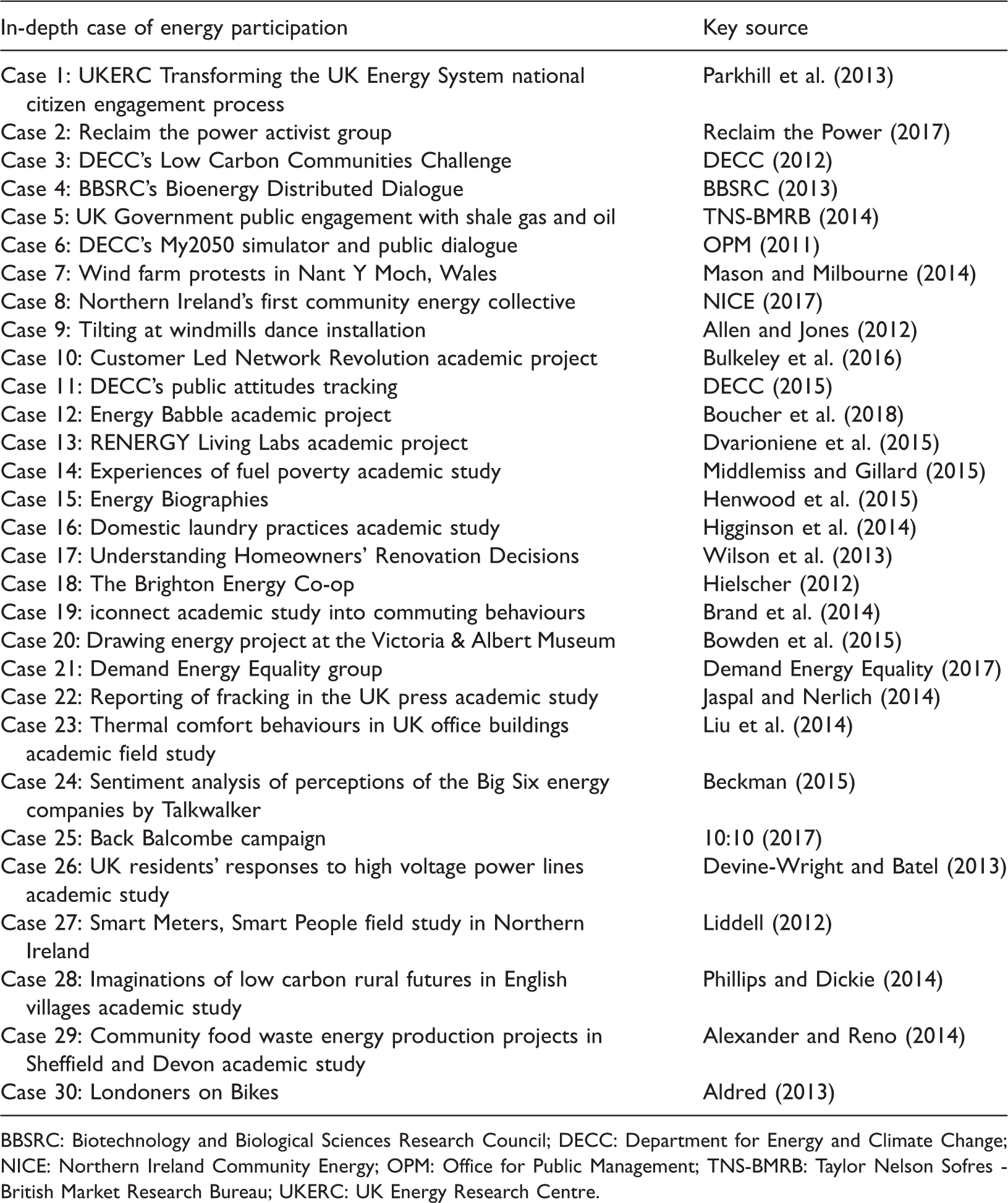
BBSRC: Biotechnology and Biological Sciences Research Council; DECC: Department for Energy and Climate Change; NICE: Northern Ireland Community Energy; OPM: Office for Public Management; TNS-BMRB: Taylor Nelson Sofres - British Market Research Bureau; UKERC: UK Energy Research Centre.
One clear challenge faced in this study and the mapping method developed are the timings of the empirical findings. While the approach has the advantage of looking back in time through documentary evidence, it is less good at tracing ongoing emergence. Once completed, our mapping findings were shared with policy, private sector and civil society stakeholders through policy reports, briefings (see Chilvers et al., 2017; Pallett et al., 2017) and presentations, yet the evidence did not reflect the new cases of energy participation continually emerging after that point in time. A significant amount of labour and time is required to carry out the searches and analysis so it would be a big investment to carry out the method on an ongoing basis, as it currently stands. However, the value of the method is not just in providing a ‘real-time’ snap shot of public participation in and around the UK energy system, but also in identifying broader trends and stabilities around the UK energy system which are likely to be more enduring and therefore still have relevance outside of the time period of the study. Another potential limitation of the method is the very broad definition of participation adopted, which could be used to imply that almost any practice constitutes participation in the energy system. However, we argue that this breadth of definition is necessary to challenge the narrowness of earlier conceptions. Finally, it should be noted that the systematic mapping method presented in this paper can only reflect and include cases that have been documented and publicized in some way (in this case via online search engines). As with any map, the findings are therefore partial, provisional and uncertain, not least with respect to the multiplicity of cases of energy public engagement that remained de-publicized or undocumented in any way.
What – Issues of energy public engagement
Objects of participation
Figure 1 shows the main issues which formed the objects of the participatory collectives in our full corpus of cases. The figure should not be read as revealing the most important public energy issues in the UK (such as renewable energy or energy practices), rather it indicates the relative sizes of the ‘issue spaces’ (Chilvers and Kearnes, 2016). Issues around which we mapped a larger number of instances of participation, also tended to include a greater range of forms of participation. We can see from this a general trend emerging of energy objects which publics are more likely to encounter through their everyday lives being the objects of a greater number of collectives, whereas apparently distant objects such as CCS, fracking and nuclear power are related to a smaller number of collectives. This is not to say that these latter objects are less important – fracking and nuclear in particular have been the focus of some of the most high-profile cases of public engagement during the period of study. However, it does challenge the conventional focus of formal invited public engagement processes on controversial new technologies, over the more mundane objects around which people are more accustomed to engaging with in everyday life.
Main issues covered by cases in systematic review corpus. CCS: Carbon Capture and Storage.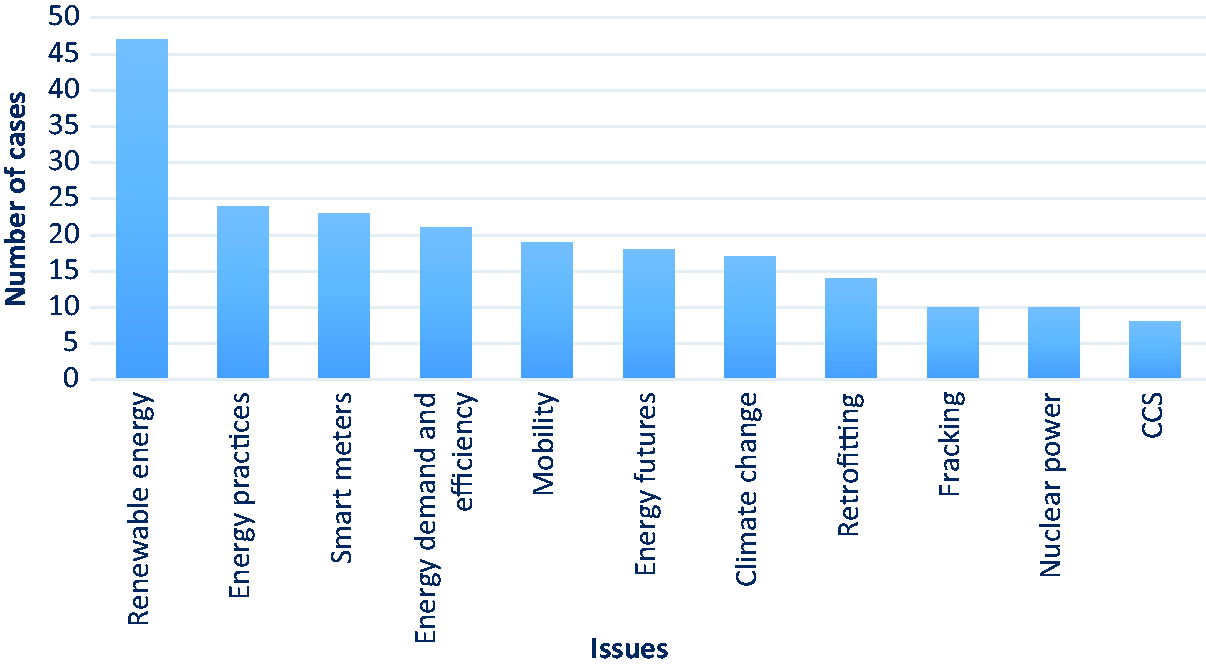
In many of the cases we identified and studied participation was not just confined to debating issues, but also often involved material commitments. For example, in some instances of activism like the ‘Reclaim the power’ anti-fossil fuel group (case 2), publics were involved in direct actions to shut down existing infrastructures or to prevent the development of new infrastructures around energy. In the case of community energy projects (such as cases 3, 8 and 18) publics were involved in installing renewable energy supply or energy saving technologies like smart meters. Academic studies of social practices in the home, such as the Customer Led Network Revolution (case 10) demonstrated the complex ways in which people participated in energy transitions through mundane technologies in the home such as in home energy displays, washing machines or micro-renewables. In other cases, such as the speculative design project Energy Babble (case 12), or the maker group Demand Energy Equality (case 21), publics have been involved in creating new technologies which aim to disrupt and shift ideas about and practices around energy.
Framing
Participation organized by central Government or by businesses tended to be the most tightly framed. For example, the public attitudes tracking carried out by the Department for Energy and Climate Change (case 11) had a relatively narrow focus on the acceptability of different energy technologies to the participants, and its format provided few opportunities for participants to offer alternative framings of the issue. These more rigid framings can be seen in part as a pragmatic response to the pressures of policy-making processes, where there is often a clear decision that participatory collectives feed into, limiting the relevance of discussions which go beyond the initial framing and are thus deemed ‘out of scope’.
There are also less tangible reasons for these patterns of institutional closure. Previous research has shown that framings of environmental problems can be very enduring and difficult to shift, even in response to new evidence and ideas. There is evidence that these framings can become institutionalized through organizational routines, ways of thinking and dominant imaginaries, such as narratives about the centrality of science and technology in achieving progress (Stirling, 2008). For example, in a nationwide academic survey and deliberative dialogue about the futures of the energy system (case 1), reporting suggests that researchers were limited to an extent in the way they could frame energy policy issues within their public workshops, due to the need for the dialogue process to speak directly to the concerns and problem definitions of policy and decision-makers in these dominant institutions. In a contrasting case, the ‘Londoners on Bikes’ activist movement and popular campaign (case 30) was targeted very specifically at getting London mayoral candidates to lay out their policies for supporting cyclists, so did not explore alternative framings or understandings of the issue. In Aldred's (2013) account of the campaign she reflects that this narrow focus helped the collective to achieve relatively quick and clear influence.
In many of the cases studied there were concerted attempts by participants to open out or challenge dominant framings of energy issues. Such resistance can be seen in cases of Government-sponsored public dialogue (cases 3–6) which tend to be strongly framed by Government priorities – and therefore dominant framings of energy issues – in order to feed directly into policy-making processes. For example, in case 6 participants used a ‘pathways calculator’ to create their own pathways for achieving the 2050 greenhouse gas reduction targets, some participants resisted this framing by objecting to some of the inbuilt assumptions of the pathways calculator, rejecting the Government's set target, or arguing that setting targets was not a useful course of action (Ipsos Mori, 2011).
It was often activist publics who most explicitly sought to open out and challenge framings of energy issues. For example, anti-fracking protesters in Balcombe in Sussex (case 25) who were often presented as reflecting narrow concerns relating to the human health and safety implications of fracking, actually articulated concerns about the direction of current energy transitions and setting out alternative energy futures, which subsequently the community tried to realize through its proposal to develop community solar energy. Academic orchestrated collectives also provide examples of explicit reframing of energy problems, often resulting from careful reflection. For example, a psychology project on homeowners' renovation decisions (case 17) deliberately looked at non-energy-related household renovations in order to better understand people's reasons for adopting energy-related retrofits, and to highlight the narrow focus of other studies in this area, as well as the assumptions made in Government policy.
It is a general pattern in our mapping that instances of participation orchestrated by civil society or by academics were relatively freed from institutional framings and constraints, but also tended to be much more distanced from important decisions about the energy system. For example, case 2 is a collective of activists loosely united by their opposition to fossil fuels, but also concerned with a number of other energy justice issues including fuel poverty, social inequality and the promotion of renewable energy. In the ‘Tilting at Windmills’ contemporary dance/film project (case 9) the researcher and performance artist reflected that her intention was that her encounters with participants on her walk would be entirely open with no set script or questions, I would not go out of my way to facilitate meetings, necessarily talk to everyone I met, or record everyone I talked to. I would be directed by the rhythms that emerged in process. (Allen and Jones, 2012: 214)
Futures
The different cases in our mapping also articulated different visions of energy futures. For example, in the Balcombe anti-fracking campaign (case 25), the contrasts drawn by activists, NGOs and members of the community between the proposed fracking development in the village and the community solar farm which the group tried to develop highlight the very different futures and forms of social organization which would be enabled by these different technologies: with fracking implying to participants in this collective the centralized autocratic governance of the energy supply, whereas the solar farm was seen as enabling a more distributed energy supply which gives communities more autonomy as well as social and financial benefits. Some of the cases specifically explored energy futures, with 18 cases from our whole corpus being primarily concerned with energy futures. For example, a study of imaginations of low carbon futures in English villages (case 28) used future scenario methods to identify participant narratives of the energy futures of English rural areas; however, the majority of participants actually expressed narratives of stasis or non-transition. DECC's 2050 public dialogue (case 6) was about exploring different pathways for reaching a clear vision of the UK's energy future – one where the Government targets to reduce greenhouse gas emissions by 80% by 2050 are met (Sciencewise, n.d.).
In some cases visions of energy futures were more implicit or emergent. For example, the activists in case 2 implicitly set out an alternative low carbon vision of UK energy futures, relating both to the technical organization of the energy system, but also connected to particular forms of social organization, such as public power over energy supply. During the course of the Customer Led Network Revolution project (case 10) which investigated the relationship between new micro-generation technologies such as solar panels and smart meters it became clear that future practices-that-use-energy would need to be reconfigured in response to the different temporal and spatial patterns of renewable energy supply (Bulkeley et al., 2016). While some participatory collectives are deliberately future oriented, all collectives of participation in our mapping are doing futures in some way by expressing how the world ought to be. Mapping approaches such as that developed in this paper can therefore help reveal diversities of visions and futures that might otherwise go unrecognized or unacknowledged.
How – Models of energy public engagement
Dominant forms of participation
The second key dimension of energy participation which we were concerned with in our mapping was the question of how publics participate and the ways in which collective participatory practices become organized, formatted and configured. Figure 2 shows the most commonly produced forms of participation which emerge from our whole corpus. Our mapping shows that there are particular formats of participatory practice in the energy system which are much more strongly represented than others, in particular surveys, deliberative workshops and consultations. These are often linked to dominant institutions and assumptions about how people should participate.
Models of participation adopted in cases in systematic review corpus.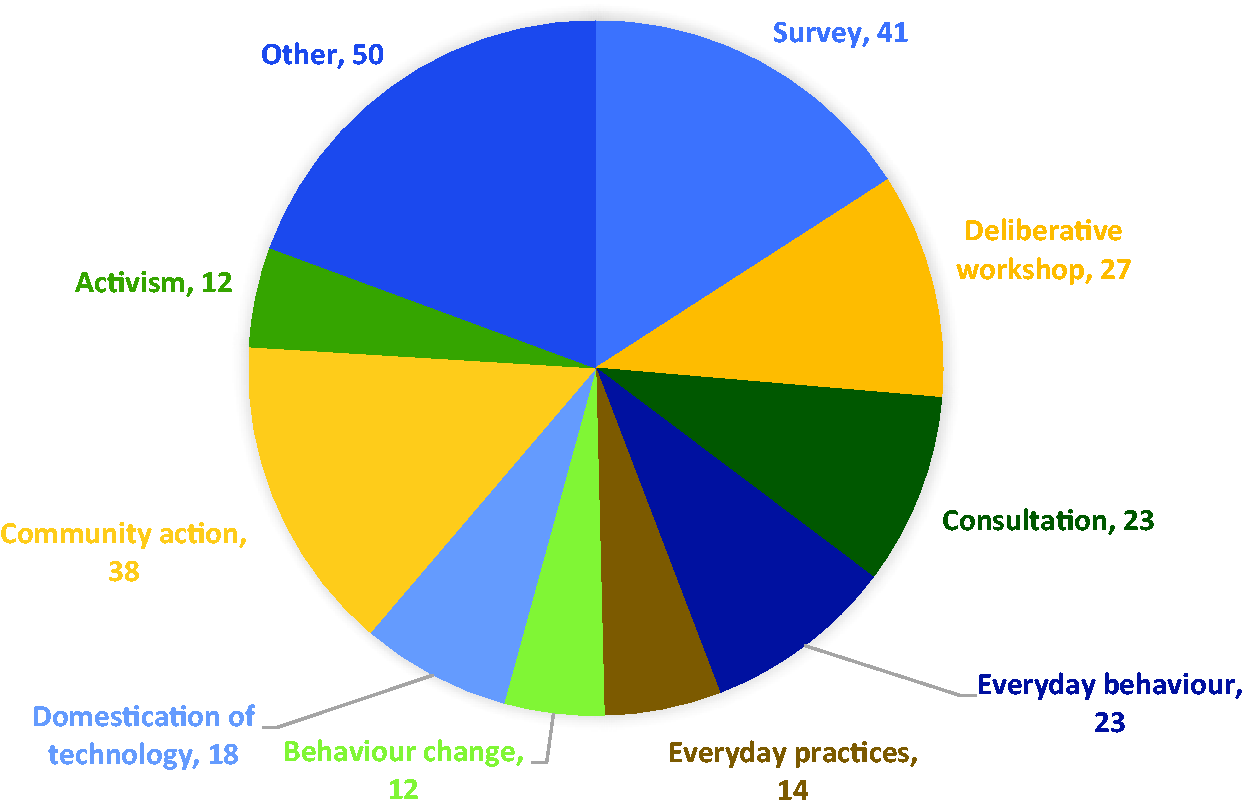
Technologies of elicitation (cf. Lezaun and Soneryd, 2007) such as surveys, deliberative workshops and consultations which are the most prevalent models of participation in Government and other formal institutions, together account for more than a third of the whole corpus. Public opinion surveys are strongly favoured by Government departments and agencies, as well as businesses and media outlets, like DECC's public attitudes tracking. Surveys are presented as gaining a representative sample of the public, as well as being cheap to run and easy to repeat and alter to reflect new developments. More recently, especially since the creation of the Government's public dialogue programme Sciencewise in 2004, governing bodies have also begun to adopt deliberative workshops as a prominent mode of participation around energy and other issues. For example, the BBSRC's Bioenergy Distributed Dialogue (case 4), the Office of Unconventional Gas and Oil's public engagement with shale gas and oil (case 5) and DECC's 2050 public dialogue (case 6) all reproduced a deliberative workshop model orchestrated by Government or Government agencies, bringing together a small group of citizens with experts and expert information, to deliberate key policy issues over one or two days (see also Chilvers, 2013; Pallett and Chilvers, 2013). This model of participatory practice, influenced by approaches from market research, is seen as giving decision-makers a more in-depth understanding of public responses to energy issues, as well as giving participants more time and opportunity to develop their views on the given issue. Deliberative workshops are also commonly used in academic studies for the same reason, especially where the orchestrators hope to directly influence policy processes, such as in case 1.
Everyday behaviours and behaviour change are modes of participation which together account for 35 of the cases in our whole corpus. Furthermore, these are prominent ways of thinking about public participation in Government and beyond which have clear implications for other collectives, for example overflowing into community energy, communication or education projects. The focus on behaviour can sometimes narrow accounts of participation as it encourages an emphasis on the levers and attitudes driving behaviour without necessarily considering broader social practices and material elements underlying the behaviour. For example, the iconnect study of commuting behaviours (case 19) conducted longitudinal research with a cohort of participants to ascertain whether improved walking and cycling infrastructures had affected their commuting behaviours (Brand et al., 2014). However, the study did not consider what other changes might have occurred in participants lives or in the cities they lived and worked in which might also have contributed to shifting practices, or locking certain behaviours in place.
Another clearly dominant form of energy participation in this time period was through media engagement, either through reading newspapers and watching television or through more active discussions on social media. However, these cases are not well accounted for in our mapping, with only one clear case analysing media reporting (case 22) and a handful of social media participation cases (e.g. case 24) included. According to media theory even engagements with media which could at first seem quite passive, such as reading a newspaper, can be understood as instances of participation because there is a tacit interaction between media outlets and their readerships or viewers with capacities for mutual rather than just one-way influence (e.g. Livingstone and Lunt, 1994). However, this is often talked about using very different language within media studies or has not been explicitly framed as a form of participation, so few cases were picked up in our searches. The small number of cases we found including public participation through market mechanisms seems to represent a similar oversight.
There are however also strong patterns of participation which occur outside of formal governing institutions. For example, activist collectives like ‘Reclaim the power’ (case 2), campaigners against the Central Sheffield energy-from-waste scheme (case29) and ‘Londoners on Bikes’ (case 30) adopted a set of closely associated methods and practices including direct action focused on significant pieces of material energy infrastructure, such as power stations or roads, as well as how they organize their meetings around deliberation and consensus decision-making, and use social media to co-ordinate their campaigns and actions.
Community action emerges as a very commonly adopted mode of energy participation from our corpus, and one which straddles the domains of government, academia, civil society and business, particularly related to community energy projects which often include actors from all of these domains. Community energy groups in the UK are well-networked with one another, providing advice and support (Hargreaves et al., 2013), so it is of little surprise that they take a range of recognizable forms, such as charitable incorporated organizations, charitable social enterprises or limited companies with social purposes (Seyfang et al., 2013). For example, Northern Ireland's first community energy group (case 8) and the Brighton Energy Co-op (case 18) both adopted a common energy co-operative structure and also related to their broader communities in similar ways, through crowd-funding or community share offers.
Emergent forms of participation
Our mapping also points to new and emerging modes of participation around energy. In some cases, these new forms build on existing modes of participation, for example the Bioenergy Distributed Dialogue (case 4) tried to develop new ways of carrying out public dialogues, which would allow them to continue for a longer period of time and to iteratively shape and respond to developments in the relevant policy area – in this case the development of bioenergy research within the BBSRC. Other modes of participation have been emerging for some time, such as the arena of community energy described above, or the increasing focus in academic research on practices, often in the home, such as the Customer Led Network Revolution (case 10), the experiences of fuel poverty study (case 14), the Energy Biographies project (case 15), the study of laundry practices (case 16) and the ‘Smart meters, smart people’ report on marginalized households in Northern Ireland (case 27). This focus on social practices aims to go beyond dominant behaviour change understandings and models of participation, to recognize the complexity and situated nature of energy demand.
New modes of participation are also emerging from developments in technology, such as the emerging possibilities for conducting co-design and speculative design processes, particularly coming out of arts and design schools like Goldsmiths University of London and the Royal College of Art, such as the Energy Babble project (case 12) and the Drawing energy project (case 19). Academics and businesses are also starting to exploit the possibilities of engaging publics through social media, for example with the development of the approach of sentiment mapping which scans interactions on social media platforms and web forums for emotional responses to particular energy issues, such as the company Talkwalker's sentiment analysis of perceptions of the Big Six energy companies (case 24).
Our more in-depth case study analysis complicates this picture of dominant and emerging participatory practices by revealing the existence of multiple forms of participation within any given collective. On a very simple level, surveys – a mode of participation in itself – have also been used by academics in a number of cases to gain insights into other modes of participation, particularly behaviours and practices, including in a study of thermal comfort behaviours in UK office buildings (case 23), the RELU-funded exploration of low carbon rural futures in English villages (case 28), the iconnect study into commuting behaviours (case 19) and the UKERC-funded project on homeowners' renovation decisions (case 17). There are also collectives where their modes of participation are understood differently by different actors, so for example, while DECC's Low Carbon Communities Challenge (case 3) was understood by most of its participants and by many of the facilitators involved as a process organized around community action, it was treated within DECC primarily as a behaviour change project. The Customer Led Network Revolution (case 10) was also understood as a behaviour change project by many of the companies funding the study, and by the engineers and economists involved in carrying out the study; however, a small but significant subset of this work was carried out by qualitative researchers emphasizing the role of everyday social practices (Bulkeley et al., 2016).
There are also many cases we analysed which actively adopted multiple modes of participation. For example DECC's 2050 public dialogue (case 6) primarily used deliberative workshops but it also employed an interactive game which was used within the workshops but also open to other participants, and there was also a further part of the collective where the organizers tried to empower young activists through involving them in a DECC youth panel focussed on the 2050 targets. Many activist collectives also included other modes of participation, for example the Demand Energy Equality group (case 21) used activist and campaigning methods, but also aimed to communicate its message to a broader public, and also to educate participants through reskilling workshops. The Back Balcombe campaign group (case 25) began as a protest against fracking, but over time evolved into a process of community action involving further modes of participation such as crowd-funding and a co-operative structure. The wind farm protests in Nant Y Moch (case 7) also illustrate how forms of activism themselves often emerge around more formal structures of participation, like the planning system, especially where particular groups feel that they or their arguments are being excluded and ignored.
Who – Subjects of energy public engagement
Across our whole corpus a wide variety of different versions of the public were produced through the participatory collectives. Figure 3 illustrates key categories of the different constructions of publics in relation to energy that were produced across the whole corpus.
Kinds of publics produced through cases in systematic review corpus.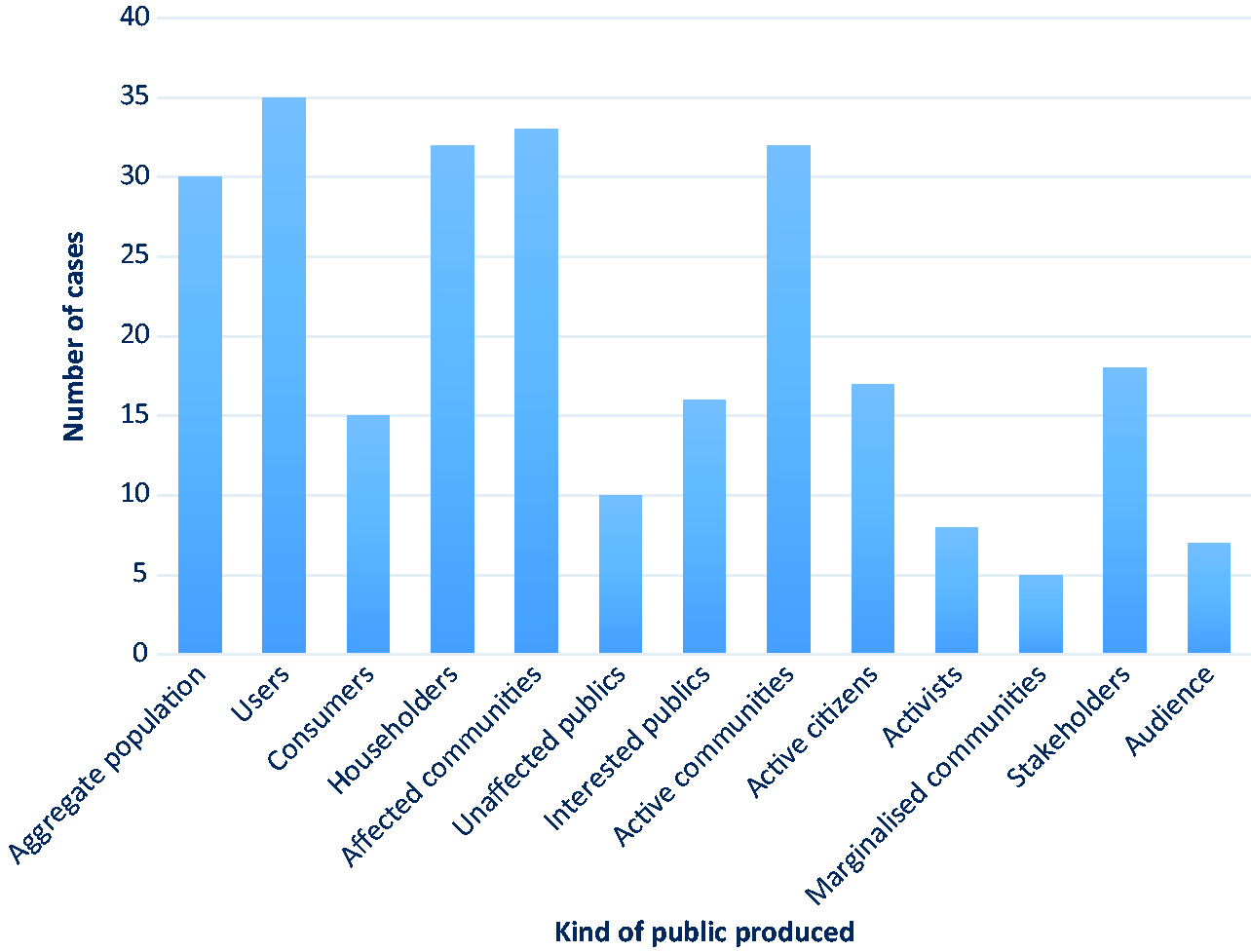
Legitimate publics
While our mapping illustrates the diversity of kinds of publics participating in the UK energy system, there are visions of publics which are particularly enduring and influential in shaping accounts of energy participation. The attempt to represent an aggregate population by selecting a subset of participants, which are statistically representative of a larger population according to a set of demographic characteristics, was common to many of the cases. For example, the UKERC national citizen engagement process (case 1), DECC's public attitudes tracking (case 11) and the homeowners’ renovation decisions project (case 17) all produce this vision of an aggregate population. Furthermore, the strength of this vision is evident in criticisms of the Bioenergy Distributed Dialogue (case 4) for example, where the official BBSRC response report dismissed some of the findings of the dialogue on the basis that the participants were not a representative cross-section of the population (BBSRC, 2014). Thus, despite widespread academic criticisms of the notion that representative samples of a population provide a singular ‘true’ account of public perspectives (cf. Law, 2009; Mohr and Raman, 2012), the vision of an aggregate population has become an important way to legitimate particular participatory collectives, and to delegitimize others, potentially foreclosing and excluding other visions of publics in the energy system.
Our mapping suggests that certain dominant visions of publics have the potential to exclude or overshadow alternatives. For example, the vision of publics as consumers potentially limits the range of ways a person can legitimately participate around the energy system, giving primacy to direct engagements with the market over broader social practices or more political forms of engagement with energy. Similarly, the vision of publics as householders, which is particularly reflected in academic work aiming to understand social practices related to energy – such as the Customer Led Network Revolution (case 10), the experiences of fuel study poverty (case 14) and the Energy Biographies project (case 15) – potentially overlooks people's engagements with energy in other parts of their lives as well as more overtly political engagements with the energy system. Finally, the construction of participants in several of the collectives as affected or unaffected publics and communities is linked to a vision of energy issues as being primarily about public acceptability of new technologies and infrastructures. This vision was produced through the UK Government's public engagement with shale gas and oil, an academic study on UK residents' responses to high voltage power lines (case 26) and the community food waste energy production schemes (case 29), often resulting in more complex participant responses and sentiments such as concerns with the directionality of the UK's energy transition or different underlying relationships to local landscapes being ignored or deemed as irrelevant.
The strength of visions of participants as active citizens or active communities amongst the cases in our corpus seems to challenge some of these more conventionally dominant visions of energy publics however, emphasizing the political activism of publics – for example cases 2 and 25 – and the ability of communities to take elements of energy transitions into their own hands through community energy projects – such as cases 3, 8, 12 and 18. This emphasis on the agency of participants appears to be a particular feature of public participation around energy, which contrasts with accounts of participation in other domains, such as biosciences or emerging technologies where dominant visions of participants have been characterized as ‘innocent citizens’ with little active knowledge or interest in the issues under discussion (Irwin, 2001). However, visions of active citizens and communities still hold the potential to obscure and exclude. For example, the evaluation report on case 3 the Low Carbon Communities Challenge (Dialogue by Design 2011) reflects that in many of the ‘communities’ involved in the programme it was a relatively small set of individuals who came to represent and act on behalf of the community sometimes leading to disputes with the broader community later on.
Accounts of active citizens and communities have also been shaped by a broader imaginary of the public as a threat, which has been described by Welsh and Wynne (2013) in terms of broader trends in visions of the public within and around the UK Government. For example, protesters in Reclaim the power's (case 2) direct actions on power stations in 2012 and 2013 were presented in some parts of the media and by the energy company EDF as a threat to property. This resulted in harsh treatment of the participants by the police as well as them being formally charged with criminal damage, though the charge was later reduced to aggravated trespass (Finchett-Maddock, 2013).
Publics producing publics
Within many of the participatory collectives analysed, visions of other publics and collectives emerged and were produced (cf. Michael, 2009). For example, the Demand Energy Equality group (case 21) sought to educate a broader population through their work, largely envisaging these people as ignorant or innocent citizens. An academic study of reporting of fracking in the UK press (case 22) demonstrates that newspaper reporting not only produced negative visions of active fracking protesters, but also continually framed the general public as a potential barrier to the quick development of fracking, which were produced in some parts of the media coverage around the issue. The orchestrators of the Londoners on bikes campaign (case 30) put a lot of thought into defining the identity of the collective and the kinds of members it sought, in recognition of stigma and apparent exclusivity of cycling identities. For example, though the collective appealed directly to cyclists, the decision was made to avoid using the term ‘cyclist’ instead appealing to the broader identity of people on bikes (Aldred, 2013). This avoided stereotypes of lycra-clad cyclists who skipped red lights, or people who only cycled for leisure.
Our mapping also reveals many examples where participants have actively challenged and in some cases shifted visions of themselves. For example, there is evidence that participants in the UK Government's public engagement with shale gas and oil process (case 5) tried to challenge the portrayal of them as ignorant of the issues through the way information about fracking was presented to them in the workshops. The participants opened up this discussion to broader energy issues and questioned the information presented to them, though were ultimately constrained by the procedural format of the collective. The evaluation report on the dialogue notes that ‘there was less focus on empowering participants and giving them the time and space to set their own agenda’ (Icaro, 2014: 31). Activists involved in protesting against the wind farms in Nant y Moch (case 7) similarly challenged the official portrayal of them as irrational and ignorant, while also rejecting the model of community participation assumed in the idea of ‘community benefits’. In their analysis of the controversy Mason and Milbourne (2014) note that ‘the notion of community benefits is […] suspect because it is limited to financial valuation of landscape and is often considered as compensation or even a bribe’ (10). While the Customer Led Network Revolution (case 10) could be considered as promoting a vision of the public as only customers or consumers, the small group of social scientists involved in the study (Bulkeley et al., 2016), as well as the inputs of the participants helped to demonstrate their broader role in engaging with the energy system through multiple social practices. Visions and constructions of the public are multiple and contested, but some become more durable than others – not only though deep-seated institutional framings and policy syndromes, but by multiple publics performing publics themselves.
Discussion and conclusion
The findings of our mapping problematize the distinction which is often drawn in accounts of public participation, between invited and uninvited forms of participation (Leach et al., 2005). While the adoption of these two terms has been useful to an extent in reflecting the often very different characters of instances of public participation formally orchestrated by governing institutions and participation occurring outside of or even in opposition to these institutions, they do not do justice to the full range of modes of participation identified in our mapping and make normative assumptions about the ways in which these different forms of participation are orchestrated and shaped. While it is often easiest to identify the actors, interests and ideas orchestrating participation in the government domain, it is also possible to trace the orchestration of other forms of participation, such as the clear patterning of activist participation and community energy groups found across the mapping (cf. Chilvers and Longhurst, 2016).
All forms of participation – whether invited or uninvited, insider or outsider – are always orchestrated and framed in powerful and highly partial ways, and are thus subject to exclusions (Braun and Schultz, 2010; Irwin, 2001; Wynne, 2006). We argue that these partialities, normativities and contingencies cannot be eliminated and should rather be more openly acknowledged and become part of how instances of participation are communicated, publicized and valued (cf. Chilvers and Kearnes, 2016). The evidence from our mapping about the ‘what’ of energy participation indicates that the propensity for participatory collectives to open up framings of the objects of energy-related participation is greater in more distributed or decentred sites and lessens with closer proximity to centres of power and decision-making. While there are significant exceptions, it is important to acknowledge this patterning when attempting to think systemically about energy participation and the objects, visions, pathways and trajectories of energy system change. In many of our 30 in-depth case studies, participatory collectives such as activist groups framed energy issues in ways that seem quite narrow at face value but which can be interpreted as speaking to a much broader set of issues and societal concerns at a systemic level.
Our mapping has identified dominant models of participation, such as surveys and deliberative processes, which are associated with established methods and technologies of participation, each of which circulate in wider spaces of standardization to be applied beyond energy issues and energy systems (cf. Lezaun and Soneryd, 2007). Relatedly there are certain publics, such as aggregate populations and consumers, who are being taken more seriously and being given more opportunities to shape the low carbon energy transition (cf. Irwin, 2001). Activists and other marginalized groups are excluded or ignored in a variety of ways (cf. Welsh and Wynne, 2013), and the diverse ways in which all publics are engaged in energy transitions through their everyday lives, as highlighted in many practice theory studies, are also often overlooked.
While there is a long-standing concern in the participation literature about the more effective application of participatory methods and techniques (e.g. Rowe and Frewer, 2000), it is often the case that multiple models and philosophies of participation co-exist and affect each other at particular sites. Importantly, multiple theories of participation co-exist ‘in the wild’ (cf. Callon et al., 2009). The mapping also shows that publics imagine and bring into being other publics, by seeking to engage them and making claims about their views or about the ‘general public’ (Michael, 2009). This complexity and multiplicity in the production of energy publics and participation shows the danger of public engagement processes and accounts which claim to authoritatively fix and represent a public view on a particular topic; there will always be publics which push back against such claims and which refuse to accept that opportunities to participate are over (Felt and Fochler, 2010). Our analysis of the ‘who’ of energy participation includes several examples of the ways in which participatory collectives have challenged or contested assumptions of what or who counts as a legitimate participant and legitimate participation in the energy system, such as the actions of participants in the Government-sponsored Shale gas deliberations.
The findings of this mapping also have implications for how the dynamics of the low carbon energy transition are understood, represented and governed. Our analysis shows that publics are already busy getting on with energy transitions and committing to new trajectories of change in diverse and distributed ways, through community energy projects, hackspaces and more. This shows the limitations of governing and understanding energy transitions with a top down emphasis on extracting public voices and opinions about the energy systems in order to inform centralized decisions, by highlighting other ‘ways of seeing’ and sensing potentially impactful public doings across energy systems (cf. Chilvers and Longhurst, 2016). Whether deliberately or more tacitly, cases of participation continually produce visions of future energy system change which often contrast to official and expert generated scenarios. It is important to note that these visions are not only technological or material in character but often have a sophisticated reading of the future social worlds that stand to be brought into being by energy transition pathways (cf. Pfister et al., 2017). This is an important feature of public participation in energy transitions and their reactions to proposed energy system changes that needs to be acknowledged.
Academic studies focused on understanding social practices or behaviours demonstrate a multiplicity or overflowing of energy-related issues and systems. In line with a more ecological reading of participation the challenge is to be open to how forms of energy participation are relationally connected to other (often seemingly ‘non-energy’) issues, practices and raise concerns about societal dimensions of energy transitions (like issues of equity and the desired direction of change) (cf. Butler et al., 2018). Attention to both the multiplicity and exclusions inherent to energy participation, which this mapping has illustrated, also strengthens calls to go beyond the acceptance/behaviour change binary which much policy action and academic work on energy participation reproduces (Owens and Driffill, 2008). To fully engage with existing and emergent public knowings and doings around the energy system, there is a need for approaches which can handle diversity and reflect inequalities in exposure and legitimacy.
The method for mapping energy participation we have proposed draws on and extends the well-established technique of a systematic review. In the context of mapping participation this approach sits in-between the emerging approaches of digital methods (e.g. Venturini, 2010) and multiple case studies (e.g. Eden, 2017), seeking to find a middle ground between the analytical and contextual depth of ethnographic approaches, and the breadth and ease of collecting and organizing of digital methods. We have found that there is a difficult trade-off between breadth and depth, and between creating a mapping which is both credible and useful to a broad range of actors, but also humbly recognizes and reflects its partialities and oversights.
Our methodology for mapping public participation has clear practical value for governance actors. It provides a tool to scan the horizon for relevant participation in relation to a given issue or system, enabling policy organizations to potentially anticipate controversies and challenges (e.g. fracking and emerging concerns about smart meters), to learn from existing examples of participation before initiating new ones, and to harness and support successful and constructive examples of participation (e.g. community energy and emerging hackspaces). This constructively advances an argument which has been building in the participation literature and amongst practitioners for some time about the need for governing institutions to more carefully listen to and be responsive to public voices rather than ritualistically carrying out invited public engagement processes as an end in themselves (Burall, 2018; Dobson, 2014; Pallett and Chilvers, 2013; Wynne, 2006). One consequence of this approach for government actors could be to productively redirect effort away from activities which are the current focus of public engagement work (which reproduce the acceptance/behaviour change binary discussed in the ‘Introduction’ section) towards considering how citizen-led energy participation like community energy or hackspaces can be further supported, or becoming aware of how current government policies have taken momentum away from such movements. It would also push governments to listen to and take seriously the perspectives and actions articulated in unofficial cases of participation such as protests or arts-based public engagement. Where more conventional opinion polls or deliberative workshops are orchestrated by government and practitioners, our mapping approach would still view these as useful processes but would suggest that their outcomes are interpreted in relation to other cases of participation rather than taken as fixed and definitive representations of ‘the public view’. Furthermore, the system-wide ambitions of this mapping make it particularly applicable in cases like energy, food production or flood risk management where a systemic transformation is being called for and attempted. These transformations will be better-informed, more holistic and potentially eased where those attempting to steer the transformation have a better understanding of how the system interacts with diverse public views and actions.
A potential draw-back of our broad definition of participation and attempt at whole system mapping is that it produces an output so broad and plural as to seem paralysing and obscure in the context of informing better policy making around UK energy transitions. However, compared to the dominant mode of policy advice which draws on only a handful of invited and highly orchestrated instances of participation, this mapping represents a much more comprehensive set of evidence upon which to base policy decisions and allows the anticipation of coming barriers or controversies. Far from making policy-makers’ lives harder this approach has the potential in some cases to save time and resources by synthesizing lessons from participation which has already taken place and avoiding the need to constantly reinvent the wheel by running yet another public dialogue process. Another key challenge in enacting this method is the limitation of the timeliness of results – at the time of writing the results of our mapping could already be viewed as out of date. However, we would argue that many of the broader patternings and dynamics revealed in our mapping are more enduringly relevant. Furthermore, we believe that it would be possible to conduct a version of this mapping in a less time and resource intensive manner, making more use of the resources available from digital methods approaches, and on a rolling basis so that the results could be continually updated. Recent developments in discussions about how to produce usable and credible data visualizations (cf. Moats, 2015) will also be a useful resource in producing more legible ‘mapping’ outputs from this work.
Crucially, however, we see these mappings not only as a tool to be used by policy-makers – as the latest in a long line of techniques from censuses (Scott, 1998) to surveys (Law, 2009) or focus groups (Lezaun, 2007) for making the public legible to a ruling elite. Rather this is a tool for all system actors – including NGOs and other civil society organizations, businesses and community groups – to use to draw their own conclusions and make their own arguments, and to inform their actions and initiatives. As has long been recognized in the discipline of Geography, maps are not neutral representations but are subjective human achievements (Wright, 1942) which can both reflect and sustain power relations by reflecting the purposes and assumptions of a governing elite and advancing their projects (Black, 1997; Scott, 1998; Woods, 1992). In our mapping we have tried to both represent and gain understanding of the dynamics of these power relations, as well as challenging them by bringing attention to the diversity of publics, issues and forms of participation in the UK energy system which go far beyond centralized accounts.
Highlights
Approaches to understanding publics in the context of environmental policy challenges like energy tend to be siloed making cross-comparison difficult. There is a need for new methods to help understand and engage with public participation systemically. The issues, models and subjects of participation in relation to the UK energy system are diverse and multiple. Policy-makers and other powerful actors have tended to privilege certain issues, models and subjects of participation in decision-making. Mappings of diverse, interconnected public participation provide a better basis for decision-making around issues such as low carbon energy transitions.
Footnotes
Acknowledgements
The authors would like to thank Jim Watson, Noortje Marres, Matt Watson, Rachel Macrorie, Nick Pidgeon, Christina Demski, Nick Eyre and Brian Wynne for comments on earlier versions of this paper.
Declaration of conflicting interests
The author(s) declared no potential conflicts of interest with respect to the research, authorship, and/or publication of this article.
Funding
The author(s) disclosed receipt of the following financial support for the research, authorship and/or publication of this article: The research presented in this paper was funded by the UK Research Councils as part of the UK Energy Research Centre Phase 3 research programme [EPSRC award EP/L024756/1].