



Abstract
We are delighted to present the first issue of Clinical and Translational Neuroscience (CTN), an international, online, open access, peer-reviewed journal, which is the successor of the Swiss Archives of Neurology and Psychiatry (SANP) founded 100 years ago by the Swiss neuroscientist Constantin von Monakow.
The journal is the response to the current urge to bridge clinical and basic neuroscience and the different clinical neurodisciplines. It is specifically devoted to inter, multi and transdisciplinarity, which is increasingly considered to be crucial by scientists, policymakers and funders, but remains still relatively underdeveloped in medicine. 1 Accordingly, the mission of the CTN is to promote the international discourse between neuroscientists across borders of specific disciplines (and methods), but also between the so-called ‘hard’ and ‘soft sciences’, providing articles and reflections to enhance science, patient care, education and professionalism.
The CTN was founded 1 year ago under the auspices of the Swiss Federation of Clinical Neurosocieties (SFCNS). The SFCNS was created in 2009 following an initiative of Claudio Bassetti and Christian Hess (representing neurology), Anton Valavanis (neuroradiology) and Gerhard Hildebrand (neurosurgery) to foster the clinical, research, teaching and political collaborations among clinical neuroscientists in Switzerland. 2,3 The inclusion in the meantime of 14 Swiss neurosocieties, the organization of large meetings (Basel 2010, Montreux 2013 and Basel 2016), the coordination of national activities in the context of the so-called highly specialized neuromedicine (e.g. stroke, epilepsy and Parkinson surgery), the promotion of academic multidisciplinary neurocentres (Geneva, Lausanne, Ticino, Bern, Zurich) and the creation of the CTN document the continuous commitment of the SFCNS to its vision and mission. 4,5 The CTN is currently supported by the official 8 Swiss neurosocieties (Table 1) and is supported also by other non-profit neuroscience foundations and fundings.
The supporting neurosocieties.

SFCNS: Swiss Federation of Clinical Neurosocieties.
A pioneer of interdisciplinarity was the Swiss neurologist, neuropathologist and psychiatrist Constantin von Monakow (1852–1930; Figure 1). 6,7 He was born in Russia, emigrated at the age of 9 to Germany and arrived at the age of 13 to Switzerland. He studied medicine in Zurich and received his training in psychiatry first at the Burghölzli hospital in Zurich with Eduard Hitzig (one of the leaders of the Zurich school of ‘brain psychiatry’) and subsequently in Pfäfers at the Heilanstalt St Pirminsberg. Here, he performed almost autodidactically experimental (mainly using the method of secondary degeneration and the ‘Gudden microtome’) and clinico-pathological studies, which established his international reputation. 7,8 In 1885, he returned to Zurich where he obtained the Venia docendi (for his works on central visual pathways) and started a successful clinical, research and teaching activity, first on a private basis and subsequently at the University. In 1923, von Monakow retired; the medical faculty in Zurich first thought to abolish his chair. In 1928, following national and international interventions, Mieczyslaw Minkowski who had assisted von Monakow since 1911 was nominated as his successor. 7

Prof. Constantin von Monakow (1852–1931) the founder of the Swiss Neurological Society (1908) and of the Swiss Archives of Neurology and Psychiatry (SANP, 1917).
For several reasons, von Monakow is considered the founder of neurology in Switzerland. 7,9 First, he organized the first outpatient neurological ambulatory clinic (1885–1887) and the first neuroanatomical laboratory (1886) of Switzerland. Second, he became in Zurich the first professor of neurology of our country in 1894 (‘Extraordinarius ad personam’), 25 years after Kojevnikov in Moscow and 12 years after Charcot in Paris. Third, he was the founder of the Swiss Neurological Society in 1908, an initiative of Robert Bing from Basel but much opposed by the psychiatrist Auguste Forel from Zurich and the internist Hermann Sahli from Bern. 10 –12 Finally, he founded the SANP in 1917 as the official journal of the Swiss Neurology and Psychiatry societies.
Constantin von Monakow is also considered internationally a central figure of modern neuroscience. This is due to his important contributions to neuroanatomy and pathology, which are summarized in the two monumental works, namely, ‘Gehirnpathologie’ (1897 and 1905) and ‘Die Lokalisation im Grosshirn’ (1914). His place in history is also linked to the fundamental description of the remote effects of lesions – for which he coined the term ‘diaschisis’ – and their role in the process of functional recovery after brain damage – which he named ‘chronogenic localization’. 13,14 The recognition of such dynamic effects was in contrast with the dominating localizational approaches of his time and created a conceptual frame which became evident only with the advent of modern functional neuroimaging and neurophysiology.
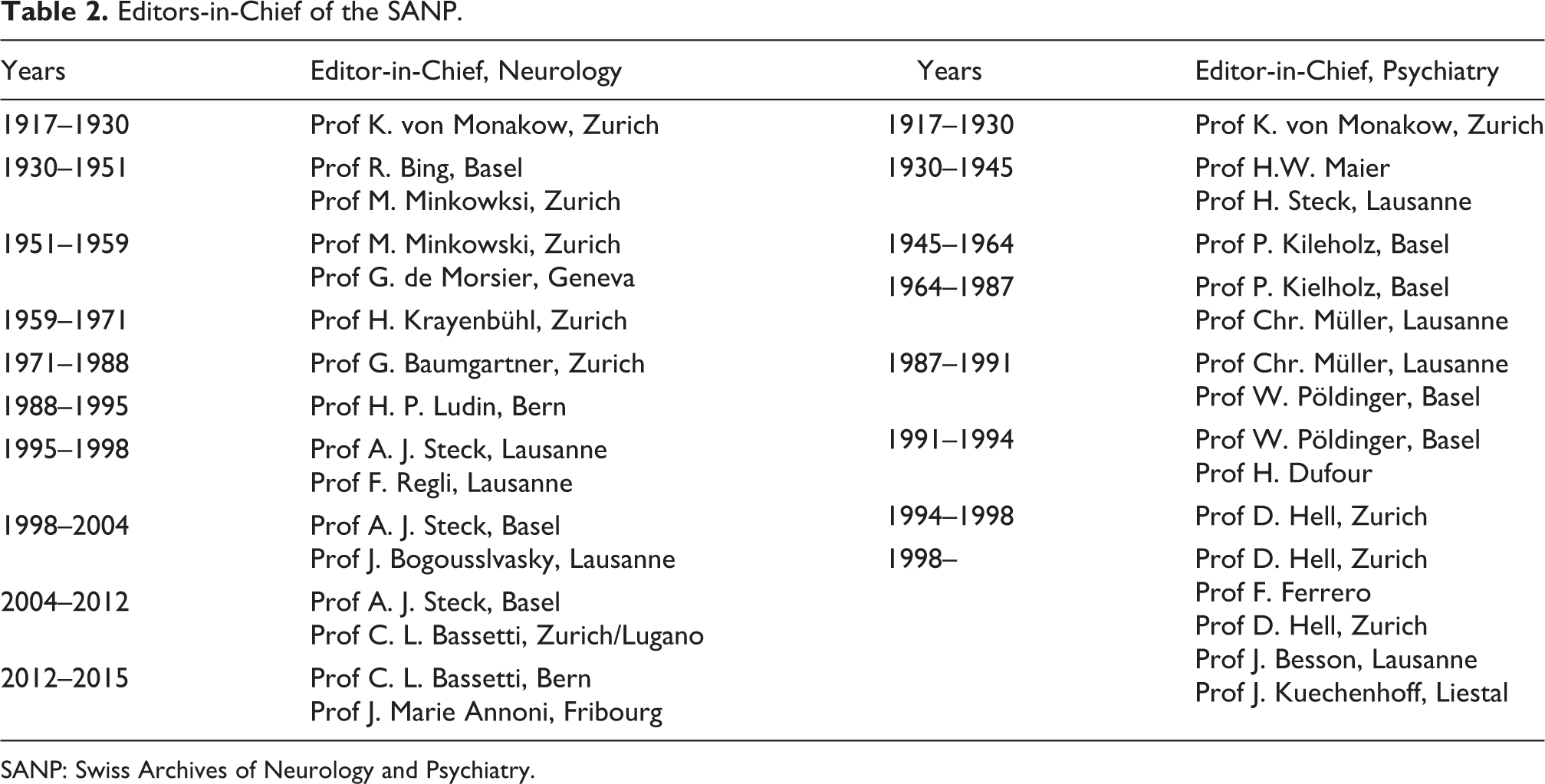
Following an agreement stipulated in 1916 between the Swiss Neurological Society and the Swiss Psychiatry Society (still named at that time ‘Verein der Irrenaerzte’), von Monakow founded the SANP 9 in 1917 (Figure 2). The idea to create a Swiss journal followed similar initiatives in other countries including Germany (Archiv für Psychiatrie und Nervenkrankheiten, 1868), England (Brain, 1878) and France (Revue Neurologique, 1893). The difficulties to publish abroad during the First World War and the wish to improve the communication between the German and the French speaking Switzerland were additional factors. 15 In 100 years of history, the journal published articles of the Nobel awardees Walter R. Hess, Rita Levi-Montalcini and Charles Sherrington but also of other famous neuroscientists including Wladimir Bechterew, Eugen Bleuler, Santiago F. Ramon y Cajal, Guido Fanconi, Samuel Goldflam, Kurt Goldstein, Henry Head, Pierre Marie, Otto Marburg, Giovanni Mingazzini, Iwan P. Pavlov, Arnold Pick, Otto M. Rademacher, Theodore Rasmussen, Wilder G. Penfield and Gazi Yasargil. 15 The SANP published the first international descriptions of the blood–brain barrier by Russian-born Lisa Stern and by Constantin von Monakow, of normotensive hydrocephalus by Raymond Adams and of idiopathic hypersomnia by Bedrich Roth. 6 Noteworthy, the Swiss neurosurgeons, following the initiative of their ‘founding father’ Hugo Krayenbühl (1902–1985), recognized the journal as the official organ of their society, which for 36 years (1959–1986) carried the name ‘Swiss Archives of Neurology, Neurosurgery and Psychiatry’. The Editors-in-Chief of the SANP are listed in Table 2. Orell Füssli (Zurich, 1917–1992), Zurich-See (Zurich, 1992–1994), Bäbler (Bern, 1994–1997) and Schwabe (Basel, 1997–2015) have been the publishers of the journal.

Extract from the introductory article by Prof. Constantin von Monakow in the first issue of the SANP in 1917.
Editors-in-Chief of the SANP.
SANP: Swiss Archives of Neurology and Psychiatry.
After 100 years, it was time for a change. The publication of articles in German and French, the dissemination in paper form, the paucity of original contributions, the limited interest of the new generations and other considerations eventually led the Swiss Neurology Society and Psychiatry Societies to stop their support of (or commitment to) the journal in 2015. 16 The SFCNS took it over recognizing great opportunities for a ‘new SANP’ in terms of vision/mission, contents, management and eventually readership and impact. The CTN was thus born.
The present inaugural issue demonstrates how wide-ranging and diverse the interests (and needs) of the neuroscience community have become and illustrate well the potential of CTN.
The visionary commitment of von Monakow to interdisciplinarity and to holistic (and humanistic) approaches in neuroscience and medicine has inspired our beginning. Let us now wish for CTN a future of originality, courage, endurance and success!