Abstract
Category:
Sports; Hindfoot
Introduction/Purpose:
Delays in diagnosis or treatment of acute Achilles tendon rupture are relatively frequent either due to the injury being misdiagnosed or the patient disregarding its severity. In the delayed presentation of Achilles tendon rupture, open repair is generally recommended for mobilization of the adherent and retracted tendons from the thickened paratenon layer repair although this introduces the risk of wound complications. Although a minimally invasive technique for acute Achilles tendon rupture has demonstrated lower infection rates, with functional results equivalent to those of open repair, their use in patients presenting in a delayed fashion has not been thoroughly investigated. The objective of this study is to compare the outcomes of percutaneous and open repair in cases of delayed presentation of acute Achilles tendon rupture.
Methods:
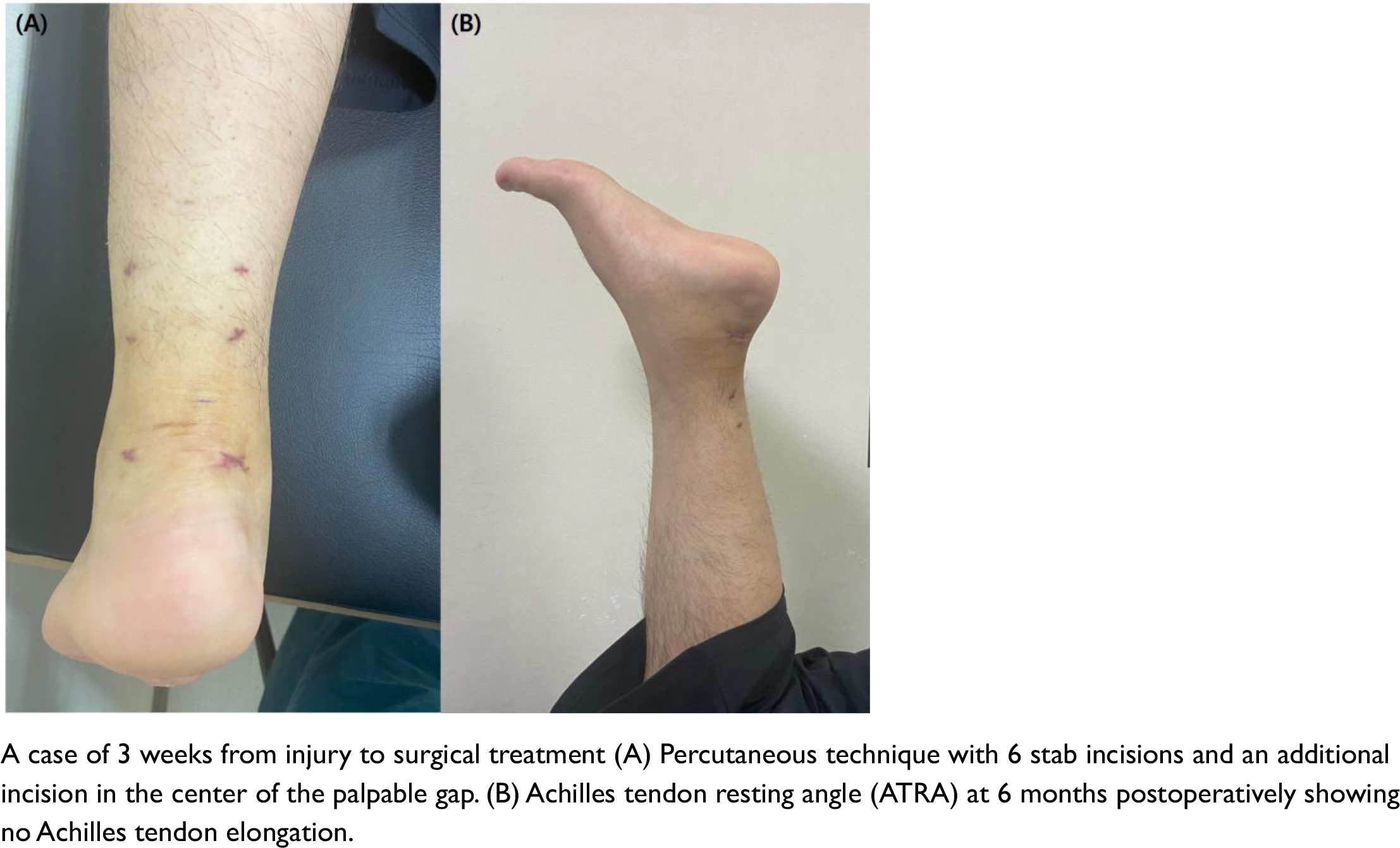
This was a retrospective study of prospectively collected data on consecutive patients who underwent either percutaneous or open repair for delayed presentation of Achilles tendon rupture and were followed up for at least one year. Delayed Achilles tendon rupture was defined as if patients underwent surgery 14 to 30 days after the injury and had received no treatment before surgery. The percutaneous repair was a modified Bunnell suture with an additional incision enough to permit mobilization of the tendon ends and core suture. An identical postoperative rehabilitation protocol was implemented in both groups: with below-knee cast in maximum plantarflexion, full weightbearing on the metatarsal heads was immediately allowed as tolerated. Postoperatively, the AT Resting Angle (ATRA), patient-reported functional outcomes using the AT Rupture Score (ATRS), and Calf circumference difference were evaluated. Postoperative complications, including re-rupture, wound infection, and sural nerve injury, were assessed.
Results:
There were no significant differences in demographic data between the percutaneous repair group (N =23) and the open repair group (N =23). The elapsed time from injury to surgical treatment and the gap between the proximal and distal stumps assessed on the MRI between the groups were similar. there were no statistically significant differences observed in ATRA (-2.9 ± 1.8 vs -2.1 ± 1.7, p = 0.687), ATRS (92.2 ± 2.5 vs 93.1 ± 2.6, p = 0.814), or calf circumference difference. Additionally, there were no cases of re-rupture in either group. A deep wound infection occurred in one patient in the open repair group. Symptoms related to sural nerve injury were observed in two patients in the percutaneous repair group, which resolved with conservative treatment.
Conclusion:
In cases of delayed presentation of Achilles tendon rupture, the percutaneous tendon repair technique is considered to yield comparable outcomes to the open tendon repair technique.