



Abstract
Background:
Geriatric ankle fractures are increasingly common. Previous work has suggested that early weightbearing following ankle fracture fixation is safe in nongeriatric patients. However, limited data is available regarding the safety of immediate weightbearing following fixation of geriatric ankle fractures using standard open reduction internal fixation techniques.
Methods:
Forty-four patients aged 65 years or older treated for rotational ankle fractures were propensity matched, with 22 patients following a nonweightbearing (NWB) protocol and 22 were allowed to weightbear immediately (WBAT) in a controlled ankle motion boot at all times. Primary outcomes included hardware failure and postoperative complications. Group differences in continuous variables were analyzed via Student t test whereas Fisher exact tests were used to analyze the differences in categorical variables. Complication-free survival and hardware failure–free survival were compared using the log-rank (Mantel-Cox) test.
Results:
There were no hardware failures in the WBAT group and 1 hardware failure in the NWB group; the difference was not statistically significant. There was no difference in incidence of postoperative complications, rate of hardware failure, or PROM scores.
Conclusion:
In this preliminary study group, we found that immediate weightbearing following fixation of geriatric ankle fractures was not associated with increased hardware failure or postoperative complications.
Level of Evidence:
Level IV, retrospective cohort.
This is a visual representation of the abstract.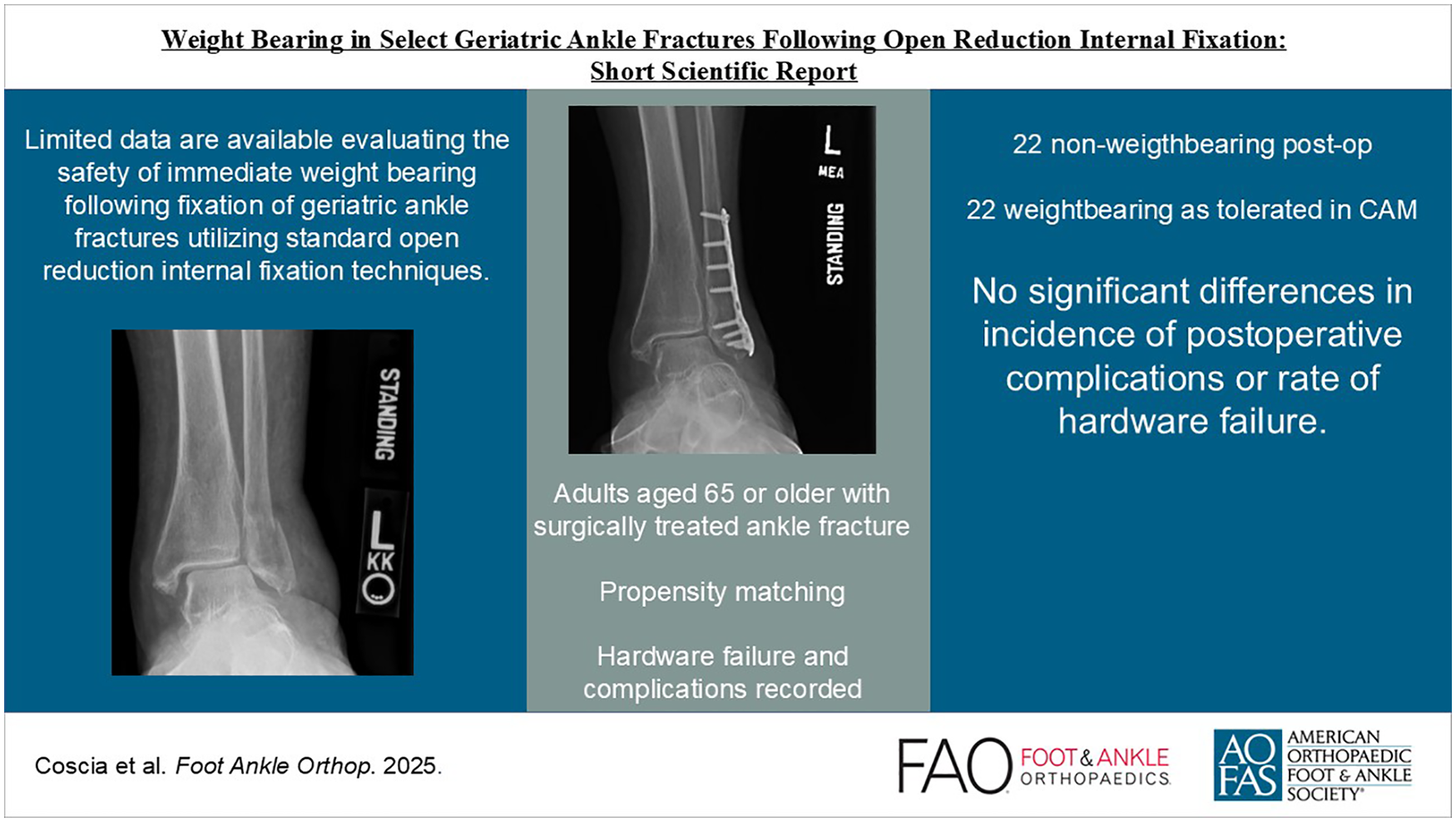
Introduction
Low-energy geriatric ankle fractures are an increasingly common injury that present unique treatment challenges. 1 The benefits of early mobilization must be weighed against the risks of wound healing complications, malunion, and hardware failure in this medically frail patient population. There remains limited evidence evaluating the safety of immediate weightbearing following fixation of geriatric ankle fractures with standard open reduction internal fixation hardware although the available literature suggests this approach may be safe in select patients. 1 The primary aim of this study was to contribute to the existing body of literature evaluating the safety of immediate weightbearing following conventional fixation of geriatric ankle fractures.
Methods
This study received institutional review board approval (HUM00250226). A retrospective review was completed of a tertiary care academic institution’s electronic medical record system. Current Procedural Terminology codes 27766, 27769, 27792, 27814, 27822, and 27823 were used to identify patients who were 65 years or older at the time that they underwent fixation of a low-energy, rotational ankle injury from January 1, 2013, to January 1, 2023. Patients who had pathologic fractures, previous surgery on the injured lower extremity, or pilon injuries were excluded. Fracture pattern was classified according to the Lauge-Hansen classification based on injury radiographs.
Patients were treated by 6 surgeons (3 fellowship-trained orthopaedic trauma surgeons, and 3 fellowship-trained orthopaedic foot and ankle surgeons). Timing of surgery, surgical approach, fixation construct, and postoperative weightbearing protocol were determined by the treating surgeon at their clinical discretion. Postoperative weightbearing protocol (immediate weightbearing in a CAM [controlled ankle motion] boot [WB] vs delayed weightbearing [NWB] consisting of 6 weeks of nonweightbearing) was recorded. Immediate weightbearing as tolerated was considered for patients who were polytraumatized or for medically frail patients for whom it was felt that immobilization would lead to unnecessary morbidity or medical complications. An immediate weightbearing protocol following fracture fixation with a conventional construct was only instituted for patients who were felt to have fracture patterns and bone quality that would allow for bony healing prior to construct failure.
The composite primary outcome of the study was development of postoperative complications. Complications were classified as (1) elective removal of hardware (ROH), (2) all complications excluding elective ROH, (3) operative complications excluding elective ROH, (4) nonoperative complications, and (5) loss of reduction. 2 Postoperative radiographs were obtained at 6 weeks and 3 months. If fractures were radiographically healed and patients were clinically progressing and ambulating without pain, no further follow-up was completed. Secondary outcomes included length of stay, discharge destination (subacute rehabilitation vs home), and PROMIS scores (global health, physical function, and pain interference). PROMIS scores were collected at the patient’s 3-month postoperative visit.
Statistical Analysis
Statistical analyses were performed using GraphPad Prism (version 10.3.0 for Windows, GraphPad Software, Boston, MA) and R studio (version R-4.4.1). To minimize selection bias and control for confounding variables, propensity score matching was performed to compare the WB and NWB. The covariates used for matching included gender, race, presence of diabetes, smoking status, peripheral artery disease, baseline ambulation status, and laterality of injury.
Categorical variables were compared using the Fisher exact test, and the Student t test was used to compare group means. Kaplan-Meier survival analysis was used to evaluate mortality. Complication-free survival and hardware failure–free survival postoperatively were compared using the log-rank (Mantel-Cox) test. Given the small sample size of the study cohort and inherent risk of type II error, effect sizes (Cohen d for continuous variables, Cohen h for categorical variables) were calculated and are reported. A value of 0.01 or greater is considered a very small effect size, ≥0.2 as small, ≥0.4 as medium, and ≥0.8 as large. 3
Results
Descriptive Statistics
The WB group had a significantly lower BMI (P = .005) and was more likely to be multiple injured (P = .049) as compared to the NWB cohort. Otherwise, there was no statistically significant difference between WB and NWB patients in terms of mean age, sex, race, presence of diabetes, smoking status, or presence of peripheral artery disease (Table 1).
Descriptive Statistics (N=44).

Abbreviations: NWB, nonweightbearing; PAD, peripheral arterial disease; WB, weightbearing as tolerated.
Treatment Course and Complications
No statistical difference was observed regarding rates of postoperative complications (P = .999), postoperative hardware failure (P = .999), or mortality rate (P = .999), or PROM scores between the groups (Table 2). Otherwise, there were no significant differences across the other secondary outcomes, and none of the primary or secondary outcomes were associated with greater than a small effect size.
Treatment Course and Complications.

Abbreviations: HW, hardware; NWB, nonweightbearing; WB, weightbearing as tolerated.
Discussion
The optimal fixation strategy and postoperative weightbearing regimen for the treatment of geriatric ankle fractures remains controversial.
There is emerging evidence that early or immediate weightbearing is safe in nongeriatric patients. Fram et al demonstrated that immediate weightbearing was not associated with increased complications in a propensity score–matched retrospective cohort that included 133 patients with an average age of 56.2. 2 A recent multicenter randomized controlled trial found early weightbearing to be noninferior to a delayed weightbearing protocol in a patient population with an average age of 48.3 years. 4 A large systematic review and meta-analysis completed by Sernandez et al also concluded that early weightbearing is safe following fixation of nongeriatric ankle fractures. 5
The safety of early or immediate weightbearing in geriatric patients has been less extensively studied. Most of the literature in this area has focused on alternative treatment options, such as hindfoot nailing. There is fair evidence that hindfoot nailing is associated with a lower complication profile and safely allows immediate weightbearing.6,7 However, hindfoot nailing has been associated with lower patient-reported outcomes postoperatively, and the question of whether to prepare the subtalar and tibiotalar joints remains controversial. 6
For certain geriatric patients and injury patterns, conventional fixation and immediate weightbearing may be safe, though there is limited evidence to guide clinical decision making. Chang and colleagues illustrated that immediate weightbearing was not associated with increased complications in a small sample (n = 22) of geriatric patients with a mean age of 72.9 years. These authors allowed patients to bear weight as tolerated in the absence of large displaced posterior malleolus fracture, complete syndesmotic disruption, profound osteoporosis, or ipsilateral lower extremity injury. The results of the current study show good agreement with these findings, in a slightly older patient population.
This retrospective series has several limitations inherent to this type of design. Surgical timing, fixation construct, and selection criteria for postoperative weightbearing protocol were all determined at the discretion of the treating surgeon and were not standardized. Additionally, sample size was perhaps the most significant limitation of the current project, similar to the existing literature reporting outcomes following conventional fixation of geriatric ankle fractures. The authors believe that the current preliminary report may contribute to the existing literature given that propensity matching was performed, and effect sizes were provided for the study’s primary and secondary outcomes. Additional work that is conducted in a prospective manner with larger sample sizes is warranted.
Supplemental Material
sj-pdf-1-fao-10.1177_24730114241310413 – Supplemental material for Weightbearing in Select Geriatric Ankle Fractures Following Open Reduction Internal Fixation: Short Scientific Report
Supplemental material, sj-pdf-1-fao-10.1177_24730114241310413 for Weightbearing in Select Geriatric Ankle Fractures Following Open Reduction Internal Fixation: Short Scientific Report by Atticus Coscia, Michal Jandzinski, Paul Talusan and Jaimo Ahn in Foot & Ankle Orthopaedics
Footnotes
Ethical Approval
IRB approval was provided for conduct of this study (HUM00250226).
Declaration of Conflicting Interests
The author(s) declared no potential conflicts of interest with respect to the research, authorship, and/or publication of this article. Disclosure forms for all authors are available online.
Funding
The author(s) received no financial support for the research, authorship, and/or publication of this article.

References
Supplementary Material
Please find the following supplemental material available below.
For Open Access articles published under a Creative Commons License, all supplemental material carries the same license as the article it is associated with.
For non-Open Access articles published, all supplemental material carries a non-exclusive license, and permission requests for re-use of supplemental material or any part of supplemental material shall be sent directly to the copyright owner as specified in the copyright notice associated with the article.
