



Abstract
Background:
It is critical for patients seeking foot and ankle care to have access to quality online resources, as the treatment of their conditions may involve the use of a variety of diagnostic and therapeutic modalities with which they are unfamiliar. This study was performed to enhance our understanding of if and why patients use Internet-based educational materials, to identify trends in utilization, and to delineate the patient-perceived attributes of quality resources.
Methods:
Questionnaires were distributed to 150 adult foot and ankle patients. The questionnaire consisted of demographic and Internet utilization questions. Statistical analysis was performed to determine the frequency of responses for each question and the relationship between demographics and Internet usage.
Results:
Younger patients were more likely to use the Internet (P= .006). However, there were no other significant differences in demographic attributes between patients who did (76%) and did not (24%) utilize the Internet (P <.05). Of the participants who didn’t search the Internet about their condition, the most commonly cited reason was they preferred to receive information directly from their physician (47%). Among Internet users, most found the quality of resources to be good or very good (75%). However, many patients were unsure of the specific websites they accessed (66%) and if materials were AOFAS sponsored (18%). When asked about the attributes of a reliable website, patients felt that physician and/or medical society endorsement were most important (52% and 46%, respectively).
Conclusion:
Although physician and medical society endorsement positively shape patients’ opinions of online education materials, patients often struggle in remembering the site they visited and if it was sponsored by a certain society. Despite this, patients are generally satisfied with online foot and ankle education resources. Future works must assess whether patient and physician perceptions of quality Internet resources are correlated.
Level of Evidence:
Level IV, case series.
Introduction
The Internet is more accessible than ever before, with 87.4% of Americans found to regularly use it in 2014. 9 It has revolutionized how patients obtain medical information, as modern search engines, social networks, and devices such as tablets and smartphones have led to an unprecedented quantity of and access to materials devoted to the symptoms, diagnosis, and treatment of virtually any condition.3,15 There is great variation in how patients perform online searches and the exact information accessed. 5
Internet use transcends medical specialties. Schwartz et al found that 74% of web-searching family medicine patients did so for health information. 18 In the surgical literature, more than 40% of patients presenting for their preoperative lab work were found to have accessed the Internet for health information. 13 In 2003, 45% of orthopedic patients acknowledged searching the Internet about their condition prior to consultation. 12 It is likely that even more orthopedic patients currently utilize the World Wide Web for medical information, as seven of ten Internet users in 2014 were found to be searching for health issues. 9
Although the Internet is a tremendous repository for orthopedic patient education materials, numerous works have found limitations with regard to available resources.1,4,7,14,16,18,19,21 In a study evaluating available resources for hallux valgus, it was determined that online materials were often of poor quality and too difficult for most to understand. 18 This is consistent with a 2009 work., which discovered that patient education materials on the American Orthopaedic Foot & Ankle Society (AOFAS) website were written, on average, at approximately the eighth-grade level, surpassing the sixth- to seventh-grade reading level recommended by the National Institutes of Health (NIH). 4
In 2014, the average reading level of patient education materials on the AOFAS website remained elevated, at 10.5, despite AOFAS requests that FootCareMD articles be written at no higher than an eighth-grade level. 17 That work also found that the readability of online foot and ankle–related patient education materials exceeded NIH recommendations on the websites of the American Academy of Orthopaedic Surgeons (AAOS), those of 11 academic medical centers in the United States, and on MedlinePlus. 17 Despite this, patients have been shown to be satisfied with the educational value of Internet resources. 3 This distinction is important, as it suggests that there is a discrepancy between what physicians and patients perceive as quality online resources.
This survey study was performed to enhance our understanding of if and why patients utilize Internet-based foot and ankle patient education materials, to identify trends in utilization, and to better delineate the attributes of quality resources, as perceived by patients. We hypothesized that most of our patients use the Internet for health information, value the endorsement of physician and medical societies, and are satisfied with the quality of available materials. We also hypothesized that there would be no difference in utilization trends as a function of demographic parameters.
Materials and Methods
Following institutional review board approval, questionnaires were distributed to 150 adults (18 years of age or older) presenting to the practice of our senior author or our institution’s Medicaid Care Clinic between January 4 and July 31, 2016. Inclusion was not limited to new patients, but also included individuals presenting for preoperative evaluations, postoperative visits, and nonoperative follow-up. Patients were informed of the study’s purpose and the risks and benefits of participation. It was emphasized that participation was voluntary, unrelated to the care they would receive, and that all results were anonymous. Patients were excluded if they did not meet the aforementioned criteria, if they had cognitive impairment, or were unable to read or write in English. Patients amenable to participation completed the survey in examination rooms, prior to being seen by a physician.
One hundred fifty patients participated in the study, out of 158 screened patients. Eight patients were deemed ineligible because of an inability to read English (Table 1). The average age was 49 ± 14 years. Most participants were female (105/150, 70%), Caucasian (114/150, 76%), and had obtained a bachelor’s or more advanced degree (99/150, 66%).
The study group’s demographic characteristics.
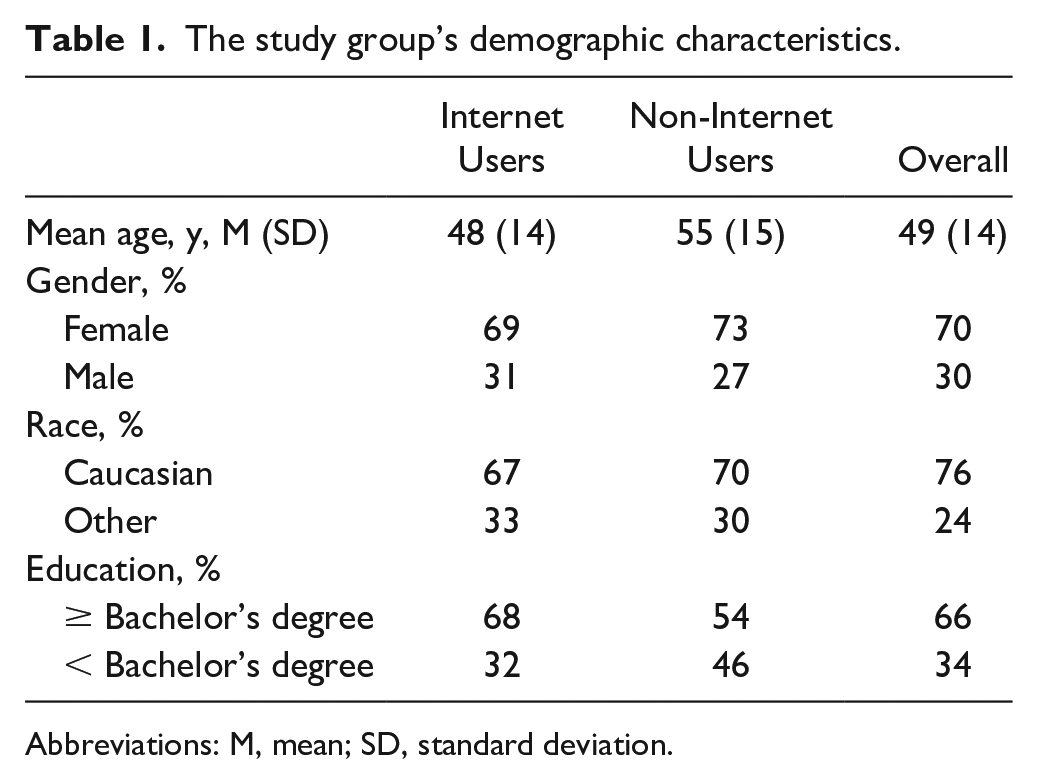
Abbreviations: M, mean; SD, standard deviation.
The questionnaire was developed by our study group and comprised two components. The first was a demographic section consisting of questions regarding age, gender, race, and education. The second consisted of questions pertaining to patients’ utilization of the Internet for foot and ankle–related health education materials. If patients did not use the Internet, they were asked to answer a single multiple-choice question regarding why (Figure 1). For those who did use the Internet, they were asked to complete an additional 12 questions (Figure 2). The questionnaire’s Microsoft Word–determined Flesch-Kincaid Readability Index was 7.2, as the National Assessment of Adult Literacy reported that the mean reading level of adults in the United States is eighth grade. 6

A breakdown of Internet usage in the study population, with the reasons why some patients did not access the Internet.

The 12-question survey given to those patients who used the Internet to research their respective foot and ankle ailments. The percentage of responses received for each answer choice is bolded. The answer choice in red is that which was most frequently selected.
Statistical analysis was performed with Microsoft Excel (Redmond, WA). The relationship between demographics and Internet usage was assessed with chi-squared and Fisher exact tests for categorical variables and independent samples t tests for continuous variables. The cutoff for statistical significance for all tests was P <.05. A descriptive statistical analysis was performed to determine the frequency of responses for each question.
Results
Of the 150 participants, 76% used the Internet to search for information pertaining to their given foot and ankle condition (Figure 1). There were no significant differences in demographic attributes between those who utilized and those who did not utilize the Internet with regard to gender, race, and education (P = .628, .757, and .112, respectively; Table 1). However, there was a significant difference with regard to age; younger patients were more likely to use the Internet (48 ± 14 years vs 55 ± 15 years, P = .006).
Twenty-four percent of participants did not search the Internet about their condition. The most commonly cited reason, selected by 17 patients, was because they preferred to receive information directly from the physician (47%). Cost and a lack of familiarity with using the Internet for health information were each cited six times (17%).
There were 12 additional questions for individuals who searched the Internet for health information (Figure 2). The majority of patients spent ≤3 hours online (81%; Figure 3) in an attempt to be better prepared for their appointments (51%). Most searched for general information (62%) and treatment options (54%) pertaining to their conditions. Among patients searching for treatment options, 24% purchased medical equipment or alternative and/or complementary remedies.

A graph illustrating the breakdown of patients’ time spent searching the Internet about their foot and ankle ailments.
The resources that patients encountered were composed of written text, videos, and other visual aids (76%, 29%, 54%, respectively), with approximately 53% of patients citing the written materials as most helpful. Additionally, approximately 83% of the cohort noted that they would have preferred more readily available and helpful videos and visuals. Seventy-five percent of Internet users found the quality of resources good (41%) or very good (34%; Figure 4), and only 11% felt more confused or anxious after searching the web for information about their foot and ankle ailments.

A graph illustrating the patient-perceived quality of Internet-based foot and ankle resources.
Almost half of the participants were unsure of which cites they accessed (66%). Both the AOFAS-sponsored FootCareMD.org site and the American College of Foot and Ankle Surgeon’s (ACFAS) site foothealthfacts.org were accessed by 17% of patients each. Furthermore, footeducation.com, an orthopedic foot and ankle surgeon–controlled site, was utilized by 16% of patients. Most patients (62%) were also unsure if the AOFAS, ACFAS, or the AAOS endorsed the materials they found, with few patients certain that they accessed such endorsed materials (18% [AOFAS], 20% [AAOS], 14% [ACFAS]). When asked about the attributes of a reliable website, 46% of patients chose medical society sponsorship, 52% selected physician or healthcare professional endorsement, and 30% chose hospital or health maintenance organization (HMO) sponsorship (participants could select more than 1 factor).
Discussion
This work demonstrates that most of our patients use the Internet for patient education, desire physician and medical society endorsed materials, and are generally satisfied with the quality of available resources.
Patients in the current study accessed the Internet more frequently (76%) than that observed by Krempec et al, who found that 45% of orthopedic patients used the Internet for medical information, and Walsh et al, who observed a 57% rate of Internet utilization among orthopedic outpatients.12,20 Admittedly, the web has become more accessible than ever before, which likely accounts for the increased use in our cohort; only 1 of the 36 (3%) patients who did not use the Internet in our study cited a lack of access as the reason.
Other than age, the demographic characteristics of our study group did not correlate with trends in Internet utilization. Although Walsh et al also found significantly less Internet use in older orthopedic outpatients, their work also found a correlation between Internet use and education; we did not observe this in our cohort. 20 However, we believe that our findings are consistent with recent studies demonstrating that the demographic makeup of those with online access has become more representative of the larger US population. 11
Our study demonstrated that most patients who used the Internet to research their foot and ankle ailments did so for general information (62%) and treatment options (54%). Patient’s Internet searches may be contingent on the chronicity of their condition, their baseline medical knowledge, and/or the type of appointment for which they were scheduled. In other words, a patient presenting for a surgical discussion would have been more likely to search for treatment options prior to the appointment. Conversely, a patient presenting for an initial evaluation would have probably searched for more general information related to his or her symptoms. Therefore, we believe that an ideal online resource would discuss both general information and treatment options.
Approximately 24% of patients who researched treatment options purchased medical equipment or other remedies. This is a reflection of the large commercial presence on the Internet. It also elucidates the trust that patients place in what they read and the online advertising that they encounter.
The Internet has played an important role in the evolution of the doctor-patient relationship, as it provides patients with unprecedented access to information about symptoms, diagnosis, and treatment modalities of virtually any condition. With such knowledge, patients come to the physician’s office more empowered to participate in their care than ever before. This has led to a more preference-sensitive partnership between physician and patient, in which the patient and surgeon collaborate to develop a treatment plan that best fits the patient’s needs, values, and preferences. 16 It was therefore not surprising that 51% of study participants utilized online resources to be better prepared for their appointments. This finding underscores the importance of providing quality online resources to our patients, as it will facilitate a more fruitful doctor-patient relationship in which patients are properly informed and prepared for the shared decision making that they desire.
Patient-accessed online materials consisted of written text, videos, and other visual aids (76%, 27%, 34%, respectively). Seventy-five percent of patients found these resources good (41%) or very good (34%), which is consistent with other works that have demonstrated that patients are generally satisfied with Internet resources.3,4,17 Further, 53% of our cohort found the written materials most helpful.
Multisensory education has been described as one of the most effective teaching techniques. 13 Our results reinforce the importance of this approach, as 61% of Internet users stated that they would have preferred more multimodal resources, with more visual aids and video included in encountered websites. Beamond et al demonstrated the importance of multimedia education tools in foot and ankle surgery, revealing that patients undergoing first metatarsophalangeal joint arthrodesis were found to have improved understanding of the procedure after viewing a module with animations and audio as compared to other modalities. 2
Since its inception in 2011, the AOFAS patient education site, FootCareMD.org, has seen an annual increase in site visitors (Figure 5).8,10 In 2015 there were over 9.9 million total hits—5 million more than its 2014 totals. 10 The site’s increasing popularity is telling of its quality and patients’ increasing reliance on the Internet for health information. Despite this, 66% of patients in the current study were unsure if they accessed FootCareMD.org during their time online, with only 17% certain that they did. Furthermore, 62% of patients were unsure if they utilized any AOFAS-endorsed resources. This is concerning, as it suggests that despite using FootCareMD.org, patients are unable to distinguish it from other sites accessed. It also indicates that most patients fail to connect the AOFAS with FootCareMD.org.

The breakdown of FootCareMD site traffic from 2011 to 2015.
This study has several limitations. Although the 150 patients who completed the survey provided sufficient data for analysis, the demographics of our cohort were relatively homogenous; more than half of the participants were Caucasian, female, and college educated. A post hoc power analysis revealed that 100 patients in each demographic cohort would be needed to achieve a power of 80%. However, studies show that the Internet is more accessible to all demographics than ever before, suggesting that demographics may no longer correlate with usage patterns. 11 Another limitation of this study is that we included patients presenting for all types of visits (initial consults, pre- and postoperative visits, nonoperative follow-up), but failed to correlate visit type with responses to survey questions. Future works must evaluate this, providing insight into the type of information patients desire at various stages of their care, and define the relationship between demographic attributes, Internet usage, and perceived quality of available materials. Although this study focused on patient satisfaction with available resources, future works should evaluate whether patient and physician perceived quality of resources are correlated.
As the Internet continues to revolutionize how patients obtain information about their medical conditions, it is imperative that providers gain insight into what patients search for, the optimal media through which to educate them, and what guides patients in determining the quality of a given resource. This work has demonstrated that foot and ankle patients rely on the Internet for information about their ailments, and that patients are generally satisfied with currently available resources. Although many patients felt that physician and medical society endorsement are defining features of a reliable resource, most could not remember the sites accessed or if the resources were endorsed by a particular group. As such, we believe that societies like the AOFAS should consider means of enhancing their online visibility, as the importance to patients cannot be refuted.
Footnotes
This article was originally published as: Rosenbaum AJ, Jones MT, Marinescu A, Ellis SJ. Foot Ankle Orthop. 2017 Jan 27;2(1)2473011416689096. doi:10.1177/2473011416689096.
Declaration of Conflicting Interests
The author(s) declared no potential conflicts of interest with respect to the research, authorship, and/or publication of this article.
Funding
The author(s) received no financial support for the research, authorship, and/or publication of this article.