



Abstract
Photonic crystals with bright colors have shown great potential application in bio-sensing, anti-counterfeiting, and smart wear. Different methods are used to construct photonic crystals on fabrics using different raw materials. However, building photonic crystals on fibers or fabrics with vibrant colors and good stability is still challenging. Various strategies have been used to increase the stability (e.g. wash, bend, friction stability, and so on) of the photonic crystal coatings on the fabrics or fibers. Therefore, this paper reviews great efforts to construct photonic crystal-coated materials, the methods to increase the stability of photonic crystal coatings on the fabrics, and their possible applications. The summarization of this review may lay the foundation for the construction of photonic crystals on fabrics with high color fastness and application in fabric coloring.
Introduction
Structural color is universal,1,2 for example, blue sky, rainbow, butterfly wings, peacock feathers, chameleon skin, and natural opals.3,4 Photonic crystals (PCs), as typical structural colored materials, have attracted great interest in bio-sensing, anti-counterfeiting, smart wear, textiles coloring, and so on. 5 PCs are microstructure materials whose dielectric constant varies periodically with space. PCs were introduced independently by Yablonovitch 6 and S John 7 in 1987. The structural color of PCs is produced by interacting light with micro-nano structures through interference, scattering, dispersion, or diffraction.8–10 Compared with chemical dyes, structural color has shown significant advantages, including bright colors, safety, environmentally friendly, fade-resistance, highly photochemical stability, and so on.11,12
PCs are usually classified into three categories according to the difference in their orientation: one-dimensional (1D) PCs, 13 two-dimensional (2D) PCs,14,15 and three-dimensional (3D) PCs, 16 which are periodically ordered in the direction of one (see Figure 1(a)), two (see Figure 1(b)), and three (see Figure1(c)) dimensions, respectively. The 2D PCs (see Figure 1(b)) can quickly produce a photonic band gap in the visible range. The 3D PCs (see Figure 1(c)) produce a completely forbidden band in all directions. 16 Based on the orderliness of the particle structure, PCs contain two types: long-range ordered and short-range ordered PCs. In the long-range ordered PCs (see Figure 1(d)), the arrangement of the particles is periodic, and their color changes with the angle of observation. Thus, long-range ordered PCs are also known as angle-dependent PCs, while short-range ordered PCs show long-range disordered or amorphous structures named amorphous PCs (APCs, see Figure 1(e)). 17 The photonic band gap formed in APCs is incomplete, and the lattice arrangement is disordered in the long range. Hence, the term “photonic pseudo gap” was used to depict their stopband.18,19 Photonic pseudo-band gaps are independent of the observation direction, and light is scattered uniformly. The structural color of APCs does not change with the angle of observation, so they are also known as angle-independent PCs.20,21
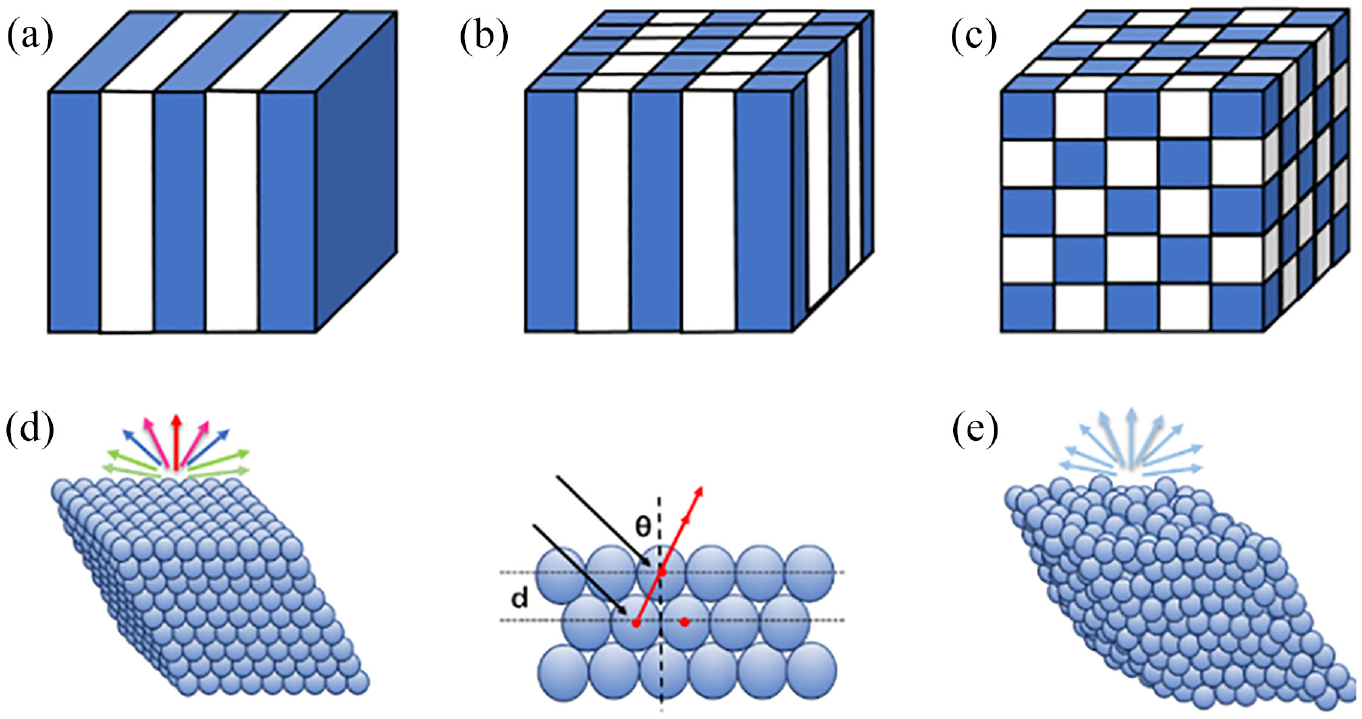
Schemati of the structure of PCs and the mechanism of their color generation. (a) 1D PCs, (b) 2D PCs, and (c) 3D PCs. (d) Mechanical diagram of structural color generation of 3D PCs. (e) Mechanical diagram of structural color generation of amorphous PCs.
Structural Color of the PCs
The structural color of PCs can be tuned according to Bragg’s diffraction law 19 and Sneer’s law of refraction,22,23 which is as follows:

where λ is the wavelength, d is the lattice spacing, m is the diffraction level, ns is the refractive index (RI), and θ1 is the angle of incident light. When photons propagate through PCs, the light waves form a photon energy band structure due to the Bragg scattering modulation of the light waves at different media junctions, leading to photon energy gaps between the bands (see Figure 1(d) and (e)). When the photons fall completely between the photonic energy gaps, they will be reflected in the PCs and forbidden. When the forbidden photonic band is located in the visible range (380–780 nm), the color can be observed by the naked eye. This means PCs have a wavelength select function that allows the light of a particular wavelength to pass through or prohibits it, thus revealing the color of a particular wavelength.24,25
Tunable Structural Color of PCs
Bragg’s diffraction law gives the possibility of regulating the color of PCs. As artificial PCs, the wavelength of the reflection peak can be regulated by changing the relevant parameters according to equation (1), containing the lattice constant, effective RI, the distance between the colloidal particles, the arrangement of the colloidal particles, and so on. By changing one or two parameters based on Bragg’s diffraction law, the structural color of PCs can be tuned.26,27
Influence of the Lattice Spacing on the Structural Color of PCs
According to equation (1), increasing the lattice spacing between the particles without changing other factors can increase the reflective wavelength of the PC and red-shift being observed. For example, only changing the lattice spacing by changing its volume fraction in the polymer matrix, their color changed from blue to red (red shift).28,29 Red-shift or blue-shift also can be observed when the PCs are stretched or compressed. When the lattice space decreases, a blue-shift is observed in the perpendicular stretching direction. Similar changes in structural color will be observed when the PCs are compressed. Thus, the structural color of the PCs can be adjusted by changing the stretching or compression ratio. 30 For example, the full color gamut of structural colored materials was constructed by changing their lattice space. 31
Moreover, the lattice space also changed by adjusting the environment of PCs, such as pH, temperature, humidity, ionic strength, and so on. Responsive PCs change their structural color with external stimulation. 28 For example, Zhu and colleagues prepared hollow microcapsules with a periodic shell layer structure whose structural color can be tuned by pH. 32 These PC microspheres can be used as drug carriers that will release the encapsulated drug by external stimulation. Thus, the obtained PCs showed controllable drug release or sensing under different pH conditions. Li et al. 33 prepared poly (N-isopropyl acrylamide) (PNIPAM)-based temperature-sensitive PCs. When the temperature is increased, the volume of the PNIPAM hydrogel system shrinks, resulting in a decrement in the distance between silica microspheres, and more specifically, blue-shifts accordingly when the temperature increases from 24°C to 34°C. When the temperature decreases, the PNIPAM changes to a swollen state, and red-shift is observed. Magnetic strength also can be used as a stimulus to prepare responsive PCs. For example, hydrophilic and size-controllable Fe3O4@poly(4-styrene sulfonic acid-co-maleic acid) (PSSMA)@SiO2 magnetic response PCs were fabricated as the assembly units of the structural color hydrogels by orderly packing of core–shell colloidal nanocrystal clusters via a two-step facile synthesis approach. 34 The dynamic ordering of magnetic nanoparticles (NPs) of PCs was non-contact, controlled by the direction and strength of the external magnetic field. Thus, the lattice constants of PC structures fixed at different orientations and applied magnetic field strengths change differently upon stretching, resulting in different structural color changes. Specifically, as the magnetic field strength gradually decreases, the reflection peaks of the gel are red-shifted, and the color of the gel changes accordingly due to an increase in the center-to-center distance of two adjacent NPs. Therefore, colored hydrogels with super elastic magnetic structures are of high value in super elastic identification anti-counterfeiting systems and also play an important role in biomedical applications, pharmaceutical packaging, and anti-counterfeit labels.
In addition, the colors of PCs can be adjusted by electric field using ionized polymers or NPs. Guo et al. found the double-sided structural color of Fe3O4@SiO2 NPs. The obtained PCs showed different structural colors on each surface side by applying an external electric field using the double-sided display device. By changing the voltage and distance between particles, the structural color of PCs changes. 35 Atobe and colleagues prepared polyaniline@poly(methyl methacrylate) (PANI@PMMA) core–shell NPs to construct PCs. 36 Due to the excellent conductivity of PANI, the structural color of the obtained PCs can be controlled by the electric field. Thus, the obtained PCs showed electrochromic and electric field responsive properties.
Influence of the Particle Size on the Structural Color of PCs
Based on the Bragg diffraction law, the structural color changes with the lattice spacing (d). 37 When the NPs are closely stacked, the lattice space is the diameter of the NPs. Thus, the structural color of PCs can be adjusted by changing the size of the NPs. For example, PCs with blue, green, and red colors can be obtained using silica NPs with different size ranges (150–300 nm). 38
Influence of RI on the Structural Color of PCs
The structural color of the PCs can also be regulated by changing the RI according to Bragg’s diffraction law (equation (1)). RI is the ratio of the speed of light propagation in a vacuum to the speed of light propagation in that medium. The higher the RI of a material, the greater the ability of the materials to refract incident light. Different materials have different RIs. For example, titanium dioxide (TiO2), 39 ferroferric oxide (Fe3O4), 40 zinc sulfide (ZnS), 41 and polydopamine (PDA) 42 NPs have a high RI. 43 Polymers (e.g. polystyrene (PS), polyacrylate (PA)) and SiO2 44 have a relatively lower RI,44,45 as shown in Table 1.
Summarization of RIs for nanoparticles commonly used for PC construction.
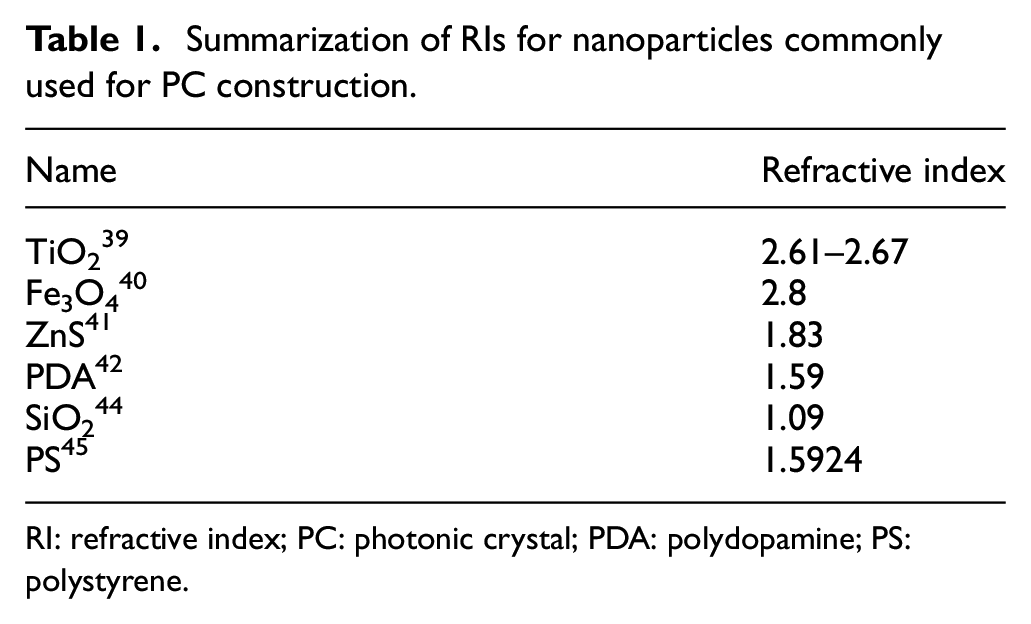
RI: refractive index; PC: photonic crystal; PDA: polydopamine; PS: polystyrene.
The RI of the materials consisting of more than two components can be represented by the effective RI (

where
The Color Saturation of the PCs
Saturation refers to the vividness of a color, also known as color purity. The structural color of PCs can be tuned by adjusting parameters containing the lattice spacing, NP size, and RI. But the color saturation depends more on the background color of the substrates, the mono-dispensability of the NPs, the incorporation of black particles, and so on. 50 Using the dark-colored substrate or adding black NPs can reduce the non-correlated scattering and improve the color saturation of PCs. That is why most of the substrates used to construct PCs are black colored. 51 Moreover, black NPs are usually incorporated into PCs to increase color saturation, for example, carbon black NPs (CB), 52 graphene, 53 PDA, 54 polypore (PPY), 55 polyaniline, and so on. 36 Dufresne and colleagues added CB to the isotropic PC films, the saturation of which increased accordingly. 56 Takeoka et al. added silver NPs to TiO2-based PCs to reduce their reflectivity and increase color saturation. 57 Shi et al. 54 used the black-colored dopamine to modify fabric to increase the color saturation. The obtained fabrics showed bright colors, good adhesion, and mechanical strength. Yang et al. 55 prepared PPY-coated PS NPs to construct PCs. Due to the dark color of PPY, PCs with high contrast can be obtained. Increasing the mono-dispensability of the particles can also increase the color saturation of PCs. According to Bragg’s diffraction given by equation (1), the reflection wavelength changes with the size of particles. The more uniform the NPs in size, the nearer the reflection wavelength and the greater the saturation of the color of PCs. 58 Zhu et al. designed metallosupramolecular polymer-based photonic elastomers (PEs) with tenable mechanical strength, angle-independent structural color, and self-healing capability. By strictly controlling the reaction conditions, nano-spheres with uniform size were obtained, resulting in a PC with a bright color similar to that of a chameleon. At the same time, the dynamic and reversible metal coordination made the elastomers have chameleon-skin-like mechanochromic capability and self-healing properties. 59
Methods for the PC-Coated Fabric Construction
The surface of the textile or fabrics is not flat because they are composed of warp and weft yarns, making it challenging to construct PCs. Moreover, the structures of the fabrics may reflect light, which may influence the colors of PCs. Therefore, standard methods for PC construction on smooth surfaces may not be suitable for constructing PCs on fabrics.60,61 In this regard, researchers have made great efforts to explore methods to construct PC-coated fabrics. Self-assembly, external field-induced assembly, printing, spray coating, and dip-coating methods have been used to construct PCs.
Self-Assembly Method
Derivation of the self-assembly method to construct PCs is from inter-particle interactions, such as capillary force, gravity, centrifugal force, and so on.62,63 It is necessary to ensure that a particular interaction exists between the particles. The balance of the electrostatic repulsion and long-range driving force between the particles drives them to form appropriate structures to construct PC textiles or fabrics. 64 According to the driving force applied for the self-assembly method, it can be divided into the deposition method, 65 interface-gravity joint assembly method, 66 electrostatic self-assembly method, 67 and field (containing electrical field, 68 magnetic field, 69 shear, 70 and so on) assisted assembly.
Gravity Sedimentation Method
The gravitational sedimentation method entails assembling uniformly sized particles to a particular container under gravity at specific temperature and humidity conditions, forming long-range or short-range ordered PCs in solution. 71 For example, Shao and colleagues assembled inorganic microspheres of SiO2 on polyester (PES) or silk fabrics by a gravity sedimentation method. 72 By controlling the concentration and height of the particle solution, PCs can be constructed on the fabrics. The brightness of the obtained PCs changed with the fabrics’ structure, the fabric surface’s flatness, and the fibers’ arrangement.
Vertical Deposition Method
The vertical deposition method assembles the particles under solvent volatilization is driving to form PCs. The fabrics are immersed in a suspension of particles, and PCs are formed after the evaporation of the solvent. The evaporation rate of the particles, temperature, and humidity can control the structure of PCs. The vertical deposition method is easy to operate and low cost, so it is commonly used to construct PCs on both sides of the fabrics. For example, using this method, Shao et al. used poly (styrene-methacrylic acid) [P (St-MAA)] microspheres to construct PCs on fabrics. PCs with different colors can be obtained with the size of the particles ranging from 190 to 305 nm. 73
Interface-Gravity Joint Self-Assembly Method
Interface-gravity joint self-assembly is the combination of interfacial self-assembly and gravitational sedimentation self-assembly. Interfacial self-assembly is carried out on the air–liquid interface, and gravitational sedimentation self-assembly takes place on the liquid–solid interface at the same time. Compared with the gravity sedimentation method, it is timesaving. The duration for assembly process only takes 1.5–2.5 h. The influence of humidity on the morphology of the PCs was subtle. 66 Thus, it is more suitable for industrial production.
Electric Field-Assisted Self-Assembly Method
Electric field-assisted self-assembly is assembling the microspheres or NPs under the assistance of an electric field to form a PC on the textiles or fabrics. It requires the particles primitive to be charged. For example, Jin and colleagues assembled charged N-isopropyl acrylamide hydrogel colloidal microspheres on CFs by tuning the electric field. 68 This method is suitable for assembling the materials under parallel plate electric fields and can be used under high voltage electric fields containing electrostatic spinning. Brightly colored PC-coated fibers can be obtained by controlling the voltage of electrostatic spinning, the concentration of the spinning solution, the shape of the receiving device, and so on. 74
Magnetic Field-Assisted Self-Assembly Method
Magnetic field-assisted self-assembly is assembling the microspheres or NPs under the assistance of a magnetic field to form PCs on the textiles or fabrics. Magnetic field-assisted assembly requires the microspheres or NPs to be magnetic, 75 for example, using Fe3O4 or core–shell structured Fe3O4 particles. 69 Hu et al. 76 assembled two different particle-sized carbon-coated magnetic particles into PCs with the assistance of a magnetic field. The color of the PCs can be adjusted by modulating the magnetic field strength, direction, and so on. 77 Due to the uniform arrangement of magnetic NPs, the obtained PCs usually showed angle-dependent color.
Shear-Induced Self-Assembly Method
Shear-induced self-assembly assembles the NPs under a shear flow field to construct PCs. Yin and colleagues assembled pre-crystallized liquid colloidal crystals (LCCs) by shear-induced methods to produce large-area PCs on flexible fabrics. 70 Baumberg and colleagues used bending-induced oscillatory shear to assist the assembly of PS-poly(methyl-methacrylate)-polyethylene acrylate (PS-PMMA-PEA) core–shell spheres in preparing PCs. 78 PCs prepared by this method are well-ordered and can be prepared continuously. 79 However, the preparation process needs specific equipment, so it is expensive.
Printing Method
The printing method is a patterning method that enables the direct and efficient distribution of materials to the desired location, enabling the rapid and straightforward preparation of PCs. It also can be used to prepare patterned PCs on textiles and fabrics. The printing methods contain inkjet, screen, and digital printing methods.
Screen-Printing Method
The screen-printing method is a method in which a printed paste is uniformly coated onto a substrate using a screen-printing process. The colloidal microspheres or NPs within the paste assemble on the substrate to form a PC pattern after drying. Tang and colleagues used a rapid screen-printing method to construct PCs on PES fabrics. 80 The obtained PC-coated fabrics showed stable, vibrant, and iridescence-free structural colors. The merit of this method is that it is fast, high efficiency, and environmentally friendly.
Digital Printing Method
The digital printing method is printing the prepared microsphere or NPs assembly solution into the ink cartridge of the digital printing device, and the droplets are sprayed onto the surface of the substrates (e.g. textiles, fabrics, and so on) through computer control to form a corresponding pattern. Ding et al. 62 used silica microspheres as the basic structural substrate to prepare PCs with angle-dependent color by a digital printing method. However, due to the “coffee ring” effect, the microspheres formed a disorganized structure at the edges of the PC patterns, resulting in heterogeneous colors. Liu et al. 81 used form amide as a co-solvent to prepare colloidal inks to suppress the “coffee ring” effect for using digital printing to prepare PC patterns. Due to the slow evaporation rate of form amide, the colors of the PCs were bright. Song et al. proposed a simple full-color structural color inkjet printing strategy to construct PCs. 82 In situ drop-by-drop printing of common single transparent polymer inks was used to create intercooler-colored dome-shaped microstructures, enabling a whole gamut of structural colors on the total internal reflection (TIR) interfering coloring principle. Uniform structural color films in red, green, and blue can be prepared by controlling the number of ink drops. Compared with the screen-printing method, which requires engraving before printing, the digital printing method can enhance the quality of PC patterns. The advantages of this method are high efficiency and low cost, and it can be used on different substrates (e.g. cotton fabrics, PES fabrics, silk fabrics, and so on).
Coating Method
Spray Coating Method
The spray coating method is a method to prepare PCs on fabrics using a spraying machine (spray gun, atomized deposition system, and so on). Microspheres or NP suspensions are used as the raw materials. The evaporation rate of the dispersion solvent, spray temperature, the distance between the equipment and receivers, gap pressure, and so on can control the arrangement of the NPs. It is usually used to prepare APCs because this method breaks the tendency of the microsphere to crystallize and obtain short-range ordered long-range amorphous structures. Chen and colleagues successfully constructed full-spectrum PCs using the spray coating method. 83 PCs with different patterns can be obtained by using a mask template. The spray coating method effectively improves the fastness of the structured colors on the fabrics. The obtained PC-coated fabrics can repeatedly withstand standard laundry, fast laundry, and even supersonic vibration without significant fading. This method is fast, easy to operate, and suitable for large-area PC construction. This is very important for PC-colored fabrics’ application in the apparel industries. 84
Spin Coating Method
The spin coating method puts the coating solution (microspheres or NPs suspension) in the center of the rotary table during spin coating and it is successfully deposited on the substrate by centripetal forces and evaporation. Ummer et al. 30 prepared colored composite films using BiFeO3/polyvinylidene fluoride-trifluoroethylene by a two-step spin-coating technique. By adjusting the materials of the spin coating substrate, the spin coating speed, evaporation rate of the solvent, and volume fractions of BiFeO3, different colored PC-coated fabrics can be obtained. However, this method requires a high-viscosity emulsion suspension, which is time-consuming for the dispersion of the suspensions and unsuitable for large-scale PC construction.
Scraping Method
The scraping method constructs PCs by acting with the lateral force of a squeegee. Yang and Jiang 85 have used this method to prepare 3D PCs. The viscosity of the colloidal suspension and the coating speed controlled the thickness of the shear-aligned PCs. However, the high concentration of suspension solution preparation is time-consuming and not easy to realize. Thus, this method is not widely used.
Generally, the commonly used methods for constructing PCs on fabrics or textiles are summarized in this section. Details of the advantages and disadvantages of various methods have been summarized in Table 2. Which method is the best depends on their actual application. We can judge from the conditions and the actual target to determine which method is more suitable, according to Table 2.
Summary of the advantages and disadvantages of methods for constructing PC-coated fabrics.
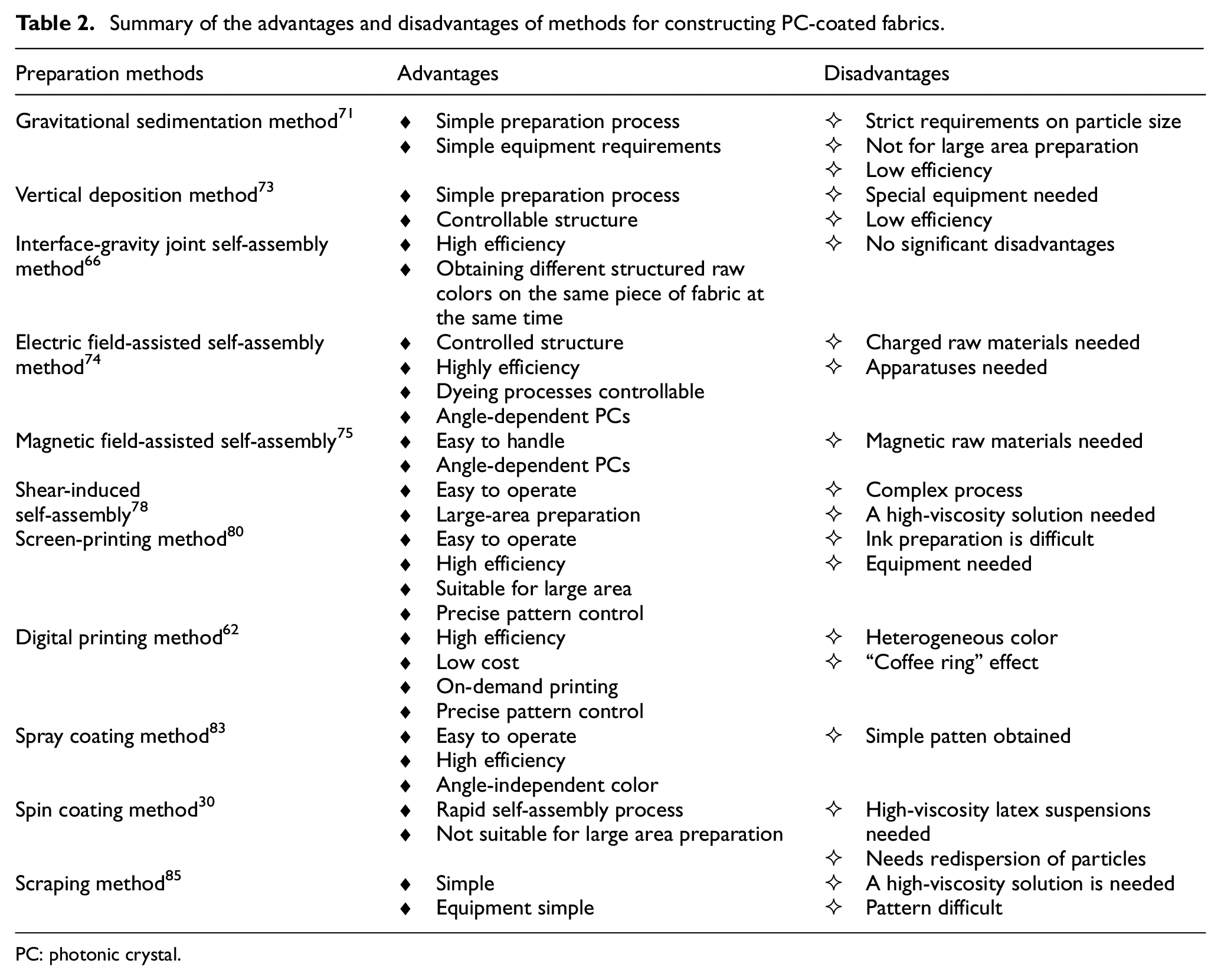
PC: photonic crystal.
Stability and Color Fastness of PC-Coated Fabrics
Fabrics or textiles are subject to sun, rain, washing, ironing, perspiration, rubbing, and chemicals, which may cause fading or peeling off in daily use (as shown in Figure 2). Therefore, it is essential to prepare stable and fade-resistant fabrics. The stability of the PCs on the fabrics involves mechanical and thermal stability. The fabrics’ color fastness can characterize the fabrics’ fading properties. Color fastness refers to the resistance of textile colors to various effects during processing and use and is one of the critical indicators of textile quality inspection. The color fastness is expressed in terms of color levels. The higher the color fastness level, the stronger the color fastness. Except for color fastness, the stability of the coatings on the fabrics is also important. If the stability of the PC coatings is not enough, during their daily use, PC coatings will peel off from the substrates. While the surface of the fabrics is usually uneven, rough, raw, and grainy, the interaction between PCs and the fabrics needs to be greater. In this case, the stability and color fastness level of PCs are not satisfactory, limiting the application of PCs in fabric coloring. Therefore, constructing PC-coated fabrics with good stability and high color fastness is still challenging in this field.
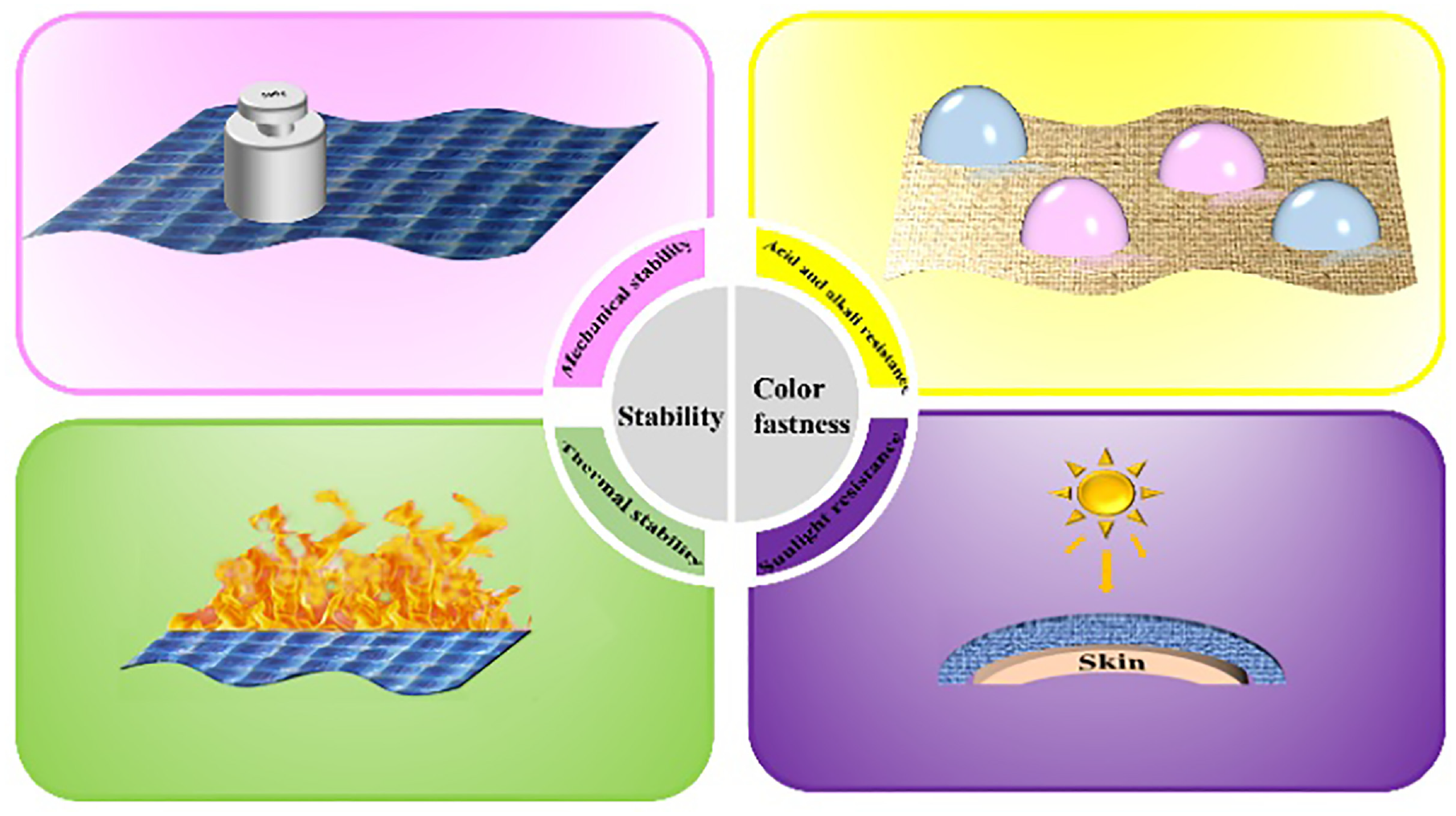
Schematic diagram of stability and color fastness between fabric and PCs.
Stability of PC-Coated Fabrics
PCs are mostly coated on the surface of fabrics or textiles by self-assembly, coating, printing, and other technologies. However, in the daily use of fabrics, they are subjected to external forces (e.g. rubbing, washing, friction, and so on) or under specific environments (e.g. high temperature), which may result in the peeling off the coating. 54 Thus, the methods used to improve the mechanical and thermal stability of PCs on the fabrics were summarized.
Mechanical Stability
The mechanical stability of PCs refers to the fading or color retention caused by external forces (e.g. washing, bending, and rubbing). It can be estimated by washing fastness and rubbing fastness. Increasing the wash and rub resistance increases the interaction between the PCs and the fabrics. The wash-resistant color fastness of textiles represents the ability of a textile to retain its colors after washing. 86 Rubbing fastness refers to the ability of the color of textiles to resist friction, and the assessment is the ability of textiles to maintain color after rubbing or bending. 10 It also refers to the mechanical stability of PCs, which is regulated by enhanced chemical interactions and hot-pressure-assisted assembly techniques. Under external friction, the PCs on the fabric easily fall off, resulting in the fabric’s poor wash or rubbing fastness. 87 Thus, improving the rubbing fastness, especially wet rubbing fastness, is still a challenge. 88 It is also essential to prevent cracks in the formation of structural color films.
Generally, there are four strategies to increase the mechanical stability of PCs on fabrics (as shown in Figure 3): (1) improving the interaction between coatings and fabrics through the structural design of colloidal particles, (2) introducing colloidal particles or polymers with a low glass transition temperature (Tg) to improve the flexibility of PC coatings, (3) encapsulating the PC-coated fabrics from outside after the PCs were constructed, and (4) preparing PCs with embeded fibers in situ.
1. Improving the interaction.
The stability of structural colored fabrics can be improved by increasing the interaction between PC coatings and the fabrics, such as constructing polar interactions, hydrogen bonds and covalent bonds, and so on. 89
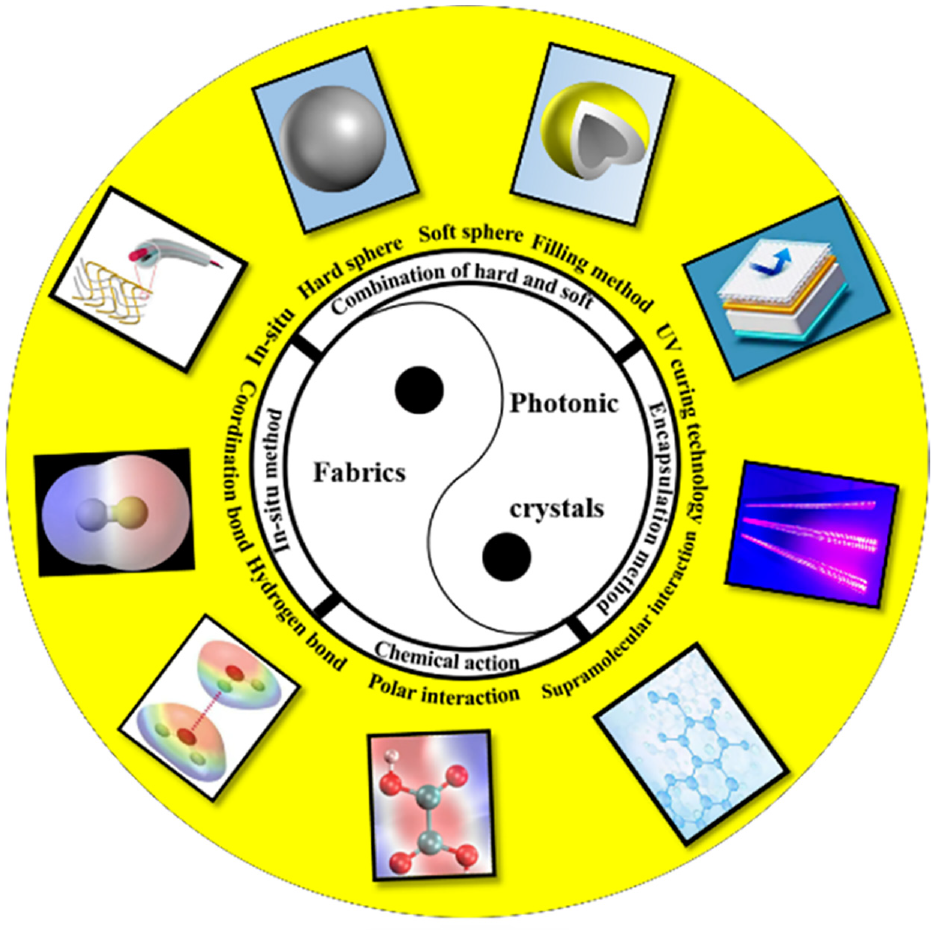
Polar Interactions
Improving the polar interaction between PCs and fabrics comprises adding polar materials or increasing the polarity of the raw materials for PC construction. The often-used materials are PES, PA, and polyurethane (PU). For example, Shao and colleagues prepared core–shell NPs of PS@ poly(methyl methacrylate-butyl acrylate) [PS@P(MMA-BA)] from two polar substances for mechanical and solvent discoloration sensors because methyl methacrylate (MMA) has a robust polar interaction with butyl acrylate (BA). 25 The PCs remain firmly on the substrate even under continuous 6 N external load application. Thus, multi-functional soft PC films (SPCFs) can retain their original structural color after 20 cycles of stretching. The mechanical color change effect of SPCFs under stretching is due to the reduction of lattice spacing during stretching, which leads to the blue shift of structural color, so SPCFs have good mechanical color change properties and friction resistance. Tang et al. prepared structured colored films using monodispersed polysulfide (PSF) colloidal microspheres. PA was used to increase the interfacial adhesion of PC coatings. The obtained structural colored films showed good mechanical stability and flexibility. In addition, the integrity of the PSF microspheres at high temperatures allowed the composite structure to be vividly printed on the fabric after hot pressing, resulting in excellent mechanical strength. It provides an innovative strategy for developing aesthetically pleasing, long-lasting colors, potentially green, with safe packaging, and decorative coatings. 90
Hydrogen Bonds
Constructing hydrogen bonds between PC coatings and fabrics uses amino-group, hydroxyl-group, or carboxyl-group materials, such as PDA, PU, and polyacrylic acid (PAA). For example, Zhang et al. prepared colloidal particles of PS@PDA with a core–shell structure to construct PCs. PS@PDA NPs were sprayed on the chitosan surface to prepare friction-resistant PC coatings with good adhesion.
91
Zeng et al.
92
gave the fabrics a non-iridescent structural color by spraying poly (styrene-methyl methacrylate-acrylic acid) colloidal microspheres and PA. Adding PA introduced more –COOH, which improved the adhesion between particles, improved washing and abrasion resistance, and the excellent stability effectively prevented color fading in a wet environment. In addition to this, in terms of improving rubbing color fastness, Han et al.
93
proposed an alternative strategy for fabric coloring based on the scattering of Cu2O single crystal spheres. Disordered thin layers of Cu2O (
Covalent Bonds
Constructing covalent bonds is possible to increase the mechanical stability of PC-coated fabrics. For example, PDA used to adhere to the surface of organic or inorganic materials can also react further with many other compounds or reactive groups and form strong chemical bonds, thus providing a powerful platform for secondary reactions. 54 After incorporating PDA, PC coatings and cotton fabric are closely bonded. Covalent bonds form using the reaction between the catechol groups on PDA and carboxyl groups on poly (styrene-methacrylate) [P-(St-MMA-AA)] latex. Zhang et al. selected bosonic acid cross-linked end-hydroxylase polydimethylsiloxane (PDMS) material as the substrate. They co-assembled it with silica NPs to obtain PC elastomer using solvent volatilization. Due to the flexibility of polyborosiloxane elastomers and the weak reversible interactions (coordination bonds, hydrogen bonds, reversible covalent bonds), rapid reconfiguration can occur even when the material is damaged, resulting in self-healing properties. An effective way to reduce cracking is to improve the interaction between the colored structural film and the substrate. Recently, we have designed a dual network between the PC coating and the fabrics by introducing hydrogen bonds and dynamic cross-linking to construct PC-coated fabrics with wash and rub resistance. Specifically, monodisperse SiO2 NPs, PDMS, and fabrics were modified with 2-formylphenylboronic acid to form the first network through dynamic cross-linking. A second network was constructed by adding tannic acid to form a hydrogen bond. The wash and rub resistance of PC-coated fabrics was indeed improved due to the formation of double networks. 94 To reduce cracks and improve the rubbing color fastness of PCs, Zheng et al. 95 introduced intermolecular force covalent bonds between the structural color PCs and the substrate to increase their stability. Poly(glycidyl methacrylate-co-HFBMA)-g-polyethylene glycol methyl ether methacrylate [P(GMA-co-HFBMA)-g-PEGMA] containing epoxy groups and hydrophobic fluorocarbon chains were synthesized, which were added to the silica PCs to form a covalent bond; the rubbing fastness and washing fastness of the PCs increased. 95 So the ability of covalent bonding to improve the stability between PC fabrics must be addressed.
2. Materials with low Tg incorporated.
Introducing colloidal particles or polymers with a low Tg can improve the flexibility of PC coatings, 96 for example, using “soft sphere” 97 colloidal particles to produce structuring chromogenic fabric. A “soft sphere” is a sphere whose Tg is lower than the usual temperature of PCs. Otherwise, the particle is a “hard sphere.” Based on this theory, PDMS, poly (butyl acrylate) (PBA) and polyuria are “soft sphere.” Particles with hard-core and soft-shell structures or hard particles embed into the soft materials to construct PCs. For example, Zhang and colleagues prepared PS@PBA-PAA NPs with a “hard core–soft shell” structure to construct PC-coated fabrics, and the resulting PC coating showed good stability when the fabrics were stretched or washed. 87 Zhang et al. assembled PS@PBA-PAA with a “hard core–soft shell” structure onto the surface of a single PES fiber. The obtained PC-coated fibers had good stability when bending, knotting, or rubbing. 98 Wang et al. 99 also used PS@PBA-PAA “soft-shell–hard-core” nano-spheres to enhance the interaction between the PCs and the substrate. Zhang and colleagues applied the “softball” theory to poly (butyl methacrylate-co-methyl methacrylate-co-butyl acrylate-co-diacetate acrylamide) (PBMBD) PCs by synthesizing PBA-poly (methyl methacrylate-BA) colloidal particles. 100 As heating proceeds, the gap between PBMBD NPs shrinks due to mutual deformation between the soft PBMBD particles, essentially adjusting the corresponding structural color by varying the particle size of the PBMBD particles. On making the heat-assisted temperature slightly higher than the Tg of the PBMBD, PCs with good homogeneity and brightness were constructed. The PC films exhibited excellent tensile properties with a yield strength of up to 8.9 MPa. In addition, the change in toughness properties after 1000 bending cycles showed that the film has good toughness and color stability and can be used as PC paper. Li and colleagues synthesized SiO2@P-(St-BA-AA) microspheres by emulsion polymerization. 101 After solvent evaporation, the spheres formed tightly packed ordered structures on black PES fabrics. The fabrics coated by PCs showed suitable washable and moisture permeability. Shao and colleagues prepared PCs by co-deposition self-assembly of SiO2 and poly(methylmethacrylate-butylacrylate)[(P(MMA-BA)] on fabric substrates. 102 “Soft” P(MMA-BA) copolymer particles fill in the voids of the SiO2 microspheres and endow the PCs with good mechanical stability. The polymer spheres act as a physical linkage point, improving the mechanical strength of the PCs and giving the PCs good color saturation and a certain level of friction resistance.
3. Encapsulating the PC-coated fabrics from outside.
Encapsulating the PC-coated fabrics from the outside is constructing coatings with good adhesive after the PC coatings were constructed to increase their stability. 103 The adhesive materials acted as viscous “glue” between the two interfaces and encapsulated the two interfaces, thereby improving the mechanical strength and stiffness of PCs on the fabrics. 104 Such methods include pre-coating, ultraviolet (UV) curing technology, and so on.
Pre-Coating Method
The pre-coating method places a tacky coating between the substrate and the PC layer, thereby enhancing the stability of the PCs. 105 Liu et al. used PS microsphere emulsions to obtain iridescent structural colors on the surface of silk fabrics. They enhanced the fastness of the resulting structural colors by casting a layer of silk protein solution on the surface of the self-assembled structural color silk fabrics. 106 Shao and colleagues used waterborne PU (wPU) to enhance the stability of PCs on the fabrics. 107 Due to the high surface tension property of wPU, it solidified on the surface of the PC-coated fabrics, increasing the coatings’ stability. 70 Ge and colleagues sprayed coated SiO2 NPs with polyvinyl alcohol (PVA) using high boiling point solvents to form PCs. 108 After the evaporation of the solvent, PVA was encapsulated on the SiO2 surface to increase the stability of the PCs.
UV Curing Technology
UV curing technology is a new technology that enables rapid curing and polymerization of substrate surfaces to form films. 109 Liu et al. 110 prepared poly(hydroxyethyl acrylate)@poly(styrene-methacrylate) [PHEA@P(St-MAA)] NPs to construct PCs on the fabric substrates. The obtained fabrics exhibit excellent tensile strength, bond strength, friction, and washing resistance with the help of PHEA. Wang and colleagues assembled PCs: first, acrylamide (AAm), cross-linker, and photo-initiator were filtered for polymerization under UV irradiation to construct the PCs. 111 After polymerization, the colloidal microspheres were encapsulated in the polymer to form a continuous structure. Thus, the mechanical strength and wash resistance of PCs were significantly improved.
4. Preparation of PCs embeds fibers in situ.
In situ synthesis of nano-functional particles based on textile materials is a promising process route, and the ideal recyclable nanocomposites can be prepared by combining different organic–inorganic materials. For example, Emam et al. 112 used the in situ incorporation technique for coloration and acquired excellent antibacterial properties for viscose fibers by silver NPs (AgNPs). AgNPs were prepared in situ and incorporated in the viscose matrix directly without using stabilizing agents. Depending on the silver concentration, yellowish-colored fibers with different shades were produced. Good fastness properties were obtained without using any cross-linker or binder. The colored fibers had excellent antibacterial activities against Escherichia coli, even after 20 washes. Su et al. 113 synthesized Cu2O in situ using flexible cotton fabric as a substrate. Cu2O grew uniformly on the cotton fiber and was wrapped with nanocellulose. Finally, the stability of the material was verified by five cycles of mechanical property tests to verify the durability of the materials. d’Água et al. 114 developed a successful method for the in situ growth of ZnO NPs in textiles. The results showed that the in situ synthesis combined with the sol–gel method promotes uniform and dense adsorption of NPs inside and on the surface of the fabrics, which can lead to stronger connections between fabrics and NPs, mass production, and fabric finishing with higher washing durability.
Thermal Stability
Fabrics used daily used fabrics are usually exposed to normal temperatures and pressure, but some unique fabrics (e.g. protective clothing worn by firefighters, smelter work clothes, and so on) must resist high temperatures. 115 Therefore, improving the heat resistance of the fabric is urgently needed to improve the thermal stability of PCs. 116 Fabrics used for special applications include aramid, glass, carbon, polyimide, and silicon carbide (SiC) fibers. However, the thermal stability of these fibers is not very high, and some of the original fabrics have color, increasing the difficulty in fabricating PC coatings. Researchers have suggested refilling the cavity with another polymer to improve the stability of the material,49,117 for example, the introduction of thermally stable NPs as a coating on the surface of the fibers. Specific examples are the loading of ZnO onto an organic–inorganic hybrid siloxane polymer film that significantly modified a decomposition pathway of the coating, which significantly enhanced the thermal stability of the PES fibers. 118 Inorganic NPs (e.g. ZnO, SiO2, ZnS, and Cu2O) can be coated on fibers to improve their thermal stability because they are more thermally stable. Using them to construct PCs not only improved their thermal stability but also eliminated the process of dyeing the fabric with organic dyes. However, due to the unique weave of special fabrics and the high crystalline surface, it is still challenging to construct PCs on them. We have tried to construct PC coatings on yellow-colored aramid fabrics. With the help of the PC coatings, the fabrics showed bright colors and good thermal stability. However, the stability of the PC-coated fabrics was not satisfactory. If we can increase their stability and endow them with fire retardancy, they will be more suitable for application in fire alarms or fire suits. 119
Color Fastness of PC-Coated Fabrics
The use environment of fabrics inevitably involves complex external environments, such as acidic and alkaline conditions, UV light, sunlight exposure, and so on. Therefore, increasing the resistance of the fastness of fabrics to acid, alkali, UV light, sunlight, and so on, is very important. Generally, PCs are constructed from colloid particles. If the particles are stable under acid, alkali, and UV light, their fastness resistance will be much better than that of chemical dyes. 120 The following section summarizes the methods of adjusting the color fastness of PC-coated fabrics.
Color Fastness Under Acids and Bases Condition
Fabrics or textiles are usually exposed to different conditions, which may damage them. These conditions include chemical substances (e.g. acids, alkalis, and oils) and physical effects (such as heat or sunlight). Therefore, it is necessary to strengthen textiles that can withstand these properties. For example, Chai et al. used an interfacial gravity self-assembly method to prepare PCs on PES fabric and studied the acid and alkali resistance of the fabrics. The obtained PC-coated fabrics showed a bright and uniform color using SiO2 and P(St-MAA) as the raw materials. 121 There were many hydroxyl groups on SiO2, which was insoluble to solvent. When P (St-MAA) was under strong acid (pH = 2), polyacrylic acid was –COOH. However, when the pH of the environment changed (pH = 10), the existence of polyacrylic acid was –COO-. The electrostatic repulsion and hydrogen bonding interactions determined the interaction between SiO2 and P(St-MAA). When the pH was between 4 and 8, carboxyl groups’ ionization increased, so the electrostatic repulsion between P(St-MAA) microspheres became stronger. Under the combined effect of electrostatic repulsion and hydrogen bonding, the P(St-MAA) microspheres may be in thermodynamic equilibrium to maintain a stable stacking structure with little change in relative structural color. When the pH increased to 10, the electrostatic repulsion was more substantial than the hydrogen bonding interaction because the carboxyl ionization increased. Thus, the thermodynamic equilibrium state of the P(St-MAA) microspheres was broken and caused the P(St-MAA) microspheres to move away from each other. The arrangement of P(St-MAA) microspheres became loose and defective. When the pH of the environment increased to 12, most P(St-MAA) microspheres separated from the PCs to form disordered structures; in addition, the color of which disappeared. Thus, the color fastness of the fabrics under different pH conditions was different.
UV Light Fastness
Most fibers or fabrics are composed of polymers that are not very stable under UV light. The color of the fabrics usually uses pigment dyes, which may deteriorate when exposed to UV light, and functional textiles with UV protection are essential for human health. However, functional modification of textiles usually uses chemical cross-linking agents. 122 Because the structural characteristics of organic dyes, which undergo electron leap under UV irradiation, are susceptible to degradation and oxidation, and prone to fading, it is therefore not suitable for exposure to sunlight for an extended period. 123 So it is necessary to rely on a chemical cross-linking agent to complete the polymer seal dye-loaded pigment. Because the color of PCs is structural color, it is more stable to UV light than chemical dyes. Generally, if the structure of PCs is not destroyed, the colors of PCs will not fade. In addition, the particles used to fabricate PCs are usually inorganic or polymers with better anti-UV capability than chemical dyes. Due to the band gap of the PCs, it may also prevent light with unique wavelengths from passing through. 124 So if PCs, which are inherently UV-resistant, are combined with UV-resistant substances, excellent UV-resistance can be obtained. For example, Shi et al. fabricated PCs with excellent UV protection by preparing building block P-(St-MMA-AA)-avobenzone core–shell latex spheres. They encapsulated the UV filter avobenzone in a P-(St-MMA-AA) shell material by emulsion polymerization. The encapsulation of avobenzone in the latex spheres ensured excellent UV protection of the structural color. Thus, the color visibility and UV protection properties were good. They also found that the UV absorption effect positively correlated with the avobenzone content. This method can meet the requirements of the textile industry for dyeing performance and provide UV protection at the same time. It will provide new prospects for developing next-generation functional dyes and pigments. 125
Sunlight Fastness
Sunlight fastness measures the resistance of dyes and materials to sunlight, including UV, infrared, other visible light, and heat. 126 Since fabrics in daily use are inevitably exposed to sunlight, it is necessary to study the light fastness of PCs if they want to be coated on the fabric surface as dyes. For example, Gao et al. 127 used a modified Sober-based solvent change method to prepare homogeneous silica NP (SNP) suspensions. Self-assembling SiO2 on the fabric using natural sedimentation technology, the optical properties of SNP-coated fabrics are affected by SNP diameter, fabric structure, and fabric background color. The obtained fabrics show good light fastness. 127
Application of PC-Coated Fabrics
Construction of dyes by structural color is a possible way to generate eco-friendly colored textiles. 128 The application of PCs in the textile has helped to prepare textiles with bright colors and fastness properties. 129 Moreover, it is also possible to prepare fabrics for special fields, such as UV protection, radiation protection, antistatic, antibacterial, light or electromagnetic wave propagation, smart sensing, and so on. PC-based fabrics produced by different methods have shown the great possibility of application in clothing, smart sensors, the biomedical field, anti-counterfeiting, and so on (see Figure 4).
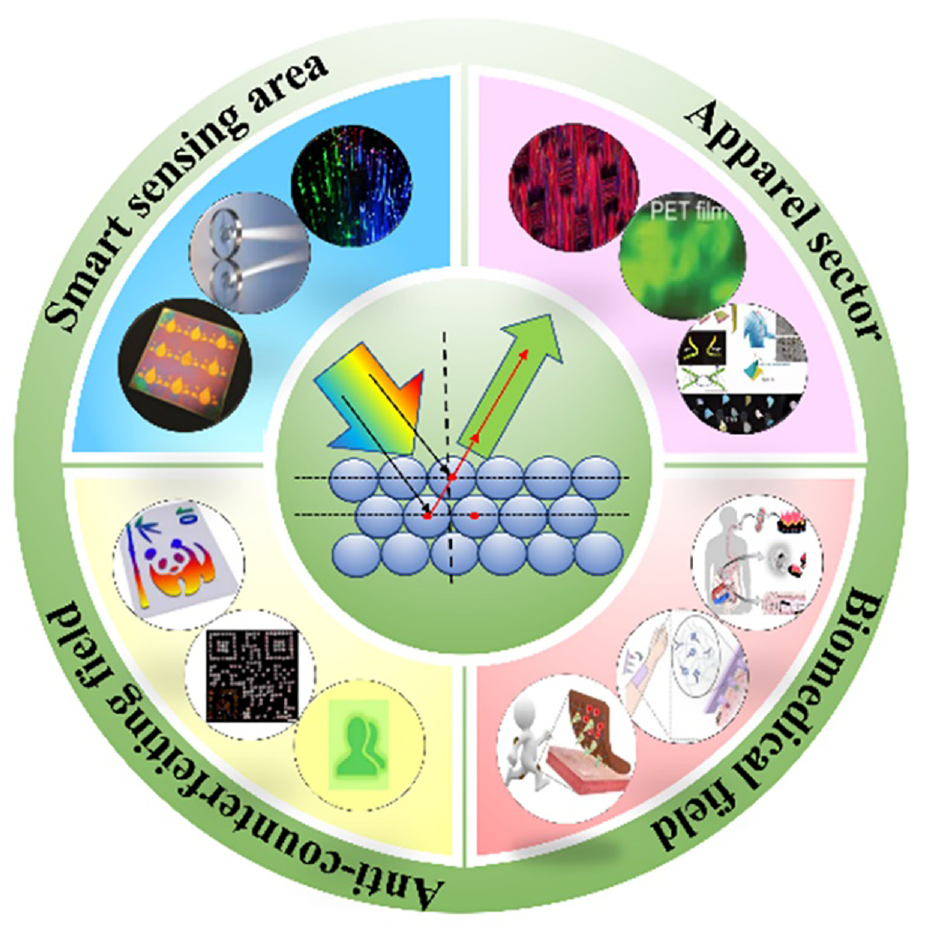
Application in Clothing
The main application for fabrics is clothing, and structured color fabrics are no exception. Due to the merit of the structural color, significant efforts have been made to construct PC-based materials in clothing. For example, Liu et al. 130 constructed P(St-MAA)-based PC on cotton fabrics by a vertical deposition method. The obtained 3D PCs showed bright colors, good thermal stability, and good hydrophobicity. 84 Wu and colleagues used different-sized Cu2O nano-spheres to construct peony, bamboo, leaf, and double carp patterns on fabric using the spray coating method. 93
However, it is still challenging to fabricate structural colored fabrics for mass production and large-scale application.131,132 This is because the construction of structural colored fabrics in the laboratory is complicated, and the requirement for equipment is still high. When structurally colored fibers are used practically, they must be woven into garment fabrics. The process of producing the fabric is quite complex as it means converting the fibers into yarn and converting the yarn into fabric, which tends to damage the surface and internal structure of the fibers. Therefore, much research is needed to understand how to best apply structural coloring directly to garment fabrics. 133 Second, the nano-coating-based coloring of textile structures could enable several functions at the same time. The development of functional and smart textiles is expected, with propoerties such as moisture sensitivity, temperature control, pressure response, filtration, and radiation resistance. 134 Third, most of this research is still in the laboratory stage and some way from industrialization. Industrial applications of the structural coloring of large-scale or high-volume large-scale other-related production equipment still need to be developed. Cotton fabric is still one of the essential raw materials in the apparel sector. If a stable PC structure can be achieved on them to produce color, it will largely advance the application of PCs in the apparel sector. Of the three major problems discussed above, researchers are currently working on all of them.
Application in the Biomedical Field
Over the decades, several types of colloidal PCs have been developed for application in the biomedical field, including microcarriers, 135 drug delivery, 136 cell research, and organs-on-a-chip. 137 PCs showed a vivid color change in biological applications, often used as chromaticity biosensors with other substances. Chromaticity biosensors are usually implemented by introducing biomolecule-responsive hydrogels into a system of PCs. For example, Asher et al. developed a new sensing motif for detecting and quantifying creatinine, an important small molecule marker of renal dysfunction. This novel sensor motif is based on smart polymerized crystalline colloidal array (IPCCA) materials, in which a 3D crystalline colloidal array (CCA) of monodisperse, highly charged PS latex particles is polymerized within lightly cross-linked polyacrylamide hydrogels. These composite hydrogels are PCs where the embedded CCA diffracts visible light and appears intensely colored. Volume phase transitions of the hydrogel cause changes in the lattice spacing of the CCA, resulting in a change in the wavelength of reflective light. 138 Therefore, this causes a shift in the peak position of the reflectance and structural color. 139 PCs can also be used as cancer sensors because the RI of cancer cells is higher than that of normal cells. 140 The contrast between cancer and normal cells can be used to develop PCs as cancer sensors. Aly and Zaky reported 1D PCs as cancer detectors. When this sensor was located in different conditions of the cells, a shift in the color of the PCs was observed. 141 Zhu and colleagues prepared hollow microcapsules with a periodic shell layer structure by emulsification, and the structural color of PC microcapsules could be effectively adjusted by pH. 32 These properties made the microcapsules able to be used as drug carriers. When they reach the target place, external stimuli release the drugs.
Application in Smart Sensors
A smart sensor with microprocessors can collect, process, and exchange information, a product of sensor integration and microprocessor combination. Compared with the general sensors, smart sensors have the following advantages: (a) high accuracy and low cost of information acquisition through software technology, (b) programming automation capability, and (c) diverse functionality.142,143
PCs can be constructed from different kinds of components, and by using sensitive components, the obtained PCs can be sensitive to local changes in the dielectric constant, pH, strain, and so on, making them suitable for sensor applications.
According to the Bragg scattering law, a change in the lattice spacing of PCs or the effective reflectance index will change their structural colors. These changes can be distinguished by the naked eye and their reflection spectrum. This means PCs are an excellent competitive candidate for a class of quantitative or semi-quantitative sensors. PCs can be used as smart sensors to design sensitive PCs. Thus, there are mainly two strategies to construct PCs: using a sensitive matrix or designing sensitive colloids.
Using Responsive Polymers
Combining a responsive polymer with a non-angle-dependent PC template results in non-angle-dependent responsive PC materials. Angle-independent responsive PCs exhibit structural colors with characteristics superior to those of angle-dependent structural colors, such as tenable saturation, wider viewing angles, and simple preparation. Combined with responsive polymers’ characteristics, angle-independent responsive PCs are usually used as sensors. For example, Ge et al. 143 infiltrated a solution of PDMS elastomer precursors into the voids of experimental templates. After heating and curing, they formed a soft layer containing PDMS and a hard layer of amorphous structured SiO2. Since hydrophilic SiO2 is less compatible with nonpolar PDMS, the distance between SiO2 in the PC film can be changed by stretching. This mechanically responsive film material can be smart windows. 144 Karrock and Gerken 145 demonstrated a pressure sensor with periodic nanostructured Bragg grating waveguide deformation and a remote optical readout on a 50 µm flexible PDMS-based membrane.The pressure sensor consists of PDMS and a flexible 1D PC plate enclosed in a chamber. The PC plate consists of a linear nanostructured PDMS film with randomly arranged TiO2 particles (with a high RI). The color of the PCs depends on the angle between the PC surface and the camera’s optical axis. The pressure change causes the deformation of the PC film and results in a change in the lattice spacing of PCs. When the color changes, the remote camera can observe the shift in the guided-mode resonance. The visibility of the guided-mode resonance is again enhanced using a cross-polarization filter. The study demonstrates the suitability of this pressure sensor for monitoring intraocular pressure to support the diagnosis and treatment of glaucoma and it has the potential to be applied as an implantable intraocular pressure (IOP) sensor. Chen and colleagues successfully realized a flexible artificial muscle with a self-sensing function using electroactive double helix artificial muscle and 2D PCs. 146 The nanoimprinting process prepared a flexible PC with a periodic cylindrical pore structure on PDMS. When the artificial muscle is designed to contract and deform under the action of an electrical signal, its deformation and strain are referral-time real-time bendable real-time sensible reactions. Importantly, the full-color gamut modulation of the structural color in the visible range is achieved within 30% of the strain range. Zhang and colleagues developed a series of novel interactive mechanical color-changing electronic textile (MET) sensors for visualizing stretchable electronics. 147 The MET sensor is based on cleverly coupling new supramolecular photonic elastomers(PEs) with layered fiber-structured conductive polyester fabrics/textile (CPT). Due to its semi-embedded structure, the MET sensor exhibits a significant negative electrical response and a simultaneous mechanical color change capability during stretching by reconstructing the conductive path and adjusting the lattice spacing of the PCs. 148 Mechanochromic photonic fiber-optic sensors consisting of PDMS and PS–polyisoprene triblock copolymers maintain over 100% repeatable stretch performance and respond to compression with predictable and reversible optical properties for use in medical textiles. 149 Niu et al. reported a self-healing photonic glass-like polymer elastomer based on the synergy of PCs and glass-like polymers. The PC structure makes the material optically functional, and photonic glass polymers have high toughness, strength, optical creep resistance, and durability. Using the synergy of PC band gap and dynamic covalent networks, photonic-like glass polymers can self-repair structural colors and visualize mechanical color change during stretching. The synthesized optical glass polymers can be used as an interactive sensor to visually monitor human movement without an external power source (see Figure 5). Zhu and colleagues presented a high RI polymer derived from S-vinyl sulfide derivatives, in which the RI changed through selective oxidation and dual responsiveness was observed when the derivatives were combined with N, N′-(dimethylamine) ethyl acrylate (DMAEA) units. The results proved that the PCs fabricated by the block copolymer showed dual effects of oxidation and pH response, owing to the oxidative-responsive property of the PVS moiety and the pH-responsive property of the DMAE moiety. The results of these investigations expanded the application of sulfur-containing polymers in PCs and realized the combination of two methods for regulating PBG based on Bragg’s law. 150 Nie et al. 151 prepared iridescent cotton fabric (ICF) with reversible multiple stimulus–responsive functions using cellulose nanocrystal (CNC) to form structural color and water content to adjust the color. Due to the responsiveness of CNC to water molecules, ICF is endowed with reversible behaviors such as anti-counterfeiting, relative humidity sensing, and moisture content detection, making ICF a smart textile that can be used in many applications as humidity sensing and moisture content detection.
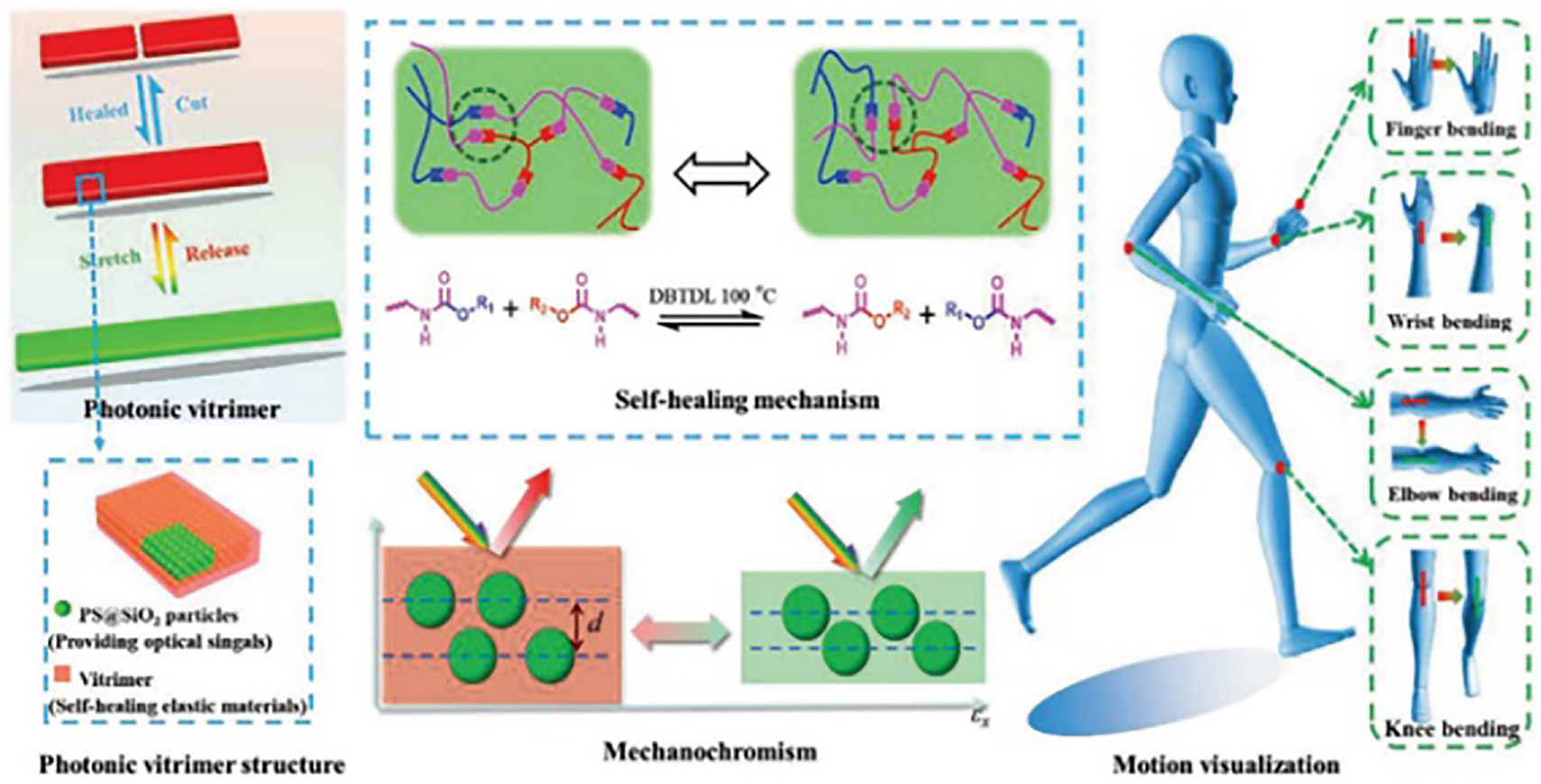
Schematic diagram of the structure of photonic-like glass polymers, mechanical chromogenic mechanism, and motion sensing. 151
Designing Sensitive Colloids
The responsiveness of PCs is very common in nature and plays a vital role in the survival of many organisms. 153 For example, chameleons can rapidly change their camouflaged skin color in response to environmental changes by actively adjusting the lattice spacing of guanine nanocrystal arrays within the iris carrier cells. This fascinating phenomenon has intrigued researchers who have explored the promising properties of PCs with their ultra-compact size, minimal analyte requirements, excellent measurement sensitivity, structural design flexibility, and integration capabilities. The unique physical properties of PCs, such as reflectivity/transmittance, give them an excellent level of sensitivity, resulting in precise detection limits. This natural phenomenon shows that it is unnecessary to add a sensitive matrix to bind to the PC, as the response of the substance can also be achieved by designing the PC as a sensitive colloid. To mimic the color change of chameleons, researchers have made great efforts. For example, Wolfbeis and colleagues prepared 3D cavities in SU-8 to create 3D PC structures. 154 The 3D PCs displayed color in the visible spectrum and could be used to detect the severity of blast exposure to assess traumatic brain injury in soldiers on the battlefield. Exposing these structures to a different pressure (410–1090 kPa), the pressure change caused the change in the lattice spacing of the PCs. The blast intensity can be visually detected, which is then accurately measured by the 3D PCs structure sensor.
In conclusion, PCs are ideally suited as sensor materials because of their microscopic color changes due to specific structural changes. They show great potential for application in this field and the advantages of their conditions.
Anti-Counterfeiting Field
Optical security plays a vital role in information security because it can be recognized by the naked eye and is difficult to imitate. Based on the unique color-generating mechanism of PCs, two kinds of anti-counterfeiting were designed. One is designing sensitive PCs or angle-independent PCs. The other is designing PCs with patterns that can be hidden and displayed under specific conditions. 8 Anti-counterfeiting is achieved by detection by the naked eye or the reflectance spectrum based on PCs. Generally, there are three strategies to realize counterfeiting: (1) changing the detection angle, (2) changing the disordered–ordered of PCs, and (3) changing the effective RI of their components.
Designing Angle-Independent PCs to Realize Counterfeiting
Angle-dependent PCs change color when the detection angle or angle of light incidence changes, which the naked eye or the camera can see. For example, Wu et al. designed a hydrophilic modified upconversion NP (M-UCNP)-integrated bilayer inverse PC film in which luminescent M-UCNPs are deposited on the surface of an optimized bilayer structure with a two-photon stopband. This structure can modulate light to produce structural colors and synergistically enhance upconversion luminescence (UCL). Since the PCs were silica nano-spheres arranged in long-range orders with angle-dependent PCs, they showed different colors at different angles to achieve the anti-counterfeiting effect. The UCL was also used to make it bright at night. The obtained film had good night vision and an all-weather anti-counterfeiting effect.
Using Disordered to Ordered State Transition to Realize Anti-Counterfeiting
PCs can be divided into two types according to the orderliness of the particle structure: short-range ordered and long-range ordered PCs. The degree of order of the particle influences the color of the PCs. Thus, changing PC color at the macroscopic level can be realized by changing the degree of order of the microstructure. For example, Li et al. 61 used a self-designed bending-induced ordering technique to transform monodisperse core-layer–shell (CIS) particles from an ordered state to a disordered state. When the mass ratio of microcapsules in PCs is 1 wt%, the orderliness of the particles in the diffraction spot disappearance film decreases, which macroscopically leads to a gradual fading of the reflected color. This means a small number of microcapsules can considerably affect the regular arrangement of the building blocks within the PC system. The prepared photochromic PC film showed unique colors under different stimulation conditions, which can be used in smart decoration and anti-counterfeiting.
Changing the Effective RI to Realize Anti-Counterfeiting
The effective RI will change the structural color based on the Bragg diffraction law (equation (2)). 155 Tuneable structural colors usually mean that lattice parameters can adjust the diffraction wavelength or PBG. For example, Ding et al. 156 reported solid-state invisible photonic printing from PS@PMMA@(poly ethyl acrylate) (PEA) nanospheres. When the polymer opal films were selectively irradiated with UV light through a mask, the irradiated pattern area hardened due to the cross-linking reaction of the PEA. The cross-linking causes a change in RI, resulting in a difference in diffraction wavelength, which is macroscopically manifested color change. Thermochromic dyes also can be embedded in PCs to form thermochromic phase change systems. Wang et al. prepared a new multifunctional tunable PC film with switchable color and transparency. Using a novel bending-induced ordering technique (BIOT), the thermal pigments and PCs were incorporated together. 157 Adding micron-sized thermosensitive pigment microcapsules to PC coatings resulted in a homogeneous thermochromic PC (TCPC) film with an ordered structure. The TCPC film can be quickly transformed from opaque to transparent for encapsulation by heating. Thus, the polymer’s RI changes, resulting in structural color changes of PCs.
The Industrialization State of PC-Coated Fabrics
PCs have advantages such as high color stability, environmental protection, and non-toxicity, and have good development potential in the field of textile dyeing. However, to achieve true industrial production, many problems still need to be overcome. For example, the color saturation and color stability of PC coatings on the fabrics need to be improved. Innovative new dyeing methods are also needed, along with high efficiency in the preparation of NPs, and so on. At present, some work on industrialization shows us a bright future for PC-coated fabrics. For example, Tang and colleagues established a dyeing model to systematically evaluate the dyeing performance of fabrics. 158 In addition, to accelerate the industrial application of structural color-dyed fabrics, the researchers are shifting their focus to the industrial-scale preparation and real application of PC coatings. Li et al. 96 assembled large-area (more than 100 square meters) PC films in a continuous roll-to-roll manner at room temperature in an energy-efficient manner. A 10 m-long PC film reflecting a bright and uniform green color was prepared. The actual length of the synthetic PC film was 200 m/roll, and the area of the film exceeded 100 square meters, exceeding the area of the international standard 80 square meters badminton court, with the industrial production potential of true large-scale production PC coatings. We believe that with the deepening of the research on fabric dyeing with structural colors, it will eventually be applied to industry to meet the requirements of our lives.
Conclusion
Although it has not been long since the concept of PCs was introduced, significant efforts have been made to prepare PC-coated fabrics and to expand their applications in clothing, the biomedical field, anti-counterfeiting, smart sensors, and so on. PC-coated fabrics have shown bright colors, fastness, and responsive properties. But the preparation of PCs still needs to be improved. It is urgently necessary to introduce new methods, such as 3D printing technology and fiber melding technology, to develop the preparation of PCs. In addition, the following challenges are faced in preparing and applying PCs.159–161
Poor color reproducibility. Structural color reproduction is related to the microspheres’ or particles’ RI and particle size. The inability to precisely control the particle size of the microspheres or particles makes it challenging to prepare structurally colored fabrics of a particular color repeatedly.
PCs influence the performance of the fabric itself. PCs colored on the fabric impact the fabrics’ softness, permeability, and smoothness and limit their application performance.
Poor mechanical fastness. Great efforts have been made to increase the mechanical fastness of the fabrics under strength. However, it is still not up to the requirements of the application. Thus, great efforts are also needed to construct fabrics meeting market needs. Enhancing the interaction between the PCs and the fabrics by chemical modification has an effect. But the mechanical properties will be decreased. Thus, finding a balance is essential.
Difficulty of fabricating large-scale PCs. The continuous preparation of PC-coated fabrics is still challenging. Among the many methods, electrostatic self-assembly and spray-printed self-assembly methods are the most promising for continuous preparation due to their low requirements on preparation conditions.
Footnotes
Author contributions
Q.S. contributed to literature search, data analysis, mapping, information organization and summarization, revision. X.W., Y.F., and I.M.S. were involved in the article revision, methodology, and investigation. X.L. and J.H. contributed to article revision and mapping. H.T. and J.S. had the idea for the article, conceptualization, methodology, data curation, giving advice and guidance, writing—review & editing.
Declaration of conflicting interests
The author(s) declared no potential conflicts of interest with respect to the research, authorship, and/or publication of this article.
Funding
The author(s) disclosed receipt of the following financial support for the research, authorship, and/or publication of this article: This work was funded by National Natural Science Foundation of China (grant no. 51803066), and the Open Research Fund of State Key Laboratory of Polymer Physics and Chemistry, Changchun Institute of Applied Chemistry, Chinese Academy of Sciences (grant no. 2020-18), State Key Laboratory of New Textile Materials and Advanced Processing Technologies, Wuhan Textile University (grant no. FZ2020012), Key Laboratory of Optoelectronic Chemical Materials and Devices of Ministry of Education, Jiangshan University (grant no. JDGD-202024), Sichuan Provincial Key Laboratory of Shock and Vibration of Engineering Materials and Structures (grant no. PLN2022-07).
Availability of data and materials
All the data can be available to the readers after publication.