



Abstract
To make full use of waste feather resources, waste feather fiber/polybutanediol succinate gradient sound-absorbing composites were prepared by a hot-pressing process with waste feather fiber as a reinforcing material and polybutanediol succinate as a matrix material. It can be applied to construction and other fields. The influence of gradient waste feather fiber mass fraction, gradient material density, and gradient material thickness on the sound-absorbing performance was studied, and the sound-absorbing mechanism of the material was analyzed. To determine the average sound-absorbing coefficient, maximum absorbing coefficient, and noise reduction coefficient as the evaluation index, the gradient sound-absorbing composites with waste feathers were compared with market common porous sound-absorbing materials with polyester fiber and wool fiber. The maximum sound-absorbing coefficient of the gradient sound-absorbing composites with waste feathers was 0.860; the average sound-absorbing coefficient was 0.408; the noise reduction coefficient was 0.393; and the noise reduction grade was IV. The sound-absorbing band was wide, and gradient sound-absorbing composites with waste feathers can be applied over a wide range.
Keywords
Introduction
Noise pollution is one of the most pressing issues in our society today. Controlling noise has become one of the most essential and prevalent factors in the development of acoustic materials. 1 Traditionally, numerous expensive and synthetic sound absorption materials, such as glass fiber, carbon fiber, and polymer fibers, were utilized to suppress noise, posing additional harm to living organisms and the environment. 1 There has been much effort to provide eco-friendly and biodegradable materials for the next generation of composite products owing to global environmental concerns and increased awareness of renewable green resources. Natural fibers are gaining popularity among researchers and academics for use in polymer composites due to their environmental friendliness and long-term viability. 2 As a renewable resource, natural fiber composites not only have biodegradability and renewability, but also have the advantages of light weight, economy, high strength, safety, 3 and low cost. 4
Poultry feather weight makes up about 7% of broiler weight. 5 It is estimated that around 8–9 million tons of waste feathers are produced every year in the world. 6 Due to their tenacity, feathers can take quite a long time to decompose naturally. Buried feathers may be a source of microbial pathogens and can cause disease. Burning feathers will produce greenhouse gases and pollute the natural environment. 7 Feathers possess unique properties like low relative density and good thermal and acoustic insulating properties. 8 The hollow structure of feathers gives them sound-absorbing characteristics. By absorbing sound waves to suppress sound propagation, sound waves can be effectively dissipated.9,10 The characteristics of the feather shaft and barb also make them suitable for manufacturing composite materials. 11 Figure 1 is the structural diagram of a waste feather, and its unique structural characteristics give it potential applications in the field of sound absorption.
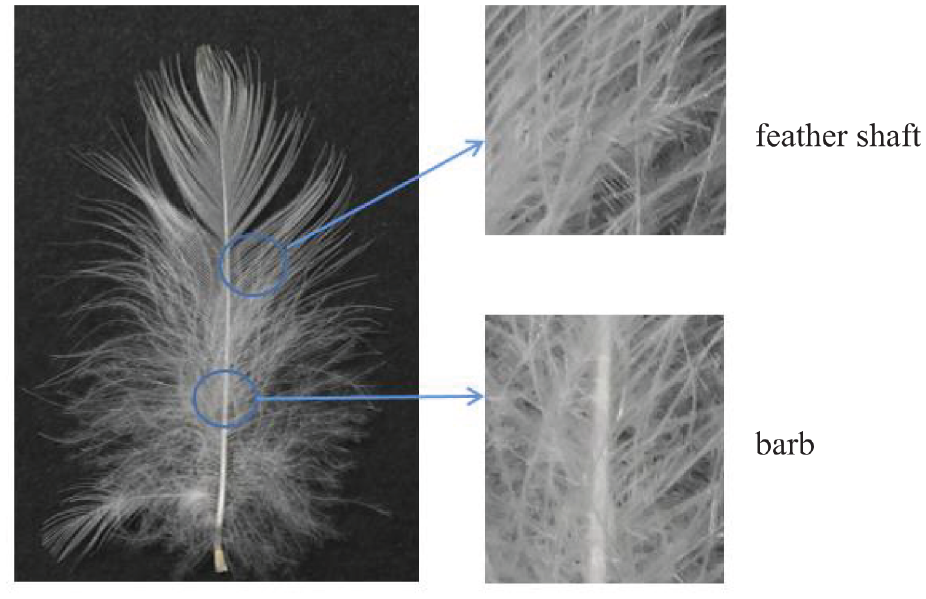
Structural diagram of a waste feather.
Gradient composite materials refer to the use of material composite technology by controlling the constituent elements of the material (composition, structure, and so on) from one side to the other of a continuous gradient change of heterogeneous materials. The main advantage of composites is the ability to combine the different properties of different materials to obtain unique and high-performance materials. 12 Fiber reinforcements and the resin matrix form the major components of composites. The primary function of resin is to transfer stress between the reinforcing fibers. It also holds the fibers together and protects them from mechanical and environmental damage. 13 The author of this article, Lyu et al.,14,15 analyzed the macromolecular structure, aggregate structure, and morphological structure of waste feathers; explored the relationship between feather structure and sound-absorbing performance; and proved that waste feather fiber has excellent sound-absorbing performance. By exploring the sound-absorbing properties of different gradient layers of composite materials, researchers have shown that gradient composite materials have better sound-absorbing properties than ordinary composite materials.16–19 Saravanan and Prakash 20 discussed the test results of the sound absorption coefficient, sound absorption coefficient Noise Reduction Coefficient (NRC) value, thickness, and density of biocomposites prepared under different fiber loading and processing conditions. It is confirmed that the thickness and density have a significant effect on the sound absorption performance of the material. Yang et al. 21 studied the underwater sound-absorbing performance of polyurethane gradient material thickness to prove that the thickness of the gradient material affected its sound-absorbing performance. In summary, the gradient structure can improve the sound-absorbing performance, and the preparation process is simple.
Waste feather fiber was used as reinforcement material, and polybutanediol succinate (PBS) was used as matrix material. Waste feather fiber/PBS gradient sound-absorbing composites were prepared by the hot-pressing process. The effects of the mass fraction of waste feathers in the gradient material, the density of the gradient material, and the thickness of the gradient material on the sound-absorbing performance of the waste feather fiber/PBS gradient sound-absorbing composites were studied, and the sound-absorbing mechanism of the material was analyzed. A polyester fiber sound-absorbing material and wool sound-absorbing felt on the market were compared. The gradient waste feather fiber sound-absorbing composite material has a wider sound-absorbing frequency band and a wide range of application. The research results can not only improve the utilization efficiency of waste feather fiber resources and protect the environment, but also play a supporting role in reducing carbon emissions and achieving carbon peak and carbon neutralization goals. The schematic diagram of the application of gradient sound-absorbing composites with waste feathers is shown in Figure 2.
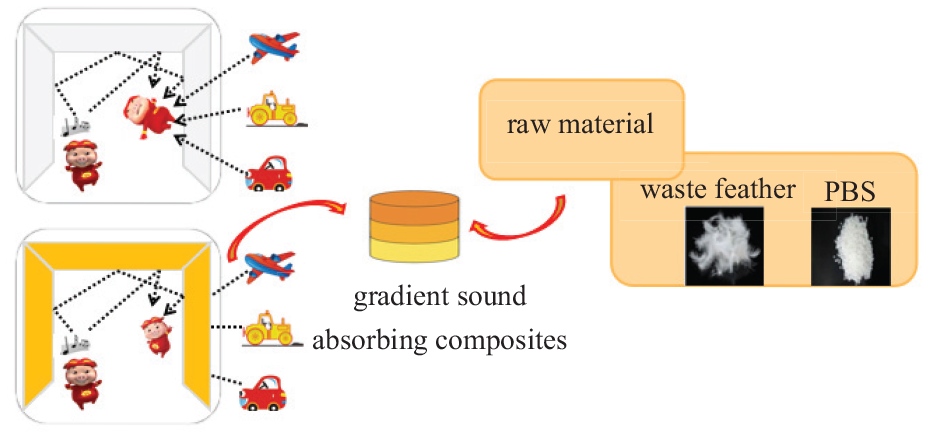
Schematic diagram of the application of gradient sound-absorbing composites with waste feathers.
Experiment
Experimental Materials
Waste feathers, 5–8 cm (poultry farm); polybutylene succinate, white powder, melting point 110°C, (Shoho Chemical Co., Ltd, Tokuchi City, Japan); anhydrous ethanol (Tianjin Fuyu Fine Chemical Co., Ltd); anhydrous sodium carbonate (Tianjin Guangfu Technology Development Co., Ltd); and polyester fiber sound-absorbing material and wool sound-absorbing felt were purchased from the market.
Instruments and Equipment
JSM-6460LV SEM scanning electron microscope: provided by JEOL; SW477/SW422 impedance tube test system: provided by Beijing Shengwang Sound Technology Co., Ltd; QLB-50D/Q pressure molding machine: Jiangsu Wuxi Zhongkai Rubber and Plastic Machinery Co., Ltd.
Pretreatment of Waste Feather
The pretreatment process of waste feathers is shown in Figure 3. Washing solution: bath ratio 1:50, anhydrous sodium carbonate 5%. Washing conditions: washing time: 30 min and washing temperature: 40°C. Wash the washed waste feathers in water at normal temperature 3 times, each time for 5 min. Put the washed waste feathers in the oven for 10 h, and the oven temperature is 60°C to obtain cleaned waste feathers.
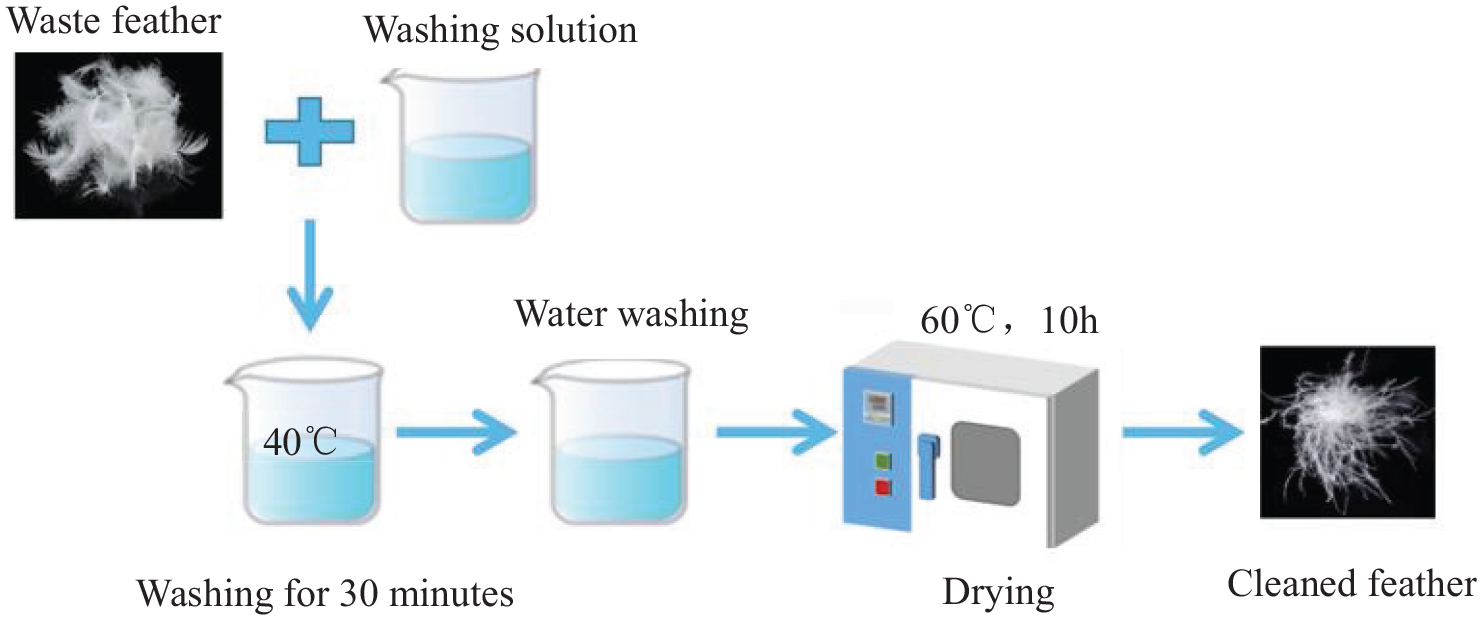
Pretreatment process of waste feathers.
Preparation of Gradient Sound-Absorbing Composites
The preparation process of gradient sound-absorbing composites is shown in Figure 4. The mass ratio of waste feather fiber to anhydrous ethanol is 1:2. The PBS and the waste feather fiber were mixed evenly and put into the mold. The hot press (120°C, 8 MPa) was used for hot-press molding. After 20 min, the PBS and the waste feather fiber were taken out. The single-layer composites were obtained by cold pressing for 30 min at normal temperature. Finally, three single-layer composites of each group of variables were put into the abrasive tool, hot pressed by hot press (120°C, 8 MPa), taken out after 10 min, and then cold pressed for 30 min under normal temperature to obtain gradient sound-absorbing composites. Three samples were obtained for each group of variables. Figure 5 shows gradient sound-absorbing composites based on waste feather fiber.
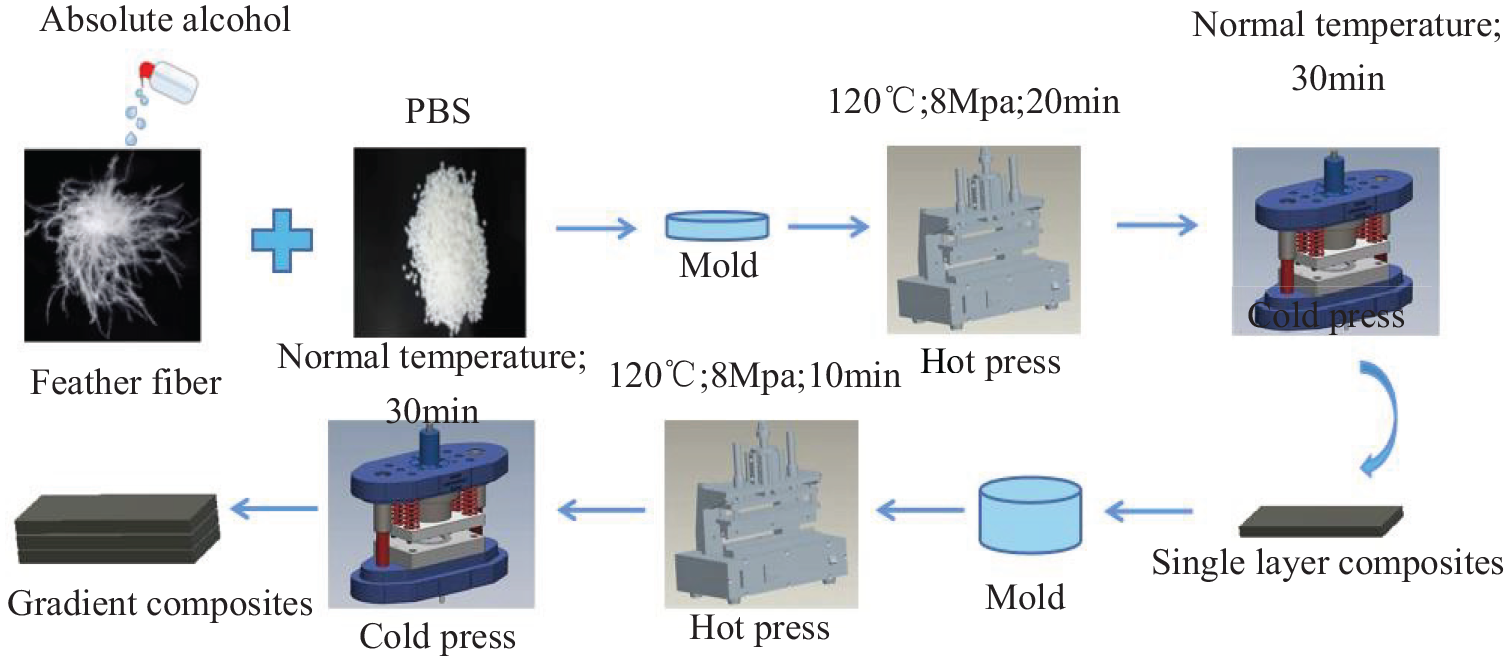
Preparation process of gradient sound-absorbing composites.
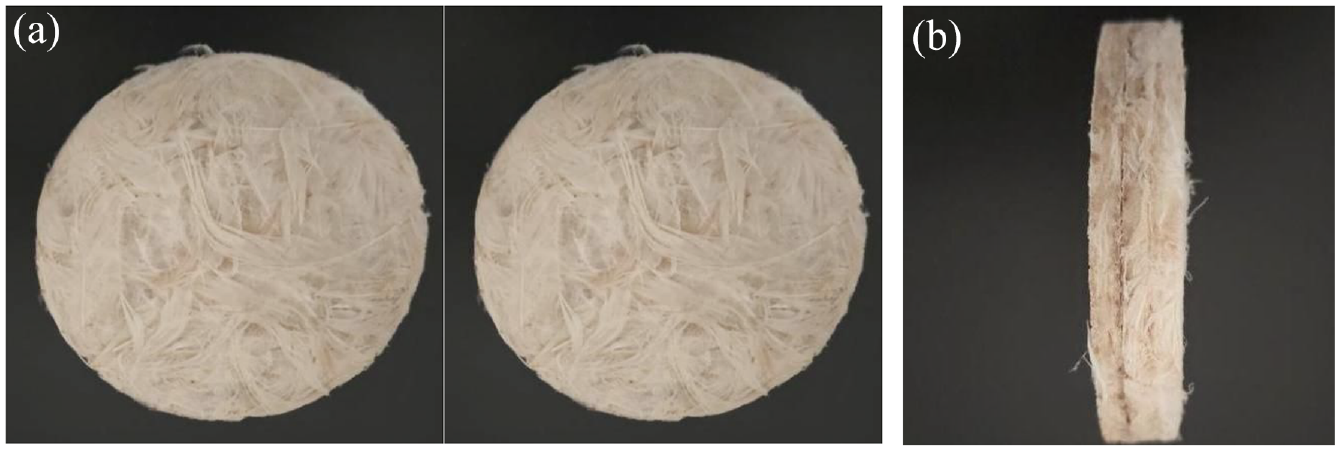
Pictures of gradient sound-absorbing composites based on waste feathers: (a) surface and (b) side.
Test Method
Sound-Absorbing Performance
According to GB/T18696.1-2004, the sound-absorbing coefficient of the gradient sound-absorbing composites at 80–6300 Hz was tested.
Surface Morphology
The waste feather gradient sound-absorbing composites were sprayed with gold, and observed using the scanning electron microscope, with a resolution of 4 nm, and the surface topography of the material was examined.
Results and Discussion
Effect of Gradient Waste Feather Fiber Mass Fraction on Sound-Absorbing Performance
The mass fractions of waste feather fiber in the three-layer gradient materials were 40–50–60%, 60–60–60%, and 60–50–40%, respectively (the material density of each layer of composite material was 0.3 g/cm3, and the thickness of each layer of material was 5 mm). The number of tests was five, and the test results were averaged. The measured curves of the sound-absorbing coefficient of gradient composites with waste feather fiber under different gradient mass fractions are shown in Figure 6. Figure 7 shows the propagation diagram of acoustic wave in waste feather fiber gradient composites with different gradient mass fraction.
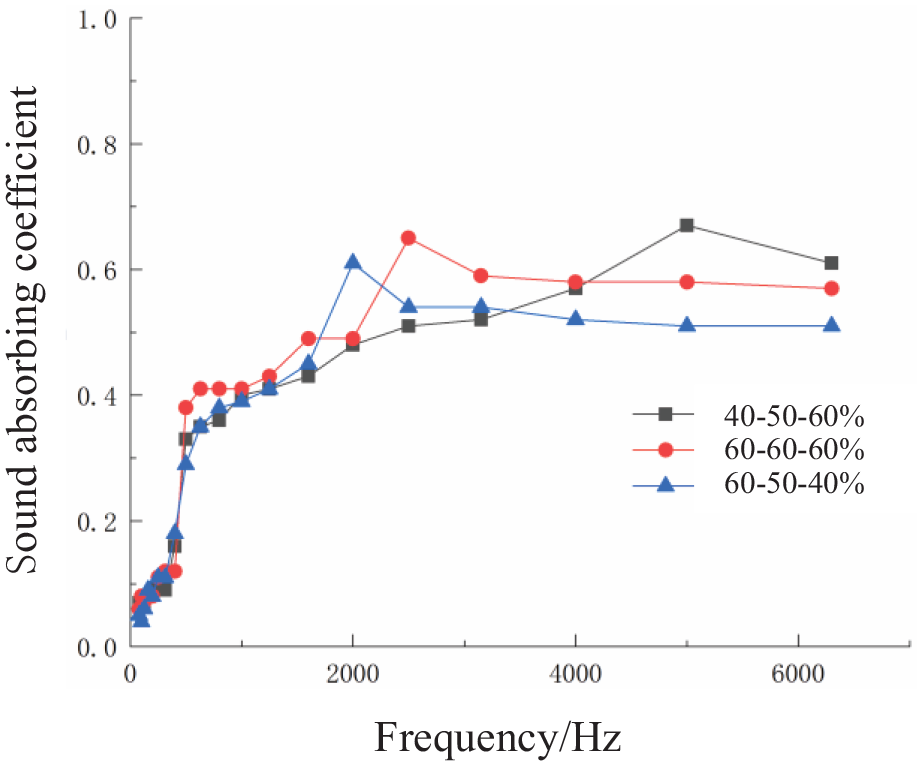
Curves of sound-absorbing efficiency of gradient composites with waste feather fiber under different gradient mass fraction.
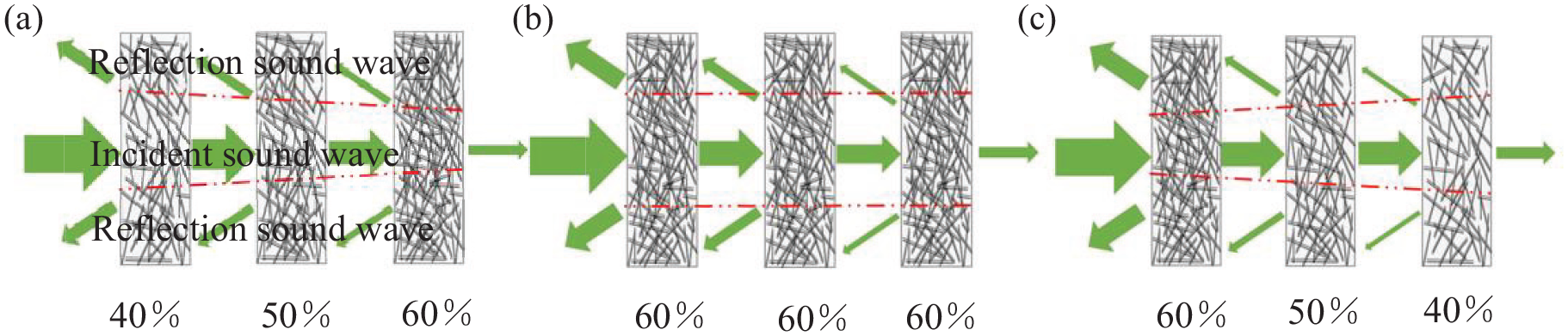
Propagation diagram of acoustic wave in waste feather fiber gradient composites with different gradient mass fraction: (a) mass fraction 40–50–60%; (b) mass fraction 60–60–60%; and (c) mass fraction 60–50–40%.
It can be seen from Figures 6 and 7 that when the mass fraction of the gradient waste feather fiber is 40–50–60%, the sound-absorbing coefficient is better than the other two groups of samples, and the maximum sound-absorbing coefficient of the gradient composite material is 0.67. This is because the first layer of the fiber layer of the gradient sound absorption composite material has a low mass fraction of waste feather fiber, and the degree of extrusion of the waste feather is small, so that the number of internal micropores is large. Within a certain range, the higher the number of micropores, the higher the pore connectivity rate, the more times the sound wave is reflected, and the stronger the material’s absorption capacity for high-frequency sound waves. On the whole, different sizes of micropores are arranged together to form a horn-like (or hourglass-like) structure, which is conducive to the dissipation of acoustic energy. 15 When the mass fraction of gradient waste feather fiber is 60–60–60% and 60–50–40%, the high-frequency sound absorption performance is not as good as 40–50–60%. This is because the mass fraction of the waste feather fiber in the first layer of gradient sound absorption composite material is high, and the adhesion between PBS and waste feather fiber is reduced, so that the number of micropores formed inside is less, resulting in a decrease in high-frequency sound-absorbing performance. When the mass fraction of gradient waste feather fiber is 60–60–60%, its low-frequency sound-absorbing performance is better. The reason for this is that the content of waste feather fiber is more on the whole, the friction between the sound wave incident through the material and the waste feather fiber and the air increases, and the sound energy consumption increases, resulting in better low-frequency sound-absorbing performance.
Effect of Gradient Material Density on Sound-Absorbing Performance
The density of gradient material of the three layers was 0.2–0.3–0.4, 0.3–0.3–0.3, and 0.4–0.3–0.2 g/cm3, respectively (the mass fraction of gradient waste feather fiber was 40–50–60%, and the thickness of each layer of material was 5 mm). The measured curves of sound-absorbing coefficient of gradient composites with waste feather fiber under different gradient material density are shown in Figure 8. Figure 9 shows the propagation diagram of acoustic wave in waste feather fiber gradient composites with different gradient material densities.
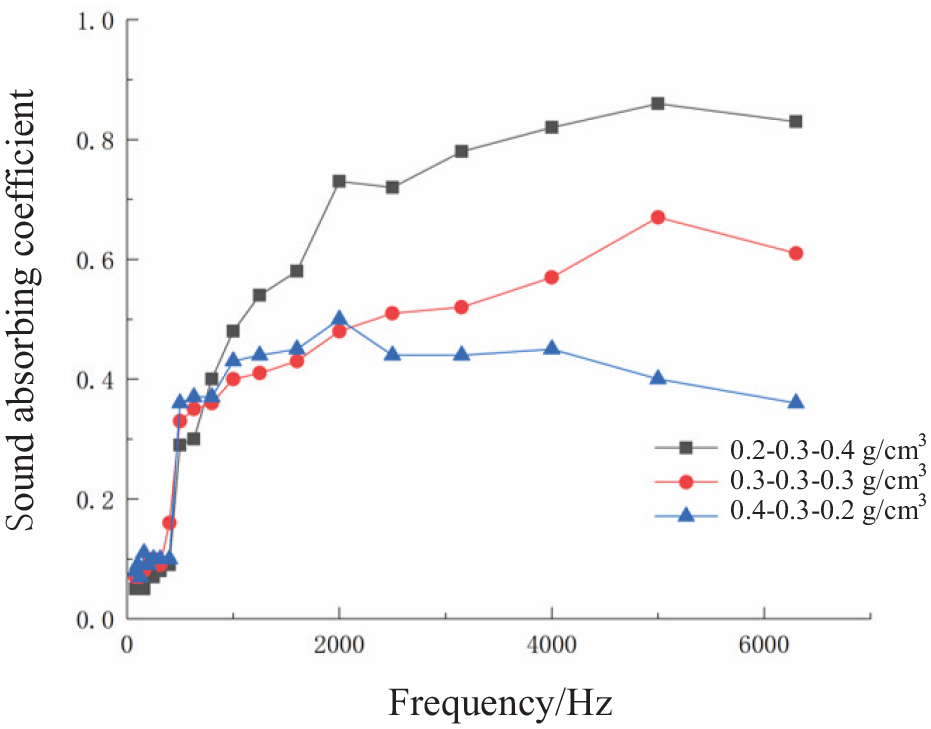
Curves of sound-absorbing coefficient of gradient composites with waste feather fiber under different gradient material density.
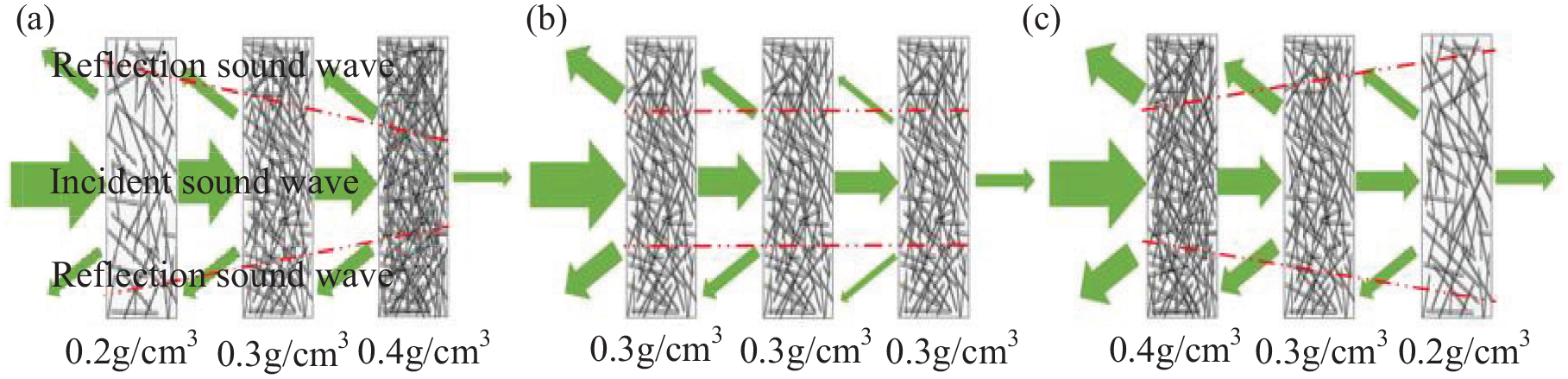
Propagation diagram of acoustic wave in waste feather fiber gradient composites with different gradient material densities: (a) material density 0.2–0.3–0.4 g/cm3; (b) material density 0.3–0.3–0.3 g/cm3; and (c) material density 0.4–0.3–0.2 g/cm3.
It can be seen from Figures 8 and 9 that in the same frequency range, the sound-absorbing performance of the whole frequency band is better when the density of the gradient material is 0.2–0.3–0.4 g/cm3. The reason is that when the acoustic wave acts on the gradient composite material, the first layer of the gradient composite material has a low density, and its porosity is large, and the micropores formed inside it are large, resulting in a small specific flow resistance inside the first layer of material and good sound-absorbing performance at medium and high frequency. When the acoustic wave passes through the second layer of the three layers of material, as the density of the material increases, the porosity of the corresponding material decreases, so that the internal specific flow resistance of the second layer of the three layers of material increases, and the acoustic energy passing through the material is less, so that the acoustic energy is reflected into the interior of the material for friction consumption, resulting in good low-frequency sound-absorbing performance in the material. On the whole, different sizes of micropores are arranged together to form a horn-like (or hourglass-like) structure. For a structure with porosity from high to low, due to the large porosity and many pores, the sound wave easily enters the material. Because the internal channel of the large porosity material is complex, it can produce more scattering and collision, and the energy loss is increased. The small porosity material superimposed on the back makes the sound wave difficult to transmit, thus having a better sound-absorbing coefficient, which is conducive to the dissipation of sound wave energy. When the density of the gradient material is 0.3–0.3–0.3 g/cm3, the high-frequency sound absorption performance is worse than that of 0.2–0.3–0.4 g/cm3. The reason is that the density of the first layer material is higher than that of the first layer material of 0.2–0.3–0.4 g/cm3, which makes the internal porosity of the first layer material smaller, so that the internal overall specific flow resistance increases, the reflected sound energy is greater, the sound wave entering the material is less, and the medium- and high-frequency sound-absorbing performance of the material is slightly worse. When the density of the gradient material is 0.4–0.3–0.2 g/cm3, the density of the first layer of the material is the largest, so that the porosity of the first layer of the material is the smallest, so that the overall internal specific flow resistance is large, and the reflected sound energy is greater, resulting in poor sound absorption performance of the material at medium and high frequency. 22
Effect of Gradient Material Thickness on Sound-Absorbing Performance
The thicknesses of the gradient materials of three layers were 3–5–7, 5–5–5, and 7–5–3 mm, respectively (the mass fraction of the gradient waste feather fiber was 40–50–60%, and the gradient material density was 0.2–0.3–0.4 g/cm3). The measured curves of sound-absorbing coefficient of gradient composites with waste feather fiber under different gradient material thickness are shown in Figure 10. Figure 11 shows the propagation diagram of acoustic wave in waste feather fiber gradient composites with different gradient material thicknesses.
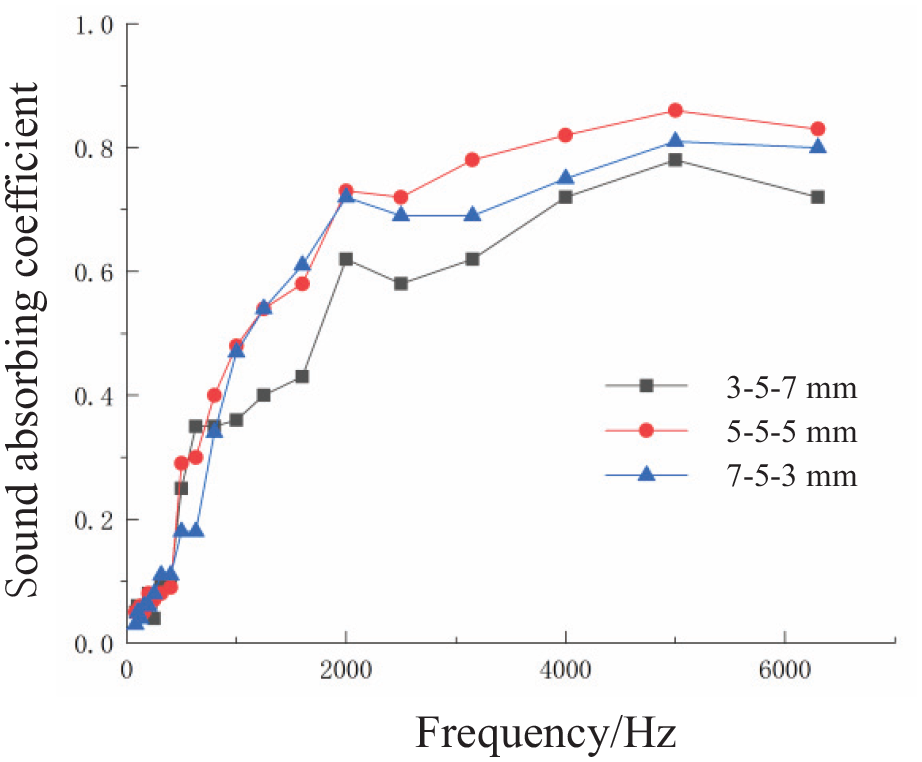
Curves of sound-absorbing coefficient of gradient composites with waste feather fiber under different gradient material thickness.
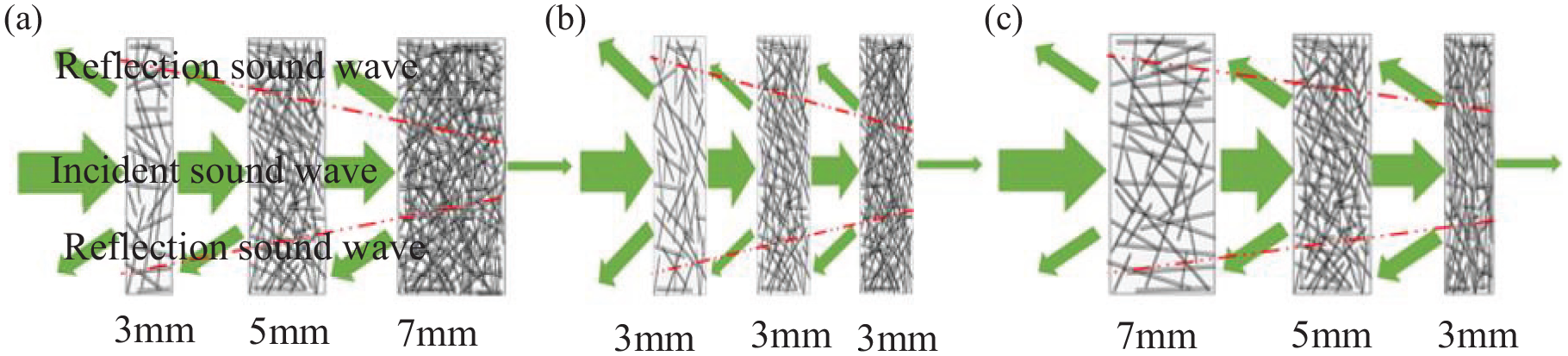
Propagation diagram of acoustic wave in waste feather fiber gradient composites with different gradient material thicknesses: (a) material density 3–5–7 mm; (b) material density 5–5–5 mm; and (c) material density 7–5–3 mm.
It can be seen from Figure 10 that in the same frequency range, the sound-absorbing performance of graded materials with thickness of 5–5–5 and 7–5–3 mm is better than that of 3–5–7 mm. Figure 11 is the sound-absorbing diagram of sound-absorbing composites with different thickness of gradient materials. The reason for this is that when the thickness of the gradient material is 3–5–7 mm, the thickness of the first layer of the material is small, the internal pore channel is not long enough, and the short wavelength of the high-frequency sound wave is absorbed by the surface of the material. The incident sound wave has not been consumed many times. The second layer of the dense material surface is reflected, resulting in a decrease in high-frequency sound-absorbing performance. The low-frequency sound-absorbing performance of the gradient material with a thickness of 5–5–5 mm is better than that of 7–5–3 mm. The reason for this is that the distance of sound wave walking inside the gradient composite is the same, but the porosity of each layer inside the gradient composite is different, that is, the distance of specific flow resistance is different. The wavelength of the low-frequency sound wave is longer, and the thickness of the gradient material is 5–5–5 mm compared with 7–5–3 mm. During the incident process of the sound wave, the sound energy blocked in the third layer can be returned to the material, and more scattering and collisions occur, which are consumed inside the material and cause the loss of sound energy.
To sum up, when the gradient waste feather fiber mass fraction was 40–50–60%, the gradient material density was 0.2–0.3–0.4 g/cm3, and the gradient material thickness was 5–5–5 mm; the curve of sound-absorbing coefficient of gradient composites with waste feather fiber is in Figure 12. The average sound-absorbing coefficient of the waste feather gradient sound-absorbing composites was 0.408; the maximum sound-absorbing coefficient was 0.86; the noise reduction coefficient was 0.393; the noise reduction level was IV; and the sound-absorbing frequency band was wide.
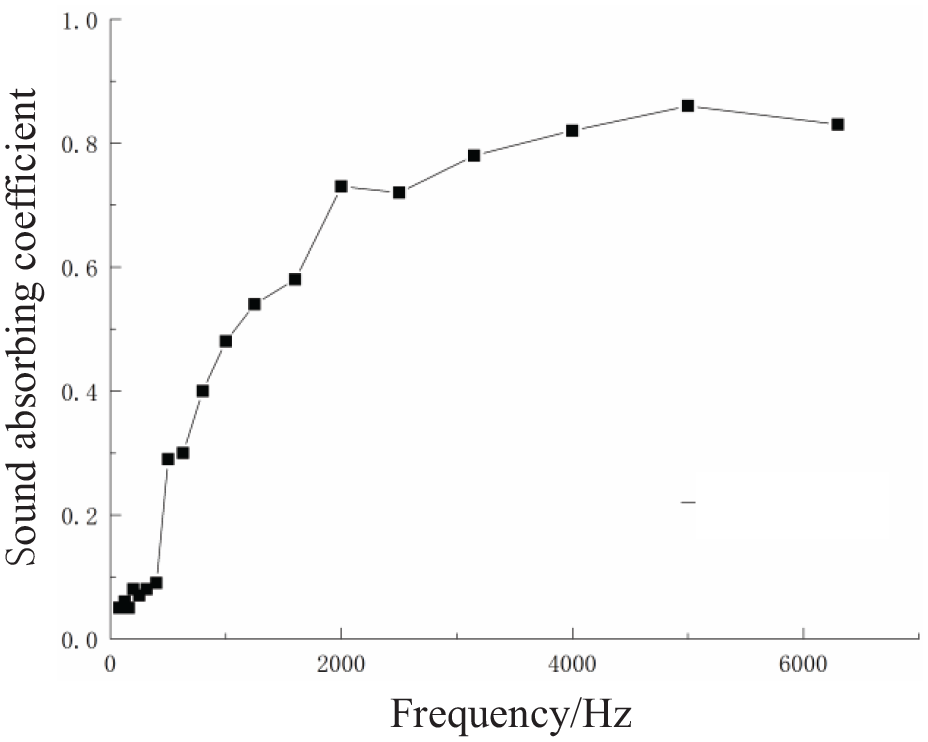
Curve of sound-absorbing coefficient of gradient composites with waste feather fiber.
Figure 13 shows the Scanning Electron Microscopy (SEM) of each layer of gradient sound-absorbing composites under the optimal process parameters. It can be seen from Figure 13 that the pores formed by the first layer of material are large, the second layer of material is second, and the pores formed by the third layer of material are the smallest. It is verified that the gradient composite material forms a structure similar to the bell mouth as a whole. The internal specific flow resistance of the first layer of material is small, and the sound-absorbing performance in the middle and high frequency is good. With the increase in material density, the internal flow resistance increases, and the sound energy through the material is less, so that the sound energy is reflected back into the material for friction consumption, resulting in good sound-absorbing performance in the middle and low frequency of the material, which is conducive to the consumption of sound energy. This is also the reason why the waste feather fiber gradient sound-absorbing composite material has excellent sound-absorbing performance.
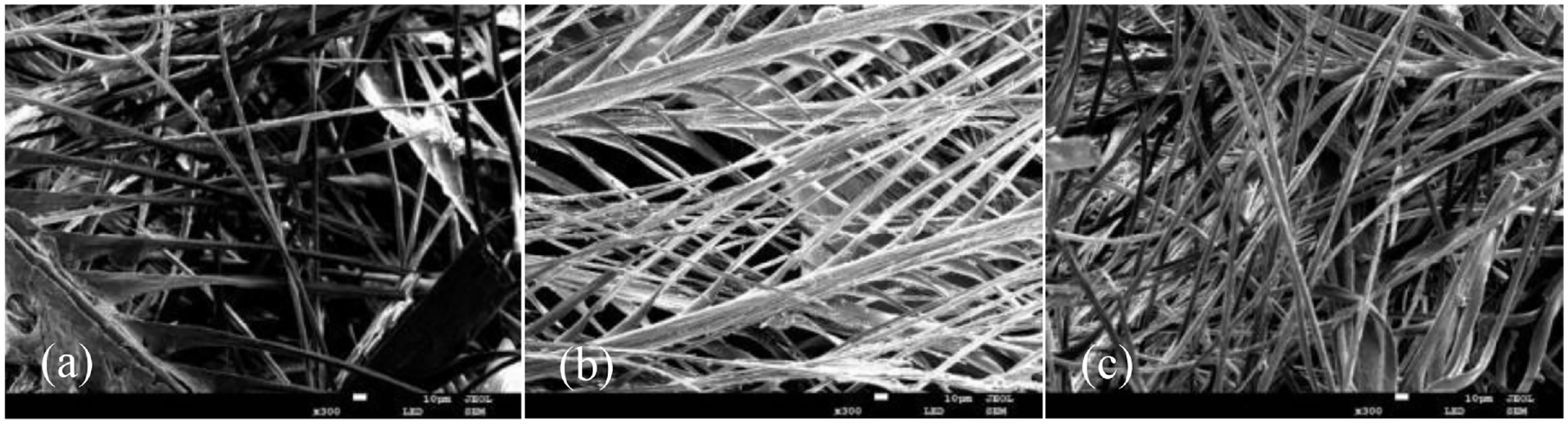
SEM of each layer of gradient sound-absorbing composite material under optimal process parameters (a) The first layer material; (b) The second layer material; and (c) The third layer material.
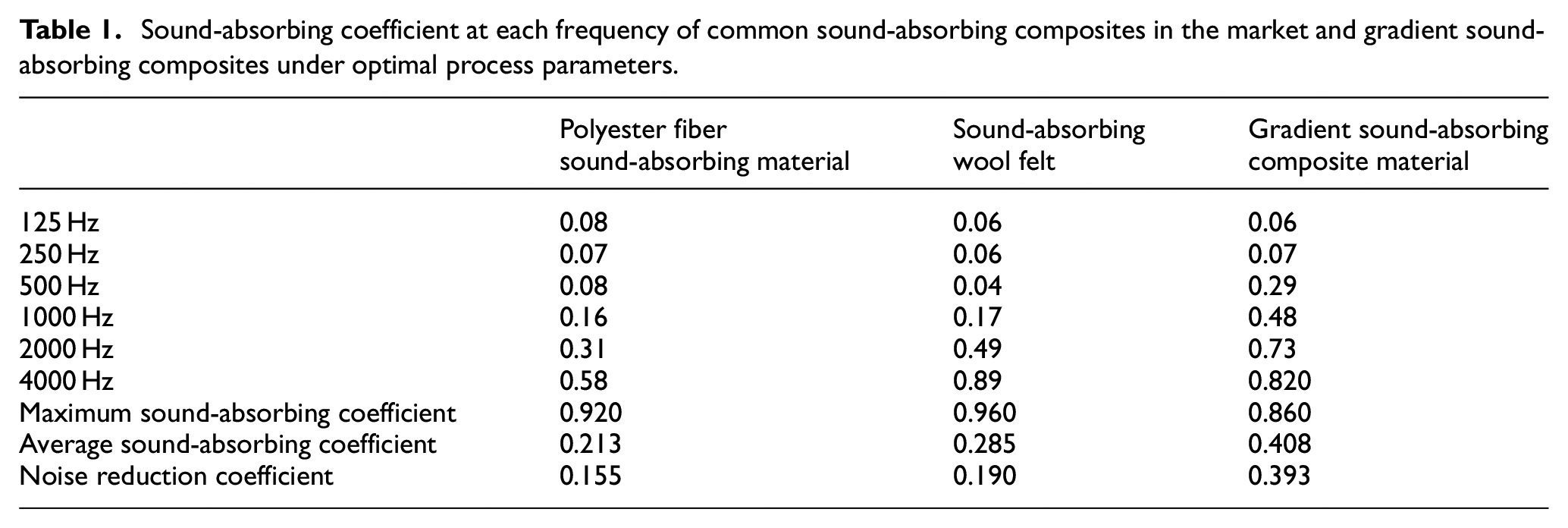
The common sound-absorbing porous materials in the market are mostly polyester fiber sound-absorbing materials and wool sound-absorbing felt. The comparison between gradient sound-absorbing composites and its sound-absorbing performance under the optimal process parameters is shown in Table 1. It can be seen from Table 1 that the maximum sound-absorbing coefficient of the waste feather fiber gradient sound-absorbing composite is 0.86, the average sound-absorbing coefficient is 0.408, and the noise reduction coefficient is 0.393, and its noise reduction level is grade IV. The gradient sound-absorbing composite has excellent sound-absorbing performance in the low- and medium-frequency range, which is significantly better than the polyester fiber sound-absorbing material and sound-absorbing wool felt on the market, but its maximum sound-absorbing coefficient is 0.86, which is less than that of polyester fiber sound-absorbing material (0.92) and wool sound-absorbing felt (0.96), that is, the sound-absorbing performance of the gradient waste feather fiber sound-absorbing composites is not as good as that of polyester fiber sound-absorbing material and wool sound-absorbing felt at a special frequency. However, the gradient waste feather fiber sound-absorbing composites have a wide sound-absorbing frequency band and can be applied in a wide range.
Sound-absorbing coefficient at each frequency of common sound-absorbing composites in the market and gradient sound-absorbing composites under optimal process parameters.
Conclusion
Waste feather fiber was used as reinforcement materials, and PBS was used as the matrix material. Waste feather/PBS gradient sound-absorbing composite was prepared by a hot-pressing process. The effects of various factors, such as the mass fraction of waste feather fiber, the density of gradient material, and the thickness of gradient material, on the sound-absorbing performance of gradient composite material were emphatically studied, and the sound-absorbing mechanism of the material was analyzed; the sound-absorbing mechanism of waste feather/PBS gradient sound-absorbing composite material was revealed.
Through single factor analysis, the optimal process condition of waste feather/PBS gradient sound-absorbing composites was obtained as follows: the mass fraction of gradient waste feather fiber was 40–50–60%; the density of gradient material was 0.2–0.3–0.4 g/cm3; and the thickness of gradient material was 5–5–5 mm.
Taking the average sound-absorbing coefficient, the maximum sound-absorbing coefficient, and the noise reduction coefficient as the evaluation indicators of the sound-absorbing performance of the gradient composite material, and comparing the waste feather fiber gradient sound-absorbing composite with the common sound-absorbing porous material polyester fiber sound-absorbing material and sound-absorbing wool felt, the maximum sound-absorbing coefficient of the waste feather fiber gradient sound-absorbing composite is 0.860, the average sound-absorbing coefficient is 0.408, the noise reduction coefficient is 0.393, and the noise reduction grade is IV. Its sound-absorbing frequency band is wide and can be applied in a wide range.
Footnotes
Declaration of conflicting interests
The author(s) declared no potential conflicts of interest with respect to the research, authorship, and/or publication of this article.
Funding
The author(s) disclosed receipt of the following financial support for the research, authorship, and/or publication of this article: This research was funded by “the Science and Technology Innovation Fund Project of Dalian, grant number 2019J12SN71.”