




Abstract
Despite the fact that textile waste is almost entirely recyclable, approximately 75% of it ends up in landfills worldwide. This has serious environmental and economic consequences. This review focuses on textile waste statistics, its contribution to pollution and recycling, as well as the benefits, barriers, types, and technologies of textile waste recycling. Textile production and textile waste generation have increased alarmingly as a result of fast fashion, which emphasizes low-cost production, frequent consumption, and short-term use of garments. This industry is distinguished by scarcity of resources, excessive consumption, and the generation of large amounts of waste. The frequency of consumer purchases is increasing, while the life span of clothing is drastically decreasing. Recycling does not occur as expected for a variety of reasons, so the environmental impact and economic losses from this waste grow over time. The textile industry currently contributes about 8% of the global carbon budget and 20% of industrial water pollution. Every year, $500 billion is lost to the system due to unused clothing and a lack of recycling. A paradigm shift is urgently required to implement an effective textile waste recycling system.
Introduction
Fast fashion, which is based on low-cost manufacturing, frequent consumption, and short-term garment use, is associated with globalization; thus, outsourcing production to low-wage countries has made clothing available in large quantities and at low prices, resulting in high clothing consumption.1,2 As a result, both renewable and non-renewable resources are being overexploited, and massive amounts of waste are being generated, posing a threat to the sustainability of textile production and processing.3,4 The majority of raw materials used in textiles are non-renewable, with the industry using 98 million tons of non-renewable resources annually around the world, including oil to produce synthetic fibers, fertilizers to grow cotton, and chemicals to dye and finish fibers and textiles. 5
Textile production (including cotton farming) consumes approximately 93 billion cubic meters of water per year, 6 contributing to water scarcity issues in some water-stressed areas. The chemical consumption in textile industries is another critical issue that must be addressed; the total amount can range between 10% and 100% by weight of the textile product. 6 H&M 2018 reports that the textile and fashion sector consumes 19% of the total energy consumed by the industry overall. This massive resource usage in the current wasteful non-circular economy has resulted in massive and ever-increasing resource pressure.
This compelled environmentalists to devise agendas for pressuring governments and regulatory bodies to implement resource consumption and waste disposal measures.7–9 At the moment, resource consumption and waste management are two of the most contentious issues in the world.10–12 According to reports, the system loses over $500 billion in value each year as a result of underutilized clothing and a lack of recycling. 13 As a result, principles like cleaner production, raw material management, industrial ecology, and material recycling, among others, are constantly being developed and implemented.14–16
The circular economy model, which is gaining popularity among scientists, business leaders, and government officials worldwide, is being supported by frameworks and regulations. 17 Consideration of the circular economy in the textile and fashion sector, as well as the use of appropriate technologies for the recycling of textile waste, will be required for the sector’s sustainability.
In writing this review paper, a large number of relevant resources were consulted, as well as more recent literatures. The expectations and goals of textile waste recycling, as well as the actual situations, have been communicated. The global statistics on textile waste and recycling are covered, as well as the impact of textile wastes, recycling strategies, and the benefits, barriers, technologies, and companies of textile waste recycling. This review on one of today’s most difficult issues is thought to be useful for researchers as a reference, businesses in planning their resource consumption and waste disposal, and governments in implementing waste management strategies.
Statistics of Textile Wastes
Clothing and textiles accounted for 6% of global manufactured goods exports in 2017, according to the World Trade Statistical Review 2018, with China and the European Union leading the way. Global textile production and consumption have more than doubled in the last two decades, according to reports.18,19 According to the World Trade Statistical Review 2018, global textile fiber production in 1975, 1997, and 2019 was approximately 23.9, 98.5, and 111 million metric tons, respectively. 20
Each year, the average American discards about 37 kg of clothing, 19 accounting for about 6% of total municipal solid waste. In 2017, 16.9 million tons of textile waste were produced, with approximately 85% of this waste ending up in landfills and only 15% being donated or recycled.1,21 The EU textile industry generates 16 million tons of textile waste per year, only 18% of which is reused and recycled, 30% is incinerated, and the remainder (52%) ends up in landfills.22,23 Korea produced 64,075 tons of textile waste in 2010. 24 Every year, China generates more than 20 million tons of textile waste, with approximately 88% of this waste ending up in landfills. 25
Textile waste has increased dramatically on a global scale as a result of increased clothing consumption and production as a result of fast fashion, as demonstrated by the case of the United States. It is widely acknowledged as the world’s fastest-growing waste stream in municipal solid waste. 1 The Wanderers Stream report for 2015 global fiber production for clothing and degree of reuse/recycle for the same year is useful for estimating current fiber consumption and degree of reuse/recycle: 53 million tons of fiber were produced for clothing (63% plastic based, 26% cotton, and 11% other fibers). According to the same report, 73% of textile waste was not recycled or reused in the same year and was instead landfilled or incinerated.13,26 Landfilling is the most common and least expensive method of solid waste disposal. 27
Data on future projections show that clothing demand is continuing to rise rapidly, driven primarily by emerging markets such as Asia and Africa. Global apparel consumption is estimated to be 62 million tons per year, with projections of 102 million tons by 2030 and 160 million tons by 2050—more than three times today’s amount by 2050.5,20 It is difficult to predict the environmental crises that will occur if the current linear economy is maintained; thus, a paradigm shift must be designed and implemented.
Impacts of Textile Wastes
As previously stated, 63% of textile fibers are derived from petrochemicals, the fate and production of which emit significant amounts of carbon dioxide. 28 Cotton, which accounts for 26% of clothing production, is a thirsty plant that has been linked to water depletion and toxic pollution as a result of pesticide use.29,30 Yarn (spinning) and fabric (weaving, knitting) production rely heavily on fossil energy, resulting in carbon dioxide and particulate emissions. 31 Textile wet treatment processes (preparatory, dyeing, printing, finishing, etc.) contribute significantly to polluted water (effluents) and groundwater depletion. 32 The textile sector contributes significantly to global municipal solid waste through landfilled textiles and textile effluent treatment plants.
The industry’s enormous footprint extends beyond the use of raw materials. Textile production emitted 1.2 billion tons of CO2, accounting for 2% of the year’s carbon budget; 33 the current estimate is 8–10% of global CO2 emissions (4–5 billion tons annually). 20 According to the same sources, in the absence of a paradigm shift, this budget will rise to 26% by 2050. The textile industry ranks fifth in terms of global greenhouse gas emissions. 1 Even after biodegradation, textiles emit methane gas into the atmosphere, increasing greenhouse gas emissions. 27 Textile solid waste is a major source of pollution in both land and water bodies. Textile fibers can take centuries to decompose, destroying aesthetics and contributing to land scarcity. 34 The industry is responsible for approximately 35% (190,000 tons per year) of oceanic primary microplastic pollution. 20
Toxic chemicals used in textile production, from fiber production to final finishing, have a negative impact on aquatic life, farmers, factory workers, and the surrounding environment as a whole. According to the literature, the textile industry consumes roughly one-fourth of all chemicals produced globally. Cotton farming alone consumes approximately 10% of agricultural chemicals and 25% of the world’s pesticides, both of which could enter our food chain and cause biomagnifications. 27 The industry releases large amounts of water containing hazardous chemicals into the environment; dyeing and textile treatment account for 20% of global industrial water pollution. 30
Waste water discharged from textile industries has an impact on flora and fauna. Chemicals, especially dyes, can have acute and/or chronic effects on exposed organisms, including humans. The most serious impact of textile waste is the depletion of dissolved oxygen in water, as dissolved oxygen is critical for marine life. This also impedes the self-purification process of water.32,35
Alternative Textile Disposal Methods
Approximately 75% of textile waste is disposed of in landfills worldwide, 13 resulting in massive underutilization of clothing. The average number of times a garment is worn before being discarded has decreased by 36% over the last 15 years (Figure 1). Clothing in the United States has a life span that is only about a quarter of the global average. In China, clothing consumption has dropped by 70% in the last 15 years, and a similar trend is emerging. However, in many low-income countries, clothing consumption is relatively high. 13 This fact reveals something about the relationship between textile recycling implementation and non-awareness of environmental impacts, which is expected to be higher in economically developed countries.
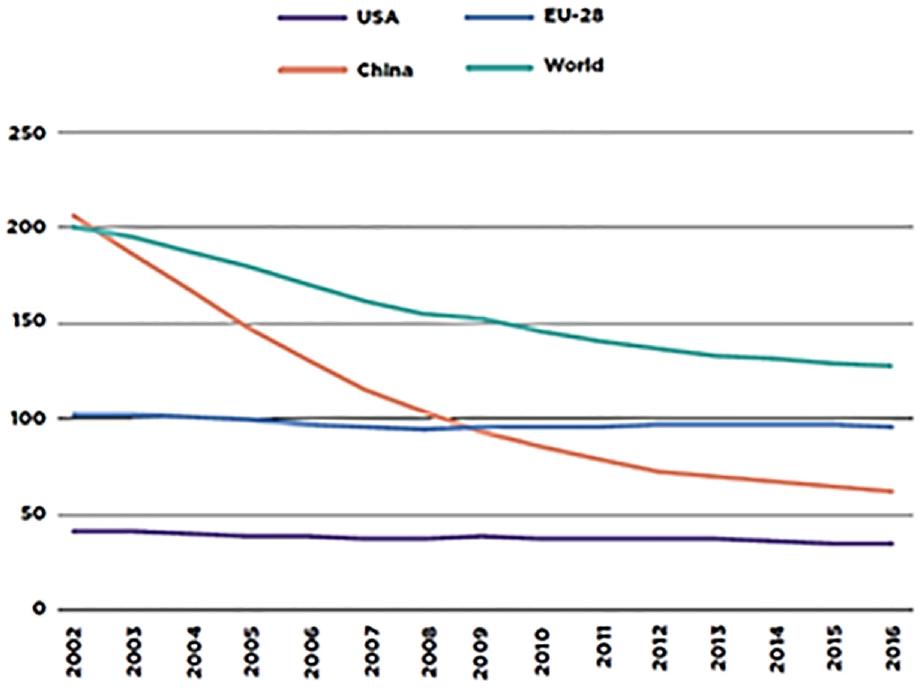
Average number of times a new garment is worn (including reuse within each region).
Some garments are estimated to be discarded after 7–10 years, 36 and more than half of all fast fashion produced globally is discarded in less than a year. 37 Consumers recognize excessive textile resource consumption; 60% of German and Chinese citizens admitted to owning more clothes than they need. 38 This fact demonstrates how clothing consumption is inextricably linked to national and individual economies.
The cost of disposing of textile waste into landfills is approximately €60/ton in some European countries 39 and $45/ton in the United States. 40 Customers worldwide lose $460 billion in value each year by discarding clothes that they could still wear. 13 This enormous loss is on top of the costs of environmental and textile effluent treatment. If this is correct, the question is whether there are any alternatives to landfilling for the disposal of textile waste. Incineration is one such viable option, especially for high-calorie wastes such as carpet fibers. Despite the fact that incineration produces green gas emissions, 1 ton of household textile waste can recover 15,800 MJ of energy and generate 27 kg of ash. 1 The literature contains a wealth of information on converting textile waste, particularly cotton waste, into various products. These wastes have been reported to be convertible into ethanol, 41 fertilizer, 42 building material, 43 or recycled fiber. 44
Recycling of Textile Wastes
Textile recycling is most commonly defined as the reprocessing of pre- or post-consumer textile wastes for use in new textile or non-textile products.26,27 In this context, recycling entails breaking down end products into previous raw materials such as fabric, fiber, or even polymer levels in order to create new products through mechanical, thermal, chemical, or combined means. In this regard, new products for clothing and non-clothing applications can be created; even higher quality products can be created through a process known as up-cycling. 27 Others, on the contrary, define recycling as a broader term that includes the reuse, reprocessing, or reproduction of a product with the goal of conserving raw materials, energy, water, and other chemicals, as well as reducing waste with the ultimate goal of preserving environmental impacts. 45 According to INTOSAI 2016, such disparities in terminology and waste classification among statistical institutes around the world are a major impediment to data globalization and comparison.
Every year, massive amounts of textile waste are generated all over the world. According to data, in the United Kingdom, 26% of clothing is discarded because the owner no longer likes it and 42% because it no longer fits (Figure 2), demonstrating that textile reuse and recycling can be a sustainable solution by reducing solid waste landfill, the use of virgin materials, and energy consumption, thereby minimizing environmental footprint. 18
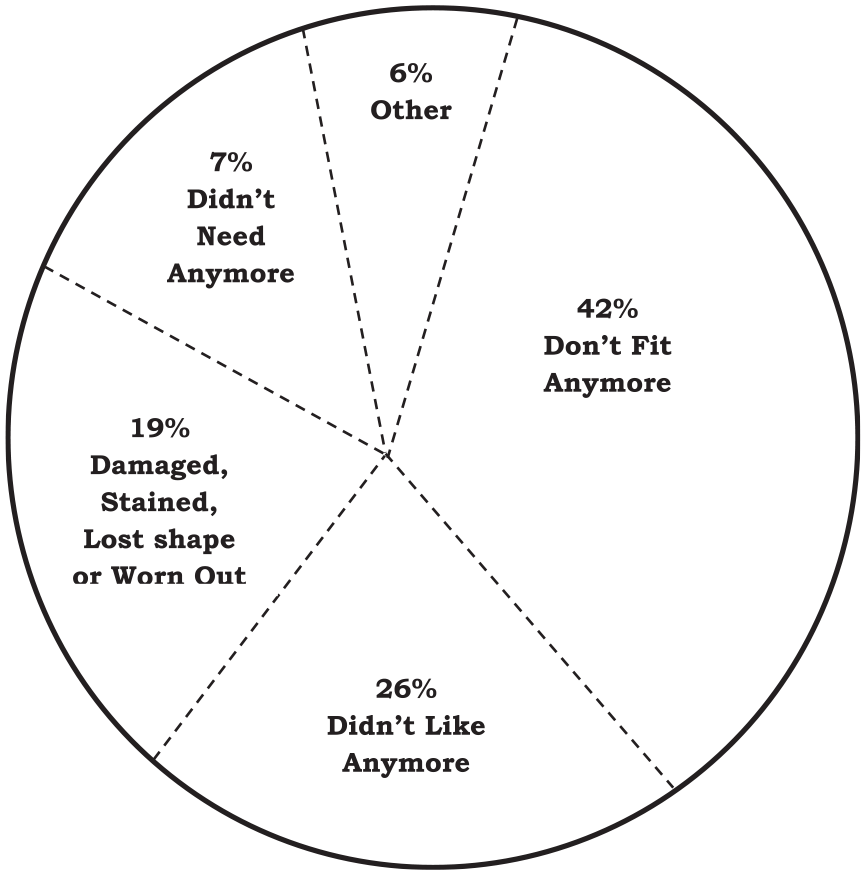
Reasons for disposal/donation/sale of clothing in the United Kingdom. 13
Textile Recycling Statistics
Reusing and recycling textile waste significantly reduce natural resource depletion and environmental impact when compared with incineration and landfilling. They also avoid/reduce the need for additional engineering processes later in the life cycle of a textile product. 26
Few countries, if any, are able to use 50% or more of their potentially recyclable textile materials; less than 12%, 10%, 11%, and 20% of potentially recyclable materials are collected in Brazil, South Africa, Russia, and China, respectively. Developed countries such as Canada, France, and Italy have higher rates of 32%, 40%, and 43%, respectively. 46 Textile recycling rates have recently fallen by 10–20% in the United Kingdom and other European countries such as Germany, Spain, Belgium, and France. 22 In some countries, such as Bosnia and Herzegovina, the Balkan region, and others, only 5% of waste is recycled. 47
The global textile waste reuse or recycling rate is approximately 25%, with less than 1% of all textiles recycled back into clothing. 13 The majority of recycling involves cascading to other industries and use in lower-value applications such as insulation, wiping, and mattress stuffing—all of which are currently difficult to recapture and thus likely constitute the final use. 48 Given the EU member states’ municipal waste reuse and recycling targets of 55% by 2025, 60% by 2030, and 65% by 2035, as well as the implementation plan of a separate collection of textiles and hazardous waste from households by January 2025, 1 it is expected that textile recycling rates will improve in the future.
In theory, textile waste is almost entirely recyclable; in an ideal world, nothing in the textile and apparel industries would be wasted. Furthermore, more than 60% of all recovered clothing can be reused, 35% can be converted into wipes and the fibers recycled, and only 5% must be discarded. 1 In their case study, Larney and Van Aardt 49 provide additional information on textile waste recycling statistics in South Africa.
Trade in Used Clothing
The global economic power of the used clothing trade has grown dramatically since the early 1990s. 50 Since 1990, the secondhand clothing (SHC) trade has grown 10-fold, reaching approximately $1 billion per year in the last 10 years; however, it accounts for less than 0.5% of total clothing trade-in value. The proportion is higher in terms of volume because SHC costs around 10–20% of the price of new clothes. 51 Almost every country participates in the SHC trade, as exporters, processors, re-exporters, or importers, with some serving in multiple capacities. Developing countries are the largest consumers of used clothing, with sub-Saharan Africa accounting for roughly 26% of total clothing imports, 51 whereas the United States is the largest exporter, exporting over 500,000 tons of used clothing per year to more than 100 different countries. 52
SHC is declining as a share of total clothing imports in most sub-Saharan African countries, owing to an increase in new cheap clothing imports from Asia, 51 on the one hand, and a ban on importing SHC 53 by countries, on the other hand. However, SHC imports continue to be significant. 51
According to reports, the clothing and shoe industrial sector in East Africa thrived and produced for both domestic and export markets from the 1960s to the early 1980s, with a well-established chain from raw material production to finished products employing thousands of people. 54 However, following economic liberalization policies in the early 1980s, most clothing and shoe industries closed, owing to the emergence and success of the used clothing and shoe business, among other things. As a result, between 1996 and 2003, employment in Nigeria’s textile sector fell by more than half, coinciding with trade liberalization, which was primarily attributed to SHC imports. 51 This compelled countries to develop modalities outlining a strategy for phasing out SHC imports. 54
Types of Textile Waste Recycling
Textile recycling is divided into several categories. Recycling can take place mechanically or chemically. Waste is mechanically recycled and reused in decoration, construction, agriculture, and gardening. 26 Chemical recycling, depending on the fiber type, refers to the recycling of textiles at the polymer stage through melting or dissolution. Chemical recycling can produce fibers that are comparable to virgin materials. 1 It can be used to convert textile waste into wood panel adhesives, as well as to produce bioethanol.
Another classification of textile recycling is based on the degree to which the recovered materials have been disassembled. This category includes fabric, fiber, polymer, and monomer recycling. Fabric recycling is the process of recovering and reusing a fabric to make new products. Fiber recycling, however, entails disassembling fabric while preserving the original fibers. Polymer/oligomer recycling is the disassembly of fibers while the polymers or oligomers are preserved. Finally, monomer recycling is the process of disassembling polymers or oligomers while retaining the monomers. 26
Up-cycling, down-cycling, closed-loop, and open-loop recycling are examples of classifications based on the relative quality of the original and recycled product. Up-cycling occurs when the recycled product is of higher quality or value than the original product; down-cycling occurs when the opposite occurs. Closed-loop recycling entails reusing material from one product in another that is nearly identical. Open-loop recycling, on the contrary, entails recycling material from one product and reusing it in another. 1
Another way to categorize recycling is by textile waste recycling stages, which are primary, secondary, tertiary, and quaternary. The process of returning man-made fibers such as polyester to their original form is known as primary recycling. Secondary recycling is the process of converting waste textile materials into materials with lower levels of physical, mechanical, or chemical properties, such as wipes. Cutting, shredding, carding, and other processes are involved. Tertiary recycling entails converting wastes into basic chemicals, monomers, or fuels using processes like pyrolysis, gasification, and hydrolysis. Plastic waste recycling into its original chemicals is one example. The final type is quaternary recycling, which involves generating heat by burning fibrous solid textile waste. 55
Timeline for Waste Recycling Concepts
Despite the fact that waste management systems were developed long before modern civilization as we know it today, they have not received as much attention in the city planning process as other sectors such as water or energy today, resulting in observable gaps in current city planning. 56 As illustrated in Figure 3, there have been six major phenomena in waste management history, referred to as waves, ranging from open dumping in antiquity, which is still available in many low-income countries, to the current projected 100% recycling or recovery.
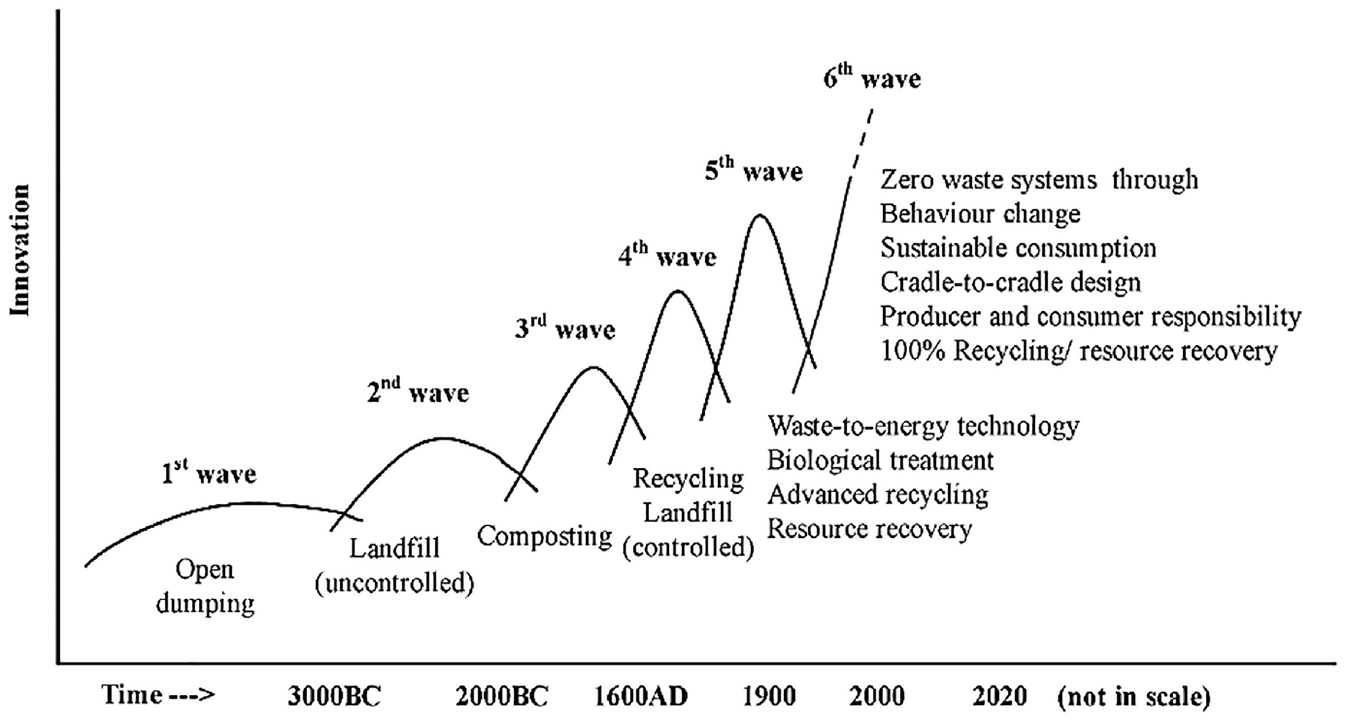
Waves of innovation in waste management systems. 56
Because of the great global oil crisis of the 1970s, the concept of waste recycling emerged during the fourth wave, then continued into the fifth, and finally into the sixth [current] wave. Recycling, in addition to organic waste composting, was first documented in Philadelphia, where paper was made from recycled fiber. 56
In 1973, Dr Paul Palmer coined the term “zero waste” to describe the design and management of products and processes to avoid and eliminate material waste while conserving and recovering all resources. 57 The zero waste principle incorporates several concepts developed for sustainable waste management systems, including reducing, reusing, redesigning, regenerating, recycling, repairing, remanufacturing, and reselling, 58 zero landfill and waste incineration, and the full life cycle of cradle-to-cradle design systems. 59 As a result, while the zero waste design principle prioritizes waste reduction and product reuse over recycling, it strongly implies that generated wastes be recycled. However, current data indicate that waste management is significantly behind schedule.
Despite international waste-related obligations, waste management is primarily the responsibility of state and territory governments, which regulate and manage waste through their respective legislation, policies, and programs, according to the Australian National Waste Report 2013. This may have contributed to a softer implementation of proposed waste management systems and regulations.
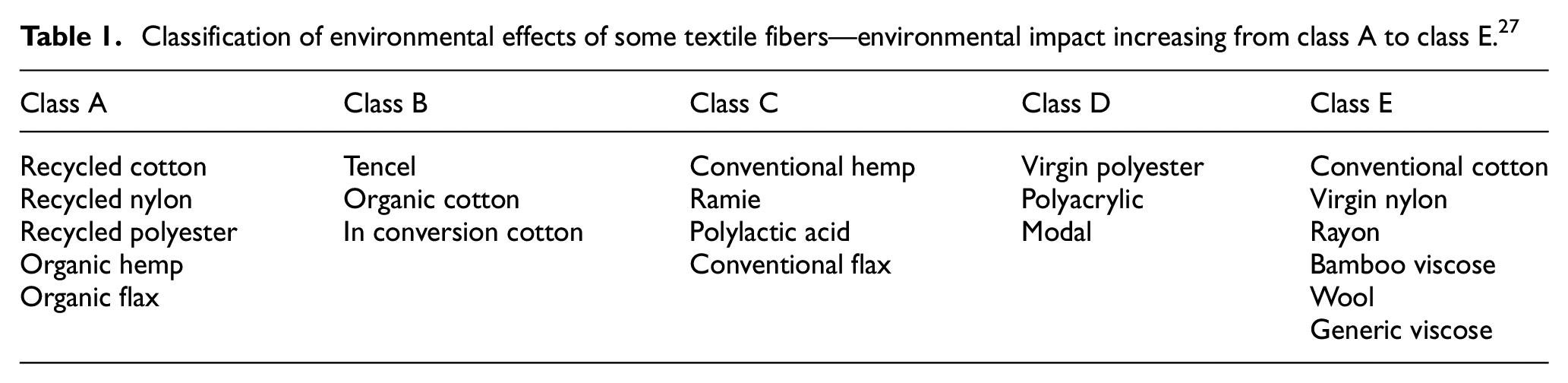
Classification of environmental effects of some textile fibers—environmental impact increasing from class A to class E. 27
Benefits of Textile Recycling
Textile waste reuse and recycling promote environmental sustainability while also maximizing and conserving raw materials, water, and energy. 60 It is possible to compare the environmental impact of virgin and recycled fibers. 27 There will be numerous benefits to textile waste recycling in terms of human health and overall ecological balance.
Although quantifying the benefits of textile waste recycling is difficult, it is estimated that 75% of textile waste recycling will save 4.2 trillion gallons of water, 17 million tons of CO2, and 7.5 million cubic yards of landfill space in terms of resources; economically create many job opportunities because waste management and recycling is a labor-intensive industry; and socially 70% of the world’s population would wear SHC. Textile recycling will be as important an industrial activity as textile manufacturing in the future. 60
Barriers to Textile Recycling
The literature categorizes textile recycling problems into different types based on different principles.61,62 The following are the major roadblocks that must be overcome in order for textile recycling to be effective. One of the major issues is the purity of textile waste, as well as related disassembling and sorting issues. Most textile wastes are not pure; some are blends, while others are colored and contain other chemicals that are difficult to separate. It will be extremely difficult to produce matching shades in a batch(es) of products if they are not de-colored. Separation technologies that are either expensive or unavailable must be installed in parallel. 63 Automation in sorting and textile recycling are gaining popularity. 1 Furthermore, the quality and durability of recycled materials may be poor, reducing the expected lifetime of the finished product and complicating recycling efforts. 64
Another impediment is the labor intensiveness of collecting and separating discarded textiles for recycling; separation, in particular, necessitates skilled labor, putting economic pressure on the textile industries. 65 Furthermore, given the competition from the less expensive, more fashionable new fast fashion industry, economic incentives should drive textile reuse and recycling. 27
According to the authors of this article, the most significant barrier to textile recycling is consumer perception of textile waste, followed by government perception of textile waste. People in low-income countries are now assumed to wear used clothing. As the economy and public awareness of the country grow, so will the rejection of SHC. As previously discussed, this could be one of the reasons for increased textile waste as nations’ economies grow. As a result, some countries have prohibited the import of SHC. 13 With this situation, it will be extremely difficult to persuade consumers to use recycled textiles. We believe that governments around the world should develop a comprehensive, non-political international framework for the effective implementation of a circular economy in the textile sector.
Technologies for Textile Recycling
Due to the complexity of textile polymer structure, the major technical challenge for textile recycling is identifying, sorting, and purifying textile materials from textile wastes. 66 Some textile products contain fiber blends with varying properties that must be identified through a series of chemical analyses (sometimes microscopic analysis is sufficient) and separated for effective recycling. Even after identification, sorting or purification will become a bottleneck. In addition, fabric waste is frequently mixed with other materials such as buttons, zippers, and other decorations. The precision with which the sorting process is carried out has a significant impact on the quality of the recycled output. 60
Several identification and sorting technologies, based on component color and morphological variations, are being developed for sorting textile and non-textile wastes, as well as textile wastes of different fibers or colors: near-infrared (NIR) spectroscopy with convolutional neural network machine learning (CNN), followed by wavelength recognition transformed through image classification, 67 attenuated total reflection (ATR)-Fourier transform infrared (FTIR) spectrometry with mathematical modeling, 68 reflectance FTIR (r-FTIR) using an FTIR micro-spectrometer, 69 and so on. According to the cited literature, a recognition rate of up to 100% has been achieved. Textile for Textile (T4T) [a European Commission eco-innovation initiative] based on NIR spectroscopy, for example, has been developed and demonstrated to be capable of sorting large quantities of textile materials based on fiber composition (cotton, wool, polyester, blends, etc.), color, structure, coating, or finish composition. 60 The commercial success of these recycling technologies is expected to have a significant impact on the future of textile waste recycling.
Together with H&M and Worn Again, Sulzer has developed a new recycling process for the textile industry. The key lies in the separation and recovery of polyethylene terephthalate (PET), a common component of clothing and cotton or other cellulosic materials from end-of-life textiles. However, this novel technology is a complex chemical process. Textiles made from polyester are generally complex and made up of different types of fibers, dyes, fillers, and additives. PET is used as a raw material for many clothing materials. However, many garments contain a variety of different materials such as polyester, cotton, viscose, and their blends. 70
With this new process, the PET materials, colorants, catalysts, and other organic additives are removed by dissolving them in special solvents. The dyes from the cellulose fibers are removed by other chemicals. Insoluble additives are then released as fine powders in a filtration process. The result is two products, namely, 100% PET resin chips, on one hand, and cellulose pulp, on the other hand, which can be further spun into cellulose fibers. The end product is pure PET and cellulose that can be reused to create new garments. This technology is unique in that it doesn’t actually change the chemical composition of the material and unlike other recycling processes separates PET and cotton/cellulose in one process, saving energy. 70
Geka GmbH, Germany has provided cosmetic packaging made from recycled plastics. It has also created solutions based on non-edible bioplastics. Sulzer’s Applicator Systems (APS) subsidiary specializes in beauty packaging manufactured from recycled plastics, PCR (post-consumer resin) materials, and bioplastics derived from non-edible sources.
Geka announced “Reborn” in 2020, a green packaging range for eye and lip cosmetics composed entirely of sustainable components. The mascara bottles are made of 100% PCR PET, the caps are made of 100% PCR PP (polypropylene), and the brush fibers are made of non-edible castor oil. 70
Textile Recycling Companies
Several multinational and regional corporations are engaged in textile recycling. The majority of them are working on pre- or post-consumer wastes that are less compact and do not contain blended textiles, such as sweaters and jeans. Waste fibers are used to make jeans, t-shirts, basic chemicals such as polyester or cellulose polymers, and other products. Downcycled post-consumer waste is typically used to make composites, stuffed toys, cleaning tools, insulation materials, carpet underlay, car shelves, shoe insoles, tissue paper, cover cloths, industrial roller cloth, electrical cabling, and other items.27,71 I: CO, SOEX GROUP, Worn Again Technologies, Birla Cellulose, Lenzing, PurFi, Mud Jeans, Pure Waste Textiles, HKRITA, Shreeji Cotfab, and others are among the companies involved in textile waste recycling.
Conclusion
Fast fashion has resulted in rapid depletion of natural resources and massive waste generation, resulting in an increasingly concerning environmental impact. Currently, the sector accounts for approximately 8% of the global carbon budget, 35% of primary microplastic pollution in the oceans, and 20% of industrial water pollution worldwide. This is critical because the textile industry generates the most waste at the fastest rate of increase, which corresponds to the sector’s fastest rate of production increase.
Consumer purchasing demand is increasing, while clothing item life span is decreasing. Production has only doubled in the last two decades, indicating an increase in consumer demand, and the average number of times a garment is used before being thrown away has decreased by 36% compared to 15 years ago. Some garments are estimated to be discarded even after only 7–10 years. As a result of these factors, textile waste generation is skyrocketing.
Textile waste is nearly entirely recyclable in theory, and the zero waste principle is currently being promoted. However, only about 25% of textile waste is recycled, with the remaining 75% dumped or incinerated. In addition to the costs associated with environmental waste, it is estimated that $500 billion is lost each year due to underutilized clothing and a lack of recycling. The primary reasons for the low rate of textile waste recycling appear to be technical difficulties in collecting, identifying, and sorting; international authorities’ and the international community’s lack of concern about SHC; and competition from low-cost fashionable products.
Several technologies are being developed and tested to address the technical issues of collecting, identifying, and sorting. The technical issue appears to be nearing resolution in this regard. As a result, the most difficult problem appears to be the international community’s belief that the use of SHC is associated with a low economy. SHC was rejected as a result of the expansion of nations’ economies. This is how it appears in the real world. As a result, in order to save our environment, the authors advocate for a global paradigm shift to reverse the incorrect perception and use of a SHC culture. Textile recycling must be rewarded in order to compete with low-cost fashionable new clothes.
Footnotes
Declaration of conflicting interests
The author(s) declared no potential conflicts of interest with respect to the research, authorship, and/or publication of this article.
Funding
The author(s) received no financial support for the research, authorship, and/or publication of this article.