




Abstract
Background
Climate anxiety is a rational response to climate change that can impact wellbeing, particularly for young people. As the climate crisis unfolds, promoting psychological resilience and adaptive coping will help young people to maintain health and wellbeing long-term. This study examined the correlates of adaptive and maladaptive forms of coping in young people.
Methods
A sample of Australian young people aged 12–25 years (N = 741, Mage = 18.5 years) were recruited via social media and panel sampling. Young people completed an online questionnaire comprised of the Climate Coping Scale (CCS), comprising Adaptive Coping (meaning-focused coping, emotion-focused coping, and problem-focused coping) and the Maladaptive Coping (impaired regulation, distancing and de-emphasising). Hypothesised correlates (ie, affective symptoms of climate distress, agency, pro-environmental behaviour, efficacy beliefs, autonomy, and perceived social support) were also measured.
Results
Young people who experienced affective symptoms of climate distress were more likely to engage in adaptive styles of coping (meaning-focused, emotion-focused, and problem-focused coping; β = .37, .37, .64, respectively), and were less likely to employ maladaptive coping styles (de-emphasise or distance themselves from climate change; β = −.24, −.45, respectively), or experience impaired regulation (β = −.77). Pro-environmental behaviour was associated with greater use of adaptive coping styles (meaning-focused, emotion-focused, and problem-focused coping; β = .15, .16, .25, respectively), but also greater de-emphasising the threats of climate change (β = .11). Those who felt more socially supported were more likely to use meaning-focused and emotion-focused coping (β = .10, .14, respectively). Efficacy beliefs, agency and autonomy were related to coping in diverse ways.
Conclusion
Affective symptoms of climate distress are related to more helpful forms of coping and less maladaptive coping. Rather than focus on reducing affective symptoms, it may be best to validate emotional experiences and support individuals to engage in adaptive coping. Interventions that focus on increasing agency and autonomy should be delivered with care, by taking into account a young person's coping skills and resources. Overall, these findings provide evidence on what can support adaptive coping and psychological resilience in the face of climate change.
Climate change poses a significant, tangible threat for the biological, social, and psychological health of humankind. 1 Unsurprisingly, an accumulating evidence base links exposure to climate change with adverse mental health outcomes. 2 Young people are at heightened risk to the bio-psycho-social-environmental consequences of climate change yet are often expected to manage these impacts while planning for and maintaining a sustainable future.3,4 To carry this burden across the lifespan may understandably be distressing for young people. Globally, many young people are reporting high levels of concern, distress and anxiety about climatic impacts. 5 Negative emotional experiences are an expected response to the realistic threats of climate change, and it is important to avoid inadvertently pathologising the experience as disordered.6,7 Yet, young people distressed about climate change may also be negatively affected in their everyday functioning as a result of these understandable emotional responses. 5 Adolescence through young adulthood is marked by rapid physical, social and psychological development, where young people are acquiring resources and skills needed to navigate life independently. 8 This pivotal time can shape wellbeing and psychological health long-term, making it an ideal time to support the development of coping. However, during this period, experiences with adversity can mean that some young people develop mental health problems and maladaptive forms of coping. 9 Given that climatic stressors are likely to be ongoing and cumulative, it is important to identify how to support youth with learning to cope early on. 10
Coping can be understood as a dynamic state of adaptation in the face of stressors and threats. According to the transactional model of coping, individuals will employ coping strategies to manage negative emotions and stress. 11 Lazarus and Folkman (1984) distinguish between emotion-focused and problem-focused coping. 12 Emotion-focused coping relates to strategies which aim to alleviate negative emotional experiences. Strategies might include behavioural activation (eg, engaging in enjoyable activities), relaxation, or psychological distancing (eg, placing oneself at a temporal, spatial or emotional distance from the emotion or threat). Problem-focused coping strategies target the problem or stressor directly in an attempt to mitigate or remove the threat. These strategies might include problem-solving the issue, making plans individually or with others, or taking steps to directly manage the stressor. Ojala and Bengtsson (2018) propose a third style of meaning-focused coping, which refers to strategies used to evoke or promote positive emotional experiences such as meaning and hope. 11 Meaning-focused strategies include finding a role in the climate crisis, connecting with spiritual beliefs, or positively reappraising climate change. 11 These positive experiences may in turn enable a greater capacity to engage in other forms of coping, thereby sustaining long-term engagement in activities that help one to emotionally-regulate, or address climate change. The types of coping strategies used may have implications for psychological health and wellbeing long term.11,13
Particular styles of coping may be considered maladaptive in that they contribute to ill-health and impairments to regulation or functioning, such as substance use or self-harm. In studies of adolescents and young people, adaptive coping can lessen the associations between maladaptive coping, poorer wellbeing, and risk-taking behaviour.12–14 As climate change evolves over time, so too will the coping strategies used by adolescents and young people. Given that coping is dynamic, it is critical to help adolescents and young people cultivate adaptive coping so as to promote long-term engagement with climate mitigation in ways that maintain wellbeing. 15
There is a growing body of evidence showing that young people can respond adaptively to climate change. Worries about climate change, for example, has been linked to greater engagement in pro-environmental behaviour and climate change news and politics in youth.16–18 Studies from Sweden further suggest that young people who use problem-focused coping and meaning-focused coping strategies are more likely to engage in pro-environmental behaviour.11,19 Meaning-focused coping and constructive hope has been associated with less general negative affect in adolescents. 20 Interestingly, problem-focused coping was associated with greater negative affect, highlighting how attempts to problem solve uncontrollable climate-related stressors could negatively impact wellbeing.
Overtime, adaptive coping may underpin psychological resilience, which refers to the ability to recover and positively adapt to adversity. 21 Psychological resilience involves the activation of personal resources to maintain equilibrium and galvanise positive change and outcomes. 21 To date, much of the research on climate-related psychological resilience has focused on mental health trajectories following acute-onset climate events or disasters. Some individuals and communities experience elevated post-traumatic symptoms following a disaster, while others may experience post-traumatic growth (ie, psychological resilience). 22 What is worth investigating are the factors that can influence maladaptive and adaptive coping, and in turn what may strengthen psychological resilience over time. According to self-determination theory, a sense of competence, autonomy and relatedness underlie motivation, engagement and growth.23,24 Meeting these three psychological needs leads to better wellbeing, and neglect of these needs may drive anxiety and other mental health problems. 23 In line with these ideas, an emerging perspective is that climate-related support for young people should focus on fostering a sense of agency, self-efficacy and sense of community in mitigating climate change.24–28 Opportunities to engage in pro-environmental action at home or school could allow some young people to build a sense of self-efficacy, agency and hope,29,30 reinforcing a young person's willingness to take future action to mitigate climate change. 31 Agency is the capacity and ability to originate action. In the context of climate change, personal agency may relate to a young person's perception of their own capability to engage in pro-environmental behaviour.32,33 Efficacy beliefs are a component of agency, and describe the self-reflective belief in the effectiveness of one's actions. 33 Other factors that are potential targets of intervention include autonomy and social support, which are both associated with psychological wellbeing and resilience in young people.34–37 Autonomy, which refers to a sense of independence and freedom in one's choices and actions, might influence a young person's coping resources. For example, a young person may be more distressed if they are unable to live in alignment with their values on climate change due to their family's circumstances or their age. Furthermore, parental and peer social support has been shown to longitudinally protect against deleterious impacts on mental health following exposure to climatic events such as natural disasters. 38 Of further consideration is the potential barriers to these strategies, such as how younger age, pre-existing mental health problems, and limited autonomy might limit helpful action. 25
Though our understanding of how these factors may influence coping is growing, more empirical work is warranted. Specifically, there is a need to explore how these potential factors relate to adaptive and maladaptive coping in the context of climate change, during a time where coping styles are developing. This study aimed to address this by examining the correlates of climate-related adaptive and maladaptive coping styles in young people. Variables were selected according to self-determination theory and based on a narrative review of the literature (ie, Crandon et al, 2022) that explores socio-ecological determinants of climate anxiety in young people. 25 More broadly, we were interested in whether age, pro-environmental behaviour, affective symptoms of climate distress, and reported experiences of climate events would relate to either adaptive or maladaptive forms of coping. In line with self-determination theory, our hypothesis was that variables relating to autonomy, agency, efficacy beliefs, and perceived social support would be positively related to adaptive coping.
Method
Participants
A total of 741 young people residing in Australia (aged 12-25) were recruited using two convenience sampling strategies: (1) through social media advertisements and community announcements (N = 239) and (2) using panel sampling with the assistance of a market research firm (N = 502). Sample characteristics are shown in Table 1.
Sample Characteristics.

Note. N = Total sample size; M = mean; SD = Standard Deviation.
Procedures
Participants completed a 15–20-min survey on Qualtrics, between April and June 2023. For young people aged 15 years or younger, parents were required to provide consent prior to their child being invited to participate. Parents who consented were asked to provide an email address for their child, who was then separately invited to participate via email. All young people who completed the survey provided informed consent and survey responses were anonymous.
Measures
Demographic items included age, gender, and cultural background. Participants were asked about whether they had been affected by climate change, using the following definition: Climate change refers to the long-term changes in global temperature and the atmosphere. Direct impacts of climate change might include weather disasters like floods, droughts or bushfires, changes to the average temperature, or changes to the environment around you (like erosion of land). The survey included demographic items, the Climate Coping Scale (CCS) and an inventory of psychological measures.
Data Analysis
Data were analysed using SPSS, version 28. Prior to analysis, both datasets were checked for large amounts of missing or non-sensical responses, pattern responding, short completion times, duplicates (repeated emails or responses to demographic questions) and potential bot responses (via Qualtrics). As a result of these initial checks, a total of 80 responses were deleted from the convenience sample. Datasets were then cleaned, and missing data was computed via Expectation Maximisation (<5%), before datasets were merged. The means of demographic items, as well as independent and dependent variables for each sample were compared (Table 1) to determine the appropriateness of combining the two samples. The Levene's test showed the variances between samples differed significantly on several variables. Equal variances not assumed, the samples differed significantly on age, pro-environmental agency, social support, autonomy, affective symptoms of climate distress, problem-focused coping, emotion-focused coping, impaired regulation and de-emphasising (Supplemental Material 3). However, mean differences and effect sizes were small and therefore considered negligible. As the effect size for impaired regulation was approaching a medium effect, regression analyses involving impaired regulation as the outcome variable were conducted on the combined sample, but also on each sample individually (Supplemental Material 4). All analyses were conducted with individual samples, however, given that the relationships were similar in interpretation, the combined sample is reported to maximise sample size.
Analyses showed the data did not violate linear regression assumptions as measured by skewness, kurtosis, Cook's Distance, and multicollinearity. Firstly, bivariate correlations were performed to check the associations between the CCS subscales and other scales. One-Way ANOVAs were performed to examine differences in means on the CCS subscales, according to reported experience of a climate event. Independent t-tests were conducted as post-hoc tests to determine which specific groups had significantly different means. Multiple linear regression analyses were conducted to examine univariate relationships between independent predictors (pro-environmental agency, affective symptoms of climate distress, individual and collective self-efficacy, as well as scores on the MSPPS and AAQ) and each of the subscales on the CCS. Significant univariate predictors were entered in a multivariate model to determine which would remain significant when tested together, and corrections for multiple testing were therefore not applied. Interpretations and implications are based on the multivariate models.
Ethical Approval
The University of Queensland Human Research Ethics Committee (2022/HE000502) provided ethical clearance, and this approval was ratified by the Human Research Ethics Committee at QIMR Berghofer Medical Research Institute.
Results
Table 2 summarises correlations between the scales, including the CCS subscales. Meaning-focused coping, problem-focused coping and emotion-focused coping were positively correlated. Similarly, impaired regulation, de-emphasising and distancing were positively correlated. The adaptive coping and maladaptive coping subscales were negatively correlated, such that greater adaptive coping was associated with less maladaptive coping.
Correlations Between All Scales Used in Analyses.
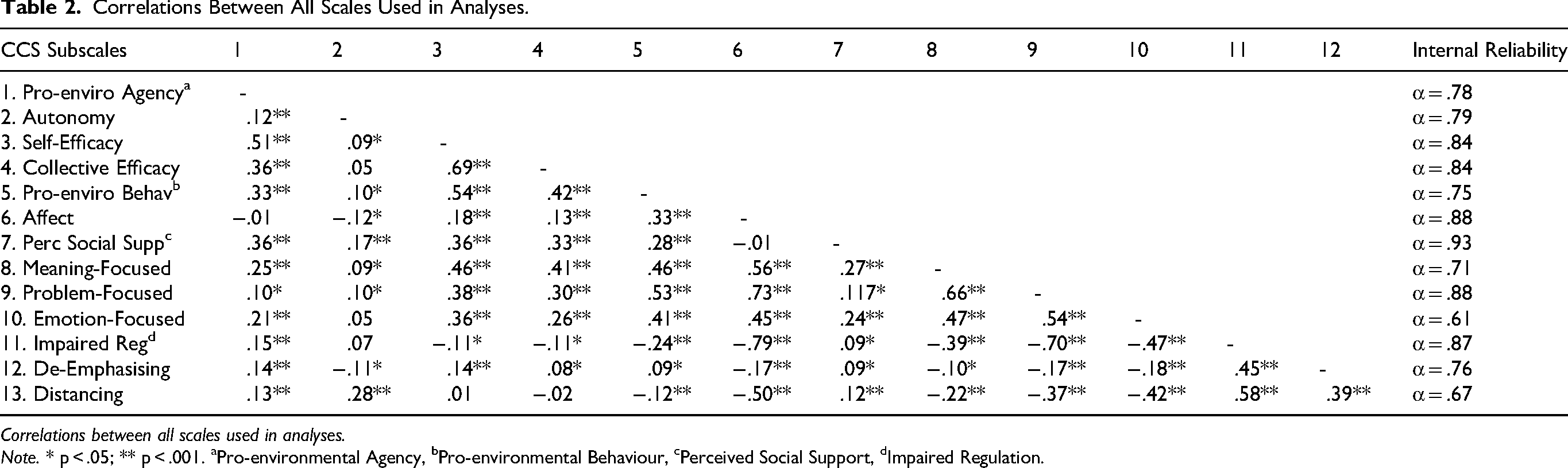
Correlations between all scales used in analyses.
Note. * p < .05; ** p < .001. aPro-environmental Agency, bPro-environmental Behaviour, cPerceived Social Support, dImpaired Regulation.
Young people who endorsed experience of a climate event had significantly higher means on meaning-focused coping, problem-focused coping, and emotion-focused coping compared to those who reported no direct experience of a climate event. Young people who did not endorse experience of a climate event had significantly higher means on impaired regulation and distancing. Cohen's d revealed these were relatively small effects, though the effect size of problem-focused coping approached a medium effect (Table 3).
Comparison of Means of the CCS Subscales, Between Young People who Reported Direct Experience of a Climate Event (N = 362) and Those who did not (N = 378).
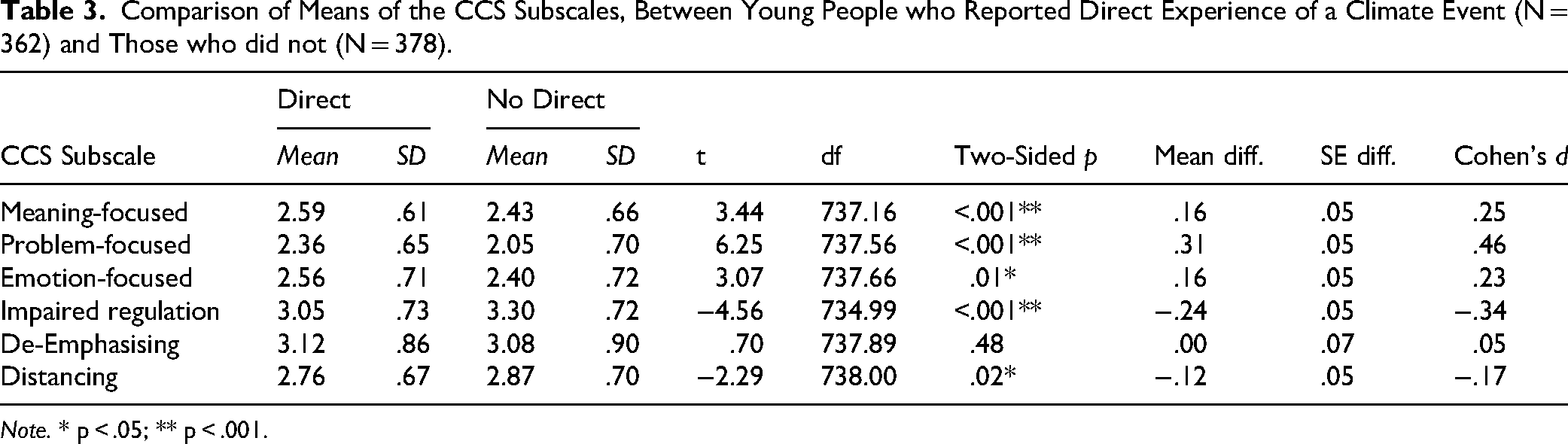
Note. * p < .05; ** p < .001.
Tables 4 and 5 provide a summary of univariate regression results. With very few exceptions, most predictors were positively associated with the three adaptive coping subscales. There were no significant negative associations with any of the adaptive coping subscales (Table 4). There were a mix of positive and negative associations between predictor variables and the three maladaptive coping subscales (Table 5). Affective symptoms of climate distress were negatively associated with all three maladaptive coping scales. Age and pro-environmental behaviour were both negatively associated with impaired regulation and distancing subscales. Pro-environmental behaviour was positively associated with de-emphasising. Social support and pro-environmental agency were both positively associated with all three maladaptive subscales. Autonomy was negatively associated with de-emphasising, but positively associated with distancing. Self-efficacy and collective efficacy were both negatively associated with impaired regulation and positively associated with de-emphasising.
Univariate Associations Between Predictor Variables and the CCS Adaptive Coping Subscales.
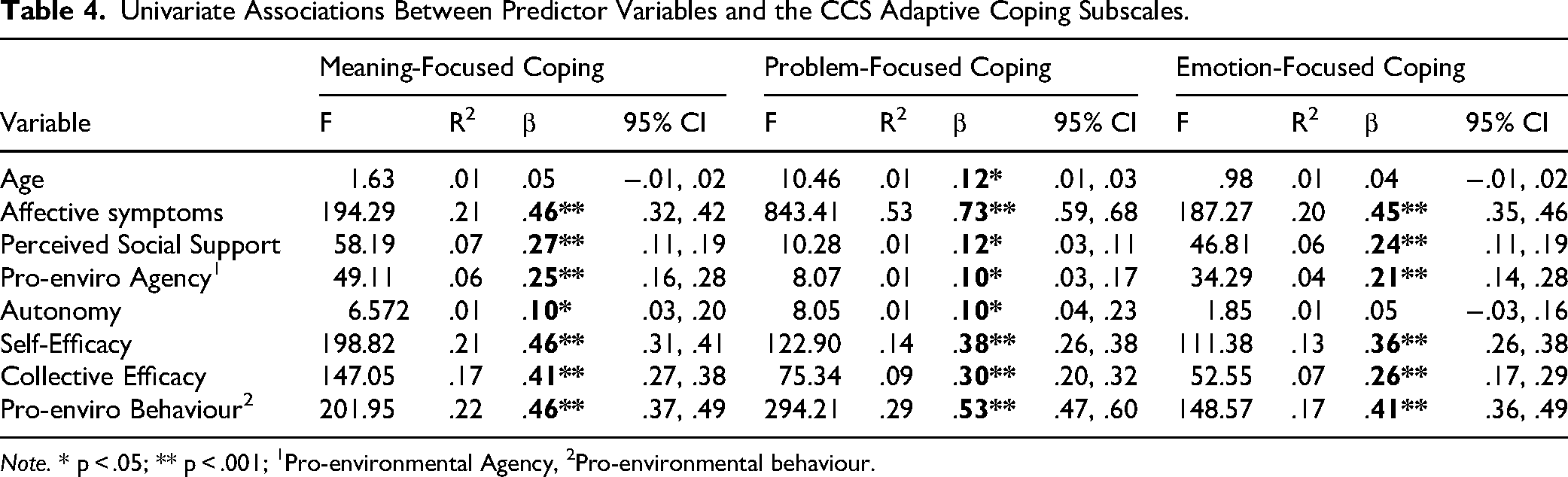
Note. * p < .05; ** p < .001; 1Pro-environmental Agency, 2Pro-environmental behaviour.
Univariate Associations Between Predictor Variables and the CCS Maladaptive Coping Subscales.

Note. * p < .05; ** p < .001; 1Pro-environmental behaviour.
Multivariate regression models are presented in Tables 6 and 7. Young people who experienced more affective symptoms of climate distress were more likely to engage in all three forms of adaptive coping, and also less likely to engage in all three forms of maladaptive coping. Across the two multivariate regression models (adaptive and maladaptive coping) and based on non-overlapping confidence intervals, affective symptoms were the strongest predictor of coping style. Youth who felt more socially supported were also more likely to use meaning-focused and emotion-focused coping. Greater pro-environmental behaviour was associated with more meaning-focused, emotion-focused, and problem-focused coping, but also greater de-emphasising the threats of climate change. Similarly, self-efficacy beliefs were associated with greater meaning-focused, problem-focused and emotion-focused coping, as well as greater de-emphasising the threats of climate change. Collective efficacy was only positively associated with meaning-focused coping. Pro-environmental agency was associated with reduced problem-focused coping, greater distancing and more impaired regulation. More autonomy was associated with greater meaning-focused coping, problem-focused coping and distancing, and less de-emphasising the threats of climate change.
Multivariate Associations Between Predictor Variables and the CCS Adaptive Coping Subscales.

Note. * p < .05; ** p < .001; aPro-environmental.
Multivariate Associations Between Predictor Variables and the CCS Maladaptive Coping Subscales.

Note. * p < .05; ** p < .001; aPro-environmental.
Discussion
The first broad aim of this study was to explore how affective symptoms of distress, age, pro-environmental behaviour and reported experience of climate events relate to coping in youth. Greater affective symptoms of climate distress were strongly positively associated with meaning-focused, emotion-focused and problem-focused coping, which supports the idea that distress and coping are closely related. The finding suggests that affective distress could act as a protective factor or facilitator for adaptive forms of coping. 7 This aligns with the theoretical model of climate anxiety and coping, which proposes that distress about climate change can elicit a cognitive and behavioural coping process, which may in turn influence emotional responses. 7 The finding that direct experience of a climatic event was also strongly related to adaptive forms of coping further supports the theoretical model. Taken together, these results suggest that the presence of affective symptoms of climate distress are not inherently harmful, but rather an emotional discomfort that can lead to adaptive forms of coping. Rather than focusing on reducing distress about climate change, it may be more important to validate emotional experiences and direct efforts to supporting adaptive coping in youth. 48 This may pave the way for psychological resilience towards climate change, but also other adversities encountered through the life course.
Young people who reported that they had not experienced a climate event were more likely to distance themselves from climate change and experienced a higher degree of impaired regulation. One hypothesis for this finding is that these young people are less likely to consider climate change to be a salient threat for them, and that their limited experience, tendency to distance, or the presence of more immediate stressors in their life, could inhibit their capacity or motivation to engage in adaptive coping. It is also possible that those who engage in greater distancing are less likely to identify experiences of ambiguous climate-related events such as air pollution or temperature rises over time. Regardless of the mechanism here, this finding highlights the need to consider the potential barriers for adaptive coping.
Youth who engaged with more pro-environmental behaviour tended to use all three adaptive coping strategies. These results align with the findings of previous studies on the role of pro-environmental behaviour and its relationship with meaning-focused and problem-focused coping.11,19 This suggests that by using adaptive coping strategies, young people are capable of actively engaging with the climate crisis in ways that can be protective of their mental health. Pro-environmental action will have positive flow-on effects for youth mental health long-term, given that it can contribute to mitigating climate change.
While emotion-focused and meaning-focused coping are associated with greater wellbeing, there is some evidence that problem-focused coping (which can include pro-environmental behaviour) is associated with negative affect. 20 Researchers have suggested this is because problem-focused coping can be distressing in situations where controllability is low.20,49 Agency in taking climate action is associated with greater climate distress in youth, 50 which might be related to the overall low controllability of climate change at the level of the individual. In the current study, young people with greater pro-environmental agency also tended to distance themselves more from climate change and had a higher degree of impaired regulation. It is possible that pro-environmental agency can inadvertently contribute to greater overwhelm and maladaptive coping in youth. This points to a need for young people to learn to act pro-environmentally in a way that does not over-exert them and lead to burnout. Rather than focusing solely on increasing agency to engage in climate action or pro-environmental behaviour, interventions could more helpfully support young people by strengthening agency to cope in the three adaptive ways, where there remains a certain degree of controllability at the level of the individual. Fostering a young person's ability to simultaneously navigate distress, meaning and action could develop climate related resilience long-term. It is important to consider support early, when young people are developing ideas about how best to cope with adversity. 51 This is underscored by our finding that younger age was associated with both greater distancing and higher levers of impaired regulation.
In line with self-determination theory, we also explored whether factors like autonomy, agency and efficacy beliefs (competence), and perceived social support (relatedness) would play a role in how young people cope with climate change. Self-efficacy beliefs were stronger for young people that used the three adaptive coping strategies, as well as for young people that de-emphasised the threats of climate change. This is interesting, given that this study found pro-environmental agency was associated with impaired regulation and distancing, whereas self-efficacy was associated with adaptive coping. Both phenomena appear to be positively associated with climate anxiety and distress.43,52 Climate self-efficacy is a self-reflective belief that one's actions can mitigate climate change. On the other hand, agency can be thought of as the power to evoke action, calling for a level of accountability, intention, knowledge, and self-efficacy. 33 Climate self-efficacy beliefs are an attempt to ameliorate the sense of helplessness and anxiety often evoked by climatic threats,52,53 which may arguably also drive pro-environmental agency and pro-environmental behaviour. The key distinguishing characteristic of self-efficacy and agency is belief versus action, respectively. While believing in and perhaps placing hope in one's own effectiveness at mitigating climate change could be associated with adaptive forms of coping, the responsibility in taking personal action might still be associated with overwhelm due to the low controllability of climate change. A combination of emotion-focused, meaning-focused and problem-focused coping, and the agency and efficacy to engage in each of these, may be most helpful for psychological resilience long-term. As expected, collective efficacy was associated with meaning-focused coping. This is not surprising given that meaning-focused coping involves having hope, trust and cognitively reappraising climate change by acknowledging current mitigation efforts.
Autonomy was positively associated with meaning-focused coping, problem-focused coping and distancing. In the current study, autonomy reflected a young person's sense of independence and freedom in their own actions. Specifically, this sense of independence related to their attitudes, emotional autonomy and functional autonomy. Autonomy could be a key facilitator or prerequisite for adaptive coping and psychological resilience toward climate change. For example, young people likely need to achieve a level of autonomy in order to manage their wellbeing and take up opportunities for growth in the face of climatic threats. The finding that greater autonomy was associated with less de-emphasising the threats of climate change further supports this idea.
It is important to acknowledge that autonomy can be influenced by environmental factors. For example, a young person's capacity to realise autonomy may be cultivated or constrained by relational, sociocultural and socioeconomic factors.35,54 Intervention should therefore look beyond individual support and identify ways in which families and communities can help youth to cultivate a sense of autonomy. For example, creating opportunities for young people to share their views, or choose and enact mitigation strategies that are values aligned.
Perceived social support was related to meaning-focused and emotion-focused coping. It is important to acknowledge that the MPPS is a measure of perceived social support and does not reflect whether actual social support was received or accessed. There are several potential explanations for why young people draw on meaning-focused and emotion-focused coping if they feel more socially supported. For example, young people could feel more supported when surrounded by people that share similar views on climate change, or who might be open to discussing the issue. Social support is thought to be a key factor in resilience to stress, and evidence shows it may attenuate the negative impacts of PTSD on functioning. 55 Feeling socially supported could mean that a young person also feels they are more able, capable and have greater resources to engage in adaptive forms of coping. Helping young people to feel more supported, whether through peer, family and community relationships, may therefore be integral to youth wellbeing through climate adversity but also other life stressors.
Limitations and Future Directions
This study is limited by its cross-sectional design and convenience sampling, and longitudinal research is needed to test the proposed explanations in a design where it is possible to test for temporality. The reported associations may be bidirectional and may also change according to how climate change evolves over time. Replication in different youth populations, culturally and geographically, is needed. This is especially important considering that the CSS was validated using the current sample, and internal reliability on some of the coping subscales was limited. Future research might also extend this work by examining the multiple, complex relationships between variables, using approaches like Structural Equation Modelling (SEM). Among these relationships, wider socio-ecological factors could also be explored. Specifically, whether cultural, socio-economic and geographic factors modify the relationships found between age, pro-environmental agency, efficacy, autonomy and perceived social support on coping. 24
Conclusion
Discourse on youth mental health and climate change is growing, and this study provides evidence on factors associated with adaptive or maladaptive forms of coping. Enhancing a young person's capacity for adaptive coping to climate change might be achieved through helping foster a sense of autonomy, collective efficacy beliefs, and perceived social support. Pro-environmental behaviour (agency and efficacy beliefs) is a strategy that should be used in combination with meaning-focused and emotion-focused coping strategies. This is because problem-focused coping, agency and efficacy beliefs are likely closely connected to feelings of control, which is difficult to attain and sustain in the context of climate change. Affective symptoms of climate distress were associated with more adaptive coping, and less maladaptive coping. Overall, the current study's findings support the conclusion that feelings of anxiety and distress toward climate change are a reasonable response, and perhaps an important part of the adaptive coping process.
Supplemental Material
sj-docx-1-css-10.1177_24705470261437486 - Supplemental material for Coping with Climate Change: Correlates of Adaptive and Maladaptive Coping in Young People
Supplemental material, sj-docx-1-css-10.1177_24705470261437486 for Coping with Climate Change: Correlates of Adaptive and Maladaptive Coping in Young People by Tara J. Crandon, James G. Scott, Fiona J. Charlson and Hannah J.Thomas in Chronic Stress
Footnotes

Funding
The authors disclosed receipt of the following financial support for the research, authorship, and/or publication of this article: This work was supported by the QIMR Berghofer Medical Research Institute, (grant number PhD Scholarship awarded to the first author (2020-).
Declaration of Conflicting Interests
The authors declared no potential conflicts of interest with respect to the research, authorship, and/or publication of this article.
Supplemental Material
Supplemental material for this article is available online.