



Abstract
Decision-making in military occupations is vital for operational success and personnel safety and relies on situational awareness, executive control, and strategic alignment of operational goals. This study examined the effects of acute operational and passive heat stress on cognitive performance in a randomized controlled trial with 68 service members. Participants were assigned to either a low- or high-stress group and completed two military scenarios using a desktop simulator. Passive heat stress was applied only to the high-stress group in a portable environmental facility. Decision-making and situational awareness were scored from scenario recordings, while executive functioning was assessed through a cognitive test battery. In addition to the group comparison, a heat index capturing individual variability in thermal strain was calculated. Contrary to expectations, heat stress did not impair cognitive performance across most domains. Decision-making performance actually improved over time in the high-stress group, with significantly better performance during the second assessment compared to the low-stress group. Cognitive flexibility also improved significantly within both groups. These changes are attributed primarily to learning effects rather than stress-induced performance. Situational awareness showed no significant differences between groups. Exploratory heat index analyses revealed that participants in the high heat index group exhibited increased situational awareness over time, suggesting a possible inverted U-shaped relationship between thermal strain and performance. In contrast, inhibition improved only in the low heat index group. Together, these findings emphasize that the heat stress protocol may not have been potent enough to generate the cortisol response needed to detrimentally affect higher-order cognition. Nevertheless, the findings highlight that thermal strain can interact with cognitive performance in complex, nonlinear ways. While passive heat stress remains a promising stressor for research, its effect may only become fully apparent under more intense or physiologically demanding conditions, warranting further investigation into its potential impact on higher-order cognitive functions in military contexts.
Introduction
Decision-making in the military domain is a critical process that underpins the success of operations and the safety of personnel. This process is guided by a thorough assessment of the situation, consideration of potential risks and benefits, and the alignment of choices with strategic objectives. 1 Military decision-making is complex, as it must account for numerous variables, including environmental conditions, provision of information, and enemy actions, all while operating under significant psychological and physical stress. Moreover, the nature of military operations demands that the decisions be made swiftly, as even small errors can lead to negative consequences, including mission failure or loss of life, amplifying the need for robust decision-making abilities.
Effective decision-making in ambiguous situations relies heavily on the cognitive processes known as executive functions.2,3 The core components—comprising working memory, inhibitory control, and cognitive flexibility — facilitate the ability to resist impulses, retain and process information, and adapt to changing circumstances. To put this in the military context, these functions enable individuals to plan, make decisions, solve problems, and pursue goal-directed actions. 4 Equally important to the process of decision-making is situational awareness (SA), which involves the perception, comprehension, and projection of environmental elements. 5 SA provides the essential context within which executive functions operate, ensuring that decisions are informed by a real-time understanding of the surrounding environment.
However, cognitive performance may be significantly affected in high-stress situations. Acute stress either has an ameliorating or a deteriorating effect on human performance in general, depending on the severity of the stressor and which aspect of human performance is required for that specific situation. 6 For example, mild stress is believed to either improve or prolong executive functioning until a certain threshold has been reached and stress is experienced as severe, which eventually impairs performance. This stress-performance relationship can be represented as an inverted-U curve. in military populations, working memory remained mostly stable after exposure to a mild operational stressor, 7 or in mild thermal conditions, 8 whereas more severe stressors, such as more extreme thermal conditions 8 and intense military operations9–13 caused a decline. Conversely, inhibitory control demonstrated stability in high-stress, military training environments,14–16 but was impaired following a 4-h fatiguing scenario. 17 Given the significance of these processes in military operations, surprisingly, research on the effects of acute stress on cognitive flexibility is limited in military populations. Only a single study demonstrated impaired cognitive flexibility as a result of heat stress in a desert environment. 18 Similarly, the effect of acute stress on SA has not been researched extensively because (hyper)vigilance was traditionally a more relevant construct in military decision-making, 19 yet appears to be disrupted. 20 To our knowledge, this is the first study to evaluate how executive functioning and SA are affected by heat and operational stress in a controlled, virtual military setting.
Accordingly, the effects of acute stress on decision-making can be explained by diminished cognitive functions through the dual-process theory. 5 The theory suggests that with intact attention and working memory, decision-making will be carried out through a slow, cognition-driven, top-down process. Contrarily, if cognitive processes are impaired, decisions will be made through a fast, emotion-driven, bottom-up process, losing cognitive control and leading to impaired decision-making. In conformity with the dual-process theory, police officers were less accurate during a stressful situation in a shooting task compared to officers not exposed to stress, albeit with a faster reaction time. 21 Moreover, military subjects decided to pull the trigger more often in a high-stress condition compared to subjects in a low-stress condition and performed worse at identifying friend from foe. 22 Furthermore, stress has negatively affected performance in various decision-making tasks, demonstrating increased risk-taking and gambling,23–25 decreased trusting behavior, 24 and less advantageous choices. 26
As a consequence, military personnel are trained vigorously on mitigating the negative effects of stress by strengthening the bottom-up process so military personnel can perform at high levels continuously. Stress inoculation methods are often used to induce acute stress in ecologically valid ways, referring to sustained operations (SUSOPS) training 13 or Survival, Evasion, Resistance, and Escape (SERE) training. 10 Unfortunately, these methods of training are strenuous and difficult to monitor for stress and performance parameters (eg, taking blood samples, doing cognitive assessments) because this would interfere with the continuity and realism of the training.
Adopting the principles of these stress inoculation programs, the use of virtual stress-inducing scenarios presents a controllable laboratory environment that allows military personnel to act on stress appraisal. This can influence cognitive resilience and may result in enhanced operational performance. 27 In addition, controllable (virtual) environments present the opportunity to enhance stress appraisal and cognitive readiness through repeated exposure.
This paper represents the second phase of a broader investigation into the effects of virtual operational stress and passive heat exposure on military personnel. Both this study and our earlier investigation 28 used the same experimental design, in which participants were divided into a low-stress and a high-stress group. Participants of both groups completed two immersive military virtual scenarios and underwent cognitive testing and situational awareness assessments. The high-stress group was additionally exposed to passive heat, while the low-stress group operated under thermoneutral conditions. The inclusion of heat exposure served to provide a controlled, reproducible physiological stressor that complements the psychological demands of operational tasks. 29 While heat stress has increasing relevance in civilian and occupational contexts due to global climate change, 30 the current study primarily functions as an experimental tool to induce acute physiological strain in a manner that is both ecologically valid and experimentally tractable for military operations.
In the previous part of this study, 28 we found that although the combination of passive heat and virtual combat scenarios elicited a clear physiological stress response—most notably in HR and HRV—there was no accompanying psychological stress response, as cortisol, alpha-amylase, and subjective stress levels remained unchanged. While the presence of a psychological stress response remains uncertain; even mild physiological strain—whether due to environmental heat, cognitive workload, or their interaction—has the potential to impact executive functioning and decision-making. Therefore, investigating cognitive performance under these conditions remains relevant, particularly in military settings. Based on these earlier findings and the supporting literature on stress and cognition, we hypothesize that the mild physiological strain observed in the high-stress group may impair working memory and cognitive flexibility, but not inhibitory control as it appears less sensitive to acute stress. Additionally, we anticipate that decision-making performance and situational awareness will be reduced in the high-stress (heat-exposed) group. No change in executive functioning and decision-making is expected in the low-stress group (thermoneutral). Although this study focuses on acute operational and heat stress, these short-term responses form the foundation for understanding how repeated exposures contribute to chronic stress adaptation. Examining the immediate cognitive and physiological mechanisms of stress provides translational insight into early biomarkers and processes that may predict long-term resilience or vulnerability, which are key priorities for the field of chronic stress.
Methods
This study was preregistered at OSF (www.osf.io, ENDURE) and approved by the Medical Research Ethics Committee of Utrecht University Medical Center (NedMec).
Participants
Sixty-eight healthy service members (57 males / 11 females) were recruited from various military bases of the Dutch Ministry of Defence. Participants were drawn from all military units and represented a diversity of military ranks, categorized into three subgroups: 16 enlisted, 26 non-commissioned officers, and 26 commissioned officers. This study imposed an age restriction between 18 and 40 years old. Because the study included a gaming aspect, it was believed that older subjects could encounter more difficulties, triggering a different stress response (eg, frustration). The mean age in this study sample was 30.31 (SD = 4.93). No significant differences in demographics were observed between groups (Table 1).
Demographic Characteristics of the Study Population.

Individuals with current psychiatric or neurological disorders, endocrine, cardiovascular, pulmonary, or sleep disorders were excluded from participation. Additionally, individuals currently using prescribed medication (except contraception), with alcohol or substance dependence, undergoing current psychotherapeutic treatment, or with a history of heat-related medical issues were also excluded. These exclusion criteria were confirmed during a screening procedure conducted on the day of testing, after written informed consent was provided. However, participants were informed of these criteria in advance. Moreover, participants were instructed to adhere to the following guidelines: 1) abstain from smoking for at least two hours before the experiment, 2) refrain from consuming food and caffeinated beverages for at least one hour before the experiment, 3) be awake for at least one hour before the experiment, and 4) avoid strenuous exercise, alcohol consumption, and substance use on the night before and the day of the experiment. Additionally, all participants were instructed to wear their respective military combat uniforms, including a helmet; if unavailable, a beret was worn (N = 3).
Based on a recent meta-analysis 31 and setting α at .05 (two-sided) with an effect size of 0.70 for the effect of stress on executive functions, an a priori power calculation to test the difference between two independent means (t-test) determined that 68 participants were required to achieve a power of 0.80 (G*Power, v3.1).
The authors assert that all procedures contributing to this work comply with the ethical standards of the relevant national and institutional committees on human experimentation and adhere to the Helsinki Declaration of 1975, as revised in 2008.
Study Design
This study was conducted at a military base in Soesterberg, The Netherlands. Data collection occurred on weekdays between 10:00

A schematic overview of the study procedure and measurements. At the start of the study, participants are randomized into either the low- or high-stress condition. Participants in the low-stress group perform under thermoneutral conditions, whereas the high-stress group is exposed to passive heat stress.
Stress Conditions
Operational stressors were used to provoke a stress response. Using Virtual Battle Space 4 (VBS, Bohemia Interactive®), a military simulator, participants engaged in two stress-inducing military scenarios, which encapsulated combat situations, ambushes, time constraints, and feelings of uncertainty and uncontrollability. Scenario order was randomized and scenarios lasted approximately six to seven minutes, whereas the training scenario lasted about three minutes. The training scenario contained no stress-inducing elements, and was solely developed to get acquainted with the software and its controls.
Furthermore, passive heat stress was induced in a portable environmental facility in the high-stress condition (PEF, Tectoniks Ltd, Kinton, Nesscliffe, Shropshire, UK). Passive heat refers to a condition in which the subject is subjected to elevated thermal conditions without engaging in physical activity requiring metabolic heat production. In the low-stress condition, participants completed the VBS scenarios at thermoneutral conditions (22.4 ± 1.2 °C and 41.4 ± 4.4% RH). Conversely, in the high-stress condition, the same VBS scenarios were completed in more extreme conditions (35.9 ± 1.6 °C and 66.4 ± 10.4%). These conditions have been shown to elicit a significant physiological response.32,33 Heat exposure lasted for approximately 45 min.
In the low-stress group, the mean temperature in the PEF was 22.4 ± 1.2 °C (72.32 ± 3.96°F), accompanied by a relative humidity of 41.4 ± 4.4%. Conversely, the high-stress group operated in an average temperature of 35.9 ± 1.6 °C (96.62 ± 2.88°F) and a relative humidity of 66.4 ± 10.4%. However, the intended temperature and humidity levels for the high-stress condition were not consistently met across all participants, due to fluctuations caused by technical issues with the PEF system. As a result, this variation may have led to less heat strain than originally anticipated. 28
Measurements
Executive Functioning
A cognitive test battery was administered via a laptop computer (HP ProBook 450 G9) and lasted approximately 20 min. The test battery was first administered outside the PEF to establish baseline performance. At the end of the experiment it was administered again, this time inside the PEF under either low-stress or high-stress conditions. The three cognitive tests used were the Spatial Span (SS), the Stop-Signal Task (SST), and the Wisconsin Card Sorting Task (WCST) and were completed in that order on both administrations. Participants wore headphones in order to minimize any distracting stimuli. The SS and the SST were preceded by a practice trial during which feedback was provided on the accuracy of the responses. The WCST contained no practice trial to eradicate any learning effect. All tests are depicted in Figure 2.

An overview of the cognitive test battery for executive functioning. A) the Spatial Span task; B) the Stop-Signal task; C) the Wisconsin Card Sorting task.
Working Memory
The SS was used to assess working memory. During the test, participants had to select stimuli (which appeared as a square shape) in the same order that was indicated by sequentially highlighted squares. The number of stimuli in the sequence increased from a sequence of two in the first trial, to nine in the final trial. Each trial had to be completed twice. In total, the test consisted of 16 trials. The location across the screen and the sequence of the stimuli was randomized in every trial. Participants were instructed to use a computer mouse to click the stimuli in the correct order, and do so as quickly as possible. Outcome measures of the SS are the number of false sequences, the longest sequence successfully recalled, total number of errors, and reaction time.
Inhibitory Control
The SST was used to assess inhibitory control. Here, participants were instructed to press the left arrow key when a left-pointing arrow was presented, and the right arrow key when a right-pointing arrow was presented. When an auditory stimulus (a loud beep) was presented, participants had to withhold their response and not press any key. This task consisted of 128 continuous trials, with 25% of trials presenting an auditory stimulus. Each stimulus was presented on screen for 500 milliseconds. Subsequently, there was a 500 millisecond period where no stimulus was presented before proceeding to the next trial. Outcome measures were direction errors (pressing the wrong key), the proportion of correct stops, and the reaction time on “Go” trials.
Cognitive Flexibility
The WCST was used to assess cognitive flexibility. In this task, participants were instructed to match the presented cards to a specific category. The reference cards have three possible categories: color, shape, or number of figures on the card. Participants are not told how the presented card should be categorised, but they are given feedback whether the chosen response is correct or incorrect. Using the feedback, they have to reason to what category the presented card belongs. After ten consecutive correct responses, the category changes. The order in which the categories are presented is randomized. When an incorrect response is given, the counter resets and the participants has to again, give ten consecutive correct answers. The task is completed when ten correct responses are given in each category, or when a participant uses all the cards. Outcome measures are the number of errors, latency (time to choose a card), perseverative errors (when an incorrect response matches the previous sorting rule), non-perseverative errors (when an incorrect response matches a sorting rule other than the previous rule), and the number of cards used.
Virtual Battle Space
In this study we did not only use VBS for stress inoculation, but also as a tool to measure SA and decision-making by evaluating the actions of participants. This was made possible through the in-game After Action Review (AAR) which enabled us to record, bookmark, and replay each scenario, helping us analyze and score performed behaviors in a later stage. The AAR is depicted in Figure 3.
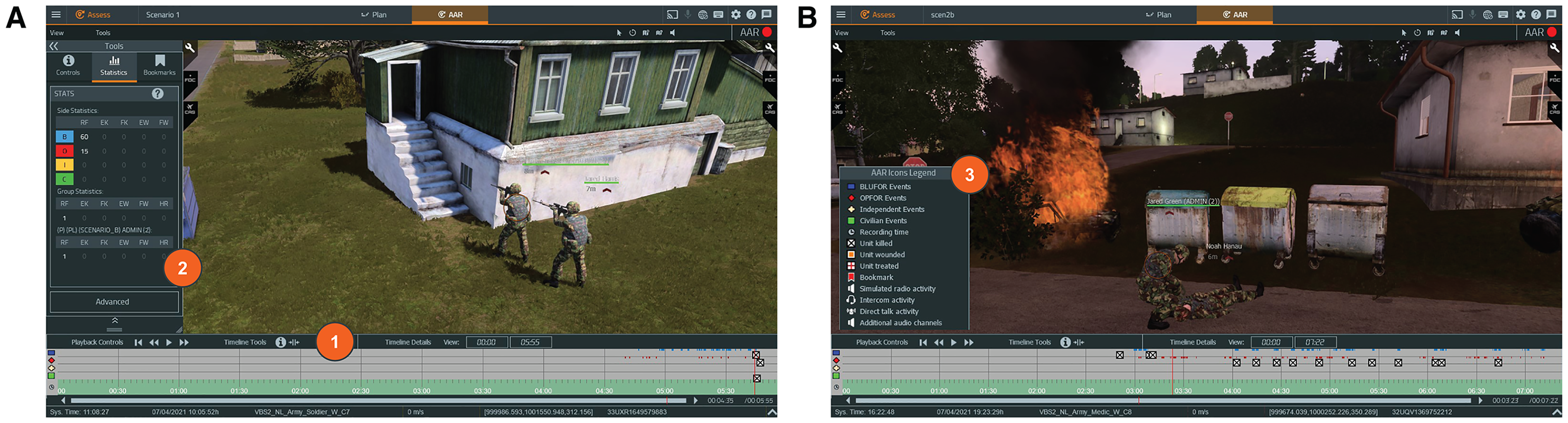
An overview of the after action review user interface. A) a screenshot of a participant engaging in a combat situation in scenario 1; B) a screenshot of a participant helping a wounded soldier in scenario 2. The AAR features 1) a timeline grid that displays timeline details and enables playback options, 2) a statistics window that displays the statistics of the selected unit, 3) recorded events that display OPFOR and BLUFOR actions.
Situational Awareness
The assessment of SA was two-fold. First, questionnaires were administered after each VBS scenario wherein seven questions needed to be answered. These questions adhered to level 1 (perception) and 2 (comprehension) of the Situation Awareness Global Assessment Technique (SAGAT). 34 Second, SA was assessed in the AAR by assigning points when the participants noticed specific details in the scenario. In total, participants could earn a score up to 15 points in scenario 1 and 9 points in scenario 2. Higher scores indicated better SA. An overview of the SA items including correct responses are shown in Supplementary Tables 1 and 3.
Decision-Making
Decision-making was measured by analyzing actions of participants in the VBS scenarios. An elaborate overview of the scenarios is provided in the Supplementary Information. Participants were debriefed on the goal of the scenarios beforehand and were instructed to take action as they saw fit. A decision-making model was established with the help of three independent military experts which allowed us to reliably score correct actions made by the participants. The assessors were blinded to the participants’ stress condition during scoring. The number of points that were assigned to the actions depended on the criticality of the action for survival of the player and others, and the goal of the mission. Participants were able to score 34 points in scenario 1 and 29 points in scenario 2. The models for each scenario are shown in Supplementary Tables 2 and 4. Because the total number of points was not equal, proportions of the total scenario score were used to compare decision-making performance between scenarios. Possible effects of gaming frequency (non-frequent or frequent), combat experience (nominal) and years of service on decision-making performance were also explored. Furthermore, the time until the participant performs an action (time-to-first-action: TTFA) was estimated in both scenarios as a measure of decision-making speed. The TTFA reflects the time from the moment the ambush starts to the first decision being made. Exploratory measures from scenario 2 also included the number of shots fired and hit ratio.
Heat index
To further explore whether variations in heat exposure influenced cognitive performance, we conducted additional analyses using the individual heat index (HI) 35 as an indicator of experienced heat stress. Although all participants were assigned to either the low-stress or high-stress condition, the actual heat index values within the high-stress group varied across individuals. Therefore, we examined whether this variability was associated with changes in decision-making, situational awareness, and executive functioning across sessions.
The mean heat index in the low-stress group was 25.07 ± 0.10 °C (77.09 ± 0.17°F) and 51.40 ± 3.91 °C (124.52 ± 7.04°F) in the high-stress group. Because the low-stress group exhibited minimal variation in heat index, we analyzed data with participants categorized into three exposure groups based on their heat index: low (<27 °C; N = 35), high (32-51 °C; N = 14), and very high (>51 °C; N = 19). 36 Full model specifications and additional results are presented in the Supplementary Information.
Statistical Analysis
To analyze the effects of acute stress on our primary outcome measures (executive functioning, decision-making, and situational awareness), we employed either linear mixed models (LMMs) or generalized linear mixed models (GLMMs) accounting for fixed effects (eg, group and time). For dependent variables that met the normality assumption, LMMs were used; otherwise, GLMMs were applied to accommodate non-normal distributions. When data were positively skewed, a gamma regression was specified as the target distribution. Normally distributed variables included decision-making, situational awareness, and the number of errors during the spatial span task, while all remaining variables violated the normality assumption. LMM and GLMM analyses included the interaction term between group and time. In cases where either the main effects or the interaction term reached statistical significance, post hoc tests were conducted to explore within-group differences across time. Covariates were added as fixed effects to control for additional variance in the dependent variable. Random intercepts for participants were specified to account for repeated measures, provided the model successfully converged. Due to convergence issues, only random intercepts (and not random slopes) were included in the final models. For decision-making and situational awareness, the inclusion of a random intercept did not improve model fit and was therefore omitted.
Exploratory measures (eg, rounds fired and hit rate) were analyzed for between-group and/or within-group differences using the Mann-Whitney U test and the Wilcoxon signed-rank test, respectively.
Significance was determined at α = .05. Given that the present study focused on preregistered primary outcomes (decision-making and situational awareness), no correction for multiple testing was applied to these analyses. Multiple comparison corrections (FDR) 37 were, however, applied to secondary measures., whereas the p-values for primary outcome measures and exploratory analyses were not corrected.
All analyses were performed using SPSS version 29.0.1.1.
Results
All 68 participants that were enrolled completed the study (Table 1). However, multiple data points had to be excluded from analyses. Scenario 2 of VBS experienced occasional technical glitches, resulting in data loss for three participants for analyses of SA and decision-making (N = 65). Additionally, the SST data (proportion of correct stops) from five participants was excluded due to ignored auditory stimuli (N = 63), and WCST data from one participant was lost due to a technical difficulty (N = 67).
Decision-Making
In analyzing decision-making performance between groups, no significant difference was found between the low-stress and high-stress groups (Figure 4A), t(63) = −1.189, p = .239.

An overview of A) the difference in total decision-making score between groups, B) the changes over time, and C) the time-to-first-action for each scenario shown as mean ± SD. Scores for A and B are depicted as proportions of the maximum score. Note. * p < .05, ** p < .01, *** p < .001 (between-group differences).
When assessing whether heat exposure over time influenced decision-making scores, the LMM analysis revealed no significant main effect of time, F(1, 129) = 0.125, p = .724 or group, F(1, 129) = 0.822, p = .366. There was, however, a significant interaction effect, F(1, 129) = 5.071, p = .026 (Figure 4B, Table S6). The model accounted for approximately 4.5% of the variance in decision-making performance (marginal R2 = conditional R2 = .045). Post hoc tests revealed that while decision-making scores did not significantly change over time within either group, scores were significantly higher at T3 in the high-stress group compared to the low-stress group (p = .031). Thus, at T3 the high-stress group showed increased decision-making performance.
To further evaluate decision-making, differences in TTFA between groups were analyzed for both scenarios. However, no significant differences were observed between groups for either scenario (Figure 4C, Table S11), meaning that decision-making speed was not affected by heat stress.
We next examined whether scenario order affected decision-making, providing insights into whether a specific scenario might have been more challenging than the other. Interestingly, in both stress groups, decision-making performance decreased significantly when scenario 2 was administered last (Figure S1, p < .0001). However, when scenario 2 was administered first, decision-making improved significantly in scenario 1 (p = .014).
Situational Awareness
To investigate potential differences in SA, the total SA scores across time points were analyzed between the low-stress and high-stress groups. An independent samples t-test revealed no significant difference between groups (Figure 5A), t(63) = −1.137, p = .260, indicating that additional heat exposure did not impact SA.
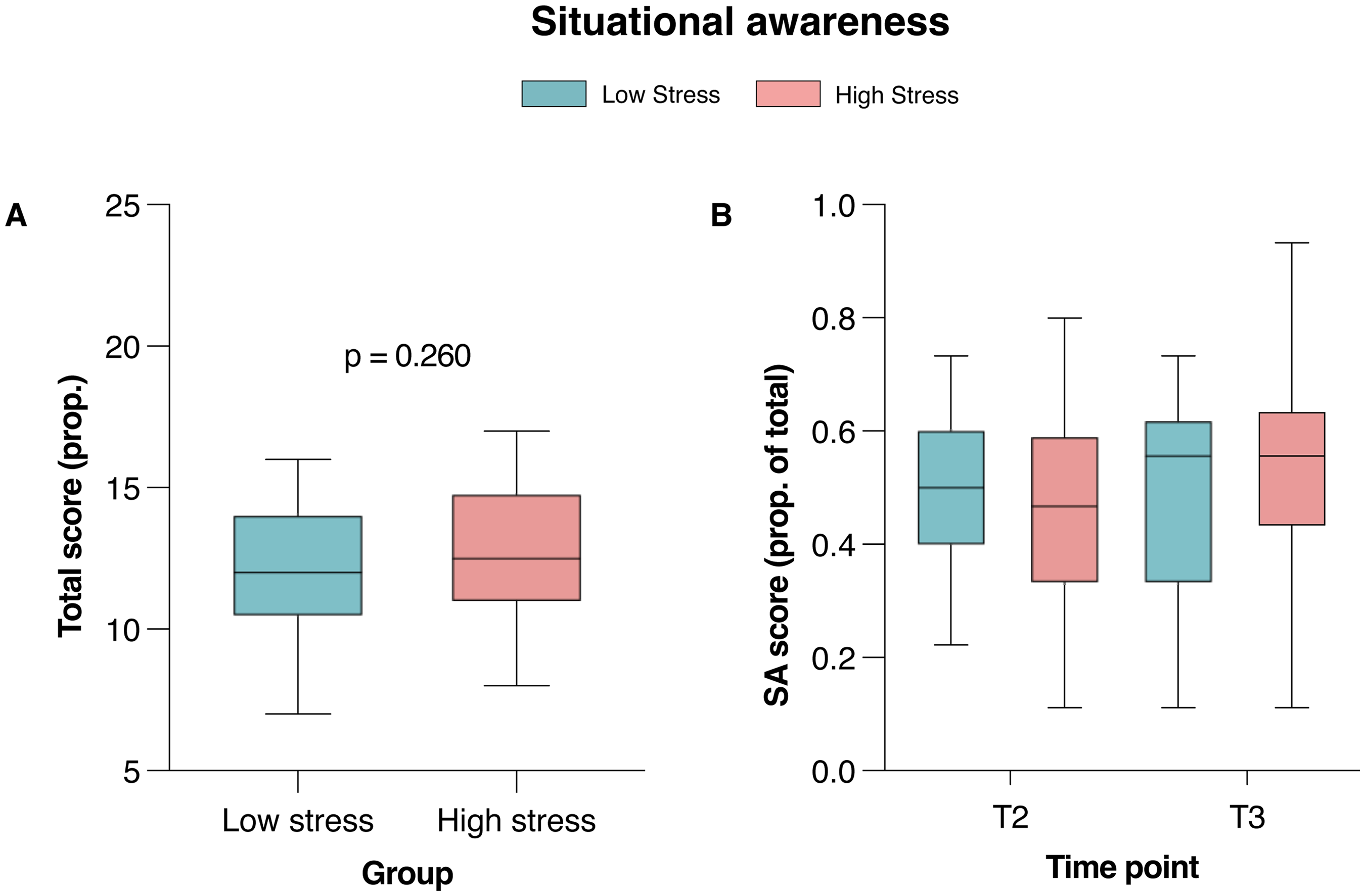
An overview of A) the difference in total situational awareness score between groups and B) the changes over time shown as mean ± SD. Scores are depicted as proportions of the maximum score.
To examine whether prolonged heat exposure affected SA over time, a LMM was employed. Results indicated no significant effects of time, F(1, 129) = 1.224, p = .271, group, F(1, 129) = 0.169, p = .681, or their interaction, F(1, 129) = 1.896, p = .171 (Figure 5B, Table S6), suggesting that prolonged exposure had no effect on SA.
Covariates
Years of Service and Combat Experience
To further investigate potential factors influencing decision-making performance and situational awareness, we included deployment experience and years of service as covariates in the analysis. These variables were examined to determine whether they accounted for additional variance in decision-making performance beyond the effects of the primary fixed factors. The results indicated that for decision-making neither years of service (p = .321) nor deployment experience (p = .407) was a significant covariate, suggesting they did not contribute meaningfully to the model. In SA models, years of service (p = .623) and deployment experience (p = .884) were also not significant contributors.
Gaming Frequency
Similarly, frequent gaming (3± hours per week) did not appear to have a significant effect on decision-making performance (p = .332) or on SA (p = .885), as it did not significantly contribute to either model.
Executive Functioning
Working Memory
To examine differences in working memory, the total number of errors and false sequences were analyzed. Both measures were evaluated with a model incorporating fixed effects for group, time, and their interaction. For total errors, no significant main effect of time, F(1, 132) = 3.396, p = .070, or group, F(1, 132) = 0.06, p = .807, were observed. The interaction was also non-significant, F(1, 132) = 0.332, p = .566 (Figure 6A, Table S6). Similarly, for false sequences, the effects of time, F(1, 132) = 2.188, p = .142, group, F(1, 132) = 2.254, p = .136, and their interaction, F(1, 132) = 0.062, p = .804, were non-significant (Figure 6B, Table S6). This indicated that working memory was not affected by stress exposure.
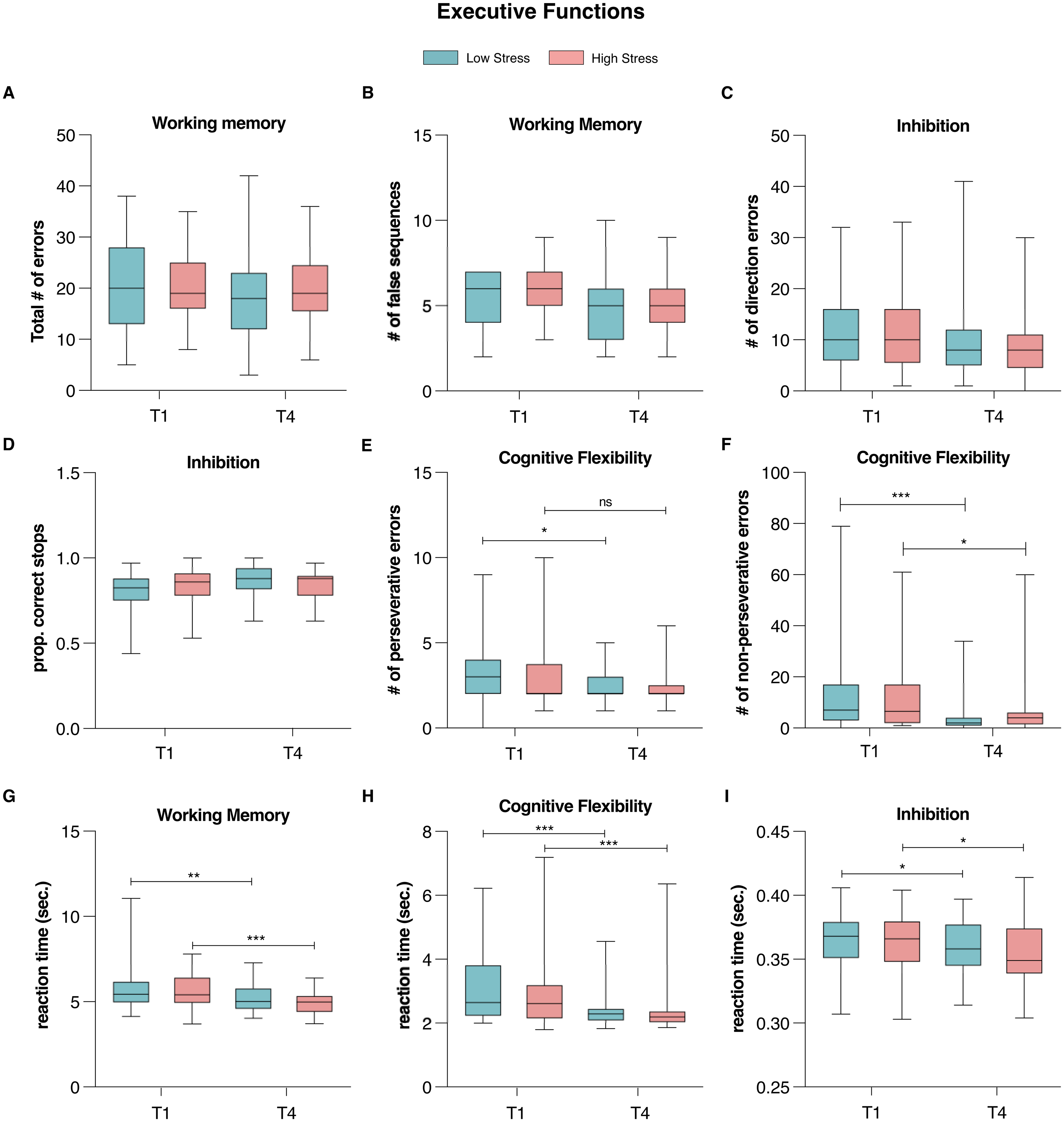
An overview of all executive functioning outcome measures shown as mean ± SD. Timepoints represent baseline levels of cognitive performance and post-stress performance. Figures G-I depict mean reaction times in seconds. Note. * p < .05, ** p < .01, *** p < .001 (between-group differences).
Inhibitory Control
Inhibitory control was assessed by the proportion of correct stops in no-go trials and the number of direction errors. For the proportion of correct stops, a significant main effect was observed for time, F(1, 125) = 10.133, p = .002, but not for group, F(1, 125) = 0.113, p = .737, yet there was a significant interaction, F(1, 125) = 5.586, p = .020. However, while the effect of time remained significant after FDR correction (p = .009), the interaction did not remain significant (p = .072) (Table S6). Post hoc tests revealed there was a significant increase in the proportion of correct stops in the low-stress group (p < .001; Figure 6C). Performance in the high-stress group remained stable (p = .402).
For direction errors, there was also a significant effect of time, F(1, 128) = 13.104, p < .001, but not for group, F(1, 128) = 0.209, p = .648, or their interaction, F(1, 128) = 0.254, p = .615 (Table S6). Post hoc tests showed that there was a significant decrease in the number of direction errors in the high-stress group only (p = .002; Figure 6D).
Cognitive Flexibility
Cognitive flexibility was measured by the number of perseverative and non-perseverative errors. For perseverative errors, there was a significant main effect of time, F(1, 130) = 13.421, p < .001, but no main effect of group, F(1, 130) = 1.680, p = .197. The interaction between time and group was also not significant, F(1, 130) = 0.002, p = .962 (Figure 6E, Table S6). Post hoc tests revealed a significant decrease in perseverative errors in the low-stress group (p = .028), though this effect was not observed in the high-stress group (p = .093). However, there was no significant difference between the groups either at either baseline or follow-up. For non-perseverative errors there was also a significant main effect of time, F(1, 124) = 38.187, p < .001, but not of group, F(1, 124) = 0.425, p = .516, or their interaction, F(1, 124) = 2.059, p = .154 (Figure 6F, Table S6). Post hoc tests indicated a significant decrease in non-perseverative errors for both the low-stress (p < .001) and high-stress group (p = .028).
Reaction Time
For reaction times on the spatial span task there was a significant main effect of time, F(1, 132) = 34.357, p < .001, but no significant main effect of group, F(1, 132) = .303, p = .583, nor a significant interaction, F(1, 132) = .885, p = .349 (Figure 6G, Table S7). Post hoc tests revealed a significant decline in reaction times for both the low-stress (p < .001) and the high-stress group (p < .001). There was no significant difference between groups at either timepoint.
For reaction times on the SST there was a significant main effect of time, F(1, 65.463) = 8.265, p = .005, but no significant effects of group, F(1, 66.152) = .002, p = .965, or their interaction, F(1, 65.463) = .337, p = .563 (Figure 6H, Table S7). The model showed a marginal R2 of .020 and a conditional R2 of .691, indicating substantial variance explained by random effects. Post hoc tests revealed a significant decline in reaction times for both the low-stress (p = .036) and the high-stress group (p = .045).
Reaction times on the WCST demonstrated a significant main effect of time, F(1, 131) = 19.319, p < .001, but not of group F(1, 131) = .000, p = .997, nor a significant interaction F(1, 131) = .077, p = .782 (Figure 6I, Table S7). The model showed a marginal R2 of .118 and a conditional R2 of .118. Post hoc tests revealed a significant decline in reaction times in both groups (p < .001).
A summary of primary and secondary outcome measures is depicted in Table 2. Estimated means and confidence intervals were also reported for analyses that showed either a significant main effect or a significant interaction (Table S10).
A Summary of the Primary, Secondary, and Additional Cognitive Outcome Measures Across the Experimental Time Course per Stresscondition.

Heat Index
No significant interaction effects of time × heat index were revealed on decision-making performance, working memory, or cognitive flexibility, indicating that heat index had no differential effects on those cognitive parameters (Table S8).
However, there was a significant interaction for situational awareness, F(2, 127) = 4.551, p = .012, though there was no significant effect of time, F(1, 127) = 3.344, p = .070 or group, F(1, 127) = .147, p = .863 (Table S8). The model accounted for approximately 7.7% of the variance in situational awareness score (marginal R2 = conditional R2 = .077). Post hoc tests revealed a significant increase in situational awareness in the high heat index group (p = .036, Figure 7) but no change in the other groups.

An overview of A) the difference in total situational awareness score and B) the difference in proportion of correct stops for heat index groups shown as mean ± SE. Scores are depicted as proportions of the maximum score. Note. * p < .05, ** p < .01, *** p < .001 (within-group differences).
Also, a significant interaction was found for the proportion of correct stops in the inhibition task, F(2, 123) = 4.456, p = .014 (Table S8). Post hoc tests revealed a significant increase in the low-stress group only (p < .001), whereas participants with a high heat index (p = .075) and a very high heat index (p = .505) remained stable (Figure 7).
Moreover, a significant main effect of time was observed on various outcome measures without a significant interaction. Post hoc tests revealed a decrease in direction errors in the SST in the low HI group only (p = .042, Figure S2A). Similarly, only the low HI group demonstrated a decrease in perseverative errors (p = .016, Figure S2B), whereas both the low HI group (p < .001) and the very high HI group (p = .05) showed a decrease in non-perseverative errors (Figure S2C). Moreover, reaction times on the working memory task were significantly lower in all three HI groups at follow-up (Figure S2D), Despite a significant main effect of time for reaction times on the SST, post hoc comparisons within each group did not reveal significant differences between time points (Figure S2E). For reaction times on the WCST, all three groups showed a significant decrease (Figure S2F).
A summary of primary and secondary outcome measures for heat index groups is depicted in Table S8 and Table S9. Estimated means and confidence intervals were also reported for analyses that showed either a significant main effect or a significant interaction (Table S11).
Exploratory Analyses
Rounds Fired and hit Rate
In scenario 2, no significant differences were found for the number of rounds fired (p = .703; Figure 8A) or hit rate (p = .963; Figure 8B, Table S12). Given that both groups fired a similar number of rounds and achieve comparable accuracy, this indicated that heat exposure did not impact participant's engagement or precision in simulated task performance.

An overview of explorative outcome measures shown as mean ± SD. Rounds fired and hit ratio were only measured in scenario 2.
Discussion
This study aimed to examine the effects of passive heat-induced stress in virtual military simulations on decision-making, situational awareness, and executive functioning. We hypothesized that heat-induced stress would impair working memory, cognitive flexibility, decision-making and situational awareness in the high-stress group while leaving inhibitory control unaffected. Contrary to our expectations, heat exposure appeared to have limited effects on cognitive performance across the majority of measured outcomes. Specifically, there were no significant differences between low-stress and high-stress groups in working memory, inhibitory control, and situational awareness. However, a significant difference between groups emerged for decision-making performance at the final time point, demonstrating better performance in the high-stress group. Most of these findings challenge the assumption that heat-induced stress—at least at the levels tested in this study—negatively impacts cognitive processes.
One critical question that arises from this study is whether the passive heat stress was strong enough to elicit the physiological and psychological responses necessary to impact higher-order cognitive functioning? In previous research, we already demonstrated that this heat exposure protocol failed to induce a significant increase in cortisol and self-reported stress levels. 28 Without a substantial cortisol response, it is highly plausible that our heat stress protocol was insufficient to trigger meaningful cognitive impairments. Elevated cortisol levels are closely linked to impairments in executive functions and decision-making, as excessive cortisol can saturate the glucocorticoid receptors in the prefrontal cortex, disrupting prefrontal cognitive processes. 38 Studies that do evoke an increase in cortisol levels using acute stress often also demonstrate cognitive impairment.12,39,40 However, when cortisol does not increase significantly, this impairment is often not observed.41–43 As also demonstrated previously, 44 a mild stress response, evident only through changes in cardiovascular measurements, was not sufficient to impair cognitive functioning.
Although there was no substantial cortisol increase or an apparent change in self-reported stress levels, the physiological responses we did record—such as increased heart rate and decreased heart rate variability 28 —may have still influenced cognitive performance in the high-stress group. These physiological changes, namely, may indicate a heightened state of arousal, which could have contributed to stability in working memory and inhibitory control observed over time. Because moderate levels of acute stress may actually facilitate working memory through glucocorticoid release,45,46 it would be expected that cognitive performance remained unaffected.
Similarly, our findings suggest that participants maintained comparable decision-making performance and speed in both stress conditions. While the overall main effects of stresscondition and time were not significant, the significant interaction indicates that performance trajectories differed across groups. Specifically, participants exposed to heat demonstrated higher decision-making scores at the final assessment. Though the effect was very small, this finding may reflect an adaptive arousal effect in the heat-exposed group as indicated by the cardiovascular measurements 28 which may have slightly boosted decision-making performance. Meanwhile, decreased attention after a prolonged period of “stress-free” task engagement in the low-stress group may have reduced decision-making performance due to a lack of arousal, revealing a significant difference.
A similar explanation could account for our observations in the domain of SA. SA is known to be sensitive to stress,47,48 but in this study, no significant differences were observed between the low-stress and high-stress groups. Given that no substantial stress response was induced, it is not surprising that SA remained stable across both groups. Moreover, since SA was primarily assessed during the calmer sections of each scenario, a similar difference in performance between groups (like for decision-making) was not observed. Had the assessment been conducted during the more demanding phases of the scenarios, SA might have shown a similar pattern. However, exploratory analyses using the heat index revealed that participants in the high HI group exhibited increased SA over time, whereas SA remained stable in the other HI groups. And although the effect was small, this pattern suggests an inverted U-shaped relationship between thermal load and SA, whereby high heat exposure may represent an optimal arousal zone supporting SA performance.
Interestingly, cognitive flexibility showed notable within-group improvements over time, particularly in error reduction. Given our results, this suggests that practice effects, rather than stress-induced changes, primarily drove these improvements. 49 More importantly, heat exposure did not differentially influence cognitive flexibility. Interestingly, inhibition significantly improved only in the low HI group. Although the high HI group showed a similar trend, this change did not reach significance. Conversely, performance in the very high HI group appeared to decline slightly, but was also not significant. Though exploratory, these findings provide meaningful insights into how differing levels of heat exposure may differentially influence cognitive control. Both the low- and high-stress groups also exhibited significantly faster reaction times in working memory, inhibition, and cognitive flexibility tasks over the course of the study, suggesting that participants became more efficient with repeated exposure to the task. The same trend was observed for the HI groups, further supporting the presence of practice effects.
Surprisingly, our results revealed no significant effect of years of service or previous deployments in war zones on decision-making performance or situational awareness. This finding challenges the assumption that individuals with greater operational experience would demonstrate superior cognitive performance under stress.50,51 A possible explanation would be that the controlled nature of the virtual environment may not fully replicate the complexity and intensity of real-world scenarios, 52 minimizing the influence of experiental factors. Alternatively, it is plausible that these higher-order cognitive processes are more dependent on, for example, stress tolerance and adaptability than on accumulated experience in high-stress environments. Similarly, gaming experience—despite its apparent relevance to the virtual scenarios—had no discernible impact on these parameters. This could be because the military-specific context of the tasks may demand specialized knowledge or stress management strategies that gaming experience alone cannot provide. 53
While the results are somewhat unexpected, they underline an important insight by highlighting the importance of selecting stressors that are potent enough to elicit measureable cognitive changes. The modest impact of heat exposure on cognitive performance observed here suggests that future research should aim to employ this stressor to be more physiologically impactful. Still, the use of a highly controllable and easily applicable stressor such as passive heat stress is something we advocate building upon. Suggestions would be to increase the temperature, humidity and exposure times, and aim at increasing both skin and core body temperature as a measure of thermal strain. 54 When thermal strain is increased, performance on more complex tasks showed greater vulnerability to passive heat exposure.
Although the present study was designed primarily to investigate stress mechanisms within a military context, its findings have broader implications for understanding human performance under acute environmental strain. The use of passive heat as a controllable physiological stressor not only allowed for the experimental isolation of acute stress effects but also reflects a stressor that is increasingly relevant in civilian and occupational domains. With global temperatures rising and heat exposure becoming more frequent and prolonged, the capacity to maintain cognitive performance and sound decision-making under thermal strain is emerging as a critical concern for public health and occupational safety.
The current findings suggest that moderate levels of heat exposure, when not accompanied by substantial endocrine activation, may not impair executive functioning or decision-making. This indicates that humans possess a certain degree of resilience to thermal stress, likely mediated by adaptive physiological mechanisms that maintain performance stability within a moderate arousal range. However, as thermal strain intensifies or recovery opportunities diminish, these same mechanisms may become maladaptive, potentially mirroring the trajectory from acute to chronic stress responses observed in neurobiological models of stress-related dysfunction. In this regard, understanding how repeated or prolonged heat exposure influences stress biomarkers and cognitive control systems could provide valuable insights into the transition from adaptive acute responses to chronic stress-related impairments.
Strengths and Limitations
This study introduced a novel stress-inducing technique for military populations that utilized occupation-related scenarios and decision-making frameworks in a virtual environment accompanied by a custom behavioral scoring system to assess decision-making. Using this integrated approach has the potential to offer more accurate, context-driven insights into the effects of stress on military performance and could provide actionable data for designing better training programs aimed at enhancing cognitive resilience and operational effectiveness. Another notable strength of this study was the randomization of the virtual scenarios, which effectively mitigated the significant order effect observed in these scenarios (Figure S1). By randomizing the sequence, we minimized potential biases, enabling a clearer and more accurate interpretation of the findings.
However, despite these methodological strengths, the study is not without limitations. Several limitations in cognitive testing should be considered. First, the spatial span task may have lacked sufficient power to detect meaningful differences due to the relatively small number of trials. Additionally, only a few of these trials were sufficiently challenging, making it difficult to observe significant variations in the number of false sequences. Similarly, the Stop-Signal task may have benefited from an increased number of trials, especially to differentiate between No-Go trials. Another limitation was related to the WCST, which exhibited a steep learning curve. Because participants may rapidly figure out the underlying sorting strategy, especially with short intervals between assessments, ceiling effects are a concern, limiting the sensitivity of the test to detect subtle changes in executive functioning.
Additionally, the use of a keyboard and mouse for task navigation in the virtual environment may have introduced some limitations, particularly as these tools do not fully translate to military actions that require physical movement and fine motor control (ie, aiming and shooting). For many participants, inexperience with keyboard and mouse may have increased cognitive load, which could have, in turn, diminished their ability to focus on the primary tasks. Moreover, VBS has not been validated specifically for cognitive or decision-making assessments. This raises concerns about the generalizability of decision performance findings obtained within this platform. Future studies should either validate VBS for such use or supplement it with established cognitive assessment tools to ensure interpretive robustness.
Lastly, considerable heterogeneity in demographics (eg, sex and rank) warrants consideration. While they reflect the military's organizational structure, it introduces variability that may have influenced individual responses to stress or decision-making demands. Although random intercepts were included to account for individual-level variance, this heterogeneity still limits the generalizability of the results.
Conclusion
This study provided valuable insights into the impact of passive heat-induced stress on cognitive performance in military-related virtual environments. While heat exposure did not impair executive functioning, situational awareness, or decision-making, it did appear to influence performance trajectories over time. Decision-making appeared to be significantly better following prolonged heat exposure, situational awareness was improved under high, but not intense, heat exposure, and though inhibitory control improved when there was no exposure, this effect was lost with heat exposure. These results suggest that specific levels of thermal stress may facilitate certain aspects of cognitive functioning, potentially through optimal arousal mechanisms, but that the applied heat stress was insufficient to elicit a severe physiological and psychological response to disrupt higher-order cognitive processes. The findings underscore the need for more robust stress protocols in future research to better assess the negative effects of acute stress on cognitive performance. Enhancing the intensity of passive heat stress, alongside more tailored task designs, could yield more measurable effects and provide further insights into the relationship between stress and higher-order cognitive processes.
Supplemental Material
sj-docx-1-css-10.1177_24705470261416768 - Supplemental material for Passive Heat Stress Affects Decision-Making, but not Situational Awareness and Executive Functioning in Virtual Simulations in Military Personnel
Supplemental material, sj-docx-1-css-10.1177_24705470261416768 for Passive Heat Stress Affects Decision-Making, but not Situational Awareness and Executive Functioning in Virtual Simulations in Military Personnel by Frank P. M. Schilder, Antoin D. de Weijer, Bastiaan Bruinsma and Elbert Geuze in Chronic Stress
Footnotes
Acknowledgements
We would like to express our gratitude to Michel Lapré for his contributions to the development of the decision-making framework and the data collection and analyses. We also acknowledge Wayne de Leeuw and Karel van den Bosch for their valuable input into the decision-making framework. Also, our sincere thanks to Koen Levels and Chris Harts for their support in providing access to the portable environmental facility and for sharing their extensive expertise, which was critical to the execution of this study. We extend our appreciation to the SimCen team for their exceptional work in developing the VBS scenarios and for building the foundation upon which this study was conducted. Finally, we are deeply grateful to all our colleagues and participants who contributed and endured the various aspects of this research. We gratefully acknowledge the insightful comments and constructive suggestions provided by the reviewers, whose recommendations, particularly the inclusion of the heat index analyses, substantially improved the rigor and interpretative depth of this study.

Ethical Considerations
This study was approved by the Ethics Committee of Utrecht University (NedMec, Ref. 22-980) on 08/01/2023. All participants provided written informed consent prior to the start of the study. This research was conducted ethically in accordance with the World Medical Association Declaration of Helsinki.
Consent for Publication
Not applicable.
Authorship Contribution Statement
Frank P.M. Schilder: Writing– review & editing, Writing– original draft, Visualization, Validation, Project administration, Methodology, Investigation, Formal analysis, Data curation, Conceptualization. Antoin D. de Weijer: Writing– review & editing, Supervision, Methodology, Conceptualization. Bastiaan Bruinsma: Writing–review & editing, Supervision, Methodology, Conceptualization. Elbert Geuze: Writing– review & editing, Supervision, Funding acquisition, Conceptualization.
Funding
The authors disclosed receipt of the following financial support for the research, authorship, and/or publication of this article: This project was supported by the Dutch Ministry of Defence. The Dutch Ministry of Defence had no involvement in study design; in the collection, analysis and interpretation of the data; in the writing of the report; and in the decision to submit the article for publication.
Declaration of Conflicting Interests
The authors declared no potential conflicts of interest with respect to the research, authorship, and/or publication of this article.
Data Availability
The data that support the findings of this study are available on request from the corresponding author, F.P.M. Schilder. The data are not publicly available due to restrictions (eg, containing information that could compromise the privacy of research participants).
Declaration of Generative AI and AI-Assisted Technologies
During the preparation of this work the authors used chatGPT in order to improve language and readability. After using this tool/service, the authors reviewed and edited the content as needed and take full responsibility for the content of the publication.
Supplemental Material
Supplemental material for this article is available online.
References
Supplementary Material
Please find the following supplemental material available below.
For Open Access articles published under a Creative Commons License, all supplemental material carries the same license as the article it is associated with.
For non-Open Access articles published, all supplemental material carries a non-exclusive license, and permission requests for re-use of supplemental material or any part of supplemental material shall be sent directly to the copyright owner as specified in the copyright notice associated with the article.
