




Abstract
Posttraumatic stress disorder is common among military Veterans. While effective treatments exist, many Veterans either do not engage in treatment or fail to achieve full remission. Thus, there is a need to develop adjunctive complementary interventions to enhance treatment engagement and/or response. Equine-assisted activities and therapies (EAAT) are one category of animal assisted interventions that might serve this function. The aim of this article is to review the current state and challenges regarding the use of EAAT for Veterans with PTSD and provide a roadmap to move the field forward. EAAT hold promise as adjunctive complementary interventions for symptom reduction among Veterans with PTSD. Additionally, there is evidence that these approaches may enhance wellbeing in this population. At this time, many gaps in the literature exist and rigorous randomized controlled trials are needed before definitive conclusions can be drawn. The authors of this work provide recommendations as a roadmap to move the field forward. These include standardizing the EAAT nomenclature, focusing mechanism of action studies on the human-horse bond using biological metrics and using a standardized intervention model across studies.
Keywords
Introduction
US military Veterans experience high rates of psychiatric and substance use disorders in general and posttraumatic stress disorder (PTSD) is the most highly prevalent mental health disorder among this group.1–10 Evidence indicates that 87.0% of Veterans report exposure to at least one potentially traumatic event that could result in the development of this condition. 3 Studies indicate that the prevalence of lifetime and current PTSD among Veterans is around 8% and 5% respectively2,3 and the prevalence among Operation Enduring Freedom/Operation Iraqi Freedom (OEF/OIF) Veterans is estimated to be as high as 23%. 11 A study 12 found that among Veterans with PTSD, up to 80% may have complex PTSD and there is an increased risk of having mood, anxiety and substance use comorbidities as well as suicidal ideation and attempts.2,3 Finally Veterans with the PTSD and pain comorbidity have worse outcomes than those with chronic pain alone. 13
Evidence-based psychotherapies (EBPs) for PTSD, such as prolonged exposure therapy, exist however many Veterans do not respond or have post-treatment residual symptoms.10,14–16 Furthermore, one study 17 found that among Iraq and Afghanistan War Veterans who had a post-deployment PTSD diagnosis, only 22.8% initiated an evidence-based psychotherapy for PTSD and of those who did, only 9.1% completed treatment. Further, a recent study 18 reported that among Veterans receiving pharmacology for PTSD, 71.8% of Veterans discontinued medication treatment within 180 days, and 34.6% within 30 days. Lastly, those with comorbid substance use disorders face challenges of addiction treatment including partial effectiveness of interventions, 19 treatment resistance20,21 and high relapse rates. 22 Thus, a need exists to develop complementary interventions aimed at enhancing treatment engagement and/or response among Veterans with PTSD.
Equine-assisted activities and therapies (EAAT) are a group of horse-related activities aimed at providing benefits for humans. 23 Equine-assisted psychotherapies (EAP) is one EAAT aimed to address emotional, mental and social components of functioning. 24 Since the 1990s, the use of EAP has grown rapidly in Europe and the United States 24 and is being increasingly used for active duty military and Veteran populations.25,26 As one example, the number of equine centers accredited by the Professional Association of Therapeutic Horsemanship International (PATH Intl) providing services to Veterans, grew from 89 to 335 centers between 2009 and 2016. 27
Despite the increased use of EAPs for military and Veterans, there is limited evidence of benefit. For example, a Department of Defense sponsored research report concluded that an insufficient body of evidence existed to determine the effectiveness and safety of EAAT for adults with PTSD, suicide risk, and/or other psychological conditions. 23 Kinney and colleagues concluded that EAAT targeting psychosocial outcomes among Veterans were found to be promising and that continued scientific investigation is warranted to establish their efficacy. 28 However, these authors also pointed out the significant gaps in the literature will need to be addressed to move the field forward. This paper provides an overview of the current state of using EAAT for Veterans with PTSD and outlines roadmap to guide future investigations and development of the field.
Current State of the Field
Most of the research regarding the use of EAAT for psychiatric conditions comes from studies of community samples. For example, benefits have been reported for a variety of conditions including schizophrenia-spectrum illness,29–32 autism-spectrum disorders,33–42 attention-deficit/hyperactivity disorder (ADHD),43–45 social anxiety, 46 dyspraxia, 47 attachment disorders 48 and depression. 49 Additionally, a number of studies have reported improvements in quality of life, cognition and wellbeing.24,50–52 One study reported an intervention was associated with reduced posttraumatic stress symptoms, less intense emotional responses to trauma as well as less anxiety and depression. 53 Taken together, these reports suggest that EAAT hold promise in terms of providing psychological, cognitive and quality of life benefits for some community subpopulations. However, for the most part, rigorous research is lacking, and further studies are needed.
Currently, there are ten studies in the literature describing the utilization of some form of EAAT for Veterans with PTSD (Table 1)26,54–62 and one single-subject case study. 63 There is also a review by Kinney and colleagues 28 as well as three reports of EAAT for Veterans that do not provide diagnoses.25,64,65 Among the studies of PTSD, only two of these55,57 have a control group and only one 57 is a randomized trial. Among the ten investigations only three,26,55,58 used the same intervention, which was the Equine-assisted growth and learning association (Eagala) model. Most report improvement in PTSD symptoms. The randomized study 57 by Johnson and colleagues, though not an EAP, is the most compelling but limitations include a relatively small sample size. Interestingly, the other study 55 with a control group found pre- to post-intervention improvements in PTSD symptoms but no differences between the active treatment and control groups. Thus, at this time the literature has very significant gaps and the field is currently at the level of very early scientific development. However, taken together, these studies provide enough preliminary evidence to indicate that large randomized controlled trials (RCT) of EAP are warranted for Veterans with PTSD. In addition to diagnosis-specific symptom reduction, EAAT may prove to be valuable as trans-diagnostic interventions aimed at enhancing well-being via improvements in resilience, life satisfaction, trust, self-image and self-control 24 as well as quality of life.24,51,52,55
Published studies of EAAT for veterans with PTSD.

WL = wait list; R = randomized; PTSD = posttraumatic stress disorder; SX = symptoms; FO = functional outcomes; PD = Psychological distress; NR = non-randomized; TAU = treatment as usual; EAP = equine-assisted psychotherapy; G = groundwork; M = mounted; EFMH = equine-facilitated mental health; Eagala = Equine-assisted growth and learning association; EAA = equine-assisted activity; THR = therapeutic horse riding; NS = not specified; EAL = equine-assisted learning; EAAT = equine-assisted activates and therapies; SUD = substance use disorder: EF-CPT = equine-facilitated cognitive processing therapy.
While large rigorous RCTs are clearly needed, there are significant challenges that must be overcome to facilitate this work. The aim of the remainder of this paper is to outline the challenges and articulate a methodical response, such that rigorous studies can be conducted, and advances made in the field. Key recommendations are listed in Table 2.
Key research recommendations to advance the field of EAAT for Veterans with PTSD.

Nomenclature
Current State
There is currently not a standardized terminology within the field. According to Hallberg 66 and Wood et al. 67 inconsistent and excessive terminology has caused challenges in both practice and research. This, in part, a result of the fact that there are many organizations that champion EAAT, such as the Professional Association of Therapeutic Horsemanship International (PATH Intl. https://pathintl.org/) and the Equine Assisted Growth and Learning Association (EAGALA. https://www.eagala.org/index). Several offer certifications or trainings but use different terminology and definitions of terms. 66 This lack of standardized language and terminology has made it difficult to do replicable research. In order to conduct more rigorous studies that can be replicated, a consistent, well-accepted nomenclature is necessary. 66
Roadmap to Move the Field Forward
Until recently there have been minimal efforts to develop a standardized nomenclature. Figure 1 illustrates a nomenclature based upon the work of Hallberg 66 and is representative of naming conventions often used in the field. This figure is intended to illustrate one possible schema as well as to demonstrate the challenges of developing a standardized nomenclature. Further, this naming convention is used in this paper. In this nomenclature, the term, EAAT (equine-assisted activities and therapies) is used to describe the general category of equine-assisted interventions including both therapy and non-therapy activities. 66 In this schema the phrasing, “equine-therapy” is not used, and a clear distinction is made between “activities” and “therapies.” Activities are goal-directed interactions conducted for motivational, educational and/or recreational purposes, such as recreational riding, adaptive riding and equine-assisted learning.66,68 Therapies are structured interventions directed and/or delivered by healthcare professionals, regulated by healthcare laws and provided by appropriately trained and credentialed healthcare professionals.66,68 One group of therapies are EAP, which aim to address mental, emotional, and social functioning. 24
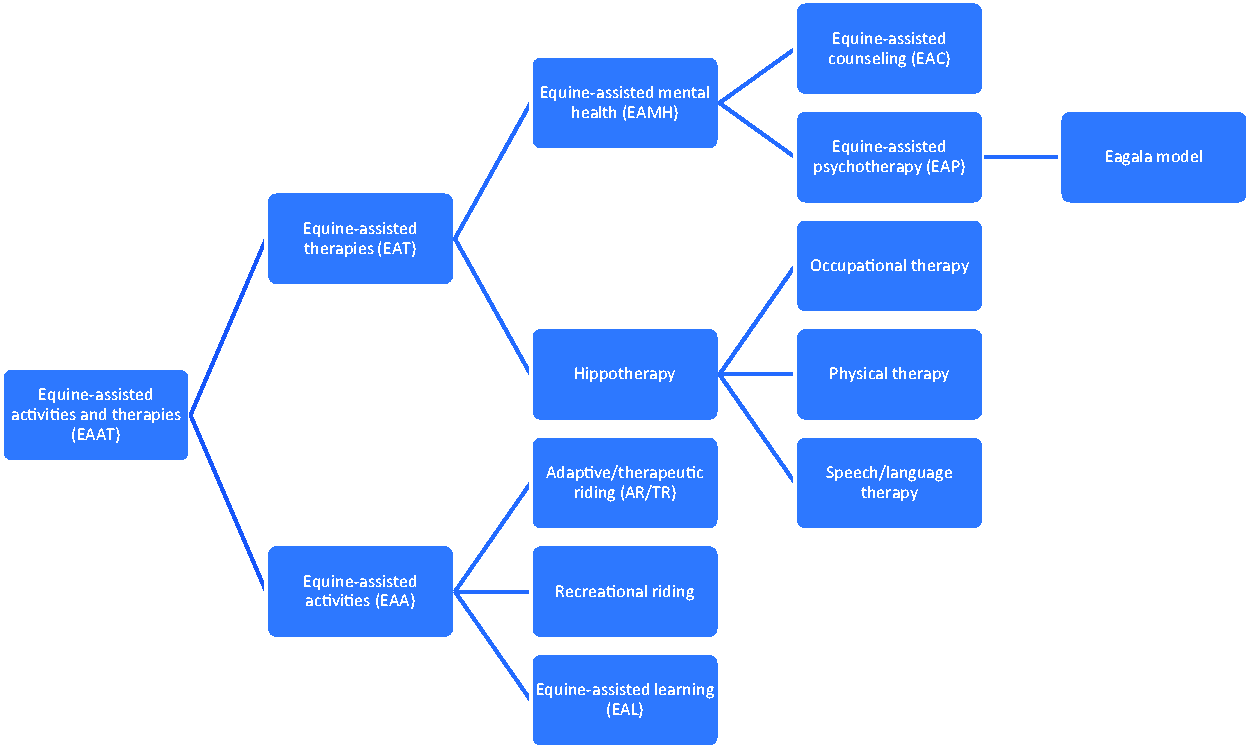
Example of a nomenclature for equine assisted activities and therapies based upon the work of Hallberg. 66
In this nomenclature, therapeutic riding (TR) is an equine- assisted activity that is geared towards learning riding and horsemanship while adapting to the rider’s special needs. 24 The American Hippotherapy Association website 69 states that, “the term hippotherapy refers to how occupational therapy, physical therapy and speech-language pathology professionals use evidence-based practice and clinical reasoning in the purposeful manipulation of equine movement as a therapy tool to engage sensory, neuromotor and cognitive systems to promote functional outcomes.” Hippotherapy generally focuses on using the movement of a horse to improve functioning in patients with a variety of conditions, including multiple sclerosis, stroke, spinal cord injury, traumatic brain injury, and cerebral palsy. 23 A number of studies and reviews beneficial effects of hippotherapy, for example,70–76 and a recent systematic review and meta-analysis 77 concluded that hippotherapy is a viable intervention option for patients with balance, gait, and psychomotor disorders.
This paper is focused on EAAT for PTSD, and the term used herein for this general category is equine-assisted mental health (EAMH). 66 Under this heading, two subcategories have been used. These are equine-assisted counseling (EAC) and equine-assisted psychotherapy (EAP). Although there is overlap between the two, counseling tends to be problem-oriented, short-term and skills-based whereas psychotherapy is frequently longer-term with a focus on behavior change, self-awareness, and symptom reduction. Furthermore, psychotherapy is often provided in the form of manualized, evidence-based interventions, such as cognitive behavioral therapy. There are currently no standardized definitions of either EAC or EAP within the EAAT field. However, a standardized definition is critical for research efforts and key elements of specific interventions need delineated in the classification system by way of specifiers. We propose that for EAMH, interventions aimed at problem-solving and skills attainment be specified as EAC and those that targeting symptom reduction be specified as EAP. Additional specifiers should indicate the specifics of the intervention, such as whether the equine interaction included groundwork, riding or both as well the frequency, duration, intensity, and intervention components.
A recent publication by Wood et al. 67 has proposed a standardized nomenclature that is significantly different than the terminology discussed above and illustrated in Figure 1. While this work is titled as consensus document written by experts in the field, the authors acknowledge that disagreement occurred during the consensus building process and that the article is a living document subject to modification.
The work by Wood et al. 67 is a major step forward for the field. However, it remains to be seen whether the recommendations will be adopted in full or in part. Further, if this schema is widely adopted, it could easily take several years for the entire field to make the shift in terminology and it is unclear to what extent the schema will be modified during adoption. Thus, it seems unlikely that the terminology issue will be resolved in the near future. Thus, for current and near-term future studies of EAP for Veterans with PTSD, the authors recommend a detailed description of the intervention such that it can be replicated regardless of the naming convention used and consideration of using the terminology outlined in Figure 1.
Mechanism of Action
Understanding why horses might contribute to a psychotherapeutic process for Veterans with PTSD is critical to move the field forward. It is particularly important to have theoretical models that can be tested in mechanism of action studies. There are several hypothetical mechanisms by which horse-human interactions may provide therapeutic benefit and some of which have been posited as leading to benefits specifically for Veterans.
Human-Horse Bond
The human-horse bond has been hypothesized to be one factor contributing to benefits associated with EAP. 66 Several investigators have hypothesized that formation of the human-horse bond contributed to benefits specifically for Veterans.60,63,65
The formation of this bond is thought to be possible because horses are herd animals. Herd animals must bond, communicate and cooperate with other members of the herd as well as be able to function within a hierarchical social organization. Horses and humans share many life-cycle processes and communal dynamics including friendship, courtship, rejection, reproduction and death. 24 As a result of and these similarities and domestication, horses are thought to perceive humans as herd members and therefore form durable horse-human bonds.
Formation of human-animal bonds is hypothesized to be the result of a number of mechanisms including those explained by attachment theory, biophilia as well as neurobiological mechanisms, such as the activation of the oxytocin system.78,79
Additional theoretical approaches have also been explored, such as, anthropomorphism, a focus on the experiential system instead of the verbal-symbolic system, implicit processes and intrinsic motivation, and distraction processes by Beetz. 78 Further research is needed to identify which of these theories provide the best explanation of the human-horse bond.
Many people find that human-horse bonding results in a comforting and affectionate relationship. A participant in a study by Lanning and Krenek 65 said, “When you’re with a horse, they give you kindness and compassion and love and they don’t expect anything.” Thus, the human-horse bond, even if of short duration, may provide a means of feeling positive emotions and experiencing a sense of connection to another living being. This may be especially important for individuals who have difficulty forming and maintaining human-to-human bonds.
Safe and Nonjudgmental Environment
In addition to positive emotions that humans may experience from being with horses, many find the relationship to be safe and nonjudgmental. This may allow EAP participants to verbally express thoughts to another sentient being that they would not be able to share with another human. Some investigators have hypothesized that the nonjudgmental environment was a mechanism of action specifically for Veterans.59,60
Experience of Control/Autonomy
Enhanced sense of being in control and autonomy has also been posited as a mechanism of benefit.63,65 Horse-human relationships often requires the human to take on a leadership role. 24 This can be challenging because the size of a horse can be intimidating and/or some humans find it difficult to be assertive. Anxiety during EAAT may also be triggered by unfamiliarity with horses. Working through these challenges as participants learn to work with the horses may lead to increased confidence and a sense of autonomy as well as enhancing leadership and self-control skills.
Horse as a Mirror or Metaphor
Horses are prey animals, unlike humans and canines, both of which are predators. Prey animals need to elude predators for survival. Thus, horses have evolved to become extremely sensitive to their environment in general and to other nearby animals, including humans. Horses will often provide feedback to other animals through various behaviors, including approach, avoidance and aggression. Horses are particularly sensitive to inconsistency, agitation and autonomic arousal, all of which could signal an imminent attack. 62 Thus, the equine response to human actions, emotions and body language may provide feedback which can facilitate enhanced human insight and self-awareness. Additionally, the Eagala model (https://www.eagala.org/index) of EAP and personal development is developed around the concept of horses serving as metaphors for participants engaged in an experiential learning process. Two Veteran specific studies have hypothesized mirroring as a contribution to benefit.25,60
Mindfulness
Two investigators have theorized that mindfulness may contribute to the therapeutic benefits for Veterans.59,60 Our group has shown that mindfulness training can be combined with nature exposure, via recreational sailing, resulting in preliminary evidence of benefit for Veterans. 80 We hypothesize that combining mindfulness training with equine exposure would achieve similar results.
Nature Exposure
EAAT also nests under the broad umbrella of nature-exposure and adventure-based interventions. There is developing literature supporting benefits of these approaches, but many unanswered questions remain. 81 Future studies of EAAT will need to differentiate the benefits of nature-exposure from other potential mechanisms of action.
Roadmap to Move the Field Forward
There are many challenges that must be overcome to disambiguate the factors that may contribute to benefits of EAP for Veterans as well as for the EAAT field in general. In part, this is because there may be several components underlying therapeutic benefit and the extent of the contribution of any one factor may differ from one person to another. One of the most fundamental questions that must be addressed is whether combining psychotherapy with equine exposure results in differing outcomes compared to equine exposure alone. It is possible that many of the potential mechanisms outlined above could occur without the addition of a psychotherapist. Thus, a critical next step is to conduct randomized studies of equine exposure alone compared to a control condition and/or three arm studies comparing equine exposure alone, equine exposure combined with psychotherapy and a control condition.
While there are several potential mechanisms by which EAP might provide therapeutic benefit for Veterans, the authors propose that the most important area for future investigations is the human-horse bond. Both psychometric and biometric should be utilized to explore this relationship. Regarding psychometrics, there are many instruments that have been designed to assess human-animal relationships. 82 However, to our knowledge, there are none designed specifically to investigate human-horse relationships. Many are designed for companion animal owners and not suitable for use in EAAT. There is a critical need to either adapt existing measures or develop and validate new measures that can be used to investigate the psychological mechanisms of human-horse relationships.
A promising area of research is in using biometrics to evaluate both the human and the horse. Some evidence from completed studies in community populations suggest that measurable physiological changes may be demonstrable by measuring oxytocin levels, electroencephalogram,45,83 heart rate variability84,85 and functional MRI.48,86
EAP Intervention Design and Research Methodology
Current State
In addition to a standardized nomenclature, there is a need for a framework for the development and evaluation of novel and existing EAPs, such that studies are comparable and replicable. A problem with the current state of the literature for all EAAT, as has been pointed out by others,23,66 is the significant variation in the interventions used between the various studies (Table 1).
A standardized nomenclature is one step towards more rigorous research, but in addition, studies must have high internal and external validity and be comparable and replicable to establish efficacy and effectiveness and ultimately to advance the field. Herein, we propose a model EAP intervention, which can be easily reproduced and used by investigators at multiple sites. This prototype is based on our investigations of mindfulness-based and nature exposure interventions for Veterans.80,81,87 Additionally, we propose utilization of research methods aimed to enhance both internal and external validity of future studies.
Roadmap to Move the Field Forward
To enhance internal validity and reproducibility, we propose a model EAP intervention based upon six, two-hour sessions of groundwork only combined with psychotherapy. This recommendation is based upon three studies reviewed herein, which reported benefits from durations ranging from one to seven days. It is possible that a longer duration of treatment might result in greater benefit, however, longer interventions are more challenging and costly to implement and may carry a greater risk of attrition. Groundwork only is proposed to limit the confounding variable of riding as well as the added complexity and risk of riding. If groundwork with psychotherapy is shown to be beneficial then future studies should investigate whether the intervention can be improved with the addition of mounted activities.
The psychotherapeutic approach to be used in EAP for Veterans studies needs to be standardized as well. The Eagala model has shown promise in three of the studies reviewed herein and is a well-established EAP and personal development intervention.55,58 Further evaluation of this intervention is warranted and using the format recommended above would facilitate standardization and replicability. Additionally, the authors recommend combining mindfulness training with equine exposure as another model EAP to be tested. This is based upon emerging evidence of benefits of mindfulness for Veterans and our previous work indicating the feasibility of combining mindfulness training with nature-based activities.80,87
As stated above, to move the field forward, large RCTs are needed and must include both explanatory and pragmatic trials. Regarding research methods for these investigations, it will be necessary to conduct studies with a reasonable balance of internal versus external validity. Internal validity refers to the degree of confidence that any symptom changes that participants experience are due to the intervention and not some confounding variable. External validity refers to the generalizability of results. It must be acknowledged that EAP studies will be conducted in riding stable environments, which will likely present challenges to maintaining high internal validity because of many potential confounding variables. Examples include differences between various stable environments, behavior and temperament of the equines and interactions between participants and staff. Given this challenging environment in which to conduct research, it will be important for investigators to eliminate as many extraneous factors that could impact outcomes as possible. Additionally, use of a control group with randomization as well as a large sample size can help mitigate the challenges to internal validity. Important study design considerations also include addressing other confounding variables, such as concurrent mental health treatment and psychiatric comorbidity. Ideally, there would be no simultaneous mental health treatment or at least no change in treatment, such as medication adjustments during the trial. Further, psychiatric comorbidities, such as depressive spectrum disorders and substance abuse should either be exclusion criteria or at least require symptoms to be in remission during the trial.
The various stable environments can also be a challenge to ecological validity, which is one form of external validity. For example, results from a study in a stable environment that is clean, quiet and surrounded by mountain scenery may not be generalizable to a real-world stable that is noisy, dusty and crowded with people and horses. There will also be threats to construct validity in EAP investigations because of the inability to conduct completely double-blind studies and the challenges of developing a control intervention. Without blinding, participants in the intervention group are likely to guess the hypothesis as well as researcher expectations and therefore alter responses in the direction of the desired outcome. Thus, while EAP studies will likely always have limitations due to both the nature of the intervention itself and the variable environment where it is provided, rigorous RCTs can be conducted. Strategies to enhance the validity and generalizability of results of open-label RCTs include the conduct of multi-center studies with large sample sizes and allocation concealment. As mentioned above, standardization and consistency of the psychotherapy component is also critical. Lastly, research reports must provide details of the intervention and research methodology such that comparisons to other studies can be made and so that clinicians can assess whether EAP may be beneficial to their patients.
Safety and Liability
Current State
Mitigating safety and liability risks of EAP with vulnerable populations is critical for the welfare of the humans, animals and organizations involved. There has been little discussion of potential adverse effects from EAAT in the literature, yet at least one case of serious injury has been reported. 88 “Inherent risk” has been associated with equines in courts of law due to their unpredictable nature. 89 Their natural prey and herd instincts combined with their large size presents can result in injuries to humans or other horses ranging from minor to fatal. 90
As safety is evaluated, it is imperative that we evaluate the affect that EAAT is having on the horses involved and their subsequent response. When horses are stressed several physiologic and behavior changes occur. Physiologic changes include increased cortisol levels as well as elevated heart and respiration rates. Behavior responses can include changes in gait, head height, distance from humans or other horses and ear orientation. Awareness and understanding of equine responses to stress facilitates safety while working with them in therapeutic activities. However, some studies suggest EAAT is not stressful for horses based upon measurements of equine cortisol levels56,91 and heart rate variability. 56 A study by Merkies and colleagues evaluated equine salivary cortisol levels, heart rate variability and behavior scores and concluded that horses do not differentiate between humans with or without PTSD. 92 This finding provides preliminary evidence that the presence of, at least one, human psychiatric illness may not add to equine stress. One study suggests that equine-assisted therapies produces neither a positive nor negative experience for the horses and is not any more stressful than recreational riding. 93 More must be done to understand if this holds true in all situations as well as whether the environment can be molded to a more positive experience for the horse. Finally, there is some evidence that emotional state may be transferred from humans to horses. 94 Further research is necessary to better understand the impact of EAAT on horses and what can be done to mitigate any negative impacts.
Roadmap to Move the Field Forward
To mitigate risks, equines should be specifically trained for EAP work. Horses must undergo rigorous evaluation processes by equine specialists prior to involvement in EAP and demonstrate appropriate, consistent, and safe behaviors. EAAT providers must have appropriate training and certifications and facilities must be routinely evaluated for safety risks. Research papers must document the equine training and evaluation process used as well as any adverse effects from participation for humans or horses. Additional investigations are needed to further explore the impact of EAP work on equines.
Conclusion
EAAT hold promise as adjunctive complementary interventions for Veterans with PTSD. Many gaps in the literature exist and rigorous RCT studies are needed before definitive conclusions can be drawn. However, the evidence is compelling enough to warrant those studies being done. The authors of this work provide research recommendations (Table 2) as a roadmap to move the field forward. These include standardizing the EAAT nomenclature, focusing mechanism of action studies on the human-horse bond using biological metrics and using a standardized intervention model across studies.
Footnotes
Declaration of Conflicting Interests
The author(s) declared no potential conflicts of interest with respect to the research, authorship, and/or publication of this article.
Funding
The author(s) disclosed receipt of the following financial support for the research, authorship, and/or publication of this article: This project was not funded by a research grant mechanism. However, this work was supported by the Veterans Healthcare Administration VISN 19 Whole Health Flagship site located at the Veterans Administration Salt Lake City Health Care System.
