




Abstract
Background
Personality traits, such as the character traits self-directedness and cooperativeness, might play a role in the risk of developing post-traumatic stress disorder (PTSD) after deployment to a combat zone. However, it is unclear whether these traits are preexisting risk factors or if event-related changes might also be associated with PTSD symptoms over time. Therefore, the current aim was to assess if military deployment is associated with changes in cooperativeness and self-directedness and to study how these traits are related to PTSD symptom trajectories.
Methods
In a large cohort of military personnel (N = 1007), measurements were performed before, at one and six months, and two and five years after deployment to Afghanistan. Linear mixed-effect models were used to assess the individual change in the traits over time and to study the relation with potential predictors.
Results
Cooperativeness was found to remain stable, whereas self-directedness was found to slightly decrease over time. This decrease was related to the development of PTSD symptoms over time. Furthermore, lower levels of self-directedness were associated with the symptomatic trajectories of PTSD symptoms. Lower levels of cooperativeness were only associated with the recovered PTSD trajectory.
Conclusions
So, not only do the findings confirm that lower levels of these character traits are associated with the development of PTSD symptoms, it was also shown that there are differences in the relation between these traits and the course of PTSD symptoms. Studying methods to promote the levels of these character traits might help to improve the resiliency of military personnel.
Introduction
Exposure to potentially traumatic combat-related stressors, such as enemy fire, during deployment to a war zone increases the risk of developing stress-related mental health problems, such as post-traumatic stress disorder (PTSD). About 6%–13% of Dutch military personnel develop a high level of PTSD symptoms in the five years after return from Afghanistan.1,2 Moreover, there is heterogeneity in the development of PTSD symptoms over time. A previous study in our group identified three trajectories with a different change from pre- to five years postdeployment: a resilient trajectory (low and stable level of PTSD symptoms); a recovered trajectory (an increase in PTSD symptoms shortly after deployment after which it decreases); and a delayed-onset trajectory (an increase in PTSD symptoms five years after deployment). 1 Personality traits are shown to play a role in the individual differences in PTSD symptom development. For instance, high levels of neuroticism and harm avoidance and low levels of conscientiousness and self-directedness are related to PTSD. 3 Also, elevated levels of self-criticism were found among war veterans with PTSD 4 and PTSD patients. 5 Moreover, a recent study found that negative emotionality and neuroticism predicted new-onset and chronic PTSD trajectories in National Guard Soldiers deployed to Iraq. 6 However, although personality traits might be important risk/resilience factors for PTSD, it is unclear if deployment to a combat zone has an impact on the development of personality traits as well.
Initially, personality traits were found to show little meaningful change past the age of 30.7,8 However, others have shown that personality continues to develop throughout adulthood and can also change as a result of life experiences.9–11 So, in addition to intrinsic maturation or genetic effects, social demands and life events may account for changes.11,12 For instance, the transition from school to university or work and a first relationship are found to have a positive influence on personality. 13 The psychobiological model of temperament and character14,15 postulates an interaction of genetics and environment. The model describes four temperament dimensions (novelty seeking, harm avoidance, reward dependence, and persistence), which manifest early in life, and three character dimensions: self-directedness, cooperativeness, and self-transcendence. These dimensions are expected to change with age toward psychological maturity due to increasing self-awareness and consequences of one’s actions. 14 Maturity is characterized by high self-directedness and high cooperativeness,14,16 which refers to the ability of individuals to regulate emotions and behavior to achieve their goals and values, and to be able to identify with and accept other people.14,17 This change toward maturity is in line with age-related increases in agreeableness and conscientiousness found in studies on the Big Five personality traits.8,18
The psychological maturation of character has an important role in reducing the vulnerability for psychopathology, the development of resilience to environmental adversity, and in coping with challenges.17,19 Low levels of harm avoidance and high levels of self-directedness and cooperativeness were found to be related to resilience from extreme trauma in Iranian refugees.20,21 Moreover, the development of self-directedness and cooperativeness is positively related to well-being.16,22 Self-directedness and cooperativeness have been proposed to form a general measure of mental health and adaptive skills, with low levels potentially reflecting mental health problems.14,22 Low levels have been found to be associated with many psychiatric disorders, such as schizophrenia, mood and anxiety disorders, 22 and also PTSD.3,23,24 Moreover, in military personnel, lower self-directedness prior to deployment predicted PTSD symptoms at six months after homecoming. 25 However, it is unclear if the traits only reflect preexisting vulnerability factors or whether event-related changes in these character traits also influence the development of PTSD symptoms over time.
So, high levels of self-directedness and cooperativeness might represent the resources to enable individuals to cope with stressful or traumatic events; however, little is known about the impact of a prolonged period of high-intensity stress on character traits over time. Although the effects are small, experiencing extreme adverse events is associated with changes in personality traits, for instance, increases in neuroticism and decreases in openness to experience and agreeableness.26,27 Moreover, military training was found to be associated with lower changes in agreeableness over time, a personality trait conceptually related to cooperativeness, compared to civilian community service, which persisted five years after training. 28 Yet, the development of self-directedness and cooperativeness with age is essential to improve resilience and reduce the vulnerability for psychopathology. Therefore, the aim of the current study was to investigate the potential change in self-directedness and cooperativeness from pre- to five years postdeployment. Additionally, the potential relation between the character traits and the trajectories of PTSD was assessed, in addition to demographic characteristics and general life events. Knowledge about the stability of these traits after deployment might provide valuable information for developing training or interventions aimed at self-directedness and cooperativeness to improve the resilience of military personnel.
Methods
Participants
Temperament and character were assessed as part of a large prospective longitudinal cohort study named Prospective Research in Stress-related Military Operations (PRISMO). The aim of this study is to examine potential biological and psychological factors that are associated with the development of stress-related (mental) health problems. The participants are military personnel who were deployed to Afghanistan between 2005 and 2008 for a period of approximately four months. They were deployed as part of the International Security Assistance Force of NATO with either the Provincial Reconstructions Teams or with the Task Force Uruzgan. At the first wave of the PRISMO study, 1032 military men (N = 939) and women (N = 93) volunteered to participate in the study. After excluding nondeployed individuals (N = 25), the data of 1007 participants were eligible for further analyses.
Procedures
Military personnel were approached to volunteer to participate in the PRISMO study after receiving a written and verbal description of the study at the army base and informed consent was obtained. Participants completed the questionnaires used in this part of the study approximately one month prior to deployment (T0), at one (T1) and six (T2) months postdeployment, and at two (T3) and five (T4) years after return from Afghanistan. Paper-and-pencil questionnaires were filled out at the army base for T0 to T2. At T3 questionnaires were filled out at home and returned by mail and at T4 Internet-based questionnaires were used. Participants received financial compensation (a voucher in the value of €100) for completing the assessments. This study was approved by the institutional review board of the University Medical Center Utrecht.
Measurements
Personality was assessed with the Dutch Short version of Temperament and Character Questionnaire (TCI-SF 29 ). The TCI-SF is based on the psychobiological theory of personality.14,15 The questionnaire contains 105 dichotomous items (0: False; 1: True). In the current study, we focused on two character scales previously shown to be important in the development of PTSD symptoms: self-directedness and cooperativeness.3,24,25 Self-directedness refers to self-determination and willpower or the ability of an individual to control, regulate, and adapt behavior to fit the situation in accord with individually chosen goals and values. Cooperativeness refers to identification with and acceptance of other people; being socially tolerant, empathic, and compassionate. Both subscales consist of 15 dichotomous items.
Exposure to deployment and combat-related stressors was measured with the Deployment Experiences Scale (DES 2 ) at one month postdeployment. This is a 19-item dichotomous checklist, which was specifically developed for this study. Potentially traumatic experiences during childhood (<18 years) were measured with the Dutch version of the Early Trauma Inventory–Self Report short form (ETI-SR-SF 30 ) prior to deployment. The questionnaire consists of 27 dichotomous items which represent the severity of traumatic events during childhood.
The level of symptoms of PTSD was measured using the Dutch Self-Rating Inventory for PTSD (SRIP 31 ). The SRIP contains 22 items, corresponding to the three symptom clusters according to diagnostic criteria for PTSD of the DSM-IV. 32 The scores on the items were summed for an indication of the severity. In a previous study, 1 latent growth mixture modeling was used to identify subpopulations that have a different change in PTSD symptoms over time after deployment. Three distinct trajectories of PTSD symptom development were identified, namely, a resilient trajectory (85%) reporting a low level of PTSD symptoms over the five years after deployment; a recovered trajectory (5%) reporting an increasing level of symptoms in the first year after deployment that then decreased; and a delayed-onset (9%) trajectory reporting a moderate level of symptoms that increased heavily at five years postdeployment. These trajectories were used in the analyses. For more information about the trajectories, we refer to Eekhout et al. 1
Various demographic characteristics were measured prior to deployment, namely, age, education, rank, relationship status, and previous deployments. Age was categorized in five-year age groups using the lowest category (<21 years) as reference in the analyses. Life events such as beginning and/or ending of a relationship, birth of children, marriage, moving in with partner, and new deployments were measured at five years postdeployment.
Statistical Analysis
All data analyses were performed in R 33 using the packages lavaan, 34 mice, 35 and lme4. 36
First, measurement invariance was assessed for the subscales self-directedness and cooperativeness. In models that study change in personality, it is important to assess if changes in the scores over time are due to real change in the construct, and not attributable to change in the relation between the indicators and the latent variables (Self-Directedness and Cooperativeness) over time. Measurement invariance of the subscales across time was assessed by means of confirmatory factor analyses for ordinal variables. 37 A series of nested models was examined, starting with the least restrictive model and compared to increasingly restrictive models. Model 1 includes no constraints for any of the parameter estimates. In model 2, factor loadings were constrained to be invariant (weak invariance), and in model 3, both factor loadings and intercepts (strong invariance) were constrained to be invariant over time. Little or no change in goodness of fit between the increasingly restrictive models suggests invariance of the structure across time. In this study, the comparative fit index (CFI) and the root mean square error of approximation (RMSEA) were compared. According to Chen, 38 a change larger than −.010 in CFI, supplemented by a change larger than .015 in RMSEA would indicate a violation of invariance.
After measurement invariance was confirmed, missing item scores were imputed with multivariate imputation by chained equations using predictive mean matching. 35 Based on missing values analysis and Little’s Missing Completely At Random test, the missing values in the data were assumed to be missing at random (see Supplemental material). All the variables used in the analyses were included in the imputation model. For the outcome measures, the missing and then deletion strategy of von Hippel 39 was applied. So, the outcome variables were included in the imputation but deleted prior to the data analyses, otherwise the variables would have been imputed as though they were not related to the outcome variable. 40 A total of 30 imputed data sets were generated.
Next, a series of linear mixed-effect models were fit to the data to assess the individual change in the subscale scores over time and the relationships between various predictors and the character scales. The outcome variables were the character scales, self-directedness and cooperativeness. As fixed effects, the endorsement of traumatic experiences during childhood and the experience of combat-related stressors were investigated. In addition, the relation with various demographic characteristics (age, gender, education, rank, relationship status prior to deployment, and previous deployments), potential life events in the period after deployment (beginning and/or ending of a relationship, birth of children, marriage, moving in with partner, and new deployments), and trajectories of PTSD development 1 was assessed. Lastly, relevant interactions between the variables (time and age with the ETI-SR-SF, DES, and PTSD trajectories) were included in the models. Time was coded as time in years relative to deployment (−0.083, 0.083, 0.5, 2, and 5). A random intercept was used to account for the variance between participants where time = 0; a random slope for time was also included in the model to account for the variance in slopes between participants. Visual inspection of the residual plots did not show deviations from homoscedasticity or normality. The results of the analyses were pooled according to Rubin’s rules. 41 Variables were entered hierarchically to identify relevant predictors for each of the outcome measures. These were examined using the Wald test, which pools the p values for comparing nested models using the method of Li et al. 42 The p values for the Wald tests were adjusted to correct for multiple testing with the correction as suggested by Benjamini and Hochberg 43 using the “p.adjust” function in R. 33 The final models with the relevant predictors are presented in the “Results” section. Effect sizes were calculated based on the χ 2 values used for the Wald tests with one degree of freedom.
Results
Demographic information and life events.

Note: PTSD: post-traumatic stress disorder; SD: standard deviation.
Count may not add up to 1007 participants due to missing values.
Descriptive statistics for cooperativeness and self-directedness over time.
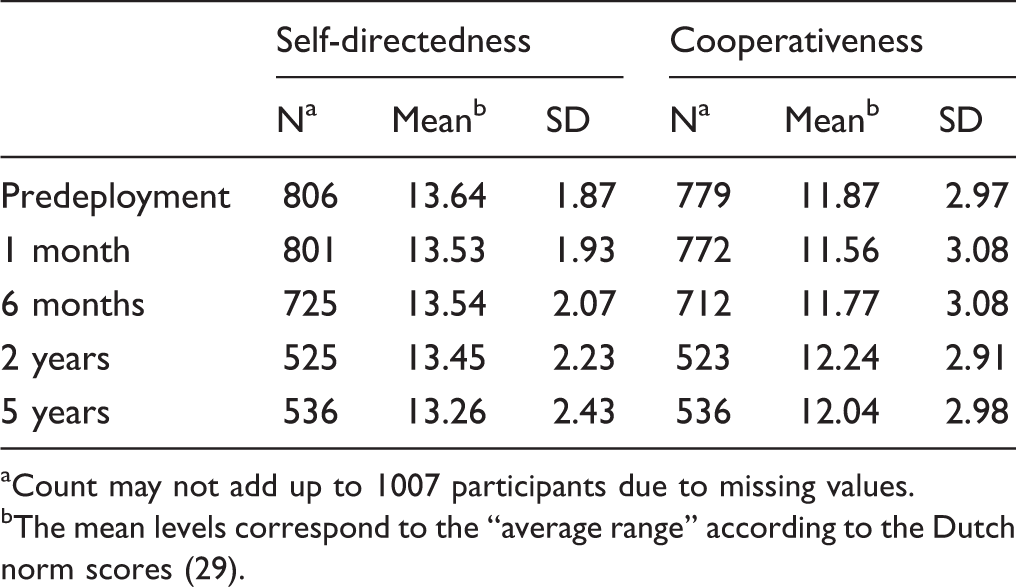
Count may not add up to 1007 participants due to missing values.
The mean levels correspond to the “average range” according to the Dutch norm scores (29).
The first step in the analyses was to establish measurement invariance for the character subscales over time. The results from the measurement invariance analysis are presented in the Supplemental material, Tables S1 and S2. The results indicate that strong invariance holds for both character subscales. In the model for cooperativeness, one item (item 73) was deleted from the analyses after inspection of the modification indices. As shown in Tables S1 and S2, the resulting models all showed acceptable CFI and RMSEA fit, and this suggests structural stability of the subscales self-directedness and cooperativeness across time.
Model estimates for self-directedness over time (N = 972).

Note: 95% CI: 95% confidence interval; PTSD: post-traumatic stress disorder.
Reference category is age <21 years.
Reference category is the resilient trajectory.

Development of self-directedness over time for the three PTSD trajectories.
Model estimates for cooperativeness over time (N = 963).

Note: 95% CI: 95% confidence interval; PTSD: post-traumatic stress disorder; NCO: noncommissioned officer.
Reference category is age <21 years.
Reference category is female.
Reference category is private.
Reference category is the resilient trajectory.

Development of cooperativeness over time for the three PTSD trajectories.
Discussion
Although serious adverse events might have an impact on the development of personality traits, the current findings show that the character trait cooperativeness is relatively stable over time after deployment to a combat zone. In contrast, a small decrease in self-directedness over time was found, which seemed to be associated with the development of PTSD symptoms. In addition, the baseline levels of these character traits were associated with various demographic characteristics: age, gender, and rank. In agreement with the literature,44,45 self-directedness and cooperativeness were negatively associated with the endorsement of early life trauma. Furthermore, as expected based on a previous study of our group, 25 lower self-directedness was related to the recovered and the delayed-onset PTSD trajectories. Moreover, a stronger decline in the level of self-directedness over time was found in these trajectories compared to the resilient PTSD trajectory. In contrast, lower cooperativeness was only associated with the recovered PTSD trajectory.
Our findings show that, after controlling for age, the level of cooperativeness does not change as a result of military deployment. Both the level of cooperativeness and self-directedness over time were not associated with experiencing combat-related stressors. In line with our findings, a recent Swedish study reported that personal values also remained relatively stable after participating in a six-month military deployment to Afghanistan. 46 In contrast, previous studies have shown that experiencing serious adverse life events is associated with increases in neuroticism and decreases in agreeableness and openness.26,27,47 They suggest that these changes were not rooted in preexposure personality but emerged as a result of exposure to trauma. In addition, other life events, such as a first relationship and the transition to college or work, were shown to be associated with decreases in neuroticism and increases in openness and agreeableness,13,48 yet the current findings show no association between the character traits and general life events. Moreover, neither previous nor new deployments were related to the character traits. Thus, this might suggest that deployment to a combat zone is not directly related to changes in character traits over a five-year time period.
An explanation for the stability of character after deployment might be that individuals with specific personality traits choose to join the military in the first place. As shown by Jackson et al., 28 the decision to enter the military was predicted by lower levels of agreeableness, neuroticism, and openness to experience. In line with this, Sundberg 46 suggests that the stability of values after deployment is a consequence of a well-fitting context, showing significant differences in several values between Swedish soldiers and a representative sample of male Swedes. These so-called selection effects 49 suggest that joining the military but also some of the life events a person experiences or endorses are a result of personality. For instance, higher levels of neuroticism predict endorsing a wider range of negative events, higher extraversion predicts more positive life events, and openness to experience predicts more events in general. 12 In contrast, research by North et al., 23 showed that low self-directedness and cooperativeness (and high self-transcendence and harm avoidance), were associated with PTSD after the Oklahoma City bombing. According to these authors, there was little to no link between personality and the likelihood of being at that location when the bomb was detonated. However, trauma exposure during military deployment is not necessarily a random occurrence, and certain traits might predispose to experiencing more trauma.
In addition to selection effects, personality change might be influenced by the pressure exerted on an individual to conform to the expectations of a group or society.19,49 Jackson et al. 28 reported an increase in agreeableness over time in military recruits; however, this change was smaller compared to individuals who chose civilian community service. This socialization effect 49 might explain the change in personality of military recruits. It is also possible that if an individual cannot conform to the expectations, it leads to dropping out of the military. However, in the current study, character was measured prior to deployment and after an extensive period of training. So, it might be speculated that military lifestyle and training mediate the association between personality and combat-related experiences; however, further research starting with multiple assessments prior to deployment is necessary to truly assess this association over time.
In line with the literature on the maturity principle,12,19,48 the level of cooperativeness and self-directedness increased over the different age categories. As described in the “Introduction” section, this is important to improve resilience, 19 since lower cooperativeness and self-directedness is typically associated with different psychopathologies. 22 More specifically, lower levels of the traits are reported in PTSD patients compared to healthy controls.20,24 Our findings confirm that lower levels of cooperativeness at baseline are associated with the development of PTSD symptoms in the first year after deployment. However, participants in the delayed-onset PTSD trajectory showed similar levels of cooperativeness as the resilient PTSD trajectory. Higher cooperativeness refers to being socially tolerant, empathic, and compassionate and is related to greater perceived social support compared to low cooperativeness. 22 Since postdeployment social support might reduce the severity of traumatic stress, 50 this support might initially enable these individuals to cope with their experiences, emotions, and behavior. Further research should examine how the preexisting personality profiles are associated with the course of PTSD symptom development.
For self-directedness, lower levels were observed for both the recovered and delayed-onset trajectory compared to the resilient trajectory. As was previously reported by van Zuiden et al., 25 low predeployment self-directedness predicted a high level of PTSD symptoms at six months postdeployment. However, whereas self-directedness was relatively stable over time in the resilient participants, an increase in PTSD symptoms over time was associated with a decline in self-directedness over time. Low self-directedness refers to difficulty in self-regulating emotions and adapting behavior to fit a situation, lack of long-term goals and determination, and low self-esteem, 14 which is often seen in PTSD patients. It is unclear what the causal relation between self-directedness and the development of PTSD symptoms is. However, from the current study, we can conclude that self-directedness is more stable in participants that were resilient for the development of PTSD symptoms over time.
An important strength of the current study is that personality was assessed in a large sample over time starting prior to deployment to Afghanistan and included multiple follow-up assessments. Furthermore, measurement invariance was assessed for the subscales cooperativeness and self-directedness, and strong invariance was given. However, there are some limitations that need to be taken into consideration. As previously discussed, individuals with specific personality traits enter the military and this might limit generalizability to populations outside the military. The generalizability is further limited due to the underrepresentation of female soldiers. However, this is a frequent limitation in military studies because of the low percentage of females in the military. In addition, in this study, there is no nondeployed or civilian control group to assess differences in character trait development over time. To account for confounding influences of unobserved factors on personality change, it would be valuable to include an age-matched control group in future research.
Conclusion
Although deployment to a combat zone increases the risk of experiencing potentially traumatic events and developing stress-related disorders, it is clear the character trait cooperativeness remained relatively stable after deployment. Although the findings confirmed that low levels of the traits are related to the development of PTSD symptoms, it was also shown that there are differences in the relation between the traits and the course of PTSD symptoms over time. This underlines the importance of examining personality traits in an earlier phase to be able to assess stability or changes due to training and to identify personality profiles with an increased risk for PTSD. The finding that the character traits are relatively stable and are not directly influenced by deployment might provide opportunities to assess and develop methods to promote the development of traits, such as self-directedness and cooperativeness, prior to deployment and increase the resilience and well-being of military personnel.
Supplemental Material
Supplemental material for Development of Self-Directedness and Cooperativeness in Relation to Post-Traumatic Stress Disorder Symptom Trajectories After Military Deployment
Supplemental material for Development of Self-Directedness and Cooperativeness in Relation to Post-Traumatic Stress Disorder Symptom Trajectories After Military Deployment by Alieke Reijnen, Elbert Geuze, Rosalie Gorter and Eric Vermetten in Chronic Stress
Footnotes
Acknowledgments
The authors thank the Dutch commanders and troops and all the members of the PRISMO team involved in data acquisition for their time and effort. The authors would also like to thank Prof. Joëls for her valuable comments and suggestions.
Declaration of Conflicting Interests
The author(s) declared no potential conflicts of interest with respect to the research, authorship, and/or publication of this article.
Funding
The author(s) disclosed receipt of the following financial support for the research, authorship, and/or publication of this article: This study was financially supported by the Dutch Ministry of Defence.
Supplemental Material
Supplemental material for this article is available online.
References
Supplementary Material
Please find the following supplemental material available below.
For Open Access articles published under a Creative Commons License, all supplemental material carries the same license as the article it is associated with.
For non-Open Access articles published, all supplemental material carries a non-exclusive license, and permission requests for re-use of supplemental material or any part of supplemental material shall be sent directly to the copyright owner as specified in the copyright notice associated with the article.
